Sharif University of Technology
Scientia IranicaTransactions E: Industrial Engineering www.scientiairanica.com
Interval-valued trapezoidal intuitionistic fuzzy
generalized aggregation operators and application to
multi-attribute group decision making
J.-Y. Dong
a,band S.-P. Wan
c;a. College of Information Technology, Jiangxi University of Finance and Economics, Nanchang, 330013, China. b. Research Center of Applied Statistics, Jiangxi University of Finance and Economics, Nanchang 330013, China. c. College of Statistics, Jiangxi University of Finance and Economics, Nanchang, 330013, China.
Received 29 April 2014; received in revised form 10 August 2014; accepted 10 March 2015
KEYWORDS Multi-attribute group decision making; Interval-valued trapezoidal intuitionistic fuzzy number;
Generalized
aggregation operator; Barycenter.
Abstract. An Interval-Valued Trapezoidal Intuitionistic Fuzzy Number (IVTrIFN) is a special case of an Intuitionistic Fuzzy Set (IFS), which is dened on a real number set. From a geometric viewpoint, the expectation and expectant score of an IVTrIFN are dened using the notion of a barycenter, and a new method is developed to rank IVTrIFNs. Hereby, some generalized aggregation operators of IVTrIFNs are dened, including the generalized ordered weighted averaging operator and the generalized hybrid weighted averaging operator, which are employed to solve multi-attribute group decision making problems. Using the weighted average operator of IVTrIFNs, the attribute values of alternatives are integrated into the individual comprehensive ratings, which are further aggregated into the collective one by the generalized hybrid weighted averaging operator of IVTrIFNs. The ranking orders of alternatives are then generated according to the expectation and expectant score of the collective comprehensive ratings of alternatives. A numerical example is examined to demonstrate the applicability and implementation process of the decision method proposed in this paper.
© 2015 Sharif University of Technology. All rights reserved.
1. Introduction
Atanassov [1] introduced the Intuitionistic Fuzzy Set (IFS), which is a generalization of the fuzzy set [2]. The IFS has received considerable attention since its appearance. Gau and Buehrer [3] proposed the notion of vague set, which is identied with that of IFS, as pointed out by Bustince and Burillo [4]. Atanassov and Gargov [5] further generalized the IFS in the spirit of the ordinary Interval-Valued Fuzzy Set (IVFS), and dened the notion of an Interval-Valued Intuitionistic Fuzzy Set (IVIFS). There is much research regarding IFS and IVIFS in the applications of Multi-Attribute
*. Corresponding author. Tel.: +86 0791 13870620534 E-mail address: [email protected] (S.-P. Wan)
Decision Making (MADM) [6-10] and Multi-Attribute Group Decision Making (MAGDM) [11-19].
Fuzzy numbers are a special case of fuzzy sets. As a generalization of fuzzy numbers [20], an Intuitionistic Fuzzy Number (IFN) seems to suitably describe an ill-known quantity [21-34]. Shu et al. [22] dened the concept of a Triangular IFN (TIFN) in a similar way to that of the fuzzy number [20] and developed an algorithm for intuitionistic fuzzy fault tree analysis. Li [21] pointed out and corrected some errors in the denition of the four arithmetic operations over the TIFNs in [22]. Li [23] discussed the concept of the TIFN and ranking method on the basis of the concept of a ratio of the value index to the ambiguity index, as well as applications to MADM problems in depth. Li et al. [24] proposed a value and ambiguity
based method to rank TIFNs and applied it to solve MADM problems, in which the ratings of alternatives on attributes are expressed using TIFNs. Nan et al. [25] dened the ranking order relations of TIFNs and investigated the matrix games with payos of TIFNs. Chen and Li [26] constructed a dynamic MADM model based on TIFNs. Wan et al. [27] introduced the possibility mean, variance and covariance of TIFNs. Subsequently, Wan and Li [28] developed a possibility mean and variance based method for MADM with TIFNs. Further, Wan [29] proposed the possibility variance coecient method for MADM with TIFNs. Wan et al. [30] extended the classical VIKOR method for solving MAGDM with TIFNs. Wang et al. [31] proposed new arithmetic operations and logic operators for TIFNs and applied them to fault analysis of a printed circuit board assembly system. Dong and Wan [32] investigated a new method for MAGDM with TIFNs. Wan and Dong [33] dened Choquet integral operator of TIFNs and applied to MADM with TIFNs. Wan and Dong [34] proposed the possibility method for MAGDM with TIFNs and incomplete weight information.
In a similar way to TIFNs, Wang [35] dened the Trapezoidal IFN (TrIFN) and Interval-Valued Trape-zoidal IFN (IVTrIFN). Both TrIFN and IVTrIFN are extensions of TIFNs. Wang and Zhang [36] investi-gated the weighted arithmetic averaging operator and weighted geometric averaging operator on TrIFNs and their applications to MADM problems. Wei [37] in-vestigated some arithmetic aggregation operators with TrIFNs and their applications to MAGDM problems. Du and Liu [38] extended the fuzzy VIKOR method with TrIFNs. Wu and Cao [39] developed some fam-ilies of geometric aggregation operators with TrIFNs and applied them to MAGDM problems. Wan and Dong [40] dened the expectation and expectant score, ordered weighted aggregation operator and hybrid aggregation operator for TrIFNs and employed them for MAGDM. Ye [41] developed the expected value method for intuitionistic trapezoidal fuzzy multicrite-ria decision-making problems. Ye [42] proposed the MAGDM method using vector similarity measures for TrIFNs. Wan [43] developed four kinds of power av-erage operator of TrIFNs, involving the power avav-erage operator, weighted power average operator of, power order weighted average operator of, and power hybrid average operator of TrIFNs. Wan [44] rstly dened some operational laws and the weighted arithmetical average operator of IVTrIFNs. Based on the score function and accurate function, an approach is pre-sented to rank IVTrIFNs. The MAGDM method using IVTrIFNs is then proposed. Wan [45] constructed non-linear fractional programming models to estimate the alternative's relative closeness. After transformation into linear programming models, the interval of the
alternative's relative closeness is obtained through solving these linear programming models. Then, the fractional programming method is proposed for the MADM with IVTrIFNs. Wu and Liu [46] dened some interval-valued trapezoidal intuitionistic fuzzy geometric aggregation operators and applied to them MAGDM with IVTrIFNs. Wei et al. [47] dened the interval trapezoidal intuitionistic fuzzy ordered weighted geometric operator and the interval trape-zoidal intuitionistic fuzzy hybrid geometric operator. An approach based on these operators is developed to solve the MAGDM problems with IVTrIFNs.
It is worthwhile to mention that the domains of the IFS and IVIFS are discrete sets, which are also the same as fuzzy sets. TIFN, TrIFN and IVTrIFN extend the domain of IFS from the discrete set to the continuous set. They are the extensions of fuzzy numbers [36]. Compared with the IFS, both TrIFN and IVTrIFN are dened by using trapezoidal fuzzy num-bers expressing their memnum-bership and non-memnum-bership functions. Hence, TrIFN and IVTrIFN may better reect the information of decision problems than IFS. Some practical decision problems generally involve multiple attributes with dierent physical dimensions and units, such as risk investment and performance evaluation of military systems, as well as partner selection of supply chain management. For example, during the process of evaluating the supplier quality of the product, Decision Makers (DMs) have some hesitancy or lack of knowledge, due to the knowledge structure and specialty, as well as the complexity of the evaluation object. The evaluation results often present three aspects: armation, negation, and hesitancy, between the armation and negation. Thus, DMs may give an evaluation in the format of IVTrIFN ([1-4]; [0.6,0.8], [0.1,0.2]), which means that the most possible value is [2,3], and the lower and upper limits are 1 and 4, respectively. Meanwhile, the maximum membership degree for the most possible value [2,3] is between 0.6 and 0.8, the minimum non-membership degree for the most possible value [2,3] is between 0.1 and 0.2, and the indeterminacy is between 0 and 0.3. An IVTrIFN, described using three characteristic functions: membership degree, non-membership degree and hesitancy degree, is just a strong instrument to represent the information of these three aspects. The ability of an IVTrIFN to capture vagueness and uncer-tainty is stronger than that of the TIFN and TrIFN. The IVTrIFN can subtly and eectively describe the decision information with dierent dimensions and units. Therefore, IVTrIFNs are of great importance in scientic research and real life applications. Although Wan [44], Wu and Liu [46], and Wei et al. [47] investigated some arithmetic aggregation operators and geometric aggregation operators for IVTrIFNs, there exists no investigation about the generalized
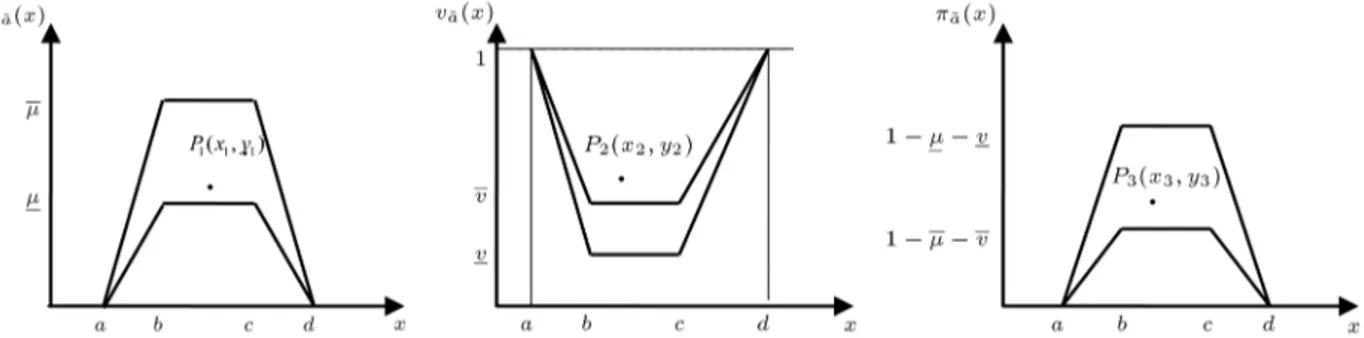
aggrega-Figure 1. Membership function, non-membership function and hesitancy function for IVTrIFN.
tion operators for IVTrIFNs. The aim of this paper is to study the expectation and expectant score and new ranking method for IVTrIFNs from the geometry point of view, and develop some generalized aggregation operator of IVTrIFNs, as well as their application to MAGDM problems. The main contributions of this paper are as follows:
(i) A new ranking method for IVTrIFNs is developed from a geometric viewpoint, which is very intu-itive, simple and eective;
(ii) The generalized ordered weighted average oper-ator for IVTrIFNs and the generalized hybrid weighted averaging operator of IVTrIFNs are investigated and the desirable properties are dis-cussed. These operators are helpful extensions of the intuitionistic fuzzy aggregation operators;
(iii) The MAGDM method proposed in this paper enriches the research content and decision ap-proaches for MAGDM in intuitionistic fuzzy en-vironments.
This paper is structured as follows. Section 2 in-troduces the denition and operation laws of IVTrIFNs and presents their new ranking method. Section 3 develops some generalized aggregation operators over IVTrIFNs. Section 4 gives the problem description of MAGDM with IVTrIFNs and proposes the corre-sponding group decision making method. A numerical example and comparison analysis are given in Section 5. Concluding remarks are given in Section 6.
2. Interval-valued trapezoidal intuitionistic fuzzy numbers and barycenter based ranking method
In this section, the denition, operation laws and properties for IVTrIFNs are reviewed. Then, a ranking method of IVTrIFNs is proposed based on barycenter. 2.1. Operation laws and properties for
IVTrIFNs
Denition 1 [35]. Let ~a be an IFN in the set of real numbers whose membership function and non-membership function are dened as:
~a=
8 > > > > > < > > > > > :
x a
b a; if a x < b
; if b x c
d x
d c; if c < x d
0; else and:
v~a(x) =
8 > > > > > < > > > > > :
b x+(x a)v
b a ; if a x < b
v; if b x c
x c+(d x)v
d c ; if c < x b
1; else
respectively (see Figure 1), where a, b, c, and d are all real numbers, = [; ] and v = [v; v] are intervals, which represent the maximum membership degree interval and the minimum non-membership degree interval, respectively, such that they satisfy the following conditions:
0 1; 0 1; 0 v 1; 0 v 1 and + v 1:
Then, the IFN ~a is called IVTrIFN, denoted by ~a = [a; b; c; d]; [; ]; [v; v]. Let the function ~a(x) = 1
~a(x) v~a(x) denote the hesitation of ~a. The smaller
~a(x), the more certain ~a.
If a 0 and one of the four values, a, b, c and d, is not equal to 0, then the IVTrIFN, ~a, is called a positive IVTrIFN, denoted by ~a > 0. Likewise, if d 0 and one of the four values, a, b, c and d, is not equal to 0, then the IVTrIFN, ~a, is called a negative IVTrIFN, denoted by ~a < 0. If = and v = v, then, the IVTrIFN, ~a, is called the TrIFN. When b = c, a TrIFN reduces to a TIFN. Therefore, both TrIFN and TIFN are special cases of the IVTrIFN.
For example, there is an IVTrIFN ~6 =([4; 5; 7; 8]; [0:5; 0:7], [0:1; 0:2]). Then, when x = 5, its membership degree being an IVTrIFN ~6 is [0.5, 0.7], its non-membership degree not being an IVTrIFN ~6 is [0:1; 0:2], and its hesitation being or not being an IVTrIFN ~6 is [0:1; 0:4].
Denition 2 [44]. Let:
~a1=
[a1; b1; c1; d1]; [1; 1]; [v1; v1]
;
and: ~a2=
[a2; b2; c2; d2]; [2; 2]; [v2; v2]
;
be two IVTrIFNs and 0. Then the operation laws for IVTrIFNs are dened as follows:
1. ~a1+ ~a2 =
[a1+ a2; b1+ b2; c1+ c2; d1+ d2]; [1
+2 12 12; 1+ 2 12]; [v1v2; v1v2]
;
2. ~a1:~a2 =
[a1a2; b1b2; c1c2; d1d2]; [12; 12]; [v1
+v2 v1v2; v1+v2 v1v2]
, where ~a1> 0, ~a2> 0;
3. ~a1 =
[a1; b1; c1; d1]; [1 (1 1); 1 (1
1)]; [v 1; v1]
;
4. ~a 1 =
[a
1; b1; c1; d1]; [1; 1]; [1 (1 v1); 1 (1
v1)]
, where ~a1> 0.
From Denition 2, the following properties are proven:
1. ~a1+ ~a2= ~a2+ ~a1;
~a1:~a2= ~a2:~a1;
2. (~a1+ ~a2) = ~a1+ ~a2,
1~a1+ 2~a1= (1+ 2)~a1,
~a1
1 :~a12= ~a11+2, where ; 1; 2 0; 3. (~a
1)k = ~ak1 , where ~a1> 0 and ; k 0.
2.2. A new ranking method of IVTrIFNs based on barycenter
Since the three characteristic functions of IVTrIFNs are all piecewise continuous, their function images are the plain regions, as depicted in Figure 1. We view them as sheets with uniform density and calculate their barycentric coordinates. For the MAGDM in intuitionistic fuzzy environments, the ranking of in-tuitionistic fuzzy numbers plays an important role. In order to compare the IVTrIFNs, it is necessary to develop a method to rank the IVTrIFNs. Mo-tivated by the score and accuracy functions of IFS [48], we dene the expectation and expectant score of IVTrIFNs and thereby propose a new ranking method of IVTrIFNs.
Denition 3. Let P1(x1; y1), P2(x2; y2) and P3(x3,
y3) be the barycentric coordinates of the images of
membership, non-membership and hesitation functions for an IVTrIFN, ~a = [a; b; c; d]; [; ]; [v; v], respec-tively. Then, the expectation of ~a is dened as follows: E(~a) = x1y1+ x2y2+ x3y3: (1)
The expectant score of ~a is dened as follows:
S(~a) = E(~a)y1(2 y1 y2): (2)
As the three characteristic functions of an IVTrIFN are equal in characterizing the IVTrIFN, the total mass of the sheet focuses on the barycenter. If the three characteristic functions of the IVTrIFN are regarded as the three states of a discrete random variable in probabilistic theory, then, the horizontal and vertical coordinates of each barycenter represent, respectively, the value (or state value) and its membership (or cor-responding state probability) of the IVTrIFN. Eq. (1) denes the expectation of the IVTrIFN by summing the products of horizontal and vertical coordinates of each barycenter, which is similar to the mathematical expectation of a discrete random variable. So, the expectation dened by Eq. (1) reects accurately the value distribution of the IVTrIFN and its geometrical meaning is very clear.
Eq. (2) may be interpreted by a vote model as follows. The values, ~a(x), v~a(x) and ~a(x), can be
interpreted as proportions of the armation, dissension and abstention in a vote, respectively. By considering the possibility that in the abstention group some people tend to cast armative votes, others are dissenters and still others tend to abstain from voting, we can divide the abstention proportion, ~a(x), into three
parts: ~a(x)~a(x), v~a(x)~a(x) and ~a(x)~a(x), which
express the proportions of the armation, dissension and abstention in the original part of abstention. Thus, the total armative proportion is ~a(x)+~a(x)~a(x) =
~a(x)[2 ~a(x) v~a(x)]. As aforementioned, the
vertical coordinates, y1and y2, of membership function
~a(x) and non-membership function v~a(x) represent,
respectively, the corresponding state probabilities of the IVTrIFN. Then, we can use y1 to replace ~a(x),
and y2 to replace v~a(x). So, ~a(x)[2 ~a(x)
v~a(x)] = y1(2 y1 y2). We use y1(2 y1 y2) in
Eq. (2) to characterize the score function under the situation without considering domain [a; b; c; d], where y1 and y2 correspond to ~a(x) and v~a(x), respectively.
Consequently, the expectant score dened by Eq. (2) considers both the score function and the domain [a; b; c; d] of the IVTrIFN and is more reasonable and comprehensive.
Remark 1. Using calculous, the barycentric coor-dinates are easily obtained. We take the image of
the membership function ~a(x) (see Figure 1) as an
example to illustrate the computing process. The area of the sheet is:
M = Z b
a
x a b adx +
Z c
b dx +
Z d
c
d x d cdx Z b
a
x a b adx +
Z c
b dx
+ Z d
c
d x d cdx
=12( a b + c + d)( ):
The static moment to the x-axis is:
Mx=12
Z b
a
x a b a
2
dx + Z c
b
2dx
+ Z d
c
d x d c
2
dx Z b
a
x a b a
2
dx
+ Z c
b
2dx +Z d c
d x d c
2
dx
=12( a 2b + 2c + d)(2 2):
The static moment to the y-axis is:
My=
Z b a x
x a b a
dx +
Z c
b xdx
+ Z d
c x
d x d c
dx
Z b
a x
x a b a
dx
+ Z c
b xdx +
Z d
c x
d x d c
dx
= 12( a2 ab b2+ c2+ d2+ dc)( ):
Hence, the horizontal and vertical coordinates of the barycenter P1(x1; y1) are obtained as:
x1= MMy = a
2 ab b2+ c2+ d2+ dc
3( a b + c + d) ; and:
y1=MMx = ( a 2b + 2c + d)( + )3( a b + c + d) ;
respectively.
In a similar way, the coordinates of barycenters, P2(x2; y2) and P3(x3; y3), for the non-membership and
hesitation functions, can be obtained as follows:
x2= a
2 ab b2+ c2+ d2+ dc
3( a b + c + d) ;
y2=( a b+ c+ d)(c b)(v + v) +( a+ b c+ d)(1+ v+ v)3( a b+ c+ d) ;
x3= a
2 ab b2+ c2+ d2+ dc
3( a b + c + d) ;
y3= 1 3( a b + c + d)( + v v)L ;
where:
L =( a + b c + d)(2v 2v + v2 v2+
+ v v) + 3(c b)(2v 2v + v2 v2)
+ ( a 2b + 2c + d)(2 2):
Let ~a1 and ~a2 be two IVTrIFNs. According to the
concepts of the expectation and expectant score, a ranking method can be summarized as follows:
- If E(~a1) > E(~a2), then ~a1is bigger than ~a2, denoted
by ~a1> ~a2;
- If E(~a1) < E(~a2), then ~a1is smaller than ~a2, denoted
by ~a1< ~a2;
- If E(~a1) = E(~a2), then
(i) if S(~a1) > S(~a2), then ~a1> ~a2;
(ii) if S(~a1) = S(~a2), then ~a1 and ~a2 represent the
same information, denoted by ~a1= ~a2; (iii) if S(~a1) < S(~a2), then ~a1< ~a2.
Example. Let ~a1=([4; 5; 7; 8]; [0:5; 0:7], [0:1; 0:2])
and ~a2 =([3; 4; 6; 7]; [0:6; 0:8], [0:0; 0:1]) be
two IVTrIFNs. Using the above formulas, we can get their barycentric coordinates for the images of membership, non-membership and hesitancy functions as follows: P11(6:0; 0:53), P12(6:0; 0:24), P13(6:0; 0:22),
P21(5:0; 0:47), P22(5:0; 0:16) and P23(5:0; 0:22),
respec-tively. By Eqs. (1) and (2), we have E(~a1) = 6:0,
E(~a2) = 4:22, S(~a1) = 3:91 and S(~a2) = 2:71. Since
E(~a1) > E~a2, we get ~a1> ~a2.
3. Some generalized aggregation operators for IVTrIFNs
In a group decision, dierent DM play dierent roles. To emphasize the individual inuence on the deci-sion results, some generalized aggregation operators of IVTrIFNs are developed on the basis of Denition 2 and the ranking method in Subsection 2.2, in this section. For convenience, let I be the set of all IVTrIFNs.
Denition 4 [44]. Assume that ~aj (j = 1; 2; :::; n) is
a collection of the IVTrIFNs. Let IVTrIFWA: In! I.
If:
IVTrIFWA (~a1; ~a2; :::; ~an) = n
X
j=1
wj~aj; (3)
where w = (w1; w2; :::; wn)T is the weight vector of
~aj (j = 1; 2; :::; n), satisfying that 0 wj 1
(j = 1; 2; :::; n) and Pnj=1wj = 1, then, the
func-tion, IVTrIFWA, is called the n-dimensional weighted averaging operator of the IVTrIFNs. Especially, if wj= 1=n (j = 1; 2; :::; n), then the IVTrIFWA operator
is reduced to the arithmetic averaging operator of the IVTrIFNs.
Theorem 1 [44]. Let ~aj(j = 1; 2; :::; n) be a
collec-tion of IVTrIFNs, then, their aggregated value, using the IVTrIFWA operator, is also an IVTrIFN, and:
IVTrIFWA (~a1; ~a2; :::; ~an) =
Xn
j=1
wjaj; n
X
j=1
wjbj;
n
X
j=1
wjcj; n
X
j=1
wjdj
;
1 n
j=1(1 j)wj;
1 n
j=1(1 j)wj
;
n
j=1(vj)wj;
n
j=1(vj)wj
: (4)
Denition 5. Assume that ~aj (j = 1; 2; :::; n) is a
collection of IVTrIFNs. Let IVTrIFOWA: In! I. If:
IVTrIFOWA (~a1; ~a2; :::; ~an) = n
X
j=1
!j~a(j); (5)
where ! = (!1; !2; :::; !n)T is the weight vector
as-sociated with IVTrIFOWA, satisfying that 0 !j
1 (j = 1; 2; :::; n) and Pnj=1!j = 1, ~a(j) is the
jth largest IVTrIFN of ~aj (j = 1; 2; :::; n), then,
the function IVTrIFOWA is called the n-dimensional ordered weighted average operator of the IVTrIFNs. Especially, if !j = 1=n (j = 1; 2; :::; n), then the
IVTrIFOWA operator is reduced to the arithmetic averaging operator of the IVTrIFNs.
Theorem 2. Let ~aj (j = 1; 2; :::; n) be a
collec-tion of IVTrIFNs, ~a(j) = a(j); b(j); c(j); d(j);
h
(j); (j)i; hv(j); v(j)
i
. Then, their aggregated value, using the IVTrIFOWA operator, is also an IVTrIFN, and:
IVTrIFOWA (~a1; ~a2; :::; ~an) =
Xn
j=1
!ja(j);
n
X
j=1
!jb(j); n
X
j=1
!jc(j); n
X
j=1
!jd(j)
;
1 n
j=1(1 (j))!j; 1 nj=1
(1 (j))!j;
n
j=1(v(j))!j;
n
j=1(v(j))!j
: (6)
Denition 6. Assume that ~aj (j = 1; 2; :::; n) is a
collection of IVTrIFNs. Let IVTrIFGOWA: In ! I.
If:
IVTrIFGOWA (~a1; ~a2; :::; ~an)=
0 @Xn
j=1
!j(~a(j))
1 A
1=
; (7) where ! = (!1; !2; :::; !n)T is the weight vector
associ-ated with IVTrIFGOWA, satisfying that 0 !j 1
(j = 1; 2; :::; n) and Pnj=1!j = 1, ~a(j) is the jth
largest IVTrIFN of ~aj (j = 1; 2; :::; n), 2 [0; +1) is a
parameter, then, function IVTrIFGOWA is called the n-dimensional generalized ordered weighted averaging operator of the IVTrIFNs.
Theorem 3. Let ~aj (j = 1; 2; :::; n) be a
collec-tion of IVTrIFNs, ~a(j) = a(j)b(j); c(j); d(j);
(j); (j), v(j); v(j). Then, their aggregated
value, using the IVTrIFGOWA operator, is also an IVTrIFN, and:
IVTrIFGOWA (~a1; ~a2; :::; ~an)=
Xn
j=1
!ja(j)
1= ;
Xn
j=1
!jb(j)
1= ;
Xn
j=1
!jc(j)
1= ;
Xn
j=1
!jd(j)
1=
; 1 n j=1
(1 (j))!j
1=; 1 n j=1
(1 (j))!j
1=;1 1 n j=1(1
n
j=1(1 (1 v(j)))!j1=: (8)
According to Denitions 2 and 4, proofs of Theorems 2 and 3 can be easily completed by using the mathemat-ical induction on n.
The weight vector, ! = (!1; !2; :::; !n)T,
as-sociated with IVTrIFOWA (or IVTrIFGOWA), can be obtained by the fuzzy linguistic quantier [49] as follows:
!i= Q
i n
Q
i 1
n
(i = 1; 2; :::; n); (9)
where Q is the fuzzy linguistic quantier and:
Q(t) = 8 > > > < > > > :
0; t < (t )=( ); t <
1; t
with ; t; 2 [0; 1]. For the criteria \at least half", \most", and \as many as possible", the parameter pair (; ) takes the values (0,0.5), (0.3,0.8), and (0.5,1), respectively.
Combined with Denition 2 and Theorem 3, the following theorems can be obtained.
Theorem 4 (idempotency). Let ~aj (j = 1; 2; :::; n)
be a collection of IVTrIFNs. If all the ~aj(j = 1; 2; :::; n)
are equal, i.e. ~aj = ~a for all j, then IVTrIFGOWA
(~a1; ~a2; :::; ~an) = ~a.
Theorem 5 (boundedness). Let ~aj (j = 1; 2; :::; n)
be a collection of IVTrIFNs,
~a = min
1jnfajg; min1jnfbjg; min1jnfcjg min1jnfdjg
;
min
1jnfjg; min1jnfjg
;
max
1jnfvjg; max1jnfvjg
;
and:
~a+= max
1jnfajg; max1jnfbjg; max1jnfcjg max1jnfdjg
;
max
1jnfjg; max1jnfjg
;
min
1jnfvjg; min1jnfvjg
:
Then, ~a IVTrIFGOWA (~a1; ~a2; :::; ~an) ~a+.
Theorem 6 (monotonicity). Let ~aj and ~a0j (j =
1; 2; :::; n) be two collections of IVTrIFNs. If ~aj ~a0j
(j = 1; 2; :::; n), then, IVTrIFGOWA (~a1; ~a2; :::; ~an)
IVTrIFGOWA (~a0
1; ~a02; :::; ~a0n).
Theorem 7. Let ~aj (j = 1; 2; :::; n) be a collection
of IVTrIFNs and ! = (!1; !2; :::; !n)T be the weighted
vector correlating with IVTrIFGOWA. Then:
1. If = 0, then;
IVTrIFGOWA (~a1; ~a2; :::; ~an) = ni=1 ~a(j)!i;
which is called the interval-valued trapezoidal intuitionistic fuzzy ordered weighted geometrical (IVTrIFOWG) operator;
2. If = 1, then:
IVTrIFGOWA (~a1; ~a2; :::; ~an) = n
X
i=1
!i~a(j);
which is reduced to the IVTrIFOWA operator;
3. If ! +1 and !i 6= 0(i = 1; 2; ::; n), then:
IVTrIFGOWA (~a1; ~a2; :::; ~an) =
max f~aiji = 1; 2; :::; ng ;
which is called the Max operator of IVTrIFNs;
4. If !j= 1=n (j = 1; 2; :::; n), then:
IVTrIFGOWA (~a1; ~a2; :::; ~an)=
0 @Xn
j=1
1
n(~a(j)) 1 A
1=
;
which is called the generalized mean operator of the IVTrIFNs;
5. If !1 = 1, then IVTrIFGOWA (~a1; ~a2; :::; ~an) =
maxf~aiji = 1; 2; :::; ng;
6. If !n = 1, then VTrIFGOWA (~a1; ~a2; :::; ~an) =
minf~aiji = 1; 2; :::; ng;
7. If !j = 1, then VTrIFGOWA (~a1; ~a2; :::; ~an) = ~a(j),
where ~a(j) is the jth largest of ~ai (i = 1; 2; :::; n).
Denition 7. Let ~aj (j = 1; 2; :::; n) be a collection
of IVTrIFNs. If IVTrIFGHWA: In ! I, so that:
IVTrIFGHWAw;!(~a1; ~a2; :::; ~an)=
0 @Xn
j=1
!j(~a0(j))
1 A
1=
; (10) where ! = (!1; !2; :::; !n)T is the weight vector
associ-ated with IVTrIFGHWA, satisfying that 0 !j 1
(j = 1; 2; :::; n) and Pnj=1!j = 1, ~a0(j) is the jth
largest number of IVTrIFNs ~a0
~a0
i= nwi~ai, w = (w1; w2; :::; wn) is the weighting vector
of ~ai (i = 1; 2; :::; n) with 0 wj 1 (j = 1; 2; :::; n)
andPnj=1wj = 1, n is the balancing coecient, then,
function IVTrIFGHWA is called the n-dimensional generalized hybrid weighted averaging operator of the IVTrIFNs.
Especially, if wj = 1=n (j = 1; 2; :::; n), the
IVTrIFGHWA operator is reduced to an IVTrIFGOWA operator. Therefore, the 'H
w;! operator generalizes
both 'G
w and 'Ow operators and reects the important
degrees of both the given IVTrIFNs and the ordered position of the IVTrIFNs.
It is easy to obtain the following theorem by Denition 2.
Theorem 8. Let ~aj (j = 1; 2; :::; n) be a collection of
IVTrIFNs, ~a0
i = [a0i; b0i; c0i; d0i]; [0i; 0i]; [v0i; v0i]
, ~a0
(j) =
[a0
(j); b0(j); c0(j); d0(j)]; [0(j); 0(j)]; [v0(j); v0(j)]
. Then, the aggregated value, using the IVTrIFGHWA operator, is also an IVTrIFN, and:
IVTrIFGHWAw;!(~a1; ~a2; :::; ~an)
= "0
@Xn
j=1
!ja0(j)
1 A
1=
; 0 @Xn
j=1
!jb0(j)
1 A
1=
;
0 @Xn
j=1
!jc0(j)
1 A
1=
; 0 @Xn
j=1
!jd0(j)
1 A
1=#
;
(1 n
j=1(1 0(j))!j)1=;
(1 n
j=1(1 0(j))!j)1=
;
1 1 n j=1(1
(1 v0 (j)))!j
1=
; 1 1 n j=1(1
(1 v0
(j)))!j
1=!
: (11)
4. MAGDM method using IVTrIFNs
A MAGDM problem is one which nds a best com-promise solution from all feasible alternatives assessed on multiple attributes. Assume that there is a group consisting of k DMs fP1; P2; :::; Pkg, which has to
choose one of (or rank) m alternatives fA1; A2; :::; Amg
based on n attributes fa1; a2; :::; ang. Denote an
alternative set by A = fA1; A2; :::; Amg and an
attribute set by F = fa1; a2; :::; ang. Suppose
that the intuitionistic fuzzy rating of alternative Ai
on attribute aj, given by DM Pt, is an IVTrIFN
~a(t)ij = h(t)1i(aj); h(t)2i(aj); h(t)3i(aj); h(t)4i(aj); (t)ij; vij(t)
where (t)ij = (t)
ij; (t) ij
[0; 1] denotes the ex-tent to which alternative Ai belongs to trapezoidal
fuzzy number h(t)1i(aj); h(t)2i(aj); h(t)3i(aj); h(t)4i(aj) on
attribute aj by DM Pt, and v(t)ij =
v(t)ij; v(t)ij [0; 1] denotes the extent to which alternative Ai does not belong to the trapezoidal fuzzy
number h(t)1i(aj); h(t)2i(aj); h(t)3i(aj); h(t)4i(aj) on
at-tribute aj by DM Pt and vij(t) =
h
v(t)ij ; v(t)ij i [0; 1] denotes the extent to which alternative Ai
does not belong to the trapezoidal fuzzy number
h(t)1i(aj); h(t)2i(aj); h3i(t)(aj); h(t)4i(aj) on attribute aj by
DM Pt, satisfying (t)ij + v(t)ij 1. Hence, a MAGDM
problem using IVTrIFNs can be concisely expressed in matrix format as follows:
~
D(t)=~a(t) ij
mn (t = 1; 2; :::; k); (12)
which are the interval-valued trapezoidal intuitionistic fuzzy decision matrixes.
An algorithm and process of MAGDM problems with IVTrIFNs may be summarized as follows: Step 1. Identify the evaluation attributes and alter-natives;
Step 2. Pool the DM's opinion to get the ratin-gs of alternatives on attributes, i.e. to obtain the interval-valued trapezoidal intuitionistic fuzzy decision matrixes, ~D(t)=~a(t)
ij
mn(t = 1; 2; :::; k).
Step 3. Normalize matrixes ~D(t) = ~a(t) ij
mn (t =
1; 2; :::; k).
In general, attributes can be classied into two types: benet attributes and cost attributes. In other words, attribute set F can be divided into two subsets: F1 and F2, which are the subsets of benet attributes
and cost attributes, respectively. Since the physical dimensions and ranges of the n attributes are dierent, the attribute values need to be normalized. In this paper, the attribute value:
~a(t)ij = h(t)1i(aj); h(t)2i(aj); h(t)3i(aj); h(t)4i(aj); (t)ij ; v(t)ij
; is normalized as:
~r(t)ij = r1i(t)(aj); r(t)2i(aj); r(t)3i(aj); r4i(t)(aj); (t)ij; vij(t)
; where:
r(t)si(aj) =
h(t)si(aj) 1jnmin fh(t)1i(aj)g
max
1jnfh
(t)
4i(aj)g 1jnmin fh(t)1i(aj)g
rsi(t)(aj) =
max
1jnfh
(t)
4i(aj)g h(t)5 s;i(aj)
max
1jnfh
(t)
4i(aj)g min
1jnfh
(t) 1i(aj)g
(s = 1; 2; 3; 4; j 2 F2): (14)
Note that the second term of the numerator of Eq. (14) is h(t)5 s;i(aj), and the subscript is 5 s (s = 1; 2; 3; 4),
which can ensure that r1i(t)(aj) r(t)2i(aj) r3i(t)(aj)
r(t)4i(aj), i.e. [r1i(t)(aj); r(t)2i(aj); r(t)3i(aj); r(t)4i(aj)] is still a
trapezoidal fuzzy number. Thus, the normalized value, ~r(t)ij , is still an IVTrIFN. Furthermore, all r(t)si(aj) 2
[0; 1] (i = 1; 2; :::; m; j = 1; 2; :::; n; t = 1; 2; :::; k; s = 1; 2; 3; 4), i.e. ~r(t)ij is a normalized IVTrIFN. Then, the matrix ~D(t) can be transformed into the normalized
interval-valued trapezoidal intuitionistic fuzzy decision matrix, ~R(t)= (~r(t)
ij )mn (t = 1; 2; :::; k).
Step 4. Aggregate the intuitionistic fuzzy ratings of each alternative on all attributes given by the DM. Using the IVTrIFWA operator, the individual comprehensive rating of alternative Ai for DM Pt is
obtained as follows:
~a(t)i = IVTrIFWA (~r(t)i1; ~r(t)i2; :::; ~r(t)in)
=Xn
j=1
wj~rij(t) (i = 1; 2; :::; m; t = 1; 2; :::; k);
(15) where w = (w1; w2; :::; wn)T is the weight vector of
attributes.
Step 5. Compute the collective comprehensive ratings of alternatives for the group. According to the method of the fuzzy linguistic quantier [49], weight vector ! = (!1; !2; :::; !k)T associated with the IVTrIFGHWA
op-erator can be obtained. A collective comprehensive rating of alternative Ai is aggregated by Eq. (11) as
follows:
~ai= IVTrIFGHWAv;!(~a(1)i ; ~a(2)i ; :::; ~a(k)i )
(i = 1; 2; :::; m); (16) where v = (v1; v2; :::; vk)T is the weight vector of DMs.
Step 6. The ranking orders of alternatives are gen-erated by the ranking method based on barycenter for IVTrIFNs ~ai(i = 1; 2; :::; m). Also the best alternative
can be determined.
5. A numerical example and comparison analysis of computational results
A numerical example is analyzed and the comparison analysis is conducted in this section.
5.1. A numerical example and the analysis process
In this section, a problem concerning a manufacturing company searching for the best global supplier for a critical part used in its assembly process is designed to verify and illustrate the method proposed in this paper. These attributes are considered in selection of three potential global suppliers, Ai (i = 1; 2; 3), as:
quality of product, a1, service performance of supplier,
a2, and supplier prole, a3. These attributes are
all benet attributes. An expert group consists of three experts, Pt (t = 1; 2; 3), who are invited to
evaluate the three potential global suppliers. Assume that the weight vector of the attributes is w = (0:26; 0:32; 0:42)T, and the weight vector of the
ex-perts is v = (0:33; 0:36; 0:31)T. The experts give
the characteristics of the potential global suppliers by the IVTIFNs. Thereby, the interval-valued trape-zoidal intuitionistic fuzzy decision matrices, ~D(t)(t =
1; 2; 3), are given in Tables 1-3. For example, ~a(1)11 = ([1; 2; 3; 4]; [0:6; 0:8], [0:1; 0:2]) may be explained as stated in Section 1: Introduction.
We solve this problem using the proposed method in this paper. The solving process is summarized as follows:
Table 1. Interval-valued trapezoidal intuitionistic fuzzy decision matrix ~D(t)given by expert P t.
a1 a2 a3
A1 ([1, 2, 3, 4];[0.6,0.8],[0.1,0.2]) ([4, 5, 6, 8];[0.3,0.5],[0.2,0.4]) ([1, 4, 5, 6];[0.1,0.3],[0.3,0.5])
A2 ([5, 6, 7, 8];[0.3,0.5],[0.2,0.4]) ([2, 4, 6, 7];[0.4,0.6],[0.1,0.3]) ([2, 4, 6, 7];[0.1,0.3],[0.4,0.6])
A3 ([2, 3, 4, 5];[0.1,0.3],[0.4,0.6]) ([2, 4, 5, 7];[0.5,0.7],[0.2,0.3]) ([3, 4, 6, 8];[0.4,0.6],[0.0,0.2])
Table 2. Interval-valued trapezoidal intuitionistic fuzzy decision matrix, ~D(2), given by expert P 2.
a1 a2 a3
A1 ([3, 5, 6, 8];[0.1,0.3],[0.4,0.6]) ([2, 3, 4, 5];[0.6,0.8],[0.0,0.1]) ([2, 4, 5, 7];[0.4,0.7],[0.1,0.3])
A2 ([2, 3, 4, 6];[0.4,0.6], [0.2,0.3]) ([1, 3, 5, 8];[0.3,0.5],[0.2,0.4]) ([1, 2, 4, 6];[0.1,0.2],[0.3,0.6])
Table 3. Interval-valued trapezoidal intuitionistic fuzzy decision matrix, ~D(3), given by expert P 3.
a1 a2 a3
A1 ([2, 4, 5, 8];[0.1,0.2],[0.3,0.6]) ([2, 3, 4, 5];[0.3,0.4],[0.2,0.4]) ([1, 3, 6, 7];[0.2,0.4],[0.4,0.6])
A2 ([4, 5, 6, 7];[0.2,0.3],[0.3,0.5]) ([1, 3, 5, 6];[0.4,0.6],[0.0,0.2]) ([4, 6, 7, 9];[0.5,0.7],[0.1,0.3])
A3 ([1, 2, 3, 4];[0.4,0.7],[0.1,0.3]) ([2, 3, 4, 5];[0.2,0.4],[0.3,0.5]) ([3, 4, 6, 7];[0.1,0.4],[0.2,0.5])
Table 4. Normalized decision matrix, ~R(1), given by expert P 1.
a1 a2 a3
A1 ([0,0.14,0.29,0.43];[0.6,0.8],[0.1,0.2]) ([0.43,0.57,0.71,1.0];[0.3,0.5],[0.2,0.4]) ([0,0.43,0.57,0.71];[0.1,0.3],[0.3,0.5])
A2 ([0.5,0.67,0.83,1.0];[0.3,0.5],[0.2,0.4]) ([0,0.33,0.67,0.83];[0.4,0.6],[0.1,0.3]) ([0,0.33,0.67,0.83];[0.1,0.3],[0.4,0.6])
A3 ([0,0.17,0.33,0.50];[0.1,0.3],[0.4,0.6]) ([0,0.33,0.50,0.83];[0.5,0.7],[0.2,0.3]) ([0.17,0.33,0.67,1.0];[0.4,0.6],[0.0,0.2])
Table 5. Normalized decision matrix, ~R(2), given by expert P 2.
a1 a2 a3
A1 ([0.17,0.50,0.67,1.0];[0.1,0.3],[0.4,0.6]) ([0,0.17,0.33,0.50];[0.6,0.8],[0.0,0.1]) ([0,0.33,0.50,0.83];[0.4,0.7],[0.1,0.3])
A2 ([0.14,0.29,0.43,0.71];[0.4,0.6], [0.2,0.3]) ([0,0.29,0.57,1.0];[0.3,0.5],[0.2,0.4]) ([0,0.14,0.43,0.71];[0.1,0.2],[0.3,0.6])
A3 ([0,0.14,0.29,0.43];[0.1,0.2],[0.4,0.7]) ([0.29,0.43,0.57,1.0];[0.2,0.4],[0.2,0.5]) ([0.29,0.43,0.71,0.86];[0.3,0.4],[0.4,0.5])
Table 6. Normalized decision matrix, ~R(3), given by expert P 3.
a1 a2 a3
A1 ([0.14,0.43,0.57,1.0];[0.1,0.2],[0.3,0.6]) ([0.14,0.29,0.43,0.57];[0.3,0.4],[0.2,0.4]) ([0,0.29,0.71,0.86];[0.2,0.4],[0.4,0.6])
A2 ([0.38,0.50,0.63,0.75];[0.2,0.3],[0.3,0.5]) ([0,0.25,0.50,0.63];[0.4,0.6],[0.0,0.2]) ([0.38,0.63,0.75,1.0];[0.5,0.7],[0.1,0.3])
A3 ([0,0.17,0.33,0.50];[0.4,0.7],[0.1,0.3]) ([0.17,0.33,0.50,0.67];[0.2,0.4],[0.3,0.5]) ([0.33,0.50,0.83,1.0];[0.1,0.4],[0.2,0.5])
Step 1. Step 1 is omitted. Step 2. Step 2 is omitted.
Step 3. According to Eqs. (13) and (14), the nor-malized interval-valued trapezoidal intuitionistic fuzzy decision matrices are obtained as in Tables 4-6. Step 4. Combining the weight vector of attributes w = (0:26; 0:32; 0:42)T with the IVTrIFWA operator,
the individual comprehensive rating of alternative A1
for expert P1 is calculated by Eq. (15) as follows:
~a(1)1 = IVTrIFWA (~r11(1); ~r11(1); ~r(1)13) = 3 j=1
~r(1)1j Wj
= [0:1376; 0:3994; 0:542; 0:73] ; [0:3274; 0:5462] ; [0:1980; 0:3669]:
In a similar way, the individual comprehensive ratings of each alternative Ai (i = 1; 2; 3) for experts Pt (i =
1; 2; 3) are obtained as:
~a(1)2 = [0:13; 0:4184; 0:7116; 0:8742]; [0:2595; 0:4638]; [0:2144; 0:4326];
~a(1)3 = [0:0714; 0:2884; 0:5272; 0:8156]; [0:3711; 0:5780]; [0; 0:3030]; ~a(2)1 = [0:0442; 0:323; 0:4898; 0:7686];
[0:4144; 0:6716]; [0; 0:2528];
~a(2)2 = [0:0364; 0:227; 0:4748; 0:8028]; [0:2526; 0:4252]; [02371; 0:4401];
~a(2)3 = [0:2146; 0:3546; 0:556; 0:793]; [0:2201; 0:3534]; [0:3204; 0:5457]; ~a(3)1 = [0:0812; 0:3264; 0:584; 0:8036];
[0:2096; 0:3534]; [0:2973; 0:5270];
~a(3)2 = [0:2584; 0:4746; 0:6388; 0:8166]; [0:4011; 0:5900]; [0; 0:3009]; and:
~a(3)3 = [0:193; 0:3598; 0:5944; 0:7644]; [0:2200; 0:4989]; [0:1902; 0:4378]; respectively.
Step 5. According to Eq. (9), we choose the \al-most" criteria and determine that the weight vector associated with the IVTrIFGHWA operator is ! = (0:067; 0:667; 0:267)T. The collective comprehensive
rating of alternative A1 for the group is obtained by
Eq. (16) as:
~a1= IVTrIFGHWAv;!(~a(1)1 ; ~a(2)1 ; ~a(3)1 )
= [0:0611; 0:3402; 0:5338; 0:8016]; [0:3751; 0:6182]; [0; 0:2571];
where v = (0:33; 0:36; 0:31)T is the weight vector of the
experts, and = 1.
Analogously, the collective comprehensive ratings of alternatives A2 and A3 are obtained, respectively,
as:
~a2= [0:1124; 0:3713; 0:6466; 0:8596];
[0:2697; 0:4657]; [0; 0:3948]; and:
~a3= [0:1541; 0:3251; 0:5483; 0:7471];
[0:2553; 0:4976]; [0:2434; 0:4243]:
Step 6. By Denition 3, we calculate the barycenters of three characteristic functions of ~a1for the alternative
A1 as P11 = (0:4363; 0:3997), P12 = (0:4363; 0:2986)
and P13= (0:4363; 0:3017), respectively.
Analogously, the barycenters of characteristic functions of ~a2 and ~a3are obtained as follows:
P21= (0:5040; 0:3111);
P22= (0:5040; 0:3209);
P23= (0:5040; 0:3680);
P31= (0:4641; 0:3196);
P32= (0:4641; 0:4344);
P33= (0:4641; 0:2460):
Then, by Eqs. (1) and (2), the expectation and expectant scores for ~a1, ~a2 and ~a3 are obtained as
E(~a1) = 0:4363, S(~a1) = 0:2270, E(~a2) = 0:5040,
S(~a2) = 0:2145, E(~a3) = 0:4641 and S(~a3) = 0:1848,
respectively.
According to Subsection 2.2, the ranking order of the suppliers for the group is A2 A3 A1, and the
best supplier is A2.
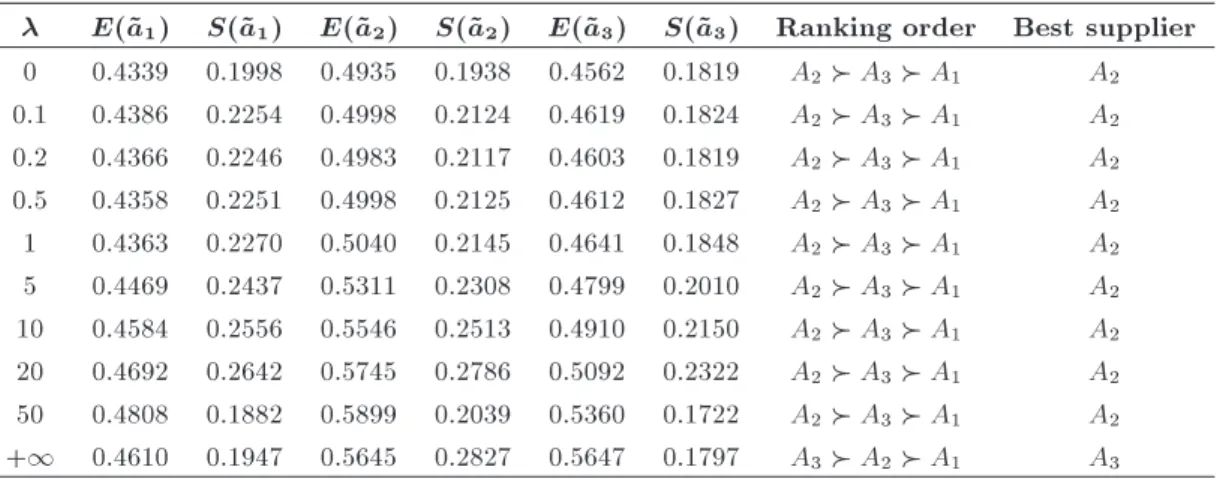
Similarly, for dierent parameter values, 2 [0; +1), we can obtain the ranking order of the suppliers. The computation results and ranking orders of suppliers are listed in Table 7.
Table 7 shows that the ranking orders of alterna-tives may be dierent for dierent parameter values of . If 50, the rank order is A2 A3 A1, and
the best supplier is A2, while, for ! +1, the rank
order is A3 A2 A1 and the best supplier is A3.
This observation implies that DMs can select dierent parameter values according to their preferences in making decisions, which greatly enhances the exibility of the decision process.
5.2. Comparison analysis of the obtained results
In this subsection, we compare the results obtained by the proposed method in this paper and the method of Wei [37]. Since [37] utilized TrIFNs to express the attribute values, we rst take the interval middle-points of the maximum membership degree interval and the
Table 7. The computation results for dierent parameter values and ranking orders of suppliers. E(~a1) S(~a1) E(~a2) S(~a2) E(~a3) S(~a3) Ranking order Best supplier
0 0.4339 0.1998 0.4935 0.1938 0.4562 0.1819 A2 A3 A1 A2
0.1 0.4386 0.2254 0.4998 0.2124 0.4619 0.1824 A2 A3 A1 A2
0.2 0.4366 0.2246 0.4983 0.2117 0.4603 0.1819 A2 A3 A1 A2
0.5 0.4358 0.2251 0.4998 0.2125 0.4612 0.1827 A2 A3 A1 A2
1 0.4363 0.2270 0.5040 0.2145 0.4641 0.1848 A2 A3 A1 A2
5 0.4469 0.2437 0.5311 0.2308 0.4799 0.2010 A2 A3 A1 A2
10 0.4584 0.2556 0.5546 0.2513 0.4910 0.2150 A2 A3 A1 A2
20 0.4692 0.2642 0.5745 0.2786 0.5092 0.2322 A2 A3 A1 A2
50 0.4808 0.1882 0.5899 0.2039 0.5360 0.1722 A2 A3 A1 A2
minimum non-membership degree interval in Tables 4-6 to transform the IVTrIFNs into TrIFNs. Then, using method [37], the collective comprehensive ratings of alternatives, Ai(i = 1; 2; 3), are obtained as:
~r1= [0:0786; 0:2491; 0:3387; 0:7602]; 0:4557; 0:2365;
~r2= [0:1562; 0:3455; 0:4013; 0:8453]; 0:4059; 0:2773;
and:
~r3= [0:1384; 0:3231; 0:3280; 0:7312]; 0:4114; 0:2677;
respectively.
The distances between the collective comprehen-sive ratings of alternatives and the trapezoidal intu-itionistic fuzzy positive ideal solution, ~r+, [37] are
calculated as: d(~r1; ~r+) = 0:7826, d(~r2; ~r+) = 0:7534
and d(~r3; ~r+) = 0:7826, respectively.
Therefore, the suppliers are ranked as A2 A3=
A1, and the best supplier is A2.
Obviously, the ranking results obtained by the method proposed in this paper are remarkably dierent from those obtained by the method [37]. Compared with the method in [37], the proposed method in this paper has the following advantages:
(i) The abilities of representing uncertainty are very dierent for IVTrIFN and TrIFN. The former uses the intervals to express the maximum member-ship degree and the minimum non-membermember-ship degree, while the latter uses crisp real numbers to express the maximum membership degree and the minimum non-membership degree. Consequently, the latter is only a special case of the former.
(ii) The method in [37] can only obtain a single rank-ing result, while the proposed method in this pa-per can generate dierent ranking results through choosing dierent parameter values. Thus, the latter is more exible and agile than the former.
(iii) If there exist two dierent alternatives, with equal distances relative to the fuzzy positive ideal solution, then, the method in [37] cannot distinguish these two alternatives. For example, because d(~r1; ~r+) = d(~r3; ~r+) = 0:7826, A3 is
the same as A1 when using the method in [37].
However, if there exist two dierent alternatives with equal expectations, the method of this paper can further distinguish these two alternatives, according to expectant scores. For example, though E(~a1) = E(~a2) = 0:4460, and S(~a1) =
0:3175 > S(~a2) = 0:2967, A1 is superior to A2
when using the method proposed in this paper. From this point of view, the distinguishing power of this paper's method is stronger than that of [37].
6. Conclusion
As stated previously, the IVTrIFN is a useful gen-eralization of the IFS. From a geometric viewpoint, the expectation and expectant scores of IVTrIFNs are dened by using the notion of barycenter. A new method based on barycenter is presented to rank IVTrIFNs. Then, the IVTrIFOWA, IVTrIFGOWA, and IVTrIFHWA operators for IVTrIFNs are devel-oped and employed to solve a MAGDM problem with IVTrIFNs. Though a supplier, a selected example is used to illustrate the applicability and implementation process of the decision method proposed in this paper. It is expected to be applicable to decision problems in many areas, such as risk investment and per-formance evaluation of military systems, engineering management, and partner selection of supply chain management.
However, constructing IVTrIFNs (i.e., extracting the membership and non-membership functions, whose values depend on both dierent intervals and trape-zoidal fuzzy number) is a key problem when apply-ing the proposed methodology to practical decision problems. Generating methods of IVTrIFNs will be investigated in the near future.
Acknowledgment
This work was partially supported by the National Natural Science Foundation of China (Nos. 71061006, 61263018 and 11461030), the Humanities Social Sci-ence Programming Project of the Ministry of Edu-cation of China (No. 09YGC630107), the Natural Science Foundation of Jiangxi Province of China (Nos. 20114BAB201012 and 20142BAB201011), the Science and Technology Project of Jiangxi province educational department of China (No. GJJ12265), \Twelve ve" Programming Project of Jiangxi province Social Sci-ences (2013) (No. 13GL17), the Young Scientists Train-ing Object of Jiangxi Province (No. 20151442040081), and the Excellent Young Academic Talent Support Program of Jiangxi University of Finance and Eco-nomics.
References
1. Atanassov, K.T. \Intuitionistic fuzzy sets", Fuzzy Sets and Systems, 20(1), pp. 87-96 (1986).
2. Zadeh, L.A. \Fuzzy sets", Information and Control, 18, pp. 338-353 (1965).
3. Gau, W. and Buehrer, D.J. \Vague sets", IEEE
Transactions on Systems, Man, and Cybernetics, 23, pp. 610-614 (1993).
4. Bustince, H. and Burillo, P. \Vague sets are intuition-istic fuzzy sets", Fuzzy Sets and Systems, 79, pp. 403-405 (1999).
5. Atanassov, K. and Gargov, G. \Interval-valued intu-itionistic fuzzy sets", Fuzzy Sets and Systems, 31(3), pp. 343-349 (1989).
6. Li, D.F. \The GOWA operator based approach to
mul-tiattribute decision making using intuitionistic fuzzy sets", Mathematical and Computer Modelling, 53(5-6), pp. 1182-1196 (2011).
7. Tan, C.Q., Ma, B.J., Wu, D.S.D. and Chen, X.H.
\Multi-criteria decision making methods based on interval-valued intuitionistic fuzzy sets", International Journal of Uncertainty, Fuzziness and Knowledge-Based Systems, 22(3), pp. 475-494 (2014).
8. Wang, J.Q., Zhou, P., Li, K.J., Zhang, H.Y. and Chen, X.H. \Multi-criteria decision-making method based on normal intuitionistic fuzzy-induced generalized aggre-gation operator", TOP, 22, pp. 1103-1122 (2014).
9. Wang, J.Q. and Zhang, H.Y. \Multi-criteria decision-making approach based on Atanassov's intuitionistic fuzzy sets with incomplete certain information on weights", IEEE Transactions on Fuzzy Systems, 21(3), pp. 510-515 (2013).
10. Wang, J.Q., Li, K.J., Zhang, H.Y. and Chen, X.H.
\A score function based on relative entropy and its application in intuitionistic normal fuzzy multiple criteria decision making", Journal of Intelligent and Fuzzy Systems, 25(3), pp. 567-576 (2013).
11. Xu, Z.S. \Approaches to multiple attribute group
decision making based on intuitionistic fuzzy power ag-gregation operators", Knowledge-Based Systems, 24, pp. 749-760 (2011).
12. Chen, T.Y. \Multiple criteria group decision-making with generalized interval-valued fuzzy numbers based on signed distances and incomplete weights", Applied Mathematical Modelling, 36, pp. 3029-3052 (2012).
13. Tan, C.Q. \Generalized intuitionistic fuzzy geometric aggregation operator and its application to multi-criteria group decision making", Soft Computing, 15, pp. 867-876 (2011).
14. Tan, C.Q. and Chen, X.H. \Interval-valued
intu-itionistic fuzzy multi-criteria group decision making based on VIKOR and Choquet integral," Journal of Applied Mathematics, 2013, Article ID 656879, 16 pages (2013). http://dx.doi.org/10.1155/2013/656879
15. Tan, C.Q. \A multi-criteria interval-valued intuitionis-tic fuzzy group decision making with Choquet integral-based TOPSIS", Expert Systems with Applications, 38(4), pp. 3023-3033 (2011).
16. Meng, F.Y., Tan, C.Q. and Zhang, Q. \The induced
generalized interval-valued intuitionistic fuzzy hybrid Shapley averaging operator and its application in decision making", Knowledge-Based Systems, 42(1), pp. 9-19 (2013).
17. Wang, J.Q., Han, Z.Q. and Zhang, H.Y.
\Multi-criteria group decision-making method based on intu-itionistic interval fuzzy information", Group Decision and Negotiation, 23, pp. 715-733 (2014).
18. Wan, S.P. and Dong, J.Y. \A possibility degree
method for interval-valued intuitionistic fuzzy multi-attribute group decision making", Journal of Com-puter and System Sciences, 80(1), pp. 237-256 (2014).
19. Wan, S.P. and Li, D.F. \Atanassov's intuitionistic
fuzzy programming method for heterogeneous mul-tiattribute group decision making with Atanassov's intuitionistic fuzzy truth degrees", IEEE Transaction of Fuzzy Systems, 22(2), pp. 300-312 (2014).
20. Dubois, D. and Prade, H., Fuzzy Sets and Systems:
Theory and Applications, Academic Press, New York (1980).
21. Li, D.F. \A note on using intuitionistic fuzzy sets for fault-tree analysis on printed circuit board assembly", Microelectronics Reliability, 48(10), p. 1741 (2008).
22. Shu, M.H., Cheng, C.H. and Chang, J.R. \Using
in-tuitionistic fuzzy sets for fault tree analysis on printed circuit board assembly", Microelectronics Reliability, 46(12), pp. 2139-2148 (2006).
23. Li, D.F. \A ratio ranking method of triangular intu-itionistic fuzzy numbers and its application to MADM problems", Computers and Mathematics with Applica-tions, 60, pp. 1557-1570 (2010).
24. Li, D.F., Nan J.X. and Zhang, M.J. \A ranking
method of triangular intuitionistic fuzzy numbers and application to decision making", International Journal of Computational Intelligence Systems, 3(5), pp. 522-530 (2010).
25. Nan, J.X., Li, D.F. and Zhang, M.J. \A lexicographic method for matrix games with payos of triangular intuitionistic fuzzy numbers", International Journal of Computational Intelligence Systems, 3(3), pp. 280-289 (2010).
26. Chen, Y. and Li, B. \Dynamic multi-attribute decision making model based on triangular intuitionistic fuzzy numbers", Scientia Iranica, 18(2), pp. 268-274 (2011).
27. Wan, S.P., Li, D.F. and Rui, Z.F. \Possibility mean, variance and covariance of triangular intuitionistic fuzzy numbers", Journal of Intelligent and Fuzzy Sys-tems, 24(4), pp. 847-858 (2013).
28. Wan, S.P. and Li, D.F. \Possibility mean and variance based method for multi-attribute decision making with triangular intuitionistic fuzzy numbers", Journal of Intelligent and Fuzzy Systems, 24(4), pp. 743-754 (2013).
29. Wan, S.P. \Multi-attribute decision making method
based on possibility variance coecient of triangular intuitionistic fuzzy numbers", International Journal of Uncertainty, Fuzziness and Knowledge-Based Systems, 21(2), pp. 223-243 (2013).
30. Wan, S.P., Wang, Q.Y. and Dong, J.Y. \The extended
VIKOR method for multi-attribute group decision making with triangular intuitionistic fuzzy numbers", Knowledge-Based Systems, 52, pp. 65-77 (2013).
31. Wang, J.Q., Nie, R.R., Zhang, H.Y. and Chen X.H.
\New operators on triangular intuitionistic fuzzy num-bers and their applications in system fault analysis", Information Sciences, 251, pp. 79-95 (2013).
32. Dong, J.Y. and Wan, S.P. \A new method for multi-attribute group decision making with triangular intu-itionistic fuzzy numbers," Kybernetes, 45(1), pp. 1-29 (2016).
33. Wan, S.P. and Dong, J.Y. \Multi-attribute decision
making based on triangular intuitionistic fuzzy number Choquet integral operator," Chinese Journal of Man-agement Science, 22, pp. 121-129 (2014).
34. Wan, S.P. and Dong, J.Y. \Possibility method for
triangular intuitionistic fuzzy multi-attribute group decision making with incomplete weight information", International Journal of Computational Intelligence Systems, 7(1), pp. 65-79 (2014).
35. Wang, J.Q. \Overview on fuzzy multi-criteria decision-making approach", Control and Decision, 23(6), pp. 601-607 (2008).
36. Wang, J.Q. and Zhang, Z. \Aggregation operators on
intuitionistic trapezoidal fuzzy number and its applica-tion to multi-criteria decision making problems", Jour-nal of Systems Engineering and Electronics, 20(2), pp. 321-326 (2009).
37. Wei, G.W. \Some arithmetic aggregation operators
with intuitionistic trapezoidal fuzzy numbers and their application to group decision making", Journal of Computer, 5(3), pp. 345-351 (2010).
38. Du, Y. and Liu, P.D. \Extended fuzzy VIKOR method
with intuitionistic trapezoidal fuzzy numbers", Infor-mation - an International Interdisciplinary Journal, 14(8), pp. 2575-2584 (2011).
39. Wu, J. and Cao, Q.W. \Same families of geometric
aggregation operators with intuitionistic trapezoidal fuzzy numbers", Applied Mathematical Modelling, 37, pp. 318-327 (2013).
40. Wan, S.P. and Dong, J.Y. \Method of intuitionistic
trapezoidal fuzzy number for multi-attribute group decision", Control and Decision, 25(5), pp. 773-776 (2010).
41. Ye, J. \Expected value method for intuitionistic trape-zoidal fuzzy multicriteria decision-making problems", Expert Systems with Applications, 38(9), pp. 11730-11734 (2011).
42. Ye, J. \Multicriteria group decision-making method
using vector similarity measures for trapezoidal intu-itionistic Fuzzy Numbers", Group Decision and Nego-tiation, 21(4), pp. 519-530 (2012).
43. Wan, S.P. \Power average operators of trapezoidal
intuitionistic fuzzy numbers and application to
multi-attribute group decision making", Applied Mathemat-ical Modelling, 37(6), pp. 4112-4126 (2013).
44. Wan, S.P. \Multi-attribute decision making method
based on interval intuitionistic trapezoidal fuzzy num-ber", Control and Decision, 26(6), pp. 857-861 (2011).
45. Wan, S.P. \Method based on fractional
program-ming for interval-valued intuitionistic trapezoidal fuzzy number multi-attribute decision making", Control and Decision, 27(3), pp. 455-458 (2012).
46. Wu, J. and Liu, Y.J. \An approach for multiple
at-tribute group decision making problems with interval-valued intuitionistic trapezoidal fuzzy numbers", Com-puters & Industrial Engineering, 66, pp. 311-324 (2013).
47. Wei, G.W., Zhao, X.F. and Wang, H.J. \An approach
to multiple attribute group decision making with interval intuitionistic trapezoidal fuzzy information", Technological and Economic Development of Economy, 18(2), pp. 311-324 (2012).
48. Chen, S.M. and Tan, J.M. \Handling multi-criteria
fuzzy decision-making problems based on vague set theory", Fuzzy Sets and Systems, 67, pp. 163-172 (1994).
49. Yager, R.R. \On ordered weighted averaging aggrega-tion operators in multicriteria decision making", IEEE Transactions on Systems, Man and Cybernetics, 18, pp. 183-190 (1988).
Biographies
Jiuying Dong received a PhD degree in Graph Theory and Combinatorial Optimization from Nankai Univer-sity, Tianjin, China, in 2013. She is currently Asso-ciate Professor in the College of Statistics at Jiangxi University of Finance and Economics, China. She has more than 20 articles published in professional journals. Her current research interests include decision analysis, graph theory and combinatorial optimization.
Shuping Wan received a PhD degree in Control The-ory and Control Engineering from Nankai University, Tianjin, China, in 2005. He is currently Professor in the College of Information Technology at Jiangxi University of Finance and Economics, China. He has more than 80 articles published in professional journals, His current research interests include decision analysis, fuzzy game theory, information fusion, and nancial engineering.