Insulation Resistance Tester
Supplier: Nieaf-Smitt bv
Vrieslantlaan 6
3526 AA Utrecht Holland P.O. box 7023 3502 KA Utrecht
Specifications of the equipment: IRT-S
Specifications of the user manual: Date: 05-02-04 Number: 561144037 Ref.: 004
Utrecht
- Page 2 - Ref. 004
Preface
This manual describes the Insulation Resistance Tester. The information in this manual is important for proper and safe functioning of the machine. In case you are not familiar with the operation, the preventive maintenance, etc. of the Insulation Resistance Tester, then you read this user manual from the beginning to the end thoroughly.
If you are familiar with these matters, you can use this manual for reference. You can find the required information rapidly using the table of contents.
In this user manual, the following four marking conventions are used to focus attention on certain subjects or actions.
TIP:
gives you suggestions and advice to perform certain tasks easier or handier.
ATTENTION:
a remark with additional information; draws your attention to possible problems.
CAUTION:
the machine may be damaged, if you do not carefully execute the procedures.
WARNING FOR DANGER:
you can (seriously) hurt yourself or seriously damage the product, if you do not carefully execute the procedures.
- this document is described with the words manual or user manual;
- the test equipment is described with the words tester, instrument or test device; - values or displayed data is placed between inverted commas for example “230 V”; - keys or switch positions are placed between angular brackets for example [Start] key.
Utrecht
- Page 3 - Ref. 004
Warranty
Nieaf-Smitt bv guaranties the tester for a period of 6 months.
The period of warranty will be effective at the day of delivery. The warranty clauses and the stipulations regarding liability in terms of delivery (FME and HE).
© Copyright 1997
All rights reserved. Nothing from this edition may be multiplied, or made public in any form or manner, either electronically, mechanically, by photocopying, recording, or in any manner, without prior written constent form Nieaf-Smitt bv.
Nieaf-Smitt bv reserves the right to change parts at any given moment, without prior or direct notification to the client. The contents of this user manual may also be changed without prior warning.
This user manual is compiled with all possible care, but Nieaf-Smitt bv can not accept any responsibility for possible errors in this user manual or any consequences resulting from that.
Utrecht
- Page 4 - Ref. 004
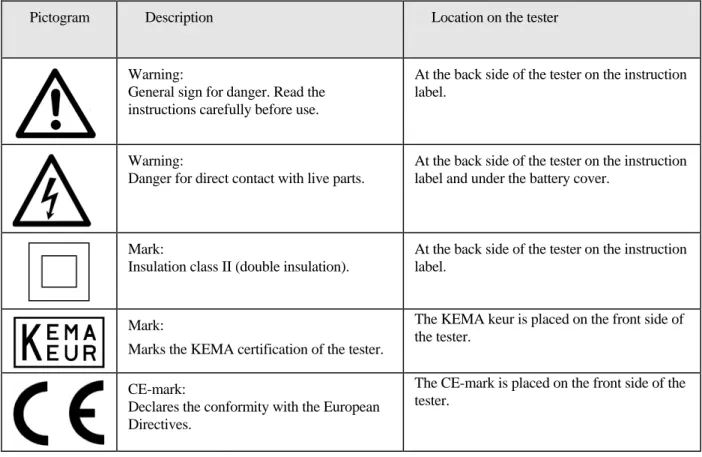
Warning pictograms on the tester
There are a number of pictograms on the tester, meant to warn the user of remaining risks that may be present in spite of the safe design.
Pictogram Description Location on the tester
Warning:
General sign for danger. Read the instructions carefully before use.
At the back side of the tester on the instruction label.
Warning:
Danger for direct contact with live parts.
At the back side of the tester on the instruction label and under the battery cover.
Mark:
Insulation class II (double insulation).
At the back side of the tester on the instruction label.
Mark:
Marks the KEMA certification of the tester.
The KEMA keur is placed on the front side of the tester.
CE-mark:
Declares the conformity with the European Directives.
The CE-mark is placed on the front side of the tester.
All peripherals, which are used by this tester, must be provided with a CE-mark. For example the use of a PC.
Utrecht
- Page 5 - Ref. 004
CONTENTS
1. GENERAL SAFETY REGULATIONS ... 7
2. INTRODUCTION ... 8
2.1 GENERAL ... 8
2.1.1 The intended use... 8
2.1.2 Target group ... 8 2.1.3 Working principle... 9 2.2 SPECIFICATIONS ... 10 2.3 CERTIFICATION ... 11 3. TESTER COMPOSITION ... 12 3.1 GENERAL ... 12 3.2 PRINCIPLE OF MEASUREMENT... 12 3.2.1 Visual inspection ... 12
3.2.2 Insulation resistance measurement ... 13
3.2.3Lowresistance……….………...…………. 14
3.2.4 Beeping ... 13
3.2.5 Mains Voltage and mains frequency ... 13
4. INSTALLATION; START-UP AND ADJUSTING ... 14
5. HOW TO USE THE TESTER ? ... 15
5.1 OPERATION ... 15
5.1.1 Starting ... 17
5.2 TESTING ... 17
5.2.1 Test 1: Insulation resistance measurement ... 19
5.2.2 Test 2: Low resistance measurement ... 19
5.2.3 Test 3: Beeping the stallation……….…………...20
5.2.4 Test 4: Voltage / frequency of mains voltage measurement ... 19
5.3 MEMORISING OF RESULTS ... 20
5.4 RECALLING OF MEMORISED RESULTS. ... 22
5.5 RS232 COMMUNICATION ... 23
5.6 ERASING OF RESULTS... 25
5.7 RESET OF THE INSTRUMENT ... 27
5.8 TROUBLESHOOTING ... 28
5.9 CALIBRATION AND REPAIR ... 29
6. MAINTENANCE... 30
6.1 BATTERIES REPLACEMENT... 30
6.2 CLEANING... 31
Utrecht
- Page 6 - Ref. 004
Tables:
Table 1: Pictograms on the tester Table 2: Switches
Table 3: Sub results and parameters Table 4: General faults and warnings
Figures:
Figure 1: Operating
Figure 2: Identification number of each function Figure 3: RS232 connector
Figure 4: RS232 cable
Figure 5: An example of print out Figure 6: Batteries inserted
Attachments:
Attachment 1: EU-Declaration of Conformity Attachment 2: Circuit diagrams
- Insulation resistance measurement:
- Insulation resistance of telephone line measurement; - Floor resistance measurement;
- Insulation resistance of mains installations measurement; - Insulation resistance of ground cable measurement - Low resistance measurement
Utrecht
- Page 7 - Ref. 004
1.
GENERAL SAFETY REGULATIONS
It is not allowed to remove, to skirt or to tide over (by handy constructions) the enclosure or safeties of the tester during normal use. Method of measurement and range are indicated on the back side of the instrument.
It is not allowed to change or remove the case or protections of the tester during normal use and without written constent from Nieaf-Smitt bv.
Method of measurement and range are indicated on the back side of the instrument.
It’s forbidden to place and/or to use the instrument in a room where is a risk of explosion.
If the tester is used by a third party, you being the owner are responsible, unless otherwise specificated.
Repair can only be done by Nieaf-Smitt bv.
Utrecht
- Page 8 - Ref. 004
2.
INTRODUCTION
2.1
GENERAL
2.1.1
The intended use
The IRT-S is intended for execution of low resistance, voltage and insulation resistance
measurements. If the instrument is used in manner not specified in this user manual, the protection provided by the instrument may be impaired and the supplier is excluded from any responsibility.
2.1.2
Target group
The target group of people for whom the tester and this user manual are applicable are competent and technical qualified persons.
Competent persons are persons who:
- have got a certain level of technical knowledge gained by education/training and who; - have got certain skills required to operate the tester.
Technical qualified persons are persons who: - are competent and who;
- have got a certain level of technical knowledge gained by education/training and who;
- are familiar with the applied technology in the instrument and are aware of the possible dangers and risks.
Repair can only be done by Nieaf-Smitt bv.
By operating we mean:
- setting up the instrument and executing tests; - processing the test results.
Utrecht
- Page 9 - Ref. 004
2.1.3
Working principle
Structure
The IRT-S is a professional microprocessor-controlled instrument, intended for the execution of low resistance, voltage and insulation resistance measurements. Select the test by means of the rotary switch. Now the user is able to prescribe the desired measuring method. The test results are clearly displayed on the LCD.
Connecting
The instrument is powered by four alkaline batteries (4 x 1,5 V IEC). The tester is provided with a on/off switch and can, after powering up the instrument, be used at once. The test cord or the RS232 cable (data transfer cable) are connected at the upper side of the tester.
Measuring
Each test has it’s specific circuit diagram which is given in the attachments. Next measurements are executable by the instrument:
1. The measuring of the Insulation resistance using - 100 V
- 250 V - 500 V - 1000 V
2. The measuring of the low resistance. 3. The measuring of the mains voltage. 4. The measuring of the mains frequency.
Utrecht
- Page 10 - Ref. 004
2.2
SPECIFICATIONS
General
Power supply : 4 x 1,5 V IEC LR14 alkaline batteries
Battery life time : approx. 1200 measurements (1 measurement per 5 minutes)
Display : 3 digit 7 segment LCD 19mm
Quality standard : design, development and production according to ISO 9001
Mass : approx. 0,75 kg including batteries and accessories Dimensions (wxhxd) : 110 x 65 x 290 mm
Environment and storage
Reference temp. range : 5°C - 35°C Operating temp. range : 0°C - 40°C Storage temp. range : -10°C - 60°C
Max. operating humidity : 85% RH (0°C - 40°C) Max. storage humidity : 80% RH (40°C - 60°C) 90% RH (-10°C - 40°C) Degree of protection : IP50
Pollution degree : Class II
Over voltage protection : Category II 600V Category III 300V
Testing
Insulation resistance (Riso) using 100 V (0-10%)
Open circuit output voltage : 100 V / 0 - 10% Measuring current : ≥ 1 mA at 100 kΩ load
Range (auto range) : 0 - 1,999 MΩ / 2,00 - 19,99 MΩ / 20,0 - 199,9 MΩ Resolution : 0,001 MΩ / 0,01 MΩ / 0,1 MΩ
Accuracy : ± 2% of reading ± 2 digits Short circuit current : ≤ 1,4 mA
Insulation resistance (Riso) using 250 V (0-10%)
Open circuit output voltage : 250 V / 0 - 10% Measuring current : ≥ 1 mA at 250 kΩ load
Range (auto range) : 0 - 1,999 MΩ / 2,00 - 19,99 MΩ / 20,0 - 199,9 MΩ Resolution : 0,001 MΩ / 0,01 MΩ / 0,1 MΩ
Accuracy : ± 2% of reading ± 2 digits Short circuit current : ≤ 1,4 mA
Insulation resistance (Riso) using 500 V (0-10%)
Open circuit output voltage : 500 V / 0 - 10% Measuring current : ≥ 1 mA at 500 kΩ load
Range (auto range) : 0 - 1,999 MΩ / 2,00 - 19,99 MΩ / 20,0 - 199,9 MΩ Resolution : 0,001 MΩ / 0,01 MΩ / 0,1 MΩ
Accuracy : ± 2% of reading ± 2 digits Short circuit current : ≤ 1,4 mA
Utrecht
- Page 11 - Ref. 004
Insulation resistance (Riso) using 1000 V (0-10%)
Open circuit output voltage : 1000 V / 0 - 10% Measuring current : ≥ 1 mA at 1000 kΩ load
Range (auto rang) : 0 - 1,999 MΩ / 2,00 - 19,99 MΩ / 20,0 - 199,9 MΩ Resolution : 0,001 MΩ / 0,01 MΩ / 0,1 MΩ
Accuracy : ± 2% of reading ± 2 digits Short circuit current : ≤ 1,4 mA
Low resistance
Range : 0 - 20 Ω
Resolution : 0,01 Ω
Accuracy : ± 2% of reading ± 2 digits Short circuit current : 200 mA at Ubat > 5 V Open circuit output voltage : > 4,5 V at Ubat > 5V
Limiting value : upper- and lowerlimit are adjustable with sound signal
Voltage
Range : 0 - 440 Veff
Resolution : 1 V
Accuracy : ± 2% of reading ± 2 digits
Frequency
Range : 25,0 - 199,9 Hz / 200- 500 Hz Frequency : 0,1 / 1 Hz
Accuracy : ± 0,1% of reading ± 1 digit
Transport
The tester is a portable test device which can be hand-held or lay down (solid foundation) during the tests. Take care of the instrument during transport to avoid any damage.
2.3
CERTIFICATION
The tester and this manual have been designed, constructed and tested according to the European directives. During all these phases the relevant (preliminary European standards have been taken into account. The CE-mark has been mounted on the instrument. The directives and the standards mentioned are enumerated in the EC-Declaration of Conformity.
Utrecht
- Page 12 - Ref. 004
3.
TESTER COMPOSITION
3.1
GENERAL
The IRT-S is built in an enclosure of solid ABS plastic. The display is situated at the front side of the tester. The test results are displayed. The main parts (see figures in Chapter 5) are listed below:
Front:
1. On/off key 2. Rotary switch
3. LCD-display (NR. 13 in the figure)
Back:
1. Instruction label 2. Serial number 3. Battery cover
4. Battery cover fastening screw
3.2
PRINCIPLE OF MEASUREMENT
3.2.1
Visual inspection
Visually check the test object or installation before executing the safety tests. The function of the visual inspection is to ensure the electrically safety of the latter parts. Check wires, cables and components for possible damages. If any damage has been noticed, it isn’t allowed to perform any tests before a technical qualified person has repaired the test object or installation . The visual inspection is executed by the operator.
Utrecht
- Page 13 - Ref. 004
3.2.2
Insulation resistance measurement
Do not touch the test object or the test cords during the measurement because hazardous voltage can be present.
This test is intended to check the insulation resistance of a test object or installation. The test can be executed by four different voltages.
The discharging of the capacitive load is performed automatically after finishing the measurement. After the measuring of the capacitive object, the discharged voltage will be displayed.
3.2.3
Low resistance
This test is intended to check the low resistance between two terminals of a test object or installation. The test can be done between different live parts or live - and neutral parts of the installation or the object.
In order to obtain correct results, first a compensation of the test cords’ resistance must be carried out. The measurement is automatically carried out in two steps. The first step is executed with the positive polarity of the test voltage, while the second step is executed with the negative polarity.
The displayed result is an average of both polarities:
Result =Re ( )s+ +Re ( )s−
2
Result: displayed value;
Res (+): result obtained with positive polarity (can not be displayed separately); Res (-): result obtained with negative polarity (can not be displayed separately);
3.2.4
Beeping
The IRT-S is equipped with adjustable limits that can be used as an indication for the value of the resistance measured. This method is called “beeping” of an object. After setting a minimum and maximum limit, a sound signal will be produced each time a result is between these limits.
3.2.5
Mains Voltage and mains frequency
This test is intended to check the present voltage and frequency.
Utrecht
- Page 14 - Ref. 004
4.
INSTALLATION; START-UP AND ADJUSTING
The tester can only be used if no damages or defects are noticed and all original components belonging to the tester are mounted
The transportation and the handling of the tester should be done carefully to prevent any damage.
This paragraph describes the installation and the starting up procedure of the instrument. The installation, the starting up and the adjustment of the instrument may be done by competent persons.
1. Unpack the instrument.
Remove the packing materials without causing damages to the environment. Check the tester on possible damages. If damages are noticed, contact Nieaf-Smitt bv..
2. Put the instrument in a horizontal position, at the workplace or in the test room.
Keep enough clearance around the instrument to facilitate an easy operation, adjustment and reading of test results, without any problems or extra danger.
3. Insert the batteries in the instrument.
4. Connect the test object according to the circuit diagrams with the IRT-S. 5. Carry out the selected test.
Find a place to put the manual such that it is within reach during the use of the instrument.
Utrecht
- Page 15 - Ref. 004
5.
HOW TO USE THE TESTER ?
5.1
OPERATION
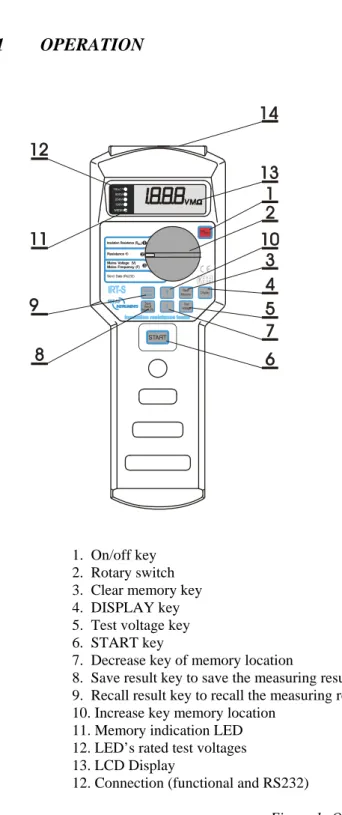
1. On/off key 2. Rotary switch 3. Clear memory key 4. DISPLAY key 5. Test voltage key 6. START key
7. Decrease key of memory location
8. Save result key to save the measuring results 9. Recall result key to recall the measuring results 10. Increase key memory location
11. Memory indication LED 12. LED’s rated test voltages 13. LCD Display
12. Connection (functional and RS232)
1. Instruction label 2. Serial number 3. Battery cover
4. fixing screw for battery cover 5. Plastic cover of the locking screw 6. Locking screw covered by a rubber foot
Utrecht
- Page 16 - Ref. 004
Keys
Function key description.
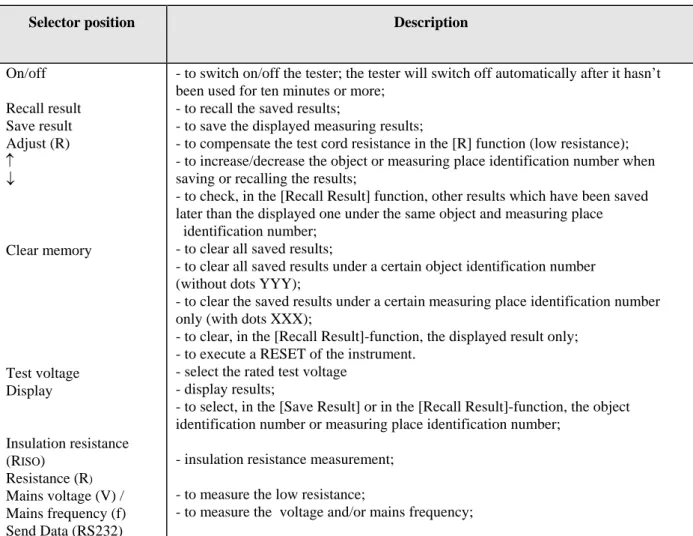
Selector position Description
On/off Recall result Save result Adjust (R) ↑ ↓ Clear memory Test voltage Display Insulation resistance (RISO) Resistance (R) Mains voltage (V) / Mains frequency (f) Send Data (RS232)
- to switch on/off the tester; the tester will switch off automatically after it hasn’t been used for ten minutes or more;
- to recall the saved results;
- to save the displayed measuring results;
- to compensate the test cord resistance in the [R] function (low resistance); - to increase/decrease the object or measuring place identification number when saving or recalling the results;
- to check, in the [Recall Result] function, other results which have been saved later than the displayed one under the same object and measuring place identification number;
- to clear all saved results;
- to clear all saved results under a certain object identification number (without dots YYY);
- to clear the saved results under a certain measuring place identification number only (with dots XXX);
- to clear, in the [Recall Result]-function, the displayed result only; - to execute a RESET of the instrument.
- select the rated test voltage - display results;
- to select, in the [Save Result] or in the [Recall Result]-function, the object identification number or measuring place identification number;
- insulation resistance measurement;
- to measure the low resistance;
- to measure the voltage and/or mains frequency;
- to transfer stored data to the printer or to the PC.
Utrecht
- Page 17 - Ref. 004
5.1.1
Starting
Operating the instrument may only be done by competent persons. Never open the instrument during thre esting.
Check before every test:
* cables and test cords on possible damages; * tester on possible damages and/or defects.
1. Check the instrument on visible damages and/or defects, for example the power plug, the line cord etc. .Don’t carry out any test with a damaged or broken instrument. Provide skilled reparation first
2. Do not connect the test object as well as the test cords with the tester. 3. The instrument can be used at once.
Test selection
First carry out a visual inspection on the test object or the installation. Connect the tester conform the circuit diagrams of attachment 2.
We have three different tests:
Test 1: the measuring of the insulation resistance. Test 2: the measuring of the low resistance.
Test 3: the measuring of the mains voltage and/or the mains frequency.
5.2
TESTING
-
Avoid testing objects or installations under the influence of high electromagnetic and/or electrostatic fields.In the following paragraph the test methods will be explained. We consider that the starting-up is carried out as described in paragraph 5.1.1.
Utrecht
- Page 18 - Ref. 004
5.2.1
Test 1: Insulation resistance measurement
- Do not disconnect the test cords during the measurement, because measured object
can stay charged => dangerous;- Do not touch the object or test cords during the measurement => hazardous voltage
can be present;
- Each result can be saved only once.
How to carry out test 1:
1. Connect the test cords with the instrument conform the circuit diagram of attachment 2. 2. Set the rotary switch to [insulation resistance RISO].
3. Select the nominal test voltage using the [Test voltage] key. 4. Press the [Start] key and release it.
5. The result is displayed. Read out the result, save it if required, and note the memory codes when necessary.
6. Disconnect the test object or carry out another measurement.
5.2.2
Test 2: Low resistance measurement
- First carry out compensation.
- Displayed result is an average of both (+ , -) polarities. - Each result can be saved only once.
First carry out compensation:
1. Set the rotary switch to [low resistance R] to test the low resistance.
2. Connect the test cords to the instrument and cross the measure tips (make sure the contact is well done).
3. Press the [Save result / Adjust (R)] key and release it. If the the test cords are well compensated, 0.00 6 should be displayed.
4. Now the lights are going to burn near “Lead Adjust”.
How to carry out test 2:
5. Connect the test cords with the instrument conform the circuit diagram of attachment 2. 6. Check if the rotary switch is set to [Resistance (R)].
7. Press the [Start] key and release it.
8. The result is displayed. Read out the result, save it if required, and note the memory codes when necessary.
Utrecht
- Page 19 - Ref. 004
5.2.3
Test 3: Beeping the installation
A beep sound can be used as an indication for a good result in low resistance measurement (also paragraph 3.2.4). A signal will be produced every time the measurement result will be between the upper and lower resistance limits.
In case the result falls outside the limits, no sound is produced and the sign is shown next to the result.
1. - ON or OFF is displayed according to the current value of the buzzer status (in the second case the BUZ text lasting 2s precedes the OFF text).
2. , , , - Set the buzzer status ON or OFF using [↑],[↓]
keys.
- To confirm selection, press [SAVE] key or press [DISPLAY] key to continue without change. - In case the ON status is selected, LO text is shown for 2s and the current value of the LOW limit is
shown afterwards.
- If the OFF status is selected the instrument exists this procedure and --- is displayed.
3. , , , - Set LOW limit using [↑],[↓] keys.
- To confirm the new limit value, press [SAVE] key or press [DISPLAY] key to continue without
change.
- HI text is shown for 2s and the current value of the HIGH limit is shown afterwards.
4. , , , - Set HIGH limit using [↑],[↓] keys.
- To confirm the new limit value, press [SAVE] key or press [DISPLAY] without change.
Afterwards --- is displayed.
The LOW limit can not exceed the HIGH limit.
If the operator makes a wrong selection, the limit values are
automatically adjusted to satisfy this rule.
Utrecht
- Page 20 - Ref. 004
Max. allowed input voltage is 440 Volts.
How to carry out test 3:
1. Connect the test cords with the instrument conform the circuit diagram of attachment 2. 2. Set the rotary switch to [Mains voltage (V) / mains frequency (f)].
3. The result will be displayed without pressing the [Start] key. The displayed value is the present voltage.
4. Press the [Display] key to display the mains frequency.
5. Save the result if required, and note the memory codes when necessary. 6. Disconnect the test object or carry out another measurement.
5.3
MEMORISING OF RESULTS
Each saved result is equipped with an identification code defined by the customer. The code consists of 2 x 3 characters as follows:
Where X.X.X represents a code of a certain measuring place inside the tested object, and YYY. represents a code of the tested object. Remark: X.X.X is at least one level higher than YYY. For detailed information we refer to the manual delivered with the PATS-W Administration-Software.
Utrecht
- Page 21 - Ref. 004
Each displayed result can be stored as follows:
Pressed key Comments
1. The last changed partial code (X.X.X. of YYY) which is used for the memorising of the results will, if necessary, be saved in the order of changing.
2.
Insert new codes using the [↑, ↓] keys if necessary. 3.
Check the other part of the code pressing the [DISPLAY] key and change it using the [↑, ↓] keys if necessary.
4.
Confirm saving by using the [Save Result] key.
The displayed value is now saved to a memory location including the sub results and the parameters of the measurement that can be checked by using the [DISPLAY] key when it is set into the
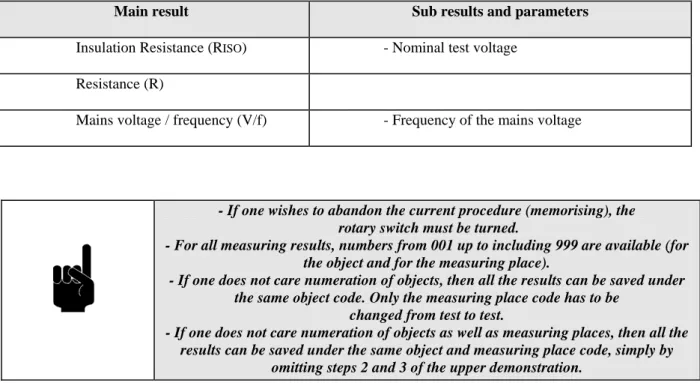
[Recall Result]-function. The list of the sub results and the parameters, which are saved to memory together with the main result, are shown in the following table:
Table 3: Sub results and parameters.
Main result Sub results and parameters
Insulation Resistance (RISO) - Nominal test voltage Resistance (R)
Mains voltage / frequency (V/f) - Frequency of the mains voltage
- If one wishes to abandon the current procedure (memorising), the rotary switch must be turned.
- For all measuring results, numbers from 001 up to including 999 are available (for the object and for the measuring place).
- If one does not care numeration of objects, then all the results can be saved under the same object code. Only the measuring place code has to be
changed from test to test.
- If one does not care numeration of objects as well as measuring places, then all the results can be saved under the same object and measuring place code, simply by
Utrecht
- Page 22 - Ref. 004
5.4
RECALLING OF MEMORISED RESULTS.
Each memorised result is equipped with an eventual sub result and parameters of the measurement (see table 4). Each function has an identification number (1 t/m 3 see figure below). The user is able to identify the function where the sub result belongs to. The identification number is displayed for a while only, before the recalled results are displayed.
Figure 2: Identification number of each function
Procedure how to recall memorised results:
Pressed key Comments
The last changed partial code (X.X.X of YYY), used for the recalling of results, is displayed.
Insert the desired code by using the [↑, ↓] keys if necessary.
Insert the desired code by using the [↑, ↓] keys if necessary. Confirm recalling pressing [Recall Result] key again.
Utrecht
- Page 23 - Ref. 004
First the identification number of a function is displayed for a while and then the main result will be displayed.
Check the other results saved under the same object and measuring place code by using the [↑, ↓] keys.
Form of the memory locations under a certain code X.X.X, YYY:
Result 1 + sub result; Result 2 + sub result; ... ... Result n + sub result
For detail information about codes we refer to the user manual delivered with the PATS-W Administration-Software.
- If one wishes to abandon the current procedure (recalling), the rotary switch must be turned.
- Use the [DISPLAY] key to check the sub results too.
5.5
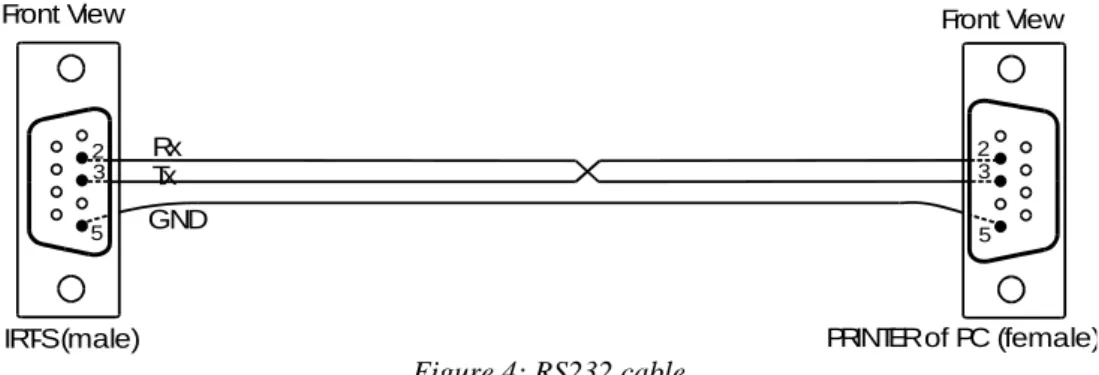
RS232 COMMUNICATION
2...Rx 3...Tx 5...GND
Utrecht - Page 24 - Ref. 004 2 2 3 3 5 5 Rx GND IRT-S(male)
Front View Front View
PRINTERof PC (female) Tx
Figure 4: RS232 cable
- connect the printer or the PC to the IRT-S using a RS232 cable, which is supplied with the PATS-W;
- set all communication parameters at the PC by using the PATS-W Administration Software that can be supplied by NIEAF-SMITT upon separate order;
- set the rotary switch of the IRT-S to the RS232-position, “ ” will be displayed; - press the [START] key in order to transfer the stored data to the PC or to the printer;
RS232 parameters
- baud rate 4800 Baud;
- format: 1 start bit, 8 data bits, 1 stop bit, no parity; - protocol: XON/XOFF. IRT-S Serial. Nr. 9621002 --- Date: --- Operator: --- Place: --- Note: --- Object: 001 Place: 001 --- Test 1 Testresult
Figure 5: An example of a print out
Utrecht
- Page 25 - Ref. 004
5.6
ERASING OF RESULTS
In order to avoid confusion, it is advisable to erase all stored results before starting new family of measurements. Sometimes only results stored under a certain object number or measuring place of the object are to be erased, or even only a recalled result has to be erased To prevent confusion it is important to follow the erasing procedure correctly.
All results are to be erased
Set the rotary switch in any position but the RS232 position.
Pressed key Comments
is flashing.
By pressing this key again, the clearing will be confirmed.
All results will be erased.
Only results of a certain object (YYY) are to be erased.
Set the rotary switch in any position but the RS232 position.Pressed key Comments
The last changed partial code (X.X.X of YYY), used for the recalling of the results, is displayed.
Use the [DISPLAY] key to select an object code (without dots) if necessary.
Insert the desired code by using the [↑, ↓] keys if necessary. “ ” is flashing.
Utrecht
- Page 26 - Ref. 004
Only results of a certain measuring place (X.X.X) of the object are to be erased.
The rotary switch in any position but the RS232 position.Pressed key Comments
The last changed partial code (X.X.X of YYY), used for the recalling of the results, is displayed.
Insert the desired object / measuring place code by using the [↑, ↓] keys.
Use the [DISPLAY] key to select a measuring place / object code.
Insert desired object / measuring place code by using the [↑, ↓] keys if necessary.
Use the [DISPLAY] key to select the already inserted measuring place code (with dots) if it is not already selected.
“ “ is flashing.
By pressing this key again, the clearing will be confirmed.
Only results of a certain measuring place of the object will be erased.
Only recalled result displayed is to be erased
Set the rotary switch in any position but the RS232 position.
Execute the following acts:
1. Recall the result under a certain measuring place and object code - follow the procedure under paragraph 5.6..
2. Use the [↑, ↓] keys to select the result which has to be erased. 3. Press the [Clear memory] key, “ “ is flashing. 4. Press the [Clear memory] key again to confirm the erasing.
Only the recalled result under a certain measuring place of the object is erased now. The next result saved under the same measuring place and object code is displayed.
- If one wishes to abandon the current procedure (recalling / clearing), the rotary switch position must be changed.
Utrecht
- Page 27 - Ref. 004
5.7
RESET OF THE INSTRUMENT
After inserting the batteries or if there is a malfunction noticed, it is advisable to reset the instrument. How to reset?
1. Switch off the instrument.
2. Press the [Clear memory] key and keep it pressed while you’re switching on the instrument. 3. is displayed for a while meaning the reset function has been effected.
- Performing the reset function means that all memory locations will be erased.
Parameters of all functions will be set to it’s default values as follows: - the nominal voltage for [RISO] function is set to 100V;
- the compensation of the test cords resistance is erased; - the measuring place identification number is set to 0.0.1; - the object identification number is set to 001.
Utrecht
- Page 28 - Ref. 004
5.8
TROUBLESHOOTING
Table 4 describes the different displayed fault messages of the tester. For each fault an explanation and cause is given. Faults, which demand technical qualified persons, are marked with a star (*). Defect fuses can only be exchanged by Nieaf Smitt bv. personnel.
When executing various tests, various warnings could be displayed. They are having the following meanings:
Table. 4. General faults and warnings
Display Cause
The external voltage is present (RISO or R function is selected). (flashing).
Out of range.
The battery voltage is lower than 4.3V → replace the batteries. All memory locations are empty.
The measurement place identification number (with dots).
The object identification number (without dots).
Full memory.
The clear function is active.
The reset of the instrument has been carried out or new batteries are inserted.
A broken fuse (in the [R]-function only *)
The used test cables were not compensated properly (in the [R]-function only). Negative result
Utrecht
- Page 29 - Ref. 004
5.9
CALIBRATION AND REPAIR
To warrant the technical specifications of the tester, we will advise you to calibrate the instrument at least once a year. It’s to be shown that the tested products are governed by an established test procedure.
The calibration will be executed by Nieaf-Smitt b.v.. In the calibration report the results, judgements, town, date and name of the reponsible person will be mentioned. There are no user replaceable parts in the instrument (batteries excepted)!
For calibration and/or service you can send your tester post-paid to your local dealer
Utrecht
- Page 30 - Ref. 004
6.
MAINTENANCE
Don’t replace parts yourself but call technical qualified persons (see paragraph 2.1.2).
6.1
BATTERIES REPLACEMENT
Exchange all four batteries. If there are memorised results in the instrument and the “BAT” mark appears then transfer them to an extern printer or PC first. The
batteries have to be changed within one minute!
Disconnect all cables (test cable or RS232 cable) before removing the battery cover. Caution, possible live parts under the battery cover
Throw, after using, the empty batteries in the special battery basket.
If the “BAT” mark appears at the display, it means that the battery voltage is lower than 4,3 V. Remove the old batteries and insert new ones. Procedure batteries replacement:
1. Disconnect all cables and cords, and remove the battery cover. 2. Remove the old batteries.
3. Place the new batteries in the battery holder. Always exchange all four batteries simultaneously.
Utrecht
- Page 31 - Ref. 004
Use the batteries declared in technical specification only.
If there is no chance to transfer the results (extern printer or PC not available), then follow the next procedure when changing batteries in order not to loose any stored data:
1. Switch off the instrument. 2. Remove the battery cover.
3. Exchange the batteries within one minute.
4. Place the battery cover back and switch on the instrument
5. should not be displayed after switching it on. The memorised results have not been erased now.
6.2
CLEANING
Do not use liquids based on petrol! Do not spill cleaning liquid over the instrument.
Utrecht
- Page 32 - Ref. 004
7.
ACCESSORY AND REPLACEABLE PARTS
Supplied standard set:
- according to EN 61010-2-31; one red measuringcord; - according to EN 61010-2-31; one red measuringprobe; - according to EN 61010-2-31; one black measuringcord; - according to EN 61010-2-31; one black measuringprobe; - one English user manual.
Check all the supplied items (enclosure of the instrument as well as the accessories). If there are any damages please return the tester to the supplier for exchange or service.
The IRT-S can only be used in combination with cables which are satisfied with the norm EN 61010-2-31.
Supplied options:
- RS232 cable, for data transfer and software; - PATS-W Administration-Software; - ETESTV.2
- Carrier bag; - Carrier suitcase. - Protective holster
Utrecht
- Page 33 - Ref. 004
Attachment 1
EU-DECLARATION OF CONFORMITY
Product: Insulation Resistance Tester
Identification of the instrument:
Trademark: Nieaf-Smitt bv. Model/Type: IRT-S
Nieaf-Smitt herewith declare that the instrument which this declaration refers to is in conformity with the following standards and according to the conditions of following Directives:
Low Voltage Directive (73/23/EEG) as last amended. EMC-Directive (89/336/EEG) as last amended.
VDE0701 IEC1010-1 EN 55022 class B NEN-EN 50081-1 NEN-EN 50082-1 IEC801-2 level 3 IEC801-3 level 2 IEC801-4 level 4
Place and date of issue Name and signature or equivalent stamp of authorised person.
Utrecht
- Page 34 - Ref. 004
Attachment 2 1/6
Circuit diagrams
-
Insulation resistance of telephone line measurement
Utrecht
- Page 35 - Ref. 004
2/6 -
Floor resistance measurement
Utrecht
- Page 36 - Ref. 004
3/6
- Insulation resistance of mains installations measurement
Utrecht
- Page 37 - Ref. 004
4/6 -
Insulation resistance of ground cable measurement
Utrecht
- Page 38 - Ref. 004
5/6 -
Low resistance measurement
Utrecht
- Page 39 - Ref. 004
6/6 -