CORROSION INHIBITION BY CARBOXYMETHYL
CELLULOSE
N. Manimaran
[a]*, S. Rajendran
[b,c], M. Manivannan
[d], J. Angelin Thangakani
[e]and A. Suriya Prabha
[f]Keywords: Carboxymethyl cellulose, carbon steel, ground water, SEM, AFM, F-Test, corrosion inhibition.
The inhibition efficiency (IE) of carboxymethyl cellulose (CMC)-Zn2+ system in controlling corrosion of carbon steel in ground water in
the absence and presence of Zn2+has been evaluated by weight loss method. The formulation consisting of 250 ppm CMC and 50 ppm Zn2+
has 98 % IE. A synergistic effect exists between CMC and Zn2+. Synergism has been confirmed by synergism parameter. AC impedance
spectra confirm the formation of protective film on the metal surface. The nature of the protective film has been characterized by scanning electron microscopy (SEM).
Corresponding Authors
E-Mail: [email protected], [email protected]
[a] Department of Chemistry, Yadava College, Madurai-625 014, Tamilnadu, India.
[b] PG and Research Department of Chemistry, GTN Arts College, Dindigul-624 005, Tamilnadu, India.
[c] Department of Chemistry, RVS School of Engineering and Technology, Dindigul-624 005,Tamil Nadu, India.
[d] Department of Chemistry, Chettinad College of Engineering and Technology, Karur – 639 114, Tamil Nadu, India. [e] CEOA Matric Hr Sec School, A. Kozakulam, Madurai-17,
Tamil Nadu, India.
[f] Department of Chemistry, Shanmuganathan Engineering, College, Arasampatti-622 507, Tamil Nadu, India. Chapters
INTRODUCTION
Corrosion can be defined as the destruction of metals and alloys by electrochemical reaction with its environment. Corrosion occurs because of the natural tendency of the metals to return back to their thermodynamically stable native state. It cannot be avoided, but it can be controlled and prevented by using appropriate preventive measures like cathodic protection, anodic protection, coating, alloying and using inhibitors, etc. Out of these methods, the inhibitors reduce the aggressiveness of the corrosion and harmful aqueous environment. Thus prevent the metal and alloy by the forming of a protective layer on the metal surface. The applications of inhibitors are mostly find applications in cooling water system and boiler water system.1,2 The
organic compounds containing hetero atoms like oxygen, nitrogen, phosphorus, halogen and sulphur, etc have been used as corrosion inhibitors to control the metals from corrosion.3-5 The compound carboxy methyl cellulose,6-8 has
been used as corrosion inhibitor for mild steel in various aqueous environments. Rajendran et al. have been investigated that the corrosion behavior of carbon steel in presence of carboxymethyl cellulose-1-hydroxyethane-1,1-diphosphonic acid.9 Moreover, the application of polymers
and their derivatives in corrosion controlling of metals and alloys in various aqueous environment have been investigated by various researchers.10-11
The present work is undertaken:
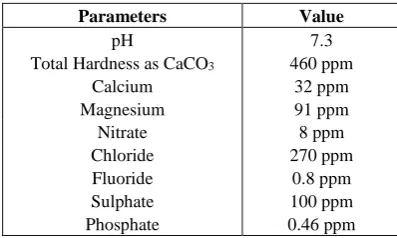
1) to evaluate the inhibition efficiency(IE) of CMC in controlling corrosion of carbon steel in ground water which is collected from Yadava college which is located at Madurai, Tamil Nadu, India (Table 1)
2) to study the synergism using synergism parameters.
3) to understand the mechanistic aspects of corrosion inhibition and formation of protective film on the metal surface by AC impedance spectra.
4) to analyze the protective film formed on the metals surface by scanning electron microscopy (SEM)
5) to propose a suitable mechanism for corrosion inhibition process.
EXPERIMENTAL
Preparation of the specimens
Carbon steel specimens (0.026 % S, 0.06 % P, 0.40 % Mn, 0.10 % C, and the rest iron) of dimensions 1.0 x 4.0 x0.2 cm were polished to mirror finish and degreased with trichloroethylene were used for both weight-loss method and surface examination studies. The environment chosen is ground water and the physico-chemical parameter of ground water is given in Table 1.
Table 1. Physico-chemical parameters of ground water
Parameters Value
pH 7.3
Total Hardness as CaCO3 460 ppm
Calcium 32 ppm
Magnesium 91 ppm
Nitrate 8 ppm
Chloride 270 ppm
Fluoride 0.8 ppm
Sulphate 100 ppm
Weight- loss method
Carbon steel specimens in triplicate were immersed in 100 mL of the ground water containing various concentrations of the inhibitor in the presence and absence of Zn2+ for 3 day.
The corrosion product was cleaned with Clark’s solution.12
The weights of the specimens before and after immersion were determined using an analytical balance, Shimadzu AY210 model. Then the Inhibition efficiency (IE) was
calculated using the equation (1).
where
W1=corrosion rate (mdd) in absence of inhibitor,
W2 = corrosion rate (mdd) in presence of inhibitor.
The corrosion rate (CR, in mdd) was calculated using the equation (2)
where
m - weight loss in mg
A- area of the specimen in dm2
t- Immersion period in days
Synergism Parameter (SI)
Synergism parameters are indications of synergistic effect existing between the inhibitors. SI value is found to be
greater than one suggesting that the synergistic effect between the inhibitors.13-14 The S
I value can be calculated
using the formula as follows:
where,
θ1+2 = (θ1+θ2) – (θ1θ2)
θ1 = surface coverage of inhibitor CMC
θ2 = surface coverage of inhibitor Zn2+
θ’1+2 = combined surface coverage of inhibitor
carboxymethyl cellulose (CMC) and Zn2+.
AC impedance measurements
AC Impedance study was carried out in Electrochemical Impedance Analyzer model CHI 660A using a three electrode cell assembly. The working electrode was used as a rectangular specimen of carbon steel with one face of the electrode of constant 1 cm2 area exposed. A saturated
calomel electrode (SCE) was used as reference electrode. A
rectangular platinum foil was used as the counter electrode. AC impedance spectra were recorded after doing iR compensation. The real part (Z’) and imaginary part (Z’’) of
the cell impedance were measured in ohms for various frequencies. The corrosion parameters such as charge transfer resistance (Rt) and double layer capacitance (Cdl)
values were calculated. During the AC impedance spectra, the scan rate (V s-1) was 0.005; Hold time at Ef (s) was zero
and quiet time (s) was 2.
Surface Characterization by Scanning Electron Microscopy (SEM)
The carbon steel immersed in blank and in the inhibitor solution for a period of one day was removed, rinsed with double distilled water, dried and observed in a scanning electron microscope to examine the surface morphology. The surface morphology measurements of the carbon steel were examined using HITACHI S-3000 H computer controlled scanning electron microscope.
RESULTS AND DISCUSSION
Analysis of results of weight loss study
The calculated inhibition efficiencies (IE) and corrosion rates (CR) of CMC in controlling corrosion of carbon steel immersed in ground water both in the absence and presence of Zn2+ ion are given in Table 2.
Table 2: Inhibition efficiencies (IE %) and Corrosion rates (CR) obtained from CMC - Zn2+ systems, when carbon steel is immersed
in ground water
CMC ppm
Zn2+, ppm
0 50
CR, mdd IE % CR, mdd IE, %
0 15.15 --- 12.88 15
25 13.64 10 5.30 65
50 12.57 17 3.64 76
75 11.51 24 2.12 86
100 9.85 35 1.52 90
125 8.33 45 0.91 94
250 7.88 48 0.30 98
The calculated values indicate the ability of CMC to be a good corrosion inhibitor. The IE is found to be enhanced in the presence of Zn2+ ion. CMC alone shows some IE. But
the combination of 250 ppm CMC and 50 ppm Zn2+ shows
98% IE. This suggests that a synergistic effect exists between CMC and Zn2+ ion.15-20
Synergism parameters (SI)
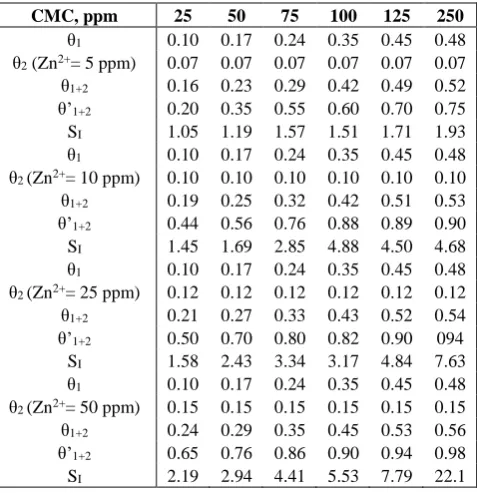
The synergism parameters of CMC-Zn2+ system are given
in Table 3. For different concentrations of inhibitors, SI
approaches 1 when no interaction between the inhibitor compounds exists. When S1 >1, it points to synergistic
effects. In the case of S1<1, it is an indication that the
synergistic effect is not significant. From Table 4, it is observed that value of synergism parameters (S1) calculated
from surface coverage were found to be one and above. This 2
(%) 100 1 (1)
1 W IE W
(2) m CR A t 1 1 2
(3)
I 1 '
indicates that the synergistic effect exists between CMC and Zn2+ ions.21
Table 3: Inhibition efficiencies and synergism parameters for various concentrations of CMC-Zn2+ system, when carbon steel
immersed in ground water
CMC, ppm 25 50 75 100 125 250
θ1 0.10 0.17 0.24 0.35 0.45 0.48
θ2 (Zn2+= 5 ppm) 0.07 0.07 0.07 0.07 0.07 0.07
θ1+2 0.16 0.23 0.29 0.42 0.49 0.52
θ’1+2 0.20 0.35 0.55 0.60 0.70 0.75
SI 1.05 1.19 1.57 1.51 1.71 1.93
θ1 0.10 0.17 0.24 0.35 0.45 0.48
θ2 (Zn2+= 10 ppm) 0.10 0.10 0.10 0.10 0.10 0.10
θ1+2 0.19 0.25 0.32 0.42 0.51 0.53
θ’1+2 0.44 0.56 0.76 0.88 0.89 0.90
SI 1.45 1.69 2.85 4.88 4.50 4.68
θ1 0.10 0.17 0.24 0.35 0.45 0.48
θ2 (Zn2+= 25 ppm) 0.12 0.12 0.12 0.12 0.12 0.12
θ1+2 0.21 0.27 0.33 0.43 0.52 0.54
θ’1+2 0.50 0.70 0.80 0.82 0.90 094
SI 1.58 2.43 3.34 3.17 4.84 7.63
θ1 0.10 0.17 0.24 0.35 0.45 0.48
θ2 (Zn2+= 50 ppm) 0.15 0.15 0.15 0.15 0.15 0.15
θ1+2 0.24 0.29 0.35 0.45 0.53 0.56
θ’1+2 0.65 0.76 0.86 0.90 0.94 0.98
SI 2.19 2.94 4.41 5.53 7.79 22.1
Analysis of AC impedance spectra
AC impedance spectra (electro chemical impedance spectra) have been used to confirm the formation of protective film on the metal surface. If a protective film is formed on the metal surface, charge transfer resistance (Rt)
increases; double layer capacitance value (Cdl) decreases and
the impedance log(Z/ohm) value increases. The AC impedance spectra of carbon steel immersed in ground water in the absence and presence of inhibitors (CMC-Zn2+) are
shown in Fig.1 to Fig. 3. The AC impedance parameters namely charge transfer resistance (Rt) and double layer
capacitance (Cdl) derived from Nyquist plots are given in
Table 4. The impedance value log (Z/ohm) derived from Bode plots are also given in Table 4.
Table 4. Impedance parameters for corrosion of carbon steel immersed in ground water in the absence and presence of inhibitors obtained by AC impedance spectra
System Nyquist plot Bode plot
Rt, cm2 Cdl, F cm-2 log (Z/ohm)
Ground Water 1962.3 2.5989 x 10⁻⁹ 3.297
Ground Water + CMC (250 ppm) + Zn2+ (50 ppm)
2081.9 2.4496 x 10⁻⁹ 3.340
It is observed that when the inhibitors [CMC (250 ppm) + Zn2+ (50 ppm)] are added, the charge transfer resistance (R
t)
increase from 1962.3 ohm cm2 to 2081.9 ohmcm2. The C dl
value decreases from 2.5989x10⁻⁹ Fcm-2 to 2.4496x10⁻⁹ F
cm-2. The impedance value [log(Z/ohm)] increases from
3.297 to 3.340. These results lead to the conclusion that a protective film is formed on the metal surface.22-25
Figure 1. AC impedance spectra of carbon steel immersed in various test solutions (Nyquist plot) a) Ground water b) Ground water + CMC (250 ppm) + Zn2+(50 ppm)
Figure 2. AC impedance spectra of carbon steel immersed in various testsolutions (impedance-Bode plot) a) Ground water (blank) b) Ground water + CMC (250 ppm) + Zn2+(50 ppm)
Figure 3. AC impedance spectra of carbon steel immersed in various testsolutions (Phase-Bode plot) a) Ground water, b) Ground water + CMC (250 ppm) + Zn2+ (50 ppm)
Scanning Electron Microscopy (SEM)
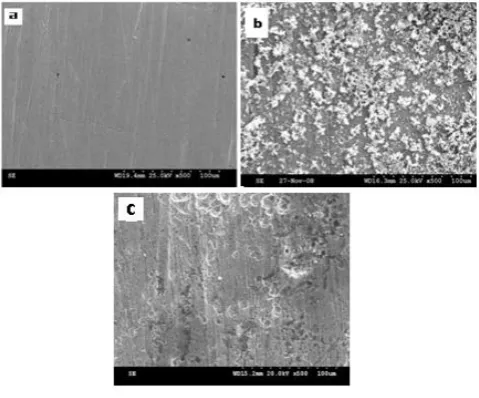
SEM provides a pictorial representation of the surface. To understand the nature of the surface film in the absence and presence of inhibitors and the extent of corrosion of carbon steel, the SEM micrographs of the surface are examined.26
the metal. This shows the absence of any corrosion products or inhibitor complex formed on the metal surface.
The SEM micrograph (X 500) of carbon steel specimen immersed in the ground water for one day is shown in Fig. 4 (b) and (c) respectively. The SEM micrograph of carbon steel surface immersed in ground water in Fig. 4 (b) shows the roughness of the metal surface which indicates the corrosion of carbon steel in ground water. The Fig. 4 (c)
indicates that in the presence of 250 ppm CMC and 50 ppm Zn2+ mixture in ground water, the surface coverage
increases which in turn results in the formation of insoluble complex on the metal surface. In the presence of CMC and Zn2+, the surface is covered by a thin layer of inhibitors
which effectively control the dissolution of carbon steel.27
Figure 4. SEM analysis of a) Polished Carbon steel (control); b) Carbon steel immersed in ground water (Blank); c) Carbon steel immersed in ground water + 250 ppm of CMC + 50 ppm of Zn2+
Mechanism of corrosion inhibition
Based on the above studies the following mechanism can be proposed for corrosion inhibition process.
Zn2+ - CMC + Fe2+ → Fe2+ - CMC + Zn2+
Zn2+ + 2 OH- → Zn(OH) 2 ↓
Protective film consists of Fe2+ - CMC complex and Zn(OH) 2
At anode: Fe → Fe2+ + 2e
-At cathode: H2O + ½ O2 + 2e- → 2 OH
-Fe2+ - CMC → CMC complex
It accounts for the synergism of CMC – Zn2+ system.
CONCLUSIONS
The present study leads to the following conclusions:
The formulation consists of 250 ppm of CMC and 50 ppm of Zn2+ offers 98% IE to carbon steel immersed in ground water.
Synergistic effect of exists between CMC and Zn2+.
AC impedance spectra reveal that the formation of protective film on the metal surface.
SEM study confirms the formation of protective film on the metal surface and hence the corrosion process is inhibited.
ACKNOWLEDGEMENTS
The authors are thankful to their respective managements.
REFERENCES
1Mars G., Fontana, Corrosion Engineering (Tata McGraw Hill
Education Private Limited, New Delhi, 2005).
2Pierre R., Roberge, Handbook of Corrosion Engineering,
(McGraw Hill, 2000).
3Thomas, J. G. N.,Proc. 5th Eur. Symp. Corr. Inhibitors, Ferrara, Italy, University of Ferrara, 1981, 453.
4Donnelly, B. E., Downie, T. C., Grzeskowaik, R., Hamburg, H. R.
and Short, D., Corr. Sci., 1997, 38, 109.
5Tadros, A. B., and Abdel-Naby Y., J. Electroanal. Chem., 1988,
224, 433.
6Umoren, S. A., Solomon, M. M., Udosoro, I. I., Udoh, A. P.,
Cellulose, 2010, 17(3), 635.
7Solomon, M. M., Umoren, S. A., Udosoro, I. I., and Udoh, A. P.,
Corr. Sci., 2010, 52(4), 1317.
8Bayol E., Gürten, A. A., Dursun M., Kayakirilmaz K., Wuli
Huaxue Xuebao/ Acta Physico - Chimica Sinica, 2008, 24(12), 2236.
9Rajendran S., Joany, R. M., Apparao, B. V., Palaniswamy N., Bull.
Electrochem., 2002, 18(1), 25.
10Khairou, K. S., El-Sayed A., J. Appl. Polym. Sci., 2003, 88(4),
866.
11El-Sayed A., Corr. Prevent. Cont., 1996, 43(1), 27.
12Wranglen G., Introduction to corrosion and protection of metals,
Chapman and Hall, London, 1985, 236.
13Benita Sherine H., Jamal Abdul Nasser A., and Rajendran S., Int.
J. Eng. Sci. Technol., 2010, 2(4), 341.
14Agnesia Kanimozhi S., and Rajendran S., Int. J. Electrochem.
Sci., 2009, 4, 353.
15Sahaya Raja A., Rajendran S., Nagalakshmi R., Angelin, T. J.,
Pandiarajan M., Eur. Chem. Bull.,2012, 1(3), 130-136.
16Bouyanzer A., Hammouti B., and Majidi L., Mater. Lett., 2006,
60(23), 2840.
17Satapathy, A. K., Gunasekaran G., Sahoo, S. C., Kumar A., and
Rodrigues, P. V., Corr. Sci., 2009, 51(12), 2848.
18de Souza, F. S., Spinelli A., Corr. Sci.,2009, 51(3), 642.
19Sathiyabama J., Rajendran S., Selvi, J. A., Jeyasundari J., The
Open Corr. J., 2009, 2, 76.
20Nithya, A., Rajendran, S., Bulg. Chem. Comm., 2010, 42(2), 119. 21Manivannan M., and Rajendran S., J. Chem. Bio. Phy. Sci.,2011,
1(2), 241.
22Joseph Raj X., and Rajendran N., Int. J. Electrochem. Sci., 2011,
23Weihua Li, Lichao Hu, Shengtao Zhang and Baorong Hou,Corr.
Sci., 2011, 53(2), 735.
24Rajendran S., Anuradha K., Kavipriya K., Krishnaveni A.,
Angelin Thangakani J., Eur. Chem. Bull.,2012, 1(12), 503-510.
25Chauhan, L. R., and Gunasekaran G., Corr. Sci., 2007, 49(3),
1143.
26Manivannan M., Rajendran S., and Suriya Prabha A., Eur. Chem.
Bull.,2012,1(8), 317-329.
27Fallavena T., Antonow M., Gonçalves, R. S., Appl. Surf. Sci.,
2006, 253, 566.