European Journal of Physical Education and Sport Science
ISSN: 2501 - 1235 ISSN-L: 2501 - 1235 Available on-line at: www.oapub.org/edu
doi: 10.5281/zenodo.3739527 Volume 6 │ Issue 3 │ 2020
INVESTIGATION OF IMAGERY STATUS OF
AMATEUR SOCCER PLAYERS
Yavuz Selim Ağaoğlu1, Mehmet Kargün2, Osman İmamoğlu3
1,2Gaziosmanpaşa University, Faculty of Sport Sciences,
Tokat, Turkey 3Yaşar Doğu Faculty of Sports Sciences, Ondokuz Mayıs University, Samsun, Turkey
Abstract:
The present study tries to explain what imagery is and how commonly it is used by athletes to increase performance. This study aims to provide information that imagery
(mental visualization) is a very powerful tool to increase athletes’ performance and to
provide guidance based on sport psychology. The aim of the present study is to determine the types and levels of using imagery in sport in amateur league Soccer players. Sport Imagery Questionnaire was given to a total of 190 Soccer players aged between 18 and 35 who were playing in amateur leagues of Samsun province. In the study conducted, no significant difference was found between the ages of female and male amateur Soccer players (p>0.05). At the same time, no significant difference was found between their sport years (p>0.05). In addition, no significant difference was found in motivational general mastery (MG- M) and (MS) in terms of gender and in the comparison of imagery scores in terms of age category and sport years (p<0.05). Conclusion: It is concluded that the visualization status of amateur Soccer players varies slightly according to gender, age group and year of sports. It was observed that the visualization scores were better as the age of sports increased. It is thought that starting sports at earlier contributes to the good visualization scores. It may be suggested that children should be directed to Soccer at an earlier age.
Keywords: soccer, imagery, sport
1. Introduction
People aren’t passive recipients of emotions. They hold attitudes and beliefs that
an emotion is harmful, they might try to avoid it or situations that increase the likelihood of experiencing it. If individuals believe an emotion is helpful, they might engage in behaviors that increase its intensity or duration (Goodman et al., 2020, Tamer et al., 2019). A great number of famous athletes, some of them including Mark McGuire, Michael Jordan, Tiger Woods and Chris Evert, have attributed a part of their success to using mental images (mental visualization) and some psychological parameters (Beauchamp et al., 2002; Çavuşoğlu et al., 2017). Researches and applied studies
conducted have shown that sport related imagery can be developed through training (Morris et al., 2004). A great number of studies have examined the relationship between imagery and sport performance (Martin et al., 1999). A comprehensive data base has emerged related with how athletes use imagery (mental visualization) in training and imagery performance (Jordet, 2005). Athletes believe in getting any advantage to win and they believe that a few psychological techniques give them this advantage to do this. One of these is using imagery (mental visualization). Mental skills form, socialization and happiness significant foundations to ensure successful competitive performance (Hall et
al., 2009; Doğan et al., 2018).
Imagery is generally considered as “the cornerstone of sport psychology study field”
(Cornelius, 2002). Imagery is used in every level by athletes as a common mental training tool (Munroe-Chandler and Hall, 2007). Imagery is considered as one of the ways facilitating learning in sport. Imagery is used as an applied field of sport psychology studies and an important component of mental preparation (Morris et al., 2004). Although the term imagery is used in a broad sense, imagery (mental visualization) used for sport performance is expressed as “imagery in sport” (Taylor and Wilson, 2005). Some
other terms such as mental practice, mental rehearsal, visualization and some recreational activities have also been used to refer to various components of imagery in sport (Omar-Fauzee et al., 2009; Aksoy et al., 2017; Kabadayı et al., 2017). Imagery is the skill of forming an idea or picture in the mind (Gawain, 2007) and visualizing (Mcıntyre
and Moran, 2001). It is the process of learning or perfecting any movement without any
exercise by visualizing it in a planned and intensive way and mentally (İkizler and
Karagözoğlu, 1997; Esentaş et al., 2018). From where the athlete remembers and reconstructs the pieces of information stored in memory is important to create a meaningful imagery because previous experiences of most of the athletes are recalled in a vivid and detailed way through imagery (Omar-Fauzee et al., 2009).
Imagery process and capacity of athletes enables their mental training program to be more efficient. The capacity and skill of managing an imagery process is a decisive feature to maximize the effectiveness of the imagery program (Morris, et al., 2004). The
ability to visualize is defined as “the evaluation of the individual in terms of the capacity to create images and sensory and emotional characteristics for generations”. Athletes should have
at least moderate capacity to create and maintain clear visualizations in the mind and to control these with various sensory methods (Budnik-Przybylska et al., 2014; Özaslan et
al., 2017). Imagery is a significant determiner of the athlete’s exercise behavior related
self-sufficiency and motivation in sport, exercise, dance and rehabilitation. While it is generally used in terms of its cognitive and motivational characteristics, athletes use imagery in a way that will lead them to skills of knowing and improving themselves and thus ease and revive their performance (Omar-Fauzee, et al., 2009). An individual’s
mental visualization skill can determine that person’s efficiency in terms of his/her
participation and interest in mental practices. It has been reported that especially individuals who are interested in imagery and who find imagery practices easy make more use (for example improved performance) of imagery (Robin et al., 2007). For this reason, while developing effective imagery studies, the skill of visualization is an important factor that should be taken into consideration. However, it is not enough only to use imagery to get the desired effect on performance. For this reason, Martin et al. (1999) developed a practical imagery use model to guide the imagery practice and to increase the efficiency of this practice (Gregg and Clark, 2007). There are two different perspectives an athlete can take while performing mental imagery; external or internal perspective.
Mahoney and Avener (1977) defined imagery in terms of external perspective as watching a past performance as a film or video. On the other hand, internal perspective is defined as watching like it is in their bodies and experiencing all these feelings that can be expected from the actual situation (Cumming and Ste-Marie., 2001). Strategies can be applied according to individual differences and needs of athletes such as self-confidence,
relaxing, motivation, goal setting and concentration (Altıntaş and Akalan, 2008; Bostanci
et al., 2019). Imagery is a part of the sport psychology skill (mental skill) which enables athletes to achieve success in their tournaments or matches (Omar-Fauzee et al., 2009). Paivio (1985) suggested an analytical frame which explains the functions of imagery and which can provide answers to the question of how and why mental imagery works and stated that both through cognitive (for exp. skill and strategy repetition) and motivational (for exp. self-confidence, stimulation, goal setting) mechanisms imagery can affect behavior in general or at a specific level. Based on Paivio’s studies and other existing
literature on imagery, a series of researches were made and it was concluded that imagery fulfils five main functions; (a) cognitive specific (for exp., specific sport skills), (b) cognitive general; (for exp., strategies about competition),(c) motivational specific (for exp., specific goals and goal oriented behavior), (d) motivational general arousal (feelings of relaxing, stress, anxiety and arousal) and (e) motivational general mastery (for exp. self-confidence, effective coping, mental satiety, focusing and control) (Barrow et al., 2007). Although it can serve both cognitive and motivational functions, it is known that athletes generally use imagery for motivational purposes. Such a function increases self-confidence or more specifically self-sufficiency. Athletes who perform imagery more frequently know their personal characteristics in higher levels and develop their self-confidence (Williams and Cumming, 2012). Today, many athletes and coaches believe in the power of imagery in sport performance. Athletes in many different branches attribute at least some part of their success to their use of imagery (Omar-Fauzee, et al., 2009).
have shown that a great number of athletes use imagery and consider it as an important psychological skill. Researches have shown a positive association between imagery and some psychological characteristics, such as the self-confidence of the athlete (Callow and
Hardy, 2001). In addition, associations between athletes’ imagery states and self
-confidence levels have been investigated (Abma et al., 2002). When the athlete’s self -confidence increases, his/her performance also increases (Chapman et al., 1997). Imagery has been a well-researched topic for adult athletes, especially elite athletes, for the last fifty years. However, there are limited number of studies investigating the use of imagery for young athletes (Munroe-Chandler et al., 2005). A great number of qualitative and quantitative researches have been conducted on the issue. It has been found in these studies that the systematic use imagery is associated with performance improvement. These improvements have been found not only in the fields of motor performance and skill acquisition, but also in the fields of improvement in concentration and decrease in anxiety. There are a great number of reports on the efficiency of mental imagery in the improvement of sport performance in addition to positive experimental findings. As a
result of these, imagery generally is included in athletes’ mental training program as skill
acquisition and performance increasing strategy (Weinberget al., 2003)
2. Material and Method
2.1 Participation
Sport Imagery Questionnaire, which was developed by Hall et al. (2009) was given to a total of 190 Soccer players who were between the ages of 18 and 35 and who were playing in Samsun amateur leagues. The questionnaire was applied through face-to-face interview with the athletes who participated in the study. The interviews were conducted
before athletes’ trainings. The questionnaires were given to the coaches of the teams and
the athletes filled in the questionnaires with the help of their coaches who were informed about how to fill in the questionnaire. The questionnaires which were filled in were collected from the coaches.
2.1.1 Sport Imagery Questionnaire- SIQ
The original questionnaire includes five sub-dimensions and 30 questions. Turkish validity and reliability study of the questionnaire was conducted by Kızıldağ and Tiryaki
M): Includes higher level of motivational skills. It is known that athletes who use this kind of imagery more have more skills related with mastery (Kartal, et al., 2017). In the present study, internal consistency values calculated with Cronbach alpha were .82 for cognitive specific sub-dimension, .81 for motivational specific sub-dimension, .72 for motivational general arousal sub-dimension and as .60 for motivational general mastery sub-dimension.
2.2 Statistical Analysis
Values are expressed as frequency, percentage or mean, standard deviation.
Shapiro-Wilk’s test was used, histogram and q-q plots were examined to assess the data
normality. To compare the differences between/among groups, independent samples t test or one-way ANOVA were used for continuous variables. Analysis were conducted using Statistical analysis was performed by using commercial software. p<0.05 was considered as statistically significant.
3. Results
Table 1: Distribution of age and sport year by gender
Variables Gender n Mean±SD t p
Age (year) Female 55 24.42±3.36 -0.56 0.489
Male 135 24.75±2.81
Sport year Female 55 8.11±3.04 -0.58 0.658
Male 135 8.43±4.99
No significant difference was found between ages and sport years (p>0.05).
Table 2: Comparison of imagery scores by gender
Variables Gender n Mean±SD t p
Cognitive Specific (CS) Female 55 52.73±7.97 1.12 0.160 Male 135 50.88±8.3
Motivational Specific (MS) Female 55 30.66±4.58 1.68 0.040* Male 135 28.68±6.46
Motivational General Arousal (MG- A) Female 55 21.34±4.83 0.54 0.495 Male 135 20.82±4.72
Motivational General Mastery (MG- M) Female 55 19.04±2.83 2.14* 0.009 Male 135 17.55±3.76
Total Female 55 123.78±15.79 1.74 0.030*
Male 135 117.92±17.16
While significant difference was found in “motivational specific” (MS) and total score in
Table 3: Comparison of imagery scores by age category
Variables Age category n Mean±SD t p
Cognitive Specific (CS) 18-24 years 125 47.59±8.36 0.78 0.276
25 + 65 46.24±7.5
Motivational Specific (MS) 18-24 years 125 27.69±5.44 2.62* 0.001* 25 + 65 24.44±6.79
Motivational General Arousal (MG- A) 18-24 years 125 19.86±4.56 2.73* 0.001*
25 + 65 17.2±4.78
Motivational General Mastery (MG- M) 18-24 years 125 16.68±3.51 0.64 0.371
25 + 65 16.2±3.48
Total 18-24 years 125 111.83±17.07 2.20* 0.002*
25 + 65 104.1±14.39
In the comparison of imagery scores by age group, while significant difference was found
in “motivational specific (MS)”, “motivational general arousal (MG- A)” and “total”
scores (p<0.05), no significant difference was found in the other sub-dimensions (p>0.05).
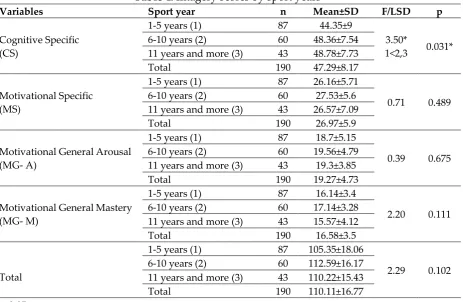
Table 4: Imagery scores by sport years
Variables Sport year n Mean±SD F/LSD p
Cognitive Specific (CS)
1-5 years (1) 87 44.35±9
3.50*
1<2,3 0.031* 6-10 years (2) 60 48.36±7.54
11 years and more (3) 43 48.78±7.73
Total 190 47.29±8.17
Motivational Specific (MS)
1-5 years (1) 87 26.16±5.71
0.71 0.489 6-10 years (2) 60 27.53±5.6
11 years and more (3) 43 26.57±7.09
Total 190 26.97±5.9
Motivational General Arousal (MG- A)
1-5 years (1) 87 18.7±5.15
0.39 0.675 6-10 years (2) 60 19.56±4.79
11 years and more (3) 43 19.3±3.85
Total 190 19.27±4.73
Motivational General Mastery (MG- M)
1-5 years (1) 87 16.14±3.4
2.20 0.111 6-10 years (2) 60 17.14±3.28
11 years and more (3) 43 15.57±4.12
Total 190 16.58±3.5
Total
1-5 years (1) 87 105.35±18.06
2.29 0.102 6-10 years (2) 60 112.59±16.17
11 years and more (3) 43 110.22±15.43
Total 190 110.11±16.77
*p<0.05
While significant difference was found in “cognitive specific (CS)” sub-dimension in
4. Discussion
Imagery is one of the effective ways of increasing sport performance. There are some different types of imagery that can be used by athletes. These have different effects on performance and self-confidence. In order to make use of imagery types in the best way, images should be applied in a consisted, purposeful and structured way and at the same time they should be as realistic as possible. Sport psychologists often report that athletes need to practice more imaging before trying to use imagery in competitions. In the present study, no statistically significant difference was found between the ages and sport years of female and male amateur Soccer players (p>0.05). On the other hand, when imagery scores were compared by gender, while significant difference was found in
“motivational specific” (MS) sub-dimension (p<0.05), no significant difference was found
in the comparison of imagery scores in terms of age category and sport year (P<0.05). Both beginner and advanced level mountain climbing athletes use their MS imagery levels significantly less than athleticism athletes. In fact, MS sub-scale represents the greatest inconsistency between imagery used by mountaineers and athleticism athletes (Ewert, 1985). While significant difference was found in “motivational specific” (MS) and “total” scores in the comparison of imagery scores by gender (p<0.05), no significant difference was found in other sub-dimensions (p>0.05).
In other conducted studies, significant differences were found between gender and sport branches related with imagery use and efficiency. In another study, no
significant association was found between gender and imagery skills (Sarı, 2015). For this
reason, these factors should be considered while making decisions about imagery use and efficiency (Weinberg et al., 2003). In addition, no significant difference was found in the present study in the comparison of imagery scores by gender for general mastery (MG- M) and (MS) and by age category and sport year for (MG- M) (p<0,05). On another study, it was found in MG-M imagery sub-scale that athletics athletes used more MG-M images than mountaineers. In addition, Martin and Gill (1991) found that athletics athletes reported high levels of athlete confidence and self-sufficiency. In a study conducted to analyze the imaging and attention capacities of badminton players, it was found that while there were no significant differences between gender and imagery in badminton players, motivational specific imagery capacity of female players were found to be higher than that of male players in reaching a successful performance goal (Bastug, Agilonu, Balkan, 2017). A significant association was found between sport ages of badminton players for cognitive imagery and motivational general mastery. As cognitive imagery values increased, motivational general arousal values were also found to increase. As motivational general mastery scores increased, motivational specific scores also increased. When athletes face a self-confidence problem or a problem in competitions, their motivational general competences increase. Their goal-based imagery
and motivational specific imagery increases positively (Kolayiş et al., 2015)
Another study examined the effects of elite athletes’ imagery tries to develop
success on their problems solving skills and found that imagery tries had positive effects
conducted on badminton players, it was found that imagery developed players’ self -confidence (Callow and Hardy, 2001). Imagery studies cause high performance on some Soccer skills (such as pass, tempo and shooting) of athletes between the ages of 7 and 14 (Munroe-Chandler et al., 2012). Furthermore, imagery use and regular physical activity were as effective as physical practice in improving soccer dribbling performance and some social status (Munroe-Chandler et al., 2005; Aksoy and Ziyagil, 2017). A great number of top-level athletes have good levels of imagery skills because before they represent their countries, they gain experience in tournaments and competitions (Omar-Fauzee, et al., 2009). Athletes who practice and use their imagery skills in top levels will show great improvement in sport performance (Omar-Fauzee, et al., 2009). In one study, it was found that imagery was used as a mediator technique to increase self-confidence. In addition, it was found that athletes used MG-M type images consciously and top-level athletes used more conscious images (Mamassis and Doganis, 2004).
Athletes who evaluate and re-evaluate their feelings more frequently tend to show higher skills, strategy, effect and mastery imaging ability. There is a strong association between re-evaluation and mastery imaging ability (Anuar et al., 2017). For this reason, the results obtained in the later images of athletes who tend to re-evaluate their performance skills frequently emphasize the positive association between re-evaluation and the two sub-dimensions. It is possible for athletes to remember these more easily. The third highest association with evaluation is the presence of a perfect imaging ability. When an athlete re-evaluates emotions, it won’t be surprising if there is a change of
emotions (Anuar, et al., 2017). While cognitive anxiety was directly and negatively predicted with mastery imaging ability, direct and positive effect was predicted with the
athlete’s imaging ability. While athletes increase their adaptation by using positive
images, individuals with weak mastery imaging ability may not be able to change their anxiety by using positive images or individuals with low self-confidence cannot change or transform a spontaneous negative imagery (Hanton, Stephen and Hall, 2004; Bostanci, 2014). Individuals with high self-confidence have been found to use all imagery functions better than the group with low self-confidence and statistically significant differences have been found for CS and MG-A. In this study, which was conducted by using modified SIQ, averages have shown that the group with high self-confidence used more CS than the group with low-self-confidence. On the other hand, it was found that the group with low confidence used more MG-A and MS than the group with high self-confidence (Short and Short, 2005).
Another study showed that the evidence in sport psychology studies indicated that self-confidence was associated with imagery content. In addition, more questions on how we can maximize the uses of imagery will be important for examining the useful and complicated psychological skills of mental images in future studies (Abma et al., 2002). Sports activities can reduce perceived stress. In a study, found Pilates and aerobic exercises contributed positively to the body image in obese women (Çetinkaya and
İmamoğlu, 2018). In addition to differences in role and movement quality imagery,
role and movement quality imagery). A possible explanation for this finding may be that imagery is used and encouraged more openly by dance instructors than sport trainers (Nordin and Cumming, 2008). Irrespective of the type of imagery, high-level dancers perform imagery more often than low-level dancers. This thought seems to be consistent with previously conducted studies on dance, aesthetic sport and more generally sport (Nordin and Cumming, 2008). In previously conducted studies, positive association was found between imagery frequency and exercise behavior for each imagery type (Cumming, 2008).
Individuals who perform imagery in confidence to complete a training (for exp. self-sufficiency imagery) gain higher level of “coping” self-sufficiency levels (that is, coping and timing by using self-sufficiency). Similarly, individuals who work on how to make an exercise by using imagery (that is, exercise technique images) show more self-confidence while performing different aspects of exercise. With the partial support of this hypothesis, technical images have been associated with a greater task competence. That is, individuals who report a greater self-confidence about their ability to perform exercise activity at the same time tend to be more interested in technical imagery. At the same time, individuals who performed images of their health and appearance more frequently reported more self-confidence in their ability to exercise under deterrent and compelling conditions (Cumming, 2008). Education can contribute to the positive reflections of the
body image (İmamoğlu and Demirtaş, 2017). In another study, it was reported that
motivational general mastery studies can affect self-sufficiency performance. Increased self-sufficiency will cause an athlete to set higher goals, to show more effort and to continue flexibly in the face of difficulties. All these will contribute to an increase in performance (Beauchamp, et al., 2002).
5. Conclusion
It is concluded that the visualization status of amateur Soccer players varies slightly according to gender, age group and year of sports. It was observed that the visualization scores were better as the age of sports increased. It is thought that starting sports at earlier contributes to the good visualization scores. It may be suggested that children should be directed to Soccer at an earlier age.
References
Abma, C. L., Fry, M. D., Li, Y. and G. Relyea (2002). Differences in Imagery Content and Imagery Ability between High and Low Confident Track and Field Athletes. Journal of Applied Sport Psychology, 14: 67–75.
Aksoy, Y., Çankaya, S. and Tasmektepligil, M. Y. (2017). The Effects of Participating in Recreational Activities on Quality of Life and Job Satisfaction. Universal Journal of Educational Research, 5(6):1051-1058.
Aldemir, Y. G., Biçer, T. and E. K. Kale. (2014). Futbolcularda İmgeleme Çalışmalarının
Problem Çözme Üzerine Etkisi. Spor ve Performans Araştırmaları Dergisi 5(2): 37
-45.
Altıntaş, A. and C. Akalan (2008). Zihinsel Antrenman ve Yüksek Performans. Spormetre
Beden Eğitimi Ve Spor Bilimleri Dergisi, 6(1): 39-43.
Anuar, N., Cumming, J. and S. Williams. (2017). Emotion Regulation Predicts Imagery Ability. Imagination, Cognition and Personality: Consciousness in Theory, Research, and Clinical Practice Vol. 36(3), 254–269.
Barrow, M. A., Weigand, D. A., Thomas, S., Hemmings, B. and M. Walley (2007). Elite and Novice Athletes' Imagery Use in Open and Closed Sports. Journal of Applied Sport Psychology 19(1):93-104
Bastug, G., Agilonu, A., and N. Balkan (2017). A Study of Attention and Imagery Capacities in Badminton Players. Turkish Journal of Sport and Exercise. Volume: 19 - Issue: 2 - Pages: 307-312.
Beauchamp, M. R., Bray, S. R. and J. G. Albison (2002). Pre-Competition Imagery, Self-Efficacy and Performance in Collegiate Golfers. Journal of Sports Sciences, 20, 697- 705.
Bostanci, Ö. (2014). Trait anxiety levels of university students studying at sports departments. Educational Research and Reviews, 9(20):10-21.
Bostancı, Ö., Karaduman, E. And Mayda, M. H. (2019). Investigation of self confidence
levels in elite extreme athletes. Physical education of students, 23(3):106-111. Budnik-Przybylska, D., Karasiewicz, K., Morris, T. and A. Watt (2014). Reliability, Factor
Structure, and Construct Validity of the Polish Version of the Sport Imagery Ability Measure. Current Issues in Personality Psychology 4(4):196-207.
Callow N. and L. Hardy (2001). Types of Imagery Associated with Sport Confidence in Netball Players of Varying Skill Levels. Journal of Applied Sport Psychology, 13 (1): 1-17.
Cavusoglu, G., Yılmaz, A. K., Kabadayı, M., Abacı, H. S. and Tasmekteplıgıl, M. Y. (2017).
Comparison of narcissism levels of students in the faculty of sports sciences in terms of some demographic variables. Turkish Journal of Sport and Exercise, 19(2):150-156.
Çetinkaya G., İmamoğlu G. (2018). Investigation of The Effect of Plates-Aerobic Exercises on Body Composition and Body Image in Obesity Female, The Journal of International Social Research, Volume: 11 Issue: 59, pp.1451-1456,
Chapman C., Lane, A. M., Brierley, J. H. and P. C. Terry (1997). Anxiety, Self-Confidence and Performance in Tae Kwon-Do. Percept Mot. Skills. Dec;85(3 Pt 2):1275-8. Cornelius, A. (2002). Interventions Techniques in Sport Psychology. In Psychological
Foundations of Sport, Edited By: Silva, J. M. And Stevens, D. E. 177–196.
Cumming, J. (2008). Investigating the Relationship between Exercise Imagery, Leisure-Time Exercise Behavior, and Self-Efficacy. Journal of Applied Sport Psychology, 20: 184–198.
Doğan, E., Yılmaz, A. K., Kabadayı, M. and Mayda, M. H. (2018). Spor bilimleri
öğrencileri ile farklı fakültelerde okuyan öğrencilerin sosyalleşme ve mutluluk
düzeylerinin incelenmesi. Kafkas Üniversitesi Sosyal Bilimler Enstitüsü Dergisi, 22:403-411.
Esentaş, M., Pınar, G., Vural, M. (2018). Popüler Kültürde Rekreatif Bir Etkinlik Olarak
Dijital Sporlar. Atatürk Üniversitesi Beden Eğitimi ve Spor Bilimleri Dergisi. 20
(1): 71-79.
Ewert, A. (1985). Why People Climb: The Relationship of Participant Motives and Experience Level to Mountaineering. Journal of Leisure Research, 17(3), 241-250.
Goodman, F. R., Kashdan, T. B., & İmamoğlu, A. (2020). Valuing Emotional Control in
Social Anxiety Disorder: A Multimethod Study of Emotion Beliefs and Emotion
Regulation. Emotion. Advance online publication.
http://dx.doi.org/10.1037/emo0000750
Gregg M. J. and T. Clark (2007). Theoretical and Practical Applications of Mental Imagery. International Symposium on Performance Science. 296-299.
Hall, C. R., Munroe-Chandler, K. J., Cumming, J., Law, B., Ramsey, R. and L. Murphy. (2009). Imagery and Observational Learning Use and Their Relationship to Sport Confidence. Journal of Sports Sciences. Volume 27, Issue 4.
Hanton, S., Stephen, M. and R. Hall (2004). Self-Confidence and Anxiety Interpretation: A Qualitative Investigation. Psychology of Sport and Exercise 5(4):477-495.
İkizler, C., and C. Karagözoğlu (1997). Sporda Başarının Psikolojisi (3. Baskı). İstanbul:
Alfa Basım Yayım Dağıtım, p.119.
İmamoğlu G., Demirtaş Ö. (2017). Investigation of Students' Views Who Receive Art and
Religious Training about Body Image, International Journal of Cultural and Social Studies (IntJCSS), 3 (SI): 476-483.
Jordet, G. (2005). Perceptual Training in Soccer: An Imagery Intervention Study with Elite Players. Journal of Applied Sport Psychology, 17: 140–156.
Kabadayı, M., Eski, T., Bayram, L., Yılmaz, A. K. and Mayda, M. H. (2017). Analysis of
the factors which influence participation of university students in recreational activities. European Journal of Education Studies.
Karademir, T., Kayabaşı, A., Vural, M. (2019). Ortaöğretim Öğrencilerinin Şiddet Eğilim
Durumlarının Belirlenmesi. Gaziantep Üniversitesi Spor Bilimleri Dergisi, 4 (2):
243-254.
Kartal, Z., Güvendi, B., Türksoy, A., and E. E. Altıncı (2017). Takım Sporcularının
İmgeleme Kullanımları İle Başarı Motivasyonları arasındaki İlişki. İÜ Spor
Bilimleri Dergisi, Cilt (Vol) 7, Sayı (No) 1 1303-1414
Kızıldağ E., and M.Ş. Tiryaki(2012). Sporda İmgeleme Envanterinin Türk Sporcular İçin
Kolayiş H., Sarı I., and Ö. Köle (2015). Investigating the Relationship Among Imagery, Motivation and Anxiety in Female Athletes from Team Sports. Ankara Üniversitesi, Spor Bilimleri Fakültesi,; 13(2): 129-136.
Mamassis, G. and G. Doganis (2004). The effects of a mental training program on juniors pre competitive anxiety, self-confidence and tennis performance. Journal of Applied Sport Psychology, 16, 118-137.
Martin, K. A., Moritz, S. E. and C. Hall (1999). Imagery Use in Sport: A Literature Review and Applied Model. The Sport Psychologist, 13, 245.268
Mcıntyre T. E., and A. P. Moran (2007). A Qualitative Investigation of Meta-Imagery Processes and Imagery Direction Among Elite Athletes. J Imagery Res Sport Phys Activ, 2(1): 1-20
Morris, T., Spittle, M., & C. Perry (2004). Mental Imagery in Sport. In: T. Morris, & J. Summers (Eds.), Sport Psychology: Theory, Applications, and Issues (2nd Ed., Pp. 344-383)
Munroe-Chandler, K. J. and C. R. Hall (2007). “Psychological Interventions in Sport”. In
Introduction to Sport Psychology: A Canadian Perspective, Edited By: Crocker, P. 184–213.
Munroe-Chandler, K. J., Hall, C. R., Fishburne, G. J., Murphy, L., and N. D. Hall (2012).
Effects of a Cognitive Specific Imagery İntervention on the Soccer Skill
Performance of Young Athletes: Age Group Comparisons. Psychology of Sport and Exercise, 13(3), 324–331.
Munroe-Chandler, K. J., Hall, C. R. Fishburne, G. J. and V. Shannon (2005). Using Cognitive General Imagery to Improve Soccer Strategies. European Journal of Sport Science, March; 5(1): 41-/49.
Nordin, S M. and J. Cumming (2008). Exploring Common Ground: Comparing the Imagery of Dancers and Aesthetic Sport Performers. Journal of Applied Sport Psychology, 20: 375–391.
Omar-Fauzee, M. S., Wan Daud, W. R. B., Abdullah, R. and S. A. Rashid (2009). The Effectiveness of Imagery and Coping Strategies in Sport Performance. European Journal of Social Sciences, Volume 9, Number 1.
Özaslan, B. R., Biçer, M., Özdal, M., Vural, M., & Şan, G. (2017). Investigation of visual
and auditory simple reaction time of individuals with mental retardation. European Journal of Special Education Research. 2 (3): 68-76.
Paivio, A. (1985). Cognitive and Motivational Functions of Imagery in Human Performance. Canadian Journal of Applied Sport Sciences, 10, 225-285.
Robin, N., Dominique, L., Toussaint, L., Blandin, Y., Guillot, A and M. Le Her (2007). Effects of Motor Imagery Training on Service Return Accuracy in Tennis: The Role of Imagery Ability, International Journal of Sport and Exercise Psychology, 5(2).
Sarı I. (2015). An investigation of imagery, intrinsic motivation, self-efficacy and
performance in Athletes. Anthropologist, 20(3): 675-688.
Taylor, J and G. Wilson (2005). Applying Sport Psychology: Four Perspectives. 117-134. Champaign, IL: Human Kinetics.
Weinberg, R., Butt, J., and Knight, B., Burke K. L. and A. Jackson (2003). The Relationship between the Use and Effectiveness of Imagery: An Exploratory Investigation. Journal of Applied Sport Psychology, 15: 26.40.
Creative Commons licensing terms