ESL Teachers as Theory Makers: A Discourse
Analysis of Student Assignments in a Second
Language Acquisition Course
Paul Markham University of Kansas, USA
Mary Rice University of Kansas, USA
Behnaz Darban University of Kansas, USA
Abstract—Second Language Acquisition (SLA) knowledge is necessary in order to increase the likelihood that teachers will engage in sound practices. The purpose of this study was to discursively examine the evolving SLA knowledge as part of living educational theories in course assignments of 29 teachers in an SLA theory class. This study offers several valuable additional insights about teachers living educational theories of SLA. Specifically, preservice teachers exhibited more willingness to change their practice in the future than inservice teachers, yet preservice teachers still expressed both a confirmation of original beliefs and personal validation for extant beliefs.
Index Terms—education, research, English language learners, second language acquisition, discourse analysis
I. INTRODUCTION
Embedded in the call for higher quality education for English Language Learners (ELLs) in K12 settings is a presumed need for teachers to have working knowledge of Second Language Acquisition (SLA) (Zepeda, Castro, & Cronin, 2011). This alignment between SLA knowledge and practice is the premise under which arguments are made for creating contexts where experienced teachers are empowered to plan meaningful language learning for students (Basturkmen, 2012).
Teachers’ ability to leverage knowledge of SLA in behalf of their English learning students can be conceptualized as living educational theories (Whitehead, 1989). According to Argyris & Schön (1974):
Theories are theories regardless of their origin: there are practical, common sense theories as well as academic or scientific theories. A theory is not necessarily accepted, good, or true; it is only a set of interconnected propositions that have the same referent— the subject of the theory. Their interconnectedness is reflected in the logic of relationships among propositions: change in propositions at one point in the theory entails changes in propositions elsewhere in it. Theories are vehicles for explanation, prediction; explanatory theory explains events by setting forth propositions from which these events may be inferred (p. 41).
According to Horowitz (1986) SLA knowledge (as part of a living educational theory) is necessary in order to increase the likelihood that teachers will engage in sound practices. In fact, Fillmore and Snow (2000) and Faltis, Arias, and Ramírez-Marín (2010) have all attempted to outline what schoolteachers of English Language Learners should know about language pedagogy. Among these competences is knowledge of formal SLA theory. In addition to improving practice, researchers have suggested that learning about SLA theories positions teachers to design effective bilingual/ESL programs (Calderon, Slavin, & Sánchez, 2011) as well as advocate for social change (Fillmore & Snow, 2000). In addition, practicing teachers themselves cite SLA knowledge as integral to their success working with English learners (Nassaji, 2012).
Since knowledge of SLA theory as it operates in living educational theories of teachers is so important, it is noteworthy that little research has inquired into how teachers reveal and position understandings about ideas such as language learning in their living educational theories. The purpose of this study was to discursively examine the evolving SLA knowledge as part of living educational theories in course assignments of 29 teachers in an SLA theory class. The major research questions are listed below.
(1) What are these teachers’ initial living educational theories in regards to formal SLA theory?
(2) What do the teachers’ course assignments reveal about their living educational theories in relationship to the public theories they have been presented in class?
their practice?
We hoped that these assignments would indeed offer insights into their living educational theories with reference to their knowledge of SLA and revealed spaces of potential willingness to reconsider practice.
Merging SLA Theory and Language Pedagogy in Course Design
As a response to the apparent need for ESL teachers to learn about SLA theories, coursework is often included as part of teacher preparation and/or professional development (Lucas, 2011). This is necessary in light of recent studies suggesting that teachers continue to harbor beliefs about bilingualism in classrooms that are incompatible with current SLA knowledge. An example of this is Vaish’s (2012) study that found many teachers still thought parents’ use of first language in the home was detrimental to students’ learning at school.
Studies like Vaish’s (2012) highlight Ellis’ (2011) review of research on course design for ESL teachers about SLA. He proposed that rather than focusing on what ESL teachers should know for student learning, designers of courses should think about how SLA could inform teacher learning. To build his argument about the qualities of effective SLA theory courses, he cited Cook’s (1999) requirements for the use of SLA research in teaching, namely that the research should be (1) valid (i.e., sound methodology, adequate data, reasoned conclusions); (2) ethical (e.g., not exploiting learners by placing them in contexts where they are unlikely to be successful); (3) sufficient to allow for generality and extrapolation to different contexts; (4) matched between the language(s) investigated in the research and the language being taught; (5) matched between the profiles of the learners being investigated and the profiles of the students being taught; and (6) accorded with the instructional goals of the class (for example, Cook argued against a narrow research focus on morphosyntax, saying that it limits the usefulness of SLA for language teaching).
While sound course design featuring sound research should improve teachers’ knowledge of SLA and influence their beliefs about their teaching, there is evidence that ESL teachers’ beliefs about SLA are not always based on the theories they have “learned” as part of their preparation to work with ESL students (Basturkmen, Loewen & Ellis, 2004). Extensive efforts to alter beliefs and enhance theoretical understandings in teachers have questionable rates of success (Ellis, 2010; Peacock, 2001), although the preponderance of evidence suggests that teacher educators can have some positive effect on teachers (Busch, 2010; Erlam, 2008; McDonald, Badger, & White, 2001).
Teachers’ Uptake of SLA Knowledge
One reason for the tentative approach teachers take with respect to SLA theory may be due to the relationship between living educational theories and identity. According to Walkington (2005) teacher identity rests on a foundation of personal theories about teaching and being a teacher. A living educational theory is then formed and reformed through experience (Freeman & Johnson, 1998; Knowles & Holt-Reynolds, 1991). Thus, teachers who come to SLA classes with personal experiences with language learners already or with personal experiences of learning other language already have working theories that are part of their identities as ESL teachers, no matter how much experience (or lack of experience) they actually have teaching English learners in K12 settings.
Since teachers enter coursework through with ideas about SLA, it is difficult to map how, when and if changes in practice occur. For example, Peter, Markham, and Frey (2012) examined teacher attitudes and practices using multiple methods including an analysis of comments on course evaluations, written class assignments, formal observations post-coursework instruction, and a questionnaire administered after the completion of an18-credit hour ESOL endorsement program. These experienced teachers reported ambivalent feelings towards whether the ESOL endorsement program improved their attitudes and actual teaching practices.
A particularized study on this topic had similar findings to Peter and her colleagues (2012) while shedding light on the process that teachers use as they look at theory in coursework. Kamiya and Loewen (2014) conducted a case study typifying the way in which belief and SLA theory interact in the context of identity. These researchers profiled the learning of a teacher as he read original research articles on the topic of corrective feedback. The researchers found that this teacher was much more interested in the articles from class that validated the parts of his living educational theory that corrective feedback was a highly effective method and ignored evidence in other articles that questioned the legitimacy of corrective feedback practices. Even so, the researchers agued, reading the articles helped him name his practices with precision and reflect on them. To us, this also seemed like an opportunity for this teacher to articulate and advocate his living educational theories in class and to researchers. We wanted to explore the expression of living education theories about SLA on a greater scale.
II. CONCEPTUAL FRAMEWORK
We undertook this study with the understanding that teacher identities are expressed through living educational theories (Varghese, Morgan, Johnston, & Johnson, 2005). These theories are not formed in practice alone, but also in discourse as linguistically-based social interactions with others (Hymes, 1972). In these interactions, people display a variety of personas that collectively constitute a conception of the self. As people displace their conceptions of self, they also reveal their duties, obligations, and living educational theories around phenomena like SLA theory. In other words, we use responses during interactions that reveal who we think we are and who we think others think we are. Those responses are referred to as positioning (Harré & van Langenhove, 1999).
ideas about ventriloquism as part of a dialogical encounter where an interlocutor derives his own language by borrowing and imitating with slight, moderate, or even substantial variations on the language used by others. Thus, analyzing responses in a dialogical form does not focus on finding original or new statements. Instead, it looks at how language is expressed as utterances are ventriloquized and given new life through dialogue. Those ventriloquized utterances merge into a more complicated discourse that has been bounded in some way. It is in ventriloquism during dialogue that SLA theories are taken up and expressed in living educational theories.
We drew on Fairclough’s (2003) method of discourse analysis to understand the positions the teachers used within the discourse context of the SLA class. Fairclough’s work focused the commitments that we make in conversation as markers of identity. These linguistic commitments are displayed through several types. Some of these commitments are to truth, obligation, and necessity. Other commitments are more evaluative in nature; they are grounded in what is believed to be desirable or undesirable. Evaluative commitments are expressed through the use of terms such as good/bad and useful/important. Evaluative orientations are also used to establish category membership (Bucholtz & Hall, 2005), which implies that people in the same category have shared ways of thinking or of expressing thought. The claims of belonging in certain categories are made both implicitly and explicitly.
Another key principle to consider in the discursive construction of position is the identity relationships that we assert (Bucholtz & Hall, 2005). There are several types of identity relations: differentiation, relationality, authorization, and legitimation. Differentiation establishes relations of social difference. Relationality deals with the social networks that provide authorization (an imposing or affirming of an identity through institutionalized power and ideology) and legitimation (an invocation of the utility or practicality of particular actions). Relationality that is asserted through legitimation can be derived from moral or value sources, or through narratives of experience (Fairclough, 2003). We used these understandings about differentiation and relationality as a starting point for examining what the students (as past, present, or future teachers) were saying about SLA theories in relationship to their living educational theories. From there, we were able to develop understandings about how these teachers with varying experience levels position their knowledge of SLA within the context of the course.
III. METHODS
This section will offer more information about the participants. It will also detail aspects of data collection and analysis. Finally, it will address the ways in which the researchers attempted to address issues of reliability and trustworthiness in the study.
A. Participants
The participants of the study were twenty-nine international and domestic bachelor’s, master’s, and doctoral students from two semesters of an SLA class. Some of these students had prior experience teaching in the United States or in international contexts and some did not. This experience was with children, adolescents, or adults and often (especially for international students) involved working with English learners to some degree. Whether they had extensive experiences working with English learners or not, they were taking this class as part of an ESL endorsement or they were planning to pursue research on SLA issues. Table 1 highlights the experience level and nationality status of the participants. Due to concerns for confidentiality, no other personal data will be provided. The participants were invited to participate in the study at the beginning of each semester and provided a consent form approved by the university ethics board.
TABLE 1. PARTICIPANT INFORMATION
In-service Experienced American (IEA)
In-service
Experienced International (IEI)
Pre-service American (PA)
Pre-service International (PI)
15 8 4 2
Total 29
It was possible for us to determine which of these participants taught which subjects and grades in which countries and for how long. However, the high amount of variability of these teaching experiences does not allow for meaningful statistical comparisons of any kind to be made. As demonstrated in the above table, the demographic information that is provided suggests that only two substantially sized groups can be compared at all—that of experienced/inexperienced teachers and that of national/international students. This is a limitation of this dataset. More data from more participants across more semesters will be needed to look at groups based on elementary/secondary levels, types of schools, content areas, and characteristics such as country of origin. For this reason, the data collection for this study is ongoing. Eventually there might be enough participants to look at the data in more nuanced categories. Even with this limitation in place, however, patterns emerged within the groups for which we did have enough assignments within the current data collection period.
As in Kamiya and Loewen’s (2014) study, the course from which the data were drawn for the current study was designed to elicit and interrogate beliefs about SLA. This course has been designed as an upper-level course in SLA theory. It is cross-listed, meaning that advanced undergraduates who are also pre-service teachers, master’s students who are usually in-service teachers who work in local school districts, and doctoral students who have taught in schools or who are international students interested in SLA research all take this class. In order to meet the requirements of the program in terms of topic coverage the course is divided into 14 lessons. The weekly lesson topics for the class are listed in Table 2. The course has been influenced by current research trends in SLA and the national accreditation plan implemented by the department, along with other university requirements for seat time, work load for credit hours, and professor interest and expertise.
Several other important assumptions also underlie the selection of topics. In particular, there is a heavy emphasis on quantitative techniques for examining learner language and testing theories of SLA. This emphasis reflects many of the forces mentioned above but also supports the current educational milieu, which focuses on data-driven instruction and measurable observable behavior as the basis for pedagogical decision-making. Hence, the coursework emphasizes learning outcomes that are more geared toward outcomes for individual learners rather than socially produced language and there is an assumption that competencies are based on the standard of some idealized native speaker, rather than interrogation of socially constructed standards or language competence. In schools in the United States, accountability for content knowledge is demonstrated in English; therefore the idealized speaker takes precedence in most of the contexts that many teachers have come from or will be entering.
TABLE 2. WEEKLY LESSON TOPICS
Week Lesson Topic
1 What is a theory? How do we evaluate it? 2 What is language? First language acquisition
3 Relating first and second language processes to the critical theory hypothesis 4 History and research on bilingual education
5 Research on learning versus acquisition
6 Psychological foundations of language learning: Cognitive styles, strategies, and affective factors
7 Psychological foundations of language learning: Information processing—parallel and distributed processing 8 Linguistics and language learning: Universal grammar?
9 Sociolinguistics, pidginization and creoles
10 Contrastive analysis, error analysis, and interlanguage study 11 Communicative competence
12 Applying the previous lessons: The case of computer assisted language learning 13 English for Specific Purposes
14 Future trends/Final exam review
Since the course is taught both online and in a face-to-face setting simultaneously, students who are enrolled online listen to live lectures via the Internet while other students attend the lecture in person. Students are invited to attend class either way and many move back and forth between going to the class, watching it live, and watching after the fact. These attendance variations propose another set of differences in student responses that might emerge, but for which no controls were built into the study.
Original research articles are the primary texts for the class. These articles are selected for their quality according to Cook’s (1999) criteria and also in the interest of presenting opposing or diverse stances on the topic. Students complete a response to each week’s readings for the professor. The responses ask the students to evaluate the various stances on the topic and then declare an alignment with one of the stances, decry all of them, and/or propose a new stance. Also, for each lesson in the course, the students are asked to attend to the question “What have you learned from this week’s readings that helps you be a better teacher?” This question comes at the end of each assignment. Although the structure of the course suggests that the teachers can take what they want and leave what they want to some degree, this question suggests that teachers must take something to their practice.
them is what the teachers told us, when we prompted them, that they might incorporate into their living educational theory or what they believed should be there, even if they never fully inject it into their practice.
C. Data Collection
The dataset for this study consists of assignments from the 29 participants. These assignments were submitted electronically and were retained. The participants received their regular feedback from the professor and/or his graduate teaching assistant. After the study began, they were not reminded of their participation in the study so that their responses would be as authentic as possible, and thus, minimize Hawthorne effects (Adair, 1984). The total dataset of assignments from 15 weeks, plus a final exam was 420. Some assignments were not turned in, as is typical during the course of a semester. Assignments collected for use as data during the course of the semester were placed in a secure electronic folder in a password protected storage cloud until the semester was over, grades were given, and teacher evaluations had been completed.
IV. DATA ANALYSIS
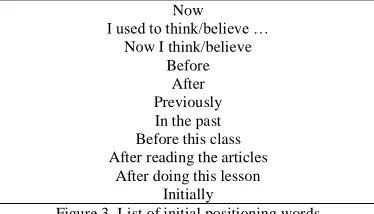
The data were analyzed in an iterative coding process, which followed several cycles. To accomplish the coding, the data were divided into three random groups. Each of the groups was assigned to a member of the research team. The team then generated a list of possible positionings of SLA theory within their living educational theories and in response to the prompt and the expected discursive signals that might accompany these positions. Figure 1 lists the initial anticipated discursive signal words. These words were not intended to function as the positioning itself, but rather to give us as raters some common ground to begin our critical reading for positioning. Then we read through their assigned data set and looked for the expected linguistic patterns as well as other positionings and signals of positionings that were not anticipated. From this list, the formal coding manual was developed (Miles, Huberman, & Saldaña, 2013).
Now I used to think/believe …
Now I think/believe Before
After Previously In the past Before this class After reading the articles
After doing this lesson Initially
Figure 3. List of initial positioning words
After the first review of the data, the team came together to review what they had found and update the coding manual with additional signal words and to reflect the nuances that had appeared in the data which might not be reflected in tidy phrases. Then the team analyzed data once more looking for new linguistic patterns. We came together again, checked each other’s findings, made notes and updated the coding manual and started the third round of coding. This process ensured immersion in the data (Miles, Huberman, & Saldaña, 2013) and prepared the research team to uncover the richness of the data, rather than merely represent essentialized patterns.
When the coding process of the data that we were able to gather was completed, the findings were compiled and tabulated according to the positionings represented in the coding manual. Researchers grouped the finding by the citizenship status (American or international) and experience level (in-service/experienced or pre-service/inexperienced). The findings revealed interesting patterns for the dataset as a whole as well as for the two groupings designed to answer the research questions. Table 3 represents a sample of commonly found phrases and the discursive positionings assigned to them during the first round of coding.
TABLE 3.
SAMPLE WORDS AND DISCURSIVE POSITIONING
Sample phrase Discursive positioning coded
In my own classroom, I always Self-legitimation (present)
It felt good to learn that Self-authorization
I disagree that Rejection of authorization
In the future, I plan to Self-authorization (future) I did not understand that Request for legitimation Just like … says, I agree that Ventriloquization In the future teachers (I) can Authorization (future)
A. Reliability
internal consistency were not practical or even possible. We established procedures to code the data and then check each other’s codes and reanalyze data.
We performed a simple calculation of inter-rater reliability (Armstrong, Gosling, Weinman, & Marteau, 1997). The inter-rater reliability among us was about 70 percent, which is quite low. When we looked at the discrepancies, we found that the disagreements we had over phrases like Teachers should … were read more conservatively by one of the raters than the other two. When these phrases were eliminated from the calculation, the inter-rater reliability climbed to 95 percent. We calculated percentages for agreement rather than running a statistical test of agreement. This agreement was generally high, but there was a set of responses from the participants upon which we never reached full agreement. That set of data was the responses that used third person obligatory language (e.g. Teachers should…) rather than the less ambiguous I will … as an indicator of an intent or willingness to incorporate an aspect of SLA theory into one’s living educational theory.
Determining what to do with the Teachers should … and similar phrases are an on-going point of negotiation and deliberation as the analysis proceeds. If the participants could be interviewed they might be able to shed some light on why they would say Teachers should … instead of something more personal like I should … or I could … or even something like I wish that I were able to … One assumption that we have been making is that students were using these constructions to make personal statements. In one study by Freedman and Ball (2004) they found that international teachers often used “we” rather than “I” because they thought it sounded more official when they were talking about their practice. They had an orientation towards referring to themselves as part of a profession rather than individual practitioners on public documents and they considered class assignments to be public.
B. Trustworthiness
Several steps were taken to increase trustworthiness of the findings for this study. The specific techniques used were referred to as validity in the sources from which we drew, and therefore we have maintained that terminology here even though the term is generally associated with quantitate work more than qualitative. In thinking about content validity for the course itself, as mentioned previously, the course was developed in part as a response to research stating what teachers should know about SLA theory (Faltis, Arias, & Ramírez-Marín, 2010; Fillmore & Snow, 2000). To increase face validity, we showed the curriculum and the assignments to an SLA professor at another university who would not have a stake in whether the course was considered successful. She said that these assignments would likely solicit living educational theories about the course topics and that they also had the potential to demonstrate change.
As an additional measure to increase face validity we could have sent the materials to additional experts. Because this was not an intervention study where a formal testing instrument was used, we did not develop techniques for establishing predictive, concurrent, convergent, or discriminant validity. If our research purpose had been to test SLA knowledge in a formal way, we would have developed an objective test and piloted it in order to establish these types of validity for the entire exam and for individual items.
V. FINDINGS
After collecting the data, the three researchers merged and analyzed the data sets as described above. The descriptive data are summarized in Table 4. The results are organized and presented in conjunction with each of the research questions.
A. Initial Living Educational Theories in Regards to Formal SLA Theory
Preservice/Inexperienced teachers come to the course having fairly vague personal/informal theories of SLA that are only tangentially related to formal SLA theory. There were only few firm beliefs stated. This is represented in the data as Table 4. Conversely, inservice/experienced American teachers come to the course with better-articulated personal theories that are more obviously related to formal SLA theory that made far more statements of personal beliefs that were directly tied to personal experiences.
Inservice/Experienced International teachers also come to the course with more developed personal theories that are somewhat clearly related to formal SLA theory (See Table 4). The following is an example of a well-articulated living educational theory of how to teach language to students given by an inservice international female student.
From my own experience teaching English as a foreign language to university level students, I found two main components to be very effective in students’ grasping new language items when focused on thoroughly. Those two components are presentation and practice. The presentation of the language material or target language should be as clear and natural as possible, as well as repeated (orally and written) multiple times throughout the lesson in order for the students to get an accurate model of the target language. The next step I go to after the specific language point has been modeled and repeated is for the students to start practicing. I usually divide practice into two parts; controlled and free. The students start with controlled practice in which they get to practice the new language points in objective type questions (multiple choice, true/false, fill in the blank, matching.., etc.).
production stage, it’s ok as long as they feel comfortable. I also usually like to give the students homework containing writing practice using the same language points they exercised in class (International, Inservice teacher, Lesson 1 assignment).
This student stated the source of her knowledge about SLA—through teaching adults in a university setting. On the first day of class, he was already able to use terms like communicative practice and discuss language production with some sophistication. When he talks of presentation and practice he is articulating models mainly grounded in explicit and direct instruction and he does not attend to the fact that what he calls free practice really is not free and that for what is probably genuine concern about communicative competence and a nurturing orientation toward student correction of errors, he has a highly developed notions of accuracy—that there is a right way to communicate and idea.
B. Living Educational Theories in Relation to Public Theories
All of the groups frequently reported ways to apply insights gained from the formal theories presented in the course to their future teaching practice regardless of their initial level of commitment to their personal/informal theories. However, this outcome was likely affected by the question presented in each lesson that directed the students to report what they had learned in from the class materials that might help them become better teachers (see Table 4). The inservice/experienced American (IEA) teachers were especially adamant about their own authority in their classrooms. Two assignments from a female inservice/experienced American (IEA) teacher illustrate the ways in which students insisted on their autonomous identities as teachers in relationship to coursework.
The readings for this week, while informative, will not be incredibly helpful in my future teaching, as I do not anticipate teaching students who use a PC language. However, these readings comment on the idea of UG, and especially with Bickerton’s view on children using a bio-program for language learning, it will be interesting to see what future research shows about these concepts as related to adult language learning (Inservice/Experienced American, Lesson 9).
From these readings I have a better understanding of CLT. We addressed CLT in C&T 820, but having more background on what exactly communicative competence is helps my understanding of how the pedagogical model functions. As a language learner, communicative classroom activities were most helpful in gaining fluency, and merely being presented grammatical rules or lists of vocabulary was not as helpful as interacting with classmates for practice or playing games. In my own classroom, I hope to implement a variety of CLT activities when I have the opportunity (Inservice/Experienced American, Lesson 11).
C. Discursively Assertions of Modifications to Theories and Intended Changes to Practice
Preservice teachers asserted changes to their initial, vaguely described, personal/informal theories and also reported changes in their vaguely articulated future teaching practices (Table 4). However, these findings must be viewed somewhat cautiously as there were only two preservice American (PA) teachers and one Preservice International teacher.
American inservice/experienced (IEA) teachers mostly reasserted their initial personal theories. However, they also somewhat frequently described some changes in their future teaching despite their rearticulated personal theories. Here is one example of an Inservice/Experienced American (IEA) student’s response to readings about universal grammar.
UG [Universal Grammar] can be quite relevant in teaching language learners. What I take away from this week’s readings is, knowing basic grammar parameters of my ELLs’ first language can enlighten my instruction. It would help in understanding the roots of possible writing and reading “errors,” and offer a foundation for ways to build on this background knowledge of grammar. Beyond this, simply providing opportunities for using language, in any way, will be beneficial for ELLs to experience the language (Inservice/Experienced American, Lesson 8).
This student immediately legitimized principles from universal grammar for language learners in general in her initial statement. She then connected this to her own teaching. She translated this understanding as a need to understand basic grammar in a learner’s first language, presumably to help students start to understand how to transfer their understanding of grammar from their first language to their second. This understanding is based on the students’ living educational theory more than it is based on understanding of universal grammar as a concept. Embedded in this response is also the understanding that if grammar is universal there must be a right and a wrong way to perform language, but the quotation marks around “errors” also suggests that the student is open to considering more liberal views on standardization in language use. Although she does not seem to convey a sense that a truly universal approach to grammar would preclude most instruction, she indicates openness to ideas about experiencing language (her words) in order to learn it.
Inservice/Experienced international (IEI) students also remained somewhat solidly committed to their personal/informal theories, but indicated a greater willingness to adjust their future teaching (see Table 4). The following response from a female teacher demonstrates this stated willingness to take up new SLA practice.
the cons, because I believe the current world is not possible to exist without harmony and balance of individuals all over around. Only monolingual education cannot make it happen for sure (International, Inservice/Experienced, Lesson 4).
This students’ response fails to offer any particular evidence of understanding of the issues around bilingual education, yet offers a positive opinion of it and a willingness to try the approach. Her acceptance of the concept seems to stem more from her existing interest or belief in pluralism as part of her living educational theory rather than a critical look at the material presented in class.
VI. DISCUSSION
The results of this study tend to reaffirm some outcomes of prior studies, but there are valuable additional insights associated with the present investigation. Specifically, the preservice teachers, though few in number, exhibited more willingness to change their practice in the future, but still expressed both a confirmation of original beliefs and personal validation sporadically. The Inservice/Experienced American (IEA) students were quite consistently committed to a confirmation of their original beliefs while at the same time frequently expressed a commitment to new practice. They also confirmed their original beliefs to a greater extent than any other group. The Inservice/Experienced International (IEI) students expressed a greater willingness to commit to new practices.
Perhaps a reason for the students in all categories to demonstrate the tendency to confirm their original beliefs while at the same time expressing openness to try out new practices is that the students did not feel that experimenting with new practices necessarily negated their commitment to their original beliefs. However, it would be fascinating to observe if students would change their original beliefs if they were able to implement practices around their new understanding that worked better for students. It would be reasonable to expect students to alter their original beliefs to a certain extent in order to conform to their new reality. If their new practices were perceived as being successful, it would seem logical to expect their theoretical orientation to expand in order to explain and justify their new practices.
VII. RECOMMENDATIONS
These data were drawn from classes during three semesters taught by the same instructor at one university. Yet, we were able to demonstrate discernible interesting patterns in responses that add to the literature about second language acquisition theory knowledge development in teacher education. We also recognize that in a discourse analysis investigation, the researchers use the students’ written language as the basis for interpretation of the data. However, the researcher can never determine for certain what any particular teacher meant with a given written statement without asking the teacher directly.
Interviewing the teachers and perhaps observing them teach would provide further insights into their living educational theories, but it would not necessarily solve all of the issues of data analysis as an act of interpretation filtered through a researcher as the primary instrument. Nevertheless, the main finding of this work—that students in this class used language that suggested that they were actively considering and/or dismissing theory, as well as ventriloquizing it as their own suggests that teachers deserve credit for wanting to teach second language learners in theoretically based ways. In the future, further investigations should look more carefully at why and how processes like ventriloquization and rejection of SLA theory occur for individual and groups of teachers.
TABLE 4.
CHANGES TO LIVING EDUCATIONAL THEORIES OF SLA FROM INITIAL ASSIGNMENT TO FINAL ASSIGNMENT
N=10 IEA N=7 IEI N=2 PA PI
Confirmation of original beliefs 56 31 9 1
Personal validation 17 10 5 2
Commitment to new practice 50 19 10 8
Expression of confusion 5 1 0 0
IEA—Inservice/experienced American IEI—Inservice/experienced international PA—Preservice American
PI—Preservice International
REFERENCES
[1] Adair, J. G. (1984). The Hawthorne effect: A reconsideration of the methodological artifact. Journal of Applied Psychology,
69(2), 334-345.
[2] Argyris, C., & Schön, D. A. (1974). Theory in practice: Increasing professional effectiveness. San Francisco, CA: Jossey-Bass. [3] Bakhtin, M. M. (2010). The dialogic imagination: Four essays. Austin, TX: University of Texas Press.
[4] Basturkmen, H. (2012). Review of research into the correspondence between language Teachers’ stated beliefs and practices.
System, 40(2), 282-295.
[5] Basturkmen, H., Loewen, S., & Ellis, R. (2004). Teachers’ stated beliefs about incidental focus on form and their classroom practices. Applied Linguistics, 25 (2), 243-272.
[7] Busch, D. (2010). Pre-service teacher beliefs about language learning: The second language acquisition course as an agent for change. Language Teaching Research, 14(3), 318-337.
[8] Calderón, M., Slavin, R., & Sánchez, M. (2011). Effective instruction for English learners. The Future of Children, 21(1), 103-127.
[9] Cook, V. (1999). Using SLA research in language teaching. International Journal of Applied Linguistics, 9(2), 267-284. [10] Ellis, R. (2011). A principled approach to incorporating second language acquisition research into a teacher education
programme. Reflections on English Language Teaching, 9(1), 1-17.
[11] Ellis, R. (2010). Second language acquisition, teacher education and language pedagogy. Language Teaching, 43(2), 182-201. [12] Erlam, R. (2008). What do you researchers know about language teaching? Bridging the gap between SLA research and
language pedagogy. International Journal of Innovation in Language Learning and Teaching, 2(3), 253-267.
[13] Faltis, C., Arias, M. B., & Ramírez-Marín, F. (2010). Identifying relevant competencies for secondary teachers of English learners. Bilingual Research Journal, 33(3), 307-328.
[14] Fairclough, N. (2003). Analysing discourse: Textual analysis for social research. New York, NY: Routledge.
[15] Fillmore, L. W., & Snow, C. E. (2000). What teachers need to know about language. ED ED444379. Center for Applied Linguistics: Washington D. C. Retrieved September 23, 2014 from http://files.eric.ed.gov/ED444379.pdf.
[16] Freeman, D., & Johnson, K. E. (1998). Reconceptualizing the knowledge-base of language teacher education. TESOL Quarterly, 32(3), 397-417.
[17] Freeman, S. D., & Ball, A.F. (2004). Ideological becoming: Bakhtinan concepts to guide the study of literacy, language, and learning (pp. 3-33). In S.D. Freeman & A.F. Ball (Eds.) Bakhtinan perspectives on language, literacy, and learning New York, NY: Cambridge University Press.
[18] Harré, R. & van Langenhove, L. (1999). Positioning theory: Moral contexts of international action. Oxford, England: Wiley-Blackwell Publishing
[19] Horowitz, D. (1986). Process not product: Less than meets the eye. TESOL Quarterly 20.1, 1 41–144. [20] Hymes, D. (1972). On communicative competence. Sociolinguistics, 269-293. 1 41–144.
[21] Kamiya, N., & Loewen, S. (2014). The influence of academic articles on an ESL teacher’s stated beliefs. Innovation in Language Learning and Teaching, 8(3), 205-218.
[22] Knowles, G., & Holt-Reynolds, D. (1991). Shaping pedagogies through personal histories in preservice teacher education. The Teachers College Record, 93(1), 87-113.
[23] Lucas, T. (2011). Teacher preparation for linguistically diverse classrooms. New York, NY: Routledge.
[24] MacDonald, M., Badger, R., & White, G. (2001). Changing values: what use are theories of language learning and teaching?.
Teaching and Teacher Education, 17(8), 949-963.
[25] Miles, M. B., Huberman, A. M., & Saldaña, J. (2013). Qualitative data analysis: A methods sourcebook. Thousand Oaks, CA: Sage.
[26] Nassaji, H. (2012). The relationship between SLA research and language pedagogy: Teachers’ perspectives. Language Teaching Research, 16(3), 337-365.
[27] Peacock, M. (2001). Pre-service ESL teachers’ beliefs about second language learning: A longitudinal study. System, 29(2), 177-195.
[28] Peter, L., Markham, P., & Frey, B. (2012). Preparing elementary teachers for culturally and linguistically diverse classrooms: Challenges and opportunities for university TESOL educators. Teacher Education Quarterly, 47(4), 302-327
[29] Vaish, V. (2012). Teacher beliefs regarding bilingualism in an English medium reading program. International Journal of Bilingual Education and Bilingualism, 15(1), 53-69.
[30] Varghese, M., Morgan, B., Johnston, B., & Johnson, K. A. (2005). Theorizing language teacher identity: Three perspectives and beyond. Journal of language, Identity, and Education, 4(1), 21-44.
[31] Walkington, J. (2005). Becoming a teacher: Encouraging development of teacher identity through reflective practice. Asia-Pacific Journal of Teacher Education, 33(1), 53-64.
[32] Whitehead, J. (1989). Creating a living educational theory from questions of the kind, ‘How do I improve my practice?’
Cambridge Journal of Education, 19(1), 41-52.
[33] Zepeda, M., Castro, D. C., & Cronin, S. (2011). Preparing early childhood teachers to work with young dual language learners.
Child Development Perspectives, 5(1), 10-14.
Paul Markham is Associate Professor of TESOL in the Dept. of Curriculum and Teaching at the University of Kansas. He completed a bachelor’s degree in German and French with a secondary teaching license at Utah State University. His master’s degree major was German at the University of Washington. He completed a Ph.D. in Foreign Language Education/TESOL at The Ohio State University. His research interests include teacher education and second language listening and reading comprehension. He has taught teacher education, ESL, German, and French at the university and secondary levels.