Available online throug
ISSN 2229 – 5046
MHD POWER LAW FLUID FLOW PAST A STRETCHING POROUS SHEET
NEELKAMAL S
1, P H VEENA*
2AND V K PRAVIN
31
Dept. of Mathematics, Gulbarga University, Gulbarga, Karnataka, India.
*2
Dept. of Mathematics, Smt. V. G. College for Women, Gulbarga, Karnataka, India.
3
Dept. of Mech. Engg., P. D. A. College of Engg., Gulbarga, Karnataka, India.
(Received On: 23-03-18; Revised & Accepted On: 21-04-18)
ABSTRACT
I
n the present paper magneto hydrodynamic flow of an MHD power law fluid over a porous stretching sheet is studied by applying exact analytical similarity transformation technique. The flow is caused by linear stretching of a sheet from a permeable wall. The momentum equation is simplified by converting the governing momentum boundary layer partial differential equation into ordinary differential equation by using classical similarity transformation technique with appropriate boundary conditions.The effect of porosity and magnetic field on the flow profile is analyzed analytically and it is found that permeability and magnetic field tend to make the boundary layer thinner and thereby enhancing the skin wall friction.
Key words: Stretching sheet, boundary layer thickness, power law fluid, displacement thickness, permeability.
1. INTRODUCTION
The interest of studying momentum boundary layer flow of non – Newtonian fluids has been increased in the last four decades for their important usage in various manufacturing and processing industries and wide range of applications such as hot rolling, extrusion, glass fiber production, paper production, continuous casting and in wire drawing. Apart from these many metallurgical processes including chemical engineering processes involve cooling of continuous strips or filaments by drawing them into a cooling system. The fluid mechanical properties desired for the outcome of such a process would mainly depend on the rate of stretching and cooling.
Hence because of the growing use of these fluids considerable efforts have been directed towards the study of momentum transfer to control the quality of the final product of these processes. [1–4].
In view of many such applications Crane [5] initiated the analytical study of boundary layer flow due to a stretching sheet. The velocity of the sheet was assumed to vary linearly with the distance from the slit. The motion of a plane sheet in its own plane due to boundary layer flow was investigated by Sakiadis [6]. Erickson [7] extended this problem to study the temperature distribution in the boundary layer when the sheet is maintained at a constant temperature with suction/blowing. These investigations have many significant applications in the polymer industry when a polymer sheet is extruded continuously from a die, with an inextensible stretching sheet. However, in real situations one has to encounter the boundary layer flow over a stretching sheet. Following two different approaches of [5] and [6] the uniqueness of the exact analytical solutions was proved simultaneously by Maclead and Rajgopal [8] and Troy et al [9]. Rajgopal et al [10] made a study on boundary layer flow over a stretching sheet for a special class of non – Newtonian fluids, known as second order fluids and obtained similarity solutions.
Anderson and Dandapat [11] extended the Newtonian boundary layer flow problem considered by crane [5] to an important class of non- Newtonian fluids obeying the power – law model.
Motion of visco – elastic fluids in the presence of transverse uniform magnetic field was studied earlier by several authors Sarpakaya [12] and Djukic [13] etc in different situations. Pavlov [14] studied the boundary layer flow of an MHD fluid due to stretching of a plane elastic surface and obtained an exact similarity solution of the problem.
Corresponding Author: P H Veena*
2and V K Pravin
3Schowalter [15] applied boundary layer theory to study the flow of power law pseudo plastic fluids and obtained similarity solutions. Hassanien et al [16] made an investigation on the flow and heat transfer in a power law fluid over a non-isothermal stretching sheet. Naikoti and Borra [17] made an analysis of the influence of transverse magnetic field on the flow transfer of an MHD conducting power – law fluid over a stretching sheet with thermal dispersion. Liao [18] made an excellent work on magneto hydrodynamic stretching sheet problem involving power law fluid model using homotopy based analytical method. Fox et al [19] made a study on the flow of a power law fluid over a moving surface. Wang [20] analysed the heat transfer charectristics of the steady laminar mixed convection of non-Newtonian fluids over a vertical plate using the boundary layer equations for the power – law viscosity index. Gorla et al [21] presented the study of mixed convection in non – Newtonian fluids along a vertical plate in a porous medium.
Guedda [22] made a theoretical analysis to derive a range of exponents and amplitudes for the boundary layer region for which similarity solutions exists. Howell et al [23] investigated the flow and heat transfer in a power – law fluid on a continuous moving sheet.
Recently the problem of laminar natural convection heat transfer from a vertical flat plate at constant temperature to a non – Newtonian pseudo – plastic liquid was studied by Dale and Emery [25] with uniform heat flux. Som and Chen [26] analyzed the natural convection heat transfer in power law fluid from a two – dimensional body of which the surface is subject to power – law variations in temperature and heat flux. Caponkov [27] discussed the free convection flow in power – law fluids past two – dimensional bodies for large Prandtl number for arbitrary variations in body temperature. Recently the effects of magnetic field on a power – law fluid past a vertical plate embedded in a porous medium were studied by Et – Amin and Mohammdein [28].
Thus in the current investigation it is considered extension of ref[30] ie the free convection boundary layer steady two – dimensional flow of a non – Newtonian power – law fluid model. [Ref Vujannovic et al [29]. It is the simplest and most common type called the Ostwald – de Wale model] i.e., power – law fluid in the presence of uniform transverse magnetic field and porous medium.
2. FLOW ANALYSIS
Consider the two – dimensional steady, laminar flow of an incompressible and electrically conducting power – law fluid in the presence of transverse magnetic field and porous medium past a flat sheet coinciding with the plane Y = 0, the flow being confined to Y > 0. Two equal and opposite forces are applied along X – axis. The basic boundary layer equations for continuity and momentum Anderson et al. [30] take the following form.
𝜕𝑢 𝜕𝑥 +
𝜕𝑣
𝜕𝑦= 0 (1)
u 𝜕𝑢
𝜕𝑥 + 𝑣 𝜕𝑣 𝜕𝑦=
1 𝜌 �
𝜕𝜏𝑥𝑦 𝜕𝑦 � −
𝜎𝐵02
𝜌 𝑢 − 𝑣
𝑘′𝑢 (2)
Where u and 𝑣 are the velocity components along x – and y – directions respectively. 𝜌, 𝜎, 𝐵0, 𝑣𝑎𝑛𝑑𝑘′are the density, electrical conductivity, magnetic field strength, Kinematic viscosity and permeability of the medium respectively. 𝜏𝑥𝑦 is the shear stress and the stress tensor is defined rheologically as
𝜏𝑖𝑗 = 2𝐾 (2𝐷𝑘𝑖𝐷𝑘𝑗)
𝑛−1
2 𝐷𝑖𝑗 (3) Where 𝐷𝑖𝑗 = 1
2 � 𝜕𝑢𝑖
𝜕𝑥𝑗 +
𝜕𝑢𝑗
𝜕𝑥𝑖�denotes the stretching tensor, K is called the consistency co – efficient and n is the power – law index. The two parameter rheological equation (3) represents a Newtonian fluid with dynamic co – efficient of viscosity K for n = 1. With n≠1, the constitutive equation (3) represents shear – thinning i.e., for (n < 1) and shear thickening (n>1) fluids. However, the in elastic power – law model (3) does not exhibit normal – stress differences.
Thus the shear stress in the present study is given by
𝜏𝑥𝑦= −𝑘 �−𝜕𝑢𝜕𝑦� 𝑛
for 𝜕𝑢
𝜕𝑦 < 0 (4)
Then equation of motion (2) reduces to the following form.
u 𝜕𝑢
𝜕𝑥 + 𝑣 𝜕𝑣 𝜕𝑦= −
𝐾 𝜌 𝜕 𝜕𝑦�− 𝜕𝑢 𝜕𝑦� 𝑛
− 𝜎𝐵02𝑢
𝜌 − 𝑣
𝑘′𝑢 (5)
With the following boundary conditions
𝑢=𝐵𝑥, 𝑣= 0 𝑎𝑡𝑦=𝑜 (6)
𝑢 →0 𝑎𝑠𝑦 → ∞ (7)
Further this flow is caused solely by the stretching of the sheet wall and hence there is no free – stream velocity outside the boundary layer.
It can be automatically shown that the system of equations (1) to (5) admits self similarity solutions with respect to the boundary conditions (6) & (7) in terms of the similarity function variable G( ɳ ) defined by
Ѱ = �𝐵1−2𝑛𝑘 𝜌 �
−𝑛+11
𝑥𝑛+12𝑛 𝐺( ɳ ) (8)
and
ɳ=𝑦 �𝐵2−𝑛𝑘
𝜌
�
1 𝑛+1
𝑥((1−𝑛1+𝑛)) (9)
Where u and v are the stream functions which are taken as
𝑢= −𝜕𝑦𝜕Ѱ 𝑎𝑛𝑑 𝑣=𝜕𝜕𝑥Ѱ (10)
Now using the transformations defined in (8) and (9), equation (5) becomes
n(−Gn)(n−1)Gɳɳɳ − �Gɳ�2+ �2n
n+1� GGɳɳ
−(M+k2) Gɳ = 0 (11)
Where M = 𝜎𝐵02𝑢
𝜌𝐵 = the magnetic parameter
k2 =
𝑣
𝑘′ = the permeability parameter
Boundary conditions (6) and (7) convert to
Gɳ (0) = 1 , G(0) = 0 (12a)
Gɳ (∞) = 0 , (12b)
For the value n=1 in equation (11) we obtain the equation of momentum for a Newtonian fluid as follows.
𝐺ɳɳɳ− (𝐺ɳ )2 + G 𝐺ɳɳ− (M + k2) 𝐺ɳ = 0 (13)
With above boundary conditions (12a) and (12b). Equation (13) has an exact analytical solution of the form
𝐺ɳ ( ɳ ) = 𝑒−𝐸ɳ, 𝐸> 0 (14)
and
𝐺( ɳ ) =1𝐸 (1− 𝑒−𝐸ɳ) (15)
Satisfying the boundary conditions 𝐺ɳ(0) = 1 and 𝐺ɳ(∞) = 0 and G(0) = 0.
Where E = �1 +𝑀+ 𝑘2 (see Pavlov [14] ) and Andersson and Dandpat [30] for non – porous medium.
3. ANALYTICAL SOLUTION METHOD
Anderson et al [30] solved the present problem by standard fourth order Runge - Kutta integration technique for non – porous case and they solved the same by Keller Box method and also Anderson et al. [10] applied the same numerical method recently to the non magnetic case also.
In the present paper the non – linear momentum equation [13] for power – law fluid with magnetic and porositic case is solved by special perturbation method with exact analytical solution with respect to the boundary conditions [12] for the case n = 1 is obtained.
Putting 𝐺ɳ=𝑦 ⇒ 𝐺(ɳ)= 𝑦2
2 (16)
Then Equation [13] reduces to
𝑌′′−𝑌2𝑌′
2 − 𝑎𝑌= 𝑌2 (17)
Whose solution is assumed in the following form
𝑌= 𝑦0+ ∈ 𝑦1+ ∈2𝑦2 + … … … … .. (18)
Now substituting for Y, 𝑌′,𝑌′′ in (17) and equating the like co – efficient of ϵ, we obtain the following set of equations in 𝑦0, 𝑦1 and 𝑦2 as
𝑑2𝑦0
𝑑ɳ2 − 𝑦02
𝑑𝑦0
With Boundary conditions 𝑦0(0) = 1 and 𝑦0 (∞) = 0 (19 a)
𝑑2𝑦1
𝑑ɳ2 − 𝑦02 𝑑𝑦𝑑ɳ1+ 2 𝑦0𝑦1 𝑑𝑦𝑑ɳ0 − 𝑎𝑦1− 2 𝑦0𝑦1= 0 (20)
With 𝑦1 (0) = 1 and 𝑦2 (∞) = 0 (20a)
𝑑2𝑦2
𝑑ɳ2 − 𝑦02
𝑑𝑦2
𝑑ɳ − 𝑦12
𝑑𝑦0
𝑑ɳ −2 𝑦0𝑦1
𝑑𝑦1
𝑑ɳ − 2𝑦0𝑦2
𝑑𝑦0
𝑑ɳ − 𝑎𝑦1− 2𝑦1𝑦2− 2𝑦2𝑦0= 𝑦12 (21)
With 𝑦2 (0) =1 and 𝑦2 (∞) = 0 (21a)
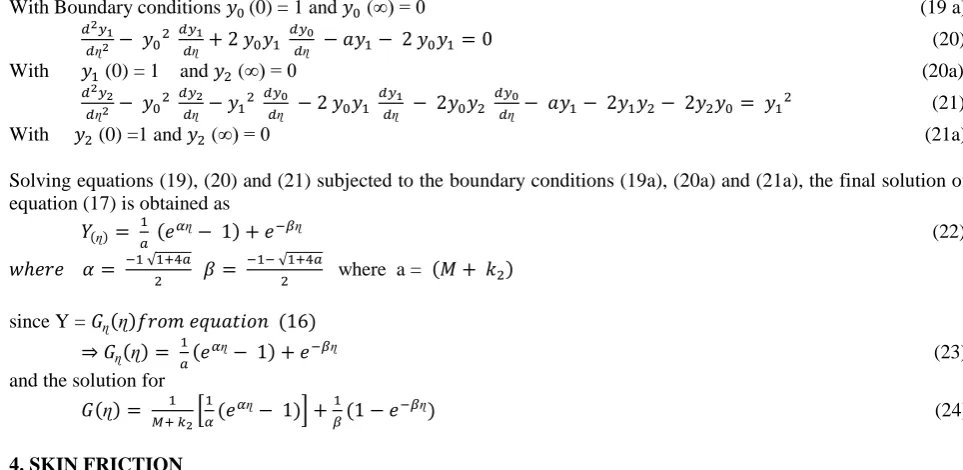
Solving equations (19), (20) and (21) subjected to the boundary conditions (19a), (20a) and (21a), the final solution of equation (17) is obtained as
𝑌(ɳ)= 𝑎1 (𝑒𝛼ɳ− 1) +𝑒−𝛽ɳ (22)
𝑤ℎ𝑒𝑟𝑒 𝛼= −1√1+4𝑎2 𝛽= −1−√1+4𝑎2 where a = (𝑀+ 𝑘2)
since Y = 𝐺ɳ(ɳ)𝑓𝑟𝑜𝑚𝑒𝑞𝑢𝑎𝑡𝑖𝑜𝑛 (16)
⇒𝐺ɳ(ɳ) = 𝑎1(𝑒𝛼ɳ− 1) +𝑒−𝛽ɳ
(23)
and the solution for
𝐺(ɳ) = 𝑀+1𝑘
2�
1
𝛼(𝑒𝛼ɳ− 1)�+ 1
𝛽(1− 𝑒−𝛽ɳ) (24)
4. SKIN FRICTION
The important boundary layer characteristic is the skin friction co-efficient 𝜏xy at the sheet y = 0 is defined and derived
as
[𝜏xy]y=0 = 2 �−𝐺ɳɳ(0)�n(Re)− 1n+1
Where Re is the local Reynolds no. and Re = (𝑐𝑥)2−𝑛 .
𝑥ɳ
�𝑘𝜌� based on sheet velocity.
5. RESULTS AND DISCUSSION
The present non-Newtonian MHD power – law fluid flow problem with porosity is solved analytically by the special method of perturbation technique for five different values of the magnetic parameter (M ≤ 2 .0 ) and five different values of permeability parameter (k2 ≤ 10) and for different values of the power – law index in the range 0.6 ≤ n ≤ 2.0.
computed values of velocity field are presented through the following graphs.
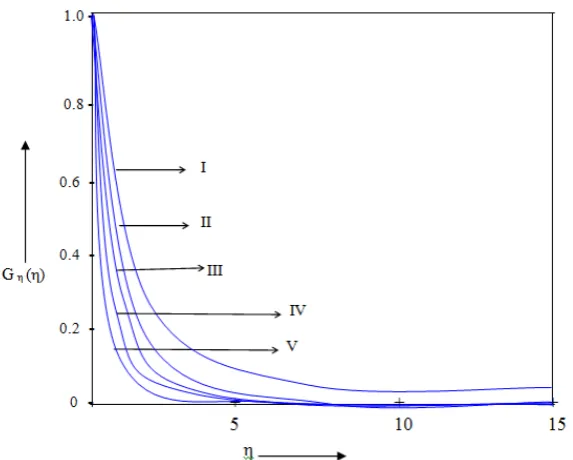
Fig (1a) and (1b) represents the similarity velocity profiles for shear thinning fluid with power law index n=0.6 for different values of magnetic parameter fig (1) and permeability parameter fig (2) respectively. From both the figures it is observed that 𝐺ɳ decreases with increasing values of Mn and k2. For a given fluid the effect of magnetic field and
porous media is therefore to reduce the velocity distribution u = Bx 𝐺ɳ across the boundary layer and parallel to the stretching sheet.
Fig (2a) and (2b) are drawn to represent the velocity profiles 𝐺ɳ vs ɳ for Newtonian fluid (n=1) and for different values of magnetic and permeability parameters m and k2 respectively. A common feature of both the velocity profiles
irrespective of power law index n, is that horizontal velocity distribution 𝐺ɳ lowers with enhancing values of m and k2
which indicates that the exact analytical solution [14] is accurately reproduced by computations for n = 2 in fig (2a) and (2b).
Similarly Figures (3a) and (3b) depict the flow velocity profiles for shear thickening fluids with power – law index n=2 and it is observed from the figures that velocity distribution is lowered for increasing values of Mn and k2 which
indicates that for shear – thickening fluid, the effect of magnetic field and porous field is to reduce the velocity component u=Bx𝐺ɳ parallel to the stretching surface.
In fig (4) the important aspect of boundary layer characteristic property known as dimensionless. Skin – friction co-efficient Ʈxy – shear stress at the sheet for y=0 is presented.
Since𝐺ɳɳ (0) values are negative and computed values of -𝐺ɳɳ (0) with m and n are displayed graphically in fig (4a) and (4b). For Different values of M and k2 respectively. It is observed from the figures that -𝐺ɳɳ (0) increases monotonically
with M (fig 4a) and k2 (fig 4b) for power law fluid. More over fig (4a) and (4b) demonstrate the facts that the
magnitude of the wall velocity gradient decreases gradually with increasing values of n and fixed values of Mand k2.
The graph of boundary layer thickness ɳδ for various values of permeability parameter k2 is presented in fig 5. It is
observed from the figure that the thickness of the boundary layer thickness decreases with permeability for the power law fluid considered.
Fig (6) is the representation of dimensionless displacement thickness for various values of permeability parameter and it is found from the figure that the imposition of porous media reduces the sensitiveness of boundary layer thickness.
6. CONCLUSIONS
The magnetic field and porous media tends to make the boundary layer thinner duely increasing the skin wall friction. This combined effect of porosity and magnetism is pronounced more for shear thinning fluids than shear thickening fluids. The imposition of magnetic field and porosity makes the difference between the various fluids more distinct in the near wall-region but less influencial on the global thickness of the boundary layer behaviors.
Figure-1a: Similarity velocity profiles for a shear thining fluid (power law index n=0.6) fixed k2 and for different
values of magnetic parameter M = 0.0, 0.5, 1.0, 1.5, 2.0
Figure-1b: Similarity velocity profiles for a shear thinning fluid (power law index n=0.6) M = 1 and for different
Figure-1c: Similarity horizontal velocity profiles G η (η) for power law fluid with n < 1, n = 1 and n > 1for fixed value of M=1, k2 = 2.
Figure-2a: Similarity velocity profiles for power law fluid with (n = 1-Newtonian)for different values magnetic
parameter M= 0.0, 0.5, 1.0, 1.5, 2.01, k2 = 2.
Figure-2b: Similarity velocity profiles for power law fluid with (n = 1-Newtonian) and M=1 for different values of
Figure-3a: Similarity velocity profiles for a shear thickening (n = 2) and k2 = 2 for different values M = 0.0, 0.5, 1.0,
1.5, 2.0
Figure-3b: Similarity velocity profiles for a shear thickening (n = 2) and M = 1 and for different values k2 = 2, 4, 6, 8, 10
Figure-4b: Graph of Dimensionless velocity gradient at the wall with power law index n for different values of k2 with
M = 1
Figure-5:Graph of Dimensionless boundary layer thickness ηδ Vs. power law index n with different values of k2 and
fixed value of M = 1
7. REFERENCES
1. V. Ashok; Singh, C. Pallath and C. S. Nirmal:Effect of transverse magnetic field on a Hot plate Int. J-of Heat and mass transfer, vol. 43, 3253 (2000).
2. Fosdick, R. L and K. R. Rajagopal: Fluids of differential type a critical review. Arch. Ration, Mech. Anal, v01170, 145-152(1995).
3. Siddappa and A. Subhash: Non-Newtonian flow past a stretching plate. Rheol Acta, Vol 23, 213 (1984). 4. S. Lawrence and B. Nageshwar rao: Reinvestigation of the non uniqueness of the flow of a visco elastic liquid
over a stretching sheet QAM, vol LI, No 3, 401-404 (1993).
5. L. J. Crane, Flow past a stretching plate, ZAMP, Vol. 21, 645-647 (1970).
6. B. C. Sakiadis, Boundary Layer behavior on continuous solid surfaces AICHEJ, 726-28 (1961).
7. L. E. Erickson, L. T. Fan and V. G. Fox, Heat and mass transfer on a moving continuous flat plate with Suction or injection. Ind. Engng. Chem. Fundam, vol 5, 19-25 (1966).
8. J. B. Mac Leod and K. R. Rajagopal, on the uniqueness of flow of Navier Stokes fluid due to a stretching boundary. Arch. Ratinal Mech. Anal, vol 98, 385-393 (1987).
9. W. C. Troy, E. A. Overman If, G. B. Ermentrout and J. p. Keener, unequeness of flow of a Second order fluid past a stretching surface Q. Appl. Math. vol.44, 753-755 (1987).
10. K. R. Rajagopal, T.Y. Na and A. S. Gupta, A linear boundary layer on a stretching sheet in a non-Newtonian fluid with uniform free stream. J. Math. Phys, Scc, vol. 21, 189-200(1987).
11. H. I. Anderson and B. S. Dandpat, Flow of a power-law fluid over a stretching sheet; Appl. Anal continuous media, vol 1, 339-347 (1991).
12. T. Sarpakaya, Flow of non-Newtonian fluids in a magnetic field A. I. Ch. E. J. vol. 7, 324-328 (1961). 13. D. S. Djukic, On the use of erocco’s equation for the flow of power-law fluids in a transverse magnetic field.
AIChE J, vol. 19, 1159-1163 (1973).
14. K. B. Pavlov, Magneto hydrodynamic flow of an incompressible viscous fluid caused by deformation of a plane surface. Magiet nay a Gidrodinami ka (USSR) vol. 4, 146-147 (1974).
15. Schowalter, W. R; The application of Boundary layer theory to Power law Pseudo Plastic Fluids; Similar solutions AI ChE J. vol6, 24-28 (1960).
16. I. A. Hassanien, A.A. Abdullah and R. S. R. Gorla: Flow and Heat transfer in a Power-law fluid over a non- isothermal Stretching Sheet. Mathematical and computer modeling, vol.28, No. 9, 105-116 (1998).
17. K. Naikoti and S. R. Borra: Quasi Linearization Approach to MHD effects on boundary layer flow of Power-law fluids past a Semi infinite flat plate with thermal Dispersion. Int-S. of Non-linear Science, vol. 11, No. 3. 301-311 (2011).
18. Liao, S. J; on the homotopyanalysis method for non-linear problems Appl. Math. Comput. Vol. 147, 499-513 (2004).
19. V. G. Fox, L. E. Erickson and L. T. Fan; Methods for solving the boundary layer equations for moving continuous flat surfaces with suction and injection. AIChE, vol.14, 726-736 (1968).
20. Wang. T. Y; Mixed convection from a vertical plate to non-Newtonian fluids with uniform surface heat flux Int. Comm, Heat mass Transfer, vol 22, issue 3, 369- 380 (1995).
21. R. S. R. Gorla, M. Kumari: Mixed convection in non-Newtonian fluids along a vertical plate in a porous medium. Acta Mechani Ca, vol. 118, 55-64 (1996).
22. M. Guedda ; Boundary layer equations for a power-law shear-drivan flow over a plane surface of non-Newtonian fluids. Acta Mech, vol 202, Issue 01, PP 205-211 (2009) Power Law Shear driver boundary layer flow over a plane surface analysed by Guedda [22].
23. T G. Howell; Momentum and Heat Transfer on a Continuous moving surface in a Power-law fluid, Int. J. of Heat and mass transfer, vol. 40, Issue 8, 1853-1861 (1997).
24. Z. H. Kodha and H. M. Duwairi : Inertia effects on mixed convection for vertical plates with variable wall temperature in saturated porous media J. Heat mass transfer / waerme-5 toffuebertr, vol, 31, 333-338 (1996). Mixed convextion with variable wall temperature for a vertical plate is studied by Kodha and Duwairi [24]. 25. Dale J and Emery. A: The free convection of heat from a vertical plate to several non-Newtonian pseudo
plastic fluids. ASMEJ of Heat Transfer, vol. 194, 64-72 (1972).
26. Chem. T. V. W and Woller sheim, D. E: Free Convection at a Vertical plate with uniform flux conditions in Non-Newtonian Power law Fluids. J. of Heat Transfer, vol. 95, 123-124 (1973).
27. K. Naikoti and, S. R. Borra; Quasilinearisation Approach to MHD effects on boundary layer flow of power law fluids past a semi infinite flat plate with thermal Dispersion. Int 5. Of Non-linear Science, vol.11, No 3, 301-311 (2011).
28. Mohammdein. A. A. d El- amin; Free convection through conducting non-Newtonian fluids over a thin axisymmetric body with surface heat flux. J. of Mechanica, Vol. 45, Issue 01, 8p 89-96 (2010).
29. H. I. Anderson, K. H. Bech and B. S. Danda. Pot: magneto hydrodynamic flow of a power-law fluid over a stretching sheet. International Journal of Non-Linear Mechanics, vol.27, No. 6, 929-936 (1992).
30. J. A. Sheer cliff: A text book of magneto hydrodynamics. Pergamon press, oxford (1965).
Source of support: Nil, Conflict of interest: None Declared.