Proceedings of the
Fifth International Workshop on on Foundations
and Techniques for Open Source Software Certification
(OpenCert 2011)
Analysis of Collaboration Effectiveness and Individuals’ Contribution in
FLOSS Communities
Antonio Cerone, Simon Fong and Siraj Ahmed Shaikh
15 pages
Guest Editors: Lu´ıs Soares Barbosa, Dimitrios Settas
Managing Editors: Tiziana Margaria, Julia Padberg, Gabriele Taentzer
Analysis of Collaboration Effectiveness and Individuals’
Contribution in FLOSS Communities
Antonio Cerone1, Simon Fong2and Siraj Ahmed Shaikh3
UNU-IIST — International Institute for Software Technology United Nations University, Macau SAR China
Department of Computer and Information Science University of Macau, Macau SAR China
Department of Computing, Coventry University, UK
Abstract: Free/Libre Open Source Software (FLOSS) development has proven
it-self over the years to be able to deliver high-quality software products. However, it is not clear how quality emerges from the large amount of loosely organised ac-tivities of a FLOSS community. This makes it difficult to apply traditional quality metrics and certification processes to FLOSS products.
This paper investigates possible indicators of collaboration effectiveness and qual-ity of individuals’ contribution that could be extracted from the data available in repositories of FLOSS projects. The ultimate purpose of this effort is to develop quantitative metrics for these indicators and merge such metrics into a global metric for FLOSS software quality to be used in a certification process.
Keywords: Open Source Software, software quality, collaboration models, trust
models, certification.
1
Introduction
Free/Libre Open Source Software (FLOSS) development has proven itself over the years to be able to deliver high-quality software products. Moreover, the potential benefits of the FLOSS development model include “the ability to more easily carry out open peer reviews, add new functionality either locally or to the mainline products, identify flaws, and fix them rapidly — for example, through collaborative efforts involving people irrespective of their geographical locations and corporate allegiances.” [Neu05].
This is important if open source development is to be used for producing high quality com-plex software for use in critical domains such as safety and security. In fact, Schneider [Sch00] finds that open source software still falls short of requirements for security systems. Halloran and Scherlis [HS02] review a number of notable quality practices on some popular open source projects, of which good project communication and management is highlighted.
Coverity has been analysing the quality of open source software since 2006, using Coverity Scan, a tool for automated static analysis of source code [Cov]. The results of this analysis have been published by Coverity in annual reports. The 2008 and 2009 reports show that defect density has fallen by 16% over the period 2006–2008 to the extent that the static analysis defect density averaged across all the participating projects is 0.25, or roughly one defect per 4,000 lines of code [Cov08, Cov09]. Improvements to Coverity Scan and its underlying technology over the past years have allowed to flag more defects than in prior years. As a consequence a direct comparisons to prior years Coverity Scan results is no longer possible. The 2010 report highlights that (1) nearly half (45%) of the defects discovered in open source are considered high-risk defects; (2) there has been very little change in the types of defects found and frequency in which they occur in open source software; and (3) open source accountability is fragmented [Cov10]. In spite of these drawbacks, the report expresses the expectation that as open source continues to mature, more and more projects will begin to adopt stronger quality practices. The 2011 report includes a comparison of proprietary software and open source software that leads to an important key finding: “Open source quality for active projects in Coverity Scan is better than the software industry average” [Cov11].
Large communities of users have been growing around popular high-quality FLOSS products such as Linux, Ubuntu, Apache, MySQL and Moodle, among the others. The widespread use of FLOSS products not only involves personal users, who install Linux/Ubuntu and MySQL on their machines, but also small and medium enterprises, who use Apache servers and FLOSS tools in their production activities or even incorporate FLOSS components in their software products, and academic and teaching institutions, who use FLOSS products in their research and educational activities, including Learning Management Systems (LMS) such as Moodle. More recently, large software companies have been launching FLOSS projects with the aim to get revenues by adopting a freemium business model, in which the basic product or service is provided free of charges, while a premium is charged for the provision of support services and/or advanced features and functionality.
As highlighted by the 2010 Coverity report [Cov10], due to the rapid adoption of open source as part of many commercial software supply chains, there is an increasing demand from OEMs (original equipment manufacturer) to get visibility into the open source software development process and hold open source to the same scrutiny as their other software systems to meet the enterprises necessary quality, safety, and security requirements. The fragmented nature of open source supply chain, made up of multiple components from multiple development teams, makes if difficult to identify who is accountable to upholding requirements and providing visibility and who is to be blamed if and when there is a problem [Cov10].
com-munity makes it difficult to apply traditional quality metrics and certification processes to FLOSS products. For instance, if we consider McCall’s production revision quality factors [MRW77], can we claim that a FLOSS product lacks maintenability because there are no defined coding standards and guidelines to which programming has adhered? The philosophy of freedom and absence of hierarchical organisation typical of FLOSS communities results in collaborative pro-duction environments in which there is no space for prescriptive standards and strict guidelines. Communication and collaboration are the drivers of such production environments and naturally determine the evolution of programming practices within teams of contributors and across the FLOSS community, even beyond a specific FLOSS project. In such a context, a descriptive ap-proach that analyses the FLOSS community of practise and its activities is likely to define better indicators of the quality of the software product than a prescriptive approach that tries to check whether these activities follow prescribed standards and guidelines [Cer12].
In this paper, we carry out a preliminary discussion towards a methodology to analyse com-munity activities in FLOSS projects and extract from the data collected pieces of semantic in-formation to be used as indicators of the quality of the software product. In particular, we focus on two aspects of the FLOSS community of practice: collaboration effectiveness and quality of individuals’ contribution.
In Section2we identify possible indicators of collaboration effectiveness and present
cognitive-based collaboration models and a filtering trust network model, and discuss how to adapt them to
a FLOSS context. Based on the adaptation of one of such cognitive-based collaboration models to a FLOSS context, Section2.1 illustrates an example of metric to characterise collaboration effectiveness in a FLOSS community. Section2.2 illustrates an instantiation of filtering trust network model and further discusses how to adapt such a model to a FLOSS context. Section3 analyses engagement, productivity and reputation, as indicators to be used to define metrics that characterise quality of individuals’ contribution. Finally Section4summerises the achievements of this work and discusses ideas and objectives for future work.
2
Collaboration Effectiveness
Collaboration within FLOSS communities is enabled by the usage of tools, such as versioning systems, mailing lists, reporting systems, etc. These tools also serve as repositories which can be data mined to understand the identities of the individuals involved in a communication, the topics of their communication, the amount of information exchanged in each direction, as well as the amount of contribution in terms of code commits, bug fixing, reports and documentation produced and email postings. Such a large amount of data can be selectively collected and then analysed not only by using inferential statistics to identify activity patterns but also by using ontology engineering formalisms that support the extraction of semantic information. In the area of Empirical Software Engineering, cyber-archeology [SSS07] has been applied to these repositories to learn and better understand the patterns of contribution of FLOSS developers in the projects concerned [SC10].
Individuals Team
perform task
? notice need for interaction
? prepare
for interaction
6
interaction
- delivertask product
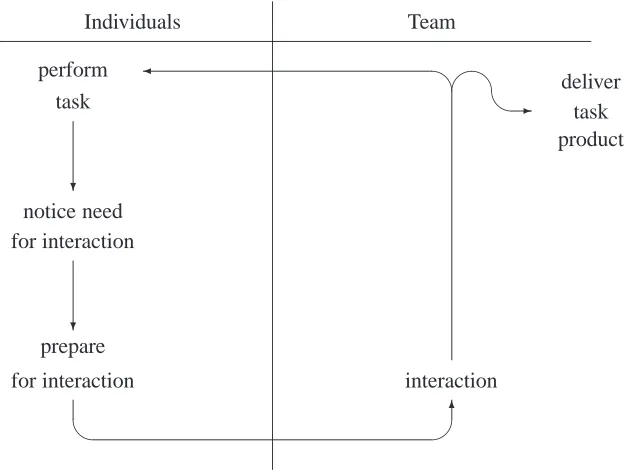
Figure 1: Noble and Letsky Individual Team interplay.
surveys or through written reports by researcher who joined the community as observers, thus providing subjective rather than objective data. With reference to existing cognitive-based col-laboration models [NL02], data mining methods can be used to extract content information from email communication and posting with the support of appropriate ontologies aiming to iden-tify patterns, progress, evolution and achievements in the collaboration process occurring within groups of participants. This requires the analysis of incremental data and the construction and analysis of graph data from the overall social networking aspect of the FLOSS community.
Cognitive-based collaboration theory [NL02] aims to consider many different factors underly-ing the mechanisms that connect community member understandunderly-ings to community effectiveness in production. There is no single model that represents all of these factors, but separate mod-els that address different factors. Only some of these modmod-els are relevant to a self-organising non-hierarchical community as is a FLOSS community.
The individual-team interplay model [NL02] described in Figure1is a cyclic model in which individuals perform a task, notice need for interaction, prepare for interaction, perform the
interaction and go back to the task, possibly delivering the product of the task and then starting a
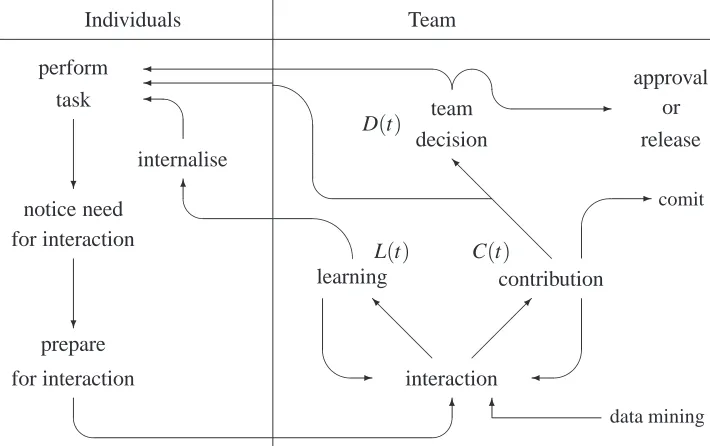
new task. Figure2shows how this model can be adapted to the FLOSS context. Here interaction consists essentially in posting activities while the product of the task is delivered through a commit activity by the individual or through an approval or release decision by the leader team. The interaction process is decomposed into two looping sub-processes [Cer12]:
learning sub-process in which the exchange of knowledge between individual and community
Individuals Team perform task ? notice need for interaction ? prepare for interaction 6 interaction @ @ @ I learning contribution -comit $ 6 internalise @ @ @ @ @ I team decision $
- approvalor
release
data mining 6
L(t) C(t)
D(t)
Figure 2: Individual Team interplay for FLOSS.
level;
contribution process in which a contribution in terms of commit of code, bug report, etc. is the
result of an exchange of communications.
With reference to this adapted model, Section2.1illustrates a possible way for defining a metric to characterise collaboration effectiveness in a FLOSS community.
The Cognition-Behaviour-Product model [NL02] emphasises the nature of the relationship between individual and team understandings, individual and team behaviours and individual and team production. In a FLOSS context, this model has the important role to explain how task quality and understanding affect each other and is essential in measuring individual task performance and collaboration effectiveness.
An important factor in collaboration is trust. Fong et al. [CKF12,CF10], have developed a
filtering trust network model to study about fusing elusive information and deriving trust factors
in a social network, by taking Facebook as a case.
2.1 Towards an Individual-Team Interplay Metric
One way for defining a metric to characterise collaboration effectiveness within a community that is continuously evolving and producing, as a FLOSS community, is to take snapshots of the collaboration measure at consecutive intervals of a sufficiently short duration ∆t and then calculate the average of the measure over the entire community lifetime.
With reference to Figure2we consider the numbers • L(t)of learning activities,
• C(t)of contributions,
• D(t)of team decisions
that occur during the period [t,t + ∆t] for a given time t. It has been observed [Cer12] that participation in a FLOSS project evolves through three stages:
Stage 1 (understanding) in which communication is heavily used to capture, describe and
un-derstand contents, while no production activity is performed;
Stage 2 (practice) in which the role of communication gradually moves to the proposal of new
contents, the defence of the proposed contents and the criticism to existing contents or contents proposed by others, while production activity starts as a trial and error process;
Stage 3 (developing) in which real development occurs.
Let
• N1(t)be the number of contributors in the understanding stage (stage 1),
• N2(t)be the number of contributors in the practice stage (stage 2),
• N3(t)be the number of contributors in the developing stage (stage 3)
at time t. Then the measure of the collaborative effectiveness that characterises the quality
en-hance of the project development during the period[t,t+∆t]for a given time t as follows.
Mt= L(t)·KL
N1(t) +N2(t)
+ C(t)·KC
N2(t) +N3(t)
+D(t)·KD
N3(t)
if N2(t)6=0 and N3(t)6=0.
where KL, KC and KD are constants. This measure shows how collaboration effectiveness in
individual-team interplay within a FLOSS community is characterised by a combination of learn-ing activities (L(t)) by individuals at the learning (N1(t)) and practice (N2(t)) stages, contribution
activities (C(t)) by individuals at the practice (N2(t)) and developing (N3(t)) stages, and team
de-cision activities only by individuals at developing (N3(t)) stages. The contribution of each of the
N(t) N1(t) N2(t) N3(t) L(t) C(t) D(t) Mt
10 6 2 2 5 1 1
KL=1 KC=2 KD=4
3.125
10 5 1 4 5 1 1
10 3 3 4 5 1 1
2.233
2.219
10 5 1 4 4 2 1
10 3 3 4 3 1 3
2.467
3.786
Figure 3: Example.
any active project and if N1(t) =N2(t) =0 the equation above may be modified by removing the
first addend.
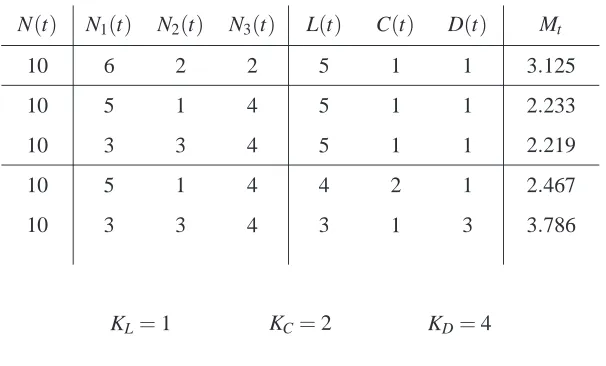
Let us consider the example in Figure3where we use constants KL=1<KC=2<KD=4. A
project with 10 contributors, 6 at the learning stage, 2 at the practice stage and 2 at the developing stage with 5 learning activities, 1 contribution activity and 1 team decision activity has a quality enhance 3.125. As contributors move to more mature stages, if there is no variation on the activity pattern, the quality enhance decreases to 2.233 (2 contributors move to the developing stage) and then to 2.210 (to further contributors move to the practice stage). On the other hand, an increase in the number of contribution activities is associated with an increase in quality enhance from 2.233 to 2.467 (1 additional contribution) and an increase in the number of team decision activities is associated with an increase in quality enhance from 2.219 to 3.786 (2 additional team decisions).
The quality by development of a project of duration D is therefore defined as follows
M=1
n n
∑
t=0
Mt
where n=D/∆t.
2.2 Filtering Trust Network Model
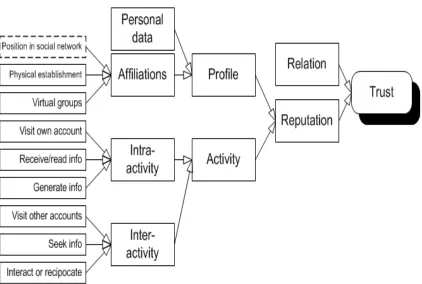
Figure 4: Hierarchical trust metrics model.
In a recent paper [CF10], online trust is inferred via a hierarchical metrics model which con-sists of explicit trust by relation, and implicit trust by reputation. Figure4shows the online trust metrics model. Trust by relation would have to be manually configured by a system administra-tor. Trust by relation suggests that a relatively high degree of trust is perceived between parents and children, spouses and siblings, and perhaps only a moderate amount of trust is reckoned for a stranger who was met on a trip. In a FLOSS project, it is more relevant to deduce implicit trust — hence reputation, from a series of online social criteria, because of the availability of the collected data.
The quantified trust by reputation Ta,ubetween user a and user u can be evaluated based on the
measured values of these attributes using Multiple Attribute Utility Theory (MAUT) as follows:
Ta,u=α ∑PI
totPI+β ∑
W TW P totW TW P +γ ∑
LF totLF +δ ∑
NF totNF +ε ∑
T totT +θ ∑
GIC totGIC
whereα+β+γ+δ+ε+θ=1, and
• PI quantifies personal information;
• W TW P is the number of wall-to-wall posts;
• LF is the number of links among friends;
• NF is the number of friends;
• T is the number of tags between user a and user u;
• GIC is the number of groups in common.
and in each term, the denominator tot represents the total quantity of that particular attribute of this user.
Given the trust estimation equation between any pair of users, a quantifying reputation Ra
could be defined as the general perceivable credibility of a particular user a by all his peers
Ra=φ
N
∑
u=0
u6=a Ta,u
where N is the total number of users in the online community andφ is the normalizing factor. However, it should be clear that the selection of criteria is tightly dependent on the functionalities that each specific social networking site provides to its users, and thus can vary greatly from site to site. A recent study [GK09] generalized the trust factors into seven categories (called time strength dimensions), and has statistically shown how useful they are as predictive variables for trust in social networks. These factors are illustrated in Figure5.
In addition to the metrics mentioned above, which can be extracted directly from the users’ accounts, the influence of a particular user in a social network can be quantified by how far and how deep his messages propagate to. It is also known that the reputation of a good user is partially measured by his popularity and that of his messages, assuming they are of good-will. Klout [Klo], the standard for measuring online influence, has derived a collection of in-depth metrics as social media analytics that measure the outreach level and popularity of one’s messages; hence they may form insightful indicators for inferring one’s reputation in his social group. Klout scores which range from 1 to 100 correspond to the assessment of the three following measures:
True Reach which measures the group size of the user’s engaged followers who actively
re-spond to his posted messages;
Amplification Propensity which calculates the likelihood that the user’s posted messages will
Figure 5: The distribution of the predictive power of the seven time strength dimensions as part of the how-strong model. Source: Gilbert and Karahalios [GK09].
Network Score which computes the influential impact value on the users followers.
3
Quality of Contributions
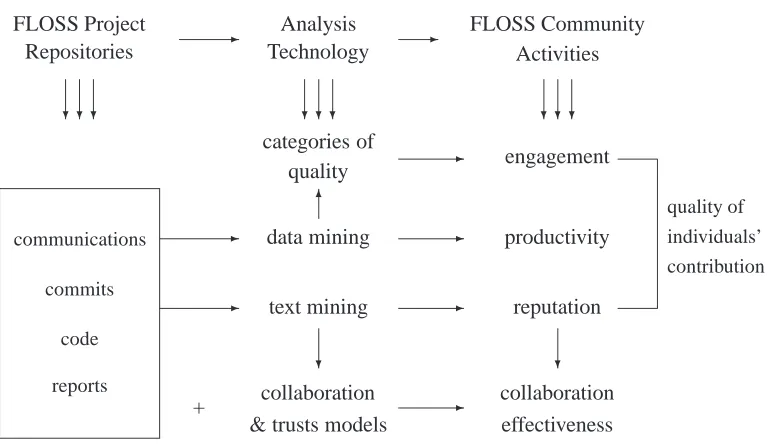
Quality of an individual’s contribution to a FLOSS project can be measured in terms of three parameters: engagement, productivity and reputation.
Shaikh and Cerone [SC09] have identified some factors that are unique to the FLOSS devel-opment process and influence the entire software develdevel-opment process and, consequently, the quality of the final software product. In their work, Shaikh and Cerone also define an initial framework in which such factors can be related to each other and to the quality. In particular, they distinguish three main notions of quality in the context of FLOSS development
quality by access which aims to measure the degrees of availability, accessibility and
readabil-ity of source code in relation to the media and tools used to directly access source code and all supporting materials such as the documentation, review reports, testing outcomes, as well as the format and structural organisation of both source code and supporting mate-rials.
quality by development which aims to measure the efficiency of all development and
commu-nication processes involved in the production, evolution and release of source code, its execution, testing and review, as well as bug reporting and fixing;
quality by design which corresponds to the traditional notion of software quality [Pre00]: the end quality is judged by the design and implementation of the actual software and the code that underlies it.
These three notions of quality can be used as a basis for characterising the quality of engagement of an individual in the community. Every activity of an individual can be classified under an appropriate category of quality and marked to contribute to the final software product accord-ingly. Bug reporting, testing and reviews enhance quality by development, the media and format used to externalise such contributions affect quality by access, whereas evidence of planning and design, and validation of software code contribute to quality by design.
Number of commits and communications provide indicators of the level of contribution of an individual in the community and have been statistically analysed to determine patterns of contribution and their implications for the quality of code [SC10]. The number of commits describes how much the individual delivers in terms of product and is therefore an indicator of the individual’s productivity. Although there is no guarantee on the quality of the product delivered, number of commits can be considered by itself an important parameter in evaluating the quality of the individual as a contributor. Moreover, by integrating data on the quality of the contribution in terms of quality of code and bug reports produced, and efficacy of bug fixing, and quantitative data on the approval and inclusion of the resultant artifacts in a release by the project leader team, we can define a more accurate measure of the quality of the individual’s productivity.
FLOSS Project Repositories
- Analysis Technology
- FLOSS Community Activities
??? ??? ???
communications
commits
code
reports
- data mining - productivity
- text mining - reputation
quality of
individuals’
contribution
+
? collaboration & trusts models
- collaboration effectiveness
? categories of
quality
- engagement
6
Figure 6: Descriptive approach for FLOSS quality assurance
FLOSS communities. Communications among members of a FLOSS community can be anal-ysed to extract information about the reputation an individual has achieved within the commu-nity. Text mining of communications can be used to identify keywords and phrases that may indicate whether an individual is asking or providing support and whether an answer or sug-gestion is taken on board or refuted by others. In addition, the filtering trust network model [CKF12,CF10] discussed in Section 2.2 can highlight trust factors that contribute to build an individuals reputation. Factors influencing individual reputation can then be categorised as both computational (such as communications) and non-computational (trust factors, ratings).
The reputation of an individual depends not just on the participation to a specific FLOSS project, but on the global activities of that individual in the FLOSS world. Therefore reputation information of a given individual have to be collected over all FLOSS projects listing that in-dividual as a participants and be integrated with personal information including the inin-dividual’s background, publication in the FLOSS field and participation in related social networks and dis-cussion fora. Finally, the level of engagement of an individual within a project is visible to the entire project community and, therefore, implicitly affects that individual’s reputation.
4
Conclusion and Future Work
qual-ity defined by Shaikh and Cerone [SC09], to extract indicators of specific FLOSS communqual-ity activities. Such indicators can be used to define metrics that characterise collaboration effec-tiveness in terms of information interaction, task performance, product quality and peer trust, as we have discussed in Section2, and quality of individuals’ contribution in terms of engagement, productivity and reputation, as we have discussed in Section3.
We have seen in Section 2.1 how to use the individual-team interplay model for FLOSS to define a metric to characterise collaboration effectiveness in a FLOSS community. We have illustrated in Section2.2an instantiation of filtering trust network model and further discussed how to adapt such a model to a FLOSS context as a characterisation of reputation and as a further characterisation of collaboration effectiveness.
Finally, we have discussed in Section3how separate metrics can be defined to characterise en-gagement, productivity and reputation of individuals. However, it is still unclear how to combine such metrics into a global metric that could quantify the quality of an individuals contribution to a specific FLOSS project. One of the challenges is represented by possible interrelations between the three metrics; for instance, we have pointed out above that engagement affects reputation. In addition to trust, recent work in this area points to various other social parameters that affect rep-utation [HZC12] demonstrating how reprep-utation obeys the laws of cumulative advantage (through higher likelihood of attracting good reputation given past reputation) and homophily (providing advantage through shared affiliations in terms of common FLOSS projects). Further work will aim to
1. analyse all these various social parameters that affect reputation and their impact on quality of individual’s contribution and collaboration effectiveness;
2. combine separate metrics for quality of individuals’ contribution possibly into a con-tributor profile to offer a more member-centric view of FLOSS development than the community-centric analysis traditionally common in this domain.
In our future work, as the final objective of the work presented in this paper, we intend to merge all metrics defined for specific quality indicators into a comprehensive framework to determine a global metric for FLOSS software quality to be used in a certification process.
Acknowledgements: This work has been supported by Macao Science and Technology
Devel-opment Fund, File No. 019/2011/A1, in the context of the PPAeL project.
Bibliography
[Cer12] A. Cerone. Learning and Activity Patterns in OSS Communities and their Impact on Software Quality. In Proceedings of OpenCert 2011. Volume 48 of Electronic Communications of the EASST. 2012.
[CF10] W. Chen, S. Fong. Social Network Collaborative Filtering Framework and Online Trust Factors: a Case Study on Facebook. In The 5th International Conference on
Digital Information Management (ICDIM 2010). July 2010, Thunder Bay, Canada,
[CKF12] W. Chen, R. Khoury, S. Fong. Web 2.0 Recommendation Service by Multi-Collaborative Filtering Trust Network Algorithm. Journal of Information Systems
Frontiers, 2012.
[Cov] Coverity Scan.
http://scan.coverity.com/about.html
[Cov08] 2008 Coverity Scan Open Source Report. 2008. http://scan.coverity.com/report/
[Cov09] 2009 Coverity Scan Open Source Report. 2009. http://scan.coverity.com/report/
[Cov10] Coverity Scan: 2010 Open Source Integrity Report. 2010.
http://www.coverity.com/library/pdf/coverity-scan-2010-open-source-integrity-report.pdf [Cov11] Coverity Scan: 2011 Open Source Integrity Report. 2011.
http://www.coverity.com/resource-library
[Fon12] S. Fong. Measuring Emotions from Online News and Evaluating Public Models from Netizens Comments: A Text Mining Approach. Journal of Emerging Technologies
in Web Intelligence 4(1):60–66, February 2012.
[GK09] E. Gilbert, K. Karahalios. Predicting Tie Strength With Social Media. In Proceedings
of the 27th International Conference on Human Factors in Computing Systems (CHI 09). April 4–9, 2009, Boston, Massachussetts, USA, pp. 211–220. ACM, 2009.
[HNH03] G. Hertel, S. Niedner, S. Herrmann. Motivation of software developers in Open Source projects: an Internet-based survey of contributors to the Linux kernel.
Re-search Policy 32(7):1159–1177, 2003.
[HS02] T. J. Halloran, W. L. Scherlis. High Quality and Open Source Software Practices. In
2nd Workshop on Open Source Software Engineering. May 2002.
[HZC12] D. Hu, J. L. Zhao, J. Cheng. Reputation management in an open source developer social network. Decision Support Systems 53(3):526–1058, Jun 2012.
[Klo] Klout.
http://www.klout.com
[MB04] P. Massa, B. Bhattacharjee. Using trust in recommender systems: An experimental analysis. In Proceedings of the 2nd International Conference in Trust Management
(iTrust 2004). Lecture Notes in Computer Science 2995, pp. 221–235. 2004.
[McC99] S. McConnell. Open Source Methodology: Ready for Prime Time? IEEE Software 16(4):6–8, Jul/Aug 1999. IEEE Computer Society.
[MRW77] J. A. McCall, P. K. Richards, G. F. Walters. Factors in Software Quality. Volume I. Concepts and Definitions of Software Quality. 1977.
[Neu05] P. G. Neumann. Attaining Robust Open Source Software. In Perspectives on Free
and Open Source Software. The MIT Press, 2005.
[NL02] D. Noble, M. Letsky. Cognitive-Based Metrics to Evaluate Collaboration Effective-ness. In Analysis of the Military Effectiveness of Future C2 Concepts and Systems. RTO-MP-117, NATO Consultation, Command and Control Agency, The Hague, The Netherlands, 23-25 April 2002.
http://www.rto.nato.int/Pubs/rdp.asp?RDP=RTO-MP-117
[Pre00] S. R. Pressman. Software Engineering - A Practitioner’s Approach. McGraw-Hill International, London, 2000.
[Ray99] E. S. Raymond. The cathedral and the bazaar. O’Reilly, 1999.
[RHS06] J. Roberts, I. Hann, S. Slaughter. Understanding the motivations, participation, and performance of open source software developers: a longitudinal study of the Apache projects. Management Science 52(7):984–999, 2006.
[SC09] S. A. Shaikh, A. Cerone. Towards a metric for Open Source Software Quality. In
Proceedings of OpenCert 2009. Volume 20 of Electronic Communications of the
EASST. 2009.
[SC10] S. K. Sowe, A. Cerone. Integrating Data from Multiple Repositories to Analyze Pat-terns of Contribution in FOSS Projects. In Proceedings of OpenCert 2010. Volume 33 of Electronic Communications of the EASST. 2010.
[Sch00] F. B. Schneider. Open Source in Security: Visting the Bizarre. In 2000 IEEE
Sympo-sium on Security and Privacy. May 14–17, 2000, Berkley, California, USA, pp. 126–
127. IEEE Computer Society, 2000.
[SSS07] S. K. Sowe, I. G. Stamelos, I. M. Samoladas (eds.). Emerging Free and Open Source