Research Article
a
June
2018
Computer Science and Software Engineering
ISSN: 2277-128X (Volume-8, Issue-6)
Review on Network Security and Cryptography
Kajal*
Scholar, Department of Computer Science & Engineering ABESIT, Ghaziabad, Uttar Pradesh, India
Rizwan Khan
AssociateProfessor, Department of Computer Science & Engineering ABESIT, Ghaziabad, Uttar Pradesh, India
Abstract— In these days communication technology is very advanced. Digital communication has become very important to secure transmission of information between the sender and the receiver. Security for exchange is a very important feature because it protects information from interloper. In this paper we present a hierarchy of network security technologies such as privacy, authentication, non-rejection and honesty control. There are two popular security mechanisms, namely cryptography and steganography. Both are well known and widely used techniques. Cryptography is used to send data in an encrypted form using the encryption key. Encrypted data is transmitted through unsafe public media. Decryption algorithms are also used to decrypt messages when using decryption keys. Steganography is used to hide data in other cover media.
Keywords— Network Security, Cryptography, Decryption, Encryption, Steganography.
I. INTRODUCTION
The transmission of information via the Internet may include sensitive personal data that may be attacked by intruders. In addition, there are many applications on the Internet and many websites require the user to fill out the form in which sensitive personal data can be used. The user may need personal and secure communication for a number of reasons, which protect his information from intruders who are still waiting for an attack on sensitive data. Therefore, confidentiality and data integrity are necessary to protect information from unauthorized access and use. Network security issues can be divided into four parts: confidentiality, authentication, rejection, and integrity checking. Confidentiality or confidentiality concerns the protection of information against unauthorized users. This means that unauthorized users should not be able to read and understand the information. Verification means that any party that may be a sender or receiver can verify that the other party is what he claims, that is, validates the identity of the other party. Indemnification means that the sender can not refuse to send a particular message. That is, if there is a transaction between the two parties, the non-refusal service can prove that it has done the transaction for one of the parties, and not another person. Integrity means that the recipient can confirm that a message has not been modified during the transmission, that is, to store information about forgery.
II. SECURITYREQUIREMENTS
A. Confidentiality
The information must only be readable for the desired recipient. That is, save information from saving. There are two main techniques for obtaining security: cryptography and steganography. Cryptography is the science of secret or hidden writing of information. There are two main components: coding and decoding. There are two types of cryptography algorithms: public key cryptography and symmetric key cryptography. Steganography is a technology of secret communication where the intruder may not suspect that communication is going on. Secret information in steganography is hidden in another file without any problems. A carrier file or cover file can be an image, audio, video or text file.
B. Authentication
It means verification. Verification means the identification process of a person based on the user name and password. In security systems, authentication is the process by which people access items based on their identity. Authentication ensures that the person he claims but does not say anything about the person's right
C. Non-repudation
ISSN(E): 2277-128X, ISSN(P): 2277-6451, pp. 21-25 D. Data integrity
In terms of networking, data integrity refers to the overall completeness, accuracy and stability of the data. Data integrity should be imposed when sending data through the network. This error can be achieved using the probe and correction protocol.
Fig-1: Classification Of Network security algorithm
III. CRYPTOGRAPHY
Cryptography is a technology that ensures security by preventing messages from being encrypted and readable. Cryptography is a technology to transmit data on the Internet by applying an encryption algorithm that intruders are difficult to attack specific confidential information or personal information. The two basic words used in encryption are encryption and decryption. The encryption process is the process of converting plain text to encrypted text, and the decryption process is the reverse process of encryption. Plain text is text that contains the original message or unencrypted data and the cipher text is text that can be shared after encrypting the message. A key is necessary for encrypting and decrypting messages.
Fig2. Encryption And Decryption
1. Plain Text
ISSN(E): 2277-128X, ISSN(P): 2277-6451, pp. 21-25
2. Cipher Text
Represents ordinary text that is incomprehensibly represented by the application of a mathematical algorithm. The code text is coded plain text that is sent to the recipient.
3. Key
A mathematical value, formula, or process that describes how to encode or decode a flat text message. The key is the only way to decrypt the encrypted information.
A. Cryptographic Algorithm
An expression used to encrypt plain text to generate code text. Converting readable text to encrypted text using cryptographic algorithms is called coding, and converting encrypted text to readable text with the same cryptographic algorithm is called decryption. Figure 1 shows the cryptographic tactics. Widely cryptographic algorithms can be divided into two categories:
Stream algorithms : Clear byte operation at once. Bytes can be letters, numbers or special characters. This process is inefficient and slow.
Block algorithms : Works on the readable text in blocks of bytes, called blocks (hence block name algorithm or block numbers). The general block size for modern algorithms is 64 bytes, small enough to work with but large enough to prevent code breakers. Unfortunately, breaking the 64-byte algorithm with brute force is unfortunately a relatively simple task with the current microprocessor speed.
1. Types of Cryptography
a. Secret Key Cryptography(Private key Cryptography): This algorithm is also known as secret key cryptography, where the sender and receiver encode and decode messages using the same key. An algorithm known as symmetric key algorithm is used for symmetric key encryption. Symmetric algorithms are classified into two types: stream encryption and block encryption. The flow encryption algorithm is optimized to accept readable text streams used to create encryption keys and to encode text streams. The block number algorithm works on data blocks where readable text is divided into blocks and each block is used independently.
Some algorithms are:
• Data Encryption Standard(DES)
• Advanced Encryption Standard(AES)
• Triple Data Encryption Standard
• International Data Encryption Algorithm
• Blowfish Encryption Algorithm
• Twofish Encryption Alggorithm
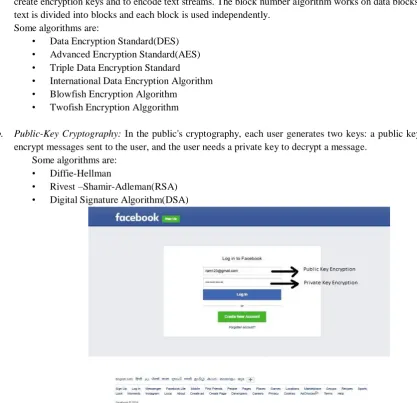
b. Public-Key Cryptography: In the public's cryptography, each user generates two keys: a public key that is used to encrypt messages sent to the user, and the user needs a private key to decrypt a message.
Some algorithms are:
• Diffie-Hellman
• Rivest –Shamir-Adleman(RSA)
• Digital Signature Algorithm(DSA)
ISSN(E): 2277-128X, ISSN(P): 2277-6451, pp. 21-25
c. Hash Functions: The hash function uses mathematical changes in an irreversible encryption information. The main
application of the hash function in cryptography is the integrity of messages. Hash Value Message delivers the digital framework and ensures that the message is not replaced by attack, virus or other. The hash algorithm is efficient due to the very low probability that two different plain text messages will produce the same hash value.
2. Advantages And Disadvantages
Advantages:
• It hides information and keep safe.
• Nobody knows what this says until there is no key for the code.
• You can write what you want. Even if the code (subject of code) wants to keep your secret code.
Disadvantages:
• In this code takes a long time.
• It takes a long time to understand the code.
• If you want to send a code to another person in the past, it will cost a lot to meet.
B. Steganography
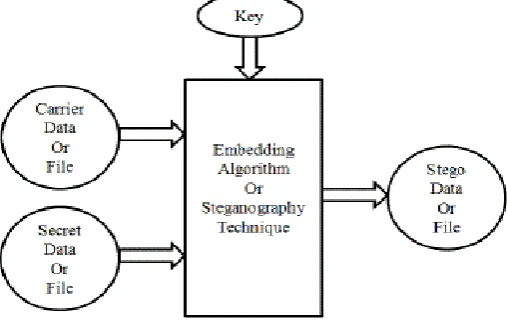
Steganography is a technology for embedding hidden messages or data so that the existence of messages can not be discovered. It is the advanced technology of cryptography. The main purpose of steganography is to hide the message or secret information so that no one can detect it. If they receive doubt data, the target is lost The various types of data can be audio, video, text and images etc.
1. The Carrier image:The image of the courier is also called the cover object that will carry the message / data that used to be hidden.
2. The Message:There may be anything like a message data, file or image etc.
3. The Key: A key is used to decode and understand the hidden message.
Fig 4. Basic Model Of Steganography
Advantages And Disadvantages Advantages:
A. Difficult to detect and only detect the receiver.
B. It can speed up with many software.
C. Provides better security for data sharing across LAN, MAN and WAN.
Disadvantages:
• If this technique has fallen into the wrong hands like hackers, terrorists and criminals, then it can be very
dangerous for everyone.
• A large number of data, huge file sizes, so anyone can doubt for all.
IV. CONCLUSIONS
ISSN(E): 2277-128X, ISSN(P): 2277-6451, pp. 21-25 REFERENCES
[1] STALLINGS Cryptography and Network Security Principles and Practices by Menezes, Paul C. van Oorschot,
and Scott A. Vanstone CRC Press. Hardware Security(HARDSEC) : Design, Threats, and Safeguards by Debdeep Mukhopadhyay and Rajat Subhra Chakraborty, CRC Press, Taylor and Francis Group.
[2] HilalAlmara'beh “Steganography Techniques - Data Security Using Audio and Video”, International Journal of
Advanced Research in Computer Science and Software Engineering Volume 6, Issue 2, February 2016
[3] Marwa E. Saleh , Abdelmgeid A. Aly, Egypt Fatma A. Omara,“Data Security Using Cryptography and
Steganography Techniques” in (IJACSA) International Journal of Advanced Computer Science and Applications, Vol. 7, No. 6, 2016
[4] Vishnu S babu and Prof. Helen KJ, “A study on combine cryptography and steganography” in IJRSCSE
International Journal of Research Studies in Computer Science and Engineering, Volume 2, Issue 5, May 2015, PP 45-49
[4] Hemang A. Prajapati, Dr. Nehal G. Chitaliya, “Secured and Robust Dual Image Steganography: A Survey” in
International Journal of Innovative Research in Computer and Communication Engineering, Vol. 3, Issue 1, January 2015
[5] AartiMehndiratta, “Data Hiding System Using Cryptography & Steganography: A Comprehensive Modern
Investigation” in International Research Journal of Engineering and Technology (IRJET), Volume: 02 Issue: 01 | Apr-2015
[6] ShyamNandan Kumar, “Review on Network Security and Cryptography” in International Transaction of
Electrical and Computer Engineers System, 2015, Vol. 3, No. 1, 1-11
[7] Md. Khalid Imam Rahmani and KamiyaArora, Naina Pal, “A Crypto-Steganography: A Survey in” in (IJACSA)
International Journal of Advanced Computer Science and Applications, Vol. 5, No. 7, 2014
[8] Rakhi1, Suresh Gawande2 “A REVIEW ON STEGANOGRAPHY METHODS”, International Journal of