© 2019, IRJET | Impact Factor value: 7.211 | ISO 9001:2008 Certified Journal
| Page 548
Optimization of Surveillance Camera for Low Cost Storage Device
M. Porpavai
1, S. Ramya
2, V. Rajesh
3, Ms. R. Birundha
41,2,3
Student ,Final Year B.E- ECE, Valliammai Engineering College, Tamilnadu, India.
4Assistant Professor, Dept. of ECE, Valliammai Engineering College, Tamilnadu, India.
---***---
ABSTRACT - In surveillance, CCTV camera is more costlybecause of the use of computer. It reserves too much space for continues recording and also require manpower to detect the unauthorized Activity. By comparing to the existing system Raspberry pi system is much cheaper with better resolution and low power consumption feature. Here Motion Detection Library is used as a simple but powerful people presence triggers. This system is only suitable for small personal area surveillance such as personal office cabin, bank locker room and parking entrance. Whenever the motion is detected through Motion Detected inside the room the image is captured through camera and temporarily stored in the raspberry pi module. Application under IOT (Internet of Things) can be used remotely to view the activity and get notifications when motion is detected. System works standalone without the PC once programmed. One Internet browsers is used to get the notification on motion detection.
Key Words: Storage optimization, Raspberry Pi, USB Camera, CCTV, Redundant frames.
1. INTRODUCTION
Surveillance cameras are the basic requirements for the security of any place. After certain period of time, the memory space should be upgraded which leads to high maintenance cost. Hence the video size is optimized by removing unwanted video frames. Our project is to design and implement an intelligent system that accepts input as a video sequences. The video sequences are subdivided into the frames. The adjacent frames are compared then they will store the frames that are not similar to each other. This approach will optimize the storage as well as maintain the information quality. Whenever the motion sensor detect an image then the camera will turn on, take the image using the surveillance camera by image processing technique.
Image processing is basic methods of converting image into digital form. Digital capturing is more popular because of the captured video by digital surveillance cameras is very easy to track and analyze with object detection and content analysis tools. The captured video is sent to the server for further processes.
2. LITERATURE REVIEW
In literature [6] IOT based system, its advantages, uses, email notification are discussed and cloud is used to store
data in image processing, literature [7] discusses about image data transfer to the android device with limited distance constraint.
© 2019, IRJET | Impact Factor value: 7.211 | ISO 9001:2008 Certified Journal
| Page 549
3. PROPOSED METHODOLOGYThe aim is to make smart motion surveillance system which can be monitored by owner remotely through android applications. As it is connected with the system, the system will send push notifications to android device when an intrusion is detected. It is necessary to develop and implement an affordable low cost web-camera based surveillance system for remote security monitoring. An authorized user can access to their monitoring system remotely through internet with the use of a mobile phone and monitor the situation. This entire work is done by using Raspberry Pi with Raspbian operating system.
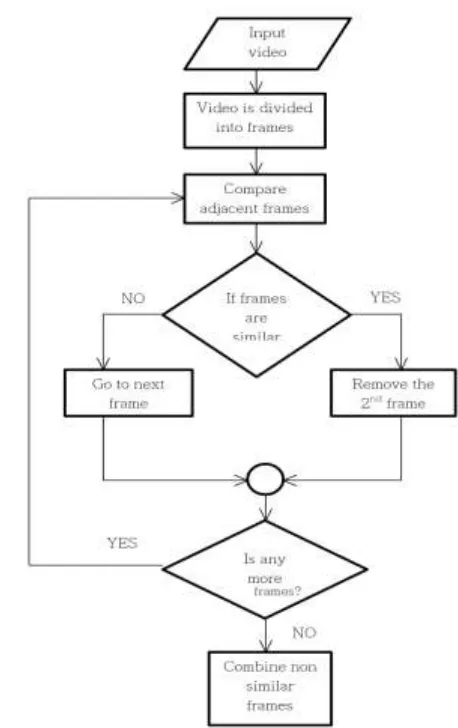
The main objective is to propose a system to optimize the storage and as well as to maintain the information quality. The camera will continuously capture the images. The video sequences are divided into subsequent frames. The adjacent frames of the video sequence are compared. Then the system will store the frames that are not similar to the adjacent frames. In this work, Python is used as the platform for implementing the various image processing and computer vision techniques.
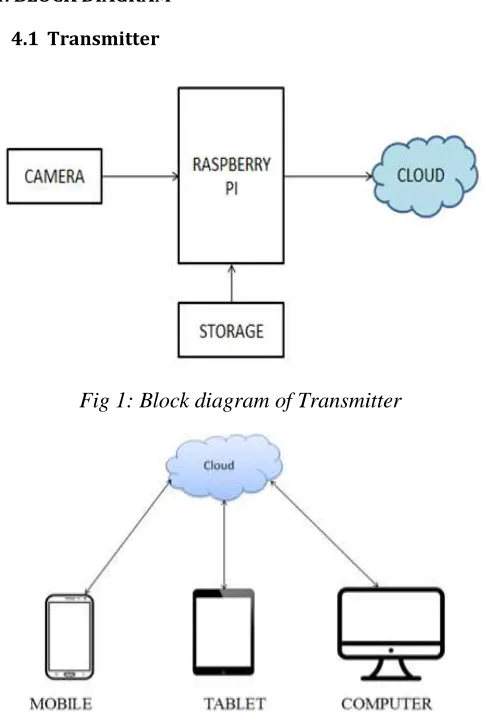
4. BLOCK DIAGRAM
[image:2.596.40.283.368.730.2]4.1 Transmitter
Fig 1: Block diagram of Transmitter
5. WORKING PRINCIPLE
This project consists of four modules. They are
Extraction of the frames from the video sequence.
Comparison of the adjacent frames of video sequence.
Combining the non-similar frames of the video sequence.
Sending an alert mail to the receiver regarding the motion detection.
The project implementation includes the following steps
Step 1: Setting up of the Raspberry Pi
After getting the Raspberry Pi, SD Card is written with its OS. Then the Micro USB Power Cable is attached along with the Raspberry Pi with monitor through HBMI cable. Then the keyboard and mouse are connected with it.
Step 2: Making the Raspberry Pi operate without monitor, keyboard and mouse.
The Raspberry Pi is made to be connected with internet without any PC. Through Putty the system works in standalone mode, this helps to access the command window of Pi.
Step 3: Installation of the VNC Viewer
The VNC Viewer is installed in the system. After installation, the IP address of Raspberry Pi is dynamically entered to operate the Pi through PC.
Step 4: Running the VNC Viewer
It is necessary to ensure that the VNC starts automatically, as it enables the working of the system remotely with GUI display of Pi.
Final Process is as follows
Motion Detection: The Python helps to find the difference between the last frame and the present frame.
Sending Notification: When the motion is detected, it will send the notification to the receiver by means of alert mail, along with the motion detection video.
6. HARDWARE DESCRIPTION
6.1.Raspberry Pi
© 2019, IRJET | Impact Factor value: 7.211 | ISO 9001:2008 Certified Journal
| Page 550
keyboard and mouse. It is a very cheap computer that [image:3.596.45.272.197.387.2]uses Linux, but it also provides a set of GPIO (general purpose input/output) pins that allows us to control electronic components. It is a capable little device that enables people to explore computing, and to learn how to program in languages. It has the ability to interact with the outside world, and it can be used in a wide array of digital marker projects.
Fig 3: Raspberry Pi 3 Model B+
6.2. USB Camera
We use a normal standard USB webcam to take the pictures and video on the Raspberry Pi. The quality and the configurability of the camera module is highly superior to a standard USB webcam. We can also use “IR camera” instead of USB camera for “Night Vision”.
Fig 4: USB Camera
7. SOFTWARE DESCRIPTION
Python is an interpreter, high level, general purpose programming language. Python’s elegant syntax and
dynamic typing, along with its interpreted nature, makes it an ideal language for the rapid application development in most platforms. It is the Raspberry Pi’s recommended programming language. Linux is one of the open source software. It is the Raspberry Pi’s recommended operating system; it is also based on Linux Kernel. Every flavor of the Raspberry Pi uses Raspbian. Raspbian is the Debi an-based computer operating system for Raspberry Pi.
[image:3.596.320.549.211.575.2]FLOW CHART
Fig 5: Flow Chart of the video recording
8. EXPERIMENTAL RESULTS
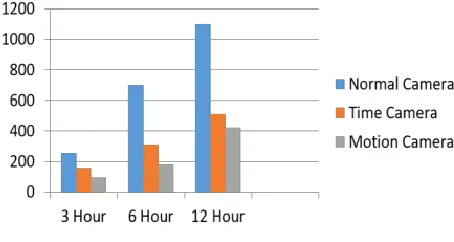
The main objective is to minimize or optimize the storage space occupied by the CCTV footage based on the redundancy of the adjacent frames.
[image:3.596.68.253.528.676.2]© 2019, IRJET | Impact Factor value: 7.211 | ISO 9001:2008 Certified Journal
| Page 551
receiver, regarding the motion detection.• Normal camera - 24/7- activity 30% - 1GB
• Time camera - 12/7- activity 30% - 500MB
• Motion detection by Frame comparison
[image:4.596.52.279.204.325.2]-24/7- activity 30% - 300MB
Fig 4: Comparison of the memory storage of various cameras.
9. ADVANTAGES
Increase cyber security by using Linux based software.
Core level image processing by raspberry pi will increase quality and security in recording.
Reduce memory space with increased quality of camera view.
10. APPLICATIONS
It can be used in small personal area surveillance. I.e. Personal office cabin, Bank locker room, Parking entrance, etc.
It can also be used in Army surveillance, Space research.
It can also be used in high dense areas. E.g.: Mall, Traffic signals.
11. CONCLUSION
It is designed in such a way that the CCTV surveillance system can fulfill the needs of the user. It is designed mainly to optimize the storage for Closed-Circuit Television (CCTV) because the storage is a real challenge with increasing market demand. The system has countless applications and they can be used in different environments and scenarios.
12. REFERENCES
[1]. Benny Thornberg, Martin Palkovic, Qubo Hu, Leif Olsson, Per Gunnar Kjeldsberg, Mattias O’Nils, and Francky Catthoor, “ Bit-Width Constrained Memory Hierarchy Optimization for Real-Time Video Systems”, IEEE Transactions on computer-aided design of integrated circuits and systems, Vol. 26, N0. 4, April 2007.
[2]. Limin Liu, Zhen Li, and Edward J, Delp, “ Eifficient and Low-Complexity Surveillance Video Compression Using Backward-Channel Aware Wyner-Ziv Video Coding”, IEEE Transactions on circuits and systems for video technology, Vol. 19, NO. 4, April 2009.
[3]. Jasmeet Kaur, A Combined DWT-DCT approach to perform video compression base of Frame Redundancy Volume 2, Issue 9, September 2012 International Journal of Advanced Research in Computer Science and Software Engineering, pp-325-332
[4]. Seagate, Video Surveillance Storage: How Much is Enough? White Paper, February 2012
[5]. Video Surveillance and Storage Survey by HIS Technology,Sept 2014,www.emc.com/collateral/analyst-reports.
[6]. Aamir Nizam Ansari\Mohamed Sedkyl, Neelam Sharma2, Anurag Tyagil IFaculty of computing, Engineering and sciences, Staffordshire University, Stoke-on-Trent, United Kingdom” An Internet of Things Approach for Motion Detection using Raspberry Pi” presented at the International Conference on Intelligent Computing and Internet of Things (ICIT), 2015.
[7]. Sung Wook Moon 1, Young Jin Kim2, Ho Jun Myeong3, Chang Soo Kim4, Nam Ju Cha5, and Dong Hwan Kim 6 “Implementation of Smartphone Environment Remote Control and Monitoring System for Android Operating System-based Robot Platform” , 2011 8th International
Conference on Ubiquitous Robots and Ambient Intelligence (URAI 2011) , Songdo ConventiA, Incheon, Korea, Nov. 2011
[8]. Ying-Wen Bai, Zi-Li Xie and Zong-Han Li, “Design and Implementation of a Home Embedded Surveillance System with Ultra-Low Alert Power” IEEE Trans. Consumer Electronics, Vol.57. pp, 153-159, February 2011
[9]. Sanjana Prasad, P. Mahalakshmi, A. John Clement Sunder, R. Swathi, “ Smart Surveillance Monitoring System Using Raspberry PI and PIR Sensor”, International Journal of Computer Science and Information Technologies, Vol. 5(6), 2014, 7107-7109.
Systems-© 2019, IRJET | Impact Factor value: 7.211 | ISO 9001:2008 Certified Journal
| Page 552
ISSN: 2249-0868, Foundation of Computer Science FCS,New York, USA, Volume 10-No.5, February 2016-www.ijais.org
[11]. Internet of Things’, 2012 Second International Conference on Instrumentation, Measurement, Computer, Communication and Control, 2012.