ARTIGO ORIGINAL
RESUMO
Introdução: As baterias clássicas de caracterização de afasia são demasiado longas para serem utilizadas no contexto do acidente vascular cerebral agudo ou como ferramenta de monitorização. O Aphasia Rapid Test é uma escala de 26 pontos desenvolvida como teste de cabeceira para avaliar a gravidade da afasia num doente com acidente vascular cerebral em menos de três minutos. O objetivo do estudo é adaptar e validar a escala para o português europeu.
Material e Métodos: Foram avaliados 56 doentes com acidente vascular cerebral no primeiro e sétimo dia pós-acidente vascular cerebral. Ao sétimo dia, foram avaliados por dois avaliadores independentes para avaliar o acordo interavaliadores. Para estudar a validade concorrente, a 20 doentes foi aplicada também a Bateria de Avaliação de Afasias de Lisboa. A capacidade preditiva do Aphasia Rapid Test foi avaliada aos seis meses, através do valor da subescala de afasia do National Institutes of Health Stroke Scale.
Resultados: A tradução para o português europeu baseou-se nas versões francesa e inglesa, respeitando a frequência de utilização das palavras. O α de Cronbach foi de 0,796. O coeficiente de concordância entre examinadores foi excelente (0,985). A correlação entre o Aphasia Rapid Test e a Bateria de Avaliação de Afasias de Lisboa é forte (r = -0,958, p < 0,001). Os gráficos de Bland-Altman corroboram as boas concordâncias interavaliadores e validade concorrente. O Aphasia Rapid Test no primeiro dia é preditor independente do resultado a longo prazo.
Discussão: Este estudo apresenta resultados confiáveis para o português europeu, com valores de consistência interna, concordância interavaliadores e validade concorrente adequados.
Conclusão: O Aphasia Rapid Test é um bom instrumento para avaliação e monitorização da afasia em doentes com acidente vascular cerebral.
Palavras-chave: Acidente Vascular Cerebral; Afasia/diagnóstico; Portugal; Resultado do Tratamento; Testes Neuropsicológicos
Aphasia Rapid Test: Translation, Adaptation and Validation
Studies for the Portuguese Population
Aphasia Rapid Test
: Estudos de Tradução, Adaptação e
Validação para a População Portuguesa
1. Serviço de Neurologia. Centro Hospitalar e Universitário de Coimbra. Coimbra. Portugal. 2. Faculdade de Psicologia e de Ciências da Educação. Universidade de Coimbra. Coimbra. Portugal.
3. Centro de Estudos de Linguística Geral e Aplicada. Departamento de Línguas, Literaturas e Culturas. Faculdade de Letras. Universidade de Coimbra. Coimbra. Portugal. 4. Faculdade de Medicina. Universidade de Coimbra. Coimbra. Portugal.
5. Serviço de Medicina Física e Reabilitação. Centro Hospitalar e Universitário de Coimbra. Coimbra. Portugal. 6. Escola Superior de Saúde. Universidade de Aveiro. Aveiro. Portugal.
7. Serviço de Medicina Interna. Centro Hospitalar e Universitário de Coimbra. Coimbra. Portugal.
Autor correspondente: Miguel Tábuas-Pereira. [email protected]
Recebido: 17 de abril de 2017 - Aceite: 30 de abril de 2018 | Copyright © Ordem dos Médicos 2018
Miguel TÁBUAS-PEREIRA1, Sandra FREITAS2, José BEATO-COELHO1, Joana RIBEIRO1, Joana PARRA1,
Cristina MARTINS3, Miguel SILVA4, Maria Assunção MATOS5,6, Ana Rita NOGUEIRA7, Fernando SILVA1,
João SARGENTO-FREITAS1, Gustavo CORDEIRO1, Luís CUNHA1,4, Isabel SANTANA1,4
Acta Med Port 2018 May;31(5):265-271 ▪ https://doi.org/10.20344/amp.9090 ABSTRACT
Introduction: Classical aphasia evaluation scales are too long to use in the context of acute stroke or as a monitoring tool. The Aphasia Rapid Test is a 26-point scale developed as a bedside assessment to rate aphasia severity in acute stroke patients in less than 3 minutes. We aimed to adapt and validate this scale for European Portuguese.
Material and Methods: We evaluated 56 acute stroke patients in the first and in the seventh days post-stroke. In the seventh day, patients were evaluated by two independent raters, to evaluate inter-rater agreement. To study concurrent validity, the Lisbon Aphasia Examination Battery was applied to a subset of 20 patients. The predictive ability of the Aphasia Rapid Test was assessed at six months, by the aphasia subscale of the National Institutes of Health Stroke Scale.
Results: Translation to European Portuguese was based in the French and English versions, considering the words’ utilization frequency. The Chronbach’s alpha was 0.796. The concordance coefficient between the two raters was excellent (0.985). Correlation between Aphasia Rapid Test and the Lisbon Aphasia Examination Battery was strong (r = -0.958, p < 0.001). The study through Bland-Altman graphs corroborated the good inter-rater agreement and concurrent validity of the test. The Aphasia Rapid Test score in the first day is an independent predictor of long-term outcome.
Discussion: This study provides reliable results for European Portuguese, with adequate internal consistency, inter-rater agreement and concurrent validity.
Conclusion: The Aphasia Rapid Test is a good tool for the evaluation and monitoring of aphasia in stroke patients.
Keywords: Aphasia/diagnosis; Neuropsychological Tests; Portugal; Stroke; Treatment Outcome
INTRODUCTION
Approximately 21% to 38% of the patients with an acute
stroke had aphasia at admission,1 with a relevant impact on
the quality of life,2 affecting not only patient’s professional
and social activity,3 as also patient’s family and caregivers.4
Classical stroke-related aphasia assessment scales are too long and therefore less suitable for patients with an acute
stroke5 or even as a monitoring tool. In an acute setting with
ARTIGO ORIGINAL rapid assessment method within the initial medical evalua-tion at the emergency room and sensible to the time course
of aphasia. Some rapid bedside scales have been used in this context, even though with a limited or unassessed
abil-ity to work as a monitoring instrument.6-8
Currently, the relevance of neurological impairment in stroke is routinely assessed by the National Institute of
Health Stroke Scale (NIHSS),9 which is a rapid, easy and
reproducible bedside scale, with enough sensitivity as to detect for small changes in patient’s neurological status and
is a good predictor of functional outcome,10 even though
language is only superficially assessed. The Aphasia Rapid
Test (ART)11 has been recently proposed as a bedside scale
for grading the severity of aphasia, based on the neurologi-cal parameters that are usually assessed in stroke. The
ART was developed in France by C. Azuar et al.11 and is
available both in French and in English and, according to the authors, is a simple and rapid instrument easily handled by health professionals upon a short training period and re-quiring no specific support material, allowing for an early detection and grading of the severity of aphasia throughout patient’s stay at the hospital, allowing for a more informed
referral for a speech-language pathology program.12,13
Our study aimed to the use of this scale in Portugal. Therefore, upon the adaptation and transcultural validity of the test to European Portuguese, the scale’s psychometric characteristics and potential to predict long-term outcome of aphasia have also been studied.
MATERIAL AND METHODS Participants
Patients with acute stroke consecutively admitted to the
Department of Neurology of the Centro Hospitalar e
Univer-sitário de Coimbra between 1 July 2014 and 31 December
2014 were included in the study. Verbal consent has been obtained from all the participants or, whenever unavailable, from the patient’s nearest relative. The study was approved by the Ethics Committee and all data were anonymous at the time of collection, therefore complying with confidential-ity. All study procedures were carried up according to the 1975 Helsinki Declaration.
Patients within the following inclusion criteria were se-lected:
a) European Portuguese as patient’s first language (patients with a more usual and current use of an-other language for over a 10-year period were ex-cluded from the study);
b) Right-handed patients (assuming a usual pattern of hemisphere dominance);
c) Diagnosed by the assistant neurologist with stroke and language impairment;
d) Presence of an acute ischaemic lesion in head CT-scan.
These were the exclusion criteria: a) Presence of impaired consciousness; b) Previous stroke;
c) Physical inability making any tasks related to the
ap-plication of the scale impossible, namely the pres-ence of endotracheal intubation or any other physi-cal barrier preventing from the production of speech sounds.
Method of data collection Material
The ART11 aimed to rate the level of aphasia in patients
with acute stroke, including six sub-scales for the assess-ment, in at least three minutes, of the main four parameters found in a language study: comprehension, repetition, nam-ing and semantic fluency. The patient is initially asked to perform two simple (maximum 2 points) and one complex order (3 points), allowing for the evaluation of simple and complex verbal comprehension, followed by the repetition of three words (6 points) and one sentence (2 points). The patient is subsequently asked to name three everyday ob-jects (maximum 6 points) while semantic fluency (4 points) is assessed by a 1-min verbal semantic fluency task. Apart from the assessment of the main four parameters, dysar-thria (0 to 3 points) is also rated, according to a scoring
system similar to the NIHSS.12 The ART has a 0-26 scoring
range, with the poorest performance corresponding to the highest score.
Procedures
The Portuguese version of the ART and the NIHSS9,10
were included into the assessment protocol and both were applied to all the patients, by this sequence and by the same examiner (stroke neurologist). The time of administration of the ART was recorded from the beginning of the first task up to the end of the last one and all the items have been administered to all the participants, including those patients with severe comprehension impairment.
The patients were assessed at different post-stroke mo-ments: within 24 h of stroke onset (± 1 day) – D1, within the seventh post-stroke day (± 1 day) - D7- and also at the follow-up medical assessment (within 6 to 12 months of stroke onset). The study of the scale’s psychometric prop-erties was focused on the assessment at D7 and a patient subgroup was examined by two independent examiners for the assessment of inter-examiner agreement and both evaluations were always made at a maximum interval of 12 hours. As regards convergent validity, four tasks of the
Bateria de Avaliação de Afasia de Lisboa (BAAL)13-15 were administered to a patient subgroup (10 patients at D7, 10 patients at six months post-stroke).
ART’s prediction of 6-12-month aphasia outcome has
been obtained and compared to the NIHSS (NIHSSaphasia),
with an ART score ranging between 0 and 3. Patients were divided into two groups, using the scores obtained with this sub-scale: those scoring 0 or 1 (corresponding to a good outcome) and those with 2 or 3 (poor outcome).
Data analysis
The statistical analysis was made by using the
ARTIGO ORIGINAL
software (IBM SPSS, Chicago, IL). The characteristics of our group of patients and the time of administration of the scale were analysed by using descriptive statistics. Cron-bach’s alpha was considered as an indicator of internal consistency of the instrument and Pearson’s correlation coefficients were used to examine its construct validity (inter-subtest and subtest and total score correlations). In-ter-examiner agreement was analysed by using intra-class correlation coefficient and weighted kappa (considering the distance between the results obtained by the two examiners and not only the simple univocal agreement between them). The same kappa was obtained for each subtest. Bland-Alt-man plots have also been obtained in order to exclude pos-sible systematic differences between examiners and outli-ers. Convergent validity was assessed by using correlation coefficients between the scores obtained with the adminis-tered tasks and a simple linear regression and the analy-sis of scoring linear relationship. The ART score variation between D1 and D7 (D1 ART and D7 ART) was compared
in groups with different aphasia outcomes (NIHSSaphasia of
0-1 versus 2-3) through Mann-Whitney’s test, in order to determine the scale’s sensitivity. The scale’s prediction (D1
ART) of 6-12-month NIHSSaphasia ≥ 2 was analysed through
an age-adjusted binomial logistic regression as well as
ad-justed for patient’s educational level and NIHSSmotor at D1
(this value was obtained from the NIHSS - the items pos-sibly affected by language impairment were excluded: items regarding command achievement (item 1b), language (item 9) and dysarthria (item 10) – as we wanted to study ART’s value in prediction of aphasia apart from other impairments and not as an alternative to the NIHSS and also to avoid considering some language impairments twice, which would increase co-linearity and reduce the scale’s value).
RESULTS
Transcultural adaptation to the Portuguese population
Approval for studying the adaptation and validity of the ART to the Portuguese population was given by the au-thors of the 2014 original version and the procedure
recom-mended by Herdman et al.16 has been followed: translation,
retranslation, analysis of semantic equivalence and experi-mental application. The translation of the scale for Euro-pean Portuguese was completed by a trilingual linguistic translator experienced in the adaptation of neuropsycholog-ical tests, based on the original French scale as well as on the translation into English obtained by the authors. The fre-quency of use of words in the original scale has been
com-plied with (upon consultation of the LEXIQUE,17
SUBTLEX-us18 and the language dictionary),19 regarding repetition and
naming. Retranslation into English has been obtained, due to a greater experience of the expert panel and due to the fact that this is the most widely used scale. The analysis of semantic equivalence was made by a three-expert panel (two neurologists and one neuropsychologist) and the op-tion for naming of everyday objects easily available at the hospital has been made, in order to allow for the application of the scale without the need for any specific support mate-rial.
Socio-demographic and clinical characteristics
A total of 56 admitted patients with acute stroke and aphasia (36 female; mean age 78.5 ± 10.3 years; 3.2 ± 2.9 years of education, on average) were included in the study. A mean ART score of 13.0 ± 9.0 and NIHSS score of 9.6 ± 8.3 were obtained at baseline.
Time for administration
Time for the administration of the scale (including the 60-second fluency task) was recorded in the first 25 pa-tients (14 female; mean age of 71.9 ± 14.4 years; 4.4 years of education, on average) and a mean two-minute 34.8-sec-ond (standard deviation = 50.4 s) time has been recorded.
Psychometric characteristics
Total ART scores at D7 were considered for the analysis of the internal consistency and a Cronbach’s alpha of 0.796 has been obtained, which did not increase upon the exclu-sion of any item of the test.
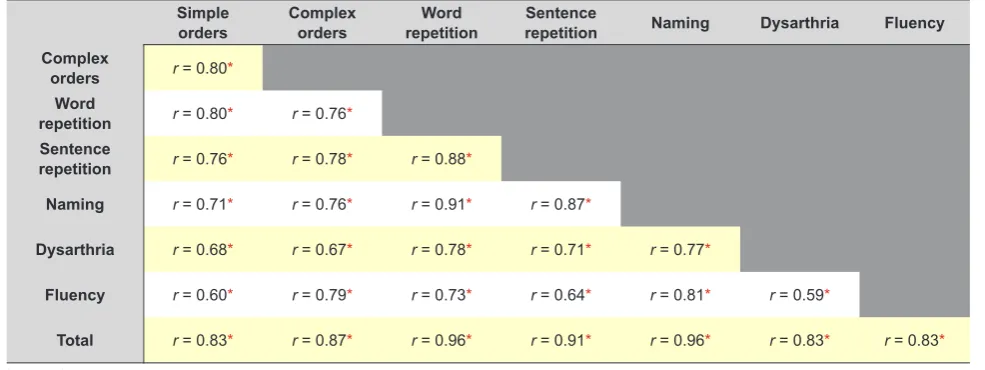
Table 1 – Correlation coefficients between ART subtests and ART total score
Simple
orders Complex orders repetitionWord repetitionSentence Naming Dysarthria Fluency
Complex
orders r = 0.80*
Word
repetition r = 0.80* r = 0.76*
Sentence
repetition r = 0.76* r = 0.78* r = 0.88*
Naming r = 0.71* r = 0.76* r = 0.91* r = 0.87*
Dysarthria r = 0.68* r = 0.67* r = 0.78* r = 0.71* r = 0.77*
Fluency r = 0.60* r = 0.79* r = 0.73* r = 0.64* r = 0.81* r = 0.59*
Total r = 0.83* r = 0.87* r = 0.96* r = 0.91* r = 0.96* r = 0.83* r = 0.83*
ARTIGO ORIGINAL As regards construct validity, positive and statistically significant correlation coefficients between the scores
ob-tained in subtests (ranging between 0.601 and 0.908) and between subtest scores and total ART score (ranging be-tween 0.832 and 0.960) were found (Table 1).
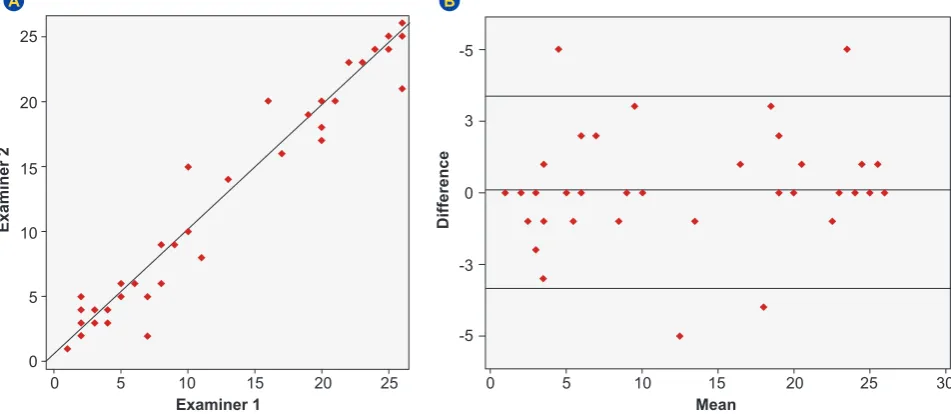
A strong inter-examiner agreement has been found, with an agreement coefficient of 0.985 between both examiners
[95% CI = (0.974, 0.991); p < 0.001, Fig. 1A], a 0.712 kw
[95% CI = (0.676, 0.748); p < 0.001] and the kw for each
subtest ranged between 0.811 (comprehension of complex orders) and 0.956 (naming). Bland-Altman plot (Fig. 1B) showed a stable reproducibility of the ART at all levels of severity of aphasia and showed that a difference of >3.5 points was significant for the classification of the severity of aphasia.
Concurrent validity has been studied in a 20-patient subgroup (12 female; mean age of 72.2 ± 13.8 years; 4/5 years of education, on average), half of these presenting with chronic aphasia (ongoing impairment six months post-stroke). Total scores with ART and BAAL are shown in Fig.
2A and 2B. Linear regression has shown a 0.92 R2, β
a =
-0.958, p < 0.001. The correlation between both scales was
r = -0.96 (p < 0.001).
Patients presented with an average score of 14.7 (± 8.7) with ART, ranging between 2 and 26. A mean 51.8 (± 36.8) BAAL ratio has been found, ranging between 0 and 98.44. Moderate to very strong significant correlations have also been found in terms of the dimensions that were
evalu-ated: comprehension (r = -0.76, p < 0.001), repetition (r =
-0.98, p < 0.001), naming (r = -0.86, p < 0.001) and fluency
(r = -0.62, p = 0.003).
Long-term outcome of aphasia
A complete longitudinal assessment has been obtained
(D1, D7 and chronic stage) regarding 42 patients (26 fe-male; mean age 78.3 ± 11.8 years). At baseline (D1), ART
scores statistically correlated with the NIHSS score (r =
0.86, p < 0.001), but not with gender (rpb = -0.17, p = 0.281),
age (r = 0.19, p = 0.238) or educational level (r = -0.09, p =
0.624).
A statistically significant difference (p = 0.001) between
both groups of patients with different outcome of aphasia
(NIHSSaphasia = 0 - 1, NIHSSaphasia =2 - 3) has been found
when D1 and D7 ART score variation (Fig. 3) has been compared, changing from a 7.0 median score (IQR = 6.5) at D1 to 3.0 (IQR = 5.0) in D7 in the group of patients with the
best outcome (NIHSSaphasia ≤ 1) and from 26.0 (IQR = 2.0)
to 26.0 (IQR = 3.0) in the group of patients with the poorest outcome (35.7% of the sample).
A binomial logistic regression (adjusted for patient’s
age, educational level and NIHSSmotor) has been obtained,
in order to assess the predictive ability of the scale. In this model, D1 ART score was an independent predictor of poor
long-term outcome (NIHSSaphasia = 2 - 3) [OR = 1.291, 95%
CI = (1.047, 1.591), p = 0.017, acuity = 87.9%].
DISCUSSION
The ART has been designed for the quantification of aphasia severity in patients with an acute stroke and for the assessment, in less than 3 minutes, of comprehension, rep-etition, naming and verbal fluency. The short duration of its application is in part explained by the simplicity of the tasks and also by the quick scoring in patients with acute aphasia who fail most of the items. As NIHSS, it is a bedside test that can be used by non-specialized professionals and no specific material is required.
As regards transcultural adaptation to the Portuguese context, our study was based on the model of assessment
Figure 1 – (A) Distribution of ART scores for each patient, according with examiner 1 and examiner 2, showing a strong inter-examiner agreement of the ART, with a 0.985 agreement coefficient; (B) Bland-Altman plot showing inter-examiner agreement of the ART.
Examiner 2 Difference
Examiner 1 Mean
A B
0
-5 -3 0 3 -5
5 10 15 20 25
ARTIGO ORIGINAL
of the equivalence of transcultural adaptation instruments
suggested by Herdman et al.16 which has been widely used
in different international studies. The authors have consid-ered that the equivalence should be assessed at six levels: (i) conceptual, (ii) regarding each item, (iii) semantic, (iv) operational, (v) regarding measurement and (vi) functional; assessment strategies have been applied for each level. The adaptation procedure of the ART to the Portuguese population was made according with the different levels and therefore we may establish that the Portuguese Final Ver-sion of the ART is equivalent to the original verVer-sion of the instrument.
An easy and rapid use of the scale are major character-istics in order to achieve an adequate monitoring of hospi-talized patients with acute stroke who are usually submitted to different successive techniques and feel tired easily. A two-minute 34.8 second average time for the application of the scale has been found in our group of patients, ranging up to a maximum time of 300 seconds (five minutes), similar to the time that was described in the original version of the
scale and also comparable to the application of the NIHSS.5
The analysis of the scale’s major psychometric char-acteristics, namely internal consistency, construct validity, inter-examiner agreement and concurrent validity was in-volved in scale’s validation. Initially, a strong internal con-sistency of the scale has been confirmed, shown by the high value of the Cronbach’s alpha as well as by the fact that this index was not increased with the exclusion of any of the subtests, showing the relevance of the subtests that were used and their good reliability for the general assess-ment of the domain of the language. As these subtests have shown moderate to strong correlations between each other and with the final score, we could also confirm its construct validity.
The analysis of inter-examiner agreement has shown a good reliability (a 0.985 agreement coefficient between both
examiners has been found) and inter-observer variability has shown to be independent from the severity of aphasia (Fig. 2). An excellent level of inter-examiner agreement has
been found, with a 0.712 kw and kw in subtests have ranged
between 0.811 and 0.956. The Bland-Altman plot (Fig. 1B) has shown that (i) ART reproducibility is reliable at all lev-els of severity of aphasia and (ii) a difference > 3.5 points meant a significant difference in the classification of severity of aphasia. This is a similar value to the one found with the
NIHSS.12
Figure 3 – Patients were divided according with the score obtained in item 9 of the NIHSS (language assessment) at 6 months post--stroke. Box plot showing the difference between ART scores at D1 (light green) and D7 (dark green) in both groups with different functional score (NIHSSaphasia ≤ 1 and NIHSSaphasia ≥ 2).
NIHSS 0 or 1 NIHSS 2 or 3
ART
0 5 10 15 20 25
D1 D7
Figure 2 – (A) Distribution of the scores for each patient, comparing the scores obtained with the BAAL and with the ART; (B) Bland-Altman plot showing strong agreement between the scores obtained with the BAAL (adjusted for direct comparison) and the ART.
Difference
Mean
A B
-5.0 -2.5 0.0 2.5 5.0 7.5 10.0
0 5 10 15 20 25
BAAL
ART
0 20 40 60 80
100 R2 = 0.918
ARTIGO ORIGINAL Based on these results, we may reach the conclusion that this scale can be used by different examiners
through-out patient’s clinical course, making patient monitoring and communication easier. The analysis of the correlation of the results obtained with the ART and the BAAL (the most wide-ly used scale for the assessment of aphasia in clinical
prac-tice in Portugal)20 has shown a good external concurrent
va-lidity, suggesting that a similar impairment [dys(function)] is measured by both tests. Positive and statistically significant correlations between the scores obtained in all subtests of the ART and the corresponding functions in the BAAL have been found. As regarding total scores, the weakest correla-tion has been found in fluency, even though it was signifi-cant and with no influence on the final score, probably due to the fact that, in BAAL, fluency is obtained differently in an-terior and posan-terior aphasia while, in ART, it is obtained for all aphasias in a similar way. This result has validated the ART as a diagnostic measurement instrument for aphasia, even though obviously without the same diagnostic ability and comprehensiveness.
Considering a variation ≥ 4 points as significant, 45.2% of the patients have clinically improved over the first week post-stroke, in line with what has been described in
litera-ture.21-23 ART variation over the first week post-stroke is
dif-ferent among the groups with difdif-ferent outcomes of apha-sia (Fig. 3), suggesting that this is an adequate scale for monitoring of impairment in aphasia, detecting small initial changes predicting long-term outcomes with a functional relevance. In current medical practice, motor strength im-pairment is additionally assessed by the NIHSS and by the
scale of the Medical Research Council,24 while the
assess-ment of aphasia has been limited to the superficial meas-urement provided by the NIHSS. Our results have allowed us to recommend ART as the additional assessment scale within this domain of aphasia.
The severity of initial aphasia has been considered as
the best clinical predictor of long-term outcome.25-27 Initial
aphasia assessed by the ART has also been correlated in our group of patients with language impairment in chronic stages and was predictor of long-term impairment,
regard-less of patient’s educational level, age and NIHSSmotor. A
1.291 times higher risk of poor outcome has been found for each increasing point in ART score. Therefore, the ART has an outcome value, such as it was found in the article of the original version.
Some limitations were found in our study. A wider study sample would confer stronger statistical power to the re-sults, even though the validity of this scale for the assess-ment of aphasia has been confirmed. The administration of the scale by other professionals involved in the care of
patients recovering from stroke would also be very relevant, namely by those working at stroke units (non-neurologist physicians and stroke specialist nurses).
As regards the limitations of the instrument, it is worth mentioning that the ART has been designed as a severity scale of aphasia, rapidly usable and applicable in emer-gency settings and therefore providing for an obviously superficial assessment of language impairment, not ever replacing a comprehensive evaluation using standard lan-guage scales. The fact that some relevant functions of the language as reading and writing are not included should be underlined. The ART should be valued in isolation as a diag-nostic instrument in aphasia as its performance regarding certain items may be affected by non-aphasic speech im-pairments (namely dysarthria) and it should not be used as an instrument for the classification of the type of aphasia as, apart from the fact that its rapid use does not provide for a more comprehensive evaluation, the assessment of fluency may become affected by an impairment in other domains, even though these are unavoidable limitations and common to other instruments with the same objective.
CONCLUSION
The Aphasia Rapid Test is a bedside test with an ade-quate sensitivity for the assessment of aphasia severity and is an easy and rapid instrument with reproducible results, allowing for an efficient measurement and monitoring of aphasia severity both at the acute stage as in the follow-up of patients with stroke. It is worth mentioning that the ART seems as a predictor of long-term outcome of aphasia, add-ing to efficient and patient-tailored rehabilitation programs of stroke-related aphasia.
HUMAN AND ANIMAL PROTECTION
The authors declare that the followed procedures were according to regulations established by the Ethics and Clini-cal Research Committee and according to the Helsinki Dec-laration of the World Medical Association.
DATA CONFIDENTIALITY
The authors declare that they have followed the
proto-cols of their work centre on the publication of patient data.
CONFLICTS OF INTEREST
The authors declare that there were no conflicts of inter-est in writing this manuscript.
FINANCIAL SUPPORT
The authors declare that there was no financial support in writing this manuscript.
REFERENCES
1. Pedersen PM, Jorgensen HS, Nakayama H, Raaschou HO, Olsen TS. Aphasia in acute stroke: incidence, determinants, and recovery. Ann Neurol. 1995;38:659-66.
2. Bersano A, Burgio F, Gattinoni M, Candelise L, Group PS. Aphasia burden to hospitalised acute stroke patients: need for an early
rehabilitation programme. Int J Stroke. 2009;4:443-7.
3. Musser B, Wilkinson J, Gilbert T, Bokhour BG. Changes in identity after aphasic stroke: implications for primary care. Int J Family Med. 2015;2015:970345.
ARTIGO ORIGINAL
survivor depressive symptoms are associated with family caregiver depression during the first 2 years poststroke. Stroke. 2011;42:302-6. 5. Laska AC, Bartfai A, Hellblom A, Murray V, Kahan T. Clinical and
prognostic properties of standardized and functional aphasia assessments. J Rehabil Med. 2007;39:387-92.
6. Enderby P, Crow E. Frenchay Aphasia Screening Test: validity and comparability. Disabil Rehabil. 1996;18:238-40.
7. Flamand-Roze C, Falissard B, Roze E, Maintigneux L, Beziz J, Chacon A, et al. Validation of a new language screening tool for patients with acute stroke: the Language Screening Test (LAST). Stroke. 2011;42:1224-9.
8. Nakase-Thompson R, Manning E, Sherer M, Yablon SA, Gontkovsky SL, Vickery C. Brief assessment of severe language impairments: initial validation of the Mississippi aphasia screening test. Brain Inj. 2005;19:685-91.
9. NIHSS - Versão Portuguesa. Porto: Faculdade de Medicina da Universidade do Porto; 2011. [consultado 2014 mar 22]. Disponível
em: https://secure.trainingcampus.net/uas/modules/trees/windex.
aspx?rx=nihss-portuguese.trainingcampus.net.
10. Adams HP Jr, Davis PH, Leira EC, Chang KC, Bendixen BH, Clarke WR, et al. Baseline NIH Stroke Scale score strongly predicts outcome after stroke: a report of the Trial of Org 10172 in Acute Stroke Treatment (TOAST). Neurology. 1999;53:126-31.
11. Azuar C, Leger A, Arbizu C, Henry-Amar F, Chomel-Guillaume S, Samson Y. The Aphasia Rapid Test: an NIHSS-like aphasia test. J Neurol. 2013; 260:2110-7.
12. Wityk RJ, Pessin MS, Kaplan RF, Caplan LR. Serial assessment of acute stroke using the NIH Stroke Scale. Stroke. 1994;25:362-5. 13. Castro-Caldas A. Diagnóstico e evolução das afasias de causa vascular.
Lisboa: Universidade de Lisboa; 1979.
14. Damásio A. Neurologia da linguagem. Lisboa: Universidade de Lisboa; 1986.
15. Ferro J. Neurologia do comportamento – estudo da correlação com a tomografia axial computadorizada. Lisboa: Universidade de Lisboa; 1986.
16. Herdman M, Fox-Rushby J, Badia X. A model of equivalence in the
cultural adaptation of HRQoL instruments: the universalist approach. Qual Life Res. 1998;7:323-35.
17. New B, Pallier C, Brysbaert M, Ferrand L. Lexique 2: a new French lexical database. Behav Res Methods Instrum Comput. 2004;36:516-24.
18. Brysbaert M, New B, Keuleers E. Adding part-of-speech information to the SUBTLEX-US word frequencies. Behav Res Methods. 2012;44:991-7.
19. Linguateca. Lisboa: Fundação para a computação Científica Nacional; 2012. [consultado 2014 mar 22]. Disponível em: http://www.linguateca. pt/.
20. Matos M, Jesus L, Cruice M. Assessment of aphasia in Portugal: past, present and future. J Stem-, Spraak- en Taalpathol. 2014;19:S78-83. 21. Inatomi Y, Yonehara T, Omiya S, Hashimoto Y, Hirano T, Uchino M.
Aphasia during the acute phase in ischemic stroke. Cerebrovasc Dis. 2008;25:316-23.
22. Maas MB, Lev MH, Ay H, Singhal AB, Greer DM, Smith WS, et al. The prognosis for aphasia in stroke. J Stroke Cerebrovasc Dis. 2012;21:350-7.
23. Payabvash S, Kamalian S, Fung S, Wang Y, Passanese J, Kamalian S, et al. Predicting language improvement in acute stroke patients presenting with aphasia: a multivariate logistic model using location-weighted atlas-based analysis of admission CT perfusion scans. AJNR Am J Neuroradiol. 2010;31:1661-8.
24. Compston A. Aids to the investigation of peripheral nerve injuries. Medical Research Council: Nerve Injuries Research Committee. Brain. 2010;133:2838-44.
25. Pedersen PM, Vinter K, Olsen TS. Aphasia after stroke: type, severity and prognosis. The Copenhagen aphasia study. Cerebrovasc Dis. 2004;17:35-43.
26. Plowman E, Hentz B, Ellis C Jr. Post-stroke aphasia prognosis: a review of patient-related and stroke-related factors. J Eval Clin Pract. 2012;18:689-94.