717
© 2018 by the Serbian Biological Society
Impact of plant growth-promoting rhizobacteria on yield and disease control of
Nicotiana tabacum
Sohail Khan1, Fazli Subhan1, Kashif S. Haleem1, Muhammad N. K. Khattak2, Ibrar Khan3, Tariq Sultan4 and
Isfahan Tauseef1,*
1Department of Microbiology, Hazara University, Mansehra, Pakistan
2Department of Applied Biology, University of Sharjah, United Arab Emirates
3Department of Microbiology, AUST, Abbottabad, Pakistan
4Land Resource Research Institute, NARC, Islamabad, Pakistan
*Corresponding author: [email protected]
Received: March 15, 2018; Revised: July 22, 2018; Accepted: July 26, 2018; Published online: August 9, 2018
Abstract: An unexplored soil microbial community associated with the root system of Nicotiana tabacum was isolated to analyze its impact on growth and yield of the crop. A total of nine isolates out of 180 were biochemically screened and char-acterized as potential plant growth-promoting rhizobacteria due to the expression of growth-promoting traits. All isolates were positive for ammonia production, 8 were positive for phosphate solubilization but none for auxin production. The majority of the isolates were also found positive for hydrogen cyanide, siderophore and hydrolytic/degradative enzymes production, enabling them to restrict the growth of Fusarium oxysporum in an in vitro assay. Although all tested isolates enhanced tobacco growth significantly, Baj-ER-01 and CD-RS-03 were found to be the most promising in enhancing all aspects of growth. This study provides evidence for the enhancement of growth and yield of inoculated tobacco plants through an adequate supply of nutrients and/or controlling phytopathogens.
Key words: rhizobacteria; soil; tobacco; phytopathogens; plant protection
How to cite this article: Khan S, Subhan F, Haleem KS, Khattak MNK, Khan I, Sultan T, Tauseef I. Impact of plant growth-promoting rhizobacteria on yield and disease control of Nicotiana tabacum. Arch Biol Sci. 2018;70(4):717-25.
INTRODUCTION
Plant growth-promoting rhizobacteria (PGPR) are a diverse group of free-living soil bacteria colonized in the rhizosphere, rhizoplane and endorhizosphere of the plant root system [1]. This indigenous soil microbial community is extensively investigated as an alternative to chemical fertilizers for maintain-ing soil ecosystems and sustainable crop production. Although the exact mechanism of plant-growth en-hancement by these bacteria is unknown, it is believed that these bacteria involve a number of direct and indirect mechanisms that, either singly or synergis-tically, affect the growth of colonized plants. Direct mechanisms include the release of growth-stimulating phytohormones, such as indole acetic acid (IAA), cy-tokinin and gibberellins [2], whereas indirect process-es include an increase in biological nitrogen fixation activity, solubilization of inorganic phosphates and
other nutrients, production of compounds that inhibit phytopathogenic growth, improvement of soil struc-ture and elimination of toxic heavy metals or other xenobiotic compounds, all of which help the survival of plants under saline conditions and enhanced min-eral absorption [3-7].
The successful isolation and application of PGPR such as Chryseobacterium palustre and Chryseobacte-rium humi to Zea mays [2], Bacillus subtilis and Pseu-domonas fluorescence to Pelargonium graveolens [8] and Pseudomonas putida, Azotobacter chroococum to
Lycopersicon esculentum [9] have not only
the same type, but under different geographically and ecologically conditions.
The inclusion of newer and previously unexplored areas and the knowledge of indigenous rhizobacterial populations associated with a specific crop of a par-ticular region are needed to widen the existing pool of potential PGPR. The search and understanding of the diversity of the microbe populations in soil in a distinct/distant area is not only important for the discovery of novel rhizobacterial strains but also in the search of region-specific growth-promoting mi-crobial strains [11]. The soil microbiological data and the information about PGPR colonizing crops in the study area (Mansehra, Northern Pakistan) are still lacking. Tobacco, the major cash crop of this area in Khyber Pakhtunkhwa (KPK), is grown over a wide area. Currently, chemical fertilizers and fungicides are the only choice for the provision of nutrients and to control fungal diseases of tobacco plants in order to enhance growth and yield of the crop. The infor-mation concerning the use of PGPR to increase the growth and yield of tobacco and to reduce the cost and environmental hazards of applied chemicals is not only a limitation of this area but worldwide.
Therefore, the aim of this study was to isolate the indigenous soil microbial community from the rhizo-sphere, rhizoplane and endorhizosphere of tobacco (Nicotiana tabacum L.) plants grown on various soils of a previously unexplored hilly area. The isolated bac-teria were biochemically characterized and their role in growth enhancement of tobacco plant seedlings was evaluated through different plant-growth parameters with the aim of assessing their potential in growth enhancement and inhibition of fungal pathogens.
MATERIALS AND METHODS Study area
Samples were collected from the tobacco fields of the Pakhal Valley district Mansehra. The study site lies in northwest of Pakistan at a latitude 34°19΄59˝ N, lon-gitude 73°12΄00˝ E, and elevation of 1088 m (WGS 84 coordinate reference system) above sea level. The area is located at the foothills of the great Himalayan range that extends from Kashmir and comprises of plains,
valleys and lakes. The climate of the area is warm to temperate with significant rainfall (1445 mm per an-num) and precipitation even in the driest months. The average temperature per annum is ~18.5-19oC.
Soil sampling and isolation of bacteria
Tobacco rhizospheric soil samples (n=10) along with roots of the plant were collected from ten different locations in the Mansehra region. Each sample was kept in a separate, sterile and labeled polythene bag and brought to the Land Resource Research Insti-tute (LRRI), National Agriculture Research Center (NARC), Islamabad. Bacteria from soil samples were isolated from the rhizosphere, rhizoplane and en-dorhizosphere by the serial dilution method on Lau-ria Bertini (LB) agar media [12]. For the rhizospheric sample, 1 g of soil was suspended in 9 mL of auto-claved distilled water and mixed by a vortex. Serial dilutions (up to 10-9 dilution) were made by taking 1
mL from this suspension and pouring it into another tube containing 9 mL of distilled water. For the rhizo-plane samples, the root-adhered soil particles were removed and immersed in 9 mL of sterile distilled water and serially diluted, as described for the rhizo-sphere sample. Lastly, to prepare the endorhizorhizo-sphere dilutions, 1 g of root was taken and surface-sterilized using Clorox. The samples were washed three times with distilled water and crushed using a mortar and pestle. The crushed sample (1 g) was mixed in 9 mL of distilled water and serially diluted. A suspension of 0.1 mL was obtained from 10-4, 10-5 and 10-6 dilutions
of each sample and plated on LB agar plates separately. Numerous colonies grown on media after 24 h of in-cubation at 28oC were purified by restreaking on the
same media and stored at 4oC for further analysis.
Morphological and microscopic characterization of isolated bacteria
In vitro analysis of plant growth-promoting ability of isolates
Plant growth-promoting characteristics such as the pro-duction of ammonia, phosphate solubilization index and indole acetic acid production (auxin) by isolates were analyzed using methods described for each char-acter/ability [14-17]. The experiments for each charac-teristic were repeated twice to obtain consistent results.
In vitro analysis of bacterial factors antagonistic
to phytopathogens
The ability of isolates to produce hydrogen cyanide (HCN) was tested by streaking bacteria on nutrient agar medium plates modified with 4.4 g glycine L-1 [41].
Whatman filter paper no 1 soaked in 2% sodium car-bonate and 0.5% picric acid solution was placed inside the lid of Petri plates. The plates were incubated for 4 days at 36±2°C and development of orange color was considered as indicating the presence of HCN-positive bacteria. Similarly, siderophore production was de-tected as a change of the color from blue to orange on chrome azurol S (CAS) agar described previously [18].
Bioassays for the production of toxic/degradative enzymes
Catalase, amylase, pectinase and protease production by bacterial isolates was determined using standard methods [19].
Determination of antifungal activity of isolates
The antagonistic activity of bacterial isolates was tested against Fusarium oxysporum. This fungal plant pathogen was inoculated in potato dextrose agar (PDA) from a previously pure culture stored in the Land Resource Research Institute, NARC, Islamabad, Pakistan. After seven days of incubation, a 5-mm fun-gal mycelial disk was taken from the funfun-gal culture and placed on one side of a fresh PDA plate. Using a sterile toothpick, a colony of bacteria was picked from an overnight-grown pure culture and inoculated into the same plate on the opposite side. A fungal disk placed on the Petri plate without any bacterial isolate served as a control. The inoculated plates were
in-cubated for 7 days at 28oC and mycelial growth was
compared with that of the control. The experiment was repeated three times for each treatment. Zones of inhibition were measured by calculating the fungal mycelial growth toward the antagonistic bacteria. The percentage growth inhibition of the fungal pathogen was calculated as described [20] using the formula:
Percentage Growth Inhibition (PGI) = [1 - (Fungal growth/fungal control growth)] x 100.
Greenhouse/pot experiment to analyze the effect of PGPR inoculation on plant growth
The effect of PGPR on tobacco plants was investi-gated in the greenhouse of the Land Resource Re-search institute (LRRI), National Agriculture ReRe-search Center (NARC), Islamabad. Ten mL of bacterial cul-ture (1×10⁹ CFU/mL) in LB broth medium were
pre-pared for each isolate. Briefly, a bacterial isolate from its pure culture (stored at -80oC) was streaked on LB
agar plates and incubated for 24 h at 28°C to confirm its purity. Following this incubation, a single colony was picked from its respective plate and restreaked for overnight incubation under the same conditions. After 24 h of incubation, the bacterial cells from the plate were mixed in LB broth medium poured into 15-mL falcon tubes and the suspensions were adjusted to 1×10⁹ CFU/mL in a final volume of 10 mL.
The N. tabacum L.(cv. K-399) transplants were collected and their roots were washed and soaked in tubes containing representative bacterial isolate cul-ture for 10 to 15 min (inoculation with bacteria) fol-lowed by implantation (in triplicate for each isolate) in round-bottomed sterile pots (25 cm×28 cm) con-taining autoclaved soil. Non-inoculated treatments of plants were also set up as a control. The effect of bacterial isolates on treated tobacco transplants was observed for 90 days and the growth parameters (shoot and root length, number of leaves, shoot and root dry and fresh weight) of inoculated and control plants were measured and compared.
Statistical analysis
ef-fects of different inoculants/isolates, the data were analyzed using ANOVA and post hoc analysis using GraphPad prism. A statistically significant difference was considered at p<0.05.
RESULTS
Isolation and morphological characteristics of isolates
A total 180 bacterial colonies were isolated on LB agar plates from the rhizosphere, rhizoplane and endo-rhizosphere of tobacco plant selected from an unexplored area. Morphological characteristics of all isolates were determined using a multistep strategy for initial screening which helped to reduce the number of isolates with a likely potential of PGPR into 40. A second screening on the basis of Gram staining helped to further reduce the number of potential PGPR iso-lates to 9 (Supplementary Table S1). These screened isolates were different from one another according to multiple morphological characteristics and Gram staining. Wide variations of colony characteristics were clearly evident. The majority of the isolates were of irregular form with milky white and transparent colonies. The isolated cells were mostly found to be round-shaped with variable elevation and margins of colonies. Six isolates showed Gram-positive reactions while 3 were identified as Gram negative. Further morphological classification revealed that 3 isolates belonged to diplobacillus, 3 to micrococcus, 2 to strep-tococcus and 1 to diplococcus families.
Direct and indirect growth-promoting traits of the tested isolates
All 9 isolates were tested in vitro to assess their potential to enhance plant growth. Nine different traits involved in plant-growth enhancement, either directly (the pro-duction of phytohormones) or indirectly (restriction of the growth of phytopathogens), were investigated. All bacterial isolates, except Baj-ER-01, showed clear zones around the colonies on growth medium contain-ing Pikovskaya’s agar, suggestcontain-ing efficient phosphate solubilization (Table 1). The highest phosphate solu-bilization potential was recorded for the sample Dhd-RP-07-01. Similarly, all bacterial isolates associated with the tobacco root system were found to be capable of
nitrogen fixation with a moderate to strong potential. However, none of the isolates produced auxin.
Production of compounds toxic/inhibitory to the growth of phytopathogens, such as HCN and siderophores, is another important characteristic of PGPR. In this study, both compounds were pro-duced by 7 isolates, and only 2 isolates (Dhd-RS-02 and ITC-RS-01) were found negative for siderophore production and 2 isolates (ITC-06 and BP-RS-01) for HCN production (Table 1). Similarly, for the ability of degradative/inhibitory enzyme production, six isolates were capable of producing amylase, 8 were positive for pectinase, while all isolates produced catalase (Table 1). All isolates were positive for the production of at least two different degradative enzymes.
Antifungal potential of the tested isolates
To associate the production of hydrolytic enzymes and HCN by PGPR to that of fungal growth inhibi-tion, the antifungal potential of all 9 isolates was tested against F. oxysporum by the dual culture assay. The growth of fungi on the control plate spread all over, but when grown with the tested isolates, the bacte-ria restricted their growth. The restriction of fungal growth was observed for all 9 bacterial isolates. A promising percentage of growth inhibition (>40%) by each inoculant, except BP-RS-01, was evident (Fig. 1). This confirmed that all isolates harbor the potential of restricting fungal growth through the production of degradative enzymes and HCN (Fig. 1, Table 1).
Effect of PGPR on the growth parameters of inoculated tobacco plants
A direct inoculation of isolates on tobacco roots was also performed in a greenhouse experiment to link the
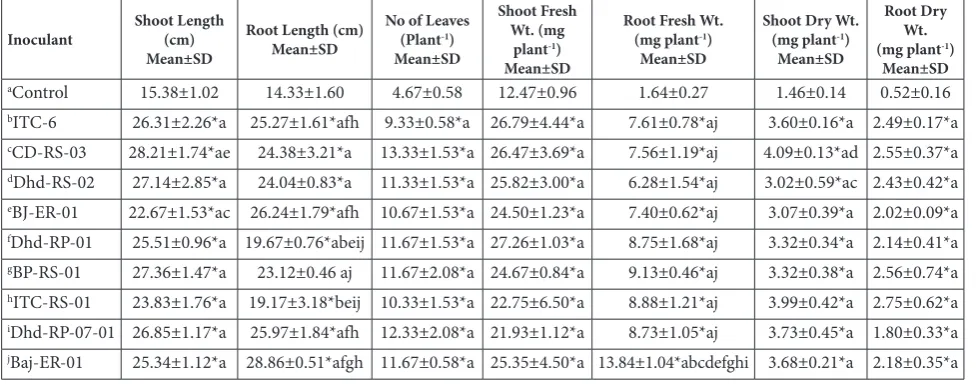
in vitro growth characteristics with the actual growth parameters of plants. All isolates, after three months of inoculation, enhanced the growth of inoculated to-bacco plants, which resulted in a significant increase in all growth parameters over the non-inoculated con-trol (Fig. 2, Table 2).
influence on shoot length, followed by BP-RS-01. On the other hand, plants treated with Baj-ER-01 showed maximum increase in root length, followed by plants treated with BJ-ER-01. Moreover, the treated plants showed a higher number of leaves than the control (Fig. 3A). Treatment of plants with CD-RS-03 resulted in an 186% increase in the number of leaves over the control. None of the PGPR showed enhancement less than 100% for this parameter.
A relative increase in shoot and root dry weight was recorded from 106-179% and from 246-429%,
Table 1. In vitro production of direct and indirect plant growth-promoting traits of rhizobacterial isolates.
Inoculant Protease Amylase Pectinase Catalase Phosphate solubilization (Sol. Index) NH3 Siderophore IAA HCN
Control − − − − (0) − − − −
ITC-06 + + + + + (1.72) + + − −
CD-RS-03 + + ++ + + (2.33) ++ + − +
Dhd-RS-02 + + +++ + + (2.33) ++ − − +
BJ-ER-01 ++ + + ++ (3.00) + + − +
Dhd-RP-01 − + − + ++ (2.60) ++ + − +
BP-RS-01 − + + + + (2.25) +++ + − −
ITC-RS-01 + + + + ++ (2.85) +++ − − +
Dhd-RP-07-01 − − ++ + +++ (4.50) + + − +
Baj-ER-01 ++ − + + − (0) ++ + − +
Presence, absence and level of activity for a given trait is shown by the type of symbol (- or +) and number of time (+, ++ or +++) it appears against each isolate.
(+) presence of a characteristic/trait with low activity, (++) presence with moderate activity, (+++) presence with strong activity, (−) absence of a characteristic/trait
Table 2. Effect of isolated PGPR on various growth parameters of tobacco plants.
Inoculant Shoot Length (cm) Mean±SD
Root Length (cm) Mean±SD
No of Leaves (Plant-1)
Mean±SD
Shoot Fresh Wt. (mg
plant-1)
Mean±SD
Root Fresh Wt. (mg plant-1)
Mean±SD
Shoot Dry Wt. (mg plant-1)
Mean±SD
Root Dry Wt. (mg plant-1)
Mean±SD
aControl 15.38±1.02 14.33±1.60 4.67±0.58 12.47±0.96 1.64±0.27 1.46±0.14 0.52±0.16
bITC-6 26.31±2.26*a 25.27±1.61*afh 9.33±0.58*a 26.79±4.44*a 7.61±0.78*aj 3.60±0.16*a 2.49±0.17*a
cCD-RS-03 28.21±1.74*ae 24.38±3.21*a 13.33±1.53*a 26.47±3.69*a 7.56±1.19*aj 4.09±0.13*ad 2.55±0.37*a
dDhd-RS-02 27.14±2.85*a 24.04±0.83*a 11.33±1.53*a 25.82±3.00*a 6.28±1.54*aj 3.02±0.59*ac 2.43±0.42*a
eBJ-ER-01 22.67±1.53*ac 26.24±1.79*afh 10.67±1.53*a 24.50±1.23*a 7.40±0.62*aj 3.07±0.39*a 2.02±0.09*a
fDhd-RP-01 25.51±0.96*a 19.67±0.76*abeij 11.67±1.53*a 27.26±1.03*a 8.75±1.68*aj 3.32±0.34*a 2.14±0.41*a
gBP-RS-01 27.36±1.47*a 23.12±0.46 aj 11.67±2.08*a 24.67±0.84*a 9.13±0.46*aj 3.32±0.38*a 2.56±0.74*a
hITC-RS-01 23.83±1.76*a 19.17±3.18*beij 10.33±1.53*a 22.75±6.50*a 8.88±1.21*aj 3.99±0.42*a 2.75±0.62*a
iDhd-RP-07-01 26.85±1.17*a 25.97±1.84*afh 12.33±2.08*a 21.93±1.12*a 8.73±1.05*aj 3.73±0.45*a 1.80±0.33*a
jBaj-ER-01 25.34±1.12*a 28.86±0.51*afgh 11.67±0.58*a 25.35±4.50*a 13.84±1.04*abcdefghi 3.68±0.21*a 2.18±0.35*a
*Indicates significant difference at p<0.05.
All growth parameters displayed significant enhancement after inoculation with the designated isolates when compared with the non-inoculated control. The alphabet adjacent to asterisk on a given value indicates that in same column, the given value is significantly different from those represented by the indicated letter.
respectively (Fig. 3B). The corresponding shoot and root fresh weights were in the range of 76-119% and 282-742%, respectively (Fig. 3C). The plants treated with Baj-ER-01 showed the highest root fresh weight increase while the inoculant Dhd-RP-01 showed the maximum increase in shoot fresh weight. The root fresh weight enhancement by Baj-ER-01 inoculation was not only significantly different from the control but also from the other treatments (Table 2). Similarly, the shoot and root dry weights clearly demonstrated the significantly higher impact of the treatments as compared to the non-inoculated control. Statistically, all growth parameters showed a significant increase over the control; however, all inoculants showed the highest increase in root fresh weight/dry weight as compared to the other parameters.
DISCUSSION
The extensive use of fertilizers and chemical fungi-cides, specifically in hilly areas, has had severe hazard-ous effects, including the leaching of chemicals that pollute nearby water resources and streams, the killing of beneficial microbes of the soil, making plants sus-ceptible to pathogenic attack, decreasing soil fertility and irreversibly injuring to the soil community system [21]. Hence, alternative strategies with the least threat to human health and the environment but a strong
potential to enhance the crop yield are needed. PGPR, the inhabitants of plant rhizosphere, rhizoplane and endorhizosphere, may provide a good alternative for growth and health promotion of plants. Phosphorous and nitrogen are the two important nutrients while auxins and gibberellins are two important groups of hormones that can be provided by these organisms, thus directly influencing plant growth [22-24]. Indi-rectly, these bacteria enhance plant growth by produc-ing deleterious compounds for phytopathogens, such as enzymes, antibiotics, HCN and siderophores [25].
Among all traits, the ability of microbes to main-tain the supply of solubilized phosphates and fixation of nitrogen are of prime importance. Previous studies have reported the beneficial effects of both processes on crop production [23,24,26,27]. All PGPR isolates examined in this study showed a strong potential for phosphate solubilization. The solubilization index for the majority of isolates was recorded as >2, indicating their ability to maintain the level of phosphate in a soil enriched with its insoluble form and acting as a limit-ing factor for crop production. Previous studies have not reported the isolation of such a large population of phosphate-solubilizing bacteria. In three different reports, phosphate solubilizers were found as 23.5% of the total tested, 5 out of 207 tested and 4 out of 9 tested, respectively [28,30]. Isolation of such a large number may be unique for this first-ever explored
Fig. 2. Growth of tobacco plants inoculated with selected PGPRs (BJ-ER-01 and CD-RS-03) and the non-inoculated control after 90 days.
Fig. 3. Relative percentage increases in different growth parameters of PGPR
in-oculated tobacco plants compared with control after 90 days of inoculation. A –
Lengths of shoots and roots and numbers of leaves; B – shoot and root dry weight;
area, and is a positive indicator to further study and explore the microbial community of the region. This will have a strong impact on the yield, sustainable growth and preservation of the ecosystem by reduc-ing the use of chemical fertilizers.
Similar results were recorded for the nitrogen fixa-tion ability of the tested isolates, which is again a strong indication that the application of these microbes can be useful for maintaining an adequate supply of nitrog-enous compounds to a tobacco crop, hence lowering the dependency on nitrogenous fertilizers. These results are in accordance with a study performed to investigate the importance of nitrogen fixation through PGPR for growth of plants [31]. Our results suggest that all iso-lates are capable of supplying adequate amounts of nec-essary growth nutrients, thus having a positive impact on the growth of the plants in a natural environment.
Surprisingly, none of the tested isolates produced auxin, which is in contrast to many previous reports on PGPR [32-34]. All these studies described auxin as a common growth factor produced by PGPR and associated their production as a vital factor for growth promotion of various crops. However, the experiments performed on tobacco plants in this study indicate that a lack of expression of indole-3-acetic acid (IAA) by PGPR is not a limiting factor for plant growth in the soil under investigation, which may be true for other unexplored soil systems. Thus, our study does not agree with the conclusion of several previous stud-ies that auxin is the only essential factor for attaining plant-growth promotion through PGPR [11,35]. We suggest that multiple traits are required by PGPR for adequate growth promotion and their synergistic ef-fect may compensate the absence or unavailability of a key growth-promoting factor like auxin.
A number of studies have identified the role of HCN production and siderophorogenesis in suppress-ing the growth of fungal pathogens [36-38]. These antagonistic factors, in coordination with hydrolytic/ degradative enzymes, disrupt the fungal cell wall and inhibit fungal growth [39-41], thus indirectly promot-ing plant growth. The collective presence of these an-tifungal agents in all isolates suggested their positive role in promoting the growth of tobacco plants. The experimental application of these isolates strongly in-hibited the growth of phytopathogenic fungi, which
provided indirect evidence for support of tobacco growth. This property is vital for crops that grow in regions (like northern Pakistan) where high annual rainfall is recorded and temperature conditions favor the growth of phytopathogenic fungal strains.
The impact of expression of growth promoting traits by PGPR on plant growth was finally confirmed by inoculating the isolates on plant seedlings in a green-house experiment. The observed growth enhancement of inoculated plants clearly demonstrated the benefi-cial effects of the PGPR on growth and yield. These traits collectively lead to a significant increase in root/ shoot biomass, length of roots/shoots and number of leaves of inoculated plants. These findings are in agree-ment with previously reported studies describing the significant effect of PGPR on growth parameters of various crops [30,42]. In both studies, the majority of isolates enhanced shoot length (by up to 45% and 66%, respectively), root length (52% and 66%, respectively), shoot dry weight (62% and 100%, respectively), root dry weight (172% and 129%, respectively), shoot fresh weight (50% and 79%, respectively) and root fresh weight up to a maximum of 104% and 92%, respective-ly. Interestingly, the PGPR isolates of this study showed ~2-7-fold enhancement (shoot length by up to 83%; root length by 101%; shoot dry weight by 179%; root dry weight by 429%; shoot fresh weight by 119%, and root fresh weight up to maximum 742%) in all growth.
These results also support the fact that the lack of expression of a key plant growth trait (auxin in this study) in vitro does not necessarily affect the potential of growth enhancement. It is likely that growth hormones produced by the host plant are in sufficient quantity, but the nutrient supply and/or phytopathogens act as a limiting factor, restricting growth. Hence, the external support provided by PGPR may help to overcome these inhibitory factors, leading to healthy plants.
specific traits and rhizospheric competencies affecting its response to different isolates [30]. Another likely explanation of the variable response may be differ-ent colonizing potdiffer-entials of differdiffer-ent isolates. An im-proper PGPR colonization would likely lead to varia-tions in the impact on growth parameters. Despite the variations in response to different PGPR, the yields of all inoculated plants were statistically significantly higher as compared to the control, which is a direct indication that all isolates purified and tested in this study have a strong ability to provide nutrients such as phosphorous and nitrogen, and also to protect in-oculated plants from phytopathogens.
In conclusion, the findings of our study provide the first information about an indigenous microbial community associated with tobacco plants in a moun-tainous and unexplored region of Hazara, northern Pakistan, and its positive influence on the growth and yield of tobacco. These unexplored microbial species expressed efficient growth-promoting traits, which enhanced the yield of inoculated tobacco plants. All isolates significantly influenced the growth parameters and have strong potential to be considered as plant growth pomoting agents for tobacco and other crops. Further studies of their molecular characteristics would be extremely beneficial for their application in the field. Their successful application is likely to reduce the use of chemical fertilizers and fungicides, which may have a strong and sustainable impact on the economy of Pa-kistan, which hugely (10%) relies on its tobacco crop.
Funding: The project was supported by the internal financial sources of department of Microbiology, Hazara University, Manse-hra, Pakistan and the Land Resources Research Institute, NARC, Islamabad, Pakistan.
Acknowledgments: The authors would like to thank the staff and technical members of the Land Resource Research Institute, NARC Islamabad, Pakistan for providing the facilities to conduct the study. We are also grateful to the administration of NARC Islamabad for giving permission to conduct the study.
Author contributions: Sohail Khanperformed the experiments
while Fazli Subhan, and Kashif Syed Haleemhelped in the
prepa-ration of the manuscript. Muhammad Nasir Khan, Ibrar Khan and Tariq Sultan provided technical expertise in the experimentation and data analysis. Isfahan Tauseef designed and supervised the experiments and prepared the final manuscript.
Conflict of interest disclosure: The authors have not any conflict of interest.
REFERENCES
1. Kumar A, Maury BR, Raghuwanshi R. Isolation and char-acterization of PGPR and their effect on growth, yield and
nutrient content in wheat (Triticum aestivum L.). Bioca Agric
Biotechnol. 2014;3:121-8.
2. Marques AP, Pires C, Moreira H, Rangel AO, Castro PM. Assessment of the plant growth promotion abilities of six
bacterial isolates using Zea mays as indicator plant. Soil Biol
Biochem. 2010;42:1229-35.
3. Ahemad M, Kibret M. Mechanisms and applications of plant growth promoting rhizobacteria: Current perspective. J King Saud Univ. 2014;26:1-20.
4. Bhatt PV, Vyas BRM. Screening and Characterization of Plant Growth and Health Promoting Rhizobacteria. Int J
Curr Microbiol App Sci. 2014;3:139-55.
5. Han H, Lee K. Plant growth promoting rhizobacteria effect on antioxidant status, photosynthesis, mineral uptake and growth of lettuce under soil salinity. Res J Agric Biol Sci. 2005;1:210-5.
6. Jeon JS, Lee SS, Kim HY, Ahn TS, Song HG. Plant growth promotion in soil by some inoculated microorganisms. J
Microbiol. 2003;41:271-6.
7. Khan AG. Role of soil microbes in the rhizospheres of plants growing on trace metal contaminated soils in phytoremedia-tion. J Trace Elem Med Biol. 2005;18:355-64.
8. Mishra RK, Prakash O, Alam M, Dikshit A. Influence of plant growth promoting rhizobacteria (PGPR) on the
pro-ductivity of Pelargonium graveolens L. herit. Rec Res Sci
Tech. 2010;2:53-7.
9. Ordookhani K, Zare M. Effect of Pseudomonas, Azotobacter and arbuscular mycorrhiza fungi on lycopene, antioxidant
activity and total soluble solid in tomato (Lycopersicon
escu-lentum F1 Hybrid, Delba). Adv Environ Biol. 2011;5:1290-5. 10. Narula N, Kumar V, Singh B, Bhatia R, Lakshminarayana K. . Impact of biofertilizers on grain yield in spring wheat under varying fertility conditions and wheat-cotton rotation. Arch Agron Soil Sci. 2005;51:79-89.
11. Deepa CK, Dastager SG, Pandey A. Isolation and character-ization of plant growth promoting bacteria from
non-rhizo-spheric soil and their effect on cowpea (Vigna unguiculata
(L.) Walp.) seedling growth. World J Microbiol Biotechnol. 2010;26:1233-40.
12. Somasegaran P, Hoben HJ. Handbook for rhizobia: methods in legume-Rhizobium technology. Springer Science & Busi-ness Media. 2012.
13. Vincent J, Humphrey B. Taxonomically significant group antigens in Rhizobium. Microbiol. 1970;63: 379-82.
14. Bric JM, Bostock RM, Silverstone SE. Rapid in situ assay
for indoleacetic acid production by bacteria immobilized on a nitrocellulose membrane. Appl Environ Microbiol. 1991;57:535-8.
15. Cappuccino JG, Sherman N. Microbiology: a laboratory manual, Vol 9. Pearson/Benjamin Cummings; 2008. 16. Nautiyal CS. An efficient microbiological growth medium
17. Premono ME, Moawad A, Vlek P. Effect of
phosphate-solu-bilizing Pseudomonas putida on the growth of maize and its
survival in the rhizosphere. Ind J of Crop Sci. 1996;11:13-23. 18. Schwyn B, Neilands J. Universal chemical assay for the detec-tion and determinadetec-tion of siderophores. Anal Biochem. 1987;160:47-56.
19. Ashwini K, Gaurav K, Karthik L, Bhaskara Rao K. Opti-mization, production and partial purification of
extracel-lular α-amylase from Bacillus sp. marini. Arch Appl Sci Res.
2011;3:33-42.
20. Sivan A, Ucko O, Chet I. Biological control of Fusarium
crown rot of tomato by Trichoderma harzianum under field
conditions. Plant Dis. 1987;71:587-92.
21. Ashrafi V, Seiedi MN. Influence of different plant densities and plant growth promoting rhizobacteria (pgpr) on yield
and yield attributes of corn (Zea maize l.). Rec Res in Sci and
Technol. 2010;3:63-6.
22. Ali B, Sabri AN, Hasnain S. Rhizobacterial potential to alter
auxin content and growth of Vigna radiata (L.). World Res
J Agric Biotechnol. 2010;26:1379-84.
23. Sharma SB, Sayyed RZ, Trivedi MH, Gobi TA. Phosphate solubilizing microbes: sustainable approach for managing phosphorus deficiency in agricultural soils. Springer Plus. 2013;2:587.
24. Shridhar BS. Review: nitrogen fixing microorganisms. Int J Microbiol Res. 2012;3:46-52.
25. Kloeppe J, Rodriguez-Kabana R, Zehnder A, Murphy J, Sikora E, Fernandez C. Plant root-bacterial interactions in biological control of soilborne diseases and potential exten-sion to systemic and foliar diseases. Australas Plant Pathol. 1999;28:21-6.
26. Saravanan V, Madhaiyan M, Thangaraju M. Solubilization of zinc compounds by the diazotrophic, plant growth
promot-ing bacterium Gluconacetobacter diazotrophicus.
Chemo-sphere. 2007;66:1794-8.
27. Shahid M, Hameed S, Imran A, Ali S, van Elsas JD. Root
colonization and growth promotion of sunflower (Helianthus
annuus L.) by phosphate solubilizing Enterobacter sp. Fs-11. World J Microbiol Biotechnol. 2012;28:2749-58.
28. Hameeda B, Rupela O, Reddy G, Satyavani K. Application of plant growth-promoting bacteria associated with composts
and macrofauna for growth promotion of Pearl millet (
Pen-nisetum glaucum L.). Biol Fert Soils. 2006;43:221-7. 29. Islam MR, Ahamed R, Rahman MO, Akbar M, Al-Amin
M, Alam K, Lyzu F. In vitro antimicrobial activities of four
medicinally important plants in Bangladesh. Eur J Sci Res. 2010;39:199-206.
30. Majeed A, Abbasi MK, Hameed S, Imran A, Rahim N. Isola-tion and characterizaIsola-tion of plant growth-promoting rhizo-bacteria from wheat rhizosphere and their effect on plant growth promotion. Front Microbiol. 2015;6: 198.
31. Chaiharn M, Chunhaleuchanon S, Kozo A, Lumyong S. Screening of rhizobacteria for their plant growth promot-ing activities. KMITL Sci Technol J. 2008;8:18-23. 32. Çakmakçı R, Erat M, Erdoğan Ü, Dönmez MF. The
influ-ence of plant growth–promoting rhizobacteria on growth and enzyme activities in wheat and spinach plants. J Soil Sci Plant Nutr. 2007;170:288-95.
33. Mehnaz S, Kowalik T, Reynolds B, Lazarovits G. Growth
promoting effects of corn (Zea mays) bacterial isolates
under greenhouse and field conditions. Soil Biol Biochem. 2010;42:1848-56.
34. Poonguzhali S, Madhaiyan M, Sa T. Isolation and identifica-tion of phosphate solubilizing bacteria from chinese cabbage and their effect on growth and phosphorus utilization of plants. J Ind Microbiol Biotechnol. 2008;18:773-7.
35. Khalid A, Arshad M, Zahir Z. Screening plant growthpro-moting rhizobacteria for improving growth and yield of wheat. J Appl Microbiol. 2004;96:473-80.
36. El-Azeem S, Mehana T, Shabayek A. Some plant growth promoting traits of rhizobacteria isolated from Suez Canal region, Egypt. Afr Crop Sci Conf Proc. 2007;8:1517-25. 37. Reetha AK, Pavani SL, Mohan S. Hydrogen cyanide
pro-duction ability by bacterial antagonist and their antibiotics
inhibition potential on Macrophomina phaseolina (Tassi.)
Goid. Int J Curr Microbiol Appl Sci. 2014;3:172-78. 38. Shaikh S, Patel P, Patel S, Nikam S, Rane T, Sayyed R.
Produc-tion of biocontrol traits by banana field fluorescent Pseudo-monads and comparison with chemical fungicide. Indian J Exp Biol. 2014;52:917-20.
39. Ann,YC. Rhizobacteria of pepper (Piper nigrum) and their
antifungal activities. Afr J Microbiol Res. 2012;6:4185-93. 40. Tian B, Li N, Lian L, Liu J, Yang J, Zhang KQ. Cloning,
expression and deletion of the cuticle-degrading protease
BLG4 from nematophagous bacterium Brevibacillus
lat-erosporus G4. Arch Microbiol. 2006.186:297-305.
41. Ali I, Sultan T, Subhan F, Haleem KS, Sultana N, Tauseef I.
PGPRs of plum (Prunus domestica) rhizosphere enhance
plant growth and antagonise fungal activity in vitro. Acta
Agric Scand B. 2018;68:367-78.
42. Islam S, Akanda AM, Prova A, Islam MT, Hossain MM. Iso-lation and identification of plant growth promoting rhizo-bacteria from cucumber rhizosphere and their effect on plant growth promotion and disease suppression. Front Microbiol. 2016;6: 1360.
Supplementary Data Supplementary Table S1.