NON-USER-FRIENDLY:
STAGING RESISTANCE
WITH INTERPASSIVE USER
EXPERIENCE DESIGN
APRJA Volume 8, Issue 1, 2019 ISSN 2245-7755
CC license: ‘Attribution-NonCommercial-ShareAlike’.
Abstract
User-friendly design makes our use of emerging technologies intuitive and
seamless, but it also conceals the new solutions’ influence over how we
act, think and plan. In this paper, I analyze the logic of our newly developed ‘touchscreen sensibilities’ to speculate on alternative, ‘non-user-friendly’ design practices that, by invading intuitive interfaces, could make the users aware of their reliance on invisible algorithmic operations to learn and to feel.
I revisit Žižek and Pfaller’s conception of ‘interpassivity’ to explore its potential
as a means of resisting interactivity and inciting consciousness in contem-porary speculative design. The critical interface I envision must defamiliarize consumption, prevent participation, and de-frame perception — make the user experience what lack of control feels like, and do so to encourage resistance.
I am using my iPad to edit this article. The Google doc is available anytime and anywhere, so I can always apply changes, jot down new thoughts on-the-go. I use the same device to access anything online, from bank accounts and YouTube clips to my memories stored as data in the cloud. The experience of navigating between these dif-ferent modes is completely intuitive. It feels natural. The device belongs to me and so does, as it seems, the universe fashioned out of data. The device ensures that my sense of orientation is closely tied up with an illusion of control. While visualization masquerades as comprehension, touch colonizes space. Wandering off course is not possible in this world with a home button.
But immediacy comes at a price as user-friendly design that makes our use of new technologies intuitive and seamless also aims to misdirect our attention from what is happening behind the scenes. The industry’s ambition to personalize our experience of media via ever more adaptive interfaces might lead to a future in which planning is entirely delegated to the machine — one that employs AI-enhanced analytics to anticipate our needs and desires. This delegation of responsibility will likely happen surrepti-tiously, as technologies have already begun to preempt decision-making without us notic-ing. The act of purposeful selection on the part of the user might eventually become ob-solete — indeed it might disappear from the menu of options made available by the future UX (user experience) design. If choice is essential to autonomy, then the question we are facing today is whether — in the age of automated decision-making, optimization of options, and ongoing surveillance of actions — we can still conceive of design strategies that allow the user to perceive the technology at work: to become aware of the algorithmic operations and invisible infrastructures that are shaping our experience of the world.
What if design was to pose a challenge to the logic of immediacy? Deny the viewer-user the power to manipulate the image and register reactions to it? Stage an experience that cannot be immediately turned into data? What if ‘non-user-friendly’ design had the potential to transform the existing feedback loops into a new system of commentary — to de-automatize choice? In what follows, I describe the logic of our newly developed ‘touchscreen sensibilities’ and speculate on alternative design practices that, by invading intuitive, user-friendly interfaces, could cause ‘cognitive glitches,’ exposing our reliance on invisible algorithmic operations to learn and to feel. I suggest there is potential in ‘inter-passivity,’ if it were inscribed into the user’s experience of media, to resist interactivity, to incite consciousness and encourage change.
Touchscreen sensibilities
In the late 2000s, Apple released the original iPhone, a new kind of apparatus equipped with a sensory system of its own — a touch-screen, a built-in camera, an accelerometer, a proximity sensor, a gyroscope, and other sensors; a device that could at once display and register images, connect different users across a distance, and react to light intensity, movement, and speed; it was both a screen — but one that could gaze back at the view-er, respond to his or her touch, heartbeat, and position in space — and a controller, a remote for executing tasks. The controller-screen seems like the ultimate ‘remediation’ (to use Bolter and Grusin’s term), realizing our desire for instantaneity and immediacy, mobility and interactivity, manipulability and control — a device that can respond to its master’s voice, recognize his or her face, or track its user’s steps. It not only determines what and how we see, but indeed how we
‘calibrate’ our bodies, how easily we orient them in the new, augmented reality.
Mark Hansen has recently remarked that the “becoming topological of culture” — the forging of topological relations among “ele-ments of worldly sensibility” by contemporary media machines (Hansen 34) — demands both our reconceptualization of sensibility and phenomenology (37), as today’s
topo-logical machines “provide artificial access to
a domain of sensibility that exceeds what hu-mans can process as sensations” (39). Users have become dependent on their devices, personal touchscreens and other wearables, to process signals that no human body part can detect on its own. To sense is to register; to feel immersed in reality is to manipulate it through swipes, taps and pinches. This is how touchscreen sensibilities have become the dominant perceptual norm of our time.
A decade after Apple introduced its first
iPhone, my personal touchscreen is always there, always at hand. And yet, it remains imperceptible. Because touchscreen sensi-bilities necessitate a design that obfuscates mediation; ‘good’ design must feel intimate and natural to allow the interface to erase it-self and pass as an extension of the organic. The controller-screen moves with us, transforming our perception with its machine vision and optimization of experiences. But
its influence remains concealed through
what designers call ‘user-friendly design’ — the kind of design that makes the use of new technologies intuitive and seamless.
User-friendly in the age of big data profiling
means tailored to the individual. Ulrik Ekman argues that in the reality of ubiquitous com-puting, even environments begin displaying “intelligent attention” to individuals and social
groups: “natural setting turns highly artificial
as it appears attentive rather than neutral or non-caring” — it constantly interacts with the viewer-user, responding with a directedness “coming not from distant otherness,” but
“intimate sameness” (Ekman 1). Ongoing developments in user experience design rely on dynamic, fully customizable interfaces that automatically adapt to the viewer-user’s needs, seemingly responding to his or her desire before it is consciously articulated.
With advances in user profiling, a process
of generating statistical models from large amounts of user data, diverse mobile ap-plications can now predict, and attune their messaging to, the users’ sexual orientation,
political affiliations, or even their menstrual
cycle. As the interface facilitates not only the consumption of digital goods, but also self-tracking, it invites the viewer-user to become conscious through the technology; self-tracking, however, serves only as a prosthe-sis of the project, an illusion of individuation aiming to collect ever more data.
Bernard Stiegler argues that the contemporary media draw “the time of con-sciousness” into production to manufacture our desires. His conception of individuation in the age of “hyper-industrial” capitalism revolves around the paradoxical relationship between the illusion of personalization and
the massification of cultural consumption —
the ways in which audiovisual technologies control “the conscious and unconscious rhythms of bodies and souls,” by exploiting the aesthetic and treating consciousness as “raw material” in the process of production (Stiegler, Symbolic Misery 2). Broadcast media, Stiegler argues, function as perva-sive systems of synchronization, relying on temporal objects such as TV programs or songs (objects whose affective potential is inscribed in their very duration), that stand-ardize the time of consciousness to format the consumer’s behaviour. While in the era of broadcast media standardization (the syn-chronization and ‘averaging’ of individuals) disguised itself as personalization (pervad-ing the home), in the era of asynchronous
users and the filtering of information) poses
as standardization (foregrounding the ‘social media’ features of the design, concealing the algorithmic processes and convincing the viewer-user that he or she is seeing what everybody else is seeing). While broadcast media have laid the groundwork for drawing the time of consciousness into production, personalized interfaces of the digital era might complete the project by soliciting our attention on a full-time basis.
Although user-friendly experience design in the era of ubiquitous computing seems to realize the promise of control vision, unlimited mobility and haptic imme-diacy, it also becomes a means of capturing information about the preferences and habits of users and turning the collected data into
profit for corporations like YouTube. And as
the techno-extensions of the human sensory system take on the role of imperceptible in-termediaries between corporate agenda and our consciousness, they may inhibit our abil-ity to plan. The device may feel personal, but it has never been truly mine.
Alternative design would have to call our new, machine-enabled feelings into question. It would have to free cognition from the mobile ‘frame’ of the controller-screen and prove a means of paradoxical ‘de-framing’ of contemporary perception. It would have to revert the logic of touchscreen sensibilities — for the idea of the project to re-emerge. Can we conceptualize UX design that reconnects the viewer-user with his or her time of consciousness, or — in other words — attunes consciousness to the lived body? Could ‘non-user-friendly’ design suc-cessfully harness the feeling of confusion and dissatisfaction to raise political awareness, to cause a cognitive glitch?
Cognitive glitching
Non-user-friendly UX design is not necessar-ily synonymous with counterintuitive design. Different iterations of counterintuitive solu-tions are being adopted by online platforms either to draw the users’ attention to their actions by breaking with prevalent design patterns, or, the exact opposite, to manipu-late their decisions by introducing confusing interface elements. Google Chrome, for example, has experimented with counterin-tuitive solutions to warn users about inse-cure connections. To proceed to a website marked up as suspicious, Chrome’s user has to click on a grey hyperlink displayed below the warning message rather than on a blue button, ensuring that he or she is taking the risk consciously and not clicking out of habit. Other companies (such as low-cost airlines) incorporate confusing, illogical procedures into their web design to trick users into buying extra services. In any case, counterintuitive design, however unfriendly, prompts the user to interact with the system as it is — some-thing non-user-friendly design should strive to prevent.
Non-user-friendly design would have to become what Anthony Dunne and Fiona Raby describe as “critical thought translated to materiality” (35) — design that combines speculation and futurology in order “to change reality, not merely describe it” (6). For Dunne and Raby, design has become “so ab-sorbed in industry, so familiar with dreams of industry, that it is almost impossible to dream its own dreams” (88). Critique, they argue, must be “a refusal, a longing, a desire” (35). In their book on speculative design, they contend that a project’s potential lies not in:
what it achieves or does but what it is and how it makes people feel, especially if it encourages people to
question, in an imaginative, troubling, and thoughtful way, everydayness and how things could be different. To be effective, the work needs to contain contradictions and cognitive glitches. Rather than offering an easy way forward, it highlights dilemmas and trade-offs between imperfect alterna-tives. Not a solution, not a ‘better’ way, just another way. Viewers can make up their own minds (189).
Design as critique must “invade the eve-ryday,” (43) and that is why non-user-friendly design is not necessarily meant as a mere inversion of user-friendliness, but rather an invasion of intuitive interfaces that exposes their underlying structures, uncovering the apparatus to reveal an aperture, a way out.
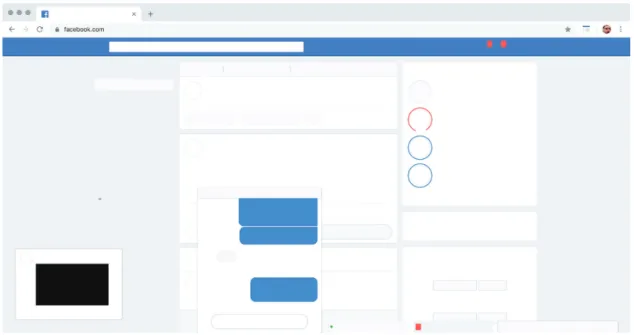
Various digital artists and designers have toyed with seemingly unfriendly inter-face elements to foster critique. Benjamin Grosser’s Safebook (2018) serves as a particularly evocative example of the trend: as a plugin available for download from the artist’s website, Safebook aims to reinvent Facebook as a space free from persuasive
algorithmic curation by automatically redact-ing virtually all content — text, images, videos — from the website. After installing Safebook on Chrome or Firefox, the user is left with a layout of blanks and omissions, with only the framework of Facebook’s user interface intact and recognizable. The user can still interact with the website, but ‘liking’ an invis-ible image by clicking one of the concealed reaction buttons invariably proves a shot in the dark.
Safebook defamiliarizes the experi-ence of ingesting information through social media, as Grosser’s software takes on the form of a sui generis AdBlock — targeting all content made available through Facebook — to suspend direct consumption. The browser extension obfuscates the results of Facebook’s personalization to diminish the
influence of algorithms over what we see, and
thus seemingly allows us to take back control over what we do with our time online. This is also how Safebook indirectly reinforces the idea that the danger posed by contemporary technology relates to the users’ compulsive tendencies: that more software can lead to
more control or, specifically, self-control, and Figure 1: Facebook News Feed modified by Safebook (https://bengrosser.com/projects/safebook/).
that the challenge for designers in the age of the continuous stream is to search for new design strategies that enable digital temper-ance. Safebook, however provocative, shares more with the likes of ScreenTime (one of Apple’s latest solutions that allows the user to schedule time away from the screen or set time limits for individual apps) than it initially appears to — realizing the conception of new design as a means of extending control over any previous design. The ‘unfriendliness’ it
stages turns out superficial, as the logic of
the interface-as-controller remains unchal-lenged. And since it is precisely the interface, not the stream of content, that makes us believe we have control over our life online, Safebook fails to embody non-user-friendli-ness as a means of disturbing the illusion of technology that merely serves its master.
Grosser does gesture, however, towards the idea of software that prevents rather than encourages interaction. Instead of making the content invisible to the user, perhaps critical design could do the reverse to bring the concept of non-user-friendly design closer to fruition: render the user imperceptible to the system. An interface that remains oblivious to the user, not reacting to touch, voice, or any other well-known com-mands, could also interrupt the false sense of control that a user-friendly interface aims to generate. Writing about the limitations of cinema, Dunne and Raby point out “it can deliver a very powerful story and immersive experience but requires a degree of
passiv-ity in the viewer” (75), contrasting film with
speculative objects as invitations for “the viewer to actively engage with the design rather than passively [consume] it” (90). Dunne and Raby think primarily of physical objects, but if we transpose their argument to digital environments, the opposite may prove to be true: putting the user in a seemingly passive position, turning to older patterns of engagement, may enable the mental process
of cognitive estrangement the designers are aiming at. Perhaps in the age of touchscreen sensibilities, only non-user-friendly design based on the performance of technological indifference — enforcing the user’s passivity via an interface usually meant to maintain a continuous interaction — could cause a cognitive glitch.
“When people’s participation becomes someone else’s business,” argues Jonathan Sterne, “the social goods that are supposed to come with it can be compromised.” He sug-gests that “the bad things that media critics have been saying about passivity” seem ap-plicable to contemporary media’s “demands to interact, to participate.” Active participation fails to renew commentary and bring about agency, as interactivity “also encompasses the ‘agree to terms’ button” (Sterne). Perhaps any form of UX design based on interactive engagement is complicit in the dreams of the industry? Perhaps to generate a cognitive glitch, to open up “all sorts of possibilities that can be discussed, debated, and used to
col-lectively define a preferable future,” (Dunne
and Raby 6) design speculations in the age of touchscreen sensibilities should reconsider the potential of passivity, of standardization, of the screen that cannot gaze back?
Interpassive interfaces
If Sterne is right and interactivity is indeed the new passivity, then could ‘interpassiv-ity’ become the new activity in the age of touchscreen sensibilities? Interpassivity was
conceptualized by Slavoj Žižek and Robert
Pfaller in the late 1990s to describe the rela-tionship between a subject and objects that have inscribed in them their own reception:
they anticipate reactions and thus fulfill their
role on their own, supposedly not relying on the subject to interact with them. The use
of ‘canned laughter’ in sitcoms is one of the most common examples of interpassivity, relating the phenomenon to the delegation of enjoyment to objects themselves: a sitcom episode seems to be ‘enjoying itself’ inde-pendently of the viewer’s presence.
Perhaps the term, as defined by Žižek
and Pfaller, is not directly applicable to contemporary digital environments, since, as Gijs van Oenen points out,
interpassiv-ity “refers more specifically to the period of
modernity, when subjectivity is ‘haunted’ by the expectation of incessant activity” (van Oenen 8). Van Oenen argues that interpas-sivity, understood in the context of modernity, becomes a delegation of activity, not passiv-ity — “a delegation necessitated by an acute sense of being overwhelmed by interactive engagements and obligations” (11). Can we argue, therefore, that new design solutions, as they aim to preempt conscious decision-making, establish an interpassive, rather than interactive, relationship with the user? The contemporary viewer-user indeed seems to unwittingly delegate his or her activity to the automated system to remain passive — to enjoy the effects of personalization without
having to take an active role in the process of selection. And yet, the canned laughter in the form of incessant recommendations, au-tomated playlists and algorithmically curated feeds is not ‘canned’ at all, as the interface maintains a never-ending exchange of infor-mation with the user; the user is, ultimately, the necessary component of the system, the key (re)source of click-throughs, likes and other sorts of data. The process of active se-lection on the part of the user might eventually become obsolete in the age of AI-enhanced personalization — but only because the user has participated in a continued interaction long enough for the system to predict his or her needs and desires in the future. The user-friendly interface employs elements that overtly encourage interaction only to enable a form of interpassivity — it masks our reli-ance on the algorithm and our delegation of decision-making to the machine with a seem-ingly controllable, interactive layer of intuitive software.
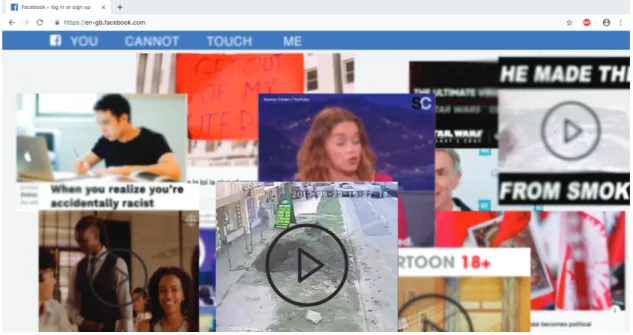
While interpassivity has been theorized in relation to the modernist notions of activ-ity and passivactiv-ity, scholars such as Hagen Schölzel have looked beyond this framework Figure 2: Visualization of an ‘interpassive’ interface (by the author).
to gesture towards the reinterpretation of interpassivity as a way of “backing away from circles of control” (187) in our current political culture of participation. I refer to these
theo-retical framings that push Žižek and Pfaller’s
ideas forward to suggest there is potential in interpassivity-as-resitance realized through contemporary critical design. Most recently, Alex Gekker has referred to the genre of idle games on YouTube (recorded by gamers and uploaded to the platform to be watched by other users) as a way of examining “the system as a whole” that allows the interpas-sive actor to inspect it “without responding to [its] always-on logic” (219). Building on van Oenen and Schölzel’s observations on inter-passivity as a form a resistance, he argues for interpassivity’s liberating potential as “an alternative to straightforward consumption” (221). Gekker’s optimistic interpretation of
consumption of specific YouTube videos
as a liberating, interpassive practice has its apparent limitations — after all, how many users who subscribe to gaming channels are capable of distancing themselves from the viewing and becoming aware of the system as a whole? — but his and Schölzel’s fram-ing of interpassivity as a way of resistfram-ing interactivity proves useful in thinking about alternative, critical strategies of UX design.
The viewer of interpassive gaming videos might be escaping the demands of interactivity, but this still happens through the user-friendly, interactive frame of the person-al screen — there is no cognitive glitch. If we
redefine interpassivity as non-participation
in the face of interactivity, then an ‘interpas-sive’ interface would have to intentionally disregard the viewer-user, openly reject his or her involvement, essentially prevent the user’s participation. While Safebook renders the content shared via Facebook invisible to halt consumption, an interpassive version of Facebook would aim to do the opposite
— overwhelm the user with an overflow of
content, while denying him or her the option
of navigating the flood of information with
recognizable interface elements. Perhaps, instead of redacting the content, a truly non-user-friendly software should obfuscate Facebook’s interface design and confront the user with an assemblage of images, text messages, and videos that suddenly begin to feel uncontrollable — indeed out of reach. Only then would touch fail to colonize data. Only then would design reveal the ultimate lack of control the user has over what he or she experiences through the interface. This kind of non-user-friendly software would make the user feel ignored, invisible — to eventually redirect his or her desire for
imme-diacy, control and omnipresence, satisfied by
the illusion of user-friendly software, from the manipulable data universe to the real world. The critical interface I envision must defa-miliarize consumption, prevent participation, and de-frame perception — make the user experience what lack of control feels like, and do so to encourage resistance.
Staging resistance
When a touchscreen — an interactive map in a shopping mall, an information board at an airport, a ticket machine — fails to respond to your touch (or turns out a regular, non-interactive screen), it can feel awkward and cause frustration; this kind of mismatch of ex-pectations is something user-friendly design aims to avoid. But designers could harness the negative feeling to transform dissatisfac-tion into disillusionment, and disillusionment into distance. Perhaps non-user-friendly interfaces must appear out-of-order to create disorder. Perhaps only a device that seems dysfunctional can originate a glitch that disturbs the hyper-industrial production line where the consumer’s consciousness serves
as raw material.
Stiegler defines films and songs as tem -poral objects because they are constituted by the time of their passing. The interface is also a temporal object, but it supplants the looped temporality of cinema with continuous change and never-ending updates. As the
flux of human consciousness is intertwined
with that of the interface, they remain in a reciprocal relationship, in passage together, affecting one another and adapting to each other. Stiegler has recently admitted that while the new, interactive screen could be “a threat, enacted through the mediation of the fully computational and automated system,” it could also “constitute a chance, an opportunity to renew commentary, to reconnect with the ‘gloss,’ through a com-pletely rethought hermeneutics” (Stiegler, The Neganthropocene 173). To live a vita activa, he argues, we must hold on “to the promise of a new hermeneutic epoch borne by these screens” (174). Non-user-friendly design could realize that promise by embrac-ing interpassivity, uncoverembrac-ing a gap between human and machine feeling. To be deemed successful, the experience of non-interaction must interrupt the illusion of control and per-sonalization, create an opening that divulges our very technicity.
Speculations on non-user-friendly design modeled on interpassivity point to the potential of the existing touchscreen infrastructures to de-automatize choice. The relevance of the search for critical, alterna-tive UX design practices is progressively becoming more evident, as the culture of ubiquitous computing moves on to more advanced sensors, AR/VR sets, holographic projections, etc. The aim of this provocation is to invite both users and practitioners to reconsider the potential of interpassivity in the age of total interactivity, to imagine a design strategy and design experience that reveals rather than covers up, that disturbs
the illusion of user-friendliness and disen-gages the user from the system.
To call our new, machine-enabled feel-ings into question, non-user-friendly design would need to replace apparent mastery with enabling vulnerability. It wouldn’t allow the technology to gaze back at the user, respond to his or her touch, heartbeat, or position in space. It wouldn’t be personalized or interac-tive. While user-friendly design conceals the
influence of the controller-screen, the every -day enhancer of sensation, non-user-friendly design would revert the logic of touchscreen sensibilities — without a complete erasure of hardware through software. This kind of design would have to elicit a sense of confu-sion; disorientation would form part of the experience.
I am using my iPad to edit this article. What if there was an app uploaded to my de-vice that, once opened, would not allow me to navigate the unknown through automa-tisms and well-known gestures? What if this non-user-friendly software would transform — even if for a little while — the interactive touchscreen of my personal device into a classical screen — a non-interactive surface for receiving projections — and turn me into an (inter)passive spectator against my will? Would this kind of non-user-friendly design prove a means of paradoxical de-framing of contemporary perception and make the user aware of his or her own expectations of sensation, shaped by design that appears user-friendly? To succeed, non-user-friendly design would have to feel intrusive. It would have to make explicit the fact that the device doesn’t belong to the user, that it doesn’t merely serve its master. Non-user-friendly
design would leave the user dissatisfied,
perhaps even angry. It would demand resistance.
Dunne, Anthony and Fiona Raby.
Speculative Everything: Design, Fiction, and Social Dreaming. MIT Press, 2013.
Ekman, Ulrik. “Introduction: Complex Ubiquity-Effects.” Ubiquitous Computing, Complexity and Culture, edited by Ulrik Ekman, Jay David Bolter et al. Routledge, 2016.
Gekker, Alex. “Let’s Not Play: Interpassivity as resistance in ‘Let’s Play’ videos.” Journal of Gaming & Virtual Worlds 10, 2018, pp. 219-242.
Hansen, Mark. “Topology of Sensibility.” Ubiquitous Computing, Complexity and Culture, edited by Ulrik Ekman, Jay David Bolter et al. Routledge, 2016.
Schölzel, Hagen. “Backing Away From Circles of Control: A re-reading of
interpassivity theory’s perspectives on the current political culture of participation.” Empedocles: European Journal for the Philosophy of Communication 8, 2017, pp. 187-203.
Sterne, Jonathan. “What if Interactivity is the New Passivity?” Flow Journal. https://www.
flowjournal.org/2012/04/the-new-passivity/.
Stiegler, Bernard. Symbolic Misery. Volume 1: The Hyperindustrial Epoch, translated by Barnaby Norman. Polity Press, 2014. Stiegler, Bernard. The Neganthropocene, edited and translated by Daniel Ross. Open Humanities Press, 2018.
van Oenen, Gijs. “Interpassivity Revisited: a
Zizek Studies, 2, 2008. https://zizekstudies. org/index.php/IJZS/article/view/80/77.
Žižek, Slavoj. “The Interpassive Subject.
Centre Georges Pompidou, Traverses.” http://www.lacan.com/zizek-pompidou.htm.