By Chelsea Barnes
A Thesis submitted to the faculty of the University of North Carolina in partial fulfillment of the requirements
of a degree with Honors in Political Science.
2015
Approved by:
_________________________________ Dr. Andrea Benjamin
_________________________________ Dr. Malinda Maynor-Lowery
Acknowledgments
Firstly, I would like to take the time to thank my advisor, professor, and mentor, Dr. Andrea Benjamin, for all of her unwavering support. Her guidance helped challenge me throughout this process. However, I was also immensely rewarded.
I would like to thank Dr. Malinda Maynor Lowery for helping me gather the materials I needed to conduct my research and more importantly, helping me to dig deeper into my own culture. I would like to express thanks to Arlinda Locklear, Esq., for giving me an inside look at Lumbee federal recognition. The knowledge both of you had to offer was extremely rewarding.
Additionally, I would like to thank all members of the Lumbee tribal community who contributed toward my research efforts as well as Dr. Christopher Clark for serving on my thesis committee. I am thankful for the time that was invested into reviewing my work. Thank you to Dr. Stephen Gent for guiding me through the initial stages of the thesis process and serving as a source of support along the way.
Table of Contents
Chapter 1- Introduction: Why study Lumbee Federal Recognition?...1
Chapter 2- Topical Background: Who are the Lumbee? What does “recognition” mean?...4
Chapter 3- Review of the Literature: Federal Recognition: A Macro and Micro View…………..7
Chapter 4- Theory: Internal Desires, External Results………….……….14
Chapter 5- Methodology: Quantitative and Qualitative……….…16
Chapter 6- Data: Basic Overview and Analytical Results……….17
Chapter 7- Discussion…….………...35
Chapter 8- Conclusion.………..41
Bibliography…..………....43
Chapter 1- Introduction: Why study Lumbee Federal Recognition?
“Indeed, shorn of all frills, the history of the Lumbees is a history of struggle. The total
story is one of struggle to gain acceptance as Indians, to escape the emasculating effects of
discriminatory laws and to join the mainstream of society as first-class citizens. The Lumbees, by
whatever name they were vicariously through the centuries, have always known themselves as
Indians.”
- Adolph L. Dial, The Only Land I Know
For decades the Lumbee Tribe of North Carolina has struggled to gain acknowledgement of our sovereignty as Indian people from the federal government in the form of federal
recognition. In 1934, Congress implemented the Indian Reorganization Act in an attempt to create evaluation guidelines for non-recognized tribes when they sought federal
acknowledgement. Given the burden of proof, the Lumbee Tribe attempted to prove a degree of “Indianness” to a committee of governmental representatives who were selected to evaluate the evidence presented by the tribe in 1936 (Lowery, 2010., p. 133). Twenty years later, the U.S. congress would conditionally recognize the Lumbees as an Indian tribe.
The Lumbee Act of 1956 stated that although the Lumbee were indeed a Native
In 1978 the Bureau of Indian Affairs (or BIA) implemented the Federal
Acknowledgement Process, an administrative procedure by which tribes are given federal recognition (Hughes, 2001). In order to be eligible for federal recognition, tribes must meet several criteria including being “identified as an American Indian entity on a substantially continuous basis since 1900” and maintaining “political influence or authority over its members as an autonomous entity from historical times until the present” amongst others (Hughes, 2001, Section II, C). Prior to this process, federal recognition was established on a case by case basis via congressional action and administrative decisions. In response to inconsistent determinations, the BIA determined that a more “uniform” process was needed (Hughes, 2001, Section II, A).
In 1989, the Lumbee Tribe petitioned the BIA in hopes of eliminating the termination language within the Lumbee Act that stated that the tribe was not eligible for services from the federal government. As a result, the Solicitor General issued an opinion stating that the
“acknowledgment regulations do not apply to groups which are the subject of Congressional legislation terminating or forbidding the federal relationship,” therefore prohibiting the tribe from participating in the formal process (“Chairman Brooks testifies before Senate”). The BIA has taken the position that the Lumbee Tribe should be required to solicit federal
acknowledgement via the legislative branch of the federal government. As a result, the Lumbee have continued to seek recognition through Congress.
This project aims to investigate the ways in which the Lumbee Tribe of North Carolina has restructured its own political organization in response to internal factors such as
recognition. Externally, federal recognition also impacts the formation of tribal government. Although the tribe is not formally eligible to participate in the Federal Acknowledgement Process, it has made significant attempts at fulfilling each of the requirements established by the Bureau of Indian Affairs in ways that are familiar to the general population and in hopes of establishing a “government-to-government” relationship with the federal government. These efforts have helped to shape the tribal government.
While this investigation affects the over 60,000 members of the Lumbee tribe, it also speaks to larger issues related to tribal government formation more generally, federal recognition policy, and the process that tribes and the federal government use to implement that policy. For many years the equitability of this process has been debated, and the Lumbee tribal case can serve as an example of why it should be (and currently is being) re-evaluated. Although many Native people would surely argue the importance of acknowledgement from the government, federal recognition can give larger insight into the political process in general and how administrative processes develop within the United States governmental system.
Chapter 2- Topical Background: Who are the Lumbee? What does “recognition” mean?
Who are the Lumbee?
With over 60,000 members, the Lumbee Tribe of North Carolina is commonly referred to as the largest tribe east of the Mississippi River and the ninth-largest tribe in the nation.
Members of the tribe reside primarily in Robeson, Hoke, Cumberland, and Scotland counties. While theories regarding the tribe’s ancestry have been debated, the tribal government articulates that the Lumbee are the descendants of Cheraw Indians who have resided in the area that is now Robeson County, North Carolina, since the early 1700s. In 1885, the tribe gained recognition from the state of North Carolina.
What does “recognition” mean?
The term “recognition” or “acknowledgment” stems from the relationship between Native Americans and the federal government. Given their unique position within the federal system, Native peoples must “turn to an outside arbiter” (or the federal government) in order to determine whether or not they are in fact a “legitimate Indian tribe” (Miller, 2013, Claiming Tribal Identity, p. 6-7). That being said, the overarching concept of recognition refers
that is recognized as having a government-to-government relationship with the United States, with the responsibilities, powers, limitations, and obligations attached to that designation, and is eligible for funding and services from the Bureau of Indian Affairs” (Frequently Asked
Questions). Additionally, these tribes are recognized as having inherent rights to
self-governance. The following are the guidelines established within the Federal Acknowledgment Process:
“a) The petitioner has been identified as an American Indian entity on a substantially continuous basis since 1900. § 83.7(a)
b) A predominant portion of the petitioning group comprises a distinct community and has existed as a community from historical times until the present. § 83.7(b)
c) The petitioner has maintained political influence or authority over its members as an autonomous entity from historical times to the present. § 83.7(c)
d) It submits to the BAR a copy of the group’s present governing document including its membership criteria. § 83.7(d)
e) The petitioner’s membership consists of individuals who descend from a historical Indian tribe or from historical Indian tribes which combined and functioned as a single autonomous political entity. § 83.7(e)
f) The membership of the petitioning group is composed principally of persons who are not members of any acknowledged North American Indian tribe. § 83.7(f)
Recognition can also be granted by an individual state. While state recognition acknowledges a tribe’s “status within the state,” it does not guarantee any services or funding (Salazar). North Carolina is home to eight state-recognized tribes. Of these eight, only the Eastern Band of the Cherokee have federal recognition.
Chapter 3- Review of the Literature: Federal Recognition: A Macro and Micro View
The Bigger Picture of Federal Recognition
Much of the current literature regarding Native Americans is focused upon federally recognized tribes and the way that they interact with the United States government. In his book entitled Native American Issues, Paul C. Rosier (2003) identifies what he believes to be key issues facing Native people groups in our society today. However, by referring to the over “550 separate Indian nations,” he largely ignores over 400 tribes who only have state recognition and instead focuses on issues such as gaming that only pertain to those tribes with a nation-to-nation relationship with the United States Government (Rosier, 2003, p. xxxi). Although state tribes are largely ignored in some realms of academic literature, it is important to investigate who these tribes are and the processes our government utilizes to affirm the existence of a distinct, sovereign political community. I intend to investigate many aspects of this in my research.
established. Though there has been a forward movement of tribes exercising sovereignty, federal recognition remains one of the areas in limbo. With this in mind, we can begin to see how the topic of federal recognition illuminates U.S. political formation.
In recent years, some research has been conducted on the logistics and history of the federal recognition process itself. When discussed in literature, the federal recognition process is generally analyzed in conjunction with a specific tribal case. For example, Sweeney (2001, p. 210) explained what was referred to as the “The Administrative Route for Federal Recognition” as a means of investigating the case of several northwestern tribes including the Samish.
Sweeney also remarks upon the many hours of labor and cost associated with the federal
recognition process (2001). A slightly older investigation concluded that federal recognition was dependent upon both external and internal socially constructed identities via an analysis of the Catawba and Lumbee tribes (McCullough & Wilkins, 1995, p. 361). In this investigation, they identify the federal acknowledgment process as the primary method for tribes to “affirm their existence as distinct political communities within the American system” (McCullough &
Wilkins, 1995). Although not directly related to the logistics of the process, Adams (2012, p. 35) argues that “the political status of tribes influenced[s] their conceptions of belonging.” Each of these pieces of literature can speak to some aspect of the Lumbee experience.
Mark Edwin Miller (2005) tackles the issue of federal recognition via an analysis of four tribes from various regions of the United States, including the Pascua Yaquis, Timbisha
unrecognized tribes and the process by which they attempt to seek federal recognition. Though the Lumbee are not formally eligible for the Federal Acknowledgement Process, understanding its impact on other tribes can enable us comprehend its external impact on the Lumbee Tribe’s political structure.
Additionally, there is a large body of work surrounding the effects of Indian gaming practices on both tribal relations with the U.S. government as well as the Federal
Acknowledgement Process. Hansen and Skopek (2011) argue that legalized gambling on Indian reservations has resulted in another dimension of conflict over tribal sovereignty. Cramer (2005) argues that the Federal Acknowledgement Process is influenced not only by the regulator and regulatee, but also other well-established tribes, gaming financers, and public opinion on the implications of federal recognition. This further reinforces the complexity of the federal recognition process and hints to the importance of internal and external factors such as intergovernmental relations within the tribe or flawed gaming contracts. Each of these issues arise in my research.
The Lumbee Tribal Case
Federal Acknowledgement Process and the Branch of Acknowledgment and Research within the Bureau of Indian Affairs (2009). Previously, Lumbees were not concerned with their proportion of “Indian blood.” This concept arose after Native identity validation began to stem from the federal government, in which one of the qualifications was a certain blood quantum.
Lowery (2010) also discusses the difficulty of the Lumbee Tribe’s pursuit for federal recognition regarding the development of the tribal constitution, which was prompted by
recommendations from the BIA in 1991. The development of the constitution arose in part from the 1978 guidelines established by the BIA, a result of the tribe’s attempt to fulfill criteria D which required them to submit a copy of their governing document. She discusses the idea that federal acknowledgment for the Lumbee Tribe was viewed as a way to non-discriminatory first-class citizenship in an era where Lumbees were easily clumped with African-Americans in the Jim Crow south.
Relating specifically to the intergovernmental issues the Lumbee Tribe faces between the legislative branch and Bureau of Indian Affairs, Wilkins discusses the variations between
soliciting for federal recognition via the formal process and congressional legislation. He states that tribes must “muster enough proof that they are a legitimate group composed
of people of Indian ancestry, [and] have to make a compelling case to the congressional
representative(s) of the state they reside in” when utilizing the congressional procedure (1993, p. 127). Although the BIA is not directly involved with the congressional procedure, they do hold authority over recognized tribes and are therefore relevant to the solicitation process, even though they may not be doing the official evaluations (1993).
could be obtained via “numerous formal political processes, bureaucratic paper shuffling, and often-accidental events” (Cramer, Miller, and Fletcher, 2006, p. 491). Thus, Cramer, Miller, and Fletcher (2006) argue that the Bureau of Indian Affairs should now ignore the restrictions established via the Federal Acknowledgement Process and rely instead solely upon Congressional precedence. McCulloch and Wilkins (1995) argue that the Lumbee tribe is essentially “frozen in time” in regards to the Federal Acknowledgement Process. Their previous attempts have proven unsuccessful, they are unable to petition via the BIA, and petitioning in Congress presents numerous bureaucratic issues.
Mark Edwin Miller (2013) cites opposition from other tribes, based on concerns about financial competition, as a reason for the Lumbee’s tribe lack of federal recognition. After the establishment of the 1978 guidelines, several tribes have spoken out against the Lumbee. Quite simply, the loss in financial support from the BIA that these tribes could incur if the Lumbee were granted recognition (and therefore federal funding) induces fear. In Miller’s (2005) analysis of the United Houma Nation of Louisiana’s pursuit of federal recognition, he strikes an
interesting parallel to the Lumbee tribe as he illustrates why they too have been unable to obtain federal recognition. This case further exemplifies the far reaching impact that a historical analysis of the Lumbee political structure can have in regards to understanding how the federal acknowledgment process shapes tribal governance as well as our understanding of the United States political system.
Bridging the Gaps
linked. By examining the origins of Native American life, issues facing federally recognized tribes, the federal recognition process as a whole, and the cases of the Lumbee tribe and other tribes with state-recognition, we can effectively examine the far reaching impacts of federal recognition and the overarching issue of tribal sovereignty within the American system.
Although each of these facets may be examined alone, they are more powerful together and can provide the foundation on which my research question can be answered. These findings
demonstrate that the current literature surrounding federal recognition is quite broad. However, the current body of knowledge lacks a clear understanding of how a tribe’s political organization adapts over time in response to their own internal desires as well as external influence. A
Chapter 4- Theory: Internal Desires, External Results
This thesis will examine ways in which the Lumbee Tribe of North Carolina has restructured its political organization in response to internal factors as well as the desire for federal recognition. While the Lumbee Tribe has actively sought federal recognition for many decades prior to the implementation of the guidelines established by the Bureau of Indian Affairs, many argue that the Lumbee Tribe is now “frozen in time” in regards to the federal recognition process. Specifically, what have the Lumbee done to restructure their political organization? How do these structural changes relate to one another? The current body of research largely ignores these topics and focuses upon external factors that affect the tribe. Therefore, I intend to provide a thorough examination of how the actions of the tribe have impacted their pursuit of federal recognition. My research will test the following hypothesis:
The Lumbee Tribe has restructured its political organization in an attempt to remedy internal desires and, in doing so, has grown closer to achieving federal recognition.
The various internal desires of the tribe shall serve as the independent variables of the test, while the obtainment of federal recognition will be the dependent variable. In order to obtain recognition, each of the internal desires of the tribe in regards to governance must be satisfied. At the same time, this will enable the tribe to grow closer to federal recognition. The various political actions of the tribe should be considered valid given that they correlate directly with the image of governance that the Federal Acknowledgement Process imposes.
While it is evident that the Lumbee Tribe has pursued federal recognition for a number of years, I anticipate that the historical data will show that the Lumbee Tribe’s attempts to
tribal community, and less from external pressures. However, these reactions to internal desires have aligned with the federal government’s standards of recognition procedure.
Internal issues have arisen within the course of the tribe’s recent history. For example, the Lewin International gaming contract failure in 2010 affected the tribe’s organization and
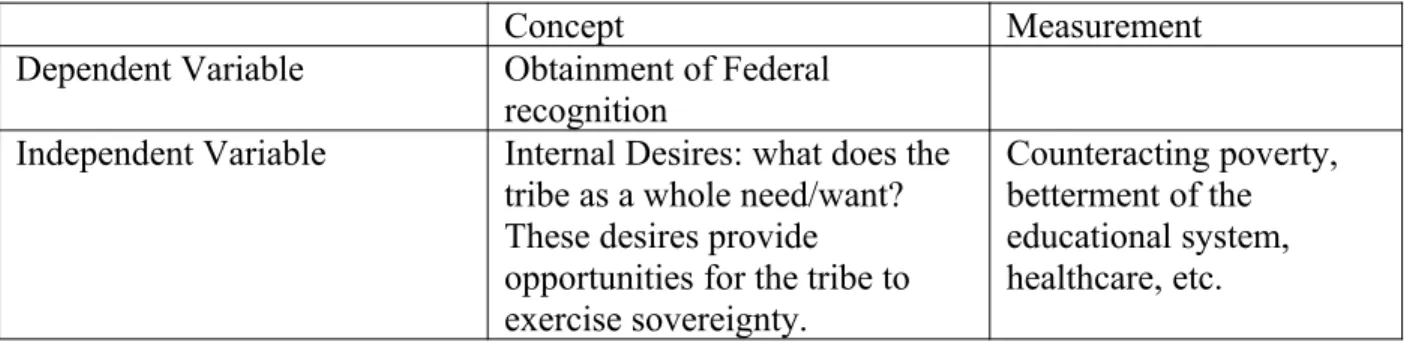
relationships within, thus hindering the tribal government’s ability to successfully advocate for the tribe as a whole. Additionally, I aim to explore the effect of internal desires such as poverty, bettering the educational system, and healthcare. If the tribe cannot remain on the same page and solve internal issues, how can they successfully solicit recognition? It is important to understand what these internal desires or issues are and further, how they affect the recognition process. My thesis will explain each of these concepts in further detail. Table 1 further explains relevant variables.
Table 1: Relevant Variables
Concept Measurement
Dependent Variable Obtainment of Federal recognition
Independent Variable Internal Desires: what does the tribe as a whole need/want? These desires provide opportunities for the tribe to exercise sovereignty.
Chapter 5- Methodology: Qualitative
To test this hypothesis, I constructed my thesis in relation to qualitative factors, stemming from a linear analysis of the tribe’s traditional forms of political organization toward modern political structure. My analysis begins with an explanation of the role of Lumbee communities serving as political “epicenters.” I then turn to an analysis of the development of the Lumbee Tribe during various historical eras, the development of the Lumbee Regional Development Association, the Lumbee Tribal Constitution, and the formation of the Lumbee Tribal
Government. Each of these historical eras help to demonstrate examples of the way the tribe exhibits political organization. Historical facts were gathered from both secondary and primary sources.
Chapter 6- Data: Basic Overview and Analytical Results
How should a tribe organize itself?
Prior to contact with whites, Native people groups governed themselves in ways that are quite different from governmental systems recognized in the United States today. For example, the Navajo Nation lived in family and clan groups with elected “peace chiefs” who were selected by the community because of their wisdom and capacity to lead (Yazzie). Similarly, the Paiute Indian Tribe of Utah held council meetings consisting of three to five households, wherein the elders of the group helped to make the decisions (American Indians-How They Governed Themselves). While the Lumbee have no recorded system of governance that dates from pre-modern times, they rely heavily upon kinship and “place.”
Kinship and Place: Early Lumbee Political Organization
Lumbees. Based heavily upon kinship, it can be argued that this is the first documentation of a Lumbee “political system.” However, other aspects of Lumbee politics were also present, although they may not have been documented as such.
Within her article Where Do You Stay At?, Karen Blu refers to a Lumbee “homeland” that has never resembled any sort of formal reservation system (201). Comprised of several smaller communities primarily located within Robeson County, the Lumbee community is not easy to understand on the surface. Smaller divisions within the larger community have their own blurry boundaries, stemming from the Civil War era as well as the Lowry War (Blu, Where Do You Stay At, 203). These communities served to provide a sense of attachment amongst
Lumbee families at a time when Indians were a target for White men. Each of these communities has its own distinct history that relates to family ties, as well as a perceived sense of character and way of life. These communities continue to impact the Lumbee way of life today.
half a dozen Indian communities identified within the Robeson County, NC area. This does not include the growing populations of Lumbee tribal members in surrounding counties such as Hoke, Scotland, and Cumberland. The presence of these communities constitute political systems by serving as a way for Lumbee tribal members to identify one another as well as providing a way to separate the Lumbee tribal territory into fourteen districts. These districts are described in the Appendix.
The Civil War
While kinship and place have always played a role in the politics of the Lumbee
community, this becomes extremely evident during and in the aftermath of the Civil War. During this period it became apparent that one of the integral aspects of the Lumbee political system was effective advocacy for the needs of the group. When researching the Lumbee Tribe of North Carolina, one is likely to encounter the name “Henry Berry Lowry.” Though he was not a formally-elected representative of the tribe, he has emerged in public memory as a “Robin Hood” figure who advocated for the needs of the people during a time when no one else cared about their struggles. Despite a tense racial climate, a political system in the form of a tri-racial band emerged under his leadership.
Confederate official) was shot and killed after a dispute with the family of Allen Lowrie, a well-respected farmer in the Lumbee community. This signified the first violent incident of many more to follow.
Henry Berry Lowry has gone down in history within the Lumbee community for his dedication to his people, as well as the legacy surrounding him. At the time of these events, the media were drawn to Robeson County in a way that had not been seen before. The story of the Lowry War would spread far and wide, to those who may not even have known that the Lumbee existed. While Henry Berry Lowry was certainly a well-respected figure within the Lumbee community, he projected a political statement to the rest of the country. Although the Lumbee Tribe had no formal tribal organization at this time, Henry had shown that they were in fact a political people who knew how to advocate for their needs. While his gang engaged in raids for material goods, the also engaged in business meetings and were well-respected, and undoubtedly feared. The Lumbee were in fact a people with leaders who were able to articulate tribal issues and draw support from the community. William McKee Evans argues that “the bold deeds of the Lowrys, which filled the Lumber River Indians with a new pride of race, and a new confidence that despite generations of defeat, revitalized their will to survive as a people” (1995, p. 259).
Petitioning for the Establishment of a Normal School and Federal Assistance
Following the end of the Lowry War, the Lumbee would soon begin to show signs of formally organized representation, another important aspect of the political system in the
signers of the petition demonstrated the commitment of the Lumbee community toward this effort. With ninety-one petitioners in total, each Lumbee family name was represented. From this time period and almost one-hundred years later, the role of kinship and residency would play a role in the leadership of the Lumbee Tribe. While the petitioners were not on any sort of formal tribal council, they attempted to represent the needs of other Lumbee tribal members and kept their best interest at heart. The Lumbees moved forward with these petitions as a unified tribal body.
The petition to the state ultimately proved to be successful. As a result, a governing body was appointed by the state legislature within the Lumbee community to oversee the newly instated normal school project. This initial board of trustees consisted of W.L. Moore, James Oxendine, James Dial, and Preston Locklear as well as three other members who were to be selected by the initial board (Eliades and Locklear, 2014, p. 20-21). The efforts of this board were to garner support for the school from within the Lumbee community, establish trust between the Lumbee and the state government, and also to obtain the resources necessary to begin the establishment of the school. It was at this time that the petition was sent to Congress in hopes to gain financial support for the cause (Pierce et al., 1987, p. 199). However, sending the document would prove to be the easiest part of the task. In the months that followed, D.F. Lowry worked within the tribal community to explain the efforts of the petition to tribal members. He also worked to form committees that would lobby the federal government.
contribute to an effective political system. However, a tribal name can also have bearing on the way tribal members perceive their own identity, as well as the way the tribe is perceived
externally. The complexity of these issues would lead to a political stalemate between the Tribe and the federal government for decades. During the beginning of intense lobbying efforts around 1914, the tribal leadership worked for the acceptance of the name “Cherokee Indians of Robeson County” (Pierce et al., 1987, p. 199-200). A few years later, however, divisions would emerge within the Lumbee community and prohibit the Tribe from making any success toward gathering funding or support for a tribal name.
Political Division
An important aspect of a successful political system is the ability to maintain stability despite times of internal division. In 1932, a newly formed group of tribal leaders emerged in efforts to gain support from the federal government. Calling themselves the “Southeastern Cherokee Indians of North Carolina,” their petition consisted of four signees. This effort to “get a bill through Congress” would ultimately result in the development of two factions who were advocating for two different tribal names. The first group advocated for tribal members to be called “Siouan” Indians and formed a tribal organization consisting of sixteen districts within Robeson County (Pierce et al., 1987, p. 202). These districts were led by councilmen who represented any number of Lumbee families in the area, ranging from six to ninety. The other group was led by D.F. Lowry and Clifton Oxendine, and worked to advocate for the continuation of the Cherokee name. While the efforts of both of these groups would ultimately prove
continued to seek acknowledgement for the tribe. This time, however, their efforts would look quite different.
In 1934, the Wheeler-Howard Act (commonly known as the Indian Reorganization Act) was passed which aimed to conserve and develop Indian lands and resources. As a result, Joseph Brooks (the leader of the Siouan division) advocated for land to be set aside for the Lumbee. These efforts marked the strongest divisions within the two political factions. While the Siouan leadership believed the power of federal support to help alleviate the needs within the
community, Lowry was concerned about white supremacists at the state level and felt that a grassroots effort through education would enable the tribe to help itself to become successful (Lowery, 2010. p. 76-77). In 1948 Lowry continued his efforts by forming the “Lumbee
Brotherhood” to deal with various issues facing the tribe (Pierce et al., 1987, p. 203). Ultimately, in 1956 the necessary legislation was finally passed and the tribe officially became known as the “Lumbee.”
While the initial petition to Congress was issued in 1888, the tribe would not be acknowledged until almost seventy years later. The political divisions that emerged within the tribe would serve to represent the tribe on a national scale. Members of the separate factions both garnered support from various government officials, locally and nationally. While their attempts proved unsuccessful for many years, by 1956 the Lumbee had officially established themselves as a tribal body on a national level. They have been recognized in this way ever since.
What made a Lumbee “leader”?
The importance of leadership within the Lumbee political system cannot be ignored. The Lumbee Tribe’s petition for federal recognition originally written in 1987 attempts to summarize in plain terms how Lumbee leaders were viewed during this time period. A leader’s potential for success depended heavily upon how they were perceived by other tribal members. Did they have the best interest of the tribe at heart? Were they honest? Additionally, the Lumbee “chose” their leaders based on their connections within the community. Did the person have ties with non-Natives too? Since tribal leaders at this time were not formally elected, events going on throughout the community (or the anticipation of them) shaped the need for leadership. When events dwindled down, however, the leader’s influence did not. They would remain well-respected within the community despite their lack of current action (Pierce et al., 1987, p. 204-205). This style of Lumbee leadership would carry on into the late 1950’s, when the Ku Klux Klan began making plans to come to Carolina.
Fighting the Klan
In January of 1958, two crosses were burned in the front yards of Indian families in Robeson County, NC. The Ku Klux Klan wanted to send a message. James W. “Catfish” Cole, a Grand Wizard within the Klan, advocated for segregation and wanted to hold a rally in Robeson County in efforts to end race mixing and “put the Indians in their place” (“The Lumbees face the Klan”). About a week after the burning of the crosses, a rally was set for the night of January 28th, despite opposition from local officials who knew that the local Lumbee sentiment was not in
gathering. To their surprise, they were met by hundreds of Lumbee Indians. As tension built at the scene of the rally, a scuffle began over the light that made the speakers visible. While the Klan was determined to carry on their rally as planned (even with the Lumbees there to watch), the Indians refused to allow this to occur. Suddenly, a shot was fired into the air, and the light was broken. In the minutes that followed, the Klan scuffled off into the woods, in fear of what would happen if the situation were to escalate.
The event would garner attention on a national scale. How had this group of simple Lumbee Indians managed to route the KKK out of Robeson County? This was surely a tale of legendary bravery, glamourized with images of Lumbee men draped in the Klan’s flag.
However, the attention did have a negative aspect. While the Indians were portrayed as heroes who had managed to overcome the Klan, the Blacks were repeatedly seen as a victimized group (Sider, 102). As a result, the event would be remembered as a way for the Lumbee to stand up for themselves, while the media reminded the Blacks that they were nothing less than deserving of such treatment by groups like the Klan and others.
What led to desire for more formalized government?
While for many years the Lumbee had responded to external influences from the political and racial environment, they would soon begin to respond to their own internal desires. In the late 1960s, the Lumbees were convinced that while they made up about a third of the county’s population, they were not receiving the services and resources that they were rightfully entitled to. This group met with Gerald Sider, a consultant with the Mobility Project of the North Carolina Fund and the North Carolina Manpower Development Corporation to discuss ways in which the tribe’s members could benefit from the programs available to them. This meeting and several others would lead to the early beginnings of Regional Development Associates, Inc.
The Development of the Lumbee Regional Development Association
funding programs to meet the Lumbee community’s needs, and enhancing the identity and acceptance of Lumbees” (Pierce et al., 1987, p. 209).
In order to tackle the first problem, the organization’s Board of Directors worked to ensure that their work would be influenced by the community by taking on new directors and establishing a steering committee consisting of sixteen members from the Lumbee community (Pierce et al., 1987, p. 210). This steering committee focused its efforts on five primary areas: education, welfare, unemployment, public relations, and housing. Two years after its inception, the organization changed its name and charter to reflect their mission of serving the Lumbee people. Based on a recommendation from the U.S. Department of Commerce, the organization would now be known as the Lumbee Regional Development Association, or LRDA. Over time, the organization would adapt to meet the needs of tribal members, and increase the size of its board to include seventeen districts, that now extended outside of Robeson County. The LRDA would work to represent the interests of Lumbees in Hoke County, the state capital of Raleigh, as well as Baltimore, MD.
What did LRDA accomplish?
the organization grew and developed into LRDA, the group was able to obtain funding for a wide variety of services including “senior citizen, health care, job training, nutrition, and elementary and secondary school programs” (Pierce et al., 1987, p. 214).
Politics within LRDA
As was noted above, the first grant that Regional Development Associates, Inc. was able to gain was through the National Congress of American Indians (NCAI). Despite establishing what appeared to be a positive relationship with the organization, relations had soured by the mid-1970s. NCAI had begun to question the role that it played in relation to non-federally recognized tribes. During their annual convention in 1974, two resolutions were passed that would affect the Lumbee negatively. Firstly, they voted to remove Adolph L. Dial (a prominent Lumbee figure) from his position within the American Indian Policy Review Committee, a group established during the ninety-third Congress to “conduct a comprehensive review of the
historical and legal developments underlying the Indians' unique relationship with the Federal Government in order to determine the nature and scope of necessary revisions in the formulation of policies and programs for the benefit of Indians” (Meeds, 1976, p.9). Secondly, they
advocated that the United States cease funding for non-federally recognized tribes (Pierce et al., 1987, p. 221-222). Similarly, the United South and Eastern Tribes organization discriminated against the Lumbee when leaving them out of a proposal that was sent to the Department of Health Education and Welfare.
They hoped that by drawing attention to this wrong-doing, they would be able to reverse the ill-will towards them within the two organizations. Once again, the political actions of the tribe proved to be effective and relationships were mended with both organizations by 1980 (Pierce et al., 1987, p. 222).
The development of the state commission led to the establishment of an annual conference, known as the North Carolina Indian Unity Conference. Later, this conference was taken over by the United Tribes of North Carolina. Nonetheless, the event still serves to unite tribes within the state of North Carolina and to give them a platform to discuss issues they are facing and brainstorm solutions together. Today, both the North Carolina Commission on Indian Affairs, as well as United Tribes both exist and work tirelessly to advocate for the needs of Indian peoples in North Carolina.
LRDA and Recognition
In the years before the inception of the Lumbee tribal government, LRDA was responsible for many of the tasks that would normally be taken on by a tribal council. For example, in 1984 the LRDA requested permission from tribal members through referendum to assemble a temporary committee that would attempt to assist in the pursuit of federal
Since 1975 the tribe had struggled with the language of the Lumbee Act that was issued in 1956. While it recognized the Lumbee as Indians, it essentially terminated their relationship with the federal government and rendered them ineligible for any services normally offered to federally recognized tribes. With that in mind, the Tribe decided to use the language to their advantage and advocated to Congress that the language within the act made them ineligible for the BIA process and therefore needed to be heard in Congress. However, this decision backfired. Due to testimonies from federally recognized tribes, the bill died in committee. Shortly
thereafter, the Solicitor General of the United States wrote to the BIA and advised them that the legislation was “terminating or forbidding the Federal relationship… and that, therefore you are precluded from considering the application of the Lumbees for recognition” (United States, 2007).
The Development of the Lumbee Constitution
In 1993, LRDA organized the Lumbee Tribal Constitutional Development Project in efforts to help prepare a draft of a constitution and explore options for tribal government
(“Chronological and Legislative History of the Lumbee”). This initial effort was in response to a suggestion from the BIA that indicated that the formation of a tribal constitution would “speed things up” in regards to recognition efforts. The project stemmed from the recruitment of delegates from various Indian churches as well as in surrounding areas to meet frequently and help with the development of the constitution. While the preliminary constitution was intended to be approved by LRDA, the committee soon got carried away in their work and took it directly to tribal members for approval. While LRDA had been seen for a long time as the tribal
“government,” this new constitution proposed an interim government to step in and take place until one could be formally elected by tribal members (Sider, lvii). The constitution was heavily supported by tribal members, many of whom had grown distant from LRDA. While LRDA had good intentions at its founding, tribal members had begun to question many of its actions in recent times, as they seemed to be motivated by finances rather than the needs of the people. This clash would lead to conflict between LRDA and the newly established tribal government. While the new leaders felt that they had rightfully earned their place in the hands of tribal members, LRDA felt as if they had been pushed aside, and unrightfully so.
This resulted in a lawsuit in 1995 by the new tribal government, who argued that LRDA would not recognize their authority and, as a result, federal agencies would not either. Though the debate went back and forth in the courts for some time, it was ultimately decided that another election would be held and tribal members would get to choose their leaders without persuasion from either side of the conflict. As a result, the Tribe’s new government would be led
With this, the new tribal constitution was officially put into place. (Woolverton, 1998.) This document represented a tangible example of the Tribe’s work to fulfill a requirement in direct response to the BIA. At the same time, the constitution would also prove to be helpful within the tribe by formally establishing the way the Tribe would exercise its sovereignty.
Tribal Government
Chapter 7- Discussion
The topic of Lumbee federal recognition is not one that has lacked exploration. However, the majority of those of who have analyzed the Lumbee in regards to the Federal
Acknowledgement Process do so only from the outside looking in. Rather than viewing the Tribe as a sovereign body with a political presence from the time of its existence, many assume that the Tribe has attempted to “fit the mold” and adapt to the requirements established by the United States government. Rather than simply delving into how the Tribe has responded to external pressures, it is important to explore internal desires in order to see the full truth. This study aims to further that goal. Rather than talking about federal recognition as a whole and how the
Lumbee fit into the puzzle, I have attempted to demonstrate the ways in which the Lumbee demonstrate their own shifting political organization that responds to needs within the group. While recognition of a nation-to-nation relationship with the federal government is certainly a goal for many tribal members, this has not been the driving force within the majority of the Tribe’s political endeavors. Although the Lumbee Tribe presents an interesting case, this is the first study of its kind that attempts to tackle the issue from start to finish. This thesis is simply a starting point on the much larger question of how tribes operate as sovereign nations within a system that aims to control them in so many ways.
By placing the historical data into the larger cultural context, the relationships may become more meaningful. The first signs of Lumbee political organization that may be analyzed through the historical record are demonstrated through kinship and place. These political
historical significance and political value of these locations is recognized by modern Lumbee officials. Members of the Tribe utilize kinship and place collectively, and are often able to learn more about one another by simply knowing where they are from. However, I propose that kinship and place can sometimes become problematic. While the “place” a tribal member belongs to can often give them a sense of pride within the Lumbee community, other times it can result in making tribal members feel disconnected from the Tribe altogether. For example, a large community of Lumbee tribal members exists in Baltimore, MD, the result of families who traveled there over fifty years ago to earn a better life for themselves with jobs in the region. Today, the population of Lumbee people within the community has grown tremendously
(Makofsky, 1982, p. 76). Despite their large numbers, their distance from Robeson County often renders them disconnected from tribal happenings. It could also be argued that their identity has been politicized in some way over the years, as their way of life is a far cry from the Lumbee of North Carolina due to their urban adaptation (Makofsky, 1982, p.76). These kinship relations represent one shortcoming of the tribe’s governmental system, as the Lumbees in Baltimore, MD do not have a representative on the tribal council, despite their substantial population in the area. While kinship and place prove advantageous within some historic Lumbee communities, others serve as a testament to a weakness within the tribal government. Issues such as this one are also related to the Federal Acknowledgment Process. Though the Lumbee do have a cohesive
community structure, shortcomings do exist. This can play a role when the tribe is examined as a collective body.
This determination has been a vital component of the larger political system. It serves as the motivating factor for the Tribe’s self-governance and strong desire to care for its people. The Lowry gang fought to alleviate poverty within the community and send a message throughout the area that the Lumbee were a force to be reckoned with. Their political organization gave a face to the Lumbee in a community that didn’t take them seriously, and drew the Lumbee onto an even larger stage. The legend of Henry Berry Lowry lived on long after him. Throughout this period, the Lumbee worked together for the betterment of the Tribe despite conditions that could have crushed their spirit. Despite these times of great hardship, their identity as Lumbee Indians was maintained and helped to carry them through. In that same light, the quarrel with the KKK at Hayes Pond in the late 1960’s serves as a similar example of how the Lumbee aimed to stand up for their community and protect tribal members in the face of unfavorable environmental
conditions.
federal recognition, it can be suggested that the University of North Carolina at Pembroke speaks volumes on behalf of the Lumbee Tribe’s perseverance and determination as a nation.
Later, in the 1930’s, the quarrel that emerged within the Tribe over what they should be named led to political factions within the Tribe that would result in the Lumbee Tribe’s presence at a nationally recognizable level. The division between Siouan leadership and the segment led by D.F. Lowry demonstrated that Lumbee were a political people, who didn’t necessarily agree on the best way to go about accomplishing their goals. While one side wanted influence from the federal government and the other advocated for a grassroots movement, this demonstrated that politics in its true form was certainly present within the Lumbee community. At the same time, both factions were recognized by leaders on a national level, drawing the Lumbee deeper into the political spectrum.
More recently, the development of the Lumbee Regional Development Association has served as an example of how the Tribe continues to advocate for the needs of its people. While its origination and purpose have already been discussed, it is important to note that this was an integral step toward formalized tribal governance within the Lumbee Tribe. Though the Lumbee were not “recognized” with a nation-to-nation relationship with the federal government, they sought out resources that would help to meet their needs. As LRDA continued to grow and develop, the Lumbee were better able to advocate for themselves at a national level and work with organizations such as the National Congress of American Indians to promote their desires. As was previously mentioned, LRDA helped in the formation of the current Lumbee
Though it is evident that the Tribe has advocated for itself as a political body, it is important to remember that they do not exist in a vacuum. Issues of race within the community have certainly been present. Prior to 1975, six school systems existed in Robeson County. Five were individual towns within the county, and the sixth was the Public Schools of Robeson County, which served all of those who didn’t live in the town limits (Barton). Because of the unique school board system, some individuals within the area had two votes while others only had one. For example, someone residing in Lumberton, NC voted for the Lumberton school board as well as the general county school board. This double voting system had a
disproportionate impact on Native Americans, as they made up sixty percent of those who resided in the county jurisdiction. A ruling issued in January 1975 reversed the policy, resulting in a more representative system. While the double voting system was largely reversed due to Lumbee activism, it raises the question as to the possibility of a Lumbee/Black coalition.
Chapter 8- Conclusion
In conclusion, this analysis finds that the Lumbee Tribe of North Carolina has maintained a shifting political organization that responds to the internal needs and desires of tribal members. This political organization has been exemplified by kinship and place as a way to organize the larger tribal community, advocacy for the Tribe’s people, a formal organizational structure, the value of tribal naming, the ability to maintain stability in times of disagreement, as well as leadership. Modern political organization has taken on the form of tangible examples of government that resemble the federal government of the United States: including a tribal constitution, executive, legislative, and judicial branch. While federal recognition is certainly desired by many within the Tribe, the tribe’s self-advocacy has stemmed from the pursuit of better access to resources and the desire to exercise tribal sovereignty.
By bringing to light the rich history of Lumbee political organization, this study suggests the need for a continued inquiry into the Tribe’s process of governance and how this fits into the governmental matrix of federal recognition. While the results of this study have contributed to our understanding of the Lumbee tribe’s political organization and how this relates to federal recognition, they also necessitate further inquiry. This research could be furthered by initiating a broader discussion of how other non-federally recognized tribes organize themselves politically. On the other hand, the Lumbee tribal case could be compared to those of tribes who have
successfully sought federal recognition. More work could be done to conduct an in-depth analysis of the modern Lumbee tribal government, since public information is limited.
Bibliography
Adams, Mikaela M. (2012). Who Belongs? Becoming Tribal Members in the South. University of North Carolina at Chapel Hill. Thesis: Ph.D.
An Act relating to the Lumbee Indians, of North Carolina, Pub. L. No. 84-570, 25 U.S.C. §, 70 Stat. 254 (2013).
"American Indians-How They Governed Themselves." Ilovehistory. State of Utah, 2014. Web. 11 Feb. 2015.
Barton, B. (2004). "Double Voting" in Robeson County: A Reminder of an Unequal Past. Tar Heel Junior Historian, 44(1).
Blu, Karen I. (2001). The Lumbee Problem: The Making of an American Indian People. Lincoln: University of Nebraska Press.
Blu, Karen. ""Where Do You Stay At?"" Senses of Place. Santa Fe: School of American Research, 1996. 197-227. Print.
Chairman Brooks testifies before Senate. (n.d.). lumbeetribe.com Retrieved May 1, 2014, from http://www.lumbeetribe.com/index.php?
option=com_content&view=article&id=153:chairman-brooks-testifies-before-senate&catid=42:rokstories
Cherokee Casino Impact. (2011, June 27). Cherokee Casino Impact. Retrieved May 1, 2014, from http://www.kenan-flagler.unc.edu/kenan-institute/publications/cherokee-report Chronological and Legislative History of the Lumbee. (n.d.). Retrieved March 17, 2015, from
http://www.lumbee.org/history2.html
Cramer, Renee Ann and Miller, Mark Edwin (2006). Politics, History, and Semantics: The Federal Recognition of Indian Tribes. North Dakota Law Review, 82(2), 487–518. Dial, A. L., & Eliades, D. K. (1975). The Only Land I Know: A History of the Lumbee Indians.
San Francisco: Indian Historian Press.
Documentary on Linguistic Heritage of NC's Lumbee Indians. (2000, September 27).
Documentary on Linguistic Heritage of NC's Lumbee Indians. Retrieved May 1, 2014,
from http://www.newswise.com/articles/documentary-on-linguistic-heritage-of-ncs-lumbee-indians
Eliades, D., & Locklear, L. (2014). Hail to UNCP!: A 125-year History of the University of North Carolina at Pembroke. Chapel Hill, NC: Chapel Hill Press.
Evans, W. M. K. (1995). To Die Game: The Story of the Lowry band, Indian Guerrillas of Reconstruction. Syracuse, NY: Syracuse University Press.
Fletcher, Matthew. (2006). [Commentary of the article Politics, History, and Semantics: The Federal Recognition of Indian Tribes, by Renee Ann Cramer and Mark Edwin Miller].
North Dakota Law Review, 82(487).
"Frequently Asked Questions." Indian Affairs. US Department of the Interior, n.d. Web. 08 Feb. 2015.
Gray, Christine K. (2013). The Tribal Moment in American Politics: the Struggle for Native American Sovereignty. Lanham, Maryland: AltaMira Press, A division of Rowman &
Littlefield Publishers, Inc.
Hughes, Jennifer P. (2001, February 1). Primer on Federal Recognition and Current Issues Affecting the Process. Primer on Federal Recognition and Current Issues Affecting the Process. Retrieved February 5, 2014, from http://www.msaj.com/papers/fedrecnov.ht
Kim, Claire Jean. (2000). Bitter Fruit: The Politics of Black-Korean Conflict in New York City. New Haven, CT: Yale University Press.
Klopotek, Brian (2011). Recognition Odysseys: Indigeneity, Race, and Federal Tribal Recognition Policy in Three Louisiana Indian Communities. Durham [N.C.]: Duke
University Press.
Lowery, Malinda Maynor (2010). Lumbee Indians in the Jim Crow South: Race, Identity, and the Making of a Nation. Chapel Hill: University of North Carolina Press.
Lowery, Malinda Maynor (2009). Telling Our Own Stories: Lumbee History and the Federal Acknowledgment Process. American Indian Quarterly, 33(4), 499–522.
"Lumbee Recognition Act (H.R. 184)." GovTrack.us. Civic Impulse, LLC, n.d. Web. 25 Jan. 2015.
Makofsky, Abraham. (1982). Struggling to Maintain Identity: Lumbee Indians in
Baltimore.Anthropological Quarterly, 55(2), 74-83. Retrieved March 22, 2015, from http://www.jstor.org/stable/3318154?seq=3#page_scan_tab_contents
McClain, Paula D., Niambi M. Carter, Victoria M. DeFrancesco Soto, Monique L. Lyle, Jeffrey D. Grynaviski, Shayla C. Nunnally, Thomas J. Scotto, J. Alan Kendrick, Gerald
McCulloch, Anne Merline, & Wilkins, David E. (1995). `Constructing’ Nations within States: The Quest for Federal Recognition by the Catawba and Lumbee Tribes. American Indian Quarterly, 19(3), 361.
Meeds, Lloyd. (1976). The Indian Policy Review Commission. Law and Contemporary Problems, 40(1), 9-11. Retrieved March 22, 2015, from
http://scholarship.law.duke.edu/lcp/vol40/iss1/2/
Miller, Mark Edwin (2013). Claiming Tribal Identity: the Five Tribes and the Politics of Federal Acknowledgment. Norman: University of Oklahoma Press.
Miller, Mark Edwin. Forgotten Tribes: Unrecognized Indians and the Federal Acknowledgment Process. Lincoln: U of Nebraska, 2004. Print.
Oxendine, David B. (2007). Perceived Fairness of an Ethnic Validation Procedure: Implications for Lumbee Federal Recognition. Saarbrücken, Germany: VDM Verlag Dr. Müller.
Pierce, J. T., Hunt-Locklear, C., & Lumbee River Legal Services. (1987). The Lumbee petition. Pembroke, NC (P.O. Drawer 939, Pembroke 28372: Lumbee River Legal Services. Rosier, Paul C. (2003). Native American Issues. Westport, Conn: Greenwood Press. Salazar, Martha. "Federal and State Recognized Tribes." National Conference of State
Legislatures. National Conference of State Legislatures, Feb. 2015. Web. 10 Feb. 2015.
Sider, Gerald M. (2003). Living Indian Histories: Lumbee and Tuscarora People in North Carolina. Chapel Hill: University of North Carolina Press.
Termination. (n.d.). itlf.org Retrieved May 1, 2014, from http://www.iltf.org/land-issues/termination
The Lumbees face the Klan. (n.d.). Retrieved March 17, 2015, from
http://www.learnnc.org/lp/editions/nchist-postwar/6068
Ture, K., & Hamilton, C. (1992). Black Power: The Politics of Liberation in America. New York: Vintage Books.
United States. (2007). Process of federal recognition of Indian tribes: Hearing before the Committee on Indian Affairs, United States Senate, One Hundred Tenth Congress, first
session, September 19, 2007. Washington: U.S. G.P.O.
USA Spending Data. (n.d.). USASpending.gov. Retrieved April 21, 2014, from http://www.usaspending.gov/data/
Wheeler-Howard Act (Indian Reorganization Act), 25 U.S.C. § 461 et seq, 48 Stat. 984.
Whirty, Ryan. (n.d.). The Lost Colony of Roanoke. Native Peoples Magazine. Retrieved May 1, 2014, from http://www.lost-colony.com/magazineNP.html
Wilkins, David E. (1993). Breaking Into the Intergovernmental Matrix: The Lumbee Tribe's Efforts to Secure Federal Acknowledgment. Publius: The Journal of Federalism 23. 4 (Fall 1993): 123-142
Woolverton, P. (1998, November 10). Tribes impasse on trial. Retrieved March 17, 2015, from http://www.fayobserver.com/news/local/tribe-s-impasse-on-trial/article_425e6b8a-2487-5846-874d-dd174e839db3.html
Yazzie, Robert. "History of the Courts of the Navajo Nation." The Judicial Branch of the Navajo Nation. The Navajo Nation, 11 Feb. 2003. Web. 11 Feb. 2015.
Appendix
The Lumbee Tribal Council is comprised of 21 members elected from 14 districts.
District 1: Gaddy, Rowland, Orrum, Sterlings, Whitehouse, and Thompson (1 representative) District 2: Back Swamp, Fairmont and Smyrna (2 representatives)
District 3: Lumberton and West Howellsville (2 representatives) District 4: Red Springs and Philadelphus (1 representative) District 5: Oxendine and Prospect (2 representatives)
District 6: Raft Swamp and North Pembroke(2 representatives) District 7: South Pembroke and Union (3 representatives) District 8: Burnt Swamp (1 representative)
District 9: Saddletree (1 representative)
District 10: Shannon, Rennert, and South St. Pauls (1 representative) District 11: Hoke County (1 representative)
District 12: Scotland County, Maxton, and Alfordsville (2 representatives)