Hallman 1 ABSTRACT
The epizonal Mount Aetna caldera in central Colorado consists of the Mount Aetna pluton and the associated large-volume Badger Creek Tuff. New CA-TIMS U/Pb zircon ages are consistent with field relations that demonstrate that the Badger Creek Tuff was erupted during the incremental assembly of the ~34.9-34.3 Ma Mount Aetna pluton. The youngest dated portion of the pluton intrudes the ~34.5 Ma Badger Creek Tuff and yields a weighted mean 206Pb/238U age of 34.28 ± 0.06 Ma. This sample also contains 34.9 Ma antecrysts that date the onset of pluton emplacement, but none that are similar in age to the ignimbrite. Similarly, the Badger Creek Tuff has no antecrysts that date the emplacement of the pluton. New major and trace element data are consistent with older studies, and suggest that the Badger Creek Tuff is not the fractionated equivalent of the Mount Aetna pluton. The disparity in age between these units also precludes this possibility. We interpret the eruption of the Badger Creek Tuff to be the result of a sudden and temporary spike in magma flux against the background low-flux assembly of the Mount Aetna pluton.
INTRODUCTION
Hallman 2
(“supereruptions”) are erupted during periods of high magma flux, perhaps leaving very little in the plutonic rock record (Glazner et al., 2004; Tappa et al., 2011; Zimmerer and McIntosh, 2012; Mills and Coleman, 2013).
Understanding the connections between intrusive rocks and large-volume ignimbrites is directly tied to deciphering the mechanisms that govern crustal growth and the processes responsible for supereruptions. Eruptions as small as 100-200 km3 have been tied to temporary changes in climate that directly affect the ability of humans to produce crops (Stothers, 2004), and the 2000 km3 75 ka eruption of Toba (Matthews et al., 2012) is thought to have reduced the human population to a few thousand (Ellis and Mark, 2013). Understanding the processes and rates at which large eruptible bodies are produced is important for anticipating and mitigating hazards associated with large eruptions.
Hallman 3
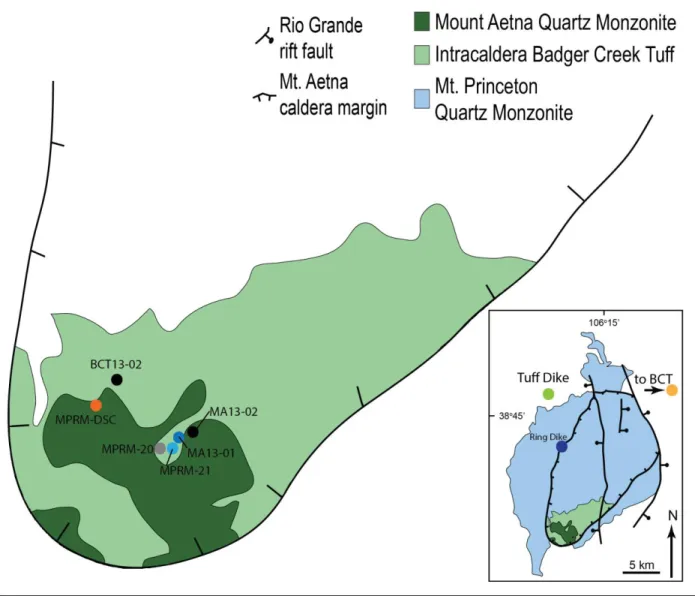
because the field relations unambiguously demonstrate that at least part of the pluton is younger than the tuff, perhaps the U-Pb zircon data do not accurately date intrusion of the Mount Aetna pluton. Evaluating this possibility is critical for the interpretation of zircon ages from any pluton. The traditional caldera model (Bowen, 1928; Smith and Bailey, 1968; Bachmann and Bergantz, 2004; Hildreth, 2004) predicts essentially synchronous ages between the Badger Creek Tuff and the Mount Aetna pluton, which would have been emplaced over a short period largely preceding eruption of the tuff. Alternatively, the flux-dependent hypothesis (Glazner et al., 2004; Tappa et al., 2011; Zimmerer and McIntosh, 2012; Mills and Coleman, 2013) predicts that the Mount Aetna pluton should have been incrementally assembled over perhaps several hundred thousand years that span a period of ignimbrite quiescence. In order to evaluate these two endmember hypotheses, we provide new high-precision CA-TIMS U-Pb zircon geochronology for the porphyritic Mount Aetna Quartz Monzonite where it intrudes the Badger Creek Tuff (MPRM-DSC), a fine-grained dike that cuts the porphyritic Mount Aetna pluton (MA13-01), and new fractions of the fine-grained facies of the Mount Aetna pluton (MPRM-20) previously dated by Mills and Coleman (2013).
GEOLOGIC SETTING
Hallman 4
Hallman 5
Hallman 6
The Mount Aetna pluton is a quartz monzonite that intrudes the ~36.0-35.3 Ma Mount Princeton batholith (Mills and Coleman, 2013). An earlier study (Mills and Coleman, 2013) reports a weighted mean CA-TIMS 206Pb/238U zircon age of 34.95 ± 0.04 Ma for the porphyritic Mount Aetna Quartz Monzonite and 34.47 ± 0.05 Ma for the Badger Creek Tuff. A ring dike, a tuff dike, and a fine-grained phase of the Mount Aetna pluton (MPRM-20) were found to be the same age as the Badger Creek Tuff within uncertainty (Mills and Coleman, 2013). A portion of the porphyritic Mount Aetna pluton (MPRM-DSC) intrudes the Badger Creek Tuff, which is inconsistent with published geochronology (Mills and Coleman, 2013), motivating this study.
METHODS
U-Pb Geochronology
Samples were prepared for zircon separation with a jaw crusher and split into fractions for geochronology and geochemical analysis. The fraction for geochronology was further processed with a disc mill, and mineral separations were carried out using a water table, heavy liquids, and a magnetic separator. Zircon fractions were hand-picked using a binocular microscope. Select grains were thermally annealed for 48 hours at 850°C and chemically abraded for 8-16 hours in a pressure-dissolution vessel containing 6 M HCl at 180°C in order to remove damaged zones that were open to Pb diffusion (Mattinson, 2005). Fractions were picked and spiked with a 205Pb-233U-236U tracer and then dissolved in 29 M HF in a pressure solution vessel for approximately 90 hours at 220°C before conversion to a chloride salt. The separation of U and Pb was accomplished with HCl anion exchange column chromatography.
Hallman 7
filaments, and U was run as an oxide. Corrections for initial Th/U disequilibrium were made using the method of Mattinson (1973), and whole rock trace element data from Mills and Coleman (2013).
Elemental chemistry
Samples were prepared with a steel jaw crusher and manually split into representative aliquots for elemental chemistry. The aliquot for chemistry was powdered with a ceramic shatterbox and ignited at 950°C to expel volatiles (Lechler and Desilets, 1987). Major element analysis was performed on lithium metaborate/tetraborate flux discs. Trace element analysis was performed on pressed powder discs that were prepared using paraffin and a 25 ton press. Elemental analysis was conducted by XRF in the Department of Geological Sciences (Tables 2 and 3).
RESULTS
U/Pb geochronology
Hallman 8
Hallman 10
Major and trace element geochemistry
Hallman 12 DISCUSSION
Field Relations
The porphyritic Mount Aetna Quartz Monzonite is unambiguously intruded by a fine grained dike (MA13-01) that we interpret as a feeder dike to the Badger Creek Tuff based on its size, age, and trace element chemistry. The Mount Aetna Quartz Monzonite from which MPRM-DSC was sampled unambiguously intrudes the Badger Creek Tuff. The observed field relations are reconcilable if either zircon geochronology does not accurately date the age of emplacement, or if the Mount Aetna pluton was incrementally assembled over a period that spanned the eruption of the Badger Creek Tuff.
New U/Pb zircon ages
We assume that Pb loss has been mitigated by chemical abrasion (Mattinson, 2005) and interpret the emplacement age of intrusive units as the age of the youngest cluster of fractions. We also assume that antecrysts represent assimilated or remobilized grains that yield insight into the extent of interaction between the sample unit and other magmas and wall rock. All presented dates are weighted mean 206Pb/238U ages.
Hallman 13
is contemporaneous with the Badger Creek Tuff eruption, but its age distribution is consistent with the expected spread of an incrementally emplaced intrusive unit. The fact that it includes no antecrysts from the earliest recognized stage of pluton emplacement starting at ~34.9 Ma is surprising, since that suggests that it experienced limited interaction with the porphyritic phase of the Mount Aetna Quartz Monzonite system. Alternatively, this unit might be a member of the Badger Creek Tuff system that remobilized zircon from the Mount Aetna pluton. In that case, the age distribution could represent mixing of rims and antecrystic cores in single fractions.
A new fine-grained sample (MA13-01) that intrudes the Mount Aetna Quartz Monzonite yields an emplacement age of 34.37 ± 0.04 Ma based on 5 concordant fractions that cluster at that age. A non-concordant fraction (F-3), an antecryst (F-7), and a fraction with a low radiogenic to common lead ratio (F-4) were omitted from the age reduction. This sample is approximately the same age as the Badger Creek Tuff within uncertainty. The fact that it includes no antecrysts from the pre-ignimbrite phase of pluton emplacement starting at ~34.9 Ma suggests that it was not comagmatic with the Mount Aetna Quartz Monzonite system and did not significantly interact with that unit.
Hallman 14
Emplacement of the Mount Aetna Quartz Monzonite
Emplacement of the Mount Aetna pluton began with a porphyritic facies (MPRM-21) by 34.95 Ma (Mills and Coleman, 2013) and continued until the initiation of emplacement of the fine-grained facies of the pluton (MPRM-20) at ~34.7 Ma. The fine-grained facies is contemporaneous with the Badger Creek Tuff, and was emplaced from ~34.7 to 34.3 Ma. Emplacement of the porphyritic Mount Aetna pluton appears to have resumed at ~34.3 Ma with the emplacement of the unit sampled for MPRM-DSC. The age range recorded by fractions of MPRM-DSC (~700 ka) can be considered a minimum interval over which the Mount Aetna pluton was assembled.
The absence of any fractions from the youngest observed portion of the Mount Aetna pluton (MPRM-DSC) with ages comparable to the Badger Creek Tuff suggests that the Mount Aetna Quartz Monzonite did not appreciably interact with the spatially-associated Badger Creek Tuff magma.
Eruption of the Badger Creek Tuff and associated intrusions
Hallman 15
Magmatic Evolution of the Mount Aetna caldera
Hallman 16
Hallman 17
The significance of the fine-grained facies of the Mount Aetna pluton (MPRM-20) is more ambiguous. We interpret an emplacement age of 34.32 ± 0.03 Ma based on two young concordant fractions, and assume that older fractions are antecrysts that record the incremental emplacement of this unit. Its fine-grained texture is a notable departure from the porphyritic Mount Aetna Quartz Monzonite, and indicates that emplacement conditions were different for this unit. We attribute this change to the development of Badger Creek Tuff magma system at about that time. This unit could represent the chilled margin from the waning stages of emplacement of the Mount Aetna Quartz Monzonite before the eruption of the Badger Creek Tuff, since a decrease in the amplitude or frequency of temperature oscillation might have prevented the large rapakivi feldspars that characterize the Mount Aetna Quartz Monzonite from forming (Mills et al., 2011). This might yield insight into the different rates and periodicity of magma emplacement between plutons and ignimbrites. Alternatively, if generation of melt in the lower crust were diverted from assembly of the Mount Aetna pluton in the upper crust to formation of the Badger Creek Tuff magma, then flux to the Mount Aetna pluton would decrease, yielding smaller intrusive increments that could crystallize more quickly, resulting in a fine-grained equivalent.
Implications for crustal assembly
Hallman 18
flux and that ignimbrites are erupted during periods of high magma flux (Glazner et al., 2004; Tappa et al., 2011; Zimmerer and McIntosh, 2012; Mills and Coleman, 2013). Based on the temporal disconnect and chemical similarity between the Mount Aetna Quartz Monzonite and the Badger Creek Tuff, we propose that a brief spike in magma flux against the background of low-flux pluton assembly led to the eruption of the Badger Creek Tuff. This implies that magma generation rates may rapidly change by orders of magnitude, which might yield insight into the processes by which melt is generated and conducted to the upper crust. An important implication of these conclusions is that under this model, a “supereruption” would not necessarily be preceded by the inflation of a large, detectable magma chamber.
CONCLUSIONS
Hallman 19 ACKNOWLEDGEMENTS
This project was supported by the Charles and Elaine Mims Fellowship, administered by the Department of Geological Sciences. Allen Glazner provided laboratory equipment and sup-plies. Lab training was provided by Ryan Frazer, Katie Wooton, Sean Gaynor, Tom Chapman, Courtney Beck, and Scott Brinkley. Field work was completed with the assistance of Roger Putnam, Sean Gaynor, and Josh Rosera. Discussions with Marcelaine Tanner, John Barefoot, and Scott Brinkley improved this project. Ryan Mills shared data, advice, and his years of experience with Aetna. Drew Coleman provided all of the above, as well as invaluable guidance and tireless patience.
REFERENCES CITED
Bachmann, O., and Bergantz, G.W., 2004, On the origin of crystal-poor rhyolites: Extracted from batholithic crystal mushes: Journal of Petrology, v. 45, p. 1565-1582.
Bowen, N.L., 1928, The Evolution of the Igneous Rocks:Princeton University Press, Princeton, New Jersey.
Coney, P.J., and Reynolds, S.J., 1977, Cordilleran Benioff zones: Nature (London), v. 270, p. 403-406.
Campbell, S.K., 1994, A geochemical and strontium isotopic investigation of Laramide and younger igneous rocks in central Colorado, with emphasis on the petrogenesis of the Thirtynine Mile volcanic field (Volumes I and II). [Ph.D. thesis]: Tallahassee, The Florida State University, 648 p.
Ellis, B.S., and Mark, D.F., 2013, 'Super-eruptions' and silicic volcanism from the Yellowstone volcanic field: Geology Today, v. 29, p. 133-137.
Epis, R.C., and Chapin, C.E., 1975, Geomorphic and tectonic implications of the post-Laramide, late Eocene erosion surface in the southern Rocky Mountains: Memoir - Geological Society of America, v. 144, p. 45-74.
Glazner, A.F., 1991, Plutonism, oblique subduction, and continental growth: An example from the Mesozoic of California: Geology (Boulder), v. 19, p. 784-786.
Glazner, A.F., Bartley, J.M., Coleman, D.S., Gray, W, and Taylor, R.Z., 2004, Are plutons assembled over millions of years by amalgamation from small magma chambers? GSA Today, v. 14, p. 4–11.
Hallman 20
Lawton, T.F., and McMillan, N.J., 1999, Arc abandonment as a cause for passive continental rifting: Comparison of the Jurassic Mexican borderland rift and the Cenozoic Rio Grande rift: Geology, v. 27, p. 779-782.
Lechler, P.J., and Desilets, M.O., 1987, A review of the use of loss on ignition as a measurement of total volatiles in whole-rock analysis: Chemical Geology, v. 63, p. 341-344.
Matthews, N.E., Huber, C., Pyle, D.M., and Smith, V.C., 2012, Timescales of magma recharge and reactivation of large silicic systems from Ti diffusion in quartz: Journal of Petrology, v. 53, p. 1385-1416.
Mattinson, J.M., 1973, Anomalous isotopic composition of lead in young zircons: Year Book - Carnegie Institution of Washington, v. 72, p. 613-616.
Mattinson, J.M., 2005, Zircon U/Pb chemical abrasion (CA-TIMS) method: Combined annealing and multi-step partial dissolution analysis for improved precision and accuracy of zircon ages: Chemical Geology, v. 220, p. 47-66.
Mills, R.D., and Coleman, D.S., 2013, Temporal and chemical connections between plutons and ignimbrites from the Mount Princeton magmatic center: Contributions to Mineralogy and Petrology, v. 165, p. 961-980.
Mills, R.D., Ratner, J.J., and Glazner, A.F., 2011, Experimental evidence for crystal coarsening and fabric development during temperature cycling: Geology, v. 39, p. 1139-1142.
Mutschler, F.E., Larson, E.E., and Bruce, R.M., 1987, Laramide and younger magmatism in Colorado: New petrologic and tectonic variations on old themes: Colorado School of Mines Quarterly, v. 82, p. 1-47.
Tappa M.J., Coleman D.S., Mills R.D., and Samperton, K.M., 2011, The plutonic record of a silicic ignimbrite from the Latir volcanic field, New Mexico: Geochemistry, Geophysics, Geosystems, v. 12.
Shannon, J.R., 1988, Geology of the Mount Aetna cauldron complex, Sawatch Range, Colorado. [Ph.D. thesis]: Golden, Colorado School of Mines, 434 p.
Smith, R.L., and Bailey, R.A., 1968, Resurgent cauldrons: Memoir - Geological Society of America, v. 116, p. 613-662.
Stothers, R.B., 2004, Density of fallen ash after the eruption of Tambora in 1815: Journal of Volcanology and Geothermal Research, v. 134, p. 343-345.
Sun, S.S., and McDonough, W.F., 1989, Chemical and isotopic systematics of oceanic basalts: Implications for mantle composition and processes: Geological Society Special Publications, v. 42, p. 313-345.
Toulmin III, P., and Hammarstrom, J.M., 1990, Geology of the Mount Aetna volcanic center, Chaffee and Gunnison counties, Colorado: U.S. Geological Survey Bulletin 1864, 44 p. Wilson, C.J.N., and Charlier, B.L.A., 2009, Rapid rates of magma generation at
contemporaneous magma systems, Taupo volcano, New Zealand: Insights from U-Th model-age spectra in zircons: Journal of Petrology, v. 50, p. 875-907.