Jessica L. Serrao. The Archival Image Revisited: An Analysis of Archival Encounters Portrayed By Genealogy Television Programming. A Master’s Paper for the M.S. in L.S degree. April, 2018. 87 pages. Advisor: Denise Anthony
This study explored how reality genealogy television programming portrayed archival encounters to public viewers during journeys of family discovery. It analyzed content from prime time shows Who Do You Think You Are? and Finding Your Roots with Henry Louis Gates, Jr to understand how portrayals of archives, archivists, archival materials and research aligned with traditional archival stereotypes and the professional archival image. The author expanded upon previous research on the archival image and
stereotypes in media by analyzing contemporary programs popular among genealogists, one of the largest constituents of archives. The study found some stereotypes were upheld while others were absent, and others were ambiguously portrayed. The findings
suggested that reality genealogy television programsfailed to deliver a nuanced depiction of the archival profession. The author suggested that increased public outreach and collaboration could help improve the archival image and spread understanding of the role of archives in society.
Headings:
Archives – Public relations
Archival research
Archives users
Content analysis (Communication)
THE ARCHIVAL IMAGE REVISITED: AN ANALYSIS OF ARCHIVAL ENCOUNTERS PORTRAYED BY GENEALOGY TELEVISION PROGRAMMING
by
Jessica Lee Serrao
A Master’s paper submitted to the faculty of the School of Information and Library Science of the University of North Carolina at Chapel Hill
in partial fulfillment of the requirements for the degree of Master of Science in
Library Science.
Chapel Hill, North Carolina
April 2018
Approved by
Table of Contents
INTRODUCTION ... 2
LITERATURE REVIEW ... 6
THE RISE OF THE ARCHIVAL PROFESSION ... 6
THE ARCHIVAL IMAGE PROBLEM ... 19
ARCHIVAL STEREOTYPES AND PUBLIC PERCEPTIONS IN MEDIA ... 25
GENEALOGISTS AND ARCHIVES ... 30
METHODS ... 37
DATA ANALYSIS AND DISCUSSION ... 46
THE ARCHIVAL ENCOUNTERS ... 46
THE REPOSITORIES ... 47
THE INFORMATION PROFESSIONALS ... 50
THE RESEARCH PROCESS AND ARCHIVAL MATERIALS ... 52
LIMITATIONS AND FUTURE WORK ... 58
CONCLUSION ... 60
REFERENCES ... 62
APPENDIX 1: DATA COLLECTION SHEET ... 70
Introduction
Archivists have a long held fascination with the public’s perception of archives,
and for good reasons. The public’s ideas of what archives are and what archivists do
reflect the outward professional image archivists present to society. At the heart of
archival work is a fiduciary responsibility to the public to preserve society’s historical
record. The Society of American Archivists’ (SAA) (2011) “Core Values of Archivists”
emphasizes the identification and preservation of “essential parts of the cultural heritage
of society,” and states the role of the archivist is to “select, preserve, and make available
primary sources that document the activities of institutions, communities, and
individuals.” If society does not know of this responsibility of archivists or see the
importance of archives to society, their mission falls flat. The archival image is how
archivists represent themselves to the public and confirms their place within society.
It is now believed the archival profession’s image and perceived societal
importance not only affects public support but that of funding departments and agencies.
Society’s perception of archives impacts an institution’s financial status and capacity to
fulfill its mission. It is not surprising, then, that archival professionals and scholars are
concerned with their image and stereotypes that manifest from public perceptions. Images
of archives invoke stereotypes particularly in the minds of individuals uninitiated in
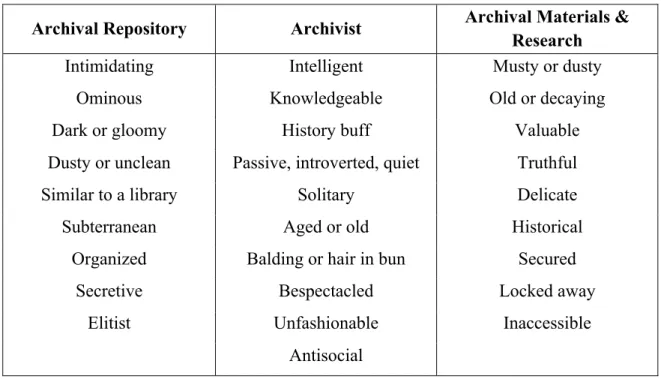
archival research. As repositories of old stuff, archives are thought to be ominous, dusty
intimidating, and elitist, and archivists are solitary, middle-aged, and bespectacled with
Rising to prominence as a hobby and career in the last several decades, genealogy
and family history has spurred an increased interest in archival research among
individuals not previously ranked among visitors of archives. Genealogists are one of the
largest user groups of archives, and genealogical research is a major driving force for the
public to seek out archival records. Consequently, increased public exposure to archives
through family history could affect prevailing stereotypes by improving public
knowledge of archives and the archival profession. In addition, genealogy’s popularity
brought about genealogy-based television shows that further piqued public interest in
conducting their own family history research. In the last decade, these shows gained
popularity on prime time television lineups, and extended their reach to a large public
audience.
To counteract negative stereotypes and misinformation, archivists advocated for
and now actively incorporate outreach, advocacy, and public education into their work to
improve transparency – transparency in what archives are, what archivists do, and how
the public can benefit from their services (Gracy, 1984; Grabowski, 1992; O’Toole,
1994; Craig, 1995; Mason, 2014). Across centuries, archives changed and evolved with
societal needs, and some scholars believe the shifting role of archives and archivists
within society created an ambiguity and confusion from which stereotypes originated
(Craig, 1995; Procter, 2010).
In this paper, I use the Oxford English Dictionary definition of stereotypes: “A
preconceived and oversimplified idea of the characteristics which typify a person,
situation, etc.” Walter Lippmann coined the term stereotype for modern psychology. In
blooming, buzzing confusion of the outer world we pick out what our culture has already
defined for us, and we tend to perceive that which we have picked out in the form
stereotyped for us by our culture” (p. 81). Bodenhausen, Todd, and Becker (2007) in the
Encyclopedia of Social Psychology, discussed stereotype formation research and one perspective asserted their formation is possibly linked to cognitive processes. This
perspective stated that stereotype creation is a function of human knowledge to
“organiz[e] and structur[e] one’s understanding of the social environment.” As people are
exposed to information about members of various social groups from a variety of sources,
including television and other media, they begin to form stereotypes “determined by
which aspects of this parade of information he or she pays attention to and remembers”
(p. 940).
The term stereotype is suggested here to be neither negative nor positive, though
according to Bodenhausen, Todd, and Becker (2007), stereotypes predominately depict
more negative than positive characteristics (p. 940). They also argued that, “for people to
form accurate images of a social group, they would need to be exposed to representative
samples of group members.” This may be difficult if representative samples are “hard to
come by (especially for groups that are personally encountered less frequently) if the
media, gossip, and other forms of public discourse focus selectively on the more negative
aspects of a social group’s behavior” (p. 940-941). Bodenhausen, Todd, and Becker
(2007) reiterated “it is an open question just how accurate most social stereotypes are” (p.
941).
The origins of preconceived notions, such as stereotypes, are difficult to trace, but
2015). Lippmann (1997) argued that the stereotypes presented in our culture are absorbed
through mass media as well as through family, peer groups, and interactions with others
(p. xxiv). The non-archival public encounters archives through exposure to a variety of
media capable of broadly disseminating information. Scholars have analyzed the image
and stereotypes of archives and archivists in several formats of media, including books,
film, newspapers, and television. This paper expands upon these previous media studies
by examining portrayals of archival encounters in genealogy reality television programs.
In particular, this paper explores how genealogy television shows portray archival
encounters to public viewers during journeys of family discovery. It analyzes content
from two of the most popular prime time shows of that genre, Who Do You Think You Are? and Finding Your Roots with Henry Louis Gates, Jr, to understand how the shows’ portrayals of archives and archivists align with current stereotypes. In doing so, this paper
looks to answer one central question: How are archival encounters portrayed in two
popular American genealogy television shows, Who Do You Think You Are? and Finding Your Roots with Henry Louis Gates, Jr? From this central question arise further inquiries. Do these portrayals of archival encounters reflect previously identified stereotypes of
archives, archivists, and archival work? Do they relate to the non-archival world’s
preconceived notions as to what archives are and what archivists do? Is genealogical
research in archives presented in a whole, truthful, and accessible manner to the public?
Are the television programs’ portrayals of archival encounters evidence of a changing
Literature Review
The Rise of the Archival Profession
Archivists must feel a need to explore the origins of their profession, to understand the circumstances and forces that have determined its evolution, and, with such understanding, to anticipate and prepare for the future. (Posner, 1972, p. 1)
Ernst Posner’s eloquent quote reminds archivists to explore their professional
history to anticipate what lies ahead. The image and stereotypes of archives and archivists
in the present are intricately linked to the history of the profession and its evolution into
the future. What archives are and what archivists do evolved over time, and with it
evolved the archive’s and archivist’s purposes and perceptions in society. Reflective of
this importance, literature on the history of archives and the archive profession abounds
(Berner, 1983; Brosius, 2003; Cook, 1983; Duchein, 1992; L. Gilliland-Swetland, 1991;
Jimerson, 2009; O’Toole, 1990; Posner, 1940; Posner, 1964; Posner, 1972). Because the
history of the American archival profession is indelibly connected to Europe, this
literature review will first explore the writings on the origins of the profession in Europe
and work toward the rise of the profession in America.
Posner, a German archivist and past professor of archives at American University,
was an influential writer on archival history. His 1972 work titled Archives in the Ancient World was the first to highlight the ancient origins of archives. Since the creation of cuneiform tablets in the fourth millennium BCE, Posner (1972) recounted that
archival records. Officials kept track of accounts, taxes, and other administrative records,
and preserved these materials for their administrative value as documentation of official
processes (Posner, 1972). Early medieval archives, according to Posner (1940), were
similar in characteristics to ancient archives. Whether ecclesiastical or secular, they were
restricted to financial or legal records kept and arranged for administrative purposes
(Posner, 1940).
Posner’s writings influenced others to incorporate into their work the history of
archives in general, and ancient archives in particular. Contributors to Maria Brosius’
(2003) Ancient Archives and Archival Traditions examined ancient record-keeping concepts. Brosius (2003) reminded readers that these ancient repositories were not meant
for public use because they belonged to kings, priests, and other authorities of the state.
This meant that access to records was limited (Brosius, 2003, p. 10-11). Randall
Jimerson, professor of history and past president of SAA, supported this argument. He
stated that, “The concept of archives prior to the French Revolution referred almost
exclusively to documents privileging legal or economic privileges to the state, the church,
the nobility, or the merchant class” (Jimerson, 2009, p. 66). Public archives did not exist
in the modern sense because they belonged to political authorities of the state and not the
general citizenry (Jimerson, 2009).
In the late eighteenth century, Posner (1940) claimed, “the French Revolution
mark[ed] the beginning of a new era in archives administration” (p. 161) with the
introduction of a new national public archives in France. This signified an effort to
centralize the scattered provincial depositories under one organization. Posner (1940)
care for its historically valuable documentary heritage. According to American historian
and professor James O’Toole (1990), the French Revolution democratized society and,
with it, archival functions. The French believed records were critical to preserve because
they “protected the rights of the people” (O’Toole, 1990, p. 29). Posner (1940) indicated
this was “the first time archives were legally opened and held subject to public use” (p.
162).
Thus, a fundamental shift began in which archives moved from privately closed to
publicly open records. As a result, Jimerson (2009) argued that the French Revolution
caused a “paradigm shift in archival identity” (p. 67). French Revolutionaries initially
viewed archives as “hated symbols of feudal oppression” (Jimerson, 2009, p. 67) by the
state and the church. After the Revolution, Western society began viewing archives as
“essential elements of a free, democratic society and its citizens” (Jimerson, 2009, p. 67).
Public citizens, Jimerson (2009) touted, now had the right to access government records
to protect their legal and property interests and ward against government wrongs.
Archives that once “served only lawyers, government officials, and interests of the
crown” shifted in the nineteenth century with a promise “to serve the public interest”
(Jimerson, 2009, p. 73).
According to French archivist Michel Duchein (1992), Napoleon’s conquests in
Europe spread the new concepts of French government, administrative, and legal
functions throughout Europe. As a result, by 1815, archives had undergone radical
change beyond France into the Netherlands, Italy, Germany, and Spain (Duchein, 1992,
p. 17). At the end of the nineteenth century, the French archival model of access and
Posner, 1940). Duchein (1992) also argued that the French Revolution paved the way for
professional archival training. Because the Revolution suppressed most monasteries and
tribunals where archivists once trained to read and interpret old documents, it spurred
demand for the first archival schools in Europe to compensate for the loss. By the 1850s,
Duchein (1992) concluded that the basis of modern archival science arrived in Europe
with the arrangement principles of provenance and respect des fonds.
Duchein (1992) believed the rise of archival schools and theory in Europe
enhanced specialization and helped the archival profession find autonomy from similar
professions, such as librarianship. Jimerson (2009) agreed, stating that the emergence of
archival theory made the work of archives “distinct from bureaucratic, historical, or
library approaches to documents” and “marked the beginnings of a nascent new
profession of archivists” (p. 72). Jimerson (2009) wrote that, as theory and practice grew,
Dutch archivists became aware of common archival interests and established the world’s
first archival professional association. In 1898, this association commissioned the
publication of the famous Dutch manual by S. Muller, J. A. Feith, and R. Fruin, which
solidified archival theory and practice in print. The manual was widely translated and, as
Jimerson (2009) argued, directly influenced the second-most influential archives manual
written by British archivist Sir Hilary Jenkinson in 1922 titled, A Manual of Archive Administration. Jimerson (2009) went on to state, “Virtually all European and North American writing about archival theory owes a debt to Muller, Feith, and Fruin” (p. 75).
Overseas in the New World, James O’Toole (1990) claimed that European settlers
and explorers brought with them their record-keeping practices. In the French manner of
their legal rights were protected (O’Toole, 1990). Colonists were preserving their own
archival record of public documents in what O’Toole (1990) identified as the “public
records tradition” (p. 30). Initially, they kept documentation of land sales, vital records of
births, marriages, and deaths, and probate records. Colonists assigned responsibility of
public record creation and preservation to government authorities (O’Toole, 1990). As an
emerging nation, Jimerson (2009) argued, it was essential for the United States to keep
accurate records of public business.
In the late 1700s, as the French Revolution continued abroad, the rise of historical
societies in America marked a shifting interest in preserving private papers. The first
established repository to collect and preserve these personal materials was the
Massachusetts Historical Society in 1791 (Jimerson, 2009). Unlike the public records
collected to uphold legal rights, Jimerson (1990) argued that private papers were
collected to retain evidence of the actions of great elite—and at the time, White—men
and to bolster a new national identity. The rise of historical societies occurred
simultaneously with the rising interest in historical study in what Richard Berner (1983)
and O’Toole (1990) identified as the “historical manuscripts tradition” (O’Toole, 1990, p.
31). In this tradition, historical societies and historical studies considered individuals’
records as valuable material because they held insights into the past. Personal papers,
O’Toole (1990) argued, were not saved for their value to protect rights, as were public
documents, but their value to document history. Thus evolved a delineation in American
archival purpose with what O’Toole (1990) called “two parallel efforts” (p. 32): public
duties; and historians and curators preserved historical manuscripts for research and
writing.
Ernst Posner (1957) called the delineation in America between archives and
manuscripts an “unfortunate dichotomy” (p. 7); one that he hoped was to be bridged with
the work of archivists Solon J. Buck, Lester J. Cappon, and Katherine Brand. The duality
in American archival approaches began in colonial times and, according to O’Toole
(1990), continued into the late 1800s with the rise of the historical profession and the
founding of the American Historical Association (AHA). Scholars credited the formation
of the American archival profession to the work of the AHA (Cook, 2009; Cox, 1986;
Posner, 1957; Russell, 1983). Jimerson (2009), echoing O’Toole’s (1990) sentiments,
believed AHA reinforced the duality of archival approaches to preservation with the
establishment of their first two standing committees: The Historical Manuscripts
Commission and the Public Archives Commission.
Formed in 1895, AHA’s Historical Manuscripts Commission searched for and
compiled lists of private manuscripts in the United States to ameliorate the historians’
lack of primary documentary sources. This aligned with Berner’s (1983) and O’Toole’s
(1990) historical manuscripts tradition to preserve documents for historical research and
writing. In 1899, AHA established the Public Archives Commission to survey existing
government records and promote better care of public documents. This government
approach aligned with Berner’s (1983) public archives tradition and O’Toole’s (1990)
similarly named public records tradition to preserve records for legal purposes. Each
creating one commission for government records and one for public records, AHA
upheld the duality of American archival approaches to preservation.
At the beginning of the twentieth century, state archives popped up throughout the
United States. Jimerson (2009) linked this phenomenon to the growing public archives
movement. Jimerson (2009) then argued that, in 1901, the two traditions—
bureaucratically oriented public archives and historically oriented historical
manuscripts—came together with the founding of the first formal state archive, the
Alabama Department of Archives and History. It proved that “Archives could serve both
a historical role and a public administration function” (Jimerson, 2009, p. 95), thus
melding the two traditions into one institution.
In nineteenth century Britain, a shift in perception of archives and archivists
occurred along a similar plane as in the United States. According to Margaret Procter
(2010), professor of record and archive studies at University of Liverpool, British
professionals once designated record keepers became archivists, not so much in title but
in action, as they shifted into a public role of “providing access to records for ‘literary’
rather than legal purposes” (p. 18). The 1838 Public Record Office Act spurred these
changes in duties, which expanded responsibilities beyond the traditional bureaucratic
keeper role to a role of historian-helper. This was what Procter (2010) deemed more in
line with an “archivist persona” (p. 18).
As their roles diversified, Procter (2010) argued that British archivists (or
registrars) were seen as both government officials linked to bureaucratic functions as well
as administers of documents used for historical research. By the 1880s, Procter (2010)
were […] seen as grouped more properly with the historian than with the bureaucrat” (p.
20). A shift from bureaucrat to archivist continued into the turn of the twentieth century
when archivists were regarded as co-workers of historians—the individual who made
possible the research and writing of history (Procter, 2010). The change in duties of
archivists from bureaucratically oriented to historically oriented, Procter (2010) argued,
confused the public’s perception of the archivist.
Barbara Craig and James O’Toole (2000) argued that archivists had a dual
personality stemming from their dual understanding of the “utilitarian role of records in
administration and the law” as well as the “historical changes in records and the
contingent circumstances in which they thrived” (Craig & O’Toole, 2000, p. 125). Craig
and O’Toole (2000) conducted a preliminary exploration into how British and American
portraits as well as genre paintings depicted records, documents, books, reading, and
writing. They posited that the study would help archivists “understand contemporary
perceptions of records by artists, sitters, and viewers” for a more holistic contextual view
of textual archival records (Craig & O’Toole, 2000, p. 97). Craig and O’Toole (2000)
believed that the depiction of documents in art could bridge the divide between the
“contending versions of archives” (p. 125).
In the United States, the twentieth century saw movement toward a solidified
archival profession. Richard J. Cox (1986), lead professor for University of Pittsburgh’s
Archives and Information Science program, posited that “professionalism has been a
consistent theme” at least “since the founding of the first public archives in 1901” (p.
230). American archivists, like their European colleagues, felt a growing need to
Leland, 1911; Newsome, 1936). In 1909, the AHA created the Conference of Archivists
as a hub of archival interest and action—what O’Toole called “the locus of professional
archival activity” (p. 34), and what Cox (1986) deemed the precursor of SAA.
By the 1920s, new American archivists continued to follow the “high standards of
professional practices being imported from Europe” (Jimerson, 2009, p. 97), including
the 1898 Dutch manual and the work of Sir Hilary Jenkinson. This was still not enough to
form a professional identity. Margaret C. Norton, the first state archivist of Illinois,
argued that, to separate from their historian roots, “archivists needed to establish their
own identity as a profession,” and overcome “the popular misconception of archives as
nothing more than historical documents.” Norton argued that this misconception impeded
progress for the archival profession (as cited in Jimerson, 2009, p. 97).
Then came the 1930s, a “crucial decade,” according to O’Toole (1990), for the
archival profession (p. 35). Jimerson (2009) theorized that, “Faced with problems
concerning their public image and perceived role, many archivists by the 1930s
recognized the need for a separate organization, apart from historians or librarians, to
address their own concerns” (p. 106). At this time, dispersed and disorganized federal
records called attention to the country’s need for a national centralized entity similar to
that attempted in France and other European countries in the last century. To address this,
Congress established the National Archive in 1934 as an independent federal agency.
Two years later, in 1936, the Society of American Archivists (SAA) formed to solidify
the archival profession (Berner, 1983; Jimerson, 2009; O’Toole, 1990). While
establishment of SAA was not the end for scholarly inquiry into the archival profession,
The founding of the National Archives, Jimerson (2009) argued, gave archivists
“the necessary sense of identity” and the “flagship institutional base” (p. 107) to organize
their profession. Established as an independent agency by President Franklin Roosevelt in
1934, the National Archives reported to the President. In 1950, the profession’s
institutional base was challenged when President Truman revoked the Archives’
autonomy and transferred it under the newly created General Services Administration
(GSA). This marked a significant time in the history of the National Archives in which it
became a proving ground for the importance of archives and the profession in society at
the highest national level.
In his Diary of a Dream: A History of the National Archives Independence Movement, 1980-1985, sixth Archivist of the United States, Robert M. Warner (1995), recounted the historic fight to regain independence for the National Archive. Warner
(1995) did not explicitly state this was a professional image problem, but he argued that
the subservience of the Archives under the GSA was clearly a “problem of status” (p. 37)
for the Archives and for the profession. Warner (1995) explained that this was because
the Archives became a service alongside housekeeping, construction, and maintenance,
and the GSA “had nothing to do with the preservation of the greatest documents of
American history” (p. 4-5). As such, Warner (1995) called it “a major mistake in public
policy” (p. 5). In 1963, Maryland Representative Charles McC. Mathias, Jr.
provocatively concluded, “the concept that GSA should become the guardian of history
as well as the custodian of washrooms, store-rooms, and work-rooms” made no sense (as
(1995) proved that the GSA provided poor support, constrained growth and funding, and
politicized the Archives during the Nixon presidency.
“One only needs to look,” Warner argued, “at the history of the Library of
Congress or the Smithsonian Institution, both independent units, to see how NARS fell
behind in these years of “captivity”” (p. 6). Thus, Warner (1995) fought to gain
independence from the GSA to improve the Archives’ status with support from many
external constituents, including the American Historical Association, the Society of
American Archivists, and the National Genealogical Society. Over 30 years after Truman
changed the National Archives’ status, the fight for independence came to fruition when
Public Law 98-497 was signed in 1984.
With twentieth century professional growth came concern over professional
identity. In Ernst Posner’s 1956 address at the SAA annual meeting, he looked to define
the American archivist. Referencing what little data he had from an SAA member
questionnaire, Posner (1957) concluded that “homo archivalis Americanus” (p. 5) were 33% female and most conducted archival and record work versus manuscript work. The
questionnaire separated archival, record, and manuscript work, but Posner (1957) stated
there was a “similarity if not identity of archival and manuscript activities” (p. 5), and
some people who conducted record and archival work could be considered a record
administrator as well as an archivist. Muddling the identity of archivists further, included
as members of SAA were those Posner (1957) labeled “the historical fringe” (p. 6) of
history professors, librarians, and others.
In the late twentieth century, discussions about professionalization shifted toward
archival identity continued to consolidate as “archivists achieved both sufficient numbers
and sufficient institutional stability” (p. 41). This, he posited, allowed professionalization
to shift toward standardization. “Consensus began to emerge on what [archivists] did,
how they did it, and why they did it” (O’Toole, 1990, p. 41), and credentials and graduate
educational programs formed to better standardize the education new archivists received.
In 1990, O’Toole predicted that, in the future, archivists will “continue to devote
considerable attention to projecting the professionalism that lies at the heart of their work
and to demonstrating the usefulness of archives to society at large” (p. 47).
Another important topic that arose while solidifying their profession was how
archivists defined what was an archive. Just as the role of archivists morphed over time,
so, too, did the definition and use of the term “archive.” In the ancient world, O’Toole
(1990) believed it designated “all collections of written records, not just those of enduring
value, as modern usage implies” (p. 28). Several scholars have discussed the definition,
misuse, or misappropriation of “archive” and called for an improved definition to
support the archival mission (Gracy, 1987; Maher, 1998). SAA (2017) addressed this
need for clarity by providing a primary definition of archives for the profession.
While O’Toole (1990) believed consensus on what archivists did began to solidify
in the late twentieth century, Barbara Craig (1995) and Margaret Procter (2010) pointed
out continued issues of ambiguity. Craig (1995) conducted a study on Canadian
newspapers of the 1990s from which she concluded the role of archives was ambiguous,
and exclusion of archivists from the news resulted in an incoherent image. Procter (2010)
studied nineteenth century perspectives of archivists in British media and showed
resulted in an ambiguous image of their purpose. She then argued that the twenty-first
century archivist still performed a multiplicity of tasks and, therefore, the image of their
ambiguity remained (Procter, 2010). As a result of their studies, Craig (1995) and Procter
(2010) suggested that archivists embrace their “inherently ambiguous responsibilities,
roles and personae” (Procter, 2010, p. 23) and reinterpret it as a professional flexibility
that adapts to “the current public need” (Procter, 2010, p. 24). Nevertheless, Procter
(2010) and Craig (1995) concluded that this ambiguity continued to perplex the general
public as evident from how journalists represented archivists in newspapers.
As can be seen, much of the literature on the history of the archival profession
was interwoven with the profession’s identity and public image in society. James
O’Toole (1990) utilized archival history to “open the door to understanding ourselves” as
humans (p. 5). He also suggested that archivists “project [their] professionalism” so as to
demonstrate “the usefulness of archives to society at large” (O’Toole, 1990, p. 47).
Randall Jimerson (2009) took a similar approached in his influential work on the power
of archives. He used the history of archival practice to explore the evolution of power in
archives and their influence on human memory and understanding of society. This
understanding, in turn, suggested for archivists a path in which they “embrace the power
of archives and use it to make society more knowledgeable, more tolerant, more diverse,
and more just” (Jimerson, 2009, p. 185).
Richard Cox (1986), in researching sociological literature on profession formation,
found that “professional status is mostly the result of image” (p. 232). The archival image
is, thus, intricately linked to the development of the archival profession. Because of this,
and archivists in society shifted over time, as did the archival image and identity as
rooted in the evolution of the archival profession. Public confusion over what archivists
did spurred professionals to visibly establish the archival profession and better
understand their image in society.
The Archival Image Problem
The recent past has been a time of great concern over archival “image,” over what the nonarchival world thinks about archives and archivists, if indeed it thinks of them at all. (O’Toole, 1990, p. 47)
The poor image of archives was under discussion at least by the 1950s, the same
decade in which the National Archives lost its independence. Ernst Posner (1957), in his
presidential farewell message to the SAA in 1956, strove to “define and to diagnose the
American archivist as a type” (p. 4). He found difficulty in this task as archivists had not
yet “captured the imagination of the American people” so as to be written about in
literature and news. Posner (1957) provocatively declared that “in a world that suspected
[archivists] of being mere antiquarians, lap dogs that society could easily dispense with,”
archivists needed to “be effective salesmen of [their] cause” (p. 9).
In the decades following the 1950s, poor image concerns among professionals
mounted (Birdsall, 1973; Gillis, 1979). In one of the earliest American research studies
into public perception of archives, Peter Gillis (1979) analyzed their portrayal in
espionage fiction novels. He concluded that the authors presented a rather traditional and
conservative concept of archives as preservers of institutional memory that collected,
classified, and retrieved information in an organized manner (Gillis, 1979). Though Gillis
portrayed as privileged and secret, which “may prove offensive to professional
archivists” (p. 12). What’s more, spy novel authors, Gillis (1979) concluded, “have
assumed a sense of mystery and a general ignorance on the part of the public toward
archives” (p. 3).
The year 1983 marked a turning point that brought a new level of attention to the
archivist’s image. The event: David B. Gracy’s presidential speech at SAA’s 47th annual
meeting. Concerned with the archival image, Gracy (1984) announced the profession had
an image problem and launched the Archives and Society campaign. Gracy (1984) linked
the image problem with public ignorance to the “nature and purpose of archival work,
ignorance of the benefits society enjoys as a result of [archivists’] labors,” (p 7) and to
the failure of archivists to eradicate that ignorance.
In what Gracy (1984) deemed the first archival revolution, he called for action
against the profession’s image problem to change the non-archivists’ “uninformed and
distorted image of the archivist” (p. 9). Archives of the 1980s suffered from diminished
resources, with Gracy (1984) citing a lack of people, space, and resources for
preservation as a few. The image problem was cause for concern because a poor image
among “those with the power to allocate resources” to archival repositories “strikes at the
heart of [the archivist’s] existence and ability to function” (Gracy, 1984, p. 8). Gracy
(1984) supported outreach as the key to expanding public awareness of archives and
improving the archival image problem (p. 7-9).
Gracy’s call for a revolution spurred scholars to research the public image
problem. Sidney J. Levy and Albert G. Robles (1984) conducted a study for SAA’s Task
characterize archivists” (p. 1). This groundbreaking survey of resource allocators’
perceptions of their own archives revealed that they saw archivists “as quiet
professional[s], carrying out an admired but comparatively subterranean activity” (Levy
& Robles, 1984, p. iv). Levy and Robles’ report went on to state that archivists, while
respected, were seen as powerless, passive, outdated, and politically impotent. They had
low visibility and, therefore, little power to challenge the budgetary constraints placed
upon them by resource allocators. The study showed that traditional stereotypes lingered,
and archives were viewed as dusty and musty “dead accumulation,” run by acquisitive,
territorial, and possessive archivists (Levy & Robles, 1984, p. v).
The 1984 analysis concluded that resource allocators valued their archives and
respected archivists as skilled intelligent employees that provided high quality services.
Yet, there was a misconception as to the importance of archives to the public. This was
seen in resource allocators’ suggestions to stifle outreach so as to curb use to only serious
researchers. These suggestions kept budgetary and staffing needs down, but did little for
educating the public on the importance of archives (Levy & Robles, 1984).
The Levy & Robles’ study generated great response in the archival literature. Not
long after the survey, Gracy (1985) added again to the image discussion. This time, he
addressed potential causes or roots of the poor archival image in the public mind.
According to Gracy (1985), it was linked to archivists’ poor perceptions of themselves.
To overcome this, he presented areas in which archivists can work to improve the
archival image:
both history and the lessons the public can draw from history. (Gracy, 1985, p. 19-22)
This was likely the first look at causes of archival stereotypes and ways in which they
may be overcome.
Mirroring Gracy’s areas of professional improvement, Richard Cox (1986)
suggested similar improvements become a new archival agenda. These included:
[…] society’s image of the archivist and its understanding of the archival mission, archivists’ need to develop a stronger national voice, problems with archival education, the purpose of individual certification and institutional accreditation, and the need for archivists to acquire a broader notion of their own potential. (Cox, 1986, p. 229)
Cox was of the impression that the public held a poor unclear image of archives due to
the lack of professionalism in the archival field.
Another technique to improve the archival image came from Gracy over the
following years (1987, 1989). He suggested the archival profession shed the obsession of
archives for the future and, instead, make the case for archives’ importance to the
contemporary world. Gracy (1987) charged that archivists must make themselves
relevant to the present. In the same vein, he suggested SAA change their official
definition of archives to focus on how archives can change society currently. That meant
discarding terms within the definition that reeked of the past, the old, and unimportant.
With a new current-minded definition, archivists could be equipped with a powerful tool
“to improve the public’s perception of the value of archives” (Gracy, 1989, p. 3).
Dutch archivist Eric Ketelaar (1995) also advocated that archivists drop the
concept of archives for the future to emphasize archives for the present. He argued,
“archivists should redirect their action from preserving the past to documenting the
Ketelaar looked to focus on the archive’s function of accountability to develop new
public relations strategies through visibility, transparency, and access.
To improve their circumstances, archivists realized they must argue for their
importance in society, or in Posner’s (1957) words, become “effective salesmen of [the
archival] cause” (p. 9). James O’Toole (1990) believed concern of the archival image in
the late twentieth century spurred a “transition from archival monks to archival
missionaries” (p. 47) as archivists began instructing the non-archival world on what
archivists do (p. 47). O’Toole (1990) further argued that “all archivists have come to
realize the importance of sharing the excitement and value of what they do with those
who use archives or would do so if they understood them better” (p. 47). This reflected
Gracy’s call for archival outreach to improve their public image.
In another response to Levy and Robles’s study, John Grabowski (1992) argued
that archivists needed to build more awareness of archival value to improve their image.
Grabowski, like O’Toole, supported Gracy’s suggestion to use outreach as a means to
achieve this end. He further advocated for archivists to work with the public and
academic historians to improve awareness of archives and bring in more users. The more
users of an archive, the more archival value could be realized. Grabowski (1992) cited the
biggest group of potential users as genealogists and family historians, being “the fastest
growing group of researchers in many repositories” (p. 467). O’Toole (1994) provided a
prime case study in archival outreach and public relations that resulted in financial
stability, an increased user base, and proof or archives’ importance to society. In a strong
others will think of you as belonging there. If you are more active “upstairs,” others will
accept and come to rely on you” (p. 119).
Harking back to Gracy’s 1983 speech on archives and society, William Maher
titled his 1997 SAA presidential address “Society and Archives.” In an unfortunate report
on the state of archives that echoed Gracy’s sentiments in 1983, Maher (1998) indicated
that many archives were at risk for lack of funding and support. Speaking at a time when
electronic records were taking archives by storm, Maher (1998) posited that “if
[archivists] are unable to establish control of electronic records, [they] will no longer
even hold the historical and cultural capital to claim a distinctive and important role in
society” (p. 253). One illustration of the archivist’s tenuous position is the misuse and
appropriation of the word “archives” by others outside the archive profession. Maher
(1998) took his resolution of this issue beyond improving the public archival image to
archivists advocating for public issues.
Eric Ketelaar (2002) took the discussion of the archival image problem in a new
metaphorical direction. He argued that archives resembled temples and prisons, both
architecturally and functionally. Archival institutions presented an external façade of
surveillance and power, and continued that image internally through strict rituals of
policing and scrutinizing patron activities as they conducted their research. Randall
Jimerson (2009) advocated that the image of archives was tri-fold: they were at once a
temple, a prison, and a restaurant:
sources while controlling the researchers and conditions under which they may examine the archival record. (Jimerson, 2009, p. 2)
The theoretical contemplations of what archives represent continued, but what became
clear in the literature of the late twentieth century is that improving the archivist’s
outward image and breaking stereotypes that had established over time, was important to
the success of their institutions.
Archival Stereotypes and Public Perceptions in Media
The American people have always had an ambivalent relationship to their history and to archives. Founded in part on the notion of escape from the shackles of European traditions and with the vision of being a “city on the hill” for a utopian new world, the United States has often been future-oriented and indifferent to the past. (Jimerson, 2009, p. 80)
Since David Gracy’s clarion call for an improvement to the archival image, and in
rare cases before 1983, archivists tuned into public perceptions of archives and archival
stereotypes by studying their representation in the media. This area of scholarly inquiry
assessed various forms of media to better gauge how archives and archivists were
portrayed. Influential forms of media that reach the masses, such as newspapers (Boylan,
1985; Cox, 1993; Craig, 1995), fiction novels (Buckley, 2008; Gillis, 1979; Schmuland,
1999), film (Buckley, 2008; Daniel & Oliver, 2014), television (Buckley, 2008), art
(Craig & O’Toole, 2000), and the Internet (Patterson, 2016) were examined for their
power to disseminate information and ideas—stereotypes in particular. According to
Arlene Schmuland (1999), head of archives and special collections at University of
Alaska Anchorage, media can “play a role in popularizing and perpetuating images of
forms, they are perpetuating ideas which eventually take on the status of stereotype” (p.
26).
An early twentieth century Dutch study of archivists in literature may be one of
the first of its kind. Posner (1957) discussed the research in his 1956 presidential address
to SAA. He explained that it examined novels, plays, and other literary works that
incorporated archivists in a leading role. The results showed that the European archivist
was “a kind-hearted introvert, absorbed in his endeavors and somewhat helpless in his
relations with the outside world and particularly with its female inhabitants” (Posner,
1957, p. 4). This study showed early signs of negative stereotypes in Europe.
Several research studies focused on archives in fiction. In one of the earliest
American studies of the archival image, Peter Gillis (1979) analyzed a particular type of
novel, espionage fiction, to examine how authors incorporated archives into their plots.
Gillis found that, since the 1930s, two particular ideas arose in fictional espionage
writing: “information as power” and “the past haunts the present” (p. 3). He concluded
that these writers produced a view of archives that is both traditional and dynamic (Gillis,
1979). Gillis (1979) uncovered several thematic archival patterns: archives have research
value and can reconstruct personal identity at the expense of personal privacy; archival
documentary evidence is suppressed and secrecy is used to cover up truths; information
in the archival record holds power and provides power to those who access it; and
archives as memory. Archivists were seen as “burrowers” who “collect, sift and file
information” (Gillis, 1979, p. 10) akin to the image of a mole. Stereotypes also arose in
his study that proved counter to what archives do. He found conflicting ideals of some
provided information on living people while others upheld personal privacy restrictions
(Gillis, 1979, p. 5-10). Gillis (1979) argued that archivists must come to terms with these
conflicting roles by establishing “conditions and control of access which balance research
use with the administrative need for secrecy” (p. 12).
Arlene Schmuland (1999) updated and expanded upon Gillis’ spy fiction research
by examining the archival image in 128 non-genre-specific fictional novels. Her purpose
was to understand how contemporary fiction “approaches archives, archivists, and
archival work” (Schmuland, 1999, p. 25). She found that many stereotypes of archives,
archivists, and their work were perpetuated in these novels, and the images authors used
in their writings were often based in reality. Walter Lippmann (1922/2017) believed there
to be a connection between our vision of stereotypes and facts of reality, “but it is often a
strange connection” (p. 87). Schmuland (1999) uncovered that the stereotypes depicted
archives as basements or tombs that held valuable and historical materials along with
secrets and dust. Archivists were depicted as glasses-wearing, stiff-standing, middle-aged
or elderly individuals with poor fashion sense and no social life. While depicted as meek,
they also possessed a strong sense of duty and great power in the knowledge they
controlled (Schmuland, 1999).
In a more casual study, Karen Buckley (2008) overviewed multiple media in the
form of novels, motion pictures, and television series to investigate how archives and the
archival record were represented. Her study found four themes that emerged:
These themes align with similar stereotypes unearthed from previous studies. Archives
are often equated with truth and identity, and records are seen as closed off and buried,
unable to be found. Just as Schmuland (2009) saw elements of truth in the stereotypes she
discovered, so did Buckley. These included the need for protecting the archival record
because of their importance to society, and archivists as dedicated to this duty.
In 2014, Anne Daniel and Amanda Oliver took the study of archival stereotypes
to the big screen. They studied the portrayal of archivists in film to discover whether it
pointed to a centralized professional identity. Their research found that the films
supported several stereotypes, showing the archive as a fortress of many restrictions
where all-knowing archivists toiled away in physical isolation. Daniel and Oliver (2014)
concluded that the lack of consistent depictions of archives and archivists in film
suggested a lack of a professional archival identity.
Several studies took the research away from the fictional media realm and turned
to news outlets as sources of stereotypes and reality. By the 1980s, few studies focused
on public perception of archives as portrayed in reality. In response to Gracy’s call to
action, James Boylan (1985) analyzed the “image” of both archives and archivists as
found in 300 news clippings from 1981 to 1984. He found that many news articles
directly dealing with archives, archivists, and archival work portrayed them in an
oppressive light, as “coffered research rooms,” “tucked-away cloisters” that painted a
picture of “unmanageable and unmanaged skyscrapers of paper and of unsavory rot”
(Boylan, 1995, p. 102) rather than useful and usable public facilities. Boylan (1985)
found that archivists most often “remained faceless” (p. 102), and once in a while were
with the profession and cynicism and mistrust of government, at least for government-run
archives (Boylan, 1985, p. 103).
Richard Cox (1993) took a more systematic approach than Boylan (1985) and
analyzed the image of archives and archivists in The New York Times during an eight-month span from 1992 to 1993. Cox (1993) also found that one of the major absences in
the news stories was “the role of the archivist” (p. 217). He concluded, “archives and
historical manuscripts are treated by the press as curiosities, generally associated with
prominent individuals […] or prominent historical events” (Cox, 1993, p. 220). Cox
(1993) believed his study results made it “clear that archival records generally only make
the news when they are directly embroiled in political disputes, associated with
prominent figures, or have interesting or different views” (p. 220).
Barbara Craig (1995) analyzed Canadian newspapers from 1989 to 1994. She,
like Boylan and Cox, found it unsettling that archivists were missing from newspaper
reports. She concluded that, “what emerges [from the news articles] is not a negative
image but an incoherent one: an elusive protagonist with a blurred image” (Craig, 1995,
p. 115). Craig (1995) thought the archival records were portrayed as divorced from their
custodians “as if the documents lived a life independent of their place of keeping and
from the people who are responsible for them” (p. 115). She believed this to be “a barrier
to understanding” (Craig, 1995, p. 115) for the public.
In 2016, Caitlin Patterson moved away from the common survey of stereotypes in
traditional media to better understand links between public perceptions and the use of
digital technology, such as the Internet. She examined the places in which the public
expectations of digital access to information. To accomplish this, she compared
television, movie, and fiction encounters of archives with online encounters. Patterson
(2016) concluded that the public has a “fairly realistic though very basic understanding of
the mission and tasks of archives and archivists” (p. 359). She further emphasized that:
Those who encounter archives most often in television, movies, and fiction appear most likely to subscribe to [traditional archival] imagery and are the only group who show a clear pattern in their choice of adjectives linked to traditional archival stereotypes. (Patterson, 2016, p. 359)
Patterson (2016) listed some of the top stereotypes of archivists as detail oriented,
organized, intelligent, knowledgeable, and efficient. The traditional stereotypes for
archives most selected were dark, musty, mysterious, quiet, and old-fashioned.
Patterson’s (2016) conclusion agreed with previous studies that found there was
no homogenous archival image across the population (Craig, 1995; Procter, 2010). Early
on in the scholarly discussions of archival stereotypes, Ernst Posner (1957) suggested
that, in real life, a single stereotypical archivist is not easily found. Patterson’s (2016)
results suggested “the possibility of multiple images of archives affected by multiple
influences” (p. 360). Personal experiences of users could foster either positive or negative
views of archives, which could dispel or confirm stereotypes (Patterson, 2016, p. 360).
Genealogists and Archives
A heavy increase in genealogy research in the late twentieth century lay in its
power of self-discovery through family history. Scholars (Colket, 1980; Redmann, 1993;
Weil, 2013) often invoked Alex Haley’s Roots: The Saga of an American Family, first published in 1976, as one of the strongest motivators for millions of Americans to seek
of Genealogists, believed that “Roots, more than any other single work, stimulated the man in the street to inquire about the genetic, cultural, and other forces that contributed to
making him the person he is” (p. 3).
French professor of history and Chancellor of the University of Paris, François
Weil (2013), wrote a thorough history of genealogy in America in which he argued that
genealogy helps us understand “personal and collective identities” (p. 1). Hannah Little
(2011), archivist for the Glasgow Women’s Library in Scotland, argued that “the archive
has become a theatre of meaning, memory and self-identity” for society, and genealogists
in particular (p. 241). The rise of social history in the mid-twentieth century, according to
Redmann (1993), compounded the interest in family history, which not only piqued the
everyday American’s curiosity toward their own families but created a surge among
academic historians as well. New academic areas of family and community history
pushed historians to seek the same primary sources as genealogists (Redmann, 1993).
Another boost in genealogical research occurred in the early twenty-first century.
In 2010, genealogy scholars noted an increased interest in genealogical research they
chocked up to the new Who Do You Think You Are? series (Alpert, 2010; Garvey, 2010; Little, 2011). At the time, president of the National Genealogical Society Janet Alpert
(2010) described two new shows, Faces of America and Who Do You Think You Are?, as “the largest focus on genealogy since Alex Haley’s Roots” (p. 3). One news headline boasted that genealogy had gone prime time (Turner, 2011), and novices to genealogy
heritage” (para. 3). Genealogist and blogger Thomas MacEntee (2010) echoed Turner’s
sentiment, blogging that Who Do You Think You Are? “did a good job at bringing the fields of genealogy and family history front-and-center for American viewers.”
To build an awareness of archival value and improve the archival image, archive
professionals advocated outreach and expansion of their user base to genealogists and
family historians (Grabowski, 1992; Levy & Robles, 1984). Grabowski (1992) argued
that genealogists were the fastest growing researcher group in archival repositories.
Phebe Jacobsen (1981), archivist at the Maryland State Archives, suggested they
comprised 50% to over 75% of archives’ clientele. Levy & Robles’ (1984) research
posited that the growing interest in genealogy could be used to archivists’ advantage to
enhance visibility and better assert “the role and importance of archivists” (p. iv). Today,
genealogists are one of the primary user groups of archives (Little, 2011), yet the
relationship between genealogists and archivists in the past was not always amicable.
In a paper read before the SAA annual meeting, Kenneth W. Richards (1962),
archival examiner for the Bureau of Archives and History at the New Jersey State
Library, explored the services that state archives should provide for genealogists.
Referring to their past contentious relationship, Richards posited that, “When the amateur
[…] genealogist is a problem to the reference staff, this may be because the archives is
not doing enough for him or, perhaps, because it is doing the wrong thing” (p. 323). He
encouraged archivists to aid genealogists in finding materials using finding aids and
guides. These, he argued, must be created for researchers so they “will not overburden
Jacobsen (1981) believed providing guides alone was not sufficient, as genealogy
researchers needed instruction in their use and, thus, reference personnel to support them.
David Kyvig (1975), director of the American Research Center at University of Akron,
took a similar stance in that archivists should better support the needs of family historians
by “familiarizing themselves with the range and nature of family history research […] to
respond […] to requests for useful documentary material” (p. 510). He charged archivists
to come to terms with the family biography phenomenon because it will likely not
disappear (Kyvig, 1975, p. 513).
The twentieth and twenty-first century boom in the genealogy industry reflected
in reading room numbers, according to Gail Redmann (1993). As the literature argued,
genealogists are now one of the largest user groups of archives, yet their relationship with
archivists has a rocky past. Much of the literature on genealogy and archives focused on
or referenced the tense relationship between the archivist and genealogist and the need to
work toward a more harmonious existence. Grabowski (1992) labeled it as a “sometimes
stormy relationship” (p. 467). Jacobsen (1981) went so far as to state, “Denigrating
genealogists has been a cherished avocation of archivists” (p. 342) since the
professionalization of the archival field.
Jacobsen (1981) went on to provide reasons for these attitudes. Archivists
believed archives were not for genealogists but for professional researchers. She argued
that genealogists, in the past, were thought to be wealthy conservatives out to impress
others with their notable ancestry. They did not have historical research training, and
archivists found themselves doing much of the work (Jacobsen, 1981). Redmann (1993)
of genealogists as untrained and un-scholarly researchers in search of dates and names.
Jacobsen (1981) and Redmann (1993) argued that archivists placed genealogical
researchers and family historians as secondary to professional historians and academic
scholars who conducted what they believed to be real research. Archivists saw
genealogists as inferior historical researchers due to a narrow idea of what genealogical
research entailed (Redmann, 1993, p. 124).
The contentious relationship between archivists and genealogists was alluded to
by Jacobsen (1981) in her use of war analogies to describe the situation: “state archives
and other record repositories throughout this country have in recent years come under
siege by a determined and persistent legion known collectively as family historians, or
genealogists” (p. 341). She further explained that this relationship was because “each
group has seen the other as the major obstacle to accomplishing mutually exclusive
goals” (Jacobsen, 1981, p. 341). Jacobsen (1981) hoped to improve the poor relationship
because genealogists, as taxpaying citizens, had just as much right to use archives as
anyone, and archivists were responsible for making the records available no matter the
researcher’s purpose. Redmann (1993) reassuringly reported that, “Although the
relationship between archivists and genealogists could still be described as tenuous, the
past two decades have witnessed a significant trend toward understanding and
cooperation” (p. 121).
As archivists realized genealogists were not going away and, in fact, were
growing in user numbers, research on the information-seeking habits of genealogists
arose to improve the broken relationship through a better understanding of genealogists’
1993; Yakel, 2004). According to Redmann (1993), newfound genealogists made the
journey toward self-discovery by hunting down census records, vital records,
newspapers, city directories, and other accessible sources to document their family’s past.
While archivists and information professionals have taken an interest in the genealogical
researcher, the literature is lacking in studies that analyze how genealogists perceive and
experience archives.
Researchers have analyzed perceptions of archives and archival stereotypes using
fiction novels, fictional television and film, news, and the Internet, and looked to find
root causes of archival stereotypes. In 1993, Richard Cox believed we “certainly could
stand to see other similar studies on the archival image in the cinema, television, and
other forms of popular fiction” (p. 197). Gillis (1979) viewed such analyses as helpful for
archivists to understand themselves and their “public persona” in new ways.
One study conducted by Hannah Little (2011) examined the BBC television
program Who Do You Think You Are? and Alex Haley’s Roots to explore the role of archives in family historians’ articulation and search for self. This identity study does
well to analyze the “highly orchestrated and carefully plotted dramatization of
genealogical discovery” (p. 245) that is the television program, and Little also addressed
the ways in which the public related to the search for self of each celebrity guest.
However, this study did not address the portrayal of archives to which the public is
exposed in Who Do You Think You Are? and what that means to the perpetuation of archival stereotypes.
At present, no study examines the relationship of genealogical research to
improving researcher numbers at thousands of archival institutions, and the rocky
relationship genealogists and archivists have had in the past, the experiences and
perceptions of genealogical inquirers is a natural extension in the literature to better
understand the present state of the archival image.
Neither is there a study that addresses the representation of archives and archivists
in reality television to better understand real-life images that may more closely reflect
public perceptions and long-held stereotypes than film or fiction. By analyzing the
portrayal of archives in television shows, we cannot quite study the public image of
archives and archivists in reality, but Cox (1993) argued that we can study the potential
of what that image may be and the image that the producers and directors have of
archives and archivists. Just as Cox (1993) used the New York Times to gain “a sense of the present public image of archivy” and “insight into a potential molder of public
opinion about archival matters” (p. 199), so too can reality genealogy television
programming be used to better understand influential sources of public perceptions and
Methods
This study used qualitative content analysis to examine the portrayal of archival
encounters in genealogy television programming. “Content analysis is a research
technique for making replicable and valid inferences from texts (or other meaningful
matter) to the contexts of their use” (Krippendorff, 2013, p. 24). Texts, in this sense, can
mean literal text found in print material, but can also mean recorded speech, works of art,
cultural artifacts, websites, and most importantly to this study, images in television
shows. Content analysis can employ qualitative or quantitative methods depending on the
purpose of the research. For this study, qualitative analysis of content was the chosen
method as it allows for the exploration of meanings underlying the visual and physical
messages (Wildemuth, 2017, p. 309). The qualitative approach integrates the objective
quantitative analysis of messages with a view for the specific contexts surrounding the
messages.
Krippendorff (2013) stated, “Recognizing meanings is the reason that researchers
engage in content analysis rather than in some other kind of investigative method” (p.
27). Therefore, this method supports an examination of “meanings, themes, and patterns
that may be manifest or latent” within the content of the genealogy television shows
examined (Wildemuth, 2017, p. 308).
Who Do You Think You Are? and Finding Your Rootswith Henry Louis Gates, Jr. were chosen for analysis based on their positions as two of the first genealogy reality
audience. The American genealogy documentary television series Who Do You Think You Are? first aired March 5, 2010 on NBC. It was adapted from the same-named British BBC series, which began in 2004 and continues in its 14th season (2017). The American
version consistently drew between 5.2 and 7.3 million viewers in its first two seasons,
according to Nielsen ratings, the primary source of audience measurements in television
(as cited in Wikipedia, 2018, Ratings section). In 2012, NBC dropped the series and TLC
picked it up. It has since aired on TLC from 2012 to the current season nine in 2017.
The PBS television series, Finding Your Roots with Henry Louis Gates, Jr., predecessor of Faces of America, first aired March 25, 2012. The show averaged around 2.5 million viewers, which is above the PBS primetime average of 2.1 million viewers
(PBS series, 2012). It has had four seasons, with the fourth concluding December 2017.
As a public broadcasting company, PBS fulfills a mission to provide trusted
programming to the public “uniquely different from commercial broadcasting” (Public
Broadcasting Service, 2017). According to PBS, it has been rated as “the most
trustworthy institution among nationally known organizations for 14 consecutive years.”
They have a reach of 200 million viewers (Public Broadcasting Service, 2017).
Two series were chosen for analysis to gain a broader perspective on the media of
genealogy television for two reasons. First, different types of stations broadcast each
series, which may result in distinct budgets, approaches, and intended audiences. Who Do You Think You Are? is aired by a commercial broadcast television network, originally NBC and now TLC, and Finding Your Roots is aired by PBS, a public broadcast television network. Second, the two series differed in their interpretive approach. Each
show takes celebrity guest stars on a journey to discover their family history and