This report describes a survey of current User Experience (UX) practitioners to establish the value of a strong portfolio during the job application process, and to define what features create a strong portfolio. Responses were collected via a formal survey distribution, informal
informational interviews, and a literature review of formal publications and professional blogs. During data collection, all levels of industry were consulted, from local, national, and
international development firms.
Nearly every UX position advertised carries the note that a portfolio review is a necessary component of candidate selection. As such, portfolio creation is a large part of professional development and a critical component of the application process for current and future UX designers. However, portfolio creation remains an art form, and can be difficult for
inexperienced designers to tackle without guidance and preparation. Headings:
Design -- Portfolios
USER EXPERIENCE: PORTFOLIO DESIGN
by Robert West
A Master's paper submitted to the faculty of the School of Information and Library Science of the University of North Carolina at Chapel Hill
in partial fulfillment of the requirements for the degree of Master of Science in
Information Science.
Chapel Hill, North Carolina
April 2013
Approved by:
________________________
Introduction
The field of web development is one of great potential for new
graduates of information-based studies.1 It combines a diverse group of
thinkers from related fields, and depends on real creativity and problem
solving skills. Few other markets allow self-trained employees without
advanced degrees to be promoted as rapidly, and the dependence on
employees with technical skills beyond the expertise of management is a
big factor in technology company structures. Web development is a
business based on collaboration and teamwork, and it is common for
members of the team to have different specializations that cover a range
of responsibilities. Companies need people who can leverage the skills of
others while contributing skills of their own.
Because companies often hire based on skill more than academic
affiliation, job seekers are in the unique situation of being able to sell their
talents directly. This is most often done through the use of a professional
portfolio site, especially for user experience (UX) designers. Unfortunately,
the portfolio is just one of many specific areas within UX that have yet to
be officially defined and accepted by those who make up the professional
community.2 As it stands now, there are great ideas and practices in
place, but the industry is young enough that individual practitioners have
to construct their own professional ethos. The portfolio then, is a major
component of professional growth. It is also a place to display talents,
abilities and creativity. As Dr. Leighton K. F. Lui of the University of
Hawaii’s School of Architecture is quoted in Portfolio Design:
A portfolio has the potential to provide a much more holistic view of a student than a resume can even suggest. If it is well done and it includes concept process sketches as well as some thoughtful commentary, the portfolio can give one an idea of how a person thinks and solves problems. It also may reflect the student’s
priorities and skills relative to how much effort went into the various aspects of the design.3
This statement drives home the importance of thoughtful design in
portfolio creation and its capacity to show employers true talents well
before an in-person interview. This kind of self-marketing is a great
opportunity for job seekers, although few authorities in industry seem
interested in laying out exactly what a portfolio should include. Basic
pointers are shared if you really do some digging with informational
interviews, and there are many blog posts with titles to the effect of “what
to put in your portfolio,” but these are more general points rather than a
map to creating a successful portfolio. Through an extended investigation
it is possible to get a general sense of what a strong portfolio should
include, and this study was designed to make that knowledge as formal as
possible despite the scarcity of source material.
2 ibid
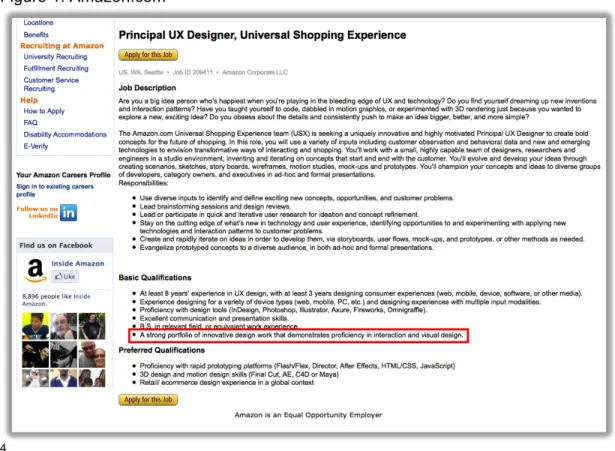
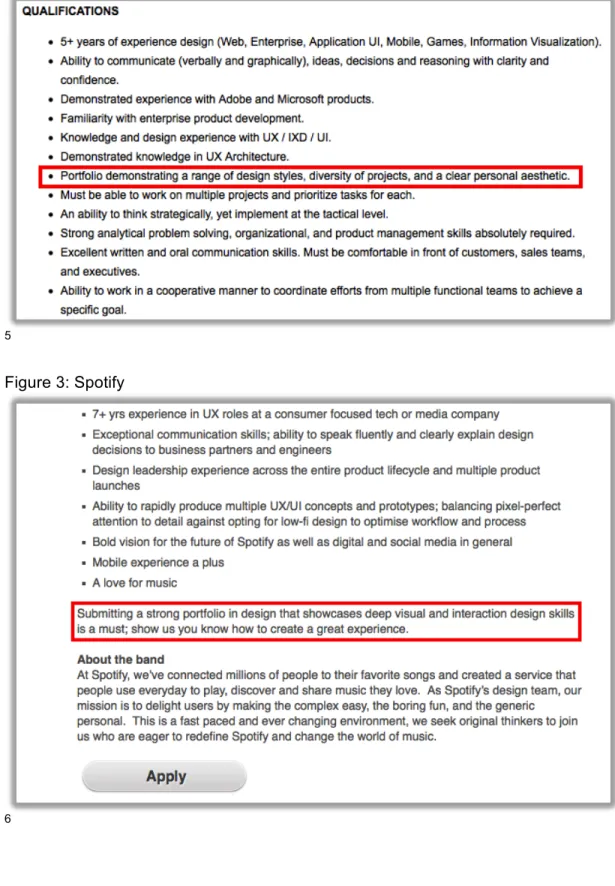
To dismiss the argument that a portfolio site is not necessary for a
graduate of an information science program, here are some representative
job listings for recent positions that have been posted either on the
organization’s parent sites or the Jobs section of uxmag.com, one of the
few resources built specifically around the UX community. None of these
posts neglect to mention a portfolio review as being a necessary
component for consideration.
Figure 1: Amazon.com
4
4 Amazon Corporate, Job Description: Principal UX Designer, Universal Shopping Experience,
Figure 2: Biamp Systems
5
Figure 3: Spotify
6
5 UX Jobs, User Experience Architect,
This last post by streaming audio service Spotify is perfectly direct
and spectacularly vague in the same moment. “Show us you know how to
create a great experience,” which is not the most detailed description of
requirements. Clearly, employers expect applicants to know exactly what
a “strong portfolio” is, and demand that the portfolio be available for review
well before the interview stage of the application process.
During a presentation to the User Interface Design course at
UNC-Chapel Hill this semester, presenters from software company SAS made
this statement about what students seeking employment in UX design
should “Be: Portfolio’d, Technically skilled, Relevant, Networked,
Experienced, and “Alright”.”7 Here, “portfolio’d” means have a portfolio.
“Alright” means not a total pain to work with everyday. The presenters
stressed that the list was constructed in order of importance, with the
portfolio being the number one most important thing a job seeker should
have. This means that technical skills, experience, and not being awful are
all secondary to having a portfolio. It is somewhat at odds with UNC’s “to
be rather than to seem,” but it does reflect the necessity of the portfolio
during the job hunt.
The quote below is from Patrick Neeman, a blogger and UX
designer who created the UX Drinking Game. It is a tool to express
frustrations with working in the UX field in general, but particularly as a
6 Spotify Jobs, Lead UX Designer – Product,
https://www.spotify.com/us/jobs/view/o5Y9XfwT/
place for designers to vent about annoying clients. 8 This post is
humorous, but a firm statement that portfolios are a necessary element of
any professional designer’s toolkit.
Background
For a detailed understanding of what a professional portfolio might
be, it is necessary to explore the practices established by the art
community. The art industry is based on production, how many “great”
works an artist completes will define their career. As a consequence,
artists—and more recently architects and designers—carefully preserve
the products of their labor across their careers, both for personal use as
well as professional.9 As their work grows in volume, it is necessary to
prune the collection back to a select few pieces that highlight their skills,
accomplishments, and professional identity. This smaller collection of
highlights is often referred to as a portfolio, and in most cases is as
valuable to these professionals as their school affiliations or past work
history.
This same phenomenon is seen with the much more recently
evolved workforce found within web development. The ease with which
files and websites can be shared across the web has made it easier than
ever for an individual to advertise their abilities to diverse audiences
across the very medium they work in. This is a critical point because not
all professions that have grown with the web offer a product that directly
corresponds to traditional services provided in the physical world. For
example, in your offline life, you might expect your car mechanic to have a
pristinely maintained vehicle, or even a restored classic automobile. In the
same way, website developers must show their skills through their code
and final products.10
On the web, consumers speak with their wallets every day by
visiting or making purchases from sites that are well designed and function
as expected. Just as companies and businesses are accountable to the
quality of their web services, the professionals who design and build those
websites are accountable for the quality of their products. The easiest way
to convince a possible client that you have great skill in web development
is to show her a sampling of amazing websites you’ve built. For
developers, those who work in the actual code and structure of web
development, it is incredibly easy to purpose build a simple but clean page
to show your competency. This is also a great opportunity to show off
proficiency with new technologies clients may require. In the same way,
graphic designers can point prospective clients to past projects that
highlight their skill in logos, layouts, or branding.
When it comes to User Experience (UX) design, a sub-category of
web development that has been widely accepted in value and importance
in recent years, however, the creation of a portfolio or professional website
can be much more difficult.11 The problem is rooted in the somewhat
ethereal and subjective nature of user experience design itself. The word
10 Mugunth Kumar, “Why you shouldn’t hire a ios developer based on his portfolio,” February 25, 2013, MK Blog,
http://blog.mugunthkumar.com/articles/why-you-shouldnt-hire-a-ios-developer-based-on-his-portfolio/
11 “The Importance of User Experience,”
“experience” is the key here. When visiting a website or using an
application, are users able to accomplish their goals without unnecessary
duress? Is the task itself as pleasant and simple as it can be? Or in very
specific circumstances, is it as fun or as entertaining as it could be? These
are the metrics by which UX is measured.12 This established, how does a
UX designer use their design skills to advertise their competency via a
portfolio or website?
Before moving into what makes a UX portfolio, it is necessary to
understand user experience design as a profession and as a community.
On one hand, the community is incredibly collaborative and very open to
new ideas and practitioners. There are forums, blogs and websites all
dedicated to sharing techniques and gathering feedback. To list a few
major resources:
• http://ux.stackexchange.com/ • http://uxmag.com
• http://uxdesign.smashingmagazine.com/ • http://viget.com/inspire
• http://www.upassoc.org/upa_publications/user_experience/
• http://adaptivepath.com/ideas • http://usability.com
• http://betteruxportfolios.wordpress.com/
In contrast to this high visibility collaboration, the other side of the
coin is a bit darker, for two reasons. The first being that the most
advanced research in user experience is done by major corporations who
rely heavily on employee non-disclosure agreements (NDA’s) to keep
advantageous findings from being shared with the larger community.13
The other major issue is that the collaborative and open nature of the UX
community makes it possible for individuals without any real knowledge or
experience to join the conversation. This can be both good and bad, but
the lack of filtering can cause concerns where quality of information is
concerned. Further complicating things is the dynamic nature of the field.
No single person is entirely in the position to accurately say what UX really
means. For a small development firm building apps for local startups, UX
looks very different than it does for large firms that may only have a few
very well funded clients.14
There is no single accepted definition of user experience, but there
are many variations that more or less mean the same thing.15 This reality
will likely persist for some time, as the UX community is large but lacking
in a defined, unified strategy. As might be expected of a field
13 “What makes a great user experience portfolio?” User Experience Stack Exchange, January 23, 2013
http://ux.stackexchange.com/questions/33392/what-makes-a-great-user-experience-portfolio
14 Russ Unger and Carolyn Chandler, A Project Guide to UX Design: for user experience designers in the field or in the making (Berkeley: New Riders, 2012), 42
characterized in this way, there isn’t any single entity or organization
defining what UX is and what makes it good or bad. There are a few
pioneering names in the field who still have a great influence, most notably
Jesse James Garrett and Bill Buxton. Garrett is the author of The
Elements of User Experience, which is as close to a bible as UX will likely get. In Elements, Garrett lays out exactly what his take on the practice of
UX design entails, and the most basic steps to practicing in its most literal
sense. Garrett defines user experience as “the experience [a] product
creates for the people who use it in the real world.”16
Outside the context of his larger book, Garrett’s definition certainly
seems lacking in any purposeful usefulness, but his work brings about a
point that is fundamental to UX design, the role of process. Process is
everything to a practicing user experience designer, and it defines them as
a professional. Process is also the reason development schedules differ
between web development firms of dissimilar size and scope. Process
then, is something that must be a significant component of a design
portfolio. This is where Bill Buxton’s contributions to the field make their
greatest impact. At the root of his work surrounding creating better
products and resources is the critical importance of design thinking. The
definition of “design” or “design thinking” is in itself a subject of study. Not
surprisingly, every expert who studies or ‘does’ design, has their own idea
of what design actually is. As a creative labor, to some extent this makes
sense. No doubt however, there are designers similar to some of today’s
UX experts who think more about how to conceptualize, market, and sell
their visions rather than come up with something simple and effective to
communicate the task and practice of design.
Because there are so many great definitions of what the term
“design” really means, it can be helpful to think of it in terms of its smaller
facets as illustrated below:
17
For a more traditional take, the Wikipedia definition of design is “the
creation of a plan or convention for the construction of an object or a
system.”18 Stopping here, the definition is fairly straightforward. However,
reading on to the many variations of design definitions rapidly shows that
there is no consensus whatsoever as to what the “correct” definition of
17 http://www.foylearts.net/ahutton/mobile/?p=597 (broken link, accessed March 18, 2013)
design is. This is not a fault of Wikipedians all trying to make their voices
heard. An investigation of scholarly texts on design shows that these
authors also coin their own definitions for design. That, or they heavily
modify a definition posed by previous thinkers to make it their own. Buxton
is no different. His definition takes pages to relate, and essentially boils
down to design being the product of careful study and thinking done by
individuals who are trained in design for the end result of making things
better. Following this thought is the necessity for sketching throughout the
design process.19 Out of context this is an absurd way of trying to define a
concept, but it does show the extent to which current thinkers are not
bound by convention when forming their own ideas around what design is
or should be.
While this discussion addresses design to a usable extent, what
about design thinking? The Wikipedia definition of design thinking is as
follows: “the methods and processes for investigating ill-defined problems,
acquiring information, analyzing knowledge, and positing solutions in the
design and planning fields.”20 In a victory for collaborative online
resources, this is one of the better definitions available, as long as the
reader holds some vague notion as to what design means to begin with.
Design thinking is at the heart of all good design and development, as it is
really just a process for taking in a situation and then evaluating what
19 Bill Buxton, Sketching User Experiences: getting the design right and the right design (San Francisco: Elsevier, 2007), 97
needs to be done to meet goals.21 The best part of design thinking is its
ability to be applied successfully to wildly different circumstances. In some
ways, it could be argued that design thinking really boils down to thinking
in a deliberate way, or better yet, thinking with a process. As mentioned
above, process defines UX design, but the way process is applied more
generally by companies in industry is worth investigating further.
Similar to the terms already put forward, process is difficult to
define apart from its most abstract “series of steps you take to reach some
result.” This simple description makes process a tool that can be easily
applied to any task that needs completion. With time and resources, it is
possible to define a single process for a scenario that gives the best
probability of a favorable outcome. Processes can be developed for any
situation, great or small. One of the best applications of process is with the
design and development model. While designing, process formalizes the
entire approach and affects project outcomes just as readily as the object
being worked on.
One popular approach to web development is the agile framework.
There are many variations and detailed descriptions are widely available.
But, at its core, agile is simply a process for deciding what to do next. A
set of workdays is created, and tasks that can realistically be completed
during that period are reviewed and assigned. Over the course of the
workdays, short meetings are held to keep everyone informed of progress
or delays. At the conclusion of the working period, a meeting is held to see
what went well and what remains to be done. Then, a new meeting kicks
off planning for the next work period, and the process repeats.22 As a
process, the agile model doesn’t always work, particularly on jobs of very
limited scope or complexity. In those instances, other processes are
employed to schedule development work. The simplest case might be a
brief meeting between a client and developer, followed by the developer
doing some work, and then a delivery meeting where the product is
shared with the client. If a firm sticks to small projects like this, they might
modify this process to improve it, but as long as they apply the model to
each job, it is still a design process.23 A survey of current UX recruiters
and designers proves that current professional opinion supports this idea
of process being a critical element in user experience design.
22 Kelly Waters, “Agile Development Cycle,” All About Agile, May 4, 2011, http://www.allaboutagile.com/agile-development-cycle/
The Study
The problem with a study that seeks to write a formula for a
successful anything is that if it were easy, someone would have done it
already. While many in industry understand what a portfolio needs to be, it
is not usually in their interests to share that knowledge. A few individuals
have the responsibility to recruit talent, and they might share some
insight—as they have for this research. Ultimately though, making a strong
portfolio is not something that current professionals teach through the
course of their work. After interviewing professionals in several different
contexts, it can firmly be said that the most useful information came from
friendly conversations rather than the direct questioning of the formal
survey. Being friendly and personable was the only approach that yielded
quality information. It is almost as if recruiters wanted to give a helpful
piece of advice only after this researcher showed some measure of
professional competence and mutual respect had formed. In contrast, the
results of the formal survey produced generalities very similar to many
opinions posted online. However, the comments taken in the study are
direct from UX designers at established firms, so they carry much greater
credibility.
To increase the number of opinions included in this study beyond
those networked with personally, hiring managers and UX directors from
varying levels of industry were interviewed formally via an electronic
size was deliberately small at 15 professionals, but was intended to be
representative of the diversity found in web development firms. An
international firm based in New York represented the upper reaches of
development work. They have a small set of very large clients with very
deep pockets. The second firm has three offices nationally, and
represents the typical well-established web shop with basic operational
structures firmly in place. Last is a local firm that caters largely to regional
startups and, increasingly, to corporations looking for faster delivery than
internal teams can manage.
Participants were given the following questions in this order, with
the intention of making the survey echo a basic informational interview:
1. What is your position title and what are your primary duties?
2. Do you have any insights to share on how your industry currently uses or
does not use a portfolio review as part of the hiring process?
3. Explain the capacity in which you currently or previously reviewed
candidates for positions, and how their application materials (portfolio
site, submitted work, etc.) affected your review.
4. While presenting themselves, what are the most important areas that an
applicant should focus on when creating a sample of work, and how
should they present their materials?
5. What challenge do newly graduating job seekers experience that a strong
portfolio could address?
6. Are there any existing resources or guides to portfolio creation you find
7. Please provide several links to any online portfolios that you feel
accomplish the task of demonstrating professionalism and technical
competence.
8. Please use the space below to add any points you wish to share that
were not related to any of the previous answers.
The response to the survey was an acceptable twenty percent
completion rate. However, the limited number of participants would have
required a greater response rate to generate serious statistical validity.
That limitation noted, the responses collected do corroborate information
gathered by the literature review and informal interviews. Taken together,
the information is highly consistent and should be considered during any
conversation related to the importance of professional portfolios in web
design.
One additional limitation of the survey is that respondents did not
represent the entire spectrum of industry as intended. In fact, all
respondents are employees of the mid level national firm. This is not ideal,
but it does suggest that the opinions of these respondents are less
susceptible to the extremes experienced by the smallest and largest
design firms. Also noteworthy, responses from this company reflect their
Results
From the survey responses, some very good points were
discovered. As mentioned, many of the ideas shared by respondents were
in line with what has been written about in popular resources online.
Despite attempts to protect anonymity in the survey wording, all
respondents made references to either themselves or their companies, so
it is necessary to summarize the findings rather than include the
responses in full form.
All from the mid-sized national firm, these respondents provided a
few more details about their working environments. The company has ~50
employees, and the respondents all act as user experience design
consultants while also contributing to development work, recruitment
efforts, and research. The respondents reported portfolio review to be a
critical phase of the recruitment process, with the portfolio often being
what determines which applicants are offered interviews. One respondent
said this about portfolios, “We’re looking for work samples that show
critical thinking, a breadth of experience, and the ability to communicate
design decisions.” Another response is worth quoting in its entirety,
referencing portfolios as a part of the hiring process.
make reasoned or haphazard design decisions) * The design and elicitation methods the candidate employs or has been exposed to.
When asked about the weight given to the results of the review just
described, the respondent noted, “It’s not uncommon for application
materials to exclude a candidate from a formal interview.”
Question 4 of the survey gets to the most valuable information
shared by respondents. Here are two responses that capture very well just
what is important to focus on while creating a portfolio. More importantly,
they present two perspectives which are shared by many in the field
today. The first:
Just as well put is the second summary, which puts forward the
popular method of using a story to tell hiring managers what the project
entailed and how the applicant solved problems specific to that project:
The most important thing is for an applicant to tell us a story around their work. We need to understand the context of the work they're showing us. What was the problem they faced? How did they approach the solution? What was the rationale for the solution? Work presented without context doesn't help us get a sense for the applicant's skills or process. The presentation is less important, but should be clean and easy to access. Online is best, but PDF is OK.
Fittingly, the last response included in full gives a final plug for
sharing personal design process through the professional portfolio. It
comes from the question prompting the respondents to address how
having a portfolio built can help newly graduated job seekers in specific.
Most new graduates will only have class work to show off, and the final result usually isn't much to look at. By focusing on the problem solving process, we can see the real work that went into the project. Also, a few good examples are better than a lot of bad ones. Good project selection can really help show off a graduate's skills.
One of the most agreed upon areas of portfolio design is the
demonstration of deliberate process. This component is found heavily in
the literature surrounding the topic of portfolio design. Because the
identification of process is found in both the formal survey and the
Suggested Resources
In this section are links to several of the best resource and portfolio
examples provided by respondents in the survey. Unfortunately, this was
the least rich content area of the survey, with several respondents even
reporting that they really should have a collection of good portfolios sites,
but they just haven’t taken the trouble to make a list of their favorites. It
continues what seems to be the theme of this research: it is far more
popular to do user experience design than it is to attempt talking about UX
in concrete terms.
Resource for reference:
http://viget.com/inspire/the-viget-guide-to-a-great-ux-portfolio Portfolios determined to be above average quality:
http://brian-talbot.com/portfolio/
http://okaydave.com/okaydave2006.html
The second portfolio example comes with a generous caveat,
“There’s so much that’s terrible about this portfolio, but Dave Werner does
an excellent job of using video and a monologue to describe his process.”
Application
More than anything else, a portfolio is an opportunity for an
applicant to share who he is, what is important to his professional work,
and how he approaches that work. Of the dozens of informal posts written
on blog creation (very few of which are any more specific than the vague
definitions already discussed) one in particular delivers what consensus
argues is the best approach. In the post 7 Steps to a Kick-Ass UX
Portfolio, Will Evans makes the case that the best way to demonstrate competency in the UX field is by applying a deliberate process to the
portfolio itself. 24 To begin, define goals and objectives. In most cases the
goal is simple: show the hiring manager at X design firm that I deserve a
spot in their shop. Taking it a step further, the portfolio should be designed
with that hiring manager as the portfolio’s intended user. Every decision
made regarding content or appearance should be made with that user’s
task in mind. If a hiring manager is the intended user, know that a portfolio
must stand out from the crowd of portfolios he might review in a given
week. At the same time however, the portfolio can’t simply be eye
catching and loud, as any page that makes a reviewer cringe will not be
one he will choose to look at any longer than necessary. Finding the
balance in between is key.
As with most professions, it is understood that a new UX employee
at a design or development firm will have to modify her style to fit the
working style of the larger company. Why then would it matter how well
she approaches problem solving if she will have to change her style? The
answer is that the awareness of process is something managers need to
see in candidates. There is no substitution for the demonstration of a
well-planned and well-executed product. T. Truman Capone, Director of the
School of Visual Arts at Virginia Polytechnic University shared these
words on portfolio planning:
It is extremely important to plan in advance and be consistent in keeping archives of your exceptional work. Only utilize about six to eight good ideas or designs in your book. Prospective clients want to be sure you can do quality work, and a few good ideas can actively prove that. Design your book as simply and elegantly as possible. It is the content and how you communicate it that are important. The portfolio tells the prospective employer that the designer understands the relationship between design and business.25
While hiring managers are receptive to creativity while reviewing
applicants’ work, they almost all require a demonstration of deliberate
process to confirm an applicant’s suitability. It is not enough to produce
great work by accident. It can be done a few times, but not on a daily
grind, project after project. An applicant who understands the value of a
deliberate approach that maximizes the possibility of a successful product
will beat an applicant with a flashy style in almost every case. This is the
single most important element of a quality portfolio, but it has yet to be
applied in all curriculum dedicated to UX design. Those students who are
up on current practice in industry however know the value of process and
portfolio creation where job hunting is concerned. One current SILS
student who was recently offered a great position with a national firm had
this to say about portfolios:
Design is all about planning, testing, and iteration; in other words, process. Good design doesn’t just appear fully formed, no matter how simple or obvious the final product may seem. Design process is what employers want to see, and that’s what is really impossible to show without a portfolio.Even if you have a great GPA and are incredibly bright, showing up to a design interview without a portfolio would be a huge mistake. By doing so, you are showing that as much as you know, you don’t understand the most
fundamental aspect of design.26
Argument
The main conclusion of this story is greater than a simple “everyone
working in UX needs a portfolio.” While that is true, there is a bigger
lesson to learn. It is that time spent in an undergraduate or graduate
program studying coursework in UX or programming or project
management gives an ample quantity of long-term projects to fill a
beginner’s professional portfolio. The projects won’t be the most stunning
work that hiring managers see. But they can illustrate a student’s skills,
especially when project scope is considered. Student projects done for
credit will never be as well-thought or as polished as projects done for
paying clients. However, even a simple project can become a great piece
in a professional portfolio. In fact, class projects are an opportunity to
make something from almost nothing. Students can demonstrate their
capabilities in a worst-case scenario situation. Few firms will throw
recently hired designers under the bus. Instead, new employees work
under the guidance of senior designers, learning skills along the way. A
class project is much more of an excuse to show potential than it is a
demonstration of a fully developed skillset. This kind of content is exactly
what successful UX designers have in their portfolios today.
A further benefit of populating a portfolio with class work is that
rarely will that work be owned by an entity other than the student. In
industry it is very common for employees to agree to non-disclosure
sharing their work with other entities while under the NDA. There has been
some discussion recently that interviews are an exception to this rule, but
popular opinion remains on the side of NDA’s being strictly followed in
practice. This established, having a few strong class projects to include in
a professional portfolio forms a great foundation of work to share that is
free of any doubt as to ownership and legality of sharing. On a similar
note, if class projects are done with the intent to include them in a portfolio
to be shared with future recruiters and hiring managers, the odds that
strong deliverables will be produced are much higher than if only done for
class credit.
There is one final point to be made, and it is one of opportunity.
There is almost no curriculum available for training the coming
generations of user experience designers. Standardizing the field and its
necessary training is a compelling opportunity to consider. Few
professions are as lacking in role definition as UX design is today. As a
field rooted in design and the arts, it would be helpful to look at the
schools of design and architecture for guidance when forming curricula. A
critical component of design training is work done for practice, along with
the creation of a well-presented portfolio to collect that work.
As a very natural first step, the curriculum for a dedicated user
experience design training program could revolve around this model,
particularly in the area of portfolio creation. If portfolios were built as
portfolios under the guidance of an experienced UX designer, a very large
component of their professional development would be achieved, and the
experience earned by the exercise would be useful not just in future
interviews, but also in the way students face design challenges for the rest
of their careers. It is possible to say even, that it would help students
Conclusion
The foreword of Portfolio Design includes the following statement
from world-famous architect Cesar Pelli:
When I look at a design portfolio, I am interested in the content, of course; but I am also interested in the design of the portfolio itself. Sometimes it tells me as much as the work it presents. In it, I can judge the person’s eye: the images chosen, how they are placed on a page, how the captions are designed, the choice of type, the color of paper, the design of the cover. I can also tell if the designer is conservative, adventuresome, flashy, restrained, neat, or sloppy.
The portfolio also tells me about the abilities of its designer to communicate ideas and images in graphic form. Much like in a building, there is a great deal of freedom within the physical limits set by the medium and the cultural limits set by convention, and I can tell about the judgment of the designers by how constrained they have been by these limits or by how much freedom they have taken with them. I can even judge how well they have managed their time in either overdoing the portfolio design or in having established an efficient process for preparing it.
Finally, I can see how all of these decisions have come together in a single object; that is, how coherent with the work illustrated is the form in which it is presented, and, just as important, how coherent is the portfolio with regard to the person that it represents. In the design of a portfolio I encounter many of the same issues, problems, skills, and talents that are necessary to produce architecture.27
Rather amazingly, the comparison between the demands of
architecture and those of user experience design are almost exactly the
same where portfolios are concerned. Granted, materials may differ, but
the detailed artistry remains. Academic programs intent on creating lasting
and competitive curriculums for UX would do well to apply some of the
teachings found in traditional design programs.
Bibliography
Amazon Corporate, Job Description: Principal UX Designer, Universal Shopping Experience,
http://www.amazon.com/gp/jobs/209411/ref=j_sr_3_t?ie=UTF8&category=*&jobS earchKeywords=ux&location=*&page=1
Buxton, Bill, Sketching User Experiences: getting the design right and the right design. San Francisco: Elsevier, 2007
Evans, Will, “7 Steps to a Kick-Ass UX Portfolio,” UX Magazine, August 9, 2011, http://uxmag.com/articles/7-steps-to-a-kick-ass-ux-portfolio
Garrett, Jesse James, The Elements of User Experience: User-Centered Design for the Web and Beyond. Berkeley: New Riders, 2011
Linton, Harold, Porfolio Design. New York: W. W. Norton & Company, 2012
Neeman, Patrick, “UX Drinking Game,” UXMAS, December 19, 2012,
http://www.uxdrinkinggame.com/drink/if-someone-says-you-dont-need-a-portfolio-to-get-a-ux-designer-job-drink/
Mugunth, Kumar, “Why you shouldn’t hire a ios developer based on his portfolio,” February 25, 2013, MK Blog, http://blog.mugunthkumar.com/articles/why-you-shouldnt-hire-a-ios-developer-based-on-his-portfolio/
Rodden, Kerry, “How to choose the right metrics for your product,” Design Staff,
http://www.designstaff.org/articles/how-to-choose-the-right-ux-metrics-for-your-product-2012-03-27.html
Rogers, Sharp, and Preece, Interaction Design: beyond human-computer interaction.
West Sussex: John Wiley & Sons, 2011
Unger, Russ, and Chandler, A Project Guide to UX Design: for user experience designers in the field or in the making. Berkeley: New Riders, 2012, 42
Spotify Jobs, Lead UX Designer – Product,
“The Importance of User Experience,” http://www.adaptiveconsultancy.com/web- design/website-design/ecommerce-web-design/the-importance-of-user-experience
UX Magazine Staff, “Solving the Key Employment and Hiring Problems in the UX Field,”
UX Magazine, January 10, 2013, http://uxmag.com/articles/solving-the-key-employment-and-hiring-problems-in-the-ux-field-with-didus
UX Jobs, User Experience Architect, http://uxmag.com/uxjobs/view_job/post_id/0398-User-Experience-Architect
Waters, Kelly, “Agile Development Cycle,” All About Agile, May 4, 2011, http://www.allaboutagile.com/agile-development-cycle/
“What makes a great user experience portfolio?” User Experience Stack Exchange,
January 23, 2013 http://ux.stackexchange.com/questions/33392/what-makes-a-great-user-experience-portfolio
Wikipedia, Design, http://en.wikipedia.org/wiki/Design