Validation of spatiotemporal image correlation spectroscopy (STICS) for the measurement of diffusion
By
Pranav Haravu
Senior Honors Thesis
Quantitative Biology (B.S.)
University of North Carolina at Chapel Hill
4/14/16
Approved:
________________________
Michael Falvo, Thesis Advisor
Mark Peifer, Reader
Steve Rogers, Reader
This thesis has been prepared in conjunction with BIOL692H and in partial satisfaction
ABSTRACT
Understanding of chemical mechanisms on an intracellular level is steadily
growing and extensively studied. However, our understanding of the physical bases for
these processes is comparatively lacking. Current limitations on measuring fundamental
intranuclear mechanical properties have stifled necessary new perspectives on
intranuclear mechanics. Here we build on the Wiseman group’s novel development of
spatiotemporal image correlation spectroscopy (STICS) to measure diffusion, and then
attempt to validate it with simulated and experimental datasets. STICS, unlike current
methods of diffusion measurement, such as image mean square displacement (iMSD),
does not require the ability to track distinct particles. Expected diffusion coefficients, D,
in simulated datasets were calculated using the Stokes-Einstein relation, which relates the
diffusive properties of particles moving in fluids as D= kBT
6πηr . For experimental bead
diffusion datasets expected D values were measured using iMSD. We observe that in
simulated datasets STICS is able to measure a linear relationship between 1/D and the
viscosity, η, as expected by Stokes-Einstein. We also see that STICS has a high
precision, as D measured from subsamples of a given video have an average standard
deviation of 3.23×10⁻¹⁴m2/s
. However, in both simulated and experimental datasets the
measured D value, denoted DS , differs from the expected D by a calibration factor
D=βDS that appears to depend on particle density, but could also depend on signal
intensity, bleaching rates, and/or imaging plane thickness. Future work will be aimed at
characterizing β and thus essentially calibrating STICS, since at present this variability
I. INTRODUCTION
While our understanding of chemical mechanisms on an intracellular level is
steadily growing and extensively studied, our understanding of physical processes is
comparatively lacking. For example, multiple mechanisms of chemical signal
transduction into the nucleus have been proposed and identified, such as G coupled
proteins and other second messenger cascades (Lodish et al., 2000). However,
mechanotransduction, the transfer of physical stimuli into the cell, is a much less
understood topic (Alenghat and Ingber, 2002). Furthermore, genomic sequencing has
facilitated our understanding of gene regulation by nucleotide sequences, but we are only
beginning to scratch the surface of other regulatory elements, such as structure, physical
arrangement, and perhaps most interestingly, force (Li and Reinberg, 2011). We have
reason to believe that physical mechanisms such as those mentioned above do exist and
serve functional roles - physical forces have repeatedly been correlated with cell
behavior, ranging from stem cell differentiation to metastasis and gene expression (Wirtz
et al., 2011; Dado et al., 2012). In addition, the literature provides evidence of structural
components such as actin cytoskeletons ‘transmitting signals’ and affecting cell behavior
in response to physical stimuli (Schwarz and Gardel, 2012). In order to further elucidate
the workings of physical mechanisms, it is necessary to understand physical properties on
a fundamental level, such as stress, strain, elasticity, tensile and compressive forces, flow,
and diffusion. Of strong interest to us is the measurement of diffusion, which can be used
to decipher numerous higher-level physical phenomenon, such as free and active
transport, structural heterogeneity within the nucleus, and the release of bound proteins
The experimental setup we are building towards for the measurement of these
fundamental physical properties utilizes atomic force microscopy (AFM) coupled with
vertical light sheet microscopy (VLSM) to image cells under induced forces. AFM is
used for the repeated induction of compressive and adhesive forces, used similarly in
prior studies to measure physical properties of live cells (Gavara and Chadwick, 2012;
Raman et al., 2011). The technique of VLSM accomplished through the use of PRISM
imaging allows imaging in the plane of deformation on a time scale that can capture
relevant physical information, an advantage over the use of confocal microscopy to build
3D stacks. This approach facilitates the capture of images containing data on diffusion,
flow, strain, and stress, and to extract these data we chose to use spatiotemporal image
correlation spectroscopy (STICS). The STICS code we built on was made by the
Wiseman group as the one of the first steps in developing STICS as a novel analysis tool
to measure flow (Herbert and Wiseman, 2005).
Current methods of measuring diffusion and flow are based on tracking individual
particles, as in iMSD and particle tracking velocimetry (PTV), or in correlation
techniques such as particle image velocimetry (PIV) (Ribeiro et al., 2015; Holenberg et
al., 2012; Amira et al., 2013). However, all of these techniques require the capability to
image distinct individual particles, a condition that makes it difficult to use
small-molecule labels, such as histone markers, in high particle density situations. Furthermore,
PIV cannot be easily used to measure diffusion – its functionality is limited primarily to
measuring flow. This needed function is served by STICS, which correlates regions of
the image with applied temporal and spatial shifts, generating meshes of velocity vectors
data on such a small scale allow us to study the heterogeneous nature of the nucleus,
potentially identifying regions of abnormal flow, diffusion, and/or strain.
Given the novelty of STICS, it is important to validate the analysis using known
simulated and experimental datasets. It has only recently been developed by the Wiseman
group, and has only been used in a handful of papers (Hedde et al., 2014). Prior work
within our lab had been done to validate the use of STICS for the measurement of flow in
situations resembling an AFM coupled VLSM setup, but the measurement of diffusion
remained to be implemented and validated.
The goal of this project was thus to implement and validate the use of STICS as a
tool to measure diffusion for future experiments in which forces are induced onto cell
nuclei. Specifically, I built upon the implementation of STICS from the Wiseman lab to
include the capability to measure the diffusion of subpixel particles in situations
resembling AFM coupled VLSM experiments. These situations include particle densities
greater than those analyzable by current methods, and range in viscosities from 1 to 300
cP, the observed range of viscosity in the cell cytoplasm and vesicles (Kuimova et al.,
2009). I validated the measurements on simulated datasets generated from existing code,
as well as experimental datasets I designed and analyzed using iMSD code I built and
verified. Resulting measurements show that STICS is able to measure a linear increase in
the inverse diffusion coefficient, 1/D, with an increase in viscosity, as well as measure D
with high precision, but its accuracy is off by a calibration factor, β, whose origin is yet
II. METHODOLOGY Implementing STICS
An implementation of STICS from the Wiseman lab was built upon to include the
capacity to measure diffusion. STICS utilizes a generalized intensity fluctuation
correlation function (equation 1) to compute a correlation score, r, as a function of spatial
and temporal lags for a given region of interest defined by x, y, and t. Specifically, and
represent spatial lags and represents a temporal lag (Hebert and Wiseman, 2005).
r(ζ,η,τ)= δi(x,y,t)δi(x+ζ,y+η,t+τ)
i t i t+τ (Eq. 1)
In equation 1, represents the intensity fluctuation at (x,y,t), i.e. the signal
above the background, with and representing spatial averaging at
a given time. To extract flow and diffusion information we utilize a discrete
approximation that combines spatial correlation information with temporal correlation
information (Hebert and Wiseman, 2005).
r'(ζ,η,Δt)= 1
N− Δt
δi(x,y,t)δi(x+ζ,y+η,t+Δt)
i t i t+Δt t=1
N−Δt
∑
(Eq. 2)Here, N is the total number of images in the series, and r’ represents the averaged
correlation functions over the (ζ,η) plane for all frames separated by the time lag Δt. The
r'(ζ,η,Δt) averaged correlation function for a given Δtcan be fit to a Gaussian of the form
r'(ζ,η,Δt)=gD(Δt)exp
(
ζ−ρ( )Δt)
2
+
(
η−ψ( )Δt)
2ω2( )Δt ⎛ ⎝ ⎜ ⎜ ⎞ ⎠ ⎟
⎟+goffset( )Δt (Eq.3)
where gD(Δt), goffset( )Δt ,ρ( )Δt , ψ( )Δt , and ω2( )Δt are functions of Δt and represent the
amplitude, the baseline correlation score as , the ζ coordinate of the peak’s ζ
η τ
δi(x,y,t)
δi(x,y,t)=i(x,y,t)− i
t ...
center, the η coordinate of the peak’s center, and the peak’s width respectively. At a time
lag of 0, we see that the Gaussian is centered at (ζ,η)=(0, 0). In the case of flow we expect
the peak to move in the direction of flow as Δt increases, and can calculate flow
velocities vζ and vη by tracking the peak locations with respect to Δt as shown in
equation 4.
ρ(Δt)=vζ⋅ Δt, ψ(Δt)=vη⋅ Δt (Eq. 4)
In the case of diffusion we would also expect the peak to become wider as it evolves to
larger time lags with the rate of change in width related to the diffusion coefficient, D
(Herbert and Wiseman, 2005). In the correlation of ω2 and Δt(Eq. 5) the ω02 represents
the width of the Gaussian for a time lag of 0, i.e. the average width when regions are
correlated with themselves.
ω2
(Δt)=4D⋅ Δt+ω02 (Eq. 5)
To calculate diffusion in a sample video the D values are calculated for each ROI in each
frame and then averaged together.
The implementation of STICS code we received from the Wiseman group was
built to provide flow data, but was not able to provide diffusion data without code
alteration. . I specifically built in the capacity to measure diffusion by writing the
necessary code to extract the widths of the Gaussians and track their evolution with
respect to Δt.
Simulated data sets
Data sets were simulated using a bead diffusion simulator built previously in the
lab, which was then modified to effectively simulate small particles at high densities by
function was previously empirically determined for our lab’s microscope setup with
particles ranging in diameter from 100nm to 1000nm. For a 10nm bead, the standard
deviation of the PSF was treated as the same as the standard deviation for the PSF of the
100nm bead. Particle tracks were determined using a random walk algorithm, and these
tracks were then visualized into an image series using the point-spread function
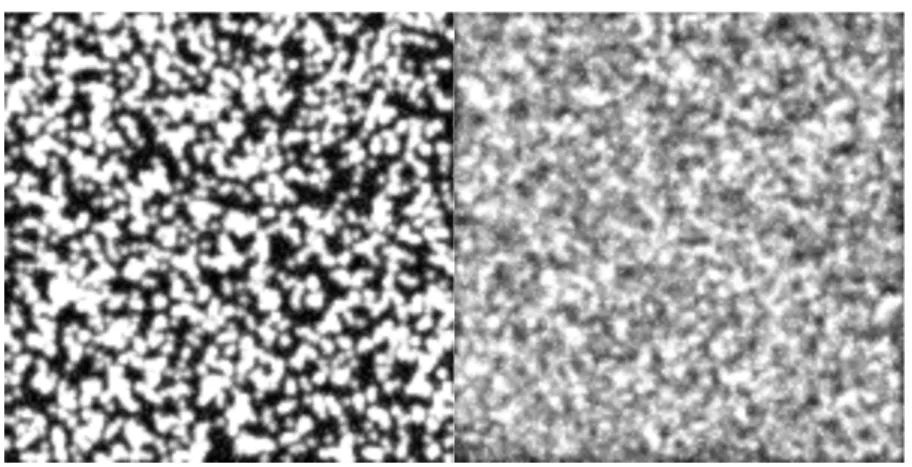
previously mentioned. Frames from a sample simulated data set are shown in figure 1.
iMSD analysis
Analysis via image mean square displacement (iMSD) was conducted on samples
to cross verify the diffusion values measured by STICS and those predicted utilizing
Stokes-Einstein theory. Video Spot Tracker (CISMM at UNC-CH) was used to select
individual particles, which were then tracked to give frame-by-frame locations. The
resulting series of coordinates were used to generate mean square displacement (MSD)
vs. τ plots, and the slope of the fit in equation (6) was used to calculate the diffusion
coefficient, D.
MSD(τ)=4Dτ (Eq. 6)
In videos with high particle densities and/or noisy conditions, the tracking of particle
movement was conducted by hand using FIJI due to the inability of the Video Spot
Tracker program to accurately follow beads.
Computational utilization
Due to the computational resources required to generate simulated bead datasets
and run STICS, jobs were run on the BASS supercomputer at the University of North
Experimental bead datasets
Experimental datasets were created by suspending 20nm, 100nm, and 200nm
yellow-green carboxylic acid coated Invitrogen fluorospheres in sucrose solutions.
Aliquots of the suspensions were then imaged using a 40x oil objective in a microscope
chamber held at 37°C. Frames from a sample experimental bead dataset are shown in
figure 2.
III. RESULTS
Findings from simulated datasets Verification of simulation using iMSD
Image MSD analysis was conducted on simulated datasets to ensure the
simulation would provide sample videos with diffusion coefficient values aligning with
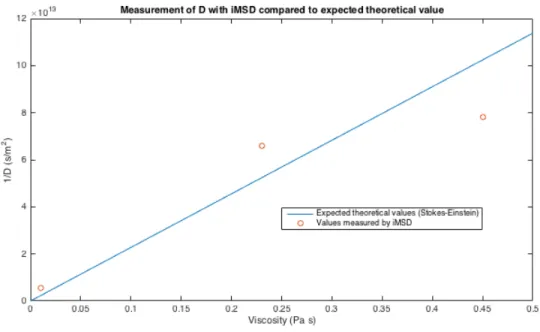
those predicted by Stokes-Einstein. This agreement is shown in figure 3, in which
diffusion values measured by iMSD for various datasets simulated over a range
viscosities agree with the predicted Stokes-Einstein values. The deviation from the
expected values is likely attributable to the small sample set of beads that could be
successfully tracked.
Ability of STICS to measure linear relationship between 1/D and viscosity For initial STICS validation 100nm particles were simulated at varying
viscosities, and the resulting videos were analyzed at 100 frames per second (FPS) using
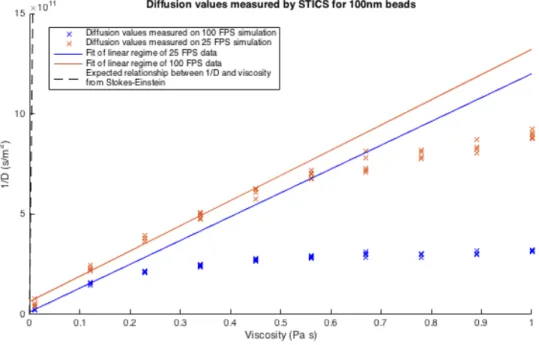
STICS. A plot of 1/D versus viscosity in figure 4 shows a linear regime, where an
increase in viscosity corresponds to the expected linear increase in 1/D (the regions fitted
in figure 4). The linear component is represented as a modified version of Stokes-Einstein
(Eq. 7)
1
D= β⋅
6πr kBT
⎛
⎝
⎜ ⎞
where represents viscosity, r represents particle radii, T represents temperature, kB
represents the Boltzmann constant, and represents a calibration factor. For the linear
region of the 100 FPS simulations in figure 4 we calculate β=0.0055 with a correlation
score of 0.95. As shown in figure 4, we note that this linear regimen is extended when the
frame rate of the simulation is decreased from 100 FPS to 25 FPS with βchanging
minimally, 5%, to β=0.0052with a correlation score of 0.99.
Effect of changing particle density
We then wished to elucidate which parameters influence β, beginning with
particle density. We decided to determine the impact of varying particle density by
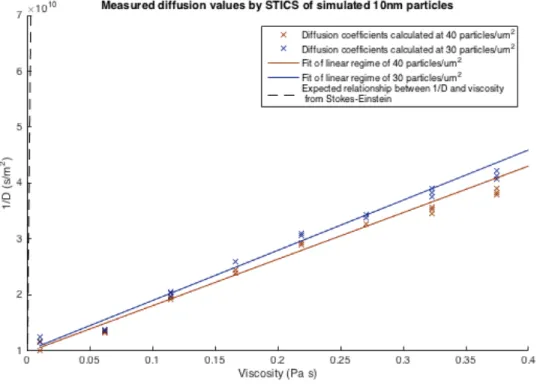
simulating 10nm particles at 30 particles/um2 and 40 particles/um2 across varying
viscosities, the results of which are displayed in figure 5. Again we noticed a linear
region, in this case up to η<0.4Pa⋅s, and fit the data to equation 7. We see that the value
of β changes with particle density from β=0.0031(r = 0.91) with 30 particles/um2 to
β=0.0039(r = 0.96) with 40 particles/um2, representing a 25% increase in β for a 33%
increase in particle density.
Findings from experimental datasets
Differences between theoretical predictions and PIV measurements
Whereas in the simulated datasets iMSD showed agreement between visualized
diffusion and that predicted by Stokes-Einstein, the same does not hold for experimental
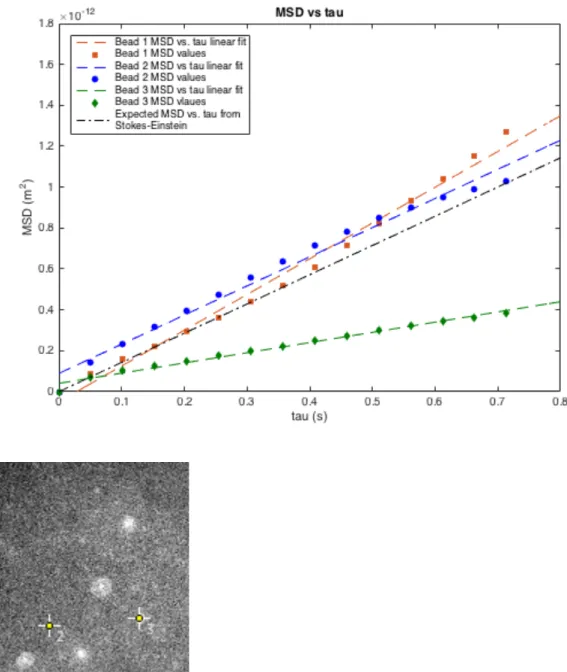
bead videos. MSD plots for individual 100nm beads in a given video show varying
diffusion coefficients (figure 6), and even when averaged across multiple beads to
calculate average diffusion coefficients for the video we see differing values between the
iMSD calculated values and theoretical predictions (figure 7). These differences in
η
expected and observed diffusion coefficients could arise from imprecise temperature
control, bead clustering affecting effective particle radii, and errors in the viscosity
measurements of the standards, all of which contribute to the calculation of D using
Stokes-Einstien. Thus, due to the inability to calibrate STICS against values predicted by
Stokes-Einstein, we decided to correlate measurements from STICS with those measured
by iMSD.
Linear relationship between diffusion coefficients measured by iMSD and STICS Given that we were unable to compare STICS measurements to theoretical values,
we compared D values measured by STICS to D values measured by iMSD to determine
if measurements in experimental datasets differed from expected values by a calibration
factorβ. Bead suspensions were prepared with 20nm, 100nm, and 200nm beads in H2O,
2M sucrose, and 2.5M sucrose solutions at 1% concentrations from the original bead
stock solutions. Each suspension was then analyzed using both iMSD and STICS. The
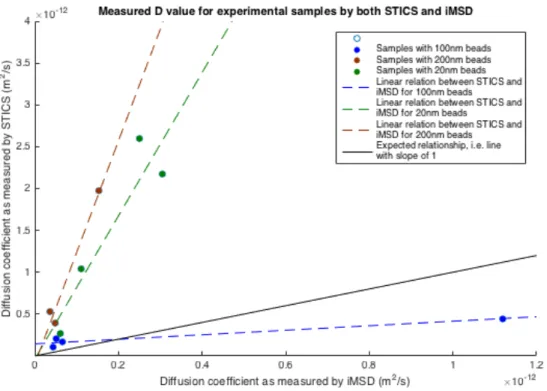
resulting values are graphed in figure 8, with the diffusion coefficient as measured by
iMSD on the x-axis and the diffusion coefficient measured by STICS on the y-axis.
Samples in which either iMSD was not possible due to an inability to effectively track
beads or which were too noisy for STICS are not depicted. The resulting plots show
linear relationships between DS, the diffusion coefficient value measured by STICS, and
D, the diffusion coefficient value measured by iMSD, for each set of beads. Specifically,
we observe D=βDSwhere β=0.075, β=3.703, and β=0.117 with correlation coefficients
Consistency of STICS within subsamples
If the STICS measurements differ from expected values by a calibration factor β
that depends on the experimental setup, then measurements from subsamples of the same
setup should differ by the same β. To test this, videos of 200nm particles in 2M sucrose
at particle densities of 0.1% and 1% (sample frames shown in figure 2) were split into
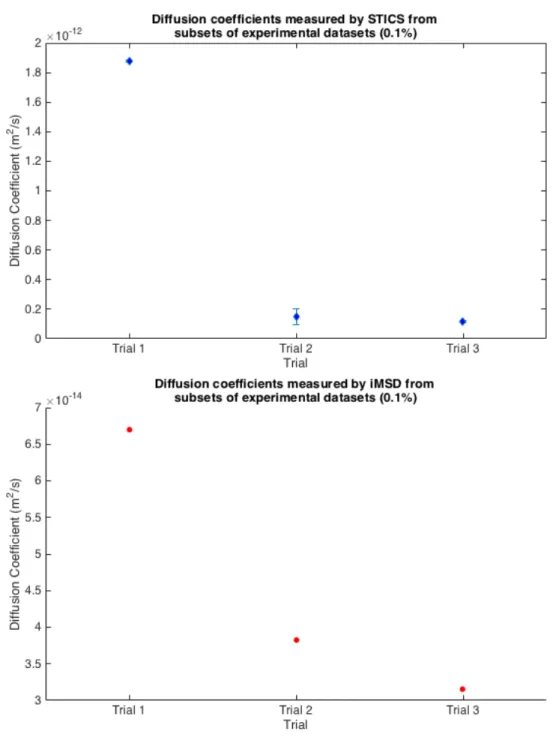
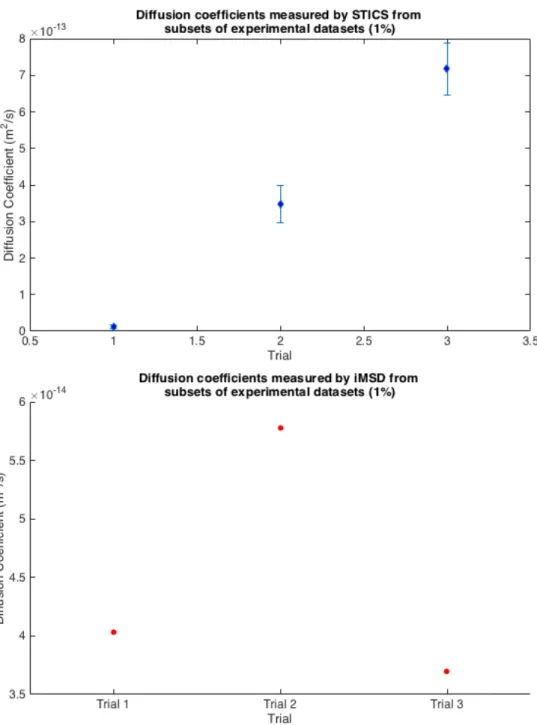
multiple videos and individually analyzed using STICS. Each trial in figure 10 represents
one recording of beads diffusing in solution that was split into 3 separate movies, each of
which was then analyzed using STICS. The mean of the 3 movies for each trial is
presented in figure 10 along with their standard deviation. Image MSD analysis was also
done for each of the trials, and the resulting diffusion coefficients are plotted on figure 9
as well. Diffusion coefficients as measured by iMSD have a standard deviation of
1.38×10⁻¹⁴m2/sacross the 6 trials, whereas the standard deviation across trials as measured
by STICS is 7.02×10⁻¹³m2/s. In contrast, the mean standard deviation of D amongst
movies within a given trial as measured by STICS is only 3.23×10⁻¹⁴m2/s. This indicates
that the diffusion coefficient measured by STICS is consistent within a movie, but differs
from iMSD measured D’s by a different amount across movies. In other words, within a
given movie diffusion coefficients calculated by STICS appear to be off by a certain
calibration factor, β, from iMSD values, but this factor changes for different movies.
IV. DISCUSSION
The ability of STICS to measure diffusion shows promise, but is yet to be fully
validated. Its ability to measure a linear relationship between 1/D and η in simulated
datasets (figures 4 and 5) and the consistency with which it measures D values for
measure diffusion, but needs to be calibrated by a cofactor β that depends on the
experimental setup. This β takes the form of D=βDS where D is the actual diffusion
coefficient and DS is the value measured by STICS.
Through simulated datasets we have shown that when bead density and particle
size are kept constant, STICS is able to measure the expected linear relationship between
the viscosity of the solution, η, and the inverse diffusion coefficient, 1/D. The linear
region where this relationship holds necessitates sufficient movement of particles
between frames. As we see in figure 4, the linear region for the 100 FPS video extends
only to 0.1 Pa s, but when the video is down sampled to 25 FPS the linear region extends
to 0.4 Pa s. With smaller changes between frames the Gaussians evolve less for a given τ
value, and so the changes in peak width and location become harder to distinguish from
noise – hence the extension of the linear region when the video is down sampled. With
constant bead size and particle density, we see that β remains constant, hence the linear
relationship between 1/D and η. However, when certain conditional parameters change,
such as particle density,β also changes.
Because we are not able to trust the viscosities of the standards, in part due to
uncertainties in temperature, we decided to validate the STICS measurements against
those from iMSD. Furthermore, as shown in figure 6, MSD vs. τ plots of experimental
videos show individual beads have differing rates of diffusion, a possible result of beads
clumping in different amounts, especially at higher bead densities, and resulting in a
range of effective radii. In figure 9 we see that for a given experimental setup with
multiple videos taken of the same region, the measurements of D by STICS differ from
changes, possibly attributed to localized differences in particle density or other factors
that β could depend on.
The origin of the calibration factor, β, is yet to be determined – its
characterization and an understanding of its roots is the final hurdle in being able to
measure diffusion using STICS. A large issue with characterizing the calibration factor
lies in the creation of experimental standards with well-characterized parameters. These
parameters include viscosity, particle radii, and temperature of the suspension. In future
experiments the viscosity of standards with beads in suspension could be determined
more precisely using cone and plate viscosity measures. Using beads with alternative
coatings could reduce bead clumping and thus ensure constant particle radii. Lastly,
ensuring the suspension equilibrates to the set temperature of the chamber on the
microscope stage could control temperature. These parameters dictate diffusion rates, and
when they are controlled we would expect variation in D as measured by STICS to be
due to changes in β, not the actual diffusion rate. Parameters of interest to consider that
could affect β are particle density in the region being imaged, which we already believe
to play a role, signal strength, signal-bleaching rate, and imaging plane thickness.
A full characterization of β’s dependence on these parameters, and others it may
depend on, would allow us to essentially calibrate STICS for a given experimental setup.
That setup is not limited to beads diffusing in a suspension, but could easily be extended
to observing intranuclear molecular flow and diffusion without the constraints of current
measurement techniques, opening a novel door to study the physical landscape inside the
V. Figures
Figure 1. (Left) Sample frame from simulated bead dataset with 100nm beads. (Right) Sample frame from simulated bead dataset with 10nm beads.
Figure 2. (Left) Sample frame from experimental bead dataset with 200nm beads at a 1% concentration. (Right) Sample frame from experimental bead dataset with 200nm beads
Figure 3. Inverse of diffusion values measured by iMSD (red circles) for simulated datasets generally agrees with the linear prediction of Stokes-Einstein (blue line).
Deviation observed from expected values is likely due to small sample size of beads that
Figure 4. Measurement of 1/D by STICS for simulated 100nm bead datasets shows an expected linear region in both the 100 FPS and 25 FPS simulations with only a 5%
difference in their slope, but the linear region extends from 0.1 Pa s for 100 FPS to 0.4
Pa s for 25 FPS. However, both linear relations differ in their slope from the expected
Figure 5. Measurement of 1/D by STICS for simulated 10nm particles shows a linear regime with respect to viscosity. Increasing the particle density in the simulation by 33%
from 30 particles/um2 to 40 particles/um2 increases the value of β by 25% from 0.0031
Figure 6. (Top) MSD vs. τplot for the 3 beads identified in the experimental setup
pictured in the bottom image. Varying rates of diffusion between the three beads could
imply bead clustering, increasing the effective radius and thus decreasing the diffusion
rate as seen in bead 3. (Bottom) Sample frame from experimental 100nm bead dataset in
Figure 7. The D values measured using iMSD across different parameters differ from the Stokes-Einstein theoretical predictions by varying amounts, potentially due to bead
Figure 8. Due to the inability to calibrate STICS against theoretical values predicted by Stokes-Einstein, we calibrate the STICS measured D (vertical axis) against the D value
measured by iMSD (horizontal axis). The resulting plot shows linear relationships for
each size of bead, with β=0.075, β=3.703, and β=0.117 for the 200nm, 100nm, and
Figure 9a. Three trials of experimental bead dataset videos (200nm beads in 2M sucrose at a 0.1% bead density) were subsampled and analyzed with STICS. The mean D of the
subsamples and their standard deviation for a given trial is plotted on the graphs, as is the
Figure 9b. Three trials of experimental bead dataset videos (200nm beads in 2M sucrose at a 1% bead density) were subsampled and analyzed with STICS. The mean D of the
subsamples and their standard deviation for a given trial is plotted on the graphs, as is the
VI. REFERENCES
1. Alenghat, F., Ingber, D. (2002). Mechanotransduction: all signals point to cytoskeleton, matrix, and integrins. Science, 119.
2. Amira, B. B., Driss, Z., & Abid, M. S. (2015). Experimental study of the up-pitching blade effect with a PIV application. Ocean Engineering, 102, 95-104.
3. Dado, D., Sagi, M., Levenberg, S., & Zemel, A. (2012). Mechanical control of stem cell differentiation. Regenerative medicine, 7(1), 101-116.
4. Gavara, N., & Chadwick, R. S. (2012). Determination of the elastic moduli of thin samples and adherent cells using conical atomic force microscope tips. Nature nanotechnology, 7(11), 733-736.
5. Hedde, P. N., Stakic, M., & Gratton, E. (2014). Rapid measurement of molecular transport and interaction inside living cells using single plane illumination.
Scientific reports, 4.
6. Hebert, B., Costantino, S., Wiseman, P. (2005). Spatiotemporal image correlation spectroscopy (STICS) theory, verification, and application to protein velocity mapping in living CHO cells. Biophysical Journal, 88, 3601-3614.
7. Holenberg, Y., Lavrenteva, O. M., Liberzon, A., Shavit, U., & Nir, A. (2013). PTV and PIV study of the motion of viscous drops in yield stress material.
Journal of Non-Newtonian Fluid Mechanics, 193, 129-143.
8. Kuimova, M. K., Botchway, S. W., Parker, A. W., Balaz, M., Collins, H. A., Anderson, H. L., ... & Ogilby, P. R. (2009). Imaging intracellular viscosity of a single cell during photoinduced cell death. Nature Chemistry, 1(1), 69-73. 9. Li, G., & Reinberg, D. (2011). Chromatin higher-order structures and gene
regulation. Current opinion in genetics & development, 21(2), 175-186.
10.Lodish H, Berk A, Zipursky SL, et al. Molecular Cell Biology. 4th edition. New York: W. H. Freeman; 2000. Section 20.1, Overview of Extracellular Signaling. Available from: http://www.ncbi.nlm.nih.gov/books/NBK21517/
11. O’Donoghue, M. B., Shi, X., Fang, X., & Tan, W. (2012). Single-molecule
atomic force microscopy on live cells compares aptamer and antibody rupture forces. Analytical and bioanalytical chemistry, 402(10), 3205-3209.
12.Raman, A., Trigueros, S., Cartagena, A., Stevenson, A. P. Z., Susilo, M.,
Nauman, E., & Contera, S. A. (2011). Mapping nanomechanical properties of live cells using multi-harmonic atomic force microscopy. Nature nanotechnology, 6(12), 809-814.
13. Ribeiro, A. J., Denisin, A. K., Wilson, R. E., & Pruitt, B. L. (2015). For whom the
cells pull: Hydrogel and micropost devices for measuring traction forces.
Methods.
14.Schwarz, U. S., & Gardel, M. L. (2012). United we stand–integrating the actin cytoskeleton and cell–matrix adhesions in cellular mechanotransduction. Journal of cell science, 125(13), 3051-3060.
15. Wirtz, D., Konstantopoulos, K., & Searson, P. C. (2011). The physics of cancer:
VII. ACKNOWLEDGEMENTS
I would like to thank my mentor for this project, Dr. Michael Falvo, without whom
this work would not have been possible. I would also like to extend thanks to Dr. Richard
Superfine and the rest of the NSRG lab group for their support and feedback throughout
the project, with special thanks to Dr. Timothy O’Brien, Kellie Beicker, and Jeremy
Cribb. Lastly I would like to thank Dr. William Kier for his guidance and the BIOL692H