Datasheet
MAX 108 segments (SEG27×COM4)
Standard LCD Segment Drivers
BU9795AFV-LB
This is the product guarantees long time support in Industrial market.
Features
Long Time Support Product for Industrial Applications.
Integrated RAM for Display Data (DDRAM) : 35 × 4bit
LCD Drive Output :
4 Common Output, 27Segment Output
Integrated Buffer AMP for LCD driving
Integrated Oscillator Circuit
No External Components
Low Power Consumption Design
Applications
Industrial Equipment
Telephone
FAX
Portable Equipment (POS, ECR, PDA etc.)
DSC
DVC
Car Audio
Home Electrical appliance
Meter Equipment Etc.
Key Specifications
■ Supply Voltage Range: +2.5V to +5.5V
■ Operating Temperature Range: -40°C to +85°C
■ Max Segments:BU9795AFV-LB 108 Segments
■ Display Duty: 1/4
■ Bias: 1/2, 1/3 Selectable
■ Interface: 3wire Serial Interface
Package
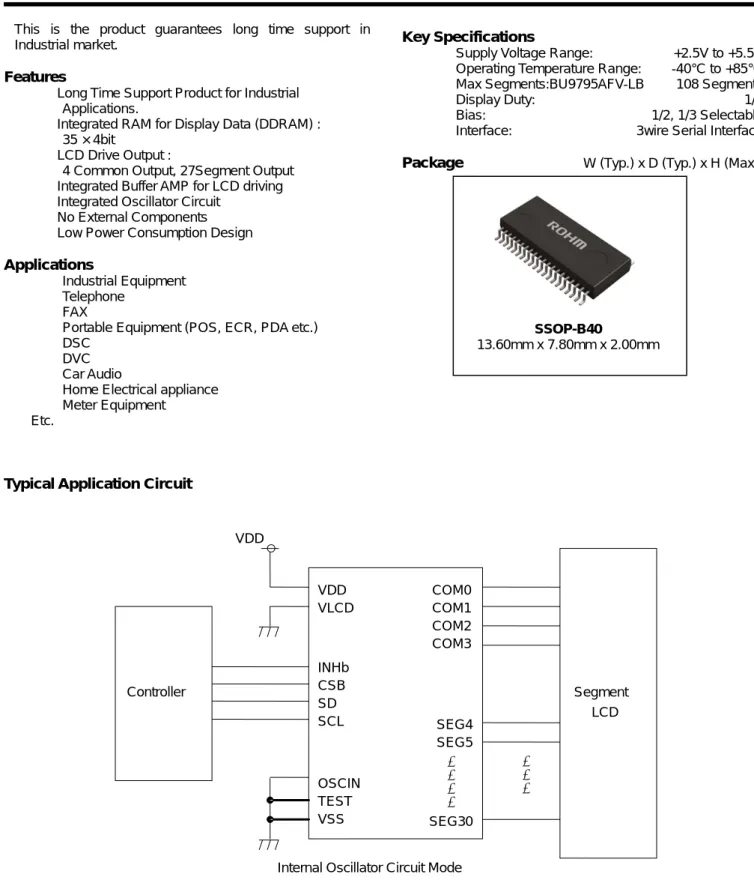
W (Typ.) x D (Typ.) x H (Max.)Typical Application Circuit
Figure 1. Typical application circuit Controller VDD VLCD INHb CSB SD SCL OSCIN TEST VSS COM0 COM1 COM2 COM3 SEG4 SEG5 Segment LCD VDD SEG30 ・・・・ ・・・
Internal Oscillator Circuit Mode
SSOP-B40
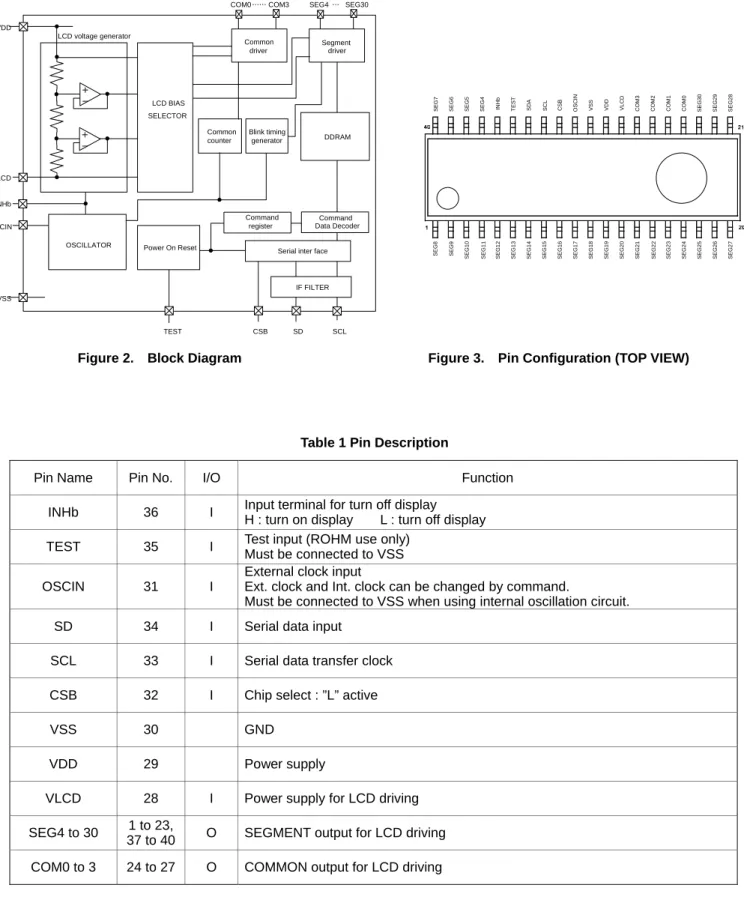
Block Diagrams / Pin Configurations / Pin Descriptions
BU9795AFV-LB
Figure 2. Block Diagram Figure 3. Pin Configuration (TOP VIEW)
Table 1 Pin Description
Pin Name Pin No. I/O Function
INHb 36 I Input terminal for turn off display H : turn on display L : turn off display TEST 35 I Test input (ROHM use only)
Must be connected to VSS
OSCIN 31 I
External clock input
Ext. clock and Int. clock can be changed by command.
Must be connected to VSS when using internal oscillation circuit.
SD 34 I Serial data input
SCL 33 I Serial data transfer clock
CSB 32 I Chip select : ”L” active
VSS 30 GND
VDD 29 Power supply
VLCD 28 I Power supply for LCD driving
SEG4 to 30 1 to 23,
37 to 40 O SEGMENT output for LCD driving COM0 to 3 24 to 27 O COMMON output for LCD driving
LCD BIAS SELECTOR Common driver Segment driver
OSCILLATOR Power On Reset
SD SCL VLCD
OSCIN
VSS
COM0……COM3 SEG4… SEG30
IF FILTER Serial inter face Command register Common counter DDRAM LCD voltage generator Command Data Decoder Blink timing generator + - + - VDD CSB TEST INHb SEG2 2 SEG2 1 SEG1 7 SEG2 0 SEG1 6 SEG2 3 SEG1 9 SEG1 0 SE G8 SE G9 SEG1 1 SEG1 2 SEG1 3 SEG1 4 SEG1 5 SEG1 8 SEG2 6 SEG2 5 SEG2 4 SEG2 7 SC L SD A SEG 5 T EST SEG 6 CS B IN H b SEG3 0 SEG2 8 SEG2 9 CO M 0 CO M 2 CO M 3 SEG 7 SEG 4 VD D VSS OS C IN VL C D CO M 1
Absolute Maximum Ratings (VSS=0V)
Parameter Symbol Ratings Unit Remark
Power Supply Voltage1 VDD -0.5 to +7.0 V Power supply
Power Supply Voltage2 VLCD -0.5 to VDD V LCD drive voltage
Power Dissipation Pd 0.7 W When use more than Ta=25°C, subtract 7mW
per degree (BU9795AFV-LB) (Package only) Input Voltage Range VIN -0.5 to VDD+0.5 V
Operational Temperature
Range Topr -40 to +85 °C
Storage Temperature Range Tstg -55 to +125 °C
Caution:Operating the IC over the absolute maximum ratings may damage the IC.The damage can either be a short circui between pins or an open circuit between pins and the internal circuitry. Therefore, it is important to consider circuit protection measures, such as adding a fuse, in case the IC is operated over the absolute maximum ratings.
Recommended Operating Conditions (Ta=-40°C to +85°C, VSS=0V)
Parameter Symbol
Ratings
Unit Remark
Min Typ Max
Power Supply Voltage1 VDD 2.5 - 5.5 V Power supply
Power Supply Voltage2 VLCD 0 - VDD
-2.4 V LCD drive voltage (Note) Please use VDD-VLCD≥2.4V condition.
Electrical Characteristics
DC Characteristics (VDD=2.5V to 5.5V, VSS=0V, Ta=-40°C to +85°C, unless otherwise specified)
Parameter Symbol Limits Unit Conditions
Min Typ Max
“H” Level Input Voltage VIH 0.7VDD - VDD V
“L” Level Input Voltage VIL VSS - 0.3VDD V
“H” Level Input Current IIH - - 1 µA
“L” Level Input Current IIL -1 - - µA
LCD Driver on Resistance
SEG RON - 3.5 - kΩ Iload=±10µA
COM RON - 3.5 - kΩ
VLCD Supply Voltage VLCD 0 - VDD -2.4 V VDD-VLCD≥2.4V
Standby Current Ist - - 5 µA Display off, Oscillator off
Power Consumption1 IDD1 - 12.5 30 µA
VDD=3.3V, Ta=25°C,
Power save mode1, FR=70Hz 1/3 bias, Frame inverse
Power Consumption2 IDD2 - 20 40 µA
VDD=3.3V, Ta=25°C, Normal mode, FR=80Hz 1/3 bias, Line inverse
Electrical Characteristics - continued
Oscillation Characteristics (VDD=2.5V to 5.5V, VSS=0V, Ta=-40°C to +85°C)
Parameter Symbol Limits Unit Conditions
Min Typ Max
Frame Frequency fCLK 56 80 104 Hz FR = 80Hz setting
Frame Frequency1 fCLK1 70 80 90 Hz VDD=3.5V, 25°C
MPU interface Characteristics (VDD=2.5V to 5.5V, VSS=0V, Ta=-40°C to +85°C)
Parameter Symbol Limits Unit Conditions
Min Typ Max
Input Rise Time tr - - 80 ns
Input Fall Time tf - - 80 ns
SCL Cycle Time tSCYC 400 - - ns
“H” SCL Pulse Width tSHW 100 - - ns “L” SCL Pulse Width tSLW 100 - - ns SD Setup Time tSDS 20 - - ns SD Hold Time tSDH 50 - - ns CSB Setup Time tCSS 50 - - ns CSB Hold Time tCSH 50 - - ns “H” CSB Pulse Width tCHW 50 - - ns
Figure 4. Interface Timing
I/O Equivalence Circuit
CSB SCL SD tCSH tSCYC tSLW tSHW tSDS tSDH tf tr tCSS tCHW VDD VLCD VSS VDD INHb VSS VDD TEST VSS VDD OSCIN VSS VDD VSS VDD CSB, SD, SCL VSS VLCD SEG4-30 COM0-3 VSS
Example of Recommended Circuit
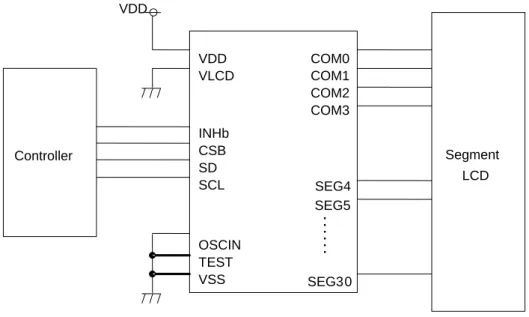
<BU9795AFV-LB>Using internal oscillator circuit mode
Using external oscillator mode
Figure 6. BU9795AFV example recommended circuit Controller VDD VLCD INHb CSB SD SCL OSCIN TEST VSS COM0 COM1 COM2 COM3 SEG4 SEG5 Segment LCD VDD SEG30 ・ ・ ・ ・ ・ ・ Controller VDD VLCD INHb CSB SD SCL OSCIN TEST VSS COM0 COM1 COM2 COM3 SEG4 SEG5 Segment LCD VDD SEG30 ・ ・ ・ ・ ・ ・
Function Description
Command and data transfer method
3-SPI (3wire Serial interface)
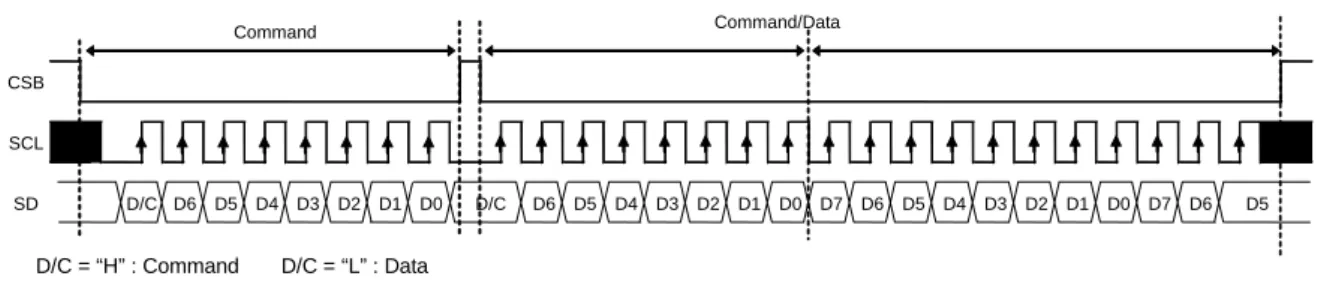
This device is controlled by 3-wire signal (CSB, SCL, and SD).
First, Interface counter is initialized with CSB=“H", and CSB=“L” makes SD and SCL input enable. The protocol of 3-SPI transfer is as follows.
Each command starts with Command or Data judgment bit (D/C) as MSB data, followed by D6 to D0 during CSB =“L”.
(Internal data is latched at the rising edge of SCL, it is converted to 8bits parallel data at the falling edge of 8th CLK.)
D/C = “H” : Command D/C = “L” : Data
Figure 7. 3-SPI Command/Data transfer format
Command transfer method
After CSB=“H”→”L”, 1st byte is always a command input.
MSB of the command input data will be judged that the next byte data, it is a command or display data (This bit is called
“command or data judgment bit”).
When set “command or data judge bit”=‘1’, next byte will be (continuously) command. When set “command or data judge bit”=‘0’, next byte data is display data.
Once it becomes display data transfer condition, it will not be back to command input condition even if D/C=1. So if you want to send command data again, please set CSB=“L”→”H”.
(CSB “L”→”H” will cancel data transfer condition.)
Command transfer is done by 8bits unit, so if CSB=“L”→”H” with less than 8bits data transfer, command will be cancelled.
It will be able to transfer command with CSB=“L” again.
Figure 8. Command transfer format
1 Command 1 Command 1 Command 0 Command Display Data … Command Command/Data D5 SCL CSB SD D/C D6 D5 D4 D3 D2 D1 D0 D/C D6 D5 D4 D3 D2 D1 D0 D7 D6 D5 D4 D3 D2 D1 D0 D7 D6 Command Command
DISCTL Command Transfer Command Cancelled (Less Than 8bits) DISPON Command Transfer
In Case Of Command Transfer
SD 1 2 3 4 5 6 7 6 1 2 3 4 5 1 STATUS 8 7 8 6 7 CSB SCL 8 1 2 3 4 5
Write display data and transfer method
<BU9795AFV-LB>
This LSI has Display Data RAM (DDRAM) of 27×4=108bit.
As SEG0, SEG1, SEG2, SEG3, SEG31, SEG32, SEG33, SEG34 are not output, these address will be dummy address.
The relationship between data input and display data, DDRAM data and address are as follows.
0000000 a b c d e f g h i j k l m n o p q r s t u v x y … Display Data
Command
Dummy data
8 bit data will be stored in DDRAM. The address to be written is the address specified by ADSET command, and the address is automatically incremented in every 4bit data.
Data can be continuously written in DDRAM by transmitting Data continuously.
(When RAM data is written successively after writing RAM data to 22h (SEG34), the address is returned to 00h (SEG0) by the auto-increment function.
DDRAM address 00h 01h 02h 03h 04h 05h 06h 07h ・・・・・・・ 1Eh 1Fh 20h 21h 22h BIT 0 a e i m q u COM0 1 b f j n r v COM1 2 c g k o s x COM2 3 d h l p t y COM3
SEG0 SEG1 SEG2 SEG3 SEG4 SEG5 SEG6 SEG7 ・・・・・・・SEG30 SEG31 SEG32 SEG33 SEG34
As data transfer to DDRAM happens every 4bit data, it will be cancelled if it changes CSB=“L”→”H” before 4bits data transfer.
Figure 9. BU9795AFV-LB Data Transfer Format
Dummy data Dummy data
D3 D2 D1 Return to address "0" by automatically increment. Address00h RAM write D4 D6 Internal signal D5 RAM write D0 D6 D5 D0 D7 D6
Write data will be canceled, when CSB='H'
without 4bit data transfer. D4 D3 D2 D1 D0 Internal signal RAM write Address00h Address01h Command CSB SCL D7 SD Address set SCL CSB SD Address set D7 D3 D2
Command RAM write
D1
D6 D5 D4 D0 D7
Address02h
Address00h Address21h Address22h RAM write (Every 4bit data)
OSCILLATOR
There are two kinds of clock for logic and analog circuit; from internal oscillator circuit or external clock input. If internal oscillator circuit will be used, OSCIN must be connected to VSS.
(Note) When you use external clock, execute ICSET command and connect OSCIN to external clock.
Figure 10. Internal oscillator circuit mode Figure 11. External clock mode
LCD Driver Bias Circuit
This LSI generates LCD driving voltage with on-chip Buffer AMP. And it can drive LCD at low power consumption.
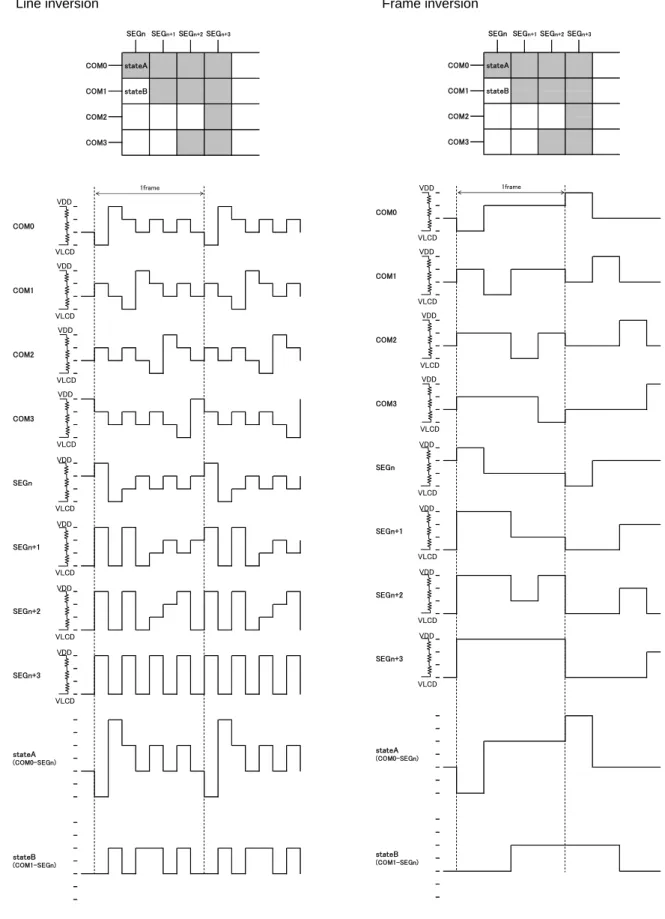
1/3 and 1/2Bias can be set in MODESET command. Line and frame inversion can be set in DISCTL command.
Refer to “LCD driving waveform” about each LCD driving waveform.
Blink timing generator
This device has Blinking function.
This LSI is able to set blink mode with BLKCTL command.
Blink frequency varies widely by characteristic of fCLK, when internal oscillation circuit. Refer to Oscillation Characteristics for more details on fCLK.
Reset (initial) condition
Initial condition after execute SOFTWARE RESET is as follows. ・Display is OFF.
・DDRAM address is initialized (DDRAM Data is not initialized). Refer to Command Description about initialize value of register.
Command / Function List
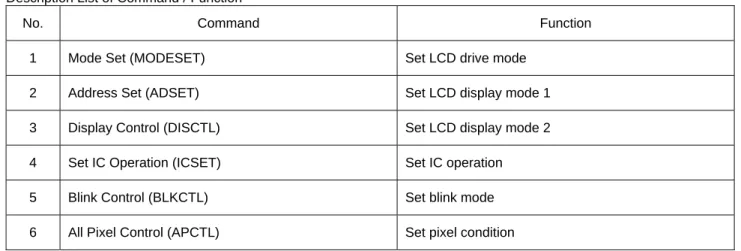
Description List of Command / Function
No. Command Function
1 Mode Set (MODESET) Set LCD drive mode
2 Address Set (ADSET) Set LCD display mode 1
3 Display Control (DISCTL) Set LCD display mode 2
4 Set IC Operation (ICSET) Set IC operation
5 Blink Control (BLKCTL) Set blink mode
6 All Pixel Control (APCTL) Set pixel condition
OSCIN BU9795AFV-LB VSS OSCIN BU9795AFV-LB VSS Clock input
Detailed Command Description
D7 (MSB) is bit for command or data judgment. Refer to Command and data transfer method.
C : 0 : Next byte is RAM write data. C : 1 : Next byte is command.
(1) Mode Set (MODE SET)
MSB LSB
D7 D6 D5 D4 D3 D2 D1 D0
C 1 0 * P3 P2 * *
(* : Don’t care)
Set display ON and OFF
Setting P3 Reset initialize condition
Display OFF(DISPOFF) 0 ○
Display ON(DISPON) 1
Display OFF : Regardless of DDRAM data, all SEGMENT and COMMON output will be stopped after 1 frame of data write. Display OFF mode will be finished by Display ON.
Display ON : SEGMENT and COMMON output will be active and start to read the display data from DDRAM.
(Note) It is not synchronize with display frame, when it will be controlled display ON/OFF with INHb terminal.
Set bias level
Setting P2 Reset initialize condition
1/3 Bias 0 ○
1/2 Bias 1
Refer to LCD driving waveform.
(2) Address set (ADSET)
MSB LSB
D7 D6 D5 D4 D3 D2 D1 D0 C 0 0 P4 P3 P2 P1 P0
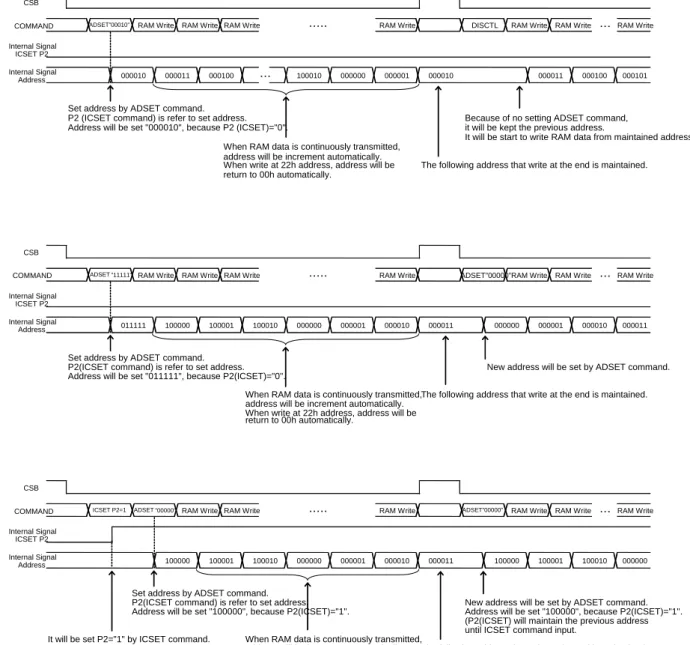
Address data is specified in P [4:0] and P2 (ICSET command) as follows.
MSB LSB
Internal register Address [5] Address [4] ・・・ Address [0]
Bit of each command ICSET [P2] ADSET [P4] ・・・ ADSET [P0]
The address is 00h in reset condition. The valid address is 00h to 22h. Another address is invalid, (otherwise address will be set to 00h.)
P2 of ICSET command is only to define either MSB of address is “1” or “0”. Address counter will be set only when ADSET command is executed.
Figure 12. Address Set sequence CSB COMMAND ・・・ Internal Signal ICSET P2 Internal Signal Address
Set address by ADSET command.
P2 (ICSET command) is refer to set address. Because of no setting ADSET command, Address will be set "000010", because P2 (ICSET)="0". it will be kept the previous address.
It will be start to write RAM data from maintained address. When RAM data is continuously transmitted,
address will be increment automatically.
When write at 22h address, address will be The following address that write at the end is maintained. return to 00h automatically. CSB COMMAND ・・・ Internal Signal ICSET P2 Internal Signal Address
Set address by ADSET command.
P2(ICSET command) is refer to set address. New address will be set by ADSET command. Address will be set "011111", because P2(ICSET)="0".
When RAM data is continuously transmitted, The following address that write at the end is maintained. address will be increment automatically.
When write at 22h address, address will be return to 00h automatically. CSB COMMAND ・・・ Internal Signal ICSET P2 Internal Signal Address
Set address by ADSET command.
P2(ICSET command) is refer to set address. New address will be set by ADSET command. Address will be set "100000", because P2(ICSET)="1". Address will be set "100000", because P2(ICSET)="1".
(P2(ICSET) will maintain the previous address until ICSET command input.
It will be set P2="1" by ICSET command. When RAM data is continuously transmitted,
(ICSET command cannot set address) address will be increment automatically. The following address that write at the end is maintained. When write at 22h address, address will be
return to 00h automatically. CSB COMMAND ・・・ Internal Signal ICSET P2 Internal Signal Address
Set address by ADSET command. It is written to RAM continuously P2(ICSET command) is refer to set address. from the previous address.
The address maintain the previous address When RAM data is continuously transmitted, because it doesn't input the ADSET command address will be increment automatically. though ICSET P2="0" setting.
When write at 22h address, address will be return to 00h automatically.
The following address that write at the end is maintained. 000101 RAM Write ・・・・・ RAM Write RAM Write
000011 000100 DISCTL RAM Write
100010 000000 000001 000010
ADSET”00010” RAM Write RAM Write
000011 000100
RAM Write
ADSET ”11111” RAM Write RAM Write RAM Write ・・・・・
000010
RAM Write
100000 100001 100010 000000
ICSET P2=1 ADSET”00000” RAM Write RAM Write
000010 000011 ・・・・・ RAM Write 000001 100010 000000 100000 100001 000001 000010 000011 100000 100001 100010 000000
ICSET P2=1 ADSET”00000” RAM Write RAM Write ・・・・・ RAM Write
ICSET P2=0 RAM Write RAM Write
100000 100001 100010 000000 100000 100001 100010 ADSET”00000” RAM Write 000011 000001 RAM Write 000000 011111 RAM Write ADSET”00000” 000010 ・・・ RAM Write RAM Write RAM Write RAM Write 000000 000001 ・・・・・
(3) Display control (DISCTL)
MSB LSB
D7 D6 D5 D4 D3 D2 D1 D0 C 0 1 P4 P3 P2 P1 P0
Set Frame frequency
Setting P4 P3 Reset initialize condition
80Hz 0 0 ○
71Hz 0 1
64Hz 1 0
53Hz 1 1
(Note) About the characteristics of FR, refer to Oscillation characteristics.
Set LCD drive waveform
Setting P2 Reset initialize condition
Line inversion 0 ○
Frame inversion 1
Set Power save mode
Setting P1 P0 Reset initialize condition
Power save mode 1 0 0 Power save mode 2 0 1
Normal mode 1 0 ○
High power mode 1 1
(Note) VDD-VLCD≥3.0V is required for High power mode.
(Reference current consumption data)
Setting Reset initialize condition
Power save mode 1 ×0.5
Power save mode 2 ×0.67
Normal mode ×1.0
High power mode ×1.8
(Note) Above current consumption data is reference value. It depends on panel load.
(Note) Frame frequency / LCD drive waveform / Power save mode setting will affect display image.
Select the best value in point of current consumption and display image using LCD panel (under real application).
Mode Screen flicker Display image / contrast
Frame frequency ○ -
LCD drive waveform ○ ○
(4) Set IC Operation (ICSET)
MSB LSB
D7 D6 D5 D4 D3 D2 D1 D0
C 1 1 0 1 P2 P1 P0
P2: MSB data of DDRAM address. Please refer to “ADSET” command. Setting P2 Reset initialize condition
Address MSB’0’ 0 ○
Address MSB’1’ 1
Set Software Reset condition
Setting P1
No operation 0
Software Reset 1
When “Software Reset” is executed, this LSI will be reset to initial condition.
If software reset is executed, the value of P2 and P1 will be ignored and they will be set initialized condition. (Refer to “Reset initial condition”)
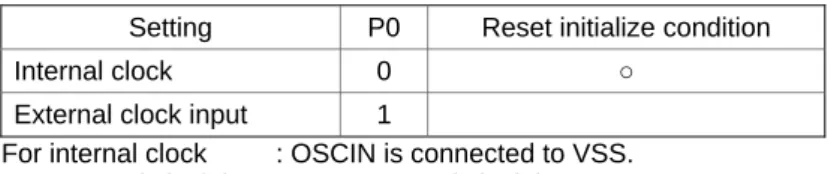
Switch between internal clock and external clock.
Setting P0 Reset initialize condition
Internal clock 0 ○
External clock input 1
For internal clock : OSCIN is connected to VSS. For external clock input: Input external clock into OSCIN.
<External Clock Frame frequency calculation>
DISCTL 80Hz select: Frame frequency [Hz] = external clock [Hz] / 512 DISCTL 71Hz select: Frame frequency [Hz] = external clock [Hz] / 576 DISCTL 64Hz select: Frame frequency [Hz] = external clock [Hz] / 648 DISCTL 53Hz select: Frame frequency [Hz] = external clock [Hz] / 768
Command ICSET
OSCIN_EN (Internal signal)
Internal clock mode
External clock mode
(Internal signal)
External clock (OSCIN) Internal oscillation
(5) Blink control (BLKCTL)
MSB LSB
D7 D6 D5 D4 D3 D2 D1 D0
C 1 1 1 0 * P1 P0
Set blink condition
Setting (Hz) P1 P0 Reset initialize condition
OFF 0 0 ○
0.5 0 1
1 1 0
2 1 1
(6) All pixel control (APCTL)
MSB LSB
D7 D6 D5 D4 D3 D2 D1 D0
C 1 1 1 1 1 P1 P0
All display set ON. OFF
Setting P1 Reset initialize condition
Normal 0 ○
All pixel ON 1
Setting P0 Reset initialize condition
Normal 0 ○
All pixel OFF 1
All pixels ON: All pixels are ON regardless of DDRAM data. All pixels OFF: All pixels are OFF regardless of DDRAM data.
(Note) All pixels ON/OFF is effective only at the time of “Display ON” status. The data of DDRAM do not change with this command. If both P1 and P0=‘1’, APOFF is selected. APOFF has higher priority than APON.
LCD Driving Waveform
(1/3bias)Line inversion Frame inversion
Figure 14. Line inversion waveform (1/3bias) Figure 15. Frame inversion waveform (1/3bias)
1frame COM0 COM1 COM2 COM3 SEGn SEGn+1 SEGn+2 SEGn+3 stateA (COM0-SEGn) stateB (COM1-SEGn) SEGn+2SEGn+3 COM3 stateA SEGn SEGn+1 COM0 COM1 COM2 stateB VDD VLCD VDD VLCD VDD VLCD VDD VLCD VDD VLCD VDD VLCD VDD VLCD VDD VLCD 1frame COM0 COM1 COM2 COM3 SEGn SEGn+1 SEGn+2 SEGn+3 stateA (COM0-SEGn) stateB (COM1-SEGn) COM2 COM3 COM0 stateA COM1 stateB
SEGn SEGn+1SEGn+2SEGn+3
VDD VLCD VDD VLCD VDD VLCD VDD VLCD VDD VLCD VDD VLCD VDD VLCD VDD VLCD
(1/2bias)
Line inversion Frame inversion
Figure 16. Line inversion waveform (1/2bias) Figure 17. Frame inversion waveform (1/2bias)
1frame stateA (COM0-SEGn) stateB (COM1-SEGn) COM2 COM3 COM0 stateA COM1 stateB
SEGn SEGn+1SEGn+2SEGn+3
SEGn SEGn+1 SEGn+2 SEGn+3 COM0 COM1 COM2 COM3 VDD VLCD VDD VLCD VDD VLCD VDD VLCD VDD VLCD VDD VLCD VDD VLCD VDD VLCD 1frame stateA (COM0-SEGn) stateB (COM1-SEGn) COM1 stateB COM2 COM3 SEGn+2SEGn+3 COM0 stateA SEGn SEGn+1 SEGn SEGn+1 SEGn+2 SEGn+3 COM0 COM1 COM2 COM3 VDD VLCD VDD VLCD VDD VLCD VDD VLCD VDD VLCD VDD VLCD VDD VLCD VDD VLCD
Example of Display Data
If LCD layout pattern is shown as in Figure18, Figure19 and DDRAM data is shown as in Table 2, display pattern will be shown as in Figure 20.
COM1 COM2 COM3 COM0
Figure 18. Example COM line pattern
Figure 19. Example SEG line pattern
Figure 20. Example Display pattern
Table 2. DDRAM Data map
S E G 0 S E G 1 S E G 2 S E G 3 S E G 4 S E G 5 S E G 6 S E G 7 S E G 8 S E G 9 S E G 10 S E G 11 S E G 12 S E G 13 S E G 14 S E G 15 S E G 16 S E G 17 S E G 18 S E G 19 COM0 D0 0 1 1 0 1 1 1 1 0 1 0 0 0 0 0 0 0 0 0 0 COM1 D1 0 0 1 1 1 0 0 1 1 1 1 0 0 0 0 0 0 0 0 0 COM2 D2 0 0 0 1 0 1 0 0 1 0 1 0 0 0 0 0 0 0 0 0 COM3 D3 0 0 1 1 0 0 0 1 0 1 0 0 0 0 0 0 0 0 0 0
Address 00h 01h 02h 03h 04h 05h 06h 07h 08h 09h 0Ah 0Bh 0Ch 0Dh 0Eh 0Fh 10h 11h 12h 13h
SEG1
Initialize Sequence
Please follow sequence below after Power-On to set this device to initial condition.
Power on
↓
CSB ’H’ …I/F initialize condition
↓
CSB ’L’ …I/F Data transfer start
↓
Execute Software Reset by sending ICSET command
(Note) Each register value and DDRAM address, DDRAM data are random condition after power on till initialize sequence is executed.
Start Sequence
1. Start sequence example 1
No. Input D7 D6 D5 D4 D3 D2 D1 D0 Descriptions
1 Power on VDD=0 to 5V (Tr=0.1ms)
↓
2 wait 100us Initialize IC
↓
3 CSB ’H’ Initialize I/F data
↓
4 CSB ’L’ I/F Data transfer start
↓
5 ICSET 1 1 1 0 1 * 1 0 Software Reset
↓
6 BLKCTL 1 1 1 1 0 * 0 1
↓
7 DISCTL 1 0 1 0 0 1 1 0
↓
8 ICSET 1 1 1 0 1 0 0 0 RAM address MSB set
↓
9 ADSET 0 0 0 0 0 0 0 0 RAM address set
↓
10 Display Data * * * * * * * * address 00h to 01h
Display Data * * * * * * * * address 02h to 03h
… …
Display Data * * * * * * * * address 22h to 00h
↓
11 CSB ‘H’ I/F Data transfer stop
↓
12 CSB ‘L’ I/F Data transfer start
↓
13 MODESET 1 1 0 * 1 0 * * Display ON
↓
2. Start sequence example 2
Initialize Sequence
DISPON Sequence
RAM write Sequence
DISPOFF Sequence
This LSI is initialized with Initialize Sequence. And start to display with DISPON Sequence. This LSI will update display data with RAM write Sequence.
And stop the display with DISPOFF sequence.
If you want to restart to display, This LSI will restart to display with DISPON Sequence.
Initialize sequence
D7 D6 D5 D4 D3 D2 D1 D0
IC initialized I/F initialized ICSET 1 1 1 0 1 0 1 0 Software Reset
MODESET 1 1 0 0 0 0 0 0 Display OFF
ADSET 0 0 0 0 0 0 0 0 RAM address set Display Data * * * * * * * * Display data
DISPON sequence
D7 D6 D5 D4 D3 D2 D1 D0
DISCTL 1 0 1 1 1 1 1 1 Display Control
BLKCTL 1 1 1 1 0 0 0 0 BLKCTL
APCTL 1 1 1 1 1 1 0 0 APCTL
MODESET 1 1 0 0 1 0 0 0 Display ON
RAM write sequence
D7 D6 D5 D4 D3 D2 D1 D0
DISCTL 1 0 1 1 1 1 1 1 Display Control
BLKCTL 1 1 1 1 0 0 0 0 BLKCTL
APCTL 1 1 1 1 1 1 0 0 APCTL
MODESET 1 1 0 0 1 0 0 0 Display ON
ADSET 0 0 0 0 0 0 0 0 RAM address set Display Data * * * * * * * * Display data
DISPOFF sequence
D7 D6 D5 D4 D3 D2 D1 D0
MODESET 1 1 0 0 0 0 0 0 Display OFF
CSB 'H'
Input DATA Description
CSB 'L' Description CSB 'L' … CSB 'H' CSB 'L' CSB 'H' Input DATA CSB 'H'
Input DATA Description
wait 100us CSB 'H' CSB 'L'
…
Input DATA Description
Power on Initialize RAM write DISPOFF DISPON
Example of Start Sequence
START
Please select Frame rate from 80Hz, 71Hz, 64Hz and 53Hz according to LCD panel characteristic.
Line inversion.
Power save mode= High Power mode
Operating current
Display quality Reduce operating
current or enhance display quality
DISCTL setup value "101**011"
Operating current decreases in order of 80Hz > 71Hz > 64Hz > 53Hz. Frame inversion.
Power save mode= Power save mode1
DISCTL setup value "101**100"
Screen Flicker? OK
NG
DISCTL setup value "101**101"
DISCTL setup value "101**100"
Screen Flicker? OK
NG
DISCTL setup value "101**101"
DISCTL setup value "101**110"
Screen Flicker? OK
NG
DISCTL setup value "101**110"
DISCTL setup value "101**111"
Please select Frame rate from 80Hz, 71Hz, 64Hz and 53Hz according to LCD panel characteristic.
Frame inversion.
Power save mode= Power save mode1
Operating current decreases in order of 80Hz > 71Hz > 64Hz > 53Hz.
Frame inversion.
Power save mode= Power save mode2
Please select Frame rate from 80Hz, 71Hz, 64Hz and 53Hz according to LCD panel characteristic.
Frame inversion.
Power save mode= Power save mode2
Operating current decreases in order of 80Hz > 71Hz > 64Hz > 53Hz.
Frame inversion.
Power save mode= Normal mode
Please select Frame rate from 80Hz, 71Hz, 64Hz and 53Hz according to LCD panel characteristic.
Frame inversion.
Power save mode= Normal mode
Operating current decreases in order of 80Hz > 71Hz > 64Hz > 53Hz.
Frame inversion.
Cautions on Power ON Condition
This LSI has “P.O.R” (Power-On Reset) circuit and Software Reset function.
Please keep the following recommended Power-On conditions in order to power up properly.
Please set power up conditions to meet the recommended tR, tF, tOFF, and Vbot spec below in order to ensure P.O.R operation.
Recommended condition of tR,tF,tOFF and Vbot
Figure 21. Power ON/OFF waveform
If it is difficult to meet above conditions, execute the following sequence after Power-On.
Command input is not accepted during power off. It has to take care that software reset is not a perfect substitute to POR function.
(1) CSB=“L”→”H” condition
VDD
CSB
Figure 22. CSB Timing
(2) After CSB”H”→”L”, execute Software Reset (ICSET command).
tR tF tOFF Vbot Less than 1ms Less than 1ms More than 150ms Less than 0.1V VDD tF tR tOFF Vbot
Cautions on Application
In case, BU9795AFV-LB used at VLCD≠VSS, voltage gap occur between SEG line to COM1–3 line at Display off state. Because of this voltage gap, there is possibility to display LCD for a moment.
To avoid this phenomenon, please decide VDD and VLCD level to satisfy Voff voltage lower than OFF level (OFF level = 1V at the example explained below).
condition : VDD=5.0V VLCD=2.0V 1/3bias
DDRAM data ALL "H"
Frame inversion VDD (5V) VLCD (2V) VLCD-VSS=2V VSS VDD (5V) VLCD (2V) VLCD-VSS=2V VSS VDD (5V) VLCD (2V) VLCD-VSS=2V VSS 3V 2V 1V 0V -1V -2V -3V 3V 2V 1V 0V -1V -2V -3V 1Frame COM0 Output COM1 Output SEG0 Output Voltage gap of COM0-SEG0
Display on Display off
Voltage gap of COM1-SEG0
Display on Display off
Send "Display off" command
the volatage between COM0 to SEG0 is 0V at display off.
Voltage gap occur between COM1 to SEG0 at display off. Output VSS level at display off (at COM 1-3 terminal) Output VLCD level at display off (All SEG terminal)
In case, VLCD voltage different from VSS level(VLCD≠VSS) In this case, volatage gap occur, between SEG line to COM 1-3 line. Because of this gap, there is possibility to display LCD for a moment.
Voff ON level
OFF level
Output VLCD level at display off (Only COM0 terminal)
the volatage between COM1 to SEG0 is -2V at display off.
Operational Notes
1. Reverse Connection of Power Supply
Connecting the power supply in reverse polarity can damage the IC. Take precautions against reverse polarity when connecting the power supply, such as mounting an external diode between the power supply and the IC’s power supply pins.
2. Power Supply Lines
Design the PCB layout pattern to provide low impedance supply lines. Separate the ground and supply lines of the digital and analog blocks to prevent noise in the ground and supply lines of the digital block from affecting the analog block. Furthermore, connect a capacitor to ground at all power supply pins. Consider the effect of temperature and aging on the capacitance value when using electrolytic capacitors.
3. Ground Voltage
Ensure that no pins are at a voltage below that of the ground pin at any time, even during transient condition.
4. Ground Wiring Pattern
When using both small-signal and large-current ground traces, the two ground traces should be routed separately but connected to a single ground at the reference point of the application board to avoid fluctuations in the small-signal ground caused by large currents. Also ensure that the ground traces of external components do not cause variations on the ground voltage. The ground lines must be as short and thick as possible to reduce line impedance.
5. Thermal Consideration
Should by any chance the power dissipation rating be exceeded the rise in temperature of the chip may result in deterioration of the properties of the chip. The absolute maximum rating of the Pd stated in this specification is when the IC is mounted on a 70mm x 70mm x 1.6mm glass epoxy board. In case of exceeding this absolute maximum rating, increase the board size and copper area to prevent exceeding the Pd rating.
6. Recommended Operating Conditions
These conditions represent a range within which the expected characteristics of the IC can be approximately obtained. The electrical characteristics are guaranteed under the conditions of each parameter.
7. Inrush Current
When power is first supplied to the IC, it is possible that the internal logic may be unstable and inrush
current may flow instantaneously due to the internal powering sequence and delays, especially if the IC
has more than one power supply. Therefore, give special consideration to power coupling capacitance,
power wiring, width of ground wiring, and routing of connections.
8. Operation Under Strong Electromagnetic Field
Operating the IC in the presence of a strong electromagnetic field may cause the IC to malfunction.
9. Testing on Application Boards
When testing the IC on an application board, connecting a capacitor directly to a low-impedance output pin may subject the IC to stress. Always discharge capacitors completely after each process or step. The IC’s power supply should always be turned off completely before connecting or removing it from the test setup during the inspection process. To prevent damage from static discharge, ground the IC during assembly and use similar precautions during transport and storage.
10. Inter-pin Short and Mounting Errors
Ensure that the direction and position are correct when mounting the IC on the PCB. Incorrect mounting may result in damaging the IC. Avoid nearby pins being shorted to each other especially to ground, power supply and output pin. Inter-pin shorts could be due to many reasons such as metal particles, water droplets (in very humid environment) and unintentional solder bridge deposited in between pins during assembly to name a few.
Operational Notes – continued
11. Unused Input PinsInput pins of an IC are often connected to the gate of a MOS transistor. The gate has extremely high impedance and extremely low capacitance. If left unconnected, the electric field from the outside can easily charge it. The small charge acquired in this way is enough to produce a significant effect on the conduction through the transistor and cause unexpected operation of the IC. So unless otherwise specified, unused input pins should be connected to the power supply or ground line.
12. Regarding the Input Pin of the IC
In the construction of this IC, P-N junctions are inevitably formed creating parasitic diodes or transistors. The operation of these parasitic elements can result in mutual interference among circuits, operational faults, or physical damage. Therefore, conditions which cause these parasitic elements to operate, such as applying a voltage to an input pin lower than the ground voltage should be avoided. Furthermore, do not apply a voltage to the input pins when no power supply voltage is applied to the IC. Even if the power supply voltage is applied, make sure that the input pins have voltages within the values specified in the electrical characteristics of this IC.
13. Ceramic Capacitor
When using a ceramic capacitor, determine the dielectric constant considering the change of capacitance with temperature and the decrease in nominal capacitance due to DC bias and others.
14. Area of Safe Operation (ASO)
Operate the IC such that the output voltage, output current, and power dissipation are all within the Area of Safe Operation (ASO).
15. Thermal Shutdown Circuit(TSD)
This IC has a built-in thermal shutdown circuit that prevents heat damage to the IC. Normal operation should always be within the IC’s power dissipation rating. If however the rating is exceeded for a continued period, the junction temperature (Tj) will rise which will activate the TSD circuit that will turn OFF all output pins. When the Tj falls below the TSD threshold, the circuits are automatically restored to normal operation.
Note that the TSD circuit operates in a situation that exceeds the absolute maximum ratings and therefore, under no circumstances, should the TSD circuit be used in a set design or for any purpose other than protecting the IC from heat damage.
16. Over Current Protection Circuit (OCP)
This IC incorporates an integrated overcurrent protection circuit that is activated when the load is shorted. This protection circuit is effective in preventing damage due to sudden and unexpected incidents. However, the IC should not be used in applications characterized by continuous operation or transitioning of the protection circuit.
Ordering Information
B
U
9
7
9
5
A
F
V
-
L B E 2
Part Number Package Product Class
LB for Industrial applications Packaging and forming specification E2: Embossed tape and reel
(SSOP-B40)
FV : SSOP-B40
Marking Diagram
SSOP-B40 (TOP VIEW)
BU9795AFV
Part Number Marking
LOT Number
Physical Dimension Tape and Reel Information
Package Name
SSOP-B40
∗ Order quantity needs to be multiple of the minimum quantity.
<Tape and Reel information>
Embossed carrier tape Tape
Quantity Direction
of feed The direction is the 1pin of product is at the upper left when you hold reel on the left hand and you pull out the tape on the right hand 2000pcs E2
(
)
Direction of feed Reel 1pinRevision History
Date Revision Changes
23.Aug.2013 001 New Release
26.Feb.2014 002 Delete sentence “and log life cycle” in General Description and Futures. Applied new style (change of the size of the title).
Notice
Precaution on using ROHM Products
1. If you intend to use our Products in devices requiring extremely high reliability (such as medical equipment (Note 1), aircraft/spacecraft, nuclear power controllers, etc.) and whose malfunction or failure may cause loss of human life, bodily injury or serious damage to property (“Specific Applications”), please consult with the ROHM sales representative in advance. Unless otherwise agreed in writing by ROHM in advance, ROHM shall not be in any way responsible or liable for any damages, expenses or losses incurred by you or third parties arising from the use of any ROHM’s Products for Specific Applications.
(Note1) Medical Equipment Classification of the Specific Applications JAPAN USA EU CHINA
CLASSⅢ
CLASSⅢ CLASSⅡb CLASSⅢ
CLASSⅣ CLASSⅢ
2. ROHM designs and manufactures its Products subject to strict quality control system. However, semiconductor products can fail or malfunction at a certain rate. Please be sure to implement, at your own responsibilities, adequate safety measures including but not limited to fail-safe design against the physical injury, damage to any property, which a failure or malfunction of our Products may cause. The following are examples of safety measures:
[a] Installation of protection circuits or other protective devices to improve system safety [b] Installation of redundant circuits to reduce the impact of single or multiple circuit failure
3. Our Products are not designed under any special or extraordinary environments or conditions, as exemplified below. Accordingly, ROHM shall not be in any way responsible or liable for any damages, expenses or losses arising from the use of any ROHM’s Products under any special or extraordinary environments or conditions. If you intend to use our Products under any special or extraordinary environments or conditions (as exemplified below), your independent verification and confirmation of product performance, reliability, etc, prior to use, must be necessary:
[a] Use of our Products in any types of liquid, including water, oils, chemicals, and organic solvents [b] Use of our Products outdoors or in places where the Products are exposed to direct sunlight or dust
[c] Use of our Products in places where the Products are exposed to sea wind or corrosive gases, including Cl2, H2S, NH3, SO2, and NO2
[d] Use of our Products in places where the Products are exposed to static electricity or electromagnetic waves [e] Use of our Products in proximity to heat-producing components, plastic cords, or other flammable items [f] Sealing or coating our Products with resin or other coating materials
[g] Use of our Products without cleaning residue of flux (even if you use no-clean type fluxes, cleaning residue of flux is recommended); or Washing our Products by using water or water-soluble cleaning agents for cleaning residue after soldering
[h] Use of the Products in places subject to dew condensation 4. The Products are not subject to radiation-proof design.
5. Please verify and confirm characteristics of the final or mounted products in using the Products.
6. In particular, if a transient load (a large amount of load applied in a short period of time, such as pulse. is applied, confirmation of performance characteristics after on-board mounting is strongly recommended. Avoid applying power exceeding normal rated power; exceeding the power rating under steady-state loading condition may negatively affect product performance and reliability.
7. De-rate Power Dissipation (Pd) depending on Ambient temperature (Ta). When used in sealed area, confirm the actual ambient temperature.
8. Confirm that operation temperature is within the specified range described in the product specification.
9. ROHM shall not be in any way responsible or liable for failure induced under deviant condition from what is defined in this document.
Precaution for Mounting / Circuit board design
1. When a highly active halogenous (chlorine, bromine, etc.) flux is used, the residue of flux may negatively affect product performance and reliability.
2. In principle, the reflow soldering method must be used; if flow soldering method is preferred, please consult with the ROHM representative in advance.
Precautions Regarding Application Examples and External Circuits
1. If change is made to the constant of an external circuit, please allow a sufficient margin considering variations of the characteristics of the Products and external components, including transient characteristics, as well as static characteristics.
2. You agree that application notes, reference designs, and associated data and information contained in this document are presented only as guidance for Products use. Therefore, in case you use such information, you are solely responsible for it and you must exercise your own independent verification and judgment in the use of such information contained in this document. ROHM shall not be in any way responsible or liable for any damages, expenses or losses incurred by you or third parties arising from the use of such information.
Precaution for Electrostatic
This Product is electrostatic sensitive product, which may be damaged due to electrostatic discharge. Please take proper caution in your manufacturing process and storage so that voltage exceeding the Products maximum rating will not be applied to Products. Please take special care under dry condition (e.g. Grounding of human body / equipment / solder iron, isolation from charged objects, setting of Ionizer, friction prevention and temperature / humidity control).
Precaution for Storage / Transportation
1. Product performance and soldered connections may deteriorate if the Products are stored in the places where: [a] the Products are exposed to sea winds or corrosive gases, including Cl2, H2S, NH3, SO2, and NO2 [b] the temperature or humidity exceeds those recommended by ROHM
[c] the Products are exposed to direct sunshine or condensation [d] the Products are exposed to high Electrostatic
2. Even under ROHM recommended storage condition, solderability of products out of recommended storage time period may be degraded. It is strongly recommended to confirm solderability before using Products of which storage time is exceeding the recommended storage time period.
3. Store / transport cartons in the correct direction, which is indicated on a carton with a symbol. Otherwise bent leads may occur due to excessive stress applied when dropping of a carton.
4. Use Products within the specified time after opening a humidity barrier bag. Baking is required before using Products of which storage time is exceeding the recommended storage time period.
Precaution for Product Label
QR code printed on ROHM Products label is for ROHM’s internal use only.
Precaution for Disposition
When disposing Products please dispose them properly using an authorized industry waste company.
Precaution for Foreign Exchange and Foreign Trade act
Since our Products might fall under controlled goods prescribed by the applicable foreign exchange and foreign trade act, please consult with ROHM representative in case of export.
Precaution Regarding Intellectual Property Rights
1. All information and data including but not limited to application example contained in this document is for reference only. ROHM does not warrant that foregoing information or data will not infringe any intellectual property rights or any other rights of any third party regarding such information or data. ROHM shall not be in any way responsible or liable for infringement of any intellectual property rights or other damages arising from use of such information or data.: 2. No license, expressly or implied, is granted hereby under any intellectual property rights or other rights of ROHM or any
third parties with respect to the information contained in this document.
Other Precaution
1. This document may not be reprinted or reproduced, in whole or in part, without prior written consent of ROHM. 2. The Products may not be disassembled, converted, modified, reproduced or otherwise changed without prior written
consent of ROHM.
3. In no event shall you use in any way whatsoever the Products and the related technical information contained in the Products or this document for any military purposes, including but not limited to, the development of mass-destruction weapons.
4. The proper names of companies or products described in this document are trademarks or registered trademarks of ROHM, its affiliated companies or third parties.
General Precaution
1. Before you use our Pro ducts, you are requested to care fully read this document and fully understand its contents. ROHM shall n ot be in an y way responsible or liabl e for fa ilure, malfunction or acci dent arising from the use of a ny ROHM’s Products against warning, caution or note contained in this document.
2. All information contained in this docume nt is current as of the issuing date and subj ect to change without any prior notice. Before purchasing or using ROHM’s Products, please confirm the la test information with a ROHM sale s representative.
3. The information contained in this doc ument is provi ded on an “as is” basis and ROHM does not warrant that all information contained in this document is accurate an d/or error-free. ROHM shall not be in an y way responsible or liable for any damages, expenses or losses incurred by you or third parties resulting from inaccuracy or errors of or concerning such information.