EVALUATION OF AN INNOVATIVE CONDOM DISTRIBUTION PROGRAM AND POINT-OF-ACCESS MESSAGING TARGETING BLACK COLLEGE WOMEN
Diane B. Francis
A dissertation submitted to the faculty of the University of North Carolina Chapel Hill in partial fulfillment of the requirements for the degree of Doctor of Philosophy in the School of
Media and Journalism.
Chapel Hill 2016
ABSTRACT
DIANE B. FRANCIS: Evaluation of an innovative condom distribution program and point-of-access messaging targeting Black college women
(Under the direction of Seth M. Noar)
Condom access is a major issue on some college campuses in the United States, including Historically Black Colleges and Universities (HBCUs). Lack of access increases risk of adverse sexual health outcomes, especially for young Black women. This project evaluated a structural intervention—a condom distribution program (via dispensers with free condoms) and point-of-access messaging (via posters on the dispensers)—on an all-female HBCU campus in North Carolina.
The three-month intervention occurred between November 2015 and January 2016. We used a pre-post intervention only longitudinal panel design. We recruited N = 195 sexually active students to complete a baseline survey and N = 118 students completed the follow-up survey. The retention rate was 61%.
The majority of students (89%) were aware of the dispensers. Slightly less than half (44%) used the dispensers, and 22% had those condoms with them at follow-up. Students mainly used dispensers to access condoms in the dorm bathrooms (81%, n = 42). They felt extremely comfortable using the dispensers, especially when alone. More than 70% (n = 38) who took condoms used them for sexual intercourse.
Condom acquisition and carrying increased significantly (p <. 05) after the
intervention. Perceptions of condom availability and accessibility also increased significantly (p <. 05). Perceptions of condom acceptability and norms did not change. Condom
intentions and use decreased significantly among the sample as a whole. In multivariate analyses, dispenser use was associated with greater condom use.
ACKNOWLEDGMENTS
A West African proverb says, “It takes a village to raise a child.” I believe it takes a village to get an individual through graduate school.
Few words can truly express how grateful I am to my village—people who supported, encouraged, and inspired me throughout this doctoral degree and beyond.
To my late grandma Mary, although you did not live to see one of your babies get this degree, you did so much of this walk with me. I thank you for raising me to be the person I am today. You will always be one of my Saints.
To my grandpa Oscar, thank you for being the strong, invisible hand guiding me through every stage of my life. Without you, I would not have been here today. You have been one of my biggest supporters all along and always believed in me even when I didn’t believe in myself.
Words cannot express the gratitude I have for my parents, siblings, grandmothers, sister-in-law and extended family. Thank you for your patience, encouragement, and unconditional love during not only the last four years but always. Gerard, thank you for always providing an ear when needed.
I have made a habit of making life-long friends at the start of new beginnings. Mikyla, I owe my life to you. I am glad I met you on the first day of undergrad orientation. You have been my best friend, champion, and confidant. Thank you for your unwavering friendship and continued support. To Nidhi, Catherine, and Whoopi, thank you so much for believing so strongly in me.
Ministry—for praying for me through this process. I truly believe your prayers and well wishes guided me through this degree. To my adopted Haitian family, many thanks for the memories that will always remind me there is life beyond academia. My Dominica and broader West Indian family, I know you walked alongside me in this journey. Yves-Marie, I was blessed the day my dad had the common sense to introduce us. Cara, thank you for being a true friend and colleague. Cassie, thank you for feeding me physically and
spiritually. Karen, I owe so much of my formal and informal education to you. Many thanks. With sincere appreciation, I also thank my advisor, Seth Noar, for his guidance, instruction, and mentorship. There is absolutely no way I will ever be able to repay or thank you for all you have done for me. I had no idea how much I would learn and gain from you in the process. The training you provided will follow me throughout my career.
To the rest of my amazing committee: Joan, Ada, Brian, and Deborah. Thank you for the knowledge you have imparted to me. Ada, thank you for taking the chance on someone who just wanted to learn about health communication and public health research. Joan, thank you for your enduring caring and support.
A special thanks to the faculty, staff, and students at the UNC Chapel Hill School of Media and Journalism. Nori Comello, thank you for giving me the opportunity to work with you. Daniel Kreiss, thank you for always supporting minority doctoral students. Heidi Hennick-Kaminski, thank you for coming through for me time and time again, and for not allowing me any moments of panic. I also greatly appreciate the amazing work done by Dana McMahan and her students Alex Brusko and Maddie Baldwin. Without their creative genius, the messages designed for this study would not have happened.
To the Park Family and the Roy H. Park Foundation, I thank you for your generous gift, without which my four years at the M-J School would not be possible
TABLE OF CONTENTS
LIST OF TABLES ... X LIST OF FIGURES ... XI
CHAPTER 1: PREVENTING HIV/STIS AMONG COLLEGE-AGED BLACK WOMEN ... 1
Introduction ... 1
The HIV/STI Epidemic Among Young Black Women ... 4
Interventions to Address HIV/STI Among Young Black Women ... 7
Project Belles: Condom Distribution Program and Point-Of-Access Messaging ... 9
Theoretical Approach ... 10
Intention-Action Conceptual Model ... 12
CHAPTER 2: EFFECTS OF A CONDOM DISTRIBUTION PROGRAM ON SAFER SEX PERCEPTIONS AND BEHAVIOR AMONG BLACK HBCU WOMEN ... 15
Introduction ... 15
Methods ... 21
Results ... 26
Discussion ... 31
Conclusion ... 35
CHAPTER 3: EXPOSURE AND IMPACT OF CONDOM DISPENSERS AND POINT-OF-ACCESS SAFER SEX MESSAGING TARGETING BLACK COLLEGE WOMEN ... 42
Introduction ... 42
Methods ... 46
Results ... 50
CHAPTER 4: EXAMINING THE ROLE OF INTERPERSONAL COMMUNICATION WITHIN THE CONTEXT OF THE CONDOM DISTRIBUTION PROGRAM AND POINT-OF-ACCESS
MESSAGING ... 61
Introduction ... 61
Methods ... 67
Results ... 69
Discussion and Conclusion ... 72
CHAPTER 5: DISCUSSION AND CONCLUSIONS ... 79
Strengths and Limitations ... 88
Conclusions ... 92
APPENDIX A: POSTERS WITH MESSAGES ... 93
APPENDIX B: TIMELINE AND CONTACTS FOR FOLLOW-UP DATA COLLECTION ... 95
APPENDIX C: BASELINE SURVEY ... 96
APPENDIX D: FOLLOW-UP SURVEY... 113
LIST OF TABLES
Table 1: Baseline Participant Demographic and Behavioral Characteristics ... 36
Table 2: Pre- and Post Intervention Evaluation Results ... 38
Table 3: Correlations for Variables in the Study ... 39
Table 4: Relationship Between Condom Access and Condom Intentions ... 40
Table 5: Relationship Between Condom Access and Condom Use ... 41
Table 6: Exposure to the Dispensers and Messages ... 57
Table 7: Perceptions of the Messages ... 58
Table 8: Sexual Health Variables by Categories of Exposure ... 59
Table 9: Logistic Regression for Sexual Health Variables by Categories of Exposure ... 60
Table 10: Interpersonal Communication and Online Social Sharing ... 76
Table 11: Correlations for Variables in the Study ... 77
LIST OF FIGURES
Figure 1: Conceptual Model……….………...……….12
Figure 2: Condom Dispenser and Safer Sex Messaging ... 19
Figure 3: Posters Used in Intervention ... 48
Figure 4: Proposed Model of Mediational Pathways Between Exposure and Norms ... 67
CHAPTER 1
Preventing HIV/STIs among college-aged Black women Introduction
The period from late adolescence to early adulthood—sometimes referred to as emerging adulthood—is a time marked by numerous transitions: chronological,
biological, psychological, social, and role-related. In the United States, the pathway from adolescence to adulthood is increasingly marked by the transition from high school to college. As of 2015, approximately two million Blacks1 between the ages of 18 and 24
attended four-year colleges and universities (Krogstad & Fry, 2014). Historically Black Colleges/Universities (HBCUs) enrolled about 300,000 students in 2015, and 50% were Black females (National Center for Education Statistics, 2016).
Emerging adulthood is also a time when young people are engaging in sexual activity (Finer & Philbin, 2013). The average age of first sexual intercourse for Black adolescents is about 15 years (Biello, Ickovics, Niccolai, Lin, & Kershaw, 2013). By their 16th birthday, 55% of Black females were likely to have had their sexual debut
(Cavazos-Rehg et al., 2009). Early adolescent sexual debut is associated with postsecondary education for females such that the earlier someone initiates sexual intercourse, the less likely they are to go to college (Spriggs & Halpern, 2008). However, early sexual debut does not preclude advancement to college. In one study of more than 7,000 HBCU students, 14% reported sexual initiation by age 13, 52% by age 15, and 73% by age 19 (Wang, Storr, Browne, & Wagner, 2011).
Consistent condom use remains low among adolescents and young adults (Buhi, Marhefka, & Hoban, 2010; Gurman & Borzekowski, 2004; McCave, Azulay Chertok, Winter, & Haile, 2013). Data from a national sample of U.S. college students show that only 42% of Black students reported always using a condom during vaginal intercourse in the previous 30 days (Buhi et al., 2010). In another study, less than one-third of college students said they always used a condom for vaginal intercourse (McCave et al., 2013). A study of HBCU students showed that among the 64% of HBCU students who used condoms at last sexual intercourse, 49% were females (El Bcheraoui, Sutton, Hardnett, & Jones, 2013). HBCU students who reported using condoms for disease prevention were more likely to have used condoms than those reporting using them for pregnancy prevention (El Bcheraoui et al., 2013).
Early sexual initiation, frequent sex, and inconsistent condom use are important risk factors for sexually transmitted infections (STIs), and may contribute to persistent sexual health disparities between Blacks and Whites. Among all women in the United States, for example, Black heterosexual women are the group most affected by HIV (Centers for Disease Control and Prevention, 2016). This disparity persists despite a reported 42% decrease in new HIV infections among Black women in the past decade (Centers for Disease Control and Prevention, 2016). STI disparities are especially pronounced among young people ages 15-24 years, despite being a smaller proportion of the sexually active population (Centers for Disease Control and Prevention, 2015b). The gonorrhea rate for Black females in that age group is 10 to 13 times that of White females; the chlamydia rate for Black females is four to five times that of White females (Centers for Disease Control and Prevention, 2015b).
condoms. Research demonstrates that condom preparatory behaviors are associated with increased condom use (Bryan, Fisher, & Fisher, 2002; Carvalho, Alvarez, Barz, & Schwarzer, 2015). Individuals, however, cannot obtain, carry and ultimately use condoms if there are significant environment constraints (Fishbein & Cappella, 2006), and condom access remains an issue for some young people.
Condom access is of particular concern to young African Americans, who are already at higher risk of acquiring STIs. African Americans may be more likely to live in condom deserts—places with low condom availability and meager sexual health resources (Shacham, Nelson, Schulte, Bloomfield, & Murphy, 2015). Recent research shows an inverse association between availability of condoms and sexually transmitted infections (Shacham, Nelson, et al., 2015; Shacham, Thornton, Godlonton, Murphy, & Gilliland, 2015). Using data from the St. Louis, Missouri, region, Shacham and
colleagues found that geographic regions with less available condoms have higher gonorrhea, chlamydia, and HIV rates (Shacham, Nelson, et al., 2015). Thus, differences in condom availability in the United States may explain some of the disparities in sexual health outcomes (Shacham, Nelson, et al., 2015; Wilson & Ickes, 2015).
Evidenced-based interventions to improve sexual health outcomes for young Black women are urgently needed. Health campaigns and condom distribution programs are among a myriad of approaches currently being tested (Centers for Disease Control and Prevention, 2015a). The research to date points to several gaps, however. First, while health campaigns can motivate psychosocial and behavior change, they do not address condom access directly. Second, while condom distribution programs can address condom access, especially condom availability and accessibility, they often fail to address or even consider condom acceptability (i.e. embarrassment when obtaining condoms), even when social marketing campaigns are conducted. Third, these
number of young Black women currently enrolled at colleges across the U.S., it is possible that many of them are acquiring STIs in their campus communities (Gonzalez-Barrera & Lopez, 2014). Consequently, interventions that address all aspects of condom access for college-aged Black women are warranted.
The purpose of this study was to develop, implement and evaluate a condom distribution intervention and point-of-access messaging targeting young Black women attending an all-female Historically Black College in North Carolina. The intervention combined campus-wide condom distribution (via condom dispensers with free condoms) and messages on the dispensers to increase condom acquisition and ultimately increase condom use.
The HIV/STI Epidemic Among Young Black Women
At the national level, Black women account for a disproportionate number of persons infected with HIV, a trend that began in the mid-1990s. The number of new HIV infections among Black women in the US declined more than 40% between 2005 and 2014 (Centers for Disease Control and Prevention, 2016). Black women, however, still account for 29% of all new infections among Black adolescents and adults, with rates 20 times that of White women in the U.S. (Centers for Disease Control and Prevention, 2015a). Put another way, two-thirds of new HIV infections among women in the U.S. occur in Black women, despite the fact that Black women represent only 14% of the female population.
Black women are also disproportionately at risk for other sexually transmitted infections such as chlamydia and gonorrhea (Centers for Disease Control and
times more likely to have gonorrhea and six times more likely to have chlamydia than White women (Centers for Disease Control and Prevention, 2014).
The HIV/STI epidemic is primarily concentrated in the certain regions of the country. The South, in particular, experienced the highest HIV infection rates in 2010 among the four main regions of the U.S. (Prejean et al., 2011), where eight of the 10 states with the highest HIV rates were in the South (Centers for Disease Control and Prevention, 2013b). Further, 15 of the top 20 Metropolitan Statistical Areas (MSAs) with the highest rates of HIV diagnoses in 2010 were in nine southern states (Centers for Disease Control and Prevention, 2013b).
At the state level, North Carolina ranked 12th among 45 states and territories
reporting new HIV diagnoses (17.8 per 100,000 population) and the adolescent/adult rate of new HIV diagnoses for Blacks was 62.8 per 100,000 (N.C. Department of Health & Human Services, 2015). This overall diagnosis rate for Blacks is almost 10 times higher than Whites. Additionally, the HIV diagnosis rate was 31.9 per 100,000 among Black females (N.C. Department of Health & Human Services, 2015). Thus, in 2014, Black females were 19 times more likely to contract HIV than their White counterparts in North Carolina (N.C. Department of Health & Human Services, 2015).
Several individual-level factors contribute to HIV/STI risk among Black women, including age of first sexual intercourse, inconsistent condom use, and low HIV/STI risk perceptions (Pflieger, Cook, Niccolai, & Connell, 2013; Sutton et al., 2011). In a study evaluating perceptions of sexual risk among Black female college students, Annang, Johnson, and Pepper-Washington (2012), found the majority of students did not
appear to be similar for black female students at public institutions and HBCUs— inconsistent condom use, increased number of sex partners, not getting tested (Buhi et al., 2010; Impett, Breines, & Strachman, 2010; Shegog, Lindley, Thompson-Robinson, Simmons, & Richter, 2012). Protective factors such as HIV/STI knowledge, HIV testing, and alcohol and drug abstinence, also appear to be as high or higher for Black students than other groups. Despite this, some Black HBCU students report higher rates of lifetime STIs (Younge et al., 2013).
Contextual factors may also contribute to HIV/STI risk. Contextual factors include lack of access to adequate sexual health products and services (such as condoms), lower social status, financial dependence on male partners, and sexual mixing patterns (Adimora, Ramirez, Schoenbach, & Cohen, 2014). As suggested before, African
Americans may live in places where they are less likely to have access to condoms and other sexual health resources (Shacham, Nelson, et al., 2015). Black students may also be more likely to attend colleges and universities with limited resources on campus, including HBCUs (Warren-Jeanpiere, Jones, & Sutton, 2011; Warren-Jeanpiere, Sutton, & Jones, 2011). Access to condoms particularly, may be an important structural-level factor that increases risk for HBCU students (Warren-Jeanpiere, Sutton, et al., 2011; Younge et al., 2013). In a study about HBCU campus culture and sexual health, Warren-Jeanpiere, Sutton, et al. (2011) found although condoms were available, the distribution sites lacked privacy and confidentiality. Additionally, some schools controlled the
distribution and acquisition of condoms: students could only acquire a limited number of condoms each time (Warren-Jeanpiere, Sutton, et al., 2011). HBCU health
sexual health, called the ‘paradox of risk’. Black adolescents and young adults engage in similar or less risky sexual behaviors than their White peers but experience higher rates of STIs (Younge et al., 2013).
Interventions to Address HIV/STI Among Young Black Women
Considering the disproportionate numbers of young Black women affected by HIV/STIs, and the individual and contextual factors affecting their risk, behavioral and structural interventions are still needed. Behavioral interventions are “interventions designed to affect the actions that individuals take with regard to their health” (Cutler, 2004). Johnson et al. (2009) conducted a meta-analysis of 78 behavioral interventions to assess their impact on sexual risk behaviors among Blacks. Such interventions proved efficacious at increasing condom use among intervention participants compared to controls (Johnson et al., 2009), with effect sizes for condom use ranging from d = .12 to .20. This meta-analysis also found short-term interventions (about 3 months) to be efficacious. Another meta-analysis of 39 studies evaluated the efficacy of behavioral interventions specifically for Black women in the United States (Crepaz et al., 2009). The results indicated these interventions were also efficacious in not only reducing self-reported risk behaviors but also STIs. The most successful interventions specifically targeted Black females, used culture- and gender-specific intervention materials, and empowered women by addressing protective behaviors (Crepaz et al., 2009).
demonstrated increased condom use at last intercourse among adolescents following introduction of condom availability programs at their schools (Blake et al., 2003; Guttmacher et al., 1997). One study found that making condoms available was associated with a decrease in STI cases among adolescent males aged 15-19 years (Wretzel, Visintainer, & Pinkston Koenigs, 2011). Previous research indicates becoming aware of condom availability programs (De Rosa et al., 2012) and obtaining school condoms (Guttmacher et al., 1997; Schuster, Bell, Berry, & Kanouse, 1997) was associated with increased condom use.
Communication campaigns occupy a space at the intersection of behavioral and structural interventions. Several of the condom distribution programs evaluated by Charania et al. (2011) included communication activities such as poster distribution and mass media campaigns. An example of this is the intervention “Hombes Sanos.” An HIV prevention campaign targeting Spanish-speaking men who have sex with men,
“Hombres Sanos” sharply increased safe sex practices by simultaneously distributing free condoms and promoting condom use via broadcast media, print materials, transit ads, and activities at local venues (Fernandez Cerdeno et al., 2012; Martinez-Donate et al., 2009; Martinez-Donate et al., 2010).
approach would be efficacious in increasing condom use among Black college-attending women.
Project Belles: Condom Distribution Program and Point-Of-Access Messaging Project Belles was an innovative, longitudinal intervention that combined condom distribution (via dispensers with free condoms) with point-of-access health messaging (posters on the dispensers) to address condom access among college-aged Black women. The target population was young Black women attending an all-female HBCU in the Southern United States. The project used a one-group, pre-post quasi-experimental design to examine effects of the intervention. In particular, the study examined: (1) changes in women’s perceptions of the availability, accessibility and acceptability of condoms on campus, as well as use of condoms, three months after implementation of the condom distribution program; (2) the influence of exposure to the point-of-access messaging on condom acceptability and condom norms; and (3) the role of interpersonal communication after the program.
The study was conducted at a small, all-female, religiously affiliated, HBCU in North Carolina. In Fall 2014, 98% of students were under 24 years of age, and 86% were Black (National Center for Education Statistics, 2016). The school enrolled students from North Carolina as well as several other states, including Georgia,
Maryland, Florida, and Washington D.C. (Bennett College, 2014); these mostly southern states experience some of the highest burdens of HIV and other STIs in the United States (Centers for Disease Control and Prevention, 2015b). Most of the North Carolina students at Bennett college were from Durham, Wake, Mecklenburg, and Guilford
disadvantaged (i.e. low socioeconomics, SES) families. Young women attending the college are similar to those attending other HBCUs in North Carolina: more than 80% of NC HBCU students receive Pell grants, and the majority have a primarily young, female student body (National Center for Education Statistics, 2016). These data suggest that, much like students at the college, many students at other HBCUs also come from low SES families. Low SES has been shown to be a significant risk factor for HIV.
This study builds on prior and existing safer sex initiatives at the college. Prior to the study, the college campus did distribute condoms to students (McDonald-Finch, 2015). However, the scope of the distribution was quite limited. Male and female condoms were primarily available at the campus health center and from dorm resident directors. At the health center, condoms were placed in bowls in the waiting area. This means condoms were in view of other students and health center staff. The limited availability of condoms and control of distribution through other persons are not surprising. One study on the sexual health environment at colleges across the U.S. revealed schools with large student populations and public institutions were much more likely to distribute condoms than institutions classified as small or faith-based institutions (Butler, Black, & Coster, 2011; Butler, Procopio, & Black, 2014).
Theoretical Approach
The current study draws on the integrative model of behavioral prediction
(Fishbein, 2000; Fishbein & Yzer, 2003) and the theory of gender and power (Wingood & DiClemente, 2000).
perceptions of what important others want them to do as well as what others in their community are doing, and self-efficacy refers to confidence that a person feels in performing a behavior. Underlying beliefs influence attitudes, perceived norms and self-efficacy (Fishbein & Yzer, 2003), and such beliefs are developed from a range of demographic, personal and societal factors. The integrative model of behavioral
prediction differs from theory of planned behavior mainly because of the inclusion of two additional constructs. The integrative model suggests that environmental factors and skills are important in determining whether a person performs a particular behavior. The theory suggests that if a person has an intention to perform a particular behavior (such condom use) but encounters environmental constraints (such as lack of access to condoms) then it is highly unlikely that the behavior will be performed.
The theory of gender and power is a social structural model that aims to
understand Black women’s risk as a function of three separate but interrelated structures (Wingood & DiClemente, 2000): The sexual division of labor, the sexual division of power and the structure of social norms and affective attachments (Wingood &
DiClemente, 2000). The sexual division of labor examines economic inequities that favor males such as unequal pay between men and women who perform the same work. The sexual division of power examines inequities and abuses of authority and control in relationships and institutions. This creates a power imbalance within relationships. The structure of social norms and affective attachments is particularly relevant to the current study. Expectations about who should be responsible for obtaining and keeping
protect herself. They also suggest conventional religious beliefs about safer sex and negative attitudes about HIV may influence a woman’s HIV risk behaviors.
Intention-Action Conceptual Model
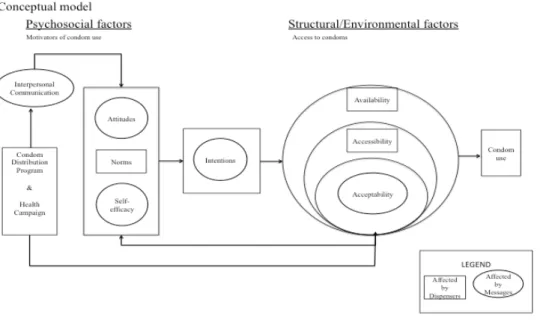
The intention-action conceptual model guides this study. The conceptual model is based on the integrative model of behavioral prediction (Fishbein, 2000; Fishbein & Yzer, 2003), the theory of gender and power (Wingood & DiClemente, 2000), prior research on structural-level condom distribution programs (Blankenship et al., 2006; Charania et al., 2011), and communication approaches to HIV prevention (Noar, Palmgreen, Chabot, Dobransky, & Zimmerman, 2009). The model holds that the
psychosocial variables of condom-related attitudes, norms and self-efficacy are primary determinants of intentions to use condoms, and that intentions are a primary determinant of condom use. Second, the model proposes that the relationship between intentions to use condoms and condom use is influenced by the extent to which the environment facilitates or constrains condom access (i.e., condom availability, accessibility, and acceptability). Third, the model suggests that the environmental factors, in turn, may influence condom attitudes, norms and self-efficacy (e.g., if condoms are more available, one’s perceptions of norms of use may be higher).
Dissertation Plan
In this dissertation, Chapter 2 reports the evaluation of the condom distribution program (via condom dispensers with free condoms). All students who were enrolled in the Fall 2015 were eligible to participate in the baseline questionnaire. We used a pretest-posttest panel design to evaluate changes in perceptions of the availability, accessibility and acceptability of condoms on campus, and use of condoms, over a 3-month period after implementation of the condom distribution program. This chapter also assesses awareness and use of the dispensers.
In Chapter 3, the effects of the point-of-access messages are explored. This chapter specifically assesses the impact of exposure to the messages and perceived message effectiveness on psychosocial and behavioral outcomes.
In Chapter 4 interpersonal communication about the combined intervention is examined, specifically addressing whether talking about the intervention affected perceptions of condom acceptability and condom norms.
CHAPTER 2
Effects of a condom distribution program on safer sex perceptions and behavior among Black HBCU women
Introduction
Condoms can prevent the transmission of many sexually transmitted infections. Limited availability and accessibility to condoms, and psychosocial barriers to condom acquisition (i.e. acceptability) may hinder their use. Condom distribution programs and communication campaigns can be efficacious in improving condom access (availability, accessibility and acceptability), condom preparatory behaviors (acquisition and carrying), and condom use (Charania et al., 2011). This paper reports the findings of an innovative, longitudinal intervention to increase condom access and use among young Black women attending an all-female Historically Black College in the Southeastern United States. Condoms were distributed via condom dispensers, and each dispenser displayed a poster with safer sex messaging. In particular, this paper focuses on (1) awareness and use of the condom dispensers; (2) changes in perceptions of condom availability, accessibility and acceptability of condoms; and (3) changes in condom norms, intentions and use. Condom Access: Availability, Accessibility and Acceptability
Three concepts in the domain of condom access—availability, accessibility, and acceptability—are important to understanding condom use (Blankenship et al., 2006; Charania et al., 2011). Availability refers to how much condoms are physically available in one’s environment. Accessibility refers to how easy or hard it is to obtain such condoms. Acceptability is the degree of comfort (or embarrassment) one feels when obtaining
condoms physically available in their environment (availability); know where to go to get them (accessibility); and be comfortable obtaining condoms in their environment
(acceptability). Any of these factors could pose significant barriers to obtaining condoms. Thus, attending to the availability, accessibility, and acceptability of condoms could facilitate condom access and use.
Availability of condoms may be a particular challenge for students attending
Historically Black Colleges/Universities (HBCUs). In past studies, students have described difficulties obtaining condoms on campus, and when condoms are available, it is usually on a limited basis (Warren-Jeanpiere, Jones, et al., 2011; Warren-Jeanpiere, Sutton, et al., 2011; Younge et al., 2013). One study found that while the majority of college health centers in the United States offered male latex condoms to students, private and faith-based
institutions were least likely to have condoms available (Butler et al., 2011). Additionally, the limited number and type of condoms distributed may not meet the sexual health needs of young women (Butler et al., 2011). The limited availability of condoms in some cases or the control of the distribution of condoms in other cases may make it difficult for college women to obtain condoms when needed (Warren-Jeanpiere, Jones, et al., 2011; Warren-Jeanpiere, Sutton, et al., 2011).
Even when condoms may seemingly be available on college campuses, they may not be easily accessible. That is, some students may not know where to get condoms on campus. In a recent study, less than half of African American female teens said they were confident they could get a condom when one was needed (Carmack, Lewis, & Roncancio, 2015). In another study, Black college students said they did not know that their HBCU campus health clinics provided free condoms (Warren-Jeanpiere, Jones, et al., 2011; Warren-Jeanpiere, Sutton, et al., 2011).
reported feeling embarrassed, and some feared the lack of confidentiality when obtaining condoms from some condom distribution sites (such as campus health centers) (Warren-Jeanpiere, Sutton, et al., 2011). This is because condoms are usually distributed in open spaces such as at a nurse’s desk, which may present opportunities for young persons to feel shame or discomfort when obtaining condoms (Warren-Jeanpiere, Jones, et al., 2011; Warren-Jeanpiere, Sutton, et al., 2011). Embarrassment when obtaining condoms may be particularly the case for young women (Francis et al., 2016). Studies show that embarrassed persons obtained, carried and used fewer condoms than those who were not embarrassed (Kelly, 1996; S. G. Moore et al., 2008; Ronis & LeBouthillier, 2013). Combined, these factors—availability, accessibility, and acceptability—affect one’s ability to obtain and use condoms, and may increase risk of adverse sexual health outcomes (Bell, 2009; S. G. Moore, Dahl, Gorn, & Weinberg, 2006; S. G. Moore et al., 2008).
To date, condom access has been given little attention in the HIV/STI prevention literature, as so many interventions focus solely on motivating condom use through individual-level changes in psychosocial variables (often with a lack of environmental changes). This despite evidence suggesting condom distribution is associated with greater condom use, and the growing evidence on the efficacy of condom distribution programs (Charania et al., 2011). In prior studies, becoming aware of condom availability programs (De Rosa et al., 2012) and obtaining school condoms (De Rosa et al., 2012; Wretzel et al., 2011) was associated with increased condom use. Condom use at last intercourse also increased among adolescents following the introduction of condom distribution programs at their schools (Blake et al., 2003); STIs also decreased (Wretzel et al., 2011). Evaluations of community-based condom distribution programs have also shown positive results (Burke et al., 2009; Burke et al., 2011; Des Jarlais et al., 2013).
does affect actual condom use among adolescents and young adults (S. G. Moore et al., 2006; Sheeran, Abraham, & Orbell, 1999). However, few findings have been reported for condom distribution interventions at U.S. colleges. Studies of condom and other sexual health resources on college campuses have primarily described the sexual health
environments (Butler et al., 2011; Butler et al., 2014; Eisenberg, Lechner, Frerich, Lust, & Garcia, 2012; Warren-Jeanpiere, Sutton, et al., 2011). For example, a survey of condom distribution methods at 378 U.S. colleges and universities found that while 96% of schools offered condoms at student health centers, only 26% offered condoms at those locations after hours (Butler et al., 2011). Only 13% of schools distributed condoms through
dispensing machines, and 9% made condoms available in bathrooms (Butler et al., 2014). Hence, increasing both actual and perceived ease of condom access is important for college-aged persons.
The purpose of this study was to assess the effectiveness of the condom distribution program and point-of-access messaging to increase condom access among college-aged Black women. The integrative model of behavioral prediction and theory of gender and power guided the intervention. The intervention was conducted at a small, all-female, religiously affiliated, HBCU in North Carolina, and builds on prior and existing sexual health initiatives at the college. The intervention began on November 1, 2015 and concluded on January 31, 2016. The intervention consisted of two main components: condoms (and lubrication) were distributed in dispensers installed in campus bathrooms, and posters with messages were placed inside the dispensers (Figure 2). We hypothesized increases in perceptions of condom availability, accessibility, and acceptability at follow-up when
compared to baseline (H1); higher condom norms, intentions and use at follow-up compared to baseline (H2); and that dispenser use and condom availability, accessibility, and
Figure 2: Condom Dispenser and Safer Sex Messaging
Formative Research and Intervention Design
Prior to launching the intervention, we conducted systematic formative research to develop the messages (See Appendix A for examples of the posters). We began the process by identifying our target audience of Black college women, and the specific site for the intervention—a Historically Black College in North Carolina. In a prior study, we found females to report greater embarrassment than males in procuring condoms after
implementation of condom dispensers on a college campus (Francis et al., 2016). Thus, it was important to develop messages targeted at females to increase comfort with taking and carrying condoms.
To develop and test the messages, we conducted six focus groups (n=40) in two phases with HBCU female students. In order to not “contaminate” the forthcoming study, we conducted this formative work at a different HBCU campus than where we implemented the condom dispensers. All focus group participants signed informed consent and received $15 gift cards. Female members of the research team conducted the focus groups.
salient beliefs about condom access, norms, and acceptability. We worked with a creative advertising team at the University of North Carolina at Chapel Hill School of Media and Journalism to draft two message concepts. The first concept used emojis (popular cartoon-like characters and symbols) and a females’ hand holding a condom. The second concept presented scripted messages (e.g. “There is nothing like being well packaged”) on a chalkboard background.
In the second phase, we conducted two additional focus group discussions to elicit feedback on the draft messages. Participants answered open-ended questions about attention, comprehension, credibility, cognitive and emotional reactions, personal relevance, perceived effectiveness, and overall appeal to HBCU students. In general, students
preferred the concept with the script on the chalkboard, perceiving it as a message that would catch their attention and encourage them to take condoms, and as something they would remember and share with their friends. Students further said they would feel comfortable obtaining condoms from the dispensers if the scripted messages were
displayed. They perceived the emoji-based concepts as interesting but not something that would motivate them to take a condom. Students suggested ways of enhancing the
chalkboard message concept, changing the colors of the posters to be more appealing, and simplifying the call to action. We revised initial messages according to the focus group feedback. Finally, we elicited feedback from key target audience informants at the intervention college. The final concept included four messages – each representing a different execution of the same theme – which was an empowering message to protect oneself, but delivered in a playful manner. The final messages used humor as a tool to attraction attention and persuasion (Markiewicz, 1974).
With our assistance and input, the campus health center staff at the participating school – led by the Health Center Manager – supervised the implementation and
messages, 15,000 condoms, and 5000 lubrication packets. The college’s staff installed the dispensers on November 1, 2015, mostly in bathrooms around campus. Nine dispensers were placed in bathrooms in four dormitories; one dispenser was placed in the campus health services building. Each dispenser holds about 120 condoms, and dorm resident directors and assistants checked and refilled the dispensers as needed. At the beginning of the project, the dispensers were filled with Trojan Lubricated® and Trojan Magnum®
condoms. Halfway through the project, Trojan Ecstasy® and lube were added to the mix. At the end of the 3-month intervention period, we counted all condoms that had not yet been used. Of the 15,000 condoms provided, about 13,021 remained at follow-up. Thus, 1,979 condoms were distributed during the intervention, or about 164.9 condoms per week.
Methods Participants and Procedures
The study used a one-group, pre-post quasi-experimental panel design to evaluate the intervention. We collected baseline surveys at a central campus location (i.e. student union lobby) over a nine-week period immediately before implementing the intervention. Prospective students were told this was a pre-post sexual health survey, but no mention of condom dispensers took place until it was asked about in the follow-up survey (in order to blind the evaluation purpose of the study). Six trained graduate research assistants (working in pairs) approached all students who entered the student union and asked if they wanted to hear about a study opportunity. Persons who said yes were provided a brief description of the study. If students were still interested in participating, they were given a screening form to assess eligibility. In order to be eligible to participate in the study, participants had to be: (1) currently enrolled at the targeted college; (2) 18 years of age or older; (3) self-identified as Black or African American; and (4) heterosexually active in the past 12 months.
completed the anonymous baseline survey. When done taking the baseline survey, respondents were given a separate iPad to input their contact information (name, email address, mailing address, and phone number) for communicating with them about the follow-up survey. The condom dispensers were implemented immediately after all baseline data collection was complete.
Participants completed the follow-up surveys on their personal computing devices three months after the intervention began. Follow-up data collection took three weeks to complete. We first sent participants an initial email containing a link to take the survey, and a text message alerting them of the start of data collection. Participants then received up to six reminder emails, three reminder text messages with links to take the survey, and two phone calls. In total, participants received between one and 13 contacts depending on when they completed the survey and their preferred method of communication (email, text messaging and phone calls). (See Appendix B for a chart with the timeline and number of contacts at follow-up.) We piloted both surveys prior to data collection. The duration for both surveys was approximately 15 minutes. Participants received a $10 gift card at baseline and $15 gift card at follow-up as incentives. At baseline, the gift card was delivered in person, while at follow-up the gift card was delivered over email.
Measures
The questionnaires comprised demographic variables, variables assessing awareness and use of the dispensers, condom access, and condom intentions and use.
Demographics were measured at baseline and included age (measured
continuously), ethnicity (Hispanic/non-Hispanic), residence (on campus or off campus), and current year in school. Participants also reported contraceptive use (birth control and emergency contraceptive) and partnership type (main or casual partners) and partner characteristics (age, education).
Sexual behavior was measured by asking participants, “In total, how many sexual partners have you had in the past 3 months?” Any participant who reported having had oral, vaginal or anal sex with one or more persons in the prior three months was reported as being currently sexually active.
Dispenser awareness was measured with one question taken from verbatim from a prior study (Francis et al., 2016): “Have you seen, in person, any of the new condom dispensers?” (1 = Yes, 0 = No.). Prior to answering that question, participants viewed a picture of the dispensers.
Dispenser use was also measured with one item: “In the past 3 months, did you ever use the condom dispensers?” (1 = Yes, 0 = No).
We measured whether participants were carrying condoms. At baseline, they were asked, “Are you carrying condoms with you right now (e.g. in your pocket, wallet, or purse)?” (1= Yes, 0 = No). At follow-up, they were asked whether they were carrying condoms that they took from the dispensers.
We also assessed other places where they obtained condoms. At baseline,
grocery store; campus event; and other. At follow-up, participants were asked to indicate places other than the dispensers from which they obtained condoms.
We assessed what participants did with the condoms they took from the dispensers. Participants were asked, “How many of the condoms that you took from the dispensers would you say you or your partner used?” and, “How many of the condoms that you took from the dispensers did you give away?” (None, a few, some, a lot, all of them). Responses were dichotomized (1 = a few or more, 0 = none).
Comfort with the dispensers was measured with 3 items, assessed separately: “In general, how comfortable do you feel using the dispensers? How comfortable do you feel using the dispensers when you are alone? How comfortable do you feel using the
dispensers when someone is watching?” (1=Extremely uncomfortable to 5=Extremely comfortable).
Availability was measured with two items adapted from a previous study (Francis et al., 2016). General availability was measured by asking, “In your opinion, how available are condoms on the Bennett College campus?” Location availability was measured by asking, “How often would you say you pass by a location where you can pick up a condom for free on campus?” These items were measured on a five-point Likert-type scale (1=not at all available, to 5=extremely available) and assessed separately.
Acceptability was measured with six items (Cronbach’s alpha was .93 at baseline and .93 at follow-up) adapted from the UCLA Multidimensional Condom Attitudes Scale (Helweg-Larsen & Collins, 1994): (1) “It is very embarrassing to obtain condoms”; (2) “When I need condoms I often dread having to get them; (3) I think that obtaining condoms is awkward”; (4) “It would be embarrassing to be seen buying condoms in a store”; (5) “It would be embarrassing to be seen picking up free condoms”; (6) “I always feel uncomfortable when I have to get condoms” (1=strongly disagree to 5=strongly agree). Values were recoded so that higher numbers are positive.
Condom norms were measured with four items (Cronbach’s alpha was .85 at baseline and .82 at follow-up): “How many of your female friends do you think…(1) talk about condoms with their sexual partners; (2) use condom during sexual intercourse; (3) carry condoms with them (4) get their own condoms” (1=none to 5=all).
Acquisition intentions were measured with a single item: How unlikely or likely is it that you will obtain condoms during the next 3 months (1=extremely unlikely to 5=extremely likely).
Carry intentions were measured with a single item: How unlikely or likely is it that you will carry condoms during the next 3 months” (1=extremely unlikely to 5=extremely likely).
Condom use intentions were measured with two items (Cronbach’s alpha was .90 at baseline and .90 at follow-up): “How unlikely or likely is it that you will…(1) use a condom the next time you have sexual intercourse during the next 3 months (oral, vaginal or anal sex); and (2) use condom every time you have sexual intercourse during the next 3 months” (1=extremely unlikely to 5=extremely likely).
Condom use was measured as frequency of condom use, “Thinking about all sexual behavior (oral, vaginal or anal sex) in the past 3 months, how often have you used
Data Analysis
All analyses were conducted in SPSS version 22 (SPSS Inc., Chicago, IL). Paired samples t-tests were used to evaluate the pre-post effects of the intervention. Descriptive, correlational, and multivariate regression analyses were performed to examine predictors of condom intentions and use. Prior to conducting the regression analyses, analysis of
standard residuals was carried out on the data to identify any outliers. The data contained no outliers (intentions: Std. Residual Min = -2.34, Std. Residual Max = 1.62; condom use: Std. Residual Min = -1.62, Std. Residual Max = 2.26). Tests to determine if the data met the assumption of collinearity indicated that multicollinearity was not a concern (VIF for all independent variables ranged from 1.01 to 1.19 for intentions and from 1.04 to 1.99 for condom use; tolerance for all variables ranged from 0.50 to 0.96 for intentions and from 0.50 to 0.96 for condom use). The data met the assumption of independent errors (intentions: Durbin-Watson value = 2.10; condom use: Durbin-Watson value = 1.86). The histograms of standardized residuals indicated that the data contained approximately normally distributed errors, as did the normal P-P plots of standardized residuals, which showed points that were at or close to the line. The scatterplots of standardized predicted values showed that the data met the assumptions of homogeneity of variance and linearity.
Results Sample Characteristics
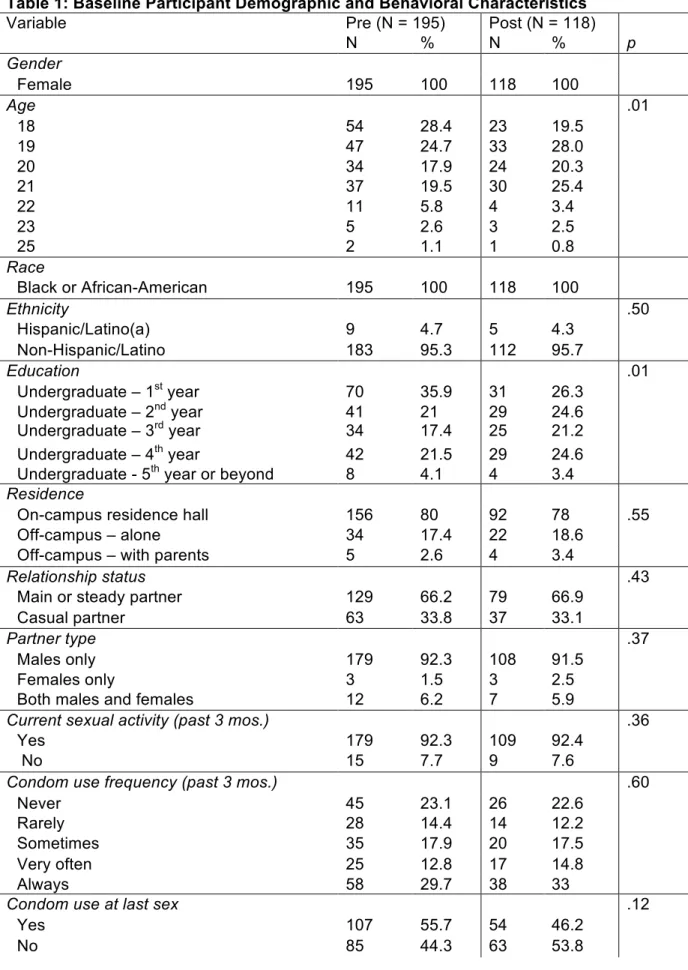
Table 1 shows the sample characteristics. At baseline, the mean age was 19.62 (SD = 1.49). First year students represented 35.9% of participants, while 21% were 2nd years,
17.4% were 3rd years and 21.5% were 4th years. Most participants (80%) lived on campus.
participants at baseline and 33% at follow-up reported always using condoms. And, less than half of the students (39.3% at baseline, 38.3% at follow-up) used other birth control methods.
In order to examine whether the follow-up sample differed from those who did not complete the study, we examined possible differences between follow-up survey completers and non-completers on age, ethnicity, education, residence, relationship status, partner type, current sexual behavior, condom use frequency, condom use at last sex, partner age, partner education, birth control, emergency contraception, and female condoms (Table 1). Age (p < .01) and education (p < .01) differed significantly among completers and non-completers, such that older participants and students in their later years of college were more likely to complete both surveys. Participants did not differ significantly on other characteristics.
Dispenser Awareness and Use
The majority of participants (89%, n = 105) saw the condom dispensers in person and 44% (n = 52) took a condom from the dispensers. The number of condoms students took each time they used the dispensers ranged from 1 to 12; on average, students took 4.35 (SD = 2.74) condoms each time. Of those who used the dispensers, ten percent (n = 5) said this was the first time they had ever obtained condoms. Participants mainly used
dispensers in the dorm bathrooms to obtain condoms (81%, n = 42). A much smaller percentage (15%) used both the dorm bathrooms and campus health center. More than 70% (n = 38) of students who got condoms from the dispensers reported using them for sexual intercourse, while 81% (n = 42) gave away some condoms they got from the dispensers.
significant. Obtaining condoms did increase significantly over the three-month period (p < .001). At the time of the follow-up survey, 22% (n = 26) were carrying condoms they got from the dispensers. In contrast, only 15% of students were carrying condoms at baseline. McNemar’s chi-quare test revealed this to be a significant increase (p < .001). We also added lubrication to the dispensers partway through the initiative. Nine students (17%) took lube packets from the dispensers. The number of packets taken each time ranged from 1 to 11.
Students were extremely comfortable using the dispensers (M = 4.25, SD = .93). They were much more comfortable using the dispensers when alone (M = 4.50, SD = .87) than when in the company of other students (M = 3.81, SD = 1.19). Students also expressed positive attitudes towards the dispensers (M = 3.99, SD = .80). They liked the condoms that were in the dispensers (M = 3.83, SD = 1.45), and the majority of students (82.7%) said they preferred the Trojan Magnum® condoms that was offered.
In terms of other places where students got condoms, at baseline most of those students had obtained condoms off campus (33% used pharmacies only and 12% used non-campus health clinics only); 17% of students had obtained condoms from the campus health center only. At follow-up, 26% of students reported obtaining condoms from the pharmacies, 13% from campus health center, and only 3% from non-campus health clinics.
Most students who used the dispensers (n = 31, 59.6%) said there were times when they went to take a condom from the dispenser but it was empty. The number of times the dispenser was empty ranged from 1 to 12, (mode = 1, median = 2).
Effects on Condom Access
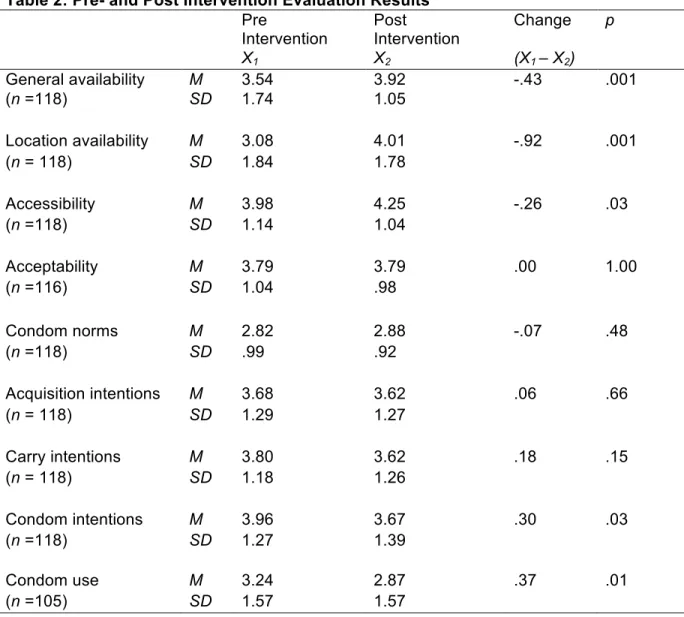
condoms to be somewhat available prior to the intervention (M = 3.54, SD = 1.74) and felt even more so after the intervention (M = 3.92, SD = 1.05), t(117) = -3.27, p < .001. They were also more likely to pass by a location with condoms (p < .001) and take free condoms (p < .01) after the intervention was implemented. Students perceived condoms to be accessible prior to the intervention (M = 3.98, SD = 1.14), and felt even more so after the intervention (M = 4.25, SD = 1.04), t(117) = -2.23, p < .05. Participants did not change their perceptions of condom acceptability, however (Pre: M = 3.79, SD = 1.04; Post: M = 3.79, SD = .98), t(115) = .01, p = 1.00.
Effects on Condom Norms, Intentions and Use
H2 predicted exposure to the intervention would increase condom norms, intentions and use at follow-up compared to baseline. Paired samples t-tests were performed to test these hypotheses (Table 2). Results revealed no significant differences in condom norms but a significant decrease in condom intentions and condom use. Condom norms slightly increased after implementation (M = 2.88, SD = .92) compared to before (M = 2.82, SD = .99), but the change was not statistically significant, t(117) = -.72, p = .48. Counter to our hypothesis, results also revealed a significant decrease in condom intentions and use. Students expressed favorable intentions to use condoms prior to implementation (M = 3.96, SD = 1.27), but they expressed lower intentions after implementation (M = 3.67, SD = 1.39), t(117) = 2.31, p = .03. Students also reported using condoms sometimes prior to the
intervention (M = 3.24, SD = 1.57), and they reported significantly lower condom use after the intervention (M = 2.87, SD = 1.57), (t(105) = 2.52, p = .01).
Association between Condom Access and Condom Intentions and Use
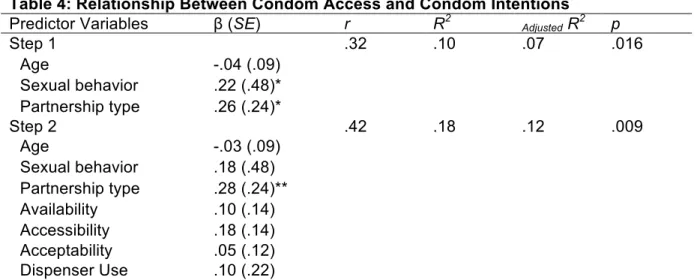
step 1, baseline age, sexual behavior and partner type were entered. In step 2, follow-up availability, accessibility, acceptability, and dispenser use were entered. The regression analysis was statistically significant (F(7, 94) = 2.90, p = .009, R2 = .18, R2
Adjusted = .12).
Sexual behavior was significant when first entered in the model (β = .22, t(94) = 2.24, p = .03). In the final model, however, only partner type was a significant predictor of condom intentions (β = .28) such that women with casual partners had higher intentions to use condoms than women with main partners. None of the other variables were significant.
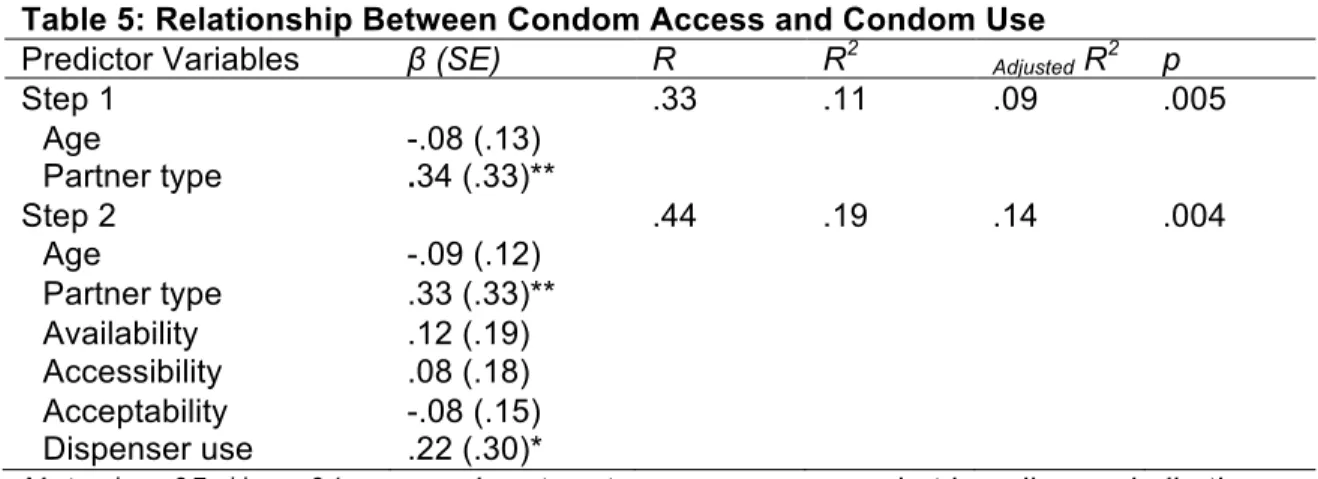
A second multiple hierarchical linear regression analysis was performed to evaluate how well key variables were associated with actual condom use at follow-up (Table 5). In step 1, baseline age and partnership type were entered. In step 2, follow-up availability, accessibility, acceptability, and dispenser use were entered. The regression analysis was significant (F(6, 87) = 3.42, p = .004, R2 = .19, R2Adjusted = .14). In the final model, partner
type (β = .33, t(94) = 3.25, p = .002) and dispenser use (β = .22, t(94) = 2.24, p = .028) were significantly associated with condom use. Women with casual partners and persons who used the dispensers were more likely to use condoms.
higher condom use frequency at follow-up (M = 3.75, SD = 1.44), followed by those who changed from casual to main partners (M = 3.43, SD = 1.43). Participants who maintained their main partnerships had lower condom use frequency (M = 2.49, SD = 1.58). Finally, participants who changed from main to casual partners reported the lowest condom use frequency (M = 2.36, SD = 1.43).
Discussion
This study investigated the effects of an innovative condom distribution program on safer sex outcomes, based on a pre-post design with a 3-month follow-up period. Results supporting this intervention were mostly found over a brief period of time, though some caveats should be noted. Overall, the findings support the potential for condom distribution programs and safe sex messaging to increase condom availability and accessibility for sexually active college-aged Black women.
The majority of respondents reported seeing the condom dispensers on campus. While slightly less than half the sample took condoms from the dispensers, the percentage increased to more than 50% when examining only those who saw the dispensers. A larger proportion of respondents were also carrying condoms after the intervention than before, and many of those condoms came from the dispensers. Put another way, more than half of respondents who saw the dispensers obtained condoms from the dispensers, and half of those who obtained condoms were carrying them at the time of the follow-up survey.
Moreover, in a multiple regression analysis controlling for several factors, dispenser use was significantly associated with condom use, suggesting that it may have played a role in increased condom use for some women. Obtaining and carrying condoms are
Perceptions of condom availability and accessibility increased significantly after the intervention. Participants were more likely to say that condoms were available after
implementation of the dispensers, and were significantly more likely to pass by a location where condoms were freely available. Although accessibility was relatively high prior to the intervention, the presence of the dispensers further increased participants’ access
perceptions of where to get condoms on campus and the ease of getting condoms. These findings are consistent with past research showing condom distribution programs increase condom availability and accessibility for young people (Centers for Disease Control and Prevention, 2015a; Charania et al., 2011). However, this study adds to this body of literature by showing that these findings extend to a predominantly Black, religiously affiliated college campus serving African American females.
Contrary to expectations, condom acceptability did not change. Condom
acceptability constitutes embarrassment, stigma, discomfort and awkwardness (or lack thereof) that young women may feel when attempting to access condoms. Evidence does indicate that embarrassment is one of the factors that can limit condom acquisition among young women (Bell, 2009; Brackett, 2004; Dahl, Gorn, & Weinberg, 1998; van Teijlingen et al., 2007). Prior to the intervention, young women in this study reported feeling moderate levels of condom acceptability. However, there was room for improvement and we expected the condom dispensers/messages to have a positive impact on condom acceptability. Some studies suggest that embarrassment may emerge as a result of the social context of
condom acquisition (Brackett, 2004; Dahl, Manchanda, & Argo, 2001). That is, the settings where students obtain condoms can sometimes provoke anxiety, stigma and
Brackett (2004) asked college students to purchase condoms and then describe their experiences in a narrative. While both males and females employed coping strategies to purchase condoms, females were more likely to do so than males. Strategies included monitoring other customers, moving quickly through the store, and concealing the box (Brackett, 2004). It is possible that acceptability remained unchanged because young women in this study had already developed strategies—such as monitoring their
environment and concealing the condom package—which they then used when obtaining condoms from the dispensers. Thus, they didn’t perceive the program as affecting how they felt about obtaining condoms. This may be particularly the case for older students, who were more likely to remain in the study at follow-up. Understanding how condom acceptability relates to condom use, and who is more susceptible to embarrassment about obtaining condoms is still important; as such findings have implications for sexual health research with young women.
Contrary to expectations, condom use intentions and condom use decreased between pre-test and post-test. The decrease in condom use was observed among individuals in main/steady relationships as well as those in more casual relationships. The decrease in condom use appears to be driven by the large number of students who maintained main partnerships throughout the study and who were less likely to use
use condoms less over time (Zimmerman et al., 2007). In many cases, they make the “contraceptive switch” from condoms to hormonal birth control as a relationship progresses, especially in the context of main/steady relationships (Noar, Zimmerman, & Atwood, 2004). Future research should continue to explore motivations for non-condom use in the context of intimate and casual relationships, including the role of condom access.
Conclusion
Table 1: Baseline Participant Demographic and Behavioral Characteristics
Variable Pre (N = 195) Post (N = 118)
N % N % p
Gender
Female 195 100 118 100
Age .01
18 54 28.4 23 19.5
19 47 24.7 33 28.0
20 34 17.9 24 20.3
21 37 19.5 30 25.4
22 11 5.8 4 3.4
23 5 2.6 3 2.5
25 2 1.1 1 0.8
Race
Black or African-American 195 100 118 100
Ethnicity .50
Hispanic/Latino(a) 9 4.7 5 4.3
Non-Hispanic/Latino 183 95.3 112 95.7
Education .01
Undergraduate – 1st year 70 35.9 31 26.3
Undergraduate – 2nd year 41 21 29 24.6
Undergraduate – 3rd year 34 17.4 25 21.2
Undergraduate – 4th year 42 21.5 29 24.6
Undergraduate - 5th year or beyond 8 4.1 4 3.4 Residence
On-campus residence hall 156 80 92 78 .55
Off-campus – alone 34 17.4 22 18.6
Off-campus – with parents 5 2.6 4 3.4
Relationship status .43
Main or steady partner 129 66.2 79 66.9
Casual partner 63 33.8 37 33.1
Partner type .37
Males only 179 92.3 108 91.5
Females only 3 1.5 3 2.5
Both males and females 12 6.2 7 5.9
Current sexual activity (past 3 mos.) .36
Yes 179 92.3 109 92.4
No 15 7.7 9 7.6
Condom use frequency (past 3 mos.) .60
Never 45 23.1 26 22.6
Rarely 28 14.4 14 12.2
Sometimes 35 17.9 20 17.5
Very often 25 12.8 17 14.8
Always 58 29.7 38 33
Condom use at last sex .12
Yes 107 55.7 54 46.2
Partner age .55
Younger than you 3 1.6 3 2.5
About the same age 106 54.9 63 53.4
Older than you 70 36.3 43 36.4
Much older than you 14 7.3 9 7.6
Partner education .49
Student at same school 5 2.6 4 3.4
Student at different school 99 51 57 48.3
Not a college student 90 46.4 57 48.3
Birth control .42
Yes 75 39.3 44 38.3
No 116 60.7 71 61.7
Emergency contraception .22
Yes 39 20.5 21 18.3
No 151 79.5 94 81.7
Female condoms .58
Yes 15 8 9 7.9
Table 2: Pre- and Post Intervention Evaluation Results Pre
Intervention
Post
Intervention
Change p
X1 X2 (X1 – X2)
General availability M 3.54 3.92 -.43 .001
(n =118) SD 1.74 1.05
Location availability M 3.08 4.01 -.92 .001
(n = 118) SD 1.84 1.78
Accessibility M 3.98 4.25 -.26 .03
(n =118) SD 1.14 1.04
Acceptability M 3.79 3.79 .00 1.00
(n =116) SD 1.04 .98
Condom norms M 2.82 2.88 -.07 .48
(n =118) SD .99 .92
Acquisition intentions M 3.68 3.62 .06 .66
(n = 118) SD 1.29 1.27
Carry intentions M 3.80 3.62 .18 .15
(n = 118) SD 1.18 1.26
Condom intentions M 3.96 3.67 .30 .03
(n =118) SD 1.27 1.39
Condom use M 3.24 2.87 .37 .01
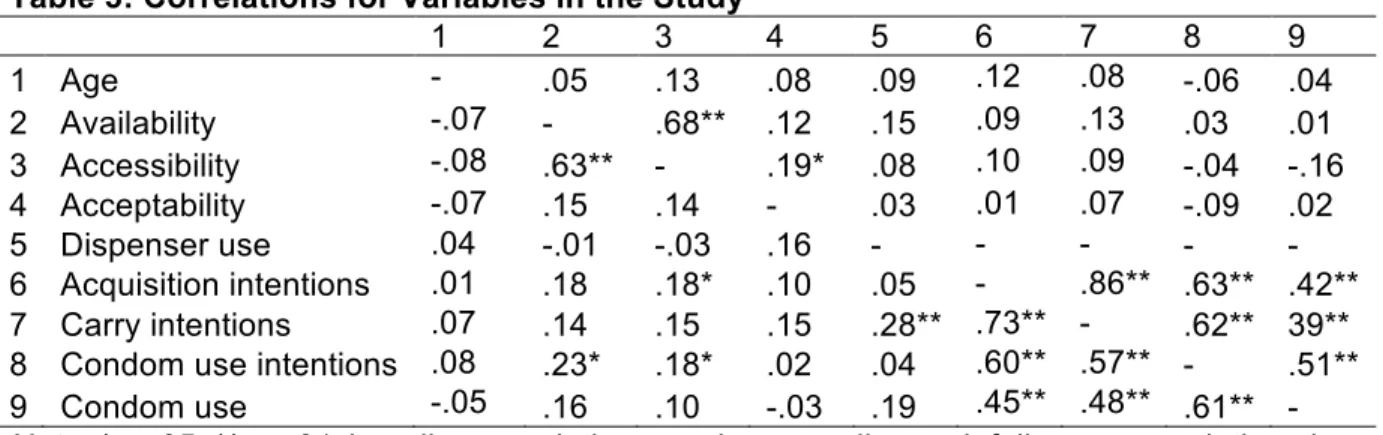
Table 3: Correlations for Variables in the Study
1 2 3 4 5 6 7 8 9
1 Age - .05 .13 .08 .09 .12 .08 -.06 .04
2 Availability -.07 - .68** .12 .15 .09 .13 .03 .01 3 Accessibility -.08 .63** - .19* .08 .10 .09 -.04 -.16 4 Acceptability -.07 .15 .14 - .03 .01 .07 -.09 .02
5 Dispenser use .04 -.01 -.03 .16 - - - - -
Table 4: Relationship Between Condom Access and Condom Intentions
Predictor Variables β (SE) r R2
Adjusted R2 p
Step 1 .32 .10 .07 .016
Age -.04 (.09)
Sexual behavior .22 (.48)* Partnership type .26 (.24)*
Step 2 .42 .18 .12 .009
Age -.03 (.09)
Sexual behavior .18 (.48) Partnership type .28 (.24)** Availability .10 (.14) Accessibility .18 (.14) Acceptability .05 (.12) Dispenser Use .10 (.22)
Table 5: Relationship Between Condom Access and Condom Use
Predictor Variables β (SE) R R2
Adjusted R2 p
Step 1 .33 .11 .09 .005
Age -.08 (.13)
Partner type .34 (.33)**
Step 2 .44 .19 .14 .004
Age -.09 (.12)
Partner type .33 (.33)** Availability .12 (.19) Accessibility .08 (.18) Acceptability -.08 (.15) Dispenser use .22 (.30)*
CHAPTER 3
Exposure and impact of condom dispensers and point-of-access safer sex messaging targeting Black college women
Introduction
Psychosocial and normative barriers to accessing condoms may impede condom acquisition and use. The current normative environment in the United States, for example, suggests that young women should not be seen acquiring condoms and should not be carrying condoms on their person (Reeves, Ickes, & Mark, 2016). According to prior studies, both young women and young men often hold the belief that young women should not be accessing and carrying condoms (Bell, 2009; Warren-Jeanpiere, Sutton, et al., 2011). Some young women also hold the belief that because they are not the ones who “use condoms” then they should not be responsible for getting them.
The theory of gender and power (Wingood & DiClemente, 2000) posits that these negative societal beliefs put young women at increased risk for HIV and other sexually transmitted infections. By creating taboos with regard to how young women should express their sexuality, society prevents young women from taking proactive steps—such as
Past research further indicates that some young people feel shameful and embarrassed about obtaining condoms (Bell, 2009; Dahl et al., 2001; S. G. Moore et al., 2006; Warren-Jeanpiere, Sutton, et al., 2011). Young women, in particular, are more likely to feel embarrassment than young men (Francis et al., 2016; Reeves et al., 2016). This is because condom acquisition carries with it a possible embarrassing acknowledgment that the person will have or intends to have sex. Young women may be stigmatized more than men if they are seen obtaining carrying condoms because of the perception that they “want sex” or are promiscuous. (Bell, 2009; Warren-Jeanpiere, Sutton, et al., 2011).
Embarrassment is a reaction to, or the anticipation of, a negative evaluation of oneself by a real or imagined audience, leading to an ‘‘aversive and awkward emotional state following events that increase threat of unwanted evaluation from a real or imaged social audience” (Dahl et al., 2001). Embarrassment and stigma about obtaining condoms is separate and independent from embarrassment about putting on, using, or disposing of condoms (S. G. Moore et al., 2008). S. G. Moore et al. (2008) found embarrassment about obtaining condoms exceeded embarrassment about condom use. They also found condom acquisition embarrassment was negatively associated with condom carrying and frequency of condom use. People who were embarrassed obtained, carried and used fewer condoms than those who were not (S. G. Moore et al., 2008). This finding complemented a study from a decade earlier, which found that embarrassed individuals purchased condoms less often, less recently, and purchased fewer condoms (Dahl et al., 1998).
Despite the relationship between condom acceptability and condom acquisition, few condom distribution interventions have directly addressed these beliefs and behaviors. Condom distribution interventions have been effective at increasing availability and
accessibility of condoms. However, that may not be enough. Francis et al. (2016) found that even when condoms were made available and accessible via dispensers in college