ISSN 1653-2090 ISBN 978-91-7295-174-7
Firms have since long given their regular custo-mers special treatment. With the help of IT, many firms have established formal ways to do this. An example is a so-called customer rewards program (CRP), by which the firm rewards the customer for repeated purchase.
Firms allocate large resources in these pro-grams with millions of customers enrolled. Hence, it seems important that the CRP works effecti-vely. By effective we mean that it increases sales. Whether it is effective or not is a matter of how it is designed.
A CRP typically comes with membership levels. We study how many membership levels the firm should offer in an effective program. We also study if customers prefer individual or group rewards and whether a CRP can break and create habitual purchasing behavior. In the study, we also analyze under what conditions the customer prefers a CRP over a sales promotion.
In general, the study adds to the understanding of Customer Rewards Programs as an incentive
structure. There are many different ways to de-sign these incentives and especially the continuing development of IT is expected to influence the future design and role of these types of programs.
This study is part of the Swedish Research School of Management and Information Technology (MIT) which is one of 16 national research schools supported by the Swedish Government. MIT is jointly operated by the following institutions: Blekinge Institute of Techno-logy, Gotland University College, Jönköping Internatio-nal Business School, Karlstad University, Linköping Uni-versity, Lund UniUni-versity, Mälardalen University College, Stockholm University, Växjö University, Örebro Univer-sity, IT University of Göteborg, and Uppsala UniverUniver-sity, host to the research school. At the Swedish Research School of Management and Information Technology (MIT), research is conducted, and doctoral education provided, in three fields: management information sys-tems, business administration, and informatics.
ABSTRACT
2010:01
Blekinge Institute of Technology
Doctoral Dissertation Series No. 2010:01
School of Management
CuSTomeR RewARdS PRogRAmS
deSigning inCenTiveS foR RePeATed PuRChASe
Customer Rewards Programs
Designing Incentives for Repeated Purchase
Customer Rewards Programs
Designing Incentives for Repeated Purchase
Henrik Sällberg
Blekinge Institute of Technology Doctoral Dissertation Series
No 2010:01
School of Management
Blekinge Institute of Technology
© 2010 Henrik Sällberg School of Management
Publisher: Blekinge Institute of Technology Printed by Printfabriken, Karlskrona, Sweden 2010 ISBN 978-91-7295-174-7
Blekinge Institute of Technology Doctoral Dissertation Series ISSN 1653-2090
Acknowledgements
This dissertation is the result of research that started the autumn 2002 when I was admitted to the Swedish Research School of Management and Information Technology. A special thanks to my advisor professor Birger Rapp, who is also one of the founders of the above mentioned research school. During the whole process you have provided me with challenging ideas and you always share your unequivocal experience in knowledge production which I highly appreciate. In general, your driving ambition to contribute to PhD-students education is a fine quality which I hope is appreciated by many. Thank you Birger.
A special thanks also to my advisor associate professor Anders Hederstierna. From our countless informal meetings I have learned so much about conducting research. I can only hope that you in the future will be able to spend more time doing research yourself. Your creativity and ability to extract what is most important are skills which there cannot be too much of in academics. Thank you Anders.
Thanks also to those responsible at the School of Management for choosing to finance this research project, thanks to my colleagues at the School of management and thanks to everyone involved in the Swedish Research School of Management and Information Technology.
Finally, I would like to thank you mum for all the lovely Sunday dinners and for raising me to what I have become; someone who never gives up.
Table of Content
CHAPTER I INTRODUCTION ... 1
The Ubiquity of Customer Rewards Programs ... 1
Rewards Program Design ... 3
Problem Discussion ... 4
Purpose ... 7
Choice of Methods ... 9
Thesis Outlook ... 13
CHAPTER II PREVIOUS STUDIES OF CUSTOMER REWARDS PROGRAMS ... 16
Loyalty ... 16
Switching Cost ... 20
Collusion ... 22
Customer Information ... 24
Comments ... 27
CHAPTER III AN INCENTIVE STRUCTURE APPROACH ... 29
Defining Customer Rewards Program ... 29
The Incentive Structure ... 32
Comments ... 38
CHAPTER IV THE INCENTIVE STRUCTURE: PREVIOUS STUDIES AND THE CURRENT STUDY ... 40
Previous Studies ... 40
The Incentive Structure: The Current Study ... 54
CHAPTER V SPENDING STRATEGIES IN CUSTOMER REWARDS PROGRAMS: TIMING AND UNCERTAINTY OF REWARDS ... 59
Background ... 59
Decision Setting ... 62
Analysis: Choice of Spending Strategy ... 65
CHAPTER VI BRONZE, SILVER AND GOLD: EFFECTIVE MEMBERSHIP DESIGN IN CUSTOMER
REWARDS PROGRAMS ... 79
Introduction ... 79
Membership Design in CRPs ... 80
The "Bronze, Silver and Gold" Phenomenon ... 85
A Structure of Membership Rewards ... 86
A Model of the Value of Spending to Become Member ... 87
Incentive to Reach a Membership level ... 90
Spending Incentive and Opportunity Cost ... 90
Discussion ... 91
CHAPTER VII REWARD ONE OR MANY: GROUP REWARDS VERSUS INDIVIDUAL REWARDS IN CUSTOMER REWARDS PROGRAMS ... 95
Background ... 95
Customer Rewards Program Incentives ... 96
Group Rewards versus Individual Rewards ... 98
Incentive Strength of a Reward: A Model ... 100
An Experiment: Group Rewards Versus Individual Rewards ... 102
Results and Analysis ... 109
Discussion ... 114
CHAPTER VIII BUY AS USUAL: CUSTOMER REWARDS PROGRAMS AND THE CREATION AND BREAKING OF CONSUMPTION HABITS ... 117
Background ... 117
Customer Rewards Programs: Purchase Effects ... 118
Consumption Habits ... 121
Experimental Design ... 124
Results and Analysis ... 130
Discussion ... 136
CHAPTER IX Validity and Reliability of Results ... 140
Main Concerns during the Study ... 140
CHAPTER X CONCLUSIONS ... 155
Returning to the Research Questions ... 155
Future Research ... 159
Final Remarks ... 164
List of Figures
FIGURE 3.1 ILLUSTRATION OF SAVED ACCUMULATED SPENDING ... 34 FIGURE 3.2 REWARD FUNCTION TRAJECTORIES ... 35 FIGURE 4.1 THE CURVILINEAR EFFECT OF EFFORT ON
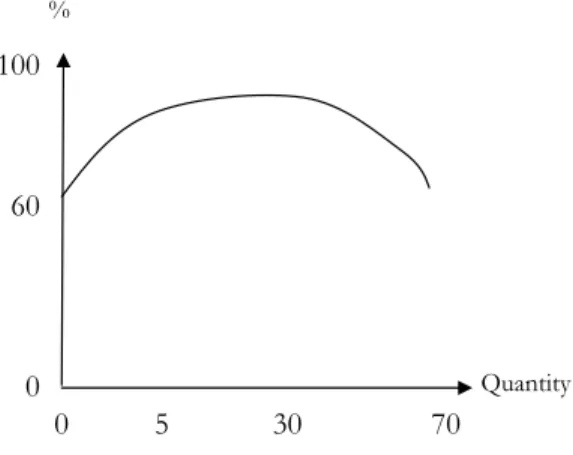
REWARD PREFERENCE FOUND BY KIVETZ (2003) ... 53 FIGURE 5.1 ILLUSTRATION OF THE TWO FICTIVE PURCHASE
INCENTIVES, WHERE S= SPENDING, R= REWARD
t= TIME ... 62 FIGURE 5.2 DECISION VALUE FOR SPENDING STRATEGIES
WHEN pS and pR ARE CERTAIN ... 66 FIGURE 5.3 DECISION VALUE FOR SPENDING STRATEGIES
WHEN pS IS UNCERTAIN ... 68 FIGURE 5.4 DECISION VALUE FOR SPENDING STRATEGIES
List of Tables
TABLE 3.1: EXAMPLES OF DEFINITIONS OF CUSTOMER REWARDS
PROGRAMS ... 30 TABLE 4.1 ILLUSTRATION OF EXPERIMENT DESIGN FOR TEST
OF MEDIUM EFFECT ... 41 TABLE 4.2 ILLUSTRATION OF POINT-ALLOCATION-SCHEDULES,
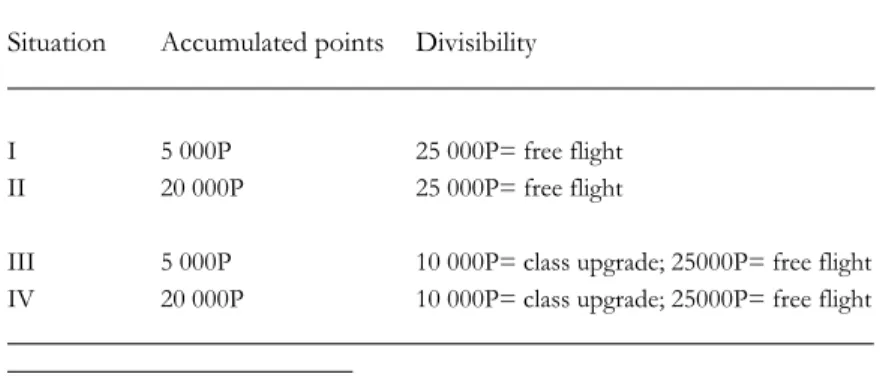
WHERE P= POINTS AND R= REWARD VALUE ... 43 TABLE 4.3 DECISION SITUATIONS IN THE DIVISIBILITY STUDY,
WHERE P= POINTS ... 46 TABLE 4.4 DECISION SITUATIONS IN THE STUDY ON
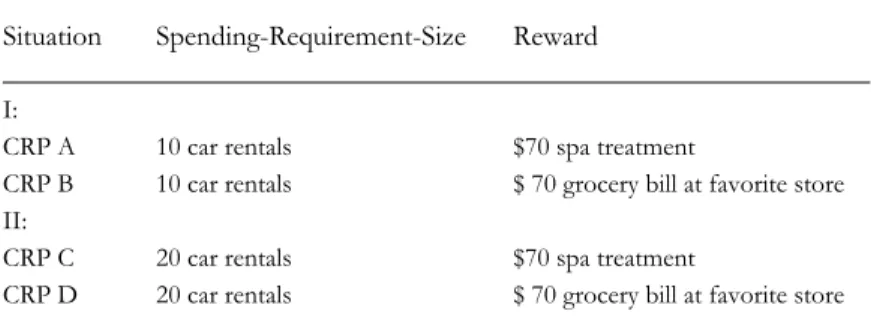
SPENDING REQUIREMENT INFLUENCE ON REWARD
PREFERENCE ... 48 TABLE 4.5 THE DECISION SITUATIONS IN THE FICTIVE GAS
STATION CRP MANIUPULATING INDIVIDUAL
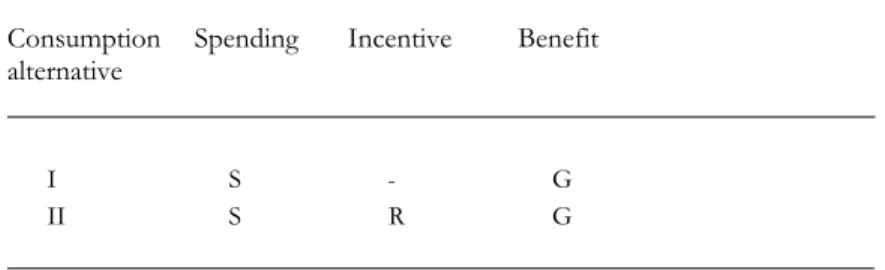
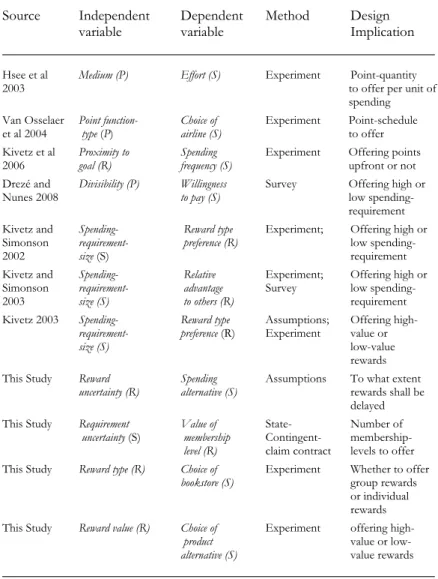
EFFORT ... 50 TABLE 4.6 A CONSUMPTION CHOICE ... 54 TABLE 4.7 CHARACTERISTICS OF PREVIOUS STUDIES AND THE
CURRENT STUDY ... 57 TABLE 6.1 ILLUSTRATION OF DIFFERENT RETENTION
REQUIREMENTS FOR A FICTIVE CRP WITH THREE
MEMBERSHIP LEVELS ... 82 TABLE 6.2 EXAMPLES OF MEMBERSHIP LEVELS ... 85 TABLE 7.1 CHARACTERIZATION OF CONTROL GROUP AND
EXPERIMENT GROUP ... 105 TABLE 7.2 CUSTOMER PREFERENCE BETWEEN AN INDIVIDUAL
REWARD AND GROUP REWARD OF EQUAL VALUE ... 109 TABLE 7.3 CUSTOMER PREFERENCE BETWEEN A SMALLER
INDIVIDUAL AND LARGER GROUP REWARD OF
EQUAL VALUE ... 111 TABLE 8.1 CRPs AND CONSUMPTION HABIT CREATION ... 131 TABLE 82 CRPs AND BREAKING A CONSUMPTION HABIT
1
Chapter I
Introduction
This thesis is about customer rewards programs, usually called loyalty programs. It is based on the idea that these programs are aimed at creating an incentive for customers to purchase repeatedly. We study different aspects on how the firm can design such programs in order to create a purchase incentive for the customer.
The Ubiquity of Customer Rewards Programs
Firms have since long given regular customers special treatment. For firms with a limited number of customers identifying regular customers is rather easy while this can be a rather difficult task for firms with many customers. As a result firms with many customers have found formal ways to give regulars special treatment. A so-called customer rewards program (CRP), in which customers are rewarded for repeated purchase, is an example of this. The archetype for contemporary CRPs are those offered by airlines in which the customer collects points (miles) when flying, which later can be used to redeem a reward such as a flight for free.
2
90% of US (Sneed, 2005) and UK consumers (Reed, 2003) actively participate in at least one CRP-like offer. Reports further indicate that about 130 airlines worldwide1, 76 % of all US grocery retailers with 50
stores or more (in Berman, 2006) and 40% of all Visa and MasterCard issuers operate a CRP (in Capizzi and Ferguson, 2005).
Furthermore, there are indications of how important CRPs are to firms. The consulting firm Loyalty Management Group in 2002 invested USD30 million to launch the “Nectar” coalition program bringing together 12 million consumers enrolled in BP’s, Debenhams, Sainsbury’s and Barclycards programs2. Also, Skogland and Siguaw
(2004) mention that the hotel chain Marriot invested USD54 million in its program in 1996. Hence, a CRP can be costly to initiate (Liu, 2007).
Also, many consumers are enrolled in single programs. According to figures from 2008, 2.8 million customers are enrolled in the airline SAS so-called Eurobonus Program3. This is twice as many compared to
1998. High numbers can also be observed for firms operating in other industries. The grocery and merchandise retailer Tesco has about 15 million UK customers enrolled in its ClubCard program4 and the hotel
chain Marriot reports to have 30 million customers in its frequent guest program5. In general, since it can constitute a large investment and since
many customers are to be enrolled, it is important for the firm that the CRP works according to expectations.
1 The Economist 20051220 2 Accessmylibrary.com, 20080801
3 According to annual reports of SAS in 2003 and 2008 4 Wall Street Journal, 20090508
3
Rewards Program Design
With the increasing number of CRPs and the increasing number of enrolments in them, academic interest has followed. One issue that has been addressed is how to design a CRP, i.e. how to create positive purchase (sales) effects (see Kivetz, 2003; Hsee et al, 2003; Drezé and Nunes, 2008). This body of studies is further related to an ongoing research debate on whether firms profit from CRPs or not (see Verhoef, 2003; Lewis, 2004; Meyer-Waarden and Benavent, 2006; Berman, 2006; Liu, 2007).
A firm can profit from a CRP by way of positive purchase effects. If most firms that operate in a market offer a CRP it can be questioned if CRPs create any positive purchase effects. Nevertheless, by creating a unique design which attracts customers it may create positive purchase effects. In this thesis we focus on how different designs of a CRP work as a purchase incentive to the customer.
4
reward. The different design variables that we study will be discussed in more detail later in this chapter.
What we call a CRP is commonly called a loyalty program. There are two reasons why we use the term CRP instead of the term loyalty program. Our interest is how different designs of a CRP create a repeat purchase incentive and repeated purchase is not necessarily the same as loyalty. Further, reports indicate that customers participate in many competing CRPs at the same time (see Mägi, 2003; Meyer-Waarden, 2007) why “reward-seeking” better than loyalty seems to capture what the phenomenon is about.
Problem Discussion
Purchase Effects
5
Results on how actual CRPs create purchase effects only in a limited way can contribute to how firms should design CRPs in order to obtain positive purchase effects. This is due to the absence of standards for CRPs in that points, rewards and spending requirements differ from one CRP to another (Kivetz and Simonson, 2002). Hence, actualCRPs differ in values for more than one design variable making it impossible to conclude if a purchase effect is due to one difference in design or the other.
Different Designs
The other body of studies focuses on how different designs create purchase effects. In such studies fictive CRPs are “used”. This enables us to capture how different values of a design variable create purchase effects. This is achieved by letting study participants choose between any two fictive CRPs being identical for all design variables but one.
Mainly, four different design aspects have been addressed within this body of studies; point-allocation-schedule construction6 (Hsee et al,
2003; Van Osselaer et al, 2004), goal distance7 (Kivetz et al, 2003;
Kivetz et al, 2006; Drezé and Nunes, 2008), spending requirement (Kivetz and Simonson, 2002; Kivetz and Simonson, 2003; Kivetz, 2003), and rewards (Dowling and Uncles, 1997; Yi and Jeon, 2003; Kivetz et al, 2006). The design alternatives in these studies, in terms of different values of a design variable, are mutually exclusive to participants (respondents).
6 This refers to how amount of points are distributed over a given number of purchases
assuming equally much monetary unit spending per purchase.
6
For instance, in the Van Osselaer al (2004) study, participants were to choose between a descending and ascending point-allocation-schedule. Results indicated that customers preferred the descending schedule, i.e. more points now and less points later. So, by approaching design alternatives in this manner, we can learn how different designs of a CRP work as a purchase incentive to the customer.
Design Combination Effects
Studying fictive CRPs, keeping everything but one design variable constant, has its limitations since we may not capture possible interaction effects between design variables. Hence, two design variables in combination may create stronger (or weaker) purchase effects than the two variables do separately. For instance, designing a CRP with one or multiple membership levels may create different purchase effects. Becoming gold-member could have symbolic value thereby working as an incentive for a customer to purchase more compared to if there is one membership level only. Similarly, offering a CRP with a non-linear point function8, so that more points are gained per
monetary unit spending once the customer has reached a spending requirement, may create stronger purchase effects than one with a linear point function.
However, the point function can be linked to membership levels so that the higher the membership level the more points are gained per monetary unit spending. This may create an interaction effect in that the design combination creates stronger purchase effects than each design does separately. To capture interaction effects could be difficult when
7
studying fictive CRPs since there are many different design alternatives available. At the same time, studying actual CRPs does not seem to be an option since the absence of standards makes it difficult to at all capture interaction effects.
Purpose
The purpose is to study how different designs of a CRP create a purchase incentive for the customer.
A firm can choose between different purchase incentives to offer. A sales promotion (SP) and a CRP are two such incentives. While the reward in a CRP is delayed, i.e. requires repeated purchase, the reward in an SP is immediate and requires no further purchasing. Previous studies of timing of rewards in CRPs have in particular focused on how individuals discount future rewards and how delay of different kinds of product rewards work as a purchase incentive to the customer (see Dowling and Uncles, 1997; Kivetz and Simonson, 2002). How delayed rewards create a purchase incentive in a context where customers choose between an SP and a CRP has though not been focused on. This leads us to the following research question:
Q1 Can a delayed reward in a CRP create a stronger purchase incentive to the customer than an immediate reward of equal value in an SP?
8
for a customer to purchase. This leads us to the following research question:
Q2 What is an effective number of membership levels in a CRP?
Observations of CRPs indicate that the reward incentive is typically individual rather than group based. In difference, in employer-employee contexts group rewards are common. Different reasons for offering employees group rewards instead of individual rewards have been asserted (see Fama and Jensen, 1983; Kandel and Lazear, 1992; Wageman and Baker, 1997). Such assertions may generalize to the CRP-context as well. This leads us to the following research question:
Q3 Can the firm by designing a CRP with group rewards instead of individual rewards create a stronger purchase incentive for the customer?
In order for a CRP to be effective for the firm one can expect the firm to either offer many low value rewards frequently or few but valuable rewards less frequently. Design of value of rewards, has in particular been studied in terms of uncertainty for the customer to obtain the reward and in terms of how the repeat-purchase-requirement for the reward influences reward expectations (see Kivetz, 2003; Kivetz and Simonson, 2003). In another body of studies, it has been observed that customers consume certain products out of habit. In such a context, a CRP, depending on reward value, may create a purchase incentive for the customer. This leads to the following research question:
9
In general, this thesis will add to previous studies both by studying other design variables and by addressing previously considered design variables in a different context.
Choice of Methods
An Isolating Approach
A firm can design a CRP in different ways. One extreme is for a firm to just copy another firm’s design. Dowling and Uncles (1997) even suggest that such behavior might explain the spread of CRPs. The other extreme is when a firm for each design variable evaluates alternatives. In this thesis we do not study how firms actually design CRPs. Instead we study how firms should design CRP. A rationale for this is that even though firms design CRPs they may not have considered all alternatives available to them. For instance, firms may not have considered whether to offer group rewards or individual rewards. Further, firms may have considered but not evaluated expected effects of different design alternatives. By studying how customers value one design compared to another we “evaluate” design alternatives.
10
Assumption Set and Model Use
In studying timing of rewards, i.e. extent of delay of rewards, we use assumption sets as method. With this we mean that based on assumptions about customers and rewards we draw conclusions about how the customer should prefer timing of rewards. This method is chosen because it enables us to address how customers are attracted to different timing of rewards under certainty and uncertainty. It also enables us to capture how each source of uncertainty influences this preference, by assuming everything else to be certain. The use of assumption sets will be further described in chapter IV in regards to the study of this design variable.
In studying membership level design we develop a model of the value of reaching a membership for the customer. We thus attempt to capture the key determinants of this value by keeping everything else constant. We then use this model to analyse what is an effective number of membership levels to offer in a CRP. In this sense we isolate the study on membership levels to a world constituted by our developed model’s constituents.
Experiments
By way of experiments we study type of reward in terms of group reward versus individual reward and reward value9 in terms of how
different reward value creates purchase effects. With experiment we here refer to a method by which the researcher manipulates an independent variable, hold constant or randomize other variables and observe the effect of the manipulated variable on the dependent variable of interest (Maines et al, 2006).
9 This either refers to the monetary value of a rebate or the monetary value (market value) of
11
For a method to be labeled experiment other requirements as well have been suggested. Schwab (2005) points out that experiments as opposed to surveys and field studies are characterized by random assignment of cases
to levels of the independent variable. Furthermore, Neal and Liebert (1986) point out that “true” experiments involve the use of control group
or conditions to eliminate the effect of third variables. In line with these statements we randomly assign cases to levels of the independent variable and use control groups in our experiments.
The main reason why we use experiment as method is that it enables us to study cause-effect relationships. Royne (2008) even states this to be the only method by which causation can be concluded10. Hence,
experimental methods are in line with our interest to understand how different designs of a CRP create a purchase incentive. The other reason is that studying actual CRPs would unlikely enable us to keep all design variables but one constant. As mentioned earlier this stems from that there is a lack of standards in that points, spending requirements and rewards differ from one CRP to another (Kivetz and Simonson, 2002). Hence, to find actual CRPs which both have to differ in value for a particular design variable and also have to be identical in all other respects would be very difficult. Consequently, we study fictive CRPs only.
Classroom Setting
We conduct the experiments with students in a laboratory setting (classroom). Students are used because they are accessible and assumed
12
to be familiar with making decisions involving CRPs. Also, they represent a homogenous group which is important from an external validity point of view (see Royne, 2008). Our classroom experiments, as experiments in general, imply a tradeoff between a gain in internal validity and a loss in external validity (see Schultz, 1999). Hence, our laboratory setting may fail to capture what Schultz call mundane realism
which refers to the equivalence of the laboratory setting to the real-world setting. By making clear the experiment instructions to participants and by creating decision situations which remind experiment participants of real purchase situations we have tried to mitigate this effect.
Incentives
Davis and Holt (1993) assert that it is preferable to provide real monetary incentives for participation in an experiment since this creates reciprocity, credibility and provides incentives for participants to pay attention to instructions. In this regard it has been fairly well established that providing monetary incentives to participants reduce performance variability in experiments (see Siegel and Goldstein, 1959). Davis and Holt (1993) even state failure to provide salient financial rewards to be one of the most common fatal errors inexperienced researchers make when designing experiments.
13
monetary incentives. By paying participants upfront we would risk getting participants who only care about obtaining the monetary incentive. Also, we believe that the students participating in our experiments will try to do well even with fictive rewards. Davis and Holt (1993) state than many times this is the case.
We have created experiment tasks which students are familiar with such as buying books. We believe that this makes it easy for students to act as if they are in the “real-world” situation spending real money and obtaining real rewards. Further, if a real monetary incentive is inadequate it will not work to reduce performance variability. Providing such incentives is therefore no guarantee for more reliable results. The specific experiment design choices, including instructions, tasks and characteristics of subjects will be described in chapters VI and VII in regards to each experiment. Further, in chapter IX we focus on validity and reliability of results of the two experiments that we conduct.
Thesis Outlook
In chapter II we will review previous studies of CRPs with the purpose to further position the thesis. More specifically, we identify and review four different bodies of study that deals with; customer loyalty, consumer switching costs, collusion and customer information. Based on this we discuss how the thesis relates to these bodies of studies.
14
incentive structure that a CRP constitutes. In this regard we discuss the dependencies between the constituents of this incentive structure.
In chapter IV we review previous studies in which the incentive structure has been used. We develop a normative argument for using this structure and argue for how we attempt to add to previous studies that have used it.
In chapter V we focus on what spending strategy customers should choose with regards to CRPs. Based on assumptions we develop propositions normatively suggesting how customers should behave given a choice between a CRP and a sales promotion (SP). By way of this choice we address timing of rewards in terms of immediate-and- delayed rewards versus delayed rewards.
In chapter VI we focus on how to design membership levels in a CRP. We use risky-state-contingent claim contracts and develop a model which constitutes the value of reaching a membership for the customer. Based on this model we then analyse what constitutes an effective number of membership levels in a CRP.
15
In chapter VIII we study whether a CRP associated to a new product alternative can break (and create) a consumption habit that a customer possesses. It is thus our assertion that something extraordinary is required for the customer to break a habit and that a CRP could be that extraordinary stimulus. We draw on consumer search studies and develop hypotheses testing this by way of experiments using fictive CRPs.
In chapter IX we address validity and reliability of results. In particular we argue for choices made regarding main concerns during the study and describe procedures chosen for obtaining valid an reliable results.
16
Chapter II
Previous Studies of Customer Rewards
Programs
The firm can offer a CRP for different reasons. They all seem to relate to the overriding purpose of creating repeated purchase. How these purposes are related has not been analysed before even though the question seems important for how to design a CRP.
Loyalty
The Loyalty Debate
A goal with offering a CRP can be to make customers become loyal to the firm. Loyalty implies customer behaviours such as exclusively buying from the firm, recommending the firm to others and disregarding competing alternatives in the buying process. This can benefit the firm through lower advertising cost, lower cost of serving customers or by customers becoming less price sensitive.
17
Neal, 1999)11; b) purely attitudinal meaning referring to a customer’s
positive feeling or attachment to a brand, product or store (see Oliver, 1999) and c) multifaceted meaning as a favourable correspondence between attitude and behaviour (Dick and Basu, 1994).
Behavioural Loyalty
The majority of studies on whether CRPs create customer loyalty or not treats loyalty as something behavioural and can be divided into two bodies of study. One is concentrated on measuring purchase effects from actual CRPs. Results from such studies are inconclusive. Hence, while some studies indicate CRPs to create customer loyalty (see Verhoef, 2003; Taylor and Neslin, 2005; Meyer-Waarden, 2007), other studies indicate mixed loyalty effects (Mägi, 2003; Meyer-Waarden and Benavent, 2006; Liu, 2007) and yet other studies indicate no loyalty effects (see Wright and Sparks, 1999; Bolton et al, 2000).
In this body of studies it is further recognized that measuring purchase effects from CRPs is difficult. One reason is that data used do not allow for measurement of whether customers buy from competing stores as well (see Benavent et al, 2000). Another reason is the use of declarative survey data which reliability problems are well documented (Mägi, 2003) and yet another reason is the use of aggregated panel data which fail to account for customer heterogeneity (see Meyer-Waarden, 2007).
11 Newman and Webel define loyal customers as “those who rebought a brand, considered
18
The other body of studies is concentrated on how different designs of a CRP create loyalty. One design aspect that has been studied is whether customers prefer a CRP offered by a single firm over a CRP offered by multiple firms. According to Cigliano et al (2000) a CRP offered by multiple firms give customers access to rewards which are out of reach in a CRP offered by a single firm.
A CRP offered by multiple firms relative to one offered by a single firm can also reduce costs to the customer for reaching a reward. This follows from that points can be earned from multiple sources (firms). The cost of reaching a reward is thus reduced if the customer, due to being able to gain points from several sources, does not have to make a budget redistribution12. An empirical study by Leenheer et al (2003)
indicates that a CRP offered by multiple firms has stronger effect on customer share-of-budget13 than a CRP offered by a single firm.
However, an empirical study by De Wulf et al (2003) indicates that customers are not more likely to participate in a CRP offered by multiple firms than one offered by a single firm.
Furhter, a firm can either offer their own products or another firm’s products as rewards in the CRP (see Dowling and Uncles, 1997). Yi and Jeon (2003) find in this regard that product involvement moderates the effect on customer loyalty. In situations when the firm sells a high-involvement product, offering one’s own product relative to another firm’s product creates stronger customer loyalty. When the firm sells a low-involvement product, the opposite result is indicated.
12 This refers to that a customer has to reallocate his resources by spending more on one
product and less on another.
13 Leenheer et al use the term share-of-wallet while we stick to the economic term budget to
19
Leenheer et al (2007) suggest that the effectiveness of a CRP may be related to the savings component14, the price discount rate and
multi-vendor structure. The results of their empirical study indicated the savings component and multi-vendor structure to have positive impact while higher price discount rates were not indicated to have any impact on share of budget15.
Attitudinal Loyalty
The ongoing debate on customer loyalty has spurred studies on whether it is sufficient for the firm that a CRP creates behavioural loyalty or if it should be designed to create attitudinal loyalty as well. According to Reichheld (2006) and McKee (2007) repeatedly spending customers may mistakenly be viewed as loyal by the firm, in the sense of having a positive attitude towards the firm, when they may be least loyal and only spending to reap rewards.
Survey results16 presented by Hallberg (2004) indicate that attitudinal
loyalty is positively correlated to behavioural loyalty implying that CRPs should be designed to create attitudinal loyalty. In line with this, results of an experimental study by Roehm et al (2002) indicate that the extent to which the reward offered in a CRP strengthens a customer’s association to the brand matters for postprogram17 brand loyalty. Further,
Shugan (2005) points to a problem of CRPs being designed to create
14 This implies that the customer saves points which can be used to redeem rewards in the
future.
15 There are other studies of how to design CRP. These studies do not focus on how CRPs
create loyalty. We will return to such studies in chapter IV.
16 Here a survey conducted by the market research firm OgilvyOne is referred to.
17 This refers to how the customer purchases once the CRP expires. An example of a CRP
20
behavioural loyalty only. He suggests that a CRP should offer customers something upfront to build commitment rather than creating a liability. This liability consists of a promise by the firm to deliver a future reward, which according to the author implies that the firm asks the customer to trust the firm in delivering the future reward.
We study a CRP as a purchase incentive which relates to how different designs of a CRP create behavioural loyalty. However, we will not refer to customer loyalty since further adding to the debate on the meaning of this construct is out of the scope of this thesis. Our study also differs from previous studies on how to design CRPs in that we address other design variables such as number of membership levels and whether to reward each individual or a group of individuals.
Switching Cost
Artificial Lock-in
According to Shapiro and Varian (1998) a CRP induces artificial
switching costs. This implies that a customer has to give up spending accumulated towards future rewards if switching to another firm (see Klemperer, 1987). By inducing artificial switching costs on customers the firm can benefit; by creating a barrier to entry, by being able to exert price discrimination, or by making it economically unjustified for customers to defect (See Klemperer, 1987, Kim et al, 2001).
21
artificial switching cost and artificial lock-in, the two terms has been used synonymously.
Artificial lock-in has thus been studied previously. Banarjee and Summers (1987) developed a two-period duopoly model showing that a CRP can create a substantial lock-in and thereby reduce welfare. According to their model, customers who buy from the same firm in both periods obtain a reward in period two. This arrangement induces artificial switching costs on customers in the second period which eliminates competitive forces creating a joint-monopoly solution to both firms (ibid). Similarly, Kim et al (2001) developed a model showing that a CRP reduces price competition due to switching costs. To what extent the firm can reach this effect depends according to their model on what type of rewards the firm offers (own supply versus another firm’s supply) and what proportion of the firm’s customers that are important18.
In line with these models, Carlson and Löfgren (2006) empirically found that CRPs in the Swedish domestic airline market induces substantial switching costs. In contrast, Hartmann and Viard (2008), empirically studying the assertion that as customers accumulate points towards a reward in a CRP they become locked-in, conclude that switching costs are not an important feature of a CRP. According to them this is because customers who highly value a firm’s product contribute most to firm sales. Those customers tend to value a CRP equally much before starting purchasing towards a reward as well as after having started purchasing towards rewards (ibid).
18 Kim et al in this regard use the terms heavy-buyers and light-buyers to distinguish between
22
Loyalty versus Switching Cost
While the term loyalty has been attributed positive connotation (see Henry, 2000) the term switching cost has been attributed negative connotation in terms of lock-in. Despite this, inducement of artificial switching cost has been referred to as loyalty inducement. Studies by Banarjee and Summers (1987) and Fernandes (2002) exemplify this. In yet other studies switching cost is treated as an antecedent of customer loyalty (see Caruana, 2004; Aydin and Özer, 2005).
Further, while the loyalty concept has been long debated, Hellmer (2008) calls for further specification of switching cost by referring to what he calls switching benefit. Following these ambiguities, it seems that more studies are required to determine whether switching cost and customer loyalty are two different phenomena or not. Further adding to this debate is out of the scope of this thesis. However, in chapter III, when formalising the incentive structure approach which we use in this study, we will develop how different designs of reward functions work to create a lock-in. In other respects, we will not refer to switching cost inducement.
Collusion
Agents and CRPs
23
CRP at the expense of the third party (the employer). This arises because the employer pays for spending towards rewards while the employee reaps the rewards. Hence, the firm offering the CRP can benefit from employees being price insensitive, implying a principal-agent problem19.
Cairns and Galbraith (1990) model how an incumbent firm due to collusion by way of a CRP can create persistent demand side entry barriers and use price discrimination to earn short-term profits. According to their model, collusion arises when agents pay only a fraction of the cost of a product and can choose from where to consume. Similarly, Basso et al (2009) develops a duopoly model showing how airlines can take advantage of an agency relationship in which agents obtain rewards while the principal pays for flights. The authors show that if only one airline offers a CRP, this airline can obtain large gains. However, if both airlines operate CRPs they show that the consequence becomes higher prices for employers and lower profits for the airlines. This implies that the airlines would be better off without CRPs.
Employee and Employer Views
A few studies have focused on employee and employer attitudes in regards to frequent flying. Deane’s (1988) survey study indicates that employees; obtain frequent flier miles from business trips, at least sometimes choose carrier based on frequent flier program, and consider frequent flier points as a “perk benefit” of their job. In another survey
19 The conflict of interest assumed is that employees are careless about spending firm
24
study by Browne et al (1995) it is found that 23% out of 124 corporations confiscated bonuses earned by employees. Their survey results further indicate that employees underestimate their employer’s concern over them making flight arrangements around frequent flier programs. These findings are in line with the suggestion that a CRP can create a principal-agent problem.
Whether to offer group rewards or individual rewards, which we study, has direct implications to collusion by way of a CRP. This is because group rewards may apply to employees since they constitute a group that represents a firm. This will be returned to in chapter VII. In other respects we do not relate to collusion.
Customer Information
Information Technology and CRPs
25
“What scares me about this [loyalty program], is that you know more about my customers in three months than I know in thirty years”, The chairman of Tesco, the retailing firm (in Byrom, 2001) “Not only can we see the effect of an advertisement on sales. We can also see what type of customer it won over”, a Tesco executive
(in Sunday Times, December 19th,2004)
With the advent of automated CRPs a body of studies on the firm use of customer information, obtained from a CRP, has evolved. In such studies it is commonly asserted that demographic data and purchase data in combination can be useful to the firm. While demographic data are typically collected when the customer enrols in the CRP purchase data are collected continually.
Customer Segmentation
Empirical studies suggest that data collected from a CRP can be used to segment customers. Byrom (2001) explored the use of reward-card data of five UK retailers and found that the such data was at least to some extent used by the retailers for product promotional purposes. The study further revealed that one out of five retailers classified customers based on reward-card transactions. Drawing on this observation, Byrom (2001) discusses how home address data together with purchase data gained from a CRP can help a firm segment their customer base to obtain efficiency gains in advertising.
26
their model, the reward-card data is useful in this regard by providing the firm with information of how much of the budget each customer spends at the firm as well as how profitable each customer is.
However, shortcomings of using CRP-data for segmenting customers have been indicated. Cortiñas et al (2008) in an empirical study found that the portion of customers participating in a firm’s CRP were less price sensitive but more promotion sensitive than the firm’s other customers20. Based on this finding it is concluded that it may be
insufficient to use reward-card data in promoting and pricing products to all the firm’s customers.
Privacy
In addition to the cost of setting up an automated CRP, the firm incurs costs for making customers reveal data about themselves. This is a so-called privacy concern which arises due to that customers are uncertain about how the firm will use reward-card data collected. Lacey and Sneath (2006) discuss this in the light of exchange theory21. According
to the authors, if customers find the firm’s use of data about them unfair, they may defect. The authors suggest two ways in which the firm can reduce the risk of this to occur. One way is to compensate customers for the cost of sharing personal information via rewards in the CRP. The other way is to clearly inform customers how the firm will use such data. According to Lacey and Sneath firms are typically free to transfer data collected from a CRP to other firms. Transfers
20 More specifically, the results indicated that for three provisions out of 10 studied,
card customers are less sensitive to price than non-card holders. At the same time, reward-card customers were found to be more sensitive to price promotions relative non-reward-card holders for 2 out of 10 products.
21 This refers to how customers and firms transfer resources such as goods, services, money
27
could range from sharing data among partners to the CRP to selling data about customers to another firm.
Enzman and Schneider (2005) take another twist on this privacy issue by developing a hypothetical design of a CRP which assures customer privacy. The authors’ idea is that by firms only being able to track how many points the customer earns towards rewards, they cannot violate customer privacy. Such a design might be effective when customers refuse participation in the CRP due to privacy concerns. In line with this, De Wulf et al (2003) empirically found that customers are more likely to join a CRP which requires revealing minimum relative to extended personal information (demographic data) at the time of enrolment.
We will neither address customer revelation of personal data nor how firms use such data gained from a CRP. Our study of how to design membership levels though relates to CRPs and customer information. This is both in that information technology has enabled firms to manage a CRP with multiple membership levels at low cost and in that membership levels are a way of segmenting customers to the firm’s CRP.
Comments
28
the customer with more valuable rewards relative to a CRP which is manual. If the goal instead is to createartificiallock-in, offering a CRP with a reward design characterised by more valuable rewards the more the customer purchases is to prefer over offering equally valuable rewards irrespective of repeat-purchase-requirements reached. This will be returned to in the next chapter.
This thesis is restricted to how different designs of a CRP create a purchase incentive to the customer. This seems to be an important goal to the firm since repeated purchase(s) is the effort that customers are rewarded for in a CRP. Wansink (2003) even states that CRPs are typically terminated if they do not generate a net increase in sales.
29
Chapter III
An Incentive Structure Approach
CRPs have been given different definitions over the years, especially in terms of what they try to achieve. From a firm’s point of view, the aim to create an incentive for repeated purchase, which can be misunderstood as “loyalty”, can be achieved by different designs. The design of the reward function and the point function needs to be analysed in more depth.
Defining Customer Rewards Program
There seems to be no generally accepted definition of CRP22. For
instance, according to Dowling and Uncles (1997) sales promotion is one kind of a CRP while according to Yi and Jeon (2003) a sales promotion is not a CRP. While a sales promotion gives an immediate reward based on one single spending there are purchase incentives giving delayed rewards based on accumulated spending. Distinguishing between purchases incentives which differ in such key characteristics seems important. Otherwise, knowledge accumulated on CRPs risks being blurred making it difficult to understand how purchase incentives with single versus accumulated spending and immediate versus delayed
22 This might be problematic since it has been stated that the absence of a generally accepted
30
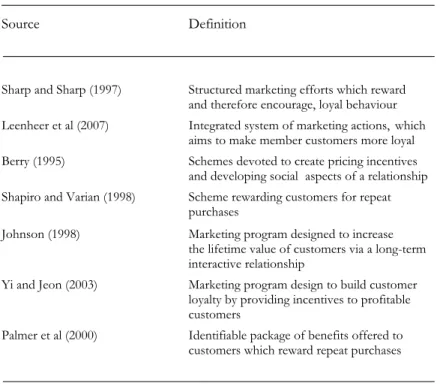
rewards work. Some examples of proposed definitions of CRP are described in table 3.1:
Table 3.1: Examples of definitions of Customer Rewards Program
Source Definition
Sharp and Sharp (1997) Structured marketing efforts which reward and therefore encourage, loyal behaviour Leenheer et al (2007) Integrated system of marketing actions, which
aims to make member customers more loyal Berry (1995) Schemes devoted to create pricing incentives
and developing social aspects of a relationship Shapiro and Varian (1998) Scheme rewarding customers for repeat
purchases Johnson (1998) Marketing program designed to increase
the lifetime value of customers via a long-term interactive relationship
Yi and Jeon (2003) Marketing program design to build customer loyalty by providing incentives to profitable
customers
Palmer et al (2000) Identifiable package of benefits offered to customers which reward repeat purchases
31
misleading to call a customer who spends repeatedly at many firms to be loyal to any of the firms.
Also, if loyalty is partly an effect of a program that creates lock-in and switching costs, loyal does not seem to be the best description of the reason for the customer´s behaviour. It may even be the case that repeatedly spending customers are mistakenly viewed by the firm as loyal customers, in the sense of having an overall positive attitude to the firm, when they in fact may be the least loyal ones and only spends to get the rewards, as suggested by Reichheld (2006) and McKee (2007). Based on the above discussion we propose the following three criteria of a CRP:
a) Repeat-Purchase-Requirement
In a CRP the customer has to purchase repeatedly to obtain a reward (see Dowling and Uncles, 1997; Shapiro and Varian, 1998). This distinguishes a CRP from a general agreement23 and a sales promotion
in which a single purchase is sufficient for obtaining a reward.
b) Delayed reward
In a CRP a reward unfolds once the customer has purchased repeatedly, i.e. the reward is delayed. This distinguishes a CRP from a customer club where the customer obtains an immediate reward against a commitment of making future purchases.
23 In a general agreement, a university for instance, may contract with a hotel chain that the
32
c) Medium
In a CRP points (includes stamps, miles and other tokens) constitute the record of accumulated spending towards rewards. This distinguishes a CRP from a volume discount offer in which points are not collected. Points have implications for the purchase incentive created to the customer. Hence, a purchase incentive including points sometimes enables the customer to buy points, exchange points into another CRP and collect points of different types such as those that qualify for rewards only and those that qualify for membership levels as well.
Based on the criteria suggested, we define a CRP as: a repeat purchase incentive in which customers collect points towards future rewards24.
The Incentive Structure
A CRP contains stipulations about spending (S), points (P) and rewards
(R) and their dependency25:
(3.1)
What we call a CRP as an incentive structure is constituted by equation 3.1 which states that a reward is a function of points and spending, in which spending determines points. The incentive structure approach to
24 We use the term repeat purchase to denote two or more purchases. Shapiro and Varian
(1998) define CRP as a scheme rewarding customers for repeat purchases. This suggests that three or more purchases are required for a customer to be rewarded. It is our belief that this was not intended by the authors. We here emphasize that the minimum spending requirement for what we call a CRP is one repeat purchase. We will further use the terms spending requirement and repeat-purchase-requirement to denote the number of purchases the customer has to make in order to reach a reward.
25 Regarding S, P and R the customer decides over spending which is exogenous to the firm
33
CRPs has been used in previous studies. In such studies, the variables S
and R are commonly expressed in monetary units (MU) while P is expressed in quantities (see Kivetz, 2003, Kivetz et al, 2006). More specifically, S is expressed as a purchase amount and R is expressed as the market value of products for free or the cash value of rebates.
The Reward Function
Based on the relationship between S and R, a CRP has been characterized as linear or non-linear (See Shapiro and Varian, 1998; Sällberg, 2004). We call this relationship reward function which is given by the following:
(3.2)
Where R is reward value, α is a constant26, S(T) is saved accumulated
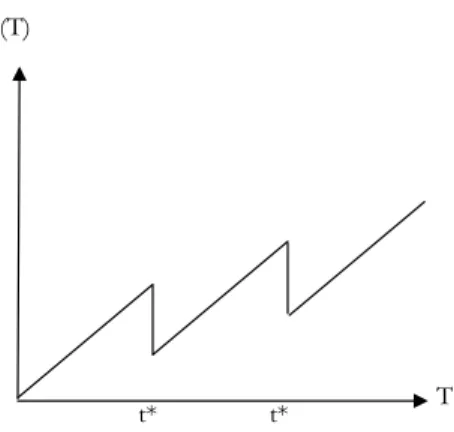
spending, T is time, and β denotes how R changes when S(T) changes. A few comments are needed for S(T). Throughout this chapter we assume that spending is constant over time implying that the customer spends equally often and equally much each time. Further, S(T) captures the possibility that not all spending in history is valid towards rewards. Hence, some spending incurred may become invalid due to that the customer redeems a reward or due to that old spending has expired and can no longer be used for claiming a reward. We illustrate this in the figure below:
26 This constant captures whether customers obtain a reward initially or not for joining the
34
Figure 3.1 Illustration of saved accumulated spending
The figure above shows an example of how saved accumulated spending towards rewards may change over time. The denotation t*
represents a point in time when saved accumulated spending towards rewards becomes invalid, implying reward redemption or that old spending expires. The fact that old spending can expire may for some customers work as an incentive to spend more frequently compared to if it would not expire. Hence, it may put pressure on customers to spend enough so that the spending requirement for a reward is reached before old spending expires. However, for other customers the risk of old spending expiring may make the CRP unattractive compared to if it would not expire, i.e. some customers may due to the risk of old spending expiring find it unlikely to reach the repeat-purchase-requirement for a reward.
In general, as S(T) increases R increases. The pace at which R increases as S(T) increases may though differ from one CRP to another implying different reward functions. In a linear reward functionthe reward value
T S(T)
35
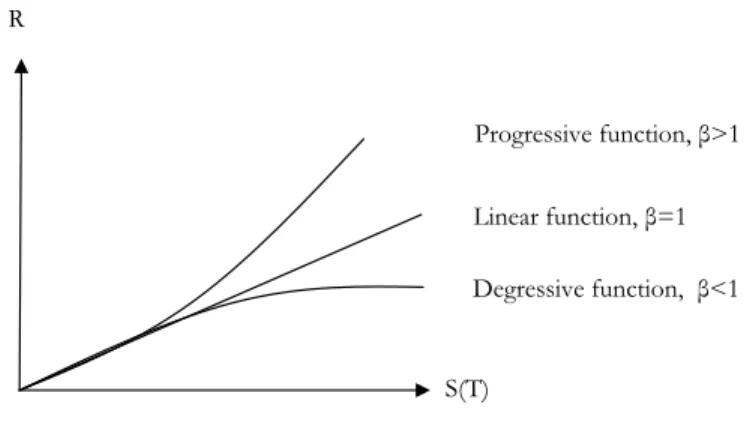
per unit of spending is constant over spending levels (β=1) while for a non-linear one it increases (β>1) or decreases (β<1) at certain spending levels reached. It is important to note that when (β>1) then the reward is increasing at an increasing rate (progressive) and when (β<1) then the reward is also increasing with spending but at a decreasing rate (degressive). The figure below illustrates this:
Figure 3.2 Reward function trajectories
An important conclusion can be drawn for the three different trajectories illustrated in figure 3.2. To arrive at this conclusion, assume the following: two CRPs, A and B, are identical in all respects despite that CRP A is characterized by a linear reward function while CRP B is characterized by a degressive reward function. Assume also that the two functions are identical to those shown in figure 3.2.
Given this, a customer participating in CRP B, at a certain spending occasion, has an incentive to switch to CRP A. Figure 3.2 illustrates this at the point where the slope of the line depicting the degressive reward function shifts to become flatter than the slope of the line of the
Degressive function, β<1
S(T) R
36
linear reward function. In terms of equation 3.2, the incentive to switch from CRP B to CRP A can be explained by that β for CRP A is greater than β for CRP B. The implication of this is that firms shall not offer a CRP with degressive reward function if they want to create an incentive for customers to purchase repeatedly.
A CRP characterized by a progressive reward function compared to a linear one enhances the customer’s incentive to continue spending towards future rewards relative a CRP. Hence, in terms of (2):
మ
మ while
మ
మ
This implies that whether a CRP is characterized by a linear reward function or a progressive one matters for what purchase incentive that is created to the customer. Hence, when a customer starts to accumulate spending in a CRP with a linear reward function, he only spends towards the next reward. After having received this reward he can start all over again or not. In a CRP with a progressive reward function the customer when making his first purchase not only accumulates spending towards the next reward but also towards the ith
reward27.
The Point Function
Reward functions ignore points, which have been found to have psychological value for customers (see Hsee et al 2003; Van Osselaer et al 2004). Also, as we mentioned earlier, points can sometimes be
27 This depends on how much S the customer expects to spend towards R and how certain
37
bought, exchanged into other CRP-currency and be of different types. Consequently, we include points in equation 3.1. The relationship between S and P, which we call point function, is given by the following:
(3.3)
Where P is points, γ is a constant28, S is spending, T is time and L
denotes how P changes when S(T) changes. We can expect the customer to prefer a progressive point function over a linear or degressive one, everything else equal29. This follows from that points
represent the currency which the customer can exchange into rewards. Hence, customers want more points over fewer points, since that entitles to more reward value for a given amount of spending.
A non-linear point function can be linked to reward occasions so that the quantity of points gained per unit of spending increases at reward occasions. Also, point functions can be linked to membership levels so that the higher the membership level the more points are gained per unit of spending. In turn, membership levels are sometimes characterised by limited duration. When this is the case, the customer has to accumulate a certain amount of points each period (usually year) in order to retain his membership level reached. This implies that the incentive for the customer to continue spending in a CRP may decrease as a consequence of not having retained a membership level. At the same time, when the point function is linked to membership levels with
28 This constant captures whether the customer obtains points initially for joining the CRP or
not.
38
periodic (limited) duration an incentive for the customer to spend sufficiently each period to retain the membership level is created.
P is not only related to S but also to R following equation 3.1. The relationship between P and R we call redemption function. We can expect the customer to prefer a progressive redemption function over a linear or degressive one, everything else the same. Hence, the customer wants to obtain as much reward value as possible for a given amount of points30.
Points gained can have limited or unlimited duration. On the one hand, points with limited duration may decrease the probability that the customer will reach the point requirement31 for a reward and thereby
also his incentive to spend. One the other hand, limited duration of points may work in the opposite direction by putting pressure on the customer to spend frequently to assure that the point-requirement and thereby the reward is reached before any gained points expire.
Comments
CRPs have been referred to as linear or non-linear based on the relationship between S and R (See Shapiro and Varian, 1998). However, in a CRP S gives P and P gives R. This has an important implication for non-linearity. Namely, a CRP may be non-linear due to its redemption-function, its point function or due to both functions. Designing a CRP
30 Psychology of money studies have shown that some individuals find a value in saving
money per se (see Wärneryd, 1999). Similarly, certain customers may find a value in collecting and saving points per se. If this is the case, points might be considered as rewards by those customers. We here ignore that points per se may have such a collection value. Hence, P is a medium between S and R.
39
with a progressive point function and linear redemption function may create a differently strong incentive for the customer compared to designing it with a linear point function and progressive redemption function. For this reason points shall not be ignored in studies of a CRP as a purchase incentive.
That point functions as well as redemption functions can be characterized as linear, progressive or degressive also shows that a CRP can be designed in different ways. Further, points can have limited or non-limited duration and can exist in different types such as those that qualify for rewards only or those that qualify for membership levels as well as rewards. The characteristics of points may thus be important for how a CRP works as a purchase incentive.
Throughout this study we will rely on equation 3.1 when studying different design aspects of a CRP. In line with studies which have used a similar approach, we suggest that it is not sufficient to understand how a CRP works as a purchase incentive by only studying the “economical” constituents S and R. The importance of not ignoring P
40
Chapter IV
The Incentive Structure:
Previous Studies and the Current Study
Until now we have dealt with the incentive structure approach normatively. Mainly, this approach has been used in experimental studies on how different designs of a CRP create a purchase incentive for the customer. Below we review this body of studies, which constitute a basis for the experiments that we describe in later chapters32.
Previous Studies
The Medium Effect
Hsee et al (2003) use the dependency between S (spending), P (points) and R (rewards) to study the value of points for customers. They claim that a medium such as a point represent a token which has no value in and of itself and is merely something that can be traded for the desired outcome. According to them, people ought to be indifferent between the following:
Effort Æ medium (M) Æ outcome (O) Effort Æ outcome
41
In terms of a CRP this implies that points are meaningless to customers since they represent the medium between spending and rewards. The tenet in Hsee et al’s paper is though that people fail to fully skip the medium and do not just maximize the effort-outcome return but also the effort-medium return.
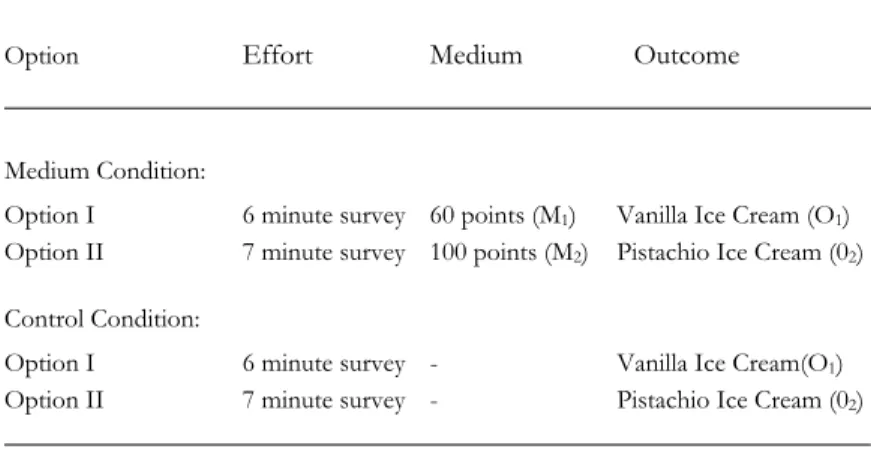
By way of experiments the authors found that people to a higher extent choose a lower valued outcome over a higher valued outcome when there is a medium associated to the lower valued outcome. Also, the authors found that the larger the value of the medium associated to the lower valued outcome the higher is the extent to which this outcome is chosen. To further explain these findings we illustrate below one of the experiment designs used in Hsee et al’s study:
Table 4.1 Illustration of experiment design for test of medium effect
Option Effort Medium Outcome
Medium Condition:
Option I 6 minute survey 60 points (M1) Vanilla Ice Cream (O1)
Option II 7 minute survey 100 points (M2) Pistachio Ice Cream (02)
Control Condition:
Option I 6 minute survey - Vanilla Ice Cream(O1)
Option II 7 minute survey - Pistachio Ice Cream (02)
42
vanilla ice cream. Table 4.1 thus illustrates the options that the experiment group (medium condition) and the control group were exposed to. In the medium condition, option II was chosen over option I more than 50% of the times despite that about 70% of the participants claimed to prefer vanilla ice cream over pistachio ice cream. In the control condition, option II was chosen about 25% of the times which was in line with participants’ preference for vanilla ice cream. This result indicates that individuals take into account the effort-medium return when making purchase decisions.
In another experiment the authors tested and found support for the hypothesis that if the medium is made just slightly larger for the lower valued outcome than the higher valued outcome the medium effect will be “turned off” (disappear). The results of Hsee et al’s study imply that when designing a CRP the firm should give customers a high quantity rather than a low quantity of points per monetary unit spending. This implication relies on the assumption that offering a high quantity instead of a low quantity of points is not more costly for the firm.
Point-Allocation-Schedule Effects
Van Osselaer et al (2004) study another “point-psychology” effect in terms of how point-allocation-schedule33 design influences individuals
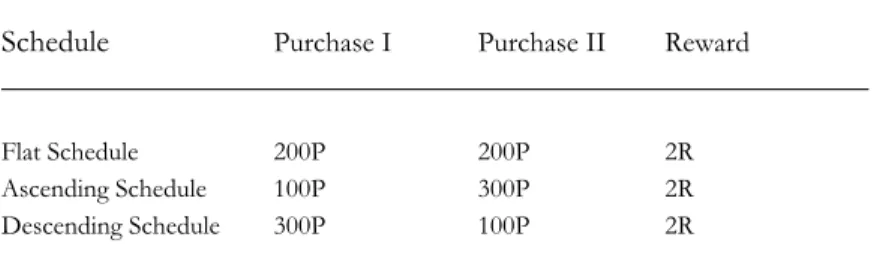
purchase decisions. The authors distinguish between the three types of point-allocation-schedules illustrated below:
33 This refers to how the amount of points are distributed between a given amount of
43
Table 4.2 Illustration of point-allocation-schedules, where P= points and R= reward value, when buying for the same amount of money
Schedule Purchase I Purchase II Reward
Flat Schedule 200P 200P 2R Ascending Schedule 100P 300P 2R Descending Schedule 300P 100P 2R
The first row in the table, illustrating a flat schedule, should be read as follows: The first and second purchase gives the customer 200 points each and after having made two purchases the 400 points accumulated can be used to redeem a reward worth 2R.
44
For the initial choice, the authors found that the type of point-allocation-schedule significantly influenced choice of CRP. Hence, 20 out of 23 participants chose an airline with flat schedule over one with an ascending schedule and 20 out of 25 participants chose an airline with descending schedule over one with a flat schedule. For sequential choices the authors found that both type of point-allocation-schedule and accumulated points in schedule(s) significantly influenced choice of airline. Hence, participants chose the flat-scheduled airline significantly more often than the ascending-scheduled airline but slightly less often than the descending scheduled airline. The results of this study indicate that customers maximize the amount of points they can obtain today despite this being irrelevant for expected reward value.
The results imply that when designing a CRP the firm shall offer descending-point-allocation-schedules. This way, firms can benefit from customers purchasing more frequently from the firm relative to if a CRP with flat or ascending-point-allocation schedule is offered.
Goal Gradient Effects
Once a customer has enrolled in a CRP his purchase decisions become influenced by future rewards. Kivetz et al (2006) study this based on the so-called goal gradient hypothesis34 which states that the tendency to
approach a goal increases with proximity to the goal. In terms of a CRP this means that the closer a customer is to reach a reward the more he accelerates spending towards the reward. Studying a university-café-CRP of the kind “buy ten coffees get one for free”, the authors found
34 The goal gradient hypothesis was first developed by Hull (1934) in which laboratory
45
support for the goal gradient hypothesis. As customers accumulated more points (stamps), the average length of time before their next coffee purchase decreased with 20% throughout the CRP.
Next, the authors put up an experiment testing if also illusionary progress towards the reward causes accelerated spending. Again, the university-café-CRP was studied. An alternative CRP was now created in which two stamps were given upfront to customers and 12 stamps were required to obtain a coffee for free. In all other respects the regular and the alternative CRP were identical and customers were randomly assigned by the café to the two CRPs.
Results indicated that customers participating in the alternative CRP reached the spending requirement for the reward in 12.7 days on average while customers participating in the regular CRP needed 15.6 days on average to reach the spending requirement. Results were significant and supported the illusionary goal progress hypothesis. The authors’ explanation to this finding is that individuals mix up perceived goal progress with real goal progress believing they are closer to reaching the goal than they actually are. Based on the two studies, Kivetz et al conclude that the goal gradient can influence customers’ responsiveness to a CRP both through real and illusionary goal distance.