UNDERSTANDING THE IMPLICATIONS: TENSIONS BETWEEN FEDERAL VERSUS STATE AND TECHNOLOGY-DRIVEN VERSUS TECHNOLOGY-AGNOSTIC
RENEWABLE ENERGY POLICIES
Leah C. Kaiser
A thesis submitted to the faculty at the University of North Carolina at Chapel Hill in partial fulfillment of the requirements for the degree of Master of Science in the Environment, Ecology,
and Energy Program (E3P).
Chapel Hill 2020
ABSTRACT
Leah C. Kaiser: Understanding the Implications: Tensions between Federal versus State and Technology-driven versus Technology-agnostic Renewable Energy Policies
(Under the direction of Jonas J. Monast)
Energy generation is inextricably linked to climate change but there is debate concerning
the most effective policies for “greening” our system. Federal-level polices are ideally situated to
take advantage of economies of scale while rising above jurisdictional constraints. Yet state-level
policies often are more politically feasible and allow for greater flexibility. Thus far, states have
pursued renewable energy policies that can be broadly categorized as either technology-driven
policies or technology-agnostic polices. Technology-driven policies are well-situated to target
market barriers and historical subsidizations but are hindered by limited flexibility and cost
constraints. Conversely, technology-agnostic policies are often more immediately actionable but
contain hidden externalities. While the best solution is likely a matter of circumstance and
opinion, it is critical that policymakers contemplate the implications behind these policy choices.
These implications could determine whether electrification is a key part of the solution to global
ACKNOWLEDGEMENTS
First and foremost, I would like to thank my advisor for his dedicated support and for always encouraging me to think outside the box. I would also like to thank my committee members for their help, advice, and expertise.
TABLE OF CONTENTS
LIST OF FIGURES ... vii
LIST OF ABBREVIATIONS ...viii
INTRODUCTION ... 1
AFFORDABLE,RELIABLE, AND CLEAN ... 2
REGULATORY BACKGROUND ... 4
CURRENT ELECTRICITY SYSTEM... 8
ENERGY AND CLIMATE CHANGE ... 9
THE IMPORTANCE OF GOAL-ORIENTED POLICY DEVELOPMENT ... 14
FEDERAL VERSUS STATE ... 17
FEDERAL ... 22
Federal Advantages ... 22
Federal Disadvantages... 25
STATES ... 29
State Advantages ... 30
State Disadvantages ... 32
FEDERAL VERSUS STATE CONCLUSIONS &IMPLICATIONS ... 35
TECHNOLOGY-DRIVEN VERSUS TECHNOLOGY-AGNOSTIC ... 38
TECHNOLOGY-AGNOSTIC POLICIES ... 45
Advantages ... 45
Disadvantages ... 47
TECHNOLOGY-DRIVEN VERSUS TECHNOLOGY-AGNOSTIC CONCLUSIONS & IMPLICATIONS ... 49
LIST OF FIGURES
FIGURE 1 - COMPARISON OF FEDERAL AND STATE ADVANTAGES AND
DISADVANTAGES... 35
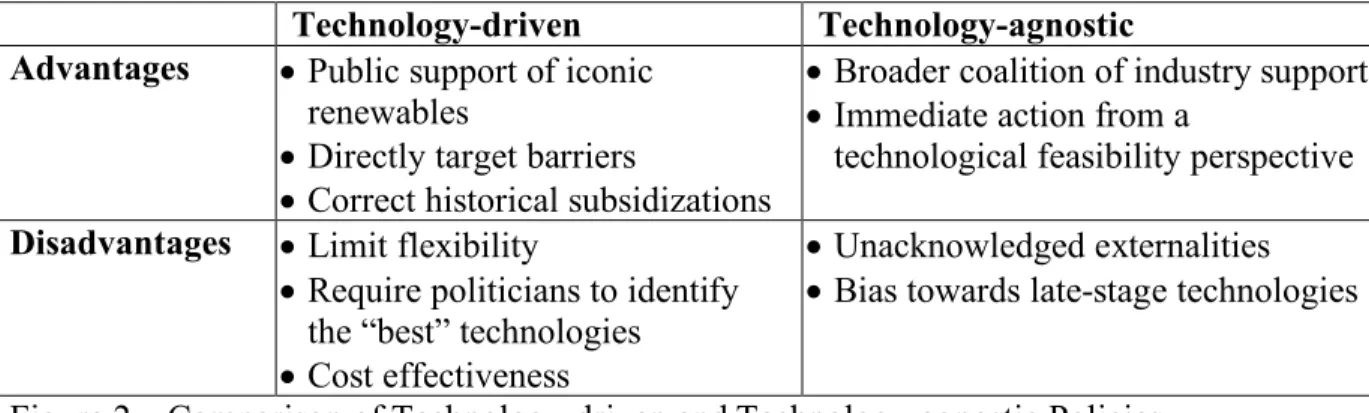
FIGURE 2 – COMPARISON OF DRIVEN AND
LIST OF ABBREVIATIONS
CAFE Corporate Average Fuel Economy
CWA Clean Water Act
CO2 Carbon Dioxide
CCS Carbon Capture and Storage
CES Clean Energy Standard
DOE Department of Energy
EIA Energy Information Administration
FERC Federal Energy Regulatory Commission
FPA Federal Power Act
ISO Independent System Operator
PUHCA Public Utilities Holding Company Act of 1935
PURPA Public Utility Regulatory Policies Act
QF Qualifying Facility
REC Renewable Energy Certificate
R&D Research and Development
RPS Renewable Portfolio Standard
RTO Regional Transmission Organization
INTRODUCTION
Our energy generation system is experiencing rapid change. The U.S. has evolved from a
nation worried about fuel shortages and reliant on coal to one with a diversified energy mix that
is currently on track to be a net energy exporter for the first in over sixty years.1 Hydraulic
fracturing has unlocked new fuel sources, just as public support has begun to push states in the
direction of increasingly ambitious renewable energy goals. These technological changes are
occurring in the face of global climate change, which threatens severe impacts to our societal and
economic wellbeing stemming from rising sea levels, increasing storm severity, desertification,
and global biodiversity loss among others. In order to mitigate the effects of global climate
change it is essential that we work towards efficient and effective emissions reductions.
Electricity generation represents an important opportunity for emissions reductions.
Greenhouse gas emissions from electricity generation currently comprise the second single
largest source of emissions in the U.S. 2 and are expected to grow rapidly due to widespread
electrification and associated increased in electricity demand. If these trends continue emissions
from electricity generation could comprise the largest source of greenhouse gas emissions in the
U.S. in the near future. Therefore, efficiently and effectively reducing emissions from electricity
generation is of paramount importance in addressing global climate change. Yet our current
energy policies are ill-suited for the challenges of today and face mounting tensions. We need to
develop goal-oriented energy policies to address the complex regulatory environment of today
under threats of climate change while staying committed to the traditional metrics of
affordability, reliability, and cleanliness by which we gauge acceptability of generation methods.
Despite strong indications of the need for new energy policy, leaders and regulators are divided
over the best path forward.
Historically, states have taken the lead in regulating and encouraging energy generation
within their borders. Yet a recent string of U.S. Supreme Court cases3 have hinted at an
expanding role for federal regulators both creating uncertainty and leading to a robust debate
over the relative value and effectiveness of state versus federal energy regulation. This regulatory
uncertainty is compounded by disagreements over the “best” type of energy policy. As energy
technology has advanced and new technologies have grown both in scale and importance it has a
created a divide between advocates of driven policies and advocates of
technology-agnostic policies. These two decision points, federal versus state and technology-driven versus
technology-agnostic, will lay the foundation for energy generation policies for decades to come.
Affordable, Reliable, and Clean
In envisioning and drafting new energy legislation for the modern day we should be
cognizant of the characteristics we want our energy generation to embody. Energy generation is
unique among emission sources due to its essential role in modern life. We must therefore
account for more than just emissions reductions when assessing new energy policies. Affordable,
reliable, and clean have become the hallmarks of the electricity system we purport to be striving
for. Although often weighted differently depending on the times, these metrics have guided
much our energy development thus far. First, energy should be affordable due to its essential
nature. A lack of electricity is often an absolute barrier to full participation in society. The “just
and reasonable” mandate was first proffered to protect electricity consumers from monopolistic
pricing and persists to this day in light of the importance of electricity. Second, energy must be
reliable. The Northeast Blackout of 2003 showcased what happens when energy isn’t reliable.4
Fifty million people were affected and New York City alone lost over $500 million in only a few
hours.5 Energy generation policies must maintain a commitment to reliability. Third, clean is
both the most recent addition and the most heavily debated. Although energy legislation has paid
lip service to renewable technology for some time, it has often primarily sought to increase
domestic energy production regardless of cleanliness, often offering similar incentives for both
renewable and non-renewable technology.6 Clean energy, however, has begun to grow in
importance as its implications for global climate change become more well-known and better
understood. Today, energy producers and distributers have coalesced around the importance of
these three metrics7 although the path to achieving them is both less clear and subject to more
debate. In order to understand how best to move forward it is essential to understand the history
of energy regulation in the U.S..
4 This day in history, HISTORY, https://www.history.com/this-day-in-history/blackout-hits-northeast-united-states (last visited March 18, 2020).
5 Id.
6 See FRED SISSINE, RES., SCIENCE, AND INDU. DIV., CONG. RESEARCH SERV, RENEWABLE ENERGY PORTFOLIO STANDARD (RPS): BACKGROUND AND DEBATE OVER A NATIONAL REQUIREMENT (2007).
7 See Erin Culbert, Duke Energy sets sights on net-zero carbon by 2050, ILLUMINATION (Sept. 17, 2019)
https://illumination.duke-energy.com/articles/duke-energy-sets-sights-on-net-zero-carbon-by-2050?_ga=2.205906320.260083576.1569102256-2088968392.1474936758 (discussing efforts to eliminate carbon emissions by 2050 while ensuring “diverse energy sources and a modern grid to protect reliability and
Regulatory Background
In order to understand how our energy metrics apply to our current system of generation
and regulation it is important to understand the history of electricity regulation in the United
States. The early conceptualization of electricity as a natural monopoly8 encouraged strict
regulation, which still forms the basis of our regulatory system today. Early regulation was
needed to keep monopolies in check. For example, in the mid-1990s a significant majority of
customers in the United States got their electricity from a single monopoly utility, typically
called an investor-owned utility (IOU), which provided “generation, transmission, local
distribution and billing/collections.”9 Without regulation these IOUs would have had
unacceptable amounts of power over their customers. Despite subsequent efforts focused on
introducing competition and “unbundling” monopoly systems, many of the regulatory mandates
that were established early on are still in effect, at least in certain areas of the country, today.
Comprehensive federal and state regulation began in 1935 with the passage of the Federal
Utility Act.10 The Federal Utility Act consisted of two major components: the Federal Power
Act (FPA) and the Public Utilities Holding Company Act of 1935 (PUHCA).11 PUHCA gave
the Securities and Exchange Commission (SEC) authority over many holding company
transactions thereby limiting industry power over mergers and acquisitions and increasing
8 “Electricity service has been considered a natural monopoly, meaning that the industry has (1) an inherent
tendency toward declining long-term costs; (2) high threshold investment and (3) technological conditions that limit the number of potential entrants.” AMY ABEL, RES., SCIENCE, AND INDU. DIV., CONG. RESEARCH SERV, ELECTRICITY RESTRUCTURING BACKGROUND: THE PUBLIC UTILITY REGULATORY POLICIES ACT OF 1978 AND THE ENERGY POLICY ACT OF 1992 (1998).
9 Severin Borenstein & James Bushnell, The US Electricity Industry after 20 years of Restructuring, 7 ANNU. REV. ECON. 437, 438 (2015).
oversight.12 While PUHCA was primarily financial in nature, the FPA continues to serve as the
primary vehicle by which Congress levies its influence over the electricity industry.13 The FPA
charged the Federal Power Commission with the regulation of interstate transmission and sales
of electricity and natural gas.14 Additionally, the FPA first codified the “just and reasonable
standard” stating that electric public utility rates subject to FPC authority cannot be “unjust or
unreasonable” or “unduly discriminatory or preferential.”15 While the FPA represented important
first steps in limiting the economic power of electric utilities, it did little to introduce competition
into the electric system or prepare it for new challenges.
The Pubic Utility Regulatory Policies Act (PURPA) was enacted in 1978 with the goal of
increasing competition in the electricity sector in order to allow the energy sector to meet the
new challenges of the 1970s.16 The 1970s were characterized by “dramatic and severe shortages
of oil and natural gas and skyrocketing prices of almost every form of energy.”17 Skyrocketing
prices and shortage-fueled fears brought energy efficiency and conservation to the forefront of
the nation’s mind for the first time, affording it a unique opportunity to focus on energy policy.
PURPA was the result of this focus. PURPA was passed with three primary goals: “conservation
of energy supplies by electric utilizes”; “the optimization of the efficiency of use of facilities and
resources by electric utilities”; and “equitable rates to electric consumers.”18 Although broadly
focused on breaking down barriers to entry, PURPA was, at its heart, simply a series of
mandates. Arguably the most important one of the mandates required utilities to purchase all of
12 CONG. RESEARCH SERV, THE FEDERAL POWER ACT (FPA) AND ELECTRICITY MARKETS (2017) [hereinafter FPA AND ELECTRICITY MARKETS].
13 Id. 14 Id.
15 16 U.S.C. § 824d (2020).
16 FPA AND ELECTRICITY MARKETS, supra note 15.
the power produced by qualifying facilities (QFs)19 at “avoided cost”.20 This provision increased
access to the market and opened the doors for increased reliance on market forces in the
electricity industry. Following the advent of PURPA both cogeneration and renewable facilities
increased in number.21 Less than twenty years after the passage of PURPA, PURPA sources
accounted for more than 5% of the United States’ generating capacity, with cogeneration
facilities making significant strides.22 When viewed in the context of its statutory goals, PURPA
was likely successful despite the original backlash it faced23 and relatively continuous calls for
its repeal.24 When viewed more broadly PURPA could be seen as an early incremental change to
electricity regulation which would launch a movement towards a market-oriented approach.25
The Energy Policy Act of 1992, signed into law by President George Bush on October
24, 1992,26 furthered the goals of PURPA by expanding federal authority in regard to
transmission access and increasing competition in the electricity sector. Broadly speaking the
Act gave support to integrated resource planning, mandated open access transmission for
wholesale electricity and created a new category of generators.27 These new generators, called
“exempt wholesale generators,” could “generate and sell electricity at wholesale without being
19 Small power production facilities were defined as a facility which: “produces electric energy solely by the use, as a primary energy source, of biomass, waste, renewable resources, or any combination thereof” and “has a power production capacity which, together with any other facilities located at the same site (as determined by the Commission), is not greater than 80 megawatts.” 16 U.S.C § 796 (2006).
20 Amy Abel & Larry Parker, , RES., SCIENCE, AND INDUS. DIV., CONG. RESEARCH SERV. ISSUE BRIEF, ELECTRICITY: THE ROAD TOWARD RESTRUCTURING (2003) [hereinafter Abel & Parker].
21 See Richard D. Cudahy, PURPA: The Intersection of Competition and Regulatory Policy, 16 ENERGY L.J. 419, 421 (1995).
22 Id.
23 U.S. Gov’t Accountability Off., EMD-81-105, Burdensome and Unnecessary Reporting Requirements of the Public Utility Regulatory Policies Act Need to be Changed (1981).
24 See Cudahy, supra note 24; see also Peter Maloney, Is PURPA done? New bill takes aim at law’s mandatory purchase obligations, UTILITY DIVE, Feb. 12, 2018, https://www.utilitydive.com/news/is-purpa-done-new-bill-takes-aim-at-laws-mandatory-purchase-obligation/516721/.
25 Abel & Parker, supra note 23.
26 THE NAT’L REG. RESEARCH INST., A SYNOPSIS OF THE ENERGY POLICY ACT OF 1992: NEW TASKS FOR STATE PUBLIC UTILITY COMMISSIONS (1993) [hereinafter NRRI REPORT].
regulated as utilities under PUHCA.”28 Furthermore, the Act provided these new generators with
guaranteed transmission access, thereby significantly changing the playing field. Although
primarily focused on reducing competition, the Energy Policy Act of 1992 also emphasized the
importance of renewable energy technologies, providing both R&D support as well as a number
of incentives, including tax credits.29 While the stated goal of these incentives was to
incorporate environmental externalities, the Act also provided similar incentives to both coal and
nuclear technologies.30 Subsequently, peak oil imports31 and increasing environmentalism in the
early 2000s lead to the Energy Policy Act of 2005, which was the first holistic energy legislation
to pass in more than a decade.32
The Energy Policy Act of 2005 had significant implications for PURPA. It repealed
Section 210 of PURPA, commonly known as the mandatory purchase requirement, for new
contracts as long as “FERC finds that a competitive electricity market exists and a qualifying
facility has adequate access to wholesale markets.”33 This significantly lessened the importance
of PURPA by essentially allowing utilities to opt out of “avoided cost” and opt into competitive
markets instead. Following 2005, significant parts of the country that had instituted regional
transmission organizations (RTOs) and independent system operators (ISOs)34 found themselves
28 Abel & Parker, supra note 23. 29 NRRI REPORT, supra note 29. 30 Id.
31 Mike Patton, U.S. Dependence of Foreign Oil Hits 30-Year Low, FORBES (Apr. 20, 2016) https://www.forbes.com/sites/mikepatton/2016/04/20/u-s-dependence-on-foreign-oil-hits-30-year-low/#1129564dff33.
32 RES., SCIENCE, AND INDUS. DIV., CONG. RESEARCH SERV., ENERGY POLICY ACT OF 2005: SUMMARY AND ANALYSIS OF ENACTED PROVISIONS (2006).
33 Id.
34 “RTOs first developed in the 1990's to accommodate the Federal Energy Regulatory Commission's (FERC) policy to encourage competitive generation through requiring open access to transmission. In the Northeast, the RTOs evolved from power pools that had coordinated utility operations for many decades. Elsewhere (the Midwest, California and Texas), RTOs grew up to meet both State and federal policies on competitive generation and open transmission access.” Today in Energy, US ENERGY INFO. ADMIN.,
exempt from the mandatory purchasing requirement.35 Currently there are seven RTOs operating
in the US, which supply approximately 60% of the power supply.36 This means that PURPA,
still widely considered our guiding energy policy, significantly effects less than half of the of the
country’s power supply.
Current Electricity System
In 2018, approximately 4.18 trillion kilowatt hours of electricity was generated at utility
generation facilities across the United States.37 Approximately, 17% of this energy came from
renewable sources, 20% came from nuclear energy, and the remainder came from nonrenewable
sources such as coal, natural gas, petroleum, and other gases.38 The AEO2019 Reference case39
suggests many of these trends will continue. In particular, the reference case shows that of the
fossil fuels natural gas and NGPLs will have the highest production growth, spurred on by low
natural gas prices.40 According to the reference case, for the first time since 1953 the United
States will also become a net energy exporter by 202041 actually realizing the rhetoric of an
energy dominant nation for the first time. The EIA report further shows that the use of
non-hydroelectric renewables is growing the most quickly (in terms of percentage) supplemented by
35 Maloney, supra note 27.
36 The seven RTOs are California ISO; ISO-New England; Midcontinent ISO; New York ISO, PJM Interconnection, Southwest Power Pool, and Reliability Council of Texas (not subject to FERC jurisdiction). EIA Today in Energy, supra note 37.
37 Frequently Asked Questions, US ENERGY INFO. ADMIN., https://www.eia.gov/tools/faqs/faq.php?id=427&t=3. (last visited March 19, 2020).
38 Id.
39 A reference case “represents EIS’s best assessment of how U.S. and world energy markets will operate through 2050” and should be “interpreted as a reasonable baseline case that can be compared with the cases that include alternative assumptions.” U.S. Energy Information Administration, Annual Energy Outlook 2019, U.S. Dept. of Energy, 1, 5 (Jan. 2019) https://www.eia.gov/outlooks/aeo/pdf/aeo2019.pdf.Ftech [hereinafter Annual Energy Outlook].
favorable conditions such as state level renewable portfolio standards, federal level production
and investment tax credits, and greater scales of economies associated with more widespread
use.42 While these trends towards increasing renewable energy are significant, the reference case
does assume the existence of a stable regulatory and legal environment, which may be fallible.
Additionally, even if these trends hold true it is important to evaluate and understand the policies
driving these changes as our ability to make adjustments in our electricity generation has
significant impacts for global climate change.
Energy and Climate Change
First, coined in 1975, by geochemist Wallace Broecker,43 climate change has quickly
become known as one of the greatest threats facing the world today. While the impacts of
climate change are wide-ranging some of the most severe impacts will come from rising sea
levels, increasing storm severity, desertification, and global biodiversity loss. These impacts and
others will have severe economic consequences.
Sea level rise is being accelerated by climate change at an unprecedented rate. Records
show the rate at which seas are rising has almost doubled since 1993.44 This trend is only
expected to continue. Sea level rise is a major threat as almost half of the population of the U.S.
currently lives in densely populated coastal areas that are characterized by vulnerability to sea
level rise. 45 Rising sea level pose two particularly salient problems. First, higher “background
42 See id.
43 NASA, What’s in a Name? Global Warming vs. Climate Change, https://pmm.nasa.gov/education/articles/whats-name-global-warming-vs-climate-change (last visited March 19, 2020).
44 Id.
water levels” will extend both the reach and severity of storm surges.46 Second, higher water
levels pose an increased risk for flooding.
Flooding is already the most common and the most expensive natural disaster in the
U.S.47 Over 40 million American live in flood zones48 and nearly 90% of all disasters in the U.S.
include some degree of flooding.49 For example, approximately 78% of the disaster the
government declared in 2016, involved hurricanes or flooding. Furthermore, four of the declared
storms exceed over $1 billion in damages each.50 The occurrence of these four separate $1
billion events doubled the previous record for billion-dollar flood events in a single year.51 Sea
level rise compounded by increasing storm severity is leading to consistently greater losses over
time and putting more and more communities at risk.
Desertification is also posing increased problems for those who live in areas bordering
deserts.52 The Sahara Desert, the largest desert in the world, has grown by 10% since 1923 due to
a combination of factors including human-induced climate change.53 Both sea level rise and
desertification are contributing to “climate refugees”. Although officially unrecognized under
international law, an average of 24 million people a year have been displaced by catastrophic
46 Id.
47 Laura Lightbody, Flooding disasters cost billions in 2016, PEW TRUST, Feb. 1 2017,
https://www.pewtrusts.org/en/research-and-analysis/articles/2017/02/01/flooding-disasters-cost-billions-in-2016 (last visited Dec. 5, 2018).
48 YaleEnvironment360, 41 Million Americans live in flood zones – three times the FEMA estimate, Finds new study, E360 Digest, March 5, 2018, https://e360.yale.edu/digest/41-million-americans-live-in-flood-zones-three-times-the-fema-estimate-finds-new-study.
49 Michael S. Carolan, One step forward, two steps back: flood management policy in the United States,16 ENVIRONMENTAL POLITICS 36 (2007).
50 Lightbody, supra note 50.
51 NOAA, Calculating the cost of weather and climate disasters, Oct. 12, 2018,
https://www.ncei.noaa.gov/news/calculating-cost-weather-and-climate-disasters (last visited Dec. 5 2018). 52 Josh Gabbatiss, World’s largest desert has grown even larger due to climate change, INDEPENDENT, March 29, 2018, https://www.independent.co.uk/environment/sahara-worlds-largest-desert-climate-change-growth-global-warming-sahel-a8280361.html.
weather events including storms and droughts since 2008.54 This displacement has severe
economic impacts both for the refugees as well as the countries tasked with relocating displaced
populations.
This is by no means a comprehensive overview of climate change impacts but rather a
brief look at some of the more salient impacts. We are already experiencing significant losses
from climate change impacts and can only expect the losses to become more severe over time.
As the salience of both the economic and emotional devastation of climate change grows, the
need to develop meaningful energy generation policy grows as well.
The development of meaningful energy policy is essential as climate change is
inextricably linked to electricity. The decisions we make regarding electricity generation will
have serious implications for the severity of climate change. In 2017, 27.5% of U.S. greenhouse
gas emissions came from electricity.55 This is the second single largest share of greenhouse gas
emissions, barely falling behind transportation at 28.9%.56 However, what sets electricity apart
from the other sectors of greenhouse gas emissions is the potential for demand to rise
dramatically. While the AEO2019 Reference case predicts only modest growth in electricity
demand, about 1% annually,57 the advent of electrification could result in significantly higher
growth rates.
Vox writer, David Roberts, suggested that one way to address the growing threat of
climate change is to “1. Clean up electricity, 2. Electrify Everything.”58 Electricity, which is
54 Tim McDonnell, The refugees the world barely pays attention to, NPR, June 20, 2018,
https://www.npr.org/sections/goatsandsoda/2018/06/20/621782275/the-refugees-that-the-world-barely-pays-attention-to.
55 Sources of Greenhouse Gas Emissions, EPA, https://www.epa.gov/ghgemissions/sources-greenhouse-gas-emissions. (last visited March 19, 2020).
56 Id.
57 Annual Energy Outlook, supra note 42.
58 David Roberts, The key to tackling climate change: electrify everything, Oct. 27, 2017, VOX,
more efficient than combustion, can be used to power everything from industry processes to
transportation.59 A shift to electric transportation alone would cause electricity to rise from 27.%
of U.S. greenhouse gas emissions to over 75% of greenhouse gas emissions. While the goal of
electrifying everything is likely still a ways away, there are two areas in which it looks like an
increased demand for electricity is imminent: electric vehicles and cloud computing.
Between 2017 and 2018 the global electric car fleet grew by almost 2 million cars,
resulting in more than 5 million electric vehicles in 2018.60 In 2018 alone the global electric
vehicle fleet consumed an estimated 58 terawatt-hours of electricity, roughly equivalent to the
total electricity demand of Sweden in 2017.61 While most of the global fleet is in China,62 the
market share dedicated to electric vehicles in the U.S. is expected to grow rapidly.63 As electric
vehicles continue to decline in price and remain cheaper to operate than traditional combustion
engines these trends are only expected to continue, leading to significantly increased electricity
demand. Some studies suggest that electricity demand could increase 38% by 2050, driven
largely by increased adoption of electric vehicles.64 Beyond increased demand associated with
electric vehicles, electricity demand is also predicted to rise in association with cloud computing.
As our society becomes increasingly reliant on cloud computing there is an associated
increased demand in electricity use. Cloud data centers consume a significant amount of
59 Id.
60 International Energy Agency, Global EV Outlook 2019,
https://webstore.iea.org/download/direct/2807?fileName=Global_EV_Outlook_2019.pdf. (last visited March 19, 2020) [hereinafter Global EV Outlook 2019].
61 Id.
62 Peter Valdes-Dapena, By 2040, more than half of new cars will be electric, CNN BUSINESS, Sept. 6, 2019, https://www.cnn.com/2019/05/15/business/electric-car-outlook-bloomberg/index.html (“China is expected to account for 48% of all electric cars sold in 2025, but only 26% in 2040.”)
63 Global EV Outlook 2019, supra note 60.
energy.65 U.S. data centers alone use more than 90 billion kilowatt hours of electricity per year,
roughly equivalent to what could be generated by 34 500-megawatt coal-powered plants.66
Currently global data centers use about 3% of the world’s electricity but this consumption is
expected to double every four years.67 The explosion of artificial intelligence, the proliferation
of internet-connected devices, and cloud computing are expected to further exacerbate data’s
energy requirements and with it the effects of greenhouse gas emissions. For example, every
query on Google results in the emittance of 7 grams of carbon dioxide.68 A ten-minute YouTube
video generates one gram of carbon dioxide.69 As the demand for internet access and cloud
computing grows these numbers will only increase.
In conclusion, it is imperative that we find an effective solution to reduce carbon
emissions in the electricity sector. “Transitioning away from our current global energy system is
of paramount importance . . . ‘the need for the ‘next’ energy transition is widely apparent as
current energy systems are simply unsustainable on all accounts of social, economic, and
environmental criteria.”70 While market forces and technology availability will undoubtedly
influence the shape of this transition, it is too important to leave to non-directable forces such as
these. In 2016, the International Energy Agency said that if “action to reduce CO2 emissions is
not taken before 2017, all the allowable CO2 emissions would be locked-in by energy
infrastructure existing at that time.”71 Although this dire prediction has yet to be realized, it does
65 Chonglin Gu et al., Greening cloud data centers in an economical way by energy trading with power grid, 78 FUTURE GENERATION COMPUT. SYS. 89, 101 (2018).
66 Radoslav Danilak, Why energy is a big and rapidly growing problem for data centers, FORBES, Dec. 15, 2017, https://www.forbes.com/sites/forbestechcouncil/2017/12/15/why-energy-is-a-big-and-rapidly-growing-problem-for-data-centers/#1f56d92f5a30.
67 Id.
68 Ali Vafamehr, Energy-aware cloud computing, THE ELECTRICITY J. (2018). 69 Id.
70 See Benjamin K. Sovacool, How long will it take? Conceptualizing the temporal dynamics of energy transitions, 13 ENERGY RESEARCH & SOCIAL SCIENCE 202, 215 (2016).
highlight the time sensitive nature of our energy transition and the importance of getting it right
the first time around. Sovacool et al. reviewed ten case studies of energy transitions, and found
that transitions were highly context dependent and were influenced by a wide array of factors
including aggressive planning, political will, stakeholder involvement, military conflict, energy
accidents, global crises, economic development, and market forces.72 The key, though, is that
only some of these forces can be anticipated and used effectively, thereby allowing for
goal-oriented policy development.
The Importance of Goal-oriented Policy Development
The increasingly damaging effects of global climate change, coupled with the emissions
potential of electricity generation, have made it clear that the US needs to transition its energy
sector towards a lower carbon system. Despite this clear necessity, there are differing opinions
concerning how to affect such a transition. Most of these opinions differ concerning the role that
market forces should play in driving systematic change.73 Capitalism is deeply ingrained in the
American psyche, and some suggest its current pervasiveness and dominance is unrivaled in the
modern world.74 As a result there is a common belief that the market forces associated with
capitalism are ultimately best suited to facilitate the transition to a lower carbon system.
However, this faith in capitalism is likely somewhat misplaced, as climate change has been
referred to as the “greatest externality the world has ever seen,” and capitalism is a system built
72 Id. at 211.
73 See Servaas Storm, Capitalism and Climate Change: Can the Invisible Hand Adjust the Natural Thermostat?, 40 DEVELOPMENT AND CHANGE, 1011, 2028 (2009).
on keeping “the real (environmental) costs of economic activities and their environmental
liability off the accounting books.”75 Beyond historic failures of market forces to create desired
change,76 market forces are especially ill-suited when it comes to the energy transition due their
susceptibility to exogenous shocks and frequent misguided market valuations.
The unexpected impact of exogenous shocks can complicate market guided transitions
due to their unpredictability and potentially dramatic effects. Exogenous shocks are external
stressors to the system such as political instability, commodity shortages, or natural disasters that
have been shown to have profound impacts on our energy system. In fact, exogenous shocks
“have often dominated the incremental benefits that regulatory reform can provide.”77 For
example, shifts in the price of gas and new technology have more significantly impacted
efficiency at power plants than regulatory reforms.78 While this might seem like it would elevate
the effectiveness of exogenous shocks and market forces, it is actually the primary problem.
Without goal-driven regulatory reform our energy system would simply react to external events.
We need policy to shape and, if necessary, limit the effects of unforeseeable exogenous events.
Otherwise a single event could have lasting impacts on our energy system. For example, the
Fukushima disaster caused widespread panic and led to the phaseout of nuclear power in several
countries despite the relative safety of nuclear power and its importance in lower carbon
electricity generation.
Beyond the risks associated with exogenous shocks, allowing market forces to guide our
energy transition implicitly condones that which the market values despite the fact that this may
75 Storm, supra note 76 at 1017.
76 See P. Trouiller et al., Drug development for neglected diseases: a deficient market and a public-health policy failure, 359 The Lancet, 2188, 2194 (2002) (describing market failures concerning drug research and development for “non-profitable” infectious diseases).
not reflect what we want to prioritize in our energy generation system. Capitalism prioritizes the
accumulation of wealth through competitive enterprise,79 and as a result “[c]onservation in the
aggregate is impossible for capitalism.”80 Our current system of energy production is rife with
unincorporated externalities, which means that capitalism is not only valuing the “wrong” things
such as wealth accumulation but is also failing to account for the real cost of our energy
generation.81 Additionally, beyond failing to incorporate known externalities, relying on market
forces does not allow for the incorporation of different values. Existing policies have
traditionally focused on providing energy that is reliable and affordable. Incorporating new
metrics, such as clean, into an existing system can be especially difficult due to existing
valuations.
In contrast, market proponents argue that these externalities can be priced into the market
through measures such as carbon pricing. While this would represent a step in the right direction
it is likely insufficient to overcome existing barriers such as the historic reliance on fossil fuel
technologies and the institutional constraints that affect project finance decisions.82 Furthermore,
it assumes that if markets can be structured such that they take all negative externalities into
account the market will achieve a maximum level of efficiency, thereby finding the “optimal
way to address pollution.”83 Even if this could be achieved it forecloses the option of structuring
our energy production system in order to meet certain predefined goals.
79 See Li, supra note 77.
80 John Bellamy Foster, Brett Clark, and Richard York, Capitalism and the Curse of Energy Efficiency: The Return of the Jevons Paradox, REV. OF THE MONTH, 1, 9 (2010).
81 Storm, supra note 76 at 1017 (“[Capitalism] is committed to keeping the real (environmental) costs of economic activities and their environmental liabilities off the accounting books”).
82 See Nicholas Howarth, Clean Energy Technology and the Role of Non-Carbon Price-Based Policy: An Evolutionary Economics Perspective, 5 European Planning Studies, 871, 891 (2012).
In order to meet these predefined energy goals, we need to develop targeted energy
policy. When envisioning the energy policies of the future there are two primary decisions that
have to be made. First, the level at which policy is implemented has significant implications for
both the structure and efficacy of a given policy. Second, the type of policy (i.e. whether it is
technology-driven or technology-agnostic) will define our energy generation system for decades
to come.
FEDERAL VERSUS STATE
By the end of the 1920s almost every state in the U.S. had passed energy regulations
governing their own in-state energy utilities.84 Then, in 1927, a dispute between the Public
Utilities Commission of Rhode Island and the Attleboro Steam & Electric Company of
Massachusetts exposed a gap in regulatory authority, whereby monopoly utilities could sell
electricity across state lines without governmental review since regulation by either state was
considered a burden on interstate commerce.85 This lapse in regulation became known as the
“Attleboro gap,” and while Congress quickly closed the “gap” with the Federal Power Act, doing
so carved out a new role for the federal government in energy regulation.86 The newly
established concurrent roles for state and federal governments began what has become a long
tradition of energy regulation litigation focused on maintaining mutually exclusive silos of
authority for both state and federal regulators.87 Under this system, federal agencies maintained
84 Daniel A. Lyons, Protecting States in the New World of Energy Federalism, 67 Emory L.J. 921, 929 (2018). 85 Pub. Utils. Comm'n v. Attleboro Steam & Elec. Co., 273 U.S. 83, 47 S. Ct. 294 (1927); see also Lyons, supra note 87.
86 Kyle Chadwick, Crossed Wires: Federal Preemption of States’ Authority Over Retail Wheeling of Electricity, 48 ADMIN. L. REV. 191, 197-98 (1996).
exclusive jurisdiction over interstate or wholesale operations, and states retained their exclusive
jurisdiction over intrastate or retail operations.88 When a question or dispute arises over what
belongs to whom, Courts engage in a formalistic inquiry to determine on which side of the
jurisdictional “bright line” the challenged initiative should be placed.89 This “bright line”
approach, whereby regulation is siloed into either federal or state jurisdiction, has been the
predominant approach to energy regulation since the “Attleboro gap” came into being. Yet as
energy regulation and energy generation initiatives became increasingly complex the line
between federal and state jurisdiction has become increasingly blurry.
The recent increase in blurriness is due in large part to three recent Supreme Court
cases90 in which the Supreme Court suggested that perhaps this was more of a dotted line, or a
double line or perhaps, not a line at all. ONEOK, Inc. v. Learjet, Inc. was decided in 2015 and is
often considered the first case to hint at the possibility of concurrent jurisdiction rather than a
bright line delineation.91 In ONEOK several purchasers of retail natural gas alleged that natural
gas traders were manipulating the market through false reports.92 The purchasers sought relief
under state level antitrust laws but the natural gas traders filed for summary judgment, arguing
the purchasers’ claims were preempted by the federal Natural Gas Act.93 This raised a difficult
legal question as the alleged false reports and associated market manipulation “affected both
wholesale sales—the traditional purview of federal regulators—and retail sales—which FERC is
not authorized to regulate.”94 In holding that the state antitrust claims were not preempted, the
88 Matthew R. McGuire, (Mis)understanding “Undue Discrimination”: FERC’s Misguided Effort to Extend the Boundaries of the Federal Power Act, 19 GEO. MASON L. REV. 549, 553-55 (2012).
89 Lyons, supra note 84 at 923.
90 Oneok, Inc. v. Learjet, Inc., 575 U.S. 373, 135 S. Ct. 1591 (2015); FERC v. Elec. Power Supply Ass'n (EPSA), 136 S. Ct. 760 (2016); Hughes v. Talen Energy Mktg., LLC, 136 S. Ct. 1288 (2016).
91 See Lyons, supra note 87. 92 See Oneok, 575 U.S. 373. 93 Lyons, supra note 87, at 942.
Supreme Court provided a new test for evaluating when state law impermissibly interferes with
the sphere of federal regulation.95 Instead of just affirming the historical bright line distinction
the Court held that moving forward “courts must consider ‘the target at which the state law aims
in determining whether [the] law is pre-empted.’”96 This focus is more akin to a balancing test
and appears to endorse concurrent state and federal regulation, at least in the pursuit of
anticompetitive conduct in interstate gas markets.97
Roughly one year later, the Supreme Court significantly strengthened its language in
ONEOK regarding concurrent jurisdiction in FERC v. Electric Power Supply Ass’n (EPSA)98.
EPSA is widely recognized forupholding FERC’s “demand response” policies, which many
believe are essential to reducing carbon emissions and managing the price of electricity.99 In
order to smooth peak energy use in wholesale electricity markets FERC enacted a demand
response rule that allowed it to balance supply and demand by paying consumers to reduce their
electricity consumption at peak times.100 A trade association challenged the rule arguing that
paying retail customers not to consume electricity intruded on state authority and that “FERC
ha[d] ‘usurped state power’ over retail markets.”101 When it applied the traditional dual
federalism framework (i.e. the bright line approach) ,the D.C. Circuit agreed with the trade
association, finding that because “FERC's rule entails direct regulation of the retail market—a
matter exclusively within state control—it exceeds the Commission's authority.”102 According to
the D.C. Circuit the rule represented an impermissible infringement on the jurisdiction of states.
95 See Oneok, 575 U.S. 373. 96 Rossi, supra note 97, at 432. 97 Id. at 433.
98 See EPSA, 136 S. Ct. 760.
99 David Roberts, The Supreme Court’s big ruling in favor of clean energy, explained, VOX, Jan. 26, 2016, https://www.vox.com/2016/1/26/10835042/supreme-court-energy.
100 Lyons, supra note 84 at 945. 101 Id.
On appeal, however, the Supreme Court disagreed, forcefully rejecting the historic bright line
approach.103 Although the Supreme Court acknowledged that demand response would influence
the state’s retail markets, it upheld the policy based on FERC’s authority “to ensure that rules or
practices ‘affecting’ wholesale rates are just and reasonable.”104 Although the Court
acknowledged the potentially “near-infinite breadth”105 of the statute, it reasoned that limiting it
to practices that “directly” affect wholesale rates would create sufficient bounds. Furthermore,
the Court found that FERC’s demand response rule met its newly articulated standard with
“room to spare,”106 suggesting an expanded role for FERC moving forward.
Finally, in Hughes v. Talen Energy Marketing, LLC107 the Court once again sided with
FERC, further broadening federal jurisdiction. In Hughes, Maryland passed an initiative to
incentivize the construction of new electricity generation facilities within Maryland based on
concerns over the phase-out of several older coal-fired plants and their difficulty in importing
electricity due to grid congestion.108 Maryland guaranteed new generators a fixed contract price
by agreeing to make up the difference between electricity rates on the wholesale market and the
contract price via a subsidy payment.109 The Court held that Maryland’s incentive was
impermissible, stating that the incentive interfered with wholesale electricity rates, which were
under the exclusive jurisdiction of FERC.110 However, the Court did take pains to stress the
narrowness of its holding, suggesting that states may pursue other means of encouraging
electricity generation and that Maryland’s failed due to only a small but “fatal defect”.111 While
103 Amy L. Stein, Regulating Reliability, 54 HOUS. L. REV. 1191, 1201 (2017). 104 See EPSA, 136 S. Ct. 760 at 764.
105 Id. 106 Id. at 774.
107 See Hughes v. Talen Energy Mktg., LLC, 136 S. Ct. 1288 (2016). 108 See Id.
some read the opinion in Hughes as an attempt to reign in growing federal jurisdiction, it does so
by siding with FERC and simply suggesting other untested options for states may be possible,
rendering it a relatively weak attempt at best.
Together, these three cases either extend or confirm federal jurisdiction while further
eroding the previous bright line analysis that historically supported dual jurisdiction.112 This
historic bright line analysis is further complicated by shifts away from the traditional vertically
integrated industry structure.113 As technology advances, our electricity generation system
becomes more complex. For example, electricity generation resources can now simultaneously
provide both retail and wholesale services, making it exceedingly difficult to determine where to
draw the line.114 These Supreme Court cases, coupled with advances in technology and changes
in business practices, have brought the question of jurisdictional level to the forefront of the
energy debate necessitating an in-depth analysis of the advantages and disadvantages of federal-
versus state-level policy.
The advantages and disadvantages should be evaluated in regard to standardization,
distributional impacts, and scale as these factors are heavily dependent on the level of
implementation. Standardization represents one of the key differences between state and federal
level policies, as a state-centric approach is often synonymous with variation in that it allows
states to implement their own policies as they see fit. Similarly, varying distributional impacts
among states is inherent in federalism, as a federal-level policy has the potential to help or harm
states differently. Finally, scale is an important factor in two ways. First, scale is often a central
112 See Joseph H. Margolies, Powerful Friends: EPSA, Hughes, and Cooperative Federalism for State Renewable Energy Policy, 118 COLUM. L. REV. 1425 (2018).
determinate of cost, which drives feasibility and political viability. Second, scale is particularly
important with regard to the effectiveness of policy insofar as the ultimate goal is to reduce
emissions in order to mitigate climate change, as climate change is a global problem and likely
requires large-scale solutions.
Federal
Federal Advantages
Federal energy regulation allows for the development of economies of scale and also
conveys significant jurisdictional benefits. Economies of scale are predicated on the belief that
with increased size comes increased efficiency and ultimately increased returns. It is a classic
“bigger is better” argument. Federal-level policies are better able to take advantage of economies
of scale, as they aggregate all of the states and their resources. These proffered advantages of
scale can be conceptualized using Renewable Portfolio Standards (RPS). These are popular
policies that are used to increase clean energy by requiring retail electricity suppliers to generate
a certain percentage of electricity from renewable sources or purchase tradable credits that
represent an equivalent amount of renewable generation.115 Currently, these policies exist only
at the state level, despite research that suggests that the efficacy of these programs would be
increased at the federal level for several reasons.116 First, the sheer size of the United States and
the associated potential for an economies-of-scale effect suggest that a federal RPS would yield
115 FRED SISSINE, CONG. RESEARCH SERV, RENEWABLE ENERGY PORTFOLIO STANDARD (RPS): BACKGROUND AND DEBATE OVER A NATIONAL REQUIREMENT (2007).
significant results.117 Advocates of a federal RPS program also argue that larger renewable
energy markets would lead to increased demand for renewables, allowing the U.S. to develop a
strong domestic manufacturing base.118 Furthermore, a unified RPS standard would facilitate the
highest and best use of each state’s individual resources by allowing them to more easily look
outside state boundaries for renewable generation. This would also contribute to reduced costs as
new generation facilities would be constructed in areas with the best natural resource availability
with the least cost constraints.119
Second, while some states currently do allow utilities to take advantage of broader
renewable energy markets through renewable energy certificates (REC) trading programs, these
programs only hint at what would be possible under a federal RPS, as their effectiveness is
limited by their level of implementation and lack of standardization. For example, there is no
way to track “clean electricity” once it has been put onto the grid.120 While REC trading
programs attempt to answer this dilemma by splitting green energy into two separate revenue
streams (actual electricity, measured in kilowatt hours and greenness measured in RECs), there is
no guaranteed way to track effectiveness,121 and as a result these programs are susceptible to
double-counting. Purchasing RECs is therefore not a guarantee that end-purchasers are using
renewable energy or even reducing carbon emissions overall.
117 See id. at 1641; but see C. Callegari, A. Szklo, and R. Schaeffer, Cost overruns and delays in energy megaprojects: How big is big enough?, 114 ENERGY POLICY 211 (2018) (describing potential downsides to economies of scale).
118 Mormann, supra note 116 at 1642. 119 Id.
120 David Roberts, RECs, which put the “green” in green electricity, explained, VOX, Nov. 9, 2015 https://www.vox.com/2015/11/9/9696820/renewable-energy-certificates.
There is also no standardization among states concerning what qualifies as renewable
energy for inclusion as a REC.122 For example, a recent review of RPS mandates found that
while most states agree that wind, biomass, methane, and solar generation qualify as renewable,
that is about where the consensus ends.123 Only thirteen states count renewables-based
cogeneration while only twenty-three count ocean and tidal energy.124 The plethora of
occasionally contradictory definitions of renewable energy at the state level complicates the
development of a meaningful REC market and adds additional administrative costs.125 Finally,
even when states agree on the validity of an individual REC, those states may assign it a different
shelf life. For example, Michigan assigns its RECs a shelf life of three years, while Arizona
allows for a potentially indefinite period of validity.126
While state-level RPSs and RECs clearly lack the benefits of standardization and scale
that stem from federal involvement, they have been successful in increasing the amount of
renewable electricity on the grid. While specific streams of renewable energy are difficult to
track to an end user, the construction of new renewable facilities is not, and RPS programs do
incentivize the construction of new renewable facilities. Furthermore, although not standardized,
varying renewable definitions do allow individual states to capitalize on and prioritize in-state
resources. Variation allows states to define renewable energy in a way that most benefits their
individual state. However, despite these advantages a federal RPS standard would still likely
convey greater benefits in regard to the ultimate goal of effectively and efficiently reducing
122 Lincoln L. Davies, The Future of Energy Policy: A National Renewable Portfolio Standard: Power Forward: The Argument for a National RPS, 42 CONN. L. REV. 1339, 1376 (2010) [hereinafter Davies 2010].
123 Id. 124 Id.
125 Jan Hamrin, REC Definitions and Tracking Mechanisms Used by State RPS Programs, CLEAN ENERGY STATES ALLIANCE (2014) https://www.cesa.org/assets/2014-Files/RECs-Attribute-Definitions-Hamrin-June-2014.pdf (listing REC definitions and tracking mechanisms by state).
emissions. A federal RPS standard would provide a unified system, thereby allowing the
beneficial effects of economies of scale and standardization. Both of these advantages would
likely lead to cost saving and increased efficiency, which are critically important to the timely
reduction of emissions.
Beyond the benefits that could be obtained from nationalizing state-level RPS standards,
increased jurisdictional pushback from the courts may leave federal standards as the only
meaningful path forward for incentivizing significant renewable energy generation. As
mentioned previously, the once bright line that divided state and federal energy jurisdiction has
begun to erode leaving more space and control for federal regulators. This has led to a slow
expansion of federal jurisdiction. This shift towards prioritizing federal policy – coupled with the
idea that FERC could have a greater influence if it chose to – further increases uncertainty for
states.127 Additionally, the increasing technological complexity that helped to give rise to the
federal versus state debate is only likely to continue.
Federal Disadvantages
Increasingly partisan politics are credited with many policy failures, and this is especially
true for energy policy at the federal level. For example, “the median Republican is now more
conservative than 97% of Democrats, the median Democrat is more liberal than 95% of
Republicans.”128 This decrease in bipartisanship overlap means that there is less and less room
127 Andy Stone, The FERC, An Under-the-Radar Federal Regulator, is Key to U.S. Energy-Climate Balance, FORBES, May 24, 2019, https://www.forbes.com/sites/andystone/2019/05/24/the-ferc-an-under-the-radar-federal-regulator-is-key-to-u-s-energy-climate-balance/#5f6e65f0f664.
for compromise and forward progress. As is the case with so many issues, increasing
partisanship coupled with the outsized ability of special interests to affect policy through
lobbying129 exemplifies the lack of political will that would be necessary to pass meaningful
energy legislation at the federal level. There have been over two dozen failed federal proposals
for a national RPS standard,130 and while it seemed briefly like that one would be adopted,131 it
now seems very unlikely.
Moreover, even if someone did manage to muster the political will to pass federal energy
policy, it would likely immediately be susceptible to “flip-flopping” and may also be problematic
due to its limiting effect on ambitious state policies. Flip-flopping, as it is used here, refers to the
sometimes dramatic changes in policy that occur when governmental control shifts from one
political party to another. Energy policy is highly susceptible to the negative impacts of
flip-flopping because it requires significant long-range planning. For example, the definition of what
constitutes renewable energy is susceptible to political will, making it possible to rely on a
definition and take action only to have it thwarted at the next election. This phenomenon would
significantly undermine the advantages of standardization associated with federal-level policies.
While highly problematic, flipflopping is not unique to federal level policies as states are also
susceptible to flipflopping. However, the effects are somewhat ameliorated at the state-level, as
federalism inherently limits the impacts. Furthermore, at the federal level FERC has in many
ways lost some of its status as an “independent” agency. Although defined as independent by
statute,132 it has become increasingly political, with members consistently voting along party
129 Alex Blumberg, Forget Stocks or Bonds, Invest in a Lobbyist, NPR, Jan. 6, 2012,
https://www.npr.org/sections/money/2012/01/06/144737864/forget-stocks-or-bonds-invest-in-a-lobbyist (A recent study showed that the return on lobbying for multinational corporations was 22,000%).
lines. Beyond the political leanings of its commissioners it has also been hamstrung by politics
and currently has only three of five commissioners for the fourth time in roughly the last twenty
years.133
Beyond the unlikeliness that a federal energy policy will come to fruition and possible
concerns associated with flipflopping, there is also concern that a federal energy policy could
limit particularly motivated states. A growing number of states are passing increasingly
ambitious energy policies, including nearly ten states that have passed bills pledging to generate
100 percent of their state’s electricity from carbon-free sources.134 However ambitious a federal
policy may be, it is highly unlikely that it would match the commitment of these states to
carbon-free energy. This concern is embodied in a current legal dispute over automobile emission
standards. Auto emission rules are dictated by Corporate Average Fuel Economy (CAFÉ)
standards, which set the average fuel economy in miles per gallon of the vehicles in a
manufacturer’s fleet.135 Although these standards are set nationally, California was granted an
exception under the Clean Air Act allowing it to set its own air emission standards.136 California
has been implementing its own standards since then, and approximately fifteen states currently
follow at least some portion of California’s vehicle emissions standards.137 However, this past
year, likely in response to pressure from the automobile industry, President Trump announced
his intent to revoke California’s ability to set its own standards.138 This announcement led
133Rod Kuckro & Jeremy Dillon, LaFleur’s exit will leave 3 commissioners – and anxiety, E&E NEWS, July 18, 2019, https://www.eenews.net/stories/1060753713.
134 Brad Plumer, Blue States Roll Out Aggressive Climate Strategies. Red States Keep to the Sidelines, N.Y. TIMES, June 21, 2019, https://www.nytimes.com/2019/06/21/climate/states-climate-change.html.
135 CENTER FOR CLIMATE AND ENERGY SOLUTIONS, Federal Vehicle Standards,
https://www.c2es.org/content/regulating-transportation-sector-carbon-emissions/ [hereinafter C2ES Report]. 136 Id.
137 Id.
California, joined by 22 other states, to file suit challenging the administration’s move.139 Easily
conceptualized as one battle in a war that pits California and other like-minded states against the
Trump administration’s efforts to roll back environmental protections, this exemplifies the
problems that federal policies can create. This concern can be significantly ameliorated, though,
by crafting a federal policy that functions as a floor rather than a ceiling. For example, floor
preemption is inherent in federal environmental law140 and allows individual states to continue to
innovate so long as they meet basic federal goals.141 The Clean Water Act (CWA) is one of the
seminal examples of such a policy.142 The CWA sets minimum federal standards for states
regarding effluent limitations but specifically envisions an active role for states, allowing them to
set their own standards as long as they do not fall below the federal floor.143 A
similarly-structured energy policy would usher in many of the advantages associated with a federal-level
policy while giving states the flexibility to pursue more ambitious policies should they wish to
do so.
Finally, a uniform federal energy policy could also unfairly burden some states based on
a few key factors. First, states that have been resistant to embracing renewable energy will have
a significantly larger gap to close than more progressive states. These states may have also made
the decision to build their state economies around carbon-intensive processes, which they could
lose under a federal standard. Furthermore, these states are likely those with the least capacity for
absorbing such economic setbacks. West Virginia, for example, has the highest carbon intensity
139 Tony Barboza & Anna M. Phillips, California sues Trump again for revoking state’s authority to limit auto emissions, L.A. TIMES, Nov. 15, 2019, https://www.latimes.com/california/story/2019-11-15/california-trump-administration-lawsuit-auto-emissions-climate-change.
140 Robert L. Glicksman & Richard E. Levy, A Collective Action Perspective on Ceiling Preemption by Federal Environmental Regulation: The Case of Global Climate Change, 102 NW. U. L. REV. 579, 581 (2008).
141 Rossi & Hutton, supra note 17, at 1288. 142 Id. at 1294-95.
of energy supply144 of all 50 states at 79 kg of CO2 per MMBtu and the second highest carbon
intensity of its economy,145 suggesting that West Virginia relies heavily on coal for both
electricity generation and economic output. West Virginia is also currently ranked 46th in
unemployment rates146 and has one of the highest rates of poverty in the country, well above the
national average.147 States like West Virginia would be both the most burdened by federal energy
policy and likely the least able to recover from that burden.
While a uniform federal policy has the potential to handicap states like West Virginia, it
could also take state-specific factors into account. For example, the Clean Power Plan allowed
individual states to choose how to meet their goals and offered emissions trading avenues for
doing so in order to lessen burdens on individual states.148 While states will have different
starting points, there are existing federal policies that showcase how federal policies can be
crafted to accommodate these distributional impacts.
States
States have historically played a dominant role in regulating and encouraging energy
generation within their borders. States had original oversight authority for regulated utilities,
144 U.S. ENERGY INFO. ADMIN., ENERGY-RELATED CARBON DIOXIDE EMISSIONS BY STATE, 2005-2016 (2019) https://www.eia.gov/environment/emissions/state/analysis/pdf/stateanalysis.pdf (“The carbon intensity of the energy supply reflects the energy fuel mix within a state.”).
145 Id. (West Virginia: 1,430 me CO2 per million dollars of GDP).
146 U.S. BUREAU OF LABOR STATISTICS, https://www.bls.gov/web/laus/laumstrk.htm (last visited March 24, 2020). 147 Casey Leins, States with the Highest Poverty Rates, U.S. NEWS, Sept. 26, 2019,
https://www.usnews.com/news/best-states/slideshows/us-states-with-the-highest-poverty-rates?slide=8. 148 U.S. EPA, FACT SHEET: CLEAN POWER PLAN AND THE ROLE OF STATES,
market structure, siting of new facilities, and rate setting and taxation.149 Furthermore, states
have used these powers to promote renewable energy development and energy efficiency
measures for decades.150
State Advantages
Many believe that a state-level, rather than federal-level policy would be a more fitting
venue for renewable energy policy, as states have historically been tasked with making these
decisions. Indeed, states offer a number of advantages that would be difficult to realize on a
federal scale. Two particularly salient advantages of state policies are the greater flexibility and
innovation present at the state level and the ability of states to more directly capitalize on public
support.
States have always been considered valuable arenas for flexibility and innovation as they
have been historically known as laboratories of democracy. Justice Brandeis was credited with
coining the phrase when he described the importance of state innovation:
To stay experimentation in things social and economic is a grave responsibility. Denial of the right to experiment may be fraught with serious consequences to the Nation. It is one of the happy incidents of the federal system that a single courageous State may, if its citizens choose, serve as a laboratory; and try novel social and economic experiments without risk to the rest of the country.151
This conceptualization of courageous states has largely come to fruition thus far. Although
numerous states have pursued energy policies, no two states have “uniform profiles in terms of
149 Barry Rabe, Race to the Top: The Expanding Role of U.S State Renewable Portfolio Standards, 7 SUSTAINABLE DEV. L. & POLICY, 10, 10 (2007) [hereinafter Rabe 2007].
150 See id.