Chapter 14
QuickCheck
Questions
QuickCheck 14.1
A mass oscillates on a horizontal spring with period
T 2.0 s. What is the frequency?
QuickCheck 14.1
A mass oscillates on a horizontal spring with period
T 2.0 s. What is the frequency?
A. 0.50 Hz
QuickCheck 14.2
A mass oscillates on a horizontal spring with period
T 2.0 s. If the mass is pulled to the right and then released, how long will it take for the mass to reach the leftmost point of its motion?
QuickCheck 14.2
A mass oscillates on a horizontal spring with period
T 2.0 s. If the mass is pulled to the right and then released, how long will it take for the mass to reach the leftmost point of its motion?
A. 1.0 s
QuickCheck 14.3
A typical earthquake produces vertical oscillations of the earth. Suppose a particular quake oscillates the ground at a frequency of 0.15 Hz. As the earth moves up and down, what time elapses between the highest point of the motion and the lowest point?
QuickCheck 14.3
A typical earthquake produces vertical oscillations of the earth. Suppose a particular quake oscillates the ground at a frequency of 0.15 Hz. As the earth moves up and down, what time elapses between the highest point of the motion and the lowest point?
A. 1 s
B. 3.3 s
QuickCheck 14.4
A block oscillates on a very long horizontal spring. The graph shows the block’s kinetic energy as a function of position. What is the spring constant?
QuickCheck 14.4
A block oscillates on a very long horizontal spring. The graph shows the block’s kinetic energy as a function of position. What is the spring constant?
A. 1 N/m B. 2 N/m
C. 4 N/m
QuickCheck 14.5
A mass oscillates on a horizontal spring with period
T 2.0 s. If the amplitude of the oscillation is doubled, the new period will be
QuickCheck 14.5
A mass oscillates on a horizontal spring with period
T 2.0 s. If the amplitude of the oscillation is doubled, the new period will be
A. 1.0 s B. 1.4 s
C. 2.0 s
QuickCheck 14.6
A set of springs all have initial length 10 cm. Each spring now has a mass suspended from its end, and the different springs stretch as shown below.
A set of springs all have initial length 10 cm. Each spring now has a mass suspended from its end, and the different springs stretch as shown below.
Now, each mass is pulled down by an additional 1 cm and released, so that it oscillates up and down. Which of the oscillating systems has the highest frequency?
QuickCheck 14.6
C
QuickCheck 14.7
Two identical blocks oscillate on different horizontal springs. Which spring has the larger spring constant?
A. The red spring B. The blue spring
QuickCheck 14.7
Two identical blocks oscillate on different horizontal springs. Which spring has the larger spring constant?
A. The red spring
B. The blue spring
QuickCheck 14.8
A block of mass m oscillates on a horizontal spring with period T 2.0 s. If a second identical block is glued to the top of the first block, the new period will be
QuickCheck 14.8
A block of mass m oscillates on a horizontal spring with period T 2.0 s. If a second identical block is glued to the top of the first block, the new period will be
A. 1.0 s B. 1.4 s C. 2.0 s
D. 2.8 s
QuickCheck 14.9
A mass oscillates on a horizontal spring. It’s velocity is vx
and the spring exerts force Fx. At the time indicated by the arrow,
QuickCheck 14.9
A mass oscillates on a horizontal spring. It’s velocity is vx
and the spring exerts force Fx. At the time indicated by the arrow,
A. vx is and Fx is B. vx is and Fx is – C. vx is – and Fx is 0
D. vx is 0 and Fx is
QuickCheck 14.10
A mass oscillates on a horizontal spring. It’s velocity is vx
and the spring exerts force Fx. At the time indicated by the arrow,
QuickCheck 14.10
A mass oscillates on a horizontal spring. It’s velocity is vx
and the spring exerts force Fx. At the time indicated by the arrow,
A. vx is and Fx is B. vx is and Fx is –
C. vx is – and Fx is 0
QuickCheck 14.11
A block oscillates on a vertical spring. When the block is at the lowest point of the oscillation, it’s acceleration ay is
A. Negative. B. Zero.
QuickCheck 14.11
A block oscillates on a vertical spring. When the block is at the lowest point of the oscillation, it’s acceleration ay is
A. Negative. B. Zero.
QuickCheck 14.12
A mass oscillates up and
down on a spring; the motion is illustrated at right.
1. At which time or times shown is the acceleration zero?
2. At which time or times shown is the kinetic energy a maximum?
QuickCheck 14.12
A mass oscillates up and
down on a spring; the motion is illustrated at right.
1. At which time or times shown is the acceleration zero?
2. At which time or times shown is the kinetic energy a maximum?
3. At which time or times shown is the potential energy a maximum?
A, C, E
A, C, E
QuickCheck 14.14
Four 100-g masses are hung from four springs, each with an
unstretched length of 10 cm. The four springs stretch as noted in the following diagram:
Now, each of the masses is lifted a small distance, released, and
allowed to oscillate. Which mass oscillates with the highest frequency?
A. Mass A B. Mass B C. Mass C
D. Mass D
QuickCheck 14.14
Four 100-g masses are hung from four springs, each with an
unstretched length of 10 cm. The four springs stretch as noted in the following diagram:
Now, each of the masses is lifted a small distance, released, and
allowed to oscillate. Which mass oscillates with the highest frequency? A. Mass A
B. Mass B C. Mass C
D. Mass D
QuickCheck 14.15
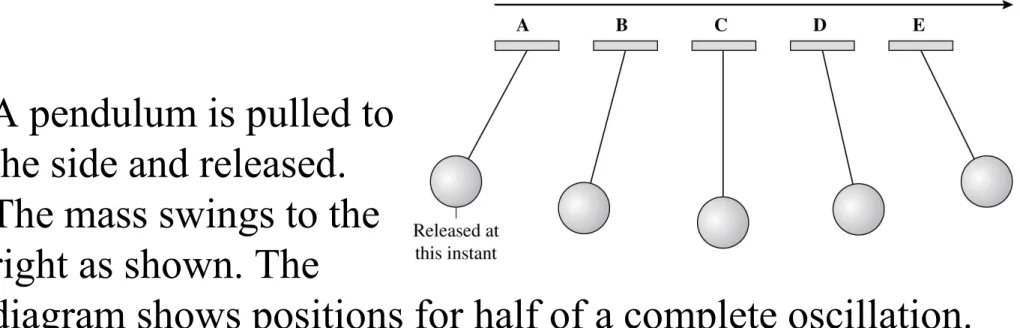
A pendulum is pulled to the side and released.
The mass swings to the right as shown. The
diagram shows positions for half of a complete oscillation.
1. At which point or points is the speed the highest? 2. At which point or points is the acceleration the
greatest?
QuickCheck 14.15
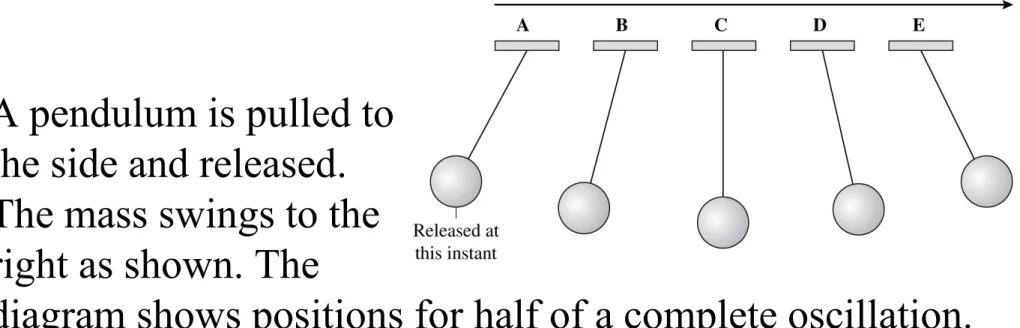
A pendulum is pulled to the side and released.
The mass swings to the right as shown. The
diagram shows positions for half of a complete oscillation.
1. At which point or points is the speed the highest? 2. At which point or points is the acceleration the
greatest?
3. At which point or points is the restoring force the greatest?
C
A, E
QuickCheck 14.16
A mass on the end of a string is pulled
to the side and released.
1. At which time or times shown is the acceleration zero?
2. At which time or times shown is the kinetic energy a maximum?
QuickCheck 14.16
A mass on the end of a string is pulled
to the side and released.
1. At which time or times shown is the acceleration zero?
2. At which time or times shown is the kinetic energy a maximum?
3. At which time or times shown is the potential energy a maximum?
B, D
B, D
QuickCheck 14.17
A ball on a massless, rigid rod oscillates as a simple
pendulum with a period of 2.0 s. If the ball is replaced with another ball having twice the mass, the period will be
QuickCheck 14.17
A ball on a massless, rigid rod oscillates as a simple
pendulum with a period of 2.0 s. If the ball is replaced with another ball having twice the mass, the period will be
A. 1.0 s B. 1.4 s
C. 2.0 s
On Planet X, a ball on a massless, rigid rod oscillates as a simple pendulum with a period of 2.0 s. If the pendulum is taken to the moon of Planet X, where the free-fall
acceleration g is half as big, the period will be
A. 1.0 s B. 1.4 s C. 2.0 s D. 2.8 s E. 4.0 s
On Planet X, a ball on a massless, rigid rod oscillates as a simple pendulum with a period of 2.0 s. If the pendulum is taken to the moon of Planet X, where the free-fall
acceleration g is half as big, the period will be
A. 1.0 s B. 1.4 s C. 2.0 s
D. 2.8 s
E. 4.0 s
QuickCheck 14.19
A series of pendulums with different length strings and different masses is shown below. Each pendulum is pulled to the side by the same (small) angle, the pendulums are released, and they begin to swing from side to side.
QuickCheck 14.19
A series of pendulums with different length strings and different masses is shown below. Each pendulum is pulled to the side by the same (small) angle, the pendulums are released, and they begin to swing from side to side.
QuickCheck 14.20
A series of pendulums with different length strings and different masses is shown below. Each pendulum is pulled to the side by the same (small) angle, the pendulums are released, and they begin to swing from side to side.
Which of the pendulums oscillates with the lowest frequency?
QuickCheck 14.20
A series of pendulums with different length strings and different masses is shown below. Each pendulum is pulled to the side by the same (small) angle, the pendulums are released, and they begin to swing from side to side.
Which of the pendulums oscillates with the lowest frequency?