!
Prof. Dr. habil. Olaf Zawacki-Richter
The Development of Online Distance Learning
- Challenges and Opportunities for HE
DAAD DIES-Conference, 29. November 2011
Olaf Zawacki-Richter, Ph.D.
Professor of Educational Technology
!
Overview
§
What is online distance education (ODE)?
§
A brief history of ODE
§
Opportunities for higher education
!
Prof. Dr. habil. Olaf Zawacki-Richter Folie 3
Simonson, Schlosser & Orellana (2011, p. 126):
"Distance Education is institution-based, formal education where the learning group is separated, and where interactive telecommunications systems are used to connect learners, resources, and instructors" (p. 126).
§
carried out through institutions, formal education
§
geographic separation of teachers and learners
§
interactive telecommunications / media
§
learning group, learning community, learning material
Simonson, M., Schlosser, C., & Orellana, A. (2011). Distance education research: a review of the literature. Journal of Computing in Higher Education, (23), 124-142.
Distance Education
!
Prof. Dr. habil. Olaf Zawacki-Richter Slide 4 Blended Learning Distance Learning E-learning Online Learning M-Learning Paper-based Distance Learning Contact Learning (residential/face-to-face) Bro w n, T . (2 00 4). T he ro le o f m-l ea rn in g in th e fu tu re o f e -le arn in g in Af rica . In D . Mu rp hy , R . C arr , J. T ayl or , & W . T at -me ng (H rsg .), D ist an ce e du ca tio n an d te ch no lo gy: issu es an d pra ct ice (S. 1 97 -2 16 ). H on g Ko ng : O pe n U ni ve rsi ty of H on g Ko ng Pre ss.
!
Prof. Dr. habil. Olaf Zawacki-Richter Folie 5
Innovations in Educational Technology
Correspondence Generation!
1850-
Telecom. Generation!
1960- Computer Generation1970- !
access flexibility costs
Attributes of Distance Education
!
Impact of Media on the Delivery of DE:
The "Golden Triangle"
Flexibility
Costs
Media
(synchronous/ asynchronous)Access
+/-
+/-
+
-
+/-
!
Prof. Dr. habil. Olaf Zawacki-Richter Folie 7
§ 1856 Langenscheidt-Toussaint
§ 1858 University of London
§ 1875 UNISA
§ flexibility: very high
§ interaction: very slow
Correspondence Generation!
1850-
!
Prof. Dr. habil. Olaf Zawacki-Richter Folie 8
§ Foundation of “Open Universities” to increase access to higher education (“mass higher education”)
§ 1969 OUUK
§ 1974 FernUniversität in Hagen
§ Network of study centres
§ academic support through telephone, fax, video, tv broadcasts, video conferencing ("multimedia generation")
Telecom. Generation! 1960-
!
Prof. Dr. habil. Olaf Zawacki-Richter Folie 9
§ Murray Turoff (New Jersey Institute of Technology) developed computer-conferencing (computer- mediated communication
§ CoSy (conferencing system) used for online tutorials in 1988 at the OUUK (Mason, 1989)
§ asynchronous cmc affords inter-personal discussion independent from time and space
Computer Generation! 1980- Viola Browser 1993 ! ! Virtual-U developed 1994 to 1995 at Simon Fraser University in Canada
!
Development of online distance learning: UMUC
§
University of Maryland University College, Adelphi, Maryland (USA)
§
Four out of five undergraduate students enrolled in UMUC’s
programs are also working full time.
§
In fall 2006, the median age for students enrolled in UMUC’s
undergraduate programs was 32 years old.
§
However, in contrast to traditional distance education, the
number of younger first time students is growing.
"Our student body is quite diverse. In age the biggest segment, is from 25 to 44; but increasingly the age group under 25 is growing. These are usually traditional students who go to residential campuses. However, in the United States, those campuses are becoming more and more expensive, and many students have to work and go to school part-time. So increasingly they come to us."
!
Prof. Dr. habil. Olaf Zawacki-Richter Folie 11
!
Student numbers and web enrollments (UMUC, 2010)
!
Prof. Dr. habil. Olaf Zawacki-Richter Folie 12
Online Enrollments USA (Sloan Foundation)
0 1000000 2000000 3000000 4000000 5000000 2001 2002 2003 2004 2005 2006 2007 2008 2009
Allen, E., & Seaman, J. (2009). Staying the course - Online Education in the United States, 2008. Sloan Foundation.
!
Prof. Dr. habil. Olaf Zawacki-Richter Folie 13
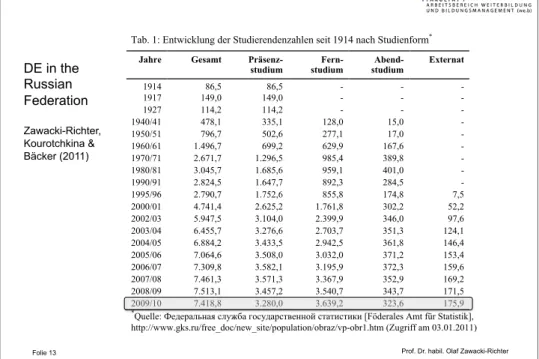
Tab. 1: Entwicklung der Studierendenzahlen seit 1914 nach Studienform*
Jahre Gesamt
Präsenz-studium studium Fern- studium Abend- Externat
1914 86,5 86,5 - - - 1917 149,0 149,0 - - - 1927 114,2 114,2 - - - 1940/41 478,1 335,1 128,0 15,0 - 1950/51 796,7 502,6 277,1 17,0 - 1960/61 1.496,7 699,2 629,9 167,6 - 1970/71 2.671,7 1.296,5 985,4 389,8 - 1980/81 3.045,7 1.685,6 959,1 401,0 - 1990/91 2.824,5 1.647,7 892,3 284,5 - 1995/96 2.790,7 1.752,6 855,8 174,8 7,5 2000/01 4.741,4 2.625,2 1.761,8 302,2 52,2 2002/03 5.947,5 3.104,0 2.399,9 346,0 97,6 2003/04 6.455,7 3.276,6 2.703,7 351,3 124,1 2004/05 6.884,2 3.433,5 2.942,5 361,8 146,4 2005/06 7.064,6 3.508,0 3.032,0 371,2 153,4 2006/07 7.309,8 3.582,1 3.195,9 372,3 159,6 2007/08 7.461,3 3.571,3 3.367,9 352,9 169,2 2008/09 7.513,1 3.457,2 3.540,7 343,7 171,5 2009/10 7.418,8 3.280,0 3.639,2 323,6 175,9
*Quelle: !"#"$%&'(%)*&+,-%./*+#%$*01"((/2*0%03*0343 [Föderales Amt für Statistik],
http://www.gks.ru/free_doc/new_site/population/obraz/vp-obr1.htm (Zugriff am 03.01.2011) DE in the Russian Federation Zawacki-Richter, Kourotchkina & Bäcker (2011) ! FernUniversität in Hagen
!
Prof. Dr. habil. Olaf Zawacki-Richter Folie 15
Widening participation with ODL
§
Growing demand for flexbile learning opportunities in the era
of lifelong learning.
§
Access to mass higher education
§
Non-traditional students: working professionals, students with
disabilities, or students with social/family obligations.
§
Internationalization via modern ICTs
§
Globalization of the education market:
Lucy was a student from Latin America, working in New Zealand and com-pleting part-time an Australian degree which was being offered via Singapore […] We asked her what she wanted to do when she finished her qualification. She said her aim was to gain a position in the United States office of the European company she worked for. (McBurnie & Ziguras, 2007, p. 6)
.
!
Prof. Dr. habil. Olaf Zawacki-Richter Folie 16
Barriers to Distance Education
§
Large-scale study
§
Factor-analytic study to identify dimensions of barriers to
distance education
§
64 items (barriers) derived from literature, previous research
and selected case studies
§
Rated on a 1-5 scale (no barrier to very strong barrier)
Muilenburg, L. Y., & Berge, Z. L. (2001). Barriers to distance education: a factor-analytic study.
!
Prof. Dr. habil. Olaf Zawacki-Richter Folie 17
Sample
§
N=2,504 valid surveys (collected in the US)
o 1,276 form HE institutions
o 448 from corporate sector
o 375 from community colleges
o 129 from government organizations
o 126 from middle or secondary schools
o 117 from non-profit organizations
o 33 from elementary schools
§
Job functions:
o 1,150 teachers, faculty or trainers
o 648 managers, directors
o 346 support staff
o 167 higher administrators (e.g. dean, vice-president)
o 193 other
Muilenburg, L. Y., & Berge, Z. L. (2001). Barriers to distance education: a factor-analytic study.
Distance Education, 15(2), 7-22.
!
Analysis
§
Exploratory factor analysis of the 64 items (barriers) revealed
10 factors that accounted for 52% of the overall variance.
§
14 variables that were not included in any factor, e.g.:
o competition with on-campus courses, or for existing students
o isolation felt by instructors
o problems with vast distances or time zones
o lack of professional prestige for distance learning
o accreditation issues
!
Prof. Dr. habil. Olaf Zawacki-Richter Folie 19
Administrative structure
!
Prof. Dr. habil. Olaf Zawacki-Richter Folie 20
Organisational change
Technical expertise, support & infrastructure
Social interaction & program quality
Faculty compensation & time
!
Prof. Dr. habil. Olaf Zawacki-Richter Folie 21 Threat of technology Legal issues Evaluation/ effectiveness Access Student support services !
Education Innovation: Organizational Change
§
Meso-level of educational management
§
Support from top management
"[…] unless a college or university is prepared to make a serious long-term, institution-wide commitment to the goal, it is extremely difficult to go virtual in a big way."
Nicholas H. Allen (2001: 72) Provost / Chief Academic Officer
University of Maryland University College (UMUC)
§
Faculty participation – incentives for innovative teaching
§
Faculty support
"Presidents may dream visions, and vice presidents may design plans, and deans and department heads may try to implement them, but without the support of faculty members nothing will change."
A. W. (Tony) Bates (2000: 95)
!
Prof. Dr. habil. Olaf Zawacki-Richter Folie 23
Organizational Change: Top-Down / Bottom-UP
Education Innovation
Academic Support Units Resources
Incentives
Mission and Vision Technical Infrastructure
Faculty Support
Professional development
Demand for flexible learning opportunities Academic Ownership Examples of good Practice Project management instructional design !
Prof. Dr. habil. Olaf Zawacki-Richter Folie 24
Instructional design
§
Instructional design is a systematic approach to the planning,
design, implementation and evaluation of educational
interventions.
§
Team approach vs. lone ranger approach
§
ADDIE model:
o
Analyze
o
Design
o
Develop
o
Implement
o
Evaluate
!
Prof. Dr. habil. Olaf Zawacki-Richter Folie 25
Instructional design process
!
Fresen, J. W., & Boyd, L. G. (2005). Caught in the web of quality. International Journal of Educational Development, 25(3), 317-331.
!
Thank you for your attention!
Olaf Zawacki-Richter, Ph. D. Professor of Educational Technology University of Oldenburg, Germany [email protected]