ChemActivity
T15
The Ideal Solution
Focus Question: An equi-molar mixture of benzene and toluene is
prepared. What will be the composition of the
vapor in equilibrium with this solution?
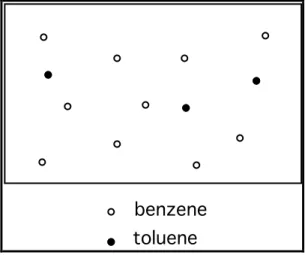
Model 1: Benzene and Toluene in the Vapor Phase.
Figure 1: A Mixture of Benzene and Toluene in the Vapor Phase Behaves as a Mixture of Ideal Gases
a
a
benzene toluene Recall that for a mixture of ideal gases,
PiV = niRT for each component i (1)
PtotV = ntotRT (2)
The partial pressure, Pi, of each component in a mixture of gases is related to the composition of the vapor phase according to the relation
Pi = Xi(vap) Ptot (3) where Xi(vap) is the mole fraction of component i in the vapor phase. Equation (3) is known as Dalton's Law.
Critical Thinking Questions
1. Show how equation (3) can be derived from equations (1) and (2).
2. At a given temperature and volume, does the partial pressure of benzene, Pbz, in Figure 1 depend on the number of moles of benzene present in the gas phase? Explain.
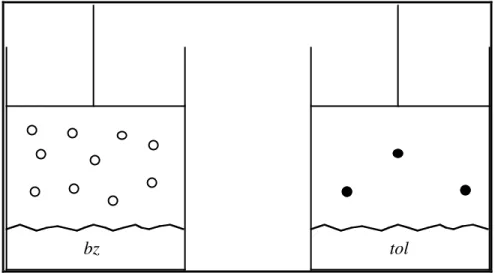
Figure 2: Benzene and Toluene in Equilibrium with the Vapor Phase at 300 K
a
bz tol
Information
The vapor pressure of a liquid may be thought of as a measure of the tendency of the molecules to escape into the gas phase. This tendency is directly related to the strength of the interactions in the liquid phase.
Critical Thinking Questions
3. Draw Lewis structures for benzene (C6H6) and toluene (C6H5CH3).
4. Provide a list of the 4 principal types of intermolecular interaction present between molecules.
5. What type of intermolecular interaction is expected to be the dominant interaction between: a) two benzene molecules (bz-bz)?
b) two toluene molecules (tol-tol)?
6. Based on Figure 2, which species (benzene or toluene) has a higher vapor pressure at 300 K? Explain your reasoning.
7. Based on Figure 2, which is the stronger intermolecular interaction: bz-bz or tol-tol? Explain.
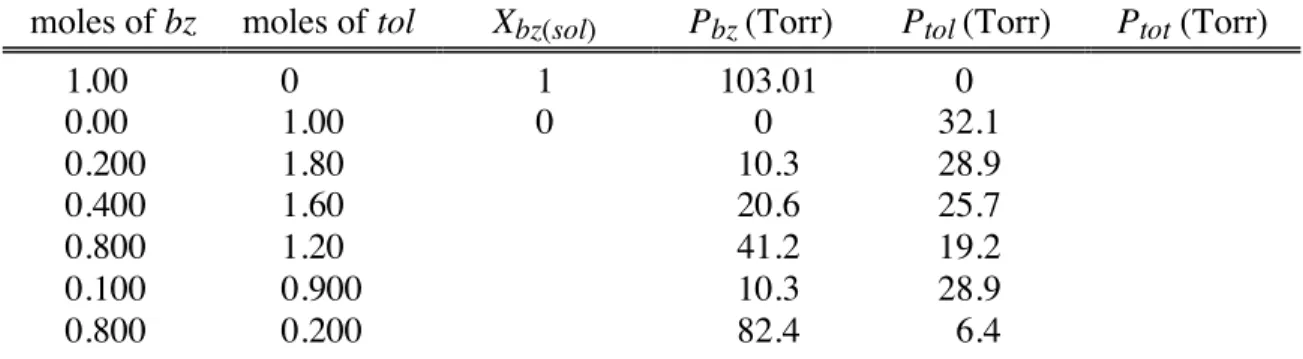
Table 1: Partial Vapor Pressures of Benzene and Toluene for Various Mixtures at 300 K
moles of bz moles of tol Xbz(sol) Pbz(Torr) Ptol (Torr) Ptot (Torr)
1.00 0 1 103.01 0
0.00 1.00 0 0 32.1
0.200 1.80 10.3 28.9
0.400 1.60 20.6 25.7
0.800 1.20 41.2 19.2
0.100 0.900 10.3 28.9
0.800 0.200 82.4 6.4
Xbz(sol) is the mole fraction of benzene present in the liquid solution.
Critical Thinking Questions
8. Complete Table 1 by calculating the missing values for Xbz(sol) and Ptot . 9. What is the vapor pressure of pure benzene, P*b z?
10. What is the vapor pressure of pure toluene, P*tol?
12. Is Pbzdetermined by the number of moles of benzene present in liquid solution? Explain your reasoning.
13. Recall that Dalton's Law describes the relationship between the partial pressure of a component and the composition of the vapor phase.
Use Table 1 to find the relationship between the partial pressure of benzene over the solution and the composition of the solution. Provide an answer to this question as both a grammatically correct English sentence and as a mathematical relationship.
14. What is the relationship between the partial pressure of toluene over the solution and the compostition of the solution? Provide an answer to this question as both a grammatically correct English sentence and as a mathematical relationship.
15. Construct a diagram similar to those in Figure 2 (having the same gas phase volume) representing a mixture of 0.8 moles of liquid benzene and 1.2 moles of liquid toluene in equilibrium with its vapor at 300 K.
Is the composition of the vapor phase the same as the composition of the liquid phase?
Model 2: The Ideal Solution.
A liquid mixture of (at least) two substances is referred to as an ideal solution when Raoult's Law is obeyed by every component. In this case, the volumes are also additive (that is, the volume of the mixture is equal to the sum of the volumes of the components).
Raoult's Law states that the partial pressure of each component of a mixture is equal to the mole fraction of the component in solution multiplied by the vapor pressure of the component when pure.
When substances are mixed the volumes tend to be additive if: a) the species mixed are roughly the same size and
b) the dominant type of intermolecular interaction between the two different species is similar to the dominant type of interaction between the molecules of each pure component.
Critical Thinking Questions
16. Provide a mathematical representation of Raoult's Law.
17. Is the mixture of benzene and toluene likely to be an ideal solution? Explain.
18. Propose a liquid (other than toluene) to mix with benzene which you would not expect to result in an ideal solution and explain your reasoning.
Exercises
1. Would you expect a mixture of dibutyl ether and H2O to be an ideal solution? Why or why not?
2. Although Raoult's Law and Dalton's Law are very similar in form, they are in fact very different. Write both laws and carefully describe the differences between them.
3. Assuming that they behave as ideal gases, calculate the Xbz(vap) and Xtol(vap) for the mixtures given in Table 1.
4. At 20°C the vapor pressures of pure toluene and xylene are 25 and 5 Torr, respectively. What is the composition of the vapor phase in equilibrium with a solution containing 1.0 mol of toluene and 1.0 mol xylene?
5. The following relationship is particularly useful for relating the composition of an ideal solution to the vapor phase composition.
XA(vap) =
XA(sol)PA*
XA(sol)PA* +
(
1–XA(sol))
PB*Derive this relation from Raoult's and Dalton's laws.
6. Is it possible for the composition of the vapor phase and the composition of the liquid phase to be identical for a mixture of two liquids? If so, under what conditions? If not, why not?