[
For more Authorinformation, go to gxpandjvt.com/bios
Welcome to “The Aseptic Core.”
This column discusses scientific and regulatory aspects of aseptic processing, with an emphasis on aseptic formulation and filling. This column has been developed with the intention of providing practical advice to professionals involved in the qualification of aseptic processes and the myriad support processes involved. The primary objective for this column: Useful information.
Aseptic processing is one of the most challenging of all pharmaceutical manufacturing processes. It is also one of the most difficult to qualify processes because of the risk factors involved. Without aseptic processing, however, many life-saving treatments would not be possible—from vaccines against childhood diseases to cancer therapies to treatments for Hemophilia. Aseptic processing is a risky but necessary process.
With that in mind, it is appropriate that the first topic for this column is “Risk Management for Aseptic Processes.” Future topics will include: Aseptic process simulations, clean room certification, environmental monitoring, aseptic gowning and gowning qualification, lyophilization, container and closure qualification, and sterile filtration.
Reader comments, questions, and suggestions are needed to help us meet our objective for this column. Please e-mail your suggestions to [email protected].
KEY POINTS
The following key points are discussed in this article:
t"TFQUJDQSPDFTTJOHJTJOIFSFOUMZSJTLZ"OFGGFDUJWF
risk management program can help to reduce risk while reducing wasted effort.
t"TFQUJDQSPDFTTJOHJOWPMWFTNBOJQVMBUJPOPGTUFSJMF
components in a carefully controlled environment using careful techniques to produce a sterile product
t"TFQUJDQSPDFTTJOHQSFTFOUTBIJHISJTLCFDBVTFUIF
lack of post-processing sterilization increases the risk of non-sterility, and because the severity of the lack of sterility in a parenteral product is extremely high
t5IFRVBMJUZSJTLNBOBHFNFOUQSPDFTTJTEFGJOFECZ
the International Conference on Harmonisation’s (ICH) Q9. It can be divided into four steps: Risk assessment, risk control, risk communication, and risk review.
t3JTLBTTFTTNFOUTIPVMECFQFSGPSNFECZBUFBNPG
qualified experts
t4PNFPGUIFNPSFQPQVMBSNFUIPETPGSJTL
assessment include failure mode and effects analysis (FMEA), fault tree analysis, and hazard analysis and critical control points (HACCP)
t3JTLDPOUSPMDPOTJTUTPGSFEVDJOHSJTLPS
accepting risk. A formal risk control plan may be the output of a risk control plan as part of risk communication.
Risk Management for Aseptic
Processing
Ed White
ABOUT THE AUTHOR
Ed White is a QA validation specialist at Baxter Healthcare Corporation. He can be reached by e-mail at [email protected].
t3JTLSFWJFXTIPVMECFQFSGPSNFEPOBQFSJPEJD
basis as part of the quality management process
t3JTLBTTFTTNFOUJTVTFEJOQSPDFTTJOHUP
determine project activities to reduce the risk level. If reduction is not possible, there should be additional in-process controls, additional testing, and additional training to mitigate risk.
t3JTLBTTFTTNFOUJTVTFEJOWBMJEBUJPOUP
determine high-risk processes. There should be proportionately increased sampling, testing, or more rigorous acceptance criteria to provide greater assurance of process acceptability.
INTRODUCTION
Aseptic processes are some of the most difficult processes in the pharmaceutical industry. Because of the nature of aseptic processes, sterile products produced aseptically present a significantly higher risk to the patient than terminally sterilized products. Because of the high level of risk, an effective quality risk management program is necessary to protect the patient.
An effective risk management program aids in the careful control of the process, reducing the risk of contamination at the same time it reduces wasted effort in controlling risks that are not significant. This column discusses some of the common techniques used to manage risks for aseptically processed products.
WHAT IS AN ASEPTIC PROCESS?
Aseptic processing involves manipulation of sterile components in a carefully controlled environment using careful techniques to produce a sterile product. While aseptic processing usually involves filling of final drug product, there are other types of aseptic processes, including aseptic assembly of devices or combination products, aseptic crystallization or aseptic precipitation of drug product to produce a sterile bulk drug substance, and aseptic formulation of final drug product.
One thing all aseptic processes have in common is their high level of risk. They require careful control of the aseptic environment, of personnel practices and procedures, sterilization of equipment and components, extensive environmental monitoring, and many other controls that will be covered in future installments of this column. The number of controls required and the severe consequences of control failure make aseptic processing one of the highest risk pharmaceutical processes. Quality risk management is an essential tool in ensuring product quality.
QUALITY RISK MANAGEMENT
Although quality risk management (QRM) is a relatively new concept to the pharmaceutical industry,
it has been used in other industries for many decades, with some risk assessment tools dating back to the World War II era. The pharmaceutical industry has been slow to adopt many of these tools because of the industry focus on regulatory compliance as the driving force for quality. This traditional compliance-based approach had its drawbacks that became more evident as the industry became more diverse and sophisticated. A “one-size-fits-all” approach to quality became increasingly unworkable, leading the US Food and Drug Administration to develop a quality systems approach to regulation.
The quality systems approach to the pharmaceutical industry was launched on a large scale with the FDA publication of Pharmaceutical cGMPs for the 21st Century—A Risk Based Approach in August 2002 (1). This initiative had the ambitious goal of transforming the FDA regulatory approach to the pharmaceutical industry into a science-based and risk-based approach with an integrated quality systems orientation.
In the time since the publication of the concept paper, this initiative has been largely successful, leading to publication of international guidance documents such as ICH Q9, Quality Risk Management
(2) and Parenteral Drug Association (PDA)
5FDIOJDBM3FQPSU/P2VBMJUZ3JTL.BOBHFNFOU for Aseptic Processes (3). The publication of ICH
Q10, Pharmaceutical Quality System has further enhanced the risk-based approach to pharmaceutical manufacturing.
There are many potential uses for quality risk management in the pharmaceutical industry, including the following:
t%FUFSNJOJOHUIFTDPQFDPNQMFYJUZBOEGSFRVFODZ
of internal and external audits
t*EFOUJGZJOHFWBMVBUJOHBOEDPNNVOJDBUJOH
the potential quality impact of quality defects, complaints, trends, and non-conformances
t1SPWJEJOHBGSBNFXPSLGPSFWBMVBUJPOPG
environmental monitoring data
t&WBMVBUJOHUIFJNQBDUPGDIBOHFTUPUIFGBDJMJUZ
equipment, or process on product quality
t&TUBCMJTIJOHBQQSPQSJBUFTQFDJGJDBUJPOTBOE
identifying critical process parameters during product and process development
t"TTJTUJOHGBDJMJUZEFTJHOEFUFSNJOJOHBQQSPQSJBUF
material, equipment, and personnel flows, appropriate level of cleanliness for processing areas, etc.
t%FUFSNJOJOHUIFTDPQFBOEFYUFOUPGRVBMJGJDBUJPO
of facilities, buildings, and production equipment and/or laboratory instruments (including proper calibration methods)
t%FUFSNJOJOHBDDFQUBCMFDMFBOJOHWBMJEBUJPOMJNJUT t%FUFSNJOJOHSFWBMJEBUJPOGSFRVFODZ
t%FUFSNJOJOHUIFFYUFOUPGDPNQVUFSJ[FETZTUFN
t*EFOUJGZJOHUIFTDPQFBOEFYUFOUPGWFSJGJDBUJPO
qualification, and validation activities
t%FUFSNJOJOHUIFDSJUJDBMBOEOPODSJUJDBMTUFQTJOB
process to assist in the design of process validation
t"OENBOZPUIFSVTFT
The uses for quality risk management tools are nearly limitless. A few examples of the uses of these tools in aseptic processing include the following:
tEquipment and facility design. QRM tools such as 3-D risk assessment (4) can be used to identify high-risk equipment and facilities, as well as low-risk equipment and facilities; this will allow risk control efforts to focus on eliminating the highest risks. Design of high-risk equipment and facilities can be enhanced using input from tools such as failure mode and effects analysis (FMEA) and fault tree analysis to identify potential failure modes. This input allows the equipment designer to add preventive measures to the equipment design to reduce the occurrence of, or even eliminate, potential failure modes.
tEquipment and facility qualification. QRM tools can be used to identify the critical aspects of the aseptic processing equipment or facility that need to be intensively qualified, and the low-risk aspects of the equipment or facility. QRM tools can also be used to determine the extent and frequency of requalification efforts.
tChange control. QRM tools can be used to identify high-risk equipment and facilities that need to be maintained under strict change control, as well as the equipment and facilities that can be placed under a simpler engineering change management program.
tProcess validation. QRM tools can be used to identify the key inputs, key process parameters, and key outputs that need to be monitored and controlled. This allows for focused process validation that ensures that process parameters that are critical to product quality are appropriately validated.
What Is Quality Risk Management?
Risk is the combination of the probability of harm and the severity of harm. For the purposes of QRM, it is the risk to the patient that is important, not the risk to other stakeholders, such as government, industry, medical practitioners, etc.
According to ICH Q9, quality risk management is defined as “a systematic process for the assessment, control, communication, and review of risks to the quality of the drug product across the product lifecycle” (2).
Some key concepts in this definition are that QRM is a systematic process, and that it is designed to manage the risks to product quality across the product lifecycle. The introduction of a systematic process for managing product quality is crucial to consistently providing a high-quality product to the customer.
ICH Q9 defines the two primary principles of quality risk management as follows:
t5IFFWBMVBUJPOPGSJTLUPRVBMJUZTIPVMECFCBTFE
on scientific knowledge and ultimately link to the protection of the patient
t5IFMFWFMPGFGGPSUGPSNBMJUZBOEEPDVNFOUBUJPO
of the quality risk management process should be commensurate with the level of risk.
These principles lead to a need for a formal risk management program for manufacturers of parenteral products. Because these products, which include most biotechnology-derived drugs, bypass many of the body’s defense systems, the level of risk to the patient is significantly higher than in oral or topical products.
THE QUALITY RISK MANAGEMENT
PROCESS
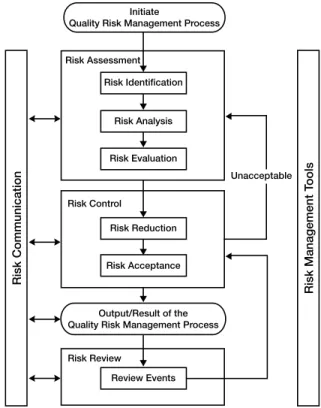
ICH Q9 describes the quality risk management process. Figure 1 illustrates the components of the quality risk management process across the product lifecycle.
Risk Assessment
Risk assessment is the first portion of the quality risk management process. It consists of identifying potential hazards, analyzing hazards, and risks associated with exposure to those hazards. A few key points about the risk assessment process include the following:
t3JTLBTTFTTNFOUTTIPVMECFQFSGPSNFECZBUFBN
of qualified experts from disciplines such as engineering, quality assurance, validation, and manufacturing, preferably facilitated by someone familiar with the risk assessment process. This team should clearly define the risk question. A poorly defined risk question can lead to lack of focus in the risk assessment.
t5ISFFGVOEBNFOUBMRVFTUJPOTTIPVMECFBOTXFSFE
in the risk assessment: What can go wrong, how likely is it to go wrong, and how severe are the consequences?
t"GFXPGUIFNPSFQPQVMBSNFUIPETGPSSJTL
assessment are given under “Risk Assessment Tools.” These tools share some of the key characteristics of a risk assessment process:
t Systematic identification of hazards referring to the risk question (risk identification)
t Estimation of the risk associated with the identified hazard (risk analysis)
t Comparison of the identified and analyzed risk against pre-determined criteria (risk evaluation). The output of the risk assessment portion of the risk management process is used in the risk control portion of the risk management process.
Risk Control
Risk control consists of developing a plan to reduce and/ or accept risks. The purpose of risk control is to reduce risk to an acceptable level. The formality and effort of risk control should be appropriate for the level of risk. The following questions should be asked during this phase:
t*TUIFSJTLMFWFMBDDFQUBCMF
t8IBUDBOXFEPUPSFEVDFPSFMJNJOBUFSJTLT t8IBUJTUIFSJHIUCBMBODFCFUXFFOSJTLTCFOFGJUT
and resources?
t%PUIFSJTLDPOUSPMFGGPSUTJOUSPEVDFOFXSJTLT
A risk control plan may be the output of the risk control process. This plan may be included in a project plan or validation master plan, as part of the risk communication process.
Risk Communication
Risk communication is simply that—communication of risks between decision makers and other interested parties, either within or outside the company. This may be done formally or informally, as appropriate for the risk level of the product and process.
Risk Review
Risk review is simply periodic review of risks as part of the ongoing quality management process. Examples of where formal or informal risk review might be performed include periodic management review, as part of a change control program or as part of annual product reviews. However it is performed, risk review should be integrated into the quality management system.
RISK ASSESSMENT TOOLS
The following is a partial list of some of the risk assessment tools used in the pharmaceutical industry. This is hardly a comprehensive list. There are
numerous risk assessment tools available in different industries and for different functions within the same industry.
3-D Risk Assessment
Three-dimensional (3-D) risk assessment (4) is a risk assessment tool that takes into account a system’s distance from the process stream, its location along the process stream (e.g., active pharmaceutical ingredient [API] synthesis, and purification, bulk product formulation, sterile filtration, filling and stoppering, etc.), and the system’s complexity. This tool is mainly used to assign a risk level to an overall system. Where appropriate, additional risk assessment tools may be used to evaluate risks within a pharmaceutical system. Figure 2 gives a visual representation of the 3-D risk assessment process for a biotechnology-derived product (4).
Failure Mode And Effects Analysis
Failure mode and effects analysis (FMEA) is one of the most commonly used methods for pharmaceutical risk assessment. It is a team-based structured risk assessment method that can assign a numerical risk priority number based on relative perceived risk. A FMEA is dependent on the expertise of the team members (see Table I).
Hazard Analysis And Critical Control Points
Hazard analysis and critical control points (HACCP) is a tool mandated by FDA’s Center for Food Safety and Applied Nutrition for use in the seafood industry and other food processing industries. Its use in the pharmaceutical industry was described in detail by the
Figure 1: Risk management process (from ICH Q9).
Initiate
Quality Risk Management Process
Risk Evaluation
Unacceptable Risk Analysis
Risk Identification Risk Assessment
Risk Acceptance Risk Reduction Risk Control
Output/Result of the Quality Risk Management Process
Risk Communication
Risk Management T
ools
Review Events Risk Review
World Health Organization (WHO) in 2003 (5). The seven principles of HACCP include the following:
t$POEVDUBIB[BSEBOBMZTJT
t%FUFSNJOFUIFDSJUJDBMDPOUSPMQPJOUT $$1T t&TUBCMJTIDSJUJDBMMJNJUT
t&TUBCMJTIBTZTUFNUPNPOJUPSDPOUSPMPGUIF$$1 t&TUBCMJTIUIFDPSSFDUJWFBDUJPOUPCFUBLFOXIFO
monitoring indicates that a particular CCP is not under control
t&TUBCMJTIQSPDFEVSFTGPSWFSJGJDBUJPOUPDPOGJSN
that the HACCP system is working effectively
t&TUBCMJTIEPDVNFOUBUJPODPODFSOJOHBMMQSPDFEVSFT
and records appropriate to these principles and their application.
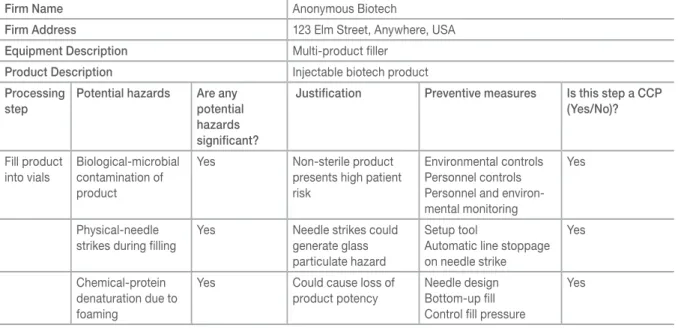
Table II illustrates an HACCP worksheet for the filling of product into vials for a hypothetical biotech company.
Fault Tree Analysis
Fault tree analysis (FTA) is a risk assessment method that begins with a failure event, and uses logic
diagrams to determine the sequence of events required to cause the failure. FTA is frequently used as a design tool for critical systems. FTA can be used with other tools such as FMEA to ensure all failure modes are included and to develop estimates of the frequency of a particular failure mode.
This tool is excellent for equipment design and commissioning, for determining procedural controls needed to prevent a failure event, and for determining qualification and control strategies. With
modification, it can also be used to assign probabilities to each failure mode.
The limitation of this tool is that it requires a large amount of time and effort to construct properly; it can expand rapidly as more detail is added. It is more suitable for large, complex systems than for simple systems because of the time and effort required.
Fault tree analysis involves the following steps:
t%FGJOFUIFGBJMVSF VOEFTJSFEFWFOUUPTUVEZ t(BJOLOPXMFEHFPGUIFTZTUFNHBUIFSBUFBNPG
experts to analyze the system
t$POTUSVDUUIFGBVMUUSFF t&WBMVBUFUIFGBVMUUSFF
t%FWFMPQDPOUSPMTUSBUFHJFTGPSUIFJEFOUJGJFE
hazards.
Figure 3 shows a partial fault tree diagram for a critical failure—cross-contamination between two products. The top event represents the failure. Each subsequent level is connected by a logic gate (AND, OR, etc.). As shown in this figure, a fault tree diagram can grow rapidly and can become quite complex.
IMPLICATIONS OF RISK ASSESSMENT ON
PROCESSING
When a process step or other activity is determined to be high risk, what should be done? These determinations should cause initiation of project activities to reduce the risk level. However, if reduction is not possible, there should be additional in-process controls, additional testing, additional training, and so on. In summary, the organization should expend additional effort to mitigate or control the risk situation. At the same time, efforts on processes or activities that are well controlled or do not represent risk can be minimized. For example, a new purified water (PW) supply was planned for an aseptic processing facility. This PW supply was to be used as feed water for a water-for-injection (WFI) still, for initial rinse water for clean in place (CIP) of formulation and filling equipment, and for make-up of wash solutions for CIP of formulation and filling equipment. WFI was used for the final rinse of this equipment. Based on these parameters, a 3-D risk assessment was performed on the PW system, giving the results shown in Table III.
The overall score determined by this risk assessment is 30, indicating the overall risk is low to medium. This low overall score indicates that detailed formal risk assessment methods such as FMEA are not needed for this system. While the overall risk score indicates few controls are needed, the distance along product stream score indicates that some engineering controls and in-process controls are justified. Based on this analysis, the design engineer decides to add an ultraviolet (UV) system for controlling bioburden,
Figure 2: 3-D risk assessment matrix (4).
1) Working cell bank thaw and inoculum cell culture 2) Bioreactor cell culture and harvest
3) Purification
4) Bulk formulation and sterile filtration
5) Post sterile filtration, filling, lyophilization, packaging, patient information, delivery to patient
Distance along product stream
Area of greatest risk
System complexity Distance from product stream 1
2
3
4
5 4 3 2 1 1
2 3 4
as well as conductivity alarms to indicate system problems. In addition, periodic monitoring and trending of system bioburden is justified. A contrasting example would be an aseptic filler intended for multiproduct use. This filler is designed for high-speed filling and stoppering of several different products with rapid changeover. This filler is designed for in-line check weighing, and for automated CIP and sterilization in place (SIP). A 3-D risk assessment of this equipment gave the results shown in Table IV.
The risk assessment clearly indicates the filler is a
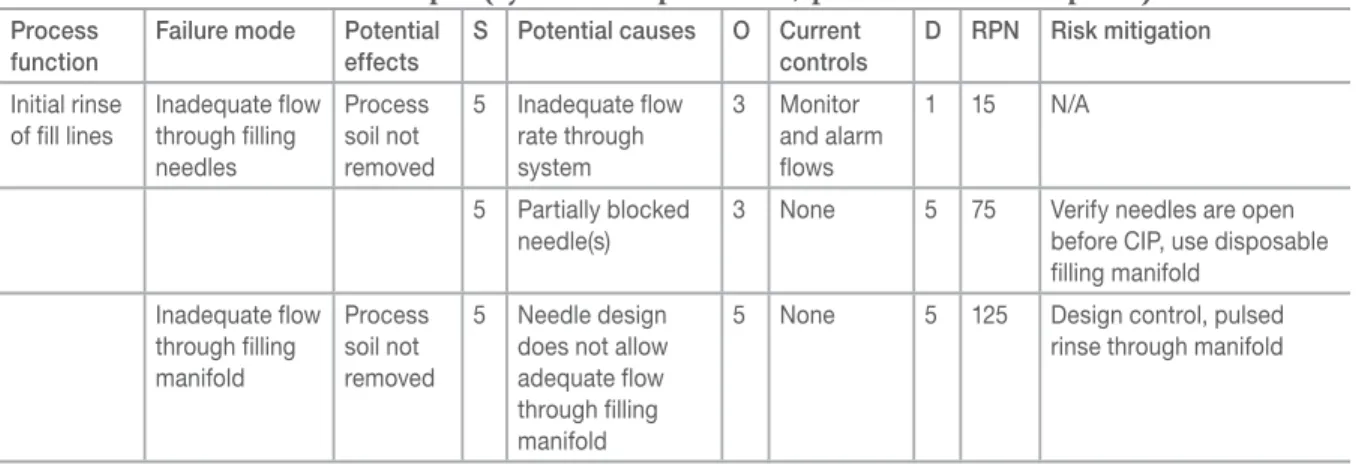
high risk system. Based on this assessment, design and process FMEAs were performed on the filler to identify controls to mitigate high-risk items. Table V is a partial example of a process FMEA used to identify design controls for the new filler.
This example shows a small portion of a detailed FMEA for the CIP process for a critical system (aseptic filler). A FMEA such as this one could be used to put additional controls into place during design of the system, as well as to identify critical items that need to be verified during validation.
Table I:
Sample FMEA for fill line change over.
System ID Usage
Failure Mode
Potential Effects
S Potential Causes
O Current Controls
D RPN Risk Mitigation Gaskets and
silicone tubing changed between products to prevent cross- contamination
Gaskets and tubing not changed out between products
Residual product could remain in tubing or gaskets, contaminating next product
5 Operator error, inadequate instructions
5 None 5 125 Use documented
second operator check to ensure change over is performed
Filler is cleaned in place to ensure removal of residual product
Filler not cleaned properly
Residual product could contaminate next product
5 CIP not performed
1 Filler interlocked to prevent use without CIP/SIP
1 5 Current controls are adequate 5 Excessive
temperature on initial rinse causes protein denaturation
1 Over temperature alarm and cycle abort
1 5 Periodic testing and calibration of alarms
5 Automatic chemical addition fails
3 Conductivity alarm to detect failure to add chemicals
2 30 Periodic testing and calibration of alarms
Table II:
HACCP worksheet (adapted from FDA CFSAN website).
Firm Name Anonymous Biotech
Firm Address 123 Elm Street, Anywhere, USA
Equipment Description Multi-product filler
Product Description Injectable biotech product
Processing step
Potential hazards Are any potential hazards significant?
Justification Preventive measures Is this step a CCP (Yes/No)?
Fill product into vials
Biological-microbial contamination of product
Yes Non-sterile product
presents high patient risk
Environmental controls Personnel controls Personnel and environ-mental monitoring
Yes
Physical-needle strikes during filling
Yes Needle strikes could generate glass particulate hazard
Setup tool
Automatic line stoppage on needle strike
Yes
Chemical-protein denaturation due to foaming
Yes Could cause loss of
product potency
Needle design Bottom-up fill Control fill pressure
IMPLICATIONS OF RISK DETERMINATION
ON VALIDATION
What are the implications of high risk processes or activities on validation? When validating high risk processes or activities, there should be proportionately
increased sampling, testing, or more rigorous acceptance criteria to provide greater assurance of process
acceptability. The 2008 FDA process validation draft guidance (6) specifically incorporates the following risk management principles:
ti3JTLBOBMZTJTUPPMTDBOCFVTFEUPTDSFFOQPUFOUJBM
variables for DOE studies to minimize the total number of experiments conducted while maximizing knowledge gained.
ti2VBMJGJDBUJPOPGVUJMJUJFTBOEFRVJQNFOUDBOCF
covered under individual plans or as part of an overall project plan. The plan should consider the requirements of use and can incorporate risk management to prioritize certain activities and to identify a level of effort in both the performance and documentation of qualification activities.” The European Union Guide to Good Manufacturing Practice, “Annex 15” (7), also refers to the use of risk management in validation and states, “Significant changes to the facilities, the equipment, and the processes, which may affect the quality of the product, should be validated. A risk assessment approach should be used to determine the scope and extent of validation.”
How is risk management incorporated into validation? Risk assessment tools are used to determine the extent of validation and frequency of validation. A few practical examples of how risk management tools are used in validation may be helpful.
Low Risk System
A chilled water system was used to cool a jacketed tank during formulation of a product prior to sterile filtration. This system contacts the tank jacket only. The chilled water system was controlled by an off-the-shelf temperature control system with a chart recorder. A 3-D risk assessment of the chilled water system gave the results shown in Table VI.
Because the system is low risk, no qualification was necessary beyond engineering commissioning of the system. Once commissioned, the system was placed under a standard PM program, and the chart recorder and temperature controller were calibrated on an annual basis.
Medium Risk System
A bulk formulation tank was used to compound a parenteral product before sterile filtration. This tank was connected to a distributed control system (DCS) that controls mixing speed and temperature according to setpoints entered by the operator from a local panel in the compounding area. Ingredients other than WFI were added manually by the operators. WFI was added from a WFI drop at the
Figure 3: Fault tree analysis diagram.
AND Product A contaminated with
Product B
Equipment Not Cleaned
OR
Product A and Product B Share
Equipment Surfaces
Cleaning Procedure Not
Performed Cleaning
Procedure Inadequate
A
Cleaning
Chemistry Wrong Equipment Failure Cleaning
Procedure Wrong
C D
B
Table III:
3-D risk assessment for purified water
system.
System Distance along prod-uct stream
Distance from product stream
System complexity
Overall score
Purified water system
5 2 3 30
Table IV:
3-D risk assessment for aseptic filler.
System Distance along product stream
Distance from product stream
System complexity
Overall score
High-speed aseptic filter
mixing tank, which was opened by the operator from the DCS local panel. A level transmitter connected to the tank indicates the volume of WFI added to the tank. A 3-D risk assessment of the formulation tank gave the results shown in Table VII.
Based on the risk score of 60, the system was designated as a medium risk system. Construction and operation of the formulation tank were verified under installation qualification (IQ) and operational qualification (OQ) protocols. The compounding process itself was verified under a performance qualification (PQ) protocol. After completing IQ, OQ, and PQ, the formulation tank was placed under change control. No periodic requalification was required, but periodic assessment of the system was required to ensure it maintained its validated state of control.
High Risk System
An injectable protein therapeutic was not stable in liquid form and requires lyophilization. The lyophilizer was highly automated, with automated CIP and SIP, automated moisture content and product temperature monitoring using pressure rise methodology, and a supervisory control and data acquisition system containing the lyophilization recipes for each dosage form of the product. Product was loaded into the lyophilizer by an auto-loading system. A 3-D risk assessment of the lyophilizer gave the results shown in Table VIII.
Based on the risk score of 125, the lyophilizer was designated a high-risk system. Extensive validation efforts, including computerized system validation (CSV), CIP, and SIP validation, IQ and OQ including shelf mapping, condenser capacity and sublimation rate, and other tests were performed to characterize the performance of the lyophilizer. PQ of the lyophilizer included surrogate lots with site specific sampling for moisture content,
cake appearance and reconstitution, followed by media fills and conformance lots for the protein therapeutic. The lyophilizer was placed under change control with periodic requalification, including shelf mapping and requalification of the CIP and SIP processes. Media fills were performed using the lyophilizer on a quarterly basis.
CONCLUSION
Quality risk management is an essential tool for qualification of aseptic processes. It is not just a tool for CGMP compliance; it offers real benefits to the validation process by identifying risks and ensuring that critical risks are controlled. By focusing managing risks to the patient, pharmaceutical manufacturers can ensure that the right resources are applied at the right place at the right time—improving patient safety while eliminating unnecessary validation efforts.
Table V:
Process FMEA example (system=aseptic filler; process=clean-in-place).
Process function
Failure mode Potential effects
S Potential causes O Current controls
D RPN Risk mitigation Initial rinse
of fill lines
Inadequate flow through filling needles
Process soil not removed
5 Inadequate flow rate through system
3 Monitor and alarm flows
1 15 N/A
5 Partially blocked needle(s)
3 None 5 75 Verify needles are open before CIP, use disposable filling manifold
Inadequate flow through filling manifold
Process soil not removed
5 Needle design does not allow adequate flow through filling manifold
5 None 5 125 Design control, pulsed rinse through manifold
Originally published in the Spring 2009 issue of 5IF+PVSOBMPG7BMJEBUJPO5FDIOPMPHZ
REFERENCES
1. FDA, Pharmaceutical CGMPs for the 21st Century—A Risk Based Appoach, August 2002.
2. ICH Q9, Quality Risk Management, November 9, 2005. 3. PDA, 5FDIOJDBM3FQPSU/P2VBMJUZ3JTL.BOBHFNFOUGPS
"TFQUJD1SPDFTTFT4VQQMFNFOU, Volume 62, No. S-1. 4. Oliver, James, “A 3-D Risk Assessment Model,” +PVSOBMPG
7BMJEBUJPO5FDIOPMPHZ, Vol. 14, No. 5, Autumn 2008. 5. WHO, “Annex 7: Application of Hazard Analysis and Critical
Control Point (HACCP) Methodology to Pharmaceuticals.” World Health Organization, 8)0&YQFSU$PNNJUUFFPO 4QFDJGJDBUJPOTGPS1IBSNBDFVUJDBM1SFQBSBUJPOT5IJSUZ4FWFOUI Report, Geneva, Switzerland, 2003.
6. FDA, Draft Guidance: Guidance for Industry—Process 7BMJEBUJPO(FOFSBM1SJODJQMFTBOE1SBDUJDFT, November 2008. 7. European Commission, Enter prise Directorate—
General, Working Party on Control of Medicines and Inspections, 'JOBM7FSTJPOPG"OOFYUPUIF&6(VJEFUP (PPE.BOVGBDUVSJOH1SBDUJDF2VBMJGJDBUJPOBOE7BMJEBUJPO, September 2001. JVT
ARTICLE ACRONYM LISTING
API Active Pharmaceutical IngredientCCPs Critical Control Points
CIP Clean in Place
CSV Computerized System Validation
DCS Distributed Control Systems
FMEA Failure Mode and Effects Analysis
FTA Fault Tree Analysis
HACCP Hazard Analysis and Critical Control Points
IQ Installation Qualification
OQ Operational Qualification
PDA Parenteral Drug Association
PQ Performance Qualification
PW Purified Water
QRM Quality Risk Management
SIP Sterilization in Place
UV Ultraviolet
WFI Water for Injection
WHO World Health Organization
Table VII:
3-D risk assessment—medium risk
system.
System Distance
along product stream
Distance from product stream
System complexity
Overall score
Bulk formula-tion tank
4 5 3 60
Table VI:
3-D risk assessment—low risk system.
System Distance
along product stream
Distance from product stream
System complexity
Overall score
Chilled water system
4 1 1 4
Table VIII:
3-D risk assessment—high-risk
system.
System Distance
along product stream
Distance from product stream
System complexity
Overall score
Automated lyophilizer