University of New Hampshire
University of New Hampshire Scholars' Repository
Affiliate Scholarship
Center for Coastal and Ocean Mapping
1-1992
Marine sediment classification using the chirp
sonar
Lester R. LeBlanc
Florida Atlantic UniversityLarry A. Mayer
University of New Hampshire, [email protected]
Manuel Rufino
University of Rhode IslandSteven G. Schock
Florida Atlantic UniversityJohn King
University of Rhode Island
Follow this and additional works at:
https://scholars.unh.edu/ccom_affil
Part of the
Geology Commons
,
Oceanography and Atmospheric Sciences and Meteorology
Commons
, and the
Sedimentology Commons
This Article is brought to you for free and open access by the Center for Coastal and Ocean Mapping at University of New Hampshire Scholars' Repository. It has been accepted for inclusion in Affiliate Scholarship by an authorized administrator of University of New Hampshire Scholars' Repository. For more information, please [email protected].
Recommended Citation
Marine sediment classification using the chirp sonar
Lester R. LeBlanc
Department of Ocean Engineering, Florida Atlantic University, Boca Raton, Florida 33431-099!
Larry
May,er
Dalhousie University, Halifax, Nova Scotia B3H 4J1, Canada
Manuel Rufino
Department of Ocean Engineering, University of Rhode Island, Narragansett, Rhode Island 02882
Steven G. Schock
Department of Ocean Engineering, Florida Atlantic University, Boca Raton, Florida 33431-0991
John King
Graduate School of Oceanography, University of Rhode Island, Narragansett, Rhode Island 02882
(Received 1 March 1991; accepted for publication 12 September 1991 )
The chirp
sonar
is a calibrated
wideband
digital
FM sonar
that provides
quantitative,
high-
resolution, low-noise subbottom data. In addition, it generates an acoustic pulse with special
frequency
domain
weighting
that provides
nearly
constant
resolution
with depth.
The chirp
sonar
was
developed
with the objective
of remote
acoustic
classification
of seafloor
sediments.
In addition
to producing
high-resolution
images,
the calibrated
digitally
recorded
data are
processed
to estimate
surficial
reflection
coefficients
as well as a complete
sediment
acoustic
impulse
profile.
In this
paper,
surficial
sediments
in Narragansett
Bay,
RI are used
to provide
ground
truth for an acoustic
model.
Quantitative
acoustic
returns
from the chirp
sonar
are
used to estimate surficial acoustic impedance and to predict sediment properties. A robust
acoustic sediment classification model that uses core samples to account for the local
depositional
environment
has
been
developed.
The model
uses
an estimate
of acoustic
impedance
to predict
surficial
density,
porosity,
compressibility,
and rigidity.
The comparisons
show
a high correlation
between
the core-determined
sediment
properties
and the estimates
obtained from acoustic measurements.
,
PACS numbers: 43.30.Ma, 43.30.Vh
INTRODUCTION
The remote classification of marine sediments by acous- tic means requires a quantitative, high-resolution profiling system as well as a solid theoretical and/or empirically de- rived basis upon which to convert the acoustic measure- ments into the desired sediment properties. Recent advances in subbottom profiler design have produced high-quality
data suitable for sediment classification work. 1 The collec-
tion and acoustic analysis of cores taken in conjunction with these seismic surveys provides a database for developing al- gorithms for sediment property prediction as well as "ground truthing" of the profiler's ability to remotely identi- fy sediment type.
In this paper we describe an experiment conducted in Narragansett Bay, RI, using the chirp sonar, a calibrated, wideband (2-10 kHz), digital FM sonar that provides quan- titative, high-resolution ( • 10 cm), deep penetration
( • 100 m) subbottom
data.
1'2 The chirp sonar
was devel-
oped with ONR funding to support the objective of remote
acoustic classification of marine sediments. In addition to
producing high-resolution images of the subsurface, the cali- brated digitally recorded data can be processed to provide surficial reflectivity estimates. Subbottom returns can also
be processed for attenuation I and when corrected for at-
tenuation, chirp sonar profiles can provide a reflectivity se- ries well suited for acoustic impedance inversion.
Along with chirp sonar profiles, cores were collected in Narragansett Bay. These cores were analyzed for velocity, density, porosity, grain density, and grain size. There is a wealth of literature describing empirical studies of sediment
physical and acoustic property relationships. 3-8 These stud-
ies have resulted in a number of regression equations that can often be successful in their ability to predict one property from another (typically within a given depositional environ- ment) but have provided only limited insight into the inter-
action between acoustic waves and marine sediments. Theo-
retical studies of sediment-acoustic wave interaction, on the
other hand, particularly those of Biot 9'1ø and Stoll ll have
used sophisticated formulations that take into account the sediment frame properties. In this paper we have initially taken a simplified view of the manner in which a normally incident acoustic wave emitted from an acoustic profiler in- teracts with a fully saturated marine sediment. In our model, we have assumed that the marine sediment is macroscopical- ly homogeneous and that most of the acoustic-marine sedi- ment interaction can be accounted for by the bulk properties of the sediment, i.e., porosity, specific gravity, elasticity, and
rigidity. The problem of extracting quantitative sediment
parameters from normal incidence reflection profiles poses a
difficult challenge. Even under the most ideal conditions, the
acoustic wave energy is scattered by the random unevenness of the seafloor and the inhomogeneities within the sediment. In order to extract any meaningful information from the stochastic acoustic signal that is returned from the seabed, a model with significant averaging of the estimated param- eters is required. The model developed in this paper has
enough flexibility to model most surficial sediment deposi-
tional environments. Further, the model can be calibrated to
a local area by using average grain density, grain elasticity, and a rigidity constant obtained from core samples. In this
manner, chirp profiler data obtained using a 2-to 10-kHz
swept FM is processed to provide reasonable predictions of
sediment type.
I. CHIRP SONAR DESCRIPTION
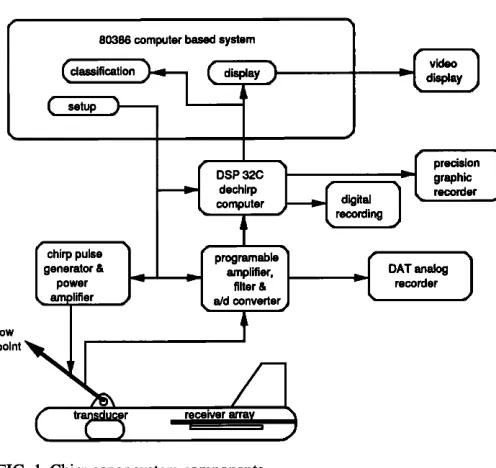
The chirp sonar system shown in Fig. 1 uses a linearly
swept FM pulse that typically covers the range of frequen-
cies from 2-10 kHz. The rectangular acoustic projector is constructed from four wideband piston type transducers and the acoustic receiver is a ceramic line array. The acoustic arrays are mounted in a tow vehicle that is designed for pro- filing at ship speeds varying from 0 (drifting) to 10 kn. Sepa- rate receiving and transmitting arrays are used to preserve linearity and to allow simultaneous transmission and recep- tion. The receiver array signal is digitized with a 16-bit A/D converter at a sampling rate of 30 kHz. To achieve the theo-
retical temporal resolution predicted by the inverse of the
bandwidth, the chirp pulse is compressed using a matched filter that correlates the chirp return signal with a replica of
the outgoing pulse. The correlation process is implemented
with a discrete Fourier transform which is calculated in real
time with a pipeline array processor. The hardware used to
accomplish this is a AT&T DSP 32c processor controlled by
80386 computer based system classification
DSP 32C
dechirp
precision graphic
tow
point
chirp pulse programable
generator & amplifier,
power filter & a/d converter
DAT analog
recorder
a 80386 microcomputer. The compressed pulse resulting from this signal processing procedure has a time duration approximately equal to the inverse of the bandwidth of the chirp pulse. Good resolution is an important factor in sedi- ment classification because it provides a more precise picture of the true geologic variability (the impulse response of the sediment), and thus permits accurate determination of the depositional processes. When the time duration of the pro- cessed pulse is too large, individual reflections will be
lumped together with random phase, thus making it difficult
to estimate impedance and to examine geologic processes. In addition to the pulse compression correlation pro- cessing achieves a signal processing gain over the back- ground noise. This gain is approximately ten times the log of the time-bandwidth product. To equal the performance of the chirp sonar pulses that were used in this experiment, a conventional pulse sonar would have to operate at a peak pulse power of 100 times larger than the chirp pulse.
Another important feature that enhances the ability of the chirp sonar system to classify sediments is realized by the deconvolution of the system response from the output pulse. The sonar system impulse response is measured in the labo- ratory and is used to design a unique output pulse that will
prevent the source from ringing. In addition to this, the chirp
wavelet is weighted in the frequency domain so as to have a Gaussian-like shape. As the Gaussian-shaped spectrum is attenuated by the sediment, energy is lost but its bandwidth
is nearly preserved. •2 Thus even after being attenuated by 20
m of sand, the chirp pulse has approximately the same reso- lution as an unattenuated pulse. This feature simplifies the mathematics of inverting the time series to obtain the imped- ance profile of the sediment. In addition to a loss of total energy, attenuation causes the center frequency of the chirp pulse spectrum to shift to a lower frequency, thus allowing us
to estimate the attenuation of the sediment.
Another important feature of the chirp sonar is the re-
duction of side lobes in the effective transducer aperture.
The wide bandwidth of the FM sweep has the effect of smearing the side lobes of the transducer and thus achieving a beam pattern with virtually no side lobes. The effective
spatial beamwidth obtained after processing the chirp signal
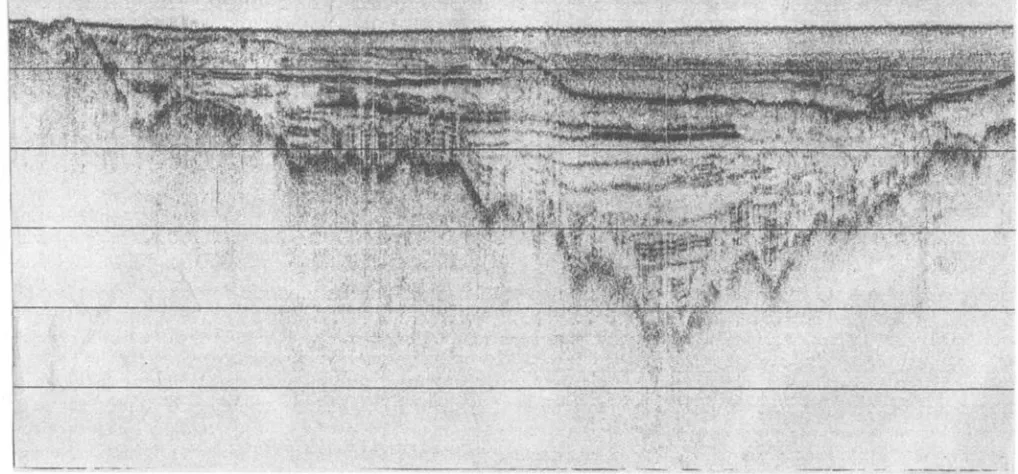
is 20 ø measured to the - 3-dB points. This feature is appar- ent when inspecting the sample profile record shown
in Fig. 2.
Since the transmitted chirp pulse is highly repeatable and its peak amplitude is precisely known, the sediment re- flectivity values can be estimated from the peak pulse ampli- tude measurements of the bottom returns. In this experi- ment, peak pulse amplitude was recorded while surveying a section of Narragansett Bay. When an interesting feature
appeared, grab samples were taken at that station. The sam-
ples were analyzed for grain size, porosity, and sound speed, and then compared to the chirp sonar estimated sediment impedance.
FIG. 1. Chirp sonar system components.
II. BOTTOM LOSS MEASUREMENT AND SEAFLOOR
CLASSIFICATION
When an acoustic wave traveling through the water en- counters the sediment boundary of the seafloor, reflected
FIG. 2. Typical chirp profile in Narragansett Bay, RI taken between the Wickford breakwall and Hope Island; horizontal extent is about 1500 m and vertical
scale is 10 m between grid lines. The record reveals: a glacially excavated river valley overlain by approximately 30 m of varved glacial lake deposits; a fluvial
uncomformity at the top of the lake sediments and; approximately 10 m of marine estuarine sediments deposited with the most recent rise of sea level.
and transmitted waves are generated at the fluid-sediment
boundary. For a simple harmonic plane wave normally inci- dent on a plane boundary, the Rayleigh reflection coefficient
is given by,
R = (p•,c•, --pwCw)/(p•,c•, +pwCw) (1) and the bottom loss (BL) of the plane wave at normal inci- dence is then given by
BL = -- 20 Log]o (R). (2)
Initially, we are using this equation as the basis for classify- ing surficial sediments on the seafloor.
Obviously, there are many approximations that can modify our analysis; seafloor roughness, planar wave as-
sumption, other waves generated at the boundary, •3 and
bottom curvature to mention a few. To some extent, the ef-
fects of seafloor roughness can be reduced by averaging the
reflected values. In addition to the mean value, the reflected
pulse width and pulse amplitude variance are indicators of sediment types. In this experiment, we used the mean ampli- tude to determine bottom type. In several instances, gaseous sediments were brought up in the grab corer and in each case, a broadening of the reflected pulse was noticed. In shal- low coastal areas, gaseous surficial sediments are quite often present. These sediments present a large reflection coeffi- cient while providing volume scattering that lengthens the
pulse returned from the boundary. TM In the future, our pro-
gram will include these effects as well as accomplish a math- ematical impedance inversion to obtain the acoustic impulse response of the sonified column of marine sediment.
109 J. Acoust. Soc. Am., Vol. 91, No. 1, January 1992
/
III. RELATIONSHIP BETWEEN SEDIMENT PROPERTIES
AND BOTTOM LOSS
An'unconsolidated marine sediment is a porous and
loose structure whose interstices are filled with seawater.
Therefore, it can be thought of as composed of a fraction
which is seawater and a remainder which is solid material.
Porosity, which is defined as the ratio of the volume of voids
between the grains of a sediment to the total volume of the sediment aggregate is therefore an important parameter in describing the way marine sediments react acoustically.
The relationship between bulk density of a marine sedi- ment and porosity is given by
Pt, =Pw n +pg(1 -- n), (3)
wherep& is the bulk density of the sediment, Pw is the density
of bottom water, log is the density of the solid material (grain
density), and n is the porosity of the sediment. This is a simple linear relationship that is easily derived by consider- ing the total mass of material enclosed in a unit volume made up of two materials. In Eq. (3), the porosity n is easily ob-
tained as a function of density:
11--
(pg
--Pw)/(Pg
--Po
).
(4)
The compressional wave velocity for a wave in isotropic elas-
tic media
• is well known
and is given
by
( 1//3t,
-I-
4/-t/3)
c• = , , (5)
Po
where/% is the bulk compressibility of the water saturated
sediment, and p is the bulk modulus of rigidity. For small
pressure
perturbations,
the bulk compressibility
is linearly
dependent on the porosity of the sediment.
For an adiabatic process, the compressibility is defined
as the fractional change in a unit volume of material for a
given change in pressure:
= a_[.
(6)
Thus the fractional change in a unit volume of water satu-
rated sediment is a linear combination of the individual com-
pressibility of each material, and is given by
=/3wn +/3g (1 - n),
(7)
where/3w
is the compressibility
of water
and/3g
is the com-
pressibility
of the solid material (grain compressibility).
The characteristic acoustic impedance (P0 co ) of the marine
sediment is now obtained by combining Eqs. (3), (5), and
(7) as follows,
Z0 --poco
= Z•(•
+pR(1--n)
+/JR (1 --n)+ •- /flJ•
4
[ n + p• (1- n
) ] ,
) 1/2
(8)
where
PR :•Og/•Ow
is the grain density
relative
to bottom
water,
•2-3; p• is the
density
of bottom
water,
1025
kg/m3;
/JR =/3g/13•
is the grain
compressibility
relative
to bottom
water, •0- 1;/3• is the compressibility of bottom water,
42.94
X 10- 11
m2/N (Ref.
7); and Zw = (p•//3•) 1/2
is the
impedance
of bottom
water, 1.549
X 106 kg/m2s (note--
p•,pg,/J•,lJg,
referred
to 1 atm and 23 øC).
The compressional wave velocity of the sediment is ob-
tained in the same manner by c. ombining Eqs. (3) and (7)
with (5):
the averagepR,/5'R, and p corresponding to the coastal depo-
sitional environment that the samples were taken from. The curve fitting process is carried out in two stages: The first stage is initiated by starting with an initial estimate of rela- tive density, relative compressibility, and rigidity. The first two of these starting values are varied until a minimum least- squares fit is obtained between the measured impedance val- ues and the impedance values predicted by Eq. (8). In the second stage, the second group of measurements (imped- ance density) are used to find the rigidity constantthat again produces a least-squares fit of Eq. (8) to the actual imped- ance measurements. In order to accomplish this, the density values were first converted to porosity by using Eq. (4) and then porosity data was used directly in Eq. (8) to calculate impedance. The process of adjusting the PR and/3R in the first least-squares solution and then rigidity p in the second solution, is repeated in this same manner until the errors in both curves are globally minimized. This procedure is used to obtain a set of constants PR,/JR, and p that provides us with a calibration of Eq. (8) to a given depositional environ-
ment.
Before carrying out the above-mentioned procedure to solve for the sediment parameters, another minor refine-
ment was required to the rigidity term in Eq. (8). Based on a
careful observation of the data collected for this study, it is
suggested that rigidity of surficial sediments is dependent on
the percentage of solid content in a marine sediment. This
concept was empirically tested by assuming the following
equation for the dependence of rigidity on density,
P = Po (Po/P,, -- 1 )•, (10)
where Po is the rigidity constant--a function of depositional
environment,
(Po/P,, -- 1 ) is a quantity
that is proportional
to the solid material in a unit volume of marine sediment,
and
r/is an arbitrary
exponential
power
constant
(r/= 1 ).
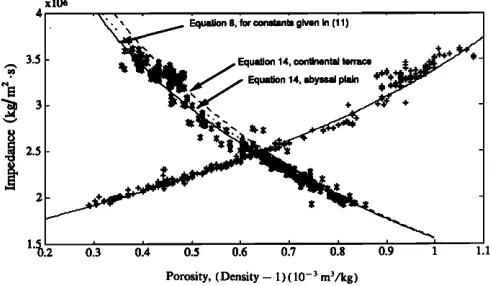
Figure 3 is a plot showing the impedance versus porosity
and impedance versus (density- 1); both "actual data"
1 •
Cb m Cw
[n
(1 -n)] [n
4/3p/3•
)•/2,
(9)
+ [n
+PR
(1
-- n)]
and the least-squares fit of Eq. (8) to the data are plotted.
The rms error in the curve fit is about 4% indicating a high
correlation between the group of data taken from Refs. 3-7
and the theory developed herein. Prior to including the rigid-
where
c• = x/1//•op•,
is the
compressional
wave
velocity
of
bottom water, 1.504 X 10³ m/s.
Equations
(8) and (9) relate
the porosity
and
rigidity
properties of a given marine sediment sample to acoustic
impedance
and
sound
velocity.
In a given
depositional
envi-
ronment,
it is hypothesized
that the relative
grain
densitypR
and
the
relative
grain
compressibility/JR
in
Eqs.
( 8
) and
(9)
are
nearly
constant
and
therefore
porosity
and
rigidity
are
the governing factors in determining the acoustic impedance of the surficial sediments.
In order to test this hypothesis, independent sets of im- pedance versus density, and impedance versus porosity data
37
were collected from five references. - All of the samples were near-surface samples taken in coastal regions (terrigen-
ous sediments). The data from these references were used in
a nonlinear least-squares curve fitting process so as to obtain
xlO•
Equation 8, for constants given in (11)
Equation 14, continents] terrace Equation 14, abyssai plain
+
0.3 0.4 0.5 0.6 0.7 0.8 0.9 1 1.1
Porosity, (Density -- 1 ) ( 10 -3 m3/kg)
FIG. 3. Impedance as a function of both porosity (.) and (density- 1 )
( + ) for actual data taken from five references and the least-squares curve
fitting of Eq. (8) to the data. Other curves are from Ref. 6.
ity term in Eqs. (8) and (9), the rms error was about 5%
greater.
In carrying out the least-squares fit, the power r/in œq. (10) was allowed to vary so as to determine its relationship to various depositional environments. In all cases, it was found that r/was very close to 1, and based on this result, r/ was fixed at a value of one and Po was recalculated for all of the data sets. It is not too unreasonable to expect the rigidity of a sediment to vary in a linear manner (r/= 1 ) with the composition of solid material in the marine sediment. The remainder of the constants obtained by the least-squares fit- ting procedure are in the proper range for terrigenous sedi- ments and are given here:
grain
density
Pg =PwPR
= 2670 kg/m
3,
grain
compressibility
fig =/3w/3R
= 4.85
X 10- • m2/N,
rigidity constant Po = 0.0005 X 10 TM N/m 2. ( 11 )
The plane-wave pressure reflection coefficient is easily related to the porosity or density by noting from Eq. ( 1 ),
R = (Z•, -- Z,,, )/(Z•, + Z,,, ), (12)
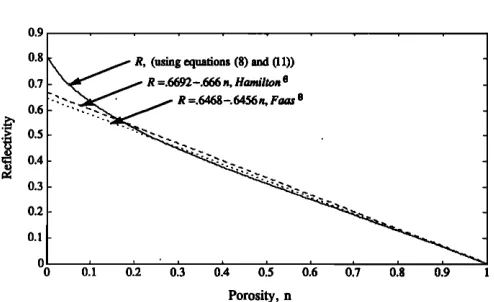
where Z is obtained either by direct substitution of the poros- ity, n into Eq. (8) or indirectly, by finding the porosity from the density values using Eq. (4), and then substituting into Eq. (8). The solid line in Fig. 4 is a plot of reflection coeffi- cient as a function of porosity. It is the result of using the
previously
derived
grain characteristics
(pg,t3g,po)
in Eq.
(8). Faas
s used
density
and compressional
sound
velocity
data from four separate references to compile impedance data. The data were then used in a linear least-squares fit to obtain an empirical equation that relates the reflection coef- ficient to porosity,
R =0.6468--0.6456n (0.35<n<0.85). (13)
Data taken from this equation are plotted for comparative purposes on the same figure. The empirical equation is only valid in the limited range given above. However, in this range, there is an excellent correspondence between our Eq. (8) derived from basic physical principles, and the empirical relationship given by Eq. (13). Part of the high degree of correspondence is attributed to some overlap in data sets used in both methods. Nevertheless, the comparison is en-
0.9 0.8 0.7 0.6
0.5 0.4
0.3 0.2 0.1 0 0
•X,•
R,
(using
equations
(8)
and
(11))
__ 'x• / R =.6692-.666 n, Hamilton S' '•'
:"
'•,'•
.-,.•.
'•'
,
,
011 012 013 014 015 016 0.7 0.8 0.9 Porosity, n
FIG. 4. Hamilton's and Faas's empirical equations for reflection coefficient compared to Eq. (8) derived in text.
couraging and points to a more quantitative way of charac- terizing the depositional environment. To account for differ- ent depositional environments, Hamilton proposed three empirical equations for relating porosity to reflection coeffi-
cient:
R = 0.6692 -- 0.666n; continental terrace,
R = 0.6199 -- 0.607n; abyssal hill,
R = 0.6461 -- 0.646n; abyssal plain, (14)
where 0.35<n<0.85.
For comparison, data from Hamilton's continental ter- race equation are also plotted in Fig. 4. All of these empirical equations constitute attempts to relate the functional behav- ior between reflection coefficient and porosity to a given de- positional environment in a qualitative manner. Using the
method
developed
in this paper,
we are able to establish
a
quantitative method of characterizing the depositional envi- ronment. This is accomplished by specifying grain density, compressibility, and rigidity values in Eq. (8). In order to obtain these parameters, in a given geographic area, a limited set of cores and knowledge of the geological depositional processes involved could be combined to provide an estimate of the constants. Using this simple calibration procedure, normal incident reflectivity values obtained from the chirp sonar are used to predict porosity, density, grain size, rigid-
ity, and sound velocity.
Hamilton 6 developed another empirical relationship
that can be used to provide an estimate of grain diameter from porosity:
n = 31.05 + 5.52•, (15)
where ß = -log2 (mean grain diameter in mm), and
1<•<9.
The correlation between porosity and mean grain diam- eter is not as well defined as the correlation between porosity and density. The standardized error is of the order of 30%. Theoretically, the actual size of each grain in a sediment has no influence on the porosity if the grains were uniform
spheres. In actuality, as the grain size decreases, friction,
adhesion, and bridging increases. Thus a correlation exists between mean grain diameter and porosity but the relation- ship is complex.
For the purpose of providing a general class name to a given sediment in this experiment, Hamilton's table for the
continental terrace (Table I) was used to relate measured
TABLE I. Sediment reflection coefficient and bottom loss for continental
terrace. 6
Sediment type Average reflection coefficient
Coarse sand 0.4098 ( -- 7.8 dB) Fine sand 0.3749 ( -- 8.5 dB)
Very fine sand 0.3517 ( -- 9.1 dB)
Silty sand 0.3228 ( -- 9.8 dB)
Sandy silt 0.2136 ( - 13.4 dB)
Sand-silt-clay 0.2504 ( -- 12 dB)
Clayey silt 0.1767 ( -- 15 dB)
Siltyclay 0.1586 (--16 dB)
reflection coefficient values to sediment type.
This general relationship between class names and sedi-
ments is based on a recommendation by Shepard •6 which
accounts for proportions of sand, silt, and clay present. A general relationship like this is possible since sands have less porosity than silts and clays and the latter are more porous.
IV. CLASSIFICATION OF MARINE SEDIMENTS USING
THE CHIRP SONAR
Since the chirp sonar is a digital FM system, the ampli-
tude of the correlated sediment-water interface reflection is
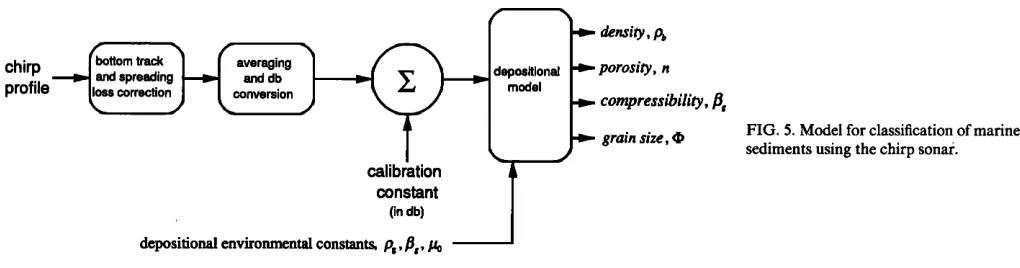
accurately measured and recorded. As shown in Fig. 5, the
reflection coefficient of the first bottom arrival is detected
and corrected for geometric spreading. These raw values are averaged over several returns ( • 10-100) to reduce the un- desirable effects of noise, scattering, and an uneven bottom.
The unscaled reflection coefficient values are then converted
to dB values, Rdb = --20 log(R). Using the sonar equa- tion, the system calibration constant is now subtracted from
the estimated, unscaled reflection values to obtain the reflec-
tion loss of the seafloor. The system calibration constant used in this equation can be obtained by either a direct tank calibration, or by an indirect method using a known seafloor type, or a flat reflecting plate target placed at a fixed distance from the transmitter and receiver pair. The impedance esti-
mate of the seafloor is now obtained from
z• =Z•[(I +R)/(] -R)]. (16)
Equations ( 8 ) and (9) are now solved to obtain porosity and sound velocity estimates for the marine sediment. Equation (3) is used to find a density estimate, Eq. (10) to find a rigidity estimate and finally, Eq. (15) is used to obtain an estimate of average grain size.
V. EXPERIMENT AND RESULTS
A seafloor reflectivity survey was carried out in Narra- gansett Bay, RI in May 1990 and a second experiment later in Sept. 1990. The chirp sonar (Fig. 1 ) system was set up and calibrated to transmit a 20-ms pulse ranging in frequency from 2 to 9 kHz at a rate of twice per second. In the first experiment in May, the system was calibrated by using a large area of seafloor of known sediment type (sand, sandy silt, clayey silt) in Narragansett Bay. Other areas in the bay were then analyzed by the chirp system and compared to
previous ground truth (cores) data. In the second experi- ment, sonar data and grab sample cores were taken at nine selected sites in the same proximity of the May survey. The cores were analyzed for sound velocity, density, and porosity and used to calibrate our depositional environment equa-
tions.
The geographic area in which these experiments were conducted is the West passage of Narragansett Bay, RI. Narragansett Bay, like many estuaries in the northeast is a
glacially deepened river valley that was excavated during the
last glaciation (approx. 18 000 years before present). As the glacier retreated, glacial till was deposited over bedrock, a
glacial lake formed behind a dam of glacial debris and ap-
proximately 30 m of varved, lake sediments were deposited
over a period of several thousand years (a typical profile is
shown in Fig. 2). With the breaching of the glacial dam and
the rise of sea level, several erosional unconformities formed
on the surface of the lake sediments followed by the depo- sition of approximately 10 m of fine-grained marine estuar-
ine sediments (Fig. 2; Peck and McMaster •7 ).
The surficial sediments of Narragansett Bay have been
studied
by McMaster;
•8 the distribution
of sediment
types
in
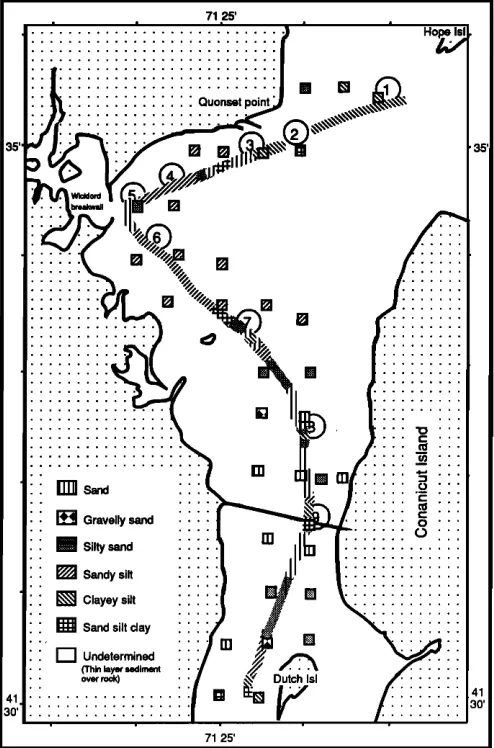
the West Passage is shown in Fig. 6. In this region, McMas- ter identified five surficial sediment types based on the rela- tive percentages of material defined as gravel (> 2 mm); sand (2-0.062 mm); silt (0.062-0.005 mm); and clay
( < 0.005 mm). The distribution of these sediments is a func-
tion of the interactions among: river supply, erosion of pre- existing deposits, redistribution by tidal and nontidal circu- lation patterns, and anthropomorphic effects (dredging).
During the May 1990 survey, a south-north line be-
tween Dutch Island and the Wickford breakwater wall and a
west-east line between the Wickford breakwater and Hope Island were run with the chirp sonar (Fig. 6). Loran C navi- gation, with three calibration points along the ship's track, provided accurate ( q- 10 m in the absence of abrupt atmo- spheric changes) positional information. Figure 2 shows a sample chirp sonar profile taken near the Wickford Harbor entrance. This profile, fairly typical of those from Narragan- sett Bay, shows the succession of geologic features described
above.
The large areas of sand north of the Jamestown Bridge, the sandy-silt area west of Wickford Harbor, and clayey silt around Hope Island provided excellent data for calibration of the chirp sonar. In each of these areas, 360 reflection val-
ß bottom track averaging porosity, n
chirp
odel
profile
- I•s
correctior•J
- Lconversion
compressibility,
fi
grain size,
calibration constant
(in db)
alepositional environmental constams, p•,,Ss, •
FIG. 5. Model for classification of marine
sediments using the chirp sonar.
71 25'
...
:::::::::::::::::::::::::
FITI! Sand ' ' '
B• Gravelly sand .1• si,y s=d • Sandy silt I• Clayey silt I• Sand silt clay
I•1 Undeterrnined
(Thin layer sediment over rock)
...
...
...
ß
71 25'
rn
FIG. 6. Comparison of chirp sonar predicted sediment characteristics along the ship's track with core sites taken from McMaster (Ref. 18). Circles
mark Sept. 1990 core sites.
ues were acquired and averaged. This corresponds to about 500 m of the ship's track in each area. The average and stan- dard deviation of the sonar's output (corrected for spherical spreading) are given in Table II for each of the three calibra-
tion sites.
The average of the differences between Hamilton's re- flection loss values and the output of the chirp sonar at the three calibration sites is Ro = 0.8 dB. This reflectivity cor- rection is used to adjust the chirp sonar output allowing pre- diction of other sediment types using the average reflection
TABLE II. Calibration of the chirp sonar using known bottom types.
Sediment Mean Reflection
type chirp Standard loss Calibration
(McMaster •8 ) output a deviation (Hamilton 6 ) constant
Sand - 8.9 dB 0.5 dB 8.0 dB 0.9 dB
Sandy silt -- 14.5 dB 0.6 dB 13.4 dB 1.1 dB
Clayey silt -- 15.4 dB 0.5 dB 15 dB 0.4 dB
a Referenced to an arbitrary system constant of 197 dB.
coefficients listed in Table I. Note that the reflectivity of silt was not given in Table I, so silt will not be a predicted sedi- ment type in this study.
Using the system calibration constant derived from Ta- ble II, the sediment types were estimated from reflectivity measurements made along the ship's track shown in Fig. 6.
In the second experiment in September 1990, core data collected along the same ship track were used to calibrate the impedance-porosity equation (8) for the depositional envi- ronment of Narragansett Bay. Table III contains the raw data from the nine stations, marked by circles in Fig. 6. The compressional wave velocity was determined by measuring the phase speed of ultrasonic pulses traveling between trans- ducers inserted into a split sediment core. Acoustic imped- ance was calculated using the bulk density and velocity mea-
surements.
Also, in the second experiment, in September, 20 acous- tic profiles were digitally recorded at each site during the coring operation. Unfortunately, two of these data files (site
2 and site 3) were lost. Site 7 was used to calibrate the source
level of the chirp sonar. The reflection data were processed to predict the impedance of the sediment at each of the re- maining sites. In Table III, the predicted value of imped- ance, and porosity [using Eq. (8) ] are provided. This com- parison of grab sample measurements and chirp sonar estimates of sediment properties show good correlation with the exception of site 9. Analysis of the core at site 9 revealed a
thin layer (5-7 cm) of silt and shells over medium sand
which accounts for the higher predicted value of impedance
at this site.
All measurements are referenced to 1 atm and 23 øC.
While bottom water temperatures vary seasonally in Narra- gansett Bay, at any given time they vary only by about 2- 3 øC. Bottom temperature measurements made within a few weeks of our survey revealed temperatures ranging from 19- 22 øC. The water depth at the core sites ranged between ap- proximately 4 to 16 m. The maximum possible difference in
velocity between actual in situ values and the data we have
referenced to 1 atm and 23 øC is thus approximately 9 m/s. Given the small magnitude of this error we have chosen to report values at 1 atm and 23 øC in order to keep them com- parable with those found in other databases.
While the coring process will inevitably cause some dis- turbances to the samples, every attempt was made to reduce these effects. The samples were collected with a Smith- MacIntyre corer that collects an approximately 20 X 20 X 15-cm grab sample. Immediately upon retrieval these cores were subsampled in the middle of the grab (well away from wall disturbances) with polybuterate liner. The subsampled sections were sealed in this manner until they were opened for processing. While very little data exist com- paring in situ measurements to core samples measured in the laboratory, a recent study compared laboratory velocity measurements made on core samples with in situ velocity
measurements made with a ROV-mounted velocimeter. •9
The results of this study have shown that the laboratory and in situ measurements can agree within 5%, and more impor- tantly both showed the same relative changes.
The experimental data given in Table III were used in
TABLE III. Analysis of grab samples taken from Narragansett Bay, RI.
Density Density
Station # (bulk) (grain)
(sediment) (kg/m 3) (kg/m 3) (core)
Porosity Impedance
(chirp) Velocity (core) (chirp)
[Eq. (8) ] (m/s) ( 10 6 kg/m 2 s)
1 Silt 1630 2800 0.67
2 Silt 1420 2670 0.76
3 Sand 2040 2680 0.40
4 Silt 1540 2640 0.69
5 Sand 2030 2690 0.41
6 Sandy silt 1660 2680 0.63
7 Sand 2080 2710 0.39 8 Sand 2000 2660 0.42
9 Silt 1540 2640 0.69
0.66 1466 2.39 2.39
N/A 1458 2.07 N/A a
N/A 1720 3.51 N/A a
0.68 1472 2.27 2.32
0.39 1645 3.34 3.48
0.58 1494 2.48 2.64
0.38 1703 3.54 3.54 b
0.39 1679 3.36 3.48
0.45 1424 2.19 3.17
Data lost at this site.
Calibration site.
the least-squares procedure to obtain the depositional con-
stants (pg,/3g,/•o). The results of the numerical analysis are
shown in Fig. 7. For comparison, core data from the equa-
torial Pacific and Emerald Basin, off Nova Scotia are includ-
ed. The equatorial Pacific samples are composed of calcar- eous and siliceous microfossils; the relative proportions of these components are a function of dissolution and thus the chemical state of bottom waters which, in turn responds to
changes in global climate. 2ø The fundamental difference be-
tween the biogeneous particles of the equatorial Pacific and the terrigenously derived particles of Narragansett Bay is apparent by noting the larger shear coefficient and higher compressibility of the equatorial Pacific sediments. The large shear coefficient is consistent with the spiny nature of many biogeneous particles (and thus pronounced grain-to- grain interlocking); the high compressibility is most likely theresult of the open, hollow structure of the biogeneous
particles
resulting
in more enclosed
water as compared
to
the predominantly incompressible quartz particles of Narra- gansett Bay. At the relatively high frequency of the core velocity measurement (200-1000 kHz) these partially open chambers appear closed and thus each particle acts more compressible than an equivalent solid grain.
The Emerald Basin data are from long (18 m) piston
4.5
4
2.5
2 X10⁶
•,. Narragansett
Bay
(s'urface
cor•s)
'
'
_N•,,'• p,
=
2690,
,8,
=.
9
x
10-",
#,
=.
00035
x
10"
. .• Average taken from references (surface cores)
• • p,=2670,,6,=4.85x10-",#o=.0005x10"
•• •/ Emerald Basin (cores)
:.•'••••..•p,
= 2600,,6,
= 9.6'/x
10-",#o
=.0021x
10"
•• Equatorial Pacific (cores)
1'•).3 014 015 016 017 018 019 1
Porosity
FIG. 7. Impedance dependence on porosity for various depositional envi-
ronments (units: pgmkg/m 3, /3g--m2/N, /•o--N/m2).
cores in a deep (300 m) proglacial basin about 80 km off
Halifax. 21 While this environment has also been influenced
by glacial processes, its relatively deeper setting (as com- pared to Narragansett Bay) results in a much higher percen- tage of clay-rich sediments. These clays form card-house structures and thus demonstrate higher compressibility than the relatively coarse material of Narragansett Bay. In addi- tion, the inclusion of subsurface samples in the Emerald Ba- sin data set will unquestionably show the effects of compac- tion on the rigidity of the sediment sample.
Finally, the Narragansett Bay cores show higher imped- ance at low porosity than the average curve taken for surfi- cial sediments from the literature (Fig. 7). This is most like- ly due to the extremely high sand percentages (80%-90%) found in the low porosity samples from Narragansett Bay. Such high sand percentages greatly increase velocity (and thus impedance) and are uncommon in the samples reported
in the literature.
Vl. CONCLUSIONS
The proposed model for acoustic sediment classification is dependent on the depositional environment. The param- eters that characterize a depositional environment are grain
density pg, grain compressibility/3•, and the rigidity con-
stant Po. The measured reflectivity of the seabed is used to calculate the acoustic impedance of surficial sediments. If the depositional environment and its parameters are known, relationships presented in this paper allow prediction of sound speed, rigidity, porosity, and bulk density from acous- tic impedance. Once a database of parameters is obtained for each depositional environment in the ocean, physical sedi- ment properties can be directly estimated from seafloor re- flection measurements made by a quantitative reflection profiler.
ACKNOWLEDGMENT
This research was supported by the Office of Naval Re-
Search (Geo-Acoustics/Arctic Science Division; program
manager, Dr. J Kravitz) under contract •N00014-91-J-
1082.
•S. G. Schock, and L. R. LeBlanc, and L. A. Mayer, "Chirp subbottom profiler for quantitative sediment analysis," Geophysics 54, 445-450
(1989).
S. G. Schock and L. R. LeBlanc, "Chirp sonar: new technology for sub- bottom profiling," Sea Technol. 31, 35-43 (1990).
R. T. Bachman, "Acoustic and physical property relationships in marine
sediments," J. Acoust. Soc. Am. 78, 616-621 (1985).
S. Buchan, F. C. D. Dewes, A. S. G. Jones, D. M. McCann, and D. Taylor
Smith, "The acoustic and geotechnical properties of North Atlantic
Cores," University College of North Wales, Marine Science Laboratories,
1 and 2 (1971).
E. L. Hamilton, H. P. Bucker, D. L. Keir, and J. A. Whitney, "Velocities
of compressional and shear waves in marine sediments determined in situ
from a research submersible," J. Geophys. Res. 75, 4039-4049 (1970). E. L. Hamilton, "Reflection coefficients and bottom losses at normal inci-
dence computed from pacific sediment properties," Geophysics 35, 995-
1004 (1970).
E. L. Hamilton, G. Shumway, H. W. Menard, and C. J. Shipek, "Acoustic and other physical properties of shallow-water sediments off San Diego,"
J. Acoust. Soc. Am. 28, 1-15 (1956).
R. W. Faas, "Analysis of the relationship between acoustic reflectivity and sediment porosity," Geophysics 34, 546-553 (1969).
M. A. Biot, "Theory of propagation of elastic waves in a fluid-saturated porous solid. I. Low-frequency range," J. Acoust. Soc. Am. 28, 168-178
(1956).
•øM. A. Biot, "Theory of propagation of elastic waves in a fluid-saturated porous solid. II. Higher frequency range," J. Acoust. Soc. Am. 28, 179-
191 (1956).
2• R. D. Stoll, "Acoustic waves in ocean sediments," Geophysics 42, 751-
725 (1977).
22 L. R. LeBlanc, S. G. Schock, and S. Panda, "Pulse and aperture design considerations for a marine sediment classification chirp sonar," Pro-
ceedings of The Marine Technology Society Conference, Nov. 91, Vol. II,
820 ( 1991 ).
13 M. A. Biot, "Generalized theory of acoustic propagation in porous dissi- pative media," J. Acoust. Soc. Am. 34, 1254-1264 (1962).
24 R. J. Urick, Principles of Underwater Sound for Engineers (McGraw-
Hill, New York, 1967).
25 W. M. Ewing, W. S. Jardetsky, and F. Press, Elastic Waves in Layered
Media (McGraw-Hill, New York, 1957).
26 F. P. Shepard, "Nomenclature based on'sand-silt-clay ratios," J. Sed. Pet-
rol. 24, 151-158 (1.954).
•7 j. Peck, and R. L. McMaster, "The geology beneath the Jamestown
Bridge," Marltimes 34(3 ), 4-6 (1990).
•8 R. L. McMaster, "Sediments of Narragansett Bay system and Rhode Is-
land Sound," J. Sed. Petrol. 30, 249-274 (1960).
29 L. A. Mayer, P. Bugden, and P. Simpkin, "The measurement of in situ velocity and attenuation in marine sediments," DREP Rep. :0:W7707-7-
0014/01-OSC, 58 pp. (1989).
2øL. A. Mayer, "Deep-sea carbonates: acoustic, physical & stratigraphic properties," J. Sed. Petrol. 49, 819-836 (1979).
21K. Moran, D. J. W. Piper, L. A. Mayer, R. Courtney, A. Driscoll, and F. Hall, "Scientific results of long coring on the eastern Canadian continen- tal margin," Proceedings of the Offshore Technology Conference, Hous-
ton, Texas, Paper No. 5963, 65-71 (1989).