From Airwaves and Newsprint to Tweets and Text: The Use of Various Forms of
Media by Actors Engaged in Political Violence
In their 1994 book Small Media, Big Revolution, Annabelle
Sreberny-Mohammadi and Ali Sreberny-Mohammadi wrote about their experiences within the Iranian
revolution of the 1970s, and how media such as pamphlets, flyers, local artists, and the
major news media all contributed to the revolution. This sparked an idea as to whether or
not there was some inherent connection between revolutions and media. The original
focus of this thesis was to look at the various ways that revolutionaries throughout time
have utilized various forms of media to spread their message. This thesis was also born
from the concept that revolutions were ideological happenings, which were based on new
ideas that challenged the status quo.
It became clear, however, that there was another aspect to be explored, and that
was technology. It would have been difficult to understand media use in revolutions
throughout various generations without having to deal with the fact that technology that
was available for some was not there for others. Therefore, instead of taking a vertical
look through history, the focus of this thesis changed to a more horizontal one, in which
revolutions would be compared to other types of political violence from around the same
time.
This thesis will look at different types of political violence, and the ways that
actors involved in these types of violence attempt to mobilize potential supporters and
communicate with target audiences. This thesis is concerned with non-state actors;
specifically revolutions, insurgencies, and terrorists. First, the three types of political
different literature. The types of political violence will then be given an “ideal” definition
based on the goals, means, and organization into which, according to this thesis, most
instances of revolution, insurgency and terrorism fit. It is important to note, however, that
not all instances of political violence will fit these ideal types. The types of mobilization
and communication that are expected under this thesis will then be laid out.
The three cases that will be examined in this thesis are the Tunisian Revolution,
the Kosovo Liberation Army, and al Qaeda. The Tunisian Revolution, which is viewed as
the revolution that really started the Arab Spring, was heralded as a social-media
revolution. The fact that the Internet was so developed by the time of the Tunisian
Revolution made it a perfect case to compare against those of the KLA and al Qaeda. Al
Qaeda was chosen because of the large amount of literature available in the United States
on al Qaeda. This group was also chosen because it existed during the earlier stages of
the Internet, on which terrorist groups regularly posted videos to YouTube and gained
followers through Facebook. The KLA was chosen because of the fact that it took place
in the late 1990s, and provides a good example of political violence before the major
Internet boom. The United States’ involvement in the KLA crisis also helped research, as
there is considerable critical literature in English about the insurgency that took place in
Kosovo. The languages that the sources are in have proven to be a challenge to
overcome, and each of these examples had a plethora of literature in English.
Chapter 1: Framework and Methodology
This first chapter will be dedicated to establishing a framework for the thesis, as
well as to a description of the methodology used. However, it is important to first define
political violence that take many different approaches to understanding the concept.
Often the authors of works that center on different types of violence come from different
backgrounds, or the works deal with understanding different aspects of political violence.
This variety of approaches in the literature means that different works are going to have
different definitions of political violence, even within the literature about a given type of
political violence. Nor can one definition for each type of political violence be selected
from one of the various definitions, as these definitions themselves are based on different
criteria. The best way to move forward, then, is to develop a way to define the different
types of political violence based on the same criteria.
The three criteria that I have considered for each of these forms of violence are
goals, means, and organization. These three criteria are derived from Charles Tilly’s
model for revolution, as described in his work From Mobilization to Revolution. Tilly
uses three elements to model revolution: interest, organization, and mobilization.1
However, because this thesis is interested in how actors in these types of political
violence try to mobilize and recruit, as well as how actors engaged in political violence
generally communicate, what their messages are, the kind of technology they use, and
who they are targeting, Tilly’s method has to be altered. It does not make sense to make
mobilization one of the criteria by which political violence will be defined. Rather than
interest, this thesis will focus on goals, which are similar to interests. Goals are the
specific changes that actors engaged in political violence wish to achieve, whereas
interests are the broad issues with which these actors are concerned. This thesis will also
look at organization; however, Tilly is concerned with specific parts of a group’s
structure that directly affect how that group interacts with other actors.2 This thesis is
concerned with how groups structure themselves as a whole, whether this takes the form
of rigid hierarchies or small cells that operate independently from a central group that
defines the goals of the group of actors. Finally, Tilly focuses on mobilization, which he
defines as the process by which groups get control over the resources needed for action.
Instead, this thesis will look at means, which are the actions taken in order to achieve
goals. Neither one of these is more important than the other.
All three factors combine to help define the types of political violence; however,
it is clear that not every case of political violence will match up with the goals, means,
and organization that are attributed to a particular type of political violence. These
definitions of the different types of political violence are ideal types. They are the typical
expectations that one could anticipate, with the knowledge that not every case will fit the
definitions exactly. The goals of the revolutions considered this thesis are large political
change. However, it is hard to separate political and social changes, as the two often go
hand in hand. As revolutionaries try to implement new forms of governance, they
ultimately draw on ideologies that also carry with them certain ideas of what the social
structure of society should be. Revolutions tend to rely on mass protest as well as large
scale violence. It may be that political and social changes are tied together when it comes
to revolutionary change. One way to think about it is that the means will have to be able
to accomplish the goal, and so for a revolution to bring about a change as large as altering
the nature of society it will need to be on a massive scale. The organization of
revolutions, however, tend to vary. When talking about organizations, this thesis focuses
of leadership, with some sort of formal membership. Informal groups are typically large,
broad collectives of people that belong to a certain demographic, and are grouped
together by this similarity. An example of an informal group would be people who are
upset with government policies. A formal group would be the organization of people who
have banded together for the sole purpose of expressing grievances with the government,
have assigned duties to the members, and have a leadership component. Information on
the revolution is often spread by word of mouth, and the gathering often consists of
people bringing people to protests and demonstrations, rather than some neatly organized
event, which may explain how they can turn violent. It is important to note that this is not
always true. The Communist Revolution in China, for example, was heavily organized in
a very militaristic manner. This is why it is important to not try and take these definitions
as always correct, rigid guides. Rather, they are general guides to the norm of a particular
type of political violence.
Revolution
Looking at the various definitions for revolution, one thing remains clear: there is
a distinct focus on the change that is supposed to be brought about by the revolution.
Many different definitions of revolution address the type of change, or how sudden the
changes are, or what exactly it is that changes. The one constant that remains is the focus
on the change itself. Perhaps most famous of these definitions is Theda Skocpol’s
definition from her work States and Social Revolutions. Her definition states that
revolutions are rapid and basic transformations of a society’s state and class.3 This 3 Skocpol, Theda. 1979. States and Social Revolutions : a Comparative Analysis of France, Russia, and
definition is based on what she considers to be the major revolutions (French, Russian,
and Chinese), and its emphasis on class structures seems indicative of the revolutions
during the Cold War, a time which saw many revolutions, such as those in Iran,
Nicaragua, and Chile. In South America these revolutions tended to have their roots in
communism. However, since Skocpol first attempted to assess revolutions, things have
changed significantly. It is hard to say that Skocpol’s ideas of revolution still apply to
modern-day examples, which would include events such as the Arab Spring. Skocpol was
writing about what she considered large revolutions that included rapid and fundamental
changes in the class structure of the society in which the revolution took place. Skocpol’s
definition is one that ultimately supports her claim that revolutions are these broad social
changes. However, this definition could be too limiting and, ultimately, narrows the pool
of potential cases too much.
Other definitions of revolution also examine the bringing about of large-scale
change; however these definitions differ in that they focus on different aspects of society
that change during a revolution. For example, the authors Summer, Parsons and Finney
define revolutions as changes in the entire social order of societies. What seems to be a
common trend among definitions is that authors assume a point from which they wish to
study revolution, and adopt a definition that focuses on that chosen aspect of revolutions.
When talking about trends in the study of revolution, some authors, such as Goldstone
and Foran, look at things from a generational approach, which separates authors who
write about revolutions into different groups based on common approaches to the study
of revolution.4
4 Foran, John. “Theories of Revolution Revisited: Towards a Fourth Generation?” Sociological Theory. Vol.
Goldstone and Foran write about three generations and a possible new fourth one.
The first generation considers what is called a natural history of revolutions, with a
comparative historical approach. The second generation focuses on general theories, and
the third takes a structural approach. Each generation seems to be getting more and more
specific, and looks closer at developing models that look for the root causes of
revolutions, where they can happen, when they can happen, and why the happen. For
example, Skocpol, from her analysis of Russia, France and China, states that revolutions
take place during times of political crises, which arise when old regimes cannot meet
certain challenges. The fourth generation of writing on revolutions takes a more
sociological (and supposedly a more synthetic) standpoint by taking structuralist
approaches and looking at other sociological factors, such as culture, history, ideology,
and the dialogue that occurs between all of these factors.
There is a lack in consistency among political scientists as to what constitutes
revolution. The focus of this paper is on political revolutions, and so only the various
definitions that deal with political revolutions have influenced the definition used in this
thesis. The general theme among these authors is that they are looking for the causes of
revolution. This thesis is not concerned with causes of these instances of political
violence; rather, it looks at how actors involved in these kinds of political violence
mobilize and gather support. However, in order to compare these different types of
political violence, they must be defined in relation to the same criteria.
Terrorism
Terrorism tends to be defined in several ways, though when one looks closely the
of the most basic examples of the definition of terrorism is the one put forth by the U.S.
government, in Title 22, which calls it the “clandestine politically motivated attack of
noncombatants”.5 This definition is relatively straightforward, however, much of
terrorism is the making of threats, and the anticipation of being attacked is part of the fear
that is hopefully instilled. Another definition, found in Achin Vanaik’s paper “Terrorism:
Definition and Ethics”, gives terrorism four characteristics: it is organized intimidation,
violent against civilians, indiscriminate who is attacked; and finally it is illegitimate.6
What is important here is that terrorism is defined as something that is illegal and outside
the norms of war. However, there are many different approaches to understanding
terrorism that seek to understand why it happens and try to avoid the illegal/illegitimate
argument cast upon terrorism (although the name itself tends to be a pejorative). An even
more detailed definition, set forth by Vanaik, attributes five aspects to an act of terrorism:
it was undertaken with the goal of actually keeping a norm in a certain area; it was
secretive; it was done as part of a defense of a territory; it did not use conventional
warfare means; and sit was seen as contributing to the goal. In one article, eleven
different definitions of terrorism were given.7
The majority of these definitions deal with describing terrorism, and are not
looking at the causes, which is the same function of the other definitions of political
violence used in this thesis. However, what most of these definitions try to do is to
5
U 22 U.S. Code § 2656f - Annual country reports on terrorism. Accessed online. http://www.law.cornell.edu/uscode/text/22/2656f
6Vanaik, Achin. “Terrorism: Definition and Ethics”. Economic and Political Weekly. Vol. 37, No. 40. PP 4164-4168
condemn terrorism, either explicitly or implicitly, calling it immoral or illegal. While it
seems obvious that terrorism has a number of moral issues and implications, it is
important to be objective and to take a definition that does not try to judge terrorism on a
moral level. The goals of actors who engage in terrorism are usually to try and force a
government to capitulate on an issue or to deter governments from engaging in policies
that are seen as detrimental to the actors engaged in terrorism. The means of terrorism is
quite clearly the use of violence against civilians. This use of violence against civilians is
one feature that any definition of terrorism will have. Finally, the organization of
terrorism will be rather loose, as the actors most likely operate in smaller cells that carry
out attacks that the larger organization wants. While terrorism is not a new phenomenon,
the scholarship on it seems to have undergone a boost in the years following 9/11. In this
sense, there is a diverse group of available definitions; however, most of them boil down
to the same points: attacks on civilians, political motivation, and illegitimacy.
Insurgency
Insurgency is the third and final category of political violence that this thesis will
consider, and poses one of the most difficult challenges when it comes to defining it. It is
difficult to find articles and books that give explicit definitions for insurgency. The
majority of authors call phenomena insurgencies without explaining why the events in
Insurgency and Terrorism, by Bard E. O’Neill. In his work, O’Neill provides the
following definition for insurgency:
“Insurgency may be defined as a struggle between a nonruling
group and the ruling authorities in which the nonruling group consciously
uses political resources (e.g., organizational expertise, propaganda, and
demonstrations) and violence to destroy, reformulate, or sustain the basis
of legitimacy of one or more aspects of politics”8
O’Neill then goes on to describe different types of insurgencies, which he classifies based
on their ultimate goals and the aspects of politics on which the actors focus. However,
O’Neill then describes the first five types of insurgency as revolutions, because “they
seek to change an existing political system completely”.9
These five types of revolutionary insurgencies are anarchist, egalitarian,
traditionalist, apocalyptic-utopian, and pluralist. The goal of anarchist insurgencies,
according to O’Neill, is to completely remove political systems and keep them from
being replaced. Egalitarian movements seek to establish a new order based on
distribution of wealth and equality. Traditionalist movements seek to return societies to
values that are rooted in tradition and ancestry. Apocalyptic-utopian insurgencies, which
to O’Neill is a small fringe number of insurgencies, deal with religious cults with
political aims that tend to transcend typical state boundaries and issues. Finally, pluralist
movements have the goal of establishing a political system that emphasizes individual
freedom and liberty.10 These five types of revolutionary insurgency would also fit the
8 O’Neill, Bard E. Insurgency and Terrorism: From Revolution to Apocalypse. 2nd ed., rev. (Washington,
D.C.: Potomac Books, 2005.) PP 15
definition of revolution that this thesis is using. While O’Neill states that these types of
insurgencies are revolutions because they seek to change the political system completely,
he seems to treat social changes as part of the political system. All of these types of
insurgency would involve broad social changes, a fact that O’Neill overlooks. However,
his definition definitely supports the idea that revolutions bring about broad social and
political changes.
The other types of insurgency that O’Neill describes are closer to the typical
definition of what insurgency seems to be. These types are secessionist, reformist,
preservationist, and commercialist. Secessionist insurgencies seek to remove themselves
from the state of which they are officially a part, either to create their own state or join
another. Reformist insurgencies target “policies that determine distribution of the
economic, psychological, and political benefits that a society has to offer”11 without
social changes. Preservationist insurgencies exist when non-ruling groups seek to prevent
ruling groups from enacting changes. Finally, commercialist insurgencies are essentially
opportunist, and whose main goal is to acquire wealth, either in resources or capital.
These four insurgencies are the kinds that authors tend to talk about when they claim that
actions are insurgencies.
Lastly, O’Neill touches on the last type of political violence with which this thesis
is concerned, that being terrorism. O’Neill defines terrorism as the threat or use of
physical violence targeting noncombatants as a means of coercion.12 O’Neill treats
terrorism as a means that could be employed by any group to bring about their goals.
However, there are some actors that are neither as organized as tightly as insurgencies
nor have such broad, sweeping goals as any of the types of insurgency or revolutions
described above. Some actors use terrorism to bring about limited changes in political
systems, usually some policy that a target government has. Therefore, this thesis treats
terrorism as a separate form of political violence.
This thesis is primarily focused with two types of insurgency that O’Neill
identifies. These are the secessionist and reformist insurgencies. Both focus on the
changing of who is governing. While O’Neill’s other types of insurgency are interesting
to think about, only his secessionist and reformist are really pertinent, as these would
most likely require the change in the ruling elite, without necessarily implying a change
in the way that either the secessionist state or the reformed state are governed.
Finally, insurgency must be defined by the same three aspects as terrorism and
revolution are. The goals of insurgency, similar to O’Neill’s definition, are changes in
political systems without broad social changes. This can occur with secessionist,
reformist, and even preservationist movements. Commercialist insurgencies have neither
political nor social changes as goals, and therefore are not the focus of this thesis. In
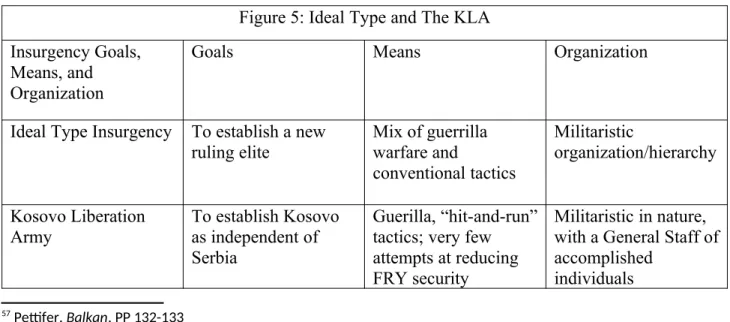
terms of organization, insurgencies tend to be tightly organized in very militaristic
fashion. The means of insurgency vary, but most insurgencies rely on guerrilla warfare,
though some insurgencies do engage in conventional warfare. Conventional warfare is
defined as warfare that focuses on degrading the military capabilities of the adversary,
whereas guerrilla warfare attempts to undermine and ambush an adversary that the actor
Type of Political Violence
Goals Means Organization
Revolution To make broad social and political changes, which are often tied together.
Popular protest that can sometimes turn into violence, though violence is not necessarily implied.
Consists of a large informal group that encompasses a broad number of supporters or potential supporters. Within these are formal groups that organize protests, try to gain
supporters, or “coattail” off the large informal group.
Terrorism To change the behavior of governments. Behavior here consists of policies and actions.
Attacks, or threats of attacks, on civilians, meant to try and coerce an adversarial government that the actors could not ordinarily coerce through violence.
Terrorists often working in small groups, which are often formal and organized. The terrorists are in an easily-defined, formal group, and this formal group tends to be small.
Insurgency To replace the existing personnel governing, or to create a new state. To establish a new governing elite.
Use of a number of different tactics, mainly guerrilla warfare, but can include conventional tactics, meaning the use of force to reduce the
enemy’s military capability.
Very strict organization, very
militaristic in nature, and organized to take over governance.
would otherwise not be able to defeat.
The concept of mobilization is a very useful and important one, as it helps one to
understand how actors gather and utilize their resources, which is essential for this thesis.
First, it seems prudent to give a definition for mobilization, though like many terms used
in this chapter, it has many possible definitions. Perhaps one of the most succinct
definitions comes from a paper by J. Craig Jenkins, titled “Resource Mobilization Theory
“Mobilization is the process by which a group secures collective
control over the resources needed for collective action. The major issues,
therefore, are the resources controlled by the group prior to mobilization
efforts, the processes by which the group pools resources and directs these
towards social change, and the extent to which outsiders increase the pool
of resources”.13
The concept of mobilization is heavily rooted in sociology, and in Jenkins’ article it is
indicated that there is much debate as to how mobilization exactly works, and what drives
it. It seems like a good idea then to try and present some of the arguments that surround
mobilization. A major point that Jenkins makes is that resources have multiple uses, and
this must be taken into consideration when creating models to try and understand how
resources are mobilized14. Jenkins then argues that the biggest contribution that
mobilization theory has made to the study of social movements has been the emphasis on
the role of “outside contributions and cooperation of institutional resources by
contemporary movements.”15
Mobilization theory also seeks to understand how groups overcome the collective
action problem; that is, how actors get people to expend and contribute their resources
when they could potentially have a “free ride,” assuming that the actors involved are
rational. The most common response is that these people are offered incentives, and that
these incentives are necessary for the actors to be willing to offer and use their
13 J. Craig Jenkins. “Resource Mobilization Theory and the Study of Social Movements.” Annual Review of
Sociology, Vol. 9, 1983. PP 527-553. PP 532-533
resources.16 However, as Jenkins notes from the work of other authors, there have been
cases when actors contributed to the collective pool of resources and less than half of the
individuals received selective incentives17, so this implies that selective incentives are not
the answer to the collective action problem. Jenkins suggests that the solution is, in fact,
collective incentives, such as group solidarity and commitment to moral purpose.18 These
collective incentives help to provide the necessary motivation for all the actors that might
be involved with the group. This thesis examines the way new members are recruited via
different forms of media, which is an essential part of mobilization theory.
There are many different recruitment strategies that actors employ in order to get
new members to join their groups. These actors employ collective incentives in order to
convince people that it is worth it to contribute their resources to the cause. These
motivations are “…built around purposive and solidary incentives, focused on preexisting
or "natural" groups, and link the vision of change to the preexisting group culture...”19
Similarly, recruiting en masse is more effective and efficient than recruiting individuals,
so recruitment campaigns have wide targets. Recruitment efforts are best used on people
who are deep in interpersonal networks, active in politics and support political or social
change, committed to an ideology that is associated with social change, and are available
for participation in the group. Jenkins presents a view that is very different than classical
ideas of recruitment that focus on charismatic leaders and personalities, who certainly
play a role, but a role that often may be over-emphasized. The aspect of mobilization that
is of greatest interest to this thesis is the role of media in this process of recruitment.
Literature already exists that explains this role, but what is of interest here are the types
of media used for this recruitment, and how they differ among the three types of political
violence. First, however, the role of media should be established.
Media, in particular mass media, have played an important role in mobilization
theory for a while now. Perhaps one of the most important aspects of the availability of
mass media is that it has reduced the cost in resources for mobilizing and recruiting more
resources.20 Mass media help inform elites, as well as the general public, and make more
and more people aware of the current political atmosphere. When the media are
independent of the government, they serve as a political actor that chooses either to
disseminate truth, or what it thinks will get the most support for whatever cause the
media producers believe in.21 Although mass media are not a perfect substitute for
personal recruitment, they do play a valuable role, and considering their resource-cheap
nature, mass media are great tools for actors looking to mobilize a large, or even a small,
number of individuals.22 These media are part of what this thesis refers to as
communication, an important part of the research that this thesis will explore later. The
next idea that should be examined is the targets of mobilization and recruitment for each
of the different types of political violence.
It is important to note that recruitment is not the only important aspect of
communication that will be examined. It is important to realize that some communication
might not be for recruitment, and that these communications could be, in fact, just
communications. However, this does not diminish their importance. Understanding who
the targets of these communications are is just as important as understanding the content
of the messages. This thesis will also look at the various targets of communication, not
just those focused on recruitment, as this is too narrow a viewpoint, and really limits the
possible understanding of these communications. The content and medium that these
messages are delivered in are also equally important. Whether a message is sent via radio
or by Internet can have a great effect on who is being targeted, even if it is only one
group, and on the possible content of that message. Therefore, it is important not to limit
the thesis to communications made only to recruit.
The first type of violence that will be studied is terrorism, which includes the
people that actors engaged in terrorism try to recruit for their causes. Terrorism is
arguably a very extreme form of violence, and it seems that the actors who engage in
terrorism are also on the outer extremes of movements.23 In essence, the actors that
engage in terrorism are on the fringe, and, thus, so are the people they recruit. These will
be people who are in the minority, either of a religion, ethnicity, or ideological belief.
The people who are recruited by terrorist actors are most likely to be upset with the
current government, and they are likely to be upset with the lack of progress achieved by
other forms of bringing about political change.24 In other words, the most likely recruits
that actors engaged in terrorism want are people who probably are interested already,
upset with the current state of politics, and are willing to turn to extreme acts.
Similarly, insurgency wants the participation of members from select groups.
Actors engaged in insurgency, much like terrorism, look for disenfranchised people who
are aware of their political situation, though they are not necessarily already politically
involved25. However, what seems to be true in insurgency that is not for terrorism is that,
typically, the people who are recruited for insurgency, as well as the people who turn to
insurgency in the first place, are often in situations where there is no institutional means
for them to express their dissatisfaction with the government.26 Another important aspect
of the people who are targeted for recruitment by insurgencies is that they belong to
either a minority ethnicity or religion, as well as inhabit a specific geographical location
that the insurgency wishes to govern by replacing the existing government.27 Actors
engaged in insurgencies, who are trying to establish a new ruling elite, are looking for
people who are willing to support these new elites. These people, who are the target
recruits of insurgencies, most likely also have access to the kinds of media that
insurgencies will use in order to mobilize28. This point will be discussed later in this
chapter.
Revolutions, by their nature as large-scale events, require that actors in a
revolution try to mobilize and recruit a large number of people with many different
backgrounds. Revolution requires a large number of participants in order to be successful,
and so it makes sense that actors engaged in revolution have to target a widespread group
of people from many backgrounds. It seems likely that revolutions will try to recruit
people who are in-line with whatever ideology the revolution is basing itself. Revolutions
seem to also look to recruit people who are already embedded in networks and
communities29, and aim to disseminate communications and recruit new actors using
25 Sumit Ganguly. “Explaining the Kashmir Insurgency: Political Mobilization and Institutional Decay.”
International Security, Volt. 21, No.2 (Fall, 1996), PP 76-107. PP 92-94
26 Ganguly. Kashmir. PP 93 27 Ganguly. Kashmir. PP 92-93 28 Ganguly. Kashmir. PP 99
29 Azamat Temirkulov. “Informal Actors and Institutions in Mobilization: the Periphery in the Tulip
these already established networks. Revolutions will also make use of formal institutions
(for example, political parties) that are already in place as a means to help recruit
people.30 Revolutions will also make use of the periphery, trying to include people who
might not normally identify or fit into a smaller category that might be recruited by
terrorism or insurgency, this time through interpersonal connections.31
Communication here refers to the actual process that actors or groups use to reach
out and try to mobilize and recruit people and resources. In order to better understand
this, communication will be separated into two parts. The first is media, or technology,
and the second is content, or message. Media or technology refers to the actual medium
that is used to deliver the message. This can be television or other traditional forms of
mass media, or electronic or Internet-based media, such as email, texts, and social media.
Content or message refers to the actual content of the communication; what is being said
or delivered by the technology. It is hard to give examples of this without being too
specific, but suffice it to say that the content is usually pretty obvious, though this does
not mean that the meaning of the message is always clear or concise. Together, these two
aspects form the communication used to recruit and mobilize resources. The best way, it
seems, to understand what kind of medium and message will be used by each type of
political violence is to look back to the people who are the targets of recruitment and
mobilization for each of the types of political violence.
Actors engaged in terrorism seem to be trying to recruit extremists who are tired
of the failures of other methods used to enact change, and so the technology and
messages must be used to get the attention of these people. The actors will need media
and technology that can reach targeted audiences without necessarily reaching a broad
group of people. The core of this communication, however, will be the message. The
actors will have to convince anyone “on the fence” of joining that they are capable of two
things: threatening or carrying out violence against civilians, and, through this violence,
bringing about the change that is the goal of the actors. Things like in person
communication through already established social networks, as well as have their threats
of violence and acts of violence be highly visible, so this means things like using the
internet to reach wide audiences or people who they wish to be afraid. However, terrorists
tend to operate as small formal groups. This means that while terrorists undoubtedly
recruit and mobilize, it may be that the more interesting aspect of the actors engaged in
terrorism is not their attempts to recruit, but their attempts to communicate with
adversaries. This would mean that the focus of the research on the terrorist would be on
terrorism as a form of communication meant to bring about change.
Insurgency must be able to convince the potential recruits that the insurgents are
capable of their goals, that their cause is worthy, that they are capable of becoming the
new ruling elite, and that they are the kinds of people that the potential recruits will want
to join. The actors will probably make use of established technologies, such as television,
the Internet, and newspapers, to highlight the problems that are being faced by the actors.
The actors will probably also make use of the preexisting social and community networks
of the specific groups they will try to recruit, which usually seem to line up around ethnic
and religious lines. Because the actors engaged in insurgency are focused on a certain
geographical location that they wish to govern, their efforts will be concentrated on the
would suggest less of an emphasis on broadcasts that reach outside the bounds of the
region where the actors wish to govern. This will also mean the use of local television,
newspaper, and radio, as well as the Internet to reach potential members that might be on
the periphery of communities or the geographical space. Part of the message will also
have to be that the actors are capable of governing in lieu of the government they wish to
replace. This means that actors who are currently fighting in an insurgency are looking to
communicate with both potential supporters and adversaries. Actors engaged in
insurgencies are concerned with the formal group, and less so with the support of any
large, informal groups. Remember, these actors are trying to change the ruling elite,
meaning they are focused on the few.
Revolutions, unlike the other two types, will be considered very broadly. In order
for actors to engage in revolution, they require a large number of participants that they
have mobilized and recruited. At the core of the revolutionaries’ message will be an
ideology, one that the target recruits most likely already know and believe in, and the
purpose is to show solidarity, one of the major incentives that revolutions try to offer to
potential recruits; or the purpose is to introduce the ideology to the potential recruit for
the first time, and then to make the ideology attractive. In order to do this, they must
make use of technology that is capable of spreading messages very widely; that is, media
like television, radio, newspapers, and the Internet, specifically social media and popular
websites. The best way to maximize recruits seems to be to use other recruits to help
reach out to their own personal networks and recruit this way. This means that the
revolutionaries will have to have material widely available and easy to disseminate, so
actors engaged in revolution seems to be potential or current supporters. These people
will probably be in the informal group, and not yet in the formal group. These
communication efforts will be dedicated to gaining support from the large informal group
that will turn into popular protest.
One important caveat that must be raised is that itself terrorism is a form of
communication. This concept is often referred to as “propaganda of the dead,” which is
understood as an act of political violence with the intention of creating a media event to
cause political change.32 The purpose of targeting civilians is to cause fear, with the hopes
of bringing about changes from the government. The act of terrorism is meant to
communicate a message to the government that this violence will continue or that more
violence is possible. This is important to think about because actors engaged in
insurgency or revolution might make use of terrorism, but still have the goals associated
with insurgency or revolution. The goals of the actors will have to be the main way to
distinguish groups who engage in terrorism as a means of changing outputs, and actors
who have the goals of changing who governs and the nature of society.
It is also important to establish that different types of political violence will direct
their messages differently. The targets of communications can be divided into two
groups. The first groups consist of supporters and potential supporters of the cause.
Actors engaged in revolution will have to consider these groups, which typically fall
outside the formal groups of revolutionaries, and within the larger, informal group. The
other group consist of adversaries. Actors engaged in terrorism are not particularly
interested in creating a large formal group, and in fact they tend to operate in small
32 Neville Bolt. The Violent Image: Insurgent Propaganda and the new Revolutionaries. (London, C. Hurst &
formal groups. However, the act of terrorism can be seen as a means of communication
directed at both potential supporters and adversaries. Insurgencies, similarly, are looking
to communicate with both supporters/potential supporters and adversaries. In fact, actors
who are currently engaged in insurgency might use acts of terrorism as a means of
communication.
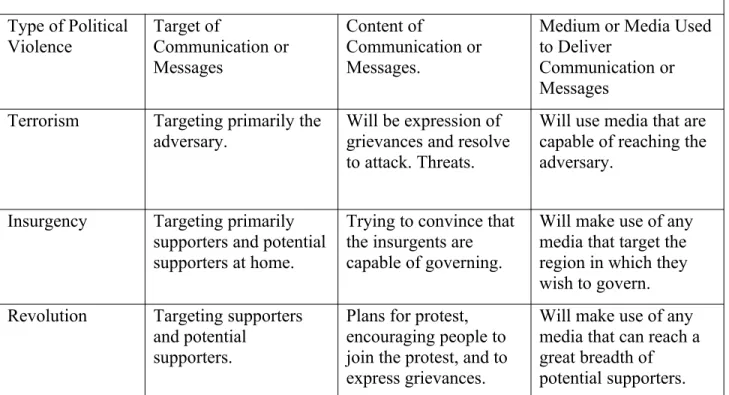
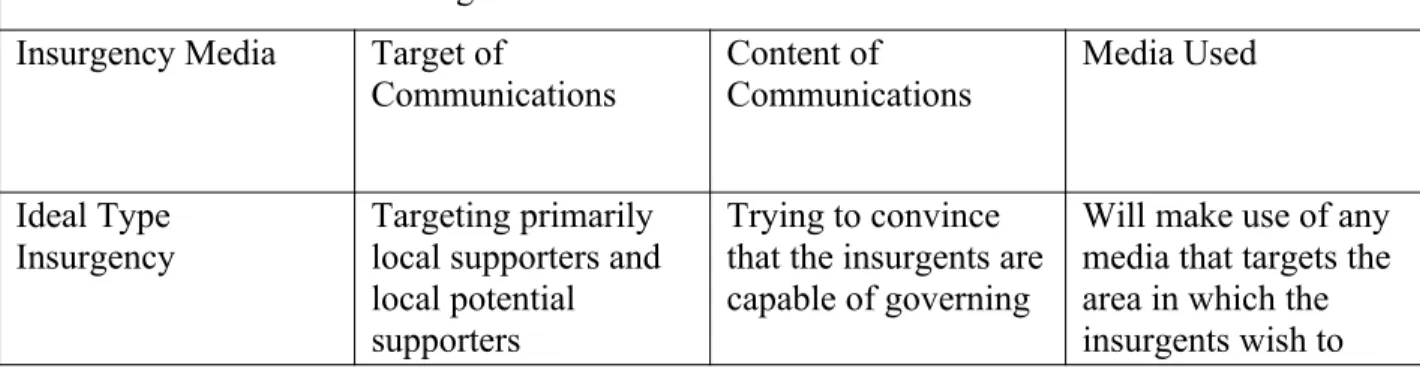
Figure 2: Violence and Communication.
Type of Political Violence Target of Communication or Messages Content of Communication or Messages.
Medium or Media Used to Deliver
Communication or Messages
Terrorism Targeting primarily the
adversary. Will be expression of grievances and resolve to attack. Threats.
Will use media that are capable of reaching the adversary.
Insurgency Targeting primarily
supporters and potential supporters at home.
Trying to convince that the insurgents are capable of governing.
Will make use of any media that target the region in which they wish to govern. Revolution Targeting supporters
and potential supporters.
Plans for protest, encouraging people to join the protest, and to express grievances.
The focus of the thesis is the connection between types of violence, as defined by
goals, and the communication, or media and message, used to mobilize the people they
need in order to achieve their goals. What this means is that if the thesis is true, there
should be a correlation between the three types of political violence and the media and
messages used to mobilize and recruit. The goal of the thesis is to try and provide
evidence that supports the claim that there is in fact such a relationship. However the
opposite could be true, and there could be no relationship. This would mean that among
the cases that will be examined for this thesis, there would be no consistency in the use of
media and messages among actors engaged in the same type of violence, or that, no
matter what kind of goal the actors have, they will all use similar types of
communications to mobilize and recruit. It will be difficult to provide enough evidence to
definitively prove this, due to the constraints of time and the length of this thesis.
The case studies that will be used in this thesis must have certain qualities. These
cases should have a large amount of information available about them. They will also
have to have a good amount of information about the media and messages used in the
actors’ attempts to recruit and mobilize, as well as to communicate with their adversaries.
Because the definitions of each type of political violence are ideal types, not all instances
of these types of violence will fit the definitions exactly. This means that there is some
flexibility in choosing cases, which in turn means that there is a wider array of choices.
Because different types of political violence will target their communication differently,
the available information might show that it is beyond the scope of this thesis to be able
the case study, it may be that this thesis will have to study different targets of
communication for each type of political violence.
Primary resources will include items such as the communications used, memoirs,
and journals from the actors who were involved discussing recruitment efforts, and
perhaps those who had experienced being recruited by the actors trying to bring about
change. Other primary resources might be artifacts such as radio and television
broadcasts, Internet posts, newspapers, and books written by actors describing their
efforts to recruit and mobilize resources. Secondary sources will include studies of these
occurrences of political violence that provide information and offers analysis of the
information. Other secondary sources will be any sort of media or communication
produced by the actors.
There are many factors that must be taken into account when trying to establish
the existence of a relationship between types of political violence and types of
communication used to mobilize and recruit resources or, alternatively, to communicate
with adversaries. The purpose of this thesis is to try and show that this relationship could
exist by looking at various case studies of different types of political violence and the
way that the actors tried to mobilize and recruit new resources.
To summarize, the types of political violence are terrorism, insurgency, and
revolution. Each type of political violence calls for different numbers and types of
resources, mostly in the form of people who belong to certain demographics. The actors
who are engaged in these types of violence will then have to use different types of
communication in order to recruit the different types of resources. Alternatively, the
order to either gain the changes the actors want, or as a threat meant to demoralize or
frighten the target audience. Communication here is defined in two parts, media or
technology, and content or message. The means that actors use will also determine who
the target of their communications are. Insurgencies will be targeting different groups of
people to support or joining the insurgency, whereas revolutions will be targeting a
broader audience in order to get more people to join in the popular protest. Media or
technology is the medium used to deliver the message. Content is the message being sent,
and is delivered by the media or technology. This thesis will look at the media used by
actors to recruit in various different instances of political violence, as well as at other
collections of data on mobilization written about these occurrences of political violence.
The cases will be selected based on the available information of the communication
efforts of the actors engaged in these types of violence. In the end, the goal is to provide
evidence that this relationship exists.
Chapter 3: Terroristic Violence and al Qaeda
The terrorist organization that will be examined is al Qaeda, one of the most
well-known and recognizable terrorist organizations in the world, especially since the
September 11th attacks in 2001. Al Qaeda is an organization that has been active for
several decades now, and is typically the name associated with terrorism, especially in
the United States. Al Qaeda’s origins can be traced back to the 1980s, during the Soviet
invasion of Afghanistan and later the Gulf War. Due to al Qaeda’s long history, it proves
to be an interesting case study for this thesis. This chapter will explore the reasoning
behind why al Qaeda makes a good case study, a brief history of the organization, and the
The framework should briefly be brought up again, so that the criteria against
which al Qaeda is being compared are clear. First, the goals of a terrorist organization are
to coerce an adversarial government into changing policies to which the actors engaged
in terrorism are opposed. This is again different from insurgency and revolution in that
the consequences do not involve broad or sweeping changes in the people governing or
the way they govern. Actors engaged in terrorist violence will make use of terrorist
means, which of course means the attack of civilian targets or the threat of violence
against civilians. Finally, the actors will be organized in small formal groups that act with
relative independence of a slightly larger formal group, which dictates the main goals of
the organization as a whole.
There are a number of reasons why al Qaeda is a great case study. First, al Qaeda
is a rather large organization, with global ties. Al Qaeda is also an organization with
decades of history. This means that there is a lot of information available about al Qaeda,
and with over twenty years of acting, al Qaeda has produced several videos and released
many communications. Another factor that makes al Qaeda a good case study is the sheer
amount of literature on al Qaeda, especially since the 2001 attacks. The September 11th
attacks were an unprecedented act of terrorism, and afterwards al Qaeda became the
focus of much research. The September 11th attacks, however, were not the first time that
the United States had dealt with terrorism from al Qaeda. In fact, for a number of years
before 2001, al Qaeda had been launching attacks on the United States. This history of
violence has led to literature from various angles examining the root causes of such
extreme violence, as well as the kinds of people engaged in this type of political violence.
science to sociology. Lastly, the leadership of al Qaeda has made connections with
various other likeminded actors who seek to bring about similar changes. Al Qaeda has
become a sort of brand that other groups wish to associate themselves with, which means
that al Qaeda has made connections with various groups worldwide, and its global nature
makes al Qaeda unique. However, all of these advantages for al Qaeda are moot unless
the organization fits in with the ideal type of terrorism as set forth in the framework,
which means that, before the media and communication that al Qaeda have put out can be
examined, the goals, organization, and means of al Qaeda must be examined.
As already mentioned, al Qaeda has been responsible for a number of attacks
against the United States. In 1993, al Qaeda bombed the New York World Trade Center,
using a truck bomb.33 Then, in 1998, al Qaeda was responsible for the bombing of two
U.S. embassies in east African countries. Earlier that year, Osama bin Laden released a
fatwa, claiming that it was the duty of ever Muslim to kill Americans and their allies.34
While this is not an act of violence, it calls for the use of violence, and the threat of
violence is a major part of terrorism. Al Qaeda was responsible for the attack on the USS
Cole in 200035, making use of an inflatable boat. Al Qaeda was also behind the biggest
terrorist attack ever take place on and in the U.S. In 2001, al Qaeda successfully
destroyed both World Trade Center buildings, as well as damaging the Pentagon, by
using hijacked planes. This attack eventually led to the invasions of Afghanistan and Iraq.
These are just a few examples of some of the largest attacks that al Qaeda has been able
to perform. The vast majority of violence that al Qaeda has ever committed, with the
exception of the USS Cole attack, have been attacks that specifically targeted civilians. In
33 Hoffman. Declares. PP 44 34 Hoffman. Declares. PP 38
this sense, the means that al Qaeda has employed fits the ideal type of means stated in the
framework.
Al Qaeda’s organization has been studied intensely, not only because it has and
operates a number of small cells, but also because al Qaeda has ties to several other
terrorist and likeminded organizations. The primary way that al Qaeda is organized is by
cells. These cells vary in responsibilities, as well as closeness to the central al Qaeda
leadership. Above all, these cells seem to have very small, formal groups of leaders that
plan out attacks and produce the media meant to threaten. Al Qaeda’s organization
definitely relies on small formal groups and larger informal groups. One way of
understanding al Qaeda’s organization is Anthony Celso’s classification of four types of
cells.36 Type A and Type B are both parts of the informal group, being distant from the
main al Qaeda leadership. Type A cells are mostly autonomous Islamist groups that look
to al Qaeda for advice and some leadership. Type B cells consist of local people who
have been inspired by what al Qaeda has done, and are willing to commit some act of
violence in order to help the cause, although it is unlikely they receive any attention from
the main al Qaeda group. Types C and D are both parts of the formal group. Type C cells
consist of affiliates who have sworn fidelity to al Qaeda, whereas type D cells consist of
al Qaeda fighters who have been trained by, and are under the most direct control of al
Qaeda leadership. Another aspect of al Qaeda’s organization is that the main al Qaeda
leadership, or the main formal group, makes lots of connections with other groups,
especially throughout Africa and the Middle East. Al Qaeda, due to its reputation, is then
able to have some influences in these regions by teaming up with local affiliates, which
All of this information about al Qaeda’s “cell structure” is to point out that the
organization mainly functions in smaller cells that, to an extent, work independently,
some without any orders or contact with the main formal organization. In fact, some of
these cells, like the Types A and B, could easily be described as small, informal groups.
This is something that was not expected within the framework. However, given that the
main structure of al Qaeda is based on small cells working both in sync and
independently of the main organization, it does fit, at least somewhat, with the
organization expected in the framework.
One way to understand the goals of al Qaeda is to look to the origin of the group,
as this will show many of the grievances and policies that have affected the actors that are
involved with the organization, and what the group would like to have changed. The
leader of al Qaeda, Osama bin Laden, got his start in violence during the invasion of
Afghanistan by Soviet forces in 1988, the final year of the war.37 Bin Laden led fighters
against Soviet invaders in Afghanistan, and these fighters would be the start of al Qaeda.
After the Soviet forces withdrew from Afghanistan, bin Laden returned to his home in
Saudi Arabia in 1989.38 Just a year later, in 1990, Saddam Hussein invaded Kuwait, and
this invasion would ultimately bring about the beginning of the first Gulf War. Bin Laden
offered his veterans of the Afghanistan war to help drive Hussein’s forces out of Kuwait.
Bin Laden was still in contact with a moderately-sized groups of veterans from the
Soviet-Afghanistan war. Much to his disappointment, the Saudi government looked to an
outside coalition force, led by the United States, to combat Iraqi forces, in what would
become known as Operations Desert Shield and Desert Storm. Bin Laden was upset,
37 Hoffman, Tod. Al Qaeda Declares War: The African Embassy Bombings and America’s Search for Justice.
(Foredge, 2014) PP 12
claiming it was an offense to have non-Muslims fighting in the area, when he believed
that the conflict should have been handled within the Arab world. Disillusioned with the
Saudi government, and perhaps seen as a threat to the monarchy there, bin Laden moved
to North Africa; however, found that he would be confronting United States forces again.
The United States was operating in Somalia in order to ensure that aide was being
distributed to those in need, rather than being stolen and kept by warlords. Seemingly
even more upset with the actions of the United States, bin Laden would begin to organize
what would become the East Africa Cell of al Qaeda, which in turn would be responsible
for the bombings of U.S. embassies in 1998.39
The origins of al Qaeda provide insights into the main goals of the organization.
Al Qaeda was formed to counter the influence of the U.S., which is representative of the
West, in the Middle East. It seems clear then that the main goal of al Qaeda has been to
coerce the United States into leaving the region, which al Qaeda considers Islamic holy
lands. The religious overtones of many of the messages, which will be explored further,
only help support the idea that al Qaeda’s main goal is the preservation of what it
considered to be holy territory that belongs to Muslims. This goal would also explain
why bin Laden was so upset when the Saudis looked to the U.S. to stop Saddam Hussein.
Looking past the religious claims, the goals of al Qaeda seem two-fold: the first is to
convince the U.S. that staying in the region is not worth it, which they attempt to do by
attacking civilians of the U.S.; the second goal is to increase their own influence in the
region, which it also accomplishes by attacking the U.S.; essentially showing the
organization’s ability to injure the United States. The goals fit those expected of actors
Al Qaeda has produced a large quantity of communications, especially since Bin
Laden’s first fatwa. Andreas Armborst explored, in great depth, the media produced by al
Qaeda in his book Jihadi Violence: A Study of al-Qaeda’s Media (2013). Armborst
focuses on a sampling of transcripts of various videos that al-Qaeda leadership released.
Here, it is important to note a technological aspect of al Qaeda’s communication.
Armborst is working off of video transcripts that al Qaeda released themselves on the
Internet. Here, the Internet is used as a platform that is easily accessible and far reaching,
meaning al Qaeda’s messages are able to spread. Armborst’s work started with 103
transcripts, and eventually narrowed it down to 31 transcripts totaling 178,000 words.40
He focuses specifically on analyzing words that relate to certain themes in an attempt to
understand how al Qaeda presents its own ideology through the media that it produces.
However, his book proves extremely useful, as it provides data on the prevalence of
certain themes in the sampling of transcripts. It is important to realize that Armborst is
presenting only a limited sample of the media produced by al Qaeda, and so this is not
wholly representative of all al Qaeda’s media, Armborst provides a solid methodology
and takes samplings from a variety of sources, such as the al Qaeda Yearbook, and
collections curated by various groups.41 Without taking Armborst data as representative
of all al Qaeda media, it still provides an invaluable insight into the themes present in
these communications.
40 Armbost. Andreas. Jihadi Violence: A Study of al-Qaeda’s Media. (Dunker & Humbolt, Germany; 2013)
PP 68; 76
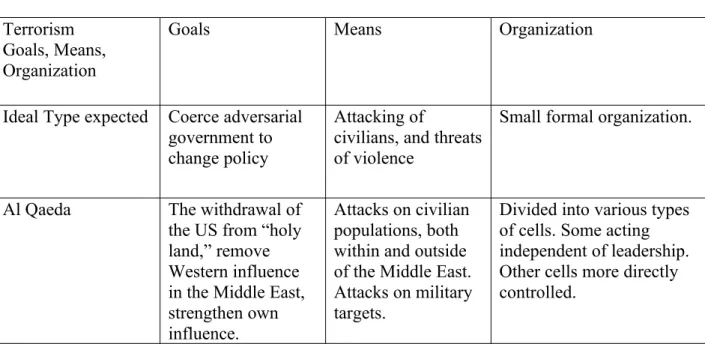
Figure 3: Ideal Type and Al Qaeda
Terrorism Goals, Means, Organization
Goals Means Organization
Ideal Type expected Coerce adversarial government to change policy
Attacking of
civilians, and threats of violence
Small formal organization.
Al Qaeda The withdrawal of
the US from “holy land,” remove Western influence in the Middle East, strengthen own influence.
Attacks on civilian populations, both within and outside of the Middle East. Attacks on military targets.
Divided into various types of cells. Some acting independent of leadership. Other cells more directly controlled.
Armborst divides the themes present in al Qaeda’s media production into seven
groups. These groups are apostasy, global conflict, appeals and advices, justifications for
violence, secular governance, instrumentality of force, and goals and objectives.42 Each of
these categories contain several themes that are represented in the various
communications produced by al Qaeda. Apostasy, for example, contains the themes of
religious superiority, “grievances,” and even “defeatist.” Armborst defines “defeatist” as
relating to those actors that al Qaeda believed to have given up fighting for Islam and
decided to work with other, non-Muslim powers, such as the United States.43 Apostasy
here refers to al Qaeda’s view that Muslims who did not agree with them had broken off
from Islam, or were not true Muslims.44 “Grievances” is a theme that is present in both
the apostasy, global conflict, and secular governance categories, and so it must be made
clear that these expressed grievances are specific to a category.
The categories are not in and of themselves extremely useful to the thesis.
However, if one looks at these categories as representative of targets and contents of
messages, then they can be used to understand the communication that al Qaeda has put
out. The various themes can be viewed as representative of two aspects of
communication: the content and the target. The content of the message is straightforward
and simple enough. The target, however, takes some inferring. However, based on the
goals (which remember are to decrease U.S. influence and involvement in the area while
bolstering their own), different themes must have been targeted at specific audiences.
Take the theme of apostasy, which contains many sub-themes of religious superiority.
Messages containing these types of themes would then be meant to express why al Qaeda
was doing what it was doing, in that their religion was superior to those of the West,
presumably Christianity. This message really could be directed at either supporters or
adversaries. However, supporters of terrorism, as stated in the framework, tend to already
be on the fringe of society and ideologies, so it seems that the supporters would not need
to hear how much better their religion was than other religions. The most likely target of
such communication seems to be adversaries.
Armborst’s data shows that themes that fall under apostasy are by far the most
prevalent in the al Qaeda communications, followed by global conflict themes.
According to Armborst’s research, of the 31 transcripts, themes relating to apostasy made
up 22 percent of the sample data, twice that of the next largest category. Within the larger
category of apostasy, the most prevalent theme in these al Qaeda communications was
religious superiority, which made up 6.7 percent of the sample data.45 The next largest
category is global conflict, with the most common theme being grievances. These two
categories make up the largest chunk of represented themes in the samples that Armborst
analyzed. Again, what is seen here is a focus on the expression of grievances, and the
expression of grievances must be targeted at the people whom the organization, in this
case al Qaeda, regard as adversaries. The large percentage of communications spent on
the expression of grievances suggest that most of the communications and media
produced by al Qaeda were targeted specifically at their adversary, the people whose
policies al Qaeda wished to change.
The third largest category is appeals and advices, and the smallest category with
the least represented themes is goals and objectives. Within the category of appeals and
advices, the largest theme is appeals for support, followed closely by appeals for
unification. The least represented theme is tactical recommendations.46 This work is
missing, however, explicit definitions for what kind of support is being asked for, or with
whom unification is being requested. This makes it difficult to assess whether or not calls
for support are meant as recruitment, or material and monetary support. The smallest
category with the lowest percentage of themes represented in Armborst sample is the
category for goals and objectives. It is interesting that the goals of al Qaeda are the least
represented in this sample, whereas themes dealing with al Qaeda’s near enemies, which
are the enemies on the other side of the cultural divide within Islam who are collaborating
with the West and non-Muslims47, are more prevalent.
Given that the majority of communications, at least within this sample group,
were thematically focused on apostasy and global conflict, these communications do not
seem targeted at recruitment, but are rather targeted at adversaries. The most prevalent
themes in these communications are dealing with the Muslims who are opposed to al
Qaeda, or who do not follow the same ideas that al Qaeda does, and are therefore the near
enemy. The second most common group of themes focus on global conflict, with the
most common theme being about grievances with the far enemy, which is the West, and
specifically the United States.48 The most common themes in the communications made
by al Qaeda that were part of this sample are directed explicitly at the adversary or are
talking explicitly about the adversary.
Appeals for support, which remains undefined in Armborst’s work, belong to the
third most common category of themes, and goals and objectives are the least most
common themes in this sampling of al Qaeda’s media. Given how little attention is given
to these categories, especially considering what high representation the top two groups
have, it seems that communications directed at supporters or potential supporters were
not the key concern for al Qaeda, at least based on the sample. However, if al Qaeda was
truly targeting their communications at supporters or potential supporters, these themes
would not have been so overshadowed by the communications directed at adversaries. It
is clear that at least some attention was paid to trying to garner support from
sympathizers, as appeals for support was the most represented theme in the third most
common category. What is shocking is that themes dealing with the explanations of goals
and objectives were dead last, and this is something that is very important in trying to
recruit potential supporters. In fact, it seems very little attention was paid to potential
supporters at all, and that al Qaeda was mostly interested in the people whom they felt
al Qaeda to provide more support. Part of mobilizing and recruiting means being able to
create incentives to overcome collective action issues. It is difficult to do this when the
potential supporter does not even know what cause they are supporting.
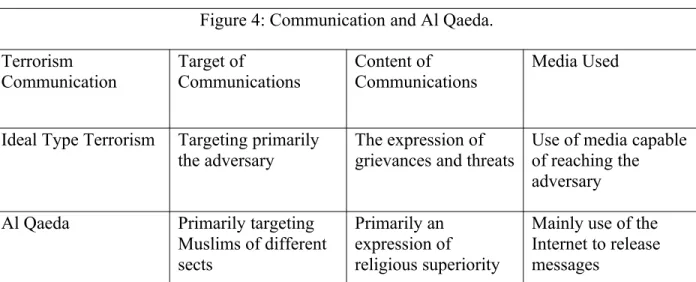
Figure 4: Communication and Al Qaeda.
Terrorism Communication
Target of
Communications
Content of Communications
Media Used
Ideal Type Terrorism Targeting primarily the adversary
The expression of grievances and threats
Use of media capable of reaching the adversary
Al Qaeda Primarily targeting
Muslims of different sects
Primarily an expression of religious superiority
Mainly use of the Internet to release messages
Al Qaeda’s communications and media, based on Armborst’s analyses, definitely
fit the expected communication of actors engaged in terrorism that was stated in the
framework. It was expected that actors engaged in terrorism would be focusing their
media and communication at their adversaries, whom they are trying to coerce. The top
themes found in the sample that Armborst took are all focused on or at the adversary. The
little communication that is directed at supporters does not try to recruit potential
supporters, nor does it specifically call for supporters to join the formal group. Very little
effort seems focused on tapping into potential supporters, as evident by how little goals
and objectives were expressed. The original belief was that actors engaged in terrorism
would concentrate and direct their communications at adversaries, and Armborst’s