PROMOTING PRIVATE WELL TESTING IN MAJORITY AFRICAN-AMERICAN CENSUS BLOCKS OF EXTRATERRITORIAL JURISDICTIONS IN WAKE COUNTY, NC, USING THE MENTAL MODELS
APPROACH TO RISK COMMUNICATION
Erica Wood
A Master’s Technical Report submitted to the faculty at the University of North Carolina at Chapel Hill in partial fulfillment of the requirements of the degree of Master of Science in Public
Health in the Department of Environmental Sciences and Engineering in the Gillings School of Global Public Health.
Chapel Hill 2019
Approved by:
Jacqueline MacDonald Gibson Courtney Woods
ABSTRACT
Erica Wood: Promoting private well testing in majority African-American census blocks of extraterritorial jurisdictions in Wake County, NC, using the mental models approach to
risk communication
(Under the direction of Jacqueline MacDonald Gibson)
ACKNOWLEDGEMENTS
A great many collaborators and sources of support contributed to this work. Participants in pilot testing gave their time and shared their valuable thoughts. Dedicated public health professionals shared their work and their experiences. Funding institutions are critical to research work and to educating future scientific and public health leaders; this work received support from the North Carolina Water Resources Research Institute #17-05-W, North Carolina Policy Collaboratory, U.S. EPA Science to Achieve Results #83927901, and NIOSH Training Program T42OH008673. I would like to thank my advisor and mentor, Dr. Jackie MacDonald Gibson, for inviting me into this work and for providing support and wise guidance in this project and far beyond. Frank Stillo, III is an open and collaborative teammate and I thank him for helping me learn many of the ins and outs of research and data analysis. I am grateful to my committee members and collaborators, Dr. Courtney Woods, Dr. Crystal Lee Pow Jackson, Dr. Wändi Bruine de Bruin, Angela Brammer, Kennedy Holt, Sidney Lockhart for their contributions of skill, time, experience, thoughtful discussions and helpful suggestions to make this work stronger. Thank you to my family for their tremendous encouragement and support. My husband, Raul Necochea, gave his enthusiastic support and has also been an outstanding role model for research and writing. My mother, Robin Wood, led by example on graduate school while parenting. I also want to warmly thank my fellow research group members and friends in the Gillings School of Global Public Health for sharing their experiences and knowledge
TABLE OF CONTENTS
LIST OF TABLES ... vi
LIST OF FIGURES ... vii
INTRODUCTION ... 1
The mental models approach to risk communication ... 3
A priority audience and key concepts to communicate ... 4
METHODS ... 8
Evaluation of existing communications ... 8
Creation of mailer... 9
Pilot testing and revision ... 10
Review by experts ... 11
RESULTS ... 11
Evaluation of existing communications ... 11
Creation of mailer... 14
Pilot testing and revision ... 17
DISCUSSION ... 20
CONCLUSIONS... 25
APPENDIX: EXAMPLES OF EXISTING COMMUNICATIONS ... 26
LIST OF TABLES
Table 1. Demographic characteristics of target audience ... 5 Table 2. Evaluation of existing communications for concepts important for our audience ... 13 Table 3. Evaluation of existing communications for additional topics, word count,
reading level ... 14 Table 4. Postcard messages corresponding to the survey responses that predicted
LIST OF FIGURES
Figure 1. Factors predicting well water testing ... 6
Figure 2. Preferred formats for information ... 7
Figure 3. Trusted sources for well testing ... 7
Figure 4. Front and back of postcard used in pilot testing ... 17
Figure 5. Representative pilot testing comments and resulting revisions ... 18
INTRODUCTION
Drinking water is a basic health need. Most U.S. residents are fortunate to benefit from the population health advances provided by disinfection of municipal drinking water and from laws regulating community water supplies for the protection of public health. However, the estimated 42.5 million people nationwide who get their drinking water from individual sources, such as private wells serving a single household, are not protected by those same regulations (Dieter et al., 2018). The responsibility for monitoring and maintaining drinking water quality falls on the homeowner. The USGS found that 23% of private wells sampled between 1991 and 2004 contained at least one contaminant that exceeded health-based levels (DeSimone, Hamilton, & Gilliom, 2009). The proportion of drinking water outbreaks associated with
individual water systems has increased (1971-2006) while the proportion associated with public water systems has decreased (Craun et al., 2010). Effective outreach and communication could improve stewardship of private well systems and reduce health risks for well users.
years have indicated that few well owners are following this schedule. In a survey in
Pennsylvania, 30% of respondents reported never having tested their wells (Swistock, Clemens, Sharpe, & Rummel, 2013) and in Texas, more than 65% had never tested their water (Gholson, Boellstorff, Cummings, Wagner, & Dozier, 2018). Among those who have tested, many are not testing frequently. Only 10% of participants in a large, statewide survey in Wisconsin reported having tested within the past year (Malecki, Schultz, Severtson, Anderson, & VanDerslice, 2017). The North Carolina state health department has expressed concern that “only a very small percentage” of wells are tested each year (Barros, Rudo, & Shehee, 2014). There is a clear need to increase rates of water quality testing among users of private drinking water wells as a critical next step in efforts to protect people from negative health effects of drinking
contaminated water.
One of the tools needed to increase the rates of private well testing is communication materials based on evidence about what people need to know to make decisions about well testing. Many health departments and organizations that support private well users have information available on their websites about potential contaminants, health risks, and how to request water tests. Relying on websites as the main method of outreach requires the well user to take the first steps of seeking information, but many may not be actively seeking
information. This potential limitation is supported by a 2013 survey of private well users in Newfoundland, in which 95% of respondents felt that advertising testing through a website was ineffective (Roche, Jones-Bitton, Majowicz, Pintar, & Allison, 2013). A 2016 literature review on effective outreach to private well owners recommends active outreach and tailoring
The specific risks associated with drinking water from private wells vary greatly with geography (underlying geology and sources of potential contamination from the surface), and results of previous studies have indicated that information needs and perceived barriers to well water testing vary between groups of people (Malecki et al., 2017). A systematic review identified only two studies that had evaluated the effects of specific communications interventions on well testing behavior (Colley, Kane, & MacDonald Gibson, 2019). One was a mass media
campaign with outreach to local officials (Renaud, Gagnon, Michaud, & Boivin, 2011). The other was a partnership between local agencies for an informational campaign and a testing service campaign which mobilized volunteers to collect samples and deliver them to testing labs during a day-long event (Paul, Rigrod, Wingate, & Borsuk, 2015). Neither gave specific information about how they developed their messaging.
The work presented here responds to a gap in research on evidence-based methods for promoting well water stewardship through the application of the mental models approach to risk communication to encourage private well water testing.
The mental models approach to risk communication
The mental models approach to risk communication provides a method for learning about the knowledge, beliefs and perceptions of an audience, for the purpose of
communicating the most decision-relevant pieces of information. It has shown promising results in risk communications on other topics (Boase, White, Gaze, & Redshaw, 2017). As far as we know, this approach has not been applied to the issue of private well water testing.
understandings of the risk to identify gaps and misunderstandings. The communication is designed to include the most prevalent knowledge gaps and misconceptions that are also the most decision-relevant ones. The communication piece is improved through feedback from both subject experts and members of the target audience. The mental models approach also calls for the communication to be tested for effectiveness. (Morgan, Fischhoff, Bostrom, & Atman, 2002)
A priority audience and key concepts to communicate
Prior work identified a priority population for promoting well water testing, as well as key factors to address in communication materials.
There are many private well users living at the edges of cities and towns but lacking access to municipal water service. Neighborhoods in these areas are often adjacent to
municipal water and sewer lines and are sometimes completely surrounded by them, without having access to this important public health service. There is evidence of racial disparities in the distribution of these resources. There have been a number of documented cases where race has played a role in who lived in or out of the town boundaries, and in which
DeFelice, Sebastian, & Leker, 2014). Evidence from Wake County indicates that people using private wells for drinking water in these neighborhoods are more likely to have bacterial and lead contamination in their drinking water than their near neighbors on municipal water (Stillo & MacDonald Gibson, 2017, 2018). This is the population that we aimed to reach with our communication. A brief demographic summary is provided in Table 1.
Table 1. Demographic characteristics of target audience. Our priority population for promoting well water testing was residents of majority African-American census blocks in extraterritorial jurisdictions without municipal water service in Wake County, NC (n=3598). (reported in Stillo III, Bruine de Bruin, Zimmer, & MacDonald Gibson, 2019).
Sex / Race / Age Education Attainment
Female 49.9% Less than high school 11.4%
Black/African-American 63.8% High school or GED 23.9%
Median age 42.8 years Some college to bachelor’s degree 56.3%
Household Income Graduate school 8.4%
Median household income $56,400
Note: Sex, age and race are reported for census blocks, while education and income represent block groups. From US Census, 2010.
Households in this population were identified by overlaying a map of ETJ boundaries with tax parcel data on water access and with census demographic data identifying blocks that had at least 50% African American residents (MacDonald Gibson et al., 2014). Fizer, et al
interviewed 19 private well owners in these neighborhoods about their views on well water and health, and compared their responses to an expert model of how a water well user can be protected from potential contaminants (Fizer, Bruine de Bruin, Stillo, & MacDonald Gibson, 2018).
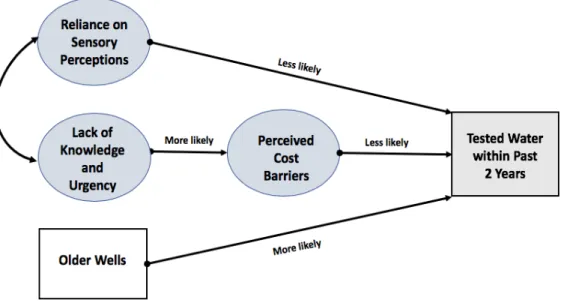
participants. Similar to what has been found in other parts of the country, this survey indicated that few households follow public health recommended testing guidelines. Only about 15% had tested within the past year. More than 40% had not tested at all in the last 10 years (Stillo III et al., 2019). Three factors predicted participation in private well water quality testing within the past 2 years, according to the multi-step statistical approach of Principal Component Analysis, logistic regression, and Structural Equation Modeling (Figure 1). Factors are sets of question responses that tended to run together, indicating an underlying commonality in the way respondents thought about them. Based on the topics that appeared in the factor questions, the factors were given the titles of 1) reliance on sensory perceptions, 2) lack of knowledge and urgency about well testing, and 3) perceived cost barriers (Stillo III et al., 2019). See Table 4 in Results for a full list of questions that appeared in the three factors.
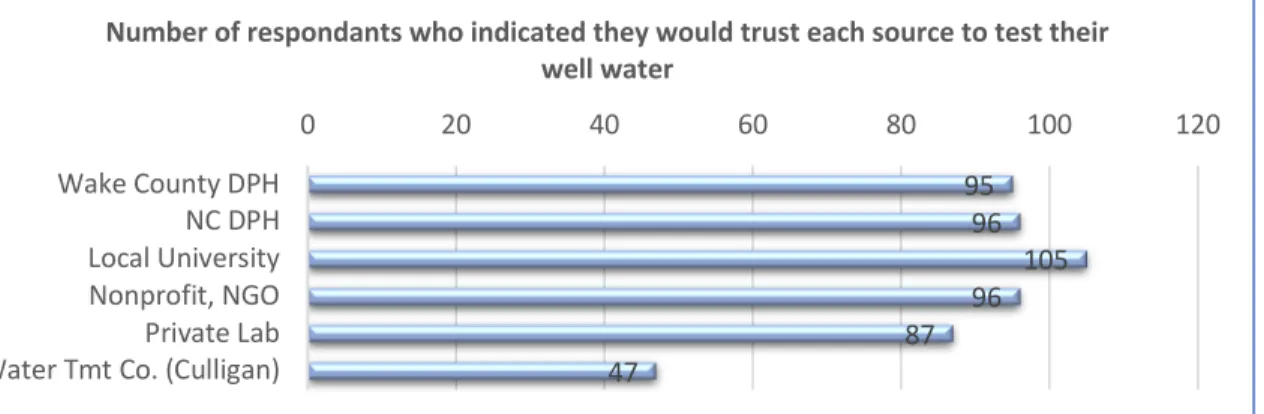
The survey provided additional insights to guide development of a communication. Figure 2 illustrates that postcards and other active forms of communication were considered by many people to be the best ways to provide information. Local universities were seen by the vast majority of survey respondents as a source they would trust for testing their water (see Figure 3), which we took as an indication that many would also trust a local university for information on testing.
Figure 2. Preferred formats for information. Counts of responses in a 2017 survey of our audience to the question, “What is the best way to provide information about well testing?” Participants were asked to rank their top 3.
Figure 3.Trusted sources for well testing. Counts of “yes” answers to the prompt, “Please indicate whether or not you would trust each organization to test your well water” in a 2017 survey of our audience.
0 10 20 30 40 50 60 70 80
Postcards County tax bills Door hangers Real estate agents Social media Government websites Religious Communities Water Tmt Co. (Culligan) Doctor's office Other
Best way to provide information about well testing
Ranked as Top 1 method for receiving well testing information Ranked as Top 3 method for receiving well testing information
95 96 105 96 87 47
0 20 40 60 80 100 120
Wake County DPH NC DPH Local University Nonprofit, NGO Private Lab Water Tmt Co. (Culligan)
Building on this prior work, this study had two objectives:
Objective 1: Evaluate examples of existing written communications to promote private well water testing that could be delivered to this audience to see whether we would be reinforcing existing messages or presenting a new focus.
Objective 2: Create a targeted communication to promote private well water testing by members of this audience. Following the mental models approach, we sought to design a risk communication mailer that is exclusively focused on the factors that were shown to predict well water testing in these communities.
METHODS
The mental models approach calls for selecting content based on the information needs of the target population. In this case, our audience is residents of majority African-American neighborhoods on the edges of cities and towns in Wake County, NC, who do not have access to municipal water service.
Evaluation of existing communications
in North Carolina. Mailers or brochures targeted to well owners were requested from the public health departments of Wake County and the state of North Carolina, as well as gathered from the websites of national organizations supporting well owners. The US EPA, the CDC, the National Groundwater Association, and The Private Well Class provide information on well testing on their websites, but we did not find documents that met our criteria. The one national resource that we were able to include was an information sheet from the Water Systems Council, a national non-profit with the mission of protecting and promoting private well water systems. For each document, we noted whether messages from each factored question appeared. We also noted whether additional topics were addressed which might detract attention from the main messages identified for this audience. Readability indicators were word counts and Flesch-Kincaid grade level analysis.
Creation of mailer
For this new mailer, messages were developed that focused exclusively on the key drivers of self-reported well water testing in our target population, with clear, everyday language and logical organization. Communication source and format were chosen based on preferences indicated in the survey. To craft messages in familiar language, we consulted the transcripts from the mental models interviews of members of our target population (interview analysis in (Fizer et al., 2018). We performed a Flesch-Kincaid grade level test on the draft, with a goal of 6th grade. A graphic designer created the layout, color-scheme and graphical elements
Pilot testing and revision
In-person “think aloud” interviews were conducted with 5 members of the target population to look for potential misunderstandings when reading our communication.
Participants for the pilot testing interviews were recruited from those who had
responded to the mental models survey in this same population and had indicated a willingness to be contacted further. Contact attempts were made until we had completed 5 interviews. Participants were offered a $15 gift card as incentive and expression of our appreciation for their participation.
A pair of researchers met with each pilot participant in a public or semi-public setting (coffee shop or participant’s office). Participants were given 10 seconds to view the postcard and then asked what they had noticed from just a first look. We alternated which side of the postcard was facing up when presented to participants, since either side could be facing up when someone picks up the mail. After the first look, participants were asked to think aloud while they read the full postcard. We specifically mentioned that any comments were fine, even if they seemed irrelevant, and that the participant would not hurt our feelings with any comments about the postcard.
Interviews were recorded and all comments relevant to the evaluation of the
Was the source of the mailer easily identifiable and recognizable? 4) Did participants say anything that indicated a misunderstanding of one of our messages? 5) Was anything off-putting or evoking a response that would cause someone to discount or push aside the communication?
Revisions were based on any concerns that came up in pilot testing related to the above questions. In particular, if concerns about any of those areas were brought up by more than one person, we found a way to address it.
Review by experts
Early and final drafts were reviewed by two experts on household drinking water well issues at the North Carolina Department of Health and Human Services, who are responsible for communicating with well owners. They confirmed that the factual information was correct.
RESULTS
Evaluation of existing communications
The documents which met our selection criteria were: 1) A door hanger from Wake County, 2) a 2-page flyer from Wake County, 3) a double-sided flyer published by NC Dept. of Health and Human Services, in collaboration with North Carolina State University, 4) a
refrigerator magnet created by NC Dept. of Health and Human Services, and 5) a 4-page info sheet from the wellcareR series by Water Systems Council. All were published within the last 8
years. Copies of each are included in the appendix.
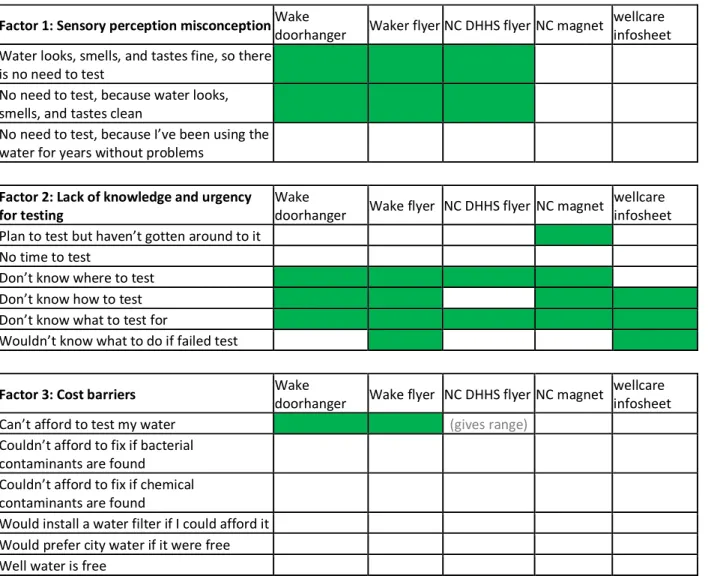
factors. Wake County’s door hanger, for example, did not mention what to do if a problem is found; however, the Wake County letter does. Neither of the Wake County pieces included phrases that emphasize urgency in testing, although the door hanger format and specific dates for waiving collection fees might serve the same function. The only other item that seemed to promote a sense of urgency was the reminder refrigerator magnet, with the phrase, “Have you tested your well lately?”
Two of the five pieces did not directly counter the misconception that one can rely on sensory perceptions to detect contaminants in water. The state and national resources did not say anything that might help alleviate concerns about cost barriers. The flyer from NC DHHS mentions a range of possible costs for tests, extending up to several hundred dollars, which could reinforce perceptions of cost barriers.
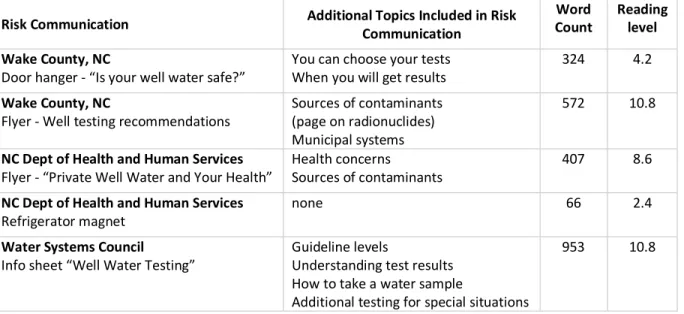
All pieces also included other topics beyond the concepts that showed up in the predictive factors. For example, some included information about sources of contaminants, effects on health, and/or maximum contaminant levels. See Table 3 for details.
There was great variation in the amount of text in the communications and in the
Table 2. Evaluation of existing communications for concepts important for our audience. Shaded boxes indicate that a message related to that key concept was found in that communication piece. No existing communication included all identified messages. The two pieces from Wake County included some messages from each factor.
Factor 1: Sensory perception misconception Wake doorhanger Waker flyer NC DHHS flyer NC magnet wellcare infosheet Water looks, smells, and tastes fine, so there
is no need to test
No need to test, because water looks,
smells, and tastes clean
No need to test, because I’ve been using the
water for years without problems
Factor 2: Lack of knowledge and urgency
for testing Wake doorhanger Wake flyer NC DHHS flyer NC magnet wellcare infosheet Plan to test but haven’t gotten around to it
No time to test
Don’t know where to test
Don’t know how to test Don’t know what to test for
Wouldn’t know what to do if failed test
Factor 3: Cost barriers Wake doorhanger Wake flyer NC DHHS flyer NC magnet wellcare infosheet Can’t afford to test my water (gives range)
Couldn’t afford to fix if bacterial
contaminants are found
Couldn’t afford to fix if chemical
contaminants are found
Table 3. Evaluation of existing communications for additional topics, word count, reading level. Additional topics are outside of the concepts identified as our audience’s key knowledge gaps and misconceptions about well water testing. Word counts exclude maps and tables. Reading levels are Flesch-Kincaid grade level score.
Risk Communication Additional Topics Included in Risk Communication Count Word Reading level
Wake County, NC
Door hanger - “Is your well water safe?”
You can choose your tests When you will get results
324 4.2
Wake County, NC
Flyer - Well testing recommendations Sources of contaminants (page on radionuclides) Municipal systems
572 10.8
NC Dept of Health and Human Services
Flyer - “Private Well Water and Your Health” Health concerns Sources of contaminants 407 8.6
NC Dept of Health and Human Services
Refrigerator magnet none 66 2.4
Water Systems Council
Info sheet “Well Water Testing” Guideline levels Understanding test results How to take a water sample
Additional testing for special situations
953 10.8
Creation of mailer
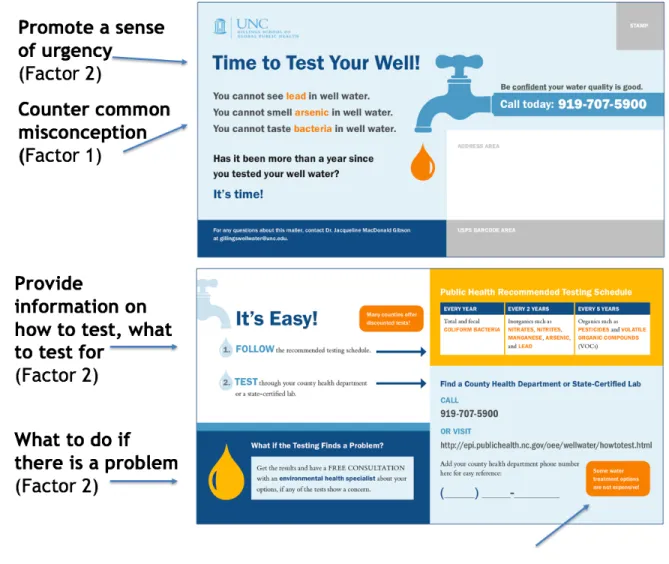
Design of the communication (seen in Figure 4) was driven by the results of the survey of the target audience. The preference of a majority of survey respondents for a postcard, over other avenues for receiving information, led us to a large (6” x 11”), two-sided, full-color postcard. (Postcard was the option with highest count as rank #1 (47 / 111) and highest count as rank #1,2 or 3 (69 / 111). Graphical elements, such as faucet, drips and blue color, were chosen to support the messages. The color orange contrasts for urgency. The university logo and contact information indicated a reputable source, as we were aware of mailings in the area from water treatment companies and others which were not focused on public health goals.
The content of the messages focused exclusively on the identified factors: reliance on sensory perceptions, lack of urgency and knowledge about testing, perceived cost barriers (see Table 4). Additional messages, for example about health risks or potential sources of
factor, with two exceptions. We did not directly address the specific idea that there might be no need to test if one had been using the water for years without problems. This was part of the misconception that senses can be relied upon to know when there is a problem, and was addressed instead by the messages about not being able to see, smell or taste contaminants. We also did not address all of the separate questions in the factor about perceived cost
barriers. Three of the questions seemed to deal with perceived costs but did not directly relate to testing the water, specifically, “I would install a home water filter if I could afford it,” “I would prefer to drink city water if it were free”, and “Getting water from a well is free.”
Word choice and phrasing were guided by interview data to be in language familiar to the target audience. The phrase, “Be confident your water quality is good” came from
Factor and associated survey questions Messages included in the mailer
Factor 1: Sensory perception misconception
Water looks, smells, and tastes fine, so there is no need to test
You cannot see lead in well water
No need to test, because water looks, smells,
and tastes clean You cannot smell arsenic in well water
No need to test, because I’ve been using the
water for years without problems You cannot taste bacteria in well water
Factor 2: Lack of knowledge and urgency for testing
Plan to test but haven’t gotten around to it. Time to test your well! It’s time!
No time to test It’s Easy!
Don’t know where to test Test through your local health department or a state-certified lab
Don’t know how to test Call XXX or Visit XXX
Don’t know what to test for Public Health recommended testing schedule
Wouldn’t know what to do if failed test Have a free consultation with an Environmental Health Specialist about your options, if any of the tests show a concern.
Factor 3: Cost barriers
Can’t afford to test my water Many counties offer discounted tests.
Can’t afford to fix my well water if bacterial
contaminants are found Some water treatment options are not expensive. Can’t afford to fix my well water if chemical
contaminants are found
Would install a water filter if I could afford it
Would prefer city water if it were free [These pieces were not directly included in the postcard because they did not deal with testing. We considered them indicative of beliefs about cost barriers]
Well water is free
Figure 4. Front and back of postcard used in pilot testing. Key factor concepts highlighted. Pilot testing and revision
few lines of text that people did not find especially helpful to ensure that the most important messages came through.
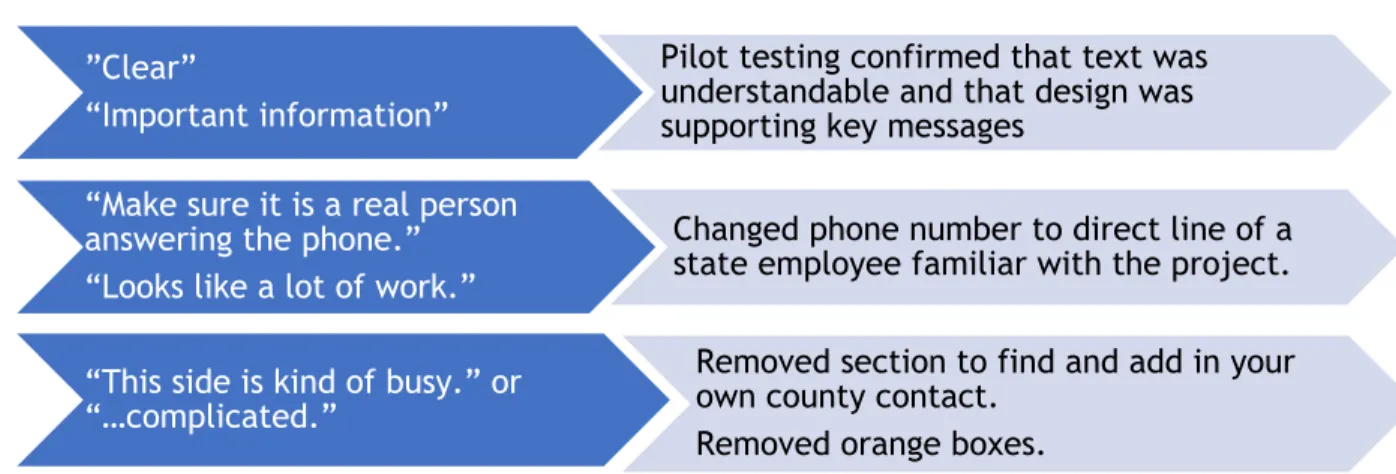
The other concern expressed by pilot testers was whether the process would actually be easy once they made that first phone call. Representative comments are shown in Figure 5. They were concerned about getting a lengthy menu of options, a voicemail, or getting transferred from person to person without results. To address this concern, we changed the phone number on the card from the general main number of the state DHHS to the direct line of a state employee who regularly communicates with well owners and who was familiar with our project.
Although participants suggested a variety of changes and possible pieces of content to add (for example, how this could impact your family’s health, or your pet), we made changes based only on whether our chosen messages came through clearly, since our approach was to only include content that addressed the factors predicting well water testing.
Pilot comments Mailer revisions
Figure 5. Representative pilot testing comments and resulting revisions. Pilot testing indicated no major points of misunderstanding and that design features supported the message.
”Clear”
“Important information”
Pilot testing confirmed that text was understandable and that design was supporting key messages
“Make sure it is a real person answering the phone.” “Looks like a lot of work.”
Changed phone number to direct line of a state employee familiar with the project.
“This side is kind of busy.” or “…complicated.”
Removed section to find and add in your own county contact.
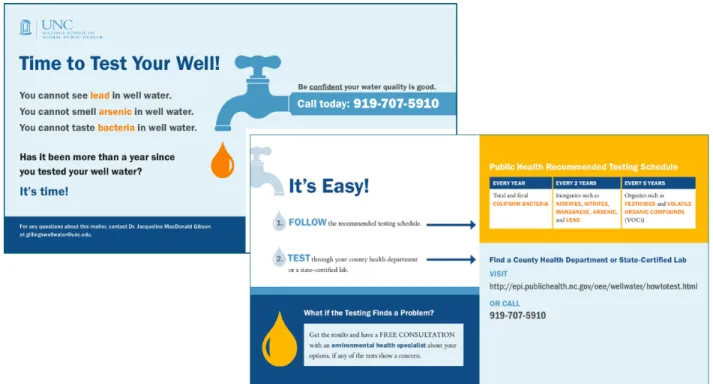
The final postcard included messages addressing each of the survey items in Factors 1 (reliance on sensory perceptions) and 2 (lack of urgency and knowledge about testing). To address the perceived cost barriers, we opted to offer a free test as one of the study conditions in the randomized-controlled trial of this communication piece, reported separately. The large-format postcard minimized barriers to the message being seen. Graphics supported the
messages and did not distract. Following this application of the mental models approach to risk communication, we had an evidence-based communication, ready to be tested for impact (Figure 6).
DISCUSSION
As a result of this work, we have designed an evidence-based print communication, ready to be tested for impact. This postcard mailer promotes private well water quality testing among residents of majority African-American neighborhoods without municipal water service on the edges of cities and towns in North Carolina. The messages were developed directly from surveys of audience members, following the mental models approach to risk communication. It focuses exclusively on the factors that were shown to predict private well water testing in our audience. Pilot testing confirmed the prominence of key messages.
The review of existing communications showed that some key messages for this audience were missing from many of the pieces. There were very few messages promoting a sense of urgency to complete water quality testing. Only three of the five directly addressed the misconception that senses can be a good guide to water quality. To address perceived cost barriers, the county level communications we reviewed gave specific information about costs and also mentioned existing subsidies and any discounts available. Not all counties subsidize testing or offer discounts. The state and national communications do not mention cost. Key messages that were being reinforced by all sources were the recommendations of what contaminants to test for. Consistent, ongoing messaging is important for effective
choose the messages, or whether the creators of those pieces had different goals from ours (for example, education on well stewardship, in addition to promoting testing). However, it is encouraging to see that our postcard mailer and Wake County’s door hanger and letter share many key messages, since their audiences closely overlap.
This work represents the first time that the mental models approach has been applied to develop a communication around the health risks from unregulated drinking water sources, to the best of our knowledge. The mental models approach to risk communication has been increasingly used and evaluated in recent years, with effects particularly shown in measures of knowledge (Boase et al., 2017). It has been used successfully in communicating about radon in homes, which has a similar context, in that homeowners are responsible for managing the risks and the contamination is not perceptible by the senses. The study applying the mental models process to brochures about radon risks found that the brochure created through this process received fewer comments expressing confusion and outperformed in contradicting
misconceptions, compared with a brochure produced by experts that did not use this method (Bostrom, Atman, Fischhoff, & Morgan, 1994). The mental models approach can guide the choice of content so that it focuses on the information that people need to make decisions around managing a risk.
testing well water (Knobeloch, 2011; Roche et al., 2013). Many survey respondents in these prior studies also indicated that they were missing information on how to get the tests done (Knobeloch, 2011; Kreutzwiser et al., 2011; Malecki et al., 2017; Roche et al., 2013). This matches one of the factors for our audience, which included lack of knowledge of how to test, where to test and what to test for. These items were all included in the postcard mailer. On the other hand, our survey did not lead us to emphasize the health impacts of drinking
contaminated water, as others have suggested would be important (Kreutzwiser et al., 2011; Malecki et al., 2017; Morris et al., 2016; Paul et al., 2015). We do not know whether this difference stems from the use of different theoretical backgrounds to inform analysis and recommendations or whether it comes from differences in the populations surveyed. These other studies were conducted primarily with rural well owners in midwestern and northeastern US states and Canadian provinces. The responses to our surveys indicated that knowledge of health risks was not driving decisions to test wells in African-American neighborhoods on the edges of cities and towns in NC. It would be helpful to have information from additional studies with well owners in North Carolina, and of non-rural well owners beyond Wake County to learn whether these important findings apply more broadly.
Cost has been recognized as a potential barrier to well water stewardship by many researchers and practitioners (Knobeloch, 2011; Kreutzwiser et al., 2011; Liukkonen, 2009; Straub & Leahy, 2014) and was one of the factors identified by our survey as influencing
the actual costs. Adjusting the costs to well owners for testing or treatment is a potential program option for health departments and other organizations. The decision was made to test both the impact of offering a free test (reducing cost barriers directly) and the impact of a communication focused solely on the key factors using a randomized-controlled trial (Stillo, III, Bruine de Bruin, & MacDonald Gibson, 2019). To clearly separate the two study conditions, we did not include cost information on the postcard.
This postcard will be put to use in promoting well testing, during the randomized-controlled trial. Outcomes of interest include whether a control group that did not receive the communication differed from the group that did receive the communication, in whether they tested their water quality, whether they indicated an intention to test their water, and in how they responded to the knowledge and perception questions that informed the design of the communication.
a more limited set of factors that appear important across communities. This would be particularly relevant for organizations with state and national audiences that have the added challenge of creating communications that are relevant to many different people. There are now indications from several sources that many people rely on their senses to decide whether to test their well water quality. This could be an important set of messages to include in more communications.
Even after outreach programs achieve greater success in promoting well water quality testing, work still needs to be done to more effectively communicate test results, the health risks related to those results, and the options for managing those risks. The mental models approach to risk communication could also contribute to those efforts.
A 2016 literature review on conducting effective outreach to private well owners emphasized the importance of understanding the audience, including existing knowledge and beliefs (Morris et al., 2016). They stated strongly that no single approach would likely be effective with all groups of well owners. Our application of the mental models approach allowed us to gain important insights about our audience and address only the most relevant information points.
CONCLUSIONS
By following the mental models approach, we have created an evidence-based
communication ready to be tested for impact. This postcard concisely addresses key points that predict well water testing in our audience, residents of majority African-American
neighborhoods on the edges of cities and towns, without municipal water service. This postcard can be used as a source of information, a reminder and a cue to action. In Wake County, NC, these underbounded communities have been shown to be at greater risk for drinking water contaminated with bacteria and lead than those on nearby municipal water. In these
communities, similar to many others across North America, rates of well testing are low, which is a barrier to the public health goal of protecting against health risks from drinking
contaminated water. Surveying other communities could guide adaptation of this
communication for additional audiences. This evidence-based communication material, and others like it, can become part of the multi-pronged approaches needed to increase rates of well water testing and other well stewardship behaviors. Ultimately, effectively promoting well testing is one tool among many needed to reach a more equitable distribution of drinking water risks.
REFERENCES
Aiken, C. S. (1987). Race as a factor in municipal underbounding. Annals of the Association of
American Geographers, 77(4), 564–579. doi:10.1111/j.1467-8306.1987.tb00181.x
Barros, N., Rudo, K., & Shehee, M. (2014). Importance of regular testing of private drinking water systems in North Carolina. North Carolina Medical Journal, 75(6), 429–434. doi:10.18043/ncm.75.6.429
Boase, N., White, M., Gaze, W., & Redshaw, C. (2017). Evaluating the mental models approach to developing a risk communication: A scoping review of the evidence. Risk Analysis,
37(11), 2132–2149. doi:10.1111/risa.12789
Bostrom, A., Atman, C. J., Fischhoff, B., & Morgan, M. G. (1994). Evaluating risk
communications: completing and correcting mental models of hazardous processes, Part II. Risk Analysis, 14(5), 789–798.
CDC. (2009). Well testing. Retrieved March 19, 2019, from
https://www.cdc.gov/healthywater/drinking/private/wells/testing.html
Colley, S., Kane, P., & MacDonald Gibson, J. (2019). Communicating to Encourage Private Well Testing: A Systematic Literature Review .
Craun, G. F., Brunkard, J. M., Yoder, J. S., Roberts, V. A., Carpenter, J., Wade, T., … Roy, S. L. (2010). Causes of outbreaks associated with drinking water in the United States from 1971 to 2006. Clinical Microbiology Reviews, 23(3), 507–528. doi:10.1128/CMR.00077-09
DeSimone, L., Hamilton, P., & Gilliom, R. (2009). Quality of Ground Water from Private Domestic Wells. Water Well Journal, April, 33–37. Retrieved from
https://pubs.er.usgs.gov/publication/70003723
Dieter, C. A., Maupin, M. A., Caldwell, R. R., Harris, M. A., Ivahnenko, T. I., Lovelace, J. K., … Linsey, K. S. (2018). Estimated Use of Water in the United States in 2015 (No. 1441). U.S. Geological Survey. Retrieved from http://DOI: 10.3133/cir144
Fizer, C., Bruine de Bruin, W., Stillo, F., & MacDonald Gibson, J. (2018). Barriers to Private Well and Septic Management: An Analysis of Homeowner Decision-Making. Journal of
Environmental Health, 81.5, 8–15.
Gholson, D. M., Boellstorff, D. E., Cummings, S. R., Wagner, K. L., & Dozier, M. C. (2018).
Consumer water quality evaluation of private and public drinking water sources. Journal
Johnson, J. H., Parnell, A., Joyner, A. M., Christman, C. J., & Marsh, B. (2004). Racial apartheid in a small North Carolina town. The Review of Black Political Economy, 31(4), 89–107. doi:10.1007/s12114-004-1012-4
Joyner, A. M., & Christman, C. (2005). Segregation in the Modern South: A Case Study of
Southern Moore County. Cedar Grove Institute for Sustainable Communities. Retrieved
fromhttps://www.cedargroveinst.org/files/Southern%20Moore%20County%20Case%20 Study.pdf
Knobeloch. (2011). 2008-9 survey of private well owners. Presented at the Wisconsin Department of Health Service.
Kreutzwiser, R., de Loë, R., Imgrund, K., Conboy, M. J., Simpson, H., & Plummer, R. (2011). Understanding stewardship behaviour: factors facilitating and constraining private water well stewardship. Journal of Environmental Management, 92(4), 1104–1114. doi:10.1016/j.jenvman.2010.11.017
Liukkonen. (2009, October). Social Dimensions of Private Well Testing: Why Don’t People Test
their Well Water? Presented at the University of Minnesota Extension Service, St. Paul,
MN.
MacDonald Gibson, J., DeFelice, N., Sebastian, D., & Leker, H. (2014). Racial disparities in access to community water supply service in wake county, north carolina. American Journal of
Public Health, 104(12), e45–e45. doi:10.2105/AJPH.2014.10412e45.1
Malecki, K. M. C., Schultz, A. A., Severtson, D. J., Anderson, H. A., & VanDerslice, J. A. (2017). Private-well stewardship among a general population based sample of private well-owners. The Science of the Total Environment, 601–602, 1533–1543.
doi:10.1016/j.scitotenv.2017.05.284
Morgan, M. G., Fischhoff, B., Bostrom, A., & Atman, C. (2002). Risk communication: A mental
models approach. Cambridge: Cambridge University Press.
Morris, L., Wilson, S., & Kelly, W. (2016). Methods of conducting effective outreach to private well owners - a literature review and model approach. Journal of Water and Health,
14(2), 167–182. doi:10.2166/wh.2015.081
NCDHHS. (2018, August 1). Testing Private Well Water. Retrieved March 19, 2019, from https://epi.publichealth.nc.gov/oee/wellwater/howtotest.html
Paul, M. P., Rigrod, P., Wingate, S., & Borsuk, M. E. (2015). A Community-Driven Intervention in Tuftonboro, New Hampshire, Succeeds in Altering Water Testing Behavior. Journal of
Renaud, J., Gagnon, F., Michaud, C., & Boivin, S. (2011). Evaluation of the effectiveness of arsenic screening promotion in private wells: a quasi-experimental study. Health
Promotion International, 26(4), 465–475. doi:10.1093/heapro/dar013
Roche, S. M., Jones-Bitton, A., Majowicz, S. E., Pintar, K. D. M., & Allison, D. (2013). Investigating public perceptions and knowledge translation priorities to improve water safety for residents with private water supplies: a cross-sectional study in Newfoundland and Labrador. BMC Public Health, 13, 1225. doi:10.1186/1471-2458-13-1225
Stillo, F., & MacDonald Gibson, J. (2017). Exposure to contaminated drinking water and health disparities in North Carolina. American Journal of Public Health, 107(1), 180–185. doi:10.2105/AJPH.2016.303482
Stillo, F., & MacDonald Gibson, J. (2018). Racial disparities in access to municipal water supplies in the American South: Impacts on children’s health . International Public Health Journal,
10(3), 309–323.
Stillo, III, F., Bruine de Bruin, W., & MacDonald Gibson, J. (2019). Well Water Testing in African American Communities without Municipal Infrastructure: A randomized control trial of a mental models risk communication.
Stillo III, F., Bruine de Bruin, W., Zimmer, C., & MacDonald Gibson, J. (2019). Well Water Testing in African American Communities without Municipal Infrastructure: Beliefs Driving Decisions.
Straub, C. L., & Leahy, J. E. (2014). Application of a Modified Health Belief Model to the Pro-Environmental Behavior of Private Well Water Testing. Journal of the American Water
Resources Association / AWRA, 50(6), 1515–1526. doi:10.1111/jawr.12217
Swistock, B. R., Clemens, S., Sharpe, W. E., & Rummel, S. (2013). Water quality and
management of private drinking water wells in Pennsylvania. Journal of Environmental
Health, 75(6), 60–66.
Wilde Anderson, M. (2008). Cities Inside Out: Race, Poverty, and Exclusion at the Urban Fringe.