TOPICS IN INTELLECTUAL PROPERTY
Peter Adam Malaspina
A dissertation submitted to the faculty of the University of North Carolina at Chapel
Hill in partial ful…llment of the requirements for the degree of Doctor of Philosophy in
the Department of Economics.
Chapel Hill
2011
Approved by,
Peter Norman
Gary Biglaiser
Helen Tauchen
Sergio Parreiras
ABSTRACT
Peter Malaspina: Topics in Intellectual Property (Under the instruction of Dr. Peter Norman)
The following chapters cover theoretical and empirical investigations into issues of
intellectual property.
The …rst chapter examines predatory behavior in patent litigation. I develop a
signal-ing model where the timsignal-ing of litigation against an initial act of infrsignal-ingement transmits
noisy signals about a patent holder’s private expectations of litigation awards. I …nd a
non-monotonic relationship between a patent holder’s award expectation and the
tim-ing of litigation. Patent holders with su¢ ciently high award expectations will exhibit
predatory behavior by delaying litigation to lure infringers. At the same time, patent
holders with moderate award expectations will litigate quickly to deter additional acts
of infringement.
The second chapter (co-authored with Dr. David Molin) examines the economic
consequences of the reduction in the …xed costs of distribution due to the emergence
of Internet and information technology. Others have examined the e¤ects of increasing
product variety on consumer welfare, in bookselling and in other markets. We identify a
set of books sold on Amazon.com for which the author’s revenue can be easily computed.
We use this data to parameterize a model of author entry and then estimate the welfare
Table of Contents
List of Tables...iv
List of Figures ...v
Chapter I. Predatory Delays in Patent Litigation...1
Introduction...1
Model...5
Results...14
Discussion...24
Conclusions...26
II. Welfare Implications of Online Publishing...28
Introduction...28
Model...34
Simulation...35
Estimation ...37
Data...41
Results...44
Conclusions...46
Appendices...48
List of Tables
Table
1. Summary Statistics for BHS and xLibris Data...44
2. T=100 simulation runs w/o stage 1 BHS variation...64
3. T = 100 simulation runs w/ stage 1 BHS variation...64
4. T = 100 simulation runs w/o stage 1 BHS variation...64
5. T = 100 simulation runs w/ stage 1 BHS variation...65
6. Summary Statistics for the B = 1000 bootstrap samples of sizeW = 1250...65
7. Normally distributed Vanity w/o stage 1 BHS variation, T=10 simulation runs..69
8. T=100, Log Normal Vanity with Mass Point w/o stage 1 BHS variation...69
List of Figures
Figure
1. A timeline of the game...4
2. An overview of the game...9
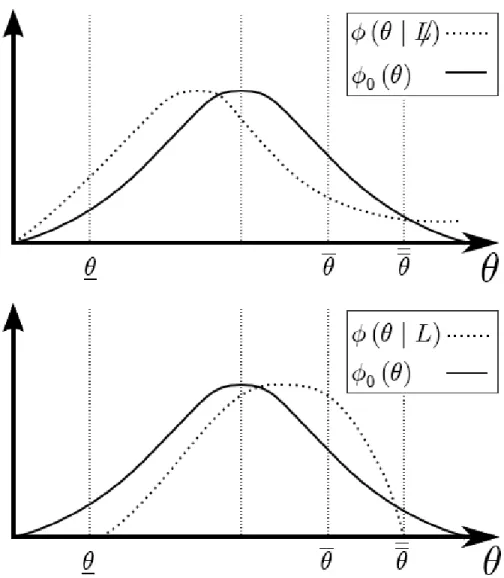
3. The the resulting class of equilibrium...18
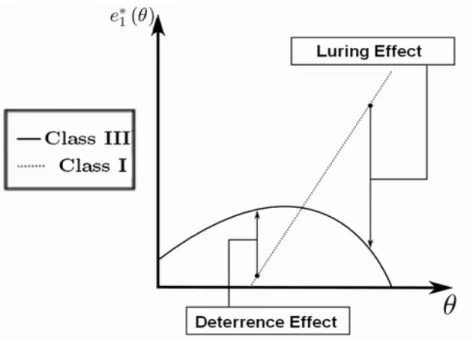
4. Optimal patent holder e¤ort in a reputational equilibrium...20
5. Changing beliefs in an example setting that results in a reputational equilibrium..21
6. Reputation’s e¤ect on patent holder e¤ort...23
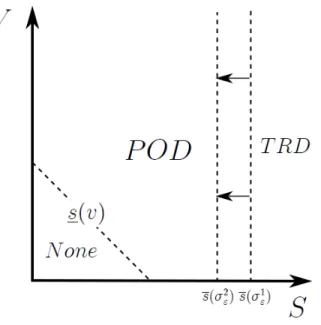
7. A shift in the boundaries of potential author choices for a decrease in "...37
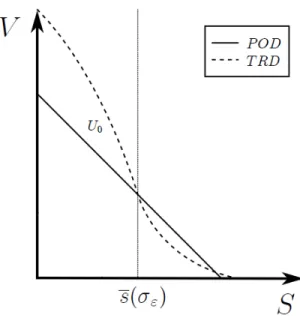
8. Level sets for utility(U0)in the typespace of author characteristics...38
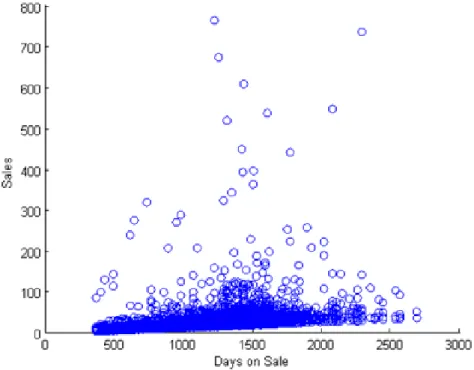
9. Sales as a function of days on sale...43
10. The CDF from a simulation run...45
11. Change in the CDF of simulated POD sales for an increase in ...71
12. Change in the CDF of simulated POD sales for an increase in ...72
13. Change in the CDF of simulated POD sales for an increase in v...72
14. Change in the CDF of simulated POD sales for an increase in v...73
CHAPTER 1
PREDATORY DELAYS IN PATENT LITIGATION
1.1 Introduction
In 2007 a jury awarded the plainti¤ Alcatel-Lucent $1.5 billion for the violation of two
patents by the defendant Microsoft, who allegedly used unlicensed audio technology in
their Windows operating systems beginning in 1997. After siding with Alcatel-Lucent,
the court based their award on 0.5% of the retail value of all the computers sold with
the unlicensed technology. Furthermore, Alcatel-Lucent waited until after the release of
Windows XP in 2001 to pursue litigation in 2002, well after the …rst unlicensed use of
the patented technology in 1997. So the question remains: why did Alcatel-Lucent wait
so long to initiate litigation?
One theory is that Alcatel-Lucent had an incentive to delay litigation until after
Microsoft committed a subsequent act of infringement with the release of Windows XP.
Alcatel-Lucent may have foreseen the potential for a larger award in the future by noting
that sales were accumulating during the delay, and that these sales would probably be
used to calculate awards. Therefore, if Alcatel-Lucent had initiated litigation based
on earlier versions of Windows, Microsoft may have avoided incorporating the patented
technology into future products altogether, and thus eliminated the potential for
Alcatel-Lucent to extract any royalty for subsequent use.
The example above suggests that a patent holder’s award expectation may a¤ect the
timing of litigation when there is a potential for additional infringement in the future.
In this paper, I model how this process works and analyze its impact on the behavior of
patent holders and infringers. To this end, I develop a signaling model where the timing
of litigation against an act of infringement transmits information about a patent holder’s
In the analysis of my model I …nd many cases where patent holder behavior is
im-pacted by two reputation e¤ects: deterrence and luring. Patent holders with su¢ ciently
high award expectations will utilize luring by delaying litigation to encourage additional
acts of infringement.1 Patent holders with relatively moderate award expectations will
utilize deterrence by litigating quickly before additional acts of infringement can be
com-mitted. Last, patent holders with the lowest award expectations will create no litigation.
Therefore, the probability of litigation preempting any additional infringement is
increas-ing in the patent holder’s award expectation up to a point, after which the probability
of preemptive litigation is decreasing until it reaches zero.2
The incentives for predatory patent holder behavior exist under the following
condi-tions: First, at least one patent holder type must expect litigation in face of infringement
to return greater expected pro…ts than the best alternative in the absence of
infringe-ment. Second, the infringer’s equilibrium entry decision must be conditioned on their
observations of any previous litigation.3 Together, these conditions will imply that there
exists at least one type of patent holder that has an incentive to delay litigation for the
sake of predation.
I show that there exists a unique perfect Bayesian equilibrium for each parameter
setting of the model. The existence property of the model, combined with the intuitive
nature of resulting equilibrium, demonstrates the model’s ability to provide insightful
results for a wide range of settings. Furthermore, the uniqueness property shows that my
conclusions are unbiased with respect to the equilibrium I choose to analyze. Uniqueness
is a useful property for models with reputation, which usually result in multiple equilibria,
1Litigation Awards can be up to three times damages plus legal costs. Furthermore, since awards for
patent infringement cannot fall below the courts de…nition of a "reasonable royalty", a patent holder who is con…dent in the validly of his patent, as well as his ability to prove infringement, should view an expected licensing fee as an approximate baseline for awards.
2In our model, a patent holder that desires deterrence is analogous to a "weak" incumbent acting
"tough" in the classic entrant incumbent game modeled in Kreps and Wilson(1982). However the potential incentives for luring provide a new twist on an old game. That is, we also see tough types acting weak.
3In some cases the infringer will ignore the …rst round signal. For example, when no patent holder
of which at least some are una¤ected by reputation.
The predatory behavior found in my model is not necessarily prohibited under current
U.S. patent law. The current statute of limitations requires that litigation be brought
within 6 years of an initial act of infringement.4 In many cases, opportunities for the
infringer to commit additional acts of infringement exist well within this time frame.5
However, I show that policy makers can a¤ect the magnitude of reputational distortions
without changing the statute of limitations. To this end, I demonstrate how the
mag-nitude of reputation’s e¤ect on behavior is linked to the prior distribution of expected
awards, noting that policy makers have some control over these distributions.
My research is related to other work that focuses on the strategic behavior of patent
holders in the face of potential infringement. Crampes and Langinier (2002) model patent
holders who must expend e¤ort to monitor for infringement. They calculate the optimal
e¤ort level, and …nd that increasing awards may not necessarily decrease the probability
of infringement. I include a similar notion of patent holder e¤ort. Michael J. Meurer
(1989) models the nature of settlement o¤ers to a potential infringer. Meurer analyzes
how a patent holder’s private expectations of their patent’s validity can lead to a
par-ticular settlement, litigation, or inaction outcome. My model also assumes that patent
holders have private information about their patent. However, I expand on Meurer’s
notion of private information by including any element of private information that
af-fects expected awards. Certainly, information about validity will a¤ect a patent holder’s
expected award. Therefore, my interpretation of private information includes, but is not
limited to, issues of validity. Neither Crampes and Langinier nor Meurer, considers a
repeated interaction between a patent holder and a sequence of infringers. Therefore,
issues concerning information revelation and reputation e¤ects are not present.
The closest to modeling reputation e¤ects in patent litigation is Choi (1998), who
examines the implications of information transmission on the strategic behavior of an
endogenous sequence of infringers. While there are some similarities in our models,
there are also some important di¤erences: In his model all patent holders are ex-ante
4Pincus(1991)
5Any future production or sales of an infringing product after the initial act of infringement could
identical. Therefore, it is impossible to account for the di¤erent reputational incentives
of patent holders who di¤er in their private expectations of litigation awards. Choi also
assumes that information is transmitted the moment litigation begins; whereas in my
model, litigation is ongoing, such that it does not fully reveal private information to
other potential infringers. The distinctions lead us to di¤erent conclusions about why
patent holders might want to delay litigation. Whereas, Choi …nds that patent holders
will delay litigation because they are afraid of revealing weakness, I …nd that patent
holders may delay litigation to avoid revealing strength.
The rest of this paper is presented in the following order: The second section presents
the model preliminaries, and de…nes equilibrium strategies and beliefs. The third section
presents the resulting equilibrium properties of the model. The fourth section discusses
the properties of the model as they relate to reputation, potential policy, and
signal-ing games in general. The …fth section states my conclusions. The sixth section is an
appendix containing the proofs of all Lemmas and Propositions.
1.2 Model
Consider a two period model where a patent holder faces o¤ against an initial act of
infringement committed at the beginning of period 1.6 Furthermore, the patent holder
foresees the potential of an additional act of infringement in period 2.7 Assume patent
holders have private information about their expected awards from any litigation. In the
resulting signaling game, signals about the patent holder’s private information will be
transmitted by the outcome of period 1 to the potential infringer before they are called
to make an entry decision in period 2. The timing of this game is summarized in …gure
1.
Assume patent holders vary in their ex-ante expected awards from any ongoing
liti-gation that has been successfully initiated, such that awards are correlated with private
information for each type 2 R.8
Furthermore, let 0( )denote the infringer’s infringer’s prior beliefs about the patent
holder’s private information in period 1. Such that 0( ) assigns each type a prior probability density, denoted as 0( ).
Let >0 be an exogenous scalar that captures the relative size of the potential act of infringement to the initial act, such that
1. If litigation is initiated successfully against either act separately, the patent holder
would expect award for the initial act of infringement, and for the potential
act of infringement.
2. If litigation is initiated successfully against both acts jointly, the expected award
becomes ( + ).
The game begins when a patent holder faces an initial act of infringement in period 1.
6First period infringement is assumed for simplicity. Endogenous …rst period entry will not change
the general intuition of our results.
7This model depicts what happens when the potential infringer is the same as the initial infringer
(See the Microsoft example in the introduction). If instead I want to analyze what happens when the potential infringer is another …rm, I can make minor modi…cations to the model that will not a¤ect the intuition of the results.
8I allow for types <0for generality. <0 might be representative of a patent holder with invalid
In order to successfully initiate litigation, the patent holder must expend e¤ort denoted
e1: Based on the patent holder’s e¤ort, nature determines the the probabilityp(e1) that
the patent holder successfully …nds arguments su¢ cient to bring the case to court in
period 1. I assume e1 2 R+; and p(e1) is twice continuously di¤erentiable such that p0(e1)>0,p
00
(e1) <0; and p(0) = 0.9 Therefore, based on his e¤ort, the patent holder
creates litigation in period 1 with probability p(e1); with complementary probability (1 p(e1)) no litigation exists at the beginning of period 2.
Any litigation initiated in period 1 is on-going at the beginning of period two.
There-fore, the only signal observed by the infringer in period 2 is the history h1 2 fL;L/g,
where fLg denotes the existence, and fL/g denotes the absence, of ongoing litigation from period 1.10
Therefore, I denote the infringer’s period 2 entry action as being conditional on
observ-ing h1. Let 2(h1)2 [0;1] denote the conditional entry probability, as mixed strategies
over fOut; Ing: If the infringer decides not to commit additional acts of infringement, they pay an exogenous licensing feeF to the patent holder for additional use.11 On the
other hand, if they commit additional acts of infringement, they avoid the licensing fee,
but may be subject to litigation in period 2.
After the potential infringer’s decision in period two, there are four possible histories
facing a patent holder in period 2, stemming from the two possible histories of period 1
fL;L/g; and the two possible actions of the infringer in period 2 fOut; Ing (See Figure 2). Therefore, the expected award for successfully initiated litigation in period 2 will
be conditional on a patent holder’s type ( ) and the set of observable histories h2 2 fh1; a2(h1)g:Here I summarize the four possible histories and provide the corresponding
9It is important to keep in mind that failure to initiate litigation does not mean that a patent holder
loses in court. In this model, failure to initiate litigation in period 1 is interpreted as a failure to …nd arguments su¢ cient to bring the case to court in period 1.
10I defend the assumption about the observable history as follows: litigation is usually a long process.
Protracted legal battles can delay information transmission beyond the onset of a trial. For example, in the case of Polaroid V. Kodak, it took 14 years for the patent infringement suit to be resolved. Therefore, the infringer will likely have other opportunities to commit additional acts of infringement before they can observe the …nal award.
11The implications of an endogenous licensing fee are examined in the discussion section. I show that
expected player pro…ts.
Let P H(h2; )denote a type patent holder’s expected pro…ts upon reaching history h2. Furthermore, let IN(h2 j ) denote the infringer’s expected pro…ts upon reaching
history h2, conditional on facing a patent holder of type .12 The four potential histories
facing the patent holder in period 2 are de…ned as follows:
History h2 = fL; Outg : The infringer decides not to commit an additional act of
infringement in the presence of ongoing litigation from period 1. The infringer pays
an exogenous licensing fee (F) to the patent holder for additional use, and awaits the outcome of the ongoing litigation from round 1.
P H(L; Out; ) = +F e
1 (1)
IN(L; Out
j ) = F (2)
12Note that at this point in the game, the infringer will not necessarily know what type of patent
History h2 =fL; IngThe infringer commits an additional act of infringement in the
presence of ongoing litigation from period 1. The infringer avoids paying the licensing
fee. However, the patent holder can then initiate litigation against the additional act of
infringement separately, with certainty, and without any additional cost of e¤ort.
P H(L; In; ) = + e
1 (3)
IN(L; In
j ) = (4)
History h2 =fL; In/ g:the infringer commits an additional act of infringement in the
absence of ongoing litigation from period 1. The infringer avoids paying the licensing fee.
However, the patent holder can expend e¤ort (e2) to try and initiate litigation against
both the initial and additional acts of infringement jointly.
P H
(L; In;/ ) = ( + )p(e2( jIn)) e2( jIn) e1 (5)
IN(L; In/
j ) = ( + )p(e2( jIn)); (6)
where e2( jIn) = argmax e22R+
f( + )p(e2) e2g:
History h2 = fL; Out/ g: The infringer decides not to commit an additional act of
infringement in the absence of litigation from period 1. The infringer pays a licensing
fee for additional use of the patent, but the patent holder can still expend e¤ort(e2)to
litigate the initial act of infringement from period one.
P H
(L; Out;/ ) =F + p(e2( jOut)) e2( jOut) e1 (7)
IN
(L; Out/ j ) = F p(e2( jOut)); (8)
where e2( jOut) = argmax e22R+
f p(e2) e2g:
All payo¤s are realized at the end of the second period. I now de…ne a reduced form of
Figure 2: An overview of the game.
The reduced form13 of a Perfect Bayesian Equilibriumwill consist of
1. Each patent holder type’s e¤ort levels: fe1( )g 8 2
2. The infringer’s entry probabilities: 2(L); 2(L)/ :
3. The infringer’s updated beliefs: f ( jL); ( jL)/ g.
Such that:
Given 2(L) and 2(L)/ , e1( ) maximizes the expected pro…ts of each type :
Given ( jh1); 2(h1) is pro…t maximizing for the infringer for all h1 2 fL;L/g.
The infringer’s updated beliefs ( jh1)are consistent withfe1( )8 2 g for all h1 2 fL;L/g:14
13I omite
2( jOut); e2( jIn)from the reduced form because they are una¤ected by beliefs. See (7)
and (5).
14Perfection is satis…ed when there is at least one type of patent holder with positive litigation
Solving for Equilibrium In the signaling game I model the infringer observes a noisy signal of the patent holder’s award expectation based on their understanding of each
patent holder type’s …rst period optimization problem. Therefore, while an infringer
does not observe the patent holder’s …rst period e¤ort, they can still update their beliefs
in a manner consistent with the equilibrium e¤ort of the patent holder. This consistency
results in a useful property: that a change in equilibrium entry probability will always
a¤ect the equilibrium e¤ort level of at least one patent holder type. Therefore any
potential change in equilibrium infringer entry probability will change their expected
pro…ts. Therefore, the resulting PBE of the game will always be unique. Thus I prove
that my …ndings about predatory behavior generated by the model are general, and not
the result of a selective choice of the equilibria to analyze.
The general procedure for identifying equilibria is guess and verify, which I brie‡y
summarize as follows:
1. Guess a set of infringer best responses
f^2(L);^2(L)/ g (9)
2. Given f^2(L);^2(L)/ g; calculate each type patent holder’s optimal e¤ort.
fe^1( )8 2 g=fe1( j ^2(L);^2(L))/ 8 2 g (10)
3. Given f^e1( )8 2 g; calculate the infringer’s updated beliefs
^ ( jL) = ( jL;^e1( )8 2 ) (11)
^ ( jL) =/ ( jL;/ ^e1( )8 2 ) (12)
4. Using updated beliefs, verify that best responses are indeed best responses
^2(L) = 2(Lj fe^1( )8 2 g) (13)
In the following I sections I will describe the relationships between optimal patent
holder e¤ort, the infringer’s beliefs, and the infringer’s best responses.
Updating Beliefs
Before making an entry decision in period 2, the infringer will update its beliefs about
the distribution of patent holder types based on the observable outcome of period 1, its
prior beliefs 0( ); and the set of equilibrium e¤ort levels for each patent holder type fe1( )8 2 g. Note that e¤ort is not observable; however, within any equilibrium, I show below that each patent holder type has a unique optimal amount of e¤ort.
There-fore,fe1( )8 2 g can be used to update beliefs in equilibrium, because the infringer will know the optimization problem faced by each patent holder type. Here I de…ne the
infringer’s updated beliefs as the set of density functionsf ( jh1) 8h1 2 fL;L/gg: De…nition 1 The infringer’s updated beliefs, is the mapping
:f ; h1g ![0;1] (15)
such that, upon observing h1
( jL) = R p(e1( )) 0( )
2
p(e1( )) 0( )d (16)
( jL) =/ R (1 p(e1( ))) 0( )
2
(1 p(e1( ))) 0( )d (17)
where p(e1( ))is the probability a type patent holder creates litigation in period 1 given its equilibrium …rst period e¤ort e1( ), and 0( ) is the prior density of a type in
nature.
The Infringer’s Entry Decision
There are only two subgames facing the potential infringer stemming from the two
ob-servable outcomes in period one: the existence of litigation, or lack thereof, denoted
their beliefs from 0( ) to ( j h1). Therefore the potential infringer’s expected
pay-o¤s from infringement become conditional on the outcome of round 1, and their entry
decision.
To see if the infringer is maximizing pro…ts by choosing fIng in period 2, I must compare it to their reservation value from choosing fOutg. Note, that an infringer’s expected pro…ts from entry and their expected reservation value is conditional on the
observed the …rst period outcome. Here I de…ne their net expected payo¤s from entry
under each observable …rst period history. Notice that the infringer’s expected pro…ts
consist of its expected pro…ts conditioned on patent holder type within the corresponding
second period histories (see (2), (4), (6), and (8)), and the densities assigned by their
updated beliefs.
IN(h
1; In) =
Z
2
IN(h
1; Inj ) IN(h1; Outj ) ( jh1)d (18)
I now de…ne an infringer best response for each observed history form period 1, as a
function of the net expected payo¤s from entry.
De…nition 2 The best response for the infringer, given an observed …rst period history
h1; is the mapping
2 :fL;L/g ![0;1] (19)
such that
2(h1) = 1; if IN(h1; In)>0 (20) 2(h1)2(0;1); if IN(h1; In) = 0
2(h1) = 0; if IN(h1; In)<0
where 2(h1) is their probability of committing the additional act of infringement
The Patent Holder’s Optimization Problem
The patent holder’s optimization problem depends on the equilibrium best responses of
the infringer to the …rst period outcome. Therefore, any set of best responses
f 2(L); 2(L)/ gwill lead to a unique choice of e¤ort(e1( j 2(L); 2(L)))/ for each patent
holder type 2 : Hence for each patent holder type 2 ;
e1( j 2(L); 2(L)/ )= arg max e12R+
8 > > > > > > < > > > > > > :
p(e1) 2(L) P H(L; In; ) + (1 p(e1)) 2(L)/ P H(L; In;/ ) + p(e1) (1 2(L)) P H(L; Out; ) + (1 p(e1)) (1 2(L))/ P H(L; Out;/ )
9 > > > > > > = > > > > > > ;
:15 (21)
As I see from the patent holder’s pro…t maximization problem above, the patent
holder considers the likelihood of reaching any history given its choice of e¤ort in period
1 and the set of equilibrium infringer best responses f 2(L); 2(L)/ g. A patent holder must also consider its expected pro…ts given that it reaches a particular history, given in
(1) (3) (5) and (7).16
The patent holder’s optimal …rst period e¤ort is based on the following …rst order
condition. Here I present this condition with respect toe1:
p0(e1) ( ) 1; (22)
where ( ) is de…ned as
( ) = 2 6 6 6 4
P H(L; Out; ) P H(L; Out;/ ) +
2(L) P H(L; In; ) P H(L; Out; ) + 2(L)/ P H(L; Out;/ ) P H(L; In;/ )
3 7 7 7
5; (23)
16Note that the patent holders expected pro…ts, given that they reach a particular subgame, are
and the corresponding second order condition
p00(e1) ( )<0: (24)
Notice that a given set of infringer best responsesf 2(L); 2(L)/ g is su¢ cient to identify the optimal …rst period e¤ort for each patent holder type. Notice that the …rst order
condition holds with equality for a given set of best responses f 2(L); 2(L)/ g whenever
( ) > 0; because p(e1) is concave and twice continuously di¤erentiable, and thus the
second order condition is also satis…ed. Furthermore, for all types such that ( ) 0; I know e1( j 2(L); 2(L)) = 0/ because the …rst order condition will never bind. Therefore, for a given set of best responses each patent holder type has only one level
of e¤ort that maximizes its expected pro…ts. This property is essential for showing that
any equilibrium is unique.
1.3 Results
In this section, I show that any parameterization of the model, with any distribution of
types R, and any twice continuously di¤erentiable functionp( )such that p0(e)>0;
p00(e)<0; p(0) = 0; has a unique Perfect Bayesian equilibrium.
First, I prove in Lemma 1 that the patent holder’s choice of …rst period e¤ort is
a continuously di¤erentiable function of the patent holder’s type ; and the infringer’s conditional equilibrium entry probabilities: 2(L) and 2(L)/ . This property is reliant on allowing the patent holder’s choice of e1 to be continuous. This will allow me to use
the appropriate derivatives in my proofs of the subsequent Lemmas and Propositions.
Lemma 1 For all 2 R; e1( j 2(L); 2(L))/ is continuously di¤erentiable in 2(L); 2(L)/ ; and :
Next, lemmas 2 and 3 show how a change in the infringer’s equilibrium conditional
entry probability a¤ects the equilibrium relative …rst period e¤ort of each patent holder
type. These lemmas will help me prove lemmas 4 and 5, and assist me in my analysis
Lemma 2 As 2(L)/ increases, the change in …rst period patent holder e¤ort is a weakly decreasing function of patent holder type ; such that
@2e
1( j 2(L); 2(L))/
@ 2(L)/ @ 0; 8 (25)
Lemma 3 As 2(L) increases, the change in equilibrium …rst period e¤ort is a weakly
increasing function of type : @2e
1( j 2(L); 2(L))/
@ 2(L)@ 0; 8 (26)
Next, in lemmas 4 and 5 I show how a change in the infringer’s equilibrium conditional
entry probability (either 2(L) or 2(L)/ ) a¤ects its expected pro…ts from entry after any …rst period history (h1), via its a¤ect on equilibrium patent holder e¤ort shown in
Lemmas 2 and 3. Lemma’s 4, and 5 are necessary conditions to prove uniqueness and
existence of equilibria in my model.
Lemma 4 The infringer’s expected pro…ts from entry, after observing the existence of litigation in period 1 (h1 =L); is
(4.1) monotonically increasing in 2(L)/ (4.2) monotonically decreasing in 2(L)
Lemma 5 The infringer’s expected pro…ts from entry after observing the absence of lit-igation (h1 =L)/ in period 1, is
(5.1) monotonically decreasing in 2(L)/ (5.2) monotonically increasing in 2(L).
Next, Lemma 6 will show how the probability of the infringer committing additional
acts of infringement must be greater under the absence of litigation than it is under the
existence of litigation. This assures me that in all equilibria the existence of litigation
will cause more deterrence than the absence of litigation.
I now present Proposition 1, which summarizes the existence and uniqueness
proper-ties of equilibria in the model. It states that for any setting of the model there will exist
one, and only one equilibrium.
Proposition 1 For any setting of the parameters and any continuous function p( ) un-der my assumptions, and for any possible prior beliefs 0( ) and any type space R;
there exists a unique perfect Bayesian equilibrium.
The existence property of the model is proven by construction in the appendix. The
proof of existence is outlined as follows: I begin by showing the procedure for checking
for equilibrium in pure strategy infringer best responses using the method outlined in
(14)-(19).
f 2(L); 2(L)/ g 2 ffOut; Outg;fOut; Ing;fIn; Ingg;
When there is no equilibrium in pure strategies, I use the following Lemmas, to show
that there must be an equilibrium in mixed entry strategies. In other words, if
f 2(L); 2(L)/ g 62 ffOut; Outg;fOut; Ing;fIn; Ingg (27)
then
f 2(L); 2(L)/ g 2 fOut; 2g or f 2; Ing (28)
where 2 2(0;1):
The uniqueness property of equilibrium in my model is derived from Lemmas 4
and 5; because even when the infringer is indi¤erent to entry under a certain history,
and therefore playing a equilibrium mixed entry strategy 2(h1); deviating and
play-ing ~2(h1) 6= 2(h1) will disrupt the equilibria by changing the equilibrium …rst period
patent holder e¤orts, which will in turn a¤ect the infringer’s expected pro…ts from entry
under any history.
For example, suppose infringer responsesf 2(L); 2(L)/ g= Out;1
2 are in equilibrium:
lower probability ^2(L)/ < 12 upon observingfL/g;his expected pro…t from entry upon observing /L will become positive; thus forcing ^2(L) = 1;/ contradicting my supposi-tion that ^2(L)/ < 12 : Furthermore, if the infringer tries enter with higher probability
^2(L)/ > 12 then by Lemma 5.1, his expected pro…ts from entry upon observing /L will become negative, thus forcing ^2(L) = 0;/ thereby contradicting my supposition that
^2(L)/ > 12:
By Lemma 6 I know that the only remaining potential alternative equilibria can lie in
ff^2(L);1g j ^2(L)>0g: However I have already shown that f^2(L);^2(L)/ g=f0;1g
will cause the infringer to expect negative pro…ts from entry upon observingfL/g: There-fore by Lemma 6 I know that the infringer’s expected pro…ts from entry upon observing
fLg must also be weakly negative when f^2(L);^2(L)/ g = f0;1g: Furthermore, by Lemma 4.2 the infringer’s expected pro…ts from entry, conditional on observing fLg are continuously decreasing in^2(L):Therefore there can be no alternative equilibrium such that ^2(L)>0:Thus I have shown that iff 2(L); 2(L)/ g= Out;12 is an equilibrium,
there can be no other equilibriumf^2(L);^2(L)/ g 6=f 2(L); 2(L)/ g:
Infringer Best Response Properties
In any equilibrium, the existence of litigation in period 1 will weakly decrease the
like-lihood of infringement in period 2. This property exists because litigation is positively
correlated with the patent holder’s private expectation of the likely award in period 2,
and thus negatively correlated with the infringer’s expected pro…ts from additional
in-fringement. This notion is formalized in Corollary 1 which stems directly from Lemma
6.
Corollary 1 In any Bayesian equilibrium 2(L)/ 2(L):
From Corollary 1, I see that litigation must always be a signal that causes deterrence
( 2(L)< 2(L))/ . Imagine if I assumed instead that 2(L)> 2(L)/ :In this case, litiga-tion would be more likely to encourage entry than the absence of litigalitiga-tion, implying that
patent holders optimal …rst period e¤ort would all be monotonically increasing in their
Figure 3: The the resulting class of equilibrium.
This in turn would cause the infringer’s expected pro…t from entry under existing
litiga-tion (24) to be less than its expected pro…ts under the absence of litigalitiga-tion (23), which
contradicts the hypothetical 2(L)> 2(L)/ :
Here I classify equilibria in terms of the entry behavior of potential infringers. This
classi…cation system will aid me in the discussion of my results. Thus an infringer’s
second period behavior within a Class (i) setting is:
(I): always choosesfOutg.
(II): chooses fOutg when observing fLg and mixes over fIn; Outg when observing
fL/g.
(III): chooses fOutg when observingfLg and choosesfIng when observingfL/g: (IV): mixes overfIn; Outgwhen observingfLg, and choosesfIngwhen observingfL/g: (V): always choosesfIng:
The Existence of Reputational E¤ects
In this section, I determine the regions of the parameter space where I …nd reputation
e¤ects. Furthermore, I show that these e¤ects exist whenever the potential infringer’s
refer to as a reputational equilibrium. This will allow me to focus on equilibria where
reputations are a factor. After all, any equilibrium where the infringer’s period 2 entry
action is una¤ected by the …rst period history is trivial in terms of any reputation e¤ects,
because the infringer’s entry behavior is una¤ected by any signal it receives.
De…nition 3 A Perfect Bayesian equilibrium in my model is areputationalequilibrium if
f 2(L); 2(L)/ g2 ff= Out; Outg;fIn; Ingg:
Here I state the following proposition to show that reputational equilibria exist within a
non-empty region of the parameter space.
Proposition 2 There exists a non-empty region of the parameter space, prior beliefs
0( ); and type spaces R; such that the equilibrium is reputational.
From the proof of Proposition 2 (in the Appendix), I show that the equilibrium will
depend on the size of ex-ante expected awardsEIN 0 [ ] =
R
2
0( )d relative to the size
exogenous licensing fee F. Consider Figure 3. Here I demonstrate that the existence of non trivial equilibria (Regions II,III,IV) relies on the ex-ante expected award being
neither too large in comparison to the licensing fee (Region I), nor too small (Region V).
The Properties of Optimal E¤ort
In this section I uncover the relationship between the incentives for reputational e¤ects
and a patent holder’s …rst period e¤ort. To this end, I use Propositions 4 and 5 to show
the thresholds in the space of private information where one e¤ect (deterrence or luring)
begins to dominate the other.
Proposition 3 In any reputational equilibrium, there exists 2R such that …rst period e¤ort is
(3.1) increasing in ; if and only if <
Figure 4: Optimal patent holder e¤ort in a reputational equilibrium.
Proposition 4 In any reputational equilibrium, there exists 2R and 2R such that (4.1) e1( ) = 0; if <
(4.2) e1( ) = 0; if > .
Propositions 3 and 4 give me thresholds in the patent holder type space. These
thresholds ( ; , and ) are used in Figure 4 to compare each patent holder type’s …rst period e¤ort. I see here that …rst period e¤ort is non-monotonic in type. This property
occurs because, for all types greater than ;the bene…ts of deterrence are diminishing, relative to the bene…ts of luring, as I increase :
Note that for all patent holder types 2 h ; i, the patent holder is still choosing positive e¤ort levels in period 1. Therefore, if a patent holder of this type succeeds in
initiating litigation in period 1, they will still go to trial. Furthermore, all patent holder
types are expending zero e¤ort in period 1, even though they have the highest
award expectations, because they do not want to deter entry under in period 2 under
any circumstance. This behavior may be characteristic of what Herald (2008) refers to as
a Patent Troll: A patent holder that relies on litigation to extract revenue from potential
licensors, who obscures their own property rights to encourage infringers.17
17An endeavor to …nd observable statistics that identify potential patent trolls post litigation merits
Corollary 2 The probability that litigation occurs in period 1, is weakly increasing in ;
if and only if < :
Corollary 2 is a direct result of Proposition 2 and corollary 1. When a patent holder is
bene…ting from the deterrence e¤ect, increasing its expected award makes it more likely
that he will create litigation in period 1. On the other hand, when a patent holder is
bene…tting from the luring e¤ect, increasing its expected award makes it less likely that
he will create litigation in period 1. This non-monotonic property is illustrated by the
optimal e¤ort depicted in Figure 4. Note that some patent holders are so interested in
luring the potential infringer, that the probability that they create …rst period litigation
is zero (types > ).
Consider …gure 5. This …gure shows the change in beliefs, for each …rst period history,
with respect to the thresholds de…ned in Propositions 3 and 4. I show in Figure 5 that
settings exist where the absence of litigation from period 1 causes the infringer to enter,
even when it assigns a higher probability density to some patent holder types with the
highest award expectations.18 At the same time, the existence of litigation will deter
entry, even though the probability of patent holder having the highest award expectation
goes to zero, because all patent holder types greater than will never create litigation in
period 1.
Corollary 3 The magnitude of reputation’s e¤ect on patent holder e¤ort is (C3.1) increasing as 2(L)/ !1
(C3.2) decreasing as 2(L)!1
In any trivial equilibrium, the infringer’s entry action is unconditional; therefore,
patent holders can not bene…t from either deterrence or luring e¤ects, because the
in-fringer’s action is una¤ected by the signal they observe. Thus, I can analyze how the
conditionality of the infringer’s entry decision a¤ects the patent holder’s incentives to
deceive, by observing the relative changes in patent holder e¤ort as the equilibrium
in-fringer responses move from f 2(L); 2(L)/ g = fOut; Ing (the dotted line in Figure 6)
18This e¤ect on beliefs is analogous to a poker game, where a player passes on the opportunity to raise
Figure 6: Reputation’s e¤ect on patent holder e¤ort.
to f 2(L); 2(L)/ g =fOut; Outg (the solid line in Figure 6), which could be caused by
a decrease in the licensing fee. The relative changes in patent holder e¤ort are a result
of Lemma 3, which shows the change in patent holder e¤ort across types, for an increase
in 2(L)/ :
As illustrated in Figure 6, when moving from a conditional entry equilibrium (Class
III) to an unconditional entry equilibrium (Class I), the optimal e¤ort in period 1 becomes
steadily increasing in type, because no type wants to expend more or less e¤ort for the
sake of any reputation e¤ect. Furthermore, I observe that for all types greater than ,
patent holders are spending less e¤ort when infringer’s entry decision is conditional, than
if it were unconditional. These types are doing so because the bene…ts from luring are
outweighing the bene…ts from deterrence. At the same time, I observe that below in the
type space, patent holders are spending more e¤ort. These types are doing so because
1.4 Discussion
Implications of Award Distributions The existence reputational equilibria depends on both the expected award from litigation EIN
0 [ ] =
R
2 0( )d and the variance
of the expected award. Distributions, with relatively low means (EIN
0 [ ]) and long and
thin upper tails create the ideal setting for predatory behavior because most patent
holder types will try and create deterrence. In these settings, the absence of litigation
in period 1 will be very enticing to a potential infringer. Thus, predatory patent holders
will be able to use the luring e¤ect to good advantage, by delaying litigation. On the
other hand, consider a distribution with two symmetrically distributed types: a patent
holder type with extremely large award expectations and those who expect zero awards
from litigation. In this setting, patent holders with extremely large award expectations
are e¤ectively unable to use the luring e¤ect, because the there is no one else for the
zero expectation patent holders to pool with (to create deterrence by imitation). For
this reason, when there are only two types, I know that the …rst period e¤ort of the
low expectation type must be less than the …rst period e¤ort of the high expectation
type. This type of setting will usually result in equilibria with minimal opportunities for
deterrence and luring (either Class II or Class IV depending on the prior density of the
two types).
I have shown that for any nontrivial equilibrium that there exists a type 2 R
such that for all > , @e1( )
@ < 0: However to show that 2 ; requires more speci…c
assumptions about the distribution. For example, under certain parameter settings it is
possible that the patent holder with the largest award expectation is threatening to a
potential infringer, but doesn’t want to encourage entry. In these cases, I see reputational
behavior analogous to the …ndings in Kreps and Wilson (1981), where every patent holder
has some incentive to create deterrence.
Policy
A policy maker might wish to control the impact of reputation in patent litigation.
Therefore, since policy makers can a¤ect the distribution through the average size of
potential awards and the requirements for recovering those awards, I conclude they have
some control over reputational behavior.
For example, allowing for awards in excess of 3 times damages in special circumstances
might stretch out the upper tail of an existing distribution of expected awards. From
Proposition 3 I know that this will weakly increase the likelihood of predatory behavior
(Luring). On the other hand, relaxing the requirements for receiving modest awards may
shift the bottom part of the distribution towards the middle. From corollary 3 I see
that this will weakly decrease the amount of anti-competitive behavior (Using deterrence
when perfect information about the patent holder’s property rights would lead to entry).
In general, vagueness about a patent holder’s property rights will broaden the
distri-bution of possible expected awards. In this sense, the reputational distortions present in
my model may represent a cost associated with a lack of clarity in patent law. At this
point I do not conjecture about the actual costs to society of any reputational behavior.
These questions lay beyond the scope of my model in its current form. However, with
the proper additions to my model I believe I can speci…cally address policy issues. This
may present an interesting avenue for research in both theoretical and empirical analysis.
Endogenous Licensing Fee
To this point I have assumed that the licensing fee is exogenous for simplicity. If I were
to allow the licensing fee to be endogenous, I would expect it to be a function of the
observed history and the patent holder’s private information.
I show that if I apply the following common sense restrictions on the endogenous
nature of the licensing fee, I do not change the general intuition of my original model.19
Assume the licensing fee F( ; h1) is a twice continuously di¤erentiable function of
19Under the following assumptions, Lemmas 1, 2, and 3 are satis…ed for an endogenous licensing fee.
and h1 such that:
@F( ; h1)
@ > 0; (29)
F ( ; L) > F( ;L)/ (30)
F ( ; L) >
Z
2
( ) 0( )d (31)
F ( ;L)/ <
Z
2
p(e2( ; In)) ( ) 0( )d (32)
The intuition of these restrictions is as follows. In (29) I require that any licensing fee
secured by the PH is increasing in their expected award. In (30) the licensing fee gained
under the threat of current litigation must be greater than the licensing fee obtained
without ongoing litigation. In (31) the licensing fee agreed upon in the presence of
litiga-tion is greater than the expected litigalitiga-tion award for the addilitiga-tional act of infringement
given initial beliefs. In (32) the licensing fee agreed upon in the absence of litigation is
less than the expected litigation award for the additional act of infringement given initial
beliefs.
1.5 Conclusions
I have developed a two period model where litigation timing a¤ects the endogenous entry
behavior of potential infringers. My model adds to the existing literature by considering
the timing of litigation in the enforcement of patents and addressing the delay of
infor-mation revelation inherent in the long litigation process. Furthermore, I have uncovered
theoretical motives that can explain why patent holders with really high expectations of
litigation awards might strategically delay litigation. This …nding could potentially be
used by …rms found guilty of infringement to argue for a reduction in awards whenever
there is a noticeable delay between an initial act of infringement and the beginning of
litigation. Also, I provide a mechanism for policy makers to a¤ect reputational behavior.
With regards to signaling games in general, my model presents an environment where
might want to appear strong. At the same time, patent holders with strong property
rights might want to appear weak. Similar phenomenon may exist in other signaling
games that have the potential for con‡icting reputational e¤ects. In this paper the high
types actually bene…t from their type being underestimated. One could imagine many
other situations like this. For example, a ratchet e¤ect model where perhaps intermediate
types want to show o¤ to keep their jobs but high types want to avoid showing o¤ initially
CHAPTER 2
WELFARE IMPLICATIONS OF ONLINE PUBLISHING
2.1 Introduction
Advances in information technology have greatly increased the variety of goods available
to consumers. While the consequences for consumer demand and welfare have been the
subject of much research, the e¤ects on producers, and potential entrants in particular
has not. We study the e¤ect of a new book publishing technology on entry in a segment
of the book industry for which data on both sales and costs was available. Although this
segment is relatively small, the ease with which data can be collected and simple pricing
terms makes it attractive for study and our qualitative conclusions extend to other more
economically signi…cant examples of user generated content.
When an author is unable to …nd a publisher willing to take on the …nancial risks of
printing and distributing their book he or she can pay a vanity publisher to have the book
printed. The term vanity publishing re‡ects the fact that these books lose money and
their authors are purchasing the pride of seeing their work in print. Huberman, Romero
and Wu show that YouTube video uploaders derive some non-pecuniary bene…t from
having their videos viewed by others by demonstrating a positive relationship between
increasing viewership and future productivity of YouTube uploaders. Our analysis seeks
to estimate the parameters governing the distribution of vanity in a population of authors
considering vanity publishing.
Up until ten years ago, all vanity publishers employed o¤set printing to publish their
books.20 With o¤set printing, the initial portion of almost every print run is unusable
because the ink is not evenly distributed on the printing plates until the press has been
20O¤set printing is a technology where the inked image is transferred (or “o¤set”) from a plate to a
running for a while. Consequently, the minimum print run with traditional o¤set
tech-nology is hundreds of copies. In contrast, publishing on-demand (POD) allows publishers
to print commercially competitive books a single copy at a time.21
Much prior research has considered the e¤ects of technological change on
creative-content industries. With data on a large number of similar products, all of which have
been subject to the same technological change, researchers can identify the e¤ect of the
change on existing products. For example, Blackburn (2004) estimates the impact of …le
sharing on the music industry and Brynjolfsson, Hu and Smith (2003), henceforth BHS,
estimate the e¤ect on consumer welfare due to emerging Internet sales technology in the
book industry. In contrast to BHS, who focus on consumer welfare gains from increased
product variety in the book market, our research estimates the welfare gain of producers
from the emergence of POD publishing technology. We use results reported by BHS to
impute books sales from Amazon sales ranks for a subset of authors who publish using
POD to parameterize an expected utility function for a population of authors, and model
their decision to publish.
Our innovation is to apply tools from the patent valuation literature to entry in a
creative-content industry. We do not observe the entire value to the author of seeing
their work published, just as the value of a patent to its holder is not directly observable.
Prior to publication, each author faces uncertainty over how many copies their book
will sell. This uncertainty is resolved over time in the same way as a patent holder’s
uncertainty over the value of the patent. Because POD publishers compete with one
another for paying customers, their pricing is as transparent just as patent o¢ ce fees
are. Identi…cation of the parameters governing the distribution of patent valuations is
achieved in Pakes (1986) by matching the simulated patent renewal rates to the rates
observed. We will identify the parameters governing the joint distribution of author’s
valuations and expected sales by matching the simulated distribution of sales to the
observed sales distribution.
Authors would set lower prices than on demand publishers do because authors of
21Publish on demand employs digital printing. Book covering and binding can be achieved inline if
obscure content typically consume a nontrivial fraction of total sales (an equivalent result
can be obtained if authors derive some non-pecuniary marginal bene…t from each sale).
This conclusion extends to other markets where user generated content is delivered via
platforms such as YouTube or MySpace. As is typical of "free" content, consumers pay
for content by being subjected to advertising, and the amount of advertising the platform
chooses is higher than the content’s creator would prefer.
The rest of the paper is organized as follows. In Section 2 we discuss the publishing
industry in the context of recent research. We model the author’s utility maximization
problem in Section 3. In Section 4 we describe the simulation methods we use to estimate
parameters governing the distribution of expected sales and author utility. In Section 5
we describe our data and the method we use to impute sales from sales rankings. We
present our results in Section 6, and Section 7 concludes the paper.
Publishing Industry
Since Gutenberg, there have been signi…cant economies of scale in printing. This,
com-bined with the signi…cant costs of editing and typesetting, has made it nearly impossible
for publishers to turn a pro…t on low volume books. Limited shelf space constrains
book-stores to o¤er only a fraction of the universe of available titles.22 Bookstore owners rely
on a variety of signals of book quality when deciding which books to stock (e.g. book
reviews, sales of previous works by the same author, endorsements from well-known
indi-viduals on the back cover, return policy, etc.). In this environment, a publisher’s decision
to invest in the production and distribution of a book is a powerful signal of quality
be-cause bookstores may return unsold copies to the publisher for a refund in the …rst year
after publication. While the refund may be partial, allowing returns helps to align the
publisher’s incentives with bookstores’.23
Most POD books are available for sale exclusively online or from the author.
With-out the credibility a non-subsidy press conveys, the barriers to bookstore distribution
22A large bookstore might stock 20-40 thousand unique titles whereas there are ~2.3 million books in
print. Brynsdolf, Hu and Smith.
23If a publisher refused to accept returns it would always have a strong incentive to sell more copies
are substantial. Anecdotal evidence suggests that most bookstore owners will not even
consider stocking a self-published or vanity press title unless the author convinces them
otherwise in person.24 Only 0.25% of the titles in our dataset ever achieved
substan-tial retail distribution, so our decision to ignore brick-and-mortar retail sales should be
justi…ed for the remaining 99.75%.
We focus on a population of authors who are unable to have their current manuscript
picked up by a legitimate publisher. There are many reasons why potential authors are
unable to …nd a legitimate publisher. New authors may lack the skill, marketability, or
reputation to justify publication. New authors may be unable to …nd the appropriate
channels for distribution, or a¤ord the search costs for marketing their work to potential
publishers. Also, some authors may just be unlucky, in the sense that even though there
work might be highly marketable, asymmetric information in the review process, and a
failure to signal their true talent causes them to be passed over. Even so, given the small
number of successful commercial authors relative to the number of potential authors as
a whole, one could imagine that the distributions that govern expectations and vanity of
the subset of vanity authors is still representative of authors as a whole.
The Long Tail
The internet o¤ers consumers both a larger variety of products and tools that lower the
cost of search. Whereas niche products are typically unavailable at most retail outlets,
on the internet they sometimes make up a large fraction of sales, a phenomenon
Ander-son (2004) coined the Long Tail. The relative importance of blockbusters and obscure
products, (i.e. the head and tail of the product distribution) has been a subject of
con-siderable debate between those who believe that "the tail is likely to be extremely ‡at
and populated by titles that are mostly a diversion for consumers whose appetite for
24See e.g. Writer Beware, Science Fiction and Fantasy Writers of America
true blockbusters continues to grow"25 and those who believe consumer demand "will
continue to shift from a few best-selling products to niche products"26. BHS estimate
that 13 million copies of books not available at typical brick and mortar retailers are
sold each year, whereas POD account for some ten or twenty million books over the last
decade, and J.K. Rowling’s Harry Potter series has sold several hundred million copies
worldwide, all since 1997.27 In the book industry blockbusters continue to dominate.
BHS examines the impact of increased product variety made available through
elec-tronic markets. Speci…cally, they calculate the increase in consumer surplus resulting
from books sold at online bookstores, which are not available at traditional "brick and
mortar" bookstores. They dub these newly available books "obscure titles." POD books
clearly …t their de…nition of obscure books as traditional bookstores almost never stock
titles from subsidy publishers. Their strategy is to assume that books with Amazon.com
sales ranks greater than some cuto¤ value are only available online. Then, they estimate
the relationship of sales rank to actual weekly sales and integrate over all books with
sales ranks above the cuto¤. In comparison to the e¤ect of newly available but
previ-ously created content, content speci…cally created in response to the increase in variety
is small.
What is Vanity?
We de…ne vanity as the portion of utility gained by an author from the publication of
his or her manuscript which is independent of any pro…ts. According to the NEA 7%
of American adults engage in creative writing at least once per year, and approximately
one seventh have their works published.28 Most artists want an audience for their work;
similarly, most people want attention from others. As with gambling or playing sports or
accumulating collectibles, in the arts there is a spectrum of talent and potential income:
most amateurs pay to enjoy their hobby, and some individuals are able to make a small
25Elberse (2008).
26Brynjolfsson, Hu and Simester (2007).
27Brynjolfsson, Hu and Smith report obscure books sales of $578 million per year and an average price
of $42.18, implying sales of some 13 million books.
income, but only the most talented are able to make a living at it.
None of our results depend on the precise nature of the utility gain, so long as the
author’s welfare depends only on money income and the binary decision, publish or
don’t publish. We rely on variation across potential authors in income, enjoyment of
writing and egotism, to generate a distribution of utility from publication which we refer
to as vanity. We favor the traditional explanation implied by the term "vanity press";
authors pursue the pride resulting from seeing their work in print. Of course, many
individuals who do not think of themselves as authors write books. Having written a
published book on a relevant topic to one’s profession is an important credential that
would likely appear on a resume. Amateurs who hope to become professional authors
might hope that the notice (or at least feedback) they receive for their current book may
increase the chance of success in the future. However, given the extreme improbability
of commercial success, the chief source of utility is being able to think of oneself as a
"published author." An alternative theory that could potentially explain our observations
about the non-pecuniary bene…ts of using POD could be that authors are investing in
human capital. To counter this claim would require a thorough analysis of the sales
performance of these authors over their lifetime. However, there are a number of authors
who have published more than one book with POD, and there does not appear to be a
signi…cant increase in sales from an author’s …rst title to later titles.
If authors care about how many copies of their books are sold independently of the
e¤ect of sales on pro…ts then our results will be biased. xLibris does sell marketing services
for the books it publishes.29 Although anecdotal evidence suggests that bookstores are
entirely unresponsive to this marketing, authors might be purchasing marketing because
they gain additional vanity based utility from being a "real" author whose books are
carried by brick and mortar retailers. As would be expected if their marketing services
were as ine¤ective as we believe, POD …rms do not publicly release data pertaining to
the e¤ectiveness of their marketing services.
29For example, an advertisement in ForeWord, a magazine containing reviews of new books published
2.2 The Model
In this section we develop a model of author choice that incorporates the possible decisions
facing authors at the time our data was collected. The goal is to establish a theoretical
framework that simulates a potential author’s behavior given their individual preferences
and expectations. The results of this section will give insight into the distributions of
potential author preferences and expectations, by matching the observed characteristics of
authors choosing to publish with Print on Demand, with the characteristics of simulated
authors choosing to publish with print on demand.
Players
We envision a population of authors, each of whom has written a single manuscript.
Individual potential authors are characterized by their demand functions and vanities.
Let an author i0s random demand function be x(s
i; "i);where si is the author’s private
information and"i is a random component of realized sales that remains unobserved until the author chooses a publication method. We assume s ? ": Let an author’s vanity be
vi; which is the value they receive upon publication of their book. Therefore, author types are drawn from the corresponding distributions f(s); g(v) de…ned over respective domainsS and V: Therefore an author typet is a member of the set T =fS Vg. We denote the joint distribution of types (s; v) =f(s)g(v):
Actions
An authors action pro…le a; is de…ned by their publishing decision such that a 2 A = fN one; P OD;fT RDQgg is a choice between respective actions: don’t publish, Print on
Utilities
An authori0sutility (ajs
i; vi)depends on their type, action, realization of sales, royalty
rates, and costs.30 Therefore we denote the author’s utility for each action respectively
as:
(nonejsi; vi) = 0
(P ODjsi; vi) = vi+RP ODx(si; "i) CP OD T RDQj jsi; vi =
8 < :
vi+RT rax(si; "i) CT ra(Qj), if x(si; "i)< Qj vi+RT raQj CT ra(Qj), if x(si; "i) Qj
9 = ;
Cj and Rj are the cost and author’s royalty rate under technology j, and { Qj, CT ra(Qj)} are the menu of available traditional print-run sizes and costs. Note that if the author chooses traditional vanity publishing, the author must choose the print-run
before publishing and so the number of copies printed is a capacity constraint and is
therefore a¤ected by realization of demand.
2.3 Simulation
Simulated Authors
We take create a simulated potential author by taking separate random draws si and vi
from the distributionsf(s)andg(v):We repeat this processntimes to form a population
P = fsi; vig n
i=1 of n potential authors. If i author chooses to publish a book, we then
add noise by taking a random draw "i from the distribution h(") such that simulated
sales for an authori becomesx(si; "i) =si"i:In order to estimate our model we need to
make assumptions about functional forms of the distributions governing expected sales,
vanity, and uncertainty.
Assumption 1 s exp( + log(U nif orm[0;1])) P areto
Assumption 2 v exp(N( ; 2v)) lognormal
Assumption 3 " exp(N( 2"
2 ; 2
")) lognormal:
We seek to estimate the …ve parameters = ( v; 2
v; ; ; 2"): the mean and
vari-ance of the author’s utility from being published, and 2 respectively; the parameters
governing the mean and variance of the distribution of author’s expected sales, and
respectively; and the variance of the ratio of realized sales to author’s expected sales, 2 ".
The simulation requires that authors choose the action that maximizes their expected
pro…ts. Given the functional form of the above distributions as determined by the set of
unknown parameters we denote the expected pro…ts for an author typeti 2(S V)as
E(none
jti; ) = 0 E(P OD
jti; ) = vi+siRP OD CP OD
E T RD
Qj jti; = vi+
Qj si
Z
0
si"RT rah "j 2" d"+
1
Z
Qj si
QjRT rah "j 2" d" CT ra(Qj)
Because POD ensures that no unsold copies are produced, expected pro…t under this
printing technology is una¤ected by the variance of Noise( 2"). We assume risk neutrality. If authors are risk averse, then expected utility from a POD book will be decreasing in
the variance of noise. However, assuming risk aversion, expected utility from traditional
publishing would decrease even faster.
Figure 1(Following Page) illustrates an author’s optimal choice as regions in the type
space. Notice that the region where types are choosing not to publish depends on both
their vanity and expected sales. Author types with relatively small vanities may choose
not to publish even thought their expected sales are greater than other types with lower
expected sales and higher vanities. As a consequence, the distribution of observed POD
sales will depend also on the distributions of vanity. This property will help us identify
the parameters of the distributions of vanity and all authors expected sales that result
Figure 7: Showing a shift in the boundaries of potential author choices for a decrease in
":
Page) illustrates level sets for expected utility in the type space of author characteristics
for two publishing decisions: POD and a traditional vanity printing of 200. The curvature
of the level set for a traditional vanity publishing choice re‡ects the tension between
diminishing average costs and a capacity constraint. In contrast, the level set for POD
is a straight line, re‡ecting the notion that since noise has no impact on expected POD