50
RESEARCHES CONCERNING THE REQUIREMENT OF IRRIGATION IN
SOUTH REGION – MUNTENIA
BURCEA MARIANA1 , CRETU DANIELA 2
1
University of Agricultural Sciences and Veterinary Medicine, Bucharest, 59 Marasti, District 1, 011464, Bucharest, Romania, Phone: +40 21 318 25 64/232,
E-mail: [email protected].
2 University of Agricultural Sciences and Veterinary Medicine of Bucharest;
Key words: drought, irrigation, productions, irrigates area, South Muntenia Region
ABSTRACT
The paper presented deals with the problem of soil fertility potential, but impaired due to quantity and time distribution of rainfall, due to decreasing precipitation and increasing amounts of global average temperature where crop irrigation may be the main solution to obtain production to meet food needs of the population (Christian Brauner, 2002) .
In Romania, areas affected by drought and desertification are Dobrogea, southern Oltenia, Wallachia and Moldavia, and Bărăgan, with low precipitation amounts, ranging from 300-500 mm and a global average air temperature in the south and east, rising by 0.80 C (Guidance on adapting to climate change, 2008).
According to statistics provided by the INS, the total irrigated surface waning, determine productions and low yields of the crops (grains and maize) in the studied area, South - Wallachia.
INTRODUCTION
A hazardous weather phenomenon and more frequently, affecting large areas of land for a long time is drought caused by the intense climate change (C. Brauner, 2002; Karl, T.R., et. al., 2009; Ding Ya, et. al., 2010).
Increase in global average air temperature, about 0.740 C in the last decade, are arid regions to become drier and start to expand. The causes of climate change are multiple, one of the growing hole in the ozone layer and greenhouse effect more pronounced.
Lack of irrigation systems in South Wallachia and ever smaller areas that apply to irrigation, lowers the total yields of all crops (Nicolaescu M. şi colab., 2003). Romania mainly grow cereals and maize, especially in the south, so these cultures are studied, in terms of total output, recorded from 2007 to 2010. To prevent cases due to prolonged drought, Romania promotes the implementation of policies and practices for identification, analysis, evaluation and monitoring to reduce their risks.
MATHERIAL AND METHODS
For the study conducted, documentation was the main element that has been collected and analyzed information and interpretation of statistical data provided by the INS, synthesized pointing the processes and phenomena that pose problems for agriculture, irrigation, due to destruction in Romania.
RESULTS AND DISCUSSIONS
51
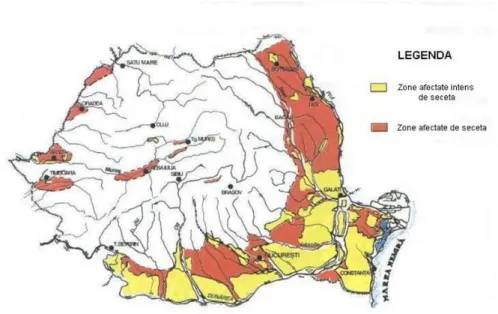
In the Romanian Plain, irrigation facilities situation pose serious challenges to agriculture, because of the aridity index (AI) increased between 0,50 to 0,65 which requires the need for irrigation (figure 1).
Figure 1. Areas affected by drought in Romania
The AI aridity index values indicate a high degree of aridity of the far southern areas of the Romanian Plain, Southern Wallachia. Subject area as defined UNCDD desertification (United Nations Convention to Combat Desertification) (land degradation in arid, semiarid and sub humid-dry), are precisely those with aridity index between 0,05 to 0,65 values that are found in area studied.
An aspect of climate extremes (often manifested by the occurrence of droughts) are amplified by the current state of irrigation systems that require upgrading works, and works that aim to increase the surface that can be irrigated, as indispensable to boost the physical and chemical properties the land of dry-sub humid regions of Romania (Vranceanu A. et al., 2007).
After the most recent estimates presented in the fourth report of the International Committee on Climate Change in 2007, is expected in Romania, annual average warming to be as the Europe-wide, with 0,5 to 1,5 0 C for the period 2020 - 2029 (Ministry of Agriculture and Rural Development, 2009).
Irrigation facilities in the Romanian Plain, South Region - Wallachia, are non-functional in most due to lack of operating equipment, and poorly maintained of various components of these systems.
According to the Statistical Yearbooks, in 2000-2004 were irrigated areas between 85.000 ha and 569.100 ha, and in 2005 fell sharply to reach 45.719 ha, after increasing slightly in 2007 to 96,224 ha.
National Administration of Land Improvements (ANIF), reports that during 2008 to 2009, irrigated area has increased in the country, being irrigated between 257.666 ha and 296.750 ha (figure 2). From 2010 the trend is decreasing leading to surface only 103.295 ha in 2011.
52
Figure 2. Evolution of the area actually irrigated (at least one watering), during 2002-2011
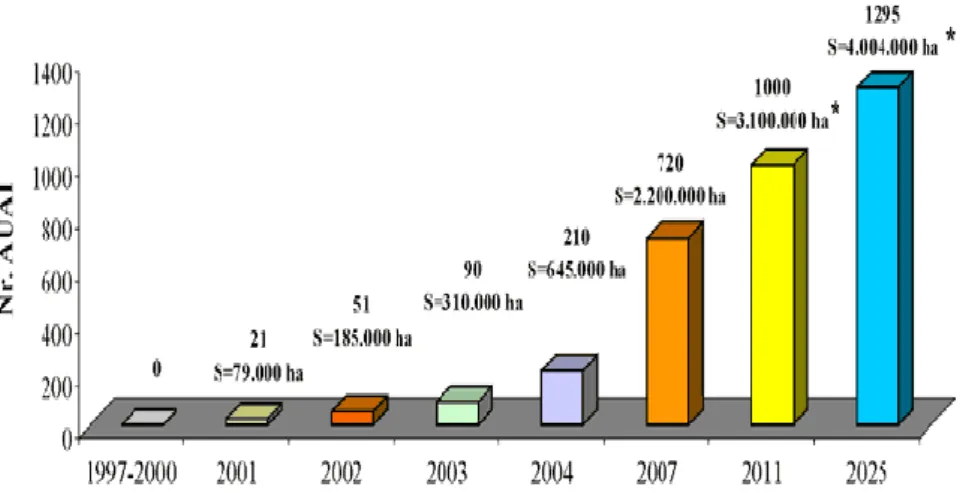
Some of these systems are in operation, is administered by the National Society of Land Improvements (SNIF), this administration is in the process of being transmitted to Associations of Irrigation Water Use (AUAI) who bring together interested farmers to apply irrigation.
If in 2011 is expected that the surface irrigation works designed with the 3.498.000 ha, in reality, surface watering applied is only 100.341 ha (figure 3).
Figure 3. Stage privatization of irrigation facilities by shifting to Irrigation Water Users Associations (AUAI) from 2000 to 2007 and for the years 2011-2025
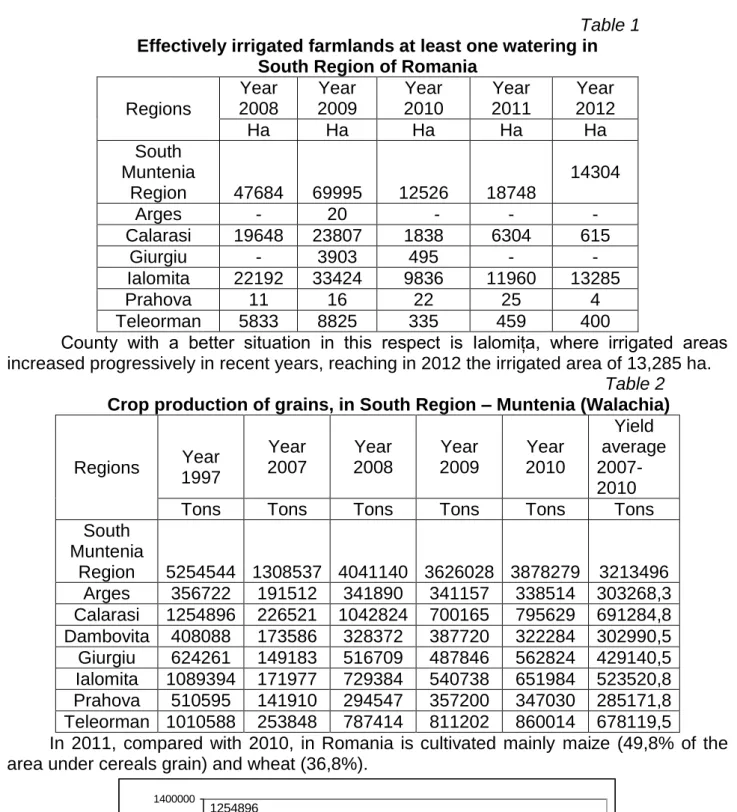
On actual irrigated agricultural area with at least one watering South Region counties, we find that there are counties in which irrigation were not applied in the last 3 years, like Dâmbovița and Argeș counties. In Giurgiu County only in 2010 were irrigated 495 ha and average area irrigated in Prahova County is significantly reduced, this being only 15,6 hectares. And in Teleorman and Călărași counties have the same situation in this chapter; irrigation is insignificant compared to their farming area.
327.900 569.100
45.719
96.224
257.666 296.750
83.322103.295
0 100.000 200.000 300.000 400.000 500.000 600.000
1 2 3 4 5 6 7 8
2002 2004 2005 2006 2008 2009 2010 2011
Su
p
ra
fa
ta
ir
ig
a
ta
(h
a
53
Table 1
Effectively irrigated farmlands at least one watering in South Region of Romania
Regions Year 2008 Year 2009 Year 2010 Year 2011 Year 2012
Ha Ha Ha Ha Ha
South Muntenia
Region 47684 69995 12526 18748
14304
Arges - 20 - - -
Calarasi 19648 23807 1838 6304 615
Giurgiu - 3903 495 - -
Ialomita 22192 33424 9836 11960 13285
Prahova 11 16 22 25 4
Teleorman 5833 8825 335 459 400
County with a better situation in this respect is Ialomița, where irrigated areas increased progressively in recent years, reaching in 2012 the irrigated area of 13,285 ha.
Table 2
Crop production of grains, in South Region – Muntenia (Walachia)
Regions Year
1997 Year 2007 Year 2008 Year 2009 Year 2010 Yield average 2007-2010
Tons Tons Tons Tons Tons Tons
South Muntenia
Region 5254544 1308537 4041140 3626028 3878279 3213496
Arges 356722 191512 341890 341157 338514 303268,3
Calarasi 1254896 226521 1042824 700165 795629 691284,8
Dambovita 408088 173586 328372 387720 322284 302990,5
Giurgiu 624261 149183 516709 487846 562824 429140,5
Ialomita 1089394 171977 729384 540738 651984 523520,8
Prahova 510595 141910 294547 357200 347030 285171,8
Teleorman 1010588 253848 787414 811202 860014 678119,5
In 2011, compared with 2010, in Romania is cultivated mainly maize (49,8% of the area under cereals grain) and wheat (36,8%).
Figure 4. Evolution of total grains production, Calarasi and Teleorman counties
795629 787414 700165 1042824 1254896 226521 1010588 811202 860014 253848 0 200000 400000 600000 800000 1000000 1200000 1400000
1997 2007 2008 2009 2010
54
Nationwide, grain production of cereals increased by 24,4% compared to 2010 (20.785 tons to 16.713 tons in 2010), due to higher yields (production per hectare), as follows: wheat (37,1%), and maize grain (3,6%), according to National Institute of Statistics.
In terms of yields obtained in Calarasi and Teleorman counties, counties with similar climatic conditions, we see that within 10 years (1997-2007) total production decreased by 70%, from 1.254.896 tons in 1997 to 226.521 tons in 2007 for Calarasi county, total production levelling off lately (2008-2010), (figure 4) at about 680.000 tons for the average total productions in the two counties. Similar situation happened in Teleorman County.
Lack of irrigation systems and soil water deficit is reflected well in productions obtained for crop yields in counties with water shortages, being inversely proportional to supply crops with water productions lowest recorded in Dambovița and Argeș counties. Cereal crop yields decreased by about 50%, with a total production of 338.514 tons in Dâmbovița county, respectively 347.030 tone in Arges county; comparing with cultures in Ialomița county where irrigation was applied, and productions were 651.984 tons.
Most fertile soils in the Teleorman county, also increase production, obtaining a quantity of 860.014 tonnes of cereal grains on the whole arable area cultivated.
In 2011, Romania was, in fifth place among EU Member States, both in terms of area under cultivation and the production obtained from wheat (7102.9 thousand tonnes) back of countries like France, Germany, England and Poland, and the ninth in terms of yield, which was 3684 kg / ha.
Table 3
Maize production, in South Region – Walachia
Regions Year
1997
Year 2007
Year 2008
Year 2009
Year 2010
Yield average
2007-2010
Tons Tons Tons Tons Tons Tons
South Muntenia
Region 3007115 463617 1448641 1684462 1794856 1347894
Arges 204941 101069 176971 194404 195039 166870,8
Calarasi 635977 58043 299197 244876 317809 229981,3
Dambovita 268289 93415 199074 269453 185481 186855,8
Giurgiu 364065 32382 180623 193379 229827 159052,8
Ialomita 638014 36826 232917 217170 256524 185859,3
Prahova 366330 97502 171033 237292 239604 186357,8
Teleorman 529499 44380 188826 327888 370572 232916,5
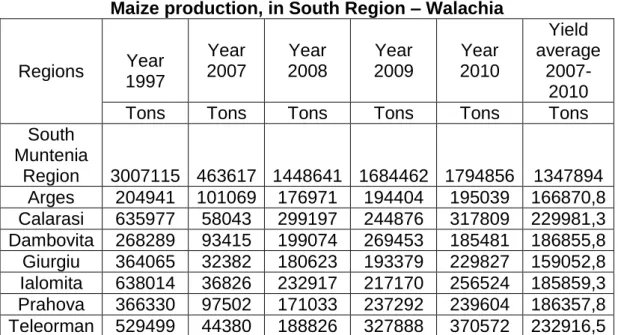
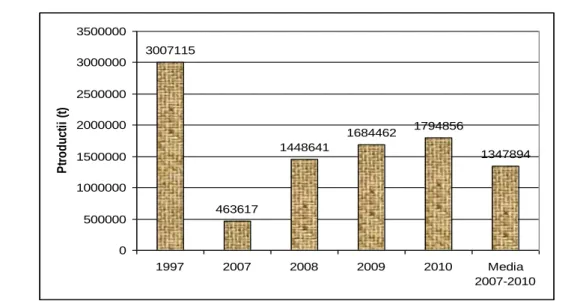
In counties with the tradition of growing maize for grain, Călărași, Giurgiu, Ialomița and Teleorman county, average total production decreased by 50% between 2007- 2010, compared to 1997, which happened at the macro South Region- Wallachia (figure 5).
55
Figure 5. Evolution of maize productions during period 1997-2010
At European level, Romania was the first in cultivated area with maize, and ranked second place concerning the maize production, after France, due to a lower yield 4464 kg / ha. Maize yield achieved by Romania is lower than other EU Member States. (National Institute of Statistics. Press release no. 70/2012).
CONCLUSIONS
Fluctuation of multiannual average annual quantities of precipitation shows a decreasing trend in terms of water resources, resulting a limiting factor with negative effects on productivity of field crops, and this is water from rainfall.
The low availability of water, heat stress and risk of drought, and irrigation application associated with the low temperatures, caused total production and low yields in grain crops and maize grain.
In the last four years is seen to increase total production from maize grain, but reported in 1997, this is more down.
On climatic conditions farmers can use crop varieties suited to new weather conditions (eg genotypes adapted to the potential environmental zones, varieties / hybrids of plants well adapted to pedoclimatic extremes).
BIBLIOGRAPHY
Vranceanu A., Mariana Burcea, Adina Burcea, Amelia Anghel, 2007. Evaluarea
pretabilitatii solurilor la irigat in Dobrogea- masura de importanta majora pentru extinderea irigatiilor ca raspuns la cresterea potentialului de aridizare in aceasta regiune. Lucrari ştiinţifice, U.Ş.A.M.V.B., Seria A, Vol. L, Bucuresti;
Christian Brauner, 2002. Opportunities and risks of climate change. UC Technical
Communications, Swiss Reinsurance Company, Zurich;
Ding, Ya; Hayes, Michael J.; and Widhalm, Melissa, 2010, "Measuring Economic
Impacts of Drought: A Review and Discussion"; Papers in Natural Resources. Paper 196;
Karl, T.R., J.M. Melillo, and T.C. Peterson, 2009. United States Global Change
Research Program. Global Climate Change Impacts in the United States. Cambridge University Press, New York, USA;
Nicolaescu M. şi colab., 2003. Lucrările de îmbunătăţiri funciare – condiţie a protecţiei şi
dezvoltării mediului rural. Simpozionul Probleme actuale ale agriculturii, în contextul integrării europene şi al globalizării. Editura AGRIS, Bucureşti;
Panita Ovidiu, Soare Marin, Soare Rodica, 2010. Aprecierea potenţialului productiv la
unele liniii izogene de grâu de toamnă, pe baza indicelui de sensibilitate la stres (iss) în
3007115
463617
1448641
1684462 1794856
1347894
0 500000 1000000 1500000 2000000 2500000 3000000 3500000
1997 2007 2008 2009 2010 Media
2007-2010
P
tr
od
uc
ti
i
(t
56
condiţiile zonei centrale a Olteniei. Analele Universitatii din Craiova. Seria Agricultura, Montanologie, Cadastru, vol. XL/2 2010. Editura Universitaria Craiova;
*** Ministry of Agriculture and Rural Development, 2009. The irrigation Rehabilitation and Reform Project, Romania;
*** The actions and measures to prevent and combat the effects of drought, land degradation and desertification, 2008;
*** The National strategy for drought mitigation, prevention and combating land degradation and desertification in the short, medium and long, 2008;