Ascorbic Acid Degradation in Cut Lemon Packaged Using Oxygen Scavenging
Active Film During Storage
Kurniawan Yuniarto
1*, Setyo Purwanto
2, Bruce Ari Welt
3, and Anang Lastriyanto
41. Department of Agricultural Engineering, Universitas Mataram, Mataram 83125, Nusa Tenggara Barat 2. National Nuclear Agency, Gedung 40, Muncul, Setu, Tangerang Selatan 15314, Banten
3. Department of Packaging Science, University of Florida. 1741 Museum Rd, Gainesville, FL 32603, United States 4. Department of Agricultural Engineering, Universitas Brawijaya, Malang 65145, Jawa Timur
*e-mail: [email protected]
Abstract
Oxygen scavenging active film can be used to prevent diffusion of free oxygen due to the action of permeation mechanism. In this study, biodegradable oxygen scavenging plastic film was designed by incorporating an antioxidant agent into plasticized polylactic acid or PLA-PEG (PPLA). Butylated hydroxytoluene (BHT) was added at different concentrations into the matrix of the PPLA film using a direct casting method to produce oxygen scavenging active film. The antiradical activity of the oxygen scavenging active film was observed, which could be applied for preventing vitamin C degradation in cut lemon during storage. The antiradical activity of the active film composite reduced after 4 days of storage at 28 °C. Initial antiradical activities were measured at 99.90%–99.91% after introducing 1%, 5%, and 10% concentrations of BHT into the matrix of the PPLA film. DPPH analysis indicated that a larger concentration of BHT exhibited higher antiradical activity after 4 days of storage surrounded with free oxygen. The final antiradical activities were 35.45%, 54.56%, and 81.65% at 1%, 5%, and 10% BHT concentrations, respectively. Therefore, incorporating a higher BHT fraction into the oxygen scavenging active film composite can certainly prevent the oxidation of cut lemon. The respective final vitamin C levels were 13.5%, 20.6%, and 22.5% after 4 days of storage.
Abstrak
Degradasi Asam Askorbat Potongan Lemon yang Dikemas dengan Menggunakan Film Aktif Pembersih Oksigen Selama Penyimpanan. Film aktif pembersih oksigen dapat diterapkan untuk mencegah difusi oksigen oksigen melalui serangan mekanisme permeasi. Film plastik oksigen yang dapat terdegradasi hayati dirancang dengan memasukkan zat antioksigen ke dalam asam polilaktat yang diplastisasi atau PLA-PEG (PPLA). Hidroksitoluena terbutilasi (BHT) ditambahkan ke dalam PPLA film matriks dengan menggunakan suatu pengecoran langsung untuk menghasilkan film aktif pembersih oksigen dengan konsentrasi yang berbeda. Riset ini mengamati penerapan film aktif pembersihan aktivitas antiradikal untuk mengawetkan degradasi vitamin C di dalam potongan lemon selama penyimpanan. Kinerja komposit film aktif aktivitas antiradikal berkurang selama penyimpanan empat hari pada 28 °C. Aktivitas antiradikal awal diukur antara 99,90-99,91% untuk memasukkan BHT 1%, 5% dan 10% ke dalam PPLA film matriks. Analisis DPPH menunjukkan suatu BHT yang lebih besar mempertahankan aktivitas antiradikal yang lebih tinggi setelah penyimpanan empat hari yang dikelilingi oleh oksigen bebas. Aktivitas antiradikal akhir teramati pada 35,45%; 54,56%; dan 81,65% ketika memasukkan masing-masing BHT 1%, 5%, dan 10%. Dengan demikian, memasukkan suatu fraksi BHT yang lebih tinggi ke dalam komposit film aktif oksigen yang terbukti mencegah potongan lemon dari oksidasi. Level-level vitamin C akhir adalah 13,5%; 20,6% dan 22,5% setelah penyimpanan selama 4 hari.
Keywords: active film, antiradical, BHT, content, DPPH
1.
Introduction
The first step in choosing a package capable of increasing a product’s shelf life is to achieve a deep knowledge about the product’s characteristics such as food moisture and susceptibility to oxygen. The second step
of active packaging types have been developed for special purposes, for example, antimicrobial packaging, oxygen scavenging, carbon dioxide scavenging, ethylene scavenging, and temperature control packaging [3]. However, the most popular active packaging is oxygen scavenging packaging, which is due to the fact that several cases of food deterioration are caused due to free oxygen attack during storage. Oxygen is propagated in several food oxidation processes during storage, such as rancidity effect, vitamin degradation, and production of hydroperoxides [4]. Therefore, oxygen levels must be regulated around the product’s headspace in the package by introducing an oxygen absorber in the packaging or incorporating an oxygen scavenger into the packaging material during processing.
Oxygen scavenging active packaging is done by integrating antioxidant agents into the packaging material matrix during casting, extruding, or blowing. The antioxidant can be applied as an oxygen barrier from natural diffusion during packed food storage [5]-[7] and delays the onset of product oxidation [8]. Hydrogen atoms have a role in scavenging free oxygen, producing a more stable compound [9]. Oxygen permeability was found to be significantly reduced or the oxygen barrier properties of the packaging film were found to be improved when some antioxidants such as tert-butylhydroquinone (TBHQ), alpha-tocopherol, and butylated hydroxytoluene (BHT) were incorporated into polylactic acid films [10].
Synthetic and natural antioxidants have been explored as candidates for designing oxygen scavenging packaging. The oxygen scavenging agents should be compatible with the material packaging matrix to prevent phase separation during packaging, casting, or molding. Bio-plastic polymers such as polyactic acid (PLA) have good miscibility with some nonpolar antioxidant agents such as tocopherol and BHT at certain concentrations. The incorporated alpha-tocopherol into the PLA matrix reacts immediately after exposure in an ambient environment and the resulting oxygen scavenging activity will be completed after 130 h [11]. Introducing synthetic phenolic antioxidants (SPAs), including BHT, into PLA films at 1% (w/w) improved oxygen permeability by 30%, although there was no change in water vapor permeability [12].
The presence of antiradical activity indicates an oxygen barrier on the active packaging, subsequently preventing the product from oxygen attack during storage. 2.2-Diphenyl-1-picrylhydrazyl (DPPH) assay is used as a common measurement for calculating the antiradical activity of active packaging. Oxygen scavenging activity can be calculated from DPPH data, where DPPH reacts with the antioxidant producing a yellow color, and the absorbance value can be measured as the antiradical value [13],[14]. It is interesting to explore
the relationship between antiradical activity and oxidation rate in food packaging application. The application of an active packaging material containing natural phenolics was shown to reduce lipid oxidation to 80% during meat storage [15]. Oxygen scavenging has been applied to prevent fresh strawberries from color deterioration during storage [16]. Oxygen scavenging film has also been used to store fresh-cut cashew apples, wherein the quantified vitamin C levels decreased under all temperature storage conditions [17].
To our knowledge regarding the application of oxygen scavenging active film, there is limited research exploring ascorbic acid deterioration during storage. Therefore, the aim of this study was to investigate the relationship between antiradical activity of active film packaging and ascorbic acid deterioration in cut lemon during storage in an ambient environment.
2.
Materials and Methods
Material. Poly(lactic acid) (PLA) 4032 D was supplied from Natureworks, LLC, USA, with 250,000 g/mole and density 1.24 g/cm3. Chloroform solution HPLC grade C606-4 was purchased from Merck, Germany. Poly-ethylene glycol-400 was supplied from Fisher Scientific, USA, with an average molecular weight of 380–420 and density 1.13 g/mol. Unmodified mont-morillonite (NaMMT) was purchased from Southern Clay Products, Gonzales, Texas, USA. 1,1-Diphenyl-2-picryl-hydrazyl (DPPH) was purchased from Sigma-Aldrich (USA), methanol was purchased from Merck (Germany), and BHT was purchased from Sigma-Aldrich (USA), Iodium (Merck, Germany), Amylum indicator.
PLA-NaMMT-BHT were peeled from the petridishes, and the thicknesses of the active films were measured at seven locations using a micrometer.
Treatments. Cut lemons were placed into three different oxygen scavenging active film packagings, i.e., active films containing 1%, 5%, and 10% BHT fractions. Then, the packed cut lemons were incubated in a dark environment for 4 days at 28 °C to prevent photo oxidation. The antiradical activities and the ascorbic acid contents of the cut lemons were measured every day for the 4 days. The radical scavenging activity of the oxygen scavenging active film was analyzed using DPPH analysis on each day from initial storage to the 4th day. All the observations were carried out in three replicates.
Antiradical Activity. The DPPH radical scavenging activity was evaluated according to a previous study [19], with a slight modification. A piece of the plasticized active film PLA (0.1 g) was cut into small pieces and mixed with 2 ml methanol. The mixture was vigorously vortexed for 3 min and placed in a dark environtment at room temperature for 3 h. Then, it was vigorously vortexed for 3 min and centrifuged at 2300 rpm for 10 min. The supernatant was analyzed for DPPH radical scavenging activity. An aliquot of methanol extract (500 µL) was mixed with 2 ml of 0.06 mM DPPH in methanol. The mixture was vigorously vortexed for 1 min and allowed to stand at room temperature in the dark for 30 min. The absorbance was measured at 517 nm using UV spectrometer (Model UV-2101 PC, Shimadzu, MD, USA). Methanol was used as control and mixed with 0.12 mM DPPH. Then, the DPPH radical scavenging activity was calculated as follows:
𝐴𝑛𝑡𝑖𝑟𝑎𝑑𝑖𝑐𝑎𝑙 𝑎𝑐𝑡𝑖𝑣𝑖𝑡𝑦 (%) = (1 − (𝐴𝑠
𝐴𝑐)) 𝑥 100% (1)
Where As is the absorbance of the sample, and Ac is the absorbance of the control. The values presented are the average of three replication measurements.
Ascorbic Acid. Iodine solution was prepared by adding 0.357 g potassium iodide to 100 ml distilled water in a glass beaker. Then, 0.635 g of iodine crystals was added and dissolved to prepare potassium iodine solution, followed by addition of distillated water to make the volume to 500 mL. Natrium thiocyanate 0.1 N solution was prepared by weighing 2.481 g Na2S2O3 and dissolving it in 100 ml distillated water. Starch indicator solution 1% was prepared by dissolving 1 g starch in 100 mL cold distilled water.
Sample preparation was done using extracted cut lemon to produce the extracted solution. Then, the extracted lemon was added 10 portion of distilled water and mixed by vortexing for 1 min. The lemon extract solution
was pipetted into a 10-mL Erlenmeyer flask and 6 ml of 2 N H2SO4 was added. Then, the starch indicator was dripped into the sample and titrated with iodine until a concordant result (blue color) was obtained. The ascorbic acid % was calculated as follows:
% 𝑎𝑠𝑐𝑜𝑟𝑏𝑖𝑐 𝑎𝑐𝑖𝑑 =
𝐼2 𝑣𝑜𝑙 × 0.88 × 𝐷𝐹 × 100𝑚𝑙 𝑠𝑎𝑚𝑝𝑙𝑒 (2)
3.
Results and Discussion
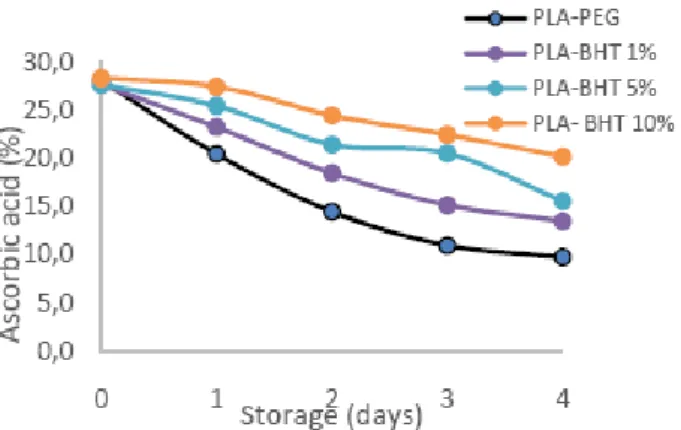
Ascorbic Acid. Lemon is an important source of ascorbic acid that can be consumed as juice. In our study, the ascorbic acid content in the extracted lemon was 27%–33%. However, ascorbic acid is easily degraded after contact with oxygen and temperature; therefore, after cutting, lemon must be protected from air diffusion. It has been reported that ascorbic acid content in cashew apple juice was reduced by 5% after 24 h of storage at 2 °C and 23 °C, whereas cut cashew apple juice had no modifications in ascorbic acid content [17]. The degradation results of ascorbic acid in the cut lemon packaged using the oxygen scavenging active film are summarized in Fig. 1.
In the present study, an oxygen scavenging active film and a passive film were used to package the cut lemon during the storage period. The most destructive agent involved in ascorbic acid deterioration during storage is oxygen attack. As expected, the ascorbic acid content in the cut lemon decreased during the storage period. The trend of loss in ascorbic acid showed a sharp decrease during the first 3 days of storage, followed by a sloping pattern at the end of storage. The passive film consisting of PLA-PEG consistently did not well protect ascorbic acid from deterioration compared with the active film (plasticized PLA-BHT). Introducing BHT significantly prevented ascorbic acid oxidation in the cut lemon, and a larger amount of BHT was added into the oxygen scavenging active film, resulting in less deterioration of ascorbic acid. Packaging ascorbic acid using the passive
film (PLA-PEG without antioxidant/BHT) did not sufficiently prevent ascorbic acid oxidation during storage. The lack of BHT in the plasticized PLA film decreased rapid ascorbic acid degradation during storage and had a similar pattern as that of oxygen scavenging active film containing 1% BHT. An earlier study showed that cut apple cashew showed an ascorbic acid loss of 12%–38% after cutting during storage at all temperatures [20]. The loss of ascorbic acid content in the cut lemon packed in passive film (plasticized PLA) was 27% on the first day, whereas packaging with the oxygen scavenging films resulted in 3.1%, 18%, and 16% losses of ascorbic acid with 1%, 5%, and 10% BHT, respectively.
Our study estimated the oxidized ascorbic acid content in the cut lemon on the surface area that was being cut because the other side was shielded by lemon skin (natural protector). The ascorbic acid content in the cut lemon was rapidly degraded after the second day of storage at all treatment conditions. Ascorbic acid is a reactive prooxidant that is capable of oxidization in the presence of oxygen, and the cut area portion reacts with oxygen. Introducing BHT into the active film effectively prevented ascorbic acid deterioration in the cut lemon during storage, because the ascorbic acid content remained at high concentration until the fourth day of storage. Therefore, adding a larger fraction of BHT into the active film has a positive effect functioning as an oxygen barrier. We had confirmed in previous studies on oxygen permeability using both passive film and active film based on polylactic acid [21],[22]. Oxygen permeability coefficient decreased when the oxygen scavenging film was used but did not completely alleviate free oxygen diffusion, which implies that some oxygen will pass through the film and react with the packaged product such as a cut lemon.
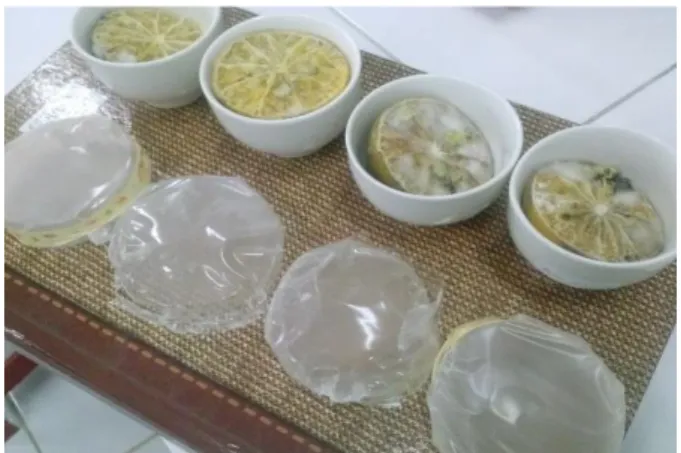
The rate of ascorbic acid deterioration was calculated for each treatment, which revealed a faster degradation rate in natural PLA, with an ascorbic acid rate loss of about 0.163–0.273 times per day. However, addition of BHT into the PLA matrix reduced ascorbic acid deterioration by 0.163–0.273 times per day (1% BHT), 0.08–0.180 times per day (5% BHT), and 0.031–0.071 times per day (10% BHT). The role of antioxidants to prolong the shelf life of a packaged product has been confirmed for antioxidant agents incorporated into chitosan film [23]. Incorporation of green tea extract into the PLA film significantly protected oxidation of smoked fish during different storage times [24]. On the other hand, this study found an unexpected result in the cut lemon, which showed growth of a mold or a microbial agent during storage.
Theoretically, oxygen scavenging creates insufficient oxygen in the headspace due to interaction with BHT in the packaging film. However, the development of the
microbial agent suggested relay on the humidity condition during storage. We do not have any hypothesis regarding the microbial growth, but we argue this finding in terms of combining oxygen scavenging with a water vapor absorber for protecting the product from microbial attack. The microbial growth appeared almost starting from the second day of storage. Further research is needed to confirm the loss of ascorbic acid due to oxygen attack as a single factor or a contribution of other factors such as microbial growth.
Antiradical Activity. The antiradical activity or the antioxidant capacity of active film can be defined as the ability to scavenge reactive oxygen. Regarding application in food packaging, the antiradical active film can act as a barrier to oxygen diffusion from the surrounding of the packaged products. BHT plays a role in reducing oxygen permeation through the oxygen scavenging active film via a hydrogen donor. The results of the antiradical activity of the oxygen scavenging active film assessed by the DPPH assay are presented in Fig. 3. As a hypothesis, pure PLA does not have antiradical activity, which was confirmed by the DPPH assay, due to the lack of free hydrogen ions in the polymer PLA film. Hydrogen ions bond with polyethylene glycol that is added during matrix preparation. Previous research has established a strong hydrogen bond formation between PLA-PEG using FTIR and Raman investigation [25]. As expected, the active composite PLA film exhibited antiradical activity due to the introduction of the antioxidant BHT, which was confirmed by DPPH analysis results. Fig. 2 shows that the antiradical activity of the active composite film decreased with storage time period at all BHT treatments. However, this result was not observed with neat plasticized PLA as it did not exhibit oxygen scavenging activity [26].
Figure 2. Mold Growth and Development on the Cut Lemon Surface During Storage
Figure 3. Antiradical Activity of Composite PLA and Active Composite Film PLA During Storage
4.
Conclusion
This study demonstrated that ascorbic acid in the cut lemon was rapidly oxidized in the plasticized PLA film, whereas application of the oxygen scavenging active film based on the antioxidant BHT improved the stability of ascorbic acid. Incorporating BHT at larger concentrations into the oxygen scavenging active film design prevented ascorbic acid in the cut lemon from oxidation.
Acknowledgement
This work was supported by the Ministry of Research, Technology and Higher Education of Republic of Indonesia (contract number 830/UN18.L1/PP/2018).
References
[1] L. Angiolillo, A. Conte, M.A. Del Nobile, Packaging and Shelf Life of Produce, Elsevier, Amsterdam, 2016.
[2] S. Remya, C.O. Mohan, G. Venkateshwarlu, G.K. Sivaraman, C.N. Ravishankar, Food Control. 71 (2017) 71.
[3] D. Gibis, K. Rieblinger, Ital. Oral. Surg. 1 (2011) 229.
[4] V. Bondet, C. Berset, L. De Chimie, Lebensm.-Wiss. u.-Technol. 615 (1997) 609.
[5] H.M.C. de Azeredo, Food Res. Int. 42/9 (2009) 1240.
[6] A.L. Brody, G.R. Strupinsky, The Use of Oxygen Scavengers and Active Packaging to Reduce, no. September 1994, 1995.
[7] A.L. Brody, E.R. Strupinsky, L.R. Kline, Active Packaging for Food Applications, Boca Raton, CRC Press, 2001.
[8] G. Cirillo et al., Chapter 6–Antioxidant Polymers for Food Packaging, Elsevier Inc., New York, 2018, p. 238.
[9] H. Ortiz-vazquez, J. Shin, H. Soto-valdez, R. Auras, Polym. Test. 30/5 (2011) 463.
[10] C.M.B. Gonçalves, L.C. Tomé, H. Garcia, L. Brandão, A.M. Mendes, I.M. Marrucho, J. Food Eng. 116 (2013) 562.
[11] P. Scarfato, E. Avallone, M.R. Galdi, L. Di Maio, L. Incarnato, Polym. Compos. 38 (2017) 981. [12] M. Jamshidian, E. Arab, F. Cleymand, S. Leconte,
T. Falher, S. Desobry, Carbohydr. Polym. 87/2 (2012) 1763.
[13] A.L. Dawidowicz, D. Wianowska, M. Olszowy, Food Chem. 131/3 (2012) 1037.
[14] A.L. Dawidowicz, M. Olszowy, Talanta. 97 (2012) 312.
[15] L. Barbosa-Pereira, G.P. Aurrekoetxea, I. Angulo, P. Paseiro-Losada, J.M. Cruz, Meat. Sci. 97/2 (2014) 249.
[16] M.S. Aday, C. Caner, LWT - Food Sci. Technol. 52/2 (2013) 102.
[17] C. Queiroz, M.L.M. Lopes, E. Fialho, V.L. Valente-Mesquita, Food Res. Int. 44/5 (2011) 1459.
[18] K. Yuniarto, B.A. Welt, Foliatini, Hanafi, C. Irawan, Appl. Packag. Res. 9/3 (2017) 1.
[19] A. Jongjareonrak, S. Benjakul, W. Visessanguan, M. Tanaka, Food Hydrocoll. 22 (2008) 449. [20] M. do, S.M. Rufino, R.E. Alves, E.S. de Brito, J.
Pérez-Jiménez, F. Saura-Calixto, J. Mancini-Filho, Food Chem. 121/4 (2010) 996.
[21] K. Yuniarto, B.A. Welt, A. Purwanto, H.K. Purwadaria, A. Abdellatief, J. Appl. Packag. Res. 6/2 (2014) 51.
[22] K. Yuniarto, Y.A. Purwanto, S. Purwanto, B.A. Welt, H.K. Purwadaria, T.C. Sunarti, Makara J. Technol. 20/1 (2016) 1.
[23] J.T. Martins, M.A. Cerqueira, A.A. Vicente, Food Hydrocoll. 27/1 (2012) 220.
[24] C. Martins et al., Ind. Crops Prod. 123 (2018) 100. [25] K. Yuniarto, Y.A. Purwanto, S. Purwanto, B.A.
Raman studies on polylactide acid and polyethylene glycol-400 blend, AIP Conf. Proc. 1725 (2016) 020101.
[26] L. Di Maio, P. Scarfato, E. Avallone, M.R. Galdi, L. Incarnato, AIP Conf. Proc. 1593/2014 (2014) 338.