Finno-Ugric Languages and Linguistics Vol. 1. No. 1–2. (2012), 89–97. http://full.btk.ppke.hu ISSN: 2063-8825
Katalin Gugán
At a certain stage of its history, Hungarian seems to have gone through Jespersen’s Cycle, having substituted the original PU negative auxiliary with the negative particle
nem, originally an indefinite pronoun. Opinions diverge concerning the details of this process, as the negative indefinite pronouns marked with nē- /nēm- in the Northern Ob-Ugric dialects may imply that certain phases of the emergence of the negative function of the indefinite pronoun can be traced back to Proto-Ugric. Even though this seems to be the most economical reconstruction, the present paper argues that data from the Ob-Ugric languages and from Old Hungarian both question the validity of this reconstruction. Negative indefinites marked with nē- /nēm- are more likely to be innovations of the Northern Ob-Ugric dialects, and indefinites marked with né- do not seem to occur at all in negative sentences in Old Hungarian (whereas quite a few other indefinites do). Therefore, this paper claims that the negative function of the particle
nem developed independently in Hungarian, and also that it may have grammaticalized straight from the indefinite pronoun némi ’some(thing)’, without acquiring the negative meaning ’nothing’ prior to this process.
Keywords: Jespersen’s Cycle, Hungarian, Ob-Ugric, negative particle, indefinite pronoun
1 Introduction
The history of negation in Hungarian seems to be a fairly straightforward case of Jespersen’s cycle. Similarly to the Ob-Ugric languages, but unlike the majority of Uralic languages, Hungarian expresses negation with the help of a negative particle instead of a negative auxiliary. The Hungarian negative particle nem is generally assumed to be a descendant of a Proto-Uralic indefinite pronoun. Similar changes, i.e. the substitution of an older negative element have been widely attested, and Dahl termed these recurring changes Jespersen-cycle, honoring Jespersen’s apt description of the process: „The history of negative expressions in various languages makes us witness the following curious fluctuation: the original negative adverb is first weakened, then found insufficient and therefore strengthened, generally through some additional word, and in its turn may be felt as the negative proper […]” (Jespersen 1917, quoted in Dahl 1979: 88).
Moreover, at first sight it seems to be evident that certain phases of this process can be traced back to the Proto-Ugric period, as the etimological equivalents of the Hungarian negative particle turn up as markers of negative indefinites in some Ob-Ugric dialects. The present paper aims at pointing out certain problems with this assumption, argues that it is necessary to give up the most economical reconstruction, and hypothesize independent development in the two branches of the Ugric group in this case.
2 The problem
As mentioned above, one common feature of Hungarian and the Ob-Ugric languages is that they express standard negation with the help of negative particles. However, these particles are different: whereas the negative particle of the Ob-Ugric languages can be traced back to the original Uralic negative auxiliary, reconstructed as PU *e ~ ä ~a (entry nr. 1876 in: Rédei [ed] 1986-1989), Hungarian has a different particle that seems to be the innovation of Proto-Hungarian. The following sentences illustrate sentential negation in Eastern (Surgut) Khanty, Northern Mansi and Hungarian:
(1)
ƽ
j mƽ
taŏ
t- pƽ
ǝntǝwuj- -ƽm
. (Eastern (Surgut) Khanti1) one some thing-ACC PART not see-PST-1SG2ʻI didn’t see anything’
(2) am nēmatar-n
ƽ
l at pilē-γ-um. I nothing-ABL not afraid-PRS-1SGʻI am not afraid of anything; I fear nothing.’ (Northern Mansi; Kálmán 1989: 73)
(3) Nem fél- -ek semmi-től. (Hungarian)
not fear-PRS-1SG nothing-ABL ʻI do not fear of anything.’
Then again, the Hungarian negative particle nem has cognates (nē- and nēm-) in the Northern dialects of the Ob-Ugric languages, where they serve as markers of negative indefinites (as shown in sentence 2 as well). In fact, Honti (1997: 164) suggests that the negative indefinite marker nem- originates in Proto-Ugric.3 In this vein it would seem quite easy to reconstruct the steps of the cycle through which the expression of negation changed. In Stage I, negation must have been expressed with a negative auxiliary in the Ugric languages, similarly to the other Uralic languages. In Stage II, the original marker of negation weakened, and a new pronominal element appeared to reinforce negation. This pronominal element, reconstructed as nëm (cf. Sipos 1991: 395) consists of two parts, an indefinite marker në- and the interrogative4 pronoun m ’what’. Finally, in Stage III the original negator disappeared altogether when the pronoun became grammaticalized as the general marker of negation. As for the chronology of this change, the preliminaries of Stage II could have occurred already in Proto-Ugric, i.e. the negative auxiliary could have
1 Eastern Khanty data were elicited with the help of a questionnaire; my thanks to the informant,
Ljudmila Kajukova, a speaker of the Surgut dialect, and Márta Csepregi, who helped administering the questionnaire
2 ACC = accusative, ABL = ablative, APPR = approximative, CONJ = conjunctive (in Hungarian,
morphologically identical with the imperative), INDEF = indefinite marker, LOC = locative, MOD = modality marker, PART = particle, POSS = possessive suffix, , PROH = prohibitive, PRS = present, PST
= past, SG = singular.
3 However, there are diverging opinions concerning this issue: K.Sal (1951) claims that nem- is a
Komi loan in Ob-Ugric, and Rédei (1970) is of the opinion that the pronominal stem is Proto-Finno-Ugric, but its negative functions (i.e. negative indefinite in Northern Ob-Proto-Finno-Ugric, and negative particle in Hungarian) are independent innovations.
4 Which must have been an undifferentiated interrogative-indefinite pronoun prior to the
reduced to a negative particle which is no longer marked for any of the verbal categories,
as the negative particle of the Ob-Ugric languages is a descendant of the Uralic negative auxiliary. However, Stage II and III must be Proto-Hungarian innovations, and the change seems to be completed by Old Hungarian.
Proto-Hungarian, where this change must have occurred, is the most mysterious phase of the history of Hungarian. It has a vague in-between status: the Ugric period that precedes it can be reconstructed through the systematic comparison of Hungarian and the Ob-Ugric languages, whereas Old Hungarian that follows it already offers written records for investigation. However, there is only indirect evidence to investigate Proto-Hungarian, and besides relying on case studies of better documented changes in other languages and general literature on language change, it is precisely the preceding and the following stages of Hungarian that reconstruction can be based on. Yet both Ob-Ugric and Old Hungarian data raise questions concerning some details of the reconstruction sketched above. In order to point at certain inconsistencies, one has to investigate negative concord in the Ob-Ugric languages (part 2) and in Old Hungarian (part 3).
3 Negative concord in the Ob-Ugric languages
The first problem that emerges is that negative indefinites marked with nem only occur in the northern dialects of Khanty and Mansi.
(4) neməlti- ăt wat-s-əm (Northern (Synja) Khanty5)
nothing-ACC not see-PST-1SG ʻI didn’t see anything.’
Negative indefinites are marked with the same particle that marks negation in Eastern Mansi:
(5) öätyi-näär- öät
not-something-ACC not find-PST-3SG
‘I didn’t find anything’ (Eastern Mansi; Kulonen 2007:194)
In negative sentences Eastern Khanty uses a set of indefinites which are composed of əj ’one’ + a pronominal stem + the particle pə:
(6) əj məta sŏŋ-nam pə əntə mən- -əm. one some direction-APPR PART not go-PRS-1SG
‘I don’t go anywhere.’ (Eastern (Surgut) Khanty)
In fact, it seems questionable whether Eastern Khanty has a special set of negative indefinites, as in elliptical contexts these composite indefinites do not have negative force themselves, they have to co-occur with the negative particle to express negation:
5 Northern Khanty data were also elicited on the basis of a questionnaire; I’d like to thank the
(7)
ŏ nam n ŋ mən- -ən? (Eastern (Surgut) Khanty) where you go-Prs-2Sg
‘Where are you going?’
(8) *əj məta sŏŋ-nam pə one some direction-APPR PART ‘Nowhere.’
According to a description of negation in Ob-Ugric dialects, there are further types of indefinites that may occur in negative sentences: it is possible to use either ’one’ or the pə particle with the pronominal stem, or even the bare indefinite itself. (K.Sal 1951).6 On the other hand, the function of the pǝ particle seems to be changing. In the Eastern Khanty dialect this particle is interpreted as an additive focus or emphatic particle in assertive sentences, and as a negative focus particle in negative sentences according to Honti (1986: 86). Perhaps it is not yet an obligatory marker of indefinites under the scope of negation yet, but my Surgut Khanty informant always used it in these indefinite constructions, and corrected the sentences lacking it.7 Besides, Csepregi (1998: 41) called attention to the fact that it may express negation without the standard negative particle, which again shows that it is strongly associated with negative force:
(9)
uj-
ƽ
-pƽ
w-namt-nƽ wă - -
8 man-3SG.POSS-PART she-APPR house-LOC live-PRS-3SG‘She does not have a husband.’ (Eastern (Surgut) Khanty)
Incidentally, there is a similar phenomenon in certain Northern Ob-Ugric languages, but in these cases the emphatic elements that turn up in negative sentences to reinforce negation are interrogative pronouns (χǫn in Kazym Khanty, χun in Sherkaly Khanty, χuń in Sosva Mansi).However, in spite of the different origin, the final stage of the process is the same as in Surgut Khanty, namely that these emphatic elements can already turn up in negative sentences that lack the standard negative marker, meaning that they are on the way to be reanalyzed as negative markers themselves (Wagner-Nagy 2011: 75-83).
Returning to the analyis of Ob-Ugric indefinites in the scope of negation, it is not a surprising phenomenon that these languages display different sets of indefinites. On the one hand, it is a commonplace that both Khanty and Mansi are strongly divergent dialectally; on the other hand, Haspelmath (1997: 171) observes that indefinite pronouns seem to change easily through language history, therefore, even closely related languages can exhibit different series. Still, if one would want to claim that the source of the Hungarian negative particle nem is a negative indefinite that can be traced back to the Ugric period, it does seem problematic to acknowledge that only the northern dialects
6 However, it must be noted that this study was based on folklore texts, which may preserve
such archaic features that are already absent from spoken language.
7 It must be noted here that even the Eastern Khanty dialect group is divergent in this respect,
as this particle seems to occur much less frequently in the easternmost (Vakh, Vasyugan, Alexandrovo) varieties (cf. Filchenko MS. 16-17).
8 In this case, w.nam is the emphatic form of the third person singular pronoun w, and the
have such a negative indefinite. Theoretically, these elements in the Northern dialects
could be either innovations or archaisms. However, it is the possibility of undifferentiated bare interrogative-indefinite pronouns appearing in negative sentences that all dialects show, and this seems to be a general solution cross-linguistically as well, so it is more viable to suppose that it is theundifferentiated bare interrogative-indefinite that is an archaic phenomenon, and all the other negative indefinite series are innovations of the different dialects. Besides, as it will be shown in the next section, Old Hungarian does not show any signs of once having a negative indefinite series marked with ne-/nem-.
4 Negative concord in Old Hungarian
Modern Hungarian (ModH) is a negative concord (NC) language, negative concord defined as „the co-occurrence of two or more negative markers within one clause that is nonetheless interpreted as containing a single semantic negation” (Jäger 2008: 151). However, it is evident that at least that set of indefinite pronouns that appears in negative sentences in ModH, namely those marked with sem-, is an innovation of Hungarian, as sem- does not have cognates in the related languages. This particle was coined from the additive focus / emphatic particle is and the negative particle nem, and the fusion of the two particles was still in progress in Old Hungarian (Juhász 1991: 495), cf. (10) and (11):
(10)
ſ
ulga-d e
ſſſſ
ne leg-en
servant-2SG.POSS PART neg be.IMP-3SG
‘You shall not have a servant, either’ (Königsberg-fragment, 14th century)
(11)
uda-t ſem
ſem
ſem
ſem mutat-hat- -nac
[…]
miracle-ACC PART show-MOD-PRS-3PL
‘They cannot show a miracle, either’ (Bécsi-codex, 15th century)
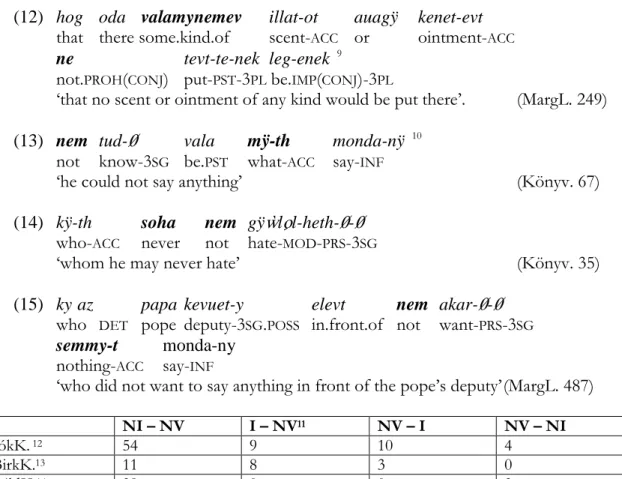
Concerning negative concord, it is instructive to investigate Old Hungarian, although at first glance it seems to be the same as ModH: a standard NC-language with a set of negative indefinites marked with sem-. However, there are two smaller groups of Old Hungarian data that would be ungrammatical in ModH: there are both a) negative indefinites that appear without the negative particle, and b) negative sentences in which there are non-negative indefinite pronouns. As the vast majority of Old Hungarian texts are translations from Latin, and Latin is a non-NC language, it has long been claimed that these and similar examples are instances of direct translations of Latin (see e.g. Pólya 1995: 41). However, É.Kiss (2010) pointed out that in certain Old Hungarian sources the distribution of pattern a) displays some regularity that suggest that this pattern, i.e. negative indefinites appearing without the negative particle, can be considered an archaic feature. In the present case, it is the second group that requires special attention.
for negative indefinites preceding the negated verb (14), NV-NI for negative indefinites following it (15).
(12) hog oda valamynemev illat-ot auagÿ kenet-evt that there some.kind.of scent-ACC or ointment-ACC
ne tevt-te-nek leg-enek 9
not.PROH(CONJ) put-PST-3PL be.IMP(CONJ)-3PL
‘that no scent or ointment of any kind would be put there’. (MargL. 249)
(13) nem tud- vala mÿ-th monda-nÿ 10
not know-3SG be.PST what-ACC say-INF
‘he could not say anything’ (Könyv. 67)
(14) kÿ-th soha nem gÿ
ẁ
l lheth -who-ACC never not hate-MOD-PRS-3SG‘whom he may never hate’ (Könyv. 35)
(15) ky az papa kevuet-y elevt nem akar- -
who DET pope deputy-3SG.POSS in.front.of not want-PRS-3SG
semmy-t monda-ny
nothing-ACC say-INF
‘who did not want to say anything in front of the pope’s deputy’ (MargL. 487)
NI – NV I – NV11 NV – I NV – NI
JókK. 12 54 9 10 4
BirkK.13 11 8 3 0
PéldK.14 39 0 0 3
MargL. 63 3 9 3
Könyv. 27 0 1 2
All 194 20 23 12
Table 1: The distribution of negative and non-negative indefinite pronouns in negative sentences of five Old Hungarian Codices
9 Szent Margit élete (The life of Saint Margaret); a copy of an earlier translation of Saint Margaret’s
legend that was made in 1510.
10 Könyvecse az szent apostoloknak méltóságokról(A treatise about the dignity of the holy apostles), 1521, again
a copy of an earlier translation from Latin.
11 However, some of the data, especially those in the group of non-negative indefinites preceding
a negated verb, are problematic, as in certain cases it is likely or even evident that although the indefinite is in a negative sentence, it is not in the scope of the negation. Consider the following example:
(i) Miden kedig vala meli k'ȢȢ'letek nem bөitөl (BirkK. 52. ) if however INDEF which of.you not fast
‘However, if there’s any of you who does not fast’
12 Jókai-kódex (Jókai-codex), containing the history of St. Francis of Assisi, translated from Latin in
the last quarter of the 14th century, the surviving copy copied around 1440.
13 Birk-kódex (Birk-codex) is the first draft of a (non-surviving final) translation of Saint Augustine’s
monastic rules; the draft was written in 1474.
14 Példák könyve (The Book of Exemplars) was probably translated around 1474/1480 into
As can be seen from the table, the majority of the data follow the standard
NC-pattern, that is, the translators / copiers did not follow the Latin original in thisrespect,15 which also calls into question whether it is right to explain the rest of the data solely with pattern borrowing from Latin. However, from the point of the present discussion there is one fact that is relevant here. There were several sets of indefinites in Old Hungarian, and one of these sets was marked with né-, which is the same marker that appears in the pronoun that is supposed to be the source of the negative particle. However, out of the several sets of indefinites, those that are marked with né- do not occur at all in negative sentences in these Old Hungarian sources, either in NC-clauses, or in non-NC clauses. Therefore, Stage II of the reconstruction, nëm entering negative sentences to reinforce them, and finally taking over the role of the general negator, seems to call for revision.
Moreover, the same Old Hungarian data also question the plausibility of relating the Northern Ob-Ugric negative indefinite marker (nē- and nēm-) and the Hungarian negative particle nem, at least as far as the reconstruction of a common negative function is concerned. All one could safely assume is that Hungarian and Northern Ob-Ugric, together perhaps with the Permic languages, shared a pronoun marked with ne-, and as Rédei (1970) suggests, this changed into a negative indefinite pronoun in the Northern Ob-Ugric languages independently. As for Hungarian, the negative particle nem seems to have grammaticalized straight from the nonnegative indefinite
nëm
, without an intermediate phase of acquiring the function of a negative indefinite. It is interesting to note here that whereas the majority of Middle High German dialects grammaticalized the negative indefinite ni(o)wiht > nicht ’nothing’ as the marker of negation, in a few dialects it was the indefinite (io)wiht > iht/ieht ’anything’ that entered into the grammaticalization process and became the source of the new negative particle (Jäger 2008: 253).The grammaticalization of nem as a negative particle seems to be completed by Old Hungarian. Moreover, the fusion of this particle with the additive focus / emphatic particle is, yielding sem, which becomes the marker of the negative indefinites, was also well in progress by the time of the first written documents. All in all, if one would want to look for parallels of the grammaticalization of the Hungarian negative indefinite marked with sem- in the related languages, the Surgut Khanty pattern is more likely to have had Proto- and Old Hungarian parallels, in spite of the formal similarity with the Northern Khanty and Mansi negative indefinite forms.
5 Conclusions
One of the objectives of this paper was to shed light on the grammaticalization process of the Hungarian negative particle nem, which appears as the marker of standard negation from the very first written records of Hungarian, but its prior history is vague in certain respects. It is claimed that although an originally indefinite pronoun marked with ne- entered negative sentences both in certain Ob-Ugric dialects and in Hungarian, these changes were independent of each other. In the Northern Ob-Ugric dialects, these emerged as the markers of negative indefinite series, whereas in Hungarian only one member of a set of non-negative indefinites acquired the function of reinforcing negation, and it finally took over the role of the standard negator. However, it seems that this element never had the function of a specifically negative indefinite, and the negative
15 As is well known, Latin was a non-NC language, so the general pattern in the sources of the
indefinite series marker sem- emerged only after the complete grammaticalization of nem as the negative particle. Therefore, it seems necessary to hypothesize that the two processes, one yielding a negative indefinite marker in the Northern Ob-Ugric dialects, another a negative particle in Hungarian, must have been independent changes in the two branches of the Ugric group.
References
Csepregi, Márta. 1998. Szurguti osztják chrestomathia. [Chrestomathy of Surgut Ostyak] Szeged: JATE Finnugor Tanszék.
É. Kiss, Katalin. 2010. A negative cycle in 12-15th century Hungarian. Research Institute for Linguistics, HAS, manuscript.
http://www.nytud.hu/oszt/elmnyelv/mgtsz/022%20_ekiss_negcycle_cambridge_ kezirat.pdf (22 June 2012)
Filchenko, Andrey. In press. Negation in Eastern Khanty and Southern Selkup. In: Miestamo, Matti, Tamm, Anne & Wagner-Nagy, Beáta (eds). 2012, Negation in Uralic Languages. (Typological Studies in Language.) Benjamins.
Haspelmath, Martin. 1997. Indefinite Pronouns. Oxford: Oxford University Press. Honti, László. 1986. Chrestomathia Ostiacica. Budapest: Tankönyvkiadó.
Honti, László. 1997. Die Negation im Uralischen I-III. Linguistica Uralica 33 (2-4). 81–96, 161–175, 242–252.
Jäger, Agnes. 2008. History of German Negation. Amsterdam-Philadelphia: John Benjamins. K. Sal, Éva. 1951. Az obi-ugor tagadó névmások. [Ob-Ugric negative indefinite
pronouns] Nyelvtudományi Közlemények 53: 210–19.
Kulonen, Ulla-Maija. 2007. Itämansin kielioppi ja tekstejä. Helsinki: Suomalais-Ugrilainen Seura.
Pólya, Katalin. 1995. Az állító és a tagadó mondatok. [Affirmative and negative sentences] In Benkő Loránd (ed), A magyar nyelv történeti nyelvtana II/2: A kései ómagyar kor: Mondattan, szöveggrammatika [Historical Grammar of Old Hungarian II/2: Late Old Hungarian], 41–42. Budapest: Akadémiai Kiadó.
Rédei, Károly 1970. Kiellon ilmaisemisen alkuperästä unkarissa. Virittäjä 74. 47–51. Rédei, Károly (ed). 1986-1991. Uralisches Etymologisches Wörterbuch. Budapest: Akadémiai
Kiadó.
Sipos, Pál. 1991. A névmások. [Pronouns] In: Benkő Loránd (ed), A magyar nyelv történeti nyelvtana I: A korai ómagyar kor és előzményei [Historical Grammar of Old Hungarian I: Early Old Hungarian and before], 353-399. Budapest: Akadémiai Kiadó.
Wagner-Nagy, Beáta. 2011. On the Typology of Negation in Ob-Ugric and Samoyedic Languages. (Suomalais-Ugrilaisen Seuran Toimituksia 262.) Helsinki: SUS.
Old Hungarian Sources
Birk-kódex (Birk-codex), 1474, published by Pusztai, István. Budapest: Akadémiai Kiadó. 1960.,
Jókai-kódex (Jókai-codex), 14th-15th century, published by P. Balázs, János. Budapest: Akadémiai Kiadó. 1981.
Példák könyve (The Book of Exemplars), 1510. Published by Bognár, András & Levárdy
Ferenc. Budapest: Akadémiai Kiadó. 1960.
Szent Margit élete (The life of Saint Margaret), 1510. Published by Dömötör, Adrienne & Pólya, Katalin. Budapest: RIL, HAS. 1990.
Katalin Gugán