ISSN: 1311-1728 (printed version); ISSN: 1314-8060 (on-line version) doi:http://dx.doi.org/10.12732/ijam.v31i4.9
SOME GRAPHS WITH SUPER VERTEX SUM NUMBER 2
Gerard Rozario Joseph1, Joseph Varghese Kureethara3§ 1 Bharathiar University
Coimbatore, 641046, INDIA 1IFET College of Engineering
Villupuram, 605108, INDIA 3CHRIST (Deemed to be University) Department of Mathematics and Statistics
Bangalore, 560029, INDIA
Abstract: In this paper we give optimal super vertex sum labeling scheme for super subdivision of bi-star, path union of spider and algorithm to construct super vertex sum labeling of super subdivision of Caterpillar.
AMS Subject Classification: 05C78, 05C99, 11Z05
Key Words: sum labeling, sum number, sum graph, isolates
1. Introduction
We considered only simple, finite and undirected graphs for the study. For all terminologies and notations which are not elucidated in detail, we refer [3] and [2]. The sum labeling of graphs was introduced by Harary [4]. Let G(p, q) be a graph and f :V(G) → {1,2, . . . ,|V(G)|} be a bijective mapping. For every pair of adjacent vertices u, v ∈ V(G) let f(u) +f(v) = f(w) for some vertex
w ∈ V(G). Let µf(G) be the maximum of f(u) for vertex ∀u ∈ V(G). If µf(G) =|V(G)|, then f is called super vertex sum labeling, [5].
A graph that admits super vertex sum labeling will be always disconnected. This is because we need isolated vertices to super vertex sum label a graph. The least number of isolates needed to super vertex sum label the graphGis called
super vertex sum number of the graph, denoted by σsv(G). It is proved that the lower bound of σsv(G) is δ(G), [5]. It is also shown that super subdivision
of path, cycles, stars and spiders are super vertex sum graph with σsv(G) = 2
[5].
The labeling with minimum number of isolates is called optimal. A graph that admitssuper vertex sum labeling is called as super vertex sum graph [5].
Definition 1. LetGbe a graph withq edges. A graphH is called asuper subdivision of G if H is obtained from G by replacing every edgeei of G by a
complete bipartite graphK2,mi for somemi, 1 ≤i≤q in such a way that the
end vertices of each ei are identified with the two vertices of the 2-vertex part
of K2,mi after removing the edge ei from graphG. If mi is varying arbitrarily
for each edge ei then super subdivision is called an arbitrary super subdivision of G, [6].
Definition 2. Let K1,p and K1,n be two stars. The resulting graph
obtained by adding an edge between the center (apex) vertices of K1,p and K1,n is called bi-star, denoted byBp,n, [3].
Definition 3. A tree is called a spider if it has a center vertexc of degree
k > 1 and each other vertex is either a leaf (pendent vertex) or has degree 2, [1].
Thus a spider is an amalgamation of k paths with various lengths. If it has x1 paths of length a1, x2 paths of length a2, . . ., xn paths of length an,
we denote the spider by SP(ax1
1 , ax22, . . . , axnn), where a1 < a2 <· · · < an and x1+x2+· · ·+xn=k.
Definition 4. Let G1, G2, . . . Gn, n ≥2 be n copies of a fixed graph G.
The graph obtained by adding an edge betweenGiandGi+1fori= 1,2, . . . , n− 1 is called the path union of G[7].
2. Optimal Super Vertex Sum Labeling Scheme for Super Subdivision of Bi-star and Path Union of Spiders
path and cycle are graceful. In this section, we obtain optimal super vertex sum labeling for super subdivision of bi-star and path union of spider.
Theorem 5. Super subdivision of bi-star is a super vertex sum graph withσsv(G) = 2.
Proof. LetGbe a bi-starBp,nwith central verticesc1 andc2. It hasp+n+2 vertices andp+n+ 1 edges. By the definition of super subdivision, each edge of Gis replaced by complete bipartite graphK2,m. The resulting graph H has
(p+n+ 1)(m+ 1) + 1 vertices and 2m(p+n+ 1) edges. Let u1, u2 be the isolated vertices necessary to super vertex sum label the graph.
Define f :V(H)→ {1,2, . . . ,(p+n+ 1)(m+ 1) + 3}as follows.
Choose the vertex with degreem(p+ 1) as first vertex and label it as 1, i.e.,
f(c1) = 1. Initialize i= 1. Fori= 1 to p,
if an unvisited vertex vi is with deg(vi)=m andd(c1, vi)=2,
then f(vi) =i+ 1
for all unvisited vertices vij adjacent tovi and deg(vij)=2,
then f(vij) =i+ 1 +j+ (m+ 1)(q−i), j= 1 to m
if an unvisited vertex vi is with deg(vi)=m(n+1) and d(c1, vi)=2, then f(c2) =p+ 2.
for all unvisited vertices vij with d(c1, vij) = 1 and d(c2, vij) = 1 and
deg(vij)=2, thenf(vij) =f(c2) +j+ (m+ 1)(q−p−1),j= 1 to m. Fori= (p+ 2)to (p+n+ 1),
if an unvisited vertex vi is with deg(vi)=m andd(c2, vi)=2, then f(vi−1) =i+ 1
for all unvisited vertices vij adjacent tovi−1 and deg(vij)=2, then f(v(i−1)j) =i+ 1 +j+ (m+ 1)(q−i),j= 1 to m
The isolates u1 and u2 are labelled as (p+n+ 1)(m+ 1) + 2 and (p+n+ 1)(m+ 1) + 3 respectively.
Hence, super subdivision of bi-star is super vertex sum graph withσsv(G) = 2.
Theorem 6. Super subdivision of path union of spiders is a super vertex sum graph withσsv(G) = 2.
1 ≤ i ≤ k. The graph G(p, q), path union of spiders, is obtained by taking
n copies of the spider and adding an edge between center vertex (vertex with maximum degree) of each copy of the spider. Therefore, the number of vertices
p=n(li+l2+· · ·+lk+1) and the number of edgesq=n(li+l2+· · ·+lk)+(n−1). Super subdivide the graph G by replacing each edge by K2,m. The resulting
graphH hasp+mq vertices and 2mq edges.
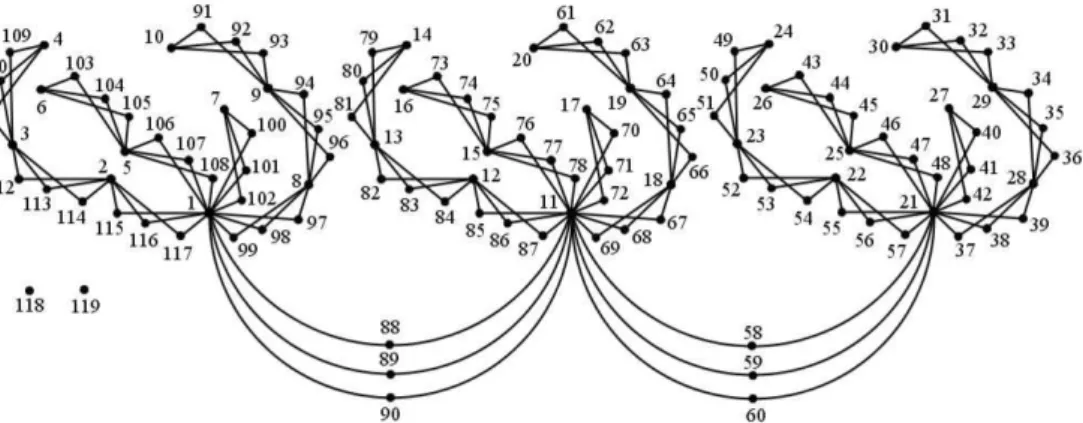
Figure 1: Super subdivided Path Union of Spider
Define f :V(H)→ {1,2, . . . , p+mq+ 2} as follows.
Choose the vertex with degreem(k+ 1) as the center vertex or apex vertex of the first copy of spider and label it asf(c1) = 1. All the remaining vertices are named as follows. Let t= 1.
i= 1,
f or x= 1 to k
f or l= 1 to lx
if l= 1,
f or an unlabelled(unvisited) vertex v with degree m or 2m and d(cg, v) = 2 f(vgi) =t+ 1
f or an unlabelled(unvisited) vertex v
with d(cg, v) = 1 and d(vgi, v) = 1 and degree2
f(vgij) =f(vgi) +j+ (m+ 1)(q−t); j= 1 to m i=i+ 1; t=t+ 1; l=l+ 1
if l6= 1 and l≤lx
f or an unlabelled(unvisited) vertex v with degree m or 2m and d(cg(i−1), v) = 2
f(vgi) =t+ 1
f or an unlabelled(unvisited) vertex v
with d(cg(i−1), v) = 1 and d(vgi, v) = 1 and degree 2
f(vgij) =f(vgi) +j+ (m+ 1)(q−t); j= 1 to m
i=i+ 1; t=t+ 1; l=l+ 1
x=x+ 1
f or an unlabelled(unvisited) vertex v
with d(cg, v) = 2and degree m(k+ 2)or m(k+ 1) f(cg+1) =t+ 1
if g≤(n−1)
f or an unlabelled(unvisited) vertex v with d(cg, v) = 1 and d(cg+1, v) = 1 degree 2
f(ugij) =f(cg+1) +j+ (m+ 1)(q−t); j= 1 to m
t=t+ 1; g=g+ 1
The isolates are labeled asf(ui) =p+mq+i; i= 1 to2.
Hence, super subdivision of path union of spider is super vertex sum graph withσsv(G) = 2.
l3 = 1,l4= 3. For path union of spiders G, we taken= 3 copies (say), thenG will havep= 30 vertices and q= 29 edges. LetGbe super subdivided byK2,m
where m = 3. Therefore, the resulting graph has p+mq = 30 + 3x29 = 117 vertices and 2mq= 2x3x29 = 174 edges.
The super vertex sum labeling for the super subdivided path union of spider is given in Figure 1.
3. Algorithm to Construct Super Vertex Sum Labeling of Super Subdivision of Caterpillar
Let G be a Caterpillar with p vertices and q edges. Let c be the number of internal vertices of the caterpillar. Super subdivide the graph G with K2,m.
The resulting graph H has p+mq vertices and 2mq edges. Let u1 and u2 be the two isolates necessary for the graph H. Choose the first vertex of H as the vertex with degree m and which has a vertex of degree greater than m at distance 2c (i.e., the head or tail of the caterpillar). We follow DFS algorithm with a modification: whenever we find a new vertex v having degree greater thanm, we first visit all the vertices at distance 2 and of degreemif any, before proceeding to next vertex with degree greater than m.
Define f :V(H)→ {1,2, . . . , p+mq+ 2} as follows: • Step 1: label the first vertex chosen,v1 as 1. • Step 2: assign i= 1,l = 1
• Step 3: for any unvisited vertex v withd(vi, v) = 1 anddeg(v) = 2
(
f or (j = 1 to m)
f(vij) =i+ 1 +j+ (m+ 1)(q−i)
• Step 4: for the vertex v withd(vi, v) = 1 and deg(v)> m f(ci) =i+ 1
increment i
• Step 5: if (l≤c) go to Step 6; else go to Step 8.
• Step 6: for an unvisited vertex (if any) with d(cl, v) = 2 and deg(v) =m do
(
f(vi+1) =i+ 1
and deg(v)> m
f or (j= 1 to m)
f(vij) =i+ 1 +j+ (m+ 1)(q−i) l=l+ 1
f(cl) =i+ 1 i=i+ 1
go to Step 5
• Step 7: for all unvisited vertex v withd(vi+1, v) = 1 anddeg(v) = 2
f or (j= 1 to m)
f(vij) =i+ 1 +j+ (m+ 1)(q−i) i=i+ 1
if (i=p) go to Step 8; else go to Step 6
• Step 8:f(u1) =p+mq+ 1 and f(u2) =p+mq+ 2 • Step 9: stop
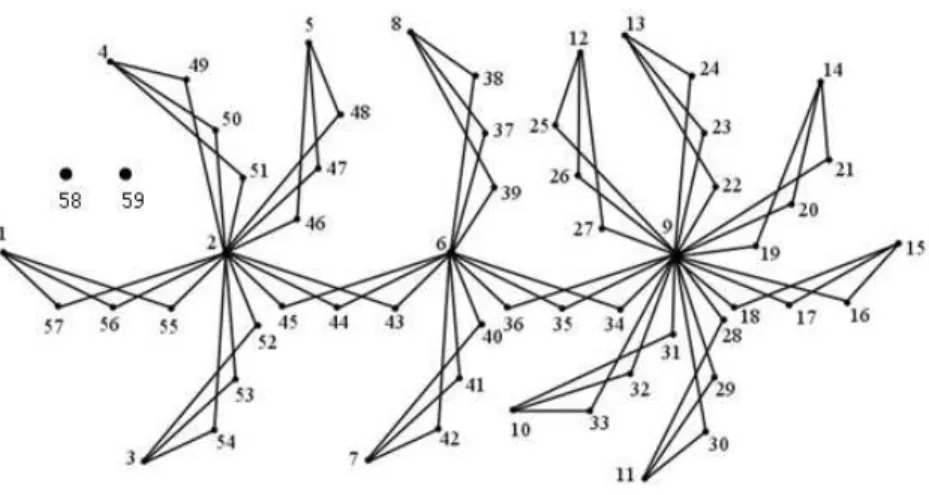
Example 2. Consider a caterpillar withp= 15 vertices and q= 14 edges. The number of internal vertices c = 3. Let G be super subdivided by K2,m
where m = 3. Therefore, the resulting graph has p+mq = 15 + 3x14 = 57 vertices and 2mq= 2x3x14 = 84 edges.
The super vertex sum labeling for the super subdivided caterpillar is given in Figure 2.
4. Conclusion
Figure 2: Super Vertex Sum Labeling for the Super Subdivided Caterpillar
References
[1] P.T. Chung and S.M. Lee, On the super edge-graceful spiders of even orders, J. Combinatorial Math. Combinatorial Computing, 64 (2008), 3-17.
[2] J.A. Gallian, A dynamic survey of graph labeling, DS6The Electronics J. Combinatorics, Version 20 (2017).
[3] F. Harary,Graph Theory, Addison Wesley, Reading, Massachusetts (1969).
[4] F. Harary, Sum graphs and Difference graphs, Congressus Numerantium, 72(1990), 101-108.
[5] G.R. Joseph and J.V. Kureethara, Super vertex sum labeling of graphs, Int. J. Pure Appl. Math., 118, No 10 (2018), 293-300; DOI: 10.12732/ij-pam.v118i10.70.
[6] G. Sethuraman and P. Selvaraju, Gracefulness of arbitrary super subdivi-sions of graphs,Indian J. Pure Appl. Math.,32, No 7 (2001), 1059-1064. [7] S.K. Vaidya, N.A. Dani, K.K. Kanani and P.L. Vihol, Cordial and