93
RESULTS ON QUANTITATIVE ANALYSIS OF NITRATES AND NITRITES
IN SOME FOOD PRODUCTS OF ANIMAL ORIGIN
M. COLĂ. FLORICA COLĂ University of Craiova Faculty of Agronomy
Keywords: nitrate; nitrite; myoglobin; amino acids
ABSTRACT
The toxicity of nitrates is also manifested by its ability to convert to nitrosamines; nitrosamines can form in both food products (exogenous origin) during storage and in the digestive system (endogenous origin), especially in the stomach. The nitrites diasotize the sulphanilic acid in an acidic medium and the formed diazonium salt is coupled with alpha-naphthylamine to give a pink-colored azoic compound with a maximum absorption at λ = 520nm. In the meat
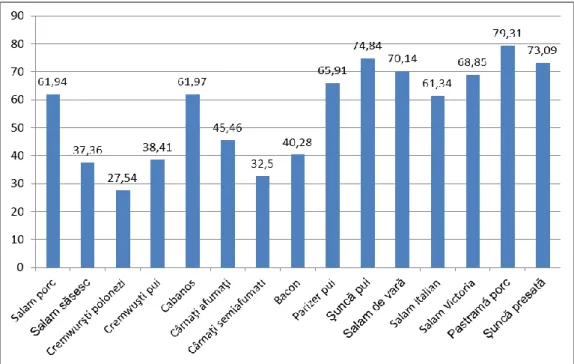
products analyzed the nitrate content recorded large variations, ranging from 27.54 mg/kg to the Polish sausage sample and 79.31 mg/kg in the pork pastrami sample.
Nitrate concentrations were within a broad range without exceeding the maximum permissible concentration (0.74 mg/kg in the half-smoked sausage sample, respectively 32,24 mg/kg in the chicken sausage.
INTRODUCTION
Sodium and potassium nitrates and nitrites (E 249 - E 252) are used for both preservative action and especially for colouring meat and meat preparations, along with sodium chloride, ascorbic acid and potassium sorbate. The nitrate ion as such has no effect on the colour of the meat, being used as a source of nitrite. Transformation of nitrate into nitrite occurs bacterially by nitrate reductase at pH higher than 5.8.
The mechanism of action of nitrites is explained by the reaction of nitrogen monoxide with myoglobin, with the
formation of nitroso-myoglobin (the
specific colouring of salted meat,
thermally untreated); by boiling, the myoglobin passes into the nitroso-hemocromogen. Haemoglobin reacts in the same way as nitrites added as an additive.
In addition to the action of fixing the colouring the meat, nitrates introduced into food play an important role in the formation of the flavour and taste of the meat; it is widely accepted that the flavour
of foods in which nitrates are incorporated is more pleasant. This phenomenon would be explained by the participation of the microbial flora, which reduces the nitrates to nitrites, to the formation of the flavour and taste of the meat.
Nitrites, added as such in the food or from nitrate reduction, exhibit moderate
antimicrobial activity (especially in
combination with sodium chloride in acidic medium), antioxidant action (due to the reduction character); nitrites are involved in the formation of an effective
inhibitor of growth of sporulating
anaerobic bacteria, Clostridium
botulinum, which produces very active
neurotoxins. The high risk of using nitrites is their ability to react with amines, amino acids, and form nitrosamines, highly carcinogenic compounds; in fact, even
nitrites as such may be carcinogens. The
value of pH and temperature influences the consumption of nitrite in meat products in the sense that at low pH and high temperatures the disappearance of
94
1997). The optimum pH is 5.8-6.0 when NaNO2 is unstable. Under the pH value of 5.6, the nitrite rapidly disappears from the environment, and below the pH value
of 5.2 the NO formation is practically inhibited. Over pH 6.0 the nitrite
becomes stable, oxidizing and
toxic.(Madrid et al., 2000).
MATERIAL AND METHOD
The research carried out was aimed at evaluating the nitrate and nitrite content of some food products of animal origin (meat products and fermented cheeses) marketed in specialized stores in Craiova. Within DSVSA Dolj, 30 samples of fermented cheeses and meat products were analyzed to determine the nitrate and nitrite content.
Determination of nitrites is performed by spectrophotometric method with Peter-Griess reagent. The nitrites diasotize the sulphanilic acid in an acidic medium and the formed diazonium salt is coupled with alpha-naphthylamine to give a pink-coloured azo compound with a maximum absorption at λ = 520nm. The quantitative determination of nitrites is carried out in several stages: extraction of the analyte from the sample to be analyzed,
purification of the extracts and
determination itself (drawing of the
calibration curve, determination of
nitrites).
Determination of nitrates is carried out in the form of nitrites (after their reduction
with cadmium powder), using the
spectrophotometric method with Peter-Griess reagent. The nitrites diasotize the sulphanilic acid in an acidic medium and the formed diazonium salt is coupled with
alpha-naphthylamine to give a pink-coloured azo compound with a maximum absorption at λ = 520nm.
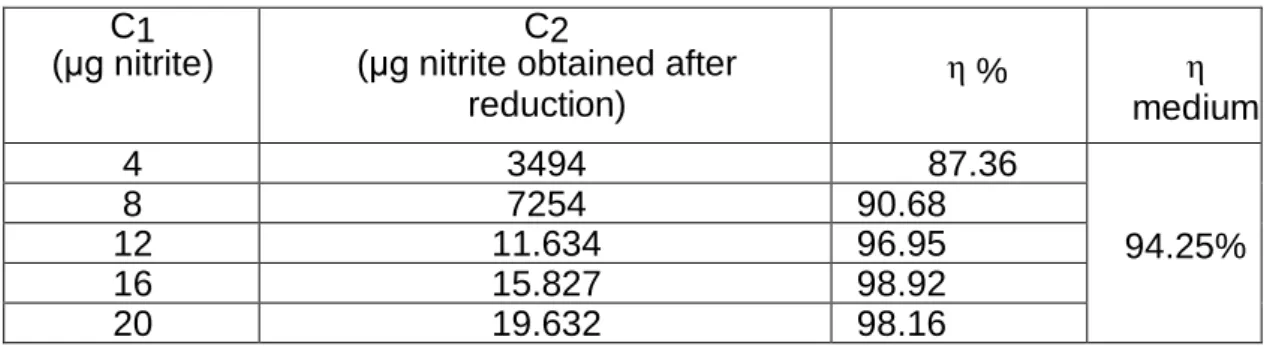
In order to calculate the evaluation of the yield of the reduction reaction of nitrate to nitrite, the calibration curve for the nitrite-nitrate system reduced to nitrite was designed as it follows:
- in a series of tubes, volumes of nitrite
standard solution containing
concentrations between 0 and 10 micrograms of nitrite, volumes of nitrate standard solution, respectively, with concentrations between 0 and 10 micrograms of nitrate, are introduced and brought to 19 ml with distilled water; 1 g of cadmium is added, shaking for 30 minutes to carry out the reduction of nitrate to nitrite.
- after the removal of cadmium, add 0,5 ml of Griess I reagent and Griess II respectively and read extinctions at λ = 520 nm against the control sample. The yield of the reduction reaction is calculated, according to the data in Table 1, for each concentration level in the calibration scale, according to the relation: η = C2 •100/ C1
.
Table 1.
The yield of the nitrate reduction reaction at nitrite
C1
(µg nitrite) (µg nitrite obtained after C2
reduction)
η % η
medium
4 3494 87.36
94.25%
8 7254 90.68
12 11.634 96.95
16 15.827 98.92
95
RESULTS AND DISCUSSIONS The results obtained in the determination
of nitrates in the meat products samples and fermented cheeses are shown in the
figures below. The results are the average of three distinct determinations
Figure 1 Nitrate and nitrite content of preparation of meat mg NO3-/kg
Figure 2 Nitrate and nitrite content of meat preparation mg NO2-/kg
In the meat products analyzed the nitrate content recorded large variations, ranging from 27.54 mg/kg to the Polish sausage sample and 79.31 mg/kg in the pork pastrami sample. Nitrate concentrations were within a
broad range without exceeding the
maximum permissible concentration
96
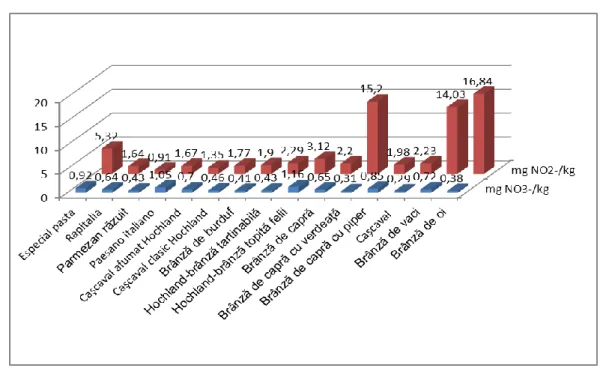
Figure 3 Compozition in nitrates and nitrites of cheeses fermented
In the fermented cheese
samples nitrate and nitrite
concentrations were well below the
maximum permitted levels. The
variation ranges for analyte
concentrations were: 0.91 mg nitrate/kg
(grated parmesan sample) -16, 84 mg nitrate/kg (sheep milk cheese sample) and 0.29 mg nitrite/kg pressed cheese sample) - 1.16 mg nitrite/kg (for the Hochland processed cheese sample).
CONCLUSIONS
For the determination of nitrite in food products (meat products and fermented cheeses) the spectrophotometric method with Peter-Griess reagent was applied. Determination of nitrates was done by the same method, after their reduction to nitrites, with cadmium powder. The yield of the reduction reaction was over 90%. 30 food samples, of which 15 samples of
meat productss, 15 samples of
fermented cheeses were analyzed,
yielding results consistent with those in the literature. In the meat products
analyzed the nitrate content recorded large variations, ranging from 27.54 mg/kg to the Polish sausage sample and 79.31 mg/kg in the pork pastrami sample. Nitrate concentrations were within a broad range without exceeding the
maximum permissible concentration
(0.74 mg/kg in the half-smoked sausage sample, respectively 32.24 mg/kg in the chicken sausage).
In the fermented cheese samples nitrate and nitrite concentrations were well below the maximum permitted levels.
BIBLIOGRAPHY
1. Andrade R, Reyes FGR, Rath S.
A., 2005 - Method for the
determination of volatile N
nitrosamines in food by HS-SPME-GC-TEA. Food Chemistry 91: 173–179.
2. Banu C, Alexe P, Vizireanu C.
1997 - Procesarea industrială a
cărnii.București: Ed. Tehnnică, 208-213, 455.
3. Honikel K. 2008 - The use and
97
4. Madrid VA, Madrid CJ. 2000; -
Los aditivos en los alimentos (Según la Unión Europea y la Legislación Española), 1a Edición,
AMV Ediciones, Mundi Prensa,
5. Menard et al. 2008 - Menard C,
Heraud F, Volatier J.L, Assesment of dietary exposure of nitrate and nitrite in France. Food Additives and Contaminants, 25: 971-988.
6. Regulamentul (UE) nr. 1129/2011
al Comisiei din 11.11.2011 de
modificare a anexei II la
Regulamentul (CE) nr. 1333/2008 al
Parlamentului European şi al