RESEARCH
Minimal clinically important differences
in health-related quality of life after total
hip or knee replacement
A SYSTEMATIC REVIEW
J. C. Keurentjes, F. R. Van Tol, M. Fiocco, J. W. Schoones, R. G. Nelissen
From Leiden University Medical Center, Leiden, The Netherlands
J. C. Keurentjes, MD, Researcher
F. R. Van Tol, Medical Student R. G. Nelissen, PhD, MD, Professor in Orthopaedic Surgery Leiden University Medical Center, Department of Orthopaedic Surgery, Postbus 9600, 2300 RC, Leiden, The Netherlands. M. Fiocco, PhD, Assistant Professor in Medical Statistics Leiden University Medical Center, Department of Medical Statistics and BioInformatics, Postbus 9600, 2300 RC, Leiden, The Netherlands.
J. W. Schoones, MA, Information Specialist Leiden University Medical Center, Walaeus Library, Postbus 9600, 2300 RC, Leiden, The Netherlands.
Correspondence should be sent to Dr J. C. Keurentjes; e-mail: [email protected]
10.1302/2046-3758.15.2000065 $2.00
Bone Joint Res 2012;1:71–77. Received 21 February 2012; Accepted after revision 20 April 2012
Objectives
We aimed first to summarise minimal clinically important differences (MCIDs) after total hip (THR) or knee replacement (TKR) in health-related quality of life (HRQoL), measured using the Short-Form 36 (SF-36). Secondly, we aimed to improve the precision of MCID estimates by means of meta-analysis.
Methods
We conducted a systematic review of English and non-English articles using MEDLINE, the Cochrane Controlled Trials Register (1960–2011), EMBASE (1991–2011), Web of Science, Academic Search Premier and Science Direct. Bibliographies of included studies were searched in order to find additional studies. Search terms included MCID or minimal clinically important change, THR or TKR and Short-Form 36. We included longitudinal studies that estimated MCID of SF-36 after THR or TKR.
Results
Three studies met our inclusion criteria, describing a distinct study population: primary THR, primary TKR and revision THR. No synthesis of study results can be given.
Conclusions
Although we found MCIDs in HRQoL after THR or TKR have limited precision and are not validated using external criteria, these are still the best known estimates of MCIDs in HRQoL after THR and TKR to date. We therefore advise these MCIDs to be used as absolute
thresholds, but with caution.
Article focus
We hypothesised that the precision of minimal clinically important differences (MCID) estimates could be enhanced by means of a meta-analysis
Key messages
Meta-analyses enhance the precision of an estimate by pooling data from differ-ent studies
Meta-analyses are not limited to results from randomised controlled trials. Any estimate from any type of study can be enhanced using the point estimate and its standard error
Strengths and limitations
This is the first study that sets out to enhance the precision of the estimate of a minimal clinically important difference
We could not perform a meta-analysis due to the lack of published MCID esti-mates
Introduction
Total hip (THR) and knee replacement (TKR) are effective surgical interventions, which alleviate pain and improve function and health-related quality of life (HRQoL) in patients with end-stage degeneration of the hip or knee joint, respectively.1 Typically, studies report the mean improvement in HRQoL at the population level, which provides information for the average patient in a population. However, this information may not be meaningful for individual patients encountered in clinical practice, who will be concerned with the likelihood that they will experience a meaningful improve-ment in return for the risk undertaken when
undergoing an intervention.2 More relevant for the
indi-vidual patient therefore is the minimal clinically impor-tant difference (MCID), defined as the minimal difference in scores of an outcome measure that is perceived by patients as beneficial or harmful.3,4 The MCID enables
patients to be classified as either a responder or a non-responder to a particular therapy, based on their own assessment of their pre- and post-operative HRQoL. Additionally, the MCID allows an estimation of the prob-ability of a relevant improvement in HRQoL of a particular therapy.
Expected benefits of treatment must be weighed against its adverse effects, inconvenience and costs.5
Therefore, there is not necessarily a single MCID value for any one outcome measure of HRQoL, which can be used for all applications and patient samples.6 For instance, the
benefits of treatment in patients suffering from end-stage osteoarthritis are considerably larger for THR and TKR compared with rehabilitational interventions. On the other hand, the risk of adverse effects is also considerably higher. These differences complicate the direct use of MCIDs in HRQoL as established for rehabilitational inter-ventions,7 in THR or TKR patients. The use of specific
MCIDs in HRQoL after THR or TKR should be encouraged. MCIDs can be established using two different methods. Anchor-based approaches use an external indicator to assign patients into several groups reflecting different amounts of change in health status.6 The within-person
global change rating is often used as an anchor, which is measured using Likert scales, ranging from five to 15 options.6 Positive MCIDs are usually estimated by the
mean difference between pre- and post-operative scores of patients, who indicate that their condition is ‘some-what better’; negative MCIDs are usually estimated by the mean difference between pre- and post-operative scores of patients who indicate that their condition is ‘somewhat worse’.5,8 Distribution-based methods offer
another approach in the estimation of MCIDs, which interpret results in terms of the relation between the mag-nitude of effect and some measure of variability in results.5 Individual effect size standards are often used to
estimate the MCID, which is defined as the difference between a patient’s pre- and post-operative HRQoL scores, normed to the standard deviation of the pre-oper-ative scores.8 Generally accepted individual effect size
standards are equal to the group effect size standards, as defined by Cohen.9 Therefore, the MCID is calculated by
multiplying the standard deviation of patients at baseline by 0.5.
Recently Quintana et al10 and Escobar et al11 have
esti-mated MCIDs for the SF-36 after THR and TKR. However, these authors have advised against using the found esti-mates of MCIDs as absolute thresholds, due to the impre-cision of these estimates caused by small sample sizes. The precision of an estimate can be enhanced by pooling results of multiple studies in a meta-analysis. Therefore,
the purpose of our study was to enhance the precision of the MCIDs after THR and TKR, by means of a systematic review and meta-analysis.
Materials and Methods
This systematic review was performed in November 2011, using the PRISMA-Statement (Preferred Reporting Items for Systematic Reviews and Meta-Analyses) as a guideline in the development of the study protocol and the report of the current study.12 The inclusion criteria and methods
of analysis were specified in advance and documented in a protocol.
Information sources and search strategy. Longitudinal
studies that estimate the MCID in HRQol, measured using the Short-Form 36 (SF-36), after primary or revision THR or TKR, were eligible for inclusion. No language, publication date, or publication status restrictions were imposed.
Studies were identified by searching electronic data-bases. No limits were applied for language and foreign papers were translated. This search strategy was applied to PubMed, MEDLINE, Embase, Web of Science, COCHRANE, ScienceDirect and Academic Search Premier. The search was run on 8 November 2011. The following search terms were used in PubMed, and were adapted for the other databases: (Mcid[tw] OR cid[tw] OR “Minimal clinically important differences” OR “Minimal clinically important difference” OR “clinically important differences” OR “clin-ically important difference” OR MCIC[tw] OR “Minimal clinically important changes” OR “Minimal clinically important change” OR “clinically important changes” OR “clinically important change” OR “Minimal clinical impor-tant differences” OR “Minimal clinical imporimpor-tant differ-ence” OR “clinical important differences” OR “clinical important difference” OR “clinical important changes” OR “minimal detectable change” OR “minimal detectable changes” OR “minimally detectable change” OR “mean-ingful changes” OR “mean“mean-ingful change”) AND (tka[tw] OR “knee replacement arthroplasty” OR “knee arthro-plasty” OR “knee replacement” OR “knee prosthesis” OR tha[tw] OR “hip replacement arthroplasty” OR “hip arthro-plasty” OR “hip replacement” OR “hip prosthesis” OR “knee” OR “knees” OR “hip” OR “hips”) AND (“SF36” OR “SF-36” OR “short form 36” OR “shortform 36”).
Study selection. Two authors (JCK and FRvT)
indepen-dently screened titles and abstracts of the papers resulting from the database search using predefined eligibility crite-ria. Papers were considered eligible for inclusion if they met two criteria; they were to concern primary or revision THR or TKR and should include an estimate of a MCID. The full text of all included papers, based on titles and abstracts, were screened using the same inclusion criteria. Disagree-ments between reviewers were resolved by consensus.
HRQoL measured using SF-36. The SF-36 consists of
transformed score is calculated (100 indicating no symp-toms and 0 indicating extreme sympsymp-toms).13
Data collection process and data items. Both authors
extracted the data independently, using a predefined data extraction form. Areas of disagreement or uncer-tainty were resolved by consensus. Estimates of MCIDs were extracted from included studies. For anchor-based estimates of MCIDs, we extracted the number of patients, on which the estimate was based, and the standard devi-ation. For distribution-based estimates, we extracted the number of patient on which the estimate was based. Additionally, study characteristics, concerning follow-up period, sample size, proportion of patients who under-went joint replacement for osteoarthritis, proportion of males, mean patient age and proportion lost to follow-up, were collected.
Risk of bias in individual studies. We assessed the risk of
bias in the included studies through a modified Newcastle-Ottawa Quality Assessment Scale,14 which
included the following questions: which approach was used to estimate the MCID? (anchor-based versus distri-bution-based); was any form of additional validation per-formed? (yes/no); was the study population representative of THR or TKR in general? (truly represen-tative/somewhat representative/selected population/not enough information given); was the follow-up adequate?
(no loss to follow-up/< 5% lost to follow-up (unlikely to bias results)/> 5% lost to follow-up (results possibly biased)). We chose the cut-off point of 5% lost to follow-up according to Pijls et al,15 who established this
thresh-old for observational studies in orthopaedic literature, using a Delphi approach to form consensus between a group of experts in the fields of THR, TKR or evidence-based medicine.
Summary measures and planned methods of analysis.
The primary outcome measure was the MCID in HRQoL, measured using SF-36, for primary THR, primary TKR, revision THR and revision TKR. Whenever possible, esti-mates of MCIDs were pooled using inverse variance weighting. 95% confidence intervals (CI) were calculated for all MCID estimates.
Results
Study selection. The search strategy revealed a total of
126 results (Fig. 1). After removal of duplicate entries, 114 unique papers remained. Screening of titles and abstracts revealed 29 papers eligible for inclusion. Further assessment of eligibility, based on full-text papers, led to the exclusion of 26 papers: two did not address THR or TKR and 24 presented no estimation of an MCID. This left three papers, describing three studies, for further analysis.10,11,16
Records identified through database searching (n = 126)
Records after removal of duplicates (n = 114)
Records screened (n = 114)
Records excluded (n = 85)
Full-text papers assessed for eligibility (n = 29)
Studies included in qualitative synthesis (n = 3)
IDENTIFIC
A
TION
SC
REENING
ELIGIBILIT
Y
INC
LUDED
Full-text papers excluded: No THR/TKR: 2 No MCID estimated: 24
Fig. 1
Study characteristics. An overview of the study charac-teristics of all included studies is presented in Table I. Quintana et al10 describe the MCID in SF-36 after
primary THR at follow-up periods of six months and two years; Escobar et al11 describe the MCID in SF-36 after
primary TKR at follow-up periods of six months and two years; and Shi et al16 describe the MCID in SF-36 after
revision THR at a follow-up period of six months (Table I). All included studies were multi-center studies. All studies estimated positive MCIDs (i.e. the minimal difference in scores of the SF-36 that is perceived by patients as beneficial); no study estimated negative MCIDs (the minimal difference in scores of an outcome measure that is perceived by patients as harmful). The sample for the estimation of the MCIDs was 43 patients after six months and 33 after two years for Quintana et al10; 76 after six months and 65 after two years for
Escobar et al11; and 67 after six months for Shi et al16
(Table I). The indication for joint replacement was osteo-arthritis in all patients of Quintana et al10 and Escobar
et al,11 while Shi et al16 offered no statement of the
indication for joint replacement (Table I). In all studies, some patients were lost to follow-up.
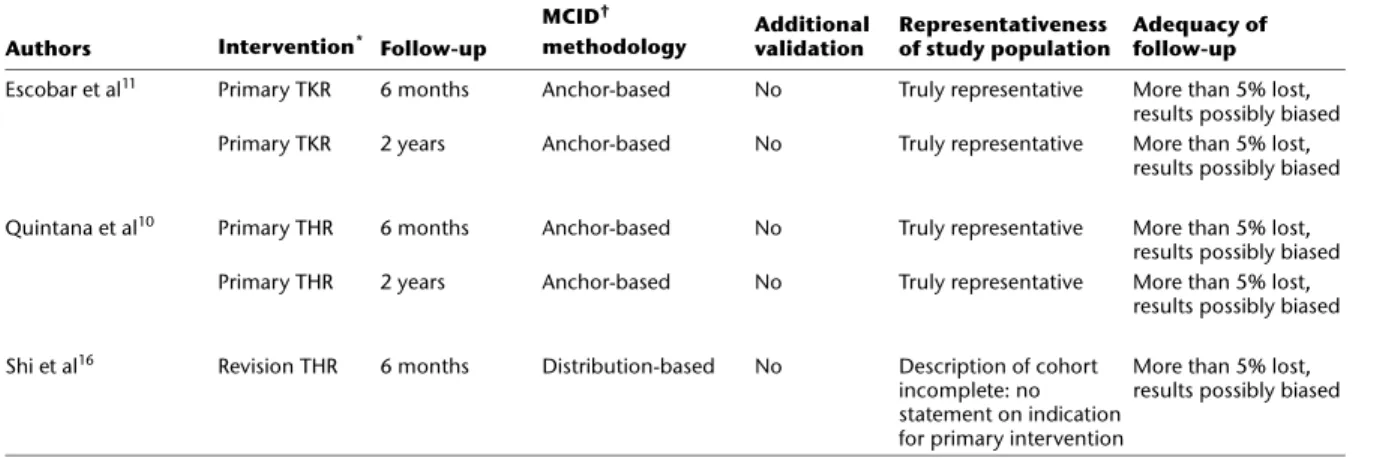
Risk of bias within studies. An overview of the risk of
bias within studies is presented in Table II. Two studies used anchor-based approaches to estimate the MCID,10,11
while the other used a distribution-based approach.16 No
study performed any form of additional validation. The study populations of Quintana et al10 and Escobar et al11
are truly representative of THR and TKR patients in gen-eral, while Shi et al16 did not provide enough information
to assess the representativeness by leaving out the indica-tion of joint replacement. All studies lost > 5% of patients to follow-up, rendering a possibility of biased results.
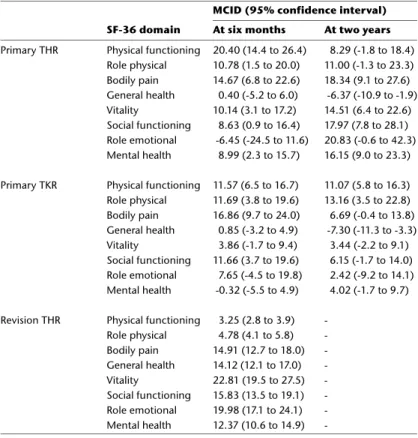
Synthesis of results. All studies have described a distinct
study population, precluding any meaningful synthesis of study results. An overview of the results of all individual stud-ies is presented in Table III and Figures 2 and 3. The MCIDs are presented with 95% confidence intervals for each of the SF-36 domains in primary TKR and primary and revision THR at six months (Fig. 2, Table III)10,11,16 and for primary TKR and
THR at two years post-operatively (Fig. 3, Table III).10,11 Table I. Study characteristics of the three included studies
Authors Intervention Follow-up Setting
Positive/ negative MCID estimated
Sample size of study
Sample size for MCID estimation
Osteoarthritis (%)
Male gender (%)
Mean age (yrs)
Lost to follow-up (%)
Escobar et al11 Primary TKR 6 months Multi-centre Positive
MCID only
423 76 100 25.0 71.6 22.39
Primary TKR 2 years Multi-centre Positive MCID only
364 65 100 25.0 71.6 33.21
Quintana et al10 Primary THR 6 months Multi-centre Positive
MCID only
485 43 100 49.3 69.4 21.86
Primary THR 2 years Multi-centre Positive MCID only
310 33 100 49.3 69.4 36.08
Shi et al16 Revision THR 6 months Multi-centre Positive
MCID only
67 67 n/a 56.7 70.2 16.25
Table II. Risk of bias within the three included studies
Authors Intervention*
Follow-up
MCID†
methodology
Additional validation
Representativeness of study population
Adequacy of follow-up
Escobar et al11 Primary TKR 6 months Anchor-based No Truly representative More than 5% lost,
results possibly biased Primary TKR 2 years Anchor-based No Truly representative More than 5% lost,
results possibly biased
Quintana et al10 Primary THR 6 months Anchor-based No Truly representative More than 5% lost,
results possibly biased Primary THR 2 years Anchor-based No Truly representative More than 5% lost,
results possibly biased
Shi et al16 Revision THR 6 months Distribution-based No Description of cohort
incomplete: no statement on indication for primary intervention
More than 5% lost, results possibly biased
Discussion
We have found one study describing MCIDs in SF-36 after primary THR,10 one after primary TKR11 and one after
revi-sion THR16; we did not find any studies describing MCIDs
after revision TKR. As all studies have described a distinct study population, no synthesis of study results can be given. Therefore, we were unable to improve the preci-sion of each MCID estimate.
However, in order to visualise the precision of all MCID estimates, we calculated 95% confidence intervals of all MCID estimates, which were not presented in the original studies. These confidence intervals are presented in Figures 2 and 3.
The findings of this systematic review underline the need to identify MCIDs for each specific population. As can be seen from Figures 2 and 3, MCIDs differ both between SF-36 subscales and patient populations. The use of a ‘one-size-fits-all’ MCID does not appear justified, as patients suffering from osteoarthritis of the hip and knee, which are regarded as similar disease entities, have different MCIDs in HRQoL.17-19 In order to study
patient-relevant improvements in HRQoL at the individual level in revision TKR patients, MCIDs need to be established in this particular population as well.
Limitations of the included studies include imprecision as a result of small sample sizes, the lack of validation of
the MCID estimates and the rates of loss to follow-up. Anchor-based approaches in particular suffer from impre-cision due to small sample sizes, as this approach uses only a part of all data to estimate the MCID. A precise esti-mation of the MCID is further hampered by the clinical success of joint replacement: typically, one expects a large effect of THR or TKR.20 The group sizes of patients
who indicate that their condition has “somewhat improved” are therefore expected to be small, which con-tributes to an imprecise estimation of MCIDs. Unfortu-nately, there are only two ways to improve the precision of anchor-based MCID estimates: one can either perform larger studies, or pool study results in a meta-analysis. To date, the only studies that have established anchor-based MCIDs in HRQoL after primary THR or TKR were those of Quintana et al10 and Escobar et al.11 More research is
required to improve the precision of MCIDs in HRQoL. Estimates with higher precision are generated by distribu-tion-based approaches, which use data from the entire population to estimate the MCID. However, these approaches are criticised for the arbitrariness of the indi-vidual effect size standards.5
A strongly recommended method of determining MCIDs is by triangulation of multiple approaches.6 None
of the included studies has applied any form of additional validation, such as secondary anchor questions; all used a
Table III. Minimal clinically important differences (MCIDs) in Short-Form 36 (SF-36) domains after primary and revision total hip replacement (THR) and primary total knee replacement (TKR)
MCID (95% confidence interval)
SF-36 domain At six months At two years
Primary THR Physical functioning 20.40 (14.4 to 26.4) 8.29 (-1.8 to 18.4) Role physical 10.78 (1.5 to 20.0) 11.00 (-1.3 to 23.3) Bodily pain 14.67 (6.8 to 22.6) 18.34 (9.1 to 27.6) General health 0.40 (-5.2 to 6.0) -6.37 (-10.9 to -1.9) Vitality 10.14 (3.1 to 17.2) 14.51 (6.4 to 22.6) Social functioning 8.63 (0.9 to 16.4) 17.97 (7.8 to 28.1) Role emotional -6.45 (-24.5 to 11.6) 20.83 (-0.6 to 42.3) Mental health 8.99 (2.3 to 15.7) 16.15 (9.0 to 23.3)
Primary TKR Physical functioning 11.57 (6.5 to 16.7) 11.07 (5.8 to 16.3) Role physical 11.69 (3.8 to 19.6) 13.16 (3.5 to 22.8) Bodily pain 16.86 (9.7 to 24.0) 6.69 (-0.4 to 13.8) General health 0.85 (-3.2 to 4.9) -7.30 (-11.3 to -3.3) Vitality 3.86 (-1.7 to 9.4) 3.44 (-2.2 to 9.1) Social functioning 11.66 (3.7 to 19.6) 6.15 (-1.7 to 14.0) Role emotional 7.65 (-4.5 to 19.8) 2.42 (-9.2 to 14.1) Mental health -0.32 (-5.5 to 4.9) 4.02 (-1.7 to 9.7)
-single approach. Besides a limited precision, caused by small group sizes, the accuracy of the MCID estimates might be limited as well due to this lack of additional val-idation.21 Therefore, further research is needed to provide
external validation of the established MCIDs in HRQoL. However, until further research is performed, the MCID estimates of these three studies10,11,16 are the best
avail-able estimates. Cautious use of these estimates should be
MCID at six months
SF-36 subscales
PF
RP
BP
GH
VT
SF
RE
MH
●
●
●
●
●
●
●
●
●
●
●
●
●
●
●
● ●
●
●
●
●
●
●
● Primary THR
Primary TKR Revision THR
Primary THR Primary TKR Revision THR
Primary THR Primary TKR Revision THR
Primary THR Primary TKR Revision THR
Primary THR Primary TKR Revision THR
Primary THR Primary TKR Revision THR
Primary THR Primary TKR Revision THR
Primary THR Primary TKR Revision THR
−40 −20 0 20 40
Paper
●Escobar et al11
●Quintana et al10
●Shi et al16
n Patients 43 67 76
Fig. 2
Graph showing the minimal clinically important differences (MCIDs) in the domains of the Short-Form 36 (SF-36) at six months after primary total hip (THR)10 and total knee replacement (TKR)11 and revision THR.16 The size of the coloured
cir-cles represents the sample sizes used to estimate the MCID, and the error bars denote the 95% confidence intervals (PF, physical functioning; RP, role physical; BP, bodily pain; GH, general health; VT, vitality; SF, social functioning; RE, role emo-tional; MH, mental health).
MCID at two years
SF-36 subscales
PF
RP
BP
GH
VT
SF
RE
MH
●
●
●
●
●
●
●
●
●
●
●
●
●
●
●
●
Primary THR Primary TKR
Primary THR Primary TKR
Primary THR Primary TKR
Primary THR Primary TKR
Primary THR Primary TKR
Primary THR Primary TKR
Primary THR Primary TKR
Primary THR Primary TKR
−40 −20 0 20 40
Paper
●Escobar et al11
●Quintana et al10
n Patients 33 65
Fig. 3
Graph showing the minimal clinically important differences (MCIDs) in the domains of the Short-Form 36 (SF-36) at two years after primary total hip (THR)10 and total knee replacement (TKR).11 The size of the coloured circles represents the
encouraged in order to study improvement in HRQoL at the individual level, the most relevant outcome measure for individual patients encountered in clinical practice.
References
1. Harris WH, Sledge CB. Total hip and total knee replacement (1). N Engl J Med
1990;323:725–731.
2. Singh J, Sloan JA, Johanson NA. Challenges with health-related quality of life assessment in arthroplasty patients: problems and solutions. J Am Acad Orthop Surg
2010;18:72–82.
3. Jaeschke R, Singer J, Guyatt GH. Measurement of health status: ascertaining the minimal clinically important difference. Control Clin Trials 1989;10:407–415. 4. King MT. A point of minimal important difference (MID): a critique of terminology
and methods. Expert Rev Pharmacoecon Outcomes Res 2011;11:171–184. 5. Guyatt GH, Osoba D, Wu AW, Wyrwich KW, Norman GR; Clinical
Signifi-cance Consensus Meeting Group. Methods to explain the clinical signifiSignifi-cance of health status measures. Mayo Clin Proc 2002;77:371–383.
6. Revicki D, Hays RD, Cella D, Sloan J. Recommended methods for determining responsiveness and minimally important differences for patient-reported outcomes. J Clin Epidemiol 2008;61:102–109.
7. Angst F, Aeschlimann A, Stucki G. Smallest detectable and minimal clinically important differences of rehabilitation intervention with their implications for required sample sizes using WOMAC and SF-36 quality of life measurement instru-ments in patients with osteoarthritis of the lower extremities. Arthritis Rheum
2001;45:384–391.
8. Wyrwich KW, Wolinsky FD. Identifying meaningful intra-individual change stan-dards for health-related quality of life measures. J Eval Clin Pract 2000;6:39–49. 9. Cohen J. Statistical power analysis for the behavioral sciences. New York:
Rout-ledge, 1988.
10. Quintana JM, Escobar A, Bilbao A, et al. Responsiveness and clinically important differences for the WOMAC and SF-36 after hip joint replacement. Osteoarthritis Car-tilage 2005;13:1076–1083.
11. Escobar A, Quintana JM, Bilbao A, et al. Responsiveness and clinically important differences for the WOMAC and SF-36 after total knee replacement. Osteoarthritis Cartilage 2007;15:273–280.
12. Moher D, Liberati A, Tetzlaff J, Altman DG; PRISMA Group. Preferred reporting items for systematic reviews and meta-analyses: the PRISMA statement. BMJ
2009;339:2535.
13. Ware JE, Snow KK, Kosinski M, Gandek B. SF-36 health survey?: manual and interpretation guide. Boston: The Health Institute New England Medical Center, 1993.
14. Wells GA, Shea B, O’Connell D, et al. The Newcastle-Ottawa Scale (NOS) for assessing the quality of nonrandomised studies in meta-analyses. http://www.ohri.ca/ programs/clinical_epidemiology/oxford.asp (date last accessed 2 May 2012). 15. Pijls BG, Dekkers OM, Middeldorp S, et al. AQUILA: assessment of quality in
lower limb arthroplasty: an expert Delphi consensus for total knee and total hip arthroplasty. BMC Musculoskelet Disord 2011;12:173.
16. Shi HY, Chang JK, Wong CY, et al. Responsiveness and minimal important differ-ences after revision total hip arthroplasty. BMC Musculoskelet Disord 2010;11:261. 17. Zhang W, Moskowitz RW, Nuki G, et al. OARSI recommendations for the
man-agement of hip and knee osteoarthritis, part I: critical appraisal of existing treatment guidelines and systematic review of current research evidence. Osteoarthritis Carti-lage 2007;15:981–1000.
18. Zhang W, Moskowitz RW, Nuki G, et al. OARSI recommendations for the man-agement of hip and knee osteoarthritis, part II: OARSI evidence-based, expert consen-sus guidelines. Osteoarthritis Cartilage 2008;16:137–162.
19. Zhang W, Nuki G, Moskowitz RW, et al. OARSI recommendations for the man-agement of hip and knee osteoarthritis: part III: changes in evidence following sys-tematic cumulative update of research published through January 2009.
Osteoarthritis Cartilage 2010;18:476–499.
20. Chesworth BM, Mahomed NN, Bourne RB, Davis AM; OJRR Study Group. Willingness to go through surgery again validated the WOMAC clinically important difference from THR/TKR surgery. J Clin Epidemiol 2008;61:907–918.
21. Walther BA, Moore JL. The concepts of bias, precision and accuracy, and their use in testing the performance of species richness estimators, with a literature review of estimator performance. Ecography 2005;28:815–829.
Funding statement: None declared
Author contributions:
J. C. Keurentjes: Study conception and design, Data analysis, Data collection, Drafting of the article, Statistical analysis
F. R. Van Tol: Study conception and design, Data collection, Drafting of the article R. G. Nelissen: Study conception and design, Critical revision of the article M. Fiocco: Data analysis, Critical revision of the article, Statistical analysis
J. W. Schoones: Study conception and design, Critical revision of the article, Provision of study material
ICMJE Conflict of Interest: None declared