TEACHER SUPPORT AS A MODERATOR BETWEEN STUDENT SIXTH-GRADE TRANSITION EXPERIENCES AND END-OF-YEAR ADJUSTMENT
Nelson Carl Brunsting
A dissertation proposal submitted to the faculty of the University of North Carolina at Chapel Hill in partial fulfillment of the requirements for the degree of Doctor of Philosophy in the
School of Education (Educational Psychology, Measurement, and Evaluation).
Chapel Hill 2016
ii © 2016
iii ABSTRACT
Nelson Carl Brunsting: Teacher Support as a Moderator between Student Sixth-Grade Transition Experiences and End-of-Year Adjustment
(Under Direction of Jill Hamm)
iv
ACKNOWLEDGEMENTS
I am grateful for everyone who has contributed to my growth and development over the last five years. First and foremost, I am thankful to my committee and to the faculty and staff at the University of North Carolina School of Education. Jill Hamm, your mentorship, grace, and insight helped me transition from backwoods group leader to a researcher. Bill Ware, for your humor and patience, thank you. It amazes me how many of the examples I remember from your classes years later despite my poor memory. Greg Cizek, your openness in your personal
reflections in 803 helped frame the journey in a wider perspective. Jeff Greene, your work and our interactions provided a role model for myself and other graduate students. Kate Norwalk, your encouragement and ideas sustained me at a critical point in this work. I knew coming into UNC that I would be among a group of individuals with the knowledge and skill to train me; what I didn’t expect and will remember the most is your humanity. Thank you all.
v
TABLE OF CONTENTS
LIST OF TABLES………...……….………...viii
LIST OF FIGURES……….………..…….ix
LIST OF ABBREVIATIONS AND SYMBOLS………...…………..…..….x
CHAPTER 1: INTRODUCTION………1
The Current Study………7
CHAPTER 2: THEORETICAL FRAMEWORK………9
Transition Experience and Students’ Adjustment………9
Approaches to the Teacher-Student Relationship and Teacher Support…….….….……12
Students’ Experience of Support in the TSR as a Potential Moderator………...14
Demographic Differences in Sixth-grade Adjustment……….…………..18
CHAPTER 3: LITERATURE REVIEW………...21
Teacher Support and Internalizing and Externalizing Behavior Problems………22
Students’ Perception of the Middle School Transition Year……….27
Teacher Support as a Moderator………28
Student Characteristics and Individual Differences……….…………..32
Hypotheses……….…………34
CHAPTER 4: METHOD………...36
Participants……….………36
vi
Measures………38
Perceived sixth-grade transition experience………..38
Perceived autonomy support……….……….39
Perceived competence support……….………..39
Perceived emotional support……….……….40
Social anxiety symptoms………...41
Defiance……….41
Demographic variables……….……….41
Plan of Analyses………41
CHAPTER 5: RESULTS………...…45
Missing Data………..45
Descriptive Statistics………..47
Power……….49
Measurement Reliability………50
Measurement Models……….………50
Creating the latent product interaction term………..52
Final measurement model……….…….52
Direct and Interactive Effects of the Independent Variables on Defiance in Spring…….53
Factorial analysis……….…..54
Direct and Interactive Effects of the Independent Variables on Social Anxiety in Spring………55
Summary of Findings……….…56
CHAPTER 6: DISCUSSION……….57
vii
viii
LIST OF TABLES
TABLE 1: Participating schools’ characteristics and percentage of sixth-grade
students consenting…..………..………68
TABLE 2: Participant sample characteristics……….…..………….69
TABLE 3: Item-level descriptive statistics in fall……….……..…………..70
TABLE 4: Item-level descriptive statistics in spring……….71
TABLE 5: Reliability estimates of measures used in the study……….72
TABLE 6: Latent interaction term item construction using a matched-pair products strategy….73 TABLE 7: Model fit indices for measurement models………..…………74
ix
LIST OF FIGURES
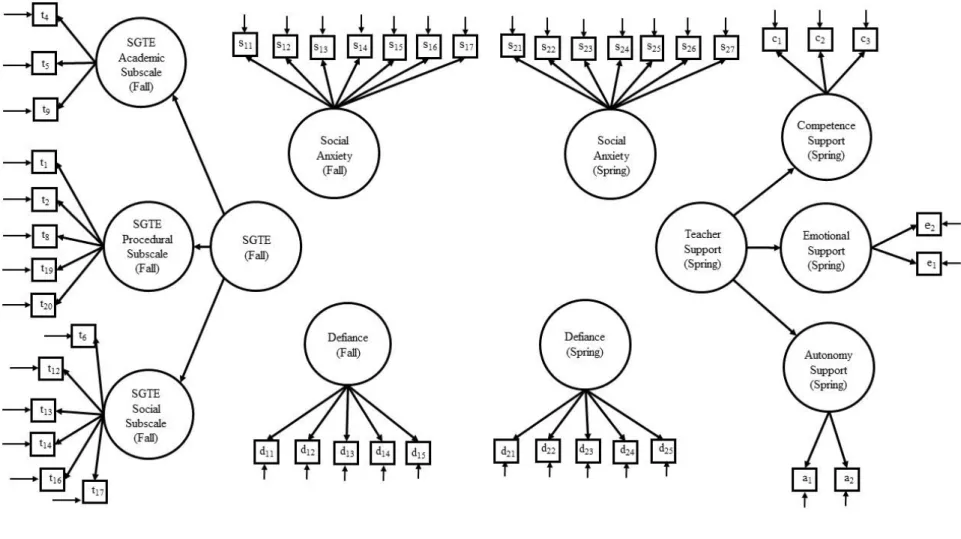
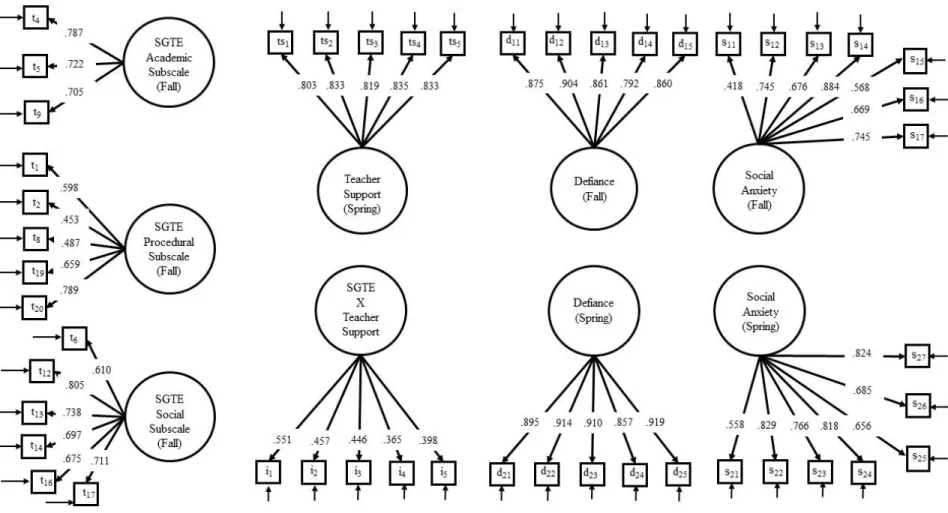
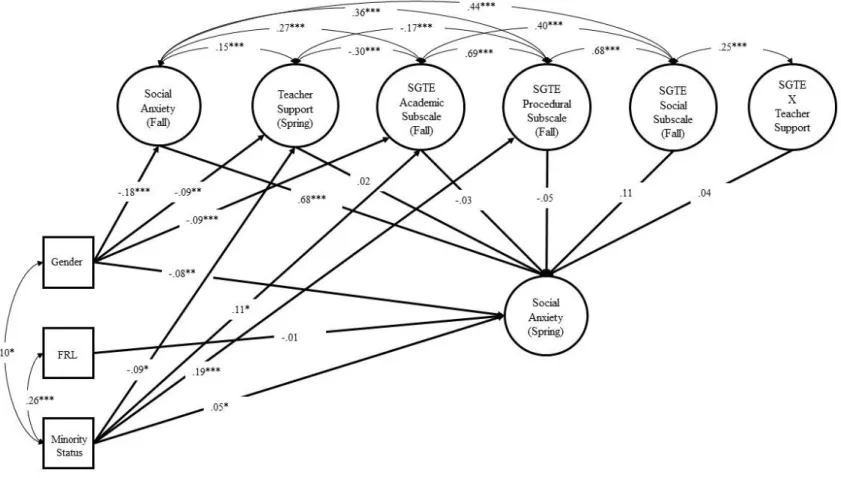
FIGURE 1: Hypothesized unrestricted measurement model………76 FIGURE 2: Final measurement model……….….77 FIGURE 3: Structural model testing for interaction effect of perception
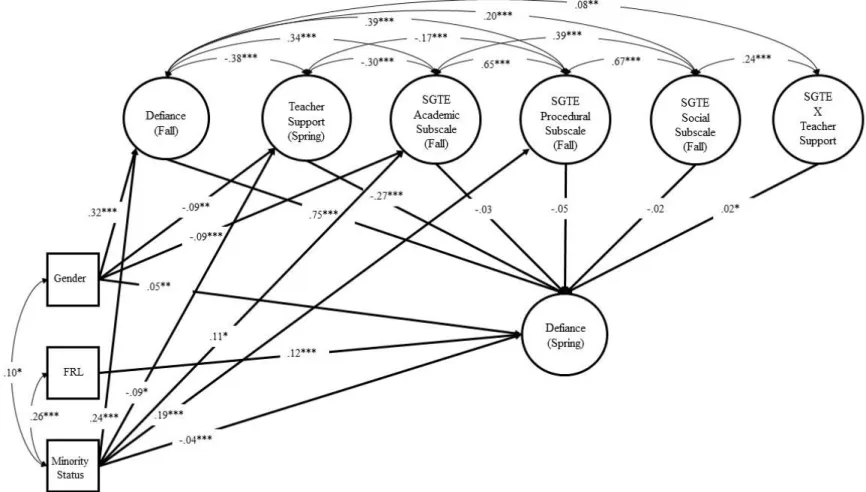
of sixth-grade transition experience (fall) and perception of teacher
support (spring) on student defiance……….……….78
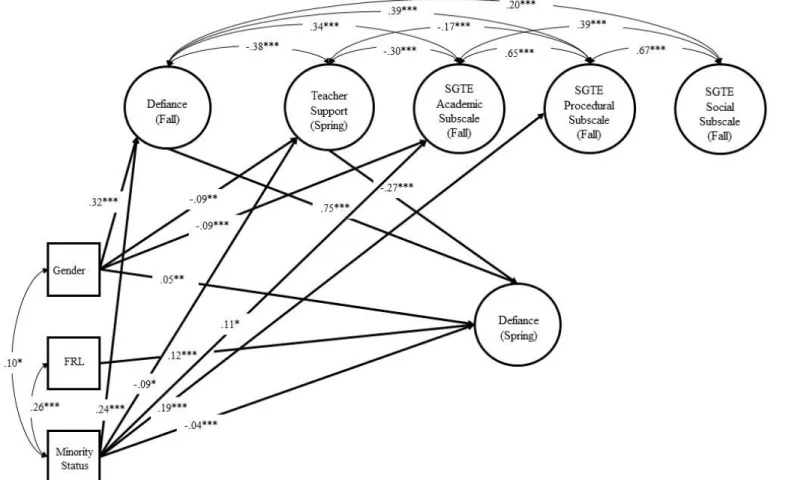
FIGURE 4: Structural model testing for direct effects of perception of sixth-grade transition experience (fall) and perception of teacher support
(spring) on student defiance………..……….79
FIGURE 5: Structural model testing for interaction effect of fall sixth- grade transition experience and spring teacher support on spring student
x
LIST OF ABBREVIATIONS AND SYMBOLS
ANOVA Analysis of Variance
CFA Confirmatory Factor Analysis
CASSS Child and Adolescent Social Support Scale CFI Comparative Fit Index
CI[ , ] Confidence Interval
F F statistic
FIML Full Information Maximum Likelihood GPA Grade point average
HSD Honestly Significant Difference
KMO Kaiser-Meyer-Olkin Measure of Sampling Adequacy
M Mean
MAR Missing at Random
MCAR Missing Completely at Random MNAR Missing Not at Random
N/n Sample size
p Probability
r Pearson product correlation
RMSEA Root Mean Square Error of Approximation SAT-MS Survey of Adaptational Tasks of Middle School
SAT-MS-R Survey of Adaptational Tasks of Middle School—Revised
xi
SD Standard deviation
SE Standard error
SEALS Supporting Early Adolescents’ Learning and Social Success SEsk Standard error skewness
SEku Standard error kurtosis SEM Structural Equation Modeling SES Socioeconomic status
SGTE Sixth Grade Transition Experience
t t statistic (Student’s t test) TLI Tucker-Lewis Index
TSR Teacher-Student Relationship VIF Variance Inflation Factor
WLSMV Weighted Least Squares Means and Variances Adjusted WRMR Weighted Root Mean Residual
α Cronbach’s alpha
β Beta
γ Gamma
1
CHAPTER 1: INTRODUCTION
As students enter and progress through the first year of middle school, they encounter new academic, procedural, and social demands such as higher academic expectations, frequent class changes, and new peer group interaction (Wigfield, Byrnes, & Eccles, 2006).
Unfortunately, these changes coincide with student social, emotional, and behavioral
maladjustment, including greater internalizing and externalizing behavior problems (Rudasill, Pössel, Black, & Niehaus, 2014; Witherspoon & Ennett, 2011). Internalizing behavior problems occur when an individual directs pressure or frustration inward resulting in symptoms such as depression, anxiety, and avoidance of social contact; whereas individuals with externalizing behavior problems project pressure or frustration outward by inappropriately seeking attention, being excessively defiant, or by using verbal or physical aggression (Lane et al., 2015; Walker, Ramsey, & Gresham, 2004). It is important for researchers and practitioners to understand factors in the schooling environment that influence student internalizing and externalizing behavioral issues in sixth grade, because antisocial behaviors often become more engrained and difficult to ameliorate as students progress through adolescence, often leading to incarceration (Dishion & Dodge, 2005; Moffitt, 1993). Moreover, long-term financial, health, and
interpersonal outcomes for adolescents experiencing internalizing behavior issues (e.g., social anxiety, panic, etc.) have been documented to be worse than those for adolescents who do not exhibit internalizing problems (Copeland, Angold, Shanahan, & Costello, 2014).
2
During this transition, students undergo a host of new challenges, including higher expectations for academic performance; integration into new and evolving peer social networks in multiple new contexts (e.g., bus, lunchroom, classroom, lockers, hallways, etc.), frequent class changes, and multiple teachers with whom to form relationships (Eccles & Roeser, 2010; Schunk, Pintrich, & Meece, 2008). Recent studies have documented that the degree to which students perceive they are meeting the new situational demands early in the first year of middle school has an effect on their end-of-year schooling adjustment, including behavioral problems (Day, Hamm, Lambert, & Farmer, 2014; Malley, Hamm, Harris, & Farmer, under review). As this line of research grows, it is important to understand how students’ perception of the transition
experience interacts with their perception of other aspects of the schooling environment— specifically teacher support—to influence their social-emotional and behavioral development.
During their transitions into new schooling environments, students have membership in multiple groups. Ongoing relationships containing two or more individuals, termed social convoys, represent critical contexts in which individuals experience interrelated growth and development (Moen & Hernandez, 2009). Typically students are embedded in various social convoys including family, peer groups, friends, and teachers (Benner, 2011; Entwisle,
3
next question to assess is the extent to which teacher support can amplify or attenuate the relationship between students’ perception of their transition experience during the first year of middle school and their subsequent end-of-year social, emotional, and behavioral adjustment.
The current study extends the literature by investigating whether or not students’ perception of teacher support by their team of teachers moderates the relationship between students’ experience of the transition at the beginning of sixth grade and their end-of-year internalizing and externalizing problems. We know from prior research that students who feel they are having difficulty responding to the new academic, social, and procedural demands of middle school exhibit greater externalizing behavioral problems (Malley et al., under review); we know that students who perceive their teachers as supportive experience fewer internalizing and externalizing issues (Tennant et al., 2014; Wang & Dishion, 2012); but we do not know whether or not students who experience difficulty with new situational demands will also experience differentiated social-emotional and behavioral adjustment based on the degree of teacher support they perceive. This study was designed to test the hypothesis that the level of teacher support students perceive during the first year of middle school will moderate the relationship between their perceived transition experience and their internalizing and externalizing behavioral outcomes in spring of sixth grade. If perceived teacher support influences the relationship between perceived transition experience and behavioral adjustment outcomes, teacher support would provide another point of entry for interventions targeting student internalizing or externalizing behavioral issues during the sixth-grade transition.
4
Augustine, & Constant, 2004). The sample of students in this study transitioned to middle school in sixth grade; thus, the sixth-grade year will be the focal timeframe, and supporting evidence will be drawn from research on students in the middle school transition year as defined within the context of each study.
Adjustment in the Middle School Transition Year
The potential for students’ perception of teacher support to reduce student
social-emotional and behavioral problems is encouraging, especially for students in the first year of the middle school transition, as the new situational demands students experience during the middle school transition increase the risk of developing antisocial habits and problematic behaviors (Eccles et al., 1993; Eccles & Roeser, 2009). Indeed, students’ navigation of challenges during the middle school transition year can be a turning point in their development, as students’ adjustment outcomes often begin a long-term decline in sixth grade which continues in subsequent grades (McGill, Hughes, Alicea, & Way, 2012; Roeser & Peck, 2003). These declines during the middle school transition year occur across a range of developmental areas (Anderman & Mueller, 2010), and include behavioral (Eccles & Roeser, 2009; Way, Reddy, & Rhodes, 2007; Witherspoon & Ennett, 2011) and social-emotional adjustment (Lanson & Marcotte, 2012; Pössel et al., 2013). These downward trends are especially concerning, as student antisocial attitudes and behaviors not attenuated in early adolescence can persist through the life span (Moffitt, 1993).
5
2006). Due to the effect that successful or unsuccessful navigation of the contextual demands students face in sixth grade has on their developmental outcomes, researchers have investigated linkages between students’ perception of their sixth-grade transition experience and their subsequent behavioral and schooling adjustment (Day et al., 2014; Malley et al., under review). Malley et al. (under review) documented that the contextual demands of the first year of middle school encompassed academic, procedural, and social challenges. The current study investigates the same construct as did Malley et al.: students’ perception of their sixth-grade transition experience; however, it will be referred to as students’ transition experience for brevity. Teacher Support and the Teacher-Student Relationship
Within the schooling ecology, the teacher-student relationship (TSR) has been identified as an integral and critical context for student development (Bronfenbrenner & Morris, 2006; Eccles & Roeser, 2010). Using self-determination theory (Deci & Ryan, 1985; Ryan & Deci, 2000) as a lens, I define the TSR as the interactive context between a student and one or more teachers that promotes optimal adjustment when the student perceives teacher support for his or her needs, specifically the psychological needs of autonomy, relatedness, and competence. As the TSR is frequently conceptualized and measured by student perception of teacher support (e.g., Reddy et al., 2003; Wang, Brinkworth, & Eccles, 2013), the focal variable in this study is studentperception of teacher support within the context of the TSR, or teacher support. Self-determination theorists typically focus on students’ perception of support, as students’ perception of autonomy, competence, and relatedness undergirds their feeling of self-determination and subsequent adjustment (Ryan & Deci, 2000; Ryan & Grolnick, 1986).
6
7
The current study was designed to extend the literature by examining the extent to which students’ perception of teacher support (a) increases the strength of the expected relationship between a positive transition experience and decreased student social-emotional and behavioral issues and (b) attenuates the linkage between negative transition experience and increases in student social-emotional and behavioral problems. While investigating these relationships, it is important to control for student individual differences (e.g., gender, race/ethnicity, free-and-reduced lunch status) as there are instances in the literature of differences in perception of teacher support based on gender (i.e., girls typically report higher teacher support than boys; Niehaus, Rudasill, & Rakes, 2012; Rueger, Malecki, & Demaray, 2010) and differences of strength of relationship between teacher support and adjustment outcomes based on socio-economic status (i.e., students of lower SES report higher teacher support; Way et al., 2007) and minority status (i.e., minority students report higher teacher support; Dornbusch, Erickson, Laird, & Wong, 2001). The current study includes gender, minority status, and free-and-reduced lunch status as control variables. The focus of the study is understanding the influence of students’ perceptions of processes in the schooling ecology which the school faculty and administration have the ability and responsibility to curate. Investigating the differential impact of demographic characteristics on student schooling outcomes is critical research; however, these are variables that the schooling ecology is not designed to alter. The current study is designed to further delineate linkages among schooling processes that can serve as potential targets for intervention and preservice preparation.
The Current Study
8
externalizing behavior to determine whether perception of teacher support moderates
relationships between students’ perception of the transition experience at the beginning of the year and their subsequent adjustment outcomes at the end of the year. The specific research hypotheses are:
1. Controlling for individual demographic differences and social anxiety symptoms and defiance at the beginning of the school year, students who perceive themselves as having a positive transition experience at the beginning of the sixth grade will report lower levels of social anxiety symptoms and defiance at the end of the school year.
2. Controlling for individual demographic differences and social anxiety symptoms and defiance at the beginning of the school year, students who perceive greater teacher support at the end of sixth grade will report lower levels of social anxiety symptoms and defiance at the end of the school year.
9
CHAPTER 2: THEORETICAL FRAMEWORK
The current study was guided by a combination of life course theory and
self-determination theory, as proponents of both theorize that the interaction between individuals and the contexts and environments they encounter is the driving force behind change in human behavior. Below, an integration of the two frameworks provides a rationale for students’
perception of their meeting situational imperatives in the transition experience influencing sixth-grade emotional and behavioral adjustment; students’ perception of teacher support predicting sixth-grade internalizing and externalizing problems; and students’ perception of teacher support moderating the relationship between students’ perception of the transition experience and their sixth-grade school adjustment.
Transition Experience and Sixth-grade Adjustment
10
1998). Thus, we expect students who perceive that they transition well to the realities of sixth grade will experience better adjustment outcomes at the end of the year. However, students do not learn to meet the many new situational imperatives of sixth grade alone: the life course theory principle of linked lives states that individuals’ development is influenced by the
relationships and interactions with the people around them (Elder, 1998, 2000). It is with these principles and mechanisms (human agency, linked lives, and situational imperatives) that self-determination theory not only aligns with life course theory but also extends it by providing an explanation of the types of support individuals need from their linked lives in order to become fully agentic and self-determined in meeting their situational demands.
The assumption at the core of self-determination theory is that all humans have three innate, inborn needs: competence, autonomy, and relatedness (Deci & Ryan, 1985; Ryan & Deci, 2000). From this assumption, self-determination theory posits that the degree to which the
environment meets individuals’ needs is the primary factor in individuals’ development. When individuals perceive that their needs for competence, autonomy, and relatedness are met, they become self-determined in their motivation and behaviors and have optimal development, functioning, and social-emotional outcomes. Conversely, students whose needs for competence, autonomy, and relatedness are thwarted become less able to direct the course of their
11
Social-emotional and behavioral adjustment. From the perspective of both theoretical approaches in this study, students’ social-emotional and behavioral adjustment during the transition year of middle school is of primary importance. The situational imperatives students face during their first year of middle school can be unfamiliar and daunting, and the pressure or stress inherent in these interpersonal situations are considered to be precursors to a range of internalizing and externalizing issues (Herres & Kobak, 2015). Further, as the school year moves on, students who do not perceive they are adapting well may feel increased pressure, frustration, or alienation, all of which are theorized to increase students’ risk of developing internalizing and externalizing behavior problems (Walker et al., 2004). It is important to consider both
internalizing and externalizing aspects when investigating students’ adjustment, as some
students’ emotional-behavioral problems can be inwardly directed (i.e., internalizing), outwardly directed (i.e., externalizing), or both (i.e., internalizing-externalizing; Lane et al., 2015). The current study includes one externalizing outcome, defiance, and one internalizing outcome, social anxiety symptoms. Both adjustment outcomes were selected to align with specific situational imperatives students face in the middle school transition.
12
them to exhibit defiant and disruptive behaviors. As the current study focuses on the influence of teacher support, the degree to which students exhibit defiant behaviors toward their teachers provides a more useful indicator than their generalized disruptive behavior to investigate how well students are being supported by their teachers during the sixth-grade transition.
The study also included social anxiety symptoms as an internalizing outcome measure in order to capture students’ social-emotional adjustment. Generalized anxiety is an important outcome and is commonly assessed in the middle school literature as the median onset age of anxiety is eleven (Kessler et al., 2005); however, social anxiety is better aligned with specific challenges students face in the sixth-grade transition, including making new friends, entering new social and physical surroundings, and building relationships with multiple teachers. In addition, students in middle school experience increased pressure for performance relative to their classmates as well as increased comparisons to their peers (Anderman & Anderman, 1999; Eccles & Midgley, 1989). In accordance with the life course theory principle of linked lives and the innate needs posited in self-determination theory, as students receive autonomy, competence and relatedness support from their teachers, they will experience fewer social anxiety symptoms during the sixth-grade transition.
Approaches to the Teacher-Student Relationship and Teacher Support
13
has been conducted for middle school students (Murray & Zvoch, 2011) and high school students (Al-Yagon, 2012; Demanet & Van Houtte, 2012). A second perspective to the TSR takes a more structural and process-oriented approach to the ongoing social interactions between teacher and student. Building on social-cognitive learning theory, researchers have viewed the TSR as a context wherein students both receive information through modeling and interaction as to which behaviors are accepted and receive information relating to their inherent worth based on the way others interact with them (Chang et al., 2004; Wentzel, 2010; Wentzel, Battle, Russell, & Looney, 2010). A third approach, and the one taken in the current study, is to approach the TSR as a context in which teacher support influences student adjustment through developing self-determined behaviors and attitudes (Deci et al., 1991; Ryan & Shim, 2012).
14
enhance students’ learning by providing them information and organization (e.g., competence support) and by scaffolding their approach to learning (e.g., autonomy support; Deci et al., 1991). Theoretically sound studies of self-determination support in the TSR should assess for all three types of support, especially when using the TSR to predict student schooling adjustment. Students’ Experience of Support in the TSR as a Potential Moderator
In the life course theory principle of linked lives, individuals’ development is influenced by the relationships and interactions with the people around them (Elder, 1998). Students’ schooling adjustment is viewed as occurring through interaction with other individuals in social convoys. These social convoys are the contexts in which individuals experience day-to-day events and inter-related development and growth (Moen & Fernandez, 2009). By integrating the life course conceptualization of social convoys with self-determination theory, one can
hypothesize that students who experience support within their convoys will develop the skillsets to successfully adapt to the situational imperatives of the sixth-grade transition. This section contains two primary theoretical arguments: (a) students’ teachers represent a critical social convoy “ferrying” them through the first year of middle school, and (b) students’ experience of autonomy support, competence support, and relatedness within their teacher social convoy will lead students to internalize the behaviors necessary to meet their situational demands and
experience positive schooling adjustment. These arguments support the hypothesis that students’ perception of teacher support moderates the relationship between their perception of their
15
Teachers as social convoys. Although any of these social convoys may be disrupted during the sixth grade transition, the social system that is normatively and structurally altered during the timeframe is that of the students’ teachers (Juvonen et al., 2004). In elementary school, students traditionally have one classroom teacher and may only have other teachers for extracurricular classes. However, in sixth grade, students typically take a range of classes, often led by different teachers (Juvonen et al., 2004; Wigfield et al., 2006). Although structurally normative, the disruption in students’ teacher social convoy has the potential to influence student adjustment, as social convoys serve as buffers during transitions (Almeida & Wong, 2009; Benner, 2011). Teacher social convoys have relevant prior knowledge of the middle school environment whereby they can help a student understand the academic, social, and procedural norms and behavioral expectations of their classrooms and school. Benner (2011) applied the idea of social convoys to the teachers of individual high school students, stating that students’ relationships with teachers in their social convoy can have long-term impact on their schooling adjustment and outcomes. Students’ peers also form an integral and important social convoy that is frequently disrupted during the middle school transition as well; however, the peer social convoy is beyond the scope of the proposed study.
In this study, I extended the idea of the social convoy of sixth-grade students’ teachers to include the group of teachers who interact with the students both inside and outside the
16
before seventh grade. Roeser and Peck (2003) use near-term to differentiate duration of
relationships: near-term relationships are those that typically have a confined and relatively short time period. As sixth-grade teachers tend to work with sixth-grade students for one year before students move to seventh grade and a different set of teachers (Wigfield et al., 2006), sixth-grade teachers constitute a near-term social convoy. Thus, the TSR may provide a buffering context wherein students who perceive they are not adapting well can be supported with autonomy, competence, and relatedness by their teacher social convoy. Students receiving teacher support may feel more successful in managing or alleviating their social-emotional and behavioral issues despite initial challenges in meeting the situational imperatives of the sixth-grade transition.
The importance of conceptualizing teachers as a social convoy is more transparent when considering student needs for self-determination within the TSR. Sixth-grade students have multiple teachers; they may perceive a supportive TSR with one teacher, but not with others. One teacher might provide competence support in one subject, but not provide support in other areas. In this study students’ perception of the overall support from all of their teachers for autonomy, competence, and relatedness is conceptualized as a more encompassing factor for their adjustment than support from one individual teacher.
17
Internalization through the TSR social convoy. According to self-determination theorists, internalization is the process by which individuals adopt the academic, social, and behavioral values of those who support their intrinsic needs for autonomy, relatedness, and competence (Grolnick, Gurland, Jacob, & DeCourcey, 2002; Ryan & Deci, 2009). Students enter sixth grade with different desires (e.g., good grades, popularity, teacher attention, and perfect attendance) and may struggle to achieve those desires in their new environment. As students receive assistance from their teachers, they typically begin to experience more success in their endeavors; it is at this point where a supportive TSR can influence student behavior through student desire for relatedness with, further competence support from, or greater autonomy from teachers (Reeve, 2009). Through continued interaction and support received in the TSR, students may realize the benefits of certain attitudes and behaviors, or they may enjoy the relatedness in the relationship with the teacher, or both. Students seeking competence or relatedness then begin to test the new attitudes or behaviors unbidden (Hardre & Reeve, 2003). Eventually, as students continue to see positive results, they autonomously integrate the tried and tested behaviors into their identity and sense of self (Ryan & Deci, 2009). Assuming a supportive TSR, the students’ values and behaviors necessary to navigate new situational imperatives become more
internalized, requiring less teacher support until the point that the student fully internalizes them. Salience of students’ perception. In the current study, teacher support is assessed by
student report rather than teacher report or observational data; this choice is due to the salience of the individual’s perception in self-determination theory. Human action and behavior are
18
student social-emotional outcomes (Ryan & Grolnick, 1986). In addition to theoretical justification for the use of students’ perception of teacher support, evidence for concurrent validity has been documented between the construct and observer ratings of teacher support (Patrick, Turner, Meyer, & Midgley, 2003).
Thus, students’ perception of support in the TSR across teachers in students’ social convoy should help them meet situational imperatives and experience positive school
adjustment. Therefore, I hypothesize that students’ relationship with the teachers in their social convoy is an important context and process which magnifies or offsets the relationship between the students’ perception of the sixth-grade transition experience and their adjustment outcomes. Demographic Differences in Sixth-grade Adjustment
To best understand the relationships between students’ transition experiences, teacher support, and adjustment outcomes, it is important to consider and account for students’ individual demographic differences. Adjustment during the sixth-grade transition may be
19
outcomes during sixth grade. Similarly, gender differences can affect students’ subjective experience of the sixth-grade transition, as pubertal timing and maturation occur during sixth grade more frequently for girls than for boys (Marceau, Ram, Houts, Grimm, & Susman, 2011). Last, despite equal capacity for educational development, students with lower socioeconomic status (SES) typically enter school behind their higher SES peers and are unable to catch up throughout the year (Entwisle et al., 2003), resulting in a large cumulative disadvantage by the time students enter middle school. Again, the transition experience is subjectively different for students from lower SES families, as they navigate exposure to—among other stressors—the social stigma of visibly receiving free-and-reduced lunch (Bhatia, Jones, & Reicker, 2011; Mirtcheva & Powell, 2009). Although this study included gender, minority status, and free-and-reduced lunch status as control variables, the focus of the study was understanding the influence of certain malleable schooling processes (e.g., transition challenges, teacher support) on student internalizing and externalizing behavioral adjustment. A better understanding of the interaction between these particular schooling processes would allow researchers to better develop new— and hone current—interventions, provide school administrators with actionable
recommendations, and improve practitioner training and professional development. It will be necessary for future research to be conducted to determine the effect of individual differences on the relationships examined.
The Current Study
20
21
CHAPTER 3: LITERATURE REVIEW
The middle school transition year can be a time of upheaval. Students experience a host of new challenges, including higher expectations for academic performance, multiple teachers with whom to form new relationships, a new social structure to navigate, and increased behavioral expectations (Eccles & Roeser, 2010; Schunk et al., 2008). These contextual tasks coincide with decreases in a full range of schooling adjustment factors during the middle school transition year (Anderman & Mueller, 2010; Eccles & Roeser, 2009). Relevant to the current study, sixth graders experience increases in internalizing symptoms (Rudasill, Pössel, et al., 2014; Lanson & Marcotte, 2012) and behavioral problems (Theriot & Dupper, 2010;
Witherspoon & Ennett, 2011) across the school year. Unfortunately, deterioration in schooling adjustment does not appear to lessen or reverse after sixth grade; rather adjustment continues to trend downward through high school (Barber & Olsen, 2004; McGill et al., 2012).
Although the decreased schooling adjustment outcomes across the middle school transition year are disconcerting, an investigation of the convergence of two traditional approaches—teacher support and students’ perception of the middle school transition
22
as a potential moderator of the relationship between transition experience and outcomes, and (d) student characteristics and individual differences.
Teacher Support and Internalizing and Externalizing Behavioral Problems
The school and classroom climate are focal areas for research on student adjustment as students spend the majority of their waking hours in schools (Juvonen et al., 2004). Within the middle school and classroom climate, students’ interactions with teachers and the support they perceive from their teachers are particularly relevant for their adjustment (Eccles & Roeser, 2009; Wenztel, 2010). Teacher support is most commonly assessed as teacher emotional support, or the degree to which students feel their teachers care about them and make the classroom an environment in which they can express their ideas and opinions freely (Wang, 2009). Students who perceived emotional support from their teachers were more likely to meet their teachers’ expectations, resulting in decreased misconduct and problem behaviors (Patrick, Ryan, & Kaplan, 2007). With regard to internalizing problems, students who reported higher levels of teacher emotional support experienced fewer depressive symptoms in sixth grade (Rudasill, Pössel, et al., 2014).
Emotional support is an important factor for emotional-behavioral adjustment; however, there are other ways teachers can provide students support. Within a self-determination
framework, students require support for their autonomy, competence, and relatedness in order to experience optimal development. Emotional support is best aligned with relatedness, and studies have documented that teacher emotional support increases students’ positive feelings of
23
conducted a series of studies to investigate the effect of teacher, peer, close friend, and parent support on student schooling adjustment investigating four different types of support: emotional, informational, instrumental, and appraisal (Demaray & Elliott, 2001; Malecki & Demaray, 2003; Rueger et al., 2010). Informational, instrumental, and appraisal support align with competence support in the self-determination framework, and a composite variable of the four types of support has been negatively associated with school misconduct and depression (Malecki & Demaray, 2003; Rueger et al., 2010). Wang (2009) included both teacher emotional support and promotion of autonomy, finding that both were negatively related to student emotional and behavioral outcomes. Researchers have investigated teacher support of student adjustment during middle school from a self-determination perspective; however, the one study (Klem & Connell, 2004) that included all three types of teacher support did not investigate internalizing or
externalizing behavior outcomes. The current study is designed to address this gap in the literature.
In terms of outcomes, teacher support is frequently associated with student adjustment across four major domains: academic, behavioral, emotional, and social (Wang, 2009). Researchers have typically examined its impact on academic or social outcomes, whereas the current study investigates the more under-developed literature on students’ emotional and behavioral outcomes. Because associations between teacher support and the specific
internalizing and externalizing behavioral outcomes included in this study, social anxiety and defiance, have not been documented, studies with similar behavioral outcomes are reviewed.
24
behavior problems for middle school students have been investigated in multiple studies. Wang (2009) tested the influence of teacher emotional support and promotion of autonomy on student adjustment, finding that both factors were negatively related with student problem behaviors and depression. Davidson and Demaray (2007) found that teacher emotional and competence support predicted internalizing and externalizing behavior problems for both male and female middle school students. Way et al. (2007) tested for bi-directionality in the relationship, determining that teacher support had a positive unidirectional effect on psychological and behavioral adjustment. In addition, autonomy opportunities were negatively associated with behavior problems and depressive symptoms (Way et al., 2007). Thus, all three types of teacher support have documented associations with internalizing and externalizing problems.
Teacher support and externalizing behavior problems. Teachers are responsible for setting behavioral rules and expectations as well as enforcing consequences when students’ behavior becomes disruptive (Farmer et al., 2006; Farmer et al., 2013). The decline across the middle school transition year in both student behavioral outcomes (Theriot & Dupper, 2010) and the teacher support they receive (Reddy et al., 2003; Way et al., 2007) is not a coincidence. Students experiencing teacher support are more likely to participate in adaptive solutions like help seeking (Patrick et al., 2003; Ryan & Shim, 2012), while students whose needs are not met by their teachers do not have optimum adjustment (Deci et al., 1991) and externalize their frustration through problematic behaviors, experience internalization outcomes like anxiety, or both (Walker et al., 2004).
25
2013), and fewer discipline problems for middle schoolers (Crosnoe et al., 2004). Longitudinal evidence exists as well. Increased levels of perceived teacher emotional support in sixth grade correlated with fewer externalizing behavior issues in sixth grade, and changes in teacher emotional support predicted behavioral problems throughout middle school (Wang & Dishion, 2012). The practical significance of the teacher support-behavioral outcome relationship appears to be strong, as teacher emotional and competence support predicted 30% of the variance in school maladjustment for students in grades 5-8 (Malecki & Demaray, 2003). The relationship between teacher support and student externalizing behavior is not solely a North American phenomenon, as one study documented findings supporting the relationship for middle school students in Norway (Bru, Murberg, & Stephens, 2001).
A similar approach to teacher support is to investigate closeness and conflict within the teacher-student relationship. Closeness within the TSR predicted student aggressiveness, with less closeness in the TSR corresponding to more aggressive behavior for sixth-grade students (Davidson, Gest, & Welsh, 2010). Similarly, students with more closeness and less conflict in the TSR exhibited less risky behavior in sixth grade (Rudasill, Reio, Stipanovich, & Taylor, 2010). Students at risk for emotional and behavioral problems in grades 5 through 8 who felt more connection, more trust, and less alienation from their sixth-grade teachers had fewer conduct problems (Murray & Zvoch, 2011). No study was identified, however, that explicitly examined the effect of teacher support on student defiance of the teacher. The current study will address this gap.
26
relatedness experience declines in their emotional adjustment (Ryan & Deci, 2000). The most frequently assessed emotional adjustment outcome for sixth graders in studies of teacher support is depression or depressive symptoms. Teacher support has been linked to social self-concept or depressive symptoms for American, Australian, Belgian, Canadian, and Norwegian middle school students (Demaray et al., 2009; Galand & Hospel, 2013; Lanson & Marcotte, 2012; Murberg & Bru, 2004; Pössel, Rudasill, Sawyer, Spence, & Bjerg, 2013), with multiple studies supporting an association between increased levels of perceived teacher support and either increases in social self-concept or decreases in depressive symptoms for sixth-grade students (Demaray et al., 2009; Rudasill, Pössel, et al., 2014). One study revealed the teacher support-depression association maintains after the transition year, as teacher emotional and competence support at middle school entry was associated with lower depressive symptoms 20.5 months after student entry into middle school (Rueger et al., 2014). Rudasill, Pössel et al. (2014) documented evidence that students’ perception of support in the TSR and teacher perception of bonding in the TSR were correlated and both predicted decreases in student depressive symptoms during sixth grade. The correlation and concurrent predictive validity between student and teacher perception of support in the TSR strengthens the rationale for using students’ perception of teacher support as theoretically sound and empirically supported, specifically with regard to associations with sixth-grade students’ internalizing outcomes. A review of the literature, however, did not yield a study linking teacher support with the internalizing outcome of social anxiety for students in the middle school transition year.
27
Furrer and Skinner (2003) found that relatedness in the TSR—in the presence of low relatedness to parents and peers—was linked with higher emotional engagement for third- through sixth-grade students, with the strongest effects for students in sixth sixth-grade. Because anxious students tend to withdraw physically and emotionally, the findings of Furrer and Skinner (2003) lend empirical support for the hypothesis that teacher support will be associated with social anxiety symptoms across the middle school transition year. Beyond teacher support, another important factor influencing student behavior outcomes is students’ experiences of the transition to the situational imperatives of the middle school transition year.
Students’ Perception of the Middle School Transition Year
Research investigating the relationship between students’ perception of the middle school environment and their adjustment outcomes is relatively robust (Eccles & Roeser, 2009; Wang & Eccles, 2012). Recent research has replicated prior findings that students’ perception of support in the school context decreases across the middle school transition year (Roeser & Eccles, 1998; Rudasill, Niehaus, Crockett, & Rakes, 2014; Wang & Dishion, 2012). Students’ perception of their experience of the transition itself, on the other hand, has received substantially less attention. Elias and colleagues (1992) made a foray into students’ perception of the middle school transition and provided solid conceptual ground that, although not explicitly mentioned by the authors, is in alignment with life course theory and the mechanism of situational
28
higher levels of academic pressure, substance abuse, and conflicts reported lower levels of perceived academic competence.
Akos and colleagues (Akos, 2002; Akos & Galassi, 2004a; 2004b) provided further evidence for specific contextual demands in the middle school transition via descriptive studies of student concerns and worries. Upon entering middle school, sixth graders were most
concerned about getting lost, being tardy to class, handling an increased homework load, and being bullied (Akos, 2002; Akos & Galassi, 2004a). Based on these findings, the authors concluded that adjustment during transitions is a process with intertwined components in three different areas: academic, procedural, and social. Malley et al. (under review) documented further evidence for these three transition process components, finding that the latent constructs in an assessment of students’ perception of their sixth-grade transition experience were aligned with the academic, procedural, and social situational imperatives students experience during their middle school transition year. Further, students’ sixth-grade transition experience predicted students’ subsequent schooling adjustment outcomes, with positive academic and social
transition experiences in the fall of sixth grade predicting increases in student school belonging and academic achievement, as well as decreases in defiant behaviors in the spring of sixth grade (Malley et al., under review). When considering student adjustment during the sixth-grade transition, it is important to understand which contexts—such as the TSR—can serve as a moderator between students’ perception of the transition experience at the beginning of sixth grade and their end-of-year adjustment.
Teacher Support as a Moderator
29
students’ sixth-grade transition experience and their schooling adjustment outcomes. Although a direct link between student transition experience and teacher support has yet to be empirically established, theory and empirical support exists to test for a relationship.
Teacher support and students’ transition experience. Teachers’ familiarity with the
challenges students face put them in a unique position to support students in the three areas of situational imperatives: academic, procedural, and social demands.
Academic demands. Teachers set the academic expectations for students and are tasked
with supporting students’ academic growth. Multiple studies have investigated the differential impact of support source (e.g., teacher, peer, parent, close friend) on student academic
adjustment, finding teacher support to be the best predictor. Malecki and Demaray (2003) tested parent, teacher, classmate, and close friend support across four dimensions: emotional,
informational, appraisal, and instrumental. Teacher emotional support was the only indicator of the sixteen tested that was associated with student academic competence (Malecki & Demaray, 2003). In another study both teacher and peer support predicted academic initiative (Danielsen, Wiium, Wilhelmsen, & Wold, 2010). However, a latent variable formed by a combination of teacher emotional support and autonomy support suppressed peer support, causing it to drop out of the model for predicting academic initiative. Thus the TSR provides a context wherein students can receive the support they need to adapt to academic challenges in the middle school transition year.
Procedural demands. As students transition through middle school, they are expected to
30
each of their classes, because teachers often differ in how they want students to prepare and act in class (Davis, 2006; Lane, Wehby, & Cooley, 2006). Wentzel (2002) investigated the impact of teacher expectations, verbal feedback, rule setting, fairness, and motivation, finding they
impacted sixth graders’ responsibility goal pursuit, class interest, and prosocial behavior. Similarly, teacher emotional support accounted for almost a third of the variance in student school maladjustment for students in grades 5 through 8, and peer, close friend, and parent support were not significantly associated with student school maladjustment (Malecki &
Demaray, 2003). These findings suggest that the TSR provides a promotive context for students to adapt behaviorally to middle school procedural demands.
Social demands. In many schooling situations the teachers establish the classroom social
context through their interaction and communication with students about what types of social behavior is acceptable (Farmer, Lines, & Hamm, 2011). Although not always fully successful, teachers are situated to be the leaders of the classroom (Farmer, 2000). There is evidence that supportive teacher relationships impact student social adjustment relative to other sources of support. Demaray et al. (2009) assessed support from teachers, parents, classmates, and close friends. Results indicated that the frequency of support from each source predicted student self-concept. However, for perceived importance of support, only support from teachers predicted students’ self-concept. Malecki and Demaray (2003) also documented that only teacher
emotional support was associated with student social skills competence—classmate, close friend, and parent support did not have a significant association.
31
adjustment; however they provide evidence of teachers’ critical role in supporting student academic adjustment across the sixth-grade year, even relative to other sources of support.
32
reasonable to expect it to moderate the relationship between students’ perception of their transition to sixth-grade situational imperatives (which include a social component) and their end-of-year internalizing and externalizing outcomes.
However, it is important to note that teacher support might not always yield a positive outcome. In a large study of Australian adolescents in grades 8 through 12, emotional support from the teacher was found to affect the relationship between student stressful life events and depression (Pössel et al., 2013). Students who reported both more stressful life events and high teacher support experienced less depression than students who reported low teacher support. On the other hand, students with fewer stressful life events reported more depression if they
experienced high teacher emotional support than low teacher emotional support. The authors may have not have found this iatrogenic effect if they had assessed for autonomy and
competence support as opposed to solely emotional support, as students with fewer stressful events may have needed more of other types of support in the TSR. Indeed, some students reported valuing teacher provision of choice of reading material and completing difficult projects more than gaining teacher praise (Daniels & Arapostathis, 2005). As the proposed study assesses all three types of support in the TSR, iatrogenic effects are not anticipated. Teacher support is expected to moderate the relationship between transition experience and student schooling adjustment.
Student Characteristics and Individual Differences
33
Individual differences and teacher support. The studies reviewed found gender differences in teacher support, with girls experiencing more school support in sixth grade (Niehaus et al., 2012; Reddy et al., 2003) higher levels of relatedness with teachers (Rueger et al., 2010), and higher teacher social expectations (Wentzel et al., 2010). However boys may experience better outcomes when teacher support serves as a moderator, as boys who evidenced low effortful control but perceived higher teacher support reported fewer depressive symptoms than their female counterparts (Wang et al., 2013). Differences related to ethnicity have also been documented, as the results from two studies revealed that the relationship between the TSR and school engagement is more strongly positive for African American students (Downey & Ainsworth-Darnell, 2002; Ferguson & Mehta, 2004). Similarly, students from minority groups tend to experience greater benefit from supportive or close TSRs than non-minority students (Crosnoe et al., 2004). A study with a low-income minority student sample found students with a high quality TSR had better emotional, behavioral, and schooling adjustment (Murray & Zvoch, 2011). Comparatively, students from lower socio-economic backgrounds fared better when experiencing a supportive TSR than did students from higher socio-economic backgrounds (Crosnoe et al., 2004; Dornbusch et al., 2001). Although the TSR can have differential influence, the lack of consensus and shortage of evidence makes it difficult to expect certain relationships based on individual differences.
34
and their defiance in the spring of sixth grade. Girls’—but not boys’—perception of their procedural transition experience predicted their end-of-year defiance. Similarly, a positive academic transition experience predicted lower defiance for students who were full pay in comparison to students who received free or reduced lunch. Lastly, procedural transition experience predicted higher defiance for students receiving free or reduced lunch than for full pay students.
Hypotheses
As there is ample evidence for a relationship between students’ perception of meeting sixth-grade situational imperatives and their behavioral adjustment and strong evidence to support the assertion that teacher support influences behavioral adjustment during sixth grade, the current study investigated whether teacher support will amplify the relationship between students’ perception of the sixth-grade transition experience and positive internalizing and externalizing outcomes and mitigate the relationship between negative transition experience and negative adjustment outcomes. The specific hypotheses that were tested are:
1. Controlling for individual demographic differences and social anxiety symptoms and defiance at the beginning of the year, students who perceive themselves as having a more positive transition experience at the beginning of the sixth grade will report lower levels of social anxiety symptoms and defiance at the end of the school year.
35
3. Controlling for individual demographic differences and social anxiety symptoms and defiance at the beginning of the year, teacher support will moderate the relationships between transition experience and the end-of-year outcomes social anxiety symptoms and defiance, such that students who rate their transition experience as positive will report lower levels of social anxiety symptoms and defiance when they perceive higher levels of teacher support as compared when they perceive lower levels of teacher support.
36
CHAPTER 4: METHOD
The current study used data from six control schools which participated in the Supporting Early Adolescents’ Learning and Social Support (SEALS) research study. The study was a
cluster-randomized control trial of the impact of the SEALS professional development
intervention (Farmer et al., 2013) for sixth-grade teachers on students’ middle school adjustment. Researchers grouped schools into matched pairs based on demographic and geographic
similarities, and one school in each pair was randomly assigned to receive the intervention. Participants
Schools. All schools in the sample were non-charter public schools from metropolitan areas in three states: two in the Southeast and one in the Northeast. School demographic data (Table 1) were collected from the National Center for Educational Statistics (NCES) for the 2012-2013 school year (NCES, 2014). School size ranged from 459 to 835 (M = 592.50, SD = 124.71), and the number of students in sixth grade ranged from 152 to 264 (M = 188.67, SD = 36.60). The sample consisted of only schools in the non-intervention (i.e. control) group.
Students. The original sample included 630 sixth-grade participants attending the six middle schools. Once students who did not participate in both fall and spring surveys
administrations were removed, the final sample numbered 515. The overall consent rate was 54.14%. The percentage of participants who identified as minority race/ethnicity within each school ranged from 13.00 to 67.01% (M = 40.94, SD = 16.70), and the percentage of participants within each school who received free or reduced lunch ranged from 28.01 to 60.27% (M = 45.93,
37
17.70 to 80.40 (M = 45.18, SD = 22.06) and the participants’ average reading proficiency score by school ranged from 35.20 to 83.00 (M = 57.03, SD = 18.70).
Procedures
Data were collected from all students who were present on the days of survey
administration and whose parents provided consent for their participation. At the appointed time, students were released to a location within the school and were seated at intervals by project staff to decrease students’ ability to talk with each other or to see one another’s answers during the survey administration. Students were also provided a blank sheet of paper and encouraged to cover their answers as they progressed. Once all students were seated a member of the project staff informed students about the purpose of the study as well as their parents’ consent for their participation. The staff member reminded students that their participation was voluntary, that they could leave at any time, and that they could ask questions either before, during, or after the survey. The students were instructed to raise their hands if they needed anything, and the other staff member(s) present would attend to them. According to established protocol, the staff member then read through the survey as students answered the prompts and other staff members monitored students. Students were given school supplies for their participation.
Students completed the surveys in the fall and spring of sixth grade. Survey
administration dates were determined in coordination with school recruitment dates and school scheduling preferences, particularly to avoid spring testing. Surveys were administered between four and five months apart in time at each school. With one exception, fall surveys were
38
provide students time to experience new behavioral demands and form new relationships with teachers and peers. The survey administration at one school occurred in December and May. Measures
Student participants completed a comprehensive survey about their and their peers’ social, behavioral, and academic adjustment and middle school experiences. The measures included in the current study focus on students’ perception of their transition experience, teacher support, and emotional-behavioral adjustment in sixth grade. Only data from surveys completed during fall and spring of sixth grade were included in this study.
Perceived sixth-grade transition experience. The SAT-MS-R: Survey of Adaptational Tasks of Middle School—Revised (Malley et al., under review) is a 15-item measure adapted from the SAT-MS (Elias et al., 1992). The SAT-MS-R assesses sixth-grade students’ adaptation to new academic and social behaviors required of them during the middle-school transition year, such as dealing with peer pressure, handling an increased academic workload, and managing multiple textbooks. Student response options are on a four-point Likert-type scale, anchored by
No problem (1) and Large Problem (4). The SAT-MS-R has demonstrated good internal
consistency, with its three subscales each having Cronbach’s alphas greater than or equal to .70: procedural subscale = .70, academic subscale = .72, and social subscale = .79.
Measurement invariance across gender and partial, invariance across ethnicity has been documented (Malley et al., under review). In addition, all subscales of the SAT-MS-R
39
Perceived autonomy support. Students’ perception of teachers’ support of autonomy is adapted slightly from a two-item measure that Danielsen et al. (2010) altered from a larger scale assessing student involvement in high school (Fraser, 1989). The clause “in my classes”was added to each item to parse students’ perception of teacher support of autonomy from potential conflation with their perception of teacher autonomy support of students in other classes or grades. Items were “students in my classes have a say in their use of class time” and “students in my classes have a say in classroom activities.” Students reported their agreement on a Likert-type scale ranging from 1 (strongly disagree) to 5 (strongly agree). The two items were shared a high correlation (r = .86) based on a sample of 13-year-old students (Danielsen et al., 2010). The measure has also been documented to form a second-order latent construct “pedagogical caring and autonomy support” with the perceived emotional support measure included in this study. The pedagogical caring and autonomy support second-order latent construct explained 74% of the variance in academic initiative of early adolescents (Danielsen et al., 2010), providing evidence for the convergent and predictive validity of the measure. Perceived autonomy support data from the spring administration of the survey are included in the study.
Perceived competence support. Students’ perception of teachers’ competence support
40
point Likert-type scale for agreement, with anchors at 1 (Strongly Disagree) and 5 (Strongly Agree). In its original format, the subscale has been demonstrated to have high internal
consistency for a sample 5th through 8th grade students ( = .81-82; Malecki & Demaray, 2003). Test-retest correlations over an eight-week period range between .60 and .76 for the CASSS subscales (Malecki & Demaray, 2002). The three items are: “my teachers explain things when I’m confused”, “my teachers give good advice”, and “my teachers in this school help me solve problems”. With regard to convergent validity, the CASSS has demonstrated a strong correlation (.70) with the Social Support Scale for Children (Harter, 1985). The CASSS has been
documented to have predictive validity for a range of student adjustment outcomes including attention in school, anxiety, depression, self-esteem, and GPA (Rueger et al., 2010). Perceived competence support data from the spring administration of the survey are included in the study. Perceived emotional support. A two-item measure was adapted from Torsheim, Wold, and Samdal (2000) to assess students’ perception of emotional support from the teachers in their school. The items are “most of my teachers are friendly” and “most of my teachers treat me fairly”. The second item was slightly altered from its original form “our teachers treat us fairly” in order to assess the students’ perception of the emotional support they received from teachers rather than their generalized sense of whether or not teachers were supportive of other students in the school. The response options for the two items are arranged on a five point Likert-type scale, anchored at 1 (strongly disagree) and 5 (strongly agree). This two-item measure has been demonstrated to have high internal item correlation on a sample of 13-year-old students (r = .80; Danielsen, et al., 2010), and test-retest correlation (r = .69) was strong on a sample of
41
emotional support measure and both a school motivation scale and a perceived teacher support availability scale (Danielsen et al., 2010). Perceived emotional support data from the spring administration of the survey are included in the study.
Social anxiety symptoms. A seven-item subscale of the Screen for Child Anxiety Related Emotional Disorders, Child Version (SCARED) screening instrument for childhood social fears (Birmaher et al., 1999) was used to assess student social anxiety. An example item is “I feel nervous when I am with people I don’t know well”. The directions for the scale ask children to read a list of sentences and to decide whether each statement is “Not True or Hardly Ever True,” “Somewhat True or Sometimes True,” or “Very True or Often True” for them over
the last 3 months. A meta-analysis of studies utilizing the SCARED with older children and adolescents across seven countries revealed that the social anxiety subscale consistently emerges as an independent factor with high internal reliability across cultures (mean = .80, range = .75 - .89; Hale, Crocetti, Raaijmakers, & Meeus, 2011). Social anxiety data from both the fall and spring survey administrations were included in the study.
Defiance. The defiance scale is a five-item measure that assesses students’ perception of the frequency of their defiant behaviors (Midgley et al., 2000). Students are asked to indicate how true statements are for them on a five-point Likert scale, anchored on 1 = not at all true and 5 = very true. An example item is “I sometimes don’t follow my teacher’s directions during
42
Demographic variables. Students’ gender, minority status, and free/reduced lunch status
were obtained from school record data. Gender, minority status, and free/reduced lunch status were dummy coded so that 0 = female, non-minority, and full-pay lunch status, respectively. Participants’ fall scores on both outcome variables were used as control variables for their spring outcomes.
Plan of Analyses
The purpose of the proposed study was to investigate the extent to which students’ perception of teacher support and students’ perception of the sixth-grade transition experience directly and interactively influenced their schooling adjustment outcomes at the end of sixth grade. Structural equation modeling (SEM) was chosen as the primary method of analysis because it permits researchers to partition measurement error and estimate relationships between latent variables (Bowen & Guo, 2012).
MPlus version 7.31 (Muthén & Muthén, 2015) was selected to perform the structural models because of its capability to handle the unique characteristics of the data in the study: ordinal variables with potentially non-normal univariate and bivariate distributions; clustered data (i.e., students nested in schools); and missing data. The MPlus program includes the weighted least squares means and variances adjusted (WLSMV) estimator that can account for potential violations of univariate and multivariate normality associated with the ordinal nature of the data (Brown, 2006) as well as documented violations of multivariate normality in the SAT-MS-R (Malley et al., under review). The WLSMV estimator allows for clustering of data; thus, recommendations to account for the non-independence of observations due to the nested nature of the data (Hoyle, 2012; Rabe-Hesketh, Skrondal, & Zheng, 2012) were heeded by
43
also includes the full information maximum likelihood (FIML) procedure, which incorporates all data regardless of whether a case had any missing values. FIML has been documented to handle missing data better than other procedures (Enders & Bandalos, 2001).
Testing of alternative models is a recommended practice when using SEM analysis (Kline, 2005). Alternative model testing allows researchers to compare competing models to determine which model fits the data best. In the current study, the hypothesized measurement model was estimated first, and subsequent measurement models were estimated to determine whether a second-order factor structure for either or both independent variables best fit the data. Then the total effects structural model which includes both direct effects and the latent
interaction term was tested for each outcome. If a significant relationship was revealed for the interaction construct, a second structural model testing only direct effects was estimated in order to determine which structural model best fit the data. To determine the appropriateness of the proposed models for the data, model fit indices were analyzed including comparative fit index (CFI), Tucker-Lewis index (TLI), root mean square error of approximation (RMSEA) and the weighted root mean square residual (WRMR). The CFI is robust to small sample size
(Tabachnick & Fidell, 2007), which provides assurance despite the adequate sample size of the current study. Recommended cut-off scores will be used for each indicator: CFI and TLI > .95 (Hu & Bentler, 1999), RMSEA < .08 (MacCallum, Browne, & Sugawara, 1996), and WRMR < .09 (Muthén & Muthén, 2013).