Suitabilty of Palm Kernel Shell As Coarse Aggregate In
Lightweight Concrete Production
Williams, F.N1*, Ijigah, E.A1 Anum, I2, Isa, R.B1 and Obanibi, A.O1 1. Department of Building, Federal University of Technology,
Minna, Niger State, Nigeria.
2. Department of Building, Modibbo Adama University of Technology, Yola, Adamawa State, Nigeria.
* E-mail: [email protected] Abtract
Palm kernel shell(PKS) is an agricultural waste which is environmental friendly. This research was focused on the assessment of characteristic strength of palm kernel shell concrete, with the view to be used as lightweight aggregate. This research is carried out to help in reducing construction cost in areas where lightweight concrete canbe considered. Various tests were carried out in order to ascertain its use as lightweight aggregate. The aim was achieved by casting the beam and cubes with total replacement of granite with PKS and also casting an equivalent control to give a basis for comparison and a water cement ratio of 0.65 at a mix ratio of 1:2:4. A total of 24 beams and cubes each were cast respectively . They were cured for 7, 14, 21 and 28days. Crushing of 3 each for the Palm Kernel Shell Concrete (PKSC) and Normal Weight Concrete (NWC) for each curing day upto the age of 28 days was carried out. The results of crushing values are as follows for 7, 14, 21 and 28 days; 14.47N/mm2, 18.49N/mm2, 20.33N/mm2 , 23.00N/mm2 and 7.40N/mm2, 9.20N/mm2; 11.30N/mm2 , 13.10 N/mm2, for NWC and PKSC respectively. The value for the flexural strength is as follow; 1.87, 0.91, 1.36, 1.81 and 0.34, 0.34, 0.40, 0.34 for NWC and PKSC respectively. The results showed that the compressive and flexural strength improved with age of curing, though the compressive and flexural strength of PKSC is low as compared to that of the NWC. It was concluded that the compressive and flexural strength of NWC is higher than that of PKSC. Therefore PKSC canbe used as lightweight concrete which should be designed with the corresponding design for NWC. It can therefore be concluded that palm kernel shell is a lightweight aggregate and can be used to produce lightweight concrete.
Keywords: Palm kernel shell, lightweight aggregate, compressive strength, flexural strength 1. Introduction
Continuous increase in the cost of construction is one of the major challenges the construction industry is encountering and quality discharge of great number of developmental project, as such projects are dependent on some factors of production which is the cost of materials (Anthony, 2000). In line with this, Shetty (1999) affirmed that the prices of concrete elements primarily depends on the cost of material and labour. According to Falade, Ikponmwosa and Ojediran, (2010) the volume of concrete is composed of about 70-80% of coarse aggregate, which is to connote that the percentage is of considerable importance. The use of natural agricultural and industrial bye product has now become imperative as alternatives to the use of granite that causes noise pollution during manufacturing according to Falade et al, (2010).
Lightweight Concrete therefore has been in use since the time of ancient Roman and that has lead to it been famous due to its lower density and thermal insulation properties (Chandra and Berntsson, 2002). They also added that lightweight concrete helps in a great way to reduce the dead load of a structural component, which makes it considerable in the construction of multi-storey buildings.
According to Olutoge,(1995) Palm Kernel Shells(PKS) are gotten from threshing or crushing mill to remove the palm seed after the palm kernel oil has been extracted. He added that during the process of extracting the oil at the mill industry, the solid residues and liquid wastes are obtained. PKS are known to have stony and hard endocarps that serve as protective covering for the palm kernel which are usually in diverse sizes and shapes. They are naturally sized, light in weight and are appropriate for replacing coarse aggregates in lightweight construction, since they are known to be hard and of organic origin, once used to produce concrete, they hardly contaminate or leach to form toxic substances, since they are attracted together in matrix form. He therefore asserted that the PKS used for lightweight concretehas an advantage over aerated concrete, since permeability is low and the chance for carbonation is reduced. Okafor (1988) described palm kernel shell to have irregular shape after cracking and therefore its shape cannot be defined. The shape takes pattern of cracking on the shell and usually composed of many shapes ranging from semi-circular shapes, parabolic, other irregular and flaking shapes. After cracking, the edges of the shells are rough and spiky and the overall shape becomes concave and
The rise in the need for concrete in the construction industry using Natural weight aggregates such as granite or gravel has greatly reduced the availability of natural stone and has lead to the damaged of the environment leading to imbalance of the ecological system (Short and Kinniburgh, 1978). Theybalso added that there is the necessity to explore and findout good replacement material to replace the natural stone. In the developed countries, construction industries have researched many natural and artificial lightweight aggregates that can serve as replacement for conventional aggregates thereby bringing down the structural sizes of the members (Ramli,2003). He also added that this has brought incredible changes in the development of lightweight concrete in high rise structures using lightweight concrete. However, in developing countries, the construction industry is yet to fully make use of lightweight concrete in the construction of high rise structures. The use of PKS is essential because the requirement of vegetable oil is regularly increasing and commercial cropping of palm oil is needed in the future (Ramli,2003).
2. Materials and Methods
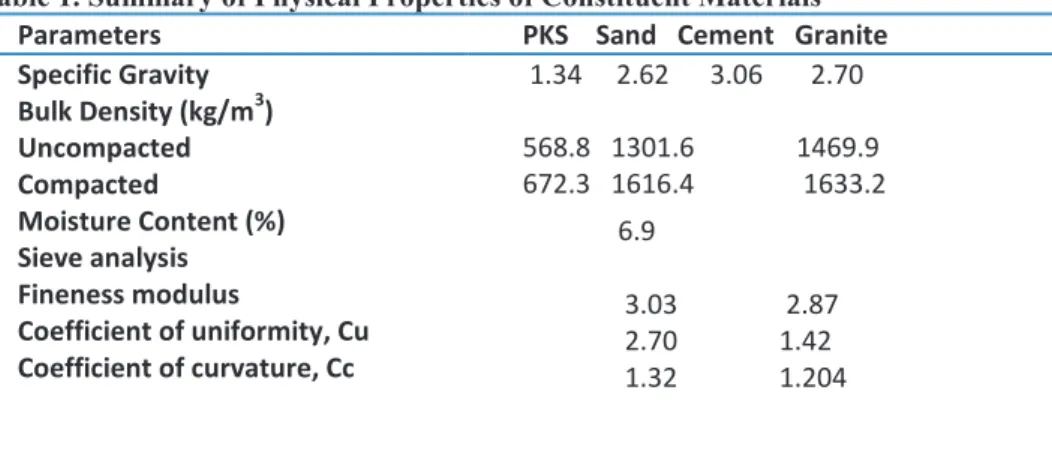
The research work was carried out with the use of the following equipments; (100×100×100)mm molds for cubes, shovel, weighing balance, sieves of different sizes, measuring pan, tamping rod, crushing machine for strength test for both flexural and compressive all available in Building laboratory Federal University of Technology Minna, Niger state. The materials that was used for this research work are coarse aggregate (maximum 19mm) which was obtained from a nearby quarry, palm kernel shell which was obtained in minna, Niger state likewise the fine aggregate. Table 1 shows the summary of the physical properties of the constituent materials used which includes specific gravity, moisture content and bulk density.
Table 1. Summary of Physical Properties of Constituent Materials Parameters PKS Sand Cement Granite Specific Gravity Bulk Density (kg/m3) Uncompacted Compacted Moisture Content (%) Sieve analysis Fineness modulus Coefficient of uniformity, Cu Coefficient of curvature, Cc 1.34 2.62 3.06 2.70 568.8 1301.6 1469.9 672.3 1616.4 1633.2 6.9 3.03 2.87 2.70 1.42 1.32 1.204
3. Results and Discussion
The results of the workability tests as shown in table 2 on each sample show that the PKSC sample requires more water due to it is high water absorption capacity. The results obtained from the crushed granite concrete indicate a true slump. The workability test indicated that granite was also within the range but that of PKSA was quite workable but did not slump as some of the water were absorbed.
Table 2. Workability test of Normal Weight Concrete(NWC) and Palm Kernel Shell Concrete(PKSC). S/No Paste W/c Degree of workability
Table 3. Summary of average Compressive Strength Test
TEST (N/MM2)
7 DAYS 14 DAYS 21 DAYS 28DAYS
NWC 14.47 18.49 20.33 23.00
PKSC 7.40 9.20 11.30 13.10
Figure 1. Chart of Average NWC Compressive Strength against PKSC
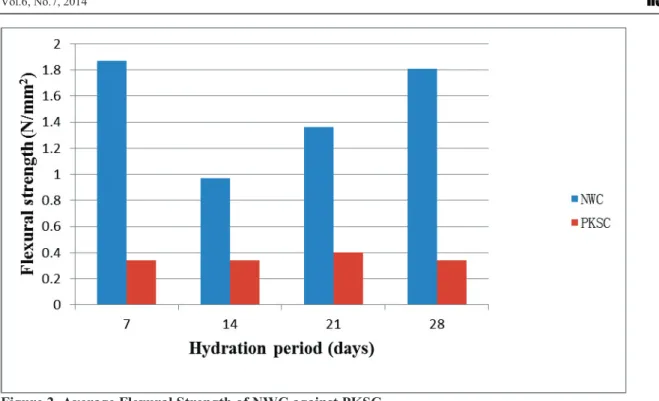
From table 4, it was observed that the flexural strength of palm kernel shell and the normal weight concrete was increasing with curing age, but that of PKSC did not. This implies that PKSC cannot withstand the flexural strength. This indicates that the crushed granite has a greater flexural strength as compared to PKSC.
Table 4. Summary of average Flexural Strength Test
TEST (N/MM2)
7 DAYS 14 DAYS 21 DAYS 28DAYS
NWC 1.87 0.91 1.36 1.81
Figure 2. Average Flexural Strength of NWC against PKSC
The average densities of cubes produced with periwinkle shell aggregates are 3760.00kg/m3, 3943.33kg/m3, 4006.67kg/m3 and 4586.67kg/m3 which lies between the densities range of 300kg/m3 to 1850kg/m3 [Neville and Brooks, 1987] for lightweight concrete.
4. CONCLUSION
§ This research work vividly shows that PKS can be used for concrete production as lightweight aggregate and therefore canbe used to produce lightweight concrete. The properties of PKS fresh concrete is however excellent, it is very workable, consistent and easily placed. Hardened palm kernel shell concrete (lightweight concrete) developed sufficient strength that will help make it suitable for a wide range of uses. However the flexural and compressive strength values of the normal weight concrete is about twice that of the palm kernel shell which is normal as PKS is lighter. The specific gravity of PKS coarse aggregate is relatively low compared to the range of values for different coarse aggregate as a result of the high amount of voids within the particles. It can therefore be concluded that PKSC is useful as coarse aggregate where they are abundant in other to reduce the cost of building construction. palm kernel shell concrete can also be partially replaced with course aggregate to get a desired strength in building construction projects.
References
Falade, F. 1995. An Investigation of Periwinkle Shells as Coarse Aggregate in Concrete. Building and Environment. 30(4): 573-577.
Falade, F, Ikponmwosa, E. E and Ojediran, N. I (2010) Behaviour of lightweight concrete containing periwinkle shell at elevated temperature Journal of Engineering Science and Technology Vol. 5(4) p. 379 - 390.
Okafor, F.O. 1988. “Palm kernel shell as a lightweight aggregate for concrete” Cement and Concrete Research
18, pp. 901-910.
Olutoge, F.A. (1995), “A Study of Sawdust, Palm Kernel Shell and Rice Husk Ash as Full/Partial Replacement
for Sand, Granite and Cement in Concrete”, M.Sc. Project, University of Lagos, Nigeria, Unpublished pp 56-62.
Ramli, A, 2003. “Short-term and long-term projection of Malaysian palm oil production”, Oil Palm Industry Economic Journal 3, pp.32-36.
Shetty, M.S. (2005) Concrete Technology: Theory and Practice