Toward Robust and Efficient Interpretations of Idiomatic
Expressions in Context
by
Changsheng Liu
Bachelor of Engineering, Huazhong University of Science and
Technology, 2008
Master of Science, Peking University, 2012
Submitted to the Graduate Faculty of the
Kenneth P. Dietrich School of Arts and Sciences
in partial fulfillment
of the requirements for the degree of
Doctor of Philosophy
University of Pittsburgh
2019
UNIVERSITY OF PITTSBURGH
KENNETH P. DIETRICH SCHOOL OF ARTS AND SCIENCES
This dissertation was presented by
Changsheng Liu
It was defended on March 27 2019 and approved by
Rebecca Hwa, Department of Computer Science, University of Pittsburgh Adriana Kovashka, Department of Computer Science, University of Pittsburgh
Diane J. Litman, Department of Computer Science, University of Pittsburgh Yulia Tsvetkov, Language Technologies Institute, Carnegie Mellon University
Copyright cby Changsheng Liu 2019
Toward Robust and Efficient Interpretations of Idiomatic Expressions in Context Changsheng Liu, PhD
University of Pittsburgh, 2019
Studies show that a large number of idioms can be interpreted figuratively or literally depend-ing on their contexts. This usage ambiguity has negative impacts on many natural language pro-cessing (NLP) applications. In this thesis, we investigate methods of building robust and efficient usage recognizers by modeling interactions between contexts and idioms.
We aim to address three problems. First, how do differences in idioms’ linguistic properties affect the performances of automatic usage recognizers? We analyze the interactions between con-text representations and linguistic properties of idioms and develop ensemble models that predict usages adaptively for different idioms. Second, can an automatic usage recognizer be developed without annotated training examples? We develop a method for estimating the semantic distance between context and components of an idiom and then use that as distant supervision to guide further unsupervised clustering of usages. Third, how can we build one generalized model that re-liably predicts the correct usage for a wide range of idioms, despite of variations in their linguistic properties? We recast this as a problem of modeling semantic compatibility between the literal interpretation of an arbitrary idiom and its context. We show that a general model of semantic compatibility can be trained from a large unannotated corpus, and that the resulting model can be applied to an arbitrary idiom without specific parameter tuning.
To demonstrate that our work can benefit downstream NLP applications, we perform a case study on machine translation. It shows that our model can help to improve the translation quality of sentences containing idioms.
Table of Contents Preface . . . xiii 1.0 Introduction . . . 1 1.1 Motivation . . . 1 1.2 Thesis Statement . . . 3 1.3 Thesis Overview . . . 4
1.3.1 Robust Idiom Usage Recognizer . . . 4
1.3.2 Unsupervised Idiom Usage Recognizer . . . 5
1.3.3 Generalized Idiom Usage Recognizer . . . 5
1.4 Contributions . . . 6
2.0 Background . . . 9
2.1 A Linguistic View of Idioms . . . 9
2.1.1 Linguistic Properties of Idiom . . . 9
2.1.2 The Context of Idiom . . . 11
2.1.3 Idioms and Metaphors . . . 11
2.2 Computational Background of Idiom Processing . . . 13
2.2.1 Models of Metaphor Processing . . . 13
2.2.1.1 Metaphor Recognition . . . 13
2.2.1.2 Metaphor Interpretation . . . 14
2.2.2 Word Sense Disambiguation . . . 15
2.3 Computational Models of Idiom Processing . . . 17
2.3.1 Idiom Type Classification . . . 17
2.3.2 Idiom Usage Recognition . . . 18
2.4 Resource: Shared Task and Corpora . . . 20
2.4.1 SemEval 2013 Task 5B . . . 20
2.4.2 Verb Noun Combination Corpus . . . 21
3.1 Introduction . . . 23
3.2 Representation of the Usage Context . . . 24
3.2.1 Lexical Representation . . . 24
3.2.2 Topical Representation . . . 25
3.2.3 Distributional Semantic Representation . . . 26
3.3 Our Model . . . 27
3.3.1 The Late Fusion Model . . . 27
3.3.2 The Early Fusion Model . . . 29
3.4 Experiment . . . 29
3.4.1 Implementation . . . 30
3.4.2 Results and Observations . . . 30
3.4.3 Discussion: Performance Variance . . . 31
3.4.4 Discussion: Combining Different Representations . . . 35
3.4.5 Limitations . . . 36
3.5 Chapter Summary . . . 37
4.0 Heuristically Informed Unsupervised Idiom Usage Recognition . . . 38
4.1 Introduction . . . 38
4.2 Our Approach . . . 39
4.2.1 Literal Usage Representation . . . 40
4.2.2 Literal Usage Metrics . . . 41
4.2.3 Heuristically Informed Usage Recognition . . . 42
4.2.3.1 Latent Variable Models . . . 43
4.2.3.2 Incorporating Soft Label into Usage Recognition . . . 44
4.3 Evaluation . . . 46
4.3.1 Experimental Setup . . . 46
4.3.2 The Performance of Our Full Models . . . 47
4.3.3 Effectiveness of MinV . . . 48
4.3.4 Integration of MinV into Learning . . . 50
4.3.5 Limitations . . . 51
5.0 Generalized Idiom Usage Recognition via Semantic Compatibility . . . 53
5.1 Introduction . . . 53
5.2 Background . . . 55
5.2.1 Continuous Bag-of-Words . . . 55
5.2.2 Attention Mechanism . . . 58
5.3 A Generalized Idiom Usage Recognition Model . . . 59
5.3.1 Limitations of CBOW for Semantic Compatibility . . . 59
5.3.2 Adapting CBOW for Semantic Compatibility . . . 60
5.3.2.1 Context Representation . . . 60
5.3.2.2 Semantic Compatibility Evaluation Layer . . . 63
5.3.2.3 Training . . . 65
5.3.3 Idiom Usage Recognition based on Semantic Compatibility . . . 65
5.3.3.1 Literal Representation of Idiom . . . 65
5.3.3.2 Usage Classification . . . 66
5.4 Evaluation . . . 66
5.4.1 Experimental Setup . . . 66
5.4.2 Experimental Result . . . 68
5.4.3 Detailed Analysis . . . 68
5.4.3.1 Using Standard CBOW for Idiom Usage Recognition . . . 68
5.4.3.2 Sequential Information . . . 70
5.4.3.3 Attention . . . 71
5.4.3.4 The Semantic Compatibility Layer . . . 71
5.4.4 Limitations . . . 72
5.5 Chapter Summary . . . 73
6.0 Applications of Idiom Usage Recognition Models . . . 74
6.1 Potential Applications . . . 74
6.2 Case Study: Improving Machine Translation of Idioms . . . 75
6.2.1 Integrating Usage Information into Machine Translation Model . . . 75
6.2.2 Limitations . . . 78
7.1 Summary . . . 79
7.2 Future Work . . . 80
7.2.1 Short Term Future Work . . . 81
7.2.2 Open Research Questions . . . 83
List of Tables
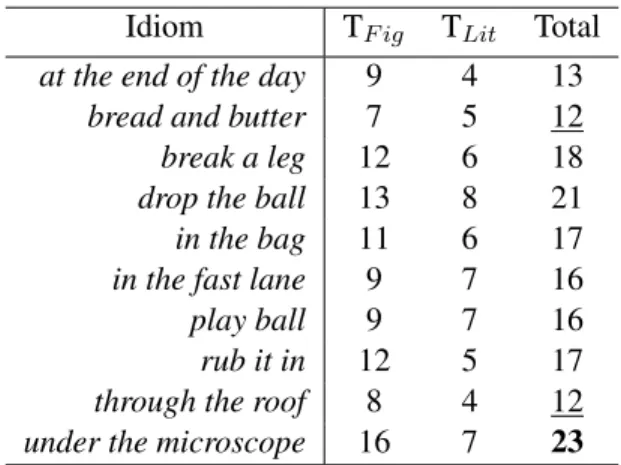
1 Corpus statistics of SemEval 2013 Task 5b. #Lit denotes the number of literal usages,#Fig denotes the number of figurative usages. . . 21 2 Statistics of VNC corpus . . . 22 3 Result of different methods. Ff ig denotes F1 score of figurative usage recognition
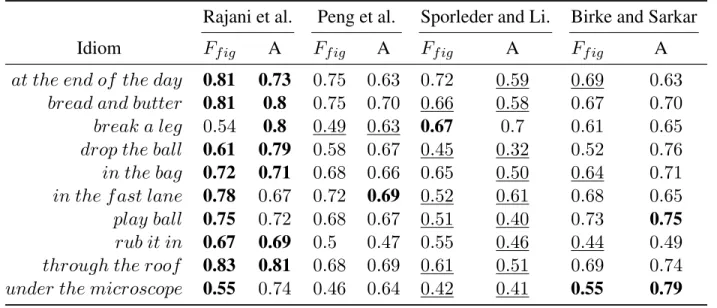
and Adenotes the overall accuracy. For each idiom, the boldfaced number shows the best performance among the four methods while underlined shows the worst. . . 32 4 Result of two supervised methods using only contextual features. Ff ig denotes F1
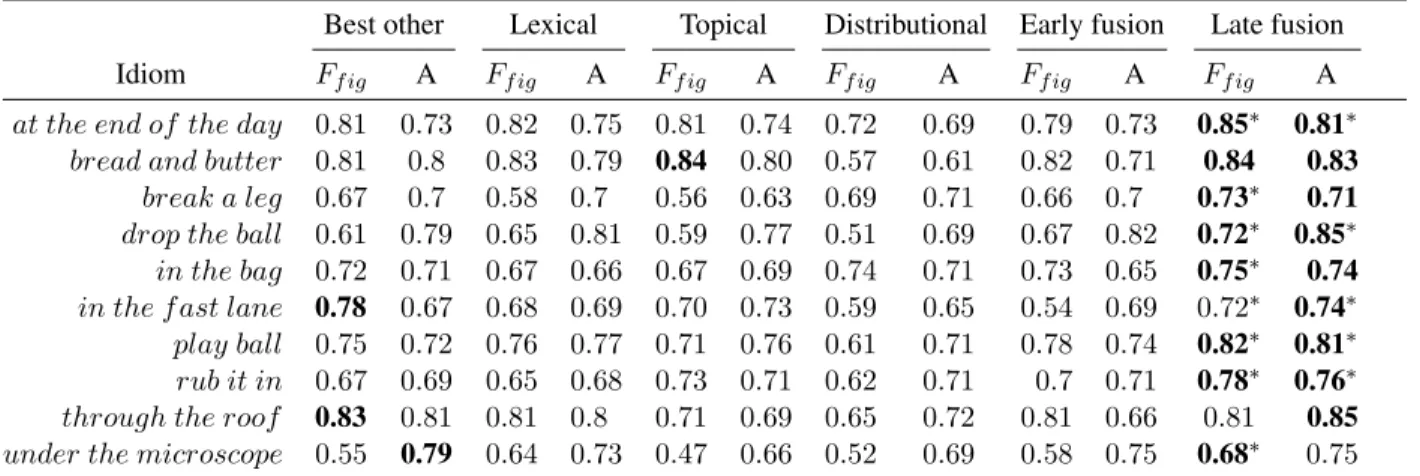
score of figurative usage recognition andAdenotes the overall accuracy. . . 32 5 The comparison between our method and competing methods. The ”Best other”
column shows the best result from the other methods. ∗ indicates the difference between the ”Late fusion” and ”Best other” is statistically significant, χ2 text, p = 0.05. The boldfaced number shows the best performance. . . 34 6 Optimal topic numbers for different idiom instances. TF ig means the topic number
of figurative set, TLitmeans the topic number of literal set. . . 35
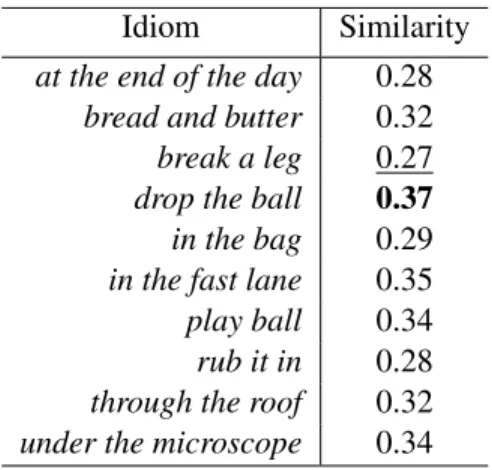
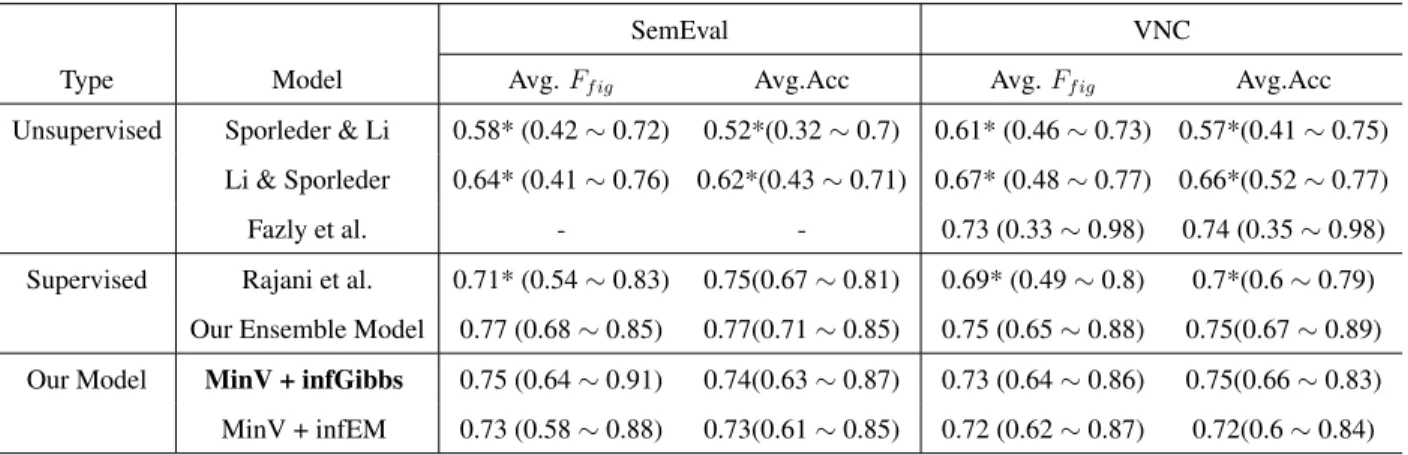
7 A measure of Semantic Analyzability . . . 36 8 The performances of different models. Avg. Ff ig denotes average figurative
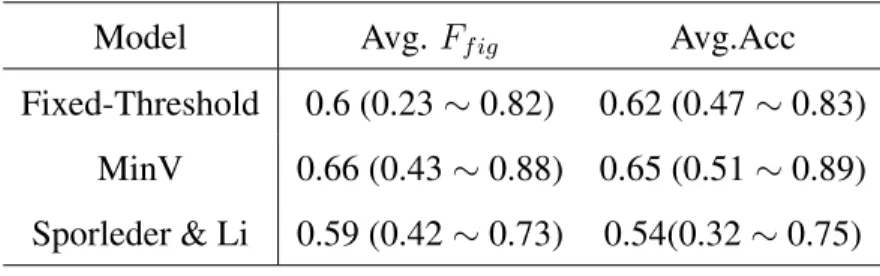
F-score, Avg.Acc denotes average accuracy. We report the range in the parenthesis. * indicates the difference is significant with our MinV+ infGibbs model at the 95% confidence level. Since the method from [Fazly et al., 2009] restricted their experi-ment to VNC type, we only report their performance on the VNC corpus. . . 48 9 A comparison of classifying by different heuristics. Results are averaged across all
the idioms in the two corpora. . . 49 10 The performance of MinV+NN and models without soft label on all the idioms in
the two corpora . . . 50 11 Hyperparameters of our network. . . 67
12 The performances of different models. Avg. Ff ig denotes average figurative
F-score, Avg.Acc denotes average accuracy. * indicates the difference is significant with our model ACE+LocalAtt+AKWE at the 95% confidence level. Since the method from [Fazly et al., 2009] restricted their experiment to VNC type, we only
report their performance on the VNC corpus. . . 68
13 The results of CBOW for idiom usage recognition. Results are averaged across all the idioms in the two corpora. . . 69
14 Top 10 most compatible words in ”can you see the [] i try to make?” . . . 69
15 The results of ablation study. Results are averaged across all the idioms in the two corpora. . . 70
16 Statistics of English-to-German translation dataset . . . 76
17 Hyperparameters of our machine translation model. . . 77
List of Figures
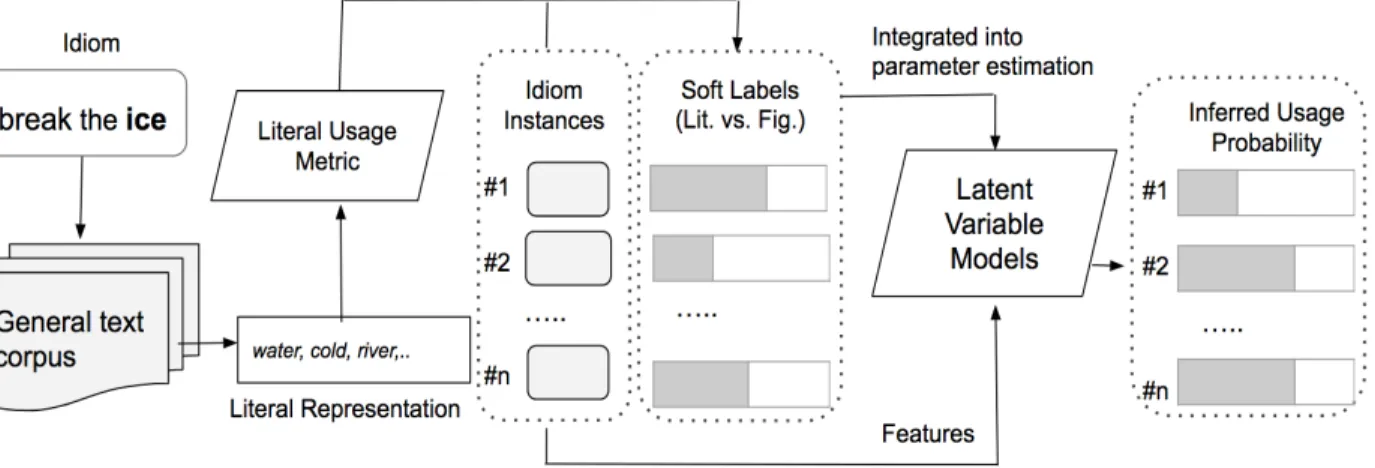
1 Interpretation of metaphor ”Make-up is a Western burqa” . . . 15 2 An overview of our unsupervised idiom usage recognition model . . . 40 3 The performance of MinV+infGibbs on the idiom ”break a leg” . . . 51 4 The overview of our idiom usage recognition model in a transfer learning fashion:
the CBOW is adapted for semantic compatibility measurement which can be trained on raw large corpus; the learned representations and parameters are then used for idiom usage recognition. [] indicates target word or idiom. . . 56 5 An working example of CBOW. Given the context ”The dog () at the mailman”, the
model aims to assign those words which are fit to the context with high scores. . . . 57 6 Bidirectional LSTM for context representation . . . 61 7 The global attention architecture when using bidirectional LSTM for sequential
en-coding . . . 62 8 The local attention architecture when using bidirectional LSTM for sequential
en-coding . . . 64 9 Visualization of attention layer . . . 71 10 Graphical model of LDA and weakly informed LDA.sis the prior topic distribution. 82 11 Encoder-Decoder model for inferring the figurative meanings of idioms . . . 83
ListofEquations 3.1 . . . 27 3.2 . . . 28 3.3 . . . 28 3.4 . . . 28 3.5 . . . 28 3.6 . . . 29 3.7 . . . 29 3.8 . . . 33 3.9 . . . 34 4.1 . . . 41 4.2 . . . 42 4.3 . . . 45 5.1 . . . 56 5.2 . . . 61 5.3 . . . 62 5.4 . . . 63 5.5 . . . 63 5.6 . . . 63 5.7 . . . 64 5.8 . . . 64 5.9 . . . 65 5.10 . . . 66
Preface
First and foremost, I want to express my greatest gratitude to my advisor Dr. Rebecca Hwa. I am sure I will fail to precisely describe all the support and assistance I get from you since they are so tremendous. Throughout my PhD study, you gave me valuable freedom to explore the topics I like, while at the same time your expertise in NLP helped me avoid numerous traps and pitfalls along the way I have chosen. We had numerous thought-provoking discussion in our meetings; I got innumerable precious feedback when we worked on papers. Your passion for perfection is infectious. I cannot finish my PhD study without you.
I would also like to thank my dissertation committee: Dr. Adriana Kovashka, Dr. Diane J. Litman and Dr. Yulia Tsvetkov. I have benefited greatly from your refreshing perspective, constructive comments, and generous support. It has been my great privilege to work with you and I appreciate all your time and effort in guiding me through the course of this thesis.
I feel very fortunate to become a member of the NLP group in Pitt. I want to thank all my colleges who have made my experience as a PhD student so pleasant and unforgettable. This espe-cially includes Huichao Xue, Wencan Luo, Lingjia Deng, Mingda Zhang, Homa B.Hashemi, Omid Kashefi, Haoran Zhang and Zahra Rahimi. There are many others in the computer science depart-ment who I am fortunate to get to know and become friends with: Rakan Alseghayer, Siqi Liu, Nils Murrugarra Llerena, Michael Cui, Qihang Chen, Zihao Zhao, Yingjie Tang, Jeongmin Lee, Mengsi Lou, Wei Guo, Salim Malakouti, Zuha Agha, Angen Zheng, Keren Ye, Xiaozhong Zhang, Xiaoyu Ge, Yanbing Xue, Duncan Yung, Zhipeng Luo, Kenrick.o.Fernandes, Phuong Pham, An-otoli Shein, Nikos Katsipoulakis and Judicael Briand Djoko,
Finally, I want to extend my sincerest thanks to my parents for your unconditional love. To my girlfriend Yujia Yang and my biggest friend Xiaobing Shi - no matter ups or downs in this journey, you are always there to support and encourage me.
1.0 Introduction
1.1 Motivation
”If natural language had been designed by a logician, idioms would not exist. ”
-Johnson-Laird, 1993 Much of human knowledge is contained in and communicated through our languages. Natu-ral Language Processing (NLP) is concerned with developing computational methods to capture this knowledge. A major challenge for computers lies in automating the processing of figurative expressions, such as metaphors and idiomatic expressions. To be able to comprehend the implicit semantics of figurative expressions represents a current frontier in NLP, or more generally, in Ar-tificial Intelligence [Gagliano et al., 2016].
Idiomatic expressions, as a special type of figurative devices, are widely used in different literary genre. A corpus study shows that three out of ten sentences contain idioms [Moon, 1998]. The most significant property of an idiom is that its figurative sense is not simply the combination of the senses of its components (e.g., the idiom “shoot the breeze” means “to chat”, which is hard to infer from its component words “shoot” and “breeze”). Idioms often behave idiosyncratically. For example, an idiom may involve the violation of selectional preferences, i.e., a word’s tendency to co-occur with words that belong to certain lexical sets (as in “The U.N. is playing with fire”). Meanwhile, idioms exhibit properties of both words and phrases. On the one hand, idioms can be considered as a single fixed semantic unit and their meanings can be comprehended by direct memory retrieval [Cacciari et al., 1993], which are, in a sense, similar to words. On the other hand, idioms are usually multiword expressions, which demonstrate different degree of syntactic flexibility, such as passivizability and tense inflection [Stone and Ann, 2016] (as in ”looks likethe beans have been spilled on one of our portrait artists” or ”old motherboard was slowly dying, finallykicked the bucketyesterday”).
Due to their abundance and idiosyncratic behaviors in natural language, idioms have long been recognized to play a crucial part in NLP. The early literature about the automated process-ing of idioms was mainly dedicated to idiom type classification, which aims to classify whether
an expression is an idiom or not without considering their contexts [Fazly and Stevenson, 2006, Venkatapathy and Joshi, 2005, Katz and Giesbrecht, 2006]. However, idiom type classification is still insufficient for more sophisticated NLP applications. Studies have shown that many idioms can be usedbothfiguratively and literally, depending on the context [Fazly et al., 2009]. For ex-ample, “break the ice” is used literally in the first instance but figuratively in the second:
(1) When they finallypunchedthrough theArcticice cap just shy of the North Pole, it took them five hours to break the ice off their submarine’s key hatches so they could reach the fresh air. (2) US President Barack Obama and Cuba’s Raul Castro will have a historic face-to-face en-counterat theSummitof the Americas this week, breaking the ice after decades of glacial rela-tions.
This ambiguity poses special challenges for various NLP applications. For instance, when we use an advanced information retrieval system to search for some information related to ”ice” in physical domain (i.e., the literal sense of ”ice”), the system should be able to exclude the second example from our results due to its non-literal interpretation of ”ice”. In sentiment analysis, idioms have been proven to impose discernible negative impact due to the models’ inability to distinguish the literal or figurative senses of idiom [Williams et al., 2015]. In machine translation, previous work [Salton et al., 2014] has shown that a typical statistical machine translation system might achieve only half of the BLEU score [Papineni et al., 2002] on sentences that contain idiomatic expressions than on those that do not.
The inefficiency of NLP applications dealing with this ambiguity makes automatic idiom usage recognition in context, or more generally referred as idiom token classification, an indispensable part of NLP research [Fazly et al., 2009]. According to [Jackendoff, 1997], it is estimated that there are 25,000 idioms in the English language alone. Prior efforts on determining the usages of idioms in context fall short when applied to idioms at such a scale. The reasons are twofold:
1. Large Performance Variance across Idioms: Different context features have varied
pre-dictive power across idioms; while lexical cues are sufficient to distinguish different usages for some idioms (e.g., certain prepositions appearing after “break the ice”), others might need deeper semantic inference. Since these inferences involve processing at different levels of language, it generally requires different representation methods to capture the underlying cues. However, the effectiveness of different representations of context is under-studied in
this task; models proposed in the literature mainly rely on single representation of context and have large performance variances across idioms [Rajani et al., 2014, Birke and Sarkar, 2006, Peng et al., 2014, Sporleder and Li, 2009]. For example, the method of [Fazly et al., 2009] achieves an overall accuracy of 98% on the idiom ”take heart”, but only gets 35% for the id-iom ”pull * leg”. This performance variance makes current models problematic if we have a large set of idioms to classify. In the context of this thesis, we refer robustness as a model’s ability to perform consistently across different idioms.
2. Intensive Human Labor and Computational Cost: Idioms vary in form and their contexts
of different usages do not follow a set of patterns that can be easily characterized. Hence, a common practice is to train a separate model for each idiom on a large amount of annotated examples [Rajani et al., 2014, Peng et al., 2014]. This is not optimal: (1) annotation needs extensive human effort; (2) a per-idiom model is computationally expensive when we have a large number of idioms. In this thesis, we define efficiency as performing the desired idiom usage recognition task with minimal human supervision and computational resource. To ad-dress the efficiency problem, we need either some general knowledge about idiom usages to reduce the need of human supervision, or training the models on generalized features across idioms so that they can be applied to different idioms. As it is hard to find universal patterns from context and idiom in isolation, their interactions tend to exhibit some common behav-iors across different idioms, e.g., the components of idiom being semantically distant from the context often signals figurative usage. Such types of interactions, while offering a promising opportunity to address the non-efficient problem of current approaches, are less-studied in the literature.
The central goal of this thesis is to address the problems mentioned above and build robust and efficient computational models to recognize an idiom’s usage in context.
1.2 Thesis Statement
With appropriate representations of context and idiomatic expression, linguistic-informed com-putational models which aim to capture the interactions between these representations can help
build robust and efficient idiom usage recognizers. In this thesis, we aim to test the following hypotheses:
H1. Addressing the interaction between context representations and linguistic properties of idioms can help totrain a robust idiom usage recognizer.
H2. Modeling the interaction between contexts and idioms by calculating their semantic dis-tance and further using it as distant supervision can help to reduce the need of human supervi-sion.
H3. Modeling the interaction between contexts and idioms by assessing their semantic com-patibility can help to train a generalized model toreduce computational cost.
1.3 Thesis Overview
This thesis presents three parts of work with a unifying goal of recognizing an idiom’s usage in context. Each part, however, emphasizes a different aspect of the problem. In the first part, we investigate the advantages and limitations of different context representations so as to build more robust idiom usage recognizers by effectively drawing knowledge from these representations. The second and third parts focus on the efficiency problem. To reduce the need of human annotation, we present an unsupervised idiom usage recognizer in the second part. The semantic similarity
between context and idiom is used as a distant supervision in our proposed models. Continuing on this work, the third part presents a generalized idiom usage recognition model by evaluating the
semantic compatibilitybetween context and the literal sense of the idiom. The generalized model can reduce the computational cost because there is no need to train the model for each individual idiom. The following is an overview of our work.
1.3.1 Robust Idiom Usage Recognizer
Previous works on idiom usage recognition did not focus on its robustness, so they tend to have large performance variances among different idioms. As noted by [Bengio et al., 2013], the perfor-mance of machine learning models is heavily dependent on the choice of data representation. In our
task, we believe that the choice of context representation can significantly impact robustness due to their interactions with linguistic properties of idioms. We summarize the context representations into three main categories: Lexical Representation, Topical Representation and Distributional Se-mantic Representation. Our studies show that these three representations have different advantages and limitations toward idiomatic expressions. Therefore, how to integrate these representations to-gether and how to incorporate linguistic knowledge of idioms into our model are essential to build a robust idiom usage recognizer. In Chapter 3, we present ensemble models to combine these con-text representations adaptively for different idioms which can achieve better stability without loss of accuracy.
1.3.2 Unsupervised Idiom Usage Recognizer
Apart from robustness, reducing the need of human supervision is also an important aspect in idiom usage recognition. Most of the success of existing work comes from supervised models, which require human effort to annotate training examples. In this part of the work, we focus on building an idiom usage recognition model without annotated training examples.
Our strategy is to find an alternative form of supervision to automatically replace the supervi-sion signal from human annotation. To achieve this goal, the new form of supervisupervi-sion should be built on features that are abstract enough, such that they are invariant across idioms. For example, lexical features are not optimal since the distribution of context words are specific to each idiom. In Chapter 4, we show how distributional semantic feature comes to the rescue in providing a distant supervision for idiom usage recognizer. We calculate thesemantic similaritybetween context and idiom and use this information to guide downstream unsupervised clustering methods, achieving competitive results compared to state-of-the-art supervised models.
1.3.3 Generalized Idiom Usage Recognizer
While reducing human effort in idiom usage recognition is important, reducing the computa-tional cost is also of great significance, considering the number of idioms in language. A particular challenge of automatic idiom usage recognition is that idioms, by their very nature, are idiosyn-cratic in their usages; therefore, most previous work on idiom usage recognition mainly adopted a
“per idiom” classifier approach, i.e., a classifier needs to be trained separately for each idiomatic expression of interest. In Chapter 5, we propose to build generalized idiom usage recognizers to reduce computational cost. As discussed above, when building an unsupervised model, we model the interaction between idiom and its context by calculating their semantic similarityand use it as a type of distant supervision. We push this interaction further by measuring thesemantic com-patibilitybetween context and the literal sense of idiom and use this information to determine the idiom’s usage. The concept ofsemantic compatibilityis closely related but different withsemantic similarity: it captures an even more generalized and sophisticated pattern of interaction between a context and an idiom. Our work is based on the observation that most idioms, when taken liter-ally, would be somehow semantically at odds with their context. We have successfully trained a model of semantic compatibility on a large raw corpus and seamlessly apply it to the idiom usage recognition task.
1.4 Contributions
Humans’ ability to interpret figurative language, such as inferring the usage of idiom in con-text, feels so effortless. It can be easy to underestimate how difficult this task is for a computer. The challenge partially lies in the fact that current computational models, as well as the representations of natural language, are not sophisticated enough to capture the complicated semantic relations in language and thus not optimal for high-level semantic tasks such as interpreting figurative lan-guage. To understand the nuance and resolve the ambiguity introduced by idiomatic expressions, computers need better semantic representations and more efficient algorithms to make inferences about what they (the idiomatic expressions) are communicating.
From the modeling perspective, this thesis presents models which can recognize the usages of idioms robustly and efficiently.
(1) To build robust idiom usage recognizers [Liu and Hwa, 2017],
• We analyze the advantage and limitation of different context representations quantitatively • We study two linguistic properties of idioms: semantic analyzability and context diversity. We
representations of context.
• We present an ensemble method based on a variant of averaged perceptron learning method [Collins, 2002] which can effectively integrate different context representations for different idioms.
(2) To build unsupervised idiom usage recognizers [Liu and Hwa, 2018],
• We propose a novelliteral usage metricbased on the semantic similarity between the context and the idiom to estimate the likelihood that the idiom is intended literally.
• We transform theliteral usage metricinto soft labels and present learning algorithms in which the soft label is served as a distant supervision to guild our learning process. We explore two representative probabilistic latent variable models: Latent Dirichlet Allocation (LDA) [Blei et al., 2003] and unsupervised Naive Bayes (NB), in which the usage of idiom is rep-resented as a mixture of linguistically motivated features.
(3) To build generalized idiom usage recognizers [Liu and Hwa, 2019],
• We propose a novel model of semantic compatibility by adapting the training of a Continu-ous Bag-of-Words (CBOW) model for the purpose of idiom usage recognition. The model is trained on a large raw corpus and there is no need to annotate idiom usage examples for training.
• We successfully apply the model on idiom usage recognition and results show that the proposed model achieves competitive results compared to state-of-the-art per-idiom models.
From a practical point of view, our model can alleviate the negative impact caused by idioms in tasks such as machine translation [Salton et al., 2014], sentiment analysis [Williams et al., 2015]. To show the application of our model, we present a case study in which we integrate the usage information of idiom captured by our generalized model into the modern machine translation sys-tems. Results suggest that we can achieve better performance on sentences containing idioms.
The contribution of this thesis is not limited to the automated processing of idioms. First, our linguistically informed ensemble model provides evidence that linguistic is essential to build intelligent and robust models. The experience of our work may serve as an example for bridging the gap between computational models and linguistic theory to other NLP tasks. Second, both the unsupervised learning framework and the semantic compatibility models presented in this thesis
may benefit the NLP community beyond their immediate applications to idiom usage recognition. The idea of soft label as distant supervision can be generalized to other unsupervised learning tasks such as text classification; the concept of semantic compatibility can be applied to detection of other figurative languages such as metaphor and irony.
2.0 Background
In this chapter, we review the literature of research on idioms from a linguistic perspective. We then review the literature of idiom processing from computational perspective. Finally, we describe computational resources (e.g., the shared task and idiom corpora) that are related to this dissertation.
2.1 A Linguistic View of Idioms
Figurative language, such as idiom, metaphor, irony and sarcasm, is ubiquitous in language. Figurative language is generally considered as a creative linguistic device; it is an effective way to convey various meaning such as humor, affection, and express deeply-felt sentiments. As a special type of figurative language, idioms have been studied comprehensively in the linguistic literature. However, there is surprisingly little consensus about the formal definition of idioms. In general, an idiomatic expression can be loosely defined as a combination of words that has a figurative meaning that is hard to infer from the expression’s individual components. In this section, we will discuss some linguistic properties of idioms. Since contexts hold clues to resolve the usage ambiguity of idioms, we will have a short discussion about the contexts in which an idiom occurs. Finally, we will briefly review the relationship between idioms and metaphors.
2.1.1 Linguistic Properties of Idiom
Linguists often characterize idioms by certain properties from different perspectives: semantic, syntactic, rhetorical, etc [Nunberg et al., 1994, Cacciari and Levorato, 1998]. We summarize some basic but essential properties of idioms as shown below [Nunberg et al., 1994]:
Conventionality: it refers to the degree to which the figurative meanings of an idiom are not predictable based upon knowledge of its constituents in isolation.
used in horse-racing as early as 1902 and meant ”to cause an upset”. Nowadays, the expression is mainly used to describe the action of revealing a secret.
Inflexibility: the syntactic configurations in which an idiom occurs tend to be relatively fixed. Concretely, an idiomatic expression tends to occur in a small number of canonical form(s). For example, ”break a leg” is a way of wishing good luck before a performance while ”a leg is broken” loses the idiomaticity.
Figuration: idioms often involve metaphor, hyperbole or other types of figuration. For example, the idiom ”I could eat a horse” is an exaggerated way to express that the speaker is extremely hungry. In Section 2.1.3, we discuss the relationship between idioms and metaphors since these two types of figurative language are closely related.
Semantic Analyzability: this measures the extent to which the meanings of the words forming an idiom contribute to its figurative interpretation. Some idioms are completely opaque in terms of semantic, such as ”buy the farm”; a significant amount of idioms are partially transparent, as in ”spill the beans” where ”spill” corresponds to ”divulge” and ”the beans” represents the secret that has been divulged.
What makes idioms interesting and challenging for NLP is that they vary greatly in degrees of these properties. As we have discussed above, idioms have different degree of semantic analyz-ability. This observation also applies to inflexibility. For example, we have seen that ”break a leg” would lose its idiomatic meaning if it is used in passive voice, whereas some idioms might not, such as ”spill the beans”. Further, it is still an open question to quantify these properties. We find that the measurement of these properties is very subjective and there is no agreed criterion, espe-cially the semantic analyzability. For example, the idiom ”kick the bucket” is generally considered to have low semantic analayzability because the words ”kick”, ”the” and ”bucket” contribute little to its figurative meaning. Nonetheless, [L. Hamblin and Gibbs, 1999] argued that the verb ”kick” conveys a meaning of quickness or suddenness such that ”kick the bucket” means “to die sud-denly” rather than “to die slowly.” They suggested that even semantically-opaque idioms are not truly frozen; their figurative meanings are partially shaped by the particular verbs used in these expressions. Due to these reasons, scholars in linguistics have struggled to provide an accurate and predictive model of idiom behaviors. We argue that the automated idiom processing should take the properties of idioms into consideration. We will have more discussion on this point in later
chapters.
2.1.2 The Context of Idiom
The context in which an idiom occurs is essential for determining an idiom’s usage. In partic-ular, we find two aspects of context are crucial: Context Word Distribution and Context Diversity. Context Word Distribution: literal and figurative usages of idiom generally co-occur with different words. More specifically, we find that when an idiom is used literally its contextual words tend to be semantically close to the constituents of the idiom. The intuition is that literal meaning of an idiom is somewhat compositional [Katz and Giesbrecht, 2006]. Literal usages of “get wind”, for instance, are more likely to occur with words like “rain”, “storm” or “weather” which are related to the constituent “wind”. In addition, we find that context word distribution is closely related to semantic analyzability. For idiom with a high degree of semantic analyzability, its figurative meaning is semantically close to its constituent words, thus the overall figurative context would also be close to its literal context.
Context Diversity: this measures how diversified the context of an expression can be. For some idioms, the figurative or literal usage might be closely related to a small range of topics. This is somewhat related to the origin of the idiom. For example, the figurative use of “break the ice” is not very diverse; it is often associated with political topics, so its contexts are likely to contain words such as “country”, “nation”, “relation” and “war”. Other idioms, such as “under the microscope”, might be used figuratively with a wider range of topics.
2.1.3 Idioms and Metaphors
Similar to idioms, metaphors are a type of figure of speech which constituent a significant part of human language. A metaphor is formally defined as a conceptual mapping between a source and a target domain [Lakoff and Johnson, 1980]. In other words, it occurs when one concept is regarded as representative or symbolic of another concept from a different domain. For example, consider the metaphorlife is a box of chocolate, the target (i.e., life) refers to an abstract entity, and the source (i.e., a box of chocolate) refers to a concrete type of food. These two seemly unrelated concepts usually share some hidden similarities so human can build the metaphorical mapping
of the two concepts automatically. Scholars found that this metaphorical mapping preserves the structural characteristics of the source concept [Lakoff, 1990], so people’s knowledge of the source concept can help them better understand and conceptualize the target domain.
Metaphors exhibit a great variety, ranging from conventional metaphors, which are com-monly used in everyday language, to poetic and creative ones. For conventional metaphors, people use them but pay little attention to which features are mapped from source to target do-main, simply because they are widely accepted and become standardized in the language system. On the contrary, it usually requires additional cognitive effort to understand creative metaphors comparing to conventional metaphors [Gibbs Jr, 1992, Gentner and Wolff, 1997, Shutova, 2010b]. [F Bowdle and Gentner, 2005] argued that metaphors undergo an evolutionary path from novel to conventional figurative statements. They referred this path as the “career of metaphor”; the more conventionalized a metaphor becomes, the less thought people pay to its actual mapping.
One widely held belief is that idioms are a type of ”dead” metaphors. In other words, they are expressions what were once metaphors but have lost their metaphorical nature over time [Gibbs Jr, 1992]. Early researchers generally assumed that idioms are frozen semantic devices within the speaker’s mental lexicons. Their figurative meaning will be retrieved when the literal in-terpretation is rejected as it is not compatible with the context [A Bobrow and M Bell, 1973]. The dead metaphor view of idiomaticity was questioned by [Gibbs Jr, 1992], who argued that numerous idioms are not ”simple, dead metaphors, but actually retain a good deal of their metaphoricity”. For example, the figurative meanings of idioms such asblow your stack,flip your lidandhit the ceiling
are closely linked to two existing metaphors: MIND IS A CONTAINER and ANGER IS HEATED FLUID IN A CONTAINER. However, the authors only experimented with a small set of idioms, it is not clear whether this argument can still hold when applied to a wider range of idioms. While the relationship between idioms and metaphors is not as straightforward as commonly assumed, they do share the property of being figurative and have overlapping patterns. As such, we review the computational models of metaphor processing in the subsequent section, which provides some context for the studies conducted in this dissertation.
2.2 Computational Background of Idiom Processing
We have now discussed idioms from the linguistic perspective. We have highlighted the prop-erties of idioms and its context. We have also discussed the relationship between idioms and metaphors. The present section provides an overview of computational models of metaphor pro-cessing. Since idiom usage recognition can be considered as a type of phrase sense disambigua-tion problem, which is closely related to word sense disambiguadisambigua-tion (WSD), we also present an overview of models of WSD.
2.2.1 Models of Metaphor Processing
Among all different types of figurative language, metaphors have been extensively studied in both NLP and other related fields such as psycholinguistics. We find that the computational models of metaphor processing can be categorized into two groups: metaphor recognition and metaphor interpretation.
2.2.1.1 Metaphor Recognition Metaphor recognition aims to distinguish between literal and
metaphorical language in text. The work in this area is pioneer by [Fass, 1991], in which the au-thor presented a system called met* which can recognize metaphor in text using hand-coded pat-terns such as selectional preference violations. [Mason, 2004] exploited a similar idea to recognize metaphors by finding systematic variations in domain-specific selectional preference. For example, they find that the verbpourhas a strong selectional preference towardliquidin LAB domain but in FINANCE domain it tends to select money. Based on this observation they suggestmoneyand
liquidis a metaphorical mapping. As pointed out by Fass, using selectional preference violations as an indicator of metaphor could lead to high false positive; other types of figurative language such as metonymies also frequently involve violations of selectional preferences. Alternatively, [Goatly, 1997] created a set of linguistic cues to recognize metaphors. For example, lexical pat-terns such as metaphorically speaking, so to speak usually signal the presence of metaphorical expression. However, this method suffers from low recall. On the one hand, it is challenging to build a comprehensive set of linguistic cues which are indicators of metaphors. On the other hand,
numerous metaphors occur without explicit linguistic cues.
Apart from selectional preferences violation and linguistic cues, previous work also suggest that the abstractness of context is also an effective indicator of metaphors [Turney et al., 2011, Tsvetkov et al., 2014]. Abstract words refer to things which are hard to perceive directly with our senses. The intuition underlying this line of work is that metaphor can be considered as a method for transferring knowledge from ”a familiar, well-understood, or concrete domain to an unfamiliar, less understood, or more abstract domain” [Turney et al., 2011]. Thus, the degree of abstractness in a word’s context is correlated with the likelihood that the word is used metaphorically.
2.2.1.2 Metaphor Interpretation Metaphor interpretation aims to explain the intended
mean-ing of metaphorical expressions. Concretely, a large body of work in this area aim to investigate the intuition behind the mapping between the target and source domains. For example, [Kintsch, 2000] proposed a method called Predication Algorithm to find the common features between the target and source domains. Given a predicate P and an argument A (both P and A are represented as vectors in a semantic space using Latent Semantic Analysis [Landauer and Dutnais, 1997]), the method proceeds as follows:
1. Findnclosest neighbours of P. Let S denote this set of neighbours.
2. Findkvectors in S that are closest to the argument A and within a thresholdt. 3. Calculate the centroid of P, A and thekvectors in step 2.
4. Interpret the centroid by comparing it with a set of suitable landmarks.
Kintsch used ”my lawyer is a shark” as an example to illustrate the algorithm. Specifically, the algorithm needs to find the features that are shared by both lawyer and shark. This is challenging because the most obvious features of a shark, e.g., a fish, are not salient to this metaphor. When the centroid is produced in Step 3 above, the paper compared it with six landmarks: three were chosen to be related to lawyer (i.e., lawyer, justice and crime) and three were related to shark (i.e., shark, fish, viciousness). Results suggested the centroid is close to landmark ”viciousness” and far from other landmarks, which is an intuitively reasonable interpretation of the metaphor.
[Veale and Hao, 2008] proposed a model called Talking Point, which utilize fluid knowledge representation to interpret metaphor. They build a logic path between the definition of source and target concept by operations such as substitution, insertion and deletion; the logic path is then
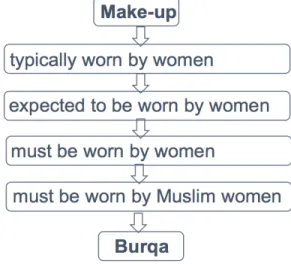
considered as an explanation of the metaphorical mapping. For example, to explain the metaphor
Make-up is a Western burqa, Talking Point establishes a link betweenmake-upandburqa by in-sertions and substitutions on the definitions of these two concepts (as illustrated in Figure 1).
Figure1: Interpretationofmetaphor”Make-upisaWesternburqa.”
[Shutova,2010a] definedm etaphori nterpretationa sa p araphrasingt ask,w hicha imst o au-tomatically derive the literal paraphrases for metaphor. For example, their system can translate the metaphoricalexpression ”brushaside accusation”into ”reject accusation”. Theyfirst gener-ate a list of possible paraphrases induced from the statistics in a large corpus and ranked them by theirlikelihood. Then theselectional preferenceinformation is appliedto selectthose literal paraphrases.
2.2.2 WordSenseDisambiguation
Thefindingthathumanprocessidiomsmuchfasterthanliteralphraseshasledtothehypothesis thatidiomsmustbecomprehendbychunksinsteadofwordbyword[ABobrowandMBell,1973, A.SwinneyandCutler,1979]. Soanidiomcanbeviewedasalargewordor”word-with-spaces”. Thissuggeststhattheidiomusagerecognitiontaskcanbepotentiallyformulatedasawordsense disambiguation(WSD)problem, i.e.,theliteralandfigurativeinterpretationsofanidiomaretwo coarsesensestobedisambiguated.
The majority of WSD models can be categorized into three main groups: knowledge-based models [Mohammad and Hirst, 2006, Patwardhan and Pedersen, 2006], supervised (semi super-vised) models [Mihalcea and Faruque, 2004, Ando, 2006, Zhong and Ng, 2010], and unsupervised models [Agirre et al., 2006, Di Marco and Navigli, 2013].
Knowledge-based models rely on existing lexical resources, such as semantic networks (e.g., WordNet [Fellbaum, 1998]), to identify the most suitable sense. The general idea of this line of work is to measure the relatedness of the senses of the target word to those context words. The most related sense of the target word is selected as the intended sense in the context. For example, [Patwardhan and Pedersen, 2006] used the gloss and structure information in WordNet to build a vector representation for each concept in the WordNet. The sense of a word and the context are represented based on these vectors and their relatedness is measured via cosine similarity.
Since constructing semantic networks is extremely expensive, researchers generally prefer sta-tistical models over knowledge-based models. Supervised stasta-tistical models are based on extract-ing local features from the words surroundextract-ing the target, and then trainextract-ing a classifier on annotated examples for each target word. These features include n-grams of nearby words, bag of words, parts-of-speech and syntactic features [Ando, 2006, Zhong and Ng, 2010]. Since sense annotation is time-consuming, semi-supervised methods are often used to alleviate this problem, e.g., a small manually annotated corpus is usually used as seeds for bootstrapping a larger annotated corpus [Mihalcea and Faruque, 2004].
Unsupervised models try to induce word senses directly from the corpus. It is based upon the assumption that similar senses occur in similar contexts, therefore it is possible to cluster word usages according to their context distributions. The clustering algorithms in WSD fall into two categories: vector space model [Pantel and Lin, 2002, Pur and Pedersen, 2004] and graph model [V´eronis, 2004, Agirre et al., 2006]. When the clusters (i.e., senses) are induced, the new occur-rences of the target word will be compared to these clusters; the most similar cluster will be selected as the intended sense. Note that these methods still need manual intervention to map their induced senses into a sense inventory.
While context is important for WSD in general, many current models ignore the order of words in the context. In the latest development, researcher has used advanced neural networks such as Long Short-Term Memory (LSTM) [Hochreiter and Schmidhuber, 1997] or
bidirectional-LSTM [Graves and Schmidhuber, 2005] to capture the order information in the context for WSD [K˚ageb¨ack and Salomonsson, 2016, Pasini and Navigli, 2017]. These methods consider each tar-get word as a separate classification problem and their output layers (i.e., softmax) need to be parameterized for each target word. This practice is similar to “per-idiom” usage recognition mod-els in which we need to train the modmod-els for each idiom separately.
It should be clear that the ”word-with-spaces” view of idiom is inadequate to account for the complicated behaviors of idioms. Essentially, idioms are different with words in many aspects. As we have discussed in Section 2.1, idioms have their own unique properties such as semantic analyz-ability and inflexibility. A sophisticated idiom processing model should take these properties into consideration. The above mentioned models of WSD, however, provide important background knowledge for the work in this dissertation.
2.3 Computational Models of Idiom Processing
In NLP, idioms have long been the focus of many research work in the area of figurative language processing. Early research work mainly focus on idiom type classification, i.e., the au-tomatic identification of idioms in large corpora. Later research has showed that a potentially idiomatic expression can be used both figuratively and literally, which contradicts the common perception that idioms always have figurative interpretation. We thus see the shift of focus to id-iom usage recognition (or idid-iom token classification) in recent years. In this section, we first briefly discuss the work of idiom type classification. We then review the previous work on idiom usage recognition that our work directly compare with, in which robustness and effectiveness have been largely overlooked.
2.3.1 Idiom Type Classification
Idiom type classification aims to determine whether a phrase could be used as an idiom or not, without considering any specific context. A large body of work in idiom type classification focus on the properties of idioms that differentiate them from the other multiword expressions. These
properties include non-compositionality, lexical fixedness (e.g., ”shoot the breeze” is an idiom but ”shoot the wind” is not) and syntactic fixedness (e.g., ”break a leg” is an idiom but ”a leg is broken” is not). [Tapanainen et al., 1998] proposed a distributed frequency function to determine the non-compositionality in verb-noun collocations. The intuition is that ”if an object only appears with a few verbs, it is highly likely that it has an idiomatic nature”. [Lin, 1999] presented a method to detect non-compositional phrases by checking the mutual information [Church and Hanks, 1990] of phrases obtained by replacing one of the component words with similar words. The main idea is that the mutual information of a non-compositional phrase should differs significantly from the mutual information of phrases obtained by substituting one of the word in the original phrase with a similar word. [Bannard, 2007] presented a method to collect potential idioms by quantifying the syntactic fixedness of phrases. They considered three types of syntactic variations that a phrase can undergo to measure its syntactic fixedness: addition or dropping of a determiner, modification of the noun phrase and passivization of verb phrase. [Fazly and Stevenson, 2006] combined both lexical and syntactic fixedness of verb-noun collocations to gather idioms from large corpora. In terms of lexical fixedness, they measured the deviation between the pointwise mutual information (PMI) [Church et al., 1991] of target expression and the average PMI of its variants (i.e., replacing the noun with similar words). In terms of syntactic fixedness, they use the Kullback Leibler(KL)-divergence between the distributions of the target verb-noun pair and its variants(e.g., passivization and pluralization)
2.3.2 Idiom Usage Recognition
In contrast to idiom type classification, idiom usage recognition (or idiom token classification) aims to determine whether an idiom is meant literally or figuratively in a specific context. A number of idiom usage recognition methods have been proposed: unsupervised [Fazly et al., 2009, Sporleder and Li, 2009, Li and Sporleder, 2009], weakly supervised [Birke and Sarkar, 2006] and supervised [Rajani et al., 2014, Peng et al., 2014].
[Cook et al., 2007] and [Fazly et al., 2009] proposed a method which relies on the concept of
canonical form. It hypothesizes that in most cases, idioms tend to be somewhat fixed with respect to the syntactic configurations in which they occur, thus idiomatic usages of an expression tend to
occur in a small number of canonical form(s) for that idiom. In contrast, the literal usages of an expression are less syntactically restricted, and are expressed in a greater variety of patterns. This method might be problematic since there are a variety of idiomatic usages of expressions can also occur in non-canonical forms.
[Sporleder and Li, 2009] presented an unsupervised method building on the concept of co-hesion graph. They build the undirected graph including all content words in the instances. If removing the idiom improves cohesion, they assume the instance is figurative. Continuing on this work, [Li and Sporleder, 2009] used the unsupervised classifier to label a subset of the test data with high confidence. This subset was then passed on as training data to the supervised classifier, which then labeled the remainder of the dataset.
[Birke and Sarkar, 2006] proposed TroFi (Trope Finder), a weakly supervised method to sep-arate literal and nonliteral usages of verb. It reduced the figurative and literal usage recognition problem to word sense disambiguation by redefining literal and figurative as two different senses of the same word. The core of the algorithm is adapted from word sense disambiguation approach developed by [Karov and Edelman, 1998]. It compares a target expression with two automatically constructed seed sets(one with literal interpretation and one with nonliteral interpretation), assign-ing the label of the closest set.
When annotated data are available, supervised classifiers are effective. [Rajani et al., 2014] extracted all non-stop-words in the context and used them as ”bag of words” features to train a L2 regularized Logistic Regression (L2LR) classifier [Fan et al., 2008]. [Peng et al., 2014] trained a supervised classifier using the topical features of the context. They also experiment with adding feature of intensity of the emotions in context and find it can provide marginal improvement over the topical feature.
It is worth noting that, apart from the model presented in [Sporleder and Li, 2009], all the models discussed above are not generalized models, which means that they need to be trained for each idiom separately.
2.4 Resource: Shared Task and Corpora
Idioms, or figurative language in general, have become an increasingly prominent part of semantic-oriented applications. In NLP, shared tasks that provide benchmarks for participants to evaluate their systems have greatly boosted the discussion within the community. It is important to emphasize that the quality of the evaluative data is crucial, which is especially true for idioms. Due to their peculiar behavior, it is not as straightforward as other tasks to build appropriate data resources. We think two criteria are important to allow a meaningful evaluation of the success of idiom usage recognizer. First, idioms with highly skewed distribution of figurative and literal usages are not optimal since always choosing the predominant usage can already yield good result. Second, idioms exist in different forms of construction (e.g., verb-noun, noun-noun), so the data should include different types of idioms, or at least include the most representative types which constitute a large amount of idioms. We find three corpora satisfy these requirements: the dataset in SemEval 2013 Task 5B [Korkontzelos et al., 2013], the corpus used in [Fazly et al., 2009] and idiom usage corpus presented in [Sporleder and Li, 2009]. However, the last corpus is not publicly available online, so we mainly use the first two corpora in this dissertation.
2.4.1 SemEval 2013 Task 5B
SemEval (Semantic Evaluation) is an international workshop that conducts evaluations on se-mantics at different levels. In SemEval 2013 Task 5B, participants were required to make a binary decision whether a target idiom is used figuratively or literally within a given context. For each idiom, several instances extracted from the ukWaC corpus [Baroni et al., 2009] are provided cor-responding to its literal and figurative usages. The majority of the instances contains 5 sentences, where the sentence with the target idiom appears in a random position. There are different types of idioms in this task, such as verb-noun combination (V+NN), preposition-noun combination (PP+NN), etc.
In this thesis, we use the following ten idioms from the shared task to evaluate our idiom usage recognition models. These idioms have reasonably large amount of literal and figurative instances, which allows for reliable models to be trained. Note that there are 4 instances labeled as “both”
which could lead to ambiguity are removed and we get 2371 instances in total, among which 1185 instances are literal usages and 1186 instances are figurative.
Table 1: Corpus statistics of SemEval 2013 Task 5b.#Lit denotes the number of literal usages,
#Fig denotes the number of figurative usages.
Expression #Lit #Fig All
at the end of the day 102 195 297
bread and butter 148 158 306
break a leg 87 29 116
drop the ball 135 62 197
in the bag 145 156 301
in the fast lane 33 79 112
play ball 157 144 301
rub it in 32 89 121
through the roof 141 170 311
under the microscope 205 104 309
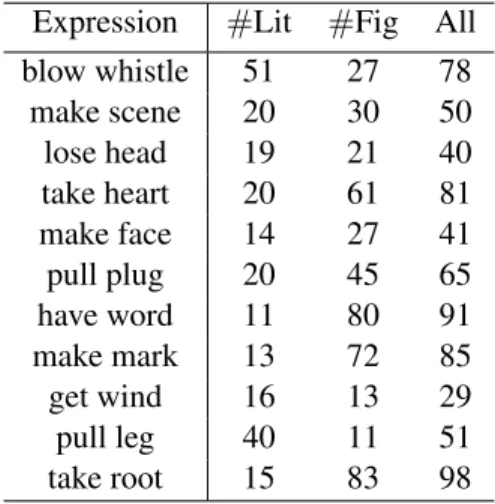
2.4.2 Verb Noun Combination Corpus
A large number of idiomatic expressions are formed by the combination of a verb and a noun (VNC). [Cook et al., 2008] released an idiom usage dateset containing exclusively VNCs. The usage instances are extracted from the British National Corpus (BNC) [Burnard, 2007]. Unlike SemEval corpus, each instance in this corpus contains only 1 sentence. Some idioms from the VNC dataset have very few figurative (or literal) instances, which presents a problem for supervised baselines. To facilitate full comparisons, we select the subset of idioms from the VNC corpus whose number of literal and figurative instances are both higher than 10.
Table2:StatisticsofVNCcorpus.
Expression #Lit #Fig All
blow whistle 51 27 78 make scene 20 30 50 lose head 19 21 40 take heart 20 61 81 make face 14 27 41 pull plug 20 45 65 have word 11 80 91 make mark 13 72 85 get wind 16 13 29 pull leg 40 11 51 take root 15 83 98
3.0 Context Representations for Robust Idiom Usage Recognizer
3.1 Introduction
Although there are a number of models proposed in the literature which can recognize an idiom’s usage in different context, the robustness of these models has received relatively less at-tention. Reviewing the performance of previous works, we observe that they tend to have large performance variances among different idioms. The objective of this section of the work is to study this problem in depth and investigate the feasibility of building robust idiom usage recogniz-ers.
As noted by [Bengio et al., 2013], the performance of machine learning models is closely re-lated to the choices of data representation. While the local context of an idiom holds clues for discriminating between its literal and figurative usages [Katz and Giesbrecht, 2006], we believe that the choice of context representation can significantly impact robustness of idiom usage recog-nition. However, the effectiveness of different representations of context is under-studied; we find that models proposed in literature mainly rely on a single representation of context. For exam-ple, [Rajani et al., 2014] proposed a supervised model trained on solely on lexical features. As idioms exhibit idiosyncratic behaviors and have varied linguistic properties, relying on a single representation of context is not optimal when applied to a larger set of idioms.
We advocate that in order to fully exploit the information offered by the local context, an id-iom usage recognizer ought to leverage knowledge from different types of representation and take the linguistic properties of the idioms into considerations. Among those properties we have re-viewed in the background chapter (§ 2.1), we findcontext diversityandsemantic analyzability significant for usage recognition. Context diversity mainly measures how diversified the context of an expression can be. As we have mentioned previously, if an expression has a low context diversity, a small set of training examples may be sufficient for developing automatic usage rec-ognizer. But for expressions with a high context diversity, however, supervised learning may be unrealistic due to sparsity of training data. Another property semantic analyzability measures the extent to which the meanings of the words forming an idiom contribute to its figurative
interpre-tation [Cacciari and Levorato, 1998]. For idiom with a high degree of semantic analyzability, its figurative meaning is semantically close to its constituent words, thus the overall figurative con-text would also be close to its literal concon-text. This could make the usage recognition difficult for methods using distributional semantics such as that of [Sporleder and Li, 2009]. Although some previous works do make use of local context, they have not sufficiently taken into account the impact of context diversity and semantic analyzability.
In terms of representations of the context, we find that they can be characterized into three categories: Lexical Representation [Rajani et al., 2014, Birke and Sarkar, 2006], Topical Repre-sentation [Peng et al., 2014] and Distributional Semantic RepreRepre-sentation [Sporleder and Li, 2009]. Each representation has its own advantages and limitations. Consequently, previous systems tend to perform better for some idioms than others. This thesis hypothesizes that a more flexible and adaptable representation of the context is necessary to account for both context diversity and se-mantic analyzability. To the best of our knowledge, this work is the first to quantitatively ana-lyze the impact of context diversity and semantic analyzability from a computational perspective. Comparing leading methods against a diverse set of idioms and analyzing the effects of contextual representations, we find that by drawing knowledge from multiple representations and adapting to different idioms, an automatic recognizer can achieve better stability without loss of accuracy.
3.2 Representation of the Usage Context
In this section, we briefly review Lexical Representation, Topical Representation and Distribu-tional Semantic Representation of context. We focus on their limitations and advantages in terms of usage recognition, with an emphasis on their communications with properties of idioms.
3.2.1 Lexical Representation
A straightforward representation is to extract surface words from the context. The assumption is that the contexts of an expression used in the same way should have many words in common. The exact range of the context varies from methods to methods. For example, [Byrne et al., 2013]
ex-tracted only the left and right boundary words of a target phrase to train Naive Bayesian classifiers. On the other hand, [Rajani et al., 2014] extracted all non-stop-words and used them as “bag of words” features to train an L2 regularized Logistic Regression (L2LR) classifier [Fan et al., 2008]. One potential drawback for methods using Lexical Representation is that shared context words are not very strong indicators. Expressions with different usages may nonetheless share some words in common in their contexts; and conversely, even when two contexts do not share any common words, an expression may still have the same usage. Another drawback is that if an idiom has a high degree of context diversity, its contexts would contain too many surface words for them to serve as reliable features.
3.2.2 Topical Representation
Instead of directly setting surface words as the feature space, Topical Representation models a context as a point in an idiomatic expression’s topic space. The assumption is that even if an idiom is used in different contexts, if the contexts have similar topics, their usage should be similar. One example of a method in this category is the work of [Li et al., 2010], in which the context is represented as a mixture over latent topics. Another example is the work of [Peng et al., 2014], in which the context is represented as a set of topic words extracted by Latent Dirichlet Allocation (LDA) [Blei et al., 2003].
An advantage of Topical Representation over Lexical Representation is that it could filter out words that are unrelated to the main topics of the context. The discriminative power of words in the context are different; Lexical Representations generally treat all the words equally. Topical Repre-sentation extracts the most critical words for the relevant topics. It can be seen as a refined version of Lexical Representation. For example, Topical Representation would extract the most informa-tive words such asFreedom,DemocracyandPresidentin the following sentence to help determine the usage ofbreak the ice. These words are generally related to political topics, indicatingbreak the iceis more likely to be used figuratively.
(1)PresidentObama, who started his approach toward the radical Islamists ruling Iran by extending a hand, turning his back on the Iranian people with their aspirations forfreedomanddemocracy, hoped that he could be the first U.S.presidentto break the ice with the Jihadists in Tehran.
informa-tion which could be used in the usage recogniinforma-tion for some idioms. For example, a figurative usage of break the ice may be indicated by the occurrence of the prepositions over or between
after it [Li and Sporleder, 2010]. These words are generally ignored by methods using Topical Representations, whereas methods using Lexical Representation may include them. Also, simi-lar to Lexical Representation, the context diversity will also influence the effectiveness of Topical Representation.
3.2.3 Distributional Semantic Representation
Methods using the previous two representations essentially rely on the calculation of common words between contexts, which is problematic for idioms with a high degree of context diversity. Distributional Semantic Representation can overcome this problem by using external resource or knowledge base to calculate words similarity. For instance, the following sentence has no word overlap with example (1). However, the wordmonarchis semantically close to the wordpresident
in example (1), which suggests they might have the same usage.
(2) Edwards usually manages to break the ice with the taciturnmonarch.
One method in the literature that used Distributional Semantic Representation is the work of [Sporleder and Li, 2009]. They used distributional semantic similarity to calculate the lexical cohesion [Halliday and Hasan, 2014] between constituent words of an idiom and its contextual words. The hypothesis of this method is that if the constituents of a potentially idiomatic expression do not ‘fit’ in any lexical chains, it is highly likely that the expression is used figuratively.
Despite its advantage, Distributional Semantic Representation still has its limitations. First, for some idioms, it is more effective to just use the surrounding words to detect its usage, such as the prepositionoveror betweenafterbreak the ice. Second, since the approach assumes that the overall literal context and figurative context is semantically distant, it is poor at handling idioms with a high degree of semantic analyzability.
3.3 Our Model
We treat literal and figurative usage recognition as a special word sense disambiguation prob-lem in the same spirit as [Birke and Sarkar, 2006]. Specifically, we use similarity-based models because they have been shown to be effective in the general problem of word sense disambiguation [Abdalgader and Skabar, 2012, Karov and Edelman, 1998]. In this section, we describe two vari-ants of our model for integrating different contextual representations within our similarity-based framework.
Representation fusion strategies To fuse different context representations, one
straightfor-ward strategy is to concatenate all the features using the three representations and build a single similarity based classifier that applies to the concatenated feature (early fusion) [Bruni et al., 2014]. Another option is a per-representation strategy; different classifiers are trained independently on the three representations, and afterwards, the results are combined to generate a final output (late fusion). We have experimented with both strategies.
3.3.1 The Late Fusion Model
In this model, three classifiers are developed based on Lexical similarity, Topical similarity and Distributional semantic similarity; and a variant of averaged perceptron learning is applied to learn the weights for each classifier according to its discriminative power over different idioms.
Lexical similarity: Given two contexts Ti andTj of a target expression, we use cosine
sim-ilarity to calculate their simsim-ilarity as shown in the Equation 4.3, whereTi
bow andT j
bow denote the
bag of word vector of the two contexts. We remove all the stop words in the context except the preceding and following words of the target expression, which tend to be useful for some idioms [Byrne et al., 2013]. Sim1(Ti, Tj) = Ti bow·T j bow |Ti bow| · |T j bow| (3.1)
Topical similarity: For an idiom, we first run LDA to all the instances and get a set ofmtopics.
For each instance, we represent the context using its probabilities over these topic set. Given two contextsTi andTj, we use Ttopici and T
j
topic to denote their Topical Representations. Their topic
T opics={t1, t2, ...., tm} (3.2) Ttopic ={P(t1), P(t2), ...., P(tm)} (3.3) Sim2(Ti, Tj) = Ttopici ·Ttopicj |Ti topic| · |T j topic| (3.4)
Distributional semantic similarity: Given two contextsTiandTj, we calculate their semantic
similarity Sim3(Ti, Tj) using doc2vec [Le and Mikolov, 2014]. In detail, we use gensim toolkit
[ ˇReh˚uˇrek and Sojka, 2010] and train our model on Wikipedia articles1. We empirically set the dimensionality of vector to 200.
Sim3(Ti, Tj) = doc2vec sim(Ti, Tj) (3.5)
We distinguish the usage of the target expression by calculating its average similarity (using one of the similarity metrics) to both the literal and figurative example set and assign the label of the set which has higher similarity. Since we have three types of similarity metrics, we now have three “voters”. We usevito denote the voting vector with each entry representing the voting results
for theith instance of a idiom.
Because idioms vary in properties that may impact each representation differently, we propose to learn the weight for each voter by applying a variant of averaged perceptron learning method [Collins, 2002]. In addition, we augment the weight learning algorithm by incorporating a novel confidence measure [Schapire and Singer, 1999]. In our case, the confidence is related to the sim-ilarity difference. Let Simf be the similarity between the context of the target expression and
figurative example set,Simlbe the similarity between the context of the target expression and
lit-eral example set (using any of the three similarity metrics). The ratio between the two similarities is a reasonable confidence measure at first glance. The intuition is that the bigger the difference between the two similarities Simf and Siml, the more confident the voter is. However, both
our empirical evidence and observation from [Schapire and Singer, 1999] suggest such confidence measure could lead to large and overly confident predictions and ultimately increases the possibil-ity of overfitting. To overcome such issue, we use a smoothed ratio between the two similarities as the confidence value shown in Equation 3.6. Similar to voting vectorvi, we construct the
confi-1