Fast Queries Over Heterogeneous Data
Through Engine Customization
Manos Karpathiotakis
†Ioannis Alagiannis
†Anastasia Ailamaki
†‡†Ecole Polytechnique Fédérale de Lausanne {firstname.lastname}@epfl.ch
‡RAW Labs SA
ABSTRACT
Industry and academia are continuously becoming more data-driven and data-intensive, relying on the analysis of a wide variety of het-erogeneous datasets to gain insights. The different data models and formats pose a significant challenge on performing analysis over a combination of diverse datasets. Serving all queries using a sin-gle, general-purpose query engine is slow. On the other hand, us-ing a specialized engine for each heterogeneous dataset increases complexity: queries touching a combination of datasets require an integration layer over the different engines.
This paper presents a system design that natively supports het-erogeneous data formats and also minimizes query execution times. For multi-format support, the design uses an expressive query alge-bra which enables operations over various data models. For mini-mal execution times, it uses a code generation mechanism to mimic the system and storage most appropriate to answer a query fast. We validate our design by building Proteus, a query engine which na-tively supports queries over CSV, JSON, and relational binary data, and which specializes itself to each query, dataset, and workload via code generation. Proteus outperforms state-of-the-art open-source and commercial systems on both synthetic and real-world workloads without being tied to a single data model or format, all while exposing users to a single query interface.
1.
INTRODUCTION
The ongoing data explosion is leading to a major overhaul in a range of scientific and business domains. Practitioners have evolved into data scientists, relying heavily on data analysis over an increas-ing number of datasets. Besides relational tables, semi-structured hierarchical data formats have become the state of the art for data exchange. In addition, scientists use domain-specific formats and external structured files containing data modeled as tables, hierar-chies, and/or arrays. Users execute widely different analysis tasks over all these data types. Heterogeneity, both in data and in query workload, significantly affects the way data analysis is performed.
Meaningful data analysis depends on combining information from numerous heterogeneous datasets: data-intensive domains such as
This work is licensed under the Creative Commons Attribution-NonCommercial-NoDerivatives 4.0 International License. To view a copy of this license, visit http://creativecommons.org/licenses/by-nc-nd/4.0/. For any use beyond those covered by this license, obtain permission by emailing [email protected].
Proceedings of the VLDB Endowment,Vol. 9, No. 12 Copyright 2016 VLDB Endowment 2150-8097/16/08.
sensor data management and decision support based on web click-streams involve queries over data of varying models and formats. Users that want to perform analysis over heterogeneous datasets can use a database engine that supports multiple use cases, but this approach is expensive because such engines are typically overly generic and hard to optimize for all cases. Therefore, users typi-cally settle for a dedicated, specialized system for each of their use cases [51]. Each of these two extremes either offers i) extensive functionality and expressiveness, or ii) minimizes response times in a particular scenario, but not both. Hence, performing analysis effortlessly and efficiently remains an open problem.
One proposed solution is to flatten the different datasets into the relational model and load them in an RDBMS [50]. Data types such as hierarchies, however, are not a natural fit for tables. Another al-ternative is the data federation of heterogeneous data sources [17, 23]. The dominant approach in this case is packaging together mul-tiple query engines, using the appropriate one for each specialized scenario, and relying on a middleware layer to integrate data from different sources. Thus, besides the challenge of data integration, users face a system integration issue, which increases complexity. Alternately, data analysis frameworks [8, 53] keep data in a “data lake” regardless of its format. Native support for rich data models in these systems is typically limited because it complicates system architecture and query optimization. Queries over complex data therefore incur a performance penalty. An encompassing design choice of the previous approaches is that all datasets have to be fully ingested and converted into a default format per system, ei-ther as a pre-loading step or during query answering. This process adds an additional upfront cost per query. Finally, ViDa [33] envi-sions effortlessly abstracting data out of its form and manipulating it regardless of the way it is stored or structured. This is a promising direction, but ViDa only proposes an abstract system blueprint.
This paper presents a system design that bridges the conflicting requirements for generality in analysis and minimal response times. The design supports both relational as well as nested data by using an expressive, optimizable query algebra that is richer than the re-lational one. The algebra allows combining data of heterogeneous models and produces data-model-conscious query plans. We cou-ple this powerful query algebra with on-demand adaptation tech-niques to eliminate numerous query execution overheads. Specifi-cally, our design is modular, with each of the modules using a code generation mechanism to customize the overall system across a dif-ferent axis. First, to overcome the complexity of the broad algebra, we avoid the use of general-purpose abstract operators. Instead, we dynamically create an optimized engine implementation per query using code generation. Second, to treat all supported data formats as native storage, we customize the data access layer of the sys-tem based on the underlying data at query time. Finally, to mimic
the storage that better fits the current workload, we materialize in-memory caches and treat them as an extra input. The shape of each cache is specified at query time, based on the types of data accessed and the query workload trends. Overall, the originally distinct mod-ules collapse into a unified, specialized query engine at runtime.
We validate our design by buildingProteus, an analytical query engine that queries heterogeneous datasets without converting them to a homogeneous form. Proteus couples a general query interface with the execution times of a system that has been specialized for a specific query, data, and workload instance. Proteus currently sup-ports CSV, JSON, and relational binary data. Its modularity makes it extensible; adding support for more formats is straightforward.
Contributions.The contributions of this work are the following: • We present a system design principle that offers i) generality in analysis and ii) minimal response times. To achieve this, the de-sign couples i) a query algebra that supports both relational and nested data with ii) on-demand customization mechanisms that collapse all layers of the system architecture at query time. The final result is a highly-optimized specialized engine per query. • Based on our design, we implement Proteus, a full-fledged
ana-lytical query engine that queries CSV, JSON, and relational bi-nary data transparently and efficiently. Proteus uses code gen-eration to specialize its entire architecture per query and to craft caching structures of different shapes to adapt to the workload.
• We show that Proteus outperforms state-of-the-art open-source
and commercial solutions in a mix of workloads. We perform a fine-grained evaluation over TPC-H data using multiple data representations; Proteus performs as if it has been designed for each use case. We also execute a challenging real-world work-load over a mix of diverse datasets, in which Proteus is∼3×to 9×faster than the state-of-the art alternatives.
2.
RELATED WORK
A large body of work proposes a variety of solutions for the prob-lem of querying heterogeneous data and efficient query processing in general. This section surveys related work and highlights how Proteus pushes the state-of-the-art even further.
Data Federation.To cope with data heterogeneity, data federa-tion approaches perform analysis over diverse data sources without placing all data in a single system [18, 20, 54]. In recent years, the dominant approach has become bundling together multiple sys-tems, each with a different query engine, and using the most appro-priate engine for each scenario. Thesepolystoresystems initially combined Hadoop with an RDBMS [3, 22]. Newer proposals [17, 23] bundle more engines to better fit more use cases. To treat multi-ple engines as one, the overall solution uses middleware to perform cross-system query optimization, query splitting, data exchange be-tween systems, etc. Thus, besides data integration, system integra-tion becomes a concern which complicates data analysis.
To address this concern, ViDa [33] envisions effortlessly ab-stracting data out of its form and manipulating it regardless of its structure. This paper advances the goals of ViDa by materializ-ing a modular system design for queries over heterogeneous data. The distinct modules of the design collapse at query time, eventu-ally resulting in a specialized implementation per query. We cou-ple this architecture with ad hoc storage structures to adapt to the query workload. Finally, we evaluate design choices extensively over Proteus, a mature system implementation.
Raw Data Processing.Asking queries over raw data is an emerg-ing paradigm [30]. NoDB [5] makes an RDBMS raw-data-aware. SDS/Q [13] and SCANRAW [21] perform parallel analysis over a scientific file format. RAW [32] generates code to make raw data
accesses cheaper. Most systems focus on a specific format; RAW does discuss multiple formats, but flattens hierarchies because it is a relational engine. Instead, Proteus natively operates over various data models and formats, also generating an engine per query.
Native Engine Support. Commercial systems like System RX and XML DB are hybrids offering native support for both rela-tional and XML data. System RX [11] uses XML-specific storage, an XQuery compiler, and XML indexes. XML DB [41] calibrates XML storage between CLOBs and objects “shredded” to rows. Or-acle [38] and SAP [16] also discuss extending an RDBMS with a JSON datatype. The processing primitives of these approaches target particular formats (e.g., relations and XML), while Proteus customizes itself for a multitude of formats on demand; its opera-tors are by design agnostic to the underlying data for extensibility.
Encoding Schemes.Various works advocate “shredding”: flat-tening hierarchies and storing them in multiple tables [14, 50]. MonetDB [14] uses specialized data encodings, join methods, and storage for XML data. Argo [19] proposes similar encoding schemes for JSON. Shredding approaches pay a penalty to reconstruct com-plex objects because multiple joins are required to re-stitch an ob-ject. Finally, Sinew [52] and PostgreSQL use a custom binary se-rialization for JSON. Instead of fitting data to the query engine, Proteus specializes itself based on the data and query types. It op-erates natively over the original data instead of loading data using complex encodings. If needed, Proteus can materialize data subsets of interest into caches to emulate different encodings dynamically.
(SQL-on-)Hadoop & Cloud Systems. Multiple systems have been built over Hadoop or a similar distributed runtime environ-ment to query heterogeneous datasets [1, 7, 8, 12, 44]. Jaql [12] and Pig Latin [44] are query languages for semi-structured nested data, and both get translated to MapReduce jobs. Spark SQL [8] in-troduces relational processing support over (semi-)structured data. Nested datatypes are again treated as objects that are opaque to the optimizer. Finally, Dremel [40] flattens nested data into columns.
Our work is applicable to the engines of these frameworks. For example, most of these systems use data serializers such as Avro to fully transform input datasets into a format they can process. Pro-teus, however, relies on input plug-ins that process only the data needed, and calls them at different steps of execution to judiciously convert input values, unnest nested structures, etc. Using plug-ins that are tightly integrated with the rest of the engine plug-instead of “black boxes” that blindly ingest data can benefit these systems.
Code Generation.Runtime code generation has become an es-tablished mechanism, used by several relational engines [6, 34, 36, 43, 45, 49]. HIQUE [36] generates cache-conscious code via code templates. HyPer [43] uses the LLVM compiler [37] to generate low-level machine code. LegoBase [34] goes through numerous rewriting (“staging”) steps to generate C code. Proteus follows the HyPer paradigm and relies on LLVM too. Proteus is more ex-pressive than relational code-generated engines because it supports multiple data models and transformations between them. More-over, Proteus treats each supported data format as its native storage and adapts to incoming queries better because it makes dynamic decisions about its data access mechanisms, “tuple” structure, and cache organization, all of which are predefined in other systems.
3.
AN EXPRESSIVE QUERY ALGEBRA
We want to enable queries over a multitude of data models, hid-ing the underlyhid-ing heterogeneity. Thus, our query algebra must treat all supported data types as first-class objects in terms of both expressive power and optimization capabilities, instead of consid-ering richer types as BLOB-like values which are opaque to the query optimizer. Existing approaches follow two main directions
Operator Name
Select (Outer) Join
Reduce Nest (Outer) Unnest Operator Symbol σp(X) X 1pY X1pY ∆⊕p/e Γ⊕p//ge/f µpathp (X) µpathp (X) Superscript p: Filtering Expression e: Output Expression
& Subscript f: Groupby Expression g: Non-nullable Expression
path: Field to unnest ⊕: Output Collection/Aggregate
Table 1: The operators of the nested relational algebra.
to deal with the data model variety. Each of them, however, sacri-fices either generality or query performance.
The first approach involves building an entire system with a spe-cific data model in mind and specialized to the use case at hand. A prominent example is the use of column-oriented DBMS for ana-lytical relational workloads. Following the same trend, systems like CouchDB and MongoDB emerged for semi-structured data. Given that they are optimized for non-relational cases, they impose a num-ber of restrictions for more “traditional”, relational-like workloads. For example, data entries are assumed to be de-normalized as self-contained objects, so joins are challenging to express. Because each specialized system supports only a specific type of input effi-ciently, users resort to system integration, i.e., having a dedicated system for each of their dataset types and using a mediation layer over them to handle cross-dataset queries.
The second approach is to extend an established system with sup-port for additional data types, e.g., adding supsup-port for JSON to an RDBMS. The extension is typically inefficient: A proper extension would add explicit query operators to support the new types of data, which requires significant engineering effort, as well as extending the (relational) model to which every system component adheres. Due to these constraints, commonly only functions that access and manipulate the new complex data are introduced, and the system’s optimizer remains unaware of the new data type particularities.
We use a third, different approach to allow queries across data of various models: We leverage a unifying data model and a pow-erful query language internally. Proteus is built around themonoid comprehension calculus[24] because this calculus supports various data collections (e.g., bags, sets, lists, arrays) and arbitrary nestings of them. The monoid calculus and its corresponding algebra are optimizable and allow transformations across data models, hence Proteus can produce multiple types of output. The calculus is also expressive enough for other query languages to be mapped to it as syntactic sugar: For relational queries over flat data (e.g., binary and CSV files), Proteus supports SQL statements, which it desug-arizes to comprehensions. For more powerful manipulations of flat data (e.g., outputting results that contain nestings) and for queries over datasets containing hierarchies and nested collections (e.g., JSON arrays), Proteus currently exposes a query comprehension syntax to the user; Example 3.1 presents a query using this syntax. For each incoming query, the first step is translating it to a cal-culus expression. The calcal-culus expression is then rewritten to an algebraic tree of anested relational algebra[24]. This algebra re-sembles the relational one, and relational optimization techniques are applicable to it. On top of that, it offers first-class support for operations related to unnesting of queries over nested data. The operators of the nested relational algebra are depicted in Table 1. Theselection,join, andouter joinoperators are identical to their relational counterparts. Reduceandnestare overloaded versions of the relational projection and the grouping operator respectively. Finally, theunnestandouter unnestoperators “unroll” a collection fieldpaththat is nested within an object.
✂ ☛ ✁✄ ☎✆ ☞ ✝✞✟✠✆ ✡ ✝ ✌ ✍✎✠ ✏✝ ✌ ✍✎✑ ✒ ✓✔✕✖ ✗✘ ✙ ✚ ✛ ✙✜ ✢✣✤ ✥ ✦ ✧★✩ ✪✫ ✬✭✮✯ ★✧✰✱✮✲✳ ✴ ✵ ✓✶✕ ✷ ✙ ✸ ✥ ✹ ✧ ✺✮✭✥✻✯✯✮✫ ✛✙✼✢✽✤ ✙ ✚ ✾✿❀❁✽✾✿❀
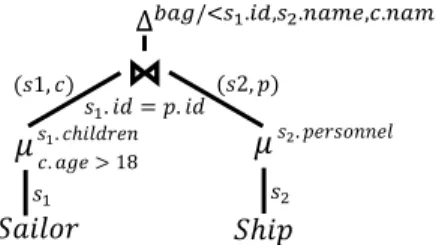
Figure 1: Query involving unnest operators: Without them, the op-erators higher in the tree would have to process BLOBs repeatedly every time they need a nested value.
Example 3.1:Suppose we have a dataset comprising sailors and a dataset comprising ships. Each sailor has anidfield and achildren
field which contains a list of(name,age)pairs for the sailor’s chil-dren. Each ship entry has anamefield and apersonnelfield which contains a list of sailor identifiers. The query “For each Sailor, re-turn his id, the name of the Ship on which he works, and the names of his adult children” is expressed in the calculus as follows:
for { s1 <- Sailor, c <- s1.children, s2 <- Ship,
p <- s2.personnel, s1.id = p.id, c.age > 18 }
yield bag (s1.id, s2.name, c.name)
The resulting plan for this query is depicted in Figure 1. Two unnest operators handle explicitly the nestings in the data.
Overcoming Complexity. Using a rich data model and lan-guage/algebra for queries over complex data was proposed when OODBs and XML appeared [24, 25, 55]. Rich models and al-gebras, however, lost traction due to their complexity. The more complex an algebra is, the harder it becomes to evaluate queries efficiently: Dealing with complex data leads to complex opera-tors, sophisticated yet inefficient storage layouts, and costly pointer chasing during query evaluation. To overcome all previous limita-tions, we couple a broad algebra with on-demand customization.
4.
THE ARCHITECTURE OF PROTEUS
Proteus is a query engine designed from scratch to enable fast queries over heterogeneous datasets. To provide generality, Proteus uses an algebra which can model operations across different types of data, thus offering expressive power and rewriting opportuni-ties for queries targeting complex data. To also minimize response time, Proteus creates a new query engine instantiation on-demand per query via code generation. Furthermore, Proteus customizes its storage structures to adapt them to the workload. The result is a custom, highly-optimized engine, expressed in machine code and operating over a data representation that suits user analysis.
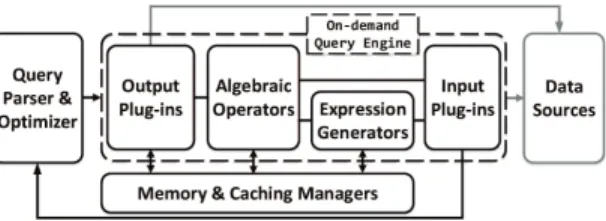
Figure 2 depicts the components of Proteus. TheQuery Parser
handles incoming queries, which are then rewritten to a physical
plan by the Query Optimizer. Algebraic Operators encapsulate
data model heterogeneity; they express the plan of a query and co-ordinate code generation.Expression Generatorsgenerate code for expression evaluation when requested by an operator. Input Plug-insencapsulate data format heterogeneity; they consider source-specific optimizations and generate code that accesses any required data. They also provide statistics and costing formulas per data source.Output Plug-insgenerate code that handles operator output and cache creation along with theMemory & Caching Managers.
Query Optimization. Systems which process heterogeneous data face the following challenges: First, queries over hierarchi-cal data typihierarchi-cally involve many levels of nesting, which increases execution overheads. Second, unless an optimizer has access to data statistics, it may produce suboptimal plans. Proteus uses a three-step approach to address these issues: First, when a user asks a query, Proteus parses and normalizes it, performing operations
Figure 2: Proteus architecture.
such as selection pushdown and unnesting multiple types of nested queries. Then, Proteus rewrites the query to a nested relational al-gebra. The algebraic representation is amenable to relational-like optimizations and further unnesting. Finally, after a number of rule-based rewrites, the optimizer considers cost-rule-based transformations; it follows a bottom-up strategy and relies on gathered statistics to perform access path selection and join re-ordering. Its difference from traditional optimizers is that statistics and costing of data ac-cesses are provided by the input plug-ins relevant per query.
On-demand Query Engine.The operators of traditional query engines are hard-coded to a database-specific input data format for efficiency. Proteus is designed to treat each data format as native storage. To cope with data heterogeneity, Proteus masks data com-plexity from the operators by using an input plug-in per data format. Each plug-in exposes a uniform interface that the rest of the engine uses to consume data values. The algebraic operators process in-put either by calling expression generators or via direct interaction with an input plug-in. This separation of concerns makes Proteus extensible: adding a plug-in suffices to support a new data format.
The operators of Proteus call output plug-ins to handle the cre-ation of output and the materializcre-ation of any required intermediate results during query execution. Proteus also uses the output plug-ins to define caching structures, which it populates as a side-effect of execution to adapt to the overall workload. Once materialized, Proteus treats caches as an additional input dataset.
For each query, Proteus uses a code generation mechanism to collapse the layered architecture of the engine – the dashed part of Figure 2 – into a specialized piece of code. Each of the components produces low-level machine code that Proteus combines to form a program serving the currently processed query. Specifically, once the optimizer has produced a physical plan, Proteus traverses it re-cursively until it finds the datasets to access (i.e., the leaf nodes). It then triggers the appropriate input plug-ins to generate code ac-cessing data. As the recursion is returning control to the root node of the plan, Proteus generates code for every visited operator. Each visited operator may (re-)trigger input and output plug-ins to pro-cess its input and/or materialize its output.
Memory Manager. Whenever a system component requests a memory block to read/write, the Memory Manager handles the re-quest. The Manager distinguishes between input files and caching structures: It memory-maps input files, treating all input data as if it is memory-resident, and delegates paging to the OS virtual memory manager. As for caching structures, Proteus pins them in a memory arena, and uses an LRU variation to evict them when appropriate.
Implementation Scope. Proteus targets read-only and append-like analytical workloads. This study focuses on full dataset scans and excludes value-based indexes, as they are an orthogonal opti-mization which is straightforward – yet optional [10] – to imple-ment. In case of data updates, Proteus currently drops and rebuilds any affected parts of existing auxiliary structures (e.g., caches).
5.
ON-DEMAND QUERY ENGINES
Ideally, a system must allow diverse queries over heterogeneous datasets, but also perform as if it has been designed for a specific
use case – even better, as if it is hard-coded to serve a specific query: For analytical queries over flat (e.g., binary, CSV) data, the system must be as fast as an analytical relational engine. For hierarchical data, it must be as fast as a document store.
The nested relational algebra of Proteus enables querying com-plex data types and considers them as first-class citizens during query optimization. It also facilitates query unnesting – a com-mon issue when input data is nested. Dealing with complex data and query operators, however, comes at increased cost.
Even when dealing with the strictly relational operators of an RDBMS, interpreting the query plan is costly. A source of over-head is the ubiquitous Volcano iterator model [27], which enables pipelining and exposes a single interface for all operators, but com-plicates control flow and introduces multiple function calls per tu-ple processed (e.g., each operator callinggetNextTuple()). Another factor is the variety of datatypes that each operator must be able to process: An operator must trigger different code paths depending on whether its arguments are i) integers, ii) floats, iii) some com-bination, etc. To support this behavior, operators use control flow statements and (virtual) function calls in their code, which leads to increased branching in the critical path of execution.
Thisinterpretation overhead[36, 43], stemming from function calls and control flow statements that disrupt the instruction pipeline, affects pipelined query execution negatively. Intuitively, the nested relational algebra operators face similar issues. Even worse, they have to i) support additional, more complex types of input, and ii) perform extra work compared to their relational counterparts. For example, besides the selection and join operators, many addi-tional operators of the nested relaaddi-tional algebra have an embedded filtering step (e.g., unnest, reduce). The additional complexity fur-ther increases the interpretation overhead.
One way to remove the interpretation overhead is to use a block-oriented, operator-at-a-time execution model, as columnar engines typically do [15]. The block-oriented model, however, introduces materialization overhead per operator. This cost would be more se-vere for Proteus compared to traditional relational systems because of the more complex datatypes to be materialized. Even worse, Proteus serves datasets whose contents rarely reside in explicit data blocks, so every query would pay an upfront cost to materialize input blocks. Instead of processing data blocks, Proteus pipelines data through its operators, but also minimizes interpretation over-head by customizing itself when it receives a query based oni)the query requirements andii)the datasets the query touches.
5.1
An Engine per Query
Traditional pipelined query engines execute a query by interpret-ing its physical plan and invokinterpret-ing multiple general-purpose opera-tors for each input tuple. Proteus removes interpretation overhead by traversing the query plan only once and generating a custom im-plementation of every visited operator. Proteus thus uses control flow mechanisms such as datatype checks only during the single traversal, and avoids the per-tuple penalty that a static pipelined engine incurs. Once all plan operators have been visited, Proteus blends the generated code stubs into a hard-coded query engine im-plementation which is expressed in machine code.
Proteus uses LLVM [37] to generate low-level code, which it compiles at runtime. LLVM is a collection of compiler infrastruc-ture which offers frontends for languages such as C/C++ and For-tran. In its core, LLVM translates these languages into an interme-diate representation (IR) resembling assembly code: theLLVM IR. LLVM then compiles the IR into actual machine code based on the underlying hardware. Proteus generates LLVM IR because i) it is strictly-typed and less error-prone than macro-based C++
✂ ☛ ✁✄☎ ✞ ✆ ✝✟✠ ✡ OID Plugin Buffer Plugin Buffer Plugin 1while(!eof(A)) { 2 addToBuffers 6} 3 if(eval(e)) { 5 } 4 sum += 1 7return sum
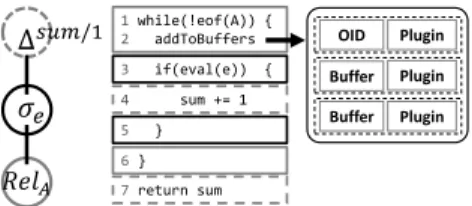
Figure 3: Example of a query plan and of the generated (pseudo-) code. Once the scan operator places needed fields in virtual buffers, they are used to evaluate the filtering expression.
code, ii) it compiles much faster than macro-based C++ code, and iii) LLVM offers rewrite passes such as dead code elimination that optimize the generated IR. In summary, Proteus uses LLVM as a plan rewriting mechanism, and performs one extra step com-pared to traditional query engines: It rewrites the physical algebraic plan – an abstract, high-level IR – into the imperative, low-level LLVM IR which is amenable to compiler-centric optimizations [2]. After parsing and optimizing a query, Proteus traverses the phys-ical plan of the query in post-order depth-first-search (DFS). When visiting a node of the plan, Proteus i) visits the node’s children to produce the code corresponding to their functionality, ii) generates the physical implementation corresponding to the current node, and iii) returns control to the node’s parent to continue the code gener-ation process. The recursive traversal terminates when it reaches a leaf node (a scan operator). Proteus then generates a code stub that, when executed, will launch a scan over a dataset. In each scan iteration, the generated code will access a “record” from the data and place the fields needed for the rest of the plan in virtual memory buffers. The virtual buffers can be thought of as local vari-ables placed in the stack frame. To maximize locality, the LLVM compiler promotes buffer contents to CPU registers when possi-ble. Therefore, subsequent operators referencing values that ex-ist in regex-ister-backed buffers experience minimal access times and fully pipeline data. Once Proteus has generated code stubs for a leaf node, it shifts control to the node’s parent, also passing along pointers to the virtual buffers and to the currently “hollow” parts of the overall query code that need to be filled in next. The same process continues until control returns to the root node.
Figure 3 depicts a plan for the querySELECT COUNT(*) FROM A
WHERE e, along with a high-level description of the resulting code. The scan of relation A results in the generation of a “hollow” while-loop. The code for the ending condition of the loop (line 1), as well as for populating virtual buffers with the fields necessary to answer the query (line 2), is injected by aninput plug-inthat allows the data-format-agnostic scan operator to interface with dataset A re-gardless of how it is stored. Then, the selection operator generates a hollowif block, whose outcome depends on the evaluation of the expressione(line 3) in each iteration. Proteus retrieves the values required to evaluateefrom the virtual buffers. The reduce operator calculates the final result by incrementing a counter, which it then outputs. The result of the physical plan traversal is not a number of standalone operator implementations: It is a minimal, special-ized piece of code representing an entire query, with operator logic tightly stitched together to ensure pipelined query execution. This type of execution minimizes intermediate query results, maximizes code and data locality, and reduces register pressure.
Proteus also uses pre-existing (i.e., not generated) C++ code for some of its functionality. Proteus wraps these operations in C++ functions and calls them when appropriate from the generated code. For example, the Memory and Caching Managers do not generate code. In another case, Proteus uses hash-based algorithms for the join and grouping operators, namely variations of the radix hash join algorithm [39] adapted from [9]. While parts of the join
imple-Input Plug-in Methods generate() hashValue() unnestInit() readValue() flushValue() unnestHasNext()
readPath() unnestGetNext()
Table 2: The input plug-in API of Proteus
mentation are indeed generated at runtime, other parts, like cluster-ing the materialized entries based on their hash values, are wrapped in a C++ function. This function is only called once per join side, so the overhead of making the function call is minimal.
Implementation. The layers of Proteus that parse, rewrite, and optimize queries are expressed in Scala and output a physical query plan. The layers that traverse the query plan and trigger code gen-eration using LLVM are written in C++. When Proteus receives a query, it generates stubs of LLVM IR, which it stitches together during the traversal of the physical query plan and puts into a single function. Within milliseconds, LLVM compiles the IR of the func-tion into actual machine code based on the underlying hardware. The result is a library which Proteus calls to serve the query.
5.2
A Custom Data Access Layer per Query
The operators of Proteus access a dataset either by triggering an expression generator to produce code for the evaluation of an algebraic expression, or by directly calling the corresponding input plug-in. This separation of concerns ensures extensibility.
Expression Generation
Proteus places values from each dataset it touches into virtual mem-ory buffers, which the query operators use to evaluate expressions of the nested relational algebra. For example, if Proteus has pop-ulated buffers with fieldsa.salanda.bonus, it can evaluate the fil-tering expression of the operatorσsal+bonus<3000. The physical
op-erators assign the evaluation of algebraic expressions to an expres-sion generator. In the example of Figure 3, an expresexpres-sion generator produces the code to calculate the result ofeval(e)at line 3, and injects it as the condition in theif statement. Similar generators are used when hashing an expression and when flushing out the query output. A useful property of this separation is that the operators are agnostic to the underlying data models/formats/properties. The operators are oblivious to whether a value in the memory buffers belongs to an array, is nested, or is not fully materialized yet; all they require is that the expression generators inject the appropriate code for expression evaluation at the code spots they designate.
Input Plug-ins
Proteus masks the details of the underlying data values from the query operators and the expression generators. To interpret data values and generate code evaluating algebraic expressions, Proteus usesinput plug-ins. Each input plug-in is responsible for gener-ating data access primitives for a specific file format. Proteus cur-rently uses input plug-ins for CSV, JSON, and relational binary data (both row-oriented or column-oriented).
Table 2 lists the API that every input plug-in exposes. Calls to a plug-in can be made by i) a scan operator populating virtual memory buffers (thegenerate()call), ii) an unnest operator looping through a nested collection (unnestInit()etc.), or iii) an expression generator calculating an expression. In the third case,readValue()
provides a field’s value to the expression generator, andreadPath()
returns a pointer to a data object’s field. Consecutive calls to read-Path()are used to access nested fields.
When a scan operator calls an input plug-in, the plug-in gener-ates code that customizes the data access layer of Proteus based on
Figure 4: Example of a structural index for a JSON object. dataset to be accessed: itsschema,format, andcontents. Using this information, Proteus generates code that performs fewer and more efficient data accesses than a general-purpose scan operator. An ex-ample of exploiting the query requirements is the following: Dur-ing query rewritDur-ing, Proteus pushes field projections down to the scan operators so that it pays to extract only the fields necessary. To perform these selective accesses, a general-purpose scan oper-ator would use a loop that checks whether each field is needed for the query, thus introducing branches in the critical path of execu-tion. Instead, Proteus generates code processing only the required data fields. Proteus also uses the dataset schema to avoid unnec-essary control logic such as datatype checks – it generates specific access primitives for integer fields, nested fields, etc. The overall code generated for scanning data resembles a hard-coded program.
Specializing per Dataset Format. Proteus generates code that considers the particularities of each data format. For binary re-lational data, an input plug-in generates code reading the memory positions of the required data fields. For more verbose or richer for-mats, Proteus uses more sophisticated access methods. The com-mon denominator of all input plug-ins is that for every data object / “tuple” they access, they produce an object identifier (OID), which they forward to the query operators. As an example, for flat data the OID is a row counter. Using an entry’s OID, an expression gen-erator can invoke the corresponding input plug-in at a later point in execution to access a value needed for an expression’s evaluation.
Apart from creating an OID, Proteus calibrates how eager / lazy the generated access primitives are (i.e., which values to place in memory buffers apart from the OID, whether to eagerly convert a value to a binary serialization, etc.). Proteus supports lazy plug-in behavior because eagerly populatplug-ing memory buffers may prove unnecessarily expensive. When performing a path query over nested objects or data unnesting, Proteus avoids eagerly serializing a com-plex object only to process a subset of it: Instead, Proteus uses structural information for the data in order to navigate in the dataset and to access only the values necessary to provide a result. In addi-tion, in many cases Proteus delays data conversion because it may prove to be unnecessary (e.g., because of some selection filtering out results). Another scenario is applying different materialization policies in relational workloads. To allow for this flexible behavior and enable a field’s reconstruction at any point, Proteus maintains plug-in information for each field value in its memory buffers. For every such value, the corresponding plug-in uses rules to specify how lazily to process it based on criteria such as its data type and at which point of the query it is used, and generates appropriate code.
Structural Indexes.The input plug-ins of Proteus use auxiliary structures to reduce the navigation cost associated with verbose data formats, for which every access requires substantial parsing effort. Thesestructural indexesstorepositionalinformation about fields in the datasets instead of actual data values. Their entries are addressable by OID, so that all plug-ins have uniform behavior. For CSV datasets, structural indexes store the binary positions of a number of data columns in each row [5]. Proteus stores the position of every Nth field of the file (e.g., if N=10, it stores the positions of the 1st, 11th, ... fields). When looking for a field, Proteus locates the closest indexed field position and starts seeking from that point. Structural indexes for JSON require a more involved process be-cause of the inherent complexity of the JSON format, which
al-lows arbitrary levels of nesting and field order, as well as optional fields. When Proteus accesses a JSON file for the first time, it val-idates the JSON input. During validation, Proteus populates an index per JSON object with structural information. The resulting structural index serves two goals: It reduces the parsing effort for subsequent accesses to the file, and minimizes the interpretation overhead stemming from the schema flexibility of JSON data.
Each entry of a JSON structural index captures information about atoken(e.g., a field name, an array, etc.) contained in a JSON ob-ject: its binarystarting and ending positionsin the file, as well as itstype. To serve requests for a data field, the JSON input plug-in fplug-inds its correspondplug-ing token entry plug-in the structural plug-index. The plug-in then forwards the entry identifier – which acts as an OID – to the operator / expression generator that requested it.
The structural index described so far corresponds to “Level 1” of the example in Figure 4. The first index entry, labeled “{}”, keeps the starting and ending positions of the overall JSON object, the second entry keeps the positions of tokena, and so on. Intuitively, if a dataset contained multiple objects similar to the one depicted
and a query requested fielda from each one, the JSON plug-in
would follow the same process for each object: Return the second entry of the object’s corresponding structural index. Nevertheless, there is no guarantee that fieldacomes before fieldb,bbeforec, etc. in every object of the dataset. Thus, Proteus would have to sequentially scan each object’s index and compare the label of the wanted field with the one currently visited.
To remove this overhead, Proteus introduces “Level 0” to the structural index. “Level 0” comprises an associative array which maps field names to their corresponding positions in “Level 1” of the index. The shaded values in Level 1 are now redundant and thus removed. The JSON plug-in finds a field’s position via a lookup to the associative array. The use of Level 0 reduces data access costs and offers determinism despite the semi-structured JSON nature.
Proteus also registers nested records in Level 0. In Figure 4, by storing a pointer to fieldc.d.d1, dereferencing occurs in one step instead of multiple ones. Nested collections are treated otherwise: Notice that fieldseand f, which correspond to the contents of a nested (array) collection, are omitted from Level 0. JSON struc-tural indexes opt against maintaining pointers to array contents be-cause Proteus has an explicitUnnestoperator to handle nested col-lections. The code path of Unnest applies the same action to every nested element, therefore it is unaffected by schema flexibility.
Specializing per Dataset Contents.The more information Pro-teus obtains about a dataset, the more aggressive optimizations it performs: An input plug-in can craft an optimized code path suit-able only for a specific file instance. In the case of JSON data, schema flexibility introduces overhead even when using a structural index, because Proteus has to store more bookkeeping information per indexed entry, and generate more complex code to process it. There are many scenarios, however, such as the case of machine-generated data, where every object in a dataset has the same fields in the same order. Proteus can verify whether this case holds while creating a structural index, and drop Level 0 because the lookup process is now deterministic: It is sufficient to maintain the sizes of any variable-length structures (i.e., JSON arrays) met and combine them with fixed schema information to deterministically compute the exact positions of relevant structural index entries. The result is a more compressed structural index and an efficient code path for lookups. In a similar optimization, if a CSV file contains fixed-length entries, Proteus deterministically computes field positions and injects them in the code instead of using a structural index.
Enabling Cost-based Optimizations. Proteus uses a metadata store to maintain statistics per data source, namely dataset
cardi-nalities and min/max values per attribute, and delegates statistics collection to each input plug-in. The statistics collection process is fine-tuned to avoid introducing execution overheads. Specifically, Proteus refrains from generating code for statistics gathering in ev-ery quev-ery to avoid bloating the minimal generated code. Instead, it collects statistics in three ways: First, Proteus collects statistics during the first (cold) access to a dataset, because I/O masks the overhead of statistics gathering. Second, when the plan contains a blocking operator (e.g., a join), the relevant input plug-in injects code that profiles the materialized values all at once. Finally, a dae-mon process periodically triggers statistics-gathering queries when the system is idle – a methodology followed by multiple DBMS. Regarding costing, each input plug-in uses different cost formulas, which it instantiates with data statistics to provide cost estimates to the query optimizer. Delegating source-specific work to a “wrap-per” per source is also popular with federated systems [46, 47].
Proteus allows plug-in developers to calibrate statistics gathering and costing. The baseline option is to use predefined, hard-coded estimates in place of statistics-based computations (e.g., assume that the default selectivity of a predicate is 10%), as well as text-book cost formulas. Proteus offers such a skeleton for every input plug-in by default because it has been shown to have satisfying results [46]. Regarding statistics, Proteus allows developers to ad-just/change the sampling function to be called during cold queries and result materialization. The function specifies the type of sam-pling to be used, and on which fields the statistics-gathering mecha-nism should focus on. Regarding costing, the developer can change the provided cost formulas with more suitable ones for her needs.
Adding More Inputs.Adding support for more inputs is straight-forward. For each new input, what is required is to code in an input plug-in which implements the methods of Table 2. A developer can use plain C++ instead of the lower-level LLVM API, since Proteus can directly call C++ functions. Of course, using the LLVM API leads to minimal, more efficient code; the plug-in developers decide how to calibrate ease of development and high performance based on their requirements. The same trade-off applies when integrating Proteus with existing data stores such as an RDBMS: A plug-in can either i) issue SQL queries to the DBMS, or ii) directly access the proprietary binary data format that the DBMS uses internally.
6.
ADAPTING STORAGE TO WORKLOAD
Proteus dynamically populates data caches as a side-effect of query execution to adapt to the workload trends. These caches can be viewed as dynamic materialized views [35], following the data recycling principle [31, 42] of automatically caching results during query evaluation for possible reuse in the future. Proteus deals with complex models and formats, so the importance of reuse is even higher because of the effort needed to re-access the data involved and recompute the expressions that queries require. Since users ex-press a range of queries over a variety of data, the caches must facil-itate each diverse workload, adapting to serve it efficiently. There-fore, instead of having a predefined structure, the caches adapt to the types of queries asked. Depending on the query workload, the caching structures can resemble i) pages filled with tuples in a sys-tem’s buffer pool, ii) binary columns accessed by a columnar en-gine, iii) nested objects serialized in a binary format, etc.
Proteus can cache any expression supported by the nested rela-tional algebra. Each query may trigger the population of caches of different shapes – caches of different shapes can even be built at different phases of the same query. For example, a query sub-tree processing hierarchical data may benefit from a different cache type than the query part touching relational tables. Some expres-sion types that Proteus can cache are the following:
• Field projections (rel.attrA).
• Arithmetic expressions ((rel1.salary+rel2.bonus)∗12). • New record constructions (<rel.attrA,tree.attrB.attrB1>). Proteus uses caching primarily to benefit queries over non-binary, verbose sources such as CSV. By caching data entries in a more compact binary format, neither parsing nor data conversions are re-quired to access them. Caching is also beneficial when a different data layout is more suitable for the workload than the one currently used by a dataset [6, 28]. Proteus is flexible enough to allow differ-ent caching policies depending on the expected workload type.
Implementation.The algebraic operators are oblivious to which expressions are to be cached and which of the input values they process is actually served from caches. When Proteus has to ma-terialize data (e.g., during a join), or the physical plan contains a caching operator, Proteus assigns the task to anoutput plug-inthat specifies i) the expression to be cached, ii) what the serialization format will be, and iii) the “degree of eagerness” to be used during caching. For example, when dealing with variable-length string en-tries, it might be sufficient to cache their binary starting positions, or even the OID of the entry to which they belong. Different types of workloads benefit from different policies across these axes.
Output plug-ins trigger cache construction similarly to expres-sion evaluation: For each data entry, an expresexpres-sion generator pro-duces code which evaluates the expression to be cached and places the result in a consecutive memory block. Proteus exposes the data cache as an additional input. As with the rest of the datasets, Pro-teus accesses the cached data using a dedicated input plug-in.
Building Caches.Proteus triggers cache creation i)implicitly, as a by-product of an operator’s work, or ii)explicitly, by introducing caching operators in the query plan. Implicitcaching exploits that some Proteus operators materialize their inputs: nest and join are blocking and do not pipeline data. Especially for joins, Proteus uses a radix hash-join variation, which materializes both input sides. It is thus important to use populated data structures and avoid re-building them, especially if the data originated in a verbose data format for which accesses are expensive.
Forexplicitcaching, Proteus can place buffering operators at any point in the query plan. An explicit caching operator calls an out-put plug-in to populate a memory block with data. Then, it passes control to its parent operator. Creating a cache adds an overhead to the current query, but it can also benefit the overall query workload: When accessing verbose formats like JSON, it is advisable to avoid re-accessing the original data whenever possible. Even when using auxiliary structures to navigate in the file, there are still additional costs. After locating a required field, the input plug-in typically needs to convert it to a binary form. In addition, verbose objects pollute CPU caches with unneeded information. Each field that Proteus needs is located at an arbitrary position in the file. When Proteus places it in a CPU cache line, the rest of the line is typically filled with an unneeded part of the overall JSON object. Dealing with compact, packed binary caches greatly improves data locality. Therefore, if a cached field ends up being re-used, the benefit from avoiding these data accesses and computations is significant.
Cache Matching. For every cache that Proteus populates, the Caching Manager stores the physical plan corresponding to the cache and uses it as a search key during cache matching. Proteus considers the available caches right before generating code for a query. The cache/view matching process resembles that of [42, 48]. Proteus treats the physical plan as a DAG, where each node corre-sponds to a physical operator, and traverses it in bottom-up fashion. The Caching Manager traverses each stored plan simultaneously with the traversal of the current plan. For every node of the DAG visited, Proteus probes the Manager for nodes in the cached plans
that can be used instead. For a node in the current query tofully matcha node in a cached plan, i) they must both perform the same operation (e.g., selection), ii) have the same arguments (i.e., eval-uate the same algebraic expressions), and iii) their children nodes must match each other respectively. Whenever the Manager finds a match, Proteus applies the same process recursively until it reaches the root of a cached plan. If successful, Proteus rewrites the plan to use the cache. Besides full matches, Proteus considerspartial matching: If Proteus has cached the intermediate results (i.e., the hash tables) ofA./B, then the newly arrived queryA./Ccan re-use the hashtable built forAif it uses the same join key. Future work includes adding support forsubsumption[26, 48], i.e, identi-fying that the cached treeσx>0(A)can replace the current sub-tree
σx>10(A)as long as we re-apply thex>10 predicate.
In summary, rewriting scenarios include replacing i) a sub-tree of the plan (e.g., a scan and a subsequent unnest operator), ii) a single operator (e.g., a scan), or iii) a part of an operator (e.g., one of the already materialized sides of a radix hash join). Code generation is an enabler for such rewrites of varying granularity, because it allows Proteus to generate code only for the necessary operations.
Cache Policies. Selecting which views to materialize is a well-studied research problem [29]. Proteus applies different material-ization policies depending on the workload characteristics. Proteus benefits significantly when it places caching operators close to the leaf nodes of the plan in order to convert input (raw) values to a binary format. A reason is that raw data access is a major over-head when querying heterogeneous datasets. In addition, the sim-pler an operator tree corresponding to a materialized result is, the more upcoming queries will be able to re-use it and benefit from it. Therefore, the Caching Manager currently focuses on ways to fully replace a costly access path instead of materializing the result of a complex query sub-tree; applying more sophisticated policies and studying their effect [4, 29] is part of our future work. Proteus thus opts for straightforward first-come-first-served caching poli-cies, and eagerly caches values read from CSV and JSON files. Proteus caches primitive values found in files containing hierar-chies to avoid re-navigating through them, especially if the involved objects are deeply nested. Proteus also caches fields used as filter-ing predicates. On the contrary, Proteus avoids cachfilter-ing variable-length string fields from CSV and JSON files, which may be ver-bose and pollute the caches. Regarding cache eviction, Proteus uses a data-format-biased version of LRU, favoring data from inputs that
are more costly to access (whereJSONCSVBinary).
7.
EXPERIMENTAL EVALUATION
We evaluate Proteus using i) synthetic benchmarks to isolate the performance of common query operations, and ii) a challenging real-life spam email analysis workload provided by Symantec.
Experimental Setup. We compare Proteus against a) systems that at some point were extended to support richer data models, and b) systems specialized for a specific scenario by design. Specifi-cally, we compare i) PostgreSQL 9.4.1, ii) commercial DBMS X, iii) MonetDB 11.19.9, iv) commercial DBMS C, and v) MongoDB 3.0.3. PostgreSQL and DBMS X are row stores that support both relational and JSON data; they showcase how a generic system per-forms in the two diverse cases. We configure DBMS X to use its “main memory accelerator”, therefore it keeps data in memory us-ing a custom memory-friendly layout. MonetDB and DBMS C are read-optimized column stores, designed to efficiently support rela-tional analytical queries, which recently added JSON support. Fi-nally, MongoDB is a specialized system for JSON data, for which it uses a binary serialization (BSON). PostgreSQL supports both a binary (jsonb) and a character-based JSON serialization; we use
jsonb because of its efficiency. The other systems treat JSON as a subtype of VARCHAR. Neither the systems we compare against nor Proteus make assumptions about field order in the JSON files.
We run all experiments on a dual socket Xeon Haswell CPU E5-2650L (12 cores per socket @ 1.80 GHz), equipped with 64 KB L1 cache and 256 KB L2 cache per core, 30 MB L3 cache shared, 256 GB RAM, and 2TB 7200 RPM SATA 3 disk storage. The operating system is Red Hat Enterprise Linux 7.1. Proteus uses LLVM 3.4 to generate custom code with the compilation time being at most ∼50 ms per query. We run all systems in single-threaded mode.
7.1
Specializing the Query Engine on Demand
This experiment isolates the performance of typical query oper-ations over both hierarchies and reloper-ations. We use JSON and re-lational binary data, and examine a range of query templates with 10%, 20%, 50%, and 100% selectivity.
We use the TPC-Hlineitemand order tables as input, using
scale factors 10 (SF10- 60M lineitem tuples, 15M order tuples)
and 100 (SF100- 600M lineitem tuples, 150M order tuples). We
shuffle each file’s contents to avoid potential optimizations that ex-ploit interesting orders and can introduce noise to the experiments. To test performance over JSON data, we convert the TPCH-SF10 tables into a 20GB JSON file for lineitems and a 3.5GB file for or-ders, and load them in all the systems we compare against. As an indication of storage size, PostgreSQL requires 27GB to store the JSON version of lineitem, and MongoDB requires 30GB. Proteus natively operates over the JSON files and builds a structural index during the first data access. Index size is∼21% of the JSON file for lineitems and∼15% for orders, and its construction is signifi-cantly faster than loading the data in the other systems (e.g.,∼4× faster than MongoDB). For experiments over binary data, we load the TPCH-SF100 version in PostgreSQL, DBMS X, MonetDB, and DBMS C. Proteus operates over binary column files similar to the ones of MonetDB. All systems operate over warm OS caches. Un-less otherwise specified, the adaptive caching of Proteus is deacti-vated. The data types are numeric fields (integers and floats).
Projections. For queries projecting a varying number of fields, we use three variations of the following query template:
SELECT AGG(val1),...,AGG(valN)FROM lineitem WHERE
l_orderkey < [X]. The first two variations compute COUNT
and MAX respectively. The third variation computes four aggre-gations (COUNT and MAX).
Figure 5 plots results for the JSON version (SF10). Proteus is the fastest system because its lightweight generated code path makes it more efficient for the CPU-intensive task of processing JSON en-tries. In addition, contrarily to PostgreSQL, Proteus does not treat JSON objects as bulky BLOB data; it uses the structural index to re-trieve the information it needs from each object, which it then feeds in the query pipeline without “polluting” the CPU caches with the verbose JSON object any further. As for the other systems, JSON access is expensive for DBMS X because it uses a character-based encoding. MongoDB is competitive with PostgreSQL only for the COUNT query. As the number of aggregates to compute increases, PostgreSQL outperforms MongoDB. JSON support is still imma-ture in MonetDB, which results in suboptimal performance. Sim-ilarly, DBMS C underperforms in all our experiments over JSON data. For this reason, and because some of the benchmarked oper-ators are either work-in-progress (e.g., unnest) or not yet supported efficiently (e.g., using a JSON field in a GROUP BY clause re-quires a costly workaround for MonetDB), we exclude MonetDB and DBMS C from the other experiments with JSON data.
Figure 6 presents results for the queries over binary data (SF100). MonetDB and DBMS C are faster than PostgreSQL and DBMS X
10 100 1000
10 20 50 100 10 20 50 100 10 20 50 100 Q: 1 Aggr. (Count) Q: 1 Aggr. (MAX) Q: 4 Aggr.
Ex ecuti on T ime ( sec ) Selectivity Factor (%) JSON Projections: SF10
PostgreSQL DBMS-X MonetDB DBMS-C MongoDB Proteus
Figure 5: Projection-intensive queries over JSON data.
0.1 1 10 100 1000 10 20 50 100 10 20 50 100 10 20 50 100 Q: 1 Aggr. (Count) Q: 1 Aggr. (MAX) Q: 4 Aggr.
Ex ec uti on Time (se c) Selectivity Factor (%) Binary Projections: SF100
PostgreSQL DBMS-X MonetDB DBMS-C Proteus
Figure 6: Projection-intensive queries over binary relational data. because the analytical query template we study is suitable for column-oriented engines (i.e., a small subset of the relation is accessed). For selective COUNT queries, DBMS C is the fastest system be-cause it sorts the input during data loading; given that the query has a predicate on the sorting key, DBMS C exploits it to skip many data entries while answering the query. In addition, this query does not project any attributes, therefore DBMS C does not incur any tu-ple reconstruction cost. For less selective instances of the COUNT query and for the other more complex queries, Proteus is faster than DBMS C and MonetDB; their columnar operators produce in-termediate results (i.e., fully materialize their output), thus paying a materialization cost for the columns involved. The materializa-tion cost increases further as queries become less selective; Proteus pipelines data instead. In addition, the resulting code of Proteus is a tight, minimal while-loop which only contains an if block evaluat-ing the selection condition. The importance of generatevaluat-ing minimal code is highlighted in the COUNT query (left side of Figure 6). The code is minimal enough for the effect of the branch predictor to be visible. When selectivity reaches 100%, very few mispredictions occur, therefore the query becomes faster for Proteus, although in-tuitively Proteus does more work to calculate the aggregate value.
Selections.To test queries with multiple selection predicates, we use three variations of the following template:SELECT COUNT(*)
FROM lineitemWHERE val1<[X] AND ... AND valN<[Z].
The examined queries include one, three, and four predicates in the WHERE clause respectively.
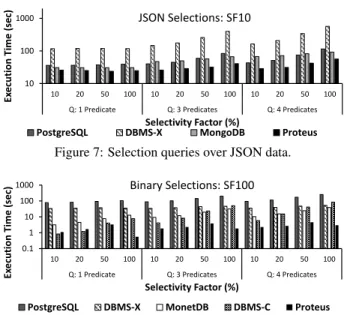
Figure 7 presents the results over JSON data (SF10). Proteus has to convert the values it needs on the fly, whereas PostgreSQL and MongoDB operate over a binary serialization. Still, Proteus is faster than the other systems across the whole experiment because once it has extracted the values it needs, it reduces the rest of the CPU overheads significantly. Besides pipelining, Proteus consults its structural index to pinpoint needed fields, thus reducing navi-gational cost in the file. These benefits become more apparent for less selective queries. DBMS X is the slowest system because of its character-based JSON encoding. Compared to Figure 5, Mon-goDB closes the gap on PostgreSQL and Proteus because the cur-rent query template projects out a count instead of more complex aggregates which MongoDB does not compute as efficiently.
In the case of binary data presented in Figure 8, the outcome is similar to the one for projection queries. Proteus is faster in the majority of cases because it pipelines data through all operators.
10 100 1000
10 20 50 100 10 20 50 100 10 20 50 100 Q: 1 Predicate Q: 3 Predicates Q: 4 Predicates
Ex ec ut ion Ti me (sec ) Selectivity Factor (%) JSON Selections: SF10
PostgreSQL DBMS-X MongoDB Proteus
Figure 7: Selection queries over JSON data.
0.1 1 10 100 1000 10 20 50 100 10 20 50 100 10 20 50 100 Q: 1 Predicate Q: 3 Predicates Q: 4 Predicates
Ex
ec
ut
ion Time (sec
)
Selectivity Factor (%)
Binary Selections: SF100
PostgreSQL DBMS-X MonetDB DBMS-C Proteus
Figure 8: Selection queries over binary relational data. MonetDB and DBMS C operators materialize their output, which becomes more expensive as selectivity moves towards 100%.
Joins & Unnests.To test joins, we use three variations of the
fol-lowing template:SELECT AGG(o.val1),...,AGG(o.valN)FROM
orders o JOIN lineitem l ON (o_orderkey = l_orderkey)
WHERE l_orderkey < [X].The first two variations compute one aggregation, COUNT and MAX respectively, while the third varia-tion computes two aggregavaria-tions (COUNT and MAX).
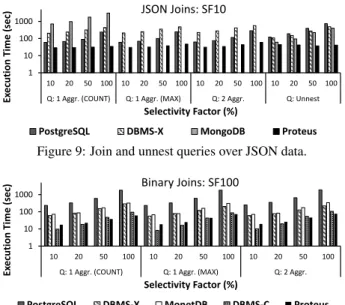
Document stores such as MongoDB lack first-class support for join operations, under the assumption that JSON data is typically denormalized (i.e., any joins are pre-materialized). We therefore include one more variation of a COUNT query over denormalized JSON data; each order object now contains an array with the lineit-ems that correspond to it, so the query has tounnestthese JSON arrays instead of performing a join.
Figure 9 plots the results for the JSON case. Proteus is faster than the other systems because of i) its minimal generated code, ii) its lightweight JSON access path, and iii) the efficiency of the radix hash join algorithm it uses, which explains the larger perfor-mance gap from PostgreSQL compared to the previous query types. For MongoDB, we implement the join logic in a map-reduce-like query. MongoDB is unsuitable for such operations, which explains its poor performance; we only list its results for the first query as an indication. On the contrary, in the “Unnest” case, MongoDB out-performs PostgreSQL and DBMS X, which rely on built-in func-tions to perform data unnesting instead of an explicit query oper-ator. Proteus is faster because its generated code involves almost no data conversions; besides evaluating a predicate, the code only increases a counter for each element of the nestedlineitemarrays.
For joins over binary data, the query template is ideal for DBMS C and DBMS X. As seen in Figure 10, DBMS C is the fastest system for selective queries because it exploits the fact that it sorts the data on the filtering key at loading time and thus skips multiple entries. In addition, it performs sideways information passing: it applies the filter onorderkeyto both sides of the join, thus reducing the pairs to be joined. DBMS X also performs sideways information passing, thus closing the gap with the column stores and Proteus compared to previous queries. For less selective queries, Proteus is the fastest system because DBMS X and DBMS C prune fewer tuples. To fur-ther study performance, we measure performance counter statistics for MonetDB and Proteus because they use the same query plan without the additional optimizations. For a join with 20%
selec-1 10 100 1000
10 20 50 100 10 20 50 100 10 20 50 100 10 20 50 100 Q: 1 Aggr. (COUNT) Q: 1 Aggr. (MAX) Q: 2 Aggr. Q: Unnest
Ex ecut ion T ime ( sec) Selectivity Factor (%) JSON Joins: SF10
PostgreSQL DBMS-X MongoDB Proteus
Figure 9: Join and unnest queries over JSON data.
1 10 100 1000
10 20 50 100 10 20 50 100 10 20 50 100 Q: 1 Aggr. (COUNT) Q: 1 Aggr. (MAX) Q: 2 Aggr.
Ex ec ut ion Ti me (sec ) Selectivity Factor (%) Binary Joins: SF100
PostgreSQL DBMS-X MonetDB DBMS-C Proteus
Figure 10: Join and unnest queries over binary relational data.
tivity, Proteus had 40×fewer dTLB (data Translation Lookaside
Buffer) misses, 10×fewer last-level-cache (LLC) misses, and 2× fewer branches encountered, leading to fewer branch mispredic-tions. These factors contribute to faster response times for Proteus.
Aggregations. To test queries that group results, we use three
variations of the following template: SELECT AGG(val1),...,
AGG(valN) FROM lineitem WHERE l_orderkey<[X] GROUP
BY l_linenumber.Figures 11 and 12 present results for queries
calculating one, three, and four aggregate values. Proteus uses a radix-hash-based grouping implementation, so the results for JSON data (SF10) are similar to the join use case, with Proteus outper-forming the rest. For the first query over binary data (SF100), Mon-etDB exploits an optimization to perform the grouping without ex-plicitly calculating a count: It calculates the count by returning the size of each corresponding bucket in the hashtable it populates to perform the grouping. Therefore, it gradually becomes faster than Proteus when only a count is computed. DBMS C also has a head-start because it skips data based on theorderkeyvalue. For queries with additional aggregates, Proteus is the fastest system.
Gauging the Effect of Caches. In the previous experiments, the caching feature of Proteus was deactivated. To quantify the speedup that Proteus can achieve by enabling caching, we instan-tiate the previous “projection” and “selection” templates for JSON and vary selectivity from 10% to 100%. Figure 13 plots the results. The first query applies a selection predicate and projects four fields. The “Baseline” dotted line is the Proteus configuration used in the previous experiments. In its “Cached Predicate” variation, the val-ues used in the query’s selection predicate are already cached by a previous query. The second query evaluates four predicates and then calculates a count. Its “Cached Predicate” version reads the values to evaluate the most selective predicate from the caches. In both queries, cache size is∼1.2% of the JSON file.
For the projection template, caching JSON values brings a high benefit. By touching the JSON file only to access the qualifying values to be projected, Proteus achieves a speed-up of up to 15× for selective queries. As selectivity reaches 100%, Proteus avoids fewer accesses of the JSON file, therefore the speedup is lower. We observe significant speedup for the selection template as well. The speedup is smaller than in the case of the projection query, because even though the projection-intensive query is more expensive than the selection-intensive one in its baseline version, both of them end up having the same execution time under “Cached Predicate”. In
1 10 100 1000
10 20 50 100 10 20 50 100 10 20 50 100 Q: 1 Aggr. Q: 3 Aggr. Q: 4 Aggr.
Ex ecut ion Ti me ( sec) Selectivity Factor (%) JSON GroupBys: SF10
PostgreSQL DBMS-X MongoDB Proteus
Figure 11: Aggregate queries over JSON data
1 10 100 1000
10 20 50 100 10 20 50 100 10 20 50 100 Q: 1 Aggr. Q: 3 Aggr. Q: 4 Aggr.
Ex ecution Time ( sec ) Selectivity Factor (%) Binary GroupBys: SF100
PostgreSQL DBMS-X MonetDB DBMS-C Proteus
Figure 12: Aggregate queries over binary relational data
0 5 10 15
10 20 50 100 10 20 50 100 Projection Template Selection Template
Sp e e d u p Selectivity Factor (%) Cached Predicate Baseline
Figure 13: Effect of caching on i) a projection query and on b) a selection query over JSON data.
other words, there are some constant costs (e.g., structural index navigation) which define the minimum execution time.
Summary. Proteus is competitive with specialized systems for different operations regardless of the underlying data models and formats. We also saw the additional benefits brought by caching, which we investigate further in the next section.
7.2
Adapting to a Real-world Workload
We now evaluate Proteus using a workload obtained from Syman-tec, which performs analysis over data derived from spam e-mails. The data silo of Symantec periodically receives batches of JSON files, collected through worldwide-distributed spam traps. Each file contains information about spam e-mails, such as the mail body and its language, its origin (IP address, country), and the bot re-sponsible for it. These files are the input to the data mining work-flows of Symantec; classification and clustering are performed over them, through which each mail is assigned to a class per classifica-tion criterion. In every iteraclassifica-tion of the workflow, output is stored in comma-separated-values (CSV) files containing an identifier of each e-mail, various assigned classes, etc. Finally, data is trans-formed and loaded in an RDBMS, with the use of which further calculations are made. This process is repeated for every new batch of JSON files: In each repetition, “fresh” JSON and CSV files have to be loaded in a DBMS and queried along with pre-existing data.
Analyzing this data involves queries over combinations of the datasets. We compare three possible solutions, for which we use i) an RDBMS that has been extended to support richer data mod-els, ii) an RDBMS for flat data and a document store for hierar-chies, and iii) Proteus, which reshapes itself based on each query. For approach I, we use PostgreSQL because it utilizes the most effi-cient JSON encoding out of the general-purpose systems we tested. For approach II, we use the combination of the specialized systems