ELECTRICAL & ELECTRONIC ENGINEERING | RESEARCH ARTICLE
Implementation of an RF based wireless automated
energy metering and billing system
Ukeh Orodje Edemirukaye1*, Aigboviosa Peter Amaize2 and Stanley Uzairue2
Abstract:
There are certain electrical power losses which have been affecting the
availability of electrical power in developing countries. The rate of non-technical
losses in developing countries is quite high which ranges from electricity theft and
non-payment of bills. Therefore, this paper is aimed at the design and
implemen-tation of a Radio Frequency (RF) based wireless automatic energy meter reading
system. This system uses a digital energy meter consisting of current and voltage
sensors, analog to digital converters, a microcontroller and a Liquid Crystal Display
(LCD) unit. The Base Station Wireless interfaced device was able to perform the
desired interfacing function between the energy meter and the base station. Bills
and reports were generated by the PC software and the outputs were found to be
accurate. This system does not only reduce the cost of labour but also increases
meter reading accuracy.
Subjects: Industrial Engineering & Manufacturing; Design; Electrical & Electronic Engineering; Electromagnetics & Communication; Electronic Devices & Materials Keywords: electrical power; energy meter; system; wireless and bills
1. Introduction
Availability of constant electrical power is a key factor for the development of industries, people
empowerment and nation’s development (Amaize, Airoboman, Adoghe, & Sanni, 2016; Oyedepo,
2012; 24X7 Power For All (Punjab), 2016). With the rapid increase in residential, commercial,
*Corresponding author: Ukeh Orodje Edemirukaye, Department of Computer Engineering, University of Benin, Benin City, Nigeria
E-mail: [email protected] Reviewing editor:
Wei Meng, Wuhan University of Technology, China
Additional information is available at the end of the article
ABOUT THE AUTHORS
Ukeh Orodje Edemirukaye is a PhD Student in the Department of Computer Engineering, University of Benin, Benin City, Edo State. His research interest includes; Electrical Power System Reliability and Stability and Renewable Energy.
Aigboviosa Peter Amaize is a PhD Candidate in the Department of Electrical and Information
Engineering, Covenant University Ota, Ogun State.
His research interest includes but not limited to: Power System Stability, Security, Reliability, Performance of Induction Machine and Renewable Energy.
Stanley Uzairue is a PhD student of information and communication engineering, Covenant University, Nigeria. His research interests are but not limited to; visible light communication, underwater communication, quality of service, fiber optics design and implementation, fiber to the home.
PUBLIC INTEREST STATEMENT
The availability of electrical power in developing countries has been a critical issue. Therefore, the need to develop power system components that can help to minimize non-technical power losses in power system cannot be over-emphasized. This work is aimed at developing an RF based wireless automatic energy metering and billing system that can take care of over and under billings, and energy theft which have contributed large percent to non-technical power losses in Nigeria. This will be of great benefit to both the consumers and utility companies.
Received: 20 October 2017 Accepted: 16 January 2018 First Published: 20 January 2018
© 2018 The Author(s). This open access article is distributed under a Creative Commons Attribution (CC-BY) 4.0 license.
industrial consumers of electricity in the world, it has become imperative for utilities companies to devise better techniques of gauging utilities’ consumption so that correct bills can be generated and
invoiced (Ezennaya, Isaac, Okolie, & Ezeanyim, 2014; Orukpe & Agbontaen, 2013).
Energy meters are installed on customer’s premises and meter-readers go to these premises to collect information for their consumptions (Raghavendra, Ranganathan, Talwar, Wang, & Zhu,
2008). Most times the meters are installed inside people’s homes and if the consumer is not at home,
the meter-reader cannot record the monthly consumption and then the utilities’ company has to
resort to estimated billing method (Igbinovia & Orukpe, 2007). Hiring meter-readers by utilities’
com-panies and providing means of transportation to them is an expensive burden on the comcom-panies’ budgets. Some Customers consider meter-readers’ to their homes as an invasion of their privacy while some meters are usually by-passed by energy consumers which cause the company losses as
they supply energy that is not being paid for by its consumers (Navani, Sharma, & Sapra, 2012).
In order to overcome these disadvantages of the meter reading system, efforts are underway around the world to automate meter reading and to provide comprehensive information to the con-sumer for efficient use of the utilities. It gives customers more information about their energy usage,
receive timely and accurate billing (Palaniappan, Asokan, Bharathwaj, & Sujaudeen, 2015).
Therefore, to complement Automated Meter Reading (AMR) system initiatives underway in various countries, there is great need to implement a Wireless automatic energy meter reading system”
(WAMRS) with a well simulated Software (Ighalo & Williams 2012) through a model of wireless
elec-tricity meter-reading system which is going to be very useful in Nigeria power system.
2. Literature survey
Cao, Tian, and Zhang (2006) developed a wireless automatic energy-meter reading system using
ZigBee technology. The wireless automatic energy-meter reading system presented here uses ZigBee networking to avoid difficulties and problems inherent to other meter reading techniques. In the above model either single parameter is used for developing AMR i.e. electricity and water or give general idea about designing of AMR. Designed model gives detailed design of AMR which will meas-ure electricity and water and for each house and will forward recorded data to central station and will also send sms to user using gsm communication, with regard to due dates, bills and so on. Cao
et al. (2006) also developed ARM system which uses Bluetooth device for wireless data transmission
for meter readings. Different Energy meters at different houses are connected with a number Radio frequency (Rf) nRf903 Bluetooth devices and Hyundai’s HY57V641620 SDRAM to run the operating system. These devices forward the data to a center hub, where all data are collected. As the Proposed system works well but the coverage ranges of an RF 903, its power consumption are still issues which
can be changed with other appropriate solutions. Silviya, Vinodhini, and Salai Thillai Thilagam (2014)
proposed a model to remotely read electricity from energy meter readings through short message
service (SMS) as done in (Matthews, Ajala, Atayero, & Popoola, 2017; Mousami, Vanjale, &
KrunalPawale, 2014; Potnis, Chimnani, Chawla, & Hatekar, 2015; Supraja, Goutham, Subramanyam,
Dasthagiraiah, & Prasad, 2014) for sending and receiving energy consumption but there is a problem
of network issues at some time. Therefore, the need to develop a system that can take care of these problems cannot be over-emphasized.
3. Methodology
Details of the design of the RF based wireless automatic meter reading and billing system is given as the system can be divided into the following units: The wireless automatic energy meter (WAEM), the base station wireless interface device (BWID), and the PC based monitoring and billing software with database support.
3.1. The wireless automatic energy meter (WAEM)
The main function of the energy meter is to measure the current and voltage flowing in the power supply line in real time, deduce and store the value of the energy consumed by the consumer,
display the energy consumed on its LCD display screen and transmit the measured data via radio to the central monitoring and billing station.
3.2. The ADC based energy meter
In this meter design, analog signal attenuation and shaping, conversion to digital format and
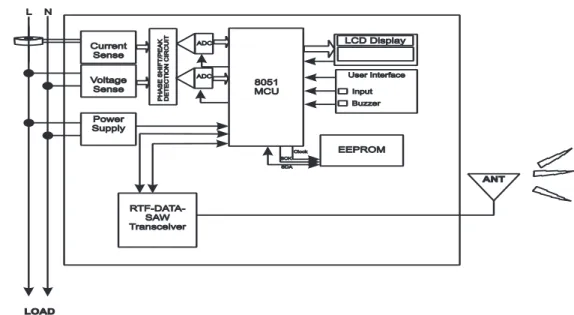
multi-plication are done by separate circuits. The block diagram of the circuit is shown in Figure 1.
3.3.1. ADC circuit design
This circuit was designed to receive analog current and voltage signal input and convert them to digital signals. The main component used in this design is the ADC0804.This component was chosen for this design in other to achieve
• Efficient and effective analog to digital signal conversion. • Control over the output digital signals by a microcontroller.
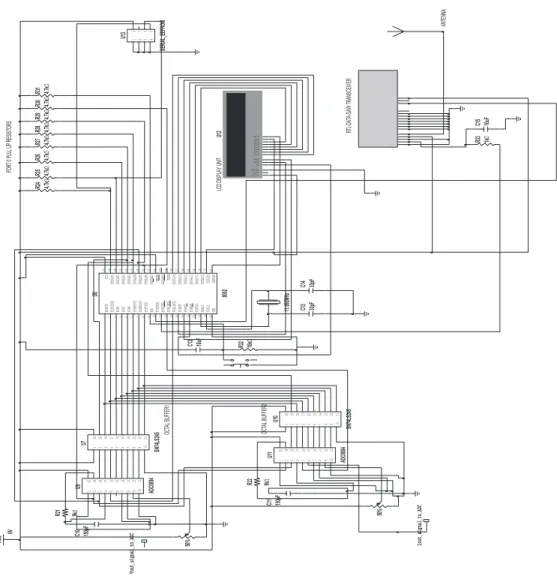
The ADCs are connected to a microcontroller via an interface IC called an octal bus driver. The IC used to provide this function is the SN54LS245. This octal bus transceiver is designed for asynchro-nous two-way communication between data buses. The circuit diagram of the analog to digital
sig-nal conversion is shown in Figure 2.
As illustrated in Figure 2, the attenuated and shaped current and voltage signals are connected to
pin 6 (V+) of the ADCs. This is the analog signal input pin of the ADC. The current signal is connected to ADC1 while the voltage signal is connected to ADC2.
The read and write (pin 2 and 3) pins of the ADCs are connected to pins 34 and 35 of the microcon-troller respectively. This enables the microconmicrocon-troller to control the sampling of signals by the ADCs by sampling current and voltage signals at the same time. Pin 5 of the ADC is the interrupt pin. It tells the microcontroller that data has just been sampled.
Pin 5 of ADC1 and ADC2 is connected to the external interrupt pin 12 and 13 respectively of the microcontroller. The 8bit output of ADC1 and ADC2 is connected to the 8bit input of the BUFFER1 and BUFFER2 respectively. The output of these buffers is connected to port1 of the AT89S52 microcon-troller (pin 1–8). The output of the buffers is controlled by the OE pin (pin 19). The OE pin of BUFFER1 is connected to pin 12 of the microcontroller while that of BUFFER2 is connected to pin 13 of the microcontroller. The buffers only produce output when a logic low is supplied to the OE pin.
Figure 1. Block diagram of the ADC based energy meter.
14 0 23 9 33 8 43 7 53 6 63 5 73 4 83 3 93 2 10 31 11 30 12 29 13 28 14 27 15 26 16 25 17 24 18 23 19 22 20 21 AT89C52 12 0 21 9 31 8 41 7 51 6 61 5 71 4 81 3 91 2 10 11 SN54LS245 12 0 21 9 31 8 41 7 51 6 61 5 71 4 81 3 91 2 10 11 ADC0804 12 0 21 9 31 8 41 7 51 6 61 5 71 4 81 3 91 2 10 11 ADC0804 12 0 21 9 31 8 41 7 51 6 61 5 71 4 81 3 91 2 10 11 SN54LS245 Vcc +5 v 9k 150p F ATTENUATED CURRENT INPUT 9k 150p F ATTENUATED VOLTAGE INPUT 4.7K 4.7K 4.7K 4.7K 4.7 K 4.7K 4.7K 4.7K 11.082MH z 33pF 33pF 10uF 10K 10K 10 K A0 1 A1 2 3 A2 4 GN D VCC WP SCL SDA 5 6 7 8 24C0 2 SERIAL EEPROM Figur e 2. Cir cuit diagr am o f the analog t o digit al signal c on version.
3.3.2. Circuit diagram of the ADC based energy meter (Part One)
When electricity is supplied to the load, the power supply unit turns on the meter by supplying the required 10 V dc to the op-amps and 5 V to the other components of the meter. The current and voltage transformers help to convert current and voltage flowing to the load into current and volt-age variable voltvolt-age signals respectively. The phase correction/signal shaping circuit attenuates the current and voltage signals into a form suitable for the ADCs. These convert the signals into digital
data which are stored in the buffers (see Figure 3).
When power is supplied to the microcontroller performs the following procedures • Places a logic high on pins 12 and 13 thus disabling the output of buffer1 and buffer2 • Loads the previous energy values stored in the EEPROM in memory.
• Displays this initial value of energy on the LCD display. • Starts its real time clock.
Every minute, the current value of the energy reading is stored in meter EEPROM so as to prevent data loss in the event of a power cut.
Figure 3. Circuit diagram of the ADC based energy meter.
3.4. The communication protocol
A simple call-and-response approach was used. Since both the energy meter and the base station were equipped with transceivers, this approach was easily implemented. If the base station gets some data, but it’s not complete, or appears garbled, a request for re-transmission is sent. The pro-tocol is described succinctly as follows
(1) The receiver section of the energy meter, when not transmitting, listens for requests. (2) When it gets one, the microcontroller program checks the header information if it is valid. (3) The meter ID is extracted from the received data.
(4) A check is performed to see if the received meter ID is the same as that of the receiving meter. If they are different then step 1 is repeated
(5) If meter ID is the same, the transmitter section of the energy meter sends out the energy reading as packets
(6) The energy meter switches back to receive mode and step 1 is repeated
3.4.1. Program flowchart
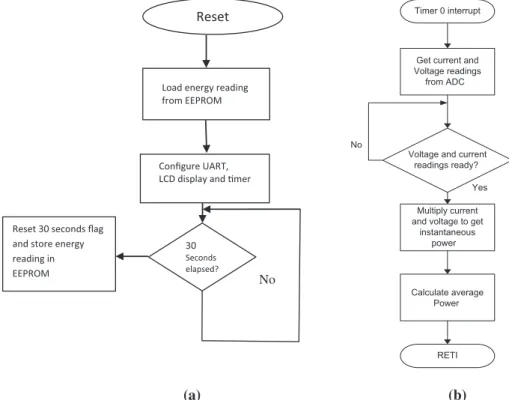
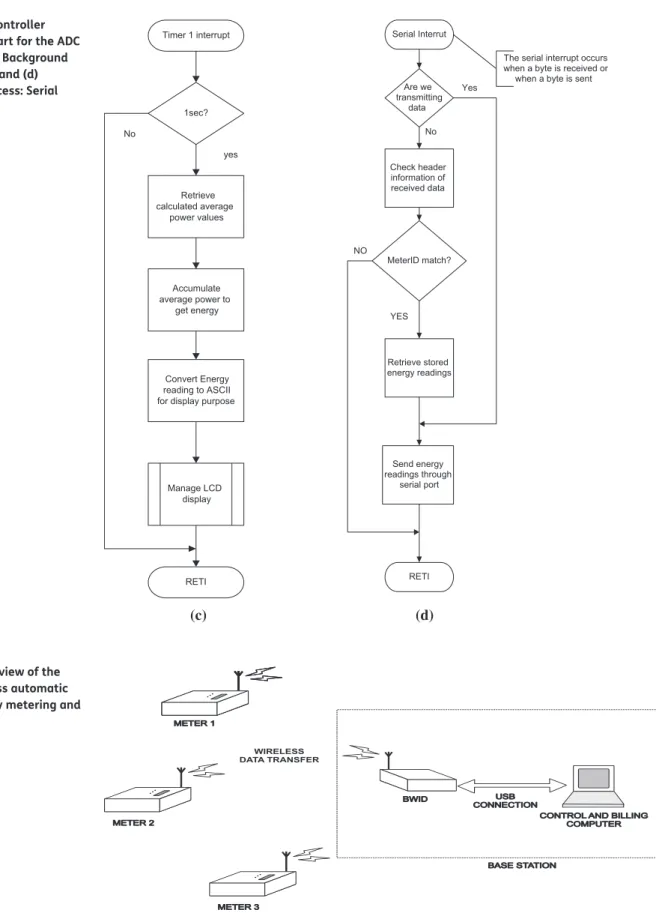
Microcontroller program flowcharts for the ADC based meter are illustrated in Figures 4 and 5.
3.5. Operation principle of the RF based wireless automatic electrical energy metering and billing system
The general diagram of the RF Based Wireless Automatic Electrical Energy Metering and Billing
System is shown in Figure 6.
Each meter is connected to the home of a registered energy consumer. It measures the energy consumed continuously. At a time specified by the base station computer operator, the control and billing computer request for the energy readings of a specified meter. It embeds the meter ID in the instruction and sends it to the BWID (Base station Wireless Interface Device).
Figure 4. Microcontroller program flowchart for the ADC based meter: (a) Foreground process and (b) Background process: Average power calculation.
Figure 5. Microcontroller program flowchart for the ADC based meter: (c) Background process: Energy and (d) Background process: Serial communication. Timer 1 interrupt Retrieve calculated average power values Accumulate average power to get energy Convert Energy reading to ASCII for display purpose
RETI Manage LCD display 1sec? yes No Check header information of received data Retrieve stored energy readings Send energy readings through serial port MeterID match? Serial Interrut RETI
The serial interrupt occurs when a byte is received or
when a byte is sent Are we transmitting data Yes NO No YES
(c)
(d)
Figure 6. Global view of the RF based wireless automatic electrical energy metering and billing system.
The BWID converts this instruction to wireless data and transmits it out to all the meters in its domain. All the meters receive the instruction. On reception of the instruction, each meter compares the meter ID embedded in the instruction with its own ID. If different, it ignores the instruction. If same, the meter responds by transmitting its present energy reading. All the devices including the BWID in this domain receive the transmitted data. The meters however ignore the transmission as they do not recognize it as an instruction.
On reception of the transmitted data, the BWID converts the data to computer readable format and sends it to the control computer via its USB connection. The control computer receives this data and checks for errors. If errors exist, it sends a data transmission request again to the specified me-ter until the data it received is correct and error free. If no errors exist, it stores the energy readings and updates the database of the consumer using the specified meter. If the received energy reading is below an average value specified by the operator, the control and billing software triggers an alert. This informs the operator of a possible bypass of the energy meter by the consumer. He can then dispatch a team to the location to investigate the matter.
The control software is also capable of generating energy bills for each user.
3.6. Single meter monitoring and meter information
From the base station, a single meter can be selected by double clicking its icon. A separate window appears and displays instantaneous readings for the selected meter. Complete meter information is stored in the database and can be view or edited. The meter address, meter ID, owners name, last read date, last bill paid, current account, etc.
3.7 Bill, report generation and data base management
The PC software uses energy readings, and billing information like cost per KWh, fixed cost and VAT stored in the database to calculate the current bill. The task menu is from where commands can be issued for this function. To generate a bill click on the task menu then click on generate bill. Reports that can be generated by the PC software are monthly bill, current readings table, meter usage chart, meter information, district information, and customer statement of account. The PC software features forms that can be used to add, edit and remove records in the main data base. Four forms are provided as: Meter information, District information, Rates information and Transactions
3.8. Communication techniques and the control panel
The software works with an RS-232 interface. The RS-232 standard serves as a link between a stand-ard PC running the Billing software and the receiving unit in the base station. The first transition on TxD line is a signal to begin transmitting, and an idle condition for one character period is a signal to turn off the transmitter. The control panel displays the meters that are assigned to a district in a list. The middle section displays information of the meters and the last reading. Directly below the me-ters list is a large textbox that displays the raw data received from the meter. This is needed for troubleshooting. To read the meters manually, click on the “Read Meter Now” button. A record is added to the database reflecting the current reading in KWh; also the raw data is displayed in the control panel. For automatic meter reading, a read date and time can be set.
3.9. Implementing the microcontroller program
The microcontroller programs were implemented using the KeiluVision version 3. KeiluVisionis an integrated development environment (IDE) with software development tools for the 8051 microcon-troller family. We present a discussion on how the microconmicrocon-troller program for the wireless auto-matic meter reading and billing system was implemented using the μVision 3 package of Keil IDE on MS Windows platform
3.9.1. LCD code simulation
In this section we present the simulation setup for the LCD routines. The setup for this simulation is
U2 GND VCC CV RS RW E D0 D1 D2 D3 D4 D5 D6 D7 U1 8052 P1B0T2 2 P1B1T2E X 3 P1B2 4 P1B3 5 P1B4 6 P1B5MOS I 7 P1B6MIS O 8 P1B7SCK 9 RST 10 P3B0RXD 11 P3B1TXD 13 P3B4T0 16 P3B5T1 17 XTAL2 20 XTAL1 21 GND 22 P2B0A8 24 P2B1A9 25 P2B2A10 26 P2B3A11 27 P2B4A12 28 P2B5A13 29 P2B6A14 30 P2B7A15 31 P0B7AD7 36 P0B6AD6 37 P0B5AD5 38 P0B4AD4 39 P0B3AD3 40 P0B2AD2 41 P0B1AD1 42 P0B0AD0 43 VCC 44 P3B2INT 0 14 P3B3INT 1 15 P3B6WR 18 P3B7RD 19 PSEN 32 ALEPROG 33 EAVPP 35 GN D VC C 5V BUS1 P2B7A1 5 1 P2B6A1 4 2 P2B5A1 3 3 P2B4A1 2 4 P2B3A1 1 5 P2B2A1 0 6 P2B1A9 7 P2B0A8 8 GN D GN D 11 109 VC C BUS1 P2B0A8 8 P2B1A9 7 P2B2A10 6 P2B3A11 5 P2B4A12 4 P2B5A13 3 P2B6A14 2 P2B7A15 1 GN D Figur e 7. Setup f or L CD simulation.
3.9.2. ADC code simulation
A generic ADC provided in MULTISIM was used to simulate the behavior of the ADC used in this study. The code was modified in such a way that its behavior can be predicted from the simulation.
3.9.3. Power and energy calculation and meter calibration
A table of sample values for current and voltage readings was hardcoded. Power and energy con-sumed was calculated based on these values and the results sent to the LCD. Meter calibration is done in hardware; variable resistors are used to vary the voltage input to the ADC in such a way that when 220 V is measured, the ADC must have an output of 220 V. Similarly for current when 60Amps is measured, the ADC must have an output of 60Amps. Accumulation gives energy in watts-seconds. Further division by 3,600 yields Wh. To avoid this division, we pre-divide the inputs to the ADC by 60 each to get 220/60 or 3.66 V for the voltage ADC and similarly, for the current ADC 60/60 give 1 V. Thus 3.66 V (representing 220 V measured) at the input of the ADC is equivalent to 220 at the output of the ADC. Similarly 1 V (representing 60 A measured) at the input of the ADC is equivalent to 60 at the output of the ADC. Thus multiplying voltage and current in the program and accumulating every second gives energy directly in Wh.
4. Test and results
4.1. Calibration and testing of the ADC meter
The meter was calibrated by connecting it to a fixed 1 KW (a pressing iron) load as shown in the
circuit diagram in Figure 8.
The measured input supply voltage was 220 V AC while the measured current drawn by the load
was 4.55 A as shown on the meters in Figure 8. A calibration program was written in the
microcon-troller strictly for this purpose. The program displays the measured current and voltage values on the LCD display.
The value of the measured current and voltage displayed on the LCD was compared with that
displayed on the standard current and voltage meters connected in Figure 8. It was observed that
the readings on the LCD display were slightly lower than the actual readings. Thus the variable Figure 8. Circuit diagram for the
calibration and test apparatus for the ADC meter.
1KW LOAD V A 220V AC ENERGY METER 220V AC STANDARD ENERGY METER LOAD 220V AC DESIGNED ENERGY METER LOAD
resistors R1 and R2 are varied accordingly to make the values on the LCD display the same as the
actual reading (see Table 1).
4.2. Testing of the base station wireless interface device (BWID)
After construction, testing of the base station wireless interface device was carried out as shown in
Figure 9.
The energy meter was connected to the power supply and a fixed load while the BWID was
con-nected to power supply as shown in Figure 9. Its data output port was connected to the control
computer via a USB connector cable. The control computer uses software that can manage a data-base of energy consumers, generate bills and manage data transaction. A REQUEST ENERGY READING instruction meant for the meter was sent by the control computer to the BWID.
4.3. Software testing
The first stage of software testing was simulation. The tool used for simulation of the 8051 program was National instruments’ Multisim version 10. Each segment of code that provides a related set of functions was simulated.
4.4. Result of the base-station wireless interface device (BWID) test
At a band rate of 1,200, the energy reading of the meter was displayed on the computer screen. Some data was received in error when the raw data was viewed however the software detected all errors. An accurate meter reading was achieved up to an approximate distance of 100 meters which can be increased from 100 m to any required distance with little adjustment.
Table 1. Test results of the ADC energy meter
Equipment Rating P (W) Test duration
t (h) Calculated energy Pxt (KWh) Measured energy on standard meter (KWh) Measured energy on ADC meter (KWh) Soldering Iron 60 0.5 30 29 29.02 Laptops (4) 260 0.5 130 130 128.57 Light bulbs (5) 1,000 0.5 500 501 498.38 Electric Iron 1,800 0.5 900 902 896.23
Figure 9. Diagram of the BWID test apparatus. 220V AC STANDARD ENERGY METER LOAD 220V AC USB CONNECTION
CONTROL AND BILLING COMPUTER BWID
4.5. Test results for the PC software
There were no run time errors in the program. The program executed as expected and all forms and reports were generated without errors. Several meter readings were taken and bills generated. The bills generated were found to be accurate.
4.6. Captured screens for PC software
Figures 10–15 are some captured screens from the PC software during the testing process.
Figure 10. Meter monitoring mode.
Figure 12. Meter information report.
Figure 13. Statement of account.
Figure 14. Diagram of designed ADC based energy meter.
5. Conclusion
The aim of this study which is to design a prototype RF based wireless automatic meter reading and billing system was achieved. The operation of the prototype was studied, from the results obtained, all the study’s objectives were achieved. The ADC based energy meter yielded the desired results with a relatively low percentage error of 4.85%. It receives and transmits data efficiently up to a distance of 100 m which can be increased from 100 m to any distance with little adjustment. The BWID was able to perform the desired interfacing function between the energy meter and the base station. Bills and reports were generated by the PC software and the outputs were found to be ac-curate. This device can be produced in large scale in Nigeria so as to take care of over and under billings and energy theft which have contributed large percent to non-technical power loss in Nigeria and this will be of great benefit to both the consumers and utility companies.
Funding
The authors received no direct funding for this research. Author details
Ukeh Orodje Edemirukaye1
E-mail: [email protected] Aigboviosa Peter Amaize2
E-mail: [email protected] ORCID ID: http://orcid.org/0000-0001-8511-2551
Stanley Uzairue2
E-mail: [email protected]
1 Department of Computer Engineering, University of Benin,
Benin City, Nigeria.
2 Department of Electrical and Information Engineering,
Covenant University, Ota, Nigeria. Citation information
Cite this article as: Implementation of an RF based wireless automated energy metering and billing system, Ukeh Orodje Edemirukaye, Aigboviosa Peter Amaize & Stanley Uzairue, Cogent Engineering (2018), 5: 1430008. References
Amaize, P. A., Airoboman, A. E., Adoghe, A., & Sanni, T. F. (2016). A
model for the mitigation of energy scarcity for a sustainable
market in Africa. In International Conference on African
Development Issues (CU-ICADI) (272–274), May 9–11, Ota.
Cao, L., Tian, J., & Zhang, D. (2006). Networked remote
meter-reading system based on wireless communication
technology. In 2006 IEEE International Conference on
Information Acquisition (172–176), IEEE. https://doi.org/10.1109/ICIA.2006.305989
Ezennaya, O. S., Isaac, O. E., Okolie, U. O., & Ezeanyim, O. I. C.
(2014, March). Analysis of Nigeria’s national electricity
demand forecast (2013–2030). International Journal of
Science and Technology Research,3(3). ISSN 2277-8616.
Igbinovia, S. O., & Orukpe, P. E. (2007, August). Rural
electrification: The propelling force for rural development of
Edo State, Nigeria. Journal of Energy in Southern Africa,18(3).
Ighalo, G. I., & Williams, A. A. (2012, October). Simulating
power distribution network in Nigeria. International
Journal of Scientific and Technology Research (IJSTR),1(9). ISSN: 2277-8616.
Matthews, V. O., Ajala, A. O., Atayero, A. A., & Popoola, S. I.
(2017). Solar photovoltaic recognition system for
smart-green access control using RFID and LoRa LPWAN
technologies’. Journal of Engineering and Applied
Sciences,12(4), 913–919.
Navani, J. P., Sharma, N. K., & Sapra, S. (2012). A case study of
analysis of technical and non technical losses in power
system and its impact on power sector. International
journal of advance in engineering science and technology,
1, 137–146. ISSN: 2319-1120/IJAESTA/
V1N2:137-146©IJAEST.
Orukpe, P. E., & Agbontaen, F. O. (2013). Prepaid meter in
Nigeria: The story so far and the way forward. Advanced
Materials Research,824, 114–119. doi:10.4028/www. scientific.net/AMR.824.114
Oyedepo, S. O. (2012). Energy and Sustainable development in
Nigeria: The way forward. Energy, Sustainability and
Society,2(1), 1–17.
Palaniappan, S., Asokan, R., Bharathwaj, S., & Sujaudeen, N.
(2015, April). Automated meter reading system—A study.
International Journal of Computer Applications,
(0975-8887) 116(18).
Potnis, M., Chimnani, A., Chawla, V., & Hatekar, A. (2015). Home
security system using GSM modem. International Journal
of Engineering Research and application (IJERA),5(4), 143–147.
Raghavendra, R., Ranganathan, P., Talwar, V., Wang, Z., & Zhu,
X. (2008, March). No power struggles: Coordinated
Multi-level power management for data centre. Hewlett Packard Technical Report, HPL-TR-2011194.
Silviya, E. M., Vinodhini, K. M., & Salai Thillai Thilagam, J. (2014).
GSM based automatic energy meter system with instant
billing. International Journal of Advanced Research in
Electrical, Electronics and Instrumentation Engineering,3, 44–49.
Figure 15. Diagram of designed base station wireless interface device.
© 2018 The Author(s). This open access article is distributed under a Creative Commons Attribution (CC-BY) 4.0 license. You are free to:
Share — copy and redistribute the material in any medium or format
Adapt — remix, transform, and build upon the material for any purpose, even commercially. The licensor cannot revoke these freedoms as long as you follow the license terms. Under the following terms:
Attribution — You must give appropriate credit, provide a link to the license, and indicate if changes were made. You may do so in any reasonable manner, but not in any way that suggests the licensor endorses you or your use. No additional restrictions
You may not apply legal terms or technological measures that legally restrict others from doing anything the license permits.
Cogent Engineering (ISSN: 2331-1916) is published by Cogent OA, part of Taylor & Francis Group.
Publishing with Cogent OA ensures:
• Immediate, universal access to your article on publication
• High visibility and discoverability via the Cogent OA website as well as Taylor & Francis Online
• Download and citation statistics for your article
• Rapid online publication
• Input from, and dialog with, expert editors and editorial boards
• Retention of full copyright of your article
• Guaranteed legacy preservation of your article
• Discounts and waivers for authors in developing regions
Submit your manuscript to a Cogent OA journal at www.CogentOA.com
Supraja, E., Goutham, K. V., Subramanyam, N., Dasthagiraiah,
A., & Prasad, H. K. P. (2014). Design of an enhanced
wireless security system with digital code lock using RF and GSM technology.
24X7 Power For All (Punjab). (2016, February). A Joint inititive of
Government of India and Government of Punjab.
Vanjale, M. S., Deshpande, A., & Pawale, K. (2014). Automatic
security system based on wireless sensor network and
GSM technology. International Journal of Engineering