Ultrafast Interfacial Proton-Coupled Electron Transfer
Bin Li1, Jin Zhao1, Ken Onda1, Kenneth D. Jordan2, Jinlong Yang3, and Hrvoje Petek1*
1
Department of Physics and Astronomy, University of Pittsburgh, Pittsburgh PA 15260
2
Department of Chemistry, University of Pittsburgh, Pittsburgh PA 15260
3
Hefei National Laboratory for Physical Sciences at Microscale, University of Science
and Technology of China, Hefei, Anhui 230026, P.R. China
Abstract
The coupling of electron and nuclear motions in ultrafast charge transfer at molecule-semiconductor interfaces is central to many phenomena including catalysis, photocatalysis, and molecular electronics. By femtosecond laser excitation we transfer electrons from a rutile TiO2(110) surface into a CH3OH overlayer state 2.3±0.2electron
volt above the Fermi level. The redistributed charge is stabilized within 30 femtoseconds by the inertial motion of substrate ions (polaron formation) and more slowly by adsorbate molecules (solvation). According to a pronounced deuterium isotope effect (CH3OD),
this motion of heavy atoms transforms the reverse charge transfer from a purely electronic process (nonadiabatic) to a correlated response of electrons and protons.
Titanium dioxide (TiO2) is a large band gap semiconductor with important
applications in photocatalysis and solar energy conversion (1-5). Electron-hole pair excitation within semiconductors such as TiO2 can initiate photocatalytic reactions in
chemisorbed molecular overlayers through interfacial charge transfer. In response to charge injection into a molecular overlayer, the interfacial lattice ions and molecules will undergo inertial motion to minimize the free energy (dielectric screening) or even chemical reactions, in competition with the charge population decay by reverse transfer into the semiconductor. Of particular interest, as a source of abundant clean energy and for environmental remediation, is the activation of H-atom containing bonds through the coupling of electrons and protons, which can reduce H2O into H2 and O2 (1-3).
Excess electrons in molecular overlayers on metal oxide surfaces are strongly attracted to the dangling H atoms of surface bound -OH groups, and on coadsorbed protic solvent molecules that are not engaged in strong hydrogen bonds (6, 7). The injection of electrons into the molecular overlayer can even release H atoms from the existing hydrogen bonds to create new dangling H atom centers. Such correlated dynamics of electrons and protons are fundamentally important in chemistry and biology: they can drive photocatalytic reactions as well as modulate charge transport at the semiconductor/protic solvent interfaces, and are known to play a role in photosynthesis, respiration, and transport through biological membranes (8-13).
In a recent time-resolved two-photon photoemission (TR-2PP) study of H2O/TiO2(110) surfaces, we discovered an excited electronic state 2.4±0.1 eV above the
Fermi level EF. This state attains the maximum intensity when -OH species formed by
monolayer (ML) coverage. Based on chemical evidence and density functional theory (DFT) calculations, we assigned this resonance to partially hydrated, or “wet” electron states. Electrons injected into the molecular overlayer are delocalized over several H atoms associated with -OH groups and neighboring water molecules. The injected electrons decay into the conduction band of TiO2 through reverse charge transfer in less
than 15 fs, faster than the dielectric response of the interface can stabilize them (6, 7).
Here we provide further insight into the decay of interfacial electrons through correlated motion of both heavy and light (hydrogen/deuterium) atoms, using the model system of CH3OH/TiO2(110). Methanol is the simplest protic organic adsorbate, with
well-known liquid and interfacial electron solvation, adsorption, and photochemical properties (14-21), which acts as a hole trap in photocatalysis (22). We find that CH3OH
stabilizes wet electrons more effectively than H2O, allowing their progressive energy
relaxation through inertial polaron formation and diffusive solvation to be observed on femtosecond to picosecond time scales. A pronounced deuterium isotope effect following a prompt inertial response suggests that the dielectric screening transforms the reverse charge transfer process from the nonadiabatic regime, where state occupations switch between electronic surfaces, to the proton-coupled regime, where the electron transfer is correlated with proton motions.
TR-2PP measurements on CH3OH/TiO2(110) surfaces were performed according to
the procedures for H2O/TiO2 (6, 23, 24). Two-photon photoemission (2PP) through
transiently occupied wet electron state (Fig. 1) was induced with 10 fs pulses from the second harmonic of a Ti:sapphire laser (3.05 eV photon energy). 2PP spectra, recorded by scanning a hemispherical electron energy analyzer, are dominated by the transiently
occupied wet electron state (24). Two-pulse correlation (2PC) measurements were used
to record the energy and population decay of the wet electron state; the 2PP signal was acquired simultaneously at seven photoelectron energies while scanning the delay between identical pump-probe pulses (25). The reduced TiO2 surface was prepared by
standard ultrahigh vacuum methods with a controlled density of surface bridging oxygen atom (Ob; Fig. 2) vacancies (23). After purification, either high-purity CH3OH or CH3OD
gas was deposited onto the TiO2 surface at 100 K. The coverage of ~1 ML corresponding
to adsorption of one methanol molecule at each terminal five-coordinate Ti5c4 +
site (20)
was attained by exposure to ~1.2 Langmuir (1 L = 1.33×10⁻⁶ mbar⋅s) according to the
procedure established in (24); other coverages are referenced to this coverage assuming a
constant adsorption probability. For the comparison of results for CH3OH and CH3OD,
the work function provided an independent measure of coverage (23).
Upon adsorption, CH3OH is deprotonated at Ob vacancy sites to form methoxy
CH3O- and hydroxy -OH species incorporated into the bridging rows. After titrating the
Ob vacancies, additional first monolayer CH3OH molecules bind with their O atoms to
the Ti5c 4 +
sites. Partial deprotonation at Ti5c 4 +
sites to form additional bridging -OH groups creates higher -OH coverage than obtained for H2O covered surfaces (20, 21) (Fig. 2).
On reduced TiO2(110) surfaces, the excess surface charge introduced by Ob vacancies
or H atoms is delocalized over several Ti5c+4 -δ sites in a band ~0.7 eV below EF (7).
Excitation with 3.05 eV light induces charge transfer from the Ti5c +4 -δ
donor to a CH3OH
overlayer acceptor state at 2.3 ± 0.2 eV above EF (Fig. 1). In (24) we reported on the
CH3OH coverage, sample temperature, and parallel momentum dependence of this wet
population decay dynamics instigated by the correlated motion of the injected charge and the heavy and light atoms at the interface.
The resonance at 2.3 ± 0.2 eV attains the maximum intensity at 1 ML CH3OH
coverage. It is similar to the wet electron resonance on H2O/TiO2 (6, 7, 24) in its
dependence on the surface -OH concentration and the parent molecule coverage, and its energy relative to EF, implying related electronic structures of the excess electrons. To
better characterize the molecular and electronic structure of CH3OH/TiO2 surfaces, we
performed DFT calculations (26-29). The CH3OH structure where 50% of molecules are
deprotonated (Fig. 2A,B) is calculated to have lower total ground state energy than the 0 and 100% deprotonated structures. Nevertheless, independent of the degree of deprotonation, the calculations give similar spatial distributions and energies of 2.5±0.1 eV above EF for the lowest energy unoccupied overlayer state at the ground state
geometry. By contrast to the H2O/TiO2 system, the unoccupied density of states resides
mostly on the Hm atoms of CH3, because hydrogen bonding consumes all of the dangling
H atoms in the ground state (Fig. 2A, B). The aliphatic H atoms of alcohols are known to participate in electron solvation in liquid methanol (16-18).
An overview of the electron injection, energy relaxation, and population decay dynamics for CH3OH and CH3OD overlayers is evident from plots of 2PP intensity
spanning 2PC records at 14 different energies for several coverages (Fig. 3). By contrast to H2O/TiO2 (6), the solvated electron dynamics for CH3OH/TiO2 strongly depend on the
coverage, with lifetimes extending to the picosecond range for ≥3 ML CH3OH (not
shown). The data in Fig. 3 show the following trends: i) at low coverages (≤1 ML), the resonance decays in <30 fs independent of energy or isotopic substitution; ii) above 1 ML
coverage, both the excited state population and its energy decay with fast and slow components; iii) only the slow decay components depend strongly on the CH3OH
coverage; and iv) most notably, the slow population decay shows a pronounced deuterium isotope effect.
To extract quantitative rates for the electron energy and population relaxation, we simulated the 2PC measurements with a model based on the optical Bloch equations (25, 30). Two-photon absorption probability was calculated for a transient intermediate state
that evolves through the coupling of the electronic and nuclear degrees-of-freedom (Fig. 1). The signal corresponding to the photoexcited state N1 (resonance peak at zero delay)
decays with isotope- or coverage-independent single exponential kinetics with a total rate
1
τ
1 = 1τ
na + 1τ
11*, (τna represents the nonadiabatic reverse charge transfer into the conduction band of TiO2). Simultaneously, N1 decays in energy by ~0.1 eV on a time
scale
τ
11* of 30 to 40 fs to a quasi-stationary, screened N1* state. Based on the energy/time scales for polaron formation through the excitation of ~24 THz longitudinal Ti-O stretching optical phonons of TiO2 (31), we attribute the fast energy relaxationτ
11* from N1 to N1* to the lattice ions screening the charge distribution created by thephotoinduced transfer from the Ti5c+4 -δ sites to the CH3OH overlayer. Such
electron-lattice correlation in TiO2 is evident in both the electronic structure of Ob atom vacancy
defects and the transient photoconductivity of TiO2 (31). This inertial dielectric response
stabilizes N1* with respect to the reverse charge transfer.
The dynamics of N1* are most apparent below the CH3OH resonance (e.g., 2.05 eV;
Fig. 3Bt). A rise time τ1, and a population and energy decay on a slower (coverage- and
TR-2PP study of CH3OH/Ag(111)(19), we attribute the slow energy relaxation to the
diffusive solvation of the injected charge by CH3OH molecules with a time constant τsol.
The deuterium isotope effect on the population relaxation of N1* cannot be explained
by a purely electronic process such as the inelastic electron scattering (25). Rather, it is
indicative of proton-coupled electron transfer (PCET) that plays an important role in homogeneous photocatalysis (9, 10). Including a PCET contribution τPCET, the total decay rate of N1* at a fixed energy is given by 1
τ
1* = 1
τ
PCET + 1τ
sol . Thus, the intermediate state populations evolve according to:0 1 1 1( ) τ t e N t N − = , [1] and N1*(t)=N1*0e − t τ1* +
α
N1 0τ
11*τ
1τ
1*τ
1−τ
1* (e −t τ1 −e − t τ1*) [2] where N1 0 and N1* 0are the initial amplitudes and α is a free parameter required to simulate dynamics of a continuum of intermediate states with a two-state model. In addition, the coherent component in 2PP is added to the incoherent one given by Eqs. 1 and 2, and their sum is convoluted with the pulse autocorrelation, as described in (25) and (30). The simulations agree well with the experimental 2PC scans (Fig. 3At, Bt, Ct).
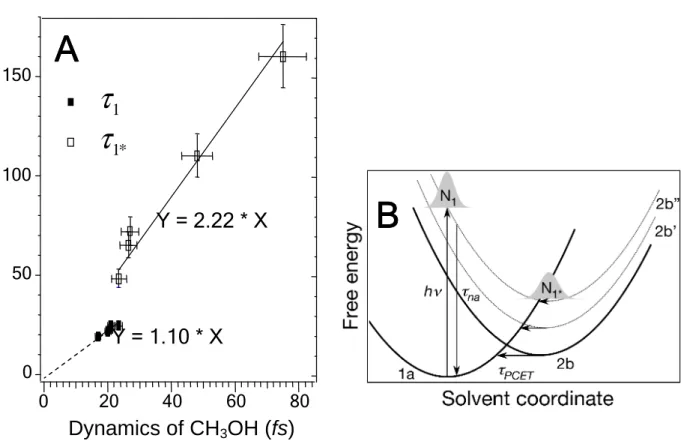
In Fig. 4a we plot the parameters τ1 and τ1* for CH3OD against those for CH3OH,
extracted from data from comparable coverage and measurement energy. The best-fit lines through the experimental τ1 and τ1* lifetimes with slopes of 1.1 and 2.2 quantify the
D/H isotope effect. The substantial increase of the slope for N1* from unity indicates an
appreciable isotope effect. The magnitude of isotope effect depends on whether the proton kinetic energy or the tunneling limits the charge transfer rates. The observed slope
proton motion of mD
mH ~1.4, such as observed in electron hydration in liquid H2O
(11), implies that it is determined by either proton tunneling or vibrational zero point energy differences (32). Based on the liquid CH3OH studies, we do not expect an isotope
effect on the diffusive solvation dynamics (11, 15).
Photoinduced electron transfer under highly nonequilibrium conditions such as in the dye-sensitized charge injection or the wet electron population decay into TiO2 cannot be
described by quasi-equilibrium models such as the Marcus-Jortner theory (8, 33, 34). In Fig. 4b we propose a scenario for how the inertial structural changes associated with the dielectric response of the interface control the wet electron dynamics. The free energy surfaces for the proton and electron transfer are plotted in Fig. 4b against a generalized solvent coordinate representing the multidimensional dielectric response of the interface to both the electron and proton displacements (32). Photoexcitation occurs “vertically”, that is, faster than the proton or solvent response, from the donor surface 1a (electron at the Ti5c+4 -δ sites and proton at its ground state geometry), to a manifold of acceptor surfaces 2b, 2b´, 2b˝, etc. This manifold represents the excited state where electron is in the CH3OH overlayer and proton is displaced with respect to the ground state (Fig. 2C,
D), with different degrees of excitation of an internal proton vibration (2b´, 2b˝, etc.). Because, at the instant of excitation, proton in the excited state is strongly displaced along these internal coordinates, the optical transition terminates on a distribution of vibrationally excited free energy surfaces. The wave packet created on the 2b manifold evolves toward the surface minimum through the inertial dielectric response. In competition with the dielectric relaxation, the excited state population decays by nonadiabatic processes, which change the state occupation (vertical transitions), and
PCET processes, which exchange the proton and electron between the acceptor and donor states (horizontal transitions) (33). Exothermic nonadiabatic transitions occur before the wave packet propagates to crossings of the 1a with 2b manifolds. By contrast, PCET is most probable at crossings between 1a and 2b manifolds, where the activation energy (solvent reorganization) is minimum. As the excited state evolves toward the equilibrium structure of wet electron state, the transition from nonadiabatic to PCET dominated population decay is revealed by emergence of the deuterium isotope effect.
To gain further insight into the PCET process, the structure of CH3OH/TiO2 was
optimized in a DFT calculation with an excess electron added to the molecular overlayer (35, 36). We cut a single layer of TiO2 from a 3 layer slab of the optimized ground state
structure (Fig. 2A, B), added an electron to the lowest energy virtual orbital associated with the Hm atoms, and optimized the overlayer structure, while keeping all the surface
atoms except Ob fixed (37). The optimized structure is attained after substantial
displacement of H atoms of the OH groups on the surface and of the CH3OH molecules
(Fig. 2C, D), with concomitant shift of the electron distribution from Hm to Hb atoms. By
following the H atom positions along the optimization path, we find that stabilization energy of 0.5 eV is gained through the rotation of the bridging -OH to the vertical orientation (0.35 eV), and transfer of a proton from CH3OH to its neighboring Ob site
(0.15 eV). The H atom motion during the structural relaxation drives wet electrons from the Hm sites (which are isolated from the surface by carbon atoms) to Hb sites, (which are
closer to the surface, and more strongly coupled to the conduction band) (6).
The DFT calculations provide insight into PCET dynamics that could account for the D isotope effect observed at >1 ML coverages. Additional interactions such as the
binding of second monolayer CH3OH molecules through a hydrogen bond with Ob atoms
can hinder and possibly impose a barrier for the proton motion in Fig. 2.
Our studies elucidate how the dielectric response of a protic-solvent/metal-oxide interface controls the electron transfer and solvation in a photocatalytic system. Presolvated electrons such as observed for CH3OH/TiO2 are potent reagents that have
been implicated in the photocatalytic decomposition of halocarbons relevant to chemical remediation and the destruction of Earth’s ozone layer (38). Conditions exist to support similar wet electron states on all oxide surfaces in contact with protic solvents. However, details of the electronic structure and dynamics most likely depend on the specific molecular scale solvent-substrate interactions.
Figure Captions
Fig. 1. Schematic diagram for the 2PP excitation at the CH3OH/TiO2 interface. The
photoinduced charge transfer from the partially reduced Ti5c+4 -δ
sites (N0) to the CH3OH
overlayer (N1) initiates the coupled electron-nuclear dynamics. The redistribution of
charge elicits a dielectric response involving fast Ti-O bond stretching (polaron formation), along with slower adsorbate reorganization (solvation), to relax the initially prepared N1 to a quasi-stable N1* state. Simultaneously, the population decay by reverse
charge transfer evolves from the nonadiabatic (τna) to the proton-coupled (τPCET) regimes. The two-photon photoemission spectra (shown for 1 ML CH3OH), and pump-probe
two-pulse correlation measurements obtained by further excitation of electrons above the vacuum level (N2), record the intermediate state electronic structure and dynamics.
Fig. 2. (A and B) Top and side views of the optimized geometry of the ground state and the associated lowest energy (2.5 eV) unoccupied adsorbate localized orbital of 50% deprotonated CH3OH at 1 ML coverage on TiO2(110) from DFT calculations (26). Ti
(blue), O (red), C (orange), and H (white) atoms remain essentially fixed, while the H atoms of the bridging -OH (green) and methanol OH (yellow) undergo substantial change in the excited state structural optimization. Arrows indicate the bridging oxygen Ob,
terminal five-coordinate titanium Ti5c rows, and methyl Hm atoms. The translucent
structures indicate the unoccupied orbital distribution of the wet electron state. (C and D) The top and side views of the optimized geometry when an electron is added to the unoccupied state. The structural changes from A and B to C and D mainly consist of rotation of the bridging -OH towards the surface normal configuration, and proton transfer from the CH3OH to the proximate Ob site. Simultaneously, the wet electron
distribution descends towards the surface from the methyl groups to the bridging -OH.
Fig. 3. (A, B, and C) Three-dimensional plots of the energy and population dynamics of the wet electron state on CH3OH and CH3OD/TiO2(110) surfaces for <1-2 ML coverages
that show the strong dependence of the wet electron state dynamics on the methanol coverage and D isotope substitution. The 3D plots are constructed from two-pulse correlation measurements taken at 0.1 eV intervals. The black circles indicate the change in the resonance maximum with time. (At, Bt, and Ct) The original two-pulse correlation
measurements used to construct the 3D plots at several characteristic energies indicated by the color-coded arrows in A to C and their simulation (solid lines) according to the model described in Fig. 1 and the text.
Fig. 4. (A) The τ1 and τ1* lifetimes determined for comparable coverage and observation
energy for the CH3OH/TiO2(110) (abscissa) and CH3OD/TiO2(110) (ordinate) surfaces.
The significant departure of the slope for τ1* from 1.0 indicates a rate limited by proton
dynamics such as evident in Fig. 2. (B) Schematic free energy surfaces for the correlated proton and electron transfer (PCET) plotted against a generalized solvent coordinate (32). The solid lines represent surfaces for electron and proton before (1a) and after (2b) photoinduced transfer; the dotted lines (2b˝ and 2b´) represent a manifold 2b surfaces with different degrees of proton vibrational excitation. The wave packet excited near the equilibrium ground state structure (N1 state) evolves through the inertial dielectric
response towards the 2b manifold minima (N1* state). The nonadiabatic electronic decay
(down arrows) is most likely before crossings of 1a with the 2b manifold. The PECT is most probable at surface crossings between 1a and 2b manifold (horizontal arrows).
References 1. A. Fujishima, K. Honda, Nature 238, 37 (1972). 2. M. Grätzel, Nature 414, 338 (2001).
3. M. A. Fox, M. T. Dulay, Chem. Rev. 93, 341 (1993). 4. R. Wang et al., Nature 388, 431 (1997).
5. P. V. Kamat, Chem. Rev. 93, 267 (1993). 6. K. Onda et al., Science 308, 1154 (2005).
7. J. Zhao, B. Li, K. D. Jordan, J. Yang, H. Petek, Phys. Rev. B (submitted). 8. H. Tributsch, L. Pohlmann, Science 279, 1891 (1998).
9. R. I. Cukier, D. G. Nocera, Annu. Rev. Phys. Chem. 49, 337 (1998). 10. S. Hammes-Schiffer, Acc. Chem. Res. 34, 273 (2001).
11. M. S. Pshenichnikov, A. Baltuska, D. A. Wiersma, Chem. Phys. Lett. 389, 171 (2004).
12. C. Tanner, C. Manca, S. Leutwyler, Science 302, 1736 (2003). 13. J. Lin, I. A. Balabin, D. N. Beratan, Science 310, 1311 (2005).
14. X. Shi, F. H. Long, H. Lu, K. B. Eisenthal, J. Phys. Chem. 99, 6917 (1995). 15. H. Shirota, K. Yoshihara, N. A. Smith, S. Lin, S. R. Meech, Chem. Phys. Lett. 281,
27 (1997).
16. M. J. Tauber, C. M. Stuart, R. A. Mathies, J. Am. Chem. Soc. 126, 3414 (2004). 17. P. Minary, L. Turi, P. J. Rossky, J. Chem. Phys. 110, 10953 (1999).
18. L. Turi, J. Chem. Phys. 110, 10364 (1999).
19. S. H. Liu et al., J. Phys. Chem. B 106, 12908 (2002).
20. M. A. Henderson, S. O. Tapia, M. E. Castro, Fara. Disc. 114, 313 (1999). 21. S. P. Bates, M. J. Gillan, G. Kresse, J. Phys. Chem. B 102, 2017 (1998). 22. T. Kawai, T. Sakata, J. Chem. Soc., Chem. Commun., 694 (1980). 23. K. Onda, B. Li, H. Petek, Phys. Rev. B 70, 045415 (2004).
24. K. Onda, B. Li, J. Zhao, H. Petek, Surf. Sci. 593, 32 (2005). 25. H. Petek, S. Ogawa, Prog. Surf. Sci. 56, 239 (1997).
26. The calculations were carried out by using the generalized gradient approximation (GGA) based on DFT. At the GGA level, we choose the Perdew-Burke-Ernzerhof functional (27, 28) together with the double numerical atomic orbitals augmented by polarization functions (DNP) as the basis functions and the density functional semi-core pseudopotential (DSPP). Self-consistent field procedures are done with a convergence criterion of 10-6 a.u. on the energy and electron density. Geometry optimizations are performed with a convergence criterion of 10-3 a.u. on the gradient, 10-3 a.u. on the displacement, and 10-5 a.u. on the energy. All the calculations carried out using the molecular simulation package DMOL3 (DMOL3 is a density-functional-theory-based package with atomic basis distributed by Accelrys (29).
27. J. P. Perdew, K. Burke, M. Ernzerhof, Phys. Rev. Lett. 78, 1396 (1997). 28. J. P. Perdew, K. Burke, M. Ernzerhof, Phys. Rev. Lett. 77, 3865 (1996). 29. B. Delley, J. Chem. Phys. 92, 508 (1990).
31. E. Hendry, F. Wang, J. Shan, T. F. Heinz, M. Bonn, Phys. Rev. B 69, 081101 (2004).
32. H. Decornez, S. Hammes-Schiffer, J. Phys. Chem. A 104, 9370 (2000). 33. W. Stier, O. V. Prezhdo, J. Phys. Chem. B 106, 8047 (2002).
34. L. G. C. Rego, V. S. Batista, J. Am. Chem. Soc. 125, 7989 (July 2, 2003, 2003). 35. R. Monnier, J. P. Perdew, D. C. Langreth, J. W. Wilkins, Phys. Rev. B 18, 656
(1978).
36. R. O. Jones, O. Gunnarsson, Rev. Mod. Phys. 61, 689 (1989).
37. The excited state prepared in the experiment corresponds to an electron in the CH3OH overlayer and a hole remaining at the TiO2 surface. By adding an
electron to the CH3OH orbital to simulate the excited state, we make an
assumption that the hole is screened and the excitonic effects can be ignored. Calculations where the ground state is optimized with an extra electron (the true ground state of our excited state), give the essentially identical structure to Fig. 2A and B. The success of the excited state optimization procedure relies on the molecular overlayer state being sufficiently decoupled from the surface not to decay into the conduction band of TiO2.
38. Q. B. Lu, T. E. Madey, Phys. Rev. Lett. 82, 4122 (1999).
39. This work was supported by the DoD MURI program under Grant DAAD19-01-1-0619, New Energy Development Organization of Japan “Molecular wire” project, National Science Foundation of China grants (20533030, and 50121202), and NSF grant CHE-0518253. The apparatus for TR-2PP has been developed with support from NSF grant DMR-0116034. We thank Prof. John T. Yates Jr. for the donation of the CH3OD sample.