OVERCOME KNOWLEDGE BARRIERS IN ERP IMPLEMENTATION Bo Xu
School of Computing, National University of Singapore, [email protected] Gee-Woo Bock
School of Computing, National University of Singapore, [email protected] ABSTRACT
Researchers and practitioners have pointed out that ignorance of knowledge transfer from consultancy to client is the reason for high ERP implementation failure rate. Although IT implementation and Innovation diffusion research have identified and empirically investigated various implementation success factors, few studies have empirically examined influential factors from the knowledge transfer perspective. Thus, we propose a research model to find antecedents of successful ERP implementation by incorporating the knowledge transfer perspective in addition to the existing IT implementation, and innovation diffusion perspectives. A cross-sectional survey was conducted in China to empirically examine the model. The result shows knowledge-related factors have significant effects on ERP implementation success as expected.
Key Words: ERP Implementation, Knowledge Transfer, China INTRODUCTION
A recent IT innovation which enhances organizational performance through end-to-end connectivity is called Enterprise Resource Planning (ERP). It is defined as “customizable integrated application software that supports the core business processes and the main administrative areas of enterprise in different industries” (Rosemann, 1999). With the promise of a variety of spectacular business benefits, the rate of diffusion and implementation of ERP systems has been extremely rapid over the last few years (Bancroft et al.1998). Davenport (1998) hailed ERP as “the most important development in the corporate use of IT in the 1990’s.”
However, since the ERP system is large and complex, its implementation process requires extensive, lengthy and costly effort, typically measured in millions of dollars (Pan et al. 2001). Moreover, it was reported that three quarters of the ERP projects are judged to be unsuccessful by the ERP implementing companies (Griffith and Zammuto 1999). Therefore, how to implement and diffuse ERP successfully have been the focal interests of many researchers and practitioners. Two streams of research – IT implementation and innovation diffusion have provided insights on this question, and numerous success factors have been identified (For a summary of success antecedents, see Larsen 2003). However, researchers in both streams have pointed out the exceptional knowledge barrier in the implementation of new, complex technology innovation (such as ERP), and called for examining technology innovation implementation from the knowledge transfer perspective (e.g. Fichman 2000; Pan et al 2001; Robey et. al 2002). Few studies have empirically investigated ERP success factors from this knowledge perspective yet.
Thus, in this study, we extend current research on ERP implementation by viewing it as “a special class of technological innovation which imposes an exceptional knowledge burden on would-be adopters” (Attewell 1992). An integrative model is derived from three related research streams - IT implementation, innovation diffusion, and knowledge transfer. The objective of the study is to investigate the conditions under which complex technology innovation (such as ERP) can be implemented successfully even facing high knowledge barrier.
LITERATURE REVIEW
The three major areas of research that provide the necessary theoretical foundations for this study are IT implementation, innovation diffusion and knowledge transfer. Each of these literatures is briefly discussed in the following section.
IT Implementation Perspective Success factors on ERP implementation have widely been researched in IS success literature. (For a comprehensive list of CSFs, see Somers and Nelson 2001). Some generic critical factors in IT implementation such as top management support, project management, training, have also been found important in ERP implementation. Researchers have also identified some ERP-specific factors such as software configuration, BPR, understanding corporate cultural change (Bancroft et al., 1998; Davenport 2000) due to the unique nature of ERP implementation such as complexity and need for process changes. However, research on this stream has been criticized because of descriptive and limited perspective and low generalizability (Robey et al. 2002; Kwon and Zmud 1987). Researchers have called for broadening IT implementation research by borrowing the perspective from innovation adoption and diffusion research.
Innovation Diffusion Perspective
Characteristics of innovation have been identified at the individual, organizational, and environmental level mostly based on DOI (Diffusion of Innovation) theory (Rogers 1983; 1995; For thorough review, see Tornatzky and Klein 1982; Dampanpour 1991; Fichman 1992; Wolfe 1994; Gallivan 2001; Fichman 2000). Kwon and Zmud (1987) first linked innovation diffusion perspective and IT implementation perspective by proposing the technological innovation perspective. IT implementation is defined as organizational effort to diffuse an appropriate information technology within a user community (Kwon and Zmud 1987). Taking this perspective, Cooper and Zmud (1990) empirically examined the implementation of MRP system; Premkumar et al. (1994) examined the EDI implementation; Lai (1997) examined the ISDN implementation; Cho and Kim (2002) examined OOPL assimilation. However, innovation studies have been characterized as “inconclusive, inconsistent, low levels of explanation” (Wolfe 1994). Researchers pointed out that traditional innovation models are only well-suited to voluntary, individual, simple technology use, but are not suitable for complex technology which are mandated to use, have strong interdependencies across multiple adopters, and impose high knowledge burden (Fichman 1992; Fichman 2000). Fichman (1992) called for integrating traditional models with new metaphors and theories (such as learning) to better explain the new complex innovation phenomenon.
Knowledge Transfer Perspective
As requested by Fichman (1992), researchers in innovation research have sought to incorporate knowledge perspective into their studies to develop innovation diffusion models for complex technology innovation. Attewell’s (1992) work provides a re-conceptualization of diffusion theory for what he calls “complex organizational technology”. Fichman (1997) followed this line of research by empirically investigating three learning related organizational factors – learning related scale, prior related knowledge, diversity. However, Fichman (1997)’s study only examines factors relevant to the knowledge recipient’s learning capability and leaves out other factors which are important to knowledge transfer outcome in the knowledge transfer literature (e.g. Argote 1999).
Argote (1999; 2003) synthesized this broad literature and classified these knowledge transfer influential factors into 3 categories: 1) properties of units (e.g., an individual, a group, or an organization) such as source credibility (Perloff, 1993), absorptive capacity (Cohen and
Levinthal, 1990); 2) properties of the relationships between units such as relationship quality (Szulanski 1996); 3) properties of the knowledge itself such as knowledge codifiability (Zander and Kogut 1995).
In the context of ERP implementation, organization needs a wide range of knowledge and skills to implement such a complex system (Chan 1999). However, organizations usually lack the requisite knowledge and skills, and often have to rely on outside expertise or consultants to implement ERP. Moreover, to effectively use and manage ERP even after consultants withdraw from the implementation effort, the client organization must request consultants to transfer requisite ERP knowledge to them. Davenport (2000) pointed out that client organizations often experience poor ERP implementation because of their ignorance on ERP knowledge management issues such as requesting knowledge transfers from consultants. Bancroft et al., (1998) suggested the effective transfer of knowledge from the consultants to the clients is critical to the success of ERP implementation. However, knowledge transfer from a consultant to a client organization in the context of ERP is especially difficult due to the embeddness of knowledge (Pan et al. 2000), complexity of the system and the “severe knowledge gap” (consultants lack of in-house knowledge and business clients lack of ERP package knowledge)(Soh et al. 2000). Thus, understanding ERP implementation from the comprehensive knowledge transfer perspective is increasingly important for both researchers and practitioners.
Several studies on ERP implementation have been done from this knowledge transfer perspective. Lee and Lee (2000) first examined an ERP implementation case from knowledge transfer perspective. Robey et al. (2002) identified two types of knowledge barriers: configuration of ERP package and assimilation of new work processes. Based on Szulanski (1996)’s Transfer model, Timbrell et al. (2001) investigated the impediments to knowledge transfer in ERP implementation. However, none of these studies provided a comprehensive, generalizable ERP implementation model. Hence, in view of the gaps in current research, we develop an integrative research model on ERP implementation by taking the IS success, innovation diffusion and knowledge transfer perspectives.
RESEARCH MODEL
Based on the literature review, the research model consists of three sets of variables: organizational characteristics from IS success studies, innovation characteristics and knowledge transfer related factors (Figure 1).
Fig1. Research Model
Dependent Variable
According to Thompson (1967), there are three-stages for innovation process: initiation, adoption, and implementation. In this study, we will focus on implementation stage in which knowledge factors become more salient than the initiation and adoption stages. Research in innovation diffusion tends to use the extent of diffusion (e.g., Mcgrowan and Madey 1998) or assimilation stage achieved (e.g., Fichman 1997) as a dependent variable (see Fichman 2000 for a summary). However, mere measurement of diffusion may not be sufficient indicators of success until all the parties involved are satisfied with its implementation and use (Prekumar et al. 1994). The Delone and Mclean (1992)’s IS success model provide a comprehensive framework to capture the different aspects of implementation success (Delone and Mclean 1992). Hence, we adopt three dimensions which capture the influence of system: use, user satisfaction, and organizational impact. Past research has suggested that these three dimensions are interrelated. Here we posit that increased user satisfaction will lead to increased use of ERP and certain organization impact will occur as a result of use and user satisfaction.
Independent Variables Innovation Attributes
Although some variance exists in the literature, three innovation attributes have been consistently found to be significant -- relative advantage, compatibility and complexity (Tornatzky and Klein 1982).
Relative advantage refers to the degree to which an innovation is perceived to be superior to its precursor (Rogers, 1995; Premkumar et al. 1994). It has been studied in various technology innovation, e.g. OOPL (Cho and Kim 2002), EDI (Premkumar et al. 1994), ISDN (Lai 1997), etc. Research in ERP indicates that adoption of ERP can not only bring technical benefits (such as solve Y2K, reduce software maintenance, etc.) but also business benefits (such as reduce inventory carrying costs and stock-outs, etc) (Markus and Tanis 2000). Therefore, it is logical to expect that organizations that perceive significant benefits from ERP are more likely to
vigorously adopt and diffuse the ERP system in their organizations, and realize greater satisfaction and success in implementation. Hence, we posit:
H1: The perceived degree of relative advantage of the ERP system will have a positive relationship with ERP implementation success.
Compatibility refers to the degree to which an innovation is consistent with the existing values, experiences and needs of the adopters (Rogers, 1995; Cooper and Zmud 1990). Lack of compatibility of an innovation discourages its adoption and leads to greater difficulty in its subsequent assimilation or use within the adopting unit (Rogers 1983). Compatibility has been cited as one of major success factors for ERP implementation as well (Cooper and Zmud 1990; Hong and Kim 2002; Bradford and Florin 2003). If the ERP system is perceived to be compatible to present work practices, existing systems and value systems of the potential adopters, it’s more likely to be successfully implemented.
H2: The perceived degree of compatibility of the ERP systems will have a positive relationship with ERP implementation success.
Complexity refers to the degree to which an innovation is perceived as being difficult to understand and use (Tornatzky and Klein 1982). Complexity has been usually observed to discourage its adoption and leads to greater difficulty in implementation and further diffusion (Cooper and Zmud 1990; Tornatzky and Klein 1982). ERP has been notorious for its complexity. For example, SAP R/3 has more than 3000 configuration tables. Dell Computer spent more than a year on only going through these tables (Davenport 1998). Difficulties in understanding and applying the new technology may result in slower recognition of its value, fear of failure and resistance, thereby inhibiting the extent of implementation success.
H3: The perceived degree of complexity of the ERP systems will have a negative relationship with ERP implementation success.
Organizational Characteristics
Among the numerous organizational characteristics, top mgmt support and training (Prescott and Conger, 1995; Somers and Nelson 2001) have almost always emerged as key variables in the past research on both IS implementation and innovation diffusion. We include these two well-established variables into our model.
Top Management Support can help develop an understanding of the capabilities and limitations of IT, establish reasonable goals for the IT systems, exhibit strong commitment to the successful introduction of IT, and communicate the corporate IT strategy to all employees (Merkise and Walton 1991). The active involvement, vision and direction of high-level executives provide the impetus needed to sustain the implementations of ERP (O’Leary, 2000). In addition, users tend to conform to the expectations of management, and they are more likely to accept a system that they perceive to be backed by the management of their organization. (Karahanna et al.1999).
H4: The degree of top management support for ERP implementation will have a positive relationship with ERP implementation success.
Training has been found positively correlated with adoption, diffusion and implementation of complex information technology, which impose high learning barrier, such as EDI (Mcgrowan and Madey 1998), OOPL (Cho and Kim 2002) and ERP (Bradford and Florin 2003). Lack of user training and failure to completely understand how enterprise applications change business processes frequently appear to be responsible for ERP implementation failures (Crowley 1999).
H5: Training for ERP will have a positive relationship with ERP implementation success. Process Adaptation: One distinguishing feature of ERP is that it is “package” software built around “best practices” to support many organizations in various industries. However, this often leads to misfit between the ERP system and the way a particular organization does business
(Markus and Tanis 2000). In such cases, either the package needs to be customized to fit a company’s needs or the company must change its business processes to conform to the package (Jenson and Johnson 1999). There is consensus among experts that adopting organizations must commit themselves to some degree of BPR instead of customizing the software (Bradford and Florin 2003; Hong and Kim 2002). Also, customization of the software is believed to result in higher implementation costs and longer implementation time (Davenport 1998). However, with the degree of process adaptation increase, more changes has to be made in organization, more efforts and resources are required, and more resistance and difficulties will be encountered. H6: The degree of process adaptation to the ERP system will have a negative relationship with ERP implementation success.
Knowledge Transfer -Related Factors
As we mentioned ealier in the literature review section, Argote (1999; 2003) synthesized knowledge transfer influential factors into 3 categories: 1) properties of units such as source credibility (Perloff, 1993) and absorptive capacity (Cohen and Levinthal, 1990); 2) properties of the relationships between units such as relationship quality (Szulanski 1996); and 3) properties of knowledge itself such as knowledge codifiability (Zander and Kogut 1995). We incorporate a representative factor in each category into our model in the context of ERP implementation.
Knowledge Tacitness: Tacit knowledge which can not be easily communicated and shared is highly personal, deeply rooted in action and in an individual’s involvement with a specific context (Nonaka, 1994). Research has found that tacit knowledge is more difficult to transfer than explicit knowledge. Reed and DeFillippi (1990) define tacitness as the implicit and non-codifiable accumulations of skills that results from learning by doing, and found that tacitness increases the ambiguity of knowledge, thus, affects the knowledge transferability. In the context of ERP, since lots of knowledge is embedded in the ERP systems and the brains of consultants, the more tacit the relevant knowledge is, the more difficult this knowledge can be transferred and the less likely the implementation will be smooth.
H7: The degree of tacitness of ERP knowledge will have a negative relationship with ERP implementation success.
Relationship Quality: Studies have also suggested that the quality of the relationship is one of the important factors affecting knowledge transfer between a source and a recipient (e.g., Argote 1999). Szulanski (1996) defined relationship quality as an emotionally non-laborious, close and good relationship between a source and a recipient. Nonaka(1994) asserted transferring knowledge that has tacit components requires frequent and numerous interactions between the involved parties. Thus, development of a good relationship is likely to affect knowledge transfer (Baum and Ingram 1998). This is extremely true in the case of ERP in which organizations are highly dependent on vendors or consultants with ERP knowledge and expertise which are deeply embedded in the system. (Pan et. al 2001).
H8: The degree of relationship quality among ERP implementation parties will have a positive relationship with ERP implementation success.
Source Credibility is the extent to which a recipient perceives a source to be trustworthy and an expert (Dholakia and Sternthal, 1977; Grewal et al., 1994). An expert and trustworthy source is more likely to influence the behavior of a recipient (Perloff, 1993). When the source unit is not perceived as reliable and is not seen as trustworthy or knowledgeable, initiating a transfer from that source will be more difficult and its advice and example are likely to be challenged and resisted. (Walton 1975). Timbrell et al. (2001) found that “source not perceived as reliable” was the most important source of stickiness during SAP implementation.
H9: The degree of knowledge source (i.e. ERP vendor, consultants) credibility will have a positive relationship with ERP implementation success.
Source Motivation: Client’s learning or improved understanding has been recognized as an important objective or result of consulting engagement. Lots of consulting companies have also claimed “knowledge transfer” as major service content. However, some of them may still be reluctant to share crucial knowledge for fear of losing ownership, a position of privilege and superiority. It may resent not being adequately rewarded for sharing; or it may be unwilling to devote time and resources to support the transfer. Szulanski (1996) found that lack of source motivation to engage in knowledge transfer is a barrier of best practice transfer. Timbrell et al. (2001) found that, in the context of ERP, source motivation remained to be a barrier for effective knowledge transfer.
H10: The degree of motivation of source (i.e. ERP vendor, consultants) to share their knowledge with clients will have a positive relationship with ERP implementation success.
Absorptive Capacity is defined as the ability for a recipient of knowledge to recognize the importance and value of the external information, assimilate it, and apply it. The capacity depends on the firm’s ability to recognize and link new knowledge to its existing in-house expertise, and is a function of firm’s level of prior related knowledge (Cohen and Levinthal, 1990). Absorptive Capacity has been long recognized as an important factor affecting knowledge transfer in alliance. Mowery et al (1996) pointed out that firm’s absorption of knowledge from partners depends on its pre-alliance level of technical overlap with partners. In a study of the transfer of best practices within a firm, Szulanski (1996) found that high absorptive capacity of recipients facilitated the transfer of best practices. Timbrell et al. (2001) found that “recipient lacks absorptive capacity” was the second most important source of knowledge stickiness during SAP implementation.
H11: The recipient – client’s absorptive capacity to acquire ERP knowledge will have a positive relationship with ERP implementation success.
RESEARCH METHODOLOGY Instrumentation
A questionnaire was developed to collected data by using five-point Likert scale items. Items for all variables have been adopted and/or adapted from previous studies on innovation diffusion, IT implementation and knowledge transfer. Questionnaire was originally developed in English, and then translated into Chinese. Back-translation method was employed as a procedure to ensure comparability of the original and translated versions of the questionnaire (Singh, 1995; Mullen, 1995).
Data Collection
The data collection was conducted in China. Questionnaire was sent to organizations in China which were using ERP system. Due to the difficulty in collecting data, we adopted convenience sampling method. Questionnaire was sent to potential respondents through contacts wherever available. The eligible potential respondents are the person who possesses the needed information and understanding on ERP implementation in organizations, such as CEO, CIO, ERP project manager, functional area manager, senior system analyst, etc.
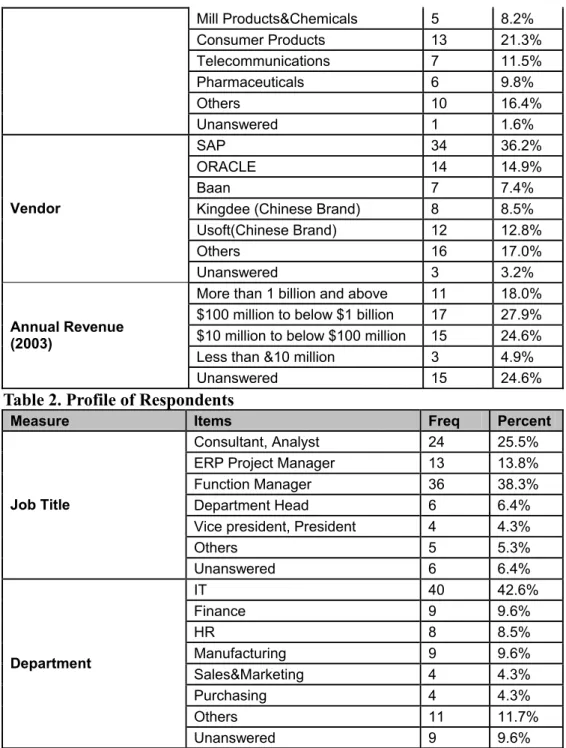
Over a 4 month time period in 2004, we collected data from a total of 94 projects in 61 organizations. 12 organizations provided multiple responses based on multiple ERP project experiences in their organizations. Table 1 shows the profile of the respondent companies while table 2 shows the profile of the individual respondents.
Table 1. Profile of Companies
Measure Items Freq Percent
Mill Products&Chemicals 5 8.2% Consumer Products 13 21.3% Telecommunications 7 11.5% Pharmaceuticals 6 9.8% Others 10 16.4% Unanswered 1 1.6% SAP 34 36.2% ORACLE 14 14.9% Baan 7 7.4%
Kingdee (Chinese Brand) 8 8.5% Usoft(Chinese Brand) 12 12.8%
Others 16 17.0%
Vendor
Unanswered 3 3.2%
More than 1 billion and above 11 18.0% $100 million to below $1 billion 17 27.9% $10 million to below $100 million 15 24.6% Less than &10 million 3 4.9%
Annual Revenue (2003)
Unanswered 15 24.6%
Table 2. Profile of Respondents
Measure Items Freq Percent
Consultant, Analyst 24 25.5%
ERP Project Manager 13 13.8%
Function Manager 36 38.3%
Department Head 6 6.4%
Vice president, President 4 4.3%
Others 5 5.3% Job Title Unanswered 6 6.4% IT 40 42.6% Finance 9 9.6% HR 8 8.5% Manufacturing 9 9.6% Sales&Marketing 4 4.3% Purchasing 4 4.3% Others 11 11.7% Department Unanswered 9 9.6%
ANALYSIS AND FINDINGS Analysis Method: PLS
We adopted Structural Equation Modeling (SEM) approach for data analysis because of SEM’s ability to simultaneously test the structural model and measurement model (Fornell 1982). PLS-Graph Version 3.000 was used.
Measurement Model
The strength of measurement model can be demonstrated through measures of convergent and discriminant validity (Hair et al. 1998). Convergent validity is generally assessed through three tests: 1) item reliability which is measured by the factor loading of the item on the construct; 2) composite reliability of each construct; 3) average variance extracted by each
construct. AppendixB presents the assessment of the convergent validity. The results suggest that the convergent validity of the research variables is adequate. All the reliability coefficients exceeded 0.80 while the average extracted variances were 0.60 above. In addition, Cronbach alpha of each construct was calculated. All the Cronbach alpha exceeded 0.80, suggesting that the constructs were reliable.
Two tests were conducted to assess discriminant validity: (1) verifying that each item loads more highly on its associated construct than on any other construct ( Thomson et al. 1991). (2) Verify that each item should correlate more highly with other items of the same construct than with items of other construct. Results show that all the items loadings were greater than or equal to 0.55 and loaded more highly on their hypothesized constructs than on any other constructs. Appendix C displays the correlations among all variables while the diagonal values representing the square root of average variance extracted (AVE). As we can see, the second discriminant validity requirement was also upheld.
In addition to the validity assessment, we check the multicollinearity of the measurement model. Appendix C displays the correlations among all variables. None of the correlations approach .80, which would suggest a problem with multicollinearity among the research variables (Hair et al., 1995). Variance Inflation Factor (VIF) for the constructs are acceptable (1.233~2.032) which rules out multicollinearity problems (Steven, 1996).
Structural Model
With adequate measurement models and an acceptable level of multicollinearity, the proposed hypotheses are tested with PLS. This evaluation consisted of an assessment of the explanatory power of the independent constructs and an examination of the size and significance of the path coefficients. Jacknifing, a non-parametric technique was recommended by Fornell and Barclay (1983) to produce parameter estimates, standard errors, and t-values. The 95 percent level of significance was used for all the statistical tests.
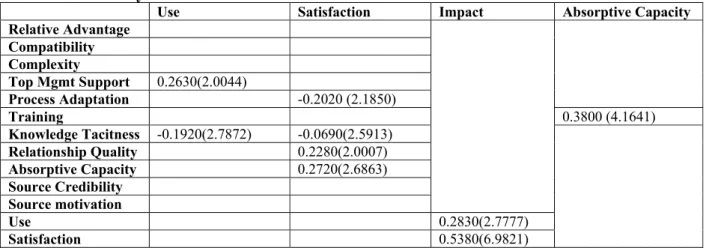
The results of the analysis are summarized in Table 3. Fifty percent of variance in organizational impact is accounted for by two constructs, use and satisfaction. 49 percent of variance of use and, 67 percent of variance of satisfaction are accounted for by the suggested model. On the contrary to expectation, user satisfaction has no effect on use. More surprisingly, among 11 success antecedents, only two antecedents --top management support and knowledge tacitness show significant relationships with use, and four antecedents-- process adaptation, knowledge tacitness, absorptive capacity and relationship quality show strong relationship with satisfaction. Two antecedents –training and absorptive capacity are significantly related each other as hypothesized. The next section will explain the results.
Table 3. Summary of Result
Use Satisfaction Impact Absorptive Capacity
Relative Advantage Compatibility Complexity Top Mgmt Support 0.2630(2.0044) Process Adaptation -0.2020 (2.1850) Training 0.3800 (4.1641) Knowledge Tacitness -0.1920(2.7872) -0.0690(2.5913) Relationship Quality 0.2280(2.0007) Absorptive Capacity 0.2720(2.6863) Source Credibility Source motivation Use 0.2830(2.7777) Satisfaction 0.5380(6.9821)
Discussion
As anticipated, both use and user satisfaction are significantly related with organizational impact. However, our results show that satisfaction has no effect on use unlike the traditional IS success research in the past. This may be explained by mandated use of ERP system: when the management mandate the use of ERP system, users may have to use the system even they are not satisfied with the system. Moreover, ERP system integrates the core business processes and includes functions which support users’ daily work. Thus, in many cases, using ERP is the only way for users to accomplish their work.
Interestingly, organization’s perception on three innovation characteristics has no effect on either use or satisfaction. This may be explained by the ERP adoption context in China. China lags behind western countries in implementing MIS. When Chinese company start to adopt ERP, ERP has been relatively widely adopted in western countries. Numerous reports have shown the equally huge benefit and risk of this new technology. Therefore, even the “early ERP adopter” in China may well understand ERP’s benefit as well as the issue of compatibility and complexity. Therefore, the use and satisfaction of system may be influenced less by the perception of innovation and more by how ERP is implemented, used and how knowledge barrier is overcome.
Contrary to expectation, source creditability and source motivation are not significantly related with the use and satisfaction of ERP. This is probably due to the fact that while recognizing the complexity and importance of ERP, most organizations hired prestigious consulting company to support their ERP implementation. This may lead to client’s positive perceptions on creditability and motivation of their partners.
As hypothesized, top management support is significantly related with the use of ERP. However, the relationship between top management support and user satisfaction is not supported. While support and order from top management can enforce the users to use the ERP system, it can’t ensure the satisfaction towards the system.
Process adaptation has negative effect on satisfaction as we expected but has no effect on use. When more process adaptations are made, more effort and resource have to be put in, and more resistance and difficulties will be encountered, thus satisfaction tends to decline. However, as we discussed earlier, it may not necessarily lead to the declined use of system, if the system is mandated to use and is the only way for users to accomplish work.
Training has no effect on both use and satisfaction. However, it’s shown to have a strong effect on absorptive capacity which is significantly related with satisfaction. Therefore, the effect of training on satisfaction is mediated through absorptive capacity in this model. The no effect on use can again be explained by the mandated use of ERP system.
As hypothesized, knowledge tacitness has effect on both use and satisfaction. Tacit knowledge is more difficult to transfer than explicit knowledge. If the knowledge about a specific ERP package is not well codified and articulated through means such as documentation, it will be extremely difficult for users to acquire requisite knowledge to use the system, and users will not be satisfied either.
Absorptive capacity and relationship quality are significantly related with satisfaction but not related with use. It’s not difficult for users to acquire the knowledge about how to navigate and use the system through Manual or basic training. Thus, users may be able to use ERP system even with low absorptive capacity and bad relationship with its partners. However, other ERP knowledge is more difficult to understand and be codified, such as the business implication of certain best practice or how to configure a business process. This knowledge can hardly be transferred when the recipient -- client has low absorptive capacity and a bad relationship with the knowledge source –its partners. Without this knowledge, users are unlikely to use ERP smoothly and achieve benefit, and thus be satisfied.
Implications For Researchers
This study has confirmed the role of knowledge transferred-related factors in ERP implementation. This suggests researchers should consider the effect of these factors in their future study of technology implementation, especially for complex, knowledge-intensive technology like ERP. In addition, this study found success factors have different effect on use and satisfaction. Therefore, research in the future should examine the effect of success antecedents on different dimensions of success.
For Practitioners
While practitioners in organization should continue to seek support and commitment from top management in ERP implementation effort, they should pay more attentions to knowledge-related factors to overcome the knowledge barriers. When external expertise is involved to support implementation effort, client organization should never ignore assimilating knowledge from its partners. Effort should be put to cultivate a healthy relationship with partners, which is characterized as trust, understanding, benefit and risk share, and commitment. While certain degree of reliance on external expertise is inevitable, organizations should be aware the dangers of over-reliance on external expertise in an ERP implementation effort. It’s necessary to maintain certain in-house expertise and knowledge related with ERP even before the implementation effort. This may help enhance organization’s absorptive capacity on ERP, and further facilitate the transfer of ERP knowledge during the implementation effort.
CONCLUSIONS
The objective of this study is investigating how the knowledge transfer related factors, together with well-established influential factors in both IT implementation and innovation literature, predict and explain the success of ERP implementation, which is complex and impose high knowledge barrier. The result has confirmed the expected role of knowledge transfer-related factors in ERP implementation context. Specifically, it shows tacitness of knowledge being transferred, the client’s absorptive capacity and the relationship quality between client and its implementation partners are significantly related with ERP success.
REFERENCE
1. Argote, L. Organizational Learning: Creating, Retaining and Transferring Knowledge, Kluwer Academic Publishers, Boston, MA. 1999.
2. Attewell, P. “Technology Diffusion and Organizational Learning: The Case of Business Computing,” Organization Science (3:1), 1992, pp. 1-19.
3. Bancroft, N., Seip, H., and Sprengel, A. Implementing SAP R/3 , Manning Publications Co., Greenwich, CT. 1998.
4. Bradford, Marianne and Florin, Juan, “Examining the role of innovation diffusion factors on the implementation success of enterprise resource planning systems,” International Journal of Accounting Information Systems (4:3), 2003, pp. 205 – 225.
5. Chan,R. “ Knowledge Management for implementing ERP in SMEs,” Proceedings of 3rd Annual SAP Asia Pacific Conference, Singapore, 1999
6. Chin, W. W. “The partial least squares approach to structural equation modeling,” in
Modern Methods for Business Research, G. A. Marcoulides (ed.), Lawrence Erlbaum Associates, Mahwah, NJ, 1998, pp.295-336.
7. Cho, I. and Kim, Y.G. “Critical Factors for Assimilation of Object-Oriented Programming Languages”, Journal of Management Information Systems (18:3), winter 2001/2002, pp. 125-156.
8. Cohen, W., and Levinthal, D. "Absorptive Capacity: A New Perspective on Learning and Innovation," Administrative Science Quarterly (35) 1990, pp 128-152.
9. Cooper, R.B. and Zmud, R.W. "Information technology implementation research: a technological diffusion approach," Management Science (36:2), February 1990, pp.123-139
10. Crowley, A. “Training Treadmill—A Rigorous Plan of End-User Education is Critical to Whipping ERP Systems into Shape”, PC Week Online, January 4, 1999.
11. Davenport, T.H. “Putting the Enterprise into the Enterprise System,” Harvard Business Review (76:4), 1998, pp. 121 – 131.
12. Davenport, T.H. “The Future of Enterprise System-Enabled Organizations,” Information Systems Frontiers (2:2), 2000, pp 163–180.
13. Davis, F.D. “Perceived usefulness, perceived ease of use and user acceptance of information technology,” MIS Quarterly, (13:3), 1989, pp. 319-340.
14. DeLone, W. H., and McLean, E. R. “Information Systems Success: The Quest for the Dependent Variable,” Information Systems Research (3:1), 1992, pp. 60-95.
15. Dholakia, R., and Sternthal, B. "Highly Credible Sources: Persuasive Facilitators or Persuasive Liabilities?" Journal of Consumer Research (3), March 1977, pp 223-232. 16. Downs, G. W., and Mohr, L. B. “Conceptual Issues in the Study of Innovation,”
Administrative Science Quarterly (21), December 1976, pp. 700-714.
17. Fichman, R.G. (1992) “Information technology diffusion: a review of empirical research,” Proceedings of International Conference on Information Systems, Dallas, TX, 1992 , pp. 195-206
18. Fichman RG, Kemerer CF. “The assimilation of software process innovations: an organizational learning perspective,” Management Science (43:10), 1997, pp.1345–1363. 19. Fichman RG. “The diffusion and assimilation of information technologies,” in Framing
the domains of IT research: glimpsing the future through the past, R.W. Zmud (eds.), Pinnaflex Educational Resources, Cincinnati, OH, 2000, pp. 105–133.
20. Fornell, C., and Larcker, D. F. “Structural equation models with unobservable variables and measurement errors,” Journal of Marketing Research, (18:3), 1981, pp.39-50
21. Gallivan, M.J. “Adoption, diffusion, and infusion of IT: Organizational adoption and assimilation of complex technological innovations: development and application of a new framework,” ACM SIGMIS Database (32:3), July 2001, pp. 51-85
22. Griffith T.L., R.F. Zammuto, L. Aiman-Sith, “Why new technologies fail?” Industrial Management, 1999, pp. 29 -34
23. Grewal, D., Gotlieb, J., and Marmorstein, H. "The Moderating Effects of Message Framing and Source Credibility on the Price-Perceived Risk Relationship," Journal of Consumer Research (21), June 1994, pp.145-153.
24. Grover, V. & Goslar, M. D. “The Initiation, Adoption, and Implementation of Telecommunications Technologies in U.S. Organization”, Journal of Management Information Systems(10:1), 1993, pp.141-163.
25. Jenson R.L., Johnson I.R.. “The enterprise resource planning system as a strategic solution,” Information Strategy Executive Journal (15:4), 1999, pp. 28–33.
26. Karahanna, E., Straub, D.W., and Chervany, N.L. “Information Technology Adoption Across Time: Cross-Sectional Comparison of Pre-Adoption and Post-Adoption Beliefs,”
MIS Quarterly (23:2), 1999, pp.183-213
27. Hong, K.K. and Kim, Y.G., “The critical success factors for ERP implementation: an organizational fit perspective,” Information and Management (40), 2002, pp. 25-40. 28. Kwon, T. and Zmud, R. “Unifying the fragmented models of information system
implementation, in Critical issues in information system research, Boland, R. and Hirschheim, R. (eds.), John Wiley, New York, 1987, pp.227-251.
29. Lai, V. S., and Guynes, J. L. “ISDN: Adoption and Diffusion Issues,” Information Systems Management (15:4), 1993, pp.87-97
30. Larsen, KAI R.T., “A Taxonomy of Antecedents of Information Systems Success: Variable Analysis Studies,” Journal of Management Information Systems (20:2), 2003, pp.169-246
31. Lee, J. N., and Kim, Y. G. “Effect of Partnership Quality on IS Outsourcing Success: Conceptual Framework and Empirical Validation”. Journal of Management Information Systems (15:4), 1999, pp.29-61
32. Markus, M.L., Axline, S., Petrie, D. and Tanis, C. “Learning from adopters’ experiences with ERP: Problems Encountered and Success Achieved,” Journal of Information Technology (15), 2000, pp. 245 – 265.
33. Markus, M.L., and Tanis, C. “The Enterprise System Experience – From Adoption to Success,” in Framing the domains of IT research: glimpsing the future through the past, R.W. Zmud (eds.), Pinnaflex Educational Resources, Cincinnati, OH, 2000, pp.105–133. 34. McGowan, M.K and Madey G.R., “The influence of organization structure and
organizational learning factors on the extent of EDI implementation in U.S. firms”,
Information Resources Management Journal (11:3). Hershey: Summer 1998. pp. 17 - 27 35. Mowery, D., Oxley, J., and Silverman, B. "Strategic Alliances and Inter-firm Knowledge
Transfer," Strategic Management Journal (17:Winter Special Issue) 1996, pp 77-91. 36. Mullen, M.R. “Diagnosing Measurement Equivalence in Cross-National Research,”
Journal of International Business Studies, (26:3), 1995, pp. 573-596.
37. Nonaka, I. "A Dynamic Theory of Organizational Knowledge Creation," Organizational Science (5:1), 1994, pp 14-37.
38. O’Leary, D.E. Enterprise Resource Planning Systems: Systems, Life Cycle, Electronic Commerce, and Risk. Cambridge University Press, United States of America, 2000. 39. Pan, S.L., Newell, S., Huang, J.C. and Wan, K.C. “Knowledge Integration as a Key
Problem in an ERP Implementation,” in Proceedings of the Twenty Second International Conference on Information Systems, 2001, pp.321 – 328.
41. Premkumar, G.; Ramamurthy, K.; and Nilakanta, S. "Implementation of Electronic Data Interchange: An Innovation Diffusion Perspective," Journal of Management Information Systems (11:2), Fall 1994, pp. 157-186.
42. Prescott MB, Conger SA. “Information technology innovations: a classification by IT locus of impact and research approach,” The Data Base for Advances in Information systems (26:2–3) 1995, pp.20–40.
43. Ramamurthy K, Premkumar G. “Determinant and outcomes of electronic data interchange diffusion,” IEEE transactions on engineering management (42:4), 1995, pp. 332–351.
44. Reed, R. and R.J. DeFillippi: “Causal Ambiguity, Barriers to Imitation and Sustainable Competitive Advantage”, Academy of Management Review (15:1), 1990, pp 88-102
45. Robey, D., Boudreau, M.-C., and Rose, G. M. “Information Technology and Organizational Learning: A Review and Assessment of Research,” Accounting, Management, and Information Technologies (10:2), 2000, pp. 125-155.
46. Robey, D., Ross, J.W., and Boudreau, M.C. (2002). “Learning to Implement Enterprise Systems: An Exploratory Study of the Dialectics of Change,” Journal of Management Information Systems (19:1), pp.17 – 46
47. Rogers, E.M. Diffusion of Innovations, 3d ed. New York: Free Press, 1983. 48. Rogers, E.M. Diffusion of Innovations, 4th ed. New York: Free Press, 1995
49. Rosemann, M., “ERP-Software – Characteristics and consequences,” Proceedings of the 7th European Conference on Information Systems, J.PriesHeje et al. (eds.) (III), 1999, pp. 1038-1043.
50. Ramamurthy, K., Premkumar, G. and Michael Crum, R, “Organizational and Interorganizational Determinants of EDI Diffusion and Organizational Performance: A Causal Model“, Journal of Organizational Computing & Electronic Commerce (9:4), 1999, pp. 253-285
51. Singh, J. “Measurement issues in cross-national research,” Journal of International Business Studies, (26:3), 1995, pp. 597-619.
52. Soh, C., Sia, S.K. and Tay-Yap, J. "Cultural Fits and Misfits: Is ERP a Universal Solution?" Communications of the ACM (43:4), April 2000, pp. 47 – 51.
53. Szulanski, G. "Exploring Internal Stickiness: Impediments to the Transfer of Best Practice Within the Firm," Strategic Management Journal (17:Winter Special Issue), 1996, pp 27-43.
54. Thompson, J.D. Organizations in Action, McGraw-Hill, New York,1967.
55. Timbrell G., Andrews, N., Gable, G. "Impediments to Inter-firm Transfer of Best Practice: in an enterprise systems context", in the Americas Conference of Information Systems, 3-5 August 2001
56. Tornatzky, L. G., and Klein, K. J. “Innovation Characteristics and Innovation Adoption-Implementation: A Meta-Analysis of Findings,” IEEE Transactions on Engineering Management, EM-29(1), February 1982, pp. 28-45.
57. Walton, R. E. “The diffusion of new work structures: Explaining why success didn’t take,” Organizational Dynamics, winter, 1975, pp. 3-21.
58. Wixom, B., and Watson, H.J. “An Empirical investigation of the factors affecting data warehousing success”, MIS Quarterly (25:1), Mar2001, 17-39
59. Wolfe, R.A. “Organizational innovation: Review, critique, and suggested research directions,” Journal of Management Studies (31:3), 1994, 405–430.
60. Zander, U., & Kogut, B. “Knowledge and the speed of the transfer and imitation of organizational capabilities: An empirical test,” Organization Science (6), 1995, pp 76–92
Appendix A – Model Construct Definition and Reference
Factors Definition References
Innovation Characteristics
Relative advantage The degree to which using the ERP system is perceived as being better than using its precursor or status quo.
Rogers, 1983; Cho and Kim 2002; Premkumar et al. 1994; Ramanurthy and Premkumar 1995; Lai 1997 Compatibility The degree to which ERP is consistent with the
existing values, experiences, and needs of the company.
Rogers, 1983; 1995; Cho and Kim 2002; Cooper and Zmud 1990; Premkumar et al. 1994; Ramanurthy and Premkumar 1995; Lai 1997; Bradford and Florin 2003; Hong and Kim 2002
Complexity The degree to which ERP system is perceived as being difficult to understand and use.
Tornatzky and Klein 1982; Cho and Kim 2002; Cooper and Zmud 1990; Premkumar et al. 1994; Ramanurthy and Premkumar 1995; Lai 1997; Bradford and Florin 2003
Organizational Factors
Top mgmt support Widespread sponsorship for a project across the management team.
Wixom and Watson 2001; Ruppel and Howard 1998 ;Lai 1997; Bradford and Florin 2003
Training Degree of importance put on educating staff on ERP.
Mcgrowan and Madey 1998;Cho and Kim 2002; Bradford and Florin 2003 Process Adaptation Extent of efforts and time spending in process
change to align with ERP.
Hong and Kim 2002; Bradford and Florin 2003
Knowledge Transfer Factors
Knowledge Tacitness
The degree to which the knowledge can be documented and verbalized.
Zander and Kogut 1995; Reed and DeFillippi 1990; Relationship
Quality
The relationship quality between the client and ERP implementation partner (vendor, consultants).
Szulanski 1996; Timbrell et al. (2001)
Source Credibility the extent to which a recipient perceived a source to be trustworthy and an expert
Szulanski 1996; Perloff, 1993; Timbrell et al. (2001) Source Motivation The degree to which knowledge owners see safety
or benefits and is willing to share knowledge
Szulanski 1996; Timbrell et al. (2001)
Absorptive Capacity The degree that the firm is able to value, assimilate and apply knowledge transferred from its implementation partner.
Cohen & Levinthal 1990; Lee 2001; Szulanski (1996)
Appendix B –Reliability Analysis Alpha Composite reliability Items Factor loadings AVE RA1 0.8655 RA2 0.8540 RA3 0.8231 RA4 0.7942 Relative Advantage .8795 0.913 RA5 0.7764 0.678 COMPAT1 0.7257 COMPAT2 0.8702 COMPAT3 0.8428 Compatibility .8194 0.879 COMPAT4 0.7655 0.645 COMPLE1 0.8369 COMPLE2 0.8766 COMPLE3 0.8630 Complexity . 9034 0.932 COMPLE4 0.9409 0.775 TMS1 0.9411 TMS2 0.9394 Top Mgmt Support . 9190 0.950 TMS3 0.9056 0.863 TRAIN1 0.9182 TRAIN2 0.7490 Training . 8225 0.891 TRAIN3 0.8929 0.734 PA2 0.8219 PA3 0.8930 Process Adaptation . 8102 0.889 PA5 0.8417 0.727 AC1 0.9323 AC2 0.9399 AC3 0.8803 Absorptive Capacity . 9350 . 953 AC4 0.9060 0.837 TACIT1 0.9374 Knowledge Tacitness . 8551 0.932 TACIT2 0.9317 0.873 RQ1 0.8073 RQ2 0.8944 RQ3 0.8201 RQ4 0.8322 Relationship Quality . 9006 0.926 RQ5 0.8726 0.716 CRE1 0.8317 CRE3 0.7952 CRE4 0.8533 Source Credibility . 8521 0.900 CRE5 0.8489 0.693 MOT1 0.8523 MOT2 0.8644 Source Motivation . 8394 0.901 MOT3 0.8864 0.703 USE1 0.8554 Use .8726 0.914 USE2 0.8483 0.727
USE3 0.8680 USE4 0.8377 SAT1 0.9552 SAT2 0.9533 SAT3 0.9179 User satisfaction . 9606 0.971 SAT4 0.9566 0.895 O_IMP1 0.8894 O_IMP2 0.8994 O_IMP3 0.9037 O_IMP4 0.8791 Organizational benefits . 9353 0.951 O_IMP6 0.8853 0.795
Appendix C –Correlation of Constructs (AVE)
RA Compa Compl TMS Train AC KT SC SM RQ PA Use Sat Imp
RA 0.823 Compa 0.151 0.803 Compl -0.201 -0.086 0.880 TMS 0.340 0.370 -0.183 0.928 Train 0.331 0.448 -0.173 0.531 0.856 AC 0.229 0.228 -0.392 0.293 0.380 0.914 KT -0.293 -0.163 0.316 -0.206 -0.419 -0.228 0.934 SC 0.386 0.262 -0.249 0.187 0.421 0.294 -0.457 0.832 SM 0.192 0.181 -0.124 0.185 0.140 0.214 -0.083 0.343 0.838 RQ 0.225 0.296 -0.166 0.432 0.349 0.291 -0.343 0.410 0.198 0.846 PA -0.048 -0.040 0.142 -0.172 0.005 -0.344 -0.052 -0.053 -0.240 -0.183 0.852 Use 0.409 0.241 -0.223 0.510 0.533 0.376 -0.464 0.395 0.093 0.441 -0.009 0.852 Sat 0.315 0.370 -0.418 0.467 0.431 0.606 -0.370 0.499 0.357 0.563 -0.408 0.442 0.946 Imp 0.365 0.273 -0.276 0.552 0.446 0.534 -0.255 0.433 0.307 0.540 -0.213 0.521 0.663 0.891
Diagonal elements are the square root of Average Variance Extracted.
Legend:
RA : Relative Advantage
Compa : Perceived Compatibility
Compl : Perceived Complexity
TMS : Top Management Support
Train : Training AC : Absorptive Capacity KT : Knowledge Tacitness SC : Source Creditability SM : Source Motivation RQ : Relationship Quality PA : Process Adaptation Use : Use Sat : Satisfaction