Exploring the Weak Limit of Gravity at Solar System Scales
A dissertation submitted in partial fulfillment of the requirements for the degree of Doctor of Philosophy at George Mason University
By
Gary L. Page
Master of Business Administration
Virginia Polytechnic Institute and State University, 1982 Master of Science
Clarkson University, 1971 Bachelor of Science Clarkson University, 1969
Director: Dr. John F. Wallin, Associate Professor Department of Computational and Data Sciences
Spring Semester 2009 George Mason University
Copyright c 2009 by Gary L. Page All Rights Reserved
Dedication
First and foremost, I dedicate this dissertation to my bride, Vicky, who encouraged me to begin this journey and then steadfastly continued to provide support and assistance through-out the whole process. Thanks are due also to our children, Kelly and Amanda Wolcott, whose support and interest made the work much easier. Finally, my mother, Rose, and my late father, Louis, provided an environment throughout my youth that encouraged curiosity and learning, and thus contributed directly towards my desire and ability to accomplish the effort described here. Without all these people, the work would not have been possible and I dedicate the results to them.
Acknowledgments
Dr. John Wallin could not have provided more help and guidance than he so ably and willingly bestowed as my Dissertation Director. As a knowledgeable, flexible, and patient mentor and friend, I could not have asked for more, even though he had an annoying habit of being correct when we disagreed on technical matters. I also acknowledge the help, support, and assistance of the rest of my committee, Drs. Peter Becker, Kirk Borne, and Daniel Carr, who all provided assistance in various ways at various times and their valuable contributions are gratefully recognized. Additionally, thanks are due David Dixon, colleague, collaborator, friend, discoverer of asteroids, proprietor of Jornada Observatory (IAU 715), and expert in practical astrometry for providing both illuminating conversations and periodic exhortations. Finally, I want to thank Dr. Barbara L. O’Kane, my associate, colleague, and friend from my “other life,” who provided support and assistance in many ways and at many times as the work proceeded.
Table of Contents
Page
List of Tables . . . viii
List of Figures . . . ix
Abstract . . . xii
1 Introduction and Background . . . 1
1.1 Scientific Justification . . . 1
1.2 Problem Statement . . . 3
1.3 Objectives . . . 6
1.4 Background . . . 7
1.4.1 Observational Background . . . 8
1.4.2 Pioneer Effect Caused by Known Physics . . . 9
1.4.3 Pioneer Effect Caused by Unknown Physics . . . 11
1.4.4 Are These Explanations Plausible? . . . 13
1.4.5 Are These Effects Observable? . . . 14
1.4.6 The Broader Context . . . 15
1.5 Organization of Dissertation . . . 18
2 Astrometric Methods and Models . . . 21
2.1 Astrometry . . . 22
2.2 Celestial Mechanics . . . 30
2.3 Sources of Perturbations . . . 32
2.4 Solar System Dynamics . . . 33
2.5 Geometrical Aspects . . . 34
3 Asteroids as Gravity Probes . . . 36
3.1 Methods and Models . . . 37
3.1.1 Minor Planets . . . 39
3.1.2 Asteroid Sample Selection . . . 40
3.2 Results . . . 41
3.3 Discussion . . . 43
3.3.1 Asteroid Dynamics . . . 43
3.4 Conclusions . . . 57
4 Major Planets as Gravity Probes . . . 60
4.1 Methods and Models . . . 63
4.1.1 Characterizing the Pioneer effect . . . 63
4.1.2 Estimating Pioneer effect manifestations . . . 63
4.1.3 Celestial mechanics . . . 65
4.1.4 Simulation of observations . . . 68
4.2 Results . . . 73
4.2.1 Prediction of sky position from orbital elements . . . 73
4.2.2 Errors in orbital elements derived from observations . . . 90
4.2.3 How can we assess the quality of an orbital fit? . . . 96
4.3 Discussion . . . 100
4.4 Conclusions . . . 103
5 Comets as Gravity Probes . . . 105
5.1 Methods and Models . . . 105
5.1.1 Non-Gravitational Forces . . . 107
5.1.2 Comet Sample Selection . . . 107
5.2 Results . . . 108
5.3 Discussion . . . 111
5.4 Conclusions . . . 116
6 Impact of LSST and Pan-STARRS . . . 118
6.1 Methods and Models . . . 119
6.2 Results . . . 124
6.2.1 Angular Separation . . . 124
6.2.2 Probability of a Significant Position Difference . . . 128
6.2.3 Quality of Orbital Fits . . . 131
6.3 Discussion . . . 136
6.3.1 Heuristic for Detection Times . . . 136
6.3.2 Physical Basis for Heuristic . . . 141
6.3.3 What Would An Observer See? . . . 142
6.4 Conclusions . . . 148
7 Astrometry Summary . . . 151
7.1 Discussion . . . 152
7.2 Conclusions . . . 154
8 Dark Matter Methods and Models . . . 161
8.1 Galactic Dark Matter Distribution . . . 161
9 Dark Matter Capture Via a Weak Interaction . . . 165
9.1 Methods and Models . . . 166
9.1.1 Solar Interior Model . . . 167
9.1.2 Solar Potential . . . 170
9.1.3 Hard Sphere Scattering . . . 172
9.1.4 Scattering Cross Section . . . 173
9.1.5 Scattering Depth . . . 174
9.2 Results . . . 175
9.3 Discussion . . . 179
9.4 Conclusions . . . 181
10 Dark Matter Capture Via Three-Body Interactions . . . 187
10.1 Methods and Models . . . 188
10.1.1 The Circular Restricted Three Body Problem . . . 189
10.1.2 Hill’s Problem . . . 193
10.1.3 Curves of Zero Velocity . . . 196
10.2 Results . . . 198
10.3 Discussion . . . 203
10.4 Conclusions . . . 204
11 Dark Matter Summary . . . 207
11.1 Discussion . . . 208
11.2 Conclusions . . . 210
12 Conclusions and Final Comments . . . 213
12.1 Conclusions . . . 213
12.1.1 Astrometry . . . 213
12.1.2 Dark Matter Capture . . . 217
12.2 Impact of Dissertation . . . 218
12.3 Future Research Areas . . . 220
12.4 Final Remarks . . . 222
List of Tables
Table Page
1.1 Implications of the existence or nonexistence of the Pioneer effect and dark
matter. . . 16
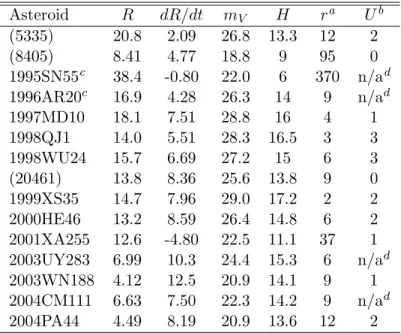
3.1 Orbital parameters of asteroids susceptible to the Pioneer effect. . . 42
3.2 Observational characteristics of asteroid candidates on 2005 April 1. . . 45
4.1 Elements for the hypothetical bodies used in the analysis. . . 69
4.2 Frequency of archive observations of Pluto. . . 70
4.3 Total number of synthetic observations used in analysis, for each arc segment evaluated. . . 71
4.4 Four cases combining gravity models and forces determining motion. . . 72
5.1 Orbital parameters of comets susceptible to the Pioneer Effect. . . 108
5.2 Change in comet orbital period because of Pioneer Effect and NGF. . . 110
5.3 Observational characteristics of comet candidates on 2005 April 1. . . 112
6.1 The mean (in years), standard deviation (in years), and rms residual (in arcsec) for each case described by a semimajor axis and an eccentricity. . . 130
6.2 Heuristic parameter values for time to a statistically significant angular sep-aration. . . 137
List of Figures
Figure Page
2.1 Keplerian elements describe the shape, size, and orientation of orbits. . . . 24
3.1 Angular deviation between Keplerian and perturbed orbits . . . 46
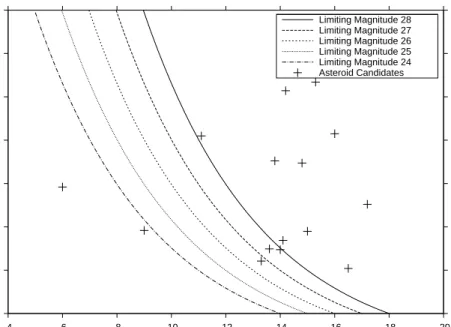
3.2 Maximum observable distance versus absolute visual magnitude . . . 47
3.3 Angular differences between positions of (5335) Damocles . . . 51
3.4 Orbital fit rms residuals for Damocles . . . 55
4.1 Angular position differences when orbits are extrapolated with “known” el-ements with– and without a Pioneer effect perturbation. . . 74
4.2 Angular position difference when orbits are extrapolated with elements de-termined from synthetic observations generated with a Pioneer effect pertur-bation over a 50 year arc. . . 76
4.3 Angular position difference when orbits are extrapolated with elements de-termined from synthetic observations generated with a Pioneer effect pertur-bation over a 100 year arc. . . 77
4.4 Angular position difference when orbits are extrapolated with elements de-termined from synthetic observations generated with a Pioneer effect pertur-bation over a 150 year arc. . . 78
4.5 Angular position difference when orbits are extrapolated with elements de-termined from synthetic observations generated with a Pioneer effect pertur-bation over a 200 year arc. . . 79
4.6 Angular position difference when orbits are extrapolated with elements de-termined from synthetic observations generated with a Pioneer effect pertur-bation over a 250 year arc. . . 80
4.7 Angular position differences for Pluto when orbits are predicted with elements determined from synthetic observations generated with a Pioneer effect per-turbation. . . 83
4.8 Observed minus calculated residuals for Pluto with respect to the DE414 ephemeris. . . 85
4.9 Normal points for the DE414 residuals and the residuals for the synthetic observations relative to their ephemeris. . . 86 4.10 Total rms residual by epoch for the DE414 case and the synthetic observation
case. . . 89 4.11 The condition number of the orbital fitting problem as a function of
eccen-tricity for different observation arc lengths. . . 94 4.12 Relative error in orbital elements in the linear approximation as observation
arc varies. . . 95 4.13 Rms residual of orbital fit as observation arc length varies. . . 98 4.14 Gravitational acceleration exerted by Uranus and Neptune on Pluto as a
function of time. . . 101 5.1 Angular deviation between modified comet orbits. . . 114 6.1 Angular separation as a function of time from perihelion for an object with
a semimajor axis of 20 AU. . . 125 6.2 Angular separation as a function of time from perihelion for an object with
a semimajor axis of 40 AU. . . 127 6.3 Probability of a statistically significant angular difference as a function of
time from perihelion for an object with a semimajor axis of 20 AU. . . 129 6.4 Probability of a statistically significant angular difference as a function of
time from perihelion for an object with a semimajor axis of 40 AU. . . 129 6.5 Probability of a significant sky position difference between the perturbed and
the unperturbed case for selected objects as a function of time from perihelion.132 6.6 Rms residual for various combinations of observations and gravity model as
the observation arc lengthens. . . 134 6.7 Time (in years) from perihelion that gives a 95 percent probability of a
signifi-cant difference in sky position between a perturbed case and the unperturbed case. . . 138 6.8 Time for an object that sometimes comes within 20 AU of the Sun to reach
a significant angular separation. . . 140 6.9 True anomaly at which an observable position difference between the
per-turbed and unperper-turbed cases is found at the 95 percent significance level. . 142 6.10 True anomaly that results in observable positional differences at the 95
per-cent significance level. . . 143 6.11 Normal points in right ascension for an object with a semimajor axis of 25
6.12 Normal points in right ascension for an object with a semimajor axis of 25
AU and an eccentricity of 0.3 in a “mismatched” case. . . 147
9.1 Solar mass interior to a radial distance . . . 168
9.2 Solar temperature versus radial distance . . . 168
9.3 Total mass density versus radial distance . . . 169
9.4 Mass fraction of main Solar constituents versus radial distance . . . 169
9.5 Gravitational potential energy per unit mass inside the Sun . . . 172
9.6 Illustrative dark matter trajectories through the Sun . . . 176
9.7 Optical depth to scattering for two dark matter trajectories . . . 177
9.8 Number of dark matter particles suffering different fates as dark matter par-ticle mass varies . . . 179
9.9 Log of binned frequency of captured dark matter particles as dark matter mass is varied . . . 180
9.10 Frequency of energy bins of captured dark matter particles . . . 181
9.11 Frequency of semimajor axis bins for captured dark matter . . . 182
9.12 Optical depth to scattering as a function of time for several representative orbits . . . 184
9.13 Representative set of orbital states that a dark matter particle traverses from initial capture into Solar orbit to eventual escape . . . 185
10.1 Zero velocity curves in the orbital plane of the primaries . . . 198
10.2 Zero velocity curves in the orbital plane of the primaries for different values of CJ . . . 200
10.3 Zero velocity curves for the Hill problem in the orbital plane of the primaries for different values of CH . . . 202
10.4 Zero velocity curves for the Hill problem in different planes for different values of CH . . . 202
Abstract
EXPLORING THE WEAK LIMIT OF GRAVITY AT SOLAR SYSTEM SCALES Gary L. Page, PhD
George Mason University, 2009
Dissertation Director: Dr. John F. Wallin
Precision tracking of multiple spacecraft in the outer Solar System has shown an unmod-elled perturbation, consisting of a small, constant, radial acceleration directed towards the Sun. Since its detection, a great deal of work has been devoted to explaining this Pioneer effect, both in terms of spacecraft-generated systematics and external physical causes. Its continuing importance is found in the fact that it has been impossible to explain away the effect through conventional means. This leaves open the possibility, however unlikely, that new physics is represented in the effect. This new physics, in turn, would be connected intimately to gravity with huge implications across astrophysics and beyond.
With this as motivation, this dissertation investigates two areas related to the Pioneer effect. The first goal is to investigate the use of planets, comets, and asteroids to determine the reality of the Pioneer effect through precision astrometry.
Here, we showed that asteroids can be used to evaluate the gravitational field in the outer Solar System. The observations can be conducted with modest allocations of telescope time, and would provide a definitive answer to the question within the next 20 years.
In assessing current knowledge of Pluto’s orbit, we determined that it is not known well enough at present to preclude the existence of the Pioneer effect. We also showed that comets are not ideal candidates for measuring gravity in the outer Solar System, although some present intriguing observational targets for related reasons. Finally, we showed that Pan-STARRS and LSST are likely to lead to a capability to test gravity in the outer Solar System in the near future.
The second goal of the dissertation involved exploring two general mechanisms for ex-plaining the Pioneer effect. The first approach involved investigating the effective mass density that would be produced in the Solar System as a result of the capture of elementary particle dark matter by means of a hypothetical weak interaction between the dark matter particles and the matter of the Sun. The second approach involved three body capture of dark matter from the Galactic halo into Solar orbit. The three bodies interacting are the Galactic barycenter, the Sun, and the dark matter particle.
In this phase of the dissertation, we showed that capture of Galactic dark matter into Solar orbit by a weak interaction with Solar matter does not accumulate dark matter in the region where the Pioneer effect manifests itself. It is possible that it does accumulate at smaller distances, however. Similarly, we showed that three body gravitational capture is not feasible as a cause of the Pioneer effect either. Dark matter captured by this mecha-nism would occur generally at distances far greater than that needed to cause the Pioneer anomaly. Thus, neither mechanism for capture of dark matter into Solar orbit sufficed to explain the Pioneer effect.
Finally, we discuss a number of future research areas that became apparent during the course of the research.
Chapter 1: Introduction and Background
This dissertation describes a research program that investigates the use of astrometry of outer Solar System bodies as a probe of gravity at multiple AU scales. The effort is part of a broader research program that includes investigation of Solar System capture scenarios of Galactic dark matter that could have observable dynamical effects.
This line of research is important because gravity is the primary force molding the evolution of the entire cosmos. Introducing ad hoc concepts like dark matter to make theories fit observation follows a time-honored approach of assuming the basic correctness of our picture of Nature and adding the simplest concepts necessary to make our picture whole. Many times in the past, the reality of the new concepts was eventually demonstrated. However, given the lack of success in directly detecting dark matter and having no empirical basis for even speculating on its nature, the time has come to investigate other possibilities.
1.1
Scientific Justification
While at first glance the goal of investigating the weak limit of gravity at Solar System scales might seem to be a settled problem, the reality is quite different. At laboratory scales, Newton’s Law of Universal Gravitation is experimentally verified by such means as the Cavendish experiment and its variants and descendants. At the distance scale of the inner planets, the tracking of space probes has experimentally confirmed our modern un-derstanding of gravity to a high degree of accuracy. This is especially true for Venus, Mars, the Moon, and, of course, our own planet, whose positions in space have been essentially “surveyed in” by multiple spacecraft.
At the largest scale, that of galaxy clusters, we observe gravitational lensing of distant galaxies by foreground clusters. However, we do not see enough matter to provide the
requisite mass to cause the lens. Similarly, on somewhat smaller but still large scales, the rotation curves of individual galaxies cannot be understood in terms of rotation in a gravitational field produced by the visible matter. In facing these issues, investigators had two choices. Either they could assume that there was some invisible matter influencing the motion, or that our theories of gravity were wrong. Normally, the easy way out is to assume that dark matter exists, even though we have no real idea of its nature and have not yet succeeded in directly detecting it.
At intermediate scales, say that of binary stars, we have problems observationally veri-fying our understanding of gravity. Such objects have only been known for about 200 years and long period binaries are not even known to be gravitationally bound to one another. Even shorter period binaries have not been studied extensively enough to observe deviations from normal gravity. Note that, as our interest is in weak-field systems, in this discussion we are ignoring binary pulsars and close, relativistic binaries, where gravity is well-measured by, for example, pulsar timings.
At somewhat smaller spatial scales, we have the outer planets of our Solar System along with various minor planets, comets, etc. The question addressed in this dissertation and our research program is whether gravity can be tested at the 20 to 100 AU distance scales typical of our local environment. Even at these scales, there is some evidence of “problems” with gravity. Our most precisely tracked spacecraft, Pioneers 10 and 11, have shown a constant sunward radial acceleration (termed the Pioneer effect) over a range of heliocentric distances from 20 to 75 AU that has resisted conventional explanation. Thus, wherever we look at either very weak gravity fields or, perhaps the same thing, at large distances, we see problems with our understanding of gravity. This and related issues are among the outstanding problems facing astronomy and astrophysics as we enter the twenty-first century.
1.2
Problem Statement
As I will discuss below, a great deal of work has been devoted to explaining the Pioneer effect, both in terms of spacecraft-generated systematics and external physical causes. The importance of this is found in the fact that it has been impossible to explain away the effect through conventional means. This leaves open the possibility, however unlikely, that new physics is represented in the effect. This new physics, in turn, would be intimately connected to gravity with huge implications across astrophysics and beyond.
Continuing professional interest in this area of research has been shown by the Euro-pean Space Agency, as part of its Cosmic Vision 2015-2025 planning (Bignami et al., 2005), exploring as a major theme “What are the fundamental physical laws of the Universe,” that envisions high precision experiments in space aimed at uncovering new physics, including probing the limits of general relativity, symmetry violations, etc. Further, the International Space Science Institute has convened an international team, “The Pioneer Explorer Collab-oration: Investigation of the Pioneer Anomaly at ISSI,”1 to define a process by which the
entire Pioneer data record can be analyzed and to use the results to define an instrument package capable of providing an independent confirmation of the anomaly and to study the feasibility of a dedicated mission to explore the Pioneer effect (Dittus et al., 2006).
Even continuing public interest in this area of research is shown by the fact that the most successful fundraising appeal conducted to date by the Planetary Society has been to support saving the complete record of all existing Pioneer tracking data, allowing continuing efforts to analyze the complete dataset.
These efforts have borne fruit and an extended dataset has been successfully recovered. It is being analyzed in a number of ways by a number of groups, and recent reports of progress have appeared in the literature (List and Mullin, 2008; Toth and Turyshev, 2006, 2008; Turyshev and Toth, 2007; Turyshev et al., 2006, for example).
In light of the continuing interest in this problem, one primary goal of the dissertation is to investigate the use of planets, comets, and asteroids to investigate the reality of the 1 http://www.issi.unibe.ch/teams/Pioneer
Pioneer effect. The proposed method of attack is one that has neither been tried nor explored by interested parties.
Although theorists have explored many potential causes of the Pioneer effect, Occam’s razor dictates that we preferentially investigate simpler explanations as a first choice. To this end, the second phase of the dissertation involves exploring two general mechanisms for explaining the Pioneer effect within the currently accepted astrophysical context.
The first approach involves investigating the effective mass density that would be pro-duced in the Solar System as a result of the capture of elementary particle dark matter by means of a hypothetical weak interaction between the dark matter particles and the matter of the Sun. This approach is restricted to potential dark matter candidates such as neutrinos or more exotic particles like neutralinos or axions that are able to interact weakly with matter in the interior of the Sun.
The second approach to explaining the Pioneer effect involves an effect that has not heretofore been recognized: three body capture of dark matter from the Galactic halo into Solar orbit. We are all familiar with utilizing gravity assist trajectories to minimize travel time for spacecraft on the way to the outer planets. What hasn’t previously been explored is using this same dynamical phenomenon in reverse. In this case the three bodies whose interactions can cause halo dark matter to lose sufficient energy to become bound to the sun are the Sun itself, the dark matter particle, and the Galactic barycenter. The process has a very large capture cross section and has the additional benefit of applying to any dark matter candidate (either elementary particle or macroscopic bodies of various levels of exoticness).
Summarizing, the problem areas addressed in the dissertation are twofold:
• Investigating the feasibility of using major and minor planets to investigate gravity at intermediate scales and in particular to evaluate the reality of the Pioneer effect.
• Investigating several potential causes of gravitational perturbations due to dark matter in the outer Solar System, and through them the Pioneer effect.
The importance of this effort lies in its relation to empirically investigating the weak limit of gravity at Solar System scales. This is an outstanding problem that, in turn, ties into perhaps one of the largest problems outstanding in astrophysics—the nature and existence of dark matter.
As far as the first problem area is concerned, it is a remarkable fact that once minor planets are discovered and their orbits determined, there is little follow-up on characterizing their orbits if they are found to present no earth impact threat. Minor planets are never followed with an eye towards assessing the gravitational fields through which they travel. Indeed, many asteroids are currently “lost” in that it has been so long since any reported observations were made that they could not now be observed by looking in a predicted position—a new search would be required (Sansaturio et al., 1998).
The orbits of the outer planets are well modeled, even though there remain irritating discrepancies in the residuals of Pluto. However, in the absence of extended visits by spacecraft, there remain uncertainties in the orbital elements of the outer planets that could easily obscure small perturbations like the Pioneer effect. Thus, there are few tests of gravity at intermediate distance scales and theorists considering gravity at these scales are operating in an empirical vacuum.
There is even disagreement about the degree to which observations of the outer planets validate Newtonian gravity (Krotkov and Dicke, 1959). Indeed, recently Page et al. (2006) stated that observational uncertainties associated with the positions of the outer planets make them infeasible for demonstrating or refuting the existence of the Pioneer effect. This statement resulted in several citations that disputed that assertion (Iorio and Giudice, 2006; Tangen, 2007), or at least to assert that the statement is controversial (Sanders, 2006). The issues raised by these researchers are dealt with elsewhere in the dissertation.
In any case, if a method of measuring the Pioneer effect was available it might serve, once and for all, to either support or refute its existence as a real phenomenon. Depending upon the characteristics of the measurements, it might even be possible to differentiate between alternative predictions of different explanations for the effect.
Thus, one main purpose of the dissertation is to outline the feasibility of using obser-vations of planets, comets, and asteroids to evaluate the distribution of mass in the outer Solar System and thereby explore the Pioneer effect by precision astrometry. Secondly, its purpose is to evaluate some possible causes of the Pioneer effect and whether they are ob-servationally detectable. Such a program could have profound effects on our understanding of the mass distribution in the outer Solar System.
1.3
Objectives
Within the two broad purposes outlined above, the main objectives of the dissertation include the following:
• Using asteroids to measure the Pioneer effect—This objective involves investigating whether asteroids can be used to determine whether or not the Pioneer effect can be validated by means of astrometric observations. The work shows that a sustained observation campaign or properly chosen asteroids can over time show whether or not the Pioneer effect exists.
• Using major planets as a probe of gravity in the outer Solar System—Contrary to a number of statements in the literature, and in agreement with other assertions I have made, we show that the motion of the major outer planets do not indicate that the Pioneer effect does not exist; rather, uncertainties in the orbit of Pluto potentially conceal small perturbations to gravity.
• Using comets to measure the Pioneer effect—This objective seeks to investigate the use of comets to see if they provide a vehicle for measuring the Pioneer effect. As smaller and typically fainter bodies that are also subject to nongravitational perturbations (Marsden et al., 1973), comets are not ideal candidates for this purpose; however, the general feasibility of comets in this role is the primary thrust of this objective.
gravity—Recognizing the scarcity of time on large telescopes, the dissertation shows that the advent of high speed, deep surveys will revolutionize the use of minor planets as probes of gravity in the outer Solar System.
• Evaluating mass capture due to particle interactions between dark matter and matter in the Sun as a source of the Pioneer effect—If Galactic dark matter exists as ele-mentary particles, and if it interacts both gravitationally and weakly with baryonic matter, those interactions should lead to capture of dark matter into Solar orbit. The thrust of this objective is to evaluate the possibility that dark matter captured in this way can explain the Pioneer effect.
• Evaluating three-body capture as a mechanism for explaining the Pioneer effect—A mechanism for explaining the Pioneer effect in the context of a mass concentration in the outer Solar System that has not previously been investigated is through three-body capture of Galactic dark matter into Solar orbit. In this context the three bodies are the Galactic barycenter, the Sun, and the dark matter particle. Note that this mechanism does not demand that dark matter be of an elementary particle nature. Any type of dark matter that gravitates would be subject to this effect.
The dissertation outlined above, in addition to standing on its own in terms of originality and scientific utility, is also open-ended in that it provides a natural path to future activities in an open, but important, area of research: Assessing gravity at the multiple AU scale. This area of research seems particularly fruitful and a number of potential future research areas are clearly visible. These future directions are outlined later in the dissertation.
1.4
Background
As indicated above, our interests here are broader than whether or not the Pioneer effect really exists. Rather, we are attempting to assess the weak limit of gravity at intermediate scales like that of the Solar System. However, the Pioneer effect provides an empirical touchstone upon which we can base our investigation. Below, we describe the Pioneer
effect in some detail, outlining potential explanations that have thus far failed to convince researchers that they in fact explain the observations, discuss whether or not the explanation attempts are plausible, and whether the Pioneer effect is independently verifiable. Finally, we describe a somewhat broader view of the arena within which the dissertation operates, and show that the researches described here have meaning, validity, and worth whether or not the Pioneer effect really exists.
1.4.1 Observational Background
Beginning in 1972, humanity began exploring the outer Solar System with the launch of Pioneer 10. As this probe receded from Earth and continued performing its initial and extended missions, other robotic explorers followed in its wake. In 1973, Pioneer 11 was launched; the twin spacecraft Voyager 1 and 2 both departed in 1977; Galileo left on its roundabout trip in 1989; Ulysses was launched into a Solar polar orbit in 1990; Cassini went on its way in 1997, and after passing by Jupiter, has entered orbit around Saturn for its extended mission; and in 2006, New Horizons left to visit Pluto in 2015. During these missions, a number of groups followed the probe’s trajectories with interest, attempting to discern unexplained perturbations of various types in the motion of the spacecraft. Anderson et al. (1989) placed bounds on the amount of dark matter in Solar orbit by using Voyager 2 Uranus flyby data to generate a new and more accurate ephemeris which bounded the extra mass. This work was followed by Anderson et al. (1995), which used Voyager 2 Neptune flyby data, coupled with data from the Jupiter encounters of Pioneer 10 and 11, as well as Voyager 1 to improve the dark matter bounds derived previously.
The Pioneers were of particular interest in this regard. As “primitive” spacecraft, they were spin stabilized and required a minimum number or Earth reorientation maneuvers which permitted precise acceleration measurements. The Voyager probes, on the other hand, were three axis stabilized and conducted numerous attitude control maneuvers that overwhelmed the small signature of the anomalous acceleration. The Pioneer design is in keeping with one of the main objectives of their extended missions, which was to conduct
accurate celestial mechanics measurements. However, both Galileo and Ulysses were also investigated. The failure of Galileo’s high gain antenna to deploy made integration times for data collection uncomfortably long, This, coupled with the closeness of the Sun and the size of the spacecraft, made it very difficult to collect the necessary ranging data to determine the position of the spacecraft and made it impossible to separate out Solar radiation effects from any anomalous acceleration. Thus, Galileo data could not be used to verify the existence of the anomaly. Ulysses, on the other hand, gives some indication of an anomalous acceleration, but the assumptions required and the high correlation between Solar radiation forces and any anomalous acceleration make it impossible to convincingly separate out the two effects. The Pioneer probes are the primary focus here, and both following Pioneer 10’s Jupiter encounter and Pioneer 11’s Saturn encounter, they continued outward on hyperbolic trajec-tories, leaving the Solar System. Because of their spin-stabilization and large heliocentric distances, they provided ideal platforms for their extended mission of conducting dynamical studies of the outer Solar System.
As reported by Anderson et al. (1998), beginning in 1980 when Pioneer 10 was 20 AU from the Sun and the pressure due to Solar radiation had decreased to less than 5×10⁻⁸
cm sec−2, analysis of unmodeled accelerations found that the biggest systematic error in the
acceleration residuals was a constant acceleration, directed towards the Sun, of approximate magnitude 8×10⁻⁸ cm sec−2, well in excess of the five day average acceleration accuracy
of 10−8 cm sec−2. When Pioneer 11 passed this 20 AU threshold, a similar effect was seen.
Prompted by this unusual result, Galileo and Ulysses data were investigated for a similar effect. Although the limited data available from Galileo could not be used, Ulysses showed a similar unmodeled acceleration residual, even at its much smaller heliocentric distance. The effect on the Pioneers has persisted until at least a heliocentric distance of 75 AU.
1.4.2 Pioneer Effect Caused by Known Physics
As might be expected, the well-reasoned arguments for an anomalous acceleration in the outer Solar System precipitated a large body of work in an effort to explain the acceleration
in terms not requiring additional hypothetical mass concentrations with special properties. In a capstone paper, Anderson et al. (2002a) reviews and addresses a large number of objections to the conclusion that there is an anomalous acceleration and provides a detailed look at technical information on the Pioneers that was previously not readily available. Roughly speaking, potential causes of the Pioneer effect can be divided into those imposed upon the spacecraft from external sources, and those originating within the spacecraft. Among the former are: Solar radiation pressure, wind, and corona; the stability of clocks and the mechanical stability of the NASA Deep Space Network (DSN) antenna complex; and electromagnetic Lorentz forces acting on a charged spacecraft. The latter encompass reaction forces from the emitted radio beam, differential emissivities of the Radioisotope Thermoelectric Generators (RTGs), helium expelled from the RTGs due to decay of their plutonium fuel, and gas leaks.
Anderson et al. (2002a) also reviews a number of attempts to explain the Pioneer effect in terms of known physics. These include: mass concentrations due to resonance effect with Neptune and Pluto (Malhotra, 1995, 1996), forces due to a hypothetical disk of matter in the ecliptic plane (Boss and Peale, 1976), and the implications for the Pioneer effect of these concentrations (Liu et al., 1996). Similarly, RTG heat reflecting off the spacecraft was investigated (Anderson et al., 1999a; Katz, 1999) and non-isotropic radiative cooling of the spacecraft was suggested (Anderson et al., 1999b; Murphy, 1999). Variations on this theme were also suggested by Scheffer (2001a,b, 2003) and discussed in Anderson et al. (2001).
The idea that the Pioneer effect was due to some new manifestation of known physics was also explored. Anderson et al. (2002a), for example, also investigated the feasibility of the anomalous acceleration being due to some unknown interaction of radio signals with the Solar wind. Similarly, Crawford (1999) investigated the idea of a gravitational red shift causing the Pioneer effect. Others looked at resistance to the motion of the spacecraft due to interplanetary dust, but infrared observations ruled out dust as a cause (Backman et al., 1995; Teplitz et al., 1999).
the possiblity that Kuiper Belt mass distributions could lead to the Pioneer effect. Similary, Xu and Siegel (2008) and Peter and Tremaine (2008) investigated the mass distribution in the Solar System of dark matter particles being captured by means of three body interactions between the Sun, planets, and the dark matter particles. Additionally, the ongoing analysis of the extended Pioneer dataset has led to further investigation of thermal issues with the spacecraft (Bertolami et al., 2008; Toth and Turyshev, 2009) and the possiblity that thermal radiation is the cause of the Pioneer effect.
None of these mechanisms convincingly explains the Pioneer effect. Although even the discoverers of the Pioneer effect acknowledge that spacecraft systematics are the most likely explanation for the acceleration, there have been no convincing arguments that that is the case. The alternative, that the Pioneer effect represents a real phenomenon, is very appealing for many reasons. What is lacking is a means of measuring the effect, its variation, its potential anisotropies, and its region of influence.
The bottom line is that the Pioneer effect seems well-founded and has not been con-vincingly explained in terms of known physics or engineering parameters of the spacecraft involved. Although spacecraft systematics remain the most likely explanation for the Pio-neer effect, its potential existence is of great interest for a variety of fundamental physical reasons.
1.4.3 Pioneer Effect Caused by Unknown Physics
Anderson et al. (2002a) also reviews a large number of potential explanations for the anoma-lous acceleration in terms of new physics. These include: whether the effect is due to dark matter or a modification of gravity; whether it is a measure of space-time curvature and cos-mological expansion (e.g., Solar System coordinates are not inertial coordinates); whether it is due to a number of more radical variants on the relativistic gravity theme.
However, in the end, Anderson et al. (2002a) finds “no mechanism or theory that ex-plains the anomalous acceleration.” Thus, in the minds of the authors of that paper, the possibility of new physics could not be ruled out. Interest in the phenomenon continues.
For example, Anderson et al. (2002b) reports a potential consequence of a Pioneer effect on the structure of the Oort cloud, and others attempt to explain the anomalous acceleration as a manifestation of the cosmological constant (Nottale, 2003).
Some simple ideas that might seem to have potential for explaining the Pioneer effect were explored in a different context. For example, Talmadge et al. (1988) investigated the impact of a number of different gravitational alternatives (e.g., a different force law exponent, a Yukawa-type distance dependence, and MOND2) and found that the motion of
the inner planets is known so precisely from space-based measurements, that none of these alternatives are feasible as modifications to gravity.
Some additional ideas investigated include modifying gravity with a Yukawa-type cor-rection term (Capozziello et al., 2001), long range accelerations induced by a new scalar field (Mbelek and Lachi`eze-Rey, 1999), and conformal gravity with dynamic mass genera-tion (Wood and Moreau, 2001). A hypothetical superstrong interacgenera-tion between photons or massive bodies and individual gravitons as a cause of a nondoppler cosmological red shift was investigated (Ivanov, 2002), as were other possible manifestations of the graviton back-ground (Ivanov, 2001). Cosmological models in 4+1 dimensions with a changing time scale factor were evaluated in the context of the Pioneer effect (Belayev, 1999), as were the time variation of the Newtonian gravitational constant (Mansouri et al., 1999). More recently, deformation of planetary orbits by a time dependent gravitational potential in the universe (Trenˇcevski, 2005) and more exotic models have also been evaluated, including five dimen-sional brane worlds, which might manifest corrections to Newtonian gravity (Bronnikov et al., 2006).
Exotic proposal continue. Østvang (2002) investigated explaining the Pioneer effect with “quasi-metric” relativity, Belayev and Tsipenyuk (2004) looked at gravi-electromagnetism in five dimensions, Ra˜nada (2004) sought an explanation in the acceleration of clocks, and McCulloch (2007) modelled the Pioneer effect as modified inertia. Other ideas that were 2 MOdified Newtonian Dynamics, a Newtonian gravity alternative which can be viewed as positing a
investigated include a variable cosmological constant and a test particle moving in a cloud of dust (Massa, 2008), and the endless possiblities inherent in a rotating G¨odel universe (Wilson, 2008).
The point made by this somewhat lengthy, but very incomplete, summary of research into potential “new physics” explanations for the Pioneer effect is that it has generated no shortage of ideas, many devoid of any connection with empiricism, to explain this intriguing phenomenon.
1.4.4 Are These Explanations Plausible?
As observed above, even the discoverers of the Pioneer effect believe that spacecraft sys-tematics are its most likely cause. The problem is that investigators have been unable to agree that reasonable values of the systematics are large enough to provide the observed effect. The prosaic explanations are all reasonable and plausible; they just don’t seem to add up to enough thrust to cause the Pioneer effect.
There are a multitude of such systematic effects and not all are well understood. Indeed, even if the Pioneer effect is shown convincingly to not exist as an independent effect and is merely due to systematics, the probable outcome of such a finding is that it would be recognized that greater care is needed in characterizing spacecraft destined for high precision missions. This endeavor would be worthwhile to engineers and others on its own merits.
With respect to the “new physics” causes, we must note that “new physics” presents itself to us very infrequently and must be dealt with using the strongest possible skepti-cism. However, one must acknowledge that the payoff associated with “new physics” is extraordinarily large and so we ignore exotic possibilities at our collective peril. Our entire academic preparation is necessarily devoted to performing “standard science” rather than the “new science” that is only very occasionally called for (Kuhn, 1996). Perhaps this is why we all remember the pioneers of new areas even though those areas undergo great growth in application and sophistication as time progresses, sometimes making the research areas virtually unintelligible to their originators.
This dissertation provides two thrusts of fundamental importance. First, recognizing that astrophysics is empirically based, we seek to develop an observational technique to ex-plore the Pioneer effect. Certainly this approach is less expensive and easier than designing, building, launching, and monitoring special purpose or piggyback space probes intended to explore the Pioneer effect. At the very least these two approaches complement one another. Secondly, this disertation will evaluate two less exotic possible explanations of the Pio-neer effect that have not heretofore been investigated. Both of these approaches involve the capture of dark matter into Solar orbit. In the first case, the underlying assumption is that the dark matter consists of nonbaryonic elementary particles that interact with baryonic matter through gravity (or else it would not suffice to be dark matter) and a hypothet-ical weak interaction. The other approach involves three body capture into Solar orbit which would operate against any matter, dark or otherwise, orbiting the Galaxy. Thus, this capture process is more general and, since it involves only gravity, would operate against any possible dark matter candidate ranging from elementary particles to brown dwarfs and mini-black holes (Titarchuk and Chardonnet, 2006).
1.4.5 Are These Effects Observable?
As outlined elsewhere in the dissertation, the problem of the Pioneer effect and determining if it is real or not can be attacked in a number of ways. The theorists have been going wild offering many alternatives to general relativistic gravity and even non-Newtonian offshoots like MOND. Additionally, possible explanations relating to cosmological expansion, time variations, inertial effects, and even more exotic possibilities have been discussed at length in the literature. Unfortunately, in all these cases, what is missing is empirical evidence beyond the few Pioneer effect observations.
Another class of approaches involve spacecraft. The European Space Agency is con-sidering both special purpose and piggyback spacecraft intended to explore the Pioneer effect. The recently launched New Horizons probe to Pluto and beyond has a lengthy spin-stabilized cruise phase after its gravity assist maneuver near Jupiter and, after leaving the
Jovian magnetospheric tail, tracking data will start being recorded for analysis some time in the future when funding is available3 (see also Nieto, 2008). The distinguishing charac-teristic of these approaches is that the very expensive and time consuming process of going from mission formulation and planning to spacecraft construction and finally launch and mission conduct. Indeed, the only probe (New Horizons) currently en route and able to contribute to the understanding of the Pioneer effect does not have funds to support the requisite analysis, although there is hope that they will be available in the future.
In this dissertation another approach is offered. First, we will investigate the use of bodies in the outer Solar System to attempt to measure the Pioneer effect. Although this approach is likely to require a long-term observation campaign, it is inexpensive and com-plements potential space-based approaches. Secondly, we will investigate two alternative causes of the Pioneer effect that have not elsewhere been evaluated. Both of these alter-natives involve the capture of Galactic dark matter into Solar orbit and investigating the potential for these processes to explain the Pioneer effect in terms of current physics. These approaches are new in the context of the Pioneer effect and one approach, three-body cap-ture, has the attractive feature that it operates on any type of dark matter that gravitates. Of course, if dark matter doesn’t gravitate, it doesn’t satisfy the minimum requirements for its invocation—explaining the rotation curves of galaxies and gravitational lensing by clusters of galaxies.
1.4.6 The Broader Context
At first glance it might seem that the dissertation is heavily weighted towards, and highly dependent upon, the existence of the Pioneer effect. We use the Pioneer effect as a not currently understood empirical observation that is an exemplar of the type of gravitational perturbation that could result from a lack of understanding of gravity at intermediate distance scales. Because of this, the twin problem areas attacked in the disseration operate upon a considerably broader stage. Table 1.1 attempts to capture this broader arena. 3 Dr. Michael Summers comment in George Mason University Space Science Colloquium, 1 Feb. 2006.
Table 1.1. Implications of the existence or nonexistence of the Pioneer effect and dark matter.
Does dark matter actually exist?
Yes No
Pioneer effect actu-ally exists
Dark matter should be captured into the Solar System. Are there ob-servable effects? If so, does dark matter cause the Pioneer effect?
Our understanding of gravity is limited. What causes lensing? What effects galaxy rotation curves? What causes the Pioneer effect? Pioneer
effect does not exist
“Standard Model” of gravity OK. All’s right with the world, except if enough dark matter is captured to have ob-servable effects, do we see it? If not, where is it?
Don’t understand grav-ity. Dark matter needed to understand lensing, galaxy rotation curves, etc.
The two columns of this table reflect whether or not dark matter, as currently hypothe-sized, really exists; the two rows reflect the same of the reality of the Pioneer effect. Thus, all of this restricted universe is represented in this matrix. It can be viewed as somewhat similar to a standard hypothesis testing matrix from undergraduate statistics.
First, let’s assume that ongoing investigations of Pioneer tracking data, tracking of the New Horizons probe on its way to Pluto, future space probes, or astrometric measurements show that the Pioneer effect exists. Further, let us assume that dark matter actually exists as well. This case corresponds to the upper left cell in Table 1.1.
Now, if enough dark matter has, in fact, been captured to be detected by the methods investigated in this dissertation, the question arises as to whether this captured dark matter could be the cause of the Pioneer effect. Depending upon the capture mechanism, we may be able to place constraints on dark matter parameters such as mass, weak scattering cross section, spatial density, velocity dispersion, etc. On the other hand, if not enough dark
matter has been captured to be observable, at the very least we can place bounds on the phase space distribution of Galactic dark matter in the vicinity of the Sun, or perhaps become aware that we need to consider other interaction and capture mechanisms.
Now, let’s suppose the Pioneer effect exists, but dark matter does not really exist. This case corresponds to the upper right hand cell in Table 1.1. In this case, we don’t understand gravity at all. What replaces the dark matter paradigm in explaining galaxy cluster lensing and galaxy rotation curves? Another major question in this case is what causes the Pioneer effect?
Conversely, suppose ongoing investigations of the Pioneer effect squarely place its origin in spacecraft systematics, perhaps the most likely outcome. If dark matter really exists, some of it should be captured into Solar orbit. If enough has been captured over the life of the Solar System to have observable consequences by methods such as those investigated here, where is it and why don’t we see it? On the other hand, if not enough has been captured to have observable consequences, again we can at least hope to constrain the phase space density of Galactic dark matter in the vicinity of the Solar System. This case corresponds to the lower left hand cell in Table 1.1.
Finally, suppose the Pioneer effect is completely due to spacecraft systematics but sup-pose dark matter actually doesn’t exist. This situation is represented by the lower right hand cell in Table 1.1. In this case, we have no broad understand of gravity at all and need to consider new theories and what manifestations of gravity should be present at So-lar System scales in an effort to understand what new model can replace the dark matter paradigm.
The point of this discussion is that the Pioneer effect provides an observational indication that there are issues with our understanding of gravity at multiple AU scales. We are obligated to investigate this and determine what it means. However, even if the Pioneer effect doesn’t exist, the existence of dark matter should lead to its capture into Solar orbit. At the very least, astrometric observations like those investigated here can place constraints on the distribution of Galactic dark matter in the vicinity of the Sun.
1.5
Organization of Dissertation
The remainder of this dissertation is broken up into three parts. Part I deals with the first problem area listed above: The investigation of gravity in the outer Solar System by means of astrometry. Part II deals with dark matter capture scenarios and discusses whether any gravitational effects in the outer Solar System would be detectable. Finally, Part III offers discussion and conclusions.
Parts I and II are organized in a similar fashion. Each part has an overall “Methods and Models” chapter that discusses tools and techniques having application throughout each individual Part. Individual chapters are then presented that cover the main issues surrounding the subject area of each Part. Each of these contains a “Methods and Models” section that describes techniques specific to the problem area of each particular chapter, followed by “Results” and “Discussion” sections. After all the expostulation chapters are presented, a concluding chapter gives a summary of the results found in the Part.
Part I contains six chapters. Chapter 2 discusses methods and models used across the other chapters in Part I. Chapter 3 discusses the use of asteroids as gravity probes. Chapter 4 discusses the use of major planets as gravity probes, and Chapter 5 does the same for comets. Chapter 6 discusses the impact of LSST and Pan-STARRS on our ability to measure small perturbations to gravity in the outer Solar System through astrometry. Finally, Chapter 7 provides a summary of Part I.
Part II contains four chapters. Chapter 8 provides a discussion of methods and models used across all parts of Part II. Chapter 9 describes our investigation of the capture of Galactic dark matter through a weak interaction with matter in the Sun. Similarly, Chapter 10 describes the three body dark matter capture scenario and its implications. Finally Chapter 11 provides a summary of the results of our investigation of the consequences of dark matter capture.
Part III offers discussion and conclusions relating to the work carried out in the disser-tation. Chapter 12 presents conclusions, including the impact of the dissertation, possible
future research areas representing a continuation of the dissertation research, and the im-portance of that proposed program.
Part I
Investigation of Gravity Through
Astrometry
Chapter 2: Astrometric Methods and Models
There are three computational areas associated with this part of the dissertation. The first is related to the observation of the positions of celestial bodies and the conversion of these measurements to orbital elements at some epoch (these are equivalent to initial conditions at some time). The second involves propagating the orbital elements forward in time, taking into account various perturbations like those caused by planets and asteroids, as well as effects like general relativity, light travel time, the Yarkovsky effect, stellar aberration, observer location, and many others. The third area deals with introducing Solar System dynamics into the orbital solution. Discussions of these areas cover the methods to be used to assess the ability to measure and characterize gravity and the Pioneer effect through astrometry of minor planets and other bodies in the outer Solar System. An additional methodological area that will be discussed here includes geometrical aspects of the problem such as angular separation in spherical trigonometry and related ideas.
We will use publicly available software as a basis for the first two areas, modified as required to handle the Pioneer effect perturbations. The software we have chosen is OrbFit, available from the OrbFit Consortium.1 This sophisticated program makes use of JPL ephemerides for Solar System dynamics and has been widely used in the celestial mechanics community. Its methodologies have been thoroughly vetted by means of articles in the peer-reviewed literature (Milani, 1999; Milani and Valsecchi, 1999; Milani et al., 2000). Additionally, OrbFit is available in source code, allowing the requisite modifications to be easily made. The final area of discussion makes use of the JPL DE405 ephemeris, which describes motion of Solar System bodies over the time frames of interest here.
2.1
Astrometry
When observations of celestial bodies are made, one normally only obtains a direction specified by two angles at a particular time. Further, seeing conditions and optical issues mitigate the precision with which these angles can be measured. With a nominal instrument under nominal conditions, a distant asteroid’s point spread function has a FWHM of about a second of arc. How can this imprecise blob of jittering light result in subarcsecond astrometric measurements of the object’s position? The answer is found in using a least squares technique to fit the position of an object of interest relative to a reference net of stars whose positions are accurately determined by other means. In the remote pre-computer days, this type of data manipulation must have been extraordinarily intimidating, but today there are a number of validated programs that perform the task quickly and easily in combination with large catalogs of accurately determined stellar positions. This statistically based method results in astrometric positions from ground based CCD observations accurate to as little as 0.3 seconds of arc.
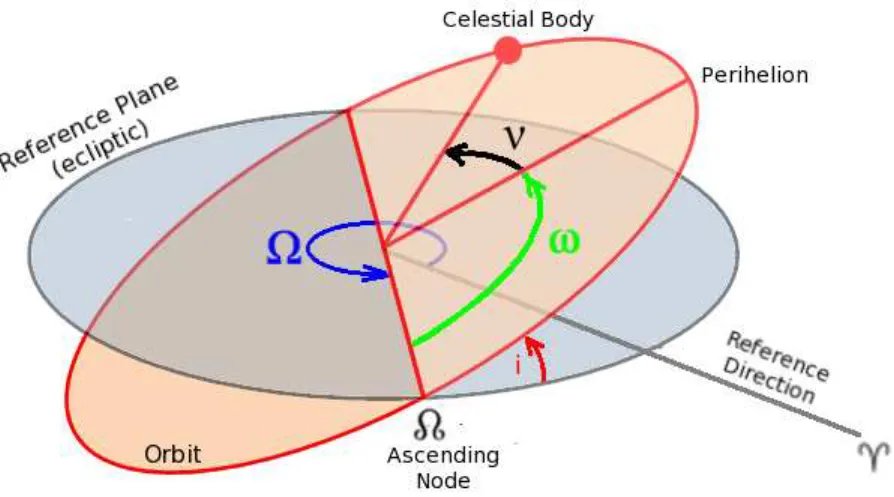
The equations of motion of an object moving under a central force contain six degrees of freedom and thus require six initial conditions to be specified. In elementary physics courses, we would normally choose the initial position and velocity of the object as the initial conditions to be specified. However, in orbital mechanics we ordinarily specify a more general set of parameters that are more widely comparable when considering families of objects. Orbital elements are a set of six quantities that specify the position and velocity of a body at a particular moment in time. This is equivalent to specifying the orientation of a Keplerian ellipse and the position of the body on the ellipse at a particular time. Of course, these quantities are initial conditions for the dynamical problem of determining the motion of the body in question. An often-used set of elements is partially illustrated in Figure 2.1. One must, however, be cautious with definitions as these elements are not uniquely defined. For example, an alternative element that is often used is the “longitude of the pericenter” (ωe), which is the sum of the non-coplanar angles ω and Ω in Figure 2.1, surely an odd, non-physical choice for a parameter.
A nominal set of Keplerian orbital elements begins with the orbit’s semimajor axis (a) and eccentricity (e), whose familiarity precludes the need for further explanation. These two elements describe the size and shape of the elliptical orbit. The orbit’s orientation in space is defined by three elements shown in Figure 2.1. These elements include the inclination (i), the longitude of the ascending node (Ω), and the argument of perihelion (ω). The inclination is the angle between the plane of the orbit and a reference plane normally taken as the ecliptic plane. Ω is the angle between a reference direction (normally the vernal point) and the line of intersection of the orbit and the reference plane, measured in the reference plane. The argument of perihelion locates the perihelion of the orbit by means of the angle between the line of intersection between the orbit and the ecliptic, and the location of the perihelion of the orbit. Finally, the position of the object in its orbit is specified in a number of ways. One way illustrated in Figure 2.1 is the true anomaly, the angle between the position vectors of the perihelion and the object, measured at the center of attraction. Another way of locating the object is through the Mean anomaly (M), which describes the position of an object on an auxilliary circular path.
In this application, we are also dealing with “classical” observations consisting of two angles describing the position of the object on the sky at a moment in time. Orbital determi-nation when one has range information, for example with radar observations, is a completely different mathematical problem. This latter area is sometimes called “astrodynamics.”
At the outset, we must realize that there is no known way of determining the elements of an orbit directly from observations. We measure angular positions of objects in the sky and then, through a mathematical process, convert the measurements into a geometricallly meaningful set of parameters called orbital elements. Normally, we proceed by using numer-ical methods to determine a “preliminary orbit” from a few initial observations. Then, as more observations become available, we improve our knowledge of the orbital elements by a process called “differential correction” that minimizes the difference in position between the calculated orbit and the observed one. Eventually, we produce the “definitive orbit.”
Figure 2.1 Keplerian elements are often used to describe the size, shape, and orientation of orbits. There is one element for each degree of freedom in the dynamical problem, and they are equivalent to specifying the initial conditions of the problem. The semimajor axis (a) and eccentricity (e) specify the size and shape of the orbit. The inclination (i), longitude of the ascending node (Ω), and argument of perihelion (ω) specify the orbit’s orientation in space, and the mean anomaly (M) or, alternatively, the true anomaly (ν) specifies the position of the object along the orbit.
its orbit. Kepler observed Mars at two times separated by a Martian sidereal year and used the observed parallax to determine the distance to the planet. The problem with this method is that observations are needed over multiple revolutions of the body in question and this became impossible in 1801 with the discovery of Ceres. Ceres was faint, and to predict the proper area of the sky to search, some method had to be found to determine the orbit from a small part of one revolution rather than many orbits. Gauss’ genius came to the rescue.
Although there are other methods, including one originated by Laplace, Gauss’ method and its elaborations is the one most often used for determination of the initial orbit. After being improved for over 200 years by some of the greatest mathematicians, the method is formidable although not a panacea. Gauss’ method is not trivial and reviewing it provides a new respect for its discoverer’s abilities. However, for brevity, we note that the basis of the method is to take three observations (containing six angles) and making a “reasonable” assumption about the distance to the object at one of the observations. Then an iterative
procedure is followed to determine orbital elements that satisfy the initial observations. The superiority of Gauss’ method arises from its making approximations to the dynamics of the motion while treating the geometry of the observations in a precise manner. In modern terminology, Gauss’ method is a second order approximation. Nevertheless, the errors in the observations coupled with the limited knowledge imparted by only three observations makes this initial orbital determination of little practical utility except as a starting point. Many more observations are normally needed to refine the elements to a useful degree.
Gauss’ method is covered adequately in the literature (Collins, 1989; Danby, 1988; Mars-den, 1985, for example). However, for the sake of completeness we will summarize the method here. If ri, Ri, and ρi are vectors from the Sun to the object, the Earth to the
Sun, and the Earth to the object, respectively at theith observation, Gauss’ method begins by assuming that the threervectors lie in a plane. Thus, there exist scalarsc1 andc2 such
that
r2 =c1r1+c3r3. (2.1)
Then, to introduce the dynamics, let
r1=f1r2+g1v2,
r3 =f3r2+g3v2. (2.2)
These immediately give
r2 =c1(f1r2+g1v2) +c3(f3r2+g3v2). (2.3)
If Eq. 2.3 is post-mulitipled by ×v2 and pre-multiplied byr2×we get
c1f1+c3f3= 1,
which can be solved to give c1= g3 f1g3−g1f3 , c3=− g1 f1g3−g1f3 . (2.5)
Now, the observer can be introduced by substituting the identity
ρi=Ri+ri (2.6)
into Eq. 2.1 to give
c1ρ1−ρ2+c3ρ3 =c1R1−R2+c3R3. (2.7) It is worth contemplating the meaning of Eq. 2.7. We know the position of the Sun and this gives us the three R vectors. We know two-thirds of the components of the ρ vectors because they are our measurements of the position of the object of interest in the sky. Assuming the validity of the Keplerian orbit model, we can estimate the c parameters. Although there are other ways to proceed, these three scalar equations can be solved for the radial positions of the object relative to the Earth. These quantities can then easily be transformed back into a heliocentric coordinate system and the elements of the preliminary orbit can be determined.
As noted above, the results of applying Gauss’ method is to provide elements of the preliminary orbit. The equations used in Gauss’ method are ill-conditioned and many factors can influence the values and errors of the resulting elements. To be useful, these elements must be improved somehow.
The method used to improve the orbit and obtain the “definitive orbit” through addi-tional observations is called “differential correction.” Entire books have been written about this process, but we will summarize it here because the actual solution of this problem is not part of the dissertation, rather is the result of using existing, well-validated code that is
widely used in the celestial mechanics community (i.e., OrbFit). Differential correction uses a least squares approach to iteratively refine the estimates of the elements as more observa-tions become available. Additionally, statistical information on the errors of the elements naturally results from the differential correction process, at least subject to reasonable as-sumptions. This process results in a set of orbital elements, along with error estimates for the elements and covariance parameters showing the degree to which the elements are correlated.
Differential correction is a widely known technique for improving the characterization of orbits as more observations are made (see Danby, 1988; Moulton, 1914, for example). We will summarize the technique here for completeness. The ansatz for the standard approach is to treat the problem as a “model” that produces an output from a set of inputs. In this case, the inputs would be a set of orbital elements and the outputs a set of predicted position coordinates of the object of interest. In this case, the model might be that of two body motion in an inverse square force. Thus, if our model is viewed as a function (or computer program), we can write
Yc =Y(X), (2.8)
where the subscript indicates “calculated.” There are also “observed” quantities that will be denoted by Yo that will not, in general, be equal to the calculated values. Differential
correction assumes the model is correct; it uses the discrepancies between the Yo and Yc
to improve the value of X. Now, assuming there are no errors in the observations, our problem is reduced to solving
Yo =Y(X) (2.9)
for X. We can begin this process with an estimated solution, X0, from which we can
calculate the corresponding values for the observations
Then, we can calculate a residual
y=Yo−Yc. (2.11)
Now, with a correct model and no observational errors, there will be a correct value of X
that is related to the starting estimate by
X =X0+x. (2.12)
As indicated above, we wish to use y to find an approximation for x. The easiest way to proceed is to assume that the squares and higher powers of x can be ignored. Then, Eq. 2.9 becomes
Yo =Y(X0+x) (2.13)
and, if we let J be the Jacobian matrix evaluated at X0, we have
Y(X0+x)'Y(X0)+J x. (2.14)
This uses the differentialJ xto approximate the difference betweenY(X0 +x)andY(X0), which provides the name “differential correction” for this process.
If Eq. 2.14 is taken as exact, then we have to solve the equation
J x=y. (2.15)
If the number of observations is equal to the number of unknowns (e.g., the six orbital elements), then the matrix J is square and, if it’s invertible, a solution to Eq. 2.15 can be found by standard methods. However, if observational errors and many more observations are introduced, theJ is no longer square and the problem becomes grossly overdetermined. Generally, a least squares approach is used to develop a solution.
An interesting aspect of the approach outlined above is that data about the quality of the solution comes about in a natural manner. Thus, covariance and correlation matrices
provide useful information that can be used with profit.
As outlined above, the differential correction problem can be stated as a linear matrix equation Ax= b, where A is an appropriate Jacobian matrix, x is a vector of elements, andb is a vector of observations. The normal equations are formulated by multiplying this equation by the transpose of A (denoted by AT
), giving AT
Ax = AT
b. This system of equations is solved formally by inverting the ATA product and multiplying again, giving
x= (ATA)−1ATb. In general, theAmatrix is not square. It has a column for each orbital
element (e.g., six columns) and a row for each measured sky coordinate (e.g., twice the number of observations). However, theAT
Amatrix is square and possesses a corresponding set of eigenvalues. The ratio of the largest to the smallest eigenvalues of the ATA matrix provides an upper limit on the condition number of the normal equations. However, the condition number of the normal equations is the square of the condition number of the A
matrix. Thus, the original equation Ax = b has a condition number equal to the square root of the condition number of the normal equations.
It is worth remembering that the equations governing celestial mechanics are nonlinear and normally a linearized version of the problem is used to determine the covariances and elements. The nonlinearity manifests itself in occasional difficulties in determining elements. These problems can be exacerbated by occasional failure of Gauss’ method to converge with a solution for the initial orbit. These problems, which can arise at any time, can be ascribed to bad geometry, bad timing, bad luck, and errors. For example, if observations are made of a high eccentricity object as the object is moving along its orbit in such a way as to foreshorten the angular distance between the observations, Gauss’ method may not converge. This is equivalent to having too short an observational arc and in some sense the failure to converge is a sign that any solution would likely have been meaningless anyway due to errors. Bad timing can produce observations that are made too close together in time. In a fashion similar to the bad geometry case, this can result in a poor or even no solution. Bad luck can occur if the object is too close to a star in the field. In this case the determination of the centroid of the object can be wrong, leading to either an