with the Extra-Early Flowering Phenotype
Author(s)
Mizuno, Nobuyuki; Kinoshita, Mika; Kinoshita, Saki; Nishida,
Hidetaka; Fujita, Masaya; Kato, Kenji; Murai, Koji; Nasuda,
Shuhei
Citation
PLOS ONE (2016), 11(10)
Issue Date
2016-10-27
URL
http://hdl.handle.net/2433/218617
Right
© 2016 Mizuno et al. This is an open access article distributed
under the terms of the Creative Commons Attribution License,
which permits unrestricted use, distribution, and reproduction
in any medium, provided the original author and source are
credited.
Type
Journal Article
Loss-of-Function Mutations in Three
Homoeologous PHYTOCLOCK 1 Genes in
Common Wheat Are Associated with the
Extra-Early Flowering Phenotype
Nobuyuki Mizuno1, Mika Kinoshita2, Saki Kinoshita2, Hidetaka Nishida3, Masaya Fujita4, Kenji Kato3*, Koji Murai2*, Shuhei Nasuda1
*
1 Laboratory of Plant Genetics, Graduate School of Agriculture, Kyoto University, Sakyo-ku, Kyoto, Japan, 2 Department of Bioscience, Fukui Prefectural University, Eiheiji-cho, Fukui, Japan, 3 Graduate School of
Environmental and Life Science, Okayama University, Kita-ku, Okayama, Japan, 4 Institute of Crop Science, NARO, Tsukuba, Ibaraki, Japan
*[email protected](SN);[email protected](KM);[email protected](KK)
Abstract
Triticum aestivum L. cv ‘Chogokuwase’ is an extra-early flowering common wheat cultivar
that is insensitive to photoperiod conferred by the photoperiod insensitive alleles at the
Pho-toperiod-B1 (Ppd-B1) and Ppd-D1loci, and does not require vernalization for flowering.
This reduced vernalization requirement is likely due to the spring habitat allele Vrn-D1 at the VERNALIZATION-D1 locus. Genotypes of the Ppd-1 loci that determine photoperiod sensitivity do not fully explain the insensitivity to photoperiod seen in ‘Chogokuwase’. We detected altered expression patterns of clock and clock-output genes including Ppd-1 in ‘Chogokuwase’ that were similar to those in an einkorn wheat mutant that lacks the clock-gene homologue, wheat PHYTOCLOCK 1 (WPCL1). Presumptive loss-of-function muta-tions in all WPCL1 homoeologous genes were found in ‘Chogokuwase’ and ‘Geurumil’, one of the parental cultivars. Segregation analysis of the two intervarietal F2populations
revealed that all the examined F2plants that headed as early as ‘Chogokuwase’ had the
loss-of-function wpcl1 alleles at all three homoeoloci. Some F2plants carrying the wpcl1
alleles at three homoeoloci headed later than ‘Chogokuwase’, suggesting the presence of other loci influencing heading date. Flowering repressor Vrn-2 was up-regulated in ‘Chogo-kuwase’ and ‘Geurumil’ that had the triple recessive wpcl1 alleles. An elevated transcript abundance of Vrn-2 could explain the observation that ‘Geurumil’ and some F2plants
carry-ing the three recessive wpcl1 homeoealleles headed later than ‘Chogokuwase’. In spite of the up-regulation of Vrn-2, ‘Chogokuwase’ may have headed earlier due to unidentified ear-liness genes. Our observations indicated that loss-of-function mutations in the clock gene
wpcl1 are necessary but are not sufficient to explain the extra-early heading of
‘Chogokuwase’. a11111
OPEN ACCESS
Citation: Mizuno N, Kinoshita M, Kinoshita S, Nishida H, Fujita M, Kato K, et al. (2016) Loss-of-Function Mutations in Three Homoeologous
PHYTOCLOCK 1 Genes in Common Wheat Are
Associated with the Extra-Early Flowering Phenotype. PLoS ONE 11(10): e0165618. doi:10.1371/journal.pone.0165618 Editor: Aimin Zhang, Institute of Genetics and Developmental Biology Chinese Academy of Sciences, CHINA
Received: August 28, 2016 Accepted: October 15, 2016
Published: October 27, 2016
Copyright:©2016 Mizuno et al. This is an open access article distributed under the terms of the
Creative Commons Attribution License, which permits unrestricted use, distribution, and reproduction in any medium, provided the original author and source are credited.
Data Availability Statement: The determined WPCL1 sequences were deposited in the DDBJ database under the accession numbers LC145078-LC145089.
Funding: The authors received no specific funding for this work.
Competing Interests: The authors have declared that no competing interests exist.
Introduction
In temperate cereals such as barley and wheat, three factors, i.e., the vernalization requirement, photoperiod sensitivity and narrow-sense earliness (earlinessper se) contribute to the timing of heading [1]. The vernalization requirement is controlled by three genes, namely, VERNALIZA-TION 1(Vrn-1),Vrn-2andVrn-3[2].Vrn-1encodes anAPETALA1/FRUITFUL-like (AP1/ FUL-like) MADS-box transcription factor [3–6]. Recessive alleles at allVrn-1homoeoloci con-fer a winter growth habit (vernalization sensitive), whereas one or more dominant alleles at
Vrn-1homoeoloci results in a spring growth habit (vernalization insensitive). The expression levels ofVrn-1in leaves are associated with earliness, suggesting thatVrn-1determines the flowering time [7]. Recently,Vrn-D4was identified as a duplicated copy ofVrn-A1[8]. The
Vrn-2locus contains two tandemly duplicated genes (ZCCT1andZCCT2) that encode a pro-tein with a CCT (CONSTANS, CO-like, and TOC1) domain and a zinc-finger motif [9]. Non-functional mutations in theZCCTgenes result in a spring growth habit and, thus, early flower-ing [9–11], indicatflower-ing their roles as flowerflower-ing repressors.Vrn-3encodes a RAF kinase inhibi-tor-like protein with similarity toArabidopsisFLOWERING LOCUS T (FT). Transgenic wheat plants overexpressingVrn-3have an extra-early flowering phenotype without the need for ver-nalization [12–13], indicating thatVrn-3is a strong flowering promoter. Hereafter, we denote
Vrn-3asWFT(wheatFT). Three models, although controversial, for the epistatic interaction between these vernalization genes have been proposed [13–16].
Photoperiod insensitive alleles ofPpd-1(Ppd-1a) were identified for each homoeolocus on chromosomes 2A, 2B and 2D of common wheat, respectively [17–20]. Three alleles ofPpd-A1a
and one allele ofPpd-D1apossess deletions in a shared promoter region [18–19,21]. The culti-vars carrying thesePpd-1aalleles had an increased expression level with an abnormal circadian rhythm forPpd-1expression. Novel mutations were found in the 5’ upstream regions of Ppd-A1andPpd-B1[21]. In addition to the mutations in the promoter region, increased copy num-bers ofPpd-B1altered its expression pattern and accelerated flowering time [22–23]. Wheat plants with at least onePpd-1aallele were associated with an increased expression level of
TaFT(WFT), which correlates with the early flowering phenotypes [20]. In barley and wheat, the orthologues of circadian clock genes inArabidopsishave been identified as candidate genes conferring the early flowering phenotype [24–28]. Recently, we showed that a wheat homo-logue ofArabidopsis LUX ARRHYTHMO/PHYTOCLOCK 1 (LUX/PCL1), which is located on the long arm of wheat chromosome 3A, is a candidate gene that is missing in an early flowering mutant of einkorn wheat (Triticum monococcumL.) [25]. InArabidopsis, LUX/PCL1 consti-tutes the Evening Complex (EC) together with EARLY FLOWERING 3 (ELF3) and ELF4 [29]; the EC directly repressesPRR9[30]. The barley and wheat mutants ofLUX/PCL1andELF3
homologues head earlier than the wild-type lines under both long day and short day conditions [24–28]. In the einkorn wheat mutant lacking the wheatLUX/PCL1homologue (WPCL1),
Ppd-1andWFTwere up-regulated, whereasLATE ELONGATED HYPOCOTYL(LHY) and
TIMING OF CAB EXPRESSION 1 (TOC1) were down-regulated [25,28]. These expression pat-terns were also observed in theArabidopsis luxmutants [31]. These results strongly suggest that barley and wheat LUX/PCL1 function similarly to their counterparts inArabidopsis.
Intermittent rain before harvest often causes pre-harvest sprouting and poor grain quality in wheat cultivated in East Asia [32]. To avoid these problems, early-heading wheat cultivars have been bred in many countries. Among 260 wheat cultivars examined, ‘Chogokuwase’, a super-early-heading wheat cultivar in Japan, is one of the earliest heading cultivars [33]. The heading time for ‘Chogokuwase’ was much earlier than the parental cultivars, ‘Minaminoko-mugi’ and ‘Geurumil’ (Table 1), suggesting that earliness genes were inherited from both parents. Seki et al. (2011, 2013) [33–34] showed that ‘Chogokuwase’ had thePpd-D1aallele
and there are no differences in thePpd-1genotypes between ‘Chogokuwase’ and the parental cultivars at any of the homoeoloci. This result strongly suggests that genes other thanPpd-1
contribute to the earliness of ‘Chogokuwase’. Here, we conducted gene expression analyses, sequence analyses and segregation analyses to elucidate the reasons for earliness in ‘Chogoku-wase’. Our results indicate that loss-of-function alleles ofWPCL1homoeologues contribute to the earliness of ‘Chogokuwase’. We discuss the function ofWPCL1in the photoperiod and ver-nalization pathways of the wheat flowering gene network.
Materials and Methods
Plant materials
‘Chogokuwase’ is an offspring of a cross between a Japanese cultivar ‘Minaminokomugi’ and a Korean cultivar ‘Geurumil’. The common wheat cultivar ‘Chinese Spring’ (CS) was used to determine copy number variation and for sequence analyses. We used the following two F2
populations for segregation analyses: (1) the “CN population” consisted of 114 F2plants
derived from a cross between ‘Chogokuwase’ and ‘Norin 61’, and (2) the “MG population” con-sisted of 489 F2plants derived from a cross between ‘Minaminokomugi’ and ‘Geurumil’.
Recombinant inbred lines (F11generation) that were derived from the cross between cultivated
einkorn wheatT.monococcumL. (KT3-5) and wild einkorn wheatT.boeoticumBoiss. (KT1-1) were used for an analysis of epistatic interactions betweenVrn-2andWPCL1[25].
Field experiments
‘Chogokuwase’, ‘Minaminokomugi’ and ‘Geurumil’ were sown in the middle of October in an experimental field (36.108 N, 136.275 E) at Fukui Prefectural University, Fukui, Japan (2011/ 2012 and 2012/2013 seasons). Sowing dates were 19 Oct 2011 and 17 Oct 2012. The heading dates of each cultivar were recorded.
Measurement of heading time in a growth chamber
To investigate their photoperiod sensitivity and vernalization requirement, plants were cultivated in a growth chamber under long-day (16 h light and 8 h dark; LD) or short-day (10 h light and 14 h dark; SD) conditions at 20°C (light intensity ~100 μE m-2s-1). Seedlings at 5-days after ger-mination were subjected to a vernalization treatment (5°C) for 21 days. After the vernalization treatment, plants were grown at 20°C. Heading time was measured in at least three replicated samples as the number of days between unfolding of the third leaf and the flag leaf. Differences between samples were statistically examined by Tukey Kramer’s HSD tests (P<0.05).
Genotyping of Vrn-1 and Ppd-1 homoeoloci
We used polymerase chain reaction (PCR) primers (S1 Table) that had been shown to identify the alleles ofVrn-1homoeoloci in previous studies [35–36]. Genotypes of the threePpd-1
Table 1. Heading dates of ‘Chogokuwase’ and the parental cultivars in the field.
Cultivar 2011/2012a 2012/2013a
‘Chogokuwase’ 18 March 24 March
‘Minaminokomugi’ 23 April 15 April
‘Geurumil’ 28 April 23 April
a
Sowing dates were 19 Oct 2011 or 17 Oct 2012, respectively.
homoeoloci in ‘Chogokuwase’, ‘Minaminokomugi’, ‘Geurumil’ and ‘Norin 61’ were deter-mined as described in Seki et al. (2011, 2013) [33–34]. To estimate the copy number of the
Ppd-B1loci, real-time PCR analyses were carried out using a LightCycler Nano System (Roche Diagnostics, Switzerland). A wheatCONSTANS2gene,TaCO2(also calledTaHd-1), was used as the internal control. We used gene-specific primer sets forPpd-B1andTaCO2as reported in a previous report [22]. The rate of amplification was monitored using THUNDERBIRD SYBR qPCR mix (TOYOBO, Japan) according to the manufacturer’s protocol. Amplification rates of the samples in five technical replications were converted to copy numbers by comparing the rates in common wheat cultivars ‘Cheyenne’, ‘Timstein’ and ‘CS’ that are known to possess one, three, and four copies ofPpd-B1, respectively [22].
Quantitative reverse-transcriptase (RT)-PCR
Expression ofVrn-1andWFTwas analyzed in non-vernalized plants, 21 days-vernalized plants grown under the LD conditions, and in 21 days-vernalized plants grown under the SD conditions. For each cultivar, seedlings were sampled from the 2-leaf stage to the 4-leaf stage. In this study, the 1-leaf stage was defined as the period from the unfolding of the first leaf to the unfolding of the second leaf. Total RNAs were extracted from leaves using ISOGEN (Nip-pon Gene, Japan). cDNAs were synthesized from the total RNAs using an oligo dT primer according to the protocol for the Ready-To-Go T-primed First-Strand Kit (GE Healthcare Life Sciences, USA). Real-time PCR analyses were performed in three technical replications using a LightCycler 2.0 (Roche Diagnostic, Switzerland) with the gene-specific primer sets shown in Table 2. Transcript abundance was determined relative to a SYBR Green-labelled amplification product of the wheatActingene (AB1819991) that is often used as an internal control for gene-expression analyses under various conditions [25,37].
For the expression analysis of the clock and clock-output genes, plants were grown at 23°C under SD conditions (9 h light and 15 h dark). Two-week-old leaves were sampled every three hours. Total RNA was isolated using an RNeasy Plant Mini Kit (Qiagen, Germany). First-strand cDNA was synthesized from 1 μg RNA in a 20 μL reaction solution with oligo-dT prim-ers using a ReverTra Ace -α- Kit (TOYOBO, Japan). Primers used for quantitative RT-PCR are shown inS2 Table. Relative transcript levels were determined in three technical replications using a LightCycler Nano System with FastStart Essential DNA Green Master (Roche Diagnos-tics, Switzerland). Quantitative RT-PCR was performed according to the manufacturer’s proto-col using the wheatActingene as the internal control.
Sequencing of three WPCL1 homoeologues
Total DNA was extracted from leaves of common wheat using a DNeasy Plant Mini Kit (Qia-gen, Germany). To obtain genome-specific primers, we searched for the sequences of all three
Table 2. Alleles at the Ppd-1 and Vrn-1 loci.
Cultivar Ppd-1a Vrn-1b WPCL1
‘Chogokuwase’ Ppd-A1b/Ppd-B1b/Ppd-D1a vrn-A1/vrn-B1/VRN-D1 wpcl-A1/wpcl-B1/wpcl-D1 ‘Minaminokomugi’ Ppd-A1b/Ppd-B1b/Ppd-D1a vrn-A1/vrn-B1/VRN-D1 wpcl-A1/WPCL-B1/WPCL-D1 ‘Geurumil’ Ppd-A1b/Ppd-B1b/Ppd-D1a vrn-A1/vrn-B1/vrn-D1 wpcl-A1/wpcl-B1/wpcl-D1 ‘Norin 61’ Ppd-A1b/Ppd-B1b/Ppd-D1a vrn-A1/vrn-B1/VRN-D1 WPCL-A1/WPCL-B1/WPCL-D1
a
Alleles designated according to Seki et al. 2011 [33] and 2013 [34] b
In the absence of dominant VRN-A1 and VRN-B1 alleles, the presence of a dominant VRN-D1 confers a spring habit to ‘Chogokuwase’ and ‘Minaminokomugi’, and a recessive vrn-D1 confers a winter habit to ‘Geurumil’.
WPCL1homoeologues in the chromosome-arm specific survey sequences of 3AL, 3B and 3DL [38]. First, a blastn search against the survey sequences was performed using theWPCL1
sequences ofT.monococcumL. (accession number; AB773826) [25] as a query. Alignments of the survey sequences obtained from the three genomes led to the design of the following genome-specific primers to amplify the entire coding region:WPCL-A1;50-GCTCCAAAAT GGGTCCAGAGGA-30and50- GGACAGTGAGTCCCAAATCTGA -30,WPCL-B1,50 -TGCGCAAATTAAATATCCGACAGA -30and50- GATCGACACAAACACACGCC -30;
WPCL-D1,50- ATCTATCCACCATCCATGCG-30and50- CCGGACAGGACACATTCACA -30. Thirty-three cycles of PCR were performed using KAPATaq Extra (Kapa Biosystems, USA) and the following reaction conditions: 30 s at 94°C, 30 s at 60°C, and 4 m at 72°C. Nucleotide sequences were determined with BigDye Terminator version 3.1 (Applied Biosystems, USA) using an Applied Biosystems 3730xl DNA Analyzer. Nucleotide sequences and their predicted amino acid sequences were analyzed by GENETYX-MAC version 12.00 software (Whitehead Institute for Biomedical Research, USA).
Segregation analyses
One hundred fourteen F2plants (CN population) from a cross between ‘Chogokuwase’ and
‘Norin 61’ were used in the first segregation analysis. The plants were grown at 23°C for ten days and then vernalized at 4°C for seven weeks. After vernalization, the plants were incubated at 23°C and grown under SD conditions (8 h light and 16 h dark). In addition to the CN popu-lation, the segregation of 489 F2plants (MG population) from a cross between
‘Minaminoko-mugi’ and ‘Geurumil’ was also analyzed. The heading dates of the F2plants in the MG
population were determined in the experimental field at Fukui Prefectural University, Fukui, Japan in the 2013/2014 cultivation season. For genotyping ofWPCL-A1andWPCL-D1, PCR was carried out using following primer sets:WPCL-A1;50-CCACGCCAACGGCGGC-30and 50-TGAATCCGGGATGGATGGTTATC-30,WPCL-D1;50-CGGCGGCTGGGGATGAC-30and 50-TTGATGACTGAACTGGACCGATCT-30. For genotyping ofWPCL-B1, multiplex PCR was conducted using the following sets of primers:50-TCGGATTGGTGTTGCGAGG-30and50 -CATGATGGTCTTGGGCACC-30, and50-ACGTAGTACTCCCTTGGTCC-30and50-CAACC GAACCTATGAACACCA-30. Thirty-four cycles of PCR were performed using KAPATaq Extra (Kapa Biosystems, USA) and following reaction conditions: 30 s at 94°C, 30 s at 60°C, and 45 s at 72°C. To detect allelic variation, the PCR products ofWPCL-A1andWPCL-D1were treated withRsaI andBspT107I, respectively. For genotyping ofVrn-D1, two primer sets (Intr1/D/F-Intr1/D/R3 and -Intr1/D/R4) were used according to Yan et al. (2004) [35]. The amplified PCR products were separated by electrophoresis through a 1.0% or 1.5% agarose gel and stained with ethidium bromide.
Results
Reduced vernalization requirement and photoperiod sensitivity in
‘Chogokuwase’
‘Chogokuwase’ headed more than three weeks earlier than the parental cultivars ‘Minaminoko-mugi’ and ‘Geurumil’ in the field (Table 1). To investigate the vernalization requirement and photoperiod sensitivity of ‘Chogokuwase’, heading dates of ‘Chogokuwase’, ‘Minaminokomugi’ and ‘Geurumil’ were recorded under LD conditions without vernalization (V0-LD), LD condi-tions with 21 days vernalization (V21-LD), and SD condicondi-tions with 21 days vernalization (V21-SD). In all conditions, ‘Chogokuwase’ headed earlier than ‘Geurumil’ (Fig 1, panel (a)). ‘Chogokuwase’ had a reduced vernalization requirement compared with ‘Geurumil’, and the
Fig 1. Comparison of days to heading for ‘Chogokuwase’ and its parental cultivars as measured by unfolding of the flag leaf. (a) The days to unfolding of the flag leaf without vernalization treatment under
long day conditions (V0-LD), after 21-days vernalization under long days (V21-LD) and after 21-days vernalization under short days (V21-SD). The different letters over the bars indicate statistically significant differences by Tukey Kramer’s HSD test (P<0.05). (b) Comparison of the vernalization requirement among three cultivars as indicated by the ratio of V0-LD over V21-LD. (c) Comparison of the photoperiod sensitivity as represented by the ratio of V21-SD over V21-LD for the three cultivars.
vernalization requirement of ‘Chogokuwase’ was as low as that of ‘Minaminokomugi’ (Fig 1, panel (b)). The photoperiod sensitivity of ‘Chogokuwase’ was similar to but lower than that of ‘Minaminokomugi’ (Fig 1, panel (c)).
‘Chogokuwase’ has a spring habit allele for VRN-D1 and an increased
number of Ppd-B1 copies
Vrn-1andPpd-1are the major genes that determine the vernalization requirement and photo-period sensitivity, respectively. PCR analysis revealed that ‘Chogokuwase’ and ‘Minaminoko-mugi’ carried aVrn-D1spring habit allele, whereas ‘Geurumil’ had a winter habitvrn-D1
(Table 2). The alleles ofVrn-A1andVrn-B1loci in these three cultivars were winter habit types. The three cultivars had a photoperiod insensitivePpd-D1aallele and photoperiod sensi-tivePpd-A1bandPpd-B1balleles [33–34]. The photoperiod insensitivePpd-B1aallele is associ-ated with a higher number (2 to 4) of copies ofPpd-B1[22–23]. Copy number estimation revealed that ‘Chogokuwase’ and ‘Minaminokomugi’ had threePpd-B1copies (S1 Fig) and an additional truncated copy (data not shown) as was reported for a Nepalese cultivar by Nguyen et al. (2013) [23].
Elevated transcript levels of Vrn-1 and WFT in ‘Chogokuwase’
Since the transcript abundance ofVrn-1andWFTare often correlated with heading time in wheat [7], we examined the expression of these genes in ‘Chogokuwase’ and its parental culti-vars.Vrn-1transcript levels were significantly higher in ‘Chogokuwase’ than in the parental cultivars at all 4L stages under V0-LD, V21-LD and V21-SD conditions (Fig 2). Levels ofVrn-1
transcripts in ‘Geurumil’ were lower than in ‘Minaminokomugi’.WFTexpression was up-regu-lated in ‘Chogokuwase’ especially under V21-LD conditions. Under the V0-LD and V21-SD condition, however, obvious difference was not observed inWFTtranscript abundance between ‘Chogokuwase’ and ‘Minaminokomugi’. Vrn-1transcript abundance was associated with the heading time rather than that ofWFT.
Expression patterns of circadian clock and clock-output genes were
altered in ‘Chogokuwase’
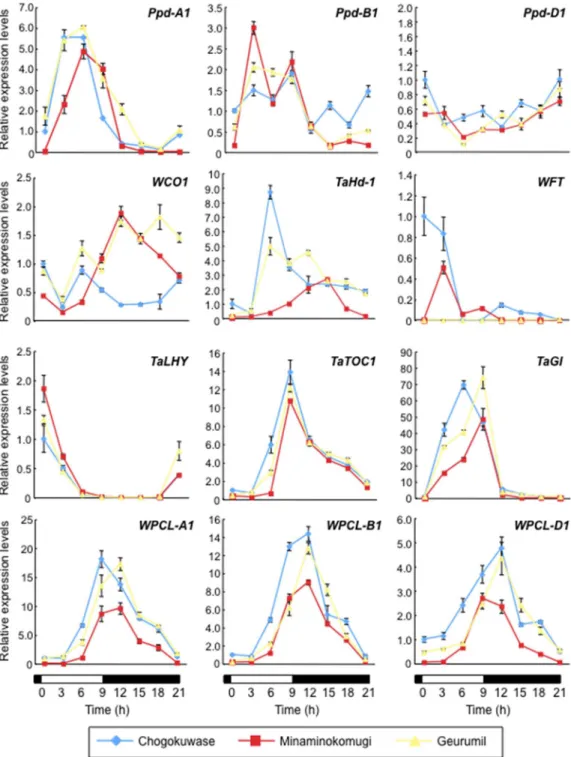
Diurnal expression patterns ofPpd-1, two wheatCONSTANS-like genes (WCO1andTaHd1) andWFTwere examined under SD conditions by quantitative RT-PCR. The transcript accu-mulation levels ofPpd-A1in the early light period were higher in ‘Chogokuwase’ and ‘Geuru-mil’ than in ‘Minaminokomugi’ (Fig 3). A higher expression level ofPpd-B1was observed in ‘Chogokuwase’ in the late dark period. UnlikePpd-A1andPpd-B1,Ppd-D1expression levels fluctuated, and no obvious differences in patterns among the three cultivars were evident. In ‘Chogokuwase’, the expression level ofWCO1during the dark period was low, whereas TaHd-1was up-regulated in ‘Chogokuwase’ and ‘Geurumil’ compared with ‘Minaminokomugi’. The expression level ofTaLHY, a clock gene, in ‘Chogokuwase’ and ‘Geurumil’ was significantly lower than ‘Minaminokomugi’ at the peak of its expression (beginning of the day). In ‘Chogo-kuwase’ and ‘Geurumil’, on the other hand, transcripts of another clock geneTaTOC1 accumu-lated earlier than in ‘Minaminokomugi’. This early accumulation pattern was more evident for the third clock geneGIGANTEA(TaGI).
Sequence analysis of WPCL1
The expression patterns of clock and clock-output genes in ‘Chogokuwase’ and ‘Geurumil’ are similar to those in the einkorn wheat mutant lackingWPCL1[25]. We determined the
nucleotide sequences ofWPCL-A1,WPCL-B1andWPCL-D1in ‘Chogokuwase’ and the paren-tal cultivars. A 142 bp deletion was observed in the region spanning the 50untranslated region
(UTR) and the first exon ofWPCL-B1in ‘Chogokuwase’ and ‘Geurumil’ (Fig 4, panel (a)). The deletion in the first exon was 65 bp that would result in a frameshift mutation. We did not find proper reading frames inWPCL-B1of ‘Chogokuwase’ and ‘Geurumil’, although we sequenced 900 bp upstream of the translation start codon. The longest presumed open reading frame of
WPCL-B1was 363 bp that could be translated into a truncated protein lacking half of the Myb domain (Fig 4, panel (b)), suggesting that this allele ofWPCL-B1in ‘Chogokuwase’ and ‘Geur-umil’ was loss-of-function (wpcl-B1). Furthermore, a single nucleotide polymorphism (SNP) was found inWPCL-D1of ‘Chogokuwase’ and ‘Geurumil’ in the SHAQKYF motif, a highly conserved region in the MYB domain [27] and whose consensus sequence in plantLUX-like genes is SHLQKY(R/Q). ‘Minaminokomugi’ and ‘CS’ had the SHLQKYR motif inWPCL-D1. The SNPs altered the amino acid sequence of this motif to CHLQKYR inWPCL-D1of ‘Chogo-kuwase’ and ‘Geurumil’. ‘Chogo‘Chogo-kuwase’, ‘Minaminokomugi’ and ‘Geurumil’ shared another
Fig 2. Gene expression patterns of VRN-1 and WFT in ‘Chogokuwase’ and its parental cultivars. Expression levels were
measured in the second (2L), third (3L) and fourth (4L) leaf stages of ‘Chogokuwase’ (blue), ‘Minaminokomugi’ (red), and ‘Geurumil’ (yellow) under V0-LD, V21-LD and V0-SD conditions. X- and Y-axis indicate days after 21 days-vernalization and relative transcript abundances, respectively. Transcript abundance was measured relative to the abundance of Actin gene transcripts. Bars on each observation indicate standard errors.
non-synonymous (K to N) substitution within the amino acid sequences of the SHAQKYF motif inWPCL-A1. The SHAQKYF motif is highly conserved in functional MYB transcription factors, and an amino acid substitution in this motif was associated with a loss-of-function mutation in the barleyLUX/PCL1geneHvLUX1[27]. Thus, we assumed that thewpcl-A1and
Fig 3. Gene expression patterns of circadian clock and clock-output genes under SD conditions in ‘Chogokuwase’ and the parental cultivars. White and black boxes indicate light and dark periods,
respectively. Two-week-old seedlings were sampled every 3 hours over 24 h. Means±standard deviations were calculated from data in three technical repeated experiments. Relative transcript abundance was calculated using the Actin gene as an internal control.
wpcl-D1alleles found in ‘Chogokuwase’ and ‘Geurumil’ were loss-of-function. In fact, the expression levels ofwpcl-A1,wpcl-B1andwpcl-D1were consistently higher in ‘Chogokuwase’ and ‘Geurumil’ than in ‘Minaminokomugi’ (Fig 3). This finding is similar to that reported for the loss-of-functionlux/pcl1mutants inArabidopsisand barley whereLUX/PCL1was up-regu-lated due to a feedback loop [27,30].
Fig 4. Mutations in WPCL1 homoeologues. (a) A 142 bp deletion was detected in WPCL-B1 of
‘Chogokuwase’ and ‘Geurumil’. The start codon is shown in bold letters in the nucleotide sequence alignment. (b) Comparison of the amino acid sequence of the Myb domain between functional (gene names shown in uppercase letters) and loss-of-function (gene names shown in lowercase letters) WPCL1 homoeologues. The gray box indicates the SHAQKYF motif.
Plants homozygous for the wpcl allele at three homoeoloci had an early
heading phenotype
Segregation analyses in two F2populations segregating theWPCL1loci (CN and MG
popula-tions) were used to test the association between the early heading phenotype and genotypes at theWPCL1homoeoloci. In the CN population derived from a cross between ‘Chogokuwase’ (all loss-of-functionwpcl1) and ‘Norin 61’ (all functionalWPCL1), a triple recessive individual should appear in one out of 64 plants and individuals in the population should be homozygous at allPpd-1andVrn-1homoeoloci (Table 2,S1 Fig). Of the 114 F2plants, only three plants
car-rying homozygouswpcl-A1,wpcl-B1andwpcl-D1alleles headed as early as ‘Chogokuwase’ (Fig 5). The segregation ratio fit a 1:63 ratio (χ2= 0.85,P= 0.36). The other 111 F2plants were
homozygous for a dominant allele or heterozygous at theWPCL1locus and headed later than the three triple recessive plants. In the MG population, only alleles at theWPCL-B1and
WPCL-D1loci segregated because ‘Geurumil’ and ‘Minaminokomugi’ have thewpcl-a1allele. Of the 489 F2plants, 26 plants carrying the homozygouswpcl1at theWPCL-B1andWPCL-D1
loci were found. Of the 26wpcl1plants, eight plants headed as early as ‘Chogokuwase’ (Fig 6, panel (a)). The segregation ratio for early (n = 8) and late (n = 18) heading fit a 1:3 ratio (χ2= 0.462,P= 0.50), but also a 3:13 ratio (χ2= 2.47,P= 0.12), which does not rule out the presence of other loci controlling heading. We found that all the early heading plants were homozygous for the triple recessivewpcl1homoeologues, and were vernalization-insensitive
Fig 5. Frequency distribution of days to heading in the 114 F2plants from a segregating population
growing under SD conditions with a vernalization treatment. The F2population was derived from a cross between ‘Chogokuwase’ and ‘Norin 61’. White boxes indicate the plants with homozygous wpcl1 alleles at three homoeoloci. Black boxes show the plants having one or more functional WPCL1 homoeoalleles. Arrows indicate days to heading in ‘Chogokuwase’ and ‘Norin 61’, respectively.
due to presence of dominantVRN-D1allele (Fig 6, panel; (b)). In thewpcl1triple recessive genetic background, the effect of copy-number variation at thePpd-B1locus on early heading is negligible as indicated by the segregation of the truncated copy ofPpd-B1in five of the eight early-heading plants (data not shown).
Fig 6. Relationship between days to heading and genotypes of WPCL1 and Vrn-1 loci in an F2population derived
from ‘Geurumil’ and ‘Minaminokomugi’. (a) Comparison of days to heading between genotypes of WPCL1
homoeoloci in the 489 F2plants. Days to heading indicate the number of days after April 1. Arrows show the heading date in ‘Chogokuwase’ (C), ‘Geurumil’ (G) and ‘Minaminokomugi’ (M), respectively. White boxes indicate the plants carrying homozygous wpcl1 alleles at three homoeoloci. Black boxes show the plants carrying functional WPCL-B1 and/or WPCL-D1 alleles. (b) A subset of the segregating population having the triple recessive wpcl1 alleles. Comparison of days to heading between genotypes of the Vrn-D1 locus in 25 F2plants with three loss-of-function wpcl1 homoeoalleles.
Epistatic interactions between WPCL1 and vernalization genes
Day-neutral mutations in wheatWPCL1and barleyELF3up-regulateVrn-2expression, result-ing in a stronger vernalization requirement [39]. Our quantitative RT-PCR experiment demon-strated that theVrn-2genes (ZCCT1andZCCT2) were expressed in ‘Chogokuwase’,
‘Minaminokomugi’ and ‘Geurumil’ (Fig 7), althoughVrn-2is generally not expressed under SD conditions [40–41]. Transcript abundance ofVrn-2in ‘Chogokuwase’ and ‘Geurumil’ was higher than that in ‘Minaminokomugi’ during dark period. The expression level ofVrn-1in thevrn-D1allele carrier ‘Geurumil’ (Table 2) was extremely low, althoughVrn-2expression was comparable to that in ‘Chogokuwase’. These results suggest that the expression levels of
Vrn-1were determined by the genotype of theVrn-D1locus rather than by the expression lev-els ofVrn-2.
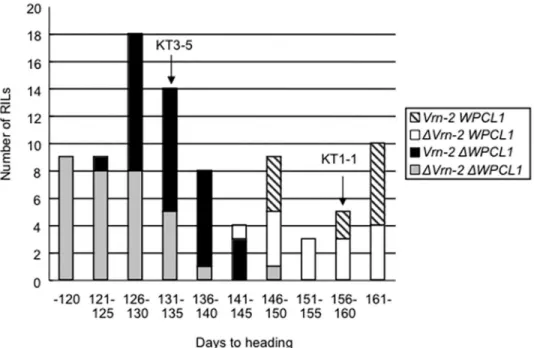
The recombinant inbred lines (RILs) resulting from a cross between aT.boeoticum acces-sion withWPCL1andVrn-2and an einkorn wheat mutant with deletions at both loci (denoted asΔWPCL1andΔVrn-2) [25] made it possible to test epistatic interactions betweenWPCL1
andVrn-2. Of the 62 RILs withΔWPCL1, the RILs withΔVrn-2headed significantly earlier than those carryingVrn-2(Fig 8;P<0.001). In contrast, among the RILs carryingWPCL1, there was no significant difference in heading time between the RILs with and withoutVrn-2.
Discussion
‘Chogokuwase’ and ‘Geurumil’ contain loss-of-function natural variants
of the WPCL1 gene
‘Chogokuwase’ is an extra-early heading cultivar that was derived from ‘Minaminokomugi’ and ‘Geurumil’ [33] and has a reduced vernalization requirement and lower sensitivity to pho-toperiod (Fig 1). The reduced vernalization requirement and phopho-toperiod sensitivity of ‘Cho-gokuwase’ were derived from the parental cultivars ‘Minaminokomugi’ and ‘Geurumil’,
Fig 7. Gene expression patterns of Vrn-1 and Vrn-2 (ZCCT1 and ZCTT2) under SD conditions in ‘Chogokuwase’ and the parental cultivars. White and black boxes indicate light and dark periods, respectively. Two-week-old seedlings were sampled at 3h
intervals over 24h. Means±standard deviations were calculated from data in three technical repeated experiments. Relative transcript abundance was calculated using the Actin gene as an internal control.
respectively.Vrn-1andPpd-1are major genes determining the vernalization requirement and photoperiod sensitivity in common wheat [6,17]. The vernalization insensitivity of ‘Chogoku-wase’ could be explained by the dominant allele ofVrn-D1that was inherited from ‘Minamino-komugi’. In contrast,Ppd-1cannot be a candidate gene for the reduced photoperiod sensitivity of ‘Chogokuwase’ because ‘Minaminokomugi’ and ‘Chogokuwase’ have the same genotypes for the threePpd-1homoeoloci (Table 2,S1 Fig). The expression patterns of clock and clock-out-put genes in ‘Chogokuwase’ and ‘Geurumil’ were similar to those of an einkorn wheat mutant that lacksWPCL1[25] and were different from those in ‘Minaminokomugi’. Sequence analyses revealed that ‘Chogokuwase’ and ‘Geurumil’ had non-synonymous substitutions in the SHAQ-KYF motif of bothWPCL-A1andWPCL-D1(Fig 4, panel (b)). The SHAQKYF amino acid motif is conserved in all LUX-family genes, and amino acid changes within the SHAQKYF motif potentially lead to loss-of-function in barley [27]. In addition, a 142 bp deletion in the 50
UTR and the first exon, which could result in a truncated protein or a frameshift mutation, was detected inWPCL-B1of ‘Chogokuwase’ and ‘Geurumil’. The clock genes in ‘Chogokuwase’ and ‘Geurumil’ had arrhythmic expression patterns, whereas theWPCL1homoeologues were up-regulated (Fig 3). Thelux/pcl1mutants inArabidopsis, barley and einkorn wheat showed the same expression patterns of these clock genes [25,27,30]. Taken together, these findings strongly suggest that ‘Chogokuwase’ and ‘Geurumil’ contain loss-of-function natural variants of theWPCL1gene. Segregation analysis revealed that the homozygosity of recessivewpcl1
alleles at all homoeoloci is a prerequisite for heading as early as ‘Chogokuwase’ (Figs5and6). Segregation of F2s in the MG population suggested thatwpcl1mutations are insufficient to
explain the exceptionally early heading of ‘Chogokuwase’. A fraction of the segregants with the triple recessivewpcl1headed as late as those with a functionalWPCL1, indicating the presence
Fig 8. Relationship between days to heading and genotypes of the WPCL1 and Vrn-2 loci in the recombinant inbred lines of einkorn wheat. The days to heading in 89 recombinant inbred lines derived
from a cross between T. monococcum mutants and T. boeoticum were compared. The parental
monococcum accession lacks WPCL1 and Vrn-2, whereas the boeoticum accession has WPCL1 and Vrn-2. Arrows indicate days to heading of the parental T. monococcum (KT3-5) and T. boeoticum (KT1-1)
accessions, respectively.
of another gene or genes that condition(s) the early heading phenotype. In the CN population, on the other hand,wpcl1mutations were sufficient to explain the earliness of ‘Chogokuwase’, suggesting that the hypothetical gene or genes is/are present in both ‘Chogokuwase’ and ‘Norin 61’ and are not segregating in the CN population. Alternatively, the number of days to heading may be unaffected by the hypothetical gene or genes in SD conditions.
Loss-of-function mutations in WPCL1 reduce photoperiod sensitivity by
up-regulating Ppd-1
In wheat and barley,Ppd-1, the homologue ofArabidopsis PRR7andPRR3, has been regarded as the main regulator of photoperiod sensitivity [17,42]. The photoperiod insensitive alleles of
Ppd-1(Ppd-1a) invoke the mis-expression and/or increased expression ofPpd-1[20]. Thus, the pattern and level ofPpd-1expression are critical in regulating photoperiod sensitivity. The mutants of circadian clock componentslux/pcl1andelf3in barley and wheat have increased levels ofPpd-1expression [24–28]. InArabidopsis, LUX and ELF3 bind to the promoter of
PRR9and repress its expression [30,43]. Therefore, we hypothesized that WPCL1 might func-tion as the repressor ofPpd-1(S2 Fig) [25]. In the present study, we found up-regulated expres-sion ofPpd-A1andPpd-B1in ‘Chogokuwase’ and ‘Geurumil’ where the functionalWPCL1is absent (Fig 3). The expression pattern ofPpd-B1in ‘Chogokuwase’ was different from that in ‘Geurumil’. This difference might be reflecting the copy number variation at thePpd-B1locus. UnlikePpd-A1andPpd-B1, there were no significant differences in expression patterns and levels ofPpd-D1transcripts betweenwpcl1mutants (‘Chogokuwase’ and ‘Geurumil’) and the cultivar with two functionalWPCL1genes (‘Minaminokomugi’). All three cultivars carried the
Ppd-D1aallele, which has a 2 kb deletion in the promoter region [33]. The 2 kb deletion over-laps with the positions of mutations inPpd-A1aandPpd-B1a[18–19,21]. These observations suggest the 2 kb region, which includes a highly conserved ca. 100 bp sequence where putative
cis-elements and regulatory motifs were predicted at the nucleotide sequence level, plays a criti-cal role inPpd-1regulation. We hypothesize that WPCL1, a member of the Myb transcription factor family, might bind to the promoter region ofPpd-1and repressPpd-1expression. We will directly test this hypothesis in the future by conducting protein-DNA interaction assays such as chromatin immunoprecipitation experiments.
WPCL1 affects the vernalization requirement through Vrn-2
Day-neutral mutations such asPpd-D1aandeam8increase the expression level ofVrn-2[39]. We confirmed thatwpcl1mutations up-regulatedVrn-2expression (Fig 7). These observations suggested that photoperiodic signals were linked with the vernalization pathway viaVrn-2(S2 Fig). In fact,Vrn-2has a CCT domain that is found in proteins involved in light signal trans-duction [9]. ‘Geurumil’ is much more sensitive to vernalization than ‘Minaminokomugi’, although there was only a slight difference in the number of days to heading when plants were grown in the field where plants were fully vernalized (Table 1,Fig 1). The stronger vernaliza-tion requirement in ‘Geurumil’ is likely due to both up-regulavernaliza-tion ofVrn-2and the absence of dominantVRN-D1alleles. Supporting evidence was reported in barley that overexpression of
Vrn-2delayed heading and decreased the expression levels ofHvFT1[44]. Therefore, the observed up-regulation ofVrn-2inwpcl1mutants could explain the delayed heading of ‘Geur-umil’. We also showed that the absence ofVrn-2loci is crucial for early heading in thewpcl1
mutants (Fig 8). ‘Chogokuwase’ exhibited vernalization-insensitive and early-heading pheno-types despite the up-regulated expression ofVrn-2. ‘Chogokuwase’ had higherVrn-1 expres-sion that was due to the spring habit allele ofVRN-D1(Fig 7). All of the early heading F2plants
demonstrated thatVrn-1expression levels in leaves were associated with earliness [7]. There-fore,VRN-D1might be a candidate gene that confers early heading in ‘Chogokuwase’, a hypothesis that remains to be tested. Our observation that all the plants in early heading sub-group were homo- or heterozygousVRN-D1alleles (Fig 6, panel (b)) indicates that vernaliza-tion-insensivity is prerequisite for the ‘Chogokuwase’-type of early heading in the genetic backgrounds of the MG population.Ppd-1is known as a major gene controlling heading time in common wheat. Our study indicates that loss-of-functionwpcl1accelerates heading time by up-regulating allPpd-1homoeologues. Althoughwpcl1mutations could accelerate heading time, the effect of earliness is likely attenuated byVrn-2up-regulation.
The timing of flowering is one of the most important traits for breeding, and early-heading cultivars are desired to avoid pre-harvest sprouting and associated poor grain quality. However, extra-early heading often reduces crop yield. In fact, ‘Chogokuwase’ is short and slender in appearance and the number of tillers is greatly reduced. In this study, we demonstrated that a loss-of-function mutation inWPCL1may accelerate and adjust flowering time due to the com-bination of vernalization gene activities in common wheat.
Supporting Information
S1 Fig. Copy number variation of thePpd-B1sequences in seven cultivars. Relative mean values of PCR amplification levels of thePpd-B1copy are shown with the standard deviation. (TIF)
S2 Fig. A revised model for the interaction of flowering-time genes in wheat. The role of
WPCL1, whose orthologue in Arabidopsis forms the “Evening Complex” withELF3[29], as a repressor ofPpd-1was added to the model proposed by Shimada et al. 2009 [13]. In their model, the triangle ofVrn1–WFT–Vrn-2gene interactions regulate the phase transition from vegetative to reproductive phase in wheat.WFTplays an integrative role in both theWCO1 -related photoperiod pathway and theVRN1-related vernalization pathway. The expression lev-els ofVrn-2were up-regulated in ‘Chogokuwase’ that is triple homozygous for the loss-of-func-tion alleles ofwpcl1, indicating thatWPCL1also repressVrn-2directly and/or through
promotion ofPpd-1expression (indicated by dashed lines). (TIF)
S1 Table. Primers used for genotyping ofVrn-1. (DOCX)
S2 Table. Primers used for gene expression analyses. (DOCX)
Acknowledgments
We are grateful to the National Bioresource Project-Wheat, Japan for providing a set of F2
seeds derived from a cross between ‘Norin 61’ and ‘Chogokuwase’. Contribution number 616 from the Laboratory of Plant Genetics, Graduate School of Agriculture, Kyoto University, Japan.
Author Contributions
Conceptualization: NM SN. Investigation: NM MK SK MF KM. Project administration: SN.Resources: MF.
Supervision: KK KM SN.
Writing – original draft: NM SN.
Writing – review & editing: NM HN KK KM SN.
References
1. Kato K, Yamagata H. Method for evaluation of chilling requirement and narrow-sense earliness of wheat cultivars. Jpn J Breed. 1988; 38: 172–186.
2. Distelfeld A, Li C, Dubcovsky J. Regulation of flowering in temperate cereals. Curr Opin Plant Biol. 2009; 12: 178–184. doi:10.1016/j.pbi.2008.12.010PMID:19195924
3. Danyluk J, Kane NA, Breton G, Limin AE, Fowler DB, Sarhan F. TaVRT-1, a putative transcription fac-tor associated with vegetative to reproductive transition in cereals. Plant Physiol. 2003; 132: 1849– 1860. doi:10.1104/pp.103.023523PMID:12913142
4. Murai K, Miyamae M, Kato H, Takumi S, Ogihara Y. WAP1, a wheat APETALA1 homolog, plays a cen-tral role in the phase transition from vegetative to reproductive growth. Plant Cell Physiol. 2003; 44: 1255–1265. PMID:14701921
5. Trevaskis B, Bagnall DJ, Ellis MH, Peacock WJ, Dennis ES. MADS box genes control vernalization-induced flowering in cereals. PNAS. 2003; 100: 13099–13104. doi:10.1073/pnas.1635053100PMID: 14557548
6. Yan L, Loukoianov A, Tranquilli G, Helguera M, Fahima T, Dubcovsky J. Positional cloning of the wheat vernalization gene VRN1. PNAS. 2003; 100: 6263–6268. doi:10.1073/pnas.0937399100 PMID:12730378
7. Nishiura A, Kazama Y, Abe T, Mizuno N, Nasuda S, Murai K. Level of VERNALIZATION 1 expression is correlated with earliness in extra early-flowering mutant wheat lines. Breed Sci. 2014; 64: 213–221. doi:10.1270/jsbbs.64.213PMID:25320556
8. Kippes N, Debernardi JM, Vasquez-Grossa HA, Akpinarb BA, Budakb H, Kato K, et al. Identification of the VERNALIZATION 4 gene reveals the origin of spring growth habit in ancient wheats from South Asia. PNAS. 2015; 112: E5401–E5410. doi:10.1073/pnas.1514883112PMID:26324889
9. Yan L, Loukoianov A, Blechl A, Tranquilli G, Ramakrishna W, SanMiguel P, et al. The wheat VRN2 gene is a flowering repressor down-regulated by vernalization. Science. 2004; 303: 1640–1644 doi: 10.1126/science.1094305PMID:15016992
10. Dubcovsky J, Chen C, Yan L. Molecular characterization of the allelic variation at the VRN-H2 vernali-zation locus in barley. Mol Breed. 2005; 15: 395–407.
11. Distelfeld A, Tranquilli G, Li C, Yan L, Dubcovsky J. Genetic and molecular characterization of the VRN2 loci in tetraploid wheat. Plant Physiol. 2009; 149: 245–257. doi:10.1104/pp.108.129353PMID: 19005084
12. Yan L, Fu D, Li C, Blechl A, Tranquilli G, Bonafede M, et al. The wheat and barley vernalization gene VRN3 is an orthologue of FT. PNAS. 2006; 103: 19581–19586. doi:10.1073/pnas.0607142103PMID: 17158798
13. Shimada S, Ogawa T, Kitagawa S, Suzuki T, Ikari C, Shitsukawa N, et al. A genetic network of flower-ing time genes in wheat leaves, in which an APETALA1/FRUITFULL-like gene, VRN1, is upstream of FLOWERING LOCUS T. Plant J. 2009; 58: 668–681 doi:10.1111/j.1365-313X.2009.03806.xPMID: 19175767
14. Greenup A, Peacock WJ, Dennis ES, Trevaskis B. The molecular biology of seasonal flowering-responses in Arabidopsis and the cereals. Ann Bot. 2009; 103: 1165–1172. doi:10.1093/aob/mcp063 PMID:19304997
15. Chen A, Dubcovsky J. Wheat TILLING mutants show that the vernalization gene VRN1 down-regu-lates the flowering repressor VRN2 in leaves but is not essential for flowering. PLoS Genet. 2012; 8: e1003134. doi:10.1371/journal.pgen.1003134PMID:23271982
16. Deng W, Casao MC, Wang P, Sato K, Hayes PM, Finnegan EJ, et al. Direct links between the vernali-zation response and other key traits of cereal crops. Nat Commun. 2015; 6: 5882. doi:10.1038/ ncomms6882PMID:25562483
17. Turner A, Beales J, Faure S, Dunford RP, Laurie DA. The pseudo-response regulator Ppd-H1 provides adaptation to photoperiod in barley. Science. 2005; 310: 1031–1034. doi:10.1126/science.1117619 PMID:16284181
18. Beales J, Turner A, Griffiths S, Snape JW, Laurie DA. (2007) A pseudo-response regulator is misex-pressed in the photoperiod insensitive Ppd-D1a mutant of wheat (Triticum aestivum L.). Theor Appl Genet. 2007; 115: 721–733. doi:10.1007/s00122-007-0603-4PMID:17634915
19. Wilhelm EP, Turner AS, Laurie DA. (2009) Photoperiod insensitive Ppd-A1a mutations in tetraploid wheat (Triticum durum Desf.). Theor Appl Genet. 2009; 118: 285–294. doi: 10.1007/s00122-008-0898-9PMID:18839130
20. Shaw LM, Turner AS, Laurie DA. The impact of photoperiod insensitive Ppd-1a mutations on the pho-toperiod pathway across the three genomes of hexaploid wheat (Triticum aestivum). Plant J. 2012; 36: 82–93.
21. Nishida H, Yoshida T, Kawakami K, Fujita M, Long B, Akashi Y, et al. Structural variation in the 50
upstream region of photoperiod-insensitive alleles Ppd-A1a and Ppd-B1a identified in hexaploid wheat (Triticum aestivum L.), and their effect on heading time. Mol Breed. 2013; 31: 27–37.
22. Dı´az A, Zikhali M, Turner AS, Isaac P, Laurie DA. Copy number variation affecting the Photoperiod-B1 and Vernalization-A1 genes is associated with altered flowering time in wheat (Triticum aestivum). PLoS One 2012; 7: e33234. doi:10.1371/journal.pone.0033234PMID:22457747
23. Nguyen AT, Iehisa JC, Mizuno N, Nitta M, Nasuda S, Takumi S. Differential contribution of two Ppd-1 homoeoalleles to early-flowering phenotype in Nepalese and Japanese varieties of common wheat. Breed Sci. 2013; 63: 374–383. doi:10.1270/jsbbs.63.374PMID:24399909
24. Faure S, Turner AS, Gruszka D, Christodoulou V, Davis SJ, von Korff M, et al. Mutation at the circadian clock gene EARLY MATURITY 8 adapts domesticated barley (Hordeum vulgare) to short growing sea-sons. PNAS 2012; 109: 8328–8333. doi:10.1073/pnas.1120496109PMID:22566625
25. Mizuno N, Nitta M, Sato K, Nasuda S. A wheat homologue of PHYTOCLOCK 1 is a candidate gene conferring the early heading phenotype to einkorn wheat. Genes Genet Syst. 2012; 87: 357–367. PMID:23558642
26. Zakhrabekova S, Gough SP, Braumann I, Mu¨ller AH, Lundqvist J, Ahmann K, et al. Induced mutations in circadian clock regulator Mat-a facilitated short-season adaptation and range extension in cultivated barley. PNAS. 2012; 109: 4326–4331. doi:10.1073/pnas.1113009109PMID:22371569
27. Campoli C, Pankin A, Drosse B, Casao CM, Davis SJ, von Korff M. HvLUX1 is a candidate gene under-lying the early maturity 10 locus in barley: phylogeny, diversity, and interactions with the circadian clock and photoperiodic pathways. New Phytol. 2013; 199: 1045–1059. doi:10.1111/nph.12346 PMID:23731278
28. Gawronski P, Ariyadasa R, Himmelbach A, Poursarebani N, Kilian B, Stein N, et al. Distorted circadian clock causes early flowering and temperature-dependent variation in spike development in the Eps-3Ammutant of einkorn wheat. Genetics. 2014; 196: 1253–1261. doi:10.1534/genetics.113.158444
PMID:24443443
29. Nusinow DA, Helfer A, Hamilton EE, King JJ, Imaizumi T, Schultz TF, et al. The ELF4-ELF3-LUX com-plex links the circadian clock to diurnal control of hypocotyl growth. Nature. 2011; 475: 398–402. doi: 10.1038/nature10182PMID:21753751
30. Helfer A, Nusinow DA, Chow BY, Gehrke AR, Bulyk ML, Kay SA. LUX ARRHYTHMO encodes a night-time repressor of circadian gene expression in the Arabidopsis core clock. Curr Biol. 2011; 21: 126– 133. doi:10.1016/j.cub.2010.12.021PMID:21236673
31. Hazen SP, Schultz TF, Pruneda-Paz JL, Borevitz JO, Ecker JR, Kay SA. LUX ARRHYTHMO encodes a Myb domain protein essential for circadian rhythms. PNAS. 2005; 102: 10387–10392. doi:10.1073/ pnas.0503029102PMID:16006522
32. Kato K, Nakamura W, Tabiki T, Miura H. Detection of loci controlling seed dormancy on group 4 chro-mosomes of wheat and comparative mapping with rice and barley genomes. Theor Appl Genet. 2001; 102: 980–985.
33. Seki M, Chono M, Matsunaka H, Fujita M, Oda S, Kubo K, et al. Distribution of photoperiod-insensitive alleles Ppd-B1a and Ppd-D1a and their effect on heading time in Japanese wheat cultivars. Breed Sci. 2011; 61: 405–412. doi:10.1270/jsbbs.61.405PMID:23136478
34. Seki M, Chono M, Nishimura T, Sato M, Yoshimura Y, Matsunaka H, et al. Distribution of photoperiod-insensitive allele Ppd-A1a and its effect on heading time in Japanese wheat cultivars. Breed Sci. 2013; 63: 309–316. doi:10.1270/jsbbs.63.309PMID:24273426
35. Yan L, Helguera M, Kato K, Fukuyama S, Sherman J, Dubcovsky J. Allelic variation at the VRN-1 pro-moter region in polyploid wheat. Theor Appl Genet. 2004; 109: 1677–1686. doi: 10.1007/s00122-004-1796-4PMID:15480533
36. Fu DL, Szucs P, Yan LL, Helguera M, Skinner JS, von Zitzewitz J, et al. Large deletions within the first intron in VRN-1 are associated with spring growth habit in barley and wheat. Mol Genet Genome. 2005; 273: 54–65.
37. Mizuno N, Shitsukawa N, Hosogi N, Park P, Takumi S. Autoimmune response and repression of mitotic cell division occur in inter-specific crosses between tetraploid wheat and Aegilops tauschii Coss. that show low temperature-induced hybrid necrosis. Plant J. 2011; 68: 114–128. doi:10.1111/j. 1365-313X.2011.04667.xPMID:21645146
38. International Wheat Genome Sequencing Consortium (IWGSC). A chromosome-based draft sequence of the hexaploid bread wheat (Triticum aestivum) genome. Science. 2014; 345: 1251788. doi:10.1126/science.1251788PMID:25035500
39. Turner AS, Faure S, Zhang Y, Laurie DA. The effect of day-neutral mutations in barley and wheat on the interaction between photoperiod and vernalization. Theor Appl Genet. 2013; 126: 2267–2277. doi: 10.1007/s00122-013-2133-6PMID:23737074
40. Dubcovsky J, Loukoianov A, Fu D, Valarik M, Sanchez A, Yan L. Effect of photoperiod on the regula-tion of wheat vernalizaregula-tion genes VRN1 and VRN2. Plant Mol Biol. 2006; 60: 469–480. doi:10.1007/ s11103-005-4814-2PMID:16525885
41. Trevaskis B, Hemming MN, Peacock WJ, Dennis ES. HvVRN2 responds to daylength, whereas HvVRN1 is regulated by vernalization and developmental status. Plant Physiol. 2006; 140: 1397– 1405. doi:10.1104/pp.105.073486PMID:16500994
42. Laurie DA. Comparative genetics of flowering time. Plant Mol Biol. 1997; 35: 167–177. PMID: 9291970
43. Chow BY, Helfer A, Nusinow DA, Kay SA. ELF3 recruitment to the PRR9 promoter requires other Evening Complex members in the Arabidopsis circadian clock. Plant Signal Behav. 2012; 7: 170–173. doi:10.4161/psb.18766PMID:22307044
44. Hemming MN, Peacock WJ, Dennis ES, Trevaskis B. Low-temperature and daylength cues are inte-grated to regulate FLOWERING LOCUS T in barley. Plant Physiol. 2008; 147: 355–366. doi:10.1104/ pp.108.116418PMID:18359843