LBS Research Online
A Bird,A Ertan, T G Ruchti and S A Karolyi Lender forbearance
Article
This version is available in the LBS Research Online repository: http://lbsresearch.london.edu/
id/eprint/1536/
Bird, A,Ertan, A, Ruchti, T G and Karolyi, S A (2020)
Lender forbearance.
Journal of Financial and Quantitative Analysis. ISSN 0022-1090
(Accepted)
Reuse of this item is allowed under the Creative Commons licence: https://creativecommons.org/licenses/by-nc-nd/4.0/
Cambridge University Press (CUP)
Users may download and/or print one copy of any article(s) in LBS Research Online for purposes of research and/or private study. Further distribution of the material, or use for any commercial gain, is not permitted.
Lender Forbearance
Andrew Bird, Aytekin Ertan, Stephen A. Karolyi, and Thomas G. Ruchti
†July 2020
† Bird ([email protected]; (412) 268-9170), Karolyi ([email protected]; (412) 268-2909), and Ruchti
([email protected]; (412) 268-1487) are at Carnegie Mellon University Tepper School of Business, 5000 Forbes Avenue, Pittsburgh, PA 15213. Ertan ([email protected]; +44 (0)20 7000 8131) is at London Business School, 26 Sussex Pl, Marylebone, London NW1 4SA, UK. We thank Steven Baker, Allen Berger, Sreedhar Bharath (discussant), David Chapman, Zhaohui Chen, Eli Fich, Mike Gallmeyer, Kris Gerardi (discussant), John Graham, Yadav Gopalan (discussant), Rawley Heimer, Christoph Herpfer, Michael Hertzel, Adam Kolasinski (discussant), Alice Liu (discussant), Marc Lipson, Elena Loutskina, Song Ma, Will Mann, Ralf Meisenzahl (discussant), Greg Nini, Matt Plosser, Michael Roberts, Adriana Robertson, Carola Schenone, Mike Schwert, Denis Sosyura, Karin Thorburn, Greg Udell, and Bill Wilhelm for excellent comments, and conference and seminar participants at the 2017 Colorado Finance Summit, the 2018 American Accounting Association Meetings, the 2018 European Finance Association Meetings, the 2018 Fixed Income and Financial Institutions Conference at the University of South Carolina, the 2018 FSU SunTrust Beach Conference, the 2018 Northern Finance Association Meetings, the 2019 American Finance Association Meetings, the 2019 Financial Management Association Meetings, and the University of Virginia.
1
Abstract
We use a threshold-based design to study ex post discretion in lenders’ contractual enforcement of covenant violations. At preset thresholds, lenders enforce contractual breaches only
infrequently, but this enforcement is associated with material consequences, e.g., fees and renegotiations. Enforcement varies significantly over time and peaks when credit conditions are tightest, indicating that enforcement is procyclical. Costly coordination reduces enforcement: syndicates with ex ante restrictive voting requirements enforce at lower rates. Consistent with theories of lender competition and implicit contracting, enforcement rates are lower for
borrowers with access to alternative sources of financing and well-reputed lead arrangers.
I.
Introduction
Restrictive financial covenants are an important feature of private loan contracts (Bradley and Roberts (2015)). These covenants are written on a multitude of financial ratios and
amounts and they include preset thresholds that, if breached, provide lenders with the right to accelerate the loan (Aghion and Bolton (1992), Roberts and Sufi (2009b)). This state-contingent transfer of control rights, known as a covenant violation, is typically resolved when borrowers in breach of the contract either agree to pay a waiver fee, agree to increase the spread on the balance of the loan maturity, or renegotiate the loan altogether (Freudenberg, Imbierowicz, Saunders and Steffen (2017)). The overall cost of a covenant violation for a firm includes not only the direct waiver fees and spread increases, but also any fallout with respect to
2
Smith, and Sufi (2009), Roberts and Sufi (2009a), Nini, Smith, and Sufi (2012), Falato and Liang (2016)).1 Corporate managers themselves acknowledge the cost of covenant violations and
they report making significant efforts to avoid breaching covenant thresholds (Graham, Harvey, and Rajgopal (2005)).
In this paper, we introduce and investigate a novel feature of loan contracting; namely, the fact that lenders use ex post discretion in their enforcement of restrictive financial covenants. Although contractual breaches provide lenders the right to accelerate the loan and extract material benefits from borrowers, we find that lenders only infrequently enforce contractual breaches.2 This laxity suggests that lenders forbear from enforcement on borrowers who are in
contractual breach, and raises questions about why lenders do not act in all cases. We provide several novel findings regarding the determinants of lender enforcement behavior around contractual thresholds as well as the costs of this behavior from the perspective of lenders.
Estimating contractual enforcement presents several empirical challenges. Contractual breaches are typically unobservable to the econometrician, and even in settings in which contractual enforcement is observable, selection on counterparty quality is a concern. We solve these problems by exploiting restrictive financial covenants in loan contracts as a setting in which breaches are observable to the econometrician and contractual thresholds vary with
1 Ex post estimates of the cost of covenant violations range from 2.5% to 3.5% of firm value (Beneish and Press (1993)),
and ex ante estimates that account for anticipation, renegotiation, and selection on leverage are even larger (Denis and Wang (2014), Roberts (2015), Glover (2016), Ertan and Karolyi (2017)).
2This result is consistent with practitioners’ long-held perspective on covenant breach enforcement as documented in
Zinbarg (1975): “My own institution's experience may serve as an illustration. … In no more than about five per cent of these cases will we refuse the request or even require any quid pro quo. . .” (p. 35).
3
counterparty quality. This allows us to account for counterparty quality when estimating enforcement rates. We observe ex ante covenant thresholds (i.e., the minimum or maximum value an underlying financial ratio or amount can take without breaching the contract) and the underlying financial ratios or amounts at all future dates. Therefore, we can calculate the distance to covenant thresholds through the duration of each contract. This allows us to implement a threshold-based empirical design for a panel of loan packages that estimates differences in enforcement propensities for borrowers whose financial ratios or amounts fall just above or just below their preset thresholds. Our most restrictive specification holds fixed both time-varying borrower quality at the industry level as well as time-invariant characteristics of the borrower-lender pair, including those that lead them to endogenously match. Our preferred specification suggests that lenders enforce covenant breaches 11% of the time.
We recognize that our baseline estimates are susceptible to measurement error because covenant slack—following the loan initiation, in particular—is measured with noise due to renegotiations, non-GAAP definitions, and dynamic covenant thresholds. Because of these issues, our focus in the paper is primarily on the existence, determinants, and costs of
forbearance, rather than its exact magnitude. Nonetheless, we conduct several additional tests to investigate potential biases due to measurement error. These tests demonstrate that our primary findings are unlikely to be explained by measurement error. For example, our results hold in subsamples of loans that include only covenant types that are not modified, those that do not have dynamic thresholds, or those that are not renegotiated before maturity. To validate our measure of enforcement, we collect data on two salient enforcement outcomes: the payment of
4
waiver or amendment fees and renegotiation.3 These fees are similar in magnitude to the other
important fees documented in Berg, Saunders, and Steffen (2016). In univariate tests, we find that the likelihood of these two enforcement outcomes are 2.0 and 4.6 times higher, respectively, when a borrower has a contemporaneous violation. We confirm that this univariate relationship holds in a multivariate setting and around covenant thresholds. These findings suggest that the choice to forbear is associated with real costs for lenders in the form of foregone fees and
renegotiations.
We complement our discontinuity evidence with an investigation of the dynamics of lender forbearance. Consistent with Freudenberg, Imbierowicz, Saunders, and Steffen (2017), we find that contracting dynamics over the course of a loan have a significant influence on enforcement rates. Lenders are more likely to enforce when borrowers simultaneously breach multiple covenants and lenders’ enforcement behavior toward a given borrower tends to be consistent over time. Lenders are more likely to enforce a covenant if they recently enforced another breach, but they are less likely to enforce a covenant if they recently exhibited forbearance toward that borrower.
Using this threshold-based design, we find that enforcement rates vary significantly over time. Within the time frame of our sample, average enforcement rates range from 5% to 18% and these rates peak when credit conditions are tightest, suggesting that enforcement
3 We measure renegotiations using the refinancing indicator in Dealscan and by identifying subsequent loans that have
similar terms and are of the same type issued by the same borrower-lead arranger pair before the maturity. Following Roberts and Sufi (2009a), we collect data on fees paid by borrowers for covenant violation waivers and term amendments from 8-K filings.
5
exacerbates credit cycles. This contrasts with the low rate of enforcement overall, which would otherwise suggest that long-term loans mitigate the rollover risk typically associated with short-term debt. Moreover, we find that lenders are less likely to enforce contractual breaches for loans that have initially strict covenant packages. This is also consistent with explicit ex ante contracting and implicit ex post contractual enforcement being behavioral complements. It further suggests that empirical measures of ex ante contract strictness should be adjusted for the likelihood of ex post forbearance (Murfin (2012), Demerjian and Owens (2016)).
We also find that cross-lender coordination costs reduce enforcement. We construct several proxies for coordination costs, including syndication status and, conditional on syndication, the size and concentration of the syndicate, the lead arranger’s retained share, and the number of participating institutional investors. Our preferred measure of coordination costs is the minimum number of lenders required to pass an enforcement action, calculated using the distribution of loan shares across syndicate participants and using the predetermined
contractual voting rules, typically following majority or supermajority conventions. Syndicates with more restrictive voting requirements are 4.0 percentage points less likely to enforce a breach.
Additionally, we investigate cross-sectional determinants of forbearance on both the borrower and lender sides. Lenders are less likely to enforce the contractual breaches of borrowers who have easy access to alternative sources of funds, suggesting that bargaining power determines equilibrium enforcement. However, lenders are more likely to enforce contracts with relationship borrowers, consistent with the literature on hold-up. Lead arrangers with high
6
reputation, as measured by their league table ranking, are less likely to enforce breaches, consistent with low reputation lenders lacking ex ante commitment to avoid opportunistic enforcement. These results further suggest that optimal enforcement depends on endogenous matching in the loan market.
Our work contributes to the bank lending literature on lender control and monitoring as well as to the applied microeconomics literature on bilateral contracting with imperfect information and the potential for renegotiation. The lender control literature has documented several consequences of covenant violations for borrowers, including investment (Chava and Roberts (2008)), debt issuance (Roberts and Sufi (2009a)), executive compensation and corporate governance (Nini et al. (2012)), and employment (Falato and Liang (2016)). To this literature, we contribute evidence of when and how, from a contracting perspective, the economic consequences of covenant breaches for borrowers arise in equilibrium.
The two closest papers to ours are Bird, Ertan, Karolyi, and Ruchti (2018) and Chodorow-Reich and Falato (2018), both of which study bank-level variation in covenant enforcement. Whereas Bird et al. (2018) focus exclusively on lender opportunism stemming from pressure to meet short-term performance benchmarks, Chodorow-Reich and Falato (2018) study
enforcement as a function of bank solvency only during the financial crisis. Both studies complement ours in that they provide additional evidence that bank-level incentives affect enforcement decisions in specific states of the world.
Our findings that lenders tend to forbear from enforcement have significant implications for our understanding of lender behavior, and they suggest the need to reinterpret previously
7
documented effects. In particular, because prior studies do not explicitly model the transition from a covenant breach to an enforcement action, they either mix the effects of enforced and unenforced covenant breaches or conflate the effects of enforcement selection with potential endogenous responses to forbearance. Because our enforcement rate estimates are significantly less than 100%, they suggest that prior studies focusing on the effects of breaches may
understate the effects of enforcement but overstate the frequency of enforcement since they attribute the effects of a few instances of material enforcement to many breaches. However, because borrowers may risk-shift or take preventive actions in response to lender forbearance, we cannot sign the estimation bias implications of our estimates for prior work that studies the effects of material covenant violations. Overall, the prevalence of lender forbearance suggests that future research should consider the enforcement decision.
To the growing literature on bank monitoring, we provide novel evidence of ex post discretion in contractual enforcement as well as a series of cross-sectional findings that show how enforcement heterogeneity is determined by syndicate structure and voting rules, lender reputation, and borrower access to alternative funding sources. Our direct evidence of lender enforcement complements recent evidence on the frequency with which lenders acquire
information using borrower data requests (Gustafson, Ivanov, and Meisenzahl (2018)) or process information using updates to internal ratings (Plosser and Santos (2016)). Banks acquire and process new borrower information and we show that they use this information to select which contractual breaches to to respond to. Together, our work complements the extant literature that studies bank monitoring using ex ante characteristics of loan syndicates and covenant
8
packages (Lee and Mullineaux (2004), Sufi (2007), Sufi (2009), Wang and Xia (2014), Becker and Ivashina (2016)).
II.
Data and Measurement
The data for our investigation come from two main sources: quarterly firm financials from Standard & Poor’s Compustat and loan-level information from Thomson Reuters’ DealScan. To link these data sources, we use Michael Roberts’ link table to match DealScan borrowers to Compustat and we use Aytekin Ertan’s link table to match DealScan lead lenders to
Compustat. Finally, we obtain data on material covenant violations from the websites of Amir Sufi and Michael Roberts, and we complement these with data on amendment and waiver fees that we collect from 8-K filings. Our main estimation sample covers the period from 1996 to 2008, since data on material covenant violations are available only for this period and exclude borrowers from the financial and utilities sectors.4 After the linking procedure, we obtain a
sample of 5,171 distinct loan packages that cover 2,762 borrowers and 410 lenders. These loans comprise, on average, one-third of the dollar value of the syndicated loan portfolios for banks in our sample.
Our main sample is constructed at the loan package-quarter level in order to follow loans over time. We use package-level rather than tranche-level or borrower-level observations because covenants are defined at the package level and because a single borrower may have more than
9
one loan outstanding across multiple lenders in a given period. We use the stated start and end dates to convert packages into package-quarters.5 We then match each loan package to
Compustat and obtain the borrower financial statement information necessary to calculate covenant slack for each quarter. Variables are defined in Appendix A. Table 1 reports summary statistics for lenders, borrower, and loans.
We calculate the slack for firm i’s jth covenant in quarter t as
(1) SLACK_MIN𝑖𝑖𝑖𝑖𝑖𝑖=
𝑢𝑢𝑖𝑖𝑖𝑖𝑖𝑖−𝑢𝑢𝑖𝑖𝑖𝑖𝑖𝑖
𝜎𝜎𝑖𝑖𝑖𝑖𝑖𝑖
for minimum covenants, such as a minimum interest coverage ratio, or (2) SLACK_MAX𝑖𝑖𝑖𝑖𝑖𝑖 =𝑢𝑢𝑖𝑖𝑖𝑖𝑖𝑖𝜎𝜎−𝑢𝑢𝑖𝑖𝑖𝑖𝑖𝑖𝑖𝑖𝑖𝑖𝑖𝑖
in the case of maximum covenants, such as a maximum debt-to-EBITDA ratio. In each of these equations, the variable u denotes the underlying financial ratio or amount, while u (ū) is the relevant threshold in the case of a minimum (maximum) covenant, and σ is the volatility of the underlying u, measured over the previous eight quarters for that firm.6 We code firm-quarter
SLACK as the minimum across the standardized values for each covenant for that package-quarter. The indicator variable NEGATIVE_SLACK is equal to one in firm-quarters in which SLACK_MIN or SLACK_MAX is less than zero. The indicator variable VIOLATION is equal to one for package-quarters that include a material covenant violation, as identified in the data from Roberts and Sufi (2009a) and Nini et al. (2012). Note that borrowers are required to disclose material covenant violations as part of SEC rules. Specifically, the rules for “General
5 We define package maturity as the stated maturity date of the largest tranche.
10
Notes to Financial Statements” (17 CFR 210.4-08) require borrowers to disclose not only
breaches of covenant thresholds that exist at the time the filing is made (e.g. in an 8-K, 10-K, or 10-Q), but also breaches that have been cured at the time of filing, such as through a waiver or an amendment, if these are associated with material consequences, such as fees or changes in loan terms. In Appendix C, we present two sets of examples of borrower disclosures surrounding covenant breaches and violations.
III.
Contractual Enforcement Around Covenant Thresholds
The lead arranger of a syndicated loan is the primary point of contact for the borrower. As a result, the lead arranger is known as the delegated monitor, which is responsible for engaging with the borrower regularly for its own benefit and that of its syndicate participants. These engagements are generally known as monitoring, and they typically include coordinating
payments and ensuring compliance with contractual terms. Assessing the borrower’s conformity to restrictive financial covenants is among the most frequent of these engagements (Gustafson et al. (2018)).
In their role as delegated monitor, lead arrangers have two avenues for influencing the resolution of contractual breaches. First, the lead arranger has discretion over whether to notify syndicate participants about breaches discovered while monitoring the borrower. This could take the form of actively waiving breaches that all parties observe, passively failing to detect a
breach, or passively failing to report a detected breach to participants. Second, conditional on the lead arranger reporting the contractual breach to the lending syndicate, the syndicate must
11
vote on whether to accelerate the loan, which could require refinancing, renegotiation, or payment default, but is typically resolved with a waiver (Gopalakrishnan and Parkash (1995), Dichev and Skinner (2002)). Lead arrangers can exercise voting power in accordance with their retained share and the voting rule adopted by the lending syndicate. Thus, in resolving
contractual breaches, lead arrangers have discretion over the intensity of their detection technology and, conditional on detection, the punishment for the breach (Lee and Mullineaux (2004)).7
III.A. Main Results
We begin our analysis with two motivating observations that demonstrate that lenders use ex post discretion in contractual enforcement. First, Figure 1 shows nonparametric evidence that lenders increase contractual enforcement to about 10% at borrowers’ preset covenant thresholds. Statistically, this evidence suggests that optimal enforcement is not trivially zero or one, and this implies that lenders use discretion in enforcement. This is consistent with the anecdotal notion that some contractual breaches are important and others are not—the latter are commonly known as “foot-faults.” Second, Figure 1 also shows nonparametric evidence that lenders are more likely to enforce the most severe breaches. This suggests that lenders use ex post discretion to enforce contracts in the most severe cases first, which could be due to noisy
7 For covenant waivers, simple majority or super majority voting rules apply. As lead arrangers typically retain between
one-quarter and one-half of the loan amount, they have a proportionally large voting stake in technical default proceedings.
12
detection technologies, the costs of renegotiation or resolution, or enforcement selection based on borrower quality.
This motivating evidence suggests that lenders use ex post discretion in contractual
enforcement. However, some unobservable characteristics of lenders or borrowers might explain these observations. For a more formal treatment of such issues, we turn to a threshold-based design that incorporates increasingly restrictive fixed effects to isolate alternative sources of identifying variation (Jiang (2015)). Our baseline regression model is
(3) VIOLATIONit = a + b1NEGATIVE_SLACKit + f(SLACKit) + eijt
in which VIOLATIONit is an indicator that equals one if borrower i discloses a material
covenant violation in quarter t, and zero otherwise, NEGATIVE_SLACK is an indicator that equals one if the borrower is in breach of at least one covenant, and zero otherwise, and f() is a polynomial control function of SLACK, the standardized distance to covenant thresholds, which is allowed to differ for positive and negative values of SLACK. We present estimates of this model in Table 2.
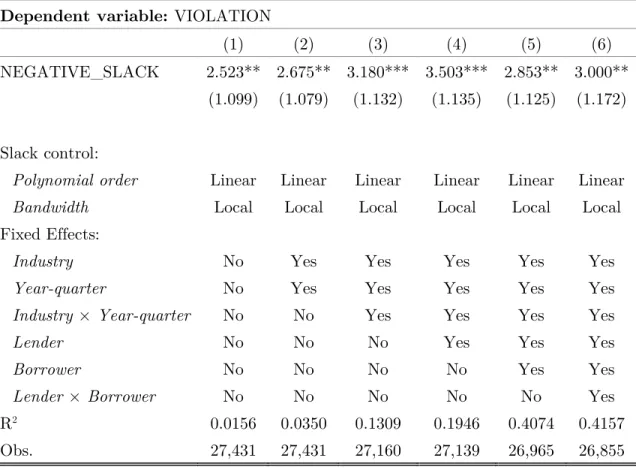
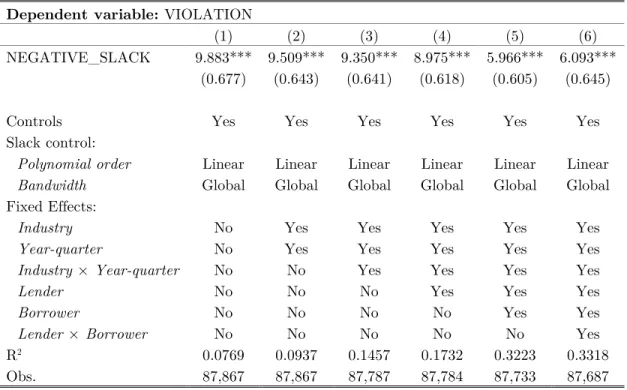
Our preferred specifications in Table 2 use global polynomial control functions. From column to column, the estimates in Table 2 correspond to an increasingly restrictive set of fixed effects, which isolate and eliminate various confounding explanations for the baseline result. In Column (1), we present baseline estimates that include no fixed effects.8 This shows that lenders
enforce contractual breaches at a rate of 10.7% in the neighborhood of preset covenant
8 We cluster standard errors at the borrower level, but the results are generally robust to clustering at other levels,
13
thresholds. This effect is statistically different from zero. Perhaps more interestingly, it is also statistically smaller than one, consistent with lax enforcement.
Columns (2)–(4) include industry and year-quarter fixed effects, industry by year-quarter pair fixed effects, and industry by year-quarter pair and lender fixed effects, respectively. All these columns present estimates in the 9–10% range. These findings suggest that unobservable trends in industry performance or loan contracting do not explain variation in contractual enforcement. The estimates in Column (4), which incrementally incorporate lender fixed effects, show that accounting for fixed differences across lenders does not affect our estimates.
Column (5) incrementally incorporates borrower fixed effects to estimate lender
enforcement behavior using variation in VIOLATION and SLACK for the same borrower over time, and Column (6) adds lender-borrower pair fixed effects to control for any characteristics that lead lenders and borrowers to initially match in the loan market. Estimates in Columns (5) and (6) are quantitatively similar to each other, but they are economically smaller than those in the first four columns, indicating that fixed borrower characteristics explain some of the
variation in enforcement. This might arise if lenders forbear enforcement for a subset of borrowers that are frequently in breach of contract. The estimates in Columns (5) and (6) are both approximately 6% and statistically different from both zero and one.
III.B. Specification Robustness
We complement the discontinuity estimates from Table 2 with a battery of robustness tests to illustrate that our findings are not sensitive to functional form choices or bandwidth
14
restrictions (Van der Klaauw (2008), Lee and Lemieux (2010)). In Columns (1) and (2) of Table 3, we vary the order of the polynomials in f(). In Column (1), we estimate a 10.5% enforcement rate with no polynomial controls for SLACK, while in Column (2) we estimate a 9.1%
enforcement rate with quadratic forms. In Columns (3) and (4), we restrict the bandwidth to within two and five standardized units of SLACK and we estimate enforcement rates of 7.1% and 8.5%, respectively. Columns (5) and (6) add linear polynomial control functions to the specifications in Columns (3) and (4) with bandwidth restrictions, and these estimate
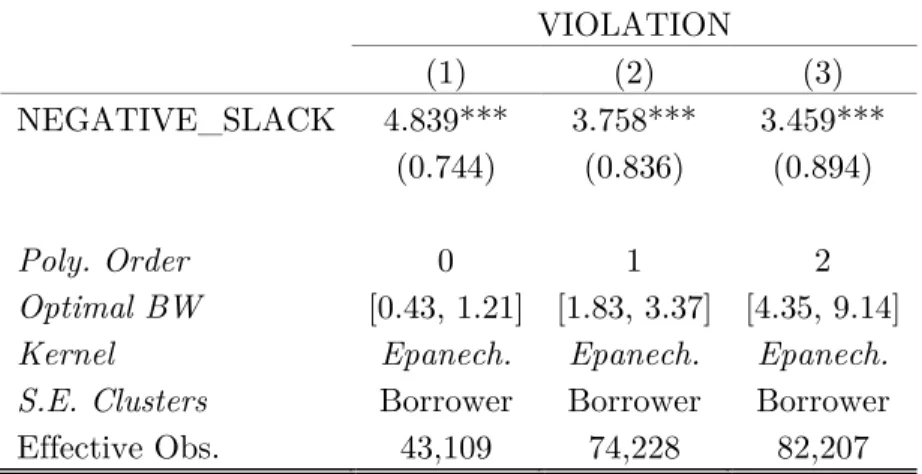
enforcement rates of 4.2% and 5.3%, respectively. In all cases, these estimates are statistically larger than zero and smaller than one. In Appendix D, we show that we again obtain similar estimates when we use optimally selected bandwidths (Calonico, Cattaneo, and Titiunik (2014), (2015)).9
As an alternative robustness check, we conduct placebo tests to examine changes in lender enforcement around placebo covenant slack thresholds. We present the results of these tests in Figure 2. Specifically, in Panel A of Figure 2, we investigate six placebo thresholds at SLACK = {-3, -2, -1, 1, 2, 3} as well as the corresponding estimate for the true threshold of SLACK = 0. These estimates correspond to our main specification presented in Column (1) of Table 2, though they are restricted to a bandwidth of one unit of SLACK, which allows us to avoid the support of SLACK crossing the true covenant threshold in each placebo test. In Panel B, we repeat the placebo test analysis for 800 placebo thresholds in the SLACK ranges [-5, -1] and [1,
9 We also check our main results for a much smaller bandwidth and for specifications that use an Epanechnikov kernel
15
5] and we present the t-statistics for each placebo discontinuity. The t-statistic underlying our preferred estimate is well above and outside the distribution of these placebo t-statistics. Altogether, these tests show no discontinuity in enforcement around placebo covenant thresholds.
III.C. Measurement Robustness
In this subsection, we discuss and explicitly address the potential for measurement error in our main variables of interest; SLACK, NEGATIVE_SLACK, and VIOLATION. We first note that we are interested in both whether enforcement rates are bounded away from zero and from one. In order to bias our estimates, the source of measurement error must be systematically correlated with both the disclosure of a material covenant violation in SEC filings as well as the underlying financial ratios and amounts we calculate using Compustat. Because we have used a restrictive set of fixed effects to isolate variation within the lender-borrower pair and within the borrower’s industry in each year, such a systematic correlation cannot be an empirical artefact of the behavior of one lender, borrower, or lending relationship, and cannot be the artefact of the time-varying economic conditions of the borrower’s industry. Therefore, our primary concerns about measurement error relate to unobserved lender actions (i.e., cases in which the lender uses control rights without a corresponding disclosure of a material covenant violation) and to unobserved contract-specific modifications to covenant definitions (i.e., SLACK reveals a breach, but the modified definition would not).
16
One such concern is the possibility of renegotiation to expunge breaches before they would have to be disclosed (Denis and Wang (2014)). As discussed earlier, the SEC’s disclosure rules require covenant violations to be reported even in cases in which the violation has been waived, as long as the violation was accompanied by any material consequences for the borrower,
including fees paid or terms amended. In the cases in which a renegotiation preempts a covenant violation, if lenders had used control rights to extract any material benefits then these benefits would be required to be disclosed. Nevertheless, we explicitly investigate the effect of
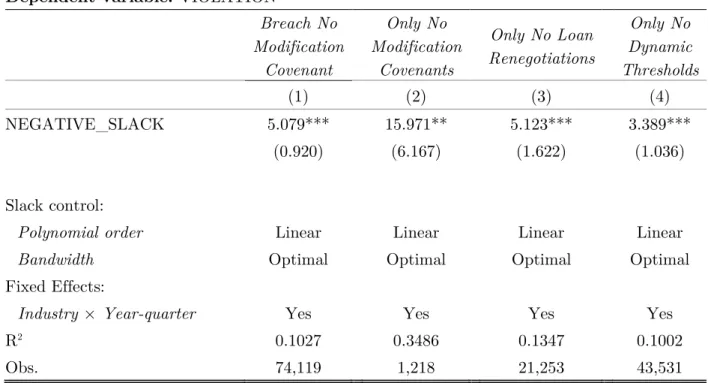
renegotiations on our estimates of enforcement rates in supplemental tests discussed below. Measurement error may arise due to three features of loan contracting and covenant definitions that vary over time at the loan level. These features include contract-specific modified covenant definitions, loan renegotiations, and dynamic thresholds. In Table 4, we estimate four specifications that explicitly address these potential sources of error.
Columns (1) and (2) focus on measurement error that stems from our calculation of SLACK using standard covenant definitions. Not all covenants have universally standard definitions, and the lack of data and loan-specific references to covenant ratios and amounts makes
interpreting modifications a challenge (Dichev and Skinner (2002), Zhang (2008), Demerjian and Owens (2016)). This means that our calculation of financial ratios and amounts governed by covenants using Compustat may generate measurement error in covenant slack at initiation.
Fortunately, to deal with this source of measurement error, we are aided by the existence of four covenant types that have standard definitions; quick ratio, current ratio, net worth, and
17
tangible net worth (Chava and Roberts (2008), Demiroglu and James (2010)).10 In Column (1),
we re-define NEGATIVE_SLACK as an indicator that equals one for observations that have negative SLACK only when one of these covenant types without modifications is breached, and zero otherwise. This ensures that our estimates of enforcement rates depend only on breaches that we measure without error. When we eliminate this source of measurement error in this specification, we estimate an enforcement rate of 10.5%. Similarly, in Column (2), we estimate enforcement rates using only the subsample of loans that have covenants without modifications. This decreases our sample size by over 95%, and therefore reduces the statistical power of our tests, but we continue to estimate a statistically significant enforcement rate of 13.4%. The results in Columns (1) and (2) are both economically larger than our preferred specification in Table 2. This suggests that, as we expected, the measurement error from covenant modifications is attenuating our estimates of enforcement rates.
Our measures based on covenant slack (i.e., NEGATIVE_SLACK and SLACK) may also suffer from measurement error over time because covenant thresholds may vary over time due to dynamic threshold terms or loan renegotiations. Column (3) of Table 4 provides similar estimates of lenders’ enforcement rates for a sample that consists only of loans without
renegotiations (i.e., those whose covenants have not been amended). This sample minimizes the potential misclassification of borrowers into breach and no breach groups because some
borrowers renegotiated their loan contracts in anticipation of a violation. In Column (4), we
18
similarly eliminate all loan packages that have covenants with dynamic threshold terms. Our enforcement rate estimates in Columns (3) and (4) are in the 10–12% range, demonstrating that these time-varying sources of measurement error do not impact our inferences.
Finally, we note that, although resolving these three sources of measurement error does increase the magnitude of our coefficient estimates, the quantitative implications of our estimates are unchanged. Importantly, in no cases are our enforcement rate estimates statistically close to the upper bound of 100% or the lower bound of 0%. This implies that lenders use discretion in ex post enforcement. Further, this result is consistent with Figure 1, which shows that enforcement rates fail to exceed 25% even for severe breaches. It also raises questions about how and when lenders choose to enforce contractual breaches.
III.D. Dynamics of Lender Forbearance
In this section, we provide complementary evidence on how enforcement depends on breach severity as well as past contracting experiences. First, we test whether lenders are more likely to enforce covenants when the borrower has breached more than one financial covenant. To do this, we interact NEGATIVE_SLACK with MULTIPLE_BREACHES, which is an indicator that equals one if borrower i is in breach of more than one financial covenant in quarter t, and zero otherwise. In Column (1) of Table 5, we present evidence that lenders are twice as likely to exhibit enforcement for borrowers who have simultaneously breached multiple covenants, consistent with the notion that lender enforcement depends on breach severity.
19
In Columns (2) and (3), we explore the extent to which contracting dynamics affect enforcement rates. Column (2) interacts NEGATIVE_SLACK with PRIOR_VIOLATION, an indicator that equals one if borrower i previously disclosed a material covenant violation in the past year, and zero otherwise. The positive and significant coefficient in Column (2) shows that lenders are more likely to enforce breaches when the borrower has had a recent violation. To study whether forbearance behavior is also persistent, we interact NEGATIVE_SLACK with PRIOR_FORBEARANCE, an indicator that equals one if borrower i breached at least one covenant of the loan package in the previous year but did not disclose a corresponding material covenant violation, and zero otherwise. Column (3) shows that lenders who chose not to enforce a recent breach are about 20 percentage points less likely than other lenders to punish a breach in the future.
IV.
Determinants of Lender Forbearance
IV.A. Credit Conditions
Credit cycles have important macroeconomic effects on output and asset prices (Bernanke and Gertler (1989), Kiyotaki and Moore (1997)). The apparent procyclicality of credit supply affects firm-level financing and investment policies (Ivashina and Scharfstein (2010), Becker and Ivashina (2014)). Moreover, access to long-term debt insulates borrowers from transient shocks to credit supply (Almeida, Campello, Laranjeira, and Weisbenner (2012)). However, the frequency of contractual breaches and the ability of lenders to exert control may expose long-term debt issuers to credit cyclicality and thus expose them to the corresponding effects on
20
financing and investment choices. If enforcement rates increase when credit is scarce, then lenders’ ex post discretion exacerbates the effects of credit cycles. But if enforcement rates decrease when credit is scarce, then lenders’ ex post discretion mitigates credit cycle risk for existing borrowers.
We test this relation using four measures of credit conditions. First, we use data from a Federal Reserve survey to measure TIGHT_CREDIT, an indicator that equals one if the standardized net proportion of senior loan officers who report tightening credit standards exceeds its median value, and zero otherwise. Figure 3 shows a strong positive correlation over time between enforcement and TIGHT_CREDIT. Second, we use RECESSION, an indicator variable that identifies year-quarters during NBER recessions. Third, we construct
HIGH_PCT_BREACH, an indicator that equals one if the contemporaneous fraction of loans in the lead arranger’s portfolio that are in breach of at least one covenant threshold exceeds its median value, and zero otherwise. Fourth, we construct HIGH_PCT_BREACH_INDUSTRY, an indicator that equals one if the contemporaneous fraction of loans in the borrower’s industry that are in breach of at least one covenant threshold exceeds its median value, and zero
otherwise. Although our objective is not to decompose demand and supply channels, we associate our findings regarding TIGHT_CREDIT and HIGH_PCT_BREACH with supply channels and we associate HIGH_PCT_BREACH_INDUSTRY with demand channels. The Federal Reserve’s survey asks respondents about credit standards, which implies funding decisions conditional on borrower demand, and the proportion of each lender’s loan portfolio in
21
breach is lender specific. However, industry downturns should cause industry trends in covenant breaches.
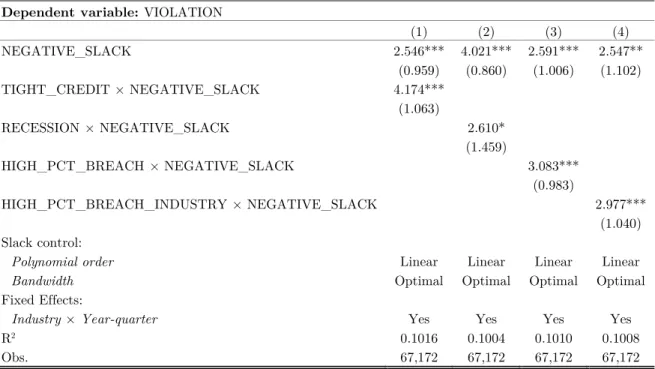
Table 6 presents results that demonstrate the relationship between credit conditions and enforcement rates, which we estimate using the same threshold-based design that was
implemented in previous sections. In each column, we interact NEGATIVE_SLACK with one of our measures of credit conditions. The coefficient of interest is on the interaction term and this can be interpreted as the incremental amount of enforcement associated with variation in credit conditions. Column (1) interacts TIGHT_CREDIT with NEGATIVE_SLACK and the SLACK polynomial control functions. The estimate of 5.5% suggests that periods with tightening credit standards are associated with 5.5 percentage points higher enforcement rates. Similarly, Column (2) suggests that enforcement rates are 3.7 percentage points higher during NBER recessions. The estimate in Column (3) suggests that when a high proportion of the lead arranger’s loan portfolio is in breach, enforcement rates increase by 3.9 percentage points. Similarly, Column (4) suggests that when a high proportion of loans in the borrower’s industry are in breach,
enforcement rates increase by 2.4 percentage points. In all cases, the coefficient on
NEGATIVE_SLACK is between 7.9% and 9.8%, suggesting that while enforcement rates vary significantly with credit conditions, they remain statistically different from both zero and one at the peaks as well as the troughs of credit cycles.
22
In this section, we investigate cross-sectional enforcement heterogeneity based on syndicate characteristics commonly associated with ex ante monitoring intensity, coordination costs, and disagreement. The difficulty in coordination across multiple lenders is an important friction that potentially hinders efficient renegotiation, particularly in the case of default (Gertner and Scharfstein (1991), Bolton and Scharfstein (1996)). Whether the loan is syndicated or sole-led changes the average level of asymmetric information between borrowers and lenders, so it should also affect the propensity of the lending syndicate to enforce contractual breaches. The
enforcement of contractual breaches may also be affected by syndicate structure if syndicate participants are at an informational disadvantage in technical default resolution. We capture coordination costs using syndicate size and concentration. In fact, this sort of subgame play is important for understanding equilibrium syndicate structure (Lee and Mullineaux (2004), Sufi (2007)).
Finally, dispersion in beliefs, or disagreement, among creditors is likely increasing in the number of lenders (Van den Steen (2010), Billett, Elkamhi, Popov, and Pungaliya (2016)). Therefore, a salient measure of the cost of coordination is the minimum number of lenders required to pass a vote to resolve a covenant breach, which we measure using ex ante loan shares and the required lenders voting convention. This required lenders voting convention is preset by the syndicate, and it typically assumes majority or supermajority forms. We also investigate the role of institutional investors because previous literature has documented their recent rise in syndicate participation and their influence on loan contracting (Becker and Ivashina (2016)).
23
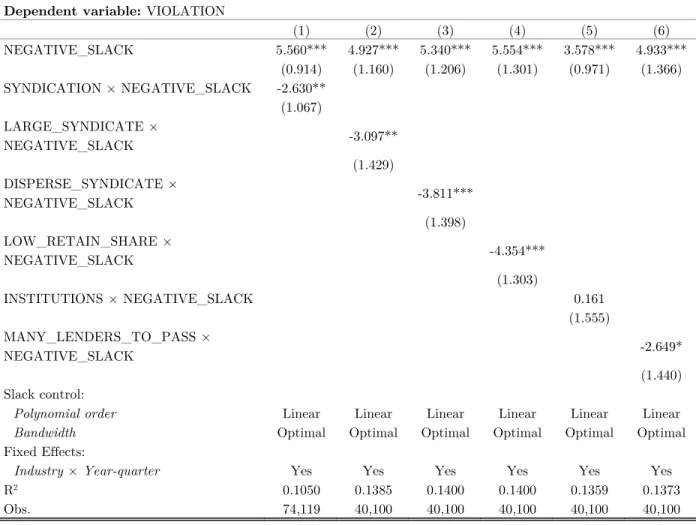
Table 7 presents results that document the importance of enforcement heterogeneity according to lender monitoring incentives, coordination costs, and the likelihood of disagreement. Again, we estimate this heterogeneity using the threshold-based design as
implemented in previous sections. In each column, we interact NEGATIVE_SLACK with one of our measures of monitoring incentives, coordination, or disagreement. The coefficient of interest is on the interaction term, and it can be interpreted as the incremental amount of enforcement associated with this source of heterogeneity. Column (1) interacts SYNDICATION with NEGATIVE_SLACK and the SLACK polynomial control functions. The estimate of -3.0% suggests that contractual breaches of syndicated loans are 3.0 percentage points less likely to be enforced than breaches of sole-led loans. Columns (2) and (3) present estimates consistent with coordination costs reducing enforcement. The estimate in Column (2) indicates that, on average, large syndicates (i.e., those with an above-median number of participants) have 3.2 percentage points lower enforcement rates. The estimate in Column (3) suggests that dispersed syndicates, those with below-median syndicate concentration (i.e., HHI of the ex ante loan shares), have 4.1 percentage point lower enforcement rates. All these results are consistent with the theoretical literature on coordination (e.g. Gertner and Scharfstein (1991)), in which the probability of coordination decreases as the number of pivotal agents increases.
We measure information asymmetries between the borrower and lenders using the lead arranger’s retained share of the loan (Sufi (2007)). The estimate in Column (4) suggests that loans with a below-median retained share have 4.4 percentage point lower enforcement rates. Column (5) estimates that loans with at least one institutional investor participant have 3.9
24
percentage point higher enforcement rates, consistent with the prior evidence that institutional investors prioritize immediate earnings (Bushee (2001)). Lastly, we find that, on average, increasing the minimum number of lenders in order to pass an enforcement vote reduces enforcement rates. This suggests that coordination costs constrain the ability to enforce contractual breaches. Overall, our results are consistent with coordination costs affecting forbearance.
IV.C. Bargaining and Lender Hold-up
In this section, we investigate the role of bargaining power and loan market competition in determining lender enforcement rates. Informational frictions can increase the cost of finding a new lender, leading to a form of hold-up in which the relationship lender increases spreads (Greenbaum, Kanatas, and Venezia (1989), Sharpe (1990), Rajan (1992)). Furthermore, the intensity of this friction depends on the amount of soft information collected by the existing lender as well as the borrower’s access to alternative funding sources, either in the loan market, the bond market, or elsewhere (Schenone (2010), Bird, Karolyi, and Ruchti (2019)).
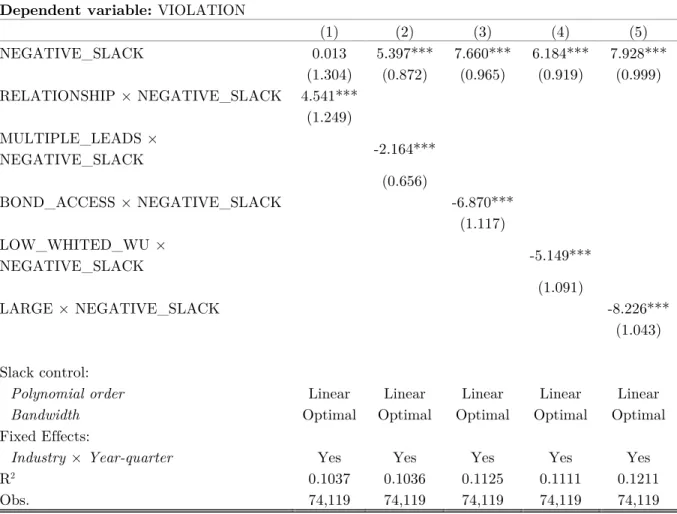
We construct five measures that capture these notions of bargaining power and hold-up. The first is RELATIONSHIP, an indicator that equals one if the borrower and lender have transacted in the past, and zero otherwise. The next is MULTIPLE_LEADS, an indicator that equals one if the borrower has contemporaneously borrowed from multiple lead arrangers, and zero otherwise. The indicator BOND_ACCESS equals one if the borrower has public bonds outstanding and zero otherwise. The indicator LOW_WHITED_WU equals one if the
25
standardized Whited-Wu (2006) index of financial constraints is below its median value, and zero otherwise. Last, LARGE is an indicator that equals one if the borrower’s total assets exceed the median total assets, and zero otherwise.
The estimate shown in Column (1) of Table 8 suggests that relationship borrowers face 6.5 percentage points higher enforcement rates than transactional borrowers, consistent with lender hold-up. The estimates in Columns (2) and (3) indicate that borrowers with cheap alternative funding sources in the private loan market and public bond market face 1.9 and 9.0 percentage points lower enforcement rates, respectively. This is consistent with the theoretical arguments in Diamond (1991) and Rajan (1992)—borrowers have more bargaining power with their lenders when they have strong outside options, in the form of cheap access to alternative financing opportunities. In Column (4), our estimate suggests that borrowers with higher financial
constraints are 8.6 percentage points more likely to face enforcement. Enforcement is more likely for worse borrowers, as measured either by covenant slack or financial constraints. Lastly, the estimates in Column (5) suggest that large borrowers face 13.1 percentage points lower enforcement rates, on average. Across each of these measures, we consistently find that
enforcement rates are increasing in information frictions and decreasing in the borrower’s ability to access alternative funding sources. In this sense, our results are consistent with those of Schenone (2010). Borrowers benefit from better outside options not just ex ante, in the explicit terms of the loan, but also over the course of the loan, due to more lenient enforcement by lenders in the case of covenant breaches.
26
IV.D. Implicit Contracting and Reputation
Are implicit and explicit contracting substitutes or complements? Restrictive covenants provide an ideal setting to investigate this question in the private loan market because
contractual thresholds are explicitly set ex ante, but lenders have implicit discretion to enforce contractual breaches ex post. In Table 9, we investigate cross-sectional enforcement
heterogeneity based on ex ante explicit contracting. In particular, we focus on the ex ante strictness of covenant sets, which we measure in two ways at the beginning of each loan. First, we use INITIAL_SLACK, which is the loan package’s minimum standardized distance to covenant thresholds. Next, we use INITIAL_STRICTNESS, a calibrated measure of the probability of technical default as in Murfin (2012).
If implicit and explicit contracting are used as substitutes, we expect higher enforcement rates when initial contract strictness is low. This is exactly what we find across all three measures. In Column (1), we find that borrowers with above-median values of initial covenant slack have 3.4 percentage points lower enforcement rates. Similarly, in Column (3), we find that borrowers with above-median values of initial contract strictness have 3.6 percentage points lower enforcement rates. Since implicit contracting may vary especially with borrower-lender pairs via endogenous matching in the loan market, we include estimates with borrower-by-lender fixed effects in Columns (2) and (4). The interaction coefficient estimates decrease in magnitude by approximately one-third, but they remain statistically and economically significant. This suggests that the substitution between ex ante explicit contracting and ex post enforcement varies within lending relationships.
27
These findings are particularly striking because selection on unobservable borrower quality should bias our results toward finding that implicit and explicit contracting are complements. This is because low-quality borrowers, who are likely to subsequently face higher enforcement rates, should only be able to negotiate contracts that are strict ex ante. While we do find that implicit and explicit contracting are substitutes, the theoretical literature on implicit contracting suggests that implicit contracting is infeasible in a one-shot game in the absence of commitment. However, it appears that lenders can solve this commitment problem to some degree through a repeated games mechanism, such as reputation (Klein and Leffler (1981), Sharpe (1990)).
We next investigate the role that lender reputation may play in the use of implicit contracting. In Table 10, we use two measures of lender reputation based on market-wide and industry-specific league table rankings to investigate cross-sectional enforcement heterogeneity with reputation. These league tables are based on annual deal volume, and anecdotally, they have sizable effects on lender choice and bargaining.11 As in our previous tables, we estimate this
heterogeneity using the same threshold-based design as implemented in previous sections. Columns (1) and (2) interact NEGATIVE_SLACK with TOP_10, an indicator that equals one if the lead arranger is ranked in the top ten in market-wide league tables, and zero
otherwise. Columns (3) and (4) instead use the natural log of league table rank. Our estimates using each of these measures suggest that high reputation lenders have lower enforcement rates; top-ranked lenders enforce 2.5 percentage points less frequently and, similarly, a 100% increase
11 The dominant provider of loan information for market participants, Loan Pricing Corporation, suggests that its
28
in rank (i.e., a decrease in reputation) is associated with a 1.0 percentage point increase in enforcement rates. Like the implicit contracting results in Table 10, we include borrower-by-lender fixed effects in Columns (2) and (4). We find robust evidence that the effect of borrower-by-lender reputation varies within lending relationships. Overall, our results in Tables 9 and 10 are consistent with theories of implicit contracting. We find that implicit and explicit contracting are substitutes in the private loan market, and that well-reputed lenders enforce contractual breaches at lower rates.
IV.E. Borrower Slack Manipulation
Dichev and Skinner (2002) show that an unusually small number of loan-quarters exhibit accounting ratios falling just below covenant thresholds, and an unusually large number fall just above. They interpret this as evidence that firms actively manage key accounting variables to avoid tripping a covenant. This is certainly a concern, for example, in studies of the real effects of covenant breaches since that literature relies on comparing subsequent investment (or other outcomes) for firms that just breached versus those that barely did not. For example, if the firms that just avoided a breach did so by reducing investment (i.e. by manipulating), then this change in the control group could contaminate estimates of the causal effect of the breach on investment.
Since our goal in this paper is to study the endogenous choice to enforce, the threshold of zero covenant slack serves only as a measurement tool. For this reason, we do not require any assumptions about the exogeneity of covenant slack. Nonetheless, the incidence of manipulation
29
may affect the interpretation of our findings on the determinants of forbearance. Most importantly, lenders’ expectations about manipulation by borrowers may be an important determinant of their enforcement behavior, though the sign of this effect is not clear a priori. The prediction depends on how lenders, cognizant of potential manipulation, view borrowers who just breach their covenants. On the one hand, breaching may be a strong negative signal if it suggests that the borrower was unable to avoid the breach even after manipulating. On the other hand, it may be a positive signal if the lender infers that this borrower can be trusted because they did not manipulate even though they could have. This ambiguity means that the relationship between manipulation and forbearance is an empirical question.
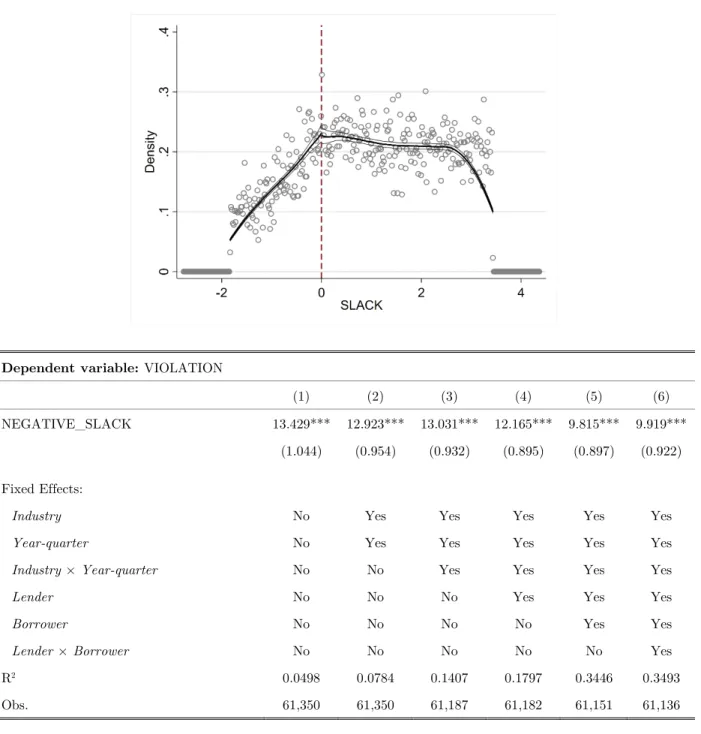
In Figure 4, we investigate whether manipulation is itself a determinant of forbearance and whether our existing findings on determinants could themselves be explained by cross-sectional variation in manipulation. The top panel of the figure shows McCrary (2008) plots for the borrower covenant slack distribution after splitting loans into two groups: a high enforcement sample and a low enforcement sample. These groups are determined according to our findings on the determinants of forbearance as described in the above subsections. If a characteristic is associated with high enforcement (i.e. it has a positive coefficient in Tables 5-10), then the loans with that characteristic are allocated to the high enforcement sample. After this sorting is completed, we find two slack distributions that are very similar in appearance. Both groups show significant evidence of manipulation, but the McCrary (2008) test statistics in the two distributions are statistically indistinguishable. We thus conclude that borrower slack
30
of such manipulation provide an alternative explanation for the evidence on determinants we present above.12
In regard to the interpretation of our results on the determinants of forbearance, one may question the representativeness of the pool of borrowers who breach, and are thus subject to enforcement. We investigate this concern by comparing other observable characteristics of borrowers and loans on either side of the covenant thresholds. This analysis, which we present in Figure 5, shows that the pool of borrowers subject to enforcement is representative of borrowers that just did not breach.
As a final test, we investigate the presence of manipulation across covenant types with the idea that some financial metrics may be more difficult or more costly to manipulate. We find no evidence of manipulation for a subset of covenants: debt/equity, leverage, cash interest
coverage, debt service coverage, EBITDA, quick ratio, current ratio, and net worth. In Appendix Table D12, we re-estimate the specifications from Table 2 using a new definition of SLACK based only on these manipulation-free covenants. Our estimates on the propensity to enforce covenant breaches are quantitatively similar to our baseline findings. This finding corroborates our inference that manipulation is not a first-order determinant of enforcement decisions.
V.
How Costly is Lender Forbearance?
12 Separately, we add controls to our main specification from Table 2, particularly including total and discretionary
accruals to account for borrower manipulation behavior. The results are presented in Appendix Table D11 and are economically and statistically similar to our baseline findings.
31
In order to understand the significance and implications of lender forbearance, it is important to understand the cost of this behavior. That is, what benefit is the lender actually giving up by not enforcing covenant breaches? Contract enforcement can have a variety of outcomes, including a formal letter to the borrower, a waiver fee, renegotiation of the loan terms, refinancing, or loan acceleration. Among these, fees and renegotiations are common.
As a first step, we wish to examine whether the fees paid when lenders enforce are
economically meaningful in the context of other fees that borrowers pay to lenders. To do so, we follow Berg et al. (2016) in comparing amendment and waiver fees to upfront fees, commitment fees, annual fees, and utilization fees.13 Figure 6 presents histograms of the distributions of each
of these different types of fees, conditional on observing them in the data. The figure shows that waiver fees, averaging 32 basis points, are of a similar magnitude to these other important fees, and they follow similar distributions. This descriptive evidence suggests that understanding the behavior of these new fees (and thus the actual cost of lender forbearance) is quantitatively important.
In combination with data on loan renegotiations from DealScan, our data on fees can also be used to validate the connection between our measure of enforcement (i.e., disclosures
concerning material covenant violations) and real contracting outcomes. Thus, our first check on the validity of VIOLATION is to correlate it with propensities for fee payment and
renegotiation. In our data, we find that the propensity of firms paying a fee is 4.6 times higher if
13 Since the distinction between waiver and amendment fees is often unclear from the text alone, we classify the fees we
32
the firm has a contemporaneous violation. Further, the propensity of a firm renegotiating its loan is 2.0 times higher if the firm has a contemporaneous violation, despite the fact that renegotiations often take place outside of covenant breach (Denis and Wang (2014)). These two univariate comparisons suggest that our measure of enforcement is tightly linked to
economically meaningful outcomes for borrowers.
To verify that this univariate relationship is not being driven by borrower quality, we also estimate the relationship between indicators that identify fee payment or renegotiations and VIOLATION. These tests allow us to control for borrower quality using polynomials of SLACK as well as restrictive fixed effects that net out time-varying economic conditions at the borrower industry level. Columns (1) and (3) of Table 11 present estimates of these tests for fee payments and renegotiations, respectively. In both cases, we find an economically large, positive
relationship between VIOLATION and these enforcement outcomes.14
Because our threshold-based design identifies forbearance at the covenant threshold, we check whether the relationship between VIOLATION and these enforcement outcomes holds locally in this region. We do this using the following fuzzy regression discontinuity design: (4) ENFORCEMENT_OUTCOMEit = a + b1VIOLATION� 𝑖𝑖𝑖𝑖 + g(SLACKit) + eijt
(5) VIOLATIONit = a + b1NEGATIVE_SLACKit + f(SLACKit) + eijt.
Since the first stage of this specification is exactly the same as the one presented in Equation (3), the identifying variation in the second stage for VIOLATION comes from just
14 In the case of fees, we include both waiver and amendment fees as defined above. This means that the increased
incidence of fees we document is over and above the baseline likelihood of fee payment due to loan amendments, which can occur whether or not the loan is in breach.
33
around the covenant threshold. Columns (2) and (4) of Table 11 present second-stage estimates of Equation (4) for fee payment and renegotiation, respectively. These estimates confirm that Violation is strongly associated with these real contracting outcomes at the threshold that determines whether lenders have control rights.
In Section IV we showed how different characteristics of borrowers, loans, and lenders are associated with differences in enforcement; this can be thought of as the extensive margin of enforcement or forbearance. Using our data on fees, we can extend these findings with some preliminary evidence on the intensive margin. That is, we ask whether the same kinds of characteristics that predict a high probability of enforcement are also associated with stronger enforcement as measured by the level of fees. In Figure 7, we show that this is indeed the case. When we split loans into high- and low-enforcement subsamples, following the same procedure as in Section IV.E., we find that the mean waiver fee for the high-enforcement sample is statistically significantly greater than for the low-enforcement sample. We believe that this difference is broadly consistent with the theories described in Section IV, and it also provides corroborating evidence underscoring the importance of the determinants of forbearance we study.
VI.
Conclusion
In this paper, we study the contractual enforcement of restrictive financial covenants. We find that lenders exercise significant ex post discretion. Breaching these covenants gives the lenders substantial power, including the right to accelerate the loan or extract benefits, in the
34
form of fees or improved terms, from the borrower. However, our baseline finding is that lenders choose to enforce contractual breaches only 11% of the time. This result suggests that lender forbearance is an economically significant feature of loan contracting. We provide several novel findings concerning variation in this behavior over time as well as across borrowers and lenders, and we show how this novel contracting margin interacts with explicit contractual terms. Enforcement is more likely when credit conditions are otherwise tight and when coordination costs among lenders are high, but enforcement is less likely when lenders have strong
35
Appendix A: Variable Definitions
Variable Name Definition
VIOLATION One for material violation that the borrower discloses in an SEC filing. SLACK Distance to covenant threshold divided by trailing volatility of the covenant variable. Minimum of these values is used for loans with multiple covenants. FEE One for waiver or amendment fee that the borrower discloses in an 8-K filing. AMENDMENT One if the amendment flag in DealScan indicates that the loan is amended. NEGATIVE_SLACK Indicator that equals one if SLACK< 0, zero otherwise.
STRICTNESS Measure of the probability of technical default as in Murfin (2012). SPREAD Weighted average spread in basis points.
AMOUNT Loan package amount in millions of dollars. MATURITY Weighted average maturity in months. SECURED Indicator that equals one for collateral.
MULTIPLE_BREACHES Indicator that equals one if the borrower is in breach of more than one financial covenant in the quarter
PRIOR_VIOLATION Indicator that equals one if the borrower previously disclosed a material covenant violation in the past year PRIOR_FORBEARANCE
Indicator that equals one if the borrower breached at least one covenant of the loan package in the previous year but did not disclose a corresponding material covenant violation
CREDIT_TIGHTENING Standardized net % loan officers reporting a tightening of credit standards. RECESSION Indicator that equals one during an NBER recession, and zero otherwise. PORTFOLIO_NEGATIVE_SLACK % of loans in the lead arranger’s portfolio that are in breach of a covenant. INDUSTRY_NEGATIVE_SLACK % of loans in the borrower’s industry that are in breach of a covenant. SYNDICATION Indicator that equals one if the distribution method is syndication. NUM_LENDERS Index of syndicate size based on the number of lenders in the syndicate. LENDER_HHI Sum of squared loan shares among syndicate participants.
RETAINED_SHARE Fraction of the loan retained by the lead arranger. NUM_INSTITUTIONS Number of institutional investors in the lending syndicate.
LENDERS_TO_PASS The smallest number of lenders required to vote for a covenant waiver based on initial loan shares and contractual voting rules.
RELATIONSHIP Indicator that equals one if the lead arranger has initiated at least one loan with the borrower previously.
MULTIPLE_LEADS Indicator that equals one if the borrower has outstanding loans with at least two distinct lead arrangers simultaneously.
BOND_ACCESS Indicator that equals one if the borrower has an S&P credit rating.
WHITED_WU Standardized Whited-Wu index, for which higher values correspond to a higher cost of external financing.
SIZEl Slack Initial Slack Standardized total assets of the borrower in millions of dollars.
INITIAL_SLACK Minimum standardized distance to covenant thresholds across covenant types in the initial loan package.
INITIAL_STRICTNESS Measure of initial contract strictness from Murfin (2012).
TOP_10 Indicator that equals one if the lead arranger is among the top ten ranked underwriters by deal volume in the quarter.
36
lnLEAGUE_RANK Log of the lead arranger’s rank by deal volume in the quarter.
Appendix B: Covenant Calculations
Covenant Name Calculation (Compustat codes)
Debt-to-EBITDA (Dlcq + Dlttq) / Rolling EBITDA Debt-to-Equity (Dlcq + Dlttq) / Seqq
Debt-to-Tangible NW (Dlcq + Dlttq) / (Atq – Intanq – Ltq) Leverage (Dlcq + Dlttq) / Atq
Current ratio Actq/Lctq
Quick ratio (Rectq + Cheq) / Lctq
Cash interest coverage Rolling EBITDA/Rolling interest paid Interest coverage Rolling EBITDA/Rolling interest expense
Debt service coverage Rolling EBITDA/(Rolling interest expense and principal payment) Fixed charge coverage Rolling EBITDA/(Rolling interest expense, principal payment, and rent payment) Net worth Atq – Ltq
Tangible net worth Atq – Intanq – Ltq EBITDA Rolling EBITDA
Rolling EBITDA, interest expense, interest paid, and principal paid are calculated using the sum of the firm’s past four quarters.
37
Appendix C: Covenant Enforcement Examples
Example #1:
Enservco Corp was in violation of its fixed charge coverage ratio as of the end of the third quarter of 2017, but was able to negotiate a waiver of the breach with its lender in exchange for a $20,000 fee.
From 10-Q filed November 14, 2017:
As of September 30, 2017, we were in violation of a loan covenant under the New Credit Facility that requires our Fixed Charge Coverage Ratio (as defined in the 2017 Credit Agreement) (“FCCR”) to be not less than 1.10 to 1.00 at the end of each month, with a build up beginning with January 1, 2017. Our FCCR as of September 30, 2017, was 0.62, calculated in accordance with the 2017 Credit Agreement, and constituted an Event of Default, as defined in the 2017 Credit Agreement. East West Bank may, at its election, declare all our obligations under the New Credit Facility immediately due and payable and cease advancing money or extending credit to us, among other remedies. We are currently in negotiations with East West Bank regarding a waiver of the testing of this covenant until December 31, 2017 through an amendment to the 2017 Credit
Agreement, which would remedy the covenant violation. However, as of November 14, 2017, we had not finalized an amendment and we therefore classified borrowings under the New Credit Facility ($23,543,802) as a current liability in the accompanying
38
significant working capital deficit of approximately $21.1 million. We cannot provide assurance that we will reach an agreement regarding the waiver, however, we believe it is probable that such an agreement will be reached. If East West Bank exercises its option to declare our borrowings under the 2017 Credit Agreement immediately due and payable, or cease advancing money or extending credit to us, our ability to continue as a going concern will be negatively affected.
Then a week later (November 21, 2017), Enservco filed an 8-K:
On November 20, 2017, Enservco Corporation (the “Company”) entered into a First Amendment and Waiver (the “Amendment and Waiver”) with respect to the Company's existing Loan and Security Agreement (the “2017 Credit Agreement”), dated November 20, 2017, by and among the Company and East West Bank, A California Banking Corporation (“East West Bank”).
Pursuant to the Amendment and Waiver, East West Bank waived an event of default with respect to the Company’s failure to satisfy the minimum fixed charge coverage ratio set forth in the 2017 Credit Agreement for the reporting period ended September 30, 2017, and permitted the Company to forego testing of its fixed charge coverage ratio as of October 31, 2017 and November 30, 2017. In connection with the Amendment and Waiver, the Company agreed to pay East West Bank an amendment fee in the amount of $20,000.
39 Example #2
Yuma Energy, Inc. was in violation of its maximum debt to EBITDA covenant and secured a waiver from its lenders in exchange for a reduction of the borrowing base under the credit agreement, extra financial disclosures, and the reimbursement of some lender costs. From 10-K filed March 30, 2016:
On December 30, 2015, we entered into the Waiver, Borrowing Base Redetermination and Ninth Amendment (the “Amendment”) to our Credit Agreement (the “credit agreement”) with Société Générale (the “Bank”) as administrative agent and issuing bank, and each of the lenders and guarantors party thereto. Pursuant to the
Amendment, the borrowing base under the credit agreement was reduced from $35.0 million to $29.8 million and will automatically be reduced to $20.0 million on May 31, 2016 unless otherwise reduced by or to a different amount by the lenders under the credit agreement. The Amendment also provided a waiver of the financial covenant related to the maximum permitted ratio of funded debt to EBITDA for the fiscal quarter ended September 30, 2015 and any failure to comply with that financial covenant and certain other financial covenants for the fiscal quarter ended December 31, 2015.
40
From an 8-K filed January 5, 2016, we can see the contractual language of the amendment, including the reduction in borrowing base described above, and an agreement by the borrower to provide extra financial disclosures to the lenders and reimburse the lenders for various fees.
On (i) Thursday of each week (commencing January 7, 2016), an update to the Borrower and its Subsidiaries’ 13-week cash flow forecast delivered with respect to the immediately preceding week, including actual performance for the prior week and variance reports, and (ii) the last Business Day of each month (commencing
December 31, 2015), a report of the outstanding accounts payable of the Borrower and its Subsidiaries (including an aging report) as of the end of the immediately prior month, in each case, in reasonable detail and otherwise in form and substance acceptable to the Administrative Agent.”
The Administrative Agent shall have received from the Borrower (a) payment of all out-of-pocket fees and expenses (including reasonable attorneys’ fees and expenses) incurred by the Administrative Agent in connection with the preparation, negotiation and execution of this Waiver and Amendment and the other documents in connection herewith and (b) all fees due and payable under the Credit Agreement and under any separate fee agreement entered into by the parties pursuant to the Credit Agreement.