Dependency Graph-Based Statistical
Machine Translation
Liangyou Li
B.Sc., M.Sc.A dissertation submitted in fulfilment of the requirements for the award of
Doctor of Philosophy (Ph.D.)
to the
Dublin City University
School of Computing
Supervisors: Prof. Qun Liu and Prof. Andy Way
I hereby certify that this material, which I now submit for assessment on the programme of study leading to the award of Ph.D. is entirely my own work, that I have exercised reasonable care to ensure that the work is original, and does not to the best of my knowledge breach any law of copyright, and has not been taken from the work of others save and to the extent that such work has been cited and acknowledged within the text of my work.
Signed:
(Candidate) ID No.:
Acknowledgments
I would first like to express my utmost gratitude to my fantastic supervisors Prof. Qun Liu and Prof. Andy Way for their guidance and encouragement throughout my Ph.D. study. Their profound professional knowledge, sharp insight and enormous support not only keep my research on the right track but also help to build solid foundations for my future career. Their guidance, from general research directions to concrete language and scientific writing, helps me build up ability and confidence to carry out my research and future work. I am also very grateful to examiners Prof. David Chiang and Dr. Jennifer Foster for their insightful feedback and creative comments which make the thesis more solid. I should also thank Dr. Alistair Sutherland for chairing my viva and thank Dr. Jennifer Foster and Dr. John McKenna for providing insightful suggestions on my transfer report.
I thank my excellent colleagues and friends who build a great research atmosphere around me and provide a great help in my life. Particular thanks go to Dr. Junhui Li, Dr. Jun Xie and Dr. Zhaopeng Tu for their help on the opportunity of being in DCU, Dr. Jun Xie again for his help on the first research work of the thesis, Dr. Xiaofeng Wu, Dr. Qi Zhang, Dr. Xiaojun Zhang, Dr. Jinhua Du, Ning Zhang, Jian Zhang, Longyue Wang and Tengqi Ye for their generous help in my study, life, and career. I thank Chris Hokamp for organizing a machine learning group where I learned a lot, Dr. Joachim Wagner for providing technical support, and Piyush Arora for actively organizing activities. I must also thank ADAPT/CNGL management team for offering all the fantastic facilities and support for my study.
Thank the Marie Curie scheme for providing generous research funding to me to allow me to gain research experiences abroad. I thank the EXPERT project which provided innovative research and training to me in the field of machine translation technologies. I am also very fortunate to have had chances to visit the MT group at the University of Amsterdam and Hermes Traducciones in Spain where I met a bunch of excellent people. Thank them all. I would also like to thank Science Foundation Ireland for their generous funding which allows me continuing my research.
Last but certainly not the least, I extend my deepest gratitude to my family. They have always been being there on my side and supporting me for everything in my life. It is their encouragement and generosity that help me go through the ups and downs in the course of my education.
Contents
List of Figures vii
List of Tables ix Abbreviations x Abstract xi 1 Introduction 1 1.1 Definitions . . . 1 1.2 Brief Overview of SMT . . . 3
1.3 Why Graphs And Which Type? . . . 5
1.4 Research Questions . . . 7
1.5 Thesis Structure . . . 11
1.6 Related Publications . . . 12
2 Statistical Machine Translation 13 2.1 Sequence-Based Models . . . 14
2.1.1 Word-Based Models . . . 14
2.1.2 Phrase-Based Models . . . 17
2.1.3 Shortcomings of Sequence-Based Models . . . 21
2.2 Tree-Based Models . . . 22
2.2.1 Hierarchical Phrase-Based Models . . . 22
2.2.2 Constituent Tree-Based Models . . . 26
2.2.3 Dependency Tree-Based Models . . . 29
2.2.4 Shortcomings of Tree-Based Models . . . 32
2.3 Graph-Based Models . . . 32 2.4 Experimental Set-up . . . 33 2.4.1 Data Sets . . . 34 2.4.2 Settings . . . 35 2.4.3 Baseline Systems . . . 36 2.5 Summary . . . 37
3 Improved Dependency Tree-to-String Translation 38
3.1 Introduction to Dependency Tree-to-String Model . . . 39
3.1.1 Examples of Rules . . . 40 3.1.2 Rule Extraction . . . 40 3.1.3 Decoding . . . 42 3.2 Dependency Transformation . . . 44 3.2.1 Algorithm . . . 45 3.2.2 Evaluation . . . 47 3.3 Dependency Decomposition . . . 47 3.3.1 Rule Extraction . . . 49
3.3.2 Creating Pseudo Forests . . . 50
3.4 Experiments . . . 52
3.4.1 Basic Results . . . 53
3.4.2 Influence of Decomposition . . . 54
3.4.3 Integrating Phrasal Rules . . . 55
3.4.4 Comparison of Model Size . . . 57
3.5 Summary . . . 58
4 Non-recursive Graph-to-String Translation 59 4.1 Dependency-Bigram Graphs . . . 60
4.2 Segmentation-Based Translation . . . 62
4.2.1 Rule Extraction . . . 63
4.2.2 Features and Decoding . . . 65
4.3 Graph Segmentation Model . . . 66
4.4 Experiments . . . 69
4.4.1 Basic Results . . . 69
4.4.2 Influence of Rule Types . . . 72
4.4.3 Statistics on Phrase Length . . . 73
4.4.4 Influence of Graph Segmentation Model . . . 75
4.4.5 Integrating Lexical Reordering Model . . . 76
4.4.6 Influence of Edge Type . . . 78
4.4.7 Influence of Distortion Limit . . . 78
4.4.8 Variance of Dependency Configurations . . . 79
4.5 Summary . . . 81
5 Recursive Graph-to-String Translation 82 5.1 Graph Grammars . . . 83
5.1.1 Edge Replacement Grammar . . . 83
5.1.2 Node Replacement Grammar . . . 86
5.2 ERG-Based Translation . . . 88
5.2.1 Dependency-Edge Graphs . . . 89
5.2.2 Practical Restrictions . . . 90
5.2.3 Rule Extraction . . . 92
5.2.4 Features and Decoding . . . 95
5.3.1 Dependency-Sibling Graphs . . . 97
5.3.2 Training and Decoding . . . 98
5.4 Experiments . . . 98
5.4.1 Basic Results . . . 100
5.4.2 Influence of Non-terminal Labels . . . 101
5.4.3 Influence of Span Limitation . . . 103
5.4.4 Influence of Sibling Links . . . 104
5.4.5 Influence of Edge Types . . . 106
5.4.6 Variance of Dependency Configurations . . . 106
5.5 Summary . . . 108
6 Conclusion 109 6.1 Contributions . . . 111
6.2 Future Work . . . 112
List of Figures
1.1 Illustration of various structures mentioned in this thesis . . . 2
1.2 An example of a recursive translation rule . . . 4
1.3 Constituent tree vs dependency tree . . . 5
1.4 An example of a graph where an additional edge is added to a dependency tree 7 2.1 Illustration of a word-alignment matrix . . . 15
2.2 Illustration of phrase alignment . . . 17
2.3 Illustration of the search space in phrase-based models . . . 20
2.4 Beam search for phrase-based models . . . 21
2.5 Illustrating the extraction of a hierarchical phrase-based rule . . . 24
2.6 An example of a derivation hypergraph . . . 25
2.7 An example of a string-to-tree translation rule . . . 27
2.8 Illustrating the extraction of the string-to-tree rule in Figure 2.7 . . . 28
2.9 An example of a tree-to-tree translation rule . . . 29
2.10 Examples of fixed and floating structures in a dependency tree . . . 30
2.11 A dependency treelet-to-string translation rule . . . 30
2.12 Two ways of creating labels to use non-syntactic phrases in a dependency tree 31 2.13 Illustration of semantic-based translation . . . 33
3.1 Illustration of head-dependent fragments in a dependency tree . . . 39
3.2 Illustration of head spans and dependency spans . . . 41
3.3 A derivation in the Dep2Str model . . . 43
3.4 Constituent-style tree converted from the dependency tree in Figure 3.1 . . 46
3.5 Illustration of decomposing an HD fragment . . . 48
3.6 Illustration of valid and invalid decompositions during training . . . 50
3.7 An example of translating an HD fragment with decomposition . . . 51
3.8 An example of a pseudo forest . . . 52
3.9 Examples of translations from D2S and PBMT . . . 53
3.10 Examples of translations of the decomposition approach . . . 55
3.11 An example of using phrasal rules . . . 55
3.12 Examples of translations generated by D2S with phrasal rules . . . 56
4.1 An example of a dependency-bigram graph . . . 61
4.2 Illustration of node-induced subgraphs . . . 62
4.3 Examples of subgraphs extracted from Figure 4.1 . . . 62
4.5 Illustration of calculating the distortion value . . . 65
4.6 A derivation of translating an dependency-bigram graph . . . 67
4.7 Illustration of extracting sparse features . . . 68
4.8 Examples of translations of SegGBMT and PBMT . . . 71
4.9 Examples of translations from SegGBMT and Treelet . . . 71
4.10 Phrase length histogram for MT02 and WMT11 . . . 74
4.11 Examples of translations using the graph segmentation model . . . 75
4.12 Illustration of three reordering orientations . . . 76
4.13 Illustration of cross alignments . . . 77
4.14 BLEU scores on different values of the distortion limit . . . 79
4.15 Illustration of various dependency configurations in SegGBMT . . . 80
5.1 Examples of an edge-labeled graph and a node-labeled graph . . . 84
5.2 Illustration of a derivation in an ERG . . . 85
5.3 Illustration of a derivation in an NRG . . . 88
5.4 An example of a rule translating an edge-labeled graph into a target string . 89 5.5 Illustration of converting a dependency tree into a dependency-edge graph . 89 5.6 Word-order restriction on dependency-edge graphs . . . 90
5.7 Illustration of inducing non-terminal symbols for DEG . . . 91
5.8 Examples of phrases which cannot be covered by our ERG-Based model . . 94
5.9 An example of a derivation in our ERG-Based model . . . 96
5.10 An example of a translation rule in our NRG-based model . . . 97
5.11 Converting a dependency tree to a dependency-sibling graph . . . 98
5.12 An example of a derivation in our NRG-based model . . . 99
5.13 Examples of translations from HPBMT, SERG, and SNRG . . . 101
5.14 Phrase correspondence produced by SERG and SNRG for translating the example in Figure 5.13 . . . 101
5.15 Examples of translations from SERG without linguistic non-terminals . . . 103
5.16 BLEU scores of HPBMT, SERG, and SNRG when the maximum phrase length is set to different values . . . 104
5.17 Examples of translations from SNRG without sibling links . . . 105
List of Tables
1.1 Comparison between our work and existing models . . . 9
1.2 Comparison between our translation models . . . 11
2.1 Examples of Chinese–English sentence pairs in a parallel corpus. . . 13
2.2 An example of a word-translation table . . . 14
2.3 Examples of phrase translations and their probabilities in a phrase-based model. . . 18
2.4 Chinese–English corpus . . . 34
2.5 German–English corpus . . . 35
2.6 Evaluation results of PBMT and HPBMT on ZH–EN and DE–EN . . . 37
3.1 Evaluation results of D2S compared with PBMT and HPBMT . . . 53
3.2 Evaluation results of the decomposition approach . . . 54
3.3 Evaluation results of D2S when phrasal rules are integrated . . . 56
3.4 The number of rules in HPBMT and D2S systems . . . 57
4.1 Comparison between our SegGBMT model and existing similar work . . . 60
4.2 Evaluation results of SegGBMT compared with PBMT, Treelet, and DTU . 70 4.3 The number of rules learned by DTU and SegGBMT. . . 71
4.4 The number of rules in different types in SegGBMT. . . 72
4.5 BLEU scores of SegGBMT using different sets of rules . . . 73
4.6 Evaluation results of SegGBMT using the graph segmentation model . . . . 75
4.7 Evaluation results of using a lexical reordering model . . . 77
4.8 Evaluation results of SegGBMT with edge types . . . 78
4.9 The number of rules in SegGBMT when edge types are labeled . . . 78
4.10 Evaluation results of SegGBMT compared with systems in Chapter 3 . . . 81
5.1 Trivial examples of different types of production rules in graph grammars . 83 5.2 Evaluation results of SERG and SNRG compared with HPBMT . . . 100
5.3 Evaluation results of SERG and SNRG without linguistic non-terminals . . 102
5.4 Evaluation results of SNRG without sibling links . . . 105
5.5 The number of rules in SNRG without sibling links . . . 105
5.6 Evaluation results of SNRG when edge types are considered . . . 106
5.7 The number of rules in SNRG with edge types . . . 106
5.8 Evaluation results of SERG and SNRG compared with D2S+Decomp in Chapter 3 and SegGBMT in Chapter 4 . . . 108
Abbreviations
CCG Combinatory Categorial Grammar. DBG Dependency-Bigram Graph. DE–EN German–English.DEG Dependency-Edge Graph. Dep2Str Dependency Tree-to-String. DSG Dependency-Sibling Graph. ERG Edge Replacement Grammar. HD Head-Dependent.
HPB Hierarchical Phrase-Based. MDD Mean Dependency Distance. MT Machine Translation.
NLP Natural Language Processing. NRG Node Replacement Grammar. POS Part-of-Speech.
SCFG Synchronous Context Free Grammar. SERG Synchronous Edge Replacement Grammar. SHRG Synchronous Hyperedge Replacement Grammar. SMT Statistical Machine Translation.
SNRG Synchronous Node Replacement Grammar. STSG Synchronous Tree Substitution Grammar. ZH–EN Chinese–English.
Abstract
Dependency-Based Statistical Machine Translation
Liangyou Li
Statistical Machine Translation has been shown to benefit from complex linguistic structures. However, previous work mainly focuses on sequences and trees. In this thesis, we build dependency graphs which are constructed from dependency trees and uniformly represent both dependency relations and sequential relations, including bigram relations and sibling relations. We propose translation models to translate these graphs into target strings and conduct experiments on Chinese→English and German→English translation tasks.
As a motivation, we firstly present a pseudo forest-to-string model which improves a dependency tree-to-string model by dependency decomposition. The decomposition takes sibling relations into consideration which results in more rules being used and thus a higher phrase coverage. Experiments show that such decomposition is beneficial to translation performance. Integrating phrasal rules further improves our model.
Then, we propose a segmentational graph-based translation model. It segments graphs into subgraphs and generates translations from left to right by combining translations of these subgraphs. The graphs explicitly combine dependency relations and bigram relations. In experiments, the graph-based model outperforms both the phrase-based model and treelet-based model. In addition, we improve this model by using a graph segmentation model to take source context into consideration.
Furthermore, inspired by using tree grammars to translate trees, we propose recursive graph-based translation models by using graph grammars. An edge replacement grammar is used to translate dependency-edge graphs which are converted from dependency trees by labeling edges to naturally take sibling relations into consideration. A node replacement grammar is used to translate dependency-sibling graphs which explicitly add sibling links to dependency trees. Experiments show that our models are significantly better than the hierarchical phrase-based model.
When I look at an article in Russian, I say “This is really written in English, but it has been coded in some strange symbols. I will now proceed to decode.”
— Warren Weaver
Chapter 1
Introduction
The task of Machine Translation (MT) is to translate texts from one language to another language. It is one of the most important applications of Natural Language Processing (NLP). Along with the availability of large corpora, Statistical Machine Translation (SMT) has developed rapidly in the last decades. SMT is formulated as follows: given a sentence𝑠 in a source language, find a sentence𝑡in a target language which has the highest probability of being the correct translation of𝑠according to the distribution𝑝(𝑡|𝑠).
1.1
Definitions
Before reviewing SMT model, we first present formal definitions of several fundamental structures which will be used throughout the thesis. Note that all of the following structures are directed (ordered) and connected. This means that for any two nodes in a structure, there is at least one path (without considering edge directions).
Definition 1.1. Alabeledandordered hypergraphis a tuple⟨𝑉, 𝐸, 𝜑, 𝜓⟩, where • 𝑉 is a finite set of nodes.
(a) Hyperedge. Node and edge labels are ignored.
A
D C B
(b) Graph. Edge labels are ig-nored. A D C F E B
(c) Tree rooted atA. Edge la-bels are ignored.
Figure 1.1: Illustration of various structures mentioned in this thesis. (a): an example of a hyperedge connecting three nodes. (b):ABCin the dashed rectangle is a subgraph. (c): ABC in the dashed rectangle is a treelet whileCEFin the dotted rectangle is a subtree.CEFis a treelet as well whileABCis not a subtree.
• 𝜑:𝐸 →𝐶is a function which assigns a label from𝐶to each edge. • 𝜓:𝑉 →𝐷is a function which assigns a label from𝐷to each node.
In a hypergraph, an edge which connects three or more nodes is called ahyperedge, as illustrated in Figure 1.1a. A graph is a special case of a hypergraph, where each edge connects two nodes as defined in Definition 1.2.
Definition 1.2. Alabeledandordered graphis a tuple⟨𝑉, 𝐸, 𝜑, 𝜓⟩, where • 𝑉 is a finite set of nodes.
• 𝐸⊆𝑉2is a finite set of edges.
• 𝜑:𝐸 →𝐶is a function which assigns a label from𝐶to each edge. • 𝜓:𝑉 →𝐷is a function which assigns a label from𝐷to each node.
In this thesis, all graphs are connected. Figure 1.1b shows a graph example. Although in Definition 1.2 a graph is both node-labeled and edge-labeled, in this thesis for simplicity a graph is either node-labeled or edge-labeled by default. The basic elements in a graph are subgraphs which are defined in Definition 1.3.
Definition 1.3. Asubgraphof a graph⟨𝑉, 𝐸, 𝜑, 𝜓⟩is a graph⟨𝑉′, 𝐸′, 𝜑, 𝜓⟩, where𝑉′⊆𝑉 and𝐸′⊆𝐸.
According to Definition 1.3, a subgraph is also a graph. Therefore, in this thesis by default, all subgraphs are connected as well. A graph is a more generalized structure than a tree:
Definition 1.4. Alabeledandordered treeis a special case of a graph, where each node has only one incoming edge except for onerootnode which has no incoming edges.
Figure 1.1b shows a tree example. Each tree has a root node. We usually call that the tree is rooted at this node. Assuming(𝑚, 𝑛)is an edge in a tree (namely,𝑚 → 𝑛),𝑚is called aparentorheadwhile𝑛is called achildordependent. Nodes which have the same head are calledsiblings. Nodes which are reachable from a node𝑛aredescendantsof𝑛. In tree-based SMT, the basic translation units are usually subtrees which are defined as follows:
Definition 1.5. Asubtreeof a tree𝑇 is a tree 𝑇′, which is rooted at a node𝑛of𝑇 and includes all descendants of𝑛.
A subtree is a special case of a treelet (Figure 1.1c) as defined in Definition 1.6.
Definition 1.6. Atreeletis a connected subgraph of a tree.
1.2
Brief Overview of SMT
SMT starts from sequence-based models where the basic translation units are words or phrases. IBM made the first breakthrough on SMT by statistically modeling the translation process at the word-level (Brown et al., 1988; Brown et al., 1990; Brown et al., 1993). The well-known phrase-based translation model (Koehn et al., 2003) significantly improved upon word-based models by extending translation units from single words to phrases which allow local phenomena, such as word order, word deletion, and word insertion, to be captured. However, conventional phrase-based models are known to be weak at phrase reordering and learning generalizations (discontinuous phrases) such as ChineseYu . . . WuGuanto English has nothing to do with.
Source: 𝑋[1] Yu 𝑋[2] WuGuan
Target: 𝑋[1] has nothing to do with 𝑋[2]
Figure 1.2: An example of a translation rule.𝑋is a general non-terminal representing a gap. Indexes on𝑋indicate mappings between source gaps and target gaps.
Therefore, tree-based (also called syntax-based) models were proposed to learn recursive translation rules. Chiang (2005) and Chiang (2007) proposed a formally syntax-based model. In this model, translation rules can be automatically learned from sentence pairs without linguistic annotations. These translation rules allow gaps which are represented by non-terminals and can be filled with other rules. Mappings between source and target non-terminals indicate how target phrases are reordered. Figure 1.2 shows an example of a translation rule. However, because the model only uses one general non-terminal𝑋, it is hard to decide which rule should be used to replace a gap during translating a sentence.
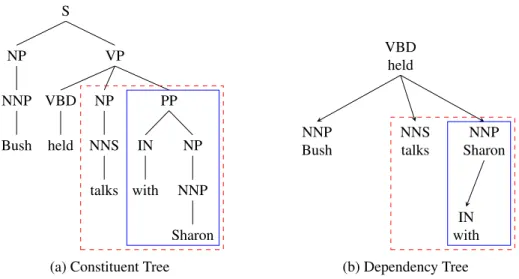
Compared withformallysyntax-based models,linguisticallysyntax-based models1make use of linguistic annotations and are believed to be better choices. One of the most widely used linguistic structures is constituent trees (as shown in Figure 1.3a) which provide syntactic categories and hierarchies of components (or phrases) in a sentence. However, translation models based on constituent structures (Galley et al., 2006; Liu et al., 2006; Huang et al., 2006a; Nesson et al., 2006; Zhang et al., 2007) could be constrained by rules which allow internal structures and linguistic annotations, because these rules may be too specific to be used during decoding (Koehn, 2010). In addition, these models usually focus on linguistically well-formed phrases (syntactic phrases, exactly covered by subtrees), such as the phrasewith Sharonin Figure 1.3a which is covered by the subtree rooted at the node PP. Therefore, non-syntactic phrases, such astalks with Sharonin Figure 1.3a, are ignored.
Different from constituent trees, dependency trees (as shown in Figure 1.3b) directly
1
Following Chiang (2005), in this thesis, tree-based models are distinguished according to whether they make use of grammars and linguistic annotations: formally syntax-based models are based on synchronous grammars, while linguistically syntax-based models are defined over structures informed by syntactic theory. A model can be both formally syntax-based and linguistically syntax-based when it uses both synchronous grammars and linguistic annotations.
S VP PP NP NNP Sharon IN with NP NNS talks VBD held NP NNP Bush
(a) Constituent Tree
VBD held NNP Sharon IN with NNS talks NNP Bush (b) Dependency Tree
Figure 1.3: Comparison of a constituent tree and a dependency tree of an English sentence. Following convention, edge directions are ignored in the constituent tree. The phrasewith Sharonin solid rectangles is an example of a syntactic phrase, while the phrasetalks with Sharonin dashed rectangles is an example of a non-syntactic phrase.
model syntactic and/or semantic relations between words in a sentence. The property enables dependency-based models to use and cover both syntactic phrases (Xie et al., 2011), such aswith Sharonin Figure 1.3b, and non-syntactic phrases connected in trees (Menezes and Quirk, 2005; Quirk et al., 2005; Xiong et al., 2007), such asBush held talks. However, non-syntactic phrases which are not connected in dependency trees, such astalks with Sharon in Figure 1.3b, are not considered.
1.3
Why Graphs And Which Type?
Although syntactic phrases are more reliable in quality and have linguistic meaning, dis-carding other phrases is a harsh decision, which usually does not work well in practice, as non-syntactic phrases can be quite useful to improve rule coverage and are extremely important to system performance (Koehn et al., 2003). Therefore, researchers have tried to patch tree-based models by using extended labels to cover non-syntactic phrases (Marcu et al., 2006; Almaghout et al., 2011; Almaghout et al., 2012). However, such methods do not change the fundamental linguistic theories and grammars used in their models. This
suggests that they may still have a weaker generative capacity over structures. In this sense, how to naturally handle non-syntactic phrases is still one of the major challenges in SMT.
The difficulty of handling non-syntactic phrases in tree-based models is mainly due to the fact that trees are recursive structures where subtrees rooted at sibling nodes do not overlap with each other, and thus phrases in trees are naturally divided into different groups: syntactic or non-syntactic. Even though dependency-based models could alleviate this by taking connected subgraphs into consideration (Menezes and Quirk, 2005; Quirk et al., 2005; Xiong et al., 2007; Chen et al., 2014), the number of subgraphs is still limited in dependency trees and thus plenty of phrases are not considered.
An obvious observation is that non-syntactic phrases which are not connected in trees could be connected in terms of sequential structures, such as the phrasetalks within Figure 1.3b. In this sense, the two structures complement one another. Since both trees and sequences are special cases of graphs, a possible way of integrating non-syntactic phrases into tree-based models is using graphs where the basic units are subgraphs and thus phrases have no syntactic types and are not distinguished.
Therefore, in this thesis, we explore the possibility of constructing graphs and design graph-based translation models which translate graphs into strings. We take subgraphs which are connected in graphs as the basic translation units. Compared with phrases or subtrees, these subgraphs are more flexible which may cover either syntactic or non-syntactic phrases in terms of tree structures.
Since dependency trees have the best inter-lingual phrasal cohesion property, i.e. phrases in one language tend to stay together during translation (Fox, 2002), and provide the flexibility of covering different types of phrases, in this thesis we construct graphs based on them. We call these graphsdependency graphs. In order to build graphs where non-syntactic phrases are connected, we add sequential relations into dependency trees. Figure 1.4 shows an example of a graph where an additional edge (in dash) is added to the dependency tree in Figure 1.3b so that the non-syntactic phrasetalks with Sharonis connected in the graph. The edge is added becausetalksandwithare adjacent words in the sequence. The
VBD held NNP Sharon IN with NNS talks NNP Bush
Figure 1.4: An example of a graph where an additional edge (dashed arrow) is added to a dependency tree so that the non-syntactic phrasetalks with Sharon(in the rectangle) is connected in the graph.
advantages of using dependency graphs are as follows:
• Compared with using hypergraphs in translation models (Jones et al., 2012), we can easily build a large training corpus by parsing sentences into trees and then adding sequential relations.
• These graphs encode both local relations from sequences and long-distance relations from trees and provide more flexible translation units than sequences and trees.
• Models based on these graphs can use both syntactic and non-syntactic phrases without distinction as long as they are connected in the graphs.
1.4
Research Questions
Because both dependency relations and sequential relations are included in dependency graphs, they provide more flexible translation units than dependency trees alone. Therefore, we would like to know whether such kinds of units improve a dependency tree-to-string model. This leads to our first research question:
RQ1 Can we improve dependency tree-to-string translation models by incor-porating more translation units implied by sequential relations?
InRQ1, we will examine two kinds of sequential relations: (i)bigram relationsbetween two continuous words which make all non-syntactic phrases available. For example, both held talks withandtalks with Sharonin Figure 1.3b are implied by bigram relations because they are continuous phrases; and (ii)sibling relationsbetween siblings. For example, in Figure 1.3b the three wordsBush,talks, andSharonare siblings because they have the same head wordheld. Even though the concept of siblings only exists in a tree structure, we treat it as a sequential relation because it will be used to connect subtrees and make non-syntactic phrases available. For example, the relation betweentalksandSharonin Figure 1.3b implies the availability of the phrasetalks with Sharon. Although, compared with bigram relations, sibling relations allow fewer phrases to be considered, the phrases connected by them are more linguistically motivated.
FollowingRQ1, we need to consider how to construct graphs which uniformly encode both dependency relations and sequential relations, and where phrases implied by these relations are connected. This leads to our second research question:
RQ2 Can we construct dependency graphs which combine dependency rela-tions and sequential relarela-tions in a unified representation?
Assuming the availability of graphs, how to translate them is another challenge. Inspired by phrase-based MT and treelet-based MT (Menezes and Quirk, 2005; Quirk et al., 2005) which segment input sequences or trees, we explore the possibility of taking connected subgraphs as the basic translation units in our graph-based translation model. One of the advantages of using subgraphs is that a subgraph may cover either a discontinuous phrase or a continuous phrase without distinction. Therefore, our next research question is as follows:
RQ3 Can we translate input graphs into target sentences by graph segmenta-tion where subgraphs, which may cover discontinuous phrases, are the basic translation units?
However, graph-based models using graph segmentation will have a similar reordering problem as in the phrase-based models. Inspired by using grammars for tree-based MT
Structure Segmentational Recursive
Sequence
• word-based models (Brown et al., 1988; Brown et al., 1990; Brown
et al., 1993)
• phrase-based models (Koehn et al., 2003)
–
Tree
• dependency treelet-to-string models (Menezes and Quirk, 2005; Quirk et al., 2005; Xiong et al., 2007)
• dependency edge-transfer models (Chen et al., 2014)
• hierarchical phrase-based models (Chiang, 2005; Chiang, 2007) • tree-to-string models (Liu et al.,
2006; Huang and Mi, 2010) • string-to-tree models (Galley
et al., 2006; Marcu et al., 2006) • tree-to-tree models (Nesson et al.,
2006; Zhang et al., 2007) • string-to-dependency models
(Shen et al., 2010)
• dependency-to-string models (Xie et al., 2011,RQ1)
Graph segmentational graph-to-string model (RQ2&RQ3)
• semantic-based models (Jones et al., 2012)
• recursive graph-to-string models (RQ2&RQ4)
Table 1.1: Comparison between our work and existing models in terms of two dimensions: (i) structures, including sequence, tree, and graph; and (ii) translation techniques, including segmentational and recursive.
to learn recursive translation rules, we further investigate the possibility of using graph grammars in our graph-based models. Accordingly, our final research question is:
RQ4 Can we translate graphs by using graph grammars which parse the graphs and simultaneously generate target sentences using recursive translation rules?
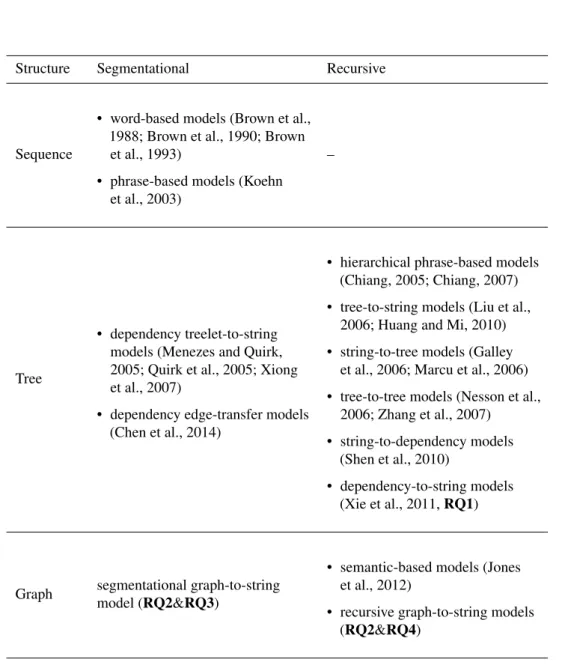
Table 1.1 compares our work with sequence-based and tree-based models which will be introduced in Chapter 2. We divide various models into groups according to structures (sequences, trees, and graphs) and translation techniques (segmentational and recursive) they use. segmentationalmeans that input structures are segmented into units and a complete translation is obtained by combining translations of these units, e.g. the phrase-based model. By contrast,recursivedenotes that inputs are translated by using recursive rules and a complete translation is obtained by recursively combining translations of lower-level structures, e.g. the hierarchical phrase-based model.
As shown in Table 1.1, inRQ1we will improve a dependency tree-to-string (also called dependency-to-string in this thesis) model. InRQ3we will present a graph-to-string model based on graph segmentation, while inRQ4we will translate graphs into strings based on graph grammars.RQ2provides methods of constructing dependency graphs which will be used subsequently inRQ3andRQ4. Table 1.2 compares our models with each other in detail which will be introduced in Chapters 3–5.
Note that our models use graph structures on the source side and translate graphs into strings. This separates our models from others which use structures on the target side, e.g. string-to-tree models (Galley et al., 2004; Galley et al., 2006; Marcu et al., 2006) and string-to-dependency models (Shen et al., 2010). During decoding, string-to-tree models translate a source sentence into a target tree which is constructedduringdecoding. By contrast, we construct source graphsbeforedecoding. Our models translate these graphs into target sentences by matching rules with them.
Dep2Str (RQ1) SegGBMT (RQ2) SNRG and SERG (RQ4) Graph used dependency tree dependency-bigram graph dependency-edge graph, dependency-sibling graph
Non-terminals yes no yes
Rule source
connected yes yes yes
gaps yes yes yes
continuity yes no yes
Rule target
gaps yes no yes
continuity yes yes yes
Table 1.2: Comparison between our translation models in three research questions, in terms of: graph structures used, whether rules use non-terminals, whether rule source is connected, whether rule source and target allow gaps, and whether rule source and target are required to cover continuous spans during decoding.
1.5
Thesis Structure
The rest of the thesis is structured as follows:
• In Chapter 2, we review the background and history of SMT. We will first introduce three kinds of statistical models: sequence-based models, tree-based models, and graph-based models. We will describe how these models are defined and their decoding algorithms for generating translations. Then, we introduce our experimental set-up, including data, tools, tuning algorithms, and automatic evaluation metrics. We will also build two baseline systems for comparison.
• In Chapter 3, we firstly review a dependency tree-to-string model and then improve it by using structures or phrases indicated by sequential relations which are useful to construct graphs. To achieve this, we propose a pseudo forest-to-string model which decomposes a dependency structure into smaller pieces. Such decomposition allows phrases implied by sibling relations to be covered. In experiments, we further integrate phrasal rules which are implied by bigram relations into our model by mixing them with other translation rules.
relations. We present a segmentational graph-based model which segments a graph into subgraphs. Translations can then be obtained by combining translations of each subgraph left-to-right. Furthermore, in order to take source context into consideration during the graph segmentation process, we propose a graph segmentation model to help select a better subgraph to translate.
• In Chapter 5, we build graphs which take dependency relations and sibling relations into consideration. Then, we use synchronous graph grammars to translate these graphs. The advantage of using synchronous grammars is that the learned recursive rules directly encode reordering information. In this chapter, two kinds of graphs are built: one is edge-labeled where sibling edges are connected, while the other is node-labeled where sibling links are directly added to dependency trees.
• We conclude in Chapter 6 with a summary of our work and contributions of the thesis. Then, we present avenues for future work.
1.6
Related Publications
The published papers related to this thesis are as follows:
1. Liangyou Li, Andy Way, and Qun Liu (2016). Graph-Based Translation Via Graph Segmentation. In: Proceedings of the 54th Annual Meeting of the Association for Computational Linguistics (Volume 1: Long Papers). Berlin, Germany, pages 97–107.
2. Liangyou Li, Andy Way, and Qun Liu (2015). Dependency Graph-to-String Trans-lation. In: Proceedings of the 2015 Conference on Empirical Methods in Natural Language Processing. Lisbon, Portugal, pages 33–43.
3. Liangyou Li, Jun Xie, Andy Way, and Qun Liu (2014). Transformation and Decom-position for Efficiently Implementing and Improving Dependency-to-String Model In Moses. In: Proceedings of SSST-8, Eighth Workshop on Syntax, Semantics and Structure in Statistical Translation. Doha, Qatar, pages 122–131.
It is remarkable that a science which began with the consideration of games of chance should have become the most important object of human knowledge.
— Pierre-Simon Laplace
Chapter 2
Statistical Machine Translation
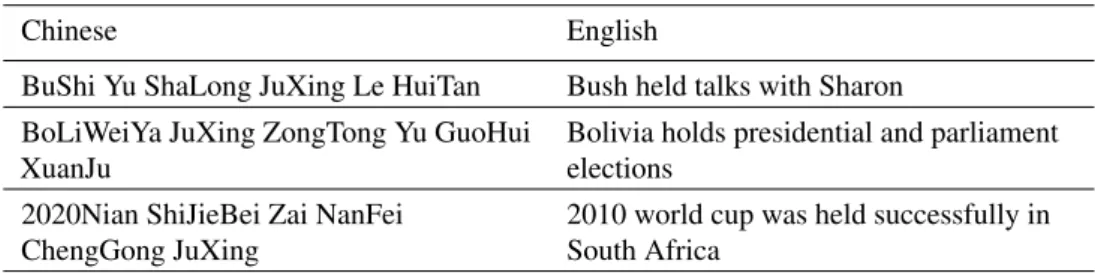
Typically, the first step of building an SMT system is (i) learning models from parallel corpora, which are defined over𝑝(𝑡|𝑠)to score each translation. A parallel corpus consists of texts in one language and their translations in another language. Table 2.1 shows examples of sentence pairs from a parallel corpus.
After obtaining models, we need to: (ii) tune parameters for these models so that good translations obtain relatively higher probabilities while bad translations obtain relatively lower probabilities; (iii) decode a source sentence to find its translation𝑡* in the target language so that𝑡* = arg max𝑡𝑝(𝑡|𝑠); (iv) evaluate translation performance of the system. In this thesis, we focus on the definition of𝑝(𝑡|𝑠), namely statistical models. Depend-ing on what kind of structural information is used, we divide different models into three
Chinese English
BuShi Yu ShaLong JuXing Le HuiTan Bush held talks with Sharon BoLiWeiYa JuXing ZongTong Yu GuoHui
XuanJu
Bolivia holds presidential and parliament elections
2020Nian ShiJieBei Zai NanFei ChengGong JuXing
2010 world cup was held successfully in South Africa
categories: sequence-based models, tree-based models, and graph-based models. We will firstly explain these models which have been explored in previous work. Then, we describe experimental settings in this thesis, including data, tools, tuning algorithms, evaluation metrics, and baseline systems.
2.1
Sequence-Based Models
Sequence-based models use sequential information of sentences to build models. The atomic translation units in sequence-based models are word sequences (or phrases). A final translation can be obtained by combining translations of each source phrase. These models include word-based models (Brown et al., 1988; Brown et al., 1990; Brown et al., 1993) and phrase-based models (Och et al., 1999; Koehn et al., 2003).
2.1.1 Word-Based Models
Word-based models were firstly introduced by IBM in the late 1980s. Thereafter, during the 2000s research in the field of SMT grew rapidly. Word-based models mathematically formulate SMT as a series of word-to-word translation. Given a parallel corpus, word-based models can learn word-translation probabilities, as illustrated in Table 2.2.
Word Alignment
A fundamental concept in word-based models is word alignment, which is a function defining many-to-many mappings from source words to target words in a sentence pair.
Source Word Target Word Probability
BuShi Bush 0.7 president 0.2 US 0.1 Yu and 0.6 with 0.4
BuShi Yu ShaLong JuXing Le HuiTan
Bush held talks with Sharon
Figure 2.1: Illustration of word alignments from a Chinese sentence (left) to an English sentence (top) as indicated by gray marks.
However, in word-based models, the learned word alignment only includes many-to-one mappings. Word alignment is treated as a latent variable which can be learned iteratively by the Expectation-Maximization algorithm (Dempster et al., 1977). This is based on the idea that the alignment can be deduced from translation probabilities of words while word-translation probabilities can be learned from word alignments. Figure 2.1 illustrates a word-alignment matrix between a Chinese sentence and an English Sentence.
Noisy-Channel Model
Inspired by the success of using information theory in automatic speech recognition, Brown et al. (1988) apply Bayes’ rule to𝑝(𝑡|𝑠)as in Equation (2.1):
𝑝(𝑡|𝑠) = 𝑝(𝑠|𝑡)𝑝(𝑡)
𝑝(𝑠) (2.1)
Since the probability𝑝(𝑠)is identical for a given source sentence𝑠, it has no impact on the selection of translations and thus can be ignored. Therefore, the task of finding the best translation can be formulated as in Equation (2.2):
𝑡* = arg max 𝑡 𝑝(𝑡|𝑠) = arg max 𝑡 𝑝(𝑠|𝑡)𝑝(𝑡) (2.2)
translation model probabilitywhile𝑝(𝑡)is called thelanguage model probability. The way of combining the two probabilities is called thenoisy-channel model.
IBM Models
Brown et al. (1993) proposed five models over𝑝(𝑠|𝑡). Model 1 assumes that the probability of a source word being produced by a target word only depends on the target word as in Equation (2.3): 𝑝(𝑠|𝑡) = 𝜀 (𝑙+ 1)𝑚 𝑚 ∏︁ 𝑗=1 𝑙 ∑︁ 𝑖=0 𝑝(𝑠𝑗|𝑡𝑖), (2.3)
where𝑚is the length of the source sentence𝑠,𝑙is the length of the target sentence𝑡, and 𝜀is a constant. However, in Model 1 source words can be arbitrarily aligned to any target words. So Model 2 explicitly models the alignment as in Equation (2.4):
𝑝(𝑠|𝑡) =𝜀 𝑚 ∏︁ 𝑗=1 𝑙 ∑︁ 𝑖=0 𝑝(𝑠𝑗|𝑡𝑎𝑗)𝑎(𝑎𝑗|𝑗, 𝑚, 𝑙), (2.4)
where𝑎(𝑎𝑗|𝑗, 𝑚, 𝑙)denotes the probability of a source word at the position𝑗being aligned
with a target word at the position𝑎𝑗 given the source sentence length𝑚and target sentence
length 𝑙. Because Model 2 does not explicitly model many-to-one alignments, Model 3 introduces a fertility probability 𝑛(𝜑𝑖|𝑡𝑖) which models the case that one target word
𝑡𝑖 corresponds to the number of 𝜑𝑖 source words. Model 3 also changes the alignment
probability𝑎into a distortion model𝑑(𝑗|𝑎𝑗, 𝑚, 𝑙)which can be seen as a simple reordering
model. Model 4 refines Model 3 by replacing the position-based distortion model with a class-based distortion model. Model 5 refines Model 4 by addressing a deficiency where probabilities are assigned to impossible events.
Language Model
The language model𝑝(𝑡)is an essential component in SMT systems as it can help to find a more fluent translation by considering word order on the target side. Given a sentence
𝑡= (𝑤1, 𝑤2,· · ·, 𝑤𝑙), the language model can be formulated as in Equation (2.5): 𝑝(𝑤1, 𝑤2,· · ·, 𝑤𝑙) = 𝑙 ∏︁ 𝑖=1 𝑝(𝑤𝑖|𝑤1,· · ·, 𝑤𝑖−1) (2.5)
Standard SMT systems use𝑛-gram language models which are based on the assumption that the probability of a word only depends on the previous𝑛−1words, as in Equation (2.6). 𝑝(𝑤1, 𝑤2,· · ·, 𝑤𝑙) = 𝑙 ∏︁ 𝑖=1 𝑝(𝑤𝑖|𝑤𝑖−𝑛+1,· · ·, 𝑤𝑖−1) (2.6) where 𝑝(𝑤𝑖|𝑤𝑖−𝑛,· · ·, 𝑤𝑖−1) = count(𝑤𝑖−𝑛+1,· · ·, 𝑤𝑖−1, 𝑤𝑖) ∑︀ 𝑤count(𝑤𝑖−𝑛+1,· · ·, 𝑤𝑖−1, 𝑤) (2.7) 2.1.2 Phrase-Based Models
Phrase-based models extend word-based models by translating phrases instead of single words. In this case, a phrase means only a sequence of continuous words in a sentence, which is not necessarily related to the linguistic notion of a phrase. Different from word-based models where many-to-one word mappings exist, phrase-based models imply a one-to-one phrase alignment, as illustrated in Figure 2.2. Thanks to the capability of capturing local phenomena, translating word groups instead of single words can help to solve translation ambiguities. Therefore, since the 2000s phrase-based models have replaced word-based models as the state-of-the-art in SMT.
The word alignment produced by word-based models only considers one direction, namely a target word is aligned to multiple source words. Instead, phrase-based models
BuShi Yu ShaLong JuXing Le HuiTan
Bush held talks with Sharon
Figure 2.2: An illustration of a one-to-one phrase alignment in a phrase-based model. Dashed lines indicate word alignments.
use a refined word alignment which is obtained by symmetrizing IBM models in both directions (Och and Ney, 2003). The refined word-alignment model consists of many-to-many mappings between words. This means multiple source words can be aligned to one target word and vice versa.
Model Definition
Given a pair of sentences⟨𝑠 = 𝑠1· · ·𝑠𝐼, 𝑡 = 𝑡1· · ·𝑡𝐼⟩, in the conventional phrase-based
model,𝑝(𝑠|𝑡)is defined as in Equation (2.8):
𝑝(𝑠𝐼1|𝑡𝐼1) = 𝐼
∏︁
𝑖=1
𝑝(𝑠𝑎𝑖|𝑡𝑖)𝑑(𝑠𝑎𝑖, 𝑠𝑎𝑖−1) (2.8)
The target sentence𝑡is broken into𝐼phrases𝑡1· · ·𝑡𝐼, each of which is a translation of a
source phrase𝑠𝑎𝑖. The distortion function𝑑is a simple reordering model which is based on
the distance between the start position of𝑠𝑎𝑖and the end position of𝑠𝑎𝑖−1.
The performance of phrase-based models relies on the quality of phrase pairs in a translation table, which consists of all phrase pairs extracted from a parallel corpus associated with translation probabilities. Table 2.3 shows an example of a translation table with probabilities𝑝(𝑡|𝑠). Conventionally, a phrase pair⟨𝑠, 𝑡⟩has two properties: (i)𝑠and𝑡are continuous phrases; and (ii) ⟨𝑠, 𝑡⟩is consistent with a word alignment 𝑎(Och and Ney, 2004):
∀(𝑖, 𝑗)∈𝑎, 𝑠𝑖 ∈𝑠⇔𝑡𝑗 ∈𝑡and∃𝑠𝑖 ∈𝑠, 𝑡𝑗 ∈𝑡,(𝑖, 𝑗)∈𝑎.
which means no word is aligned to another word outside the phrase pair. For example, given
Source Phrase Target Phrase Probability
BuShi
Bush 0.5
president Bush 0.3 the US president 0.2
BuShi Yu Bush and 0.7
the president and 0.3
the word-aligned sentence pair in Figure 2.2, we can extract a phrase pair⟨JuXing Le,held⟩, but we cannot extract⟨JuXing,held⟩because the target wordheldis aligned to an outside source wordLe.
Because phrase boundaries are unavailable, phrase-based models involve jointly seg-menting a source sentence into phrases and translating the phrases. The decoding objective can be formulated as a sum over all possible derivations:
𝑡*= arg max 𝑡
∑︁
𝑑
𝑝(𝑠, 𝑑|𝑡)𝑝(𝑡) (2.9)
where 𝑑 ∈ 𝐷(𝑠, 𝑡) is a derivation which implies a segmentation of 𝑠 and generates a target sentence𝑡. However, the summation in Equation (2.9) is computationally intractable (Williams, 2014). Thus, conventionally the objective is approximated as finding the best derivation, as in Equation (2.10):
𝑡* = arg max 𝑡,𝑑
𝑝(𝑠, 𝑑|𝑡)𝑝(𝑡) (2.10)
Log-Linear Model
Och and Ney (2002) proposed a more general framework to replace the noisy-channel model. Following the maximum entropy model (Berger et al., 1996), the probability of a translation can be formulated as in Equation (2.11):
𝑝(𝑡|𝑠) = exp{ ∑︀𝑀 𝑖=1𝜆𝑖ℎ𝑖(𝑠, 𝑡)} ∑︀ 𝑡′exp{ ∑︀𝑀 𝑖=1𝜆𝑖ℎ𝑖(𝑠, 𝑡′)} , (2.11)
whereℎ𝑖(𝑠, 𝑡)are feature functions defined over the source𝑠and the target𝑡,𝜆𝑖are feature
weights, and𝑀is the number of feature functions considered. By ignoring the denominator as it is constant for a given source sentence, the translation can be obtained by Equation (2.12): 𝑡* = arg max 𝑡 𝑀 ∑︁ 𝑖=1 𝜆𝑖ℎ𝑖(𝑠, 𝑡) (2.12)
<s> held .. . with .. . .. . .. . Bush held talks with Sharon .. . .. . talks
Figure 2.3: Illustration of the search space in phrase-based models to translate a Chinese sentence BuShi Yu ShaLong JuXing Le HuiTan. When a node is expanded by a phrase translation, the corresponding source positions in the coverage vector are marked as translated (in gray). The path in bold implies a complete translation.
As Och and Ney (2002) pointed out, the noisy-channel model is a special case of Equation (2.12) (when 𝑀 = 2, 𝜆1 = 𝜆2 = 1, ℎ1 = log𝑝(𝑠|𝑡) and ℎ2 = log𝑝(𝑡)). One of the advantages of the log-linear model is that it can integrate an arbitrary number of feature functions whose weights are tunable. These features usually can significantly improve a system.
Decoding Based on Beam Search
Phrase-based decoders generate hypotheses (partial translations) from left to right. Each hypothesis maintains acoverage vectorto indicate which source words have been translated so far. A hypothesis can be extended on the right by translating an uncovered source phrase. The translation process ends when all source words have been translated.
Figure 2.3 shows a search space, which is represented in a tree structure, of translating a sentence from Chinese to English using a phrase-based model. Translation begins with the start symbol<s>. When a node is extended by a translation of an uncovered source phrase, the corresponding positions in the coverage vector are then marked as translated. A path
0 1 • • • 2 • • •• •• 3 ••• ••• ••• 4 •••• •••• ••••
Figure 2.4: Beam search for phrase-based models (Liu and Huang, 2014). Hypotheses covering the same number of source words (integers under stacks) are grouped in the same stack. • denotes a covered source position while indicates an uncovered position.
from the start node to a leaf node implies a translation.
However, the time complexity of an exhaustive search in the search space is exponential to the input length (Knight, 1999). Therefore, beam search (as in Figure 2.4) is usually taken as an approximate search strategy to reduce the size of the decoding space. Hypotheses which cover the same number of source words are grouped in a stack where hypotheses can be pruned according to their partial translation cost and an estimated future cost.
2.1.3 Shortcomings of Sequence-Based Models
One of the significant drawbacks of sequence-based models lies in reordering words. Al-though phrase-based models extend word-based models by considering word groups which capture word order within phrases, they cannot reorder the phrases themselves. Therefore, by default, a distance-based reordering function as in Equation (2.8) is adopted. More sophisticated reordering models (Koehn et al., 2005; Xiong et al., 2006; Galley and Manning, 2008; Cherry, 2013) can also be used to build a stronger phrase-based system. However, sequence-based models are still known to be weak at long-distance reordering.
Another disadvantage of conventional sequence-based models is that only continuous phrases are considered, and thus the learned translation pairs cannot be generalized even though sometimes an apparent pattern can be recognized. Galley and Manning (2010) extend conventional phrase-based models by allowing phrases with gaps (discontinuous phrases). However, without using linguistic knowledge, the model can learn plenty of unreliable translation rules resulting in a huge model and a slower system.
2.2
Tree-Based Models
Tree-based (or syntax-based) models are proposed to solve problems in sequence-based models by learning translation rules which allow phrase reordering and generalization. Based on which kind of syntax structures is used, we explain tree-based models in three categories: Hierarchical Phrase-Based (HPB) models (Chiang, 2005; Chiang, 2007), constituent tree-based models (Galley et al., 2004; Galley et al., 2006; Liu et al., 2006; Huang et al., 2006a; Nesson et al., 2006; Zhang et al., 2007), and dependency tree-based models (Menezes and Quirk, 2005; Quirk et al., 2005; Xiong et al., 2007; Xie et al., 2011).
2.2.1 Hierarchical Phrase-Based Models
A hierarchical phrase is an extension of a phrase by allowing gaps where other hierarchical phrases are embedded. Recursively using hierarchical phrases produces a tree structure where no linguistic annotations are included. The HPB model is a formally syntax-based model, which is formulated by a Synchronous Context Free Grammar (SCFG) (Lewis and Stearns, 1968), as in Definition 2.1.
Definition 2.1. An SCFG is a tuple⟨𝑁, 𝑇, 𝑇′, 𝑃, 𝑆⟩, where • 𝑁 is a finite set of non-terminal symbols.
• 𝑇 and𝑇′are finite sets of terminal symbols. • 𝑆∈𝑁 is the start symbol.
• 𝑃 is a finite set of productions of the form(𝐴→ ⟨𝑅, 𝑅′,∼⟩), where𝐴∈𝑁,𝑅is a sequenceover𝑁⋃︀
𝑇 and𝑅′is asequenceover𝑁⋃︀
𝑇′.∼is a one-to-one mapping between non-terminal symbols in𝑅and𝑅′.
Model Definition
In HPB model, gaps are represented by a generic non-terminal symbol𝑋. Therefore, rules in the HPB model are in the form of (2.13):
𝑋 → ⟨𝛾, 𝛼,∼⟩, (2.13)
where𝛾is a string over source terminal symbols and non-terminals,𝛼is a string over target terminal symbols and non-terminals, and∼is a one-to-one mapping between non-terminals in𝛾 and𝛼and indicates reordering information. An example of a recursive rule is as in (2.14):
𝑋 → ⟨BuShi𝑋[1]JuXing Le𝑋[2], Bush held𝑋[2]𝑋[1]⟩, (2.14) where indexes on non-terminals indicate the mappings. Note that, when no non-terminals exist in𝛼and𝛾, rules are used to translate phrases as in the phrase-based model, such as (2.15).
𝑋 → ⟨Yu ShaLong, with Sharon⟩, (2.15) All HPB rules can be automatically learned from word-aligned sentence pairs. A rule extractor firstly extracts rules without non-terminals which will be subsequently used to produce recursive rules by replacing phrase pairs inside them with non-terminals. Figure 2.5 illustrates how to extract the rule (2.14) from a sentence pair according to a given word alignment, where the phrase pair⟨Yu ShaLong, with Sharon⟩is replaced by𝑋[1] while the phrase pair⟨HuiTan, talks⟩is replaced by𝑋[2].
In addition to translation rules above, two glue rules are used for robustness:
𝑆→ ⟨𝑆[1]𝑋[2], 𝑆[1]𝑋[2]⟩ (2.16a)
𝑆→ ⟨𝑋[1], 𝑋[1]⟩ (2.16b)
BuShi Yu ShaLong JuXing Le HuiTan
Bush held talks with Sharon Bush held 𝑋[2] 𝑋[1]
BuShi
𝑋[1]
JuXing Le
𝑋[2]
Figure 2.5: Illustrating the extraction of a hierarchical phrase-based rule. Two phrase pairs (in bold rectangles) are replaced by the general non-terminal𝑋. Mappings between source (left) and target (top) non-terminals are indicated by indexes.
will be translated separately, and then their translations are combined without reordering. With the help of glue rules, we can make sure to obtain at least one translation of any sentence.
Similar to phrase-based models, the probability𝑝(𝑡|𝑠) is approximated by𝑝(𝑑)as in Equation (2.17) which follows the log-linear model:
𝑝(𝑑)∝
𝑀
∏︁
𝑖=1
𝜑𝑖(𝑑)𝜆𝑖 (2.17)
where𝑑 =𝑟1𝑟2· · ·𝑟𝑛 is a derivation consisting of a sequence of rules𝑟𝑗,𝜑𝑖 are feature
functions while𝜆𝑖are feature weights.1 The best translation𝑡*can be obtained by searching
for the best derivation, as in Equation (2.18):
𝑡* = arg max 𝑡,𝑑 𝑝(𝑑) = arg max 𝑡,𝑑 𝑀 ∑︁ 𝑖=1 𝜆𝑖log𝜑𝑖(𝑑) (2.18) Chart Decoding
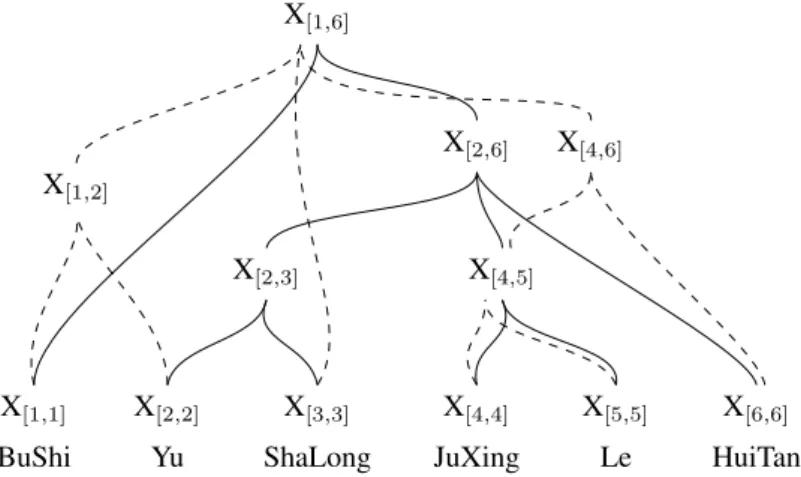
The best translation in HPB models can be obtained via chart parsing using the CYK algorithm (Kasami, 1965; Younger, 1967; Cocke and Schwartz, 1970). Chart decoders generate hypotheses bottom-up. Each hypothesis is a translation of a phrase which covers
1
Note thatℎ𝑖in Equation (2.12) equals tolog𝜑𝑖in Equation (2.18). In the rest of the thesis, by default
X[1,1] X[2,2] X[3,3] X[4,4] X[5,5] X[6,6]
BuShi Yu ShaLong JuXing Le HuiTan
X[2,3] X[4,5]
X[2,6]
X[1,6]
X[1,2]
X[4,6]
Figure 2.6: A derivation hypergraph consisting of two derivations marked by different types of lines. Edges indicate rules. Each node denotes a stack which covers a source span[𝑖, 𝑗]
and has a non-terminal𝑋. Different translations of the same source span are organized into the same stack.
a continuous span of an input sentence. Translations of smaller spans can be combined to produce translations of large spans by using translation rules which contain non-terminals. Non-terminals associated with their mappings in these rules work as the function of place-holders which specify the positions and order of smaller translations.
The search space of chart decoding can be represented by a hypergraph which contains all possible derivations, as illustrated in Figure 2.6. Each node represents a set of translations of a source span. Each edge in the hypergraph implies a rule application. Similar to phrase-based decoders (cf. Figure 2.4), hypotheses which cover the same source span are organized into the same stack so that they can be pruned and recombined.
Applying a rule which contains two non-terminals involves a combination of translations from two stacks. Assuming we have𝑚such rules covering the same source span and each stack stores𝑛translations, to obtain translations of the span, the decoder needs to consider all𝑚𝑛2possibilities. In practice, such an exhaustive search slows systems down, so cube pruning (Chiang, 2007) is used to quickly combine translations from multiple stacks, where rules and chart translations are sorted and then dynamically combined.
Integration of Linguistic Knowledge
Due to the lack of linguistic knowledge, the only non-terminal𝑋often makes the HPB model hard to select the most appropriate rule. Therefore, some work refines this non-terminal using linguistic information, such as syntactic categories from constituent structures (Zollmann and Venugopal, 2006), Part-of-Speech (POS) tags or word classes (Zollmann and Vogel, 2011), Combinatory Categorial Grammar (CCG)-based supertags (Almaghout et al., 2011; Almaghout et al., 2012), and head information from dependency structures (Li et al., 2012a).
2.2.2 Constituent Tree-Based Models
A constituent (or phrasal) structure displays the functional components of a sentence. Based on which side is parsed into such a syntactic tree, models are categorized into three groups: string-to-tree models, tree-to-string models, and tree-to-tree models. Typically, these models can be formulated in a Synchronous Tree Substitution Grammar (STSG) (Eisner, 2003), as in Definition 2.2. We found that while𝑅and𝑅′ in𝑃 in Definition 2.1 are strings, in Definition 2.2 they are trees. STSG can be seen as an extension of SCFG by considering multi-level tree structures and thus has a stronger generative capacity over tree pairs (Chiang, 2012).
Definition 2.2. An STSG is a tuple⟨𝑁, 𝑇, 𝑇′, 𝑃, 𝑆⟩, where • 𝑁 is a finite set of non-terminal symbols.
• 𝑇 and𝑇′are finite sets of terminal symbols. • 𝑆∈𝑁 is the start symbol.
• 𝑃 is a finite set of productions of the form(𝐴→ ⟨𝑅, 𝑅′,∼⟩), where𝐴∈𝑁,𝑅is a treeover𝑁⋃︀
𝑇 and𝑅′ is atreeover𝑁⋃︀
𝑇′. ∼is a one-to-one mapping between non-terminal symbols in𝑅and𝑅′.
VP PP[1] NP NNS talks VBD held 𝑋[1]JuXing Le HuiTan,
Figure 2.7: An example of a string-to-tree translation rule.𝑋is the general non-terminal on the source side whilePPand other non-leaf nodes are target non-terminals. Indexes on non-terminals indicate mappings between source and target non-terminals.
String-to-Tree Models
String-to-tree models can be traced back to Yamada and Knight (2001) and Yamada and Knight (2002) who assumed that a source sentence is obtained by processing each node of a target tree using several operations, including insertion, reordering, and translation. The translation task is to recover the target tree given the source sentence. Galley et al. (2004) and Galley et al. (2006) proposed a stronger string-to-tree model. Given a word alignment, this model automatically extracts transfer rules from a source string and a target tree. These rules map source phrases into target tree fragments.
Figure 2.7 shows an example of a typical rule in a string-to-tree model. The source side of a rule is a string over source terminals and non-terminals while the target side is a tree structure consisting of target non-terminals and terminal leaves. Similar to the HPB model, these rules can be recursively extracted by replacing smaller rules with non-terminals, as illustrated in Figure 2.8.
Given a source sentence, based on the CYK algorithm, the decoding process involves in parsing the input bottom-up using hierarchical phrases on the source side of rules and simultaneously generating a target tree. Target strings can be simply read off of the leaves of target trees.
S VP PP NP NNP Sharon IN with NP NNS talks VBD held NP NNP Bush
BuShi Yu ShaLong JuXing Le HuiTan
Figure 2.8: Illustrating the extraction of the string-to-tree rule in Figure 2.7 from a string–tree pair in lighter gray. The string–tree pair in darker gray is replaced by non-terminals. Dashed lines indicate the word alignment between source and target words.
Tree-to-String Models
Different from string-to-tree models, tree-to-string models are based on parse trees on the source side (Huang et al., 2006a; Huang et al., 2006b; Liu et al., 2006). At first, a source sentence is parsed into a constituent tree, and then translation rules, whose source sides are trees and target sides are strings, are extracted based on word alignments. During decoding, each node in the source tree is translated in a bottom-up manner. For a subtree rooted at a current node, the decoder uses a matched rule to translate the subtree into a target string, and non-terminals in the rule are replaced by translations of subtrees rooted at lower nodes. Compared with string-to-tree models, tree-to-string models can decode a sentence in linear time in practice with respect to the sentence length (Huang and Mi, 2010).
Tree-to-Tree Models
In a tree-to-tree model, both the source side and the target side of a rule are trees, as illustrated in Figure 2.9. Typically, two approaches are used in tree-to-tree models: (i) Given a source tree, transfer rules convert it to a target tree (Zhang et al., 2007); (ii) Given a source sentence, the decoder parses it and simultaneously produces a target tree (Nesson et al., 2006).
VP VP NP NN HuiTan AS Le VV JuXing PP[1] , VP PP[1] NP NNS talks VBD held
Figure 2.9: An example of a tree-to-tree translation rule. Indexes on non-terminals indicate mappings between source and target non-terminals.
One of the major challenges in a tree-to-tree model is the structural divergence between languages (Dorr, 1994), which is due to either systematic differences between two languages in expressing a concept syntactically or relatively free translations in the training corpora (Zhang et al., 2007).
2.2.3 Dependency Tree-Based Models
Dependency structures directly model relations between words in a sentence, each of which indicates the syntactic and/or semantic function of one word in relation to another word. Since dependency structures have the best inter-lingual cohesion property, it has been demonstrated to be helpful in SMT.
Shen et al. (2010) presented a model which is based on HPB models with the extension of a target dependency tree. The model focuses on well-formed dependency structures which are defined as fixed/floating structures. A fixed structure consists of a head and subtrees rooted at its children while a floating structure consists of subtrees rooted at consecutive sibling nodes. Figure 2.10 shows examples of fixed and floating structures in a dependency tree. Since both structures cover continuous spans, it is easier to integrate a dependency-based language model which scores a node according to its head and adjacent siblings and can significantly improve the system.
VBD held NNP Sharon IN with NNS talks NNP Bush
Figure 2.10: Examples of a fixed structure (in the solid rectangle) and a floating structure (in the dashed rectangle) in a dependency tree. While a fixed structure consists of a head node and subtrees rooted at the children of the head node, a floating structure only consists of subtrees rooted at sibling nodes. Both structures cover continuous spans of a sentence.
VV JuXing NN HuiTan AS Le NR ShaLong P Yu NR Bushi
(a) dependency tree
VV JuXing NN HuiTan AS Le NR Bushi ↓
Bush held talks (b) translation rule
Figure 2.11: A dependency treelet-to-string translation rule (b) which can be applied to the treelet in gray in (a).
Quirk, 2005; Quirk et al., 2005), which utilizes dependency structures on the source side and projects them to the target side. Treelet-based decoders translate a dependency tree by bottom-up traversing the tree. Translations of a subtree can be obtained by combining translations of its disjoint treelets. Xiong et al. (2007) extended the treelet approach to allow gaps in treelets and used treelet-to-string rules. Figure 2.11 shows a rule to translate a dependency treelet into a target string. However, in these work, translation rules do not encode enough reordering information. Thus, another heuristic or separate reordering model is usually adopted to decide the positions of target words.
tree-to-VV JuXing NN HuiTan AS Le NR ShaLong P Yu NR Bushi VP:VV AS NN
(a) Use non-syntactic phrases which are cov-ered by constituent nodes (Meng et al., 2013).
VP:VV AS NNis a special label to represent a non-syntactic phrase in shadow, whereVPis a constituent label. VV JuXing NN HuiTan AS Le NR ShaLong P Yu NR Bushi VV AS NN
(b) Use non-syntactic phrases which are covered by fixed or floating structures (Xie et al., 2014).
VV AS NNis a special label to represent a non-syntactic phrase in shadow which is covered by a fixed structure.
Figure 2.12: Two ways of creating labels to use non-syntactic phrases in a dependency tree
string model which is defined by a synchronous grammar similar to SCFG but including dependency relations. This model will be described in detail in Chapter 3. One of the significant weaknesses in the model is that it only considers syntactic phrases which are covered by complete subtrees. Since dependency trees are flatter than constituent trees, this model has a severe data-sparsity problem (Meng et al., 2013; Xie et al., 2014). To incorporate non-syntactic phrases, Meng et al. (2013) proposed to simultaneously use dependency trees and constituent trees so that phrases which are non-syntactic in dependency trees but syntactic in constituent trees can be covered. Figure 2.12a shows an example where a special label consisting of both a constituent label and POS tags of words is created to represent a non-syntactic phrase. By contrast, Xie et al. (2014) incorporated fixed and floating structures into the dependency tree-to-string model by creating special labels (as shown in Figure 2.12b) at run-time. However, to allow these special labels, both methods require a significant modification on the decoder. In addition, the number of non-syntactic phrases they use is very limited. In Chapter 3, we will present a simpler yet effective way to cover non-syntactic phrases.
2.2.4 Shortcomings of Tree-Based Models
When linguistic trees are used, translation performance of a system can be impacted by the accuracy of syntactic parsers (Quirk and Corston-Oliver, 2006). To alleviate this, several parse trees of a sentence can be compactly represented as a forest (Mi et al., 2008; Tu et al., 2010) which can then be used for translation. Joint parsing and translation (Liu and Liu, 2010) can also reduce the propagation of parsing errors.
Another significant challenge in linguistic tree-based models is integrating non-syntactic phrases which are not linguistically well-formed but can be important to translation perfor-mance of systems (Koehn et al., 2003; Hanneman and Lavie, 2009; Huck et al., 2014). To make use of such phrases, additional non-terminal symbols (Marcu et al., 2006; Zollmann and Venugopal, 2006; Almaghout et al., 2011; Almaghout et al., 2012) and binarization of syntax trees (Zhang et al., 2006; Wang et al., 2007) may be needed. However, such kinds of relaxation of syntactic constraints can result in less grammatical translations (Kaljahi et al., 2012).
Compared with constituent trees, dependency trees provide more flexible translation units, such as treelets or paths (Lin, 2004). However, sub-structures which are not connected in trees but which can significantly improve translation performance (Xie et al., 2014), such as the floating structure in Figure 2.10, are usually ignored.
By contrast, because the HPB model is not based on linguistically syntactic structures, it avoids the definition of linguistically syntactic and non-syntactic phrases and thus can make use of both without distinction. However, without linguistic annotations, the model usually is huge in size and has a problem with rule selection (He et al., 2008).
2.3
Graph-Based Models
Despite the use of syntax in tree-based models, it is still frequently unable to preserve basic meaning structures across languages. Therefore, as a more general and powerful representation than trees, graphs are introduced to better represent sentences. For instance,
MISS CAT ANNA instance patient agent instance owner instance Anna fehlt ihrem Kater
Anna’s cat is missing her
Figure 2.13: Illustration of semantic-based translation (Jones et al., 2012). A source sentence is firstly parsed into a hypergraph which is then converted to a target string.
Abstract Meaning Representation (AMR) (Banarescu et al., 2013) uses hypergraphs to represent semantic meanings of sentences.
Jones et al. (2012) presented a semantics-based translation model, where the semantic meaning of a sentence is represented in a hypergraph. This model is based on a Synchronous Hyperedge Replacement Grammar (SHRG) (Drewes et al., 1997) and translates a sentence in two steps, as shown in Figure 2.13: (i) parsing a source string into a hypergraph using a source SHRG; and (ii) the 1-best source hypergraph is transformed into a target string using a target SHRG. However, the recognition algorithm for SHRG is in polynomial time but potentially of a high degree (Lautemann, 1990; Chiang et al., 2013). Furthermore, large parallel corpora annotated with hypergraphs are not readily available.
2.4
Experimental Set-up
In this thesis, we conduct large-scale experiments on two language pairs: Chinese–English (ZH–EN) and German–English (DE–EN). The two language pairs are selected because they have syntactically different word order, and thus long-distance reordering is much more important to translation performance of SMT systems. We hypothesize that dependency trees are suitable for the two language pairs as they directly encode syntactic and/or semantic relations between words, and dependency-based systems have the potential to perform long-distance reordering. Furthermore, the two language pairs have different linguistic characteristics which may have a different impact on our SMT systems: