Joint Bachelor Thesis in Mobile
Interdisciplinary Higher Education Center (CFIS-UPC)
Using Trusted Execution Environments for
Secure Stream Processing of Medical Data
Spring Semester - May 2019
Author:
Carlos Segarra Gonz´alez1,2
Supervisors:
Jos´e Adri´an Rodr´ıguez Fonollosa1
Ricard Delgado-Gonzalo2
1 Universitat Polit`ecnica de Catalunya BarcelonaTech, Barcelona, Spain 2 Swiss Center for Electronics and Microtechnology (CSEM), Neuchˆatel, CH
In partial fulfillment of the requirements for the
Bachelor’s Degree in Mathematics
and
iii
Muchos a˜nos despu´es, frente al pelot´on de
fusilamiento, el coronel Aureliano Buend´ıa hab´ıa de recordar aquella tarde remota en que su padre lo llev´o a conocer el hielo. Macondo era entonces una aldea de veinte casas de barro y ca˜nabrava
construidas a la orilla de un r´ıo de aguas di´afanas que se precipitaban por un lecho de piedras pulidas, blancas y enormes como huevos prehist´oricos. El mundo era tan reciente, que muchas cosas carec´ıan de nombre, y para mencionarlas hab´ıa que
se˜nalar´ıas con el dedo.
v
Note from the Author
The work here presented is my Bachelor’s Thesis for my joint degree in Mathematics and Telecommunications Engineering within the Interdisciplinary Higher Education Center (CFIS) from the Polytechnic University of Catalonia (UPC). It has been developed during a six-month internship at the Swiss Center for Electronics and Microtechnology (CSEM) under the supervision of Ricard Delgado-Gonzalo, in the Embedded Software group. Professor Jos´e Adri´an Rodr´ıguez Fonollosa, from the UPC, has co-advised this project, and has been the official tutor with regard to the university.
Parts of this work have been included in two different conference papers which have been accepted and will be published in their respective proceedings. The first one is entitled Secure Stream Processing for Medical Data [1] and will be presented at the 41st IEEE Engineering in Medicine and Biology Conference (EMBC ’19) to be held in Berlin, Germany, from July 23-27 2019. It focuses on a particular medical application our work could be used in. The second one is entitled Using Trusted Execution Environments for Secure Stream Processing of Medical Data [2] and will be presented in the 19th International Conference on Distributed Applications and Interoperable Systems (DAIS ’19) to be held in Copenhagen, Denmark, from June 17-21 2019. It covers our solution’s implementation in-depth and evaluates its performance.
vii
Declaration of Authorship
I hereby declare that, except where specific reference is made to the work of others, this Bachelor’s thesis has been composed by me and it is based on my own work. None of the contents of this dissertation have been previously published nor submitted, in whole or in part, to any other examination in this or any other university.
Signed:
ix
Acknowledgments
These lines end a five year endeavour, during which I have met people, and learnt things that will stick with me for the years to come. Many have given me a hand along the way, but there are a certain few without which this work would have never seen the light. I would like to take this moment and thank them for their help.
First of all, I would like to thank Ricard Delgado and the Swiss Center for Electronics and Mi-crotechnology for hosting me during the six month internship that enabled me to focus completely on my work. Ricard has been an unsurpassable host and, together with Enric Muntan´e, they made Neuchˆatel feel like a home away from home. Secondly, I would like to thank Valerio Schiavoni from the University of Neuchˆatel. It was him who proposed the initial topic, it was him who provided the contact with Peter Pietzuch and Pierre-Louis Aublin, who gladly granted me with developer access to their on-going projects, and it was him who, week in and week out, helped me keep the bigger picture and paved the way for the personal success this work has been. Lastly, I would like to thank Professor Jos´e Adri´an Rodr´ıguez Fonollosa for always answering my doubts and helping me without hesitation.
On a more personal note, I would like to thank my parents for their unconditional love and support throughout all these years. Without their guidance during decisive moments, I would not be writing these lines today. I would also like to express my most sincere gratitude to Jos´e Andr´es, only he knows what has taken us to be here today, and I owe a good part of it to him. Finally, I must devote some words to Clara. Even though time might now be scarce, she has taught me more about myself than I would have learnt in a lifetime without her.
Carlos Segarra Gonz´alez Neuchˆatel, May 13, 2019
xi
Abstract
Using Trusted Execution Environments for Secure Stream Processing
of Medical Data
by
Carlos Segarra Gonz´
alez
Processing sensitive data, specially medical data produced by body sensors, on third-party un-trusted clouds is particularly challenging without compromising the privacy of the users generating it. Typically, these sensors generate large quantities of continuous data in a streaming fashion. Such vast amount of information must be processed efficiently and securely, even under strong adversarial models. The recent introduction in the mass-market of consumer-grade processors with Trusted Execution Environments (TEEs), such as Intel SGX, paves the way to implement solutions that overcome less flexible approaches, such as those atop homomorphic encryption.
This Bachelor Thesis presents a secure streaming processing system built on top of Intel SGX. To showcase the viability of this approach, we use it with a system specifically fitted for medical data. We design and fully implement a prototype system that we evaluate with several realistic datasets. Our experimental results show that our system introduces a reduced overhead to vanilla Spark while offering strong additional protection guarantees under powerful attackers and threat models.
xii
Resum
Using Trusted Execution Environments for Secure Stream Processing
of Medical Data
per
Carlos Segarra Gonz´
alez
El processat de dades de car`acter personal, especialment aquelles provinents de dominis m`edics, en servidors remots al n´uvol, ´es particularment delicat quan es vol preservar la privacitat dels usuaris que les generen. Molt habitualment, aquestes dades provenen de petits sensors que l’usuari du posats i que emeten un flux continu de mesures. Dit volum de mesures no nom´es han de ser processades de manera eficient, sin´o tamb´e de manera segura, fins i tot contra hipot`etics atacants amb acc´es privilegiat a les m`aquines al n´uvol. La recent introducci´o al mercat de processadors amb Entorns d’Execuci´o Segura (Trusted Execution Environments), com ara Intel SGX, faciliten la implementaci´o de solucions m´es flexibles i lleugeres que les basades en esquemes de criptografia homom`orfica.
Aquest Treball de Final de Grau presenta una plataforma de processament segur de fluxos que es basa en Intel SGX. Per il•lustrar la viabilitat de la plataforma, la usem en un entorn m`edic.
En el decurs del treball, dissenyem i implementem un sistema prototip que evaluem amb jocs de dades reals. Els nostres resultats experimentals mostren que la plataforma introdueix un discret ralentiment en comparaci´o amb la implementaci´o est`andard de Spark, tot oferint un nivell de protecci´o adicional per a les dades dels usuaris.
Paraules Clau: Entorns d’Execuci´o Segura, Computaci´o Segura, Processament de Fluxos, Intel SGX, Spark
xiv
Contents
Note from the Author v
Declaration of Authorship vii
Acknowledgments ix
Abstract xi
List of Figures xvii
List of Tables xix
List of Listings xxi
List of Acronyms xxiii
1 Introduction 3 1.1 Motivation . . . 3 1.2 Contributions . . . 4 1.3 Document Structure . . . 5 2 Background 7 2.1 Technical Background . . . 7
2.1.1 Trusted Execution Environments and Intel SGX . . . 7
2.1.2 Spark and Spark Streaming . . . 9
2.1.3 SGX-LKL and SGX-Spark . . . 9
2.2 Cardiac Analysis . . . 10
3 Related Work 13 3.1 Stream Processing Engines . . . 13
3.2 Privacy-Preserving Computation . . . 13
xv 4 Architecture 15 4.1 Server-Side . . . 15 4.2 Clients . . . 17 4.3 Threat Model . . . 17 4.4 Known Vulnerabilities . . . 17 5 Implementation 19 5.1 Server Implementation . . . 19 5.2 Client Implementation . . . 21 5.3 Deployment . . . 26
5.3.1 Server Execution Deployment . . . 26
5.3.2 Client Execution Deployment . . . 27
5.3.3 Deployment . . . 30 6 Evaluation 33 6.1 Hardware Settings . . . 33 6.1.1 Server . . . 33 6.1.2 Client . . . 33 6.2 Experimental Configuration . . . 34 6.3 Analyzed Metrics . . . 35 6.4 Workload . . . 36 6.5 Results . . . 37 6.5.1 Batch Execution . . . 37 6.5.2 Stream Execution . . . 37 7 Future Work 41 8 Conclusions 43 Appendix A Implementation Code Snippets 51 A.1 Server-Side Algorithms . . . 51
A.2 Client-Side Services Source Code . . . 55
A.3 Deployment Scripts . . . 64
xvii
List of Figures
2.1 Intel SGXexecution workflow. . . 8
2.2 SGX-Sparkattacker model and collaborative structure scheme. . . 9
2.3 Envisioned user-sensor ecosystem. . . 10
2.4 Schematic representation of an ECG signal showing three normal beats. . . 11
4.1 Schematic of the system’s main architecture. . . 16
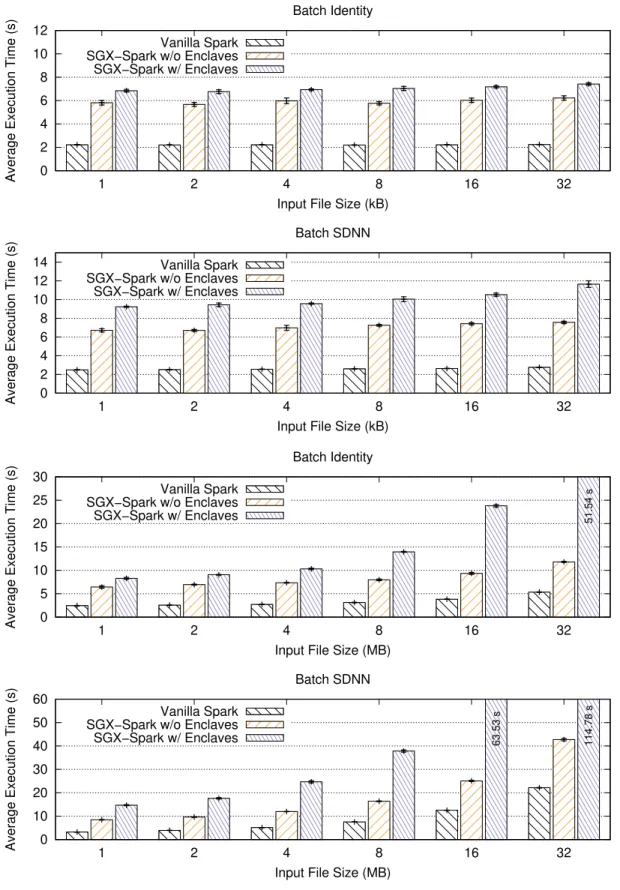
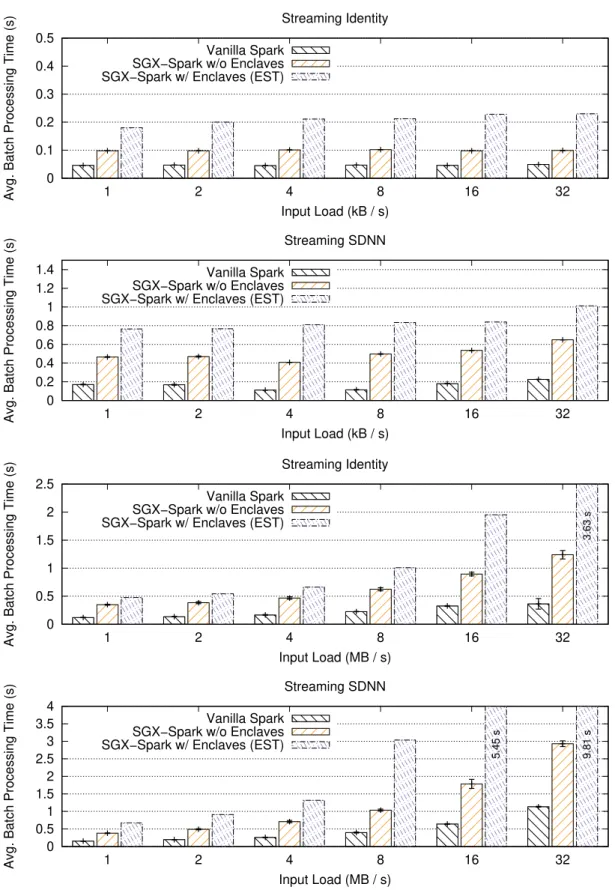
6.1 Evolution of the average elapsed (execution) time as the input workload increases. . 38 6.2 Evolution of the average batch processing time as we increase the input stream size. 39
xix
List of Tables
xxi
List of Listings
5.1 Snippet illustrating textFileStream functionality. . . 20
5.2 Snippet illustrating the artificial data generation in the sensor service. . . 21
5.3 Snippet of the data gathering and file generation in the mqtt-subscriber service. . 22
5.4 Snippet illustrating the local directory monitoring in theproducer service. . . 23
5.5 Snippet illustrating the remote filesystem monitoring in theconsumer service. . . . 24
5.6 Main method of the Server-Side Deployment Script. . . 26
5.7 Client Cluster Deployment Script. . . 28
5.8 Main entry point for a single execution. . . 30
6.1 Snippet illustrating a query to Spark’s REST API. . . 35
A.1 Implementation of the SDNN algorithm. . . 51
A.2 Implementation of the HRVBandsalgorithm. . . 51
A.3 Implementation of the Identityalgorithm. . . 54
A.4 Implementation of the sensor service. . . 55
A.5 Implementation of the mqtt-subscriber service. . . 57
A.6 Implementation of the producerservice. . . 59
A.7 Implementation of the consumerservice. . . 61
A.8 Server-Side Deployment Script. . . 64
A.9 Client Docker Compose Script. . . 66
A.10 Benchmarking and Experiment Deployment Script. . . 67
B.1 Python Script to Set Up a Port Forwarding Daemon. . . 73
xxiii
List of Acronyms
API Application Programing Interface.
DFT Discrete Fourier Transform.
DSM Data Stream Manager.
ECG Electrocardiogram.
HR Heart Rate.
HRV Heart Rate Variability.
IaaS Infrastructure-as-a-Service.
JVM Java Virtual Machine.
LoC Lines of Code.
LSDS Large Scale Data & Systems.
MEE Memory Encryption Engine.
OS Operating System.
PPG Photoplethysmogram.
RHS Right Hand Side.
SFTP Secure File Transfer Protocol.
SGX Software Guard eXtensions.
SHM Shared Memory.
xxiv
TA Trusted Application.
TEE Trusted Execution Environment.
TLS Transport Layer Security.
UniNe University of Neuchˆatel.
3
Chapter 1
Introduction
1.1
Motivation
Internet of Things (IoT) devices are more and more pervasive in our lives [3]. The number of devices owned per user is anticipated to increase by 26× by 2020 [4]. These devices continuously generate a large variety of data. Notable examples include location-based sensors (e.g., GPS), inertial units (e.g., accelerometers, gyroscopes), weather stations, and, the focus of this paper, wearable sensors that monitor human-health data (e.g., blood pressure, heart rate, stress).
Also referred as P4 medicine (Predictive, Preventive, Personalized, and Participatory), per-sonalized health uses this continuous stream of human-health data to make more targeted and effective diagnoses and treatments [5]. Medical decisions are based on the predicted response of each particular user. To implement personalized health ecosystems, a fleet of devices monitoring and processing each person’s vital signs is of crucial importance.
These devices usually have very restricted computing power and are typically very limited in terms of storage capacity. Hence, this continuous processing of data must be off-loaded elsewhere, in particular for storage and processing purposes. In doing so, one needs to take into account potential privacy and security threats that stem inherently from the nature of the data being generated and processed. Cloud environments represent the ideal environment to offload such processing. They allow deployers to hand-off the maintenance of the required infrastructure, with immediate benefit, for instance, in terms of scale-out with the workload.
Processing privacy-sensitive data on untrusted cloud platforms presents a number of challenges. A malicious (compromised) Cloud operator could observe and leak data, if no countermeasures are taken beforehand. While there are software solutions that allow to operate on encrypted data (e.g., partial [6] or full-homomorphic [7] encryption), their current computational overhead makes them impractical in real-life scenarios [8].
The recent introduction into the mass market of processors with embedded trusted execution environments (TEEs), e.g., Intel Software Guard Extensions (SGX) [9] (starting from
proces-Chapter 1. Introduction 4
sors with codename Skylake) or ARM TrustZone [10], offer a viable alternative to pure-software solutions. TEEs protect code and data against several types of attacks, including a malicious underlying OS, software bugs, or threats from co-hosted applications. The application’s security boundary becomes the CPU itself. The code is executed at near-native execution speeds inside en-claves of limited memory capacity. All the major Infrastructure-as-a-Service providers (Google [11], Amazon [12], IBM [13], Microsoft [14]) are nowadays offering nodes with SGX processors.
We focus on the specific use case of processing data streams generated by health-monitoring wearable devices on untrusted clouds with available SGX nodes. Algorithms for analyzing car-diovascular signals are getting more complex and computationally-intensive. Thus, traditional signal-processing approaches [15] have now evolved to more advanced solutions like deep neural networks [16, 17]. This increase in computational expenditure has moved the processing towards centralized centers (i.e., the cloud) with bigger and more dynamic processing power. In this work we present a system that computes in real time several metrics of the heart-rate variability (HRV) streaming from wearable sensors. While existing stream processing solutions exist [18, 19], they either lack support for SGX or, if they do support it, are tied to very specific programming frameworks and prevent adoption in industrial settings.
1.2
Contributions
In this section we highlight the contributions the work here presented makes, and also the compo-nents and resources we are given privileged access to.
The contributions of this thesis are twofold. First, we design and implement a system that can process cardiac signals inside SGX enclaves in untrusted clouds. Our design leverages SGX-Spark, a stream processing system that exploits SGX to execute stream analytics inside TEEs
(described in detail in§2). Note that our design is flexible enough to be used with different stream processing systems (as further described later), and other input data streams. Second, we compare our system against the vanilla, non-secure Spark. We perform an exhaustive assessment on the introduced overhead, and we conclude that the introduced slow-down factor is reasonable even for large datasets and high workloads. What leads us to conclude that the technology is almost ready for production environments.
As introduced before, our design has SGX-Spark in its processing core. SGX-Spark is a
modification to Spark to run security sensitive code inside SGX (see §2.1). It is an on-going project in the Large-Scale Data & Systems group from the Imperial College London [20]. We have been given early-access to the code in order to use it in our platform and provide a performance assessment.
5 1.3. Document Structure
1.3
Document Structure
The structure of the rest of this thesis is the following one. In Chapter 2 we introduce the preliminaries required to follow the rest of the sections. We divide it in§2.1 where we introduce the concepts that surround the design, implementation, and deployment of the system. And§2.2 where we introduce and motivate the envisioned use-case, and contextualize the data streams we will feed our streaming platform with. In Chapter 3 we cover the state of the art for privacy preserving stream processing engines of medical data. In Chapter 4 we first describe our system’s architecture (§4.1, §4.2) and then we go on to introduce our threat model (§4.3) and our system’s known vulnerabilities (§4.4). Then, in Chapter 5, we describe how the previously introduced architecture is implemented (§5.2, §5.1) and deployed (§5.3). A complete and exhaustive evaluation of the system is then presented in Chapter 6. In particular, we first describe the evaluation context: hardware settings (§6.1), experiment configuration (§6.2), analyzed metrics (§6.3), and injected workloads (§6.4). To then present the obtained results in §6.5. Lastly, further research lines and the thesis’ conclusions are presented in Chapters 7 and 8 respectively.
7
Chapter 2
Background
In this chapter we introduce general concepts to better understand the design and implementation details of our system. Firstly, we introduce the hardware, software and programming frameworks that we leverage, and then the medical technicalities regarding the data we use and the processing we make of it. In §2.1, we cover technical aspects exploited in the remaining of this work, specifi-cally: we describe the concept of Trusted Execution Environment, the operating principles of Intel SGX and Spark, and lastly we present two key frameworks developed by the Large Scale Data & Systems [20] group at the Imperial College London, SGX-LKL and SGX-Spark. In §2.2, we describe the specificities of the data streams from the medical domain our system deals with, how this data streams are obtained, together with the required processing that our system allows to offload on an untrusted cloud provider, and how this processing can be useful in a real use case.
2.1
Technical Background
2.1.1
Trusted Execution Environments and Intel SGX
A trusted execution environment (TEE) is an isolated area of a main processor that provides code and data therein contained with confidentiality and integrity guarantees [21]. Confidentiality refers to preventing unauthorized parties from accessing sensitive information and integrity to ensuring that sensitive code and data is not tampered with. An application developed to run and be deployed in a TEE is called a Trusted Application (TA). Trusted Execution Environments have already been available for several years in the main CPU vendors’ commodity CPUS. Arm TrustZonehas been part of Arm’s architecture since v6 for Cortex-A processors (2012) and v8
for Cortex-M (2018). IntelR Software Guard Extensions (SGX) were introduced with the
sixth generation of Intel’s processors codename Skylake in 2015.
In comparison withArm TrustZone,Intel SGXinclude a remote attestation protocol, sup-port multiple trusted applications on the same CPU, its SDK is easier to program with, and there is a greater variety of programming frameworks to develop SGX-based TAs. Most importantly, all
Chapter 2. Background 8
the major Infrastructure-as-a-Service (IaaS) providers (Google [11], Amazon [12], IBM [13], Mi-crosoft [14]) are nowadays offering nodes with SGX processors. For these reasons, Intel SGXis
our chosen hardware solution to deploy our platform in.
Untrusted Code 1 Create Enclave 2 Call Trusted Function 7 3 Trusted Code Call Gate 4 Execute 5 Return 6
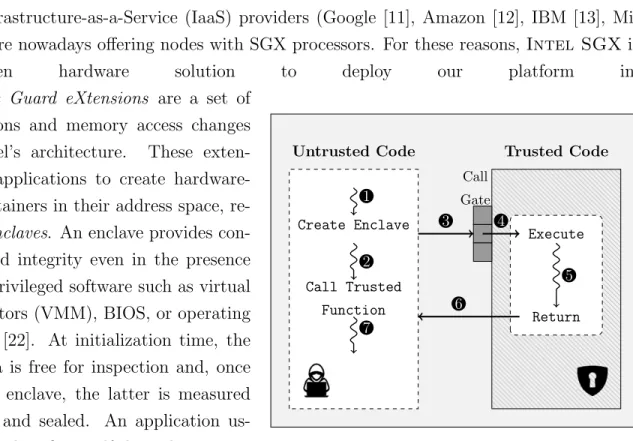
Figure 2.1: Intel SGXexecution workflow.
Intel Software Guard eXtensions are a set of new instructions and memory access changes added to Intel’s architecture. These exten-sions enable applications to create hardwaprotected containers in their address space, re-ferred to as enclaves. An enclave provides con-fidentiality and integrity even in the presence of malicious privileged software such as virtual machine monitors (VMM), BIOS, or operating systems (OS) [22]. At initialization time, the code and data is free for inspection and, once loaded to the enclave, the latter is measured (via hashing) and sealed. An application us-ing an enclave identifies itself through a remote attestation protocol and, once verified, inter-acts with the protected region through a call gate mechanism. The application can also
ver-ify that its secure code is running in a genuine enclave using the same attestation protocol via platform specific keys.
Services using SGX divide its source code in an untrusted and a trusted part. The former deployed outside the enclave and the latter inside. Figure 2.1 breaks down the typical execution workflow of SGX services. After the initial attestation protocol, code in the untrusted region creates an enclave and securely loads trusted code and data inside (Figure-Ê). Whenever this untrusted code wants to make use of the enclave, it makes a call to a trusted function (Figure-Ì) that gets captured by the call gate mechanism and, after performing sanity and integrity checks (Í), gets executed (Î), the value returned (Ï) and the untrusted code can resume execution (Ð). It is important to stress that the security perimeter is kept at the CPU package and, as a consequence, all other software including privileged software or even other enclaves are prevented from accessing code and data located inside the enclave. In particular, the systems’ main memory is left untrusted and the traffic between CPU and DRAM over the protected address range is managed by the Memory Encryption Engine (MEE) [23].
9 2.1. Technical Background
2.1.2
Spark and Spark Streaming
Apache Spark is a cluster-computing framework to develop scalable, fault-tolerant, distributed
applications. It builds on RDDs, resilient distributed datasets [22], a read-only collection dis-tributed over a cluster that can be rebuilt if one partition is lost. It is implemented inScala and provides bindings for Python, Java, SQL and R. Spark Streaming [24] is an extension of
Spark’s core API that enables scalable, high-throughput, fault tolerant stream (mini-batch) pro-cessing of data streams [25]. We leverage on Spark Streaming to perform file-based streaming, by monitoring a filesystem interface outside the enclave and processing new files as they are loaded. In particular, and as detailed later in Chapter 5, we use the Discretized Streams API [18].
2.1.3
SGX-LKL and SGX-Spark
Developed at theLarge Scale Data & Systems Group (LSDS) [20] at the Imperial College London,
SGX-LKL [26] is a library OS to run unmodified Linux binaries inside enclaves. It provides
sup-port for complex applications and managed runtimes enabling in-enclave user-level threading, sig-nal handling, and paging. Namely, it allows the execution of a fullJava Virtual Machine (JVM) in-side an enclave. This feature enables the deployment of Spark, and Spark Streaming applications to leverage critical computing inside Intel SGX with minimal to no modifications to the application’s code.
SHM
Spark
Worker
Worker
Enclave
Driver
&
App Entry
Point
Driver
Enclave
T1
· · ·
TN
Spark Master
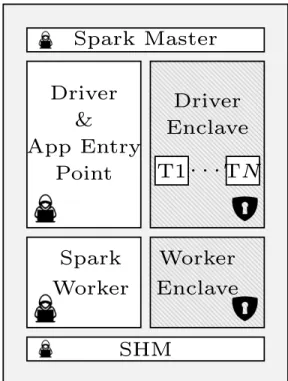
Figure 2.2: SGX-Sparkattacker model and
col-laborative structure scheme.
SGX-Spark[27] builds onSGX-LKL. It
par-titions the code of Spark applications to execute the sensitive parts inside SGX enclaves. Fig-ure 2.2 depicts its architectFig-ure. The engine de-ploys two collaborative Java Virtual Machines (JVM), one outside (Figure 2.2, left) and one inside the enclave (Figure 2.2, right) for the driver, and two more for each worker deployed in the cluster. Spark code outside the enclave accesses only encrypted data. The communica-tion between the JVMs is kept encrypted and is performed through the host OS shared mem-ory (SHM). SGX-Spark provides a
compila-tion toolchain, and it currently supports the vast majority of the native Spark operators, al-lowing to transparently deploy and run existing Spark applications into SGX enclaves. This is,
op-Chapter 2. Background 10
erators used are supported by the framework, execution is seamlessly deployed inside the enclave with no amendments to the vanilla Spark implementation.
2.2
Cardiac Analysis
The data streams used for the evaluation and the algorithms compiled with SGX-Spark belong
to the medical domain and motivate the real need for confidentiality and integrity. As further explained in Chapter 4, our use case contemplates a scenario where multiple sensors track the cardiac activity of different users. The two most standard procedures for monitoring heart activ-ity are electrocardiograms (ECG) and photoplethysmograms (PPG). ECG-based systems measure the heart’s electrical activity over time and is the chosen method by chest-based sensors [28]. PPG-based systems measure the variation of blood volume over time using LEDs and photodi-odes. Although less precise, PPGs are the chosen technique by all wrist-based cardiac monitoring sensors [29].
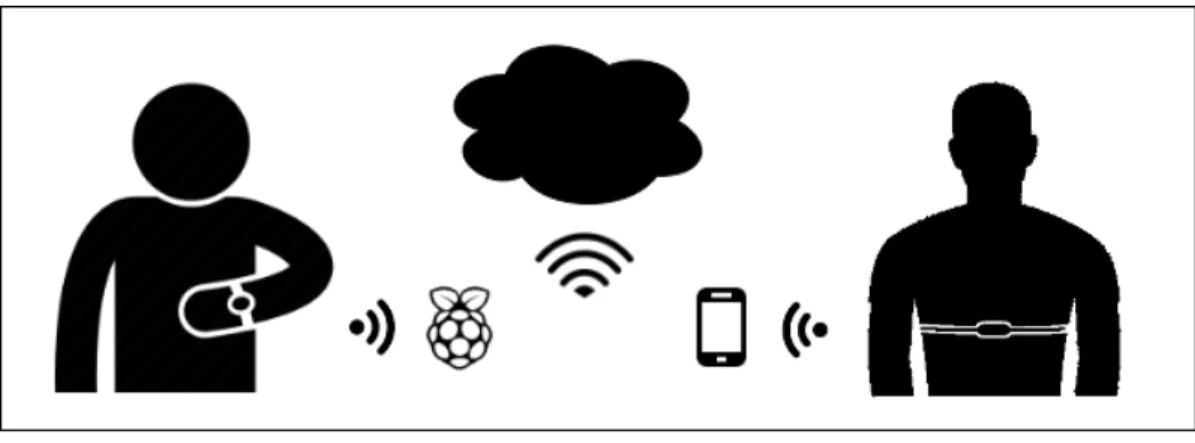
In both cases, ECG and PPG based, we contemplate the usage of wearable sensors. Wearable technologies are electronic devices that are incorporated into items which can comfortably be worn on the body [30]. Due to space and power constraints, these sensors’ memory, computing power, and communication capabilities are limited. As a consequence, to be embedded in a functional ecosystem, they rely on a gateway that forwards the information generated by the sensors to the cloud. This environment is depicted in Figure 2.3.
Figure 2.3: Envisioned sensor ecosystem composed of: a user, a wearable device, a gateway with internet connection, and the cloud were results are stored and processed.
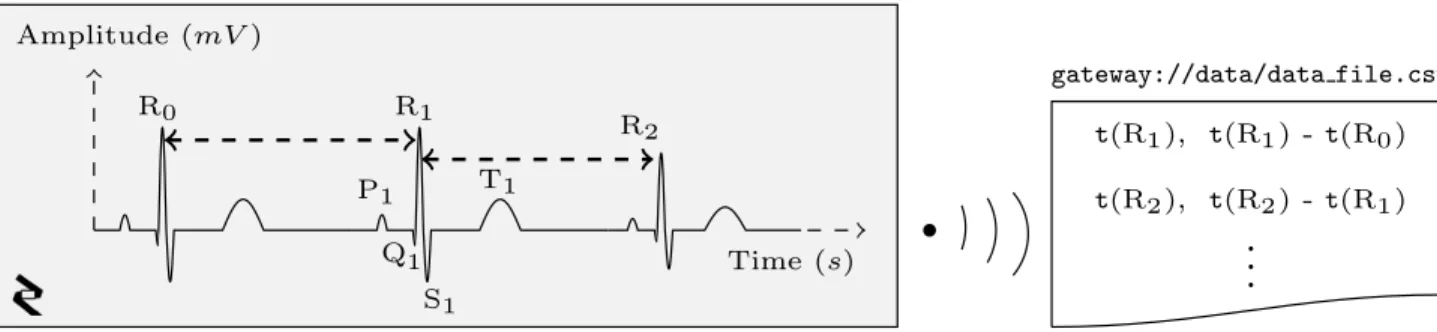
The generation of the approximated diagram (ECG or PPG) and the time measures are done inside the sensor. Figure 2.4 depicts a schematic representation of an ECG and the values streamed from the sensor to the gateway: R peak’s timestamps and RR intervals.
In our case, we focus on the analysis of the Heart Rate Variability (HRV) [32], that is, the analysis of the variation in the time intervals between heartbeats (a.k.a. RR intervals). The HRV
11 2.2. Cardiac Analysis Time (s) Amplitude (mV) R0 P1 Q1 S1 T1 R1 R2 gateway://data/data file.csv t(R1), t(R1) -t(R0) t(R2), t(R2) -t(R1) . . .
Figure 2.4: Schematic representation of an ECG signal showing three normal beats. A normal electrocardiogram can be broken down in three waves: a P wave corresponding to the depolar-ization of the atria, a QRS complex corresponding to the depolarization of the ventricles and aT wave corresponding to the repolarization of the ventricle [31]. From an ECG the sensor extracts and streams the R-peaks’ timestamp and the time elapsed between them.
is of utmost importance since it has been shown to be a predictor for myocardial infarction [33, 34]. With healthy individuals’ heart rate (HR) averaging between 60 to 180 beats per minute (bpm), the average throughput per client is between 23 and 69 bytes per second. Finally, despite our system being specifically designed for streams with these data features, its modular design (as we later describe in Chapter 4) makes it easy to adapt to other use-cases.
13
Chapter 3
Related Work
In this Chapter we cover the related work that sets the current State-of-the-Art for privacy pre-serving stream processing engines of medical data. Together with each piece of work, we provide a brief description and argue why it has or has not been considered for our project. In §3.1 we cover the most notable big data stream processing engines that relate with our system. Note that stream processing is a big field and it is out of the scope of this work to provide a detailed survey. In§3.2 we introduce relevant privacy-preserving processing engines: both stream and batch based. Lastly, in§3.3 we cover other approaches at cardiac data monitoring.
3.1
Stream Processing Engines
Stream processing has recently attracted a lot of attention from academia and industry [35, 36, 37]. Apache Spark [24] is arguably the de-facto standard in this domain, by combining batch and stream processing with a unified API [25]. Apache Spark SQL [38] allows to process structured data by integrating relational processing with Spark’s functional programming style. Structured stream-ing [39] leverages Spark SQL and it compares favorably against the discretized counterpart [25] in terms of performance. However, the former lacks security or privacy guarantees, and hence it was not considered. Furthermore SGX-Sparkonly has support for the Discretized Streams API, and
therefore we also rely on it.
3.2
Privacy-Preserving Computation
Opaque [40] is a privacy-preserving distributed analytics system. It leverages Spark SQL and Intel SGX enclaves to perform computations over encrypted Spark DataFrames. In encryption mode, Opaque offers security guarantees similar to our system’s. However, (1) the Spark master must be located in the client side, for it must be trusted. An scenario that does not fit in our multi-client setting. And (2), it requires changes to the application code, and hence is not transparent to the
Chapter 3. Related Work 14
user. In oblivious mode, i.e., protecting against traffic pattern analysis attacks, it can be up to 46×slower, a slow-down factor not tolerable for the real-time analytics in the scope of our system. SecureStreams [19] is a reactive framework that exploits Intel SGX to define dataflow processing by pipelining several independent components. In order to use this framework, the user requires a good knowledge of the underlying implementation. Moreover, applications must be written in the
Luaprogramming language, hindering its applicability to legacy systems or third-party programs. DPBSV [41] is a secure big data stream processing framework that focuses on securing data
transmission from the sensors or clients to the Data Stream Manager (DSM) or server. Its secu-rity model requires a Public Key Infrastructure (PKI) and a dynamic prime number generation technique to synchronously update the keys. In spite of using trusted hardware on the DSM end for key generation and management, the server-side processes all the data in clear, making the framework not suitable for our security model.
TaLoS [42] is a Transport Layer Security (TLS) [43] library that terminates connections by
maintaining sensitive information inside enclaves. The authors provide custom wrappers for the most common TLS API calls and securely store users and sessions’ keys inside enclaves. The
embedding with a native Spark, or SGX-Spark, application is not transparent to the end user and hence why we discard it.
Lastly, homomorphic encryption [44] does not rely on trusted execution environments and offers the promise of providing privacy-preserving computations over encrypted data. This is, it generates an encrypted result from two encrypted operands, corresponding to the encrypted value of operating both operands in plain text. The key feature of the scheme is that, at no point, neither the operands nor the result are processed in clear. While several works analyzed the feasibility of homomorphic encryption schemes in cloud environments [45, 46], the performance of homomorphic operations [47] is far from being pragmatic.
3.3
Cardiac Monitoring Systems
For the specific problem of HRV analysis, while periodic monitoring solutions exist [48], they are focused on embedded systems. As such, since they off-load computation to third-party cloud services, these solutions simply overlook the privacy concerns that we consider. Similarly, another solution [17] uses convolutional networks for the detection of arrhythmias. However, the authors take no considerations with regard to data security and privacy.
This work is one of the first attempts to building a privacy-preserving real-time streaming system specifically designed for medical and cardiac data.
Our system fills the existing research gap by proposing a system that leverages Intel SGX enclaves to compute such analytics over public untrusted clouds without changing the existing Scala-based source code.
15
Chapter 4
Architecture
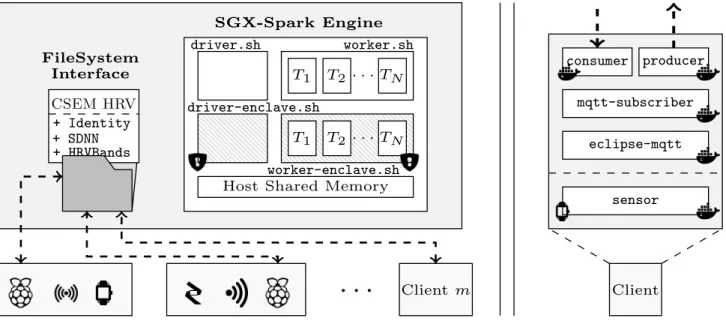
The aim of this Chapter is to depict our system’s architecture. A high-level abstraction is presented in Figure 4.1, where each different component is represented together with the path data follows. We follow a client-server organization and each functionality is designed to be modular and self-contained for the ease of deployment, evaluation, scalability and availability.
On general lines, the server-side component is executed on untrusted machines (for instance nodes on the cloud) where Intel SGX is available. There, the SGX-Spark engine is deployed
and stream processes the data generated by an arbitrary number of clients using a set of medical algorithms. Each client consists of a sensor and a gateway: the former generates samples in a continuous fashion, and the latter aggregates them and periodically sends them to the cloud-based component. Similarly, the gateway fetches the results every fixed time intervals. A filesystem is mounted at the server-side to interface the interaction between the clients and the processing engine. Each client data stream is processed in parallel independently of the chosen algorithm, and results are also stored separately.
The remaining of the chapter is structured as follows: §4.1 details the server-side architecture,
§4.2 does the same with the client-side component, in §4.3 we cover the considered threat model and the security assumptions we make in the design and lastly in §4.4 we present our project’s known vulnerabilities.
4.1
Server-Side
The server-side component is made by three different modules: a filesystem interface, the SGX-Spark engine, and a set of algorithms to analyze HRV. The filesystem interface acts as a landing
point for the batches of data generated by each client and also stores the algorithm results. This way, the gateway can fetch with the desired frequency the processed information. Currently, the filesystem is mounted and unmounted, respectively at start-up time and upon the shutdown of the service. SGX-Sparkmonitors the directory and processes new data as it is loaded.
Chapter 4. Architecture 16
· · ·
Client m ClientFileSystem Interface
SGX-Spark Engine
Host Shared Memory
driver-enclave.sh driver.sh worker-enclave.sh worker.sh T1 T2 · · ·TN T1 T2 · · ·TN CSEM HRV + Identity + SDNN + HRVBands sensor eclipse-mqtt mqtt-subscriber consumer producer
Figure 4.1: (Left) Schematic of the system’s main architecture. A set of clients bidirectionally stream data to a remote server. The interaction is done via a filesystem interface. On the server side, SGX-Spark performs secure processing using different HRV analysis algorithms. (Right)
Breakdown of a packaged client: it includes a sensor and gateway that wrap four different mi-croservices (mqtt broker, mqtt-subscriber, consumer, producer) to interact with the remote
end.
The streaming engine and the pool of algorithms are compiled together by the same toolchain, yet they are independent. ASparkjob deployed in standalone mode executes: the master process
for resource management and allocation (not included in Figure 4.1), a driver process that orches-trates the execution, and an arbitrary number of worker processes executing tasks. In the case of
SGX-Sparkjobs, two Java Virtual Machines (JVMs) are deployed per driver and worker process:
one inside an enclave and one outside. The communication between JVMs is kept encrypted and is done through the host OS shared memory (see Figure 2.2). A process outside the enclave never sees data in clear since sensitive operations are always executed in secured environments. Note that, for each newly deployed worker, a new pair of JVMs and a new enclave are also deployed.
SGX-Spark requires that algorithms are compiled together with the engine so that code can
be loaded inside enclaves. However, the specific algorithm that we will execute is currently set at start-up time. It is important to note that each client has its own dedicated data stream assigned, hence being able to choose different algorithms. These will be executed concurrently, each yielding separated results.
17 4.2. Clients
4.2
Clients
The client is a combination of: a sensor that constantly generates data, and a gateway that interacts with the remote end (see the right hand side (RHS) of Figure 4.1). For evaluation purposes, the sensor component is replaced by a synthetic data generator that simulates samples. As introduced in§2.2 and depicted in Figure 2.4, the samples produced correspond to RR intervals and their timestamps. The data generator (or fake sensor) streams samples to the gateway which is composed of: a broker and subscriber that receive the samples, a producer that aggregates them, generates files of a fixed size, and streams them to the filesystem interface, and lastly a consumer that fetches the processed data from the remote endpoint. To get a grasp on the volume of data a single client generates, each sample is a couple of bytes and a healthy individual generates between 50 and 180 samples per minute. As a consequence, an average client generates around 230—690 Bytes of data per minute. This is indeed a low throughput but, as shown in Chapter 5, the system can withhold way higher loads.
4.3
Threat Model
In this Section we cover our threat model and the main security assumptions we make. This is, what kind of attacker our system is protected from. Vulnerabilities out of the scope of this project, together with known issues are covered in§4.4. Firstly, we assume that the communication between the gateway and the filesystem is kept protected (e.g., encrypted) using secure transfer protocols (e.g. Secure File Transport Protocol (SFTP), more in Chapter 5). Secondly, we trust the whole client package. Protecting it is out of the scope of this work, but suggestions are given in Chapter 7. Given these assumptions, our threat model is the same as typical systems that rely on SGX. Specifically, we assume an attacker with access to system’s privileged software such as the OS, VMM or BIOS. Our security perimeter only includes the internals of the CPU package and the
on-die memory. Most notably, the system’s main memory (DRAM) is left outside our security perimeter. As a consequence, the traffic between enclave applications and main memory is kept encrypted and is handled by the MEE [23]. The trusted computing base is Intel’s microcode and the code loaded at the enclave, which can be measured and integrity checked. It is worth noting that, any bug or security leak included in the application code loaded in the enclave might compromise our security model.
4.4
Known Vulnerabilities
The threat model described in §4.3 is the same of SGX. As a consequence, and given our security assumptions, it is sufficient to look into the known vulnerabilities of the latter. Providing protection
Chapter 4. Architecture 18
from attacks outside of SGX’s threat model is out of the scope of this project. Intel’s MEE
is not designed to be an oblivious RAM, therefore an adversary could perform traffic analysis attacks [23] against our system. This is, even if communication between the CPU and the DRAM is kept encrypted, a smart attacker could infer information from patterns in the message exchanges. However, current work enables oblivious computations on enclaves [40]. In March 2017, Schwarz
et. al. [49] unveiled a side-channel timing attack capable of extracting a full RSA key from an enclave in under 5 minutes. Not long after, various countermeasures were made available [50, 51]. Speculative execution attacks (Spectre-like [52]) have also proven to be successful against enclaves [53]. Lastly, Foreshadow [54] is another speculative execution attack stronger than its predecessors and specifically targeted against Intel SGX.
19
Chapter 5
Implementation
The aim of this chapter is to present the implementation details of our system. Each explanation is accompanied, when required, by code snippets to further illustrate the rationale behind our design choices. For the full implementation details we refer to Appendix A. The implementation we will cover is the one the results presented in Chapter 6 are based on. As a consequence, and in order to stress-test the system, we replace real sensors with synthetic data generators in the client package first described in§4.2. All the different components introduced in Chapter 4 are packaged in sets of Docker containers. Large fleets of concurrent users are then simulated using Docker’s standalone clusters and mounted using docker-machine.
The rest of the chapter is structured as follows. In§5.1 and§5.2 we cover the implementation de-tails of the server-side and the client-side component respectively. Re-using Docker-specific nomen-clature, we will refer to logical isolated functionalities packaged in a container as services. Sets of services working collaboratively will be gathered and deployed as a component using docker-compose. Collections (or clusters) of replicated components form swarms using docker-swarm. Lastly, in§5.3 we cover how each service, component and swarm is deployed.
5.1
Server Implementation
We rely on the originalSGX-Sparkimplementation, and we only modify it to support a different
in-enclave code deployment path, so that the.jar archive is available inside the enclaves and the shared memory. To do so, we include our newly added module in the project’spom.xmlcompilation file, in the worker and driver initialization scripts and in the enclave generation Makefileso that code is loaded in the enclave at compilation time. The before-mentioned module contains two HRV processing algorithms and a benchmarking one: SDNN, HRVBands, and Identity. The SDNN algorithm computes the standard deviation of NN (RR) intervals in a rolling basis, generating one output per 10 seconds worth of samples. TheHRVBands[55] performs a Discrete Fourier Transform (DFT) of 10 seconds worth of samples, and computes the power of the low frequency and high
Chapter 5. Implementation 20
frequency components, together with their ratio. Lastly, theIdentity algorithm copies the input to the output file. It is used to provide a baseline on the overhead the system is introducing. All the application code is implemented inSpark’s binding for theScalaprogramming language [56].
We choose this particular binding since it is the only one supported by SGX-Spark’s compiler.
To be usable inside SGX enclaves, applications must adhere to the RDD [57] and DStreams [25]
API.
The particular implementation of these algorithms relies on basic Spark Streaming operators, and their corresponding Scala counterparts. For instance, the filesystem interface is monitored using DStream’s textFileStream method as exposed in Listing 5.1. There, variables and code are initialized (lines 3-10) then the input directory is monitored (line 12) and the computation and output are assigned. Note that data is not processed until the Streaming Context is started via the start() method (line 22).
1 d e f main ( a r g s : Array [ S t r i n g ] ) {
2 // I n i t i a l i z e v a r i a b l e s and Spark C o n t e x t s
3 v a l wdwSize = 10
4 v a l n u m C l i e n t s = a r g s ( 0 ) . t o I n t
5 v a l c o n f = new SparkConf ( ) . setAppName (”HRV Toolbox − SDNN”)
6 v a l s c = new SparkContext ( c o n f )
7 v a l s s c = new S t r e a m i n g C o n t e x t ( s c , D u r a t i o n ( 1 0 0 0 0 ) )
8
9 // I n i t i a l i z e t h e E s t i m a t e C l a s s
10 v a l estimateHRV = new EstimateHRVBands ( wdwSize )
11 12 // Monitor I n p u t D i r e c t o r y 13 v a l dataStreamVec = f o r ( i <− 1 t o n u m C l i e n t s ) y i e l d s s c . t e x t F i l e S t r e a m (” csem / s r c / main / r e s o u r c e s / c s v / ”+i . t o S t r i n g+” / 14 ”) 15 // E s t i m a t e
16 v a l hrvBandVec = f o r ( dS <− dataStreamVec ) y i e l d estimateHRV . e s t i m a t e ( dS )
17 // Save a s Output
18 f o r ( i <− 1 t o n u m C l i e n t s ) {
19 hrvBandVec ( i−1) . s a v e A s T e x t F i l e s (” csem / s r c / main / r e s o u r c e s / r e s u l t s / ” + i . t o S t r i n g + ” / sdnn ”) 20 } 21 // S t a r t Stream P r o c e s s i n g 22 s s c . s t a r t ( ) 23 s s c . a w a i t T e r m i n a t i o n ( ) 24 }
Listing 5.1: Snippet illustrating textFileStream functionality.
Lastly, the implementations of SDNN,HRVBands, and Identity can be found in Listings A.1, A.2, and A.3 respectively.
21 5.2. Client Implementation
5.2
Client Implementation
Clients correspond to body-sensors strapped to the body of a user working collaboratively with a smart gateway, sending gathered data to the cloud-based component. In a real deployment, the sensor service in the client component would be an actual sensor (e.g. HR band, smartwatch, or optical HR monitoring device) and the gateway would be implemented in a, for instance, Rasp-berry Pi. For evaluation purposes (see Chapter 6), these services are simulated and virtualized.
This way, we can simulate a situation where multiple clients concurrently use the platform with-out the hardware burden. As firstly introduced in §4.2, our implementation decouples the client component into into five different services (see Figure 4.1, right).
1. The sensor service is a Python script that generates sample rate random samples per second, where a sample is an RR interval and its timestamp, and publishes the information to the artificial-data topic in a MQTT [58] broker located in the gateway. Listing 5.2
presents the part of the sensorsource code where artificial data is generated and published. The full source code is available in Listing A.4. Note the particularity of the sample gen-eration procedure. First, sample rate random points in a [0,1) uniform distribution are generated (lines 18, 21). Then, current timestamps are inferred from them (line 24) and intervals are computed as successive differences (line 25). These intervals are, in fact, the RR intervals.
1 d e f l o o p ( s a m p l e r a t e ) :
2 ””” E n d l e s s Sample G e n e r a t i o n 3
4 T h i s module i s t h e e n d l e s s l o o p t h a t g e n e r a t e s <s a m p l e r a t e> 5 new s a m p l e s p e r s e c o n d and p u b l i s h e s them t o a MQTT t o p i c . 6 7 P a r a m e t e r s 8 −−−−−−−−−− 9 s a m p l e r a t e : f l o a t 10 How many s a m p l e s a r e g e n e r a t e d p e r s e c o n d 11 ””” 12 k i l l e r = K i l l e r ( ) 13 g l o b a l CL ID 14 p a s t t s = t i m e . t i m e ( ) 15 w h i l e 1 : 16 v a l u e = ” ” 17 # F i r s t we g e n e r a t e <s a m p l e r a t e> t i m e s t a m p s i n one s e c o n d 18 t s t a m p s = [ i f o r i i n random . u n i f o r m ( low=t i m e . t i m e ( ) , 19 h i g h=t i m e . t i m e ( ) + 1 , 20 s i z e =( s a m p l e r a t e ) ) ] 21 t s t a m p s . s o r t ( )
Chapter 5. Implementation 22 23 f o r i i n t s t a m p s : 24 tmp = d a t e t i m e . fromtimestamp ( i ) . s t r f t i m e (’%Y−%m−%d %H:%M:%S ’) 25 v a l u e += tmp+’ , ’+s t r(i n t( ( i − p a s t t s ) ∗ 1 e6 ) )+’\n ’ 26 p a s t t s = i 27 p u b l i s h . s i n g l e (” a r t i f i c i a l−data−{}”.f o r m a t( CL ID ) , v a l u e ) 28 t i m e . s l e e p ( 1 ) 29 i f k i l l e r . k i l l n o w : 30 p r i n t(” E x i t i n g g r a c e f u l l y ! ”) 31 b r e a k
Listing 5.2: Snippet illustrating the artificial data generation in the sensor service.
2. Theeclipse-mqttservice is the mosquitto[59] implementation of the MQTTbroker. We
rely on the public Docker image at Docker Hub [60]. It handles the samples generated by sensor and delivers them to the mqtt-subscriber when the latter subscribes to the artificial-data topic.
3. Themqtt-subscriber service is a Python script that subscribes to the artificial-data
MQTT topic and whenever it gathers FILE LINES (line 26) samples it generates a .csv file at a specified location. The key functionality of the service, sample gathering and file generation, is illustrated in Listing 5.3. The full service code is available in Listing A.5.
1 d e f o n m e s s a g e ( mosq , obj , msg ) :
2 ””” C a l l b a c k method f o r t h e m o s q u i t t o c l i e n t . 3
4 Whenever t h e MQTT c l i e n t r e c e i v e s a new sample i t t r i g g e r s t h i s method . 5 When t h e c u r r e n t c o u n t r e a c h e s t h e t h r e s h o l d , a new c s v f i l e i s g e n e r a t e d 6 and s t o r e d i n t h e l o c a l d a t a d i r e c t o r y . 7 8 P a r a m e t e r s 9 −−−−−−−−−− 10 P a r a m e t e r s a r e t h o s e o f t h e s t a n d a r d i m p l e m e n t a t i o n o f t h e MQTT c l i e n t 11 f o r Python . 12 ””” 13 g l o b a l c o u n t 14 g l o b a l c u r r s t r 15 g l o b a l FILE LINES 16 g l o b a l CL ID
17 g l o b a l LOCAL DATA DIR
18 g l o b a l k i l l e r
19 p r i n t(” R e c e i v e d message ”)
20 dcd msg = msg . p a y l o a d . d e c o d e (” u t f−8”) . s p l i t (”\n”) 21 whole msg = [ i . s p l i t (” , ”) f o r i i n dcd msg i f i != ” ”]
23 5.2. Client Implementation 23 d = d a t e t i m e . s t r p t i m e ( tmp [ 0 ] , ’%Y−%m−%d %H:%M:%S ’) 24 t i m e s t a m p = t i m e . mktime ( d . t i m e t u p l e ( ) ) 25 r r = tmp [ 1 ] 26 i f c o u n t == FILE LINES : 27 g l o b a l TS 28 p r i n t(” I t t o o k : {} s ”.f o r m a t( t i m e . t i m e ( ) − TS) ) 29 c u r r s t r += ”{ },{ }”.f o r m a t( time stamp , r r ) 30 t s = i n t( t i m e . t i m e ( )∗1 e3 )
31 f i l e n a m e = ”{}{} ”.f o r m a t(LOCAL DATA DIR, CL ID )+s t r( t s )+” . c s v ”
32 t r y: 33 w i t h open( f i l e n a m e , ”w+”) a s f : 34 f . w r i t e ( c u r r s t r ) 35 e x c e p t F i l e N o t F o u n d E r r o r a s e : 36 i f k i l l e r . k i l l n o w : 37 mosq . d i s c o n n e c t ( ) 38 p r i n t(” E x i t i n g g r a c e f u l l y ! ”) 39 b r e a k 40 c o u n t = 0 41 c u r r s t r = ” ” 42 e l s e: 43 c u r r s t r += ”{ },{ } \n”.f o r m a t( time stamp , r r ) 44 c o u n t += 1 45 e l s e: 46 i f k i l l e r . k i l l n o w : 47 mosq . d i s c o n n e c t ( ) 48 p r i n t(” E x i t i n g g r a c e f u l l y ! ”)
Listing 5.3: Snippet of the data gathering and file generation in the mqtt-subscriber service.
4. The producer service is a Python script that monitors a local directory and, whenever a
new file is stored, sends it to the remote filesystem. The monitoring functionality is depicted in Listing 5.4 and the full source code is available in Listing A.6. We keep track of the current files in the directory with a dictionary (lines 175 and 180) and we compute the difference between the pre and the post (line 181). We then transfer the new files over SFTP (line 188).
1 d e f m o n i t o r ( s s h , s f t p , ∗a r g s ) :
2 ””” S e n d i n g daemon 3
4 T h i s method s t a r t s an i n f i n i t e l o o p t h a t e v e r y <SEND PERIOD> l o o k s f o r 5 newly added d a t a f i l e s and c o p i e s them t o a remote d i r e c t o r y .
6
7 P a r a m e t e r s 8 −−−−−−−−−−
9 s s h : paramiko . SSHClient
Chapter 5. Implementation 24
11 s f t p : paramiko . SFTPClient
12 SFTP C l i e n t c o n n e c t e d t o t h e remote h o s t . 13 ”””
14 g l o b a l LOCAL DATA DIR
15 p a t h t o w a t c h = LOCAL DATA DIR
16 b e f o r e = d i c t( [ ( f , None ) f o r f i n o s . l i s t d i r ( p a t h t o w a t c h ) ] ) 17 g l o b a l SEND PERIOD 18 k i l l e r = K i l l e r ( ) 19 w h i l e 1 : 20 t i m e . s l e e p (SEND PERIOD) 21 a f t e r = d i c t( [ ( f , None ) f o r f i n o s . l i s t d i r ( p a t h t o w a t c h ) ] ) 22 added = [ f f o r f i n a f t e r i f f n o t i n b e f o r e ] 23 i f added : 24 f o r f i n added :
25 l o c a l f i l e = LOCAL DATA DIR + s t r( f )
26 g l o b a l REMOTE DATA DIR
27 r e m o t e f i l e = REMOTE DATA DIR + ” / ” + s t r( f ) 28 s f t p . put ( l o c a l f i l e , r e m o t e f i l e ) 29 o s . remove ( l o c a l f i l e ) 30 # I f t h e r e a r e a l o t o f f i l e s , no t c h e c k i n g i n s i d e a l s o l e a d s 31 # t o e r r o r w i t h c o d e 137 32 i f k i l l e r . k i l l n o w : 33 p r i n t(” E x i t i n g g r a c e f u l l y ! ”) 34 b r e a k 35 b e f o r e = a f t e r 36 i f k i l l e r . k i l l n o w : 37 p r i n t(” E x i t i n g g r a c e f u l l y ! ”) 38 b r e a k
39 f o r d i n o s . l i s t d i r (LOCAL DATA DIR) :
40 t m p f i l e = LOCAL DATA DIR + s t r( d ) 41 o s . remove ( t m p f i l e )
Listing 5.4: Snippet illustrating the local directory monitoring in the producerservice.
5. Similarly, the consumer service is a Python script that monitors the remote filesystem and, whenever a result file is stored, fetches it to the local result directory. The monitoring functionality is illustrated in Listing 5.5 and the whole source code is available in Listing A.7. It is, in essence, symmetric to the one presented for theproducerservice. The only difference is that, since sftp.get()does not support recursive invocations (e.g. -Rflags), specific care must be taken to fetch all the different files placed in the different directories.
1 d e f m o n i t o r ( s s h , s f t p ) :
2 ””” F e t c h i n g daemon 3
25 5.2. Client Implementation
4 T h i s method s t a r t s an i n f i n i t e l o o p t h a t e v e r y <FETCH PERIOD> l o o k s f o r 5 newly added d i r e c t o r i e s and c o p i e s them t o a l o c a l r e s u l t d i r e c t o r y . 6 7 P a r a m e t e r s 8 −−−−−−−−−− 9 s s h : paramiko . SSHClient 10 SSH C l i e n t c o n n e c t e d t o t h e remote h o s t . 11 s f t p : paramiko . SFTPClient 12 SFTP C l i e n t c o n n e c t e d t o t h e remote h o s t . 13 ”””
14 g l o b a l REMOTE RESULT DIR
15 g l o b a l FETCH PERIOD
16 g l o b a l LOCAL RESULT DIR
17 #p r i n t ( ”CONSUMER: u s e r −> { }” . f o r m a t ( g e t p a s s . g e t u s e r ( ) ) ) 18 p a t h t o w a t c h = REMOTE RESULT DIR
19 b e f o r e = d i c t( [ ( f , None ) f o r f i n s f t p . l i s t d i r ( p a t h t o w a t c h ) ] ) 20 k i l l e r = K i l l e r ( ) 21 w h i l e 1 : 22 t i m e . s l e e p (FETCH PERIOD) 23 a f t e r = d i c t( [ ( f , None ) f o r f i n s f t p . l i s t d i r ( p a t h t o w a t c h ) ] ) 24 added = [ f f o r f i n a f t e r i f f n o t i n b e f o r e ] 25 i f added : 26 f o r f i n added :
27 l o c a l d i r = LOCAL RESULT DIR + s t r( f ) + ” / ”
28 r e m o t e d i r = REMOTE RESULT DIR + ” / ” + s t r( f ) + ” / ”
29 t r y: 30 o s . mkdir ( l o c a l d i r ) 31 g e t a l l ( s f t p , r e m o t e d i r , l o c a l d i r ) 32 e x c e p t F i l e E x i s t s E r r o r a s e : 33 p r i n t(” F e t c h i n g a f i l e t h a t a l r e a d y e x i s t s ! ”) 34 b e f o r e = a f t e r 35 i f k i l l e r . k i l l n o w : 36 p r i n t(” E x i t i n g g r a c e f u l l y ! ”) 37 b r e a k
38 f o r d i n o s . l i s t d i r (LOCAL RESULT DIR) :
39 t m p d i r = LOCAL RESULT DIR + d
40 f o r f i n o s . l i s t d i r ( t m p d i r ) :
41 t m p f i l e = t m p d i r + ” / ” + f 42 o s . remove ( t m p f i l e )
43 o s . r m d i r ( t m p d i r )
Listing 5.5: Snippet illustrating the remote filesystem monitoring in theconsumer service.
All the services implemented in Python, amount to a total of 888 Lines of Code (LoC). As in-troduced before, for the service deployment we rely on Docker. The corresponding Dockerfiles
Chapter 5. Implementation 26
and docker-compose are presented in §5.3. Furthermore, the deployment of each service is also wrapped in a Dockerfile and included in an image. Lastly, we remark that the communication between the client and the server happens via SSH/SFTP to ensure transport layer security when transferring user’s data.
5.3
Deployment
To ease scalability and reproducibility of both server and client, deployment is orchestrated by a single script detached from both execution environments. This is done through a combination of bashscripts that act as entry points for theDockerfileanddocker-composefile. We differentiate between the server deployment (§5.3.1), the client deployment (§5.3.2) and the overall deployment and evaluation (§5.3.3).
5.3.1
Server Execution Deployment
Specifying the remote location; theSGX-Sparkengine, the streaming algorithm, and the
filesys-tem interface are initialized. Depending on whether we want to enable enclaves or not (SGX MODE, line 24), a set of scripts (lines 25 and 26) are executed in the remote server using ssh.exec com-mand(). The script then remains passive until a SIGTERM signal is captured, and all processes are killed (lines 41-49). A snippet of the main functionality is attached in Listing 5.6 and the full source code is available in Listing 5.3.1. Note that the code is intended to be launched from a location different from the server (which we leave untrusted).
1 d e f main ( s s h , s f t p ) :
2 ””” Main e x e c u t i o n method 3
4 T h i s method c o n t a i n s t h e main deployment o f UC1 . I t b a s i c a l l y s t a r t s e a c h 5 and e v e r y p r o c e s s , l a u n c h e s t h e benchmarking , and c l e a n s e v e r y t h i n g when 6 e x e c u t i o n has f i n i s h e d . 7 8 Notes 9 −−−−− 10 A l l t h e s l e e p s a r e p l a c e d due t o e x p e r i e n c e d e r r o r s r a c e c o n d i t i o n s . As a 11 c o n s e q u e n c e t h e i r arguments a r e c o m p l e t e l y e m p i r i c a l . 12 13 Arguments 14 −−−−−−−−− 15 s s h : paramiko . SSHClient 16 SSH C l i e n t t o t h e remote s e r v e r . 17 s f t p : paramiko . SFTPClient
27 5.3. Deployment 18 SFTP C l i e n t t o t h e remote s e r v e r . 19 ””” 20 g l o b a l ALGORITHM 21 g l o b a l SGX MODE 22 g l o b a l NUM CLIENTS
23 a l g o n a m e = ” . / l a u nc h−csem−{}. sh {}”.f o r m a t(ALGORITHM, NUM CLIENTS) 24 i f SGX MODE: 25 s c r i p t l i s t = [” . / m a s t e r . sh ”, ” . / w o rk e r . sh ”, ” . / worker−e n c l a v e . sh ”, 26 ” . / d r i v e r−e n c l a v e . sh ”, a l g o n a m e ] 27 e l s e: 28 s c r i p t l i s t = [” . / m a s t e r . sh ”, ” . / w o rk e r . sh ”, a l g o n a m e ] 29 f o r s c r i p t i n s c r i p t l i s t :
30 i n , o u t , e r r = s s h . exec command (” cd sgx−s p a r k ; {} &”.f o r m a t( s c r i p t ) ) 31 t i m e . s l e e p ( 3 )
32 tmp command = ” d s t a t −l −−n o c o l o r −−n o h e a d e r s 10 > c p u l o a d . c s v ”
33 , o u t , = s s h . exec command (” cd sgx−s p a r k ; {} &”.f o r m a t( tmp command ) ) 34 o u t . r e a d l i n e s ( ) 35 k i l l e r = K i l l e r ( ) 36 w h i l e 1 : 37 t i m e . s l e e p ( 1 ) 38 i f k i l l e r . k i l l n o w : 39 p r i n t(” K i l l i n g G r a c e f u l l y ! ”) 40 b r e a k 41 f o r s c r i p t i n s c r i p t l i s t : 42 , o u t , = s s h . exec command (” k i l l $ ( p g r e p −f ’{ }’ ) ”.f o r m a t( s c r i p t ) ) 43 o u t . r e a d l i n e s ( ) 44 , o u t , = s s h . exec command (” k i l l $ ( p g r e p −f ’ j a v a ’ ) ”) 45 o u t . r e a d l i n e s ( ) 46 , o u t , = s s h . exec command (” k i l l $ ( p g r e p −f ’ d s t a t ’ ) ”) 47 o u t . r e a d l i n e s ( )
48 , o u t , = s s h . exec command (”rm / dev /shm/∗”) 49 o u t . r e a d l i n e s ( )
50 r e t u r n 0
Listing 5.6: Main method of the Server-Side Deployment Script.
5.3.2
Client Execution Deployment
The client deployment procedure is more complicated than the server’s one since we support executions of variable number of clients, which are instantiated at start-up time. In short, when the number of clients is set, the platform starts a standalone Docker cluster (orswarm). However, once started with the scalability tests, we recalled that the number of clients a cluster whose network relies on Docker’s default bridge adapter can support was too small. At 20 clients, the
Chapter 5. Implementation 28
engine ran out of local IP addresses and executions would systematically fail. As a consequence, we decided to virtualize a local standalone cluster using docker-machine. This latter functionality enables the deployment of several Docker engines in a single computing instance. To do so, a virtual machine must be started for each engine, and special care must be taken to set up the network, so that all containers are reachable from the others.
Even though the full script is rather long, given its complexity and how crucial it is to the system’s performance, we attach it entirely in Listing 5.7. We firstly deploy a name discovery service based on the Consul [61] docker image, the aim of which is to keep track of all the
generated virtual machines, and assign an IP address to each one (lines 27-36). Secondly, we start
dNUM CLIENTS/20e virtual machines and register them with the name discovery service (lines 40-60). These set of virtual machines will form our Docker Swarm. As a consequence, it is important to elect one (first by default) as our swarm-master. Note that, in order to speed up the start-up time, the images for all the client services are compressed and pre-loaded to the virtual machines (lines 62-66). In third place, we create the overlay network (lines 70-71). Then, the local directories for each client in each virtual machine must be mounted and mirrored outside the virtual machine so that we can process the results. This is done using SSHF in lines 76-85. Lastly, each client is deployed using the specific docker-compose file (see Listing A.9).
1 #! / b i n / bash 2 3 s e t −a 4 5 # P r e d e f i n e d e n v i r o m e n t v a r i a b l e s 6 s o u r c e d o c k e r−env.env 7 8 # P u l l MQTT image 9 d o c k e r−compose p u l l mqtt 10 11# Max C o n t a i n e r s p e r Host 12 MAX CONTAINERS=2 13 14# I n p u t P a r a m e t e r s 15 SAMPLE RATE=${1} 16 NUM CLIENTS=${2} 17 FILE LINES=${3} 18
19 NUM HOSTS=$ ( ( $ ( ( $NUM CLIENTS / $MAX CONTAINERS ) ) + 1 ) ) 20
21# To i n t r o d u c e an a b s t r a c t i o n l a y e r , even i f t h e r e i s no r e a l need f o r an 22# o v e r l a y network ( t h e b r i d g e i t s e l f s u f f i c e s ) we c r e a t e an e x t e r n a l machine 23# anyways . T h i s may be an o v e r k i l l f o r v e r y s m a l l e x e c u t i o n s but i s i n t r o d u c e d 24# t o p r e s e r v e s c a l a b i l i t y t r a n s p a r e n t t o t h e u s e r .
29 5.3. Deployment 25 26# We f i r s t c r e a t e t h e Consul d i s c o v e r y s e r v i c e ( key / v a l u e s t o r e ) 27 d o c k e r−machine c r e a t e \ 28 −d v i r t u a l b o x \ 29 −−v i r t u a l b o x−b o o t 2 d o c k e r−u r l ˜/tmp/ b o o t 2 d o c k e r . i s o \ 30 mh−k e y s t o r e 31 e v a l ” $ ( d o c k e r−machine env mh−k e y s t o r e ) ” 32 d o c k e r run −d \ 33 −−name c o n s u l \ 34 −p ” 8 5 0 0 : 8 5 0 0 ” \ 35 −h ” c o n s u l ” \ 36 c o n s u l a g e n t −s e r v e r −b o o t s t r a p −c l i e n t ” 0 . 0 . 0 . 0 ” 37
38# We t h e n c r e a t e t h e Swarm c l u s t e r t h e f i r s t node ( i d == 1 ) w i l l be t h e swarm 39# manager .
40 f o r HOST ID i n $ ( s e q 1 ${NUM HOSTS}) ;
41 do 42 i f [ $HOST ID == 1 ] ; t h e n 43 d o c k e r−machine c r e a t e \ 44 −d v i r t u a l b o x \ 45 −−v i r t u a l b o x−b o o t 2 d o c k e r−u r l ˜/tmp/ b o o t 2 d o c k e r . i s o \ 46 −−swarm −−swarm−m a s t e r \ 47 −−swarm−d i s c o v e r y=” c o n s u l : / / $ ( d o c k e r−machine i p mh−k e y s t o r e ) : 8 5 0 0 ” \ 48 −−e n g i n e−o p t=” c l u s t e r−s t o r e=c o n s u l : / / $ ( d o c k e r−machine i p mh−k e y s t o r e ) : 8 5 0 0 ” \ 49 −−e n g i n e−o p t=” c l u s t e r−a d v e r t i s e=e t h 1 : 2 3 7 6 ” \ 50 ” sgx−csem−h o s t−$HOST ID”
51 e l s e 52 d o c k e r−machine c r e a t e \ 53 −d v i r t u a l b o x \ 54 −−v i r t u a l b o x−b o o t 2 d o c k e r−u r l ˜/tmp/ b o o t 2 d o c k e r . i s o \ 55 −−swarm \ 56 −−swarm−d i s c o v e r y=” c o n s u l : / / $ ( d o c k e r−machine i p mh−k e y s t o r e ) : 8 5 0 0 ” \ 57 −−e n g i n e−o p t=” c l u s t e r−s t o r e=c o n s u l : / / $ ( d o c k e r−machine i p mh−k e y s t o r e ) : 8 5 0 0 ” \ 58 −−e n g i n e−o p t=” c l u s t e r−a d v e r t i s e=e t h 1 : 2 3 7 6 ” \ 59 ” sgx−csem−h o s t−$HOST ID”
60 f i
61 e v a l $ ( d o c k e r−machine env ” sgx−csem−h o s t−$HOST ID”)
62 d o c k e r l o a d −i ˜/tmp/ consumer . t a r 63 d o c k e r l o a d −i ˜/tmp/ deployment . t a r 64 d o c k e r l o a d −i ˜/tmp/ f a k e−s e n s o r . t a r 65 d o c k e r l o a d −i ˜/tmp/ mqtt−sub . t a r 66 d o c k e r l o a d −i ˜/tmp/ p r o d u c e r . t a r 67 done
Chapter 5. Implementation 30
68
69# We now c r e a t e t h e o v e r l a y network
70 e v a l $ ( d o c k e r−machine env −−swarm sgx−csem−h o s t−1)
71 d o c k e r network c r e a t e −−d r i v e r o v e r l a y −−s u b n e t = 1 0 . 0 . 0 . 0 / 1 6 sgx−csem−n e t 72
73 f o r CL ID i n $ ( s e q 1 ${NUM CLIENTS}) ;
74 do
75 # P r e p a r e e n v i r o n m e n t
76 H ID=$ ( ( $ ( ( $CL ID / $MAX CONTAINERS ) ) + 1 ) ) 77 mkdir −p ${LOCAL DATA DIR}${CL ID}
78 mkdir −p ${LOCAL RESULT DIR}${CL ID}
79 e v a l $ ( d o c k e r−machine env ” sgx−csem−h o s t−$H ID ”)
80 d o c k e r−machine s s h ” sgx−csem−h o s t−$H ID ” mkdir −p ” r e s u l t s / ${CL ID}”
81 d o c k e r−machine mount ” sgx−csem−h o s t−$H ID ”:” /home/ d o c k e r / r e s u l t s / $CL ID ” \ 82 ${LOCAL RESULT DIR}${CL ID}
83 d o c k e r−machine s s h ” sgx−csem−h o s t−$H ID ” mkdir −p ” d a t a / ${CL ID}”
84 d o c k e r−machine mount ” sgx−csem−h o s t−$H ID ”:” /home/ d o c k e r / d a t a /$CL ID ” \ 85 ${LOCAL DATA DIR}${CL ID}
86
87 # Deploy c o n t a i n e r s ( Add a −d a t t h e end f o r d e t a c h mode )
88 c a t ${COMPOSE FILE} | e n v s u b s t | d o c k e r−compose −f − −p \
89 ” ${PROJECT NAME}−${CL ID}” up & 90 s l e e p 5
91 done 92
93# Return t o d e f a u l t e n v i r o n m e n t b e f o r e e x i t i n g
94 e v a l $ ( d o c k e r−machine env −u )
Listing 5.7: Client Cluster Deployment Script.
5.3.3
Deployment
The main entry point for the platform’s deployment is included in Listing 5.8. It first loads a set of environment variables and parses the input (lines 6,8-12), it then deploys the client cluster as detailed in §5.3.2, and it lastly deploys the server container as detailed in§5.3.1.
1 #! / b i n / bash 2 3 s e t −a 4 5 # P r e d e f i n e d e n v i r o m e n t v a r i a b l e s 6 s o u r c e e x e c u t i o n .env 7 8 ALGORITHM=${1}
31 5.3. Deployment 9 SGX MODE=${2} 10 SAMPLE RATE=${3} 11 NUM CLIENTS=${4} 12 FILE LINES=${5} 13 14# Deploy C l i e n t−S i d e c o n t a i n e r 15 cd ${CLIENT DIR}
16 bash ${CLIENT DIR}/ d e p l o y−c l i e n t . sh ${SAMPLE RATE} ${NUM CLIENTS} ${FILE LINES} 17 cd ${WDIR}
18
19# Deploy S e r v e r−S i d e C o n t a i n e r s
20 c a t ${COMPOSE FILE} | e n v s u b s t | d o c k e r−compose −f − −p ” ${PROJECT NAME}” up &
Listing 5.8: Main entry point for a single execution.
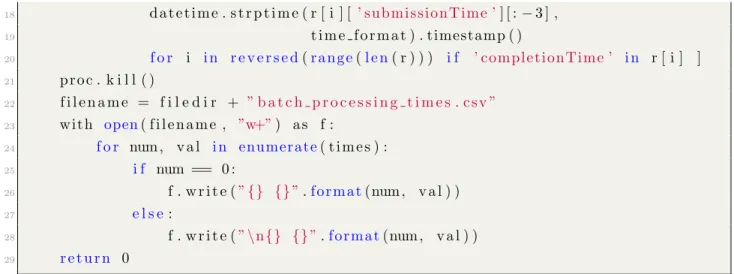
Additionally, a Python script wraps the launcher presented in Listing 5.8 in order to con-veniently orchestrate execution batches for evaluation purposes. The same script (attached in Listing A.10) also includes the queries to obtain the required metrics for the different benchmark-ing scenarios that we will present in Chapter 6.