WORKING PAPER
No. 09-02 MGT July 2009
Design Of Extended Warranties In Supply Chains
By Kunpeng Li
Sam Houston State University Suman Mallik
University of Kansas Dilip Chhajed
University of Illinois at Urbana-Champaign
Copyright by Author 2009
The Working Papers series is published periodically by the Center for Business and Economic Development at Sam Houston State University, Huntsville, Texas. The series includes papers by members of the faculty of the College of Business Administration reporting on research progress. Copies are distributed to friends of the College of Business Administration. Additional copies may be obtained by contacting the Center for Business and Economic
DESIGN OF EXTENDED WARRANTIES IN SUPPLY CHAINS
Kunpeng Li [email protected]
College of Business Administration, Sam Houston State University 1821 Avenue I, Huntsville, TX 77340
Suman Mallik [email protected]
School of Business, University of Kansas 1300 Sunnyside Avenue, Lawrence, KS 66045
Dilip Chhajed [email protected]
Department of Business Administration, University of Illinois at Urbana-Champaign 350 Wohlers Hall, 1206 South Sixth Street, Champaign, IL 61820
July 2009 Abstract
We study the design of extended warranties using a supply chain framework consisting of a manufacturer and an independent retailer. The manufacturer produces a single product and sells it exclusively through the retailer. The extended warranty could, however, be offered either by the manufacturer or by the retailer. The party offering the extended warranty decides the terms of the policy in its best interest and incurs the repair costs at product failures. Under such a setting, we use game theoretic models to answer the following questions. What are the characteristics of extended warranty policy decisions? Which scenario leads to a higher total supply chain profit, a retailer offering the extended warranty or the manufacturer? How do the optimum price and extended warranty length vary under different scenarios? We show that, depending on the repair cost relationship, either party could provide better extended warranty policies and generate more system profit. We also compare and contrast the two decentralized extended warranty provider models with a centralized system where a single party manufactures the product, sells it to the consumer and offers the extended warranty. We also consider an extension of our basic model where either the manufacturer or the retailer resells the extended warranty policies of a third party (an independent insurance company, for example), instead of offering its own policy. Key words:extended warranty, supply chain management, warranty, game theory
1. INTRODUCTION
Selling extended warranties on products is a rapidly expanding business. Extended warranties are offered on almost all consumer electronics and domestic appliances, ranging from laptop computers to washing machines and refrigerators. Selling extended warranties is also a very profitable business. Berner (2004) notes that the profits from extended warranties accounted for almost half of Best Buy’s operating income and all of Circuit City’s operating income for the year 2003. Berner further notes that the profit margins on extended warranties are nearly 18 times higher than those on the products for these retailers.
An extended warranty is actually a service plan, under which the provider promises to repair, replace, or maintain a product for free or at a lower price over a certain period of time after the manufacturer’s original warranty expires. The extended warranty may also offer additional benefits (such as return and/or exchange privileges) that are not provided by the manufacturer’s original warranty. Extended warranties are sold separately from the products and usually cost extra money. Generally, an extended warranty can be offered by a manufacturer, a retailer, or by a third party (Publication 153, Better Business Bureau). The terms of a typical extended warranty specify the price and the length of time during which the product is covered. The provider of the extended warranty incurs the actual repair costs related to the warranty.
The primary focus of our current research is to analyze the design of extended warranties in a supply chain context. We study a simple supply chain involving a single manufacturer and a single retailer. The manufacturer produces a single product and sells exclusively through the retailer. However, the extended warranty could be offered either by the manufacturer or by the retailer. The party offering the extended warranty decides the terms of the policy in its best interest and incurs the repair cost when the product fails. Thus, the repair cost directly influences the provider’s extended warranty decisions. Under such circumstances, we use game theoretic models to answer the following questions. Which scenario leads to a higher total supply chain profit, a retailer offering the extended warranty or the manufacturer? How do the optimum price and extended warranty length vary under different scenarios? How is the total supply chain profit distributed between the parties in either scenario? We also compare the two situations with a centralized system, in which a single firm manufactures the product, sells directly to the end consumer, and offers the extended warranty. We also consider an extension of our basic model where the manufacturer or the retailer resells the extended warranty policies of a third party (an
independent insurance company, for example), instead of offering its own policy. We then compare the profits of the manufacturer/retailer between the two different ways of doing business: being an extended warranty provider or being a reseller.
Many manufacturers offer extended warranties directly to the end consumers. GE Appliances, a leading manufacturer of major appliances, parts, and accessories offers GE extended warranties on almost all the products it manufactures. Firms like Ford, GM, JVC, and Apple have devoted whole divisions solely to managing and to serving extended warranty contracts (Padmanabhan 1995). Manufacturers offering extended warranties are also common for mainframe computers (IBM, for example) and high-end office machines such as copiers, fax machines, and printers. Retail stores such as Best Buy, Circuit City, and Home Depot offer and promote third party extended warranties underwritten by insurers, and thereby act as extended warranty resellers. Sears is an example of a retailer who directly provides extended warranties*
In this paper, we use game theoretic models to analyze four scenarios: a retailer or a manufacturer being an extended warranty provider (model R; model M) and a retailer or a manufacturer being an extended warranty reseller for a third party provider (model 3R; model 3M). We model the extended warranty as a free repair service over the length of the contract. We first discuss and compare the extended warranty provider (EWP) models, model R and model M. We analyze the total channel profit as well as extended warranty decisions. In . The home service department of Sears has professional repair specialists who handle most of the repairs, according to Sears Master/Repair/Value Protection Agreement, which covers most of the products sold in Sears. Normally, the extended warranty policy that is sold by the retailer is called a “service plan”. Often, these plans extend the manufacturer’s original warranty to a longer period, and may offer additional benefits not provided by the manufacturer’s original warranty. For example, Best Buy offers a three-year extended performance plan for notebook computers in the price range $1500 - $1999.99 (Carry-In) for $299.99. An example of a centralized system selling a product as well as managing the extended warranty is Dell. A customer can choose from a menu of extended warranties while customizing a computer at Dell’s website. It is difficult to find examples of the manufacturer being an extended warranty reseller and we will explain the reasons in Section 5.
addition, we consider consumer’s welfare in terms of the price per unit length of coverage of the extended warranty. Our results show that, depending on the repair cost relationship, either model R or model M can provide higher channel profit and offer better extended warranty. We also discuss how the total channel profit is distributed between the manufacturer and the retailer in the two models. In addition, we compare the performance of the decentralized models with those of a centralized system and show that the centralized system always has the highest channel profit, but does not necessarily offer the best extended warranty. We next analyze the extended warranty reseller (EWR) models, model 3R and model 3M. Our focus is in comparing the EWP models with the EWR models. We identify the conditions and provide guidelines for both the manufacturer and the retailer concerning when it is better to be an extended warranty provider or reseller.
Our paper provides insights about the influence of extended warranties on supply chain decisions and performance. It also helps to understand some of the unique features of the extended warranty, its price and duration, as well as the dependency of the extended warranty demand on the primary product demand. Note that extended warranties directly sold by third parties to consumers, though common in practice, is not a focus of our current work. Such policies can be modeled as insurance policies, the design, pricing, and analysis of which have been well studied in economics, insurance and risk management literature (e.g., Lutz and Padmanabhan 1998, Manove 1983, Schlesinger 1983, and Taylor 1995). The extended warranty provider in our paper not only sells and administers the policy, but also influences the product retail price directly (in model R) or indirectly (through the product wholesale price in model M, and the extended warranty wholesale price in model 3R and model 3M). Our model thus allows us to study the interactions of the product decisions and the extended warranty decisions in a supply chain.
The remainder of the paper is organized as follows. The next section reviews the related literature. We present our basic models (models R and M) and the solution procedures in Section 3. In Section 4, we analyze the results and develop insights. Model 3R and model 3M are discussed in Section 5, while Section 6 summarizes and concludes the paper.
The research on design and analysis of extended warranty policies is limited. However, theories of product failure and warranties have received extensive attention in both economics and operations research literature.
2.1 Economics/Marketing Literature
Three distinct theories have been proposed in economics literature to explain the existence of product warranties: the insurance theory, the signaling theory, and the incentive theory. Our paper relates closely to the insurance theory (first addressed by Heal, 1977), which assumes that consumers are more risk-averse than sellers, therefore warranties are provided to consumers as a form of insurance against product failure.
The economics and marketing literature typically treats warranties as cash compensation paid to consumers in case of a product failure. This also applies to the sparse literature on extended warranties. The “insurance” concept may be the result of consumer heterogeneity, as mentioned by Hollis (1999) and as observed by Emons (1989) and Padmanabhan (1995). Self-selection is usually adopted to deal with the consumer heterogeneity. Typical examples of such work are Padmanabhan (1995) and Lutz and Padmanabhan (1998). Warranties are also treated as monetary compensation in the empirical study by Padmanabhan and Rao (1993).
Although warranties are a form of insurance, in practice, warranty contracts are usually specified by the time duration of coverage rather than by the amount of monetary payment. Our paper captures this feature of warranties and models the extended warranty as duration of time, which distinguishes our work from most extended warranty literature. Although Hollis (1999) models warranty as time duration, unlike our work, his work deals with consumer heterogeneity and self selection.
The paper that comes closest to our work is Desai and Padmanabhan (2004). They discuss the roles of extended warranty in channel price coordination for a manufacturer, who sells a durable product through a retailer. They model the extended warranty as a reduced consumer liability when a product fails. The extended warranty is offered to the consumers directly either by the manufacturer or by an independent provider. They also consider a case where the manufacturer sells the extended warranty through the retailer. Our research differs from theirs as follows.
• Desai and Padmanabhan (2004) only model scenarios where either the manufacturer or the independent party is the extended warranty provider. Our model allows the possibility of a retailer offering the extended warranty (model R). As described in Section 1 of our paper, major retailers often provide extended warranties on various goods. By comparing model R and model M, our work explicitly considers profit implications of extended warranties in a supply chain context. While considering the third party extended warranty models, we derive our results and insights by comparing models 3M and 3R.
• Our paper focuses on the design of the extended warranties. Both the price and the length of the extended warranty are decision variables. Their work considers pricing models only.
• Consistent with our observation in practice, we model the extended warranty as duration of time, and consider the number of product failures as well as the corresponding repair costs. Their paper follows the insurance theory in economics and models the extended warranty as reduced monetary loss at a one-time product failure.
2.2 Operations Research Literature
The operations research literature on warranties focuses on mathematical models with considerable scope and details in the description of warranty costs. The product quality is usually modeled in conjunction with the product failure. Product life-time distribution and failure rate function are important components of the formulation of the warranty cost model. Sahin and Polatogu (1998) provide an excellent review of various warranty policies and product failure models. Wamer (1987) analyzes the trade-off between warranty and quality, and illustrates the sensitivity of warranty costs to environmental variables. Anderson (1977) developed a decision model for the optimal choices of the warranty period and the product price. Balcer and Sahin (1986) derive total product replacement cost under both “pro rata” and “free replacement” warranty policies by assuming that the successive failure times form a renewal process. Opp et al. (2003) consider a cost minimization problem of outsourcing warranty services to repair vendors under static allocation. They develop an efficient optimal algorithm and demonstrate that the optimal algorithm can handle industry-size problems and performs better than common static allocation heuristics.
Heese (2008) considers the scenario where two competing manufacturers sell their products through a common retailer. If the retailer sells its own extended warranty, the manufacturers face
a dilemma in setting their base warranties. While they have incentives to provide a better warranty to make their product attractive to the customer, the retailer might prefer selling the lower warranty products to enhance the sales of extended warranties. Heese develops a model to determine and analyze optimal manufacturer and retailer strategies in this setting and shows that this dynamics exerts downward pressure on manufacturer warranties. He further shows that a retailer can benefit from inducing customers to simultaneously consider product and extended warranties rather than pitching the extended warranties at checkout.
Another unique work related to warranties is by Cohen and Whang (1997), who develop a product life-cycle model in which warranty cost is incorporated in the profit function of a firm seeking to maximize total lifecycle profit from a product. They assume that the warranty will run for a fixed interval and that the warranty cost is linear with the manufacturer’s quality of after-sales service. However, the design or the management of the warranty is not the focus of their work.
We study the design of extended warranties in a supply chain setting, which allows us to study product pricing decisions and extended warranty design decisions within a unified context. To the best of our knowledge, the design of the extended warranties in a supply chain context has not been studied before.
3. THE EXTENDED WARRANTY PROVIDER MODELS
In this section, we introduce the extended warranty provider (EWP) models, where either the manufacturer or the retailer offers the extended warranty directly to the consumers and incurs all associated costs. We are mostly interested in comparing and contrasting these two scenarios in terms of the total supply chain profit and its division between the manufacturer and the retailer. We also compare and contrast the optimal extended warranty lengths and prices between the two models and derive insights from those.
Consider a supply chain consisting of a single manufacturer and a single retailer. The manufacturer produces a single product (e.g., TV, microwave, computer, or oven) and sells it exclusively through the retailer at a wholesale price x. The retailer resells the product to the end consumer at a retail price p. The manufacturer offers the original product warranty, whose length, without loss of generality, is normalized to zero. This assumption enables us to focus exclusively on the analysis of the extended warranty.
We consider two models for extended warranty. In model M, the manufacturer provides the extended warranty directly to the consumers, while in model R, the retailer is the extended warranty provider. In either model, the manufacturer sets the wholesale price of the product while the retailer sets the retail price. The specification of the extended warranty involves two components, which are the decision variables for the party offering it: the length of the extended warranty in units of time, denoted by we; and its price, denoted by pe. During the lifetime of the extended warranty, the provider commits to offer free repair service for a failed product and incurs the associated repair costs. We will compare and contrast the two decentralized models (models R and M) with a centralized system, model C, in which the manufacturer produces the product, sells directly to the end consumer, and offers the extended warranty.
Figure 1 schematically describes the three models along with their relevant decision variables. The solid line is associated with product decisions, while the dotted line is for extended warranty decisions.
(a) Model C (b) Model R (c) Model M
Figure 1: The EWP Models The Costs
We assume that the manufacturing cost for the product is constant and is normalized to zero, so that the wholesale price is also the manufacturer’s product profit margin in the decentralized models. The party offering the extended warranty chooses the extended warranty length we, its price pe, and incurs possible repair costs during the extended warranty time period. We assume that the number of product failures increases quadratically with time. The literature (Anderson 1977, Menke 1969, and Patankar and Worm 1981) often assumes that the number of failure
Manufacturer
(p)
Manufacturer Manufacturer
Retailer Retailer
Customers Customers Customers
(x) (p) (p) (x) (we, pe) (we, pe) (we, pe)
increases exponentially with time. Our quadratic failure assumption captures the increasing rate of product failure with time, while retaining the analytical tractability. A similar assumption has also been used in Heese (2008). Let ci (i= r, m representing the retailer and the manufacturer, respectively) denote the average repair cost per failure for party i. Thus, the cost of providing and managing the extended warranty of length we isciwe2, i= r, m.
Demand Functions
Two demand functions are involved in our model, the product demand and the extended warranty demand. First, consider the product demand. We assume that the demand is linearly decreasing in price and is given by:
bp
q=1− , (1)
where p is the retail price of the product, q is the product demand, and b is the price sensitivity of the consumers.
We next derive the demand function for the extended warranty. Note that only those consumers who bought the product are potential candidates for purchasing the extended warranty, i.e., the maximum demand for the extended warranty is limited by the product demand
bp
−
1 . How should the demand for the extended warranty, denoted byqe, behave? Among the important characteristics, this demand should be decreasing in extended warranty price, and increasing in extended warranty length. In practice, extended warranties for the same product vary in price and duration of coverage; consumers consider both while evaluating an offering. Thus, price per unit length of coverage, pe/we, is an effective way to compare different extended warranties and capture how demand is affected. Finally, if no extended warranty is offered, its demand should be equal to zero. We use the simplest form of demand function that satisfies these properties and maintains tractability of the model. Let d be defined as the sensitivity of pe/we, the price per unit length of coverage of the extended warranty. Then, the demand for the extended warranty is
e e w p d bp − − ) 1 ( , if we> 0; (2) 0, if we = 0. = e q
It is easy to see from (2) that the maximum allowable demand for the extended warranty is simply (1−bp), and that the demand function satisfies the desirable properties described above.
Desai and Padmanabhan (2004) derive a demand function for the extended warranty by considering product failure probability and the utilities of risk-averse consumers. Their resulting demand function is linear and is of the following form (Equation 8 in their paper):
2
1p k
k q
qe = − e + ,
where, k1 and k2 are constants. Similar to that of Desai and Padmanabhan (2004), our demand
function for the extended warranty is linear in its price. However, unlike their work, the length of the extended warranty is also a decision variable in our model. Our non-linear demand function captures the effect of the length of extended warranty on its demand. Lambertini and Orsini (2001) use a similar non-linear demand function to model the effect of product quality on its demand. We also note that we have experimented (analytically or numerically when analytical work was not possible) with several other forms of demand functions including a linear demand function. The results from these demand functions are qualitatively similar to those from our current demand function indicating that the recommendations of our model are quite robust. Section 5.2 of the paper further elaborates on these alternative demand functions. This section also explores the extension of our model to the scenario where the demand of the extended warranty is directly influenced by the product price. For example, while many consumers choose to buy extended warranties on products such as cars and flat screen televisions, few choose to buy extended warranties on products such as telephones or sewing machines.
We assume that there is no information asymmetry in the channel and that the manufacturer acts as a Stackelberg leader in the game. The manufacturer, therefore, can look ahead and anticipate the retailer’s product pricing decision, as well as his extended warranty decisions, if applicable.
We will use subscripts and superscripts to facilitate the expression of the model variables. The superscripts will denote a model (C, R, or M); the subscripts r, m, 3, e, and sys. will denote the retailer, the manufacturer, the third party, the extended warranty, and the system, respectively. We will also use the superscript “*” to denote optimal values. For example,
π
mR∗ is the optimal profit of the manufacturer in model R, while Csys.
3.1 Model C: The Centralized System
A centralized system maximizes the total supply chain profit by simultaneously considering the product and extended warranty demands.
) 1 )( ( ) 1 ( 2 , , e e e m e C w p p w p d bp w c p bp p Max e e − − − + − = π (3)
Model C can be solved by using standard optimization techniques. Table 1 presents the optimal solutions to model C and the following two decentralized models, along with the optimal values of all decision variables.
3.2 Model R: Retailer Provides Extended Warranty
In model R, besides the retail price p, the retailer also decides the extended warranty policy by specifying pe and we. In the first stage of the game, the manufacturer chooses the wholesale price x that maximizes her profit. The optimization problem of the manufacturer is given by:
) 1 ( bp x Max Rm x Π = − . (4)
In the second stage, taking the wholesale price as given, the retailer maximizes his own profit. The retailer’s problem is as follows.
) 1 )( ( ) 1 )( ( 2 , , e e e r e R r w p p w p d bp w c p bp x p Max e e − − − + − − = π (5)
We solve the model starting with the retailer’s problem and working backwards. Noting that the second order conditions for the maximization problems are satisfied, the three first order necessary conditions of the optimization problem in (5) can be solved simultaneously to yield the retailers retailer’s best response retail price p*(x) in terms of the manufacturer’s wholesale price x. The optimal wholesale price of the manufacturer can then be found by substituting this best response function into the manufacturer’s profit maximization problem in (4) and optimizing with respect to the wholesale price. Once the optimal wholesale price is known, the optimal values of all other decision variables can be derived from the first order conditions of the optimization problem in (5).
3.3 Model M: Manufacturer Provides Extended Warranty
In the first stage of the game, the manufacturer chooses the wholesale price x, and the extended warranty policy (pe,we). In the second stage, the retailer takes the manufacturer’s decisions as given and sets the retail pricep. The manufacturer’s optimization problem is as follows. ) 1 )( ( ) 1 ( 2 , , e e e m e M m w p x w p d bp w c p bp x Max e e − − − + − = π (6)
In the second stage, given the manufacturer’s decisions, the retailer solves for p: ) 1 )( (p x bp Max Mr p Π = − − . (7)
The solution procedure for model M is similar to that of model R. 4. RESULTS AND ANALYSIS
This section is divided into two sub-sections. Section 4.1 discusses the optimal design of the variables defining the extended warranty. We also elaborate on the interactions between the product market and the extended warranty market. Section 4.2 analyzes the profits of different parties offering the extended warranty. The results answer an important question: which model provides a higher supply chain profit? Our analyses are based on the optimal values of the decision variables summarized in Table 1.
4.1 Extended Warranty Design
Observation 1:The extended warranty sensitivity parameter, d, must be higher than certain threshold values for the feasibility of each of the three models, C, M, and R.
The condition for the feasibility for the three models, C, M, and R, are d ≥ b/9cm , m
c b
d ≥ /36 , and d ≥ b/12cr , respectively. These conditions impose additional restrictions on the feasible values of the problem parameters. Similar requirements can be found in Gupta and Loulou (1998), and Savaskan et al. (2004). Thus, very low sensitivity to extended warranty is not a conducive environment for offering it. Observation 1 has interesting implications. The three feasibility conditions are harder to satisfy when the product price sensitivity b is high and
the repair cost is low. Such might be the case with products such as telephones, small kitchen appliances, etc. As a result, an extended warranty is rarely offered on such products. On the other hand, the three feasibility conditions are easily satisfied when the product price sensitivity b is low and the repair cost is high. The examples of such products are flat screen televisions, cars, high-end camcorders, etc., for which extended warranties are rather common. For any fixed value of the product price sensitivity b, the threshold values for offering extended warranties decreases as the product repair cost increases. This implies that a conductive environment for offering extended warranties requires the product repair cost to be higher than certain threshold value, which seems to be consistent with the observed practices. This however does not imply, as the following proposition shows, that a higher repair cost will result in a longer length of coverage for the extended warranty.
Proposition 1: For the three models, C, M, and R, the optimal price and the optimal length of the extended warranty are
(a) decreasing in the repair cost ci, and the sensitivity parameter d.
(b) increasing in the product price sensitivity parameter b.
The proofs of all results are included in the Appendix. Our model assumes quadratic cost of extended warranty. Therefore, for a given price, as the repair cost increases (decreases), the provider reduces (increase) the length of coverage of the extended warranty. Interestingly, the optimal extended warranty price is also decreasing with the repair cost. When the repair cost increases, per Proposition 1(a), it is optimal to decrease the length of the extended warranty. This, in turn, reduces the demand for the extended warranty. To counter this effect and the effect of shorter extended warranty, the provider reduces the price of the extended warranty. According to TheWall Street Journal, DaimlerChrysler reduced the extended warranty on its vehicles from 2006 because of higher repair costs resulting from higher labor costs and complicated technology (Saranow 2005). The findings of our model directly support this action.
As the repair cost decreases, per Proposition 1(a), the length of the extended warranty and its price increases. However, when the repair cost becomes too low, the feasibility conditions described in Observation 1 are violated, and offering extended warranties are no longer feasible. Proposition 1 together with Observation 1, thus, suggests that all else being equal there is a range
of repair cost for which offering the extended warranty is optimal. It is instructive to highlight what happens at the lower and upper bounds of the feasible values of the repair cost. When the repair cost is at the upper bound of the feasible range, the provider discontinues offering the extended warranty because of the high cost. On the other hand, when the repair cost is at its lower bound, the extended warranty sensitivity of the consumers is so high (as described in Observation 1) that it is no longer economical for a provider to offer the extended warranty. This might be the case for products such as small kitchen appliances, telephones, etc.
The effect of a change in the parameter d is similar to that of the repair cost. As d increases, the demand for extended warranty goes down. A lower extended warranty price is necessary to counter this effect. Consequently, the result is a shorter extended warranty length. It is easy to show that an increase in d (or the repair cost) also results in an increase of the product wholesale and retail prices. Under this scenario, a provider attempts to offset the lost revenue from extended warranty through additional revenue from the product sales.
What is the effect of changes in the product price sensitivity parameter? In absence of an extended warranty market, both product price and demand would be decreasing in b. But with extended warranty, as b increases, the product retail price decreases and this decrease is large enough to produce an increase in the product demand. This, in turn, increases the size of the potential market for the extended warranty. Thus, a higher price can be charged for the extended warranty with a longer length of coverage.
The optimal extended warranty prices are not directly comparable across the three models as the optimal lengths of the extended warranty are different in each model. We therefore compare the price per unit length of coverage,pe/we, across the three models. The following proposition describes our result.
Proposition 2: Model M has the lowest extended warranty price per unit length of coverage, unless cr >3cm, in which case model R has the lowest price per unit length of time. In particular, when the repair costs of the manufacturer and the retailer are equal, the extended warranty price per unit length of coverage is highest for model C and is lowest for model M.
It is important to emphasize that price per unit length of coverage,pe/we, is simply a construct that allows us to compare the three models. This ratio is not a decision variable for any provider
of the extended warranty. This precludes the possibility of offering an infinitesimal warranty to maximize this ratio. It can be thought of as one measure of the value of the extended warranty to a consumer. As Proposition 2 states, both model M and model R are potential candidates for the lowest price per unit length of coverage. Consumers get the best value in terms of price per unit length of coverage when the extended warranty is provided by the manufacturer, unless the retailer’s repair cost is substantially higher than that of the manufacturer. Why does this happen? The retailer in model R directly influences the demand of the product and the extended warranty by choosing the respective prices. Thus, unless the retailer has a substantial disadvantage in repair cost (i.e., cr >3cm), he can manipulate the two prices, p and pe, simultaneously to charge
a higher price per unit length of coverage to the consumer. Model C, being a centralized model, allows the provider to charge the highest price per unit length of coverage, and consequently provides the worst value to the customer.
Under most circumstances, the repair cost of the retailer is unlikely to be three times larger than that of the manufacturer, implying that model M is often likely to have the lowest extended warranty price per unit length of coverage. Direct support of this finding can also be found in the popular business press; A Business Week article (Armstrong 2004) states that the electronic retailer CompUSA charges $369.99 for a three-year extended warranty plan on a Toshiba Satellite laptop computer, while the manufacturer Toshiba Corp. charges only $199 for a better plan. Consumer experts often recommend buying an extended warranty directly from a manufacturer. Proposition 2 supports this recommendation.
How do the product prices compare across model R and model M? Using the expressions from Table 1, it is easy to derive that the centralized system offers the lowest product retail price. Furthermore, the product retail price in Model R is higher than that in model M (i.e., R* M*
p
p > )
if and only if cr > 3cm. This implies that when the repair costs of the manufacturer and the retailer
are equal, the product retail price will be highest when the manufacturer offers the extended warranty and lowest when the supply chain is centralized (pM* > pR* > pC*). Thus, the product and the extended warranty prices per unit length of coverage exhibit opposite relationships across the three models. The intuitive explanation for this is as follows. A lower product price results in a higher demand for the product and a higher potential market size for the extended warranty which allows a provider to charge a higher price for the extended warranty per unit
product price, is not concerned about the potential demand for the extended warranty and thus price is higher.
4.2 Profit Analysis
In this sub-section, we compare the system profit for the three models, and examine the division of total profits between the manufacturer and the retailer within the models. We define the system profit (or the supply chain profit) of any model as the sum of profits of the retailer and the manufacturer. Obviously, the centralized model C yields the highest system profit amongst the three models, as can be verified using the expressions from Table 1. As a result, we will restrict our attention to only model R and model M in this sub-section. Theorem 1 below states our first result.
Theorem 1:The optimal system profit of model M is higher than that of model R (πsysM∗. >πsysR∗.) if and only if the repair cost of the retailer, cr, is higher than a threshold value ∆s, where ∆s is larger than c . In particular, when m cm =cr,
π
sysR∗. >π
sysM∗..The proof of Theorem 1 provides the analytical expression for the threshold value ∆s. Theorem 1 reveals an interesting supply chain dynamics. Per our theorem, when the repair costs of the manufacturer and the retailer are equal, the retailer offering the extended warranty yields a higher system profit compared to the scenario where manufacturer offers the extended warranty. Why? When the retailer sells the extended warranty, he controls the pricing (and hence the demand) of both the product and the extended warranty. He, thus, has stronger incentive to sell more products and hence keeps the product retail price lower. As a consequence, the double marginalization in the product market is reduced and the overall system profit improves. From a modeling perspective, in model R, the retailer decides p, pe and we, while the manufacturer decides the wholesale price x. Thus, the retailer can simultaneously manipulate all three variables to maximize profits. These three variables allow him to directly influence the product demand as well as the extended warranty demand. On the other hand, when the manufacturer offers the extended warranty (model M), the retailer still determines the product retail price. The product price, in turn, determines its demand and maximum potential for the extended warranty. Under this scenario, the retailer has no incentive to control the double marginalization in the channel
and the manufacturer has no mechanism to control it. This results in a lower total supply chain profit. Theorem 1 further shows that a better system profit can be obtained if the extended warranty is offered by the retailer, instead of the manufacturer, even when the repair cost of the retailer is higher than that of the manufacturer as long as the relationship cr <∆sholds. Our extensive numerical experiment indicates that as the product price sensitivity parameter b increases, so does ∆s. This implies that as the customers become more price sensitive, an extended warranty offered by the retailer will generate higher system profit even if the repair cost of the retailer goes up. When the repair cost of the retailer increases beyond the threshold value of ∆s, the cost advantage of model M outweighs the structural advantage (i.e., reduced double marginalization) of model R and hence, model M generates a better system profit.
We next look at the division of profit between the manufacturer and the retailer within a model, as well as between the two models. The following proposition presents the results.
Proposition 3:
(a) Comparison between model R and model M:
(i) Manufacturer’s profit:
π
mR∗ ≤π
mM∗if and only ifcr ≥3cm. (ii)Retailer’s profit: ∗ ≤ rM∗R
r π
π if and only if cr is greater than a threshold value∆r, where ∆r is larger than c . m
(iii) In particular, when cm =cr, we have
π
mR∗ >π
mM∗ and πrR∗ >πrM∗. (b) Comparison within model R and model M:(i) In model R, the profit of the manufacturer is higher than that of the retailer when 2
8 . 11 c d
b< r , and is lower than that of the retailer when11.8crd2 <b<12crd2.
(ii) In model M, profit of the manufacturer is higher than that of the retailer when b<33.75cmd2 , and is lower than that of the retailer when 33.75cmd2 <b<36cmd2.
The analytical expression of ∆r can be found in the proof of the Proposition 3(a). The proposition shows that unless the manufacturer has substantial advantages over the retailer in terms of the repair cost, both the retailer and the manufacturer are better off with the retailer
Proposition 3(a)(iii) shows that both parties are better off when the retailer offers the extended warranty. Thus, under comparable repair costs, an extended warranty offered by a retailer not only generates a higher system profit (Theorem 1), but also makes both retailer and manufacturer better off than they would be if the manufacturer were to offer the extended warranty. Why does this happen? When the retailer offers the extended warranty, as discussed after Theorem 1, the double marginalization in the channel is lower than that when the manufacturer offers the extended warranty. This results in a higher demand for the product and the extended warranty for model R. Using the expressions from Table 1, it is easy to verify that for cm =cr, R* M*
q q ≥ and * * M e R e q
q ≥ . It can further be shown that when the two repair costs are equal, the manufacturer’s wholesale price is lower in model R compared to model M. Proposition 3(a)(iii), thus, shows that the benefit of reducing the double marginalization in the channel is so significant that the manufacturer’s profit from the product alone at a lower wholesale price (model R) is more that of selling the product at a higher wholesale price and selling the extended warranty (model M). The retailer too enjoys a higher profit under model R because of higher demands for the product and the extended warranty compared to model M. These insights can serve as a useful qualitative guideline for the practitioners responsible for setting up or running extended warranty businesses. It also implies that the extended warranty can be used strategically to reduce the double marginalization is a supply chain.
Are the findings in Proposition 3(a) consistent with observed practices? Warranty Week, a major trade publication for the industry professionals, noted in its October 25, 2005 issue that on an aggregate basis, most extended warranties in the Unites States are sold by retailers
(Source:
Warranty Week further noted in its January 19, 2005 issue that the manufacturers account for only 37.2% of the total market of the extended warranty administrators in the USA (Source:
observations, once again, support the assertion in Proposition 3(a). Looking for additional examples, one of the authors visited three new automobile dealerships (Toyota, Honda, and Nissan respectively) posing as a prospective buyer. In each of the three visits, the author was told about the extended warranties only after the sale price of the new car was agreed upon and that each of the three dealers offered to sell an extended warranty underwritten by a consortium of car
dealers. The dealers told about the manufacturer’s extended warranty only when the author specifically asked for alternative extended warranties. These examples show a car dealer’s inclination for selling a retailer’s extended warranty over that of the manufacturer’s. This behavior, if driven by profit consideration, will be consistent with Proposition 3(a). Nevertheless, there are manufacturers, such as Dell and Apple, with highly profitable extended warranty businesses. What makes an individual firm successful in the extended warranty business is beyond the scope of our modeling framework. Our work, however, does imply that both the manufacturer and the retailer may benefit by reevaluating the decision of a manufacturer offering the extended warranty.
Proposition 3(b) states that in models M and R, the manufacturer’s profit is higher than that of the retailer for lower values of the product price sensitivity parameter b. The manufacturer is the Stackelberg leader in our model. She optimizes her profit by anticipating the retailer’s decisions, and is able to obtain a higher share of the total supply chain profit. However, when b becomes large, the customers become more price sensitive and a large part of total profit is derived from the product sales, giving the retailer more profit.
To provide or not to provide the extended warranty
During the 1980s extended warranties were offered only on large and expensive items. Today extended warranties are common on almost all durable goods including a simple consumer electronics items. What are the profit implications of offering an extended warranty? We explore the answer to this question next. To accomplish our objective we will compare our model with a base case where no extended warranties are sold (i.e., the manufacturer produces the product and sells it to the retailer at wholesale price and the retailer resells the product to the consumer at retail price). Under such a scenario models R and M are identical and that the system profit, the retailer profit, and the manufacturer profit are respectively,
b 16 3 , b 16 1 , and b 8 1 . The system
profit for model C is
b
4
1 . We define the rate of profit improvement of a provider (or that of the
the system profit) under the extended warranty and under the base case expressed as a fraction of the base case profit. The following proposition states our results.
Proposition 4:
(a) For the system profit, model C has the highest rate of profit improvement due to the extended warranty. Model R has the smallest rate of profit improvement due to the extended warranty if and only if cr is greater than a threshold value ∆s, where ∆s is greater than c . In m particular, when cr = c , model M has the smallest rate of profit improvement due to the m
extended warranty.
(b) In both models M and R, the retailer’s rate of profit improvement due to the extended warranty is higher than that of the manufacturer.
The analytical expression for ∆s has been provided in the proof. Proposition 4(a) shows that, providing an extended warranty improves the system profit more when it is sold by the retailer rather than the manufacturer unless the retailer’s repair cost is substantially larger than that of the manufacturer. When the retailer offers the extended warranty, he keeps the product price low to expand the potential market for the extended warranty, which in turn, reduces the double marginalization in the channel resulting in a higher rate of profit improvement for model R. Proposition 4 shows that this reduction in double marginalization can even overcome some repair cost disadvantage for the retailer. However, when the retailer has a substantial repair cost disadvantage, model M offers better rate of profit improvement.
Under the base case, the manufacturer’s profit is two times that of the retailer. However, with an extended warranty, the retailer’s profit increases at a faster rate than that of the manufacturer. Indeed, as Proposition 3(b) indicates, when the price sensitivity parameter b is sufficiently large, the retailer’s profit can even surpass the manufacturer’s profit. This indicates that a retailer stands to gain more with an extended warranty than a manufacturer. This might explain why retailers are so actively involved in the extended warranty business across various industries.
5. EXTENSIONS
Our discussion thus far has focused on the extended warranty provider models, where either the manufacturer or the retailer was the underwriter of the warranty and incurred costs
associated with product failure. The objective of this Section is two-fold: to explore an extension of our original model to allow third party extended warranties, and to study the robustness of our key findings under alternative demand functions. To accomplish our first objective, we will explore an extension of our basic model, where the manufacturer or the retailer simply resells the extended warranty policies of a third party underwriter. We will call these models the extended warranty reseller models (EWR) as opposed to the extended warranty provider models discussed thus far. As discussed in Section 1, Best Buy, CompUSA, and other retailers are often the resellers of the extended warranties from third party underwriters such as AIG, GE, and American Home Shield. Section 5.1 will discuss these models. To accomplish our second objective, we will show in Section 5.2 that the key findings of our paper continue to hold under various alternative demand functions and even when the demand of the extended warranty depends on the product price. We will also discuss the limitations of our model.
5.1 The Extended Warranty Reseller Models
In analyzing the EWR models, we keep the basic structure of our model unchanged, implying that the manufacturer still produces a single product and sells it exclusively through the retailer and that the manufacturer sets the product wholesale price while the retailer sets the retail price. However, the manufacturer or the retailer in the EWR models buys the extended warranty underwritten by a third party, and resells the policy to the end consumer at a retail price. The third party is responsible for managing the extended warranty, and decides its length w e and wholesale price xe in its best interest. The manufacturer or the retailer, on the other hand, sets the
retail price pe of the extended warranty. We will consider two EWR models, model 3R, where
the retailer resells the third party extended warranty; and model 3M, where the manufacturer resells the third party extended warranty. Our objectives in this sub-section are two-fold: to compare the EWP and EWR models and to compare the two EWR models. The first comparison yields insights about whether it is more profitable for a manufacturer or a retailer to be a provider over a reseller of the extended warranty. The second comparison provides structural insights about the 3M and 3R models.
We model the EWR scenarios as a three-stage game. In the first stage, as the Stackelberg leader, the manufacturer decides the product wholesale price. In the second stage, the third party makes the extended warranty decisions (the length and the wholesale price of the extended
warranty) after observing the product and evaluating the average repair cost. We will let c3
denote the repair cost of the third party warranty provider. Finally, the retail prices of the product and the extended warranty are determined simultaneously. The retailer decides the product retail price while the retail price of the extended warranty is determined by either the manufacturer (Model 3M) or the retailer (Model 3R). We describe our model formulations below.
Model 3R
In the first stage of the game, the manufacturer optimizes her profit by deciding the product wholesale price x: ) 1 ( 3 bp x Max mR x Π = − . (8)
In the second stage, the third party maximizes her profit by simultaneously deciding the wholesale price xe and the length weof the extended warranty
)] / ( ) 1 [( ) ( 3 2 3 3 , e e e e R w x x c w bp d p w Max e e − − ⋅ − = Π (9)
In the last stage, taking the length of the extended warranty, and the wholesale prices of the product and the extended warranty as given, the retailer simultaneously chooses the retail price of the product p, and the extended warranty retail price pe to maximize his profit. The retailer’s problem is as follows. )] / ( ) 1 [( ) ( ) 1 )( ( 3 , e e e e R r p p p x bp p x bp d p w Max e − − ⋅ − + − − = Π (10)
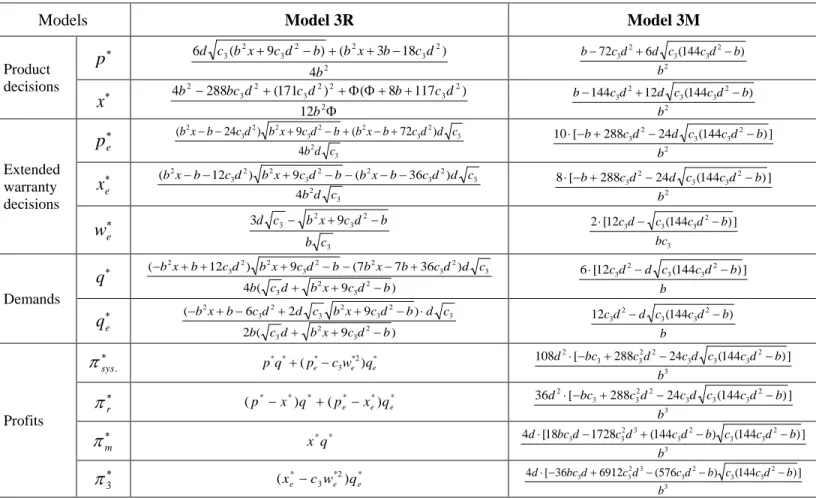
We solve for the model using standard methodology by working backwards, starting from the retailer’s problem in the last stage. Model 3M will have a similar formulation and solution methodology, and hence, are omitted. The optimal solutions of the two model 3M and 3R are presented in Table 2.
Being a Provider vs. Being a Reseller
We will compare the optimal profits of Models 3M and 3R with those of Models M and R respectively. This gives us insights about whether it is more profitable for a manufacturer or a retailer to be a reseller of the extended warranty instead of being a provider. The following proposition describes out result.
Proposition 5:
(a) The manufacturer gets a higher optimal profit by being a provider of the extended warranty
if and only if cm <4c3.
(b) The retailer gets a higher optimal profit by being a provider of the extended warranty if and only if cr <∆3, where ∆3 is a function of c3.
The analytical expression for ∆3 can be found in the proof. Proposition 5(a) shows that a manufacturer is better off being a provider of the extended warranty even when her repair cost is equal to that of the third party. In fact, she is better off being a provider unless her repair cost is substantially higher (cm ≥4c3) than that of the third party. A manufacturer is likely to have better knowledge of her product, implying her repair cost is likely to be lower than, or comparable to, that of the third party. Thus, the relationship cm <4c3 is likely to hold in practice. Therefore,
being a provider is often the preferred way of offering extended warranty for a manufacturer. This is usually the case with the auto manufacturers, as discussed in Section 1. As afore mentioned, it is difficult to find an example where a manufacturer resells third party extended warranties. Proposition 5(a) and our discussion above might explain why this is the case.
Proposition 5(b) described the necessary and sufficient conditions for the retailer to be a provider of the extended warranty. Our numerical experimentations indicate that the value of ∆3 falls in the range of 1.2c3~2.5c3 for a wide range of values of the problem parameters. (We
experimented with 100 scenarios by varying the price sensitivities b and d from 0.1 to 1 with a step of 0.1. The largest value of ∆3 is 2.493c3, and the smallest is 1.202c3, with most of the values above 2c3.) Note that the condition for being a reseller of extended warranty in Proposition 5(b) is less restrictive than that in Proposition 5(a). In addition, a retailer might not have expertise in repairing the product from a manufacturer. Propositions 5(a) and 5(b) thus indicate that in practice, a retailer is more likely to be the reseller of an extended warranty than a manufacturer is. Our examples in Section 1 strongly support this.
Proposition 5 provides general guidelines for practitioners in choosing the ways of managing the extended warranty business: to be an extended warranty provider or a reseller. We conclude this section by noting that the scenario where a third party offers extended warranty directly to a
consumer is beyond the scope of our paper. Such a scenario can easily be modeled as an insurance policy and is well studied in the literature of risk and insurance management (e.g., Lutz and Padmanabhan 1998, Manove 1983, Schlesinger 1983, and Taylor 1995).
Numerical Study: A Comparison of the two EWR Models
In this section, we present a numerical study to compare the two EWR models with respect to optimal price, demand, and profit. As the reader will see, the relationships between models 3M and 3R are qualitatively similar to those between models M and R, implying that the presence of a third party underwriter does not change the structural properties of our model.
The optimal solutions of the models 3R and 3M are summarized in Table 2. It is hard to compare the optimal solutions of these two models analytically. As a result, we numerically obtained the optimal solutions of the two models under various representative values of the model parameters. We choose the third party’s repair cost c3= 5 (other feasible values of repair cost yield similar results) and let the price sensitivities b and d vary from 0.2 to 1 at a step of 0.4. Our numerical findings are summarized in Figures 3(a) – 3(g). In each of these figures we plot the difference between the optimal solutions of the models 3R and 3M for different values of the demand sensitivity parameters b and d. These figures are straightforward. As a result, we simply summarize our findings in the following two observations.
Observation 2:
(a) The optimal retail price of the product in model 3R are always lower than those in model 3M
(i.e., R∗ < M∗ p p3 3
).
(b) The optimal extended warranty prices per unit length of time in model 3R are always higher
than those in model 3M (i.e., M e e R e e w p w p 3 * 3 *) ( ) ( ∗ ∗ > . Observation 3:
(a) The optimal profits of the retailer, the manufacturer, and the third party warranty provider are higher in model 3R than those in model 3M, implying model 3R gives rise to a better
system profit than model 3M (i.e., πr3R∗ > πr3M∗,
π
m3R∗ >π
m3M∗,π
33R∗ >π
33M∗, and R∗ sys 3 . π > ∗ M sys 3 . π ).(b) In the two models 3R and 3M, the optimal profit of the manufacturer is always higher than
that of the retailer (i.e.,
π
m3R∗ > πr3R∗ andπ
m3M∗ > πr3M∗).The relationships between models 3R and 3M in Observations 2 and 3 are similar to those between the models R and M for cm =cr (note that the repair cost for the models 3R and 3M are identical and equals to that of the third party). Thus, the presence of the third party does not significantly change the structure of our model. The intuitions behind these results have been discussed in detail in Section 4.
5.2 Sensitivity of Results with respect to Alternative Demand Functions
We discuss several alternative demand functions in this sub-section. First we consider the case where the demand of the extended warranty depends on product price. Then we present four other demand functions.
Demand of the Extended Warranty Depends on Product Price
In this section, we extend our basic model into a more complex scenario, where product price not only influences the maximum potential demand of the extended warranty (1−bp), but also has a direct impact on the extended warranty demand. Many consumers choose to buy extended warranties on expensive products such as cars, flat screen televisions etc., while few consumers buy extended warranties on products such as telephones or sewing machines. This observation suggests that the demand for the extended warranty relative to the product demand should be increasing with the product price. Our demand function in equation (2) readily accommodates such as extension by letting the parameter d to be a function of the product price p, i.e.,
e e e w p p d bp q =(1− )− ( ) , d′(p)≤0,we >0.
We choosed(p)=d/p, where d is a constant, and write the demand function for the extended warranty as 0 , ) 1 ( − − > = e e e e for w pw dp bp q .
We solve the three models numerically and compare the insights with our original model. We choose the sensitivity parameter d equal to 0.4 and 0.7, and let the price sensitivity b vary from 1.05 to 1.5 in steps of 0.05, while the repair cost ci varies from 0.05 to 4.0 in steps of 0.1. We seek the optimal solutions under the combinations of the parameters discussed. Our main findings are presented in Figures 4(a) – 4(d). Figure 4(a) shows how the extended warranty price per unit length of coverage, pe/we, vary across the three models C, M, and R when the repair costs of the retailer and the manufacturer are equal. This finding is consistent with that in Proposition 2. Similarly, Figure 4(b) validates Theorem 1 for the more general modeling framework while Figures 4(c) and 4(d) validates Proposition 3(a). This suggests that the findings of our model are quite robust and that the key insights of our original model remain unchanged even when we let the demand of the extended warranty depend on the product price.
Alternative Demand Functions
While we have used the simplest form of demand function that satisfies the desirable properties and maintains analytical tractability, to check the robustness of our model, we have repeated our calculations and analyses (analytical or numerical when analytical calculations were not tractable) for each of the following alternative demand functions:
e e e bp dp fw q =1− − + , (11) e e e bp dp f w q =1− − − / , (12) e e e bp dp f w q =1− − + , and (13) e e e w p bp q =1− − . (14)
Each of these demand functions satisfies the desirable properties of the extended warranty demand described in Section 3. Unlike our demand function in (2), each of the demand functions in (11), (12), and (13) allows different sensitivities for the price and the length of the warranty. We also test for both linear (equation 11) and non-linear (equations 12-14) relationships and allow complex relationship between the demand and length of the extended warranty by experimenting with four different (-1.0, -0.5, 0.5, and 1.0) exponents of we. We note that Desai
and Padmanabhan (2004) use a linear additive demand function to study extended warranty. Our choices allow the generalization of their demand function to more complex and realistic
scenarios. These analyses using each of the above four demand functions yield similar qualitative results as those of our original model discussed in Section 4. These calculations, once again, suggest that the recommendations from our model are quite robust.
6. SUMMARY AND CONCLUSION
In this paper, we have developed game-theoretic models to design extended warranties and compared different extended warranty schemes in a supply chain context. Specifically, we considered a supply chain involving a single manufacturer and a single retailer, either of whom can be a provider or a reseller of the extended warranty. We first analyzed two EWP models with the retailer and the manufacturer, respectively, being the provider of the extended warranty. We compared the two models in terms of system profits, retailer profits, manufacturer profits, product pricing decisions, and extended warranty decisions. We also benchmarked the performances of the two models with that of a centralized system. Our main results are as follows.
• The extended warranty length and price are decreasing in the repair cost of the party who provides extended warranty.
• Normally, the manufacturer provides the best extended warranty with respect to the lowest extended warranty price per unit length of coverage, unless the retailer’s repair cost is substantially higher than that of the manufacturer.
• The retailer, with a higher rate of profit improvement, benefits more from the extended warranty business than the manufacturer, unless he has substantial repair cost disadvantage.
• Depending on the value of the repair cost, either model can generate better system profit. However, when the repair costs of the two models are equal, model R not only generates a higher system profit but also makes a Pareto improvement over model M. This fact arises due to the reduced double marginalization in the supply chain. However, when the repair cost advantage from the manufacturer substantially outweighs the structure advantage in model R, model M is able to generate more system profit.
We then studied two EWR models where a third party offered the extended warranty, while the manufacturer or the retailer simply acted as the extended warranty reseller. Our results show that adding a third party provider does not change the dynamics of the system. By comparing the corresponding profits of the manufacturer and the retailer between EWP and EWR models, we
outlined some general guidelines for practitioners, on when a firm should choose to be a provider versus a reseller of the extended warranty.
Our paper makes the following contributions to the operations management literature. First, it provides a unique demand function for the extended warranty, which explicitly takes into account product demand, product failure, and repair cost. In line with our observation in practice, we model the extended warranty as a “service product” with price and time duration for coverage. Second, while a majority of the literature in extended warranties focuses on consumer moral hazard and heterogeneity issues, our work addresses its design issues and its role in the channel performance. By adopting a game-theoretic approach, we study the strategic interaction between the manufacturer and the retailer as well as the interaction between the product sales and the extended warranty sales. The main results of our models are able to qualitatively explain some observed practices. For example, why do consumer experts always recommend the manufacturer’s extended warranties? Why is Chrysler shortening the extended warranty on its new vehicles? Third, our model provides a new perspective in distinguishing the extended warranty sellers on the market: a provider or a reseller. We also provide guidelines for helping make the right choices. Fourth, our model implies that the extended warranty is not merely a source of revenue. Because of the unique character of its demand, which is dependent on product demand, the extended warranty could be used strategically in channel choices to improve system profits and product pricing decisions. These results provide useful insights as well as qualitative guidance to practicing managers involved in designing, setting up, and managing an extended warranty business.
Like any other model in operations management literature, our model is based on a set of assumptions. For simplicity, we studied the extended warranty business using a monopolistic setting. This allowed us to isolate the impact of the extended warranty on total supply chain profits. An important extension of our model would be to include competition, either between manufacturers or between retailers. Incorporating demand uncertainties might be another useful extension. Our model assumes no information asymmetry. In practice, a retailer might have private information about consumer demand. In such a scenario, the retailer might use this information strategically to improve his profit. We have assumed a one-sided market where the demand for the extended warranty is influenced by the product demand but not the vice-versa. This assumption seems to hold in practice for a wide range of consumer durables ranging from
domestic appliances to consumer electronics. Retailers such as Wal-Mart and Sam’s Club typically do not even pitch the sale of an extended warranty until the check out. In the authors’ own experiences, major appliance retailers such as Sears, Home Depot, and Lowes do not bring up extended warranty while helping a potential customer choose from different brands of domestic appliances. Such examples have even prompted researchers to study whether the extended warranty should be pitched to a consumer alongside a product? Heese (2008) reports that major consumer electronics retailers such as Best Buy does not pitch products and extended warranties simultaneously and develops a model to conclude that a retailer will be better of pitching both simultaneously. From these examples, it is clear that under many situations in practice, the demand of the extended warranty is influenced by the product demand but not the vice-versa. Our paper models such scenarios. Admittedly, there might be scenarios where the availability of an attractive extended warranty will influence the product demand as well. Studying extended warranties under such two-sided markets remains one our agendas for future research.
Acknowledgement
The authors thank the anonymous senior editor and the two referees for their valuable inputs.
REFERENCES
Anderson, E. (1977), “Product Price and Warranty Terms: An Optimization Model,” Operational Research Quarterly, Vol. 28, No. 3, 739 – 741.
Armstrong, L. (2004), “When Service Contracts Make Sense,” Business Week Online, December 20, Issue 3913, 86 – 86.
Balcer, Y. and I. Sahin. (1986), “Replacement Costs Under Warranty: Cost Moments and Time Variability,” Operations Research, Vol. 34, No. 4, 554 – 559.
Berner, R. (2004), “The Warranty Windfall,” Business Week Online, December 20, Issue 3913, 84 – 86.
Cohen, M. and S. Whang. (1997), “Competing in Product and Service: A Product Life-Cycle Model,” Management Science, Vol. 43, No. 4, 535 – 545.