Quoted Staged Rewriting: A Practical Approach to
Library-Defined Optimizations
Lionel Parreaux, Amir Shaikhha, Christoph Koch
EPFL, Switzerland — {firstname.lastname}@epfl.chAbstract
Staging has proved a successful technique for programmati-cally removing code abstractions, thereby allowing for faster program execution while retaining a high-level interface for the programmer. Unfortunately, techniques based on staging suffer from a number of problems — ranging from practicali-ties to fundamental limitations — which have prevented their widespread adoption. We introduceQuoted Staged Rewriting (QSR), an approach that uses type-safe, pattern matching-enabled quasiquotes to define optimizations. The approach is “staged” in two ways: first, rewrite rules can execute ar-bitrary code during pattern matching and code reconstruc-tion, leveraging the power and flexibility of staging; sec-ond, library designers can orchestrate the application of suc-cessive rewriting phases (stages). The advantages of using quasiquote-based rewriting are that library designers never have to deal directly with the intermediate representation (IR), and that it allows for non-intrusive optimizations — in contrast with staging, it is not necessary to adapt the entire library and user programs to accommodate optimizations.
We show how Squid, a Scala macro-based framework, en-ables QSR and renders library-defined optimizations more practical than ever before: library designers write domain-specific optimizers that users invoke transparently on delim-ited portions of their code base. As a motivating example we describe an implementation of stream fusion (a well-known deforestation technique) that is both simpler and more pow-erful than the state of the art, and can readily be used by Scala programmers with no knowledge of metaprogramming. CCS Concepts •Software and its engineering→ Soft-ware performance; Compilers;
Keywords Rewrite Rules, Staging, Optimization
ACM Reference Format:
Lionel Parreaux, Amir Shaikhha, Christoph Koch. 2017. Quoted Staged Rewriting: A Practical Approach to Library-Defined Op-timizations. InProceedings of 16th ACM SIGPLAN International Conference on Generative Programming: Concepts and Experiences (GPCE’17).ACM, New York, NY, USA,14pages.https://doi.org/10. 1145/3136040.3136043
Permission to make digital or hard copies of all or part of this work for personal or classroom use is granted without fee provided that copies are not made or distributed for profit or commercial advantage and that copies bear this notice and the full citation on the first page. Copyrights for components of this work owned by others than ACM must be honored. Abstracting with credit is permitted. To copy otherwise, or republish, to post on servers or to redistribute to lists, requires prior specific permission and/or a fee. Request permissions from [email protected].
GPCE’17, October 23–24, 2017, Vancouver, Canada
© 2017 Association for Computing Machinery. ACM ISBN 978-1-4503-5524-7/17/10. . . $15.00
https://doi.org/10.1145/3136040.3136043
1
Introduction
We begin by providing some necessary background before presenting our approach and core contributions.
1.1 Staging and extensible compilers
Multi-stage programming (MSP, or juststaging) [46] lets programmers syntactically distinguish multiple stages of ex-ecution in their programs. At each intermediate stage the program computes away what is known at this stage, and generates a newresidualprogram meant to execute the next stage. The ultimate stage performs the task of the unstaged program, but in a more efficient way. MSP can be viewed as a form of partial evaluation with explicit annotations for binding-time analysis [19], or as a way to define type-safe program generators that work by iteratively composing code fragments together. MSP can be applied to both run time [45,47] and static [13,56] code generation. In the latter case, programs are made of two stages where the first stage is executed at compile time and the second stage corresponds to the final, compiled program. A major limitation of MSP is that it generally offers no type-safe facilities to analyse code (it ispurely generative), which greatly restricts its capabili-ties in terms of program optimization. Moreover, staging a library exposes users of that library to staging annotations,1 which leak through its interface. Perhaps more importantly, staging requires to decide from the beginning which parts of the program are static (meant to be executed at program generation time) and which parts are dynamic, then building everything around that dichotomy, making it hard to evolve the design later on without extensive refactorings.
Staging has been successfully applied to optimizing do-main specific languages (DSL), especially Embedded DSLs (EDSL) [17] which are DSLs that are defined within a more ex-pressivehost languagesuch as Haskell [1,17,29] or Scala [26,
30,35,39]. In this context, staging has been used to facili-tate the definition of extensible compilers for performance-oriented DSLs and heterogeneous target platforms [1,9,26,
30,33]. Generally speaking, these compilers reuse the fron-tend capabilities of their host (syntax and type system) but they convert programs into their own domaspecific in-termediate representation (IR) before stringifying low-level code. This limits their ability to interact with code outside of the DSL. For example, a compiler for a streams DSL (see the LMS embedding of [24]) by default can only handle primi-tive types, strings, arrays, functions, loops and tuples, and adding support for using other constructs (such as, for ex-ample,BigInt) requires extending the compiler’s IR, which
1Type-Based Embedding eschews staging quotations [35], but requires more complex types, which also degrades the library interface [23,34]. 1
involves significant amounts of boilerplate. Moreover, ex-pressing non-trivial optimizations in these frameworks is hard and error-prone, as one has to deal with details of the IR with limited support for code pattern matching. Tools have been proposed to generate some of the boilerplate auto-matically [23,43] and solutions were sketched to make code rewriting easier [34], but the fundamental limitations and intrinsic complexity of these approaches are still there, and the burden they impose on library users only partly lifted. 1.2 User-defined rewriting
The idea of building program optimizations via high-level rewrite rules is far from new [10,21,25,33,41,42,49–51]. However, few approaches have offered a lightweight, type-safe, language-integrated way of expressing these rules, as most rely on distinct specification metalanguages or complex code transformation combinators.
A notable exception, the Glasgow Haskell Compiler (GHC) [21] allows library writers to describe simple algebraic rewrite rules consisting of two expressions: a pattern, and a template to replace the pattern with when the rule fires. GHC tries to apply as many of these rules as possible as it performs its own optimization passes. There are no termination or correctness guarantees associated with the rewrite rules, as their objective is to let users make — at their own risk — domain-specific assumptions that the compiler cannot make. There are two major limitations to this approach. First, while the rules are sufficient to express a variety of optimiza-tions, they are limited in the patterns that they can match and in the code that they can generate. For example, it is easy to define a rule to rewritepow x 2intox * x, but the generaliza-tion of that rule to rewritepow x n, wherenis constant, into x * ... * xis not expressible. Second, library designers have very weak guarantees about the actual application of their rules when a program is compiled. The result is intimately dependent on the inlining behavior of GHC (which is affected by separate compilation), so that expert knowledge about the inner workings of the GHC optimizer is often required to achieve satisfying results [21].2As a consequence, the practice is to annotate functions withINLINEor NOINLINE directives that sometimes need to refer to GHC’s own inter-nal optimization phase numbers. Moreover, approaches like stream fusion — a popular deforestation technique [6,7] — have been shown to require more powerful rewriting facili-ties than simple GHC rewrite rules. This has sparked interest in HERMIT [10,11], an interactive system based on rewriting combinators that is significantly more complex.
1.3 Quoted Staged Rewriting
In summary, staging is powerful but imposes a burden on both library users and library designers. Moreover, purely-generative staging disallows code inspection, which is lim-iting, and approaches that allow code inspection do so by exposing low-level IR constructs that are hard to manipulate.
2The GHC wiki has this informal bit about the behavior of rewrite rules in the context of list fusion:“Q: Why does making one thing fuse sometimes make something else not fuse? A: Because the whole system is built around inlining, and no one really knows how to make that Do The Right Thing every time. Also, no one knows a better way to avoid basing it on inlining.”
Rewrite rules in the style of GHC are easier to express and integrate more seamlessly with the host language, but they lack expressiveness and control.
In this paper, we bring together the advantages of stag-ing and rewritstag-ing into a unified framework,Quoted Staged Rewriting(QSR), based on the Squid metaprogramming sys-tem [31]. We claim that our approach combines the flexibility and ease of use of language-integrated rewrite rules with the power and guarantees of static staging.
Our framework works by user-defined, scoped opti-mizations, whereby: 1. library designers express powerful domain-specific optimizations by way of type-safe quasiquote-based rewrite rules; and 2. library users write normal, un-staged code that they can surround withoptimize { ... } blocks in order to apply those library optimizations. With first-class control of inlining, users can abstract on the li-brary’s constructs while letting the library see through these abstractions to apply its rewritings. Scoped optimizations are useful because it often makes sense to focus optimization efforts on the “hot execution paths” of a program, where we can afford to let the optimizer spend more time doing its job. In our experience, applying these aggressive optimizations to more code outside of the hot paths makes the general compilation slower but has rapidly diminishing results.
Rewrite rules, which are applied at compile time, are al-lowed to usearbitrary computations, a flexibility that places them on equal footing with staging. On the other hand, rewriting enables a more dynamic approach to binding-time analysis. Together with extensible pattern matching, this favors more modular optimization designs: rewritings with orthogonal concerns can be completely decoupled. Taking inspiration from transformation-based compilers [20,36], where rewritings are interspersed with successivelowering phasesthat decrease the general level of abstraction, we allow optimization designers to specify at which phase to inline which library abstractions. This is an essential feature to guarantee consistent abstraction removal and robust, pre-dictable optimization — both staples of MSP. We make novel use of a simple IR and effect system, to soundly accommo-date Scala’s imperative features while enabling high-level algebraic rewritings. We thus reap the benefits of purity while still allowing the manipulation of low-level imperative programs.
1.4 Contributions
Our contributions are organized as follows:
• We develop a simple staging example, and show how the problem of extending it to handle more optimizations ex-hibits limitations with staging (Section2).
• We show how QSR eliminates these problems while retain-ing the desirable properties of stagretain-ing, and we see how to modularly define and compose QSR libraries (Section3).
• We explain important aspects of how Squid is implemented and how its IR and effect system work to enable QSR in the presence of imperative features (Section4).
• We detail our main use-case: implementing stream fusion by QSR.3We improve on the state of the art by expressing the fusion of more programs, in a simpler way (Section5).
3Source code freely available athttp://github.com/LPTK/Squid-Examples. 2
• We empirically verify that the QSR approach to stream fusion matches staging in terms of performance, but also that it requires less lines of code (Section6).
2
Background on Staging
2.1 Preamble: Typed Quasiquotes
In this paper we will write all examples using our Squid framework, which can express staging as well as rewrit-ing. The way Squid differentiates code in the current stage from code in the next stage is by the use of c o d e"..."
quasiquotes and associatedCode [...]types. For example, while expression2. toDoubleevaluates immediately to value 2.0 of type Double, expression c o d e"2. toDouble"
evalu-ates to a code value representing the program fragment 2. toDouble of type Code[ Double ]. In order to go from a Code[ Double ]to aDouble, one has to callrunon the result, as inc o d e"2. toDouble".runwhich evaluates to2.0.
Quasiquotes support composing code fragments together by using$-escapes, which represent “unqotes.” For example,
v a l d = c o d e"2"; c o d e"$d + 1" evaluates to c o d e"2+1".
It is possible to unquote the result of bigger expressions by using curly braces after the dollar sign, so the previous code can also be writtenc o d e"${ c o d e"2" } + 1".
Although code quasiquotes use a syntax similar to string quotation"...", remark that the code fragments they gen-erate arenotinternally represented as character strings, but as constructs in Squid’s intermediate representation (IR). 2.2 Staging the Power function
The prototypical staging example ispower, a function that raises a numberxto thenthpower: since the exponent partn is often a statically known integer, it is tempting to special-ize that function so that a call to it expands into a simple sequence of multiplications. Figure1apresents the code for a stagedpower function, which takes a current-stage exponent nand returns a function from anyDoublecode valuebaseto a code value representing its multiplicationntimes. Triple quotation marks"""introduce multi-line quotations.
The figure ends with a usage example for n = 3. The astute reader will have noticed that the unquoted expres-sion power (3) has type Code [ Double ] => Code [ Double ], whereas it is applied in the next stage (inside the quota-tion) as if it were of type Code [ Double => Double ]. The reason is that Squid automatically lifts any current-stage function Code [A] => Code [B] into a next-stage function Code [A => B]upon insertion, and immediately inlines it. 2.3 New optimization opportunity
When removing abstractions programmatically and perform-ing aggressive inlinperform-ing, optimizable patterns often emerge, including patterns that a programmer would never write explicitly [21]. For instance consider a simulation applica-tion that needs to compute the gravitaapplica-tional force between several different celestial bodies. Those of us who remember our physics course will point out that the relevant equa-tion has the formF =G m0·m1
d(p0,p1)2
, which corresponds to
the program of Figure2. When the call todistance is in-lined, the body ofgravityForceends up containing a call to pow( sqrt (...) ,2), which is clearly an inefficient identity:
G * plan0 .mass * plan1 .mass /
pow(sqrt( pow( plan0 .pos.x - plan1 .pos.x, 2) + pow( plan0 .pos.y - plan1 .pos.y, 2) ), 2) Naturally, we would like to be able to optimize such patterns. 2.4 Limitations of Staging
Let us consider what happens if we stage the function of Fig-ure2, making use of thepowerfunction defined in Figure1a. Assuming purely-generative staging like in MetaOCaml [45], there is no easy way to extend that definition ofpower to perform the “power-of-power” optimization described above. The staged function can no longer accept a Code[ Double ] as the base, since purely generative approaches do not allow inspectingordecomposingcode fragments – onlycreating andcomposingthem together. However, we need to know whether a given piece of code has the form of a square root to be able to eliminate a square operation performed on it.
Solving this issue typically involves defining an auxil-iary data structure for code being constructed, that carries additional information about its underlying structure. Fig-ure4shows a generalized definitiongenPowerof the power function, that uses an algebraic data typeCodeRepto retain information about the code: subclassPowdescribes a piece of code that results from an application of the power function, whileSimplecorresponds to other code. MethodtoCodeis used toreifythat intermediate representation into a proper code fragment to be inserted into a quasiquote.
Notice how that change affected the way we definepow3. More complex usages ofpowerhave to change in an even more significant way, as is shown in Figure3 where we adapt the planet simulation code seen previously to our new staging scheme. As one can see, both the implementation of genPowerand its usage inpow3,distanceandgravityForce become tremendously more complicated. We believe that this is why purely-generative staging is often relegated to the back end — i.e., used merely for end-of-the-pipeline code generation, while the front end of the library is defined in the finally-tagless style [2] and mostly hides staging.
Extensible compiler techniques obviate the need to explic-itly wrap and unwrap code, by making the equivalent ofPow directly extend (inherit from) the compiler’s internal IR node type [16]. Moreover, type-inference-based techniques help to hide staging annotations to some extent [35], which can be further improved by language virtualization [23,28], but the added complexity and fundamental limitations are still there: DSL designers have to write the entire library with staging in mind, define IR nodes for all constructs meant to be supported by the DSL, and interact directly with details of the compiler’s IR (especially when defining rewritings [34]).
3
Quoted Staged Rewriting
3.1 Preamble: Quasiquotes in Pattern Matching Squid supportspattern matchingon code fragments, with syntax c a s e c o d e"pattern" => result. In a c o d epattern,
the semantics of unquotes is no longer toinsertbut rather to 3
def power (exp: Int )( base : Code [ Double ]): Code [ Double ] = if (exp == 0) code"1.0"
else {
assert (exp > 0)
if (exp % 2 == 0) code"""
val tmp = ${power (exp /2)( base )}
tmp * tmp """
else code"$base * ${power (exp -1)( base )}" } val pow3 = code"(x: Double ) => ${power (3)}(x)".run
(a)Defining a staged power function.
i m p o r t Math.pow // (Double , Double ) => Double
@bottomUp @fixedPoint val powOpt = r e w r i t e { case code"pow($base,0)" => code"1.0" case code"pow($base,${Const (exp)})"
if exp. isWhole && exp > 0 => if (exp % 2 == 0) code"""
val tmp = pow($base, ${Const (exp /2)})
tmp * tmp """
else code"$base * pow($base, ${Const (exp -1)})" } def pow3(x: Double ) = powOpt . optimize { pow(x ,3) }
(b)Rewriting the standard Math.pow function. Figure 1.Two approaches to optimizing the power function.
i mp o r t Math .{pow , sqrt }; val G = 6.67E -11
def gravityForce ( plan0 : Planet , plan1 : Planet ) =
G * plan0 . mass * plan1 . mass /
pow( distance ( plan0 .pos , plan1 .pos), 2)
def distance (p0: Position , p1: Position ) =
sqrt (pow(p0.x - p1.x, 2) + pow(p0.y - p1.y, 2)) Figure 2.Example simulation code usingsqrtandpow.
def gravityForce (pl0: Code [ Planet ], pl1: Code [ Planet ]) = code"""G * $pl0. mass * $pl1. mass / ${
genPower ( distance (code"$pl0.pos",code"$pl1.pos") ,2.0)
. toCode }"""
def distance (p0: Code[ Position ], p1: Code[ Position ]) =
sqrt ( Simple (code"""
${genPower ( Simple (code"$p0.x - $p1.x") ,2.0). toCode}
+ ${genPower ( Simple (code"$p0.y - $p1.y") ,2.0). toCode}
"""))
def sqrt(x: CodeRep [ Double ]) = genPower (x, 0.5)
Figure 3.Simulation code adapted for the (new) staged interface.
a b s t r a c t class CodeRep [T] { def toCode : Code[T] } case class Simple [T]( toCode : Code[T]) e x t e n d s CodeRep [T] case class Pow(cde: Code[ Double ], exp: Double )
e x t e n d s CodeRep [ Double ] { def toCode = if (exp. isWhole ) power (exp. toInt )( cde) else code"Math.pow($cde,${Const (exp)})" }
defgenPower ( base: CodeRep [ Double ],exp: Double ) = basematch{ case Simple (c) => Pow(c, exp)
case Pow(c,e) if exp. isWhole => Pow(c,exp * e)
case _ => Pow(base .toCode , exp) } val pow3 = code"(x: Double ) => ${ (x: Code[ Double ]) =>
genPower ( Simple (x), 3). toCode }(x)".run
Figure 4.New definition of the staged power function, with support for optimizing the “power-of-power” pattern.
extractcode fragments found in the place where they occur. For example, the following program evaluates to c o d e"2":
c o d e"2+1" m a t c h { c a s e c o d e"($n:Int) + 1" => n }
3.2 RewritingMath.pow
Figure1bpresents a rewriting that optimizes calls toMath.pow with integer exponents using binary exponentiation.Const is the constructor/extractor for constant values; for example Const (2)is equivalent toc o d e"2"in both expressions and
patterns. A rewriting is registered using a r e w r i t e block
containing pattern matching clauses. Each rewriting can be configured to apply in bottom-up or top-down traver-sal order, and can be made to apply repeatedly until a fixed
point is reached. In this example we use bottom-up order and fixed-point recursion. MethodisWholesimply tests whether aDoublevalue is a whole number. Note that Squid uses an IR based on the A-Normal Form (ANF) [12], which means that non-trivial sub-expressions are let-bound, so that it is not a problem to duplicate thebaseargument extracted from the patterns. For example,pow(readInt ,3)is rewritten into:
val x_0 = readInt ; x_0 * 1.0 * (x_0 * 1.0 * (x_0 * 1.0))
One can immediately notice several differences with the staged version. First we do not need to create a new, dis-tinctpowerconstruct; instead we operate directly on Java’s standardMath .powmethod. This means that any programs usingMath.powcan already benefit from our optimization without any changes to their business logic. In other words, QSR allows us to work directly on program representations instead of staged structures, but without having to define our own domain-specific IR. Moreover, the optimization of pow3in Figure1bhappens at compile-time which makes the user experience similar to built-in optimizations.
3.3 Extending the Rewriting
Implementing the “power-of-power” optimization by rewrit-ing is straightforward, as we can simply add the followrewrit-ing rewrite rules4to those of Figure1b:
case code"sqrt($x)" => code"pow($x,0.5)"
case code"pow(pow($base,${Const (a)}),${Const (b)})" if b. isWhole => code"pow($base,${Const (a * b)})" case code"pow($x,1)" => x // just for aesthetics
We can now wrap the body ofgravityForcein Figure2 in-side a powOpt . optimize {...} block, which rewrites it into:
val x_0 = plan0 .pos.x - plan1 .pos.x val x_2 = plan0 .pos.y - plan1 .pos.y
G * plan0 .mass * plan1 .mass / (x_0 * x_0 + x_2 * x_2)
There is one caveat however: the additional rules have to be insertedat the beginningof thec a s eclauses of Figure1b,
otherwise an expression such aspow(pow(x ,0.5) ,2) will be rewritten tov a l tmp = pow(y ,0.5); tmp * tmpby the
second rule of Figure1b, before the new rules can be ap-plied, missing that optimization opportunity.5This shows
4We require the outer exponentbto be a whole number to avoid performing unsound reductions, likesqrt(pow(x,2))toxinstead ofabs(x). 5The cases of a rewriting are tried in the order they are defined, similar to classical pattern matching (thematchkeyword).
@online val powOpt = r e w r i t e { case code"pow($base,${Const (exp)})"
if exp. isWhole && exp > 0 => power (exp. toInt )( base) case code"pow($base,$exp)" => throw
StagingError ("Non - static exponent : " + exp) } Figure 5.Hybrid approach: rewrite rules that falls back to staged function and emit error on rewrite failure.
that the ordering of rewritings should be carefully consid-ered by library designers. More generally, it is often useful to organize rewrite rules into separate phases. For example, considering that the implementation ofsqrtis faster than that of more general-purposepow, it would pay off to have a later phase that converts code of the formpow(x ,0.5)back intosqrt(x)before emitting the final code. The question of rewriting phases is exemplified further in Section5.4. 3.4 Hybrid approaches and online rewriting
It is possible to freely combine rewriting and traditional stag-ing. For instance, while fixed point rewriting is often useful, its use in Figure1bcould be considered overkill; instead of looping through the fixed point of the rewrite rule, we could just as well call a staged function that performs the looping itself,6as demonstrated in Figure5. In that configuration, the role of rewrite rules is to automatically extract static parts from unannotated programs, similar to binding time analysis (BTA). Reminiscent of online partial evaluation [19], the@ onlineannotation specifies that a rewriting should be performed on the fly, as program representations are con-structed. Online rewrite rules can be used to achieve a form of normalization: by restricting the space of representable programs, they make transformations simpler to express. Ad-ditionally, they can alleviate phase ordering problems [36]. 3.5 Guarantees and Control
Thanks to arbitrary code execution in rewrite rules and con-trol over inlining (see Section5.4), we make the argument that QSR is as powerful as compile-time staging. In particu-lar, it preserves all the necessary control required by library designers, who wish to guarantee to library users that pro-gram optimizations apply reliably: if some rewriting could not be applied because static information could not be ex-tracted, it is always possible for the rewrite system to emit a compile-time error and fail code generation, as is done in the second rule of Figure5. Other valid behaviors in this case may be: emitting a compile-time warning but going through with code generation; simply logging the failure in a report that users can inspect in order to understand how to speed up their program; or doing nothing at all – which is what traditional compiler optimizations have been doing.
An even stronger argument can be made following [3] and [29], who rely on the subformula principle of normal proofs adapted to programming [54] to guarantee that types that do not appear as subformulas of the types of the inputs and outputs of a program will be completely removed after sufficient normalization. For example, a program of type
6Yet another hybrid approach would be to use code pattern-matching inside of a staged definition, lifting the purely-generative restriction.
Int => Intthat is internally defined using someStreamdata type can be rewritten to a program that does not make use ofStream, as long as we can inline allStreamfunctions. The possibility of inlining the relevant functions is an integral part of the subformula principle: if we do not have access to the function body (and therefore cannot inline it), the function itself should be counted as part of the inputs to the program, which prevents the application of the subformula principle (as the function type will contain the offending type — here,Stream).
3.6 Modularity of rewritings
Squid enables the common approach [41,52] of separating term-level rewritings from transformation strategies. As a result, it is possible to define self-contained libraries of useful rewritings as well as libraries of useful transformation strate-gies and compose them modularly. To combine different strategies we rely on Scala’s mix-in composition mechanism, a technique also used in previous work [16,37].
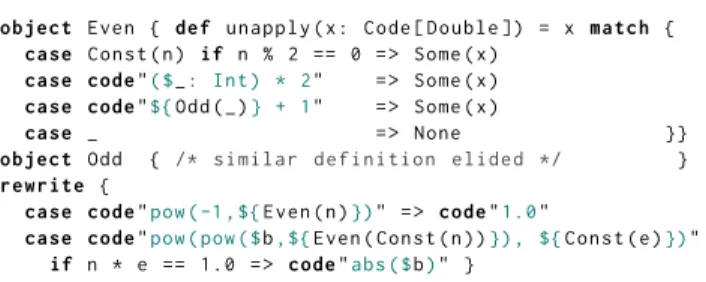
Another important direction for modularity is to allow abstracting over patterns in rewrite rules [49]. Squid achieve this by merely relying on Scala’s built-in custom extractors:
o b j e c t Even { def unapply (x: Code[ Double ]) = x match { case Const (n) if n % 2 == 0 => Some(x)
case code"($_: Int) * 2" => Some(x) case code"${Odd(_)} + 1" => Some(x)
case _ => None }}
o b j e c t Odd { /* similar definition elided */ } r e w r i t e {
case code"pow (-1,${Even(n)})" => code"1.0"
case code"pow(pow($b,${Even( Const (n))}), ${Const (e)})" if n * e == 1.0 => code"abs($b)" }
The code above defines co-recursiveEvenandOddextractors that are used to rewrite terms such aspow(pow(x ,2) ,0.5) intoabs(x)andpow (-1, readInt *2)intoreadInt ; 1.0. 3.7 Composing uses of QSR libraries
Finally, we describe how to compose together optimizers de-fined in different libraries. The simplest way to achieve com-position is tonesttheoptimizeblocks, which expand inside-out: inr0. optimize { ... r1. optimize { ... } ... }the r1block expands first (applying its rewrite rules), and what the r0block sees is the resulting optimized code. Conse-quently, this approach may yield different results depending on the order in which the different blocks are nested.
A more fine-grained alternative is to merge rewriting passes together, as in(r0+r1 ). optimize { ... } but this requires that the rewritings be defined using compatible tra-versal strategies. More advanced library optimizers (like in Section5) may be defined in terms of successive rewriting and inlining phases; determining how to mix these more complex optimizers together in a fine-grained way requires careful consideration from the user.
3.8 Optimizing Existing Libraries
As we saw with Math .powandMath .sqrt, Squid can opti-mize code written using preexisting, unmodified libraries. On the other hand, it is often beneficial to design libraries 5
with optimization in mind, using constructs that can be eas-ily manipulated and optimized by code rewriting. For ex-ample, Section5presents a streams implementation Strm that is geared towards QSR. Nevertheless, it is still possible to use that ad-hoc implementation to optimize existing li-braries, such as Scala’sStream. This is done in three phases. First, we define conversion functionstoStrmandtoStream to move between the two representations [48]. Then we rewrite allStreamoperations toStrmones using these con-versions, while collapsing useless conversions on the fly. For example, we convertStream . from (0 ,1). take (3). sum toStrm.from (0 ,1). take (3). sumwith these rewritings:
case code"($xs: Stream [Int ]). sum" =>code"toStrm ($xs). sum" case code"Stream . from ($start,$step)"
=> code"toStream ( Strm . from ($start,$step))" case code"($xs: Stream [$t]). take ($n)"
=> code"toStream ( toStrm ($xs). take ($n))" case code"toStrm ( toStream ($xs: Strm [$t]))" => xs
Finally, the usualStrmoptimizations can be applied on the resulting program, producing optimized code that may en-tirely bypass the usage ofStream. Note that in certain cases, inserting back-and-forth conversions may bedetrimentalto performance when the whole pipeline cannot be converted and when the cost of conversion outweighs the gains of optimization [7]. Thankfully, it is easy to write a separate “clean-up” phase which reverts conversions that could not
apply fully, avoiding unwanted conversion costs.
4
Enabling Quoted Staged Rewriting
In this section, we detail several important technical aspects of the Squid implementation that enable QSR.
4.1 Custom A-Normal Form (ANF)
Hash consing.The Squid ANF IR is geared towards making rewrite rules as flexible as possible. As such, we have an unconventional definition of “non-trivial expressions” (those expressions that need to be let-bound). In our approach all pure expressions are considered trivial and therefore they are never let-bound. Semantically, it isas if pure expressions were duplicated at every one of their use sites, but internally Squid uses hash-consing [18] so that there is only a single representation in memory of every pure term. Conceptually, writing c o d e"println (x +1); x+1"is equivalent to writing v a l x_0 = c o d e"x+1"; c o d e"println ($x_0); $x_0". This
is not only useful to save memory, but also allows Squid to cache transformations so that they are not performed more than once on a given pure term.
Matching.The mechanism described above gives us the benefits of ANF (normalized control-flow, sound handling of effects) while enabling powerful code pattern matching, because patterns can freely inspect nested sub-expressions as long as these sub-expressions are pure. Impure patterns can also be used, such as c a s e c o d e"println ( readInt )",
which matches c o d e"v a l x = readInt ; println (x)" but does not match any program where there are impure expres-sions intervening between thereadInt andprintln calls, like c o d e"v a l x = readInt ; readDouble ; println (x)".
Scheduling.When generating or pretty-printing code, Squid uses aschedulingphase to let-bind pure expressions that are used multiple times, in order to minimize program size and computation costs. This phase needs special care around closures, by-name arguments and branching constructs. For example, it makes sense to schedule expressionsout of a loop (so as not to recompute them on every iteration), but insidean if-then-else branch if the other branch does not also use it (so as not to perform useless computations). Due to the lack of space, we do not describe the algorithm used by Squid to perform scheduling, but there is extensive lit-erature on the subject [4]. Squid allows users to annotate higher-order method parameters to indicate whether they are expected to executeat most once,at least onceormany times. This way Squid can produce sensible schedules for code that uses custom constructs, such as the loopWhile function of Section5.3.
4.2 Effect System
Basic Principles.In order to determine which expressions are pure, Squid uses a very simple yet surprisingly versatile effect system. The idea is to differentiate two kinds of effects: directandlatent. An expression has direct effect if it reads or writes mutable state, performs I/O, etc. Latent effects are reserved for expressions thatdelaythe execution of direct effects, such as a lambda expression containing effectful code. Similarly to previous systems [38], methods are then annotated with 1. their intrinsic effect, and 2. the way they propagate the effects of their arguments. “Pure expressions” are those with no direct effect, so lambda expressions are considered pure even when they have latent effect.
Examples.Since the ScalaStreamdatatype is purely func-tional, none of its methods has any intrinsic effects. However, transformers likemap“build up” latent effects when applied to effectful functions, soStream (1 ,2 ,3). map(_ + readInt ) has latent effect. On the other hand, consumers likefold “execute” the latent effect of their arguments. This is because Streamis alazydata structure that executes computations only when required. As an example, if eithersor f have latent effect then s.fold (0)( f)has direct effect — other-wise it is pure. As a result, a stream pipeline like the ones we study in Section5is normalized to one big expression terminated by a call to a consumer such asfoldorforeach, which allows for simple yet powerful rewritings (cf. Fig-ure7). Finally, notice thatstrict collections behave differ-ently: for them, transformers execute immediately, so code likeList (1 ,2 ,3). map(_ + readInt )has direct effect. Future Work.Improving the effect system to be more finely-grained could benefit pattern matching and scheduling. In particular, we could maintain an arbitrary number of latent effect layers — currently we consider thatx => print (x) andx => y => print (x)have the same (latent) effect, which means that when the latter is appliedonceit is already consid-ered to have a direct effect, which is not unsound but rather imprecise. We could also use a graph-based IR [5] to maintain explicit dependencies between expressions, like in LMS [36] or Graal [55]. Finally, while we currently require users to 6
annotate the effects of their methods, automatic effect infer-ence is entirely feasible. Existing dedicated effect-tracking tools could also be leveraged, such as Scala FX [38]. 4.3 Implemenation of code pattern matching Squid implements pattern matching by building a term con-taining holes to represent the pattern, similarly to theFolds subsystem of HERMIT described in Farmer’s dissertation (p.73) [10]. Squid’s current rewriting algorithm works by try-ing each pattern one after the other, and does not memoize previous matching results, although that would be possible to implement — following Farmer, we plan to use trie maps in order to speed up the process. Nevertheless, we have found that even our non-optimal approach was practical, and en-abled advanced rewritings like those of Section5plus dozens of online normalization rules7to be applied on mid-sized method bodies without incurring unmanageable compilation times. We reserve an empirical study of these performance characteristics for future work.
5
Stream Fusion
5.1 Previous Approaches
List fusion, which consists in optimizing libraries that make use of functional lists — or “streams” — by removing inter-mediate results (a technique also calleddeforestation[53]), has been an intense subject of research [7,14,15,21,22,24]. Promising approaches relying on GHC rewrite rules [7,21] were thoroughly explored, but these approach often suf-fer from a lack of control and from limitations of the GHC rewrite rule framework.
On the other hand, staging has been used to achieve simi-lar goals [22,24]. Most recently, Kiselyov et al. [24] demon-strated an approach based on staging that fuses several dif-ficult stream operations, including “zipping” two streams together.8Their approach requires an elaborate staged rep-resentation of streaming code, that relies on existentially-quantified types to encode the stream’s internal state and uses continuation-passing style (CPS) thoroughly to thread state and iteration code through the streaming constructs. This makes the description and implementation of the li-brary slightly convoluted and hard to understand. On the other hand, the library exposes staging annotations, as it forces users to write all the business logic of their appli-cation inside quotations.9For example, instead of writing stream .map(x => x.foo), one has to write the equivalent of stream .map(x => c o d e"$x.foo"). This has two
disadvan-tages: first, library users generally have to use a compiler modified for staging, and need to understand staging an-notations even when it’s irrelevant for their business logic; second, this means the BTA of the library is completely
7When we did the microbenchmarks of Section6, there were a total of 66 on-line rewrite rules registered, handling things ranging from logic operations to options normalization to desugaring common Scala idioms.
8Zipping a stream of elements of typeAwith a stream of elements of type
Bproduces a stream of combined(A,B)elements.
9The authors propose to use combinators to hide staging and mitigate the issue, but we believe that this is not really helping.x => stagedFoo(x)is not qualitatively better for the user than the quoted version.
fixed [27]; i.e., which parts are known statically is fully deter-mined in advance by the library designers. Future changes to enable more optimizations may break the library interface, as we describe further in Section5.6, and any usages of the library in a slightly more dynamic setting are impossible.
In the rest of this section, we show how to use QSR and reap the benefits of staging and rewriting: we perform stream fusion without affecting the user interface of the library and more thoroughly than in the staging-based previous work, and we enable more control and more powerful transforma-tions than offered by GHC rewrite rules.
5.2 Stream Fusion by CPS and Inlining
The streams interface that we focus on is the same as in [24] and follows. All functions are standard and self-describing:
type Strm[A] <: {
def map[B](f: A => B): Strm[B]
def flatMap [B](f: A => Strm[B]): Strm[B] def take(n: Int ): Strm[A]
def filter (p: A => Bool ): Strm[A]
def zipWith [B]( that: Strm[B]): Strm [(A,B)] def fold[B](z: B)(f: (B,A) => B): B
}
def fromRange (from: Int , until : Int ): Strm[Int]
def unfold [A,B]( init:B)( next:B => Option [(A,B)]): Strm[A]
Other constructs can of course be defined on top of these ones by adding “syntactic sugar,” such asfromArrayin:
def fromArray [A]( xs: Array [A]): Strm[A] =
fromRange (0, xs. length ). map(i => xs(i))
A simple way to implement streams is by backing them with imperativeproducerswhich allow requesting elements one by one (thepullmodel of iteration) while keeping internal iteration state. In order to retain the expected pure interface for streams, it is necessary that stream objects not store a spe-cific producer, but rather a way to initialize a new producer and its internal state — a producer factory:
case class Strm[A]( producer : () => Producer [A])
Producer [A]can be implemented as a function of no argu-ments that, when called, returns Some (e)if e is the next element to be produced, or Noneif there are no more ele-ments to produce (i.e.,t y p eProducer [A] = () => Option [A]).
However, as has been noted before [44] the use ofOptionto guide control flow tends to generate code that is not easily optimized or partially evaluated, because it typically contains redundant branching expressions. In general, rewriting these into a more streamlined control flow requires some control-flow analysis. While this can certainly be done using our approach (since we can inspect code by recursively travers-ing it via pattern-matchtravers-ing), it is much easier to adopt an alternative representation of producers. As often, the better representation is in continuation-passing style:
type Consumer [A] = A => Unit
type Producer [A] = Consumer [A] => Unit
Figure6shows the gist of the Strm implementation that we finally settle on. TheandThencombinator pipelines two functions together such thatf. andThen (g)(also written in operator syntaxf andThen g) is equivalent tox => g(f(x)). 7
@embed case class Strm [A]( producer : () => Producer [A]) { def map[B](f: A => B): Strm [B] = Strm (() => {
val p = producer (); k => p(f andThen k) }) def take (n: Int ): Strm [A] = Strm (() => {
val p = producer (); var taken = 0
k => if ( taken < n) { taken += 1; p(k) } }) def zip[B]( that : Strm [B]): Strm [(A,B)] = Strm (() => {
val p0 = producer (); val p1 = that . producer ()
k => p0 { a => p1 { b => k((a,b)) } } })
def fold [B](z: B)(f: (B,A) => B): B = {
val p = producer (); var cur = z; var cont = true while ( cont ) { cont = false
p { a => cur = f(cur , a); cont = true } }; cur }
def foreach (f: A=> Unit ): Unit = fold (()){(_,a) => f(a)}
/* other implementations elided */
}
def fromRange (n: Int , m: Int ): Strm [Int] = Strm (() => { var i = n; k => { if (i < m) { k(i); i += 1 } } })
Figure 6.Implementation of theStrmdata type.
Marking theStrmclass with an@ embedannotation allows Squid to automatically create a deep embedding for the body of every method in the class (similar to [23]). By default, unless annotated with an explicit@ phase(see Section5.4), methods and data constructors are treated by Squid like syntactic sugar, and they are inlined on the fly.
Perhaps surprisingly, most of the constructs of our streams library already fuse automatically after inlining. For example, the “Hello World” of fusionxs.map(f). map(g). sumwhere s.sum=s. fold (0)( _ + _)basically desugars/inlines into:
val p = xs. producer (); var cur = 0
var cont = true ; while (cont) { cont = false
p { a => cur = cur + g(f(a)); cont = true } } cur
As a more interesting example, consider the program:
optimize { (xs: Array [Int ]) => unfold (0)( i => Some(i,i+1)) .zip( fromArray (xs ). filter (_ % 2 == 0)). foreach ( print ) }
For which Squid produces this code, slightly reformatted:
(xs_0 : Array [Int ]) => {
val len_1 = xs_0 . length ; var st_2 = 0; var i_3 = 0; var cont_4 = true ; while ( cont_4 ) { cont_4 = false ;
val x_5 = st_2 ; st_2 = x_5 + 1;
var cont_6 = true ; while ( cont_6 ) { cont_6 = false ; val iv_7 = i_3; if ( iv_7 < len_1 ) {
val x_8 = xs_0 (iv_7 );
if(x_8 % 2 == 0){ print ((x_5 ,x_8 )); cont_4 =true } else cont_6 = true ;
i_3 = iv_7 + 1; }}}}
As we can observe, all of the Strmabstractions have been removed and closures have disappeared, leaving behind a residual program made only of variables and loops. Normal-ization plays a major role in this regard: on the one hand, Squid relies on ANF (cf. Section4.1) to streamline block struc-tures and inline “one-shot” lambdas (lambdas applied only once [21]); on the other hand, user-defined online rewrite rules allow getting rid of intermediate abstractions — notice that the code above does not contain anyOptiondespite the unfoldinterface making use of them. We do not describe such normalizations here for lack of space, but the ones that apply in this case transform Some(x). isDefinedand Some(x). getintotrueandxrespectively.
5.3 The problem withflatMap
The only construct that does not play well with this state of affairs is flatMap, which is due to its intrinsic higher-order nature. To understand this, consider one of its possible implementations, shown below:
def flatMap [B](f: A => Strm[B]): Strm[B] = Strm (() => { val p= producer (); var curBp = Option . empty [ Producer [B]]
k => {
var consumed = false
loopWhile {
if (! curBp . isDefined )
p { a => curBp = Some(f(a). producer ()) } curBp .fold( false ) { bs =>
bs { b => k(b); consumed = true }
if (! consumed ) { curBp = None; true } else false
}}}})
SyntaxloopWhile {...}is the same asw h i l e({...}){}, and
opt. fold(d)(f)applies functionfon the value contained in optionoptor returnsdifoptis not defined. The imple-mentation proceeds by storing the current producer ofB elements in variablecurBp. Whenever the current producer runs out of elements (variableconsumed is not set to true after callingbs), we setcurBpto the next producer, which is obtained by applyingfon the next elementaofp.
The problem is thatcurBpis a variable that stores a func-tion, preventing its inlining (remember that typeProducer [B] is an alias forConsumer [B] => Unit). Notice that each time the value ofcurBpis reset, it captures adifferentvalue ofa that isnotavailable outside of the continuation passed top. Even if we know the body off, we cannot naively inline it at its use site, inbs{ b => ...}, because we would no longer have access to thata. As was noted before [6,7,11], these complications derive directly from the power and generality offlatMap. In the general case, for each element of the source stream, the function passed toflatMapcould return streams of arbitrary shapes constructed at runtime, making it unfea-sible for a compiler to fuse the code based solely on static information. However, in a significant proportion of stream programs used in practice (if not the vast majority),flatMap is used with more “well-behaved” functions, for example functions that always produce the same shape of streams for each source element (see Section5.7). Furthermore, it is often possible to reorganize a program so that the result of anyflatMap is consumed all at once (the “push-based” approach) instead of one element at a time, which allows us to avoid the inefficient pull-based implementation shown above. In the next section we explore that approach, and in Section5.7we describe a more general but more complex and slightly less efficient solution.
5.4 Enabling more fusion by QSR
Our goal is to defer the inlining offlatMap and the other Strmoperations so that we get a chance to rewrite stream us-age patterns in a way that removes the need for pulling from flatMapresults. To achieve this, we annotate all coreStrm methods (those that are not syntactic sugar) with @ phase (" Low ")to delay their inlining. We then take inspiration from Kiselyov et al. [24], who leverage the fact thatflatMap is no more problematic if we can consume its elements using internal iteration (push-based approach, cf.foreach) instead 8
of external iteration (pull-based). We introduce the notion of pullablestreams for streams that can be efficiently used with external iteration. To mark streams that are pullable, we use a dummy “marker” methodpull [A]( as:Strm[A]): Strm[A] also annotated with@ phase (" Low "), which simply returns its argument unchanged.10We makefromRangeandunfold syntactic sugar that wrap their body with a call topull, since their implementations are pullable, and we define the prop-agation rules seen in the first part of Figure7. These rules “float out” thepullwrapper as long as the outer operation
is also pullable.11
The next step is to define rules that fold usages of the stream combinators in order to enable internal iteration. To simplify this step, we redefinefoldandforeachin terms of adoWhilemethod that consumes the elements of a stream as long as its argument function returnstrue:
@phase (" Low ") def doWhile (f: A => Bool ) = { val p = producer (); loopWhile {
var cont = false ; p { a => cont = f(a) }; cont }}
TheFoldingrules in the second part of Figure7then reduce stream combinators that are applied to doWhile. The last two rules of Figure7dispatch the implementation ofzip depending on which of its two arguments is pullable. Similar to [24], in this section we do not explicitly handle the case where neither is pullable. FunctiondoZipis syntactic sugar for a specialized versions ofdoWhile:
def doZip [A,B](s:Strm [A],p: Producer [B])(f:(A,B) => Bool) =
s. doWhile { a => var c = false ; p { b => c = f(a,b) }; c }
Schematically, our optimizer is organized as follows:
• Desugaring: This is already done automatically by Squid; it concernsfromArray,fold,foreach,doZip, etc.
• Flow: bottom-up rewriting to propagate the pull infor-mation “down” the method chain — when possible — and to reduce consumed streams using internal iteration.
• Lowering: inlining of theStrmconstructor,pull,doWhile and other coreStrmmethods to low-level code; removal ofOptionvariables and other low-level optimizations. Example. Consider the following pipeline transformation: // Source :
fromRange (0,n) zip (
fromRange (0,m). map(i => fromRange (0,i)). flatMap (x => x) ) filter {x => x._1 % 2 == 0} foreach println
// After Desugaring :
pullable ( fromRangeImpl (0,n)). zip( pullable ( fromRangeImpl (0,m))
.map(i => pullable ( fromRangeImpl (0,i))) . flatMap (x => x)
). filter { x => x._1 % 2 == 0 } . doWhile { x => println (x); true }
10A common technique, also used by GHC developers. For example see https://ghc.haskell.org/trac/ghc/wiki/OneShot(accessed June 28 2017). 11Note that Squid allows type-parametric matching – unquotes can extract types as well as terms. For ease of presentation, Figure7has been simplified not to include type extraction. In our code base, the pattern of the first rule actually reads: case code"pull[$ta]($as) map[$tb] $f" => ...
@bottomUp @fixedPoint val Flow = r e w r i t e {
// Floating out pullable info
case code"pull($as) map $f "
=> code"pull($as map $f)" case code"pull($as) filter $pred "
=> code"pull($as filter $pred)" case code"pull($as) take $n "
=> code"pull($as take $n)"
case code"pull($as) flatMap $f" => code"$as flatMap $f"
// Folding ^ flatMap is not 'pullable '
case code"pull($as) doWhile $f" => code"$as doWhile $f" case code"$as map $f doWhile $g"
=> code"$as doWhile ($f andThen $g)" case code"$as filter $pred doWhile $f"
=> code"$as doWhile { a => !$pred(a) || $f(a) }" case code"$as take $n doWhile $f"
=> code"""var tk = 0
$as doWhile { a => tk += 1; tk <= $n && $f(a) }"""
case code"$as flatMap $f doWhile $g"
=> code"""$as doWhile { a => var c = false
$f(a) doWhile {b => c = $g(b); c}; c }"""
// Zipping
case code"$as zip pull($bs) doWhile $f" => code"""
$as. doZip ($bs. producer ()){ (a,b) => $f((a,b)) }"""
case code"pull($as) zip $bs doWhile $f" => code"""
$bs. doZip ($as. producer ()){ (b,a) => $f((a,b)) }""" }
Figure 7.Algebraic rewrite rules for stream fusion.
// After Flow:
val p = fromRangeImpl (0,n). producer ()
fromRangeImpl (0,m) doWhile { i =>
var cont_0 = false
fromRangeImpl (0,i) doWhile { b =>
var cont_1 = false
p {a => if(a % 2 == 0) println ((a,b)); cont_1 = true}
cont_0 = cont_1 cont_0 }; cont_0 }
// After Lowering , the code has only variables and loops To conclude this part, let us remark that we already fuse more programs than [24], because in contrast with that work we do not desugarfiltertoflatMap. The implementation of filteris pullable while that offlatMapis not, so that desug-aring is counterproductive. As a result, we can fuse programs such as (s0 filter f0) zip (s1 filter f1) while [24] cannot — in their case writing such a program results in the generation of variables holding closures that capture local mutable state, a failure of abstraction removal.
By using a careful design, simple high-level rewrite rules and controlled inlining, we achieved state-of-the-art stream fusion capabilities with less complexity than previous work. 5.5 Correctness of the Stream Fusion scheme The first desirable property for our stream fusion rewriting system is that it terminates, expressed in Theorem5.1below: Theorem 5.1(Strong Normalization). The fixed point appli-cation of the rewrite rules in Figure7always converges. Proof:The pullwrapper propagation converges because pullis only propagated outwards, and is never introduced by any other rule. For the rest of the rules, notice that they each reduce the number ofStrmconstructs in the program 9
by at least one. This is a decreasing measure which ensures that the rewriting is terminating.
Next, let us argue that we fuse all stream pipelines that we set out to fuse (which excludes pipelines zipping two flattened streams). Interestingly, Figure7can be viewed like small-step operational semantics, where values are fully-fused stream pipeline programs. Our goal is then to show that well-formed pipelines reduce to values, which is done via the usual properties ofsubject reduction(Theorem5.4) andprogress(Theorem5.6).
Definition 5.2(Pullable Stream). A stream term that can be rewritten to a term of the formpull(xs)by the rewrite rules in Figure7.
Definition 5.3(Well-formed pipeline). A well-typed pro-gram where: 1. all stream sub-terms are used as arguments in applications ofmap, flatMap,filter,take,zip,pull, or doWhile; 2. where any applications ofziphas at least one of its two arguments pullable; and 3. where applications of pullenclose neitherzipnorflatMapapplications.
Notice that in actual programs, pullis not invoked by the user but solely arises from desugaringfromRange (n.m) andunfold (z)(f)into well-formed sub-terms, respectively pull ( fromRangeImpl (n,m))andpull ( unfoldImpl (z)(f)). For simplicity we consider that producer () calls intro-duced by theZippingrules are immediately inlined, and that the resulting code is inlined as well, recursively.
Theorem 5.4(Subject Reduction). The rewrite rules of Fig-ure7preserve types and well-formedness.
Proof:We have type preservation for free thanks to Squid, which statically enforces that the result of each rewrite rule has the same type as the pattern. It is straightforward to see that well-formedness is preserved as well, as the rules only introduceStrm functions and low-level constructs — we can prove by induction thatproducer ()is never applied onflatMap(which is the only construct with a non-trivial producerimplementation) because the zipping rules make sure producer () is only applied on pullable streams, and flatMapdoes not propagate thepullwrapper.
Definition 5.5(Fully-fused pipeline). A program that only contains references todoWhile,fromRangeImpl,unfoldImpl and low-level constructs such as variables of primitive types, if-then-else branches, conditionals, etc.
Theorem 5.6(Progress). Any well-formed pipeline that is not fully-fused can have at least one of its sub-terms reduced by the rules of Figure7.
Proof:For a pipeline to be well-formed but not fully fused, it either needs to have non-low-level features such as function variables — which cannot happen because we only inline pullable streams — or it needs to still have one ofpull,map, flatMap,filter,takeorzip. At least one of these has to be passed into a call todoWhile, by well-formedness hypothesis (becausedoWhileis the only terminal operation). Therefore, such term can be reduced by one of the folding rewrite rules
if the outer term is not azip. If it is a zip, we can either propagatepullin one of its arguments, or we can apply one of the zipping rules because by hypothesis at least one of the two arguments is pullable.
Finally, remark thatsemanticpreservation (in terms of program execution semantics) is easily assessed by looking at each rewrite rule case in isolation. In other words, QSR makes it easy to reason locally about each rewrite rule, ensuring that it transforms its input program into an equivalent output. 5.6 Extensibility of Optimizations
We already saw that Squid allows adding syntactic sugar in the form of user-defined methods annotated with or enclosed by a class annotated with@ embed(which allows Squid to lift the method’s implementation). Here we examine how to extend the set of core stream constructs.
As an example, consider stream programs that contain code of the formi f (...) stream0 e l s estream1. At the
mo-ment, that pattern will not be recognized as pullable by the library, and may therefore get in the way of fusion. Thank-fully, by only adding the two rules below we can seamlessly integrate that pattern with the rest of the fusion system:
// Floating out pullable info
case code"if ($c) pull($thn) else pull($els)"
=> code"pull(if ($c) $thn else $els)" // Folding
case code"( if($c) $thn else $els ) doWhile $f"
=> code"""if ($c) $thn doWhile inl($f) else $els doWhile inl($f)"""
Likepull (s), syntaxinl(f)is used as a marker. It hints for Squid to inline functionf, even iffis used in several places. This effectively leads to code duplication in the case above, but that is a requirement for fusion to happen reliably.
Contrast the seamless extension above with what [24] proposes to solve the same problem, which involveschanging the user interfaceofflatMapto continuation-passing style. 5.7 When everything else fails — streamlining
flatMapthe hard way
The rewriting proposed in Section5.4generates fused code for many use cases, but unfortunately fails to fusezip ap-plications where both arguments are flattened. More gen-erally, it fails to fuse flatMap in the absence of a direct consumer of the flattened stream, which can also happen if we only have access to incomplete pipelines, such as (n:Int) => fromRange (0,n). flatMap ( fromRange (0,_)). In general, it would be useful if we couldstreamlineflatMap applications so as to make them efficiently pullable. Intu-itively, the code above could be rewritten:
(n:Int) => Strm (() => { var i = 0; var j = None ; k =>
loopWhile { // loop until suitable element is found
if (j. isEmpty && i < n) { j = Some(i); i + = 1 }
j.fold( false ) { jv =>
if (jv < i) { k(jv ); false } // element found else { j = None; true } }}}) // j stream exhausted
Notice the similarity with the implementation offlatMap shown in Section5.3. The main difference is that instead of using a variable that stores the innerProducer, we use a variable that stores thestateof the inner producer (here 10
@online val FlatMapStreamlining = r e w r i t e {
case code"doFlatMap [$ta,$tb]($pa,a => $f(a))" => close (f){
(bodyf , reopenf ) =>
def rec(t: Code [ Producer [tb]], reset : Code [() => Unit ])
: Code [ Producer [tb ]] = t match {
case code"val x = Var[$xt]($init); $innerBody(x)"
=> close ( innerBody ) { (ib ,rib) =>
code"val y = Var(null : $xt); ${ (y: Code [Var[xt ]]) =>
val newReset = code"() => { $reset(); $y := $init }"
rib(rec(ib , newReset ))(y) }(y)" }
case code"val x: $xt = $init; $innerBody(x)"
=> close ( innerBody ) { (ib ,rib) =>
code"val y = Var(null : $xt); ${ (y: Code [Var[xt ]]) =>
val newReset = code"() => { $reset(); $y := $init }"
rib(rec(ib , newReset ))(code"$y.!")
}(y)" }
case code"$effect; $innerBody "
=> rec( innerBody , code"() => { $reset(); $effect }") case code"k => $innerBody(k)" => code"""
var curA : Option [A] = None
(k: Consumer [tb ]) => { var consumed = false ; loopWhile { if (! curA . isDefined )
$p { a => curA = Some (a); ${reopenf ( reset )}(a)() } curA . fold ( false ) { a =>
${reopenf (t)}(a) { b => k(b); consumed = true }
if (! consumed ) { curA = None ; true } else false }}}
"""
case _ => throw StagingError (" Could not streamline ") }
rec(bodyf , code"() => ()")
}}
Figure 8.TheflatMapstreamlining rewrite rule.
j), and that state is reset whenever a new value of the outer producer (herei) is obtained. The idea is similar to the one proposed in [11], though we use actual imperative stream states while [11] uses a purely functional encoding of stream states, as the host language (Haskell) is purely functional.
This transformation can be applied automatically, pro-vided we have access to the complete inlined state of the inner producer. This tells us that the rewriting should apply after theLoweringphase of Section5.4. To preventflatMap from being inlined to its inefficient implementation, we change its implementation so that it inlines into a low-level doFlatMap (p,f)method wherepis the source producer, and fis the function that creates an inner producer from each element ofp. Next, we register the rewrite rule of Figure8, to be applied duringLowering. The code in Figure8is the most technical example of our paper; to understand it, we first need to introduce a few concepts:
Higher Order Patterns Variables.Squid provides a very simple form of higher-order matching [8,32], that directly mirrors the automatic function lifting facility. Concretely, while pattern c o d e"(x:Int) => $body:Int"will not match
a lambda where body makes use of x, the following pat-tern will: c o d e"(x:Int) => $f(x): Int", giving tof type
Code [Int] => Code [Int]. Applying fto someCode [Int] will replace all usages thatfmade ofxwith the provided code value. Higher order pattern variables in quasiquote-based matching was suggested before by Sheard et al. [40]. Temporary Variable Extrusion.In order to inspect open code, which is represented as a function [32], we must apply it to some value first. However, sometimes we do not yet have that value until after we have inspected the code. To solve
this, Squid provides aclose (f)(( body , reopen ) =>...)idiom used to temporarily close open codefas body, making it inspectable. Given somef : Code[A] => Code [B], the type of bodyisBbut it implicitly contains unbound references to its Aparameter.reopenhas type∀X. Code [X] => Code[A => X], and is used to reintroduce the explicit parameter dependency. reopencan be applied tobodyor to any of its subterms. This mechanism can lead to errors, if one does notreopenpieces of code that were closed and contain occurrences of the parameter. However, theclosefunction checks that no such occurrences exist in the result. Therefore, any programmer error is immediately reported at the relevant place, and we never end up with programs containing unbound or wrongly-captured variables, which greatly simplifies debugging. Virtualized mutable variables.To facilitate the handling of mutable variable bindings, Squid views all mutable vari-ables as syntactic sugar for usages of theVar[T]data type, an approach inspired by language virtualization [28].Var[T] features methods.!and:=to respectively access the value of a variable and reset it. Thereforec o d e"v a r i = 0; i += 1" is equivalent toc o d e"v a l i = Var (0); i := i.! + 1".
In Figure8we recursively analyse the body off, using a resetparameter to accumulate a function term that resets the state of the inner stream when a new element of the outer stream is available. When we encounters a mutable variable binding, we reconstruct it but initialize it withn u l land
inte-grate the actual initialization as part of theresetargument passed recursively. Immutable value bindings are converted into variables so they can be reset similarly. Finally, encoun-tered effects are simply integrated into thereset accumu-lator. When the recursion finally encounters thek => ... lambda expression constructing the resultingProducer, we build the final, efficient implementation of flatMap. Note that it is important to match a lambdak => ...term, for the soundness of the rewriting (finding something else in place of a lambda would mean that low-level state inlining might not have been complete).
Summary. We presented an algorithmic rewrite rule that performs flatMap streamlining to enable fusion in many of the cases where it failed in Section5.4. The rule is im-plemented entirely using the type-safe, high-level utilities provided by Squid. Previously, Farmer et al. [11] demon-strated a similar rewriting, but to implement it they had to extend the compiler and drop down to complicated IR ma-nipulations. We can also argue that our approach is more robust, as the user has full control on the rewriting and in-lining pipeline. Remark thatflatMapstreamlining usefully completes the scheme of Section5.4, but does not replace it: our optimizer always tries to apply the latter first, because it is more efficient (as it deals with smaller, higher-level stream representations) and because it tends to produce slightly better code with less variables and loops.
5.8 Conclusion
Quoted Staged Rewriting allows library writers to co-design high-level libraries and associated optimizers that render their usage as efficient as low-level code (cf. Section6). Ap-pendixAdetails how theStrmlibrary is organized.