“EFFECTIVENESS OF PUBLIC AWARNESS
PROGRAMME ON KNOWLEDGE AND ATTITUDE
REGARDING ILL EFFECTS OF TOBACCO AMONG
TOBACCO USERS IN SELECTED VILLAGE, VELLORE
DISTRICT”
BY
MR. P. YUGANDHAR
A Dissertation submitted to
THE TAMILNADU DR.M.G.R MEDICAL UNIVERSITY,
CHENNAI - 32In partial fulfillment of the requirement for the Degree of
MASTER OF SCIENCE IN NURSING
CERTIFICATE
Certified that this is a Bonafide work of
MR.P. YUGANDHAR
Arun College of Nursing, Vellore.
Submitted in partial fulfillment of the requirement for the degree of
Master of Science in Nursing
THE TAMILNADU DR. M.G.R MEDICAL UNIVERSITY, CHENNAI - 600032.
COLLEGE SEAL
Signature
---PROF. Mrs. J. SUNITHA PRIYADARSHINI, M.Sc (Nursing ), M.Sc (Psy)., P.hD.,
“EFFECTIVENESS OF PUBLIC AWARNESS
PROGRAMME ON KNOWLEDGE AND ATTITUDE
REGARDING ILL EFFECTS OF TOBACCO AMONG
TOBACCO USERS IN SELECTED VILLAGES, VELLORE
DISTRICT”
BY
MR. P. YUGANDHAR
M.Sc .,(N) Degree Examination,
Branch – IV, Community Health Nursing,
Arun College of Nursing, Vellore – 632 001.
A Dissertation submitted to
THE TAMILNADU DR.M.G.R MEDICAL UNIVERSITY,
CHENNAI - 32In partial fulfillment of the requirement for the Degree of
MASTER OF SCIENCE IN NURSING
“EFFECTIVENESS OF PUBLIC AWARNESS
PROGRAMME ON KNOWLEDGE AND ATTITUDE
REGARDING ILL EFFECTS OF TOBACCO AMONG
TOBACCO USERS IN SELECTED VILLAGES, VELLORE
DISTRICT”
Approved by the Dissertation committee on
Research Guide
Mrs. SUNITHA PRIYADHARSHINI.J
M.Sc., (N) M.Sc., (Psychology)., P.hD
Principal, Head of the Department of Nursing Research, Arun College of Nursing,
Vellore District of Tamilnadu
Clinical Specialty Guide
Mrs. MEENA, M.Sc.,(N)., P.hD
Associate Professor in Community Health Nursing, Arun College of Nursing,
Vellore- 632 001.
A Dissertation submitted to
THE TAMILNADU DR .M.G .R MEDICAL UNIVERSITY
CHENNAI - 32In partial fulfillment of the requirement for the degree of
“EFFECTIVENESS OF PUBLIC AWARNESS
PROGRAMME ON KNOWLEDGE AND ATTITUDE
REGARDING ILL EFFECTS OF TOBACCO AMONG
TOBACCO USERS IN SELECTED VILLAGES, VELLORE
DISTRICT”
BY
MR. YUGANDHAR
M.Sc., (N) Degree Examination,
Branch – IV, Community Health Nursing,
Arun College of Nursing, Vellore – 632 001.
A Dissertation submitted to
THE TAMILNADU Dr. M.G.R MEDICAL
UNIVERSITY, CHENNAI
. In partial fulfillment of the requirement for the
degree of MASTER OF SCIENCE IN NURSING, APRIL – 2016
---INTERNAL EXAMINER EXTERNAL EXAMINER
DECLARATION
I hereby declare that the present dissertation entitled EFFECTIVENESS OF PUBLIC
AWARENESS PROGRAMME ON KNOWLEDGE AND ATTITUDE
REGARDING ILL-EFFECTS OF TOBACCO AMONG TOBACCO USERS AT
SELECTED VILLAGE, VELLORE DISTRICT” is the outcome of the original
research work under taken and carried out by me, under the guidance of Prof. Mrs.
Sunitha Priyadharshini M.sc.,(N) M.Sc(Psy)., P.hD., Principal, Arun College of
Nursing and Mrs. P. Meena M.Sc.,(N)., P.hD Associate Professor in Community
Health Nursing. I also declare that the material of this as not formed anyway, the basis for
the award of any degree in this university or any other university.
MR.P.YUGANDH
AR
ACKOWLEDGEMENT
My deepest sense of gratitude to lord Almighty for his constant support in all endeavors.
I express genuine gratitude to Mr.L.Adhimoolam, Managing Director, Arun College of Nursing Vellore – 1 for his valuable guidance and encouragement that have been the driving force for the successful completion of this dissertation.
My sincere gratitude of Prof.Mrs.Sunitha Priyadharshini MSc.,(N) M.Sc., Psychology, Principal, Arun College of Nursing a humble Scholar and great pragmatist who had directed my dissertation to get along the set objectives and in every aspect of this dissertation for her valuable guidance and support during the study.
My wholehearted thanks to Mrs.K.Meena M.sc.,(N) Associate Professor , department of community health nursing in arun college of nursing for her excellent guidance abiding inter immense suggestions and constructive criticism during this study.
I extend by thanks to Mrs.Prabha.V M.sc(N)., M.Sc., Psychology, Vice-Principal, Arun College of Nursing for her valuable suggestions, guidance and help.
A special thanks to Mr.Sagar, M.sc.,(N) and Mr.Ashok M.Sc(Stat)., M.Phil., Head of the Department of Mental health nursing and statistician respectively for the elegant directions and encouragement. Statistician for his constructive efforts in clarifying and guidance in statistical analysis.
I deem it a privilege and pleasure to thank All the Faculty Members of Arun College of Nursing, Vellore for their continuous support and consideration at various states of the study.
I am highly pleased to extend my thanks to the experts who helped in validating the tool.
My heartfelt thanks to All participants in this study any greatly indebted for their patience’s, co-operation and giving their valuable acceptance to be participants in this study.
I take pride and please in expressing my gratitude to my parents. A note of thanks to My Classmates and Friends for their support in times of need and those who have helped me directly and indirectly towards the completion of the study.
ABSTRACT
A study to assess the effectiveness of public awareness programme on knowledge and attitude regarding the ill effects of tobacco among tobacco users at selected village, Vellore District.
OBJECTIVES
1. To assess the prevalence of tobacco users in the selected village. 2. To identify the factors influencing tobacco use among tobacco users.
3. To assess the pre and post test level of knowledge and attitude regarding the ill effects of tobacco among tobacco users.
4. To assess the effectiveness of public awareness programme on knowledge and attitude regarding the ill effects of tobacco among tobacco users.
5. To correlate the mean differed knowledge score with attitude score regarding the ill effects of tobacco among tobacco users.
6. To associate the mean differed knowledge and attitude score with their selected demographic variables
Major finding of the study
The first objective was to assess the prevalence of tobacco users in the selected
village.
The findings of the study revealed that out of the total population of the
village (1444) around 223(15.5%) people were using one or more types of tobacco
Among the total tobacco users, 193(86.5%) were smokers, 78(34.9%) of people
were using chewing type of tobacco and 24(10.7%) were using snuff. All forms of
tobacco use like smoking, chewing and snuff were more prevalent among males
(100%, 65% and 79% respectively).
The second objective was to identify the factors influencing tobacco use.
The findings of the study showed that, majority 63(63%) were unaware
about the adverse effects of tobacco use, 58(58%) were using tobacco because of
curiosity, 31(31%) were using tobacco to lift themselves, 28(28%) were using
tobacco to get rid of tension and 44(44%) was considering tobacco as an
unavoidable thing in their life.
With respect to parental factor, 78(78%) had a family history of tobacco
use, 67(67%) experienced that their family members were asking about tobacco
use and none of them were using tobacco as a revenge to their family.
With respect to socio-economic and cultural factors, 56(56%) were
encouraged by friends to use tobacco, 89(89%) were not spending money for
tobacco because they are getting enough money from job, 94(94%) were not
attracted by any tobacco advertisement, 72(72%) were not using tobacco with a
purpose to cope up with job workload, 93(93%) were not using tobacco because it
is easily available and none of them consider it as an accepted behavior in their
The third objective was to assess the pre and post test level of knowledge and
attitude regarding the ill effects of tobacco among tobacco users.
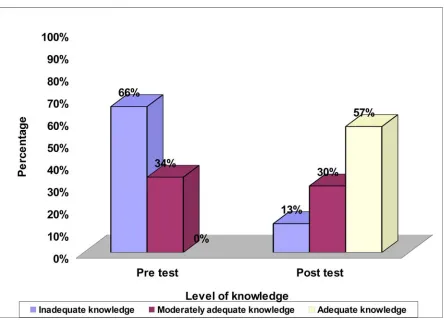
The findings of the study revealed that majority of tobacco users 66(66%)
had inadequate knowledge, 34(34%) had moderately adequate knowledge and
none of them had adequate knowledge regarding the ill effects of tobacco.
The findings of the study revealed that majority, 76(76%) had moderately
favorable attitude, 19(19%) had unfavorable attitude and 5(5%) had favorable
attitude.
Analysis of the post test level of knowledge of the tobacco users revealed
that, 13(13.0%) had inadequate knowledge, 30(30.0%) had moderately adequate
knowledge and 57(57%) had adequate knowledge regarding the ill effects of
tobacco.
Analysis of the post test level of attitude of the tobacco users revealed that,
3(3.0%) had unfavorable attitude, 27(27.0%) had moderately favourable attitude
and 70(70%) had favourable attitude regarding the ill effects of tobacco.
The fourth objective was to assess the effectiveness of public awareness
programme on knowledge and attitude regarding the ill effects of tobacco
When comparing the pre and post test level of knowledge regarding the ill effects
of tobacco, the pre-test mean score was 11.07 with S.D 2.96. The post test mean
score was 19.19 with S.D 3.34. The mean difference was 8.12 and the calculated‘t’
value was 56.489, which was statistically highly significant at P <0.05
level. This finding was suggestive of effectiveness of public awareness
programme.
When comparing the pre and post test level of attitude regarding the ill
effects of tobacco, the pre-test mean score was 29.07 with S.D 5.52. The post test
mean score was 39.81 with S.D 5.91. The mean difference was 10.74 and the
calculated ‘t’ value was 40.645, which was statistically highly significant at
P<0.001. This finding was suggestive of effectiveness of public awareness
programme.
Hence the null hypotheses
NH
1stated in the present study that
“there is no
significant difference in pre and post test level of knowledge and attitude
regarding the ill effects of tobacco use at p<0.05 level”
was
rejected
.
The fifth objective was to correlate the mean differed knowledge score
with attitude score regarding the ill effects of tobacco among tobacco users.
10.74 with S.D of 2.64. The calculated ‘r’ value was 0.126 at p<0.05, which
showed that there was a moderate positive correlation indicating that as knowledge
improves there was enhancement in favourable attitude also.
Hence the null hypotheses
NH2stated in the present study that
“there is no
significant relationship between the mean differed knowledge score with
attitude score regarding the ill effects of tobacco at p<0.05 level”
was
rejected
.
The sixth objective was to associate the mean differed knowledge and
attitude score with their selected demographic variables.
The study result revealed that none of the demographic variables had shown a
statistical significant association with the mean differed knowledge score and
attitude score regarding the ill effects of tobacco.
Hence the null hypotheses
NH
3stated in the present study that
“there is no
significant association between the mean differed knowledge score and
attitude scores and selected demographic variables at p<0.05 level”
was
CONTENTS
CHAPTER
TITLE
PAGE NO.
I
INTRODUCTION
1
Background of the study
1
Need for the study
4
Statement of the problem
7
Objectives of the study
7
Hypothesis
7
Operational Definitions
8
Limitations
9
Conceptual framework
II
REVIEW OF LITERATURE
12
Studies related to incidence of tobacco use
12
Studies related to ill – effects of tobacco use
15
Studies related to effectiveness on awareness
programme on ill effects of tobacco use
19
III
RESEARCH METHODOLOGY
23
Research Design
23
CHAPTER
TITLE
PAGE NO.
Population 25
Sample 25
Criteria for the sample selection
26
Study tool
26
Description of the study tool
27
IV
DATA ANALYSIS AND INTERPRETATION
33
V
DISCUSSION
53
VI
SUMMARY AND RECOMMENDATIONS
57
Summary of study
57
Implication for Nursing
58
Recommendation for further Research
61
REFERENCES
LIST OF TABLES
TABLE NO.
TITLE
PAGE NO.
1(a)
Frequency and percentage distribution of demographic
variables such as Age, gender, education, religion and
marital status of tobacco users.
35
1(b)
Frequency and percentage distribution of demographic
variables such as occupation, monthly income, family
type, family history of tobacco use and expenditure spent
for tobacco per day.
37
2
Percentage distribution of prevalence of tobacco users in
the selected village.
40
3(a)
Frequency and percentage distribution of factors
influencing tobacco use such as personal factors.
41
3(b)
Frequency and percentage distribution of factors
influencing tobacco use such as parental factors, socio
economic and cultural factors
42
4(a)
Frequency and percentage distribution of pretest level of
knowledge of the tobacco users regarding the ill effects
of tobacco.
TABLE NO.
TITLE
PAGE NO.
4(b)
Frequency and percentage distribution of post test level
of knowledge of the tobacco users regarding the ill
effects of tobacco.
45
5
Comparison of pre and post test level of knowledge and
attitude score regarding the ill effects of tobacco.
48
6
Correlation of mean differed knowledge score with
attitude score regarding the ill effects of tobacco.
50
7(a)
Association between mean differed knowledge score of
tobacco users and their selected demographic variable.
51
7(b)
Association between mean differed attitude score of
tobacco users and their selected demographic variable.
LIST OF FIGURES
FIGURE NO.
TITLE
PAGE NO.
1
Conceptual framework based on
Modified Von Bertalannfy’s General System Model24
2
Percentage distribution of demographic variables
such as quantity of tobacco use per day
37
3
Percentage distribution of overall pre and post test
level of knowledge of tobacco users regarding the
ill effects of tobacco.
46
4
Percentage distribution of pre and post test level of
attitude score of tobacco users regarding the ill
effects of tobacco
.
LIST OF APPENDICES
APPENDIX NO
TITLE
1
Letter seeking permission to conduct the study
2
Certificate for content validity
CHAPTER – 1
INTRODUCTION
BACKGROUND OF THE STUDY
Tobacco is a type of American leaves which contains nicotine. Tobacco may be consumed either by smoking (in the form of cigarettes, beedies, cigars, cheroots, chuttas, dhumti, pipe, hooklis, chillum and hookah) or other smokeless as chewed (as gutka, khaini, pan masala, mawa,snus etc.) and inhaled as snuff.
Tobacco is a complex mixture of chemicals such as nicotine, carbon monoxide, hydrogen cyanide, nitrogen oxides, formaldehyde, acroleine, benzene, phenol, poly aromatic hydrocarbons, N-nitrosamines, cadmium, ammonia, methanol, arsenic and acetic acid.
Many organic and inorganic chemicals such as hydrocarbons, aldehydes, ketones, phenol, cyanide, acrolein and nitrogen oxide contribute to smoke’s toxicity to respiratory system. The hydrogen cyanide may affect the respiratory system by its toxic effect on the cilia. At the same time, it may cross the placenta and have toxic effect on the growing fetus. In addition it may cause nerve damage in cigarette smokers with optic neuropathy.
Carbon monoxide in the smoke will combine with the hemoglobin thereby reducing the oxygen carrying capacity of the blood.
First hand smoking means direct inhalation of tobacco smoke. Second hand smoking means environmental tobacco smoke that is inhaled involuntarily or passively by someone who is not smoking. Third-hand smoke means, the particles and gases that is left over after a cigarette is burned. First hand smoke can cause all above mentioned health problems. Second hand smoking may lead to adverse health effects such as cancer, asthma and respiratory infections. There will be an increase in the risk of heart disease by 25-30% among non-smokers who are exposed to second hand smoke.
Tobacco consumption is one of the leading preventable causes of disease and death globally. Death due to tobacco use was around 6 million people each year globally, in which more than 600,000 people were exposed to second hand smoke. Smoking among men was highest in the WHO Western Pacific Region, in which 51% of men were aged 15 years and above and among women, smoking was highest in the WHO European Region (22%)
India is the second largest consumer of tobacco products in the world. Frequently tobacco used in India is in the form of smokeless tobacco and beedi. A daily cigarette smoker in India smokes an average of 6.2 cigarettes per day and a daily beedi smoker smokes 11.6 beedi per day.
An article stated that cancers due to tobacco use is highest among men from Kolkata and least in Mumbai. Among women it is highest in those from Chennai. sIt was estimated that all cancer in men due to tobacco use was nearly 44.4% in Kolkata, 41.4% in Chennai, 39.4% in Delhi and 39.2% in Mumbai. It was found that cancer among women was high in Chennai (15.2%).
The major ill effects of tobacco include cancer, especially lung cancer, kidney cancer, cancer of the larynx, head and neck, breast cancer, bladder cancer, cancer of the esophagus, cancer of the pancreas and stomach cancer. Other less common cancers are myeloid leukemia, squamous cell sinonasal cancer, liver cancer, colorectal cancer, cancer of gall bladder, adrenal gland and small intestine.
The Integrated Surveillance of Disease Report, Tamilnadu,2008 stated that daily smoking and smokeless tobacco use was more prevalent among the age group of 35-44 years(28.7% and 26.8%), illiterate people(31.8% and 59.2%) and also among agricultural workers(49.8% and 58.7%).
The above tobacco statistics shows that the people especially in the rural area need awareness regarding the ill-effects of tobacco.
NEED FOR THE STUDY
In the rural community the most common practice of tobacco abuse is smoking where in a substance commonly used tobacco is burned and the smoke is tasted or inhaled. It is primarily used as a form of recreational drug and also as a part of rituals. The most common method of smoking nowadays is through cigarettes, both industrially manufactured and hand rolled. Other less common forms are pipes, cigars, hookahs and bongs.
However mass media has been playing a wider role in communicating the ill effects of tobacco on a larger scale. Even then there seems to be not much change in the people who are smoking, this may be due to the lack of awareness in depth towards the use of tobacco. Therefore one to one community awareness programme may create an awareness related to the ill effects of tobacco among community people.
non smoker’s family (p<0.05). Cost analysis between smoker’s and non smoker’s family shows that there was a 3 fold difference in average annual expenditure and 8 fold difference in work days lost.
Kaushal M, et al., [2010], conducted a case-control study to analyze the role of tobacco exposure in breast cancer risk. They collected data from 117 breast cancer cases and 174 cancer free controls. Study result identified that betel quid chewing was the major risk factor for breast cancer among women with betel quid chewing. They had a 5 times the risk of developing breast cancer (4.78). The study results concluded that, betel quid chewing is a significant risk factor for breast cancer development.
Murukutla N, et al., [2011], conducted a household survey to evaluate the effectiveness of a national television and radio mass media campaign against use of smokeless tobacco among smokeless tobacco users(n=2898) in Newyork. Study results showed that around 63% of people were using only smokeless tobacco and 72% were dual users. Most of the people (>70%) were aware of the campaign and made them to stop the use. Study concluded that, campaign awareness was effective in improving the knowledge and building a negative attitude towards smokeless tobacco.
self help material. Study findings revealed that abstinence in the study group (12.5%) was significantly higher than the control group (6%) at 2 months. Study concluded that community based group intervention had the potential to increase the effectiveness of tobacco cessation services for men in rural areas of Tamilnadu.
The investigator had personal experience of working in oncology wards during his working period .Most of the cancer among men and women were caused by tobacco use. Based on the practical experience, the investigator had gone through many reviews related to ill effects of tobacco use. It was found that the most common problem due to tobacco use is chronic obstructive pulmonary disease. Previously it was believed that lung cancer is the only cancer occurs due to tobacco use. But now it was proved that tobacco use will cause all most all the cancers like lung, oral cavity, larynx, bladder etc. Other than cancer it will adversely affect all the systems in the body.
People are unaware of the ill effects of tobacco use and some are having adequate knowledge but they do not have a good attitude towards quitting tobacco use. So the investigator found it is worthful to educate people regarding ill effects of tobacco before they develop the adverse effects at their doorstep.
STATEMENT OF THE PROBLEM
A study to assess the effectiveness of public awareness programme on knowledge and attitude regarding the ill effects of tobacco among tobacco users at selected village, Vellore District.
OBJECTIVES
1. To assess the prevalence of tobacco users in the selected village. 2. To identify the factors influencing tobacco use among tobacco users.
3. To assess the pre and post test level of knowledge and attitude regarding the ill effects of tobacco among tobacco users.
4. To assess the effectiveness of public awareness programme on knowledge and attitude regarding the ill effects of tobacco among tobacco users.
5. To correlate the mean differed knowledge score with attitude score regarding the ill effects of tobacco among tobacco users.
6. To associate the mean differed knowledge and attitude score with their selected demographic variables
HYPOTHESES
NH1: There is no significant difference in pre and post test level of knowledge and attitude regarding the ill effects of tobacco at p<0.05 level.
NH2: There is no significant relationship of the mean differed knowledge score with attitude score regarding the ill effects of tobacco at p<0.05 level.
OPERATIONAL DEFINITIONS
EFFECTIVENESS
It refers to the outcome of public awareness programme on knowledge and attitude regarding the ill effects of tobacco which is assessed using structured questionnaire and 5 point Likert scale respectively.
PUBLIC AWARENESS PROGRAMME
It refers to a specific teaching programme structured by the investigator using multimedia and pamphlets to change the knowledge and attitude regarding the ill effects of tobacco among tobacco users.
x Knowledge- A power point presentation on general information regarding tobacco, ill effects of tobacco (physiological, psychological, social and cognitive problems) and its prevention and treatment methods.
x Attitude - A video show on ill effects of tobacco and ways to quit tobacco use.
KNOWLEDGE
It refers to the level of information possessed by the tobacco users regarding the ill effects of tobacco which was elicited by structured interview schedule.
ATTITUDE
EFFECTS OF TOBACCO
It refers to physiological, psychological, social and cognitive problems which arise from the use of tobacco products in the form of cigarette, beedies , gutka, khaini or inhaled form
TOBACCO USERS
It refers to people those who are using tobacco in the form of smoking, chewing or snuff as a habit.
ASSUMPTIONS
1. Tobacco users may have some knowledge and attitude regarding the ill effects of tobacco.
2. Public awareness programme may enhance their knowledge regarding the ill effects of tobacco and attitude to quit tobacco use.
LIMITATION
The study is limited to only those who are using tobacco in any forms.
The period of study upto 4 weeks only.
The conceptual framework is based on the modification made on Von Bertalannfy’s General System Theory
According to General System Theory, a system is a set of components or units interacting with each other within a boundary that facilitate the kind and the rate of flow of input and output to and from the system.
All the system is open in which there is a continuous exchange of matter, energy and information. Open system have varying interaction with environment from which the system rears input and give output and inflow of matter, energy and information.
Input is information needed by the system, also referred as imparting phase. In this study, the input is the pre test assessment of knowledge and attitude of tobacco users regarding the ill effects of tobacco and the factors influencing tobacco use. It includes the demographic variables like age, gender, religion, marital status, education, occupation, monthly income, family type, family history of tobacco use, onset of tobacco use, duration of tobacco use, expenditure spent for tobacco per day and quantity of tobacco use per day. The level of knowledge was assessed by structured questionnaire, attitude was assessed by 5 point Likert scale and factors influencing tobacco use was assessed by structured checklist.
prevention and treatment methods to improve the knowledge of the tobacco users, a video show on ill effects of tobacco use and ways to quit tobacco use to change the attitude and a pamphlet on overview of tobacco and its ill effects and ways to quit to reinforce their knowledge and attitude. The whole public awareness programme was given within a time duration of 15-20 minutes.
CHAPTER – 2
REVIEW OF LITERATURE
Literature review is an essential component for the researcher which helps the investigator to familiarize with pratical and theoretical issues relating to the problem area and helps the investigators to generate ideas and focus the research problem and its major affects. Review of literature is the process of reading, analyzing, evaluating and summarizing scholarly materials about a specific topic. Literature review assists the researchers to have an insight in the selection and development of the theoretical and methodological approaches of the problem.
The review of literature is arranged in the following section.
SECTION – A : STUDIES RELATED TO INCIDENCE OF TOBACCO USE
Doku D, et al., [2012] conducted a descriptive study to assess the exposure to tobacco promoting or restraining factors and their association with smoking among 13-18year old adolescents (n=1165). Prevalence rate of tobacco use, smoking and tawa use were 9.1%, 6.6% and 5.7% respectively. Study result revealed that attendance at a school where smoking were allowed, un awareness regarding the ill effects of tobacco use, exposure to tobacco advertisement and parental smoking were the promoting factors and knowledge about the ill effects of tobacco use and difficulty to quit were found to be the restraining factors.
had selected randomly in Burdan. Overall prevalence of tobacco use was 18.3% and 43.6% respectively. Prevalence of smoking was 14.9% and 40.7% respectively.
Quazi S. Zahiruddin, et al., [2011], conducted a cross-sectional study to find the incidence of tobacco use among adolescents (n=240) residing in six tribal villages in India. Incidence of tobacco use (all forms), smoking and smokeless were 54.45%, 23.145 and 53.41% respectively. Incidence rate was high among boys than girls (66.25% and 26%). Most common form of smoking tobacco was beedi and smokeless tobacco was pan masala and gutka. About 69% adolescents from the tribal area exposed to tobacco prevention messages.
Saddicha S, et al., [2010], conducted a descriptive study to assess the prevalence of tobacco use among young adult males (n=500) in Ranchi. Using systematic random sampling technique samples were selected and the data was collected by using structured questionnaire and monitoring urinary nicotine level. Results revealed a high prevalence of tobacco use among adult males (55.6%). Most commonly used form of tobacco was cigarette (78%) followed by khaini(20%) and gutkha(2%). Majority (77%) of tobacco users wanted to quit tobacco use.
Rao SR, et al., [2010], conducted a cross-sectional survey in Kancheepuram, Thiruvallur district, Tamil Nadu. The survey revealed that tobacco consumption was prevalent among 2993(60.7%) males and 841(15.1%) females. 46.9% of males were using smoking tobacco and 11.7% were using smokeless tobacco. Smokeless tobacco use was common among females (15.1%).
Glenn BA, et al., [2009], conducted a cross-sectional survey to assess the rate of smoking and smokeless tobacco use among South East Asians residing in USA. 344 South East Asians were selected using non random sampling method. Around one third (28%) were current users of smokeless tobacco products. Bangladeshis were using smokeless tobacco. Pakistanis (16%) were more using smoking tobacco (16%).
Mathur C, et al., [2008],conducted a cross-sectional study to assess the effect of socio-economic status on distribution of tobacco use. Samples were selected randomly from 32 schools in New Delhi and Chennai (n=11,642). They used mixed effect regression to compare the government school students and private school students. Prevalence rate of ever use of any tobacco products among government school children (18.9%) was higher than private students (12.2%). In these two large cities of India, students attending government school were using many forms of tobacco at a higher rate than private school students. The psychological risk profile suggests that government school children were more vulnerable to initiation and use of tobacco.
randomly and 15 in depth interviews and 5 focus group discussion were conducted. Study result revealed that the most common form of areca nut use was hans. The main reasons for areca nut use were found to be peer pressure, habituated due to boredom; family problem etc. study result concluded that most of the rural people were not getting enough education regarding areca nut products and its ill effects.
SECTION – B : STUDIES RELATED TO ILL-EFFECTS OF TOBACCO USE
Bracci PM, et al., [2012], conducted a case-control study to identify the association between adenocarcinoma in situ (AIS) of lung and smoking among 338 AIS patients and frequency -matched controls from the parent study (cases = 6039, controls = 2073) in California. Risk of AIS was associated with ever smoking (2.7, 95%CI), increased to 20%-30% for each 10 year and decreased with increased year since quitting (p>0.0001).
Braisch, et al., [2012], conducted a prospective study to estimate the risk of developing tobacco related subsequent primary cancer (TRSPC) in person with a tobacco related first primary cancer (TRFPC) in Bavaria, Germany. They analyzed TRFPC and TRSPC diagnosed in Bavaria between 2002-2008. They diagnosed 121631 TRFPC in men and 75,886 in women. Among this 2.5% of male and 1.2% of female were developed at least one TRSPC. There was a higher incidence of cancer in mouth, pharynx, larynx, esophagus and lung among smoker compared to general population.
women in Serbia. 497 samples were selected from the age group of 40-56 years, who live in an area with identical outdoor air pollution. Results identified congested nose (OR=3.45, 95%CI=1.38-9.01), nasal secretion (OR=3.40, 95%CI=1.38-9.02) and sinusitis (OR=2.88, 95%CI=1.22-6.89) was significantly higher in women who were exposed to environmental tobacco smoke. Passive smoking was found to be a risk factor for respiratory symptom and illness in women that leads to absence from works.
Sujatha D, et al., [2012], conducted a descriptive study to assess the incidence of oral premalignant and malignant lesions among tobacco users (n=1028) in Bangalore. Data was collected by using structured questionnaire and clinical examination. High prevalence of oral lesions was found among males (87.9%). Commonest form of tobacco use was smoking (39.2%) and smokeless tobacco (28.1%) and the most common mucosal change was leukoplakia (14%).
Underwood JM, et al., [2012],conducted a descriptive study to assess the relative risk of developing tobacco related malignancy among cervical cancer survivors. Study result identified that the increased risk of subsequent tobacco related malignancies among cervical cancer survivors was greatest in the first five years after the initial diagnosis. Women with cervical cancer had two fold increased risk of subsequent tobacco related malignancies compared with breast and colorectal cancer survivors (SIR=1.1 for both).
disease for current smoker vs non smoker was significant in women (HR=1.94) and men (HR=1.54). Hazardous ratio for fatal cardiovascular disease among current smokers vs non smokers was significant in women (HR=1.64) but not in men.
Kaushal M, et al., [2010] conducted a case-control study to analyze the role of tobacco exposure in developing breast caner. Data was collected from 117 breast cancer cases and 174 cancer free controls. Multi factor dimensionality reduction analysis was done and it was identified that, betel quid chewing as the single main risk factor and women(4.78) with history of betel quid chewing had 5 times risk of developing breast cancer.
Siatkowska H, et al., [2010],conducted a prevalence study on patients (n=1026) in a health care centre, Poland to determine the prevalence of smoking and the relation between chronic tobacco smoking, clinical symptoms, lung function test and concurrent diseases. Findings of the study revealed that there was correlation between smoking habit and dyspnoea, wheezing were confirmed and lung function decreases with increasing number of pack per year.
0.05) and urinary cotinine level was highest among the age group of 19-24 years. Study concluded that environmental tobacco smoke is as harmful as first hand smoke.
Winkelstein ML, [2010], conducted a descriptive study to determine the effect of passive smoke exposure and the modification they have made in smoking behavior towards smoke exposure in children with asthma in Baltimore, USA. Parents were given questionnaire to evaluate their smoking behavior and modification they made and also urine specimens were collected from children to measure cotinine / creatinine ratio. Children from home with smoker parents had higher mean cotinine /creatinine ratio than from smoke free home (30ng/mg Vs 4ng/mg, p=0.005). This level increased with the number of smokers in the home.
Pavlovska I, et al., [2009], conducted a case- control study to determine the existence of a casual relationship between cigarette smoking and lung cancer in Macedonia. Study consisted of both investigated group (n=91) and control group (n=91). Study result revealed that cigarette smoking is wide spread among men (68%) with cancer than the control group (40.3%). Smokers (4.55%) were at high risk of developing lung cancer than the non smokers. Study concluded that cessation of smoking appears to be important priority in prevention of lung cancer.
identified a strong association between second hand smoke and sensory and respiratory symptoms.
Sur D, et al., [2007], conducted a descriptive study to assess the impact of smoking on health with economic implication among 3000 families, who were selected randomly in Kolkata. Study result revealed that there was a significant difference in the disease pattern between smoker’s and non smoker’s family in case of chronic obstructive pulmonary disease, coronary artery disease, acute respiratory infection, common cold, hypertension and peptic ulcer(p<0.05). Annual expenditure was 3 fold greater in smoker’s family and there were 8 fold differences in work days lost.
SECTION -C : STUDIES RELATED TO EFFECTIVENESS OF AWARENESS
PROGRAMME ON ILL EFFECTS OF TOBACCO USE.
Surani, et al., [2011], conducted an experimental study to assess the effectiveness of AntE Tobacco project on baseline knowledge among school children in USA. A structured questionnaire was administered which was followed by an educational cartoon video depicting the ill-effect of tobacco. Immediately, and 6 weeks later they have administered the same questionnaire. Majority of children (82%) answered correctly immediately after the programme and 83% of children answered correctly at the follow up. Study concluded that a multimedia educational program can be used to educate and reinforce anti tobacco messages.
Murukutla N, et al., [2011], conducted a household survey to evaluate the effectiveness of a national television and radio mass media campaign against use of smokeless tobacco among the smokeless tobacco users(n=2898) in Newyork. Study results identified that majority of the people (63%) were using only smokeless tobacco and 72% were dual users. Most of the people (>70%) were aware of the campaign and made them to quit tobacco. Study concluded that campaign awareness was effective in improving knowledge and building a negative attitude towards smokeless tobacco.
Sorensen G, et al., [2011], conducted a quasi-experimental study to assess the effectiveness of school based life skill tobacco control program for youth of low socio-economic status in Mumbai. Samples (n=1851) were selected from 8th
and 9th grade school children by using non-probability method and divided into study and control group. The program consisted of activities focused on building awareness about the hazardous of tobacco, developing life skills and advocacy development. Study finding concluded that 4.1% of 8th
grade and 3.6% of 9th
using tobacco at least once in last 30 days, compared to 8.7% of students of control group. Study group were also significantly more knowledgeable about tobacco and related legislation.
Mishra GA, et al., [2009], conducted a pre experimental study to assess the knowledge, attitude and practice regarding tobacco consumption among the employees (N=104) in a chemical industry in Ratnagiri district. Intervention was given in the form of lectures, focus group discussion and one to one counseling. Study findings concluded that 48.08% of employees were using tobacco and had a poor knowledge regarding ill effects of tobacco use. It was found that peer pressure, pleasure and unawareness were the major causes for initiation of tobacco use.
Burchfield J, et al., [2007], conducted an experimental study to assess the effectiveness of anti smoking project in rural community school in USA. Purpose of the study was to discourage tobacco use among youth by focusing on tobacco short term ill effects. Results of the study revealed that 80% of students answered correctly. Study concluded that, anti smoking programme can influence to stop using tobacco.
CHAPTER – 3
RESEARCH METHODOLOGY
This study was designed to determine the effectiveness of public awareness programme on knowledge and attitude regarding the ill effects of tobacco among tobacco users at selected village , Vellore district.
RESEARCH APPROACH
Research approach is the most significant point of any research. The appropriate choice of the research approach depends on the purpose of the study undertaken the goal is to assess or evaluate the success of the programme. An experimental research is generally applied where the primary objective is to determine the extent to which a gives procedure meets the demand results. In this study the researcher wants to assess the effectiveness of public awareness programme on knowledge and attitude regarding the ill effects of tobacco among tobacco users an evaluative approach was used for this study.
RESEARCH DESIGN
A pre experimental one group pretest and post test was used for this study.
Management of Dependent variable
Manipulation of Independent variable
Measurement of dependent variable Experimental group O1 X O2
O - Observation or Measurement O1 – Pre test
RESEARCH METHODOLOGY
\
SETTING
Research Design
A Pre experimental study
Target population – People who
are using tobacco in any forms
Accessible population- Tobacco
users at poigai village who
fulfills the sample criteria
Sampling
technique-
convenient
sampling
Sample size -100
Pre test on knowledge and attitude
on ill effects of tobacco
Public awareness programme
Post test
The study was conducted at Poigai village which is having a total population of 1700. The population under study belongs to the Poigai is situated at the distance of 12 kms away from Arun college of nursing, vellore.
POPULATION
The target population of this study were all the people those who are using tobacco in any forms.
ACCESSIBLE POPULATION
The accessible population is the list of population that the investigator finds in the study area. The accessible population in the study were all the tobacco users at Poigai Village, who fulfills the sample criteria.
SAMPLE
The sample consists of 100 tobacco users at poigai village, who fulfills the sample selection criteria.
SAMPLING TECHNIQUE
100 tobacco users were selected conveniently for the study based on the inclusion and exclusion criteria.
SAMPLING CRITERIA
Inclusion criteria
1) Person those who are using tobacco of any forms. 2) Person those who are understand tamil or English. Exclusion criteria
1) Person those who are not willing to participate
2) Person those who are not available during data collection period. 3) Person those who are having sensory impairment.
4) Person those who underwent any special tobacco cessation programme.
SELECTION AND DEVELOPMENT OF TOOL
Based on the review of literature and experts opinion and with the investigator’s personal and professional experience, a structured questionnaire was developed to assess the knowledge a 5 point likert scale to assess the attitude and a checklist to assess the factors influencing the tobacco use.
DESCRIPTION OF THE TOOL
Part II: Intervention protocol
PART I : This part consisted of 5 sections SECTION A : Tobacco users survey form
The investigator utilized the survey form which consisted of general information regarding the village, family details and demographic variables like age, gender, education, occupation, age of onset of tobacco use, type of tobacco using, number of tobacco use per day, an ill effects and attempts to quit tobacco to identify the total number of population using tobacco of any forms.
SECTION B: Personal data sheet
Personal data sheet to collect the demographic characteristics consisting of 12 variables. This included the age in years, gender, education, religion, marital status, type of occupation, monthly income, family type, family history of tobacco use, onset of tobacco use, expenditure spent for tobacco per day and quantity of tobacco use per day.
SECTION C: Structured knowledge questionnaire
In the structured questionnaire, 25 questions were formulated under separate sub headings to assess the level of knowledge regarding the ill effects of tobacco among tobacco users.
Items No. of
Scoring Key:
Each item was a closed ended multiple choice questions with a single correct answer. Scoring for each correct answer was “1” and for the wrong answer and unattended question were “0”. Total score was “25”. Maximum score was 25 and minimum score was 0. The raw score was converted to percentage to interpret the level of knowledge.
Score Level of Knowledge < 50% Inadequate knowledge
51-75% Moderately adequate knowledge >75% Adequate knowledge
SECTION D: Structured check list
A structured check list to identify the factors influencing the tobacco use. The factors included were personal factors, parental/ familial factors, socio economic and cultural factors. Personal factors consisted of 6 items, parental factors consisted of 3 items and socio economic and cultural factors consisted of 6 items. Each item had a yes or no option. Frequency and percentage distribution of the responses were calculated to interpret the factors influencing tobacco use.
SECTION E: 5 point Likert scale
A 5 point Likert scale to assess the level of attitude regarding the ill effects of tobacco and willingness to quit tobacco.
Scoring Key:
Negative items: 1, 2,3,4,5
Maximum score was 50 and minimum score was 10. The raw score was converted to percentage to interpret the level of attitude.
Score Level of Practice
< 50% Unfavorable attitude
51-75% Moderately favourable attitude > 75% Favourable attitude
PART B:INTERVENTION PROTOCOL
Intervention protocol consisted of a public awareness programme, which was a specific teaching programme structured by the investigator using multimedia to change the knowledge and attitude regarding the ill effects of tobacco among tobacco users and was administered once after pre test for a time duration of 15-20 minutes.
x Knowledge- A power point presentation on general information regarding tobacco, ill effects of tobacco (physiological, psychological, social and cognitive problems) and its prevention and treatment methods.
x Attitude - A video show on ill effects of tobacco and ways to quit tobacco use.
VALIDITY
validity. Content validity of the tools was obtained from the experts from outside and also from experts of the concerned department in the college.
RELIABLITY
The reliability of the instrument was established by test pretest method. There was a high positive correlation ( r = 0.8 ) between test pretest method.
PILOT STUDY
The pilot study was conducted during the month of june for a period of one week. The investigator selected 10 tobacco users using non probability convenient sampling method, who fulfilled the sample selection criteria. The investigator gave a brief self introduction and explained about the purpose of the study. Informed consent was obtained from each sample. The samples were gathered in a well ventilated common place in the village and a structured questionnaire was administered which consisted of 25 multiple choice questions to assess the existing level of knowledge regarding the ill effects of tobacco, followed that a 5 point Likert scale to assess the level of attitude and a check list to assess the factors influencing tobacco use was done. Each participant took around 15-20 minutes to answer all the questions and followed by the pre test assessment, public awareness programme regarding the ill effects of tobacco with the help of power point presentation, video show and a pamphlet was given. After 7 days post test level of knowledge and attitude was assessed using the same structured questionnaire and 5 point Likert scale.
DATA COLLECTION PROCEDURE
The official permission was obtained from the chairperson of the ethical committee chairman nursing education to conduct the study. The period of data collection extended from the month of june 01-06-2015 to 30-06-2015 ( 4 weeks).
During data collection period, the first one week, tobacco users survey was conducted with the help of Research Assistants (B.Sc. Nursing students) to find out the total number of people using tobacco at Poigai village. Total number of tobacco users during the time of data collection was 223; among them the researcher selected 100 samples who satisfied the sample selection criteria using non probability convenient sampling method. A brief self introduction and detailed explanation regarding the purpose of the study was given to the subjects. The researcher obtained informed consent from the subjects and they were reassured regarding confidentiality.
Descriptive statistics
1. Frequency and percentage distribution to analyze the demographic variables and factors influencing tobacco use
2. Mean and standard deviation to assess the level of knowledge and attitude regarding the ill effects of tobacco.
Inferential Statistics
1. ‘t ‘test to compare the pre and post test level of knowledge and attitude regarding the ill effects of tobacco.
2. Correlation coefficient to find out the relation between knowledge and attitude regarding the ill effects of tobacco.
CHAPTER – 4
DATA ANALYSIS AND INTERPRETATION
This chapter deals with analysis and interpretation of the data collected from 100 adults having the habit of tobacco use. The data was organized, tabulated and analyzed according to the objectives. The findings based on the descriptive and inferential statistical analysis, presented under the following sections
SECTION: A
Description of the demographic variables of the tobacco users.
Assessment of prevalence of tobacco users at selected village.
Assessment of factors influencing tobacco use.
Assessment of pre and post test level of knowledge and attitude score regarding the ill effects of tobacco among tobacco users
SECTION: B
Comparison of pre and post test level of knowledge and attitude score regarding the ill effects of tobacco among tobacco users.
SECTION: C
SECTION A
Table – 1(a) : Frequency and percentage distribution of demographic variables such as age, gender, education, religion and marital
status of tobacco users.
N=100 Demographic variables No. % Age in years
17-27 8 8
28-38 21 21
39-49 27 27
50 and above 44 44
Gender
Male 88 88
Female 12 12
Education
No formal education 34 34
Primary education 59 59
Higher secondary education 7 7
Diploma 0 0
Graduate and above 0 0
Religion
Hindu 97 97
Christian 3 3
Muslim 0 0
Others 0 0
Marital status
Married 77 77
Unmarried 11 11
Widow 12 12
Separated 0 0
Table -1(a) Shows that frequency and percentage distribution of demographic variables like age, gender, education, religion and marital status of tobacco users.
[image:54.612.102.538.174.539.2]Table 1- (b): Frequency and percentage distribution of demographic variables such as occupation, monthly income, family type, family history of tobacco use and
expenditure spent for tobacco per day.
N = 100
Demographic variables No. %
Occupation
Skilled 37 37
Semi skilled 36 36
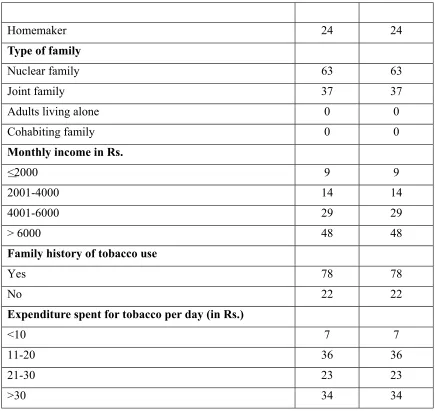
[image:55.612.98.539.612.722.2]Homemaker 24 24 Type of family
Nuclear family 63 63
Joint family 37 37
Adults living alone 0 0
Cohabiting family 0 0
Monthly income in Rs.
<2000 9 9
2001-4000 14 14
4001-6000 29 29
> 6000 48 48
Family history of tobacco use
Yes 78 78
No 22 22
Expenditure spent for tobacco per day (in Rs.)
<10 7 7
11-20 36 36
21-30 23 23
>30 34 34
Table-1(b) depicts frequency and percentage distribution of demographic variables such as occupation, monthly income, type of family, family history of tobacco use, expenditure spent for tobacco per day and quantity of tobacco per day.
[image:56.612.101.536.70.481.2]Figure 2. Percentage Distribution of Demographic Variables Such As Quantity Of
Tobacco Per Day
Figure 1depicts the percentage distribution of quantity of tobacco use per day. With regard to quantity of tobacco use per day majority 42(42%) were using tobacco more than 8 times a day.
Table – 2 : Percentage distribution of prevalence of tobacco users at selected village.
Total population=1700 Tobacco
use
No
Gender Types of
tobacco
Gender
Total
Male Female Male Female
No % No % No %
Prevalence 223
No % No %
Smoking 19
3
100 0 0
19 3 86. 5 Chewing 51 65. 3 27 34. 7 78 34. 9
Snuff 19 79 5 21 24
[image:58.612.102.567.326.591.2]10. 7 19 1 85. 6 32 14. 4 Non prevalence 122 1
were smokers, 78(34.9%) of people were using chewing type of tobacco and 24(10.7%) were using snuff. All forms of tobacco use like smoking, chewing and snuff were more prevalent among males (100%, 65% and 79% respectively).
The findings revealed that smoking type of tobacco use is more prevalent in the selected setting which was followed by chewing type of tobacco and all forms of tobacco use were more prevalent among males.
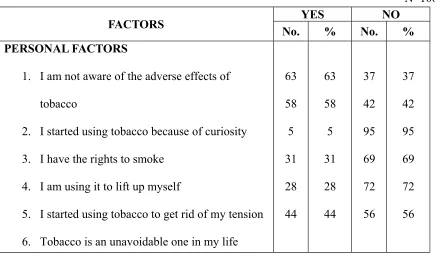
Table no -3(a) : Frequency and percentage distribution of factors influencing tobacco use such as personal factors.
N=100
FACTORS YES NO
No. % No. %
PERSONAL FACTORS
1. I am not aware of the adverse effects of tobacco
2. I started using tobacco because of curiosity 3. I have the rights to smoke
4. I am using it to lift up myself
5. I started using tobacco to get rid of my tension 6. Tobacco is an unavoidable one in my life
63 58 5 31 28 44 63 58 5 31 28 44 37 42 95 69 72 56 37 42 95 69 72 56
[image:59.612.102.537.332.589.2]tobacco to lift up themselves, 72(72%) were not started using tobacco to get rid of tension and 56(56%) was not considering tobacco as an unavoidable thing in their life.
The researcher found lack of awareness regarding the ill effects of tobacco was a major personal factor which influenced the tobacco use which was followed by curiosity. So the findings provide the baseline foundation for conducting the study.
Table-3 (b): Frequency and percentage distribution of factors influencing tobacco use such as parental factors, socio economic and cultural factors.
N=100
FACTORS Yes No
No % No %
FACTORS PARENTAL/ FAMILIAL FACTORS 1. Using it. My parents are
2. My family members are not asking about my tobacco use.
3. I am using tobacco as a revenge to my family or because of lack of care and support from my family
78 33 0 78 33 0 22 67 100 22 67 100
SOCIO-ECONOMIC AND CULTURAL FACTORS 1. My friends are encouraging me to smoke always. 2. I am getting enough money from job to spend for
tobacco.
3. Watching advertisement in medias attracted me. 4. I am using tobacco to cope up with my job workload
[image:60.612.103.546.367.717.2]6. In my culture, tobacco is considering as a acceptable
social habits. 0 0 100 100
Table- 3(b) shows the frequency and percentage distribution of factors influencing tobacco use. With respect to parental factor 78(78%) had a family history of tobacco use, 67(67%) experienced that their family members were asking about tobacco use and none of them were using tobacco as a revenge to their family.
With respect to socio-economic and cultural factors, 56(56%) were encouraged by friends to use tobacco, 89(89%) were not spending money for tobacco because they are getting enough money from job, 94(94%) were not attracted by any tobacco advertisement, 72(72%) were not using tobacco with a purpose to cope up with job workload, 93(93%) were not using tobacco because it is easily available and none of them consider it as an accepted behavior in their culture.
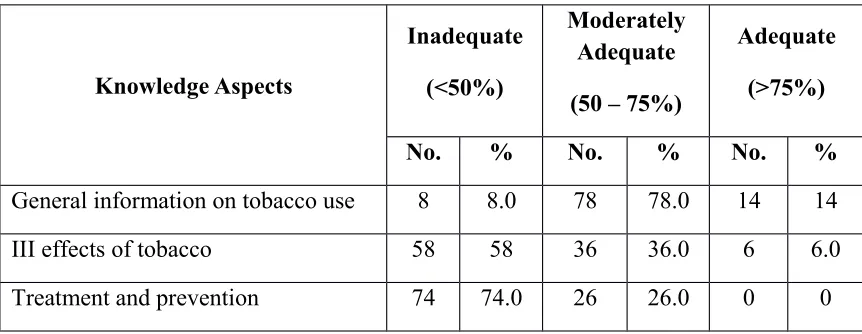
Table - 4(a) : Frequency and percentage distribution of pretest level of knowledge of the tobacco users regarding the ill effects of tobacco.
N= 100
Knowledge Aspects
Inadequate
(<50%)
Moderately Adequate
(50 – 75%)
Adequate
(>75%)
No. % No. % No. %
General information on tobacco use 8 8.0 78 78.0 14 14
III effects of tobacco 58 58 36 36.0 6 6.0
Treatment and prevention 74 74.0 26 26.0 0 0
Table- 4(a) reveals the frequency and percentage distribution of pretest level of knowledge of tobacco users regarding the ill effects of tobacco.
[image:62.612.108.539.362.529.2]The researcher found that majority of the people was unaware about the ill effects of tobacco which was supported by the factor influencing tobacco use. Researcher found it is important to give education regarding the ill effects of tobacco.
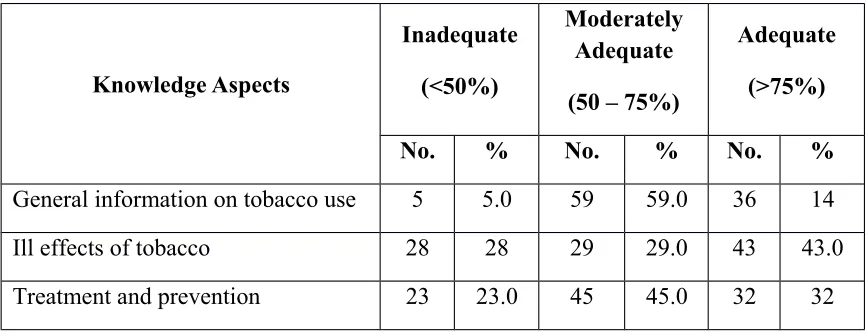
Table –4(b) : Frequency and percentage distribution of posttest level of knowledge of the tobacco users regarding the ill effects of tobacco.
N=100
Knowledge Aspects
Inadequate
(<50%)
Moderately Adequate
(50 – 75%)
Adequate
(>75%)
No. % No. % No. %
General information on tobacco use 5 5.0 59 59.0 36 14
Ill effects of tobacco 28 28 29 29.0 43 43.0
Treatment and prevention 23 23.0 45 45.0 32 32
Table- 4(b) shows the frequency and percentage distribution of post test level of knowledge of tobacco users regarding the ill effects of tobacco.
[image:63.612.106.540.280.447.2]Analysis of the post test level of knowledge of tobacco users revealed that individualized public awareness programme can enhance the knowledge of the tobacco users which may help them to quit tobacco use.
Figure -3: Percentage distribution of overall pre and post test level of knowledge of tobacco users regarding the ill effects of tobacco.
Figure 3 shows the percentage distribution of overall pre and post test level of knowledge of tobacco users regarding the ill effects of tobacco.
but only 30% had moderately adequate knowledge in the post test and none of them had adequate knowledge in the pre test but 57% had adequate knowledge in the post test
[image:65.612.108.573.198.515.2]Researcher found that the individualized public awareness programme had a noticeable effect on knowledge of the tobacco users regarding the ill effects of tobacco.
Figure 4: Percentage distribution of pre and post test level of attitude score of tobacco users regarding the ill effects of tobacco.
Fig 4 shows the percentage distribution of pre and post test level of attitude score of tobacco users regarding the ill effects of tobacco.
attitude respectively. However in the post test 70(70%) had favorable attitude, 27(27%) had moderately favorable attitude and only 3(3%) had unfavorable attitude.
Study result suggested that public awareness programme was very effective in changing the attitude of the tobacco users in a positive way Reinforcement towards the same will help them to quit the tobacco use.
[image:66.612.111.538.306.367.2]SECTION B
Table - 5 : Comparison of pre and post test level of knowledge and attitude score regarding the ill effects of tobacco.
N=100
***p<0.001, S - Significant
Table -5 shows the comparison of pre and post test level of knowledge and attitude score regarding the ill effects of tobacco.
When comparing the pre and post test level of knowledge regarding the ill effects of tobacco, the pre-test mean knowledge score was 11.07 with S.D 2.96. The post test mean knowledge score was 19.19 with S.D 3.34. The mean difference was 8.12 and the calculated‘t’ value was 56.489, which was statistically highly significant at p < 0.001 level. This finding was suggestive of effectiveness of public awareness programme.
When comparing the pre and post test level of attitude regarding ill-effects of tobacco, the pre-test mean attitude score was 29.07 with S.D 5.52. The post test mean
PRE TEST POST TEST MD ‘t’ value
Mean S.D Mean S.D
calculated ‘t’ value was 40.645, which was statistically highly significant at P < 0.001 level. This finding was suggestive of effectiveness of public awareness programme.
Table -6: Correlation of mean differed knowledge score with attitude score
regarding the ill effects of tobacco.
N=100
Variables Mean S.D ‘r’ value
Knowledge 8.12 1.44 r = 0.126*
p= 0.05
Attitude 10.74 2.64
*p<0.05, S – Significant
Table- 6 shows the correlation of mean differed level of knowledge with attitude score regarding the ill effects of tobacco.
SECTION C
Table – 7(a) : Association between mean differed knowledge score regarding the ill effects of tobacco among tobacco users and their selected demographic variable.
N = 100
Demographic Variables Pretest Posttest Mean
Difference ANOVA
Age in years No % No % No %
17-27 13.1
2
1.73 21.5 0
1.69 8.37 1.41
F=0.273 NS 28-38 12.6 7 2.15 20.9 5
2.33 8.28 1.35
39-49 11.6
3
2.96 19.7 4
3.12 8.11 1.37
50 and above 9.59 2.79 17.5 9
3.38 8.00 1.55 Gender t=1.115 NS Male 11.4 3 2.73 19.6 2
2.99 8.19 1.37
Female 7.80 3.08 15.3
0
3.94 7.50 1.90
Education F= 0.633
NS No formal education 8.91 2.79 16.8
5
3.52 7.94 1.39
Primary education 11.7 6
2.16 20.0 2
2.38 8.25 1.50
[image:69.612.89.534.222.723.2]1 7
Diploma - - -
-Graduate and above - - -
-*p=<0.05,S- Significant, NS- Not Significant
Table - 7(a) shows that there was no statistically significant association between the mean differed knowledge score and any of the selected demographic variables.
Table – 7(b) : Association between mean differed attitude score regarding the ill effects of tobacco among tobacco users and their selected demographic variable.
N = 100
Demographic Variables Pretest Posttest
Mean
Difference ANOVA
Age in years No % No % No %
17-27 29.62 3.9
9 41.3 7 3.5 0 11.7 5 1.28 F=1.980 NS
28-38 31.86 5.0
8 42.5 7 5.3 8 10.7 5 2.30
39-49 29.44 5.5
9 40.9 2 5.4 9 11.4 8 2.50
50 and above 27.41 5.4
6 37.5 2 6.0 2 10.1 1 2.93 Gender
t = 0.960 NS
Male 29.50 5.6
1 40.3 5 5.8 5 10.8 5 2.49
Female 25.20 2.2
0 34.9 0 3.9 0 9.70 3.71
Education F= 2.956
[image:70.612.90.522.71.146.2] [image:70.612.89.539.245.725.2]Primary education 29.97 4.9 4
40.9 1
4.5 8
10.9 5
2.52
Higher secondary education 34.86 2.2 7
47.2 8
0.9 5
12.4 3
1.72
Diploma - - -
-Graduate and above - - -
-*p<0.05, S – Significant, NS – Not Significant
[image:71.612.89.521.70.199.2]CHAPTER – 5
DISCUSSION
This chapter discusses in detail about the finding of the analysis in relation to the objectives of the study. The following were the objectives of the study and further discussion will exemplify how these objectives were satisfied by the study.
OBJECTIVE OF THE STUDY
The first objective was to assess the prevalence of tobacco users in the selected village.
The findings of the study revealed that out of the total population of the village (1444) around 223(15.5%) people were using one or more types of tobacco products. Among them 191(85.6%) were males and 32(14.4%) were females. Among the total tobacco users, 193(86.5%) were smokers, 78(34.9%) of people were using chewing type of tobacco and 24(10.7%) were using snuff. All forms of tobacco use like smoking, chewing and snuff were more prevalent among males (100%, 65% and 79% respectively).
The second objective was to identify the factors influencing tobacco use.
With respect to parental factor, 78(78%) had a family history of tobacco use, 67(67%) experienced that their family members were asking about tobacco use and none of them were using tobacco as a revenge to their family.
With respect to socio-economic and cultural factors, 56(56%) were encouraged by friends to use tobacco, 89(89%) were not spending money for tobacco because they are getting enough money from job, 94(94%) were not attracted by any tobacco adve